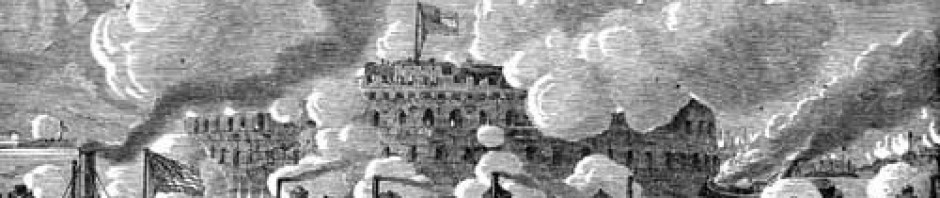
We seem to like anniversaries, counting the years with our trusty calendars. I’m pretty sure I was vainly proud to graduate from school the year of the United States bicentennial, and I know I was very enthusiastic about the Civil War sesquicentennial. 150 years ago Americans began to celebrate the U.S. centennial with commemorations at Lexington-Concord and Bunker Hill. 1875 also marked 50 years since the “Wedding of the Waters,” the official opening of the Erie Canal, but people weren’t exactly celebrating. In 1875 the New York State canal system was an example of public-private corruption. Harper’s Weekly covered New York Governor Samuel Tilden’s initiative to end the ongoing “Canal Ring” fraud. From the August 28, 1875 issue of Harper’s Weekly (page 694):
THE NEW YORK CANAL FRAUDS.
THE first report of the commission of investigation into the New York canal frauds is devoted to a thorough examination of the noted DENISON contract, and sets forth in the plainest way the elaborate and ingenious system of swindling practiced by the Canal Ring. The commission has evidently been diligent and intelligent. It has sought the truth sagaciously, and has found it. The DENISON contractors, leading members of the Canal Ring, which the report states appears to be the only permanent political power in the State, influencing and controlling the State officers, have appealed to the courts not to be forced to testify, and Judge LEARNED has decided in their favor. He says that the law which authorizes the commission “to issue subpoenas requiring the attendance of witnesses and the production of books and papers,” and even to bring witnesses before it by force, does not empower it to compel them to testify. The learned judge rules that the Legislature has given the commission every power but that which is indispensable, and he has thus invited those who know the essential facts and are interested to conceal them to say nothing. The commission has, of course, appealed, and, pending the decision of the higher court, it reports what it has already ascertained.
The report itself must be read to understand how in the work upon the canals every requirement of law is perverted or evaded, and how thousands of dollars are stolen from the State Treasury by means of official falsehood. If the reader should be depressed by the reflection that so important a branch of the public business is corrupt, he may be consoled by two other reflections — one, that it ought not to be the public business, for the government ought neither to own nor to manage the canals; and the other, that if the corruption is deep and systematic, the honest purpose and intelligence to expose and abolish it are not less evident. It will help the reader to some apprehension of the system and of the amount of the frauds if we state that the DENISON contract covered a space of canal repairs less than eight miles in length, and that DENISON agreed to do the work for $74,183.40, and that when it was about two thirds done he had received $491,260. This enormous sum was made up by false measurement and computation; by charging the State twice for work not done, as by pretending to make excavations that were never made, and putting back the same rock and earth as embankment, although they had not been disturbed. Fully one third of the whole amount paid by the State upon this contract, $150,337 02, is for work which has not been done. It is a sheer theft from the Treasury. The surveys, maps, and estimates which the law requires were never made. The Canal Commissioners certified that they had seen maps and plans and estimates which did not exist. The Canal Board resolved that these imaginary documents should be adopted. The contract was advertised and let without any authority having the knowledge of the work and the materials which the law requires. A large percentage of the money paid upon the contract was paid with a full knowledge that the work had not been done. Not a single yard of the work done corresponds to the specifications. No assistant has been removed or rebuked for making false measurements and estimates, or for accepting dishonest work. Yet had the laws of the State and the regulations of the Canal Board been enforced, the work could have been already done for the sum originally appropriated. The commission concludes that the false and fraudulent measures, estimates, and allowances were only possible through the culpable neglect or connivance of the Canal Commissioners, O. BASCOM and JOHN D. FAY, the engineers, and the inspectors in charge.
no “mere political trick”
All good citizens are indebted to the gentlemen of the commission for their fidelity and efficiency in investigating and exposing these frauds, and to Governor TILDEN for calling the attention of the Legislature and of the State to them, for recommending the inquiry, and for instructing the Attorney General to bring suit, which he has done. Orders of arrest have been issued, with the bail fixed at $200,000. Those who say that the Governor’s action is a mere political trick, and that he means nothing, evidently forget that they are speaking of the man who, when he once took hold of the TWEED prosecution, joined in pushing it relentlessly to the end. The war upon the Canal Ring is not a party question, and only the merest party spirit would decry it. What ever honest men may think of the character and tendencies of parties, they are agreed upon the necessity of punishing corruption. The accomplices in the canal frauds are men of all parties, for it is only by such a union that the system is made permanent. And if either party gains an advantage when in power by vigorously prosecuting and punishing evil-doers and by promoting public honesty, it will not be deplored by any honorable adversary, who will gladly see that it will compel his own party to be even more vigilant in the same direction. When party contests have become only competitions for honest and economical administration, we shall be approaching the millennium.
Which millennium is that?
Governor Samuel Tilden made taking on the “Canal Ring” one of his administration’s major projects. Harper’s Weekly published a lot of information about the Canal Ring throughout 1875. In its April 17, 1875 issue the newspaper questioned whether the state should even be in the business of running the canals. The governor said he was not planning on selling the canals, just cleaning up the abuses. The newspaper’s November 13, 1875 Supplement explained how the Canal Ring worked – contractors undercut other bidders for a canal project, then the state legislature would direct the canal board to increase the prices paid to the contractors. Civil War veteran and New York State Attorney General (January 1, 1872 – December 31, 1873) Francis C. Barlow courageously confronted the Canal Ring. Barlow also prosecuted the Boss Tweed Ring.
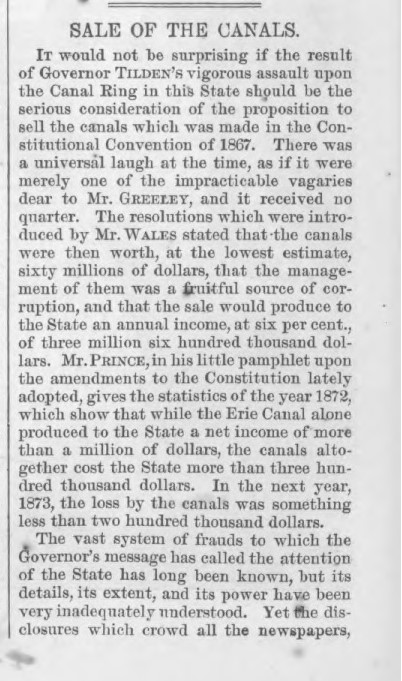
HW 4-17-1875 -sell the canals?
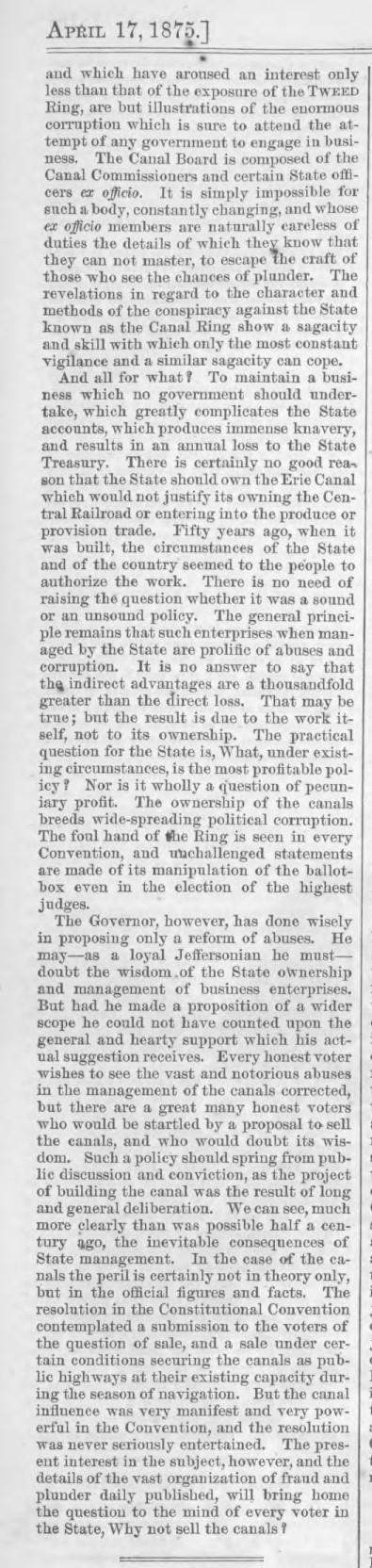
HW 4-17-1875 state ownership: “prolific of abuses and
corruption.”
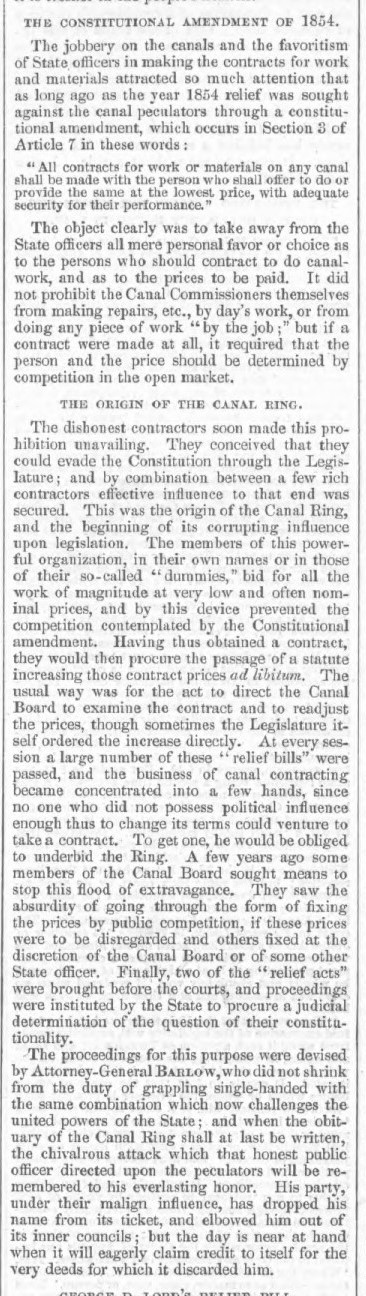
HW supplement 11-13-1875 – how Canal Ring evaded state constitution
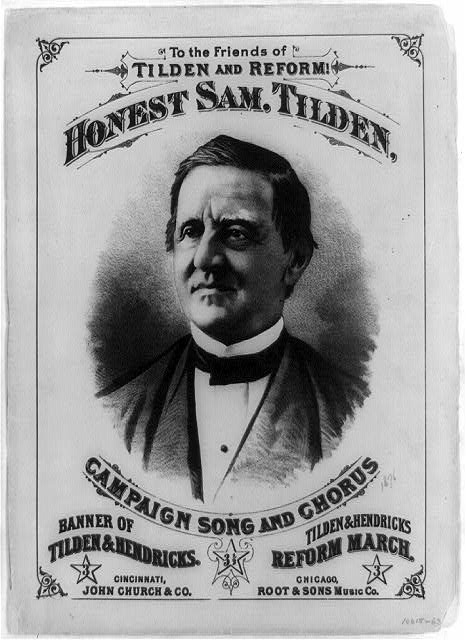
In 1871 as chairman of the New York State Democratic Committee, Samuel Tilden investigated the Tweed Ring corruption and won election to the state assembly as an anti-Tammany Democrat. As governor his most notable achievement was destroying the Canal Ring:
The Canal Ring was a bipartisan alliance whose members illegally pocketed a share of the money appropriated for repairs on the Erie Canal and its feeders. By assuring a few favored firms of canal work at prices far beyond cost and a reasonable profit, the Ring was able to obtain from the contractors a percentage of the funds paid by the state for canal repairs. Tilden alluded to the Canal Ring in his first message as governor, but as in his attack on the Tweed Ring, he refused to take the offensive until he had obtained enough evidence to ensure convictions in court. By March 1875, when he had completed his research, he delivered to the legislature a detailed account of the machinations of the Canal Ring. Despite the opposition of the Ring’s adherents in both the Senate and Assembly, the legislature authorized the governor to appoint a commission of investigation. Under the chairmanship of John Bigelow, the commission in its three-thousand-page report of February 1876 substantiated all of Tilden’s charges. Suits were immediately instituted against the Ring’s leaders and their accomplices. Although some of the guilty managed to escape jail, Tilden succeeded in smashing the Canal Ring and saved the taxpayers millions of dollars. Perhaps even more significant in an age of extreme partisanship was the fact that all but two of the men indicted for canal frauds were Democrats. [1]
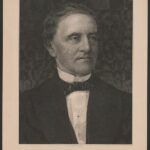
Samuel J. Tilden

Francis C. Barlow
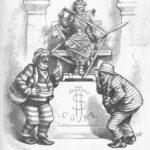
Harper’s Weekly October 16, 1875 – but the Rings were smashed
You can read more about Francis C. Barlow at the Library of Congress and the National Park Service.
During the Civil War, John Bigelow served as diplomat to France and worked with Charles Francis Adams (U.S. minister to the U.K.) to prevent France and Britain intervening in the war to help the Confederacy.
Maybe the Harper’s editorial was talking about Millennialism, a concern with the final 1000 earthly years: “He seized the dragon, that ancient serpent, who is the Devil and Satan, and bound him for a thousand years and threw him into the pit and locked and sealed it over him, so that he would deceive the nations no more, until the thousand years were ended. After that, he must be let out for a little while. — Revelation 20:2–3”.
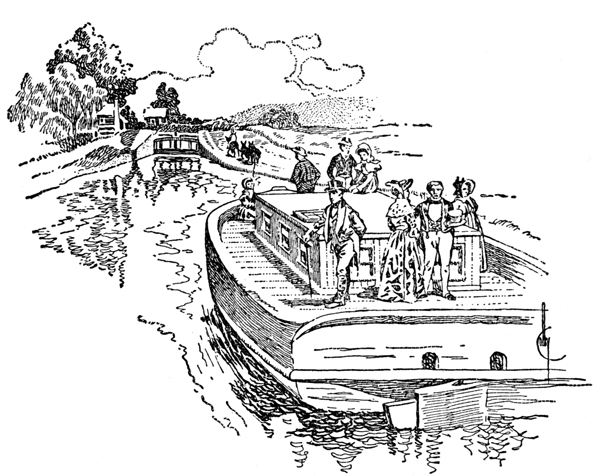
Harper’s Weekly for 1875 is at HathiTrust. The top image of a canal boat comes from U.S. History Images. From the Library of Congress: Tilden campaign song and chorus; postcard of Erie Canal Boat float from the 1909 Hudson–Fulton Celebration (speaking of historical anniversaries); Samuel J. Tilden; the photo of Francis C. Barlow; the group picture of Generals Barlow, Birney, Gibbon, & Hancock, USA
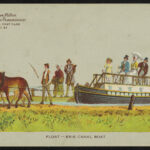
age of innocents?
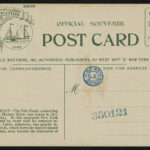
“metropolis of the New World”
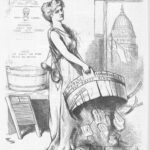
Harper’s Weekly June 5, 1875 p464 – corrupt times
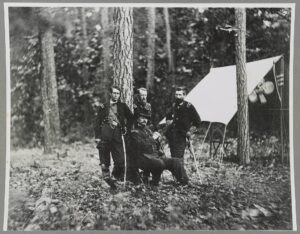
General Barlow on the left
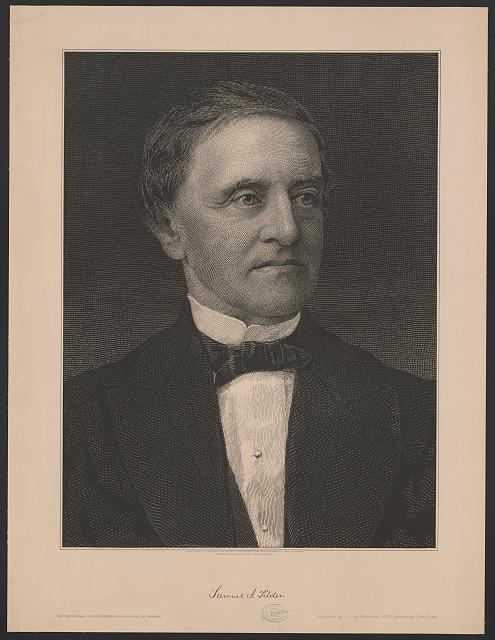
Samuel J. Tilden
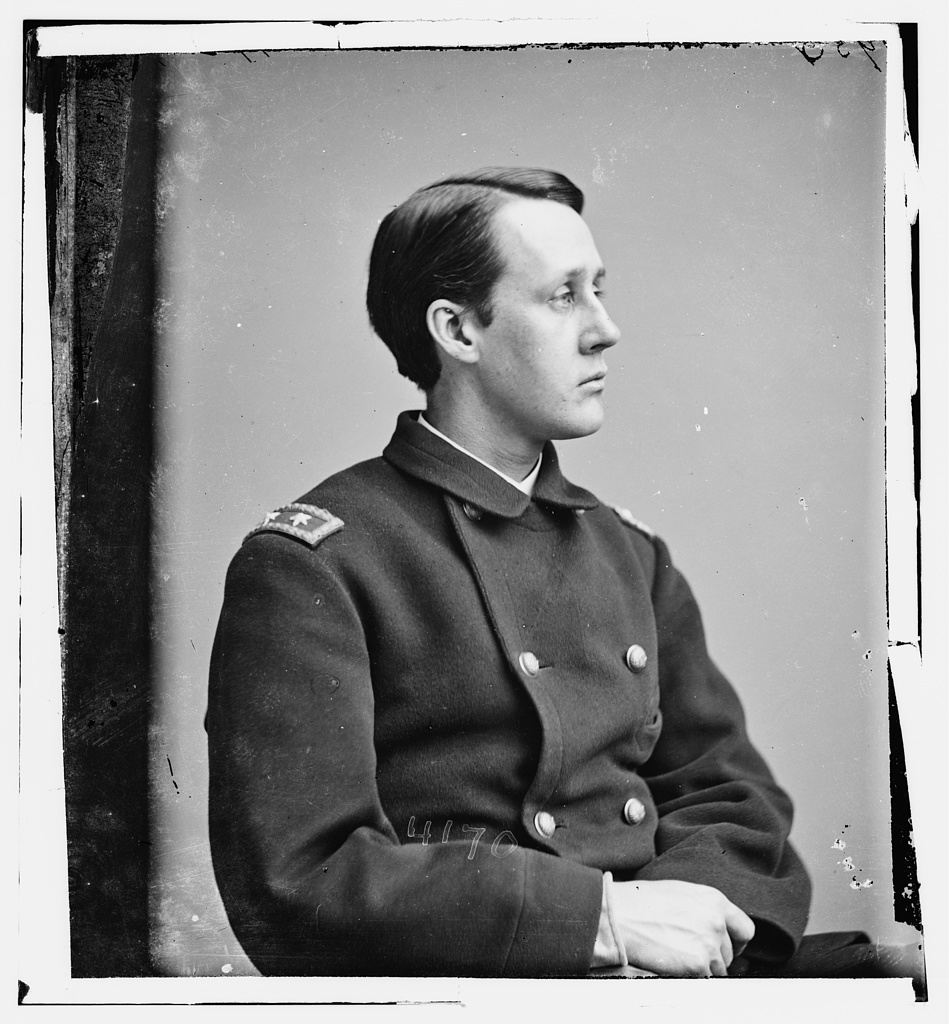
Francis C. Barlow
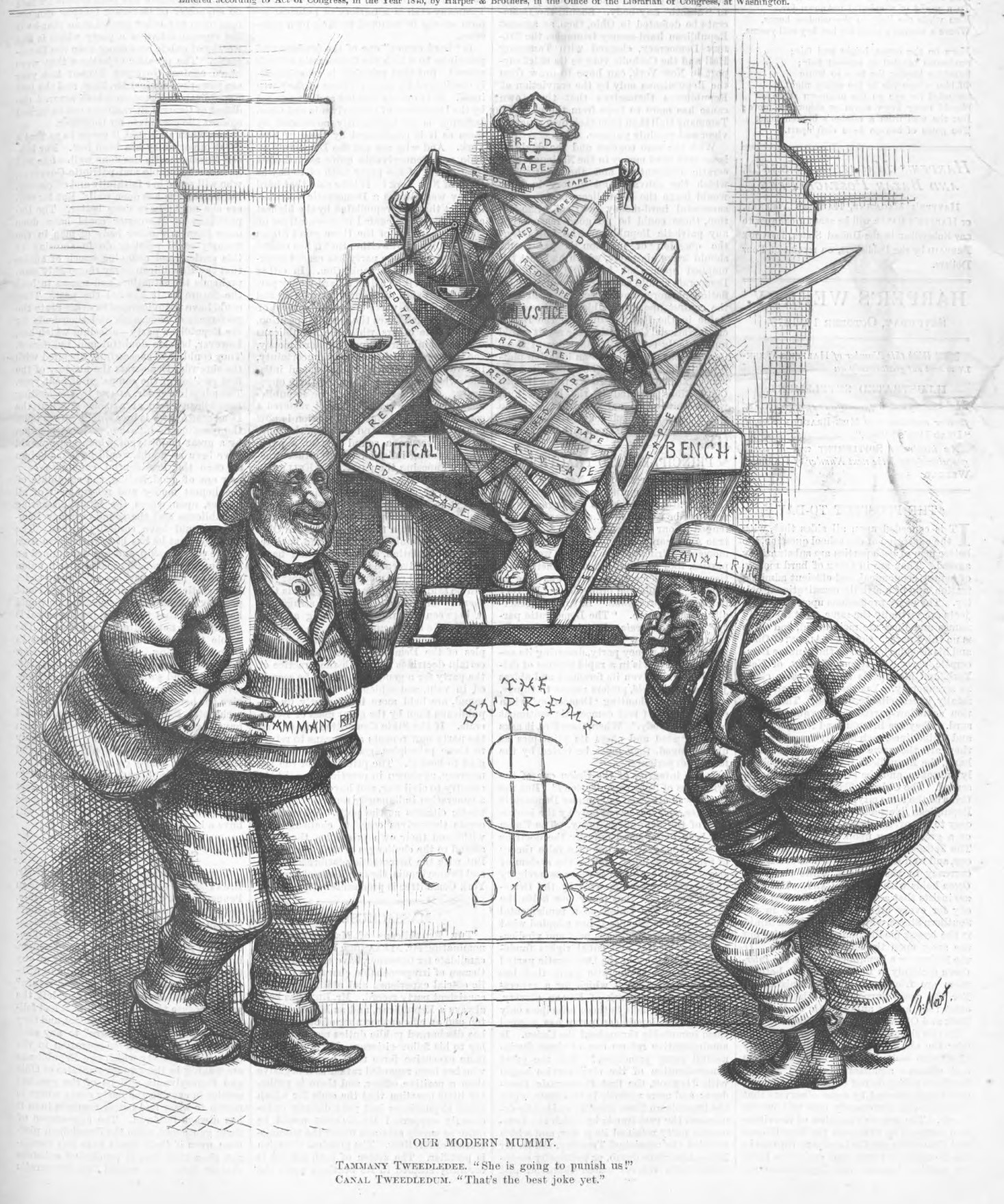
Harper’s Weekly October 16, 1875 – but the Rings were smashed
During the Civil War, John Bigelow served as diplomat to France and worked with Charles Francis Adams (U.S. minister to the U.K.) to prevent France and Britain intervening in the war to help the Confederacy.
Maybe the Harper’s editorial was talking about Millennialism, a concern with the final 1000 earthly years: “He seized the dragon, that ancient serpent, who is the Devil and Satan, and bound him for a thousand years and threw him into the pit and locked and sealed it over him, so that he would deceive the nations no more, until the thousand years were ended. After that, he must be let out for a little while. — Revelation 20:2–3”.
Harper’s Weekly for 1875 is at HathiTrust. The top image of a canal boat comes from U.S. History Images. From the Library of Congress: Tilden campaign song and chorus; postcard of Erie Canal Boat float from the 1909 Hudson–Fulton Celebration (speaking of historical anniversaries); Samuel J. Tilden; the photo of Francis C. Barlow; the group picture of Generals Barlow, Birney, Gibbon, & Hancock, USA
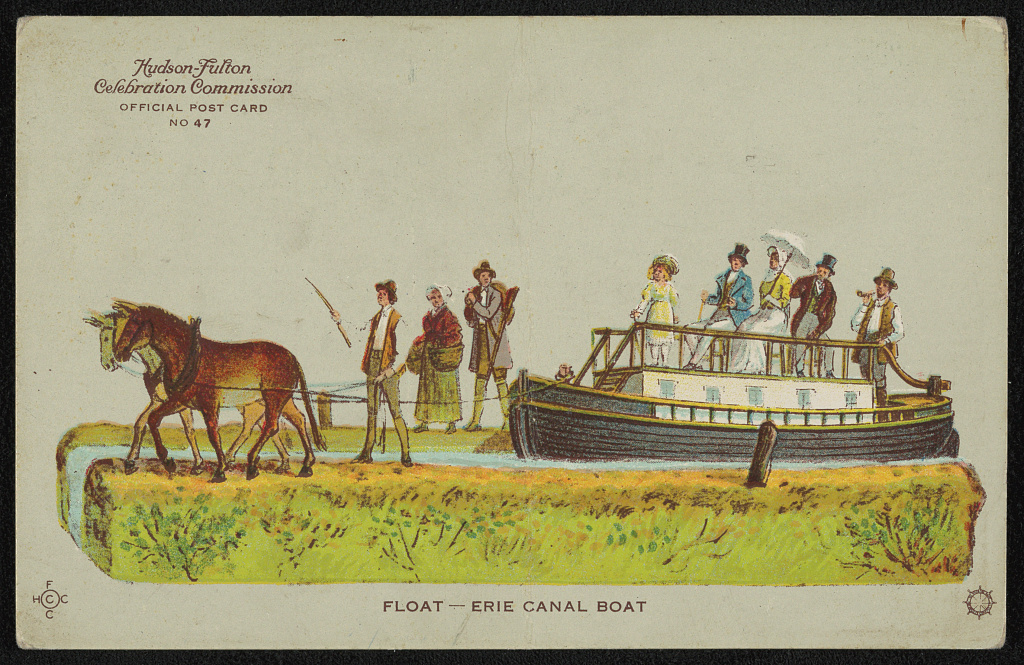
age of innocents?
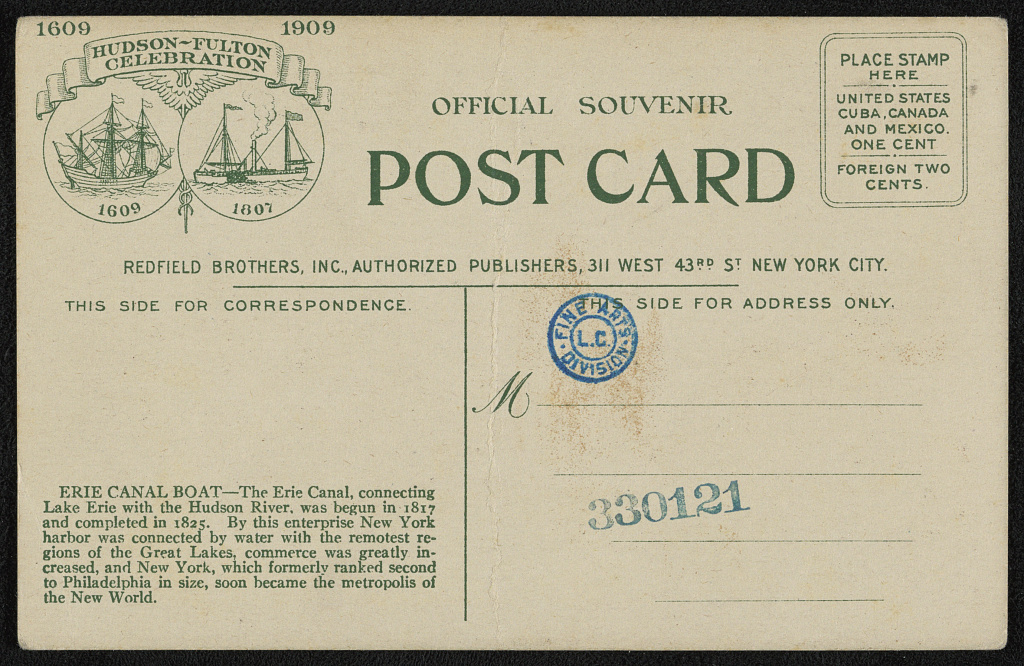
“metropolis of the New World”
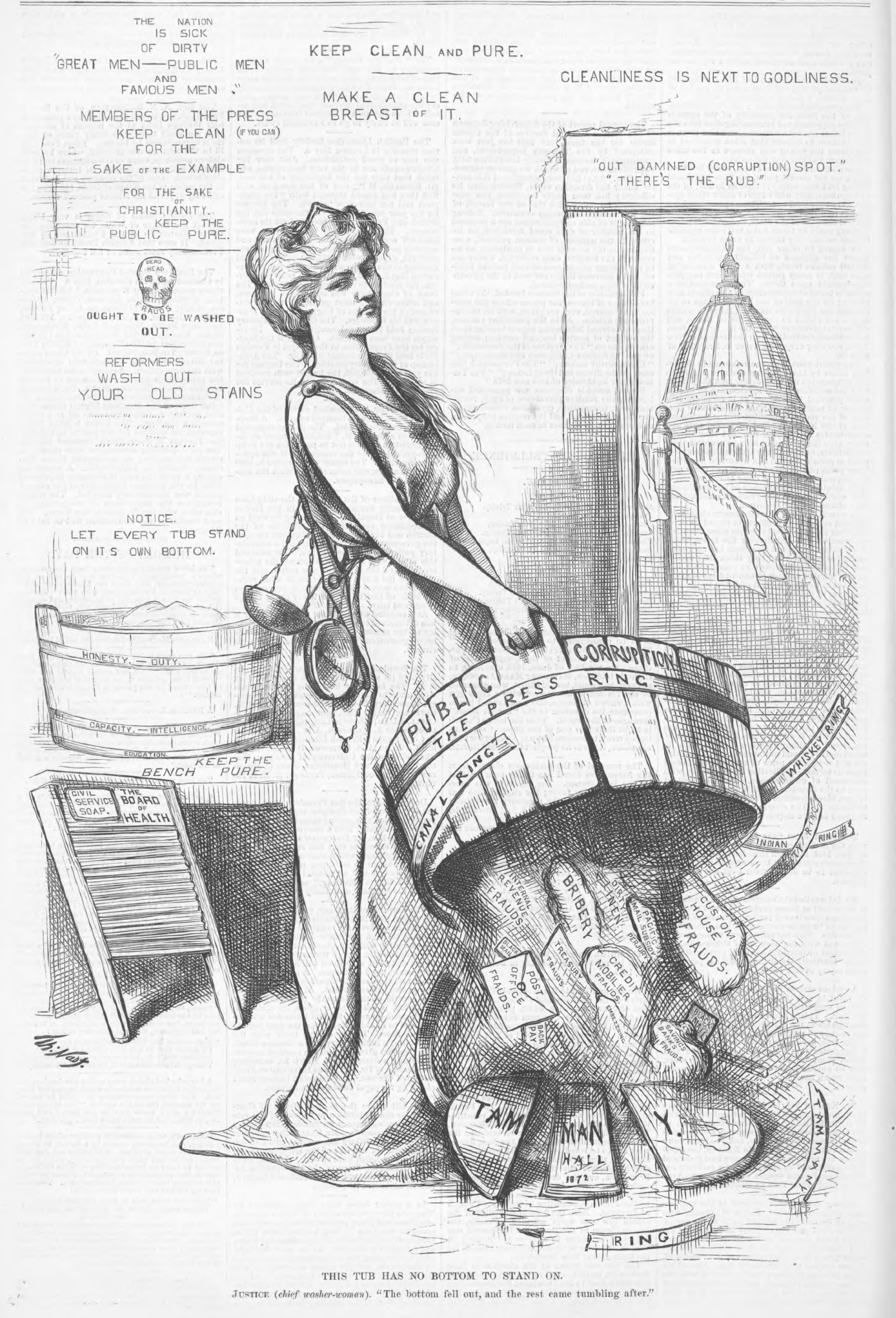
Harper’s Weekly June 5, 1875 p464 – corrupt times
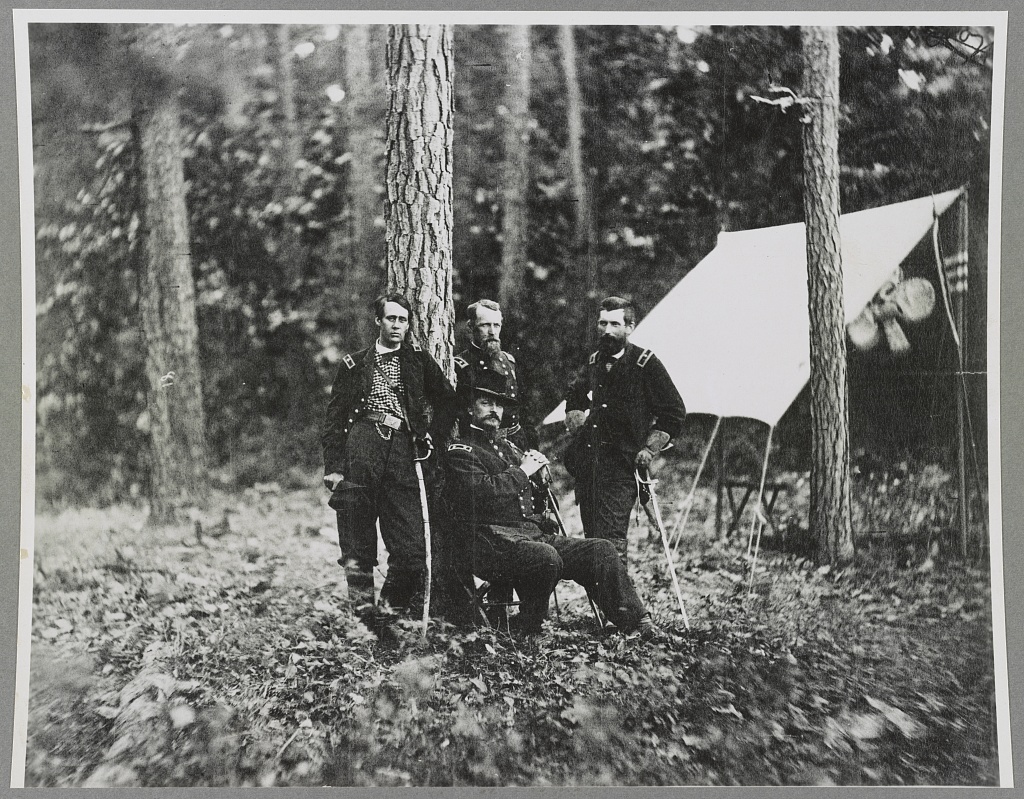
General Barlow on the left
_______________
- [1]Ellis, David M., James A. Frost, Harold C. Syrett, and Harry J. Carman. A Short History of New York State. Ithaca, New York: Cornell University Press, 1957. Print. page 362-363.↩
