150 years ago this morning Englishman Matthew Webb became the first known human to swim across the English Channel without artificial aids. He landed near Calais after about 22 hours in the salt water. From the October 2, 1875 issue of Harper’s Weekly (page 796):
CAPTAIN WEBB’S GREAT SWIM.
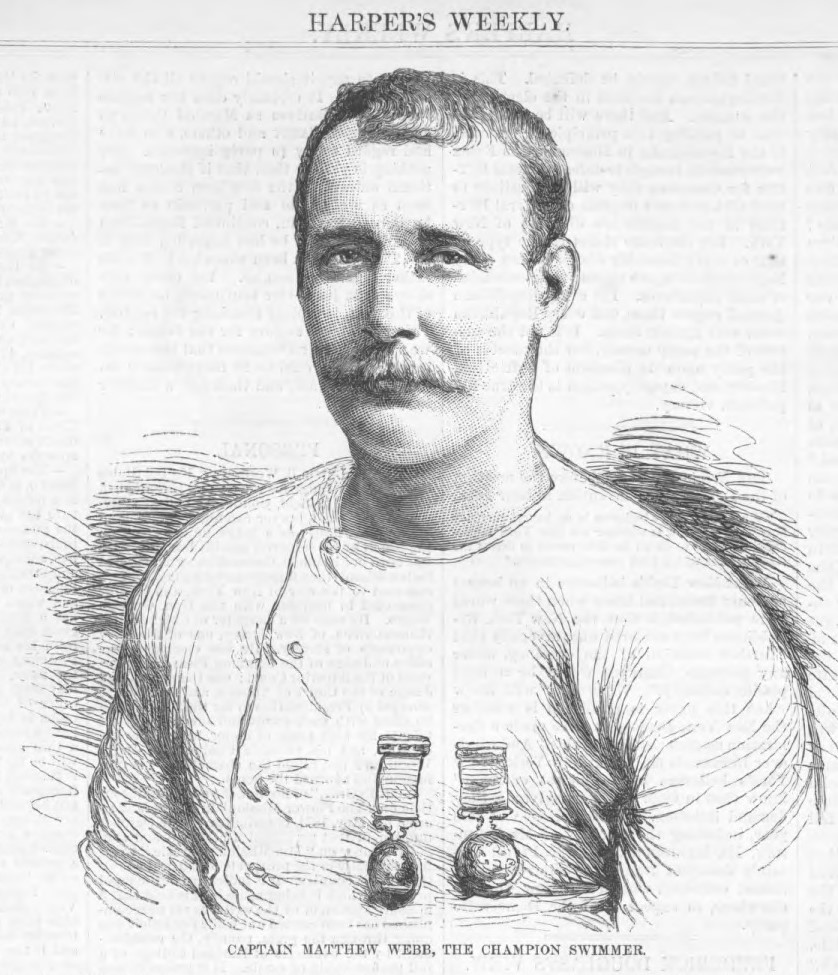
Harper’s Weekly October 2, 1875
The hero whose portrait accompanies this sketch has fairly earned the title of champion swimmer of the world, having accomplished the marvelous feat of swimming from England to France without touching any support from the time he dived off the Admiralty Pier at Dover until he landed himself on the sands at Calais. This unparalleled effort occupied just twenty-one hours and three quarters.
Captain WEBB has an interesting history. He was born at Dawley, in Shropshire, England, in 1848, and is therefore only twenty-seven years of age. His father is a surgeon, and has had a family of twelve children, of whom MATTHEW is the eldest but one. After spending some time at school, young MATTHEW entered the training ship Conway, lying in the Mersey. He had learned to swim when seven years old, and his first life-saving feat was achieved while he was on board the Conway, when he and the companions who formed the crew of his boat received each a silver pencil-case for rescuing a comrade who had fallen overboard. He was subsequently apprenticed on board an India and China merchantman, and when his indentures were expired he served first as second officer and afterward as chief officer on board various ships in the Calcutta trade, and while taking a vessel through the Suez Canal he dived and cleared away a hawser that had fouled her. In April, 1873, having shipped before the mast in the CUNARD steamer Russia, he jumped overboard in a gale of wind to save the life of a man who had fallen into the sea from the yard-arm. The Russia was going fifteen knots an hour at the time, and though the life-boat was immediately lowered, it was thirty-five minutes before he was with difficulty picked up, having failed in his noble endeavor to save the life of his shipmate, who had probably been stunned and sank at once. For this deed of gallantry he received the medal of the Liverpool Humane Society, as well as the silver medal and the gold STANHOPE medal of the Royal Humane Society, which latter were presented to him by the Duke of Edinburgh, and a present of £100, subscribed by the passengers of the Russia. Since then he has made several voyages as chief officer of the Ballina and as captain of the Emerald, and in June last, hearing of Captain BOYTON’S feat, the idea occurred to him to outdo it by swimming from England to France without any artificial aids. He made one or two experimental excursions, swimming from Blackwall to Gravesend, from Dover to the Varne Light, and from Dover to Ramsgate. A few days before his successful attempt he started for Calais, but was compelled to turn back on account of the weather
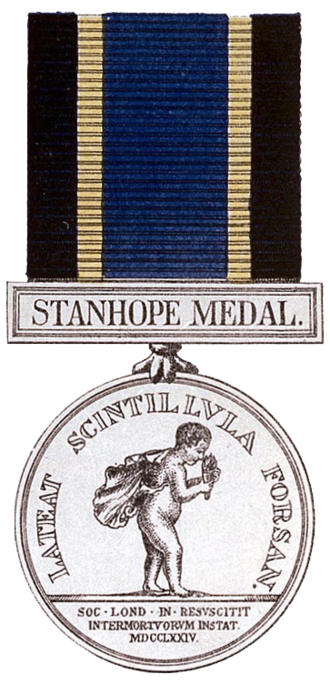
an example of Stanhope Medal
According to Mr. G. TOMS, who piloted him across, Captain WEBB must have swum between fifty and sixty miles; in fact, he was as near the land at 3 A.M. as he was five hours afterward, but the tide carried him past Cape Gris-Nez, and into a bay. He had to swim through four tides, getting two whole ones and a portion of each of the others. He describes the last three hours of his swim as cruel work. He was excessively drowsy, and the water got into his eyes till he was almost blinded. However, to use his own words, he went into the water resolved either to reach the other side or sink. At one time he was stung by a jelly-fish, and felt very faint for some minutes, but the effect soon wore off. The only refreshment he took was an occasional sup of brandy or coffee; once, cod-liver oil was administered, but it did not agree with him. On landing he went straight off to bed, slept three hours, then ate some fish, and went to sleep again. Next day he was “all right,” and returned to England in the Castalia, dined with the garrison and the yacht club at Dover, and when he walked out could scarcely move for the crowds of people who wanted to shake hands with him. On Saturday he went home to see his father, and was féted in his native county, and on Tuesday came back to London, and was enthusiastically cheered wherever he was recognized. Subscriptions have been started in London, Liverpool and other places, and a national testimonial is proposed, to which the working-men are to be invited to contribute. The only inconvenience which Captain WEBB appears to have suffered in consequence of his exploit is a stiffness and soreness of the neck, caused by his long exposure to seawater. He is five feet eight inches in height, and measures forty-three inches round his capacious chest. Our engraving of the arrival at Calais is from a sketch by a resident there, taken from the end of the West Pier. To the extreme left is the old and disused light-house, next is the picturesque belfry of the Town-hall, and a little beyond the Établissement des Bains. On the right is Cape Blanc-nez, and about midway between it and the établissement is the village of Sandgatte, concealed by sand hills, where the Channel Tunnel will come will come out on the French shore.
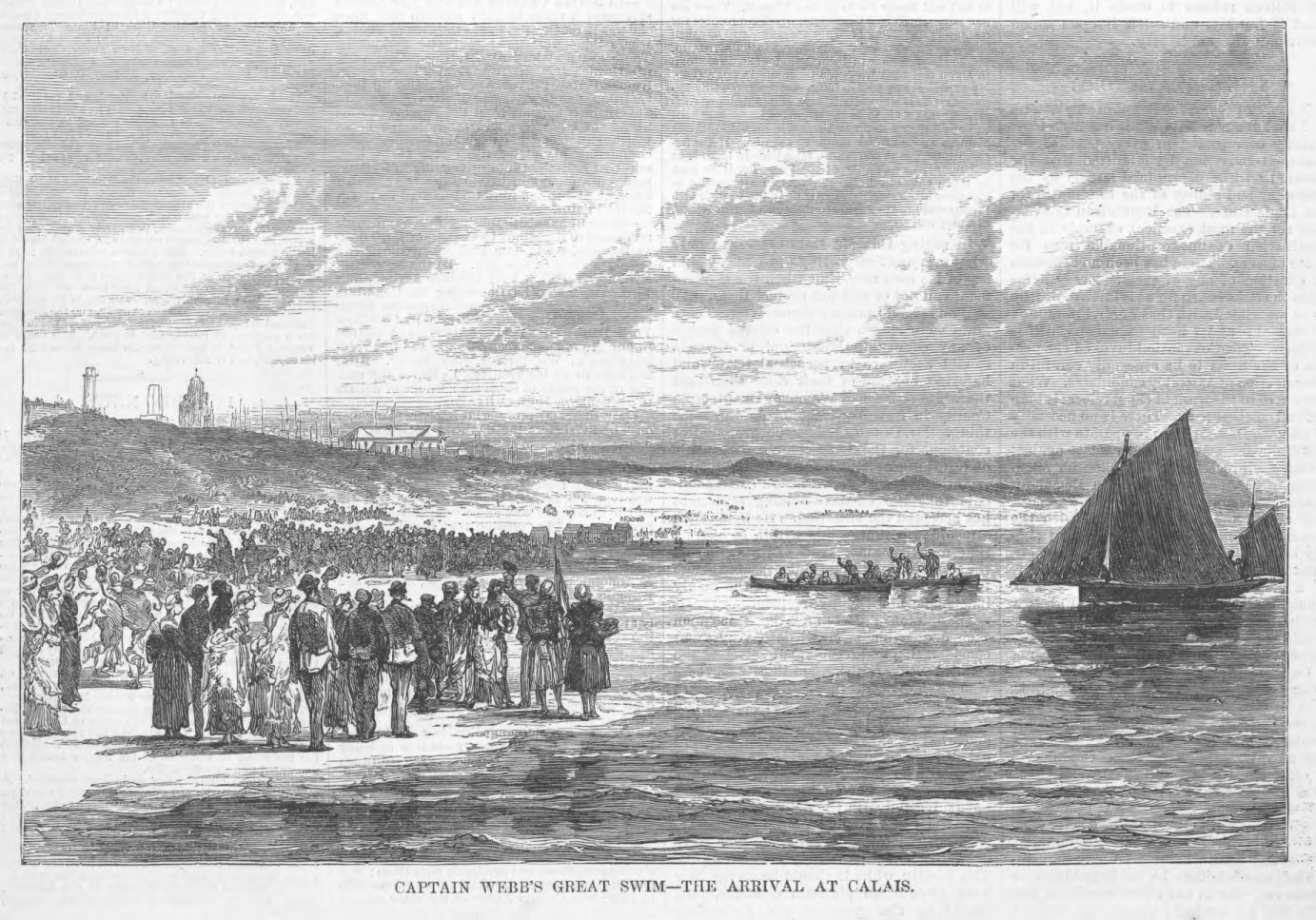
Harper’s Weekly October 2, 1875
According to Wikipedia, Paul Boyton crossed the English Channel from France to England on May 28-29, 1875 in 23.5 hours. He wore a rubber immersion suit and paddled himself feet first. He might have had a sail attached to his suit, which aided him in his failed first attempt to cross the Channel from England to France. Boyton was born in Ireland and grew up in Pennsylvania. Boyton won the only race vs. Webb that had a clear winner. Wikipedia lists has occupation as “Showman.”
Matthew Webb died on July 23, 1883 during an attempt to swim the Whirlpool Rapids below Niagara Falls. His body was found four days later and buried in Oakwood Cemetery, Niagara Falls, New York. “The autopsy revealed that he died from paralysis caused by water pressure, leading to respiratory failure.” You can read more about Captain Webb at Royal Museums Greenwich
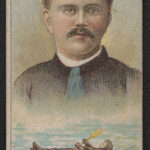
Paul Boyton suited-up
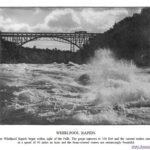
Whirpool Rapids
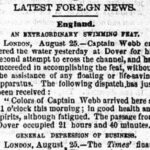
Richmond’s Daily Dispatch August 26, 1875
From Wikipedia: Stanhope Medal The picture of Whirlpool Rapids is from Project Gutenberg’s The New Book of Niagara: Scenes in Summer and Winter (c.1901) – “The Whirlpool Rapids begin within sight of the Falls. The gorge narrows to 300 feet and the current rushes onward at a speed of 40 miles an hour and the foam-crested waters are entrancingly beautiful.”
From the Library of Congress: Paul Boyton from an 1887 cigarette card in the Champions of Games and Sports card set; a clipping from the August 26, 1875 issue of Richmond’s Daily Dispatch (page 1).
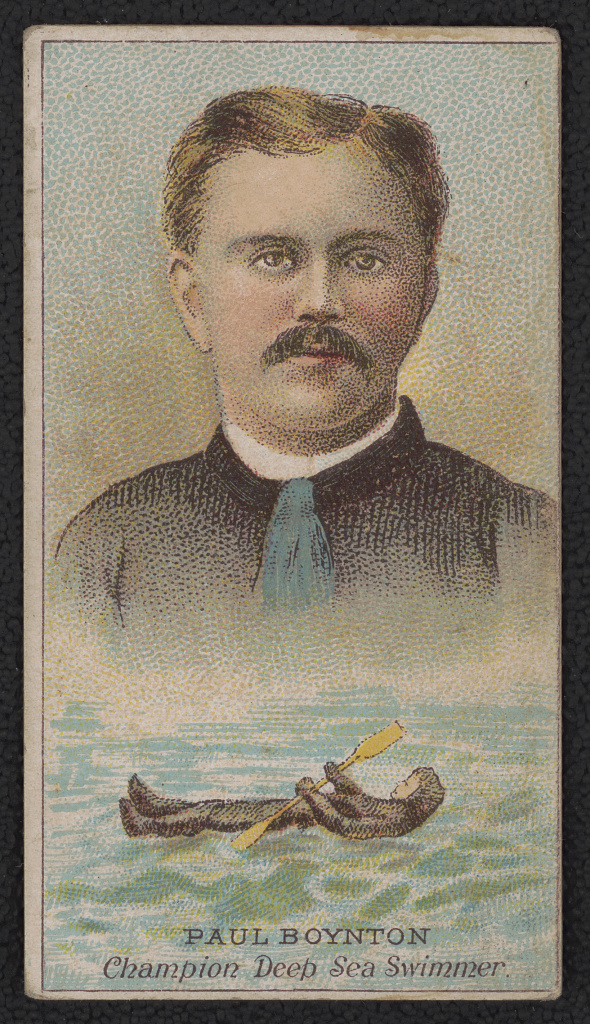
Paul Boyton suited-up
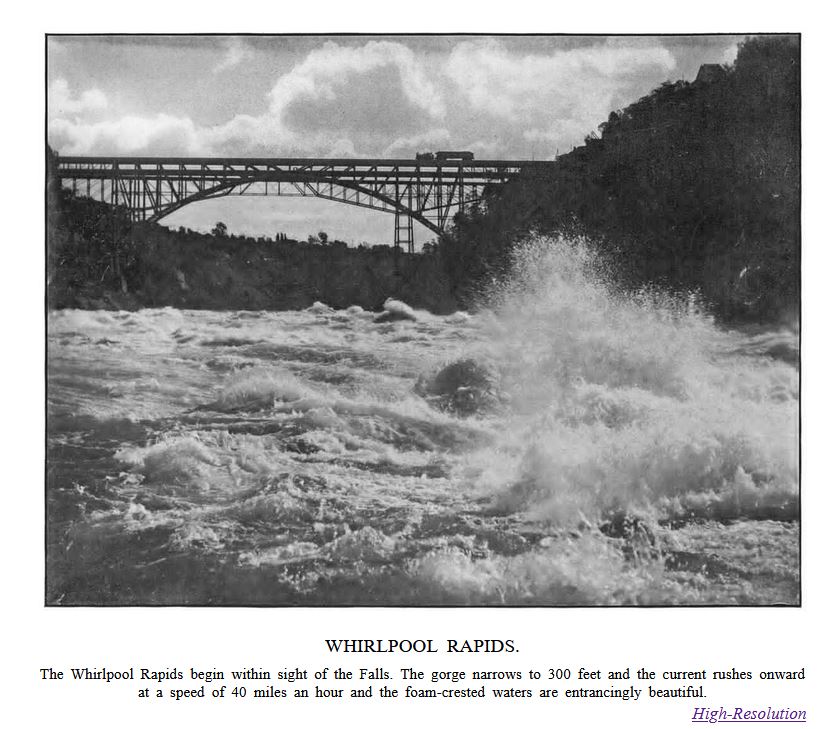
Whirpool Rapids
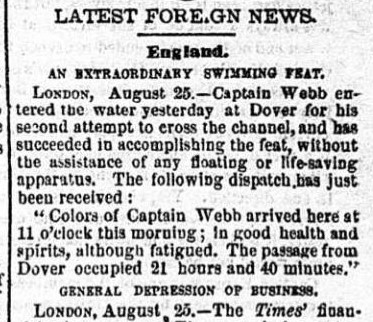
Richmond’s Daily Dispatch August 26, 1875
