“an inestimable jewel”

Why President Lincoln continues the war

From The Papers And Writings Of Abraham Lincoln, Volume Seven:

ADDRESS TO THE 166TH OHIO REGIMENT,
AUGUST 22, 1864.

SOLDIERS—I suppose you are going home to see your families and friends. For the services you have done in this great struggle in which we are engaged, I present you sincere thanks for myself and the country.

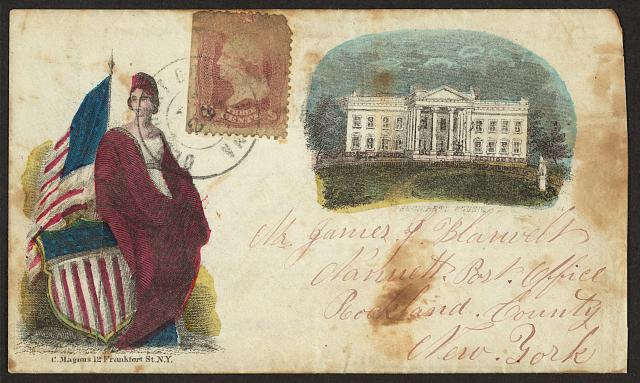
Civil War envelope showing Columbia with shield and American flag and White House (N.Y. : C. Magnus, 12 Frankfort St. ; 1862 June 22; LOC:  LC-DIG-ppmsca-26466)

Mr. Lincoln a temporary tenant

I almost always feel inclined, when I say anything to soldiers, to impress upon them, in a few brief remarks, the importance of success in this contest. It is not merely for the day, but for all time to come, that we should perpetuate for our children’s children that great and free government which we have enjoyed all our lives. I beg you to remember this, not merely for my sake, but for yours. I happen, temporarily, to occupy this big White House. I am a living witness that any one of your children may look to come here as my father’s child has. It is in order that each one of you may have, through this free government which we have enjoyed, an open field, and a fair chance for your industry, enterprise, and intelligence; that you may all have equal privileges in the race of life with all its desirable human aspirations—it is for this that the struggle should be maintained, that we may not lose our birthrights—not only for one, but for two or three years, if necessary. The nation is worth fighting for, to secure such an inestimable jewel.

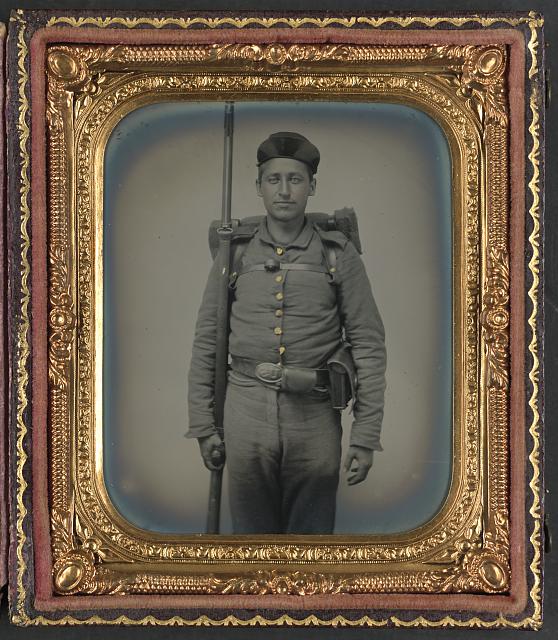
The 166th Ohio Infantry was a “100 days” regiment made up of Ohio militia mustered into federal service in May 1864. They were supposed to guard rear areas to free up other troops for the Army of the Potomac’s advance into Virginia. The regiment lost 29 or 39 men to disease during its relatively brief service.

Unidentified soldier in Ohio Volunteer Militia uniform with bedroll and musket (between 1861 and 1865; LOC: LC-DIG-ppmsca-37409)

“Unidentified soldier in Ohio Volunteer Militia uniform with bedroll and musket
” (LOC)

Posted in 150 Years Ago This Week, Lincoln Administration, Northern Politics During War, Northern Society, The election of 1864 | Tagged , | Leave a comment

a death at Elmira

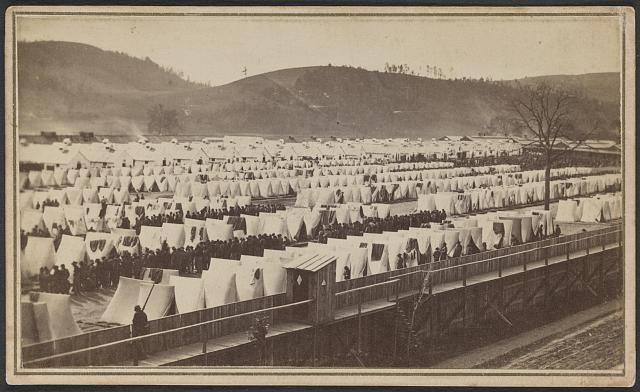
Elmira Prison, Elmira, New York (by Moulton & Larkin, between 1864 and 1865; LOC: LC-DIG-ppmsca-33993 )

“Elmira Prison, Elmira, New York”

From the Richmond Daily Dispatch September 8, 1864:

… Mr. W. B. Egerton, a citizen of Petersburg, died in the Federal prison at Elmira, New York, on the 21st ultimo.

Elmira started accepting Confederate prisoners on July 6, 1864. By August it was already holding thousands.

From a Seneca County, New York newspaper in August 1864:

REBEL PRISONERS. – There are now over eight thousand rebel prisoners in the barracks at Elmira.

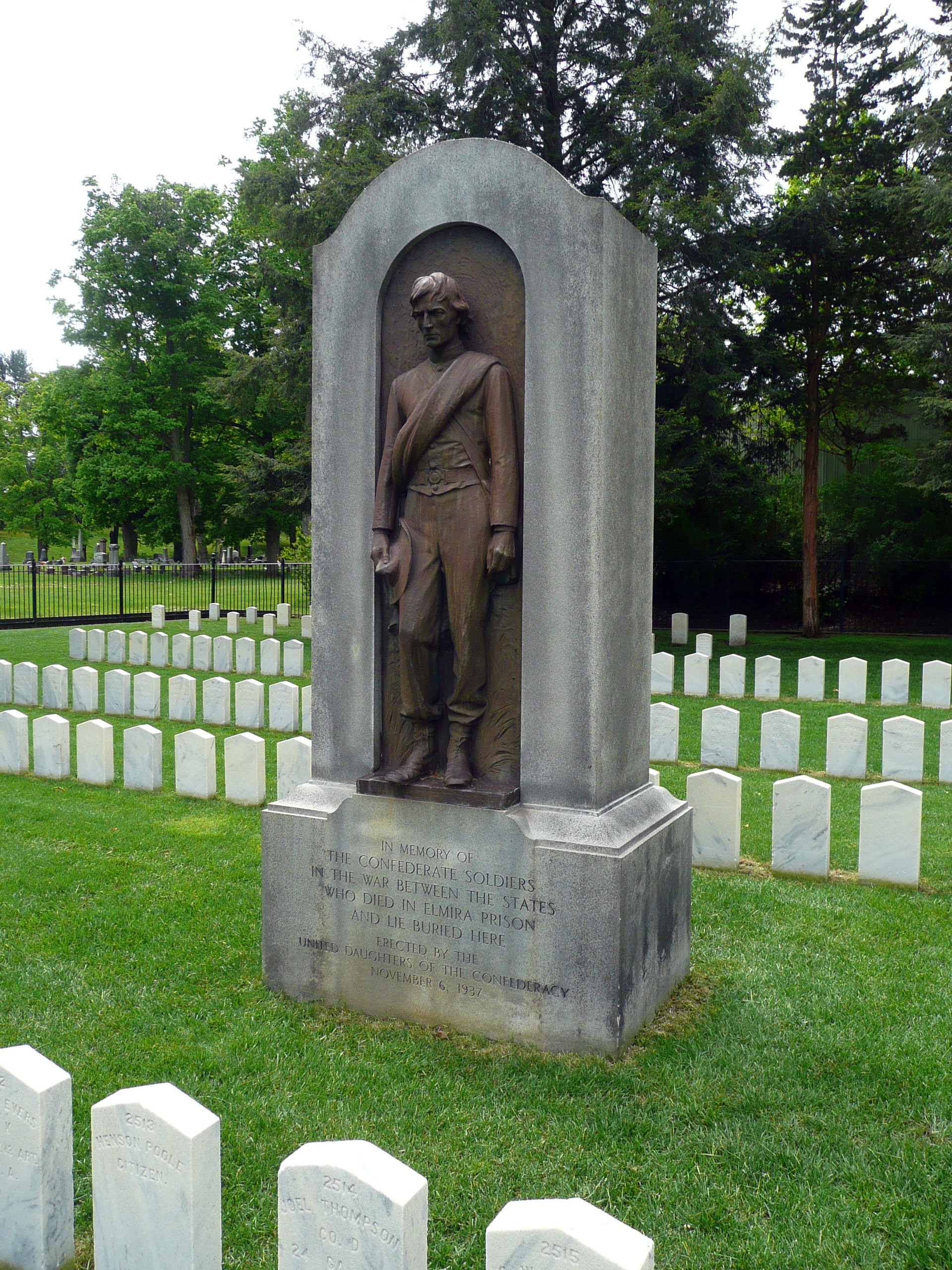
Monument to Confederate dead at Woodlawn Cemetery, Elmira, NY. Photo by Hal Jespersen, May 2010.

At Woodlawn (2010 photo by Hal Jespersen)

I don’t know the specific cause of Sergeant Egerton’s death, but it could certainly have something to do with overcrowding. Chemung County History points out that there were only enough barracks to house 5,000 prisoners. The site also says that the photo up top of the camp is from December 1864, but it would seem that tents were already probably being used in August. According to Wikipedia:

During the 15 months the site was used as a prisoner of war camp more than 12,100 Confederate soldiers were incarcerated there; of these, nearly 25% (2,963) died from a combination of malnutrition, continued exposure to harsh winter weather, and disease from the poor sanitary conditions on Foster’s Pond combined with a lack of medical care. The camp’s dead were prepared for burial and laid to rest by the sexton, an ex-slave named John W. Jones, at what is now Woodlawn National Cemetery.

Records at the Chemung County History site give Sergeant Egerton’s date of death as August 22, 1864. His Woodlawn Cemetery number is 38.

Posted in 150 Years Ago This Month, Civil War prisons, Northern Society | Tagged , , | Leave a comment

honoring General Forrest

For what it’s worth, Nathan Bedford Forrest seems to have been defending himself against charges that he ordered/condoned a massacre of blacks at Fort Pillow.

From the Richmond Daily Dispatch August 20, 1864:

General Forrest and the Negroes.

–It is known that the negroes of the Methodist congregation at Uniontown, Alabama, recently contributed one thousand dollars to the Association for the Relief of Maimed Soldiers, and being informed that this contribution was sufficient to constitute a life director, they selected General Forrest for that honor. The Selma Reporter publishes the General’s letter to Dr. Neely acknowledging the compliment, in which he says:

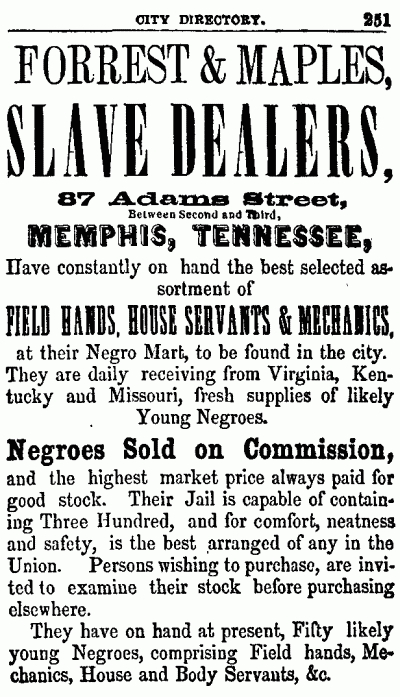
Memphis City Directory for 1855-6.

Memphis City Directory for 1855-6.

“I am not indifferent to the compliment paid me by ‘the Methodist Congregation of Negroes at Uniontown.’ I prise this manifestation on the part of the negro more than I fear the thousand calumnies with which a defeated and vanquished foe are endeavoring to blacken my name. It has been my fortune to have much dealing with the negro since I arrived at manhood, and I have uniformly treated them with kindness and humanity. Those that have been forcibly taken from me I know are sighing for the happy home from which they have been seduced. These that heeded not the ridiculous promises of the Yankees, and who still remain with me, fly from his approaching footsteps with the same instincts of fear and danger that they would fly front a leprosy. I predict that, after peace shall have been restored, most of the negroes that have been decoyed from their homes will gladly and joyfully return, infinitely preferring slavery among the Southern people to freedom at the North. Instead of guilty of the stricture charged upon me, I have my sympathies for the negro. He had [been misled?] by false promises, and I had much rather make [war?] upon the white man, who has deceived him.”

The Association for the Relief of Maimed Soldiers is discussed in a book review at H-Net Online.

General Forrest led a surprise raid on Memphis on August 21, 1864.

Posted in 150 Years Ago This Week, Confederate States of America, Southern Society | Tagged , , , | Leave a comment

thanks for the work

On July 18, 1864 Confederate Treasury Secretary Christopher Memminger resigned and headed back home to South Carolina. 150 years ago this month some Virginia women presented him with a cane to thank him for the jobs he provided at the Treasury. From the Richmond Daily Dispatch August 19, 1864:


Presentation to ex-secretary Memminger.

–On Thursdayevening last, at Columbia, South Carolina, the Virginia ladies of the Treasury Bureau presented Mr. Memminger with a handsome walking cane, enriched by inscriptions bearing testimony that it was a tribute of gratitude from Virginia ladies. The following correspondence attended the presentation:

We, Virginia’s daughters, beg Mr. Memminger’s acceptance of the accompanying humble testimonial of our gratitude to him for the benefit he has conferred on us by inaugurating a department for the employment of ladies, who, through the exigencies of the times, have been compelled to resort to some means of support. We thank him for his untiring efforts in our behalf while we were under his rule, and offer him this tribute simply as a memento of our grateful regard.

To this Mr. Memminger replied:

Mr. Memminger has received with much satisfaction “the memento” with which the “daughters of Virginia” have honored him on his return home. Admiring as he does the spirit and fortitude evinced everywhere by the women of our country, he has witnessed, with increased satisfaction, the courage and perseverance with which so many highly-gifted ladies, who, before this war, knew neither care nor want, have been content to undertake the wearying duties which you now discharge. Many of you have given up brothers, fathers and husbands to the service of the country, and are now sustaining the families they have left by your daily labor. All have given up the comforts of home without murmur or repining. Mr. M. has fully appreciated your efforts and your fidelity. He has the pleasure of saying that you have faithfully discharged your duties, and that he regards it as one of the highest privileges of the office which he has just left, that he has been able to open a field of usefulness to so many ladies deserving of the highest respect and esteem.

You can read a biography of Mr. Memminger at NCPedia (he owned a summer home in North Carolina).

The Smithsonian presents a display of Memminger on a Confederate five dollar bill.

Posted in 150 Years Ago This Month, Confederate States of America, Southern Society | Tagged , , , , | Leave a comment

“peace at any price”?

150 years ago New York State Peace Democrats held a meeting in Syracuse ahead of the National Democrat Convention in Chicago beginning on August 29th. Fernando Wood from New York City and Clement L. Vallandigham were featured speakers. The delegates voted down a resolution to send an alternate delegation to Chicago in an advisory capacity.

From The New-York Times August 19, 1864:

THE PEACE CONVENTION.; The Assembling of the Magnates at Syracuse–Speeches by Vallandigham and Wood–Resolutions Passed–Peace at Any Price–A Delegation to Chicago. SECOND DISPATCH.

SYRACUSE, Thursday, Aug. 18 — Noon.

The Mass Peace Convention called to meet in this city this afternoon, promises, to be largely attended.

Comparatively few are here from New-York or from the counties south of Albany, with the exception of Suffolk, but large delegations are coming in from Utica, Rome, Oswego, and the villages hereabouts and nearly all the Western counties are represented. …

SYRACUSE, Thurday, Aug. 18.

The weather this afternoon proves fine, and the main streets are crowded with several thousand strangers.

The mass meeting was divided into two throngs, one on Franklin-square and the other surrounding the Syracuse House, from the balcony of which the speakers addressed the people.

The principal and largest meeting, numbering, perhaps 3,000, is in Franklin-square, C.L. VALLANDIGHAM and FERNANDO WOOD being announced to speak from that stand. This meeting was organized by the election of Hon. J.N. HOUGH, as President, eight Vice-Presidents and three Secretaries. …

[???]n[???] response to loud and enthusiastic calls. Mr. VALLANDIGHAM stepped forward and addressed, the multitude for an hour or more, holding their closest attention, except when interrupted by applause. He said he was not here to parade his private griefs, not to speak of what he had done or suffered in the cause. All such things were, indeed, insignificant in comparison to the great national interests that are at stake. He would only say that time has already vindicated, almost to the utmost extent, his views in regard to national affairs. … There is now but one question before the country — war or peace. He assumed that it was the desire of all who love their country that first her liberties shall be made secure, and then her material prosperity restored. There were some who believed that these objects could be best secured by war, while a great mass of the Democracy held that they could be obtained only through peace. A majority determined to try war. We were obliged to submit. Had he possessed the power, not one drop of blood would have been shed. There would have been no marshaling of hosts, no hostile cannon, no mighty debt; none of the calamities which have made this country a land of mourning and taxation would have been known, except as known to our fathers. But war has been tried. The President has had all the men and all the money he demanded. Never was there such an example of submission by a people. Nothing has been wanting that constitutional power conceded, or that audacious usurpation could take from the people. And what is the result? With more battles fought by the three greatest conquerors of the world in any five years of their power, is the Union restored? No. A single State brought back? No. Is the Constitution maintained or observed? No. Are our liberties respected? No. Have we had a free press, free assemblages, the right of habeas corpus or arrests by due process of law? No, no. How is it in a material point of view? A debt of nearly four thousand millions, a daily expenditure of nearly five millions, and a currency worth about thirty-eight cents on the dollar, which two months ago was worth 100 per cent. more than it is now, and which two months hence will be worth 100 per cent. less. Ruin is impending, and now, in the fourth year of the war, what better is the prospect of success by war? We failed in 1861 and 1862, not for want of courage, for no braver men ever went to battle. The campaign of 1863 opened under more auspicious circumstances, and we were told that the rebellion would be speedily crushed out by force of arms; but the end of that year found us but little advanced. The campaign of 1864 opened with the largest armies the war had yet seen — those armies composed largely of three-year veterans, and concentrated for attack upon two or three vital points, and with what result? Let the record of carnage and blood answer. Having tried war so long, shall we now try some other means? He was for trying conciliation and compromise. We submitted to necessity. You have had your trial. You have tried war for four years; now let us try our plan. Our forefathers made our Constitution in convention, with pen, ink and paper, after a debate, by free speech, coming from the hearts of freemen, and for seventy-three years we prospered under it as no other people ever prospered. Yet we had our differences. During that period more than once the Union was endangered. The differences of 1820 were reconciled by compromise, and by the same instrumentality the calamity was avoided in 1850. CLAY, WEBSTER, BENTON, CASS and DOUGLAS were there then, and compromise prevailed through their advice and efforts. SUMNER, CHASE and HALE, the leaders of the party now in power, and which has brought the country so near to irretrievable ruin, were there too, and then as now, they were against compromise. With a Republican form of Government it is impossible to keep the States together by force of arms, it is contrary to the spirit of free institutions. But if it were otherwise, the war has been utterly perverted by the administration. To-day it is not a war for the Union or under the Constitution, and the eyes of the people are being opened to this fact. Hence it is that through all the States, the cry for a cessation of hostilities is being loudly uttered. He regarded the call for five hundred thousand more men as a confession that the war is to be prolonged through 1865. If you send more men, demand that the war shall be successful, and conducted to the end for which alone it was inaugurated. …

Here’s some reviews.

From the same issue of the Times:

The mass State Peace Convention met at Syracuse yesterday,and was moderately well attended. VALLANDIGHAM was the chief attraction, and made one of his characteristic speeches, thoroughly impregnated with venomous falsehoods. The proposition to appoint a delegation to Chicago was finally voted down.

From the Richmond Daily Dispatch August 24, 1864:

The peace meeting at Syracuse.

–The peace meeting at Syracuse, New York, on the 17th [sic], was a very large affair. The resolutions adopted call for peace, and present, in strong colors, the outrages of Lincoln upon the liberties of the people of the United States. The following resolution contains the action of the body:

“Resolved, That, speaking for the many thousands here assembled, gathered together from every county of the State of New York, we believe that it is the duty of the coming convention, to meet at Chicago on the 29th of August, to give expression to this beneficent spirit of peace, and to declare as the purpose of the Democratic party, if it shall recover power, to cause this desolating war to cease by the calling of a national convention, in which all the States shall be represented in their sovereign capacity; and that to this end an immediate armistice shall be declared, of sufficient duration to give the States and the people ample time and opportunity to deliberate upon, and finally conclude, a form of Union.”

Vallandigham, Fernando Wood and others made strong speeches for peace.

In its September 3, 1864 issue Harper’s Weekly summarized the Syracuse meeting as it previewed the Chicago Convention. From Son of the South:

THE CHICAGO CONVENTION.

WE give on this page portraits of C. L. VALLANDIGHAM and FERNANDO WOOD, the leaders of the Peace Party ; also a view of the WIGWAM in which the Democratic Convention is to be held on Monday the 29th. These two gentlemen recently held a Peace Convention at Syracuse, New York, the object of which was to coerce the Chicago Convention by a vast popular demonstration in favor of peace. The meeting was of no significance. They each made speeches, earnestly begging the people by their fear of severe wounds and of heavy taxes not to resist the rebellion any longer with arms, but to settle our difficulties by compromise. As our ” difficulties” are nothing but the armed resistance of certain citizens to the laws, with the declared intention of destroying the Government, it is not easy to understand what kind of compromise with them is possible, except submission to the degradation of the Government. The plan of Messrs. VALLANDIGHAM and WOOD undoubtedly contemplates a temporary separation, with the hope of an ultimate reunion upon terms that will permanently secure the Southern ascendency. Of course there is as yet no open declaration of such a scheme, but no man familiar with our politics and with the course of these two leaders will doubt it. Their silence, and the studied manner in which they always speak of the Union as endangered by the loyal men of the North, instead of the rebels at the South, and the constant declaration that the authority of the Government can not be maintained by force, are sufficiently significant of their views. …
Posted in 150 Years Ago This Week, Northern Politics During War, Northern Society, The election of 1864 | Tagged , , , , | Comments Off on “peace at any price”?

peace train

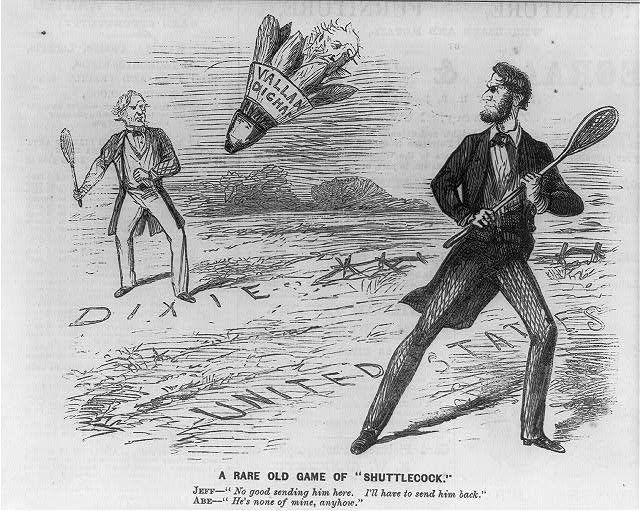
150 years ago today Clement L. Vallandigham made his way to Syracuse, New York for an upcoming peace meeting.

From The New-York Times August 17, 1864:

Movements of Vallandigham.

DUNKIRK, N.Y., Tuesday, Aug. 16.

Hon. C.L. VALLANDIGHAM passed through here at 4 P.M., to-day, en route to Syracuse, to address the Peace Democracy that is to assemble in Mass State Convention at that place on Thursday, the 1[8]th inst.

SYRACUSE, Tuesday, Aug. 16.

Hon. C.L. VALLANDIGHAM arrived to-day, and will be present and speak at the Mass Peace Convention on Thursday.

A rare old game of shuttlecock (1864?; LOC: LC-USZ62-42030)

landing in Syracuse?

Posted in 150 Years Ago This Week, Northern Politics During War, Northern Society | Tagged , , , | Leave a comment

a productive, destructive August

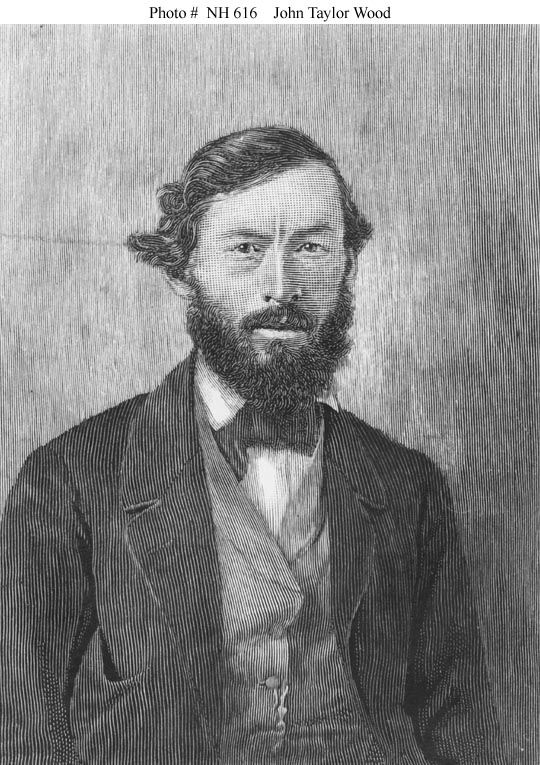
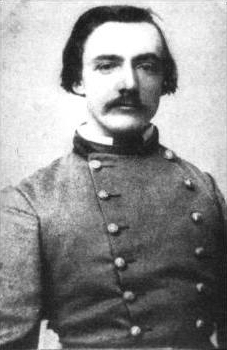
John Taylor Wood (http://www.history.navy.mil/photos/images/h00001/h00616.jpg)

Commander Wood

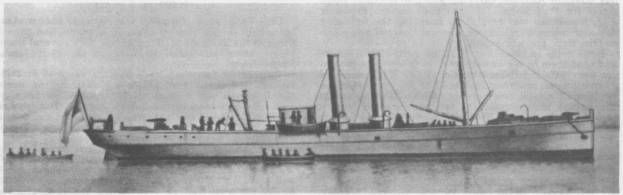
150 years ago this month the CSS Tallahassee, commanded by Zachary Taylor’s grandson John Taylor Wood, was disrupting Yankee commerce off the northern coast. Here’s a summary from the Navy:

After she was commissioned and prepared for sea Tallahassee was placed under Comdr. J. T. Wood, CSN, who took her through the blockade on 6 August 1864 and made a brilliant 19-day raid off the Atlantic coast as far north as Halifax, N.S. Being unable to procure enough coal to continue, Cdr. John Taylor Wood was forced to return to Wilmington where he arrived safely on the 26th. During this short cruise Tallahassee destroyed 26 vessels and captured 7 others which were bonded or released.

From The New-York Times August 15, 1864:

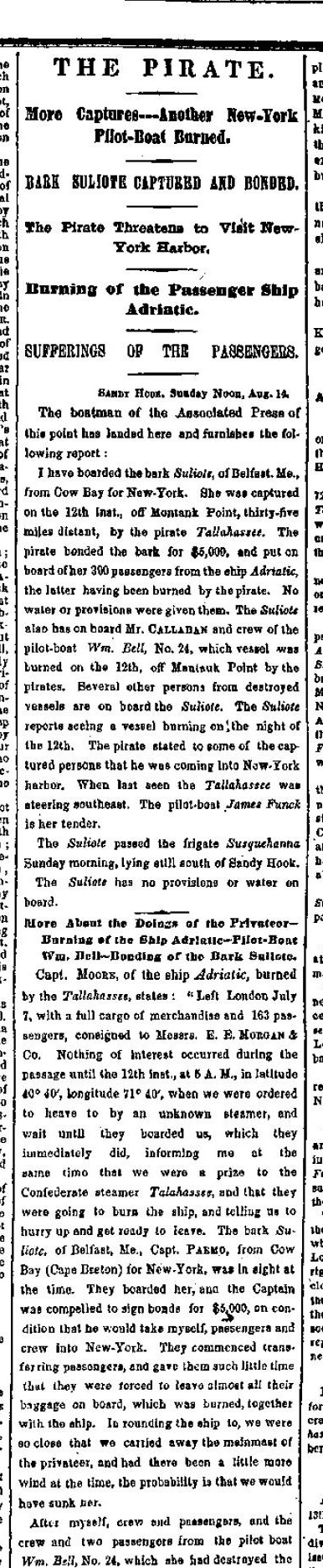
NY Times 8-15-1864

NY Times 8-15-1864

SANDY HOOK, Sunday Noon, Aug. 14.

The boatman of the Associated Press of this point has landed here and furnishes the following report:

I have boarded the bark Suliote, of Belfast. Me., from Cow Bay for New-York. She was captured on the 12th inst., off Montank Point, thirty-five miles distant, by the pirate Tallahassee. The pirate bonded the bark for $5,000, and put on board of her 300 passengers from the ship Adriatic, the latter having been burned by the pirate. No water or provisions were given them. The Suliote also has on board Mr. CALLAHAN and crew of the pilot-boat Wm. Bell, No. 24, which vessel was burned on the 12th, off Mantauk Point by the pirates. Several other persons from destroyed vessels are on board the Suliote. The Suliote reports seeing a vessel burning on the night of the 12th. The pirate stated to some of the captured persons that he was coming into New-York harbor. When last seen the Tallahassee was steering southeast. The pilot-boat James Funck is her tender.

The Suliote passed the frigate Susquehanna Sunday morning, lying still south of Sandy Hook.

The Suliote has no provisions or water on board. …

CSS Tallahassee

CSS Tallahassee

Posted in 150 Years Ago This Month, 150 Years Ago This Week, Naval Matters | Tagged , , , | Leave a comment

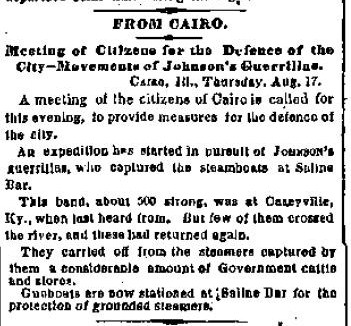
grounded steamers captured

From a Seneca County, New York newspaper in 1863:

A Rebel Raid into Illinois.


ARJohnson

Stovepipe and men captured grounded steamers

CAIRO, ILL., Aug. 13 [sic?]. About 500 rebel [c]avalry, under Col. Jonson [sic], crossed the Ohio river into Illinois, at Saline Bar Saturday.

The steamers Kate Robinson, Jimmy Perkins, Nightingale, Fanny Brandon and Clara Hall were aground at that place, and were captured by them.

These steamers had a large amount of stock on board, and those in charge of them had to pay several thousand dollars each to save them from destruction.

It is reported in the Herald that Maj. General Butler will soon arrive in Washington, for the purpose of relieving Mr. Stanton as secretary of War.

You might question the truth of this story since General Butler never became War Secretary, but here’s some confirmation of the raid part of the story from south of Mason-Dixon. Apparently the Dispatch picked up the same report as the Seneca County paper. From the Richmond Daily Dispatch August 22, 1864:

A raid into Illinois–five steamers captured and Bonded.

Cairo, August 15.

NYT 8-19-1864

NY Times 8-19-1864

–About five hundred rebel cavalry, under Colonel Johnson, crossed the Ohio river into Illinois, at Saline Bar, on Saturday. The shipsteamers Kate Robinson, Jenny Perkins, Nightingale, Famine, Brandon and Clara Hall were all aground at that place, and were captured, with a large amount of stock on board. The boats were compelled to pay several thousand dollars each to save them from destruction.

I think there is a good chance that Colonel Johnson is Stovepipe Johnson, who “[o]n August 21, 1864, … was blinded by an accidental shot from one of his own men during an attack at Grubb’s Crossroads near Princeton, Kentucky. He was subsequently captured by the Federals and imprisoned for much of the rest of the war in Fort Warren.”

You can read a more complete account of the raid in an article from the August 17, 1864 issue of the Illinois Daily State Journal at Northern Illinois University. There was speculation that the Johnson’s band was headed for Elizabethtown to free some captured rebels, but that didn’t happen.

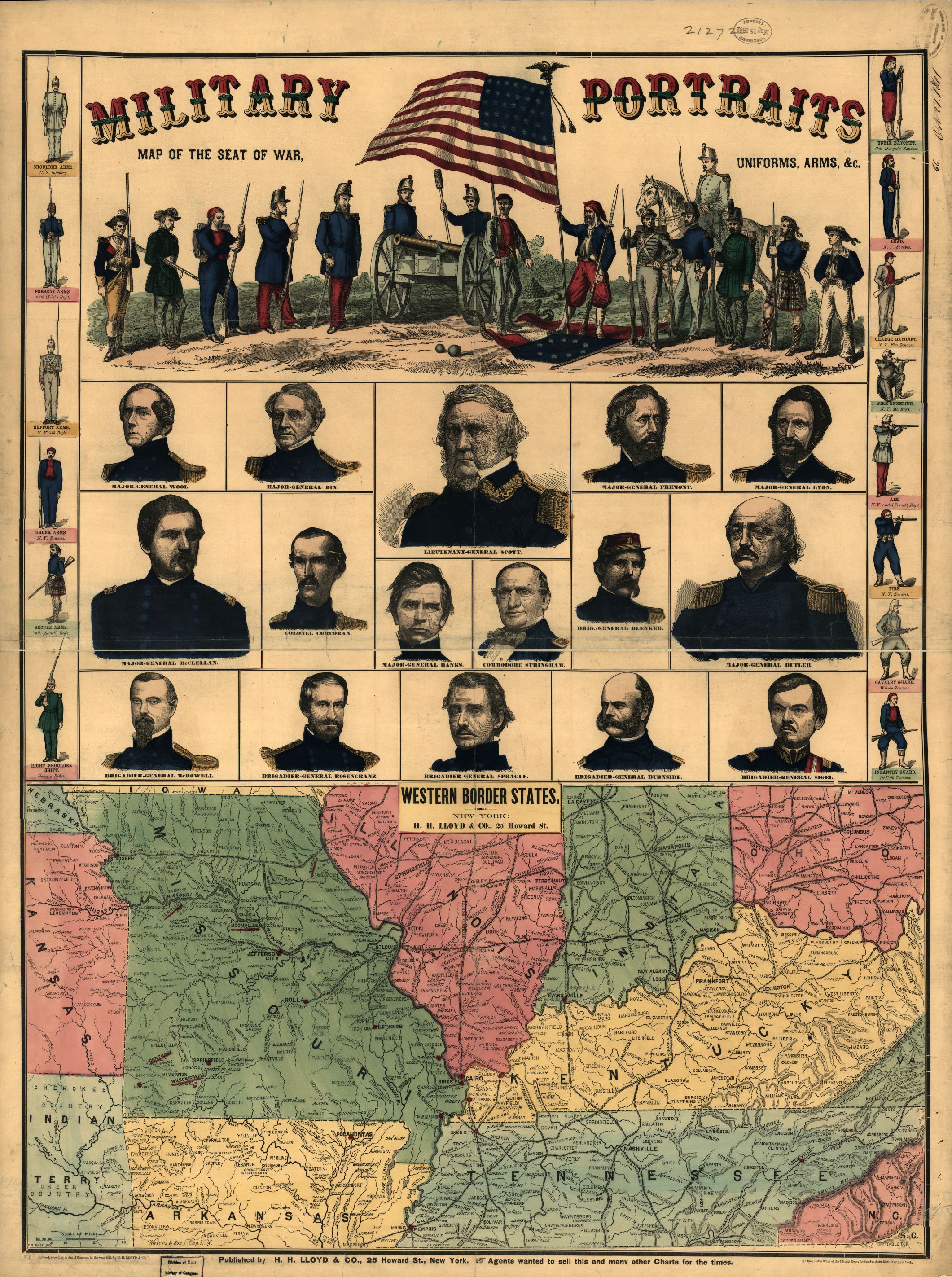
Western border states (c.1861)LOC: http://www.loc.gov/item/99447025/)

still fighting along the border (map c.1861)

____________________________________________________________
____________________________________________________________

back over here

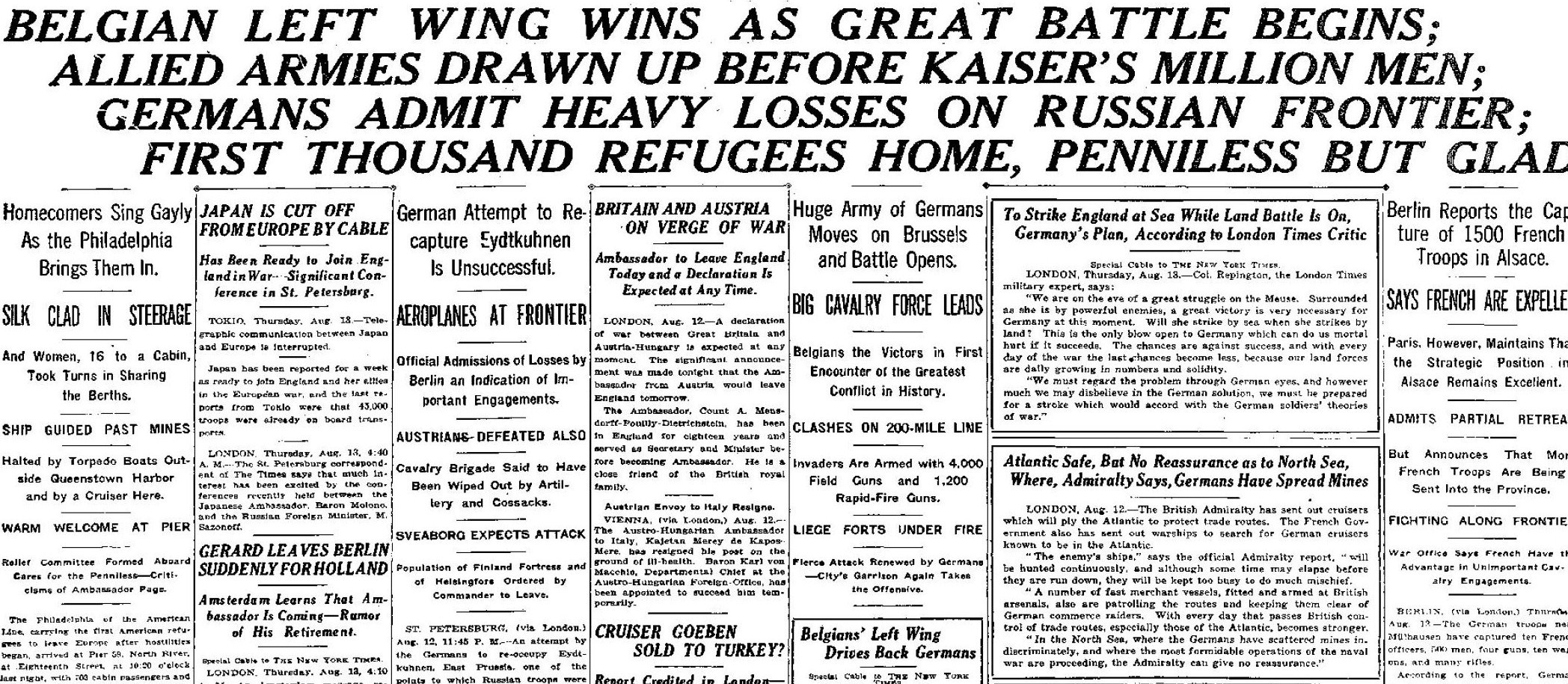
nyt 8-13-1914

first boatload of American refugees to flee Europe arrive in USA (NY Times 8-13-1914)

Posted in 150 Years Ago This Week, Military Matters | Tagged , , | Leave a comment

exchanged

150 years ago today Yankee wounded soldiers and medical personnel, , including the renowned Miss Dr. Walker, left Richmond for a swap on the James.

From the Richmond Daily Dispatch August 13 1864:

Departures by flag-of-truce.

–Four hundred and twenty-five wounded Yankee soldiers, nurses, &c., left this city yesterday morning in the shipsteamer Schultz for Varina [aka Aiken’s Landing], whence they will take the flag-of- truce shipboat North in exchange for an equal number of Confederates now confined in Yankee prisons. Among the number were sent from Castle Thunder the notorious Miss Doctor Mary E. Walker, Surgeons of the Fifty-second Ohio regiment, Dr. Culbertson and Hambleton, from Chambersburg, Pennsylvania, and Captain Samuel Stears, who was formerly a Yankee Custom-House officer. When Miss Dr. Walker emerged from the confines of the Castle she gave vent to an audible huzzah, and raising her hat from her head made an obeisance to the officers of the prison, which plainly indicated that she had no regrets in leaving there, and would remember them in her communications which would be made after her arrival home.

Posted in 150 Years Ago This Week, Confederate States of America | Tagged , , | Leave a comment

a whittlin’ in the sun

A Richmond newspaper reprinted the following report, in which a British war correspondent doubts that General Grant and the Union forces were going to defeat the South, with its armies motivated by hatred for the enemy and love of states’ rights. On the other hand, Northern soldiers fight for a variety of reasons; if the South effectively left the Union it would be no big deal to a soldier from Maine. One disadvantage of reprinting month old material – I’m pretty sure Mobile cares about Farragut’s flotilla now.

Forgive me, but Mr. Russell’s depiction of General Grant whittling as the dead and wounded piled up kind of reminded of Madame DaFarge knitting her way through the French Revolution.

From the Richmond Daily Dispatch August 11, 1864:

Russell on the Situation.
[From the London Army and Navy Gazette, July 13, 1864.]

Lieutenant-General Ulysses Grant seems to us to be in what he would most probably term, in his own nervous diction, “a very tight place.” It is quite true that in his present position he must give much anxiety to the enemy, and that he menaces the Confederate capital with a greater danger than any the tenacious and valiant Southerners have yet had to encounter from Federal foes; but it is scarcely possible that he can retain that position under the fire of the July and August sun; and as yet any attempt to improve it by advancing has not been attended with encouraging results. As a line is length without breadth, and as a circle is bounded by a line, General Grant may maintain that he has not departed from his pledge to fight out the possession of Richmond “on this line” by moving round the capital, but it is difficult to perceive what advantage he has gained by approaching it now from the south side if he fails in his purpose of cutting the Confederate communications. That the combination on which he relied for that purpose has signally failed cannot be doubted. Hunter may have done damage to the western lines, but he has suffered dearly for his interference, and the injury was speedily repaired.

The cavalry, in which the Federal seem to have established a decided preponderance, have failed to effect a permanent destruction; and an attempt made by an expedition under Wilson to break up the line between Richmond, via Petersburg and Weldon, must have ended badly, if it be true that the Confederates intercepted the horsemen and forced Meade to march a whole corps and a division to their assistance, with results yet unknown to us. Sheridan, from whom a good deal was expected, has not turned out to be a Zeidlitz, a Murat, or even a Paget. He failed in a very feeble effort to reach Hunter, and he has since lost, we are told, one thousand men in a scamper across the Peninsula, south of Richmond, with the view of getting his corps across the James river to aid the cavalry force belonging to Grant’s army. The next great Federal army, on which the hopes of the North have so long been fixed, promises to become a source of fearful anxiety. Sherman, if not retreating, is certainly not advancing; and if the Confederates can interfere seriously with his communications, he must fall back as soon as he has eaten up all the supplies of the district.

At Charleston all is quiet, and Mobile has ceased to care for Farragut’s flotilla. The blockade cannot keep out arms, supplies and special correspondents, or keep in cotton in the South. On every point of the ragged circle which the Federal seek to penetrate, they are encountered by skillful, resolute and successful opponents. All the enormous advantages possessed by the Federal have been nullified by want of skill, by the interference of Washington civilians, and by the absence of an animating homogeneous spirit on the part of their soldiery. Some fight for pay, others because they can’t help it; some fight for the Union, others for abolition; some for confiscated land, others because they dislike a slave-owning aristocracy. Every Southerner fights because, conscript though he be, he hates his enemy, and is striking for the principle of State rights, which converts the land of his birthplace into a fatherland for him against all the world. Who can be a native of a Union? A native of Georgia or Virginia has something tangible to point to when he is asked where is his country. If the Union were destroyed formally to-morrow, as we believe it has been practically long ago, the man of Maine or Ohio could go back to his home, not much damaged in any way, except in a certain windy pride, and in the happiness derived from the contemplation of excessive size, which rendered him a disagreeable companion to the rest of the world.

New York, indeed, would lose some trade, and tariffs would be modified in some States; but there the mischief would cease. Far otherwise would it be with Georgia or Virginia. If the South were crushed he would become an outcast, a pariah, the scorn of bitter enemies. Therefore, the Southerners fight to the death against the invading revolutionary North and all their hordes, sustained by such a spirit as would have animated the people of England had the First Consul thrown himself on their shores at the head of a Republican and Jacobin army. That, all things considered, the North had the elements of military superiority to such an extent as justified an impartial observer in predicting they would obtain possession of the principal strategic points, the ports, arsenals, large cities, railway termini and rivers in the South, cannot reasonably be denied. It is true they are very far from the attainment of their object now, after all their losses in money and men; nor does it look as if Grant were going to achieve it.–Even if Richmond fell, the South would fight long and desperately. But Petersburg bars the way, and Grant is still sitting in front of the Confederate earthworks whittling sticks, as is his wont, filling the hospitals with the living, and fattening the rank soil with his dead.

Posted in 150 Years Ago This Week, Siege of Petersburg, Southern Society | Tagged , , | Leave a comment