
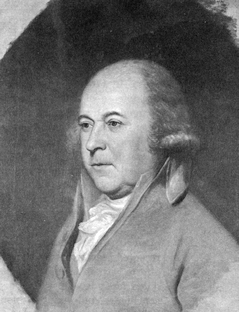
John Adams thought future generations of Americans would celebrate the Second of July as the great day of independence. On that day in 1776 the Second Continental Congress voted to separate from Great Britain and proclaim the thirteen colonies free and independent states. According to Familiar Letters of John Adams and His Wife Abigail Adams During the Revolution by Charles Francis Adams (at Project Gutenberg) John Adams wrote two letters to his wife Abigail Adams on July 3, 1776. Here are excerpts (starting on pages 190 and 192):
3 July, 1776.
… Yesterday, the greatest question was decided which ever was debated in America, and a greater, perhaps, never was nor will be decided among men. A Resolution was passed without one dissenting Colony “that these United Colonies are, and of right ought to be, free and independent States, and as such they have, and of right ought to have, full power to make war, conclude peace, establish commerce, and to do all other acts and things which other States may rightfully do.” You will see, in a few days, a Declaration setting forth the causes which have impelled us to this mighty revolution, and the reasons which will justify it in the sight of God and man. A plan of confederation will be taken up in a few days.
When I look back to the year 1761, and recollect the argument concerning writs of assistance in the superior court, which I have hitherto considered as the commencement of this controversy between Great Britain and America, and run through the whole period from that time to this, and recollect the series of political events, the chain of causes and effects, I am surprised at the suddenness as well as greatness of this revolution. Britain has been filled with folly, and America with wisdom; at least, this is my judgment. Time must determine. It is the will of Heaven that the two countries should be sundered forever. It may be the will of Heaven that America shall suffer calamities still more wasting, and distresses yet more dreadful. If this is to be the case, it will have this good effect at least. It will inspire us with many virtues which we have not, and correct many errors, follies, and vices which threaten to disturb, dishonor, and destroy us. The furnace of affliction produces refinement in states as well as individuals. And the new Governments we are assuming in every part will require a purification from our vices, and an augmentation of our virtues, or they will be no blessings. The people will have unbounded power, and the people are extremely addicted to corruption and venality, as well as the great. But I must submit all my hopes and fears to an overruling Providence, in which, unfashionable as the faith may be, I firmly believe.
Philadelphia, 3 July, 1776.
[If the colonies separated seven months earlier, things might have been better – the Americans might have taken Canada, for example.]
now comes the hard part
… But, on the other hand, the delay of this Declaration to this time has many great advantages attending it. The hopes of reconciliation which were fondly entertained by multitudes of honest and well-meaning, though weak and mistaken people, have been gradually, and at last totally extinguished. Time has been given for the whole people maturely to consider the great question of independence, and to ripen their judgment, dissipate their fears, and allure their hopes, by discussing it in newspapers and pamphlets, by debating it in assemblies, conventions, committees of safety and inspection, in town and county meetings, as well as in private conversations, so that the whole people, in every colony of the thirteen, have now adopted it as their own act. This will cement the union, and avoid those heats, and perhaps convulsions, which might have been occasioned by such a Declaration six months ago.
But the day is past. The second day of July, 1776, will be the most memorable epocha in the history of America. I am apt to believe that it will be celebrated by succeeding generations as the great anniversary festival. It ought to be commemorated as the day of deliverance, by solemn acts of devotion to God Almighty. It ought to be solemnized with pomp and parade, with shows, games, sports, guns, bells, bonfires, and illuminations, from one end of this continent to the other, from this time forward forevermore.
You will think me transported with enthusiasm, but I am not. I am well aware of the toil and blood and treasure that it will cost us to maintain this Declaration and support and defend these States. Yet, through all the gloom, I can see the rays of ravishing light and glory. I can see that the end is more than worth all the means. And that posterity will triumph in that day’s transaction, even although we should rue it, which I trust in God we shall not.
The Congress passed the Declaration of Independence on July 4th. By modern standards it took a while for the news to spread throughout the states. From The Literary Diary of Ezra Stiles, Volume II at Internet Archive (p21-22):
the British made us do it
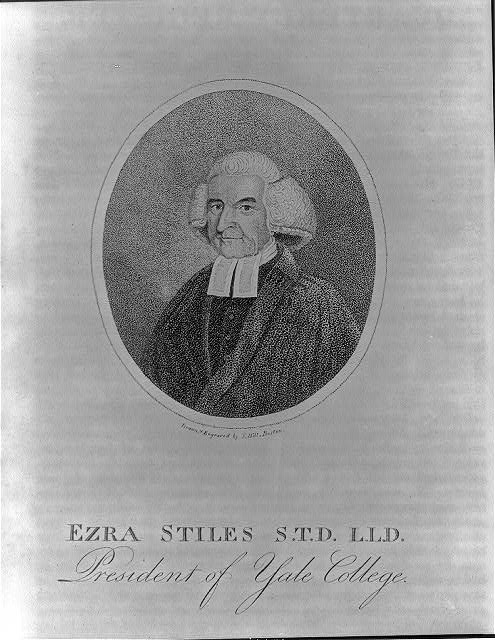
July 13, 1776. Mr. Channing returned from Newport and brought the Congresses Declaration of INDEPENDENCY dated at Philadelphia the fourth day of July instant. This I read at noon, and for the first time realized Independency. Thus the CONGRESS have tied a Gordian Knot, which the Parliament will find they can neither cut nor untie. The thirteen united Colonies now rise into an Independant Republic among the kingdoms, states and empires on earth. May the Supreme and Omnipotent Lord of the Monarchical Republic of the immense Universe, shower down his blessings upon it, and ever keep it under his holy protection! And have I lived to see such an important and astonishing revolution? Scotch policy transfused thro’ the collective body of the ruling powers in Great Britain; and their violent, oppressive and haughty measures have weaned and alienated the affections of three millions of people, and dismembered them from a once beloved parent state. Cursed be that arbitrary policy! Let it never poison the United States of America!
Ezra Stiles seemed to echo the importance of divine protection as stated in the last last sentence of the Declaration:
We, therefore, the Representatives of the united States of America, in General Congress, Assembled, appealing to the Supreme Judge of the world for the rectitude of our intentions, do, in the Name, and by Authority of the good People of these Colonies, solemnly publish and declare, That these United Colonies are, and of Right ought to be Free and Independent States; that they are Absolved from all Allegiance to the British Crown, and that all political connection between them and the State of Great Britain, is and ought to be totally dissolved; and that as Free and Independent States, they have full Power to levy War, conclude Peace, contract Alliances, establish Commerce, and to do all other Acts and Things which Independent States may of right do. And for the support of this Declaration, with a firm reliance on the protection of divine Providence, we mutually pledge to each other our Lives, our Fortunes and our sacred Honor.
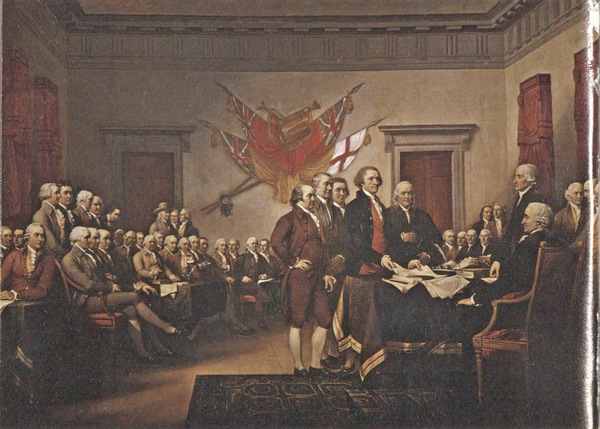
drafting committee presents the document
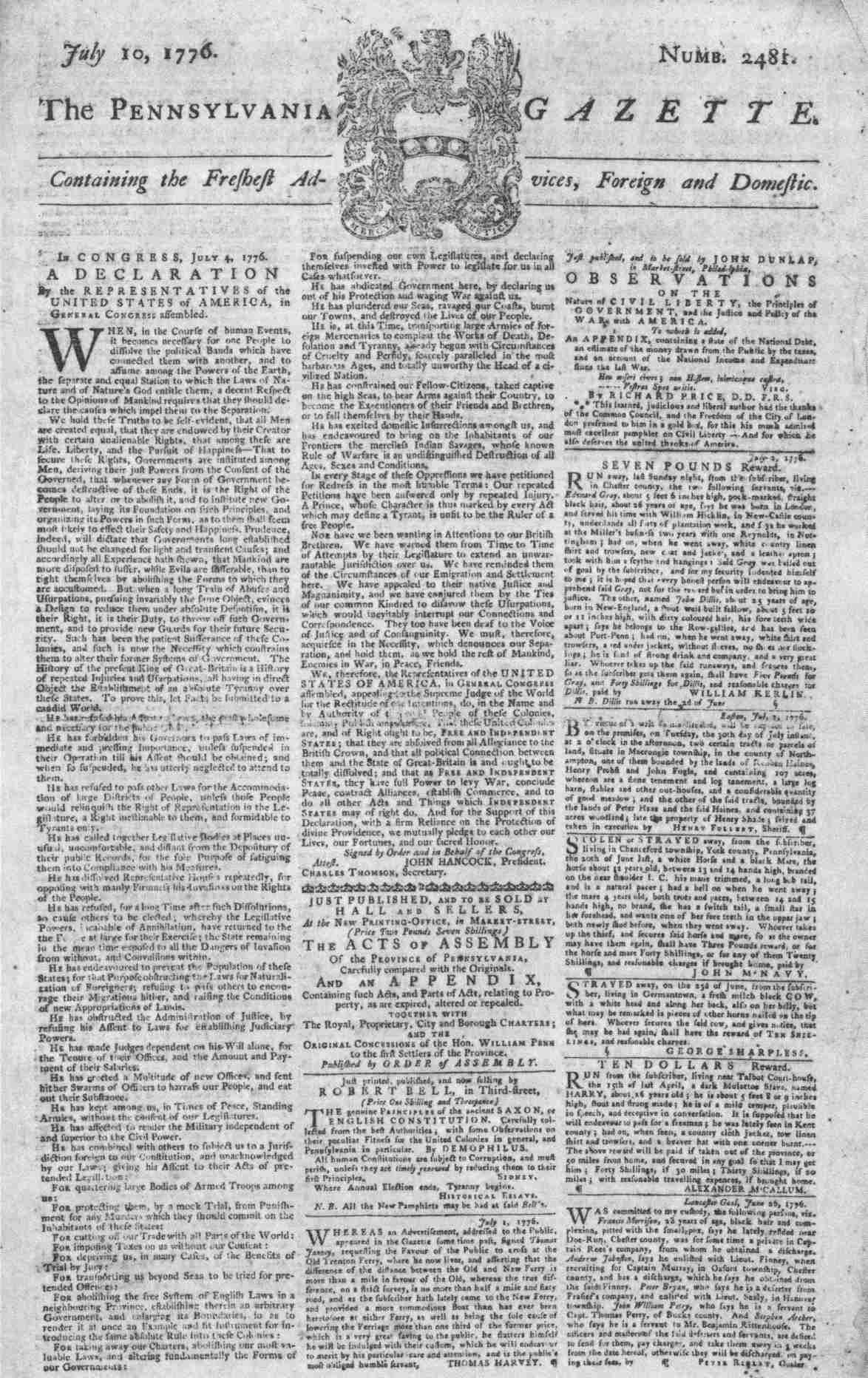
The Pennsylvania Gazette July 10, 1776
Excerpts from John Adams’ letters and Ezra Stiles’ diary entry were published in The Spirit of ‘Seventy-Six. [1]. I used the book’s modern rendering of Ezra Stiles’ diary entry in this post. A letter from John Adams to Samuel Chase in the same section of the book said when the Declaration was published and proclaimed on July 8th the people in Philadelphia celebrated with three cheers, feu de joie, and “The bells rang all day and almost all night.”
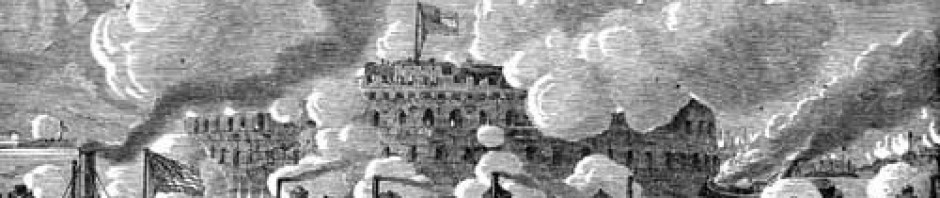
From the Library of Congress: Declaration of Independence from 1851; Ezra Stiles, who served as president of Yale from 1778-1795. From Wikimedia Commons: William B. T. Trego’s 1883 painting, The March to Valley Forge
From the National Park Services 1973 Signers of the Declaration at Project Gutenberg: John Adams; Drafting Committee presenting their draft of the Declaration on June 30, 1776; Declaration as printed on the first page of the July 10, 1776 issue of The Pennsylvania Gazette. “This eBook is for the use of anyone anywhere in the United States and most other parts of the world at no cost and with almost no restrictions whatsoever. You may copy it, give it away or re-use it under the terms of the Project Gutenberg™ License included with this eBook or online at www.gutenberg.org. If you are not located in the United States, you will have to check the laws of the country where you are located before using this eBook.”
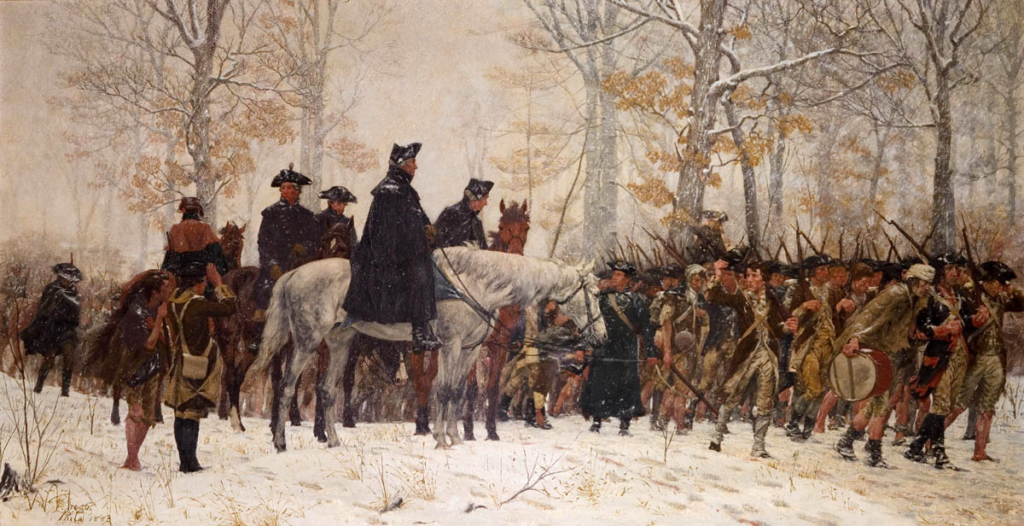
toil and blood and treasure that it will cost us
- [1]Commager, Henry Steele and Morris, Richard B. (eds). The Spirit of ‘Seventy-Six. Edison New Jersey: Castle Books 2002, pages 320-322] ↩
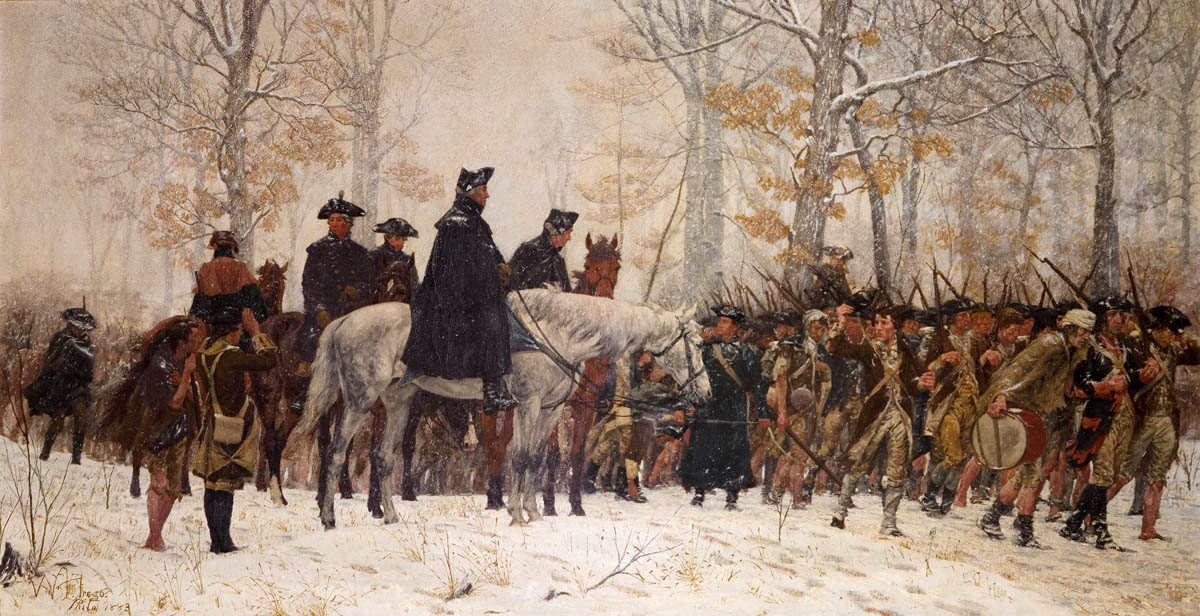
toil and blood and treasure that it will cost us

