Abundant Virginia

Scarcity in the army only due to transportation issues and poorly executed impressments

Two days after the Richmond Bread Riot(squelched by the press to conform to the Secretary of Defense’s wishes) a Richmond paper reproduced an editorial squelching the rumor that the Confederate government was going to abandon Virginia because of scarcity of supplies.

From the Richmond Daily Dispatch April 4, 1863:

An Absurd rumor.

–The following sensible remarks, from the Lynchburg, Republican, in connection with a most ridiculous sensation story which has been effort, also, in this city for the last two or three days, we commend to all who may have been timid enough to place any reliance in it:

There was an idle rumor afloat in our city yesterday, to the effect that President Davis was going to issue a proclamation announcing the evacuation of Virginia as a military necessity, growing out of the scarcity of provisions. We hardly suppose that any sensible man has given a moment’s credence to such a senseless report. A moment’s reflection will teach any one capable of being taught a single idea that if the evacuation of Virginia was a military necessity the President would have too much prudence to announce it in an official, bulletin to our enemies; and it is a not less self evident proposition, that to evacuate Virginia for the want of provisions would simply be to “jump from the frying-pan into the fire.” Where would our armies go for better supplies? If the provisions are in North Carolina or Georgia they can be much better transported to the Army of the Potomac than the army can be transported to the provisions. Besides, to abandon Virginia on account of a lack of supplies would be to surrender all we have in Virginia at this time, and all we can promise ourselves by the new crop of coming summer. To give up the most valuable agricultural country in the world to the devastation of the enemy would be a very foolish way to feed our armies.

But the rumor is too silly a one to demand notice, and we have merely alluded to it because there are a great many silly people in the world who can blow a bladder into a balloon of tremendous proportions. Virginia is not going to be evacuated for any cause, and while there may be some scarcity of supplies in our army, it is simply because the necessary transportation has not been available for some time, and because the mode of executing impressments for some time has been such as to deter farmers from sending forth their products to market. There is a plenty in the country to feed our armies until the new crop comes in, and enough of muscle in our army to whip the hosts of fighting Joe Hooker whenever that valiant Yankee may think proper to cross the Rappahannock.

The Confederate impressment law of March 26, 1863 codified the informal impressment that had occurred since 1861 and “directed military officials, with the assistance of state boards of impressments, to buy food, fuel, and other needed commodities.”

A few months after impressment became law, Confederate losses at Gettysburg and Vicksburg, combined with high inflation, created a chorus of popular protest. Government price schedules hovered at almost 50 percent below the market rate, outraging farmers and merchants. Adding to their frustration was the uneven way in which goods were impressed. Areas near military campaigns and encamped armies were picked clean, while in other areas impressed goods rotted for lack of transportation. Moreover, it was not uncommon for Southerners to impersonate impressment agents in order to obtain food and fuel to support their own needy families.

The transportation issues probably had something to do with the railroads. On March 30, 1863 The New-York Times ran an article about the importance of the railroads to the South and the fact they were wearing out with little chance of being repaired because of the war and blockade, not to mention a probable labor shortage. The Times correspondence includes this from the Richmond Examiner of March 18, 1863:

β€œIt is a fact, as well known to the enemy as to ourselves, that all the country in the vicinity of our armies has long been stripped of its provisions and forage, and that these armies depend for their existence and maintenance of their present positions upon the railroads. The railroads of this State are on the point of wearing out. They have decreased their speed to ten miles an hour as a maximum rate, and are carrying twenty five to fifty per cent. less tonnage than formerly. * * The wood-work of the roads has rotted, and the machinery has worn out. * * We are not informed of the actual condition of the railroads in the more Southern States, but conceive they are little better off than our own, except in the matter of negro labor. * * Railroads are a part, and an indispensable part, of our military system; and if they are allowed to fall through from any cause, Government and people may prepare for the retreat of our armies, and the surrender of much of the valuable country now in our possession.”
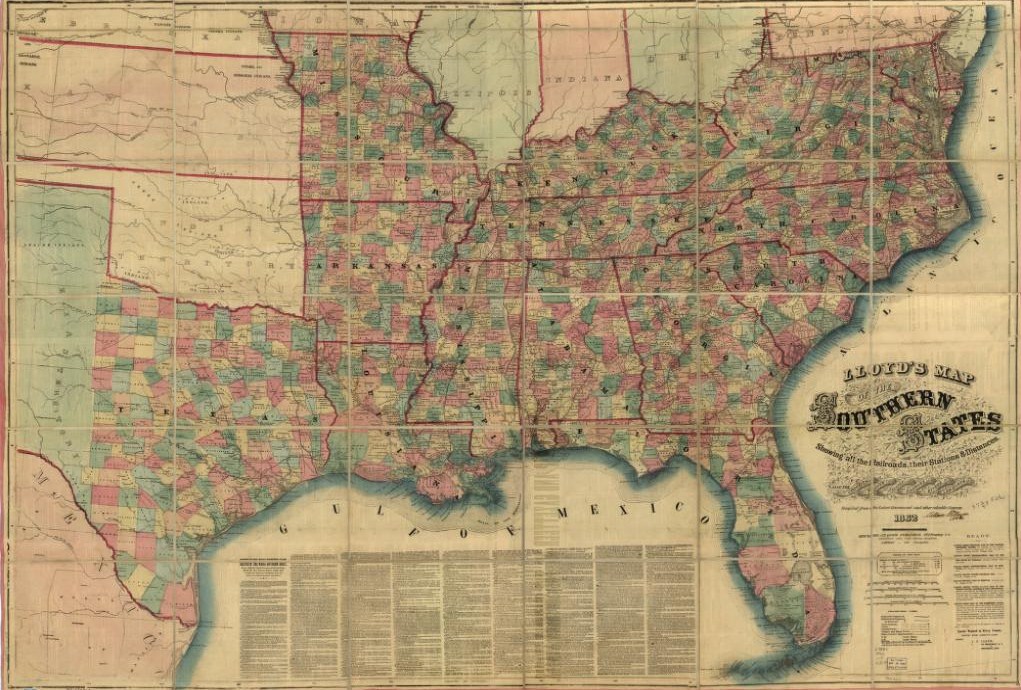
Lloyd's map of the southern states showing all the railroads, their stations & distances, also the counties, towns, villages, harbors, rivers, and forts. 1862 (http://memory.loc.gov/cgi-bin/query/h?ammem/gmd:@field%28NUMBER+@band%28g3860+rr001380%29%29)

Southern states in 1862 with their gradually rotting railroads

Posted in 150 Years Ago This Week, Confederate States of America, Southern Society | Tagged , , , , , | Leave a comment

supply side Sleight of hand

Shows railroad lines emanating south and east of Atlanta going toward Macon and Columbus, Ga., with a notation "125 miles from Atlanta to Andersonville [Prison]." by Robert Knox Sneden

stowing away the corn in Columbus

“Supply and Demand” an “old standard”

James Seddon, the Confederate Secretary of War pleaded with newspapers not to publish accounts of the April 2, 1863 Richmond Bread Riot. Nevertheless, 150 years ago today a Richmond paper was able to continue one of its main themes – one of the underlying causes of the seeming scarcity was speculation throughout the South.

From the Richmond Daily Dispatch April 4, 1863:

“Shall speculators be longer Tolerated?”

–Under the above heading the Columbus (Ga.)Enquirer thus writes:

It is apparent to every observing men that speculation has much to do with the prevailing high prices. The old standard of “supply and demand” is constantly referred to by those who apologize for speculation; and it is insisted that nothing but a scarcity inadequate to the demand enhances prices. This test would be a good one if all the supply was in market for sale. But the face [fact?] is notorious that immense supplies of provisions are held up by speculators for still higher prices. We have no doubt of the truth of the assertion that there was never before half the amount of corn stowed away in Columbus, as at the present time; yet the article commands a Signer [higher?] price than it has for many years before. It has been bought for speculation, and the speculators are still buying, and prices constantly advancing. That the heavy operations of these dealers have run up the only kind of breadstuffs that the great make of the people can at present afford to eat, to the prevailing extraordinary price, is beyond question.

It is believed, moreover, that the store rooms of deniers contain very large quantities of sugar, syrup, salt, etc., which are not offered for sale at even the high prices now ruling, but are held up for still higher figures. It is not so much an inadequate supply as the withdrawal of that supply from market, that makes scarcity and high prices.

Up North it was reported that the federal government had found a way to intervene in the quinine market to make that market work better.

From The New-York Times April 1, 1863:

… The day after the publication in the TIMES of the intention of the Medical Department to manufacture its own quinine, the price of that article declined 33 per cent., and within a day or two past the Department has received propositions from parties in New-York and Philadelphia, offering to furnish the drug at a reduction of 70 cents per ounce. Speculators in the article have lost heavily. …

Quinine was, and still is, used to treat malaria and other fevers. A surgeon in one Connecticut regiment wrote, “In one pocket I carried quinine, in the other morphine and whiskey in my canteen”. As with other important products the Confederacy developed quinine substitutes, which I guess is another way to deal with supply issues.

Posted in 150 Years Ago This Week, Confederate States of America, Southern Society | Tagged , , , , | Leave a comment

Let them read papers

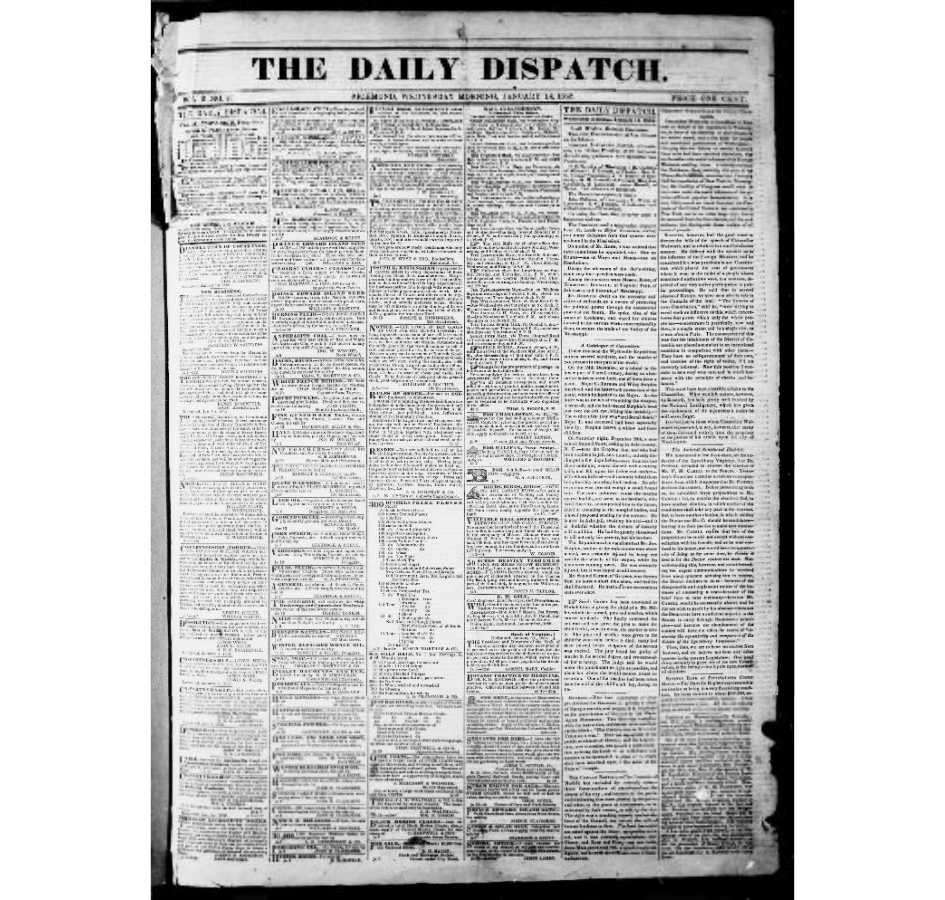
Daily Dispatch January 14, 1852

Keeping your youngsters out of the grog shop

From the Richmond Daily Dispatch April 2, 1863:

Give your child a Newspaper.

–A child beginning to read becomes delighted with a newspapers, because he reads of names and things which are very familiar, and will make progress accordingly. A newspaper in one year is worth a quarter’s schooling to a child, and every father must consider that substantial information is connected with advancement.

A mind occupied becomes fortified against the ills of life, and is braced for any emergency. Children amused by reading and study are, of course, more considerate and more easily governed. How many thoughtless young men have spent their evenings in a tavern or grog shop who ought to have been reading! How many parents who have not spent twenty dollars for books for their families, would have given thousands to reclaim a son or daughter who had ignorantly and thoughtlessly fallen into temptation.

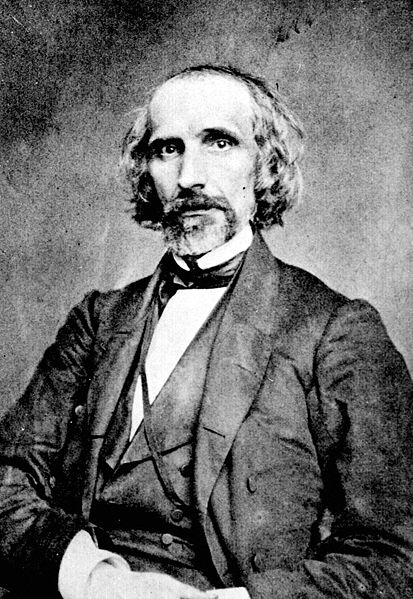
James Alexander Seddon

Please! don’t publish fodder for Yankee propaganda

Of course, in 1863 Richmond children would have been reading a good deal of slave culture propaganda. The Library of Congress chronicles the pro-slavery stance of Dispatch publisher James A. Cowardin

It seems somehow ironic that this article was published on the same day as the Richmond Bread Riot. I scanned ahead about a week in the Dispatch but not notice any obvious reports on the April 2nd disturbance. As the Encyclopedia Virginia points out:

Although the riot was over in two hours, it had shocked locals. Many believed that the rioters did not “suffer real want,” while others accused outside agitators of causing the fracas. Confederate secretary of war James A. Seddon implored the local press not to publish accounts of the disturbance for fear it would fuel Union propaganda and undermine morale at home. To some extent Seddon succeeded, but Union prisoners of war in Richmond reported what they saw and the New York Times ran a front-page article about the bread riot on April 8, 1863.

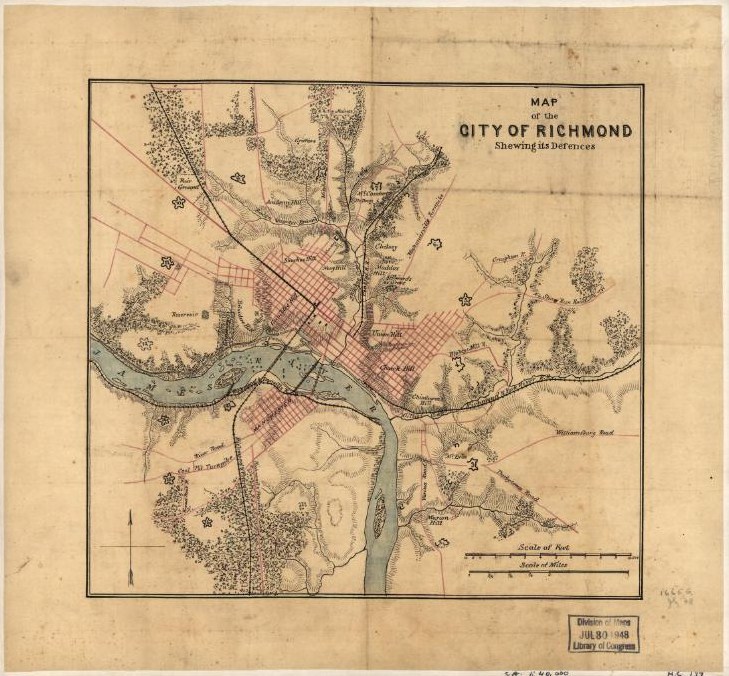
City of Richmond 1864, Hotchkiss map collection ; no. 177

Could you shew us where the bread riot was?

This story struck a chord with me. As a kid I used to listen to Syracuse University football games on Saturday afternoon and read all about it in the next day’s newspaper. I have a faint memory of the incandescent light bulb going off – oh, that’s how you spell Csonka. And yes, in my lifetime paper newspapers have become so passe.

Posted in 150 Years Ago This Week, Confederate States of America, Southern Society | Tagged , , , , | Leave a comment

DC Union meeting

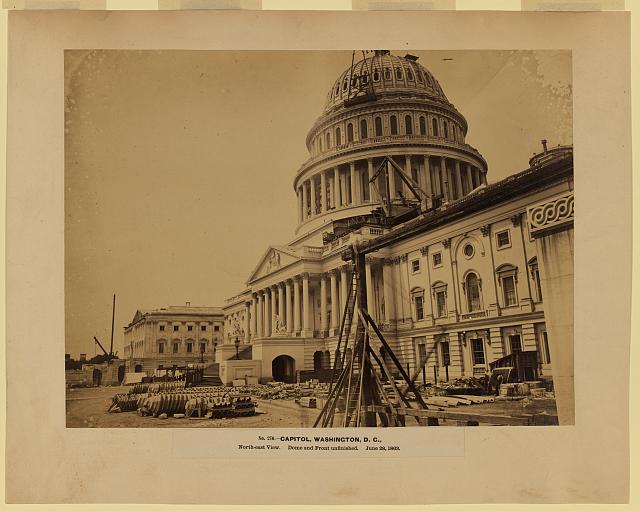
Capitol June 1863

Capitol June 1863

150 years ago yesterday a big Union rally was held in the federal Capitol. Andrew Johnson made an impassioned speech with President Lincoln looking on. Green Adams, a native of the president’s old home of Kentucky, agreed that the Administration should do whatever it took to preserve the Union. He supported the Emancipation Proclamation, even though he himself was a slave owner.

From The New-York Times April 1, 1863:

OUR SPECIAL WASHINGTON DISPATCHES.; THE GREAT UNION MEETING. COMMUNICATING WITH THE ENEMY. COMPTROLLER OF THE FINANCES. EXCHANGES. QUININE. THE WAR COMMITTEE. PROVOST-MARSHALS. AN ESCAPE. PENSIONS. A SENTENCE DISAPPROVED. NEGRO REGIMENTS.

WASHINGTON, Tuesday, March 31.

It is going on to 11 o’clock at night, and the great Union meeting, which was organized at 5 in the afternoon, is yet in full tide of enthusiastic progress. Every seat in the House of Representatives was filled. The rotunda and side passages were choked, and the Senate Chamber was also full. Mayor WALLACH presided over the meeting in the Hall. The resolutions, offered by Gen. RIBB, call on the Government to prosecute the war with the utmost energy, assuring it of the people’s confidence and support, and expressing the utmost confidence in being able very soon to crush out the rebellion. The resolutions, received with the most enthusiastic favor, were frequently interrupted by applause. Every allusion to carrying on the war with vigor, and exercising severe measures to suppress treason in our midst, was especially applauded. Alderman SARGENT introduced an additional resolution, calling upon the Government to exercise arbitrary power over domestic treason, and complimenting the people of Baltimore and Gen. SCHENCK. GR[E]EN ADAMS, of Kentucky, concluded an eloquent speech with the declaration that, as a Kentuckian and a slaveholder, he contended the Government had the power to deprive traitors not only of property, “niggers” and all, but of life. [Great cheering.] And in his opinion, so far from violating the Constitution, he performed only his duty. When Gen. JACKSON had a man to hang, if he could not do so under one law, he would under another. There was no such loyalty to be found elsewhere on the earth as in Kentucky. He believed that the President had the right to do anything that he saw necessary to put down rebellion, and hoped he would exercise it. [Loud and prolonged cheering.]

Andrew Johnson, Senator from Tennessee, Thirty-fifth Congress, half-length portrait (by Julian Vannerson, 1859; LOC:  LC-DIG-ppmsca-26767)

“burst of eloquence”

Admiral FOOTE, Judge CARTER, of the District Supreme Court, and HORACE MAYNARD, of Tennessee, made war speeches of the most uncompromising character, and were followed by Gov. ANDREW JOHNSON in a burst of eloquence seldom equaled in the Representatives’ Hall. He invoked an out-and-out support of the Government, and condemned all thought of compromise.

The President and Secretaries CHASE, SEWARD, BLAIR, USHER, and a very large number of Commodores and Generals and Judges were upon the platform. There never was a meeting in Washington at all to be compared with this, in numbers, respectability and enthusiasm. It has stirred every quarter of the city while it was in progress. Similar ones filled the Senate Hall and Rotunda, and made entrance into the Capitol anywhere almost impossible. The idea in all the speaking was the maintenance of the war to the end, last however long it might.

I thought the rest of the article was interesting. The Commissioner of Internal Revenue working on the tax code. General Franklin testifying on Fredericksburg and Antietam. An ingenious escape from Libby. 28,000 applications for war related pensions.

Under the stringent enforcement of the order issued recently by Gen. HEINTZELMAN, the disloyal residents of this vicinity find it almost impossible to maintain communication with their friends across the border. They have heretofore got passes beyond the lines, trusting to their familiarity with our officers stationed near their homes to enable them to run our pickets on their return. Many who have thus trusted to luck are unexpectedly shut out from their homes, readmission within the lines being made conditional upon taking the oath of allegiance, which they stubbornly refuse. Among those turned back yesterday was the widow of JACKSON, the murderer of ELLSWORTH, who resides at Centreville.

The name of Hon. E.G. SPAULDING, of Buffalo, has been mentioned, to-day, as the possible appointee to the vacant office of Comptroller of the Finances.

Arrangements are completed, for the exchange of all Union officers held by the rebels. Surg.-Gen. HAMMOND has instructed the surgeons in charge of hospitals to send to Baltimore immediately all rebel officers able to be removed, preparatory to sending them to City Point for exchange.

The day after the publication in the TIMES of the intention of the Medical Department to manufacture its own quinine, the price of that article declined 33 per cent., and within a day or two past the Department has received propositions from parties in New-York and Philadelphia, offering to furnish the drug at a reduction of 70 cents per ounce. Speculators in the article have lost heavily.

Gen. FRANKLIN, in his testimony before the War Committee to-day, respecting the battle of Fredericksburgh, denied ever having received any orders from Gen. BURNSIDE to reinforce Gen. MEADE, and substantially pronounced Gen. BURNSIDE’s testimony on that point to be untrue. He confessed that at Antietam 7,000 of his men never fired a shot, and that none of PORTER’s corps were engaged. Though a strong friend of MCCLELLAN’s, his involuntary condemnation of his conduct after that battle, in failing to pursue the enfeebled enemy, is the most damaging yet presented against that General.

The Secretary of War has been engaged to-day with Col. FRY, the Provost-Marshal General, in making the appointments of Provost-Marshals for Pennsylvania. They will probably be announced to-morrow. The Secretary has in many districts appointed officers who have been wounded in the service and honorably discharged.

Seven Union prisoners, confined in the Libby Prison, at Richmond, recently escaped from there by the following clever ruse: The small-pox having broken out in the prison, to prevent its further spread the patients, as soon as attacked, were removed, for medical treatment, to the pest-house, on the outskirts of the city. In order to get to the pest-house, which afforded a better opportunity to escape from than the prison, the men heated a wire and burned their faces in blisters, and, under pretence that they had the disease, asked to be removed to the pest-house. This was immediately done. After remaining in the hospital for a few hours, they managed to elude the vigilance of the guard and make good their escape-

The number of applications for widows and invalid pensions is enormous. Since the war began seventeen thousand of the former and eleven thousand of the latter have been received.

IMPORTANT TO PROMOTED OFFICERS.

WAR DEPARTMENT, ADJUTANT-GENERAL OFFICE, WASHINGTON, March 29.

GENERAL ORDERS NO. 70. — To answer frequent inquiries made by general and other officers as to whom they shall report when newly promoted, it is hereby announced, that unless otherwise specially ordered, they will continue on duty in their respecpective departments or armies, and will be assigned by the Commanders thereof. By command of Maj.-Gen. HALLECK.

L. THOMAS, Adj.-Gen.

The Secretary of War has disapproved of the sentence of the Court-martial on Col. NEVIN, Sixty-second New-York, that he be cashiered, and has ordered that he forthwith be released from arrest and restored to his command.

It is said that the President positively refuses for the present to grant authority to raise more negro regiments.

DISPATCHES TO THE ASSOCIATED PRESS.

WASHINGTON, Tuesday, March 31.

REVENUE DECISIONS.

The Commissioner of Internal Revenue has made the following decisions: Warrants of Attorney, accompanying mortgage checks drawn against State funds in bank, are exempt from stamp duty; pawn-brokers’ checks are liable, as agreements, to a stamp duty of five cents. Whenever the receipts of an insurance agent or broker, as compensation for services performed for or on account of the company or companies he represents, amount to the sum of $600 in any one year, he is liable to assessment for a license under the amended Excise law.

Green Adams served as a U.S. Representative from Kentucky twice – the second time (1859-1861) as a member of the Opposition Party, which was made up of pro-Union men opposed to the expansion of slavery into the territories. At the time of this story Green Adams was a federal bureaucrat, working as “Sixth Auditor of the Treasury Department from April 17, 1861, to October 26, 1864.”

[United States Capitol, Washington, D.C. Principle floor plan, vestibule, House of Representatives, Senate Chamber, Library] (by Benjamin henry latrobe, architect 1817; LOC:   LC-DIG-ppmsca-23663)

Capitol architecture 1817

Posted in 150 Years Ago This Week, Northern Politics During War, Northern Society | Tagged , | Leave a comment

Hold Fast

The Papers And Writings Of Abraham Lincoln,
Volume Six, by Abraham Lincoln at Project Gutenberg

PROCLAMATION APPOINTING A NATIONAL FAST-DAY.
BY THE PRESIDENT OF THE UNITED STATES OF AMERICA:

A Proclamation.

March 30, 1863.

Whereas the Senate of the United States, devoutly recognizing the supreme authority and just government of Almighty God in all the affairs of men and of nations, has by a resolution requested the President to designate and set apart a day for national prayer and humiliation:

And whereas it is the duty of nations as well as men to own their dependence upon the overruling power of God; to confess their sins and transgressions in humble sorrow, yet with assured hope that genuine repentance will lead to mercy and pardon; and to recognize the sublime truth, announced in the Holy Scriptures and proven by all history, that those nations only are blessed whose God is the Lord:

And insomuch as we know that by His divine law nations, like individuals, are subjected to punishments and chastisements in this world, may we not justly fear that the awful calamity of civil war which now desolates the land may be but a punishment inflicted upon us for our presumptuous sins, to the needful end of our national reformation as a whole people? We have been the recipients of the choicest bounties of Heaven. We have been preserved, these many years, in peace and prosperity. We have grown in numbers, wealth, and power as no other nation has ever grown; but we have forgotten God. We have forgotten the gracious hand which preserved us in peace, and multiplied and enriched and strengthened us; and we have vainly imagined, in the deceitfulness of our hearts, that all these blessings were produced by some superior wisdom and virtue of our own. Intoxicated with unbroken success, we have become too self-sufficient to feel the necessity of redeeming and preserving grace, too proud to pray to the God that made us:

It behooves us, then, to humble ourselves before the offended Power, to confess our national sins, and to pray for clemency and forgiveness:

Now, therefore, in compliance with the request, and fully concurring in the views, of the Senate, I do by this my proclamation designate and set apart Thursday, the 30th day of April, 1863, as a day of national humiliation, fasting, and prayer. And I do hereby request all the people to abstain on that day from their ordinary secular pursuits, and to unite at their several places of public worship and their respective homes in keeping the day holy to the Lord, and devoted to the humble discharge of the religious duties proper to that solemn occasion. All this being done in sincerity and truth, let us then rest humbly in the hope, authorized by the divine teachings, that the united cry of the nation will be heard on high, and answered with blessings no less than the pardon of our national sins, and the restoration of our now divided and suffering country to its former happy condition of unity and peace.

In witness whereof, I have hereunto set my hand, and caused the seal of the United States to be affixed.

Done at the city of Washington, this thirtieth day of March, in the year of our Lord one thousand eight hundred and sixty-three, and of the independence of the United States the eighty-seventh.
A. LINCOLN.

By the President: WILLIAM H. SEWARD,
Secretary of State.

Posted in 150 Years Ago This Week, Lincoln Administration, Northern Society | Tagged , , | Leave a comment

Anticipation

More soldiers from the New York 33d Voluntary Infantry visited visited home 150 years ago, only two or three months before their two year commitment would be completed.

From a Seneca County, New York newspaper in March 1863:

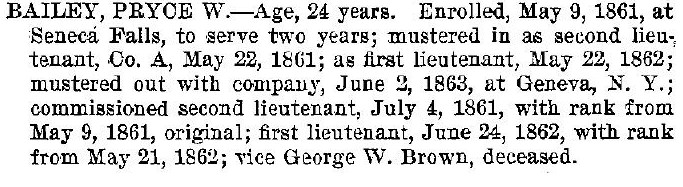
LIEUT. PRICE BAILY of Co. A, 33d regiment, returned home on Monday, on furlough. LIEUT. BAILY is looking remarkably well. He brings good accounts of the gallant 33d.

Pryce W. Bailey

Pryce W. Bailey

From a Seneca County, New York newspaper in 1863:

Lieut. Brett at Home.

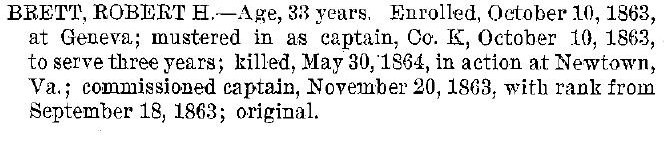
Lieut. Brett, of Co. C, of the 33d, has been at home for a few days past, and returned to-day. The Lieut. is in good health, and does not look as if he had suffered any from the war, notwithstanding the trying and perilous positions, both as regards hardships and danger, in which the 33d has been placed. Co. C has suffered comparatively but little, and we hope to see them all return home when their term of enlistment expires, which will be in May next. – Waterloo Observer.

Even after the 33d mustered out, Robert H. Brett was not going to stay home long. From the New York State Military Museum and its roster of the 1st NY Veteran Cavalry:

RH Brett 1st NY Vet Cavalry

Seven months as a cavalryman

Posted in 150 Years Ago This Month, Military Matters, Northern Society | Tagged , , , | Leave a comment

Present Arms

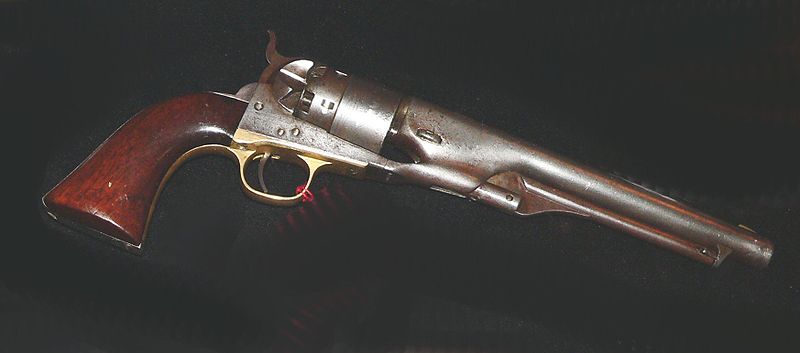
Colt-arme-1860-p1030159

Colt Army Model 1860

From a Seneca County, New York newspaper, presumably sometime in early 1863:

Presentation to Capt. McDonald.

Capt. JAS. H. MCDONALD, of the 50th Regiment, received on Monday evening, a very substantial present at the hands of his fellow-citizens, for gallant and meritorious conduct as a soldier. The presentation took place at Union Hall and was witnessed by a large number in attendence [sic]. The meeting was organized by selecting A.J. GOFFE, Esq., as chairman, after which Hon. BENSON OWEN, in a speech suitable to the occasion, presented the Captain with a pair of Colt’s Revolvers, of the best and most improved patern [sic]. A purse of $50 was also presented. Capt. MCDONALD replied in a brief, modest and appropriate speech, thanking his fellow-citizens for the flattering testimonials presented. It will be remembered that Capt. MCDONALD was seriously wounded while throwing a pontoon bridge accross [sic] the Rappahannock the day previous to the battle of Fredericksburgh, his left arm being pierced by a musket ball. He has not entirely recovered from the effects of the wound. He left, however, for his Regiment on the noon train Wednesday.

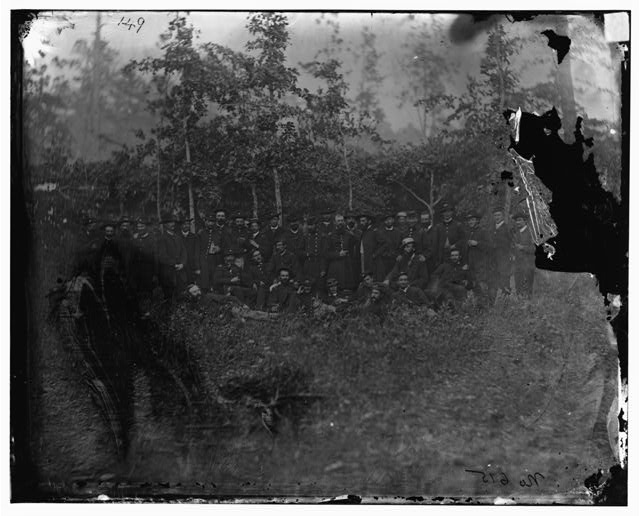
Rappahannock Station, Virginia. Officers of 50th New York Engineers (by Timothy H. O'Sullivan, 1864 Mar; LOC: LC-DIG-cwpb-04077)

Captain McDonald in the picture? 50th NY officers in 1864

Major McDonald was mustered out in June 1865.

The image of the revolver is licensed by Creative Commons.

Posted in 150 Years Ago This Month, Battle of Fredericksburg, Military Matters, Northern Society | Tagged , , , | Leave a comment

Burnside Exiled?

I guess if you’re a strongly Democratic party newspaper you have to pretty much criticize everything the Lincoln administration does. After the Battle of Fredericksburg a Seneca County, New York newspaper blasted the Lincoln and his War Department for the slaughter of General Burnside’s army. Burnside actually took responsibility for the defeat and later offered to resign. News hit the wire 150 years ago this week that General Burnside had been transferred to command of the Department of Ohio. A Seneca County newspaper was again critical. In addition to being partisan this might demonstrate the public mindset that the Eastern theater was preeminent.

From a Seneca County, New York newspaper in March 1862:

Burnside’s New Command.

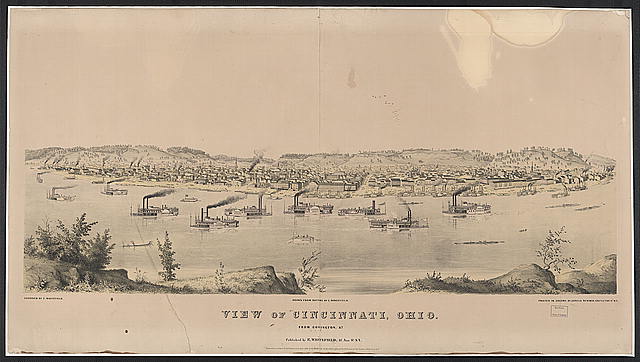
The telegraph announces that major Gen. BURNSIDE has been appointed to succeed Gen. WRIGHT in command of the Department of Ohio, Indiana, Illinois, and part of Kentucky, This command is of no special importance. It takes Gen. BURNSIDE from the field where his services are so much needed, and places him in a position that could be filled equally as well by officers of less calibre and experience. His headquarters will be at Cincinnati.

My thought would be – after the shellacking at Fredericksburg Burnside might have appreciated a change of scenery.

View of Cincinnati, Ohio from Covington, Ky. (by Edwin Whitefield, c.1848; LOC: LC-DIG-ppmsca-09404)

Cincinnati from Kentucky, c.1848

Posted in 150 Years Ago This Month, Military Matters, Northern Politics During War, Northern Society | Tagged , , , | Leave a comment

Sambo and Coffee

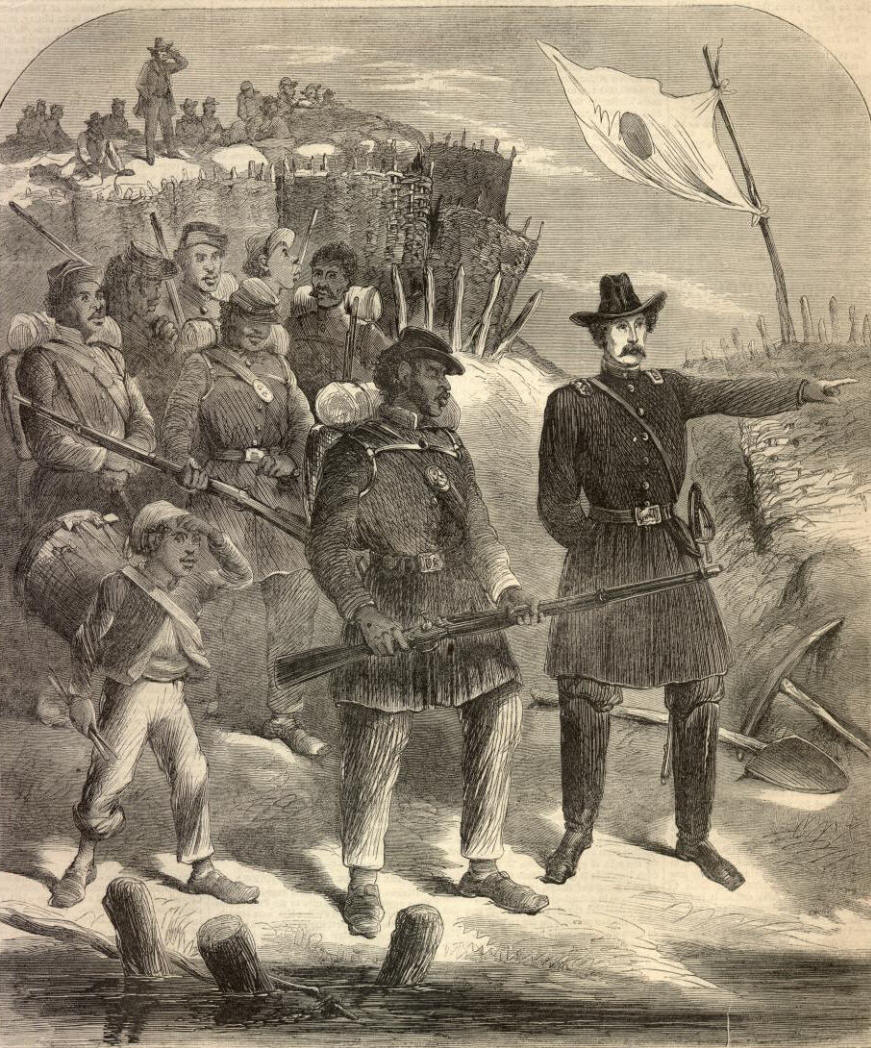
civil-war-negro-soldiers (Harper's Weekly, March 14, 1863)

TEACHING THE NEGRO RECRUITS THE USE OF THE MINIE RIFLE.

A Democratic Party oriented newspaper maintained that blacks would have to be drafted to fight for their freedom.

From a Seneca County, New York newspaper in March 1863:

Drafting the Negroes.

All the highly colored stories concerning negro volunteers at Port Royal, have proved to be mere fiction, and were doubtless gotten up to subserve Abolitionism at the North. The latest news from South Carolina is that Gen. HUNTER has issued a formal order drafting all the able-bodied male negroes within the lines of his military department into the service of the general Government. – Even Sambo and Coffee must be conscripted. They do not willingly rush to arms even when the freedom of themselves and their race is at stake. What say our Abolition friends to this? Shall we hear any more of the “fiery zeal” of the negroes at Port Royal?

The March 14, 1863 issue of Harper’s Weekly (hosted at Son of the South) published a great deal of information about General David Hunter and black troops. There are favorable reports about the First Kansas Colored Volunteers and the First South Carolina Volunteers (colored).

The above image came from the same issue of Harper’s Weekly.

The following photo is entitled “Religious service aboard the monitor Passaic, Port Royal, S.C., 1863” and would seem to support the idea that the Union navy was more integrated than the army.

Religious service aboard the monitor Passaic, Port Royal, S.C., 1863 ( photographed 1863, [printed between 1880 and 1889]; LOC: LC-DIG-ppmsca-33818)

church on a raft

Posted in 150 Years Ago This Month, Military Matters, Naval Matters, Northern Politics During War, Northern Society | Tagged , , , , | Leave a comment

anger management

Sometimes when I reproduce racist articles I feel like me and 150 years are ganging up on the people in the story – I have no idea what my thoughts and actions would be like if I lived so long ago. If we’re all just genes and environment, my environment definitely would have been different. I can be kind of set in my ways, set in my thoughts. I guess I want to try not to judge the actors; I want to respect and learn from the history.

Even though the following might just be a “story”, I thought it was worth putting up because it shows the reality of shortages and inflation during the war. Also, the same newspaper that alluded to the relatively newly developed science of atomic theory a few days ago, thinks it is a “good story” that the doctor here took out his frustrations on three helpless little people (probably pieces of property).

From the Richmond Daily Dispatch March 21, 1863:

A good Hotel story.

-In Atlanta, last week, a little incident occurred in the hotel has of business which is worth reading. The second party to the joke was the proprietor of the Atlanta Hotel. The Atlanta Confederacy says:

A Lieutenant Colonel, who was wounded at Murfreesboro’, who had been stopping a while with him, on the 20th day called for his bill, The obliging clerk handed him the document with 20 days multiplied by $4. The Colonel scanned the bill and observed its footing up–$80. He turned to the doctor, who was present, and asked him if he did not think that pretty heavy. The doctor, with that peculiarities of the head which indicates a small whirlwind, said:

“No; if you had to pay four dollars for a cobbler, one dollar a dozen for eggs, four dollars a pound for Ric[e] coffee, one dollar twenty-five cents for butter, fifteen dollars a bushel for potatoes, and five dollars a pair for shad, you’d think it was light! “

The Colonel ran his eye over his bill again and quietly replied:

“Well, I have been here twenty days, and d β€” n the article you have mentioned have I seen on your table.”

It is said that the doctor rushed out into the back yard, and did not cool off until be had whipped three little niggers.

It is said that fire-eating Dr. James P. Hambleton founded the Atlanta Southern Confederacy in 1859. He sold the paper in 1861 to join the Confederate army. In late April 1863 Dr. Hambleton was arrested in New York City with a large amount of Confederate currency in his possession. It seems like a pretty interesting story that involves General John Wool. And the writ of habeas corpus was actually invoked. Here’s the first paragraph from The New-York Times May 13, 1863:

LOCAL INTELLIGENCE.; The Case of James P. Hambleton. RETURN OF GEN. WOOL TO THE WRIT OF HABEAS CORPUS. RETURN OF GEN. WOOL.

Some two weeks ago Mr. JAMES P. HAMBLETON, of Georgia, formerly editor and publisher of the Southern Confederacy, a paper rendered infamous by the publication several years ago of the “black list” of New-York merchants, (those not supposed to be favorable to the peculiar institution,) was arrested in this city having lately come from Georgia, and having in his possession $27,000 of Confederate money and bonds. When arrested, HAMBLETON claimed to be a Union man and to have opposed the rebellion from the start; but the fact of his having in his possession so large an amount of Confederate money, coupled with his own declaration that he intended soon to return to Georgia by way of Nassau, was regarded as sufficient cause for his detention, and he has since that time been in the custody of the Government authorities, nominally confined in the Park Barracks, but in reality allowed what might be called the freedom of the City. Last week a writ of habeas corpus was issued by Judge MCCUNN to Capt. ARMSTRONG, of the Park Barracks, and Gen. WOOL, requiring them to produce the body of HAMBLETON for the purpose of inquiring into the cause of his detention. On Saturday Capt. ARMSTRONG made return to the writ that he held him by virtue of an order from his superior officer, Gen. WOOL. He also produced the body of HAMBLETON, and Judge MCCUNN adjourned the hearing of the case to 3 o’clock Monday afternoon. At the hour appointed, SAMUEL G. GLASSEY, Esq., as counsel for Gen. WOOL, appeared and made the following further return to the writ: …

Yeah, the Times said this doctor’s newspaper published a “black list” of antislavery New York merchants.

Posted in 150 Years Ago This Month, Confederate States of America, Southern Society | Tagged , , , , | Leave a comment