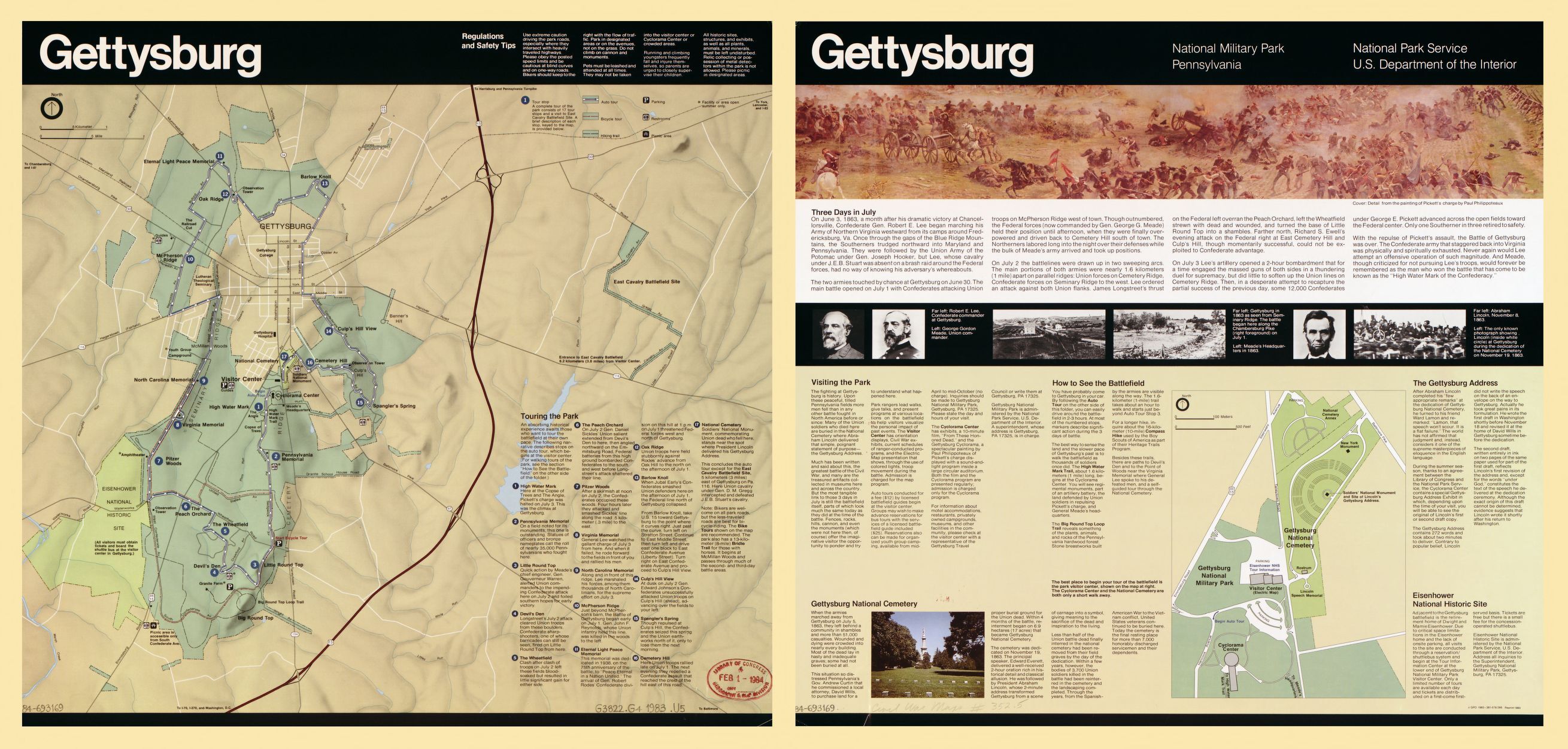

“Summer of Peace”

just a shadow of its future self

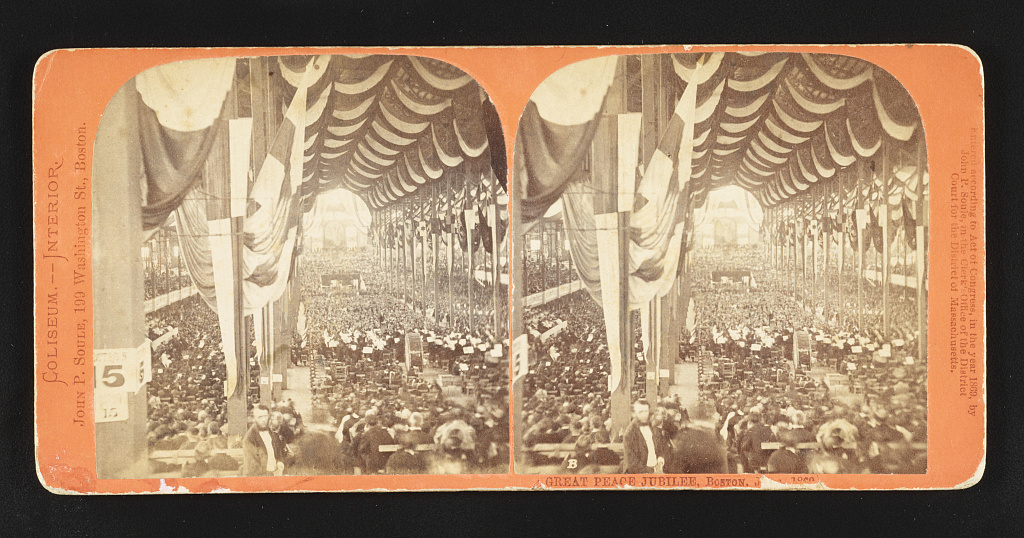
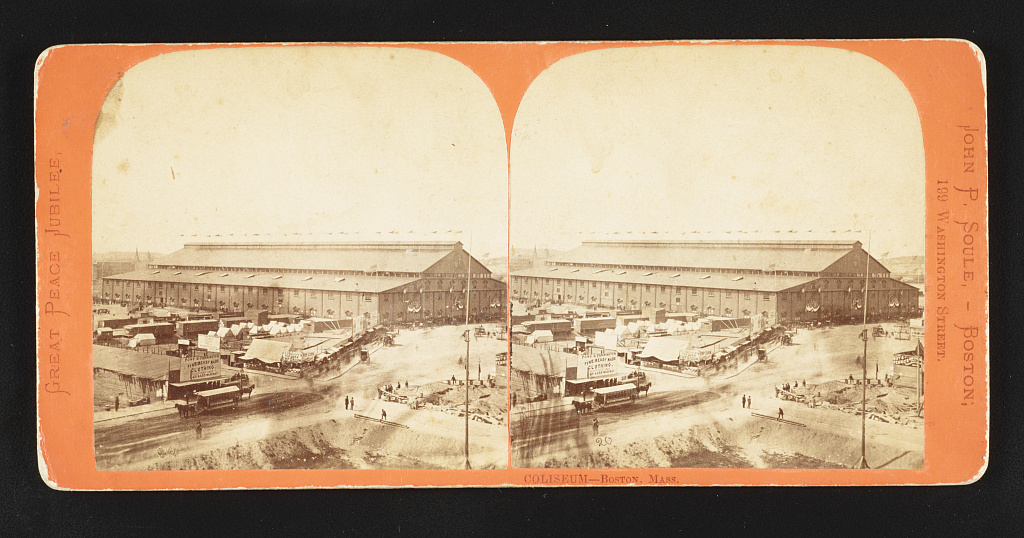
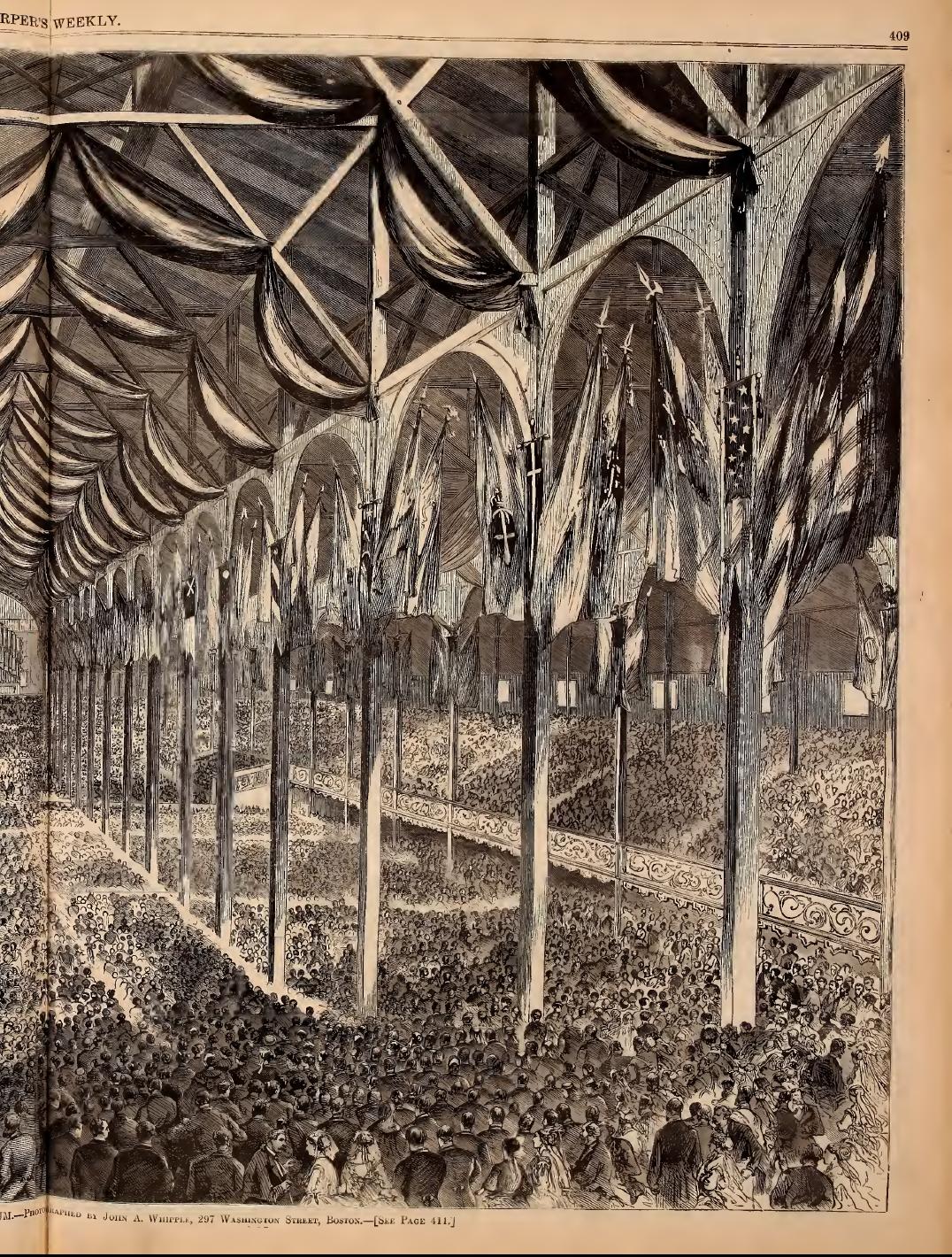
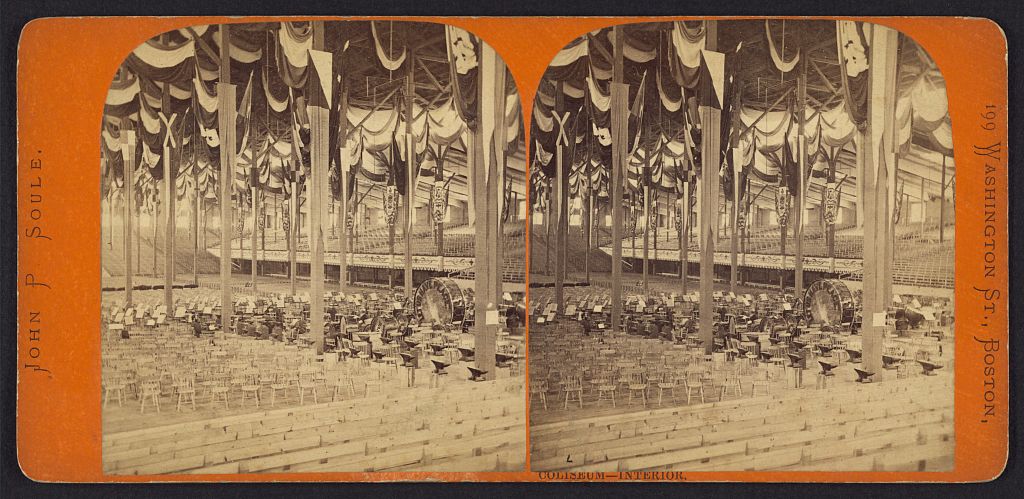
150 years ago this week a National Peace Jubilee was held in Boston, Massachusetts at the Coliseum, a temporary structure built especially for the Jubilee. In its May 22, 1869 issue Harper’s Weekly anticipated the big event:

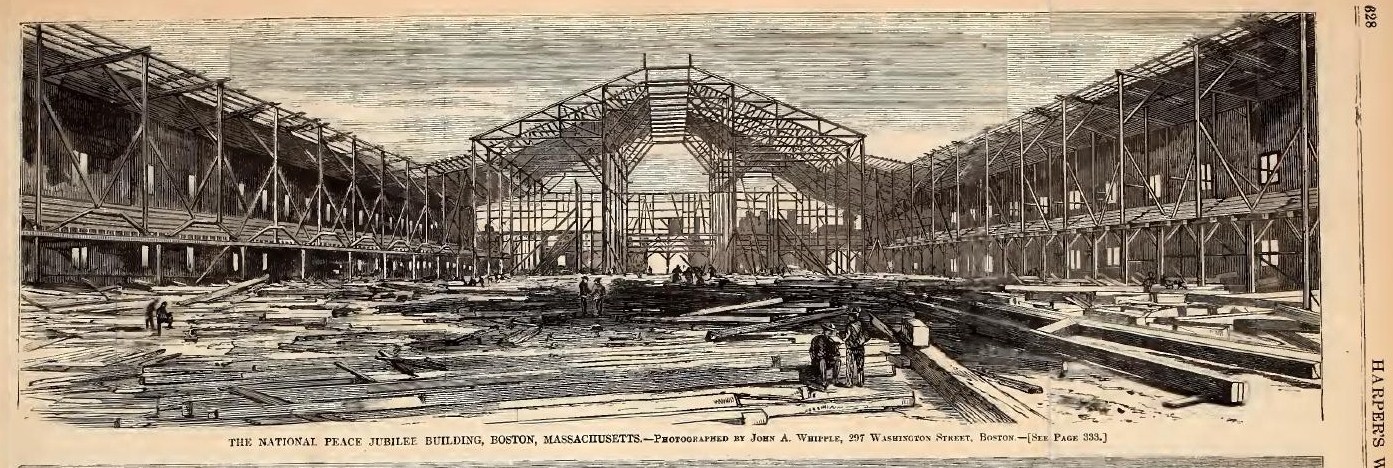
THE NATIONAL PEACE JUBILEE BUILDING, BOSTON.

OUR illustration of this building on page 328 shows its present condition. The musical festival for which it is being constructed will be held in Boston next June, beginning on the 15th, and lasting during [f]ive days. The Coliseum, as this building is called, has been roofed, and the labor of finishing and decorating the interior has been commenced. Over twenty-seven thousand dollars have been subscribed in advance for tickets of admission. Arrangements have been made for the comfortable shelter of the thousands of strangers who are expected to visit Boston during the Jubilee week.

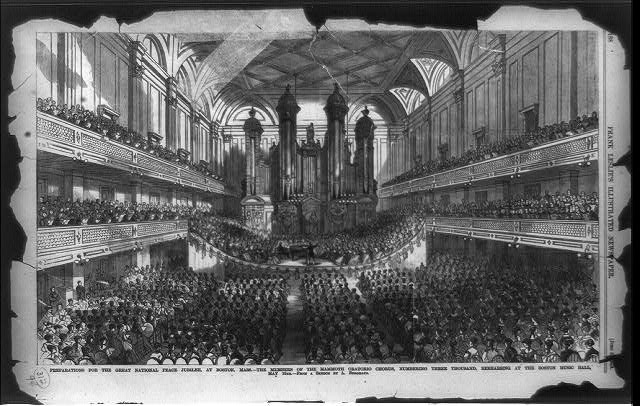
“mammoth oratorio chorus” practicing

Messrs. E. & G.G. HOOK, organ builders, of Boston, have contracted to furnish a large and powerful organ for the Coliseum, to be used at the National Peace Jubilee. It is intended that the instrument shall be one of such strength and power as shall sustain the vast chorus and orchestra, and fill the building with sound. The great chorus, the largest the world has ever seen, is now full, and the orchestral ranks are rapidly filling up, The superintendent of the chorus, Mr. E. TOURJEE, has found it necessary to issue a circular stating that no more choral organizations can be accepted, and that societies already accepted must make no more additions to their numbers. OLIVER WENDELL HOLMES, it is said, is to write a hymn to be sung by the grand chorus.

Harper’s Weekly’s coverage of the Jubilee in its July 3, 1869 issue also covered the city of Boston:

BOSTON AND THE PEACE JUBILEE.

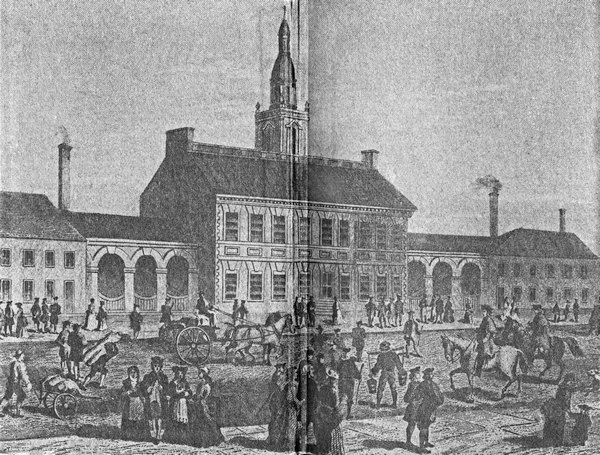
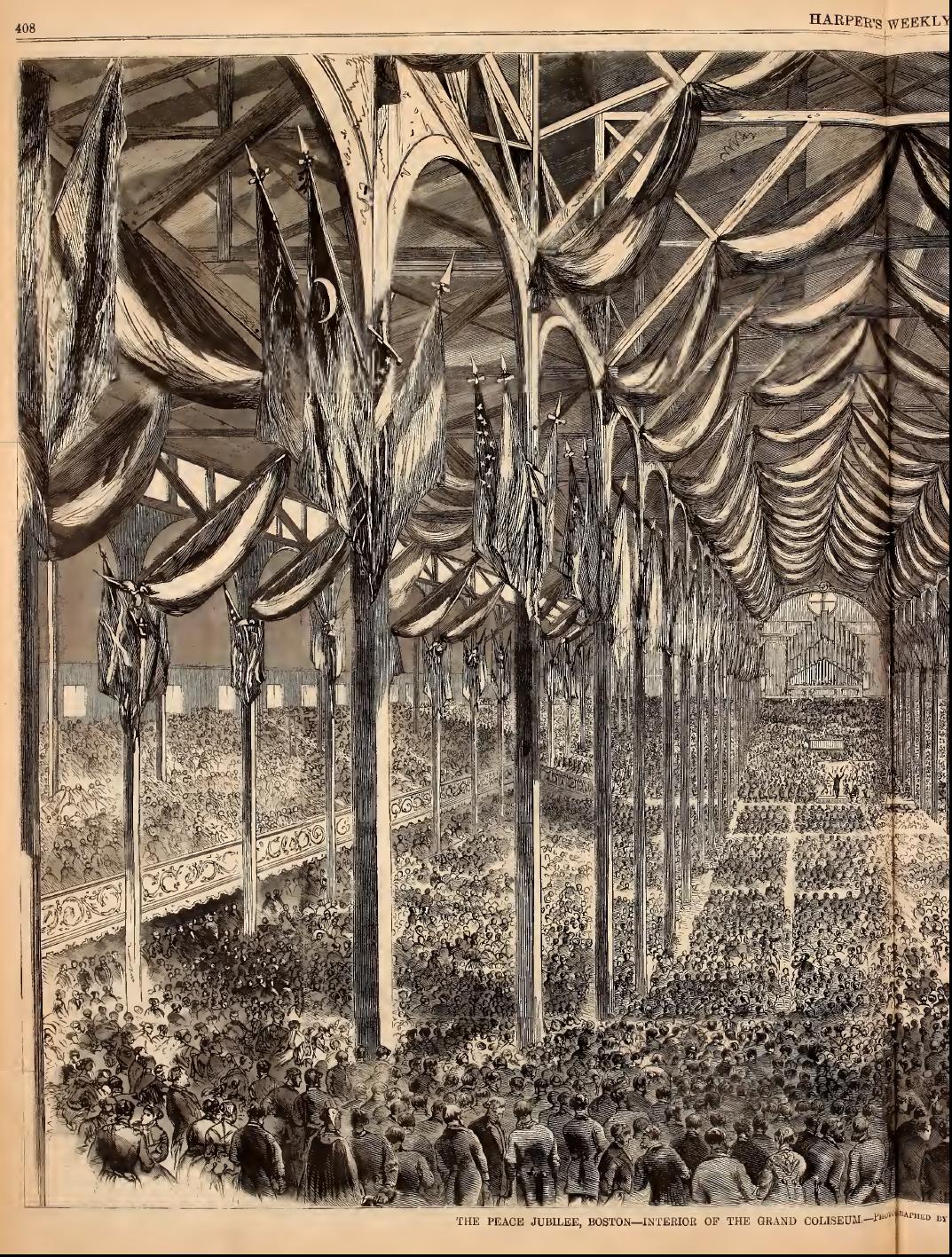
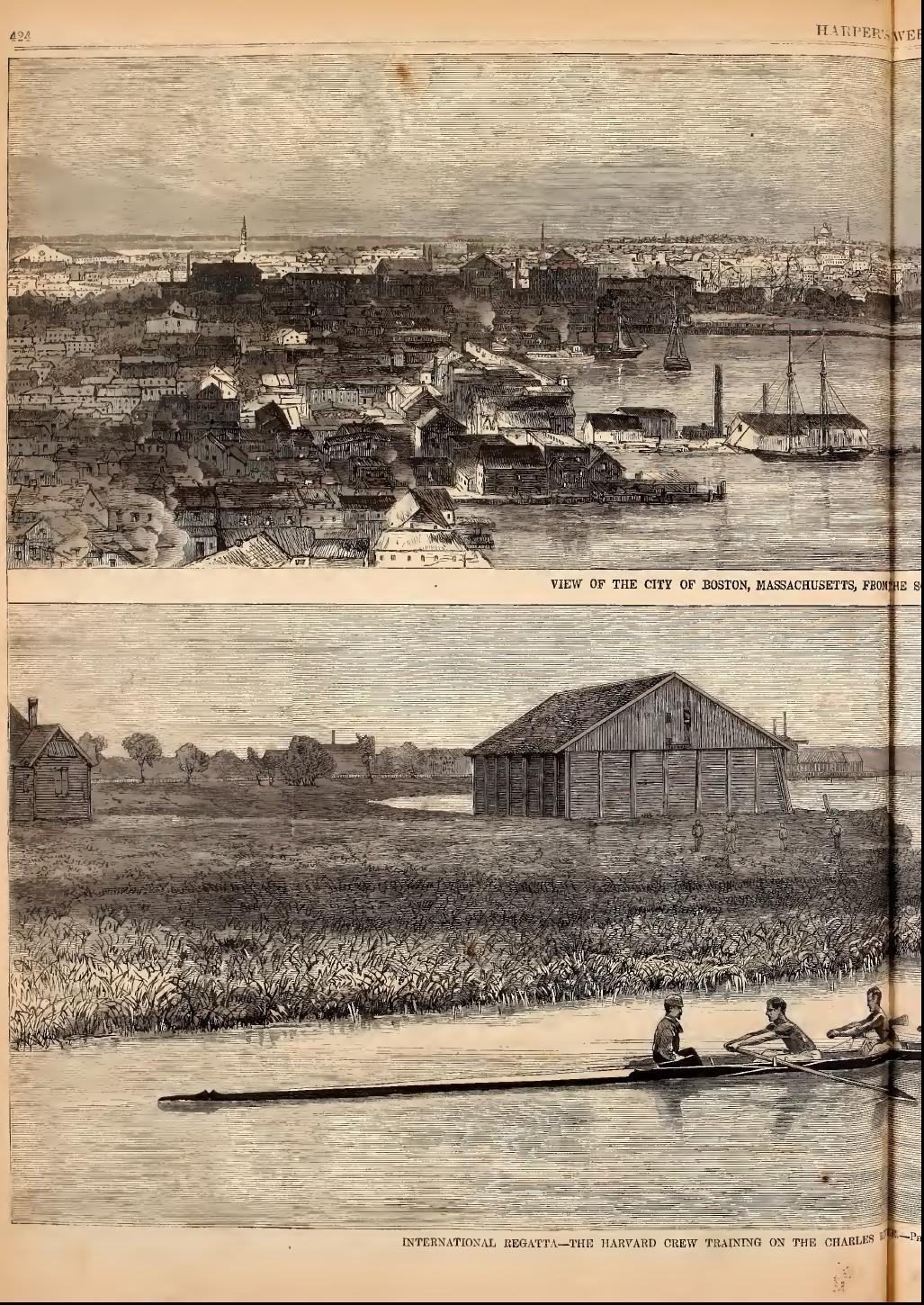
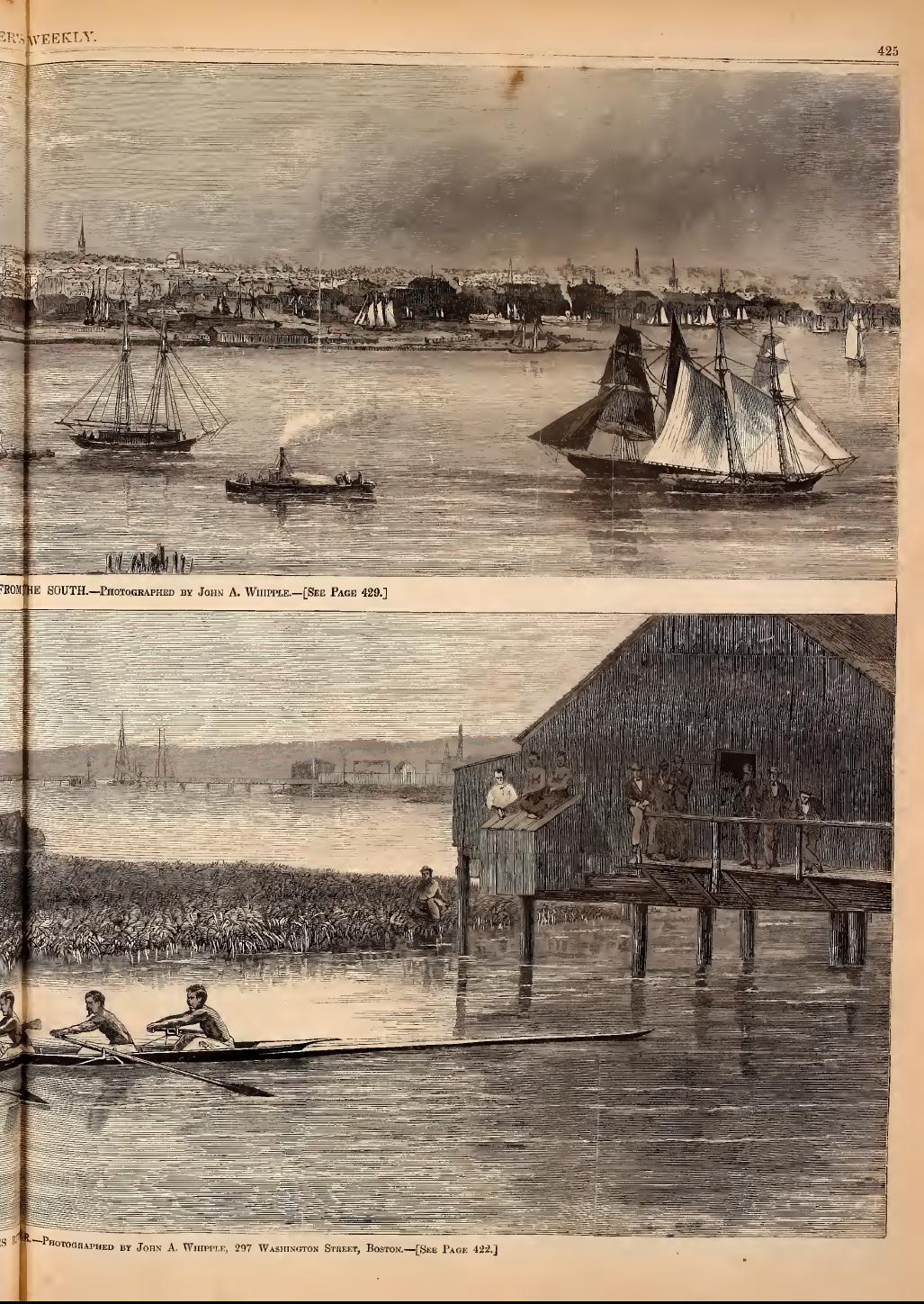
WE publish this week several illustrations connected with Boston, to which attention has lately been attracted by the mammoth Jubilee. Not the least interesting of these is the photographic view of the city reproduced in our double-page cut.

the big noisy –

a well-watered city

__________________________

[The paper reviewed Boston’s history from its founding in 1630. “In the opening scenes of the Revolution Boston took a more prominent part than any city in the Colonies.” Boston developed commercial ties all over the world; it had a world class harbor.]

chief music-makers

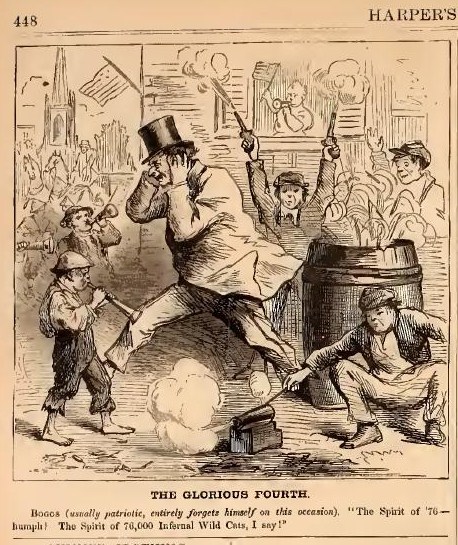
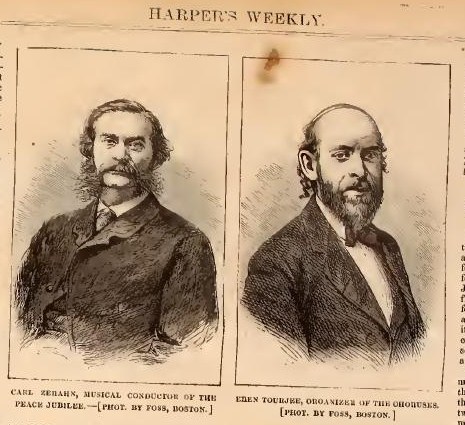
Boston has made more noise than any city in the Union. It is the first article of the creed of Boston thinkers that that city is the centre of human civilization – that Boston is the “hub of the Universe.” Now that she has had the biggest concert of all history – we refer to the recent Musical Jubilee – she will henceforth consider herself as the centre of “music of the spheres.” We expected to hear the “anvil chorus” in New York, but were disappointed. Still, the Jubilee was a great success. The programme was carried out without difficulty. The rendering of the symphonies and the oratorio music was excellent, and the grand chorus was a remarkable success. We give portraits on this page of CARL ZERAHN, conductor of the symphony and oratorio music, and also of EBEN TOURJEE, the organizer of the choruses.

In connection with this Jubilee one thing is noticeable – and that is the death which occurred on the 17th. In the ancient theatres, where over 30,000 were assembled, both births and deaths were of frequent occurrence. It is not wonderful, therefore, that in an assemblage of sixty thousand there should have been a single death.

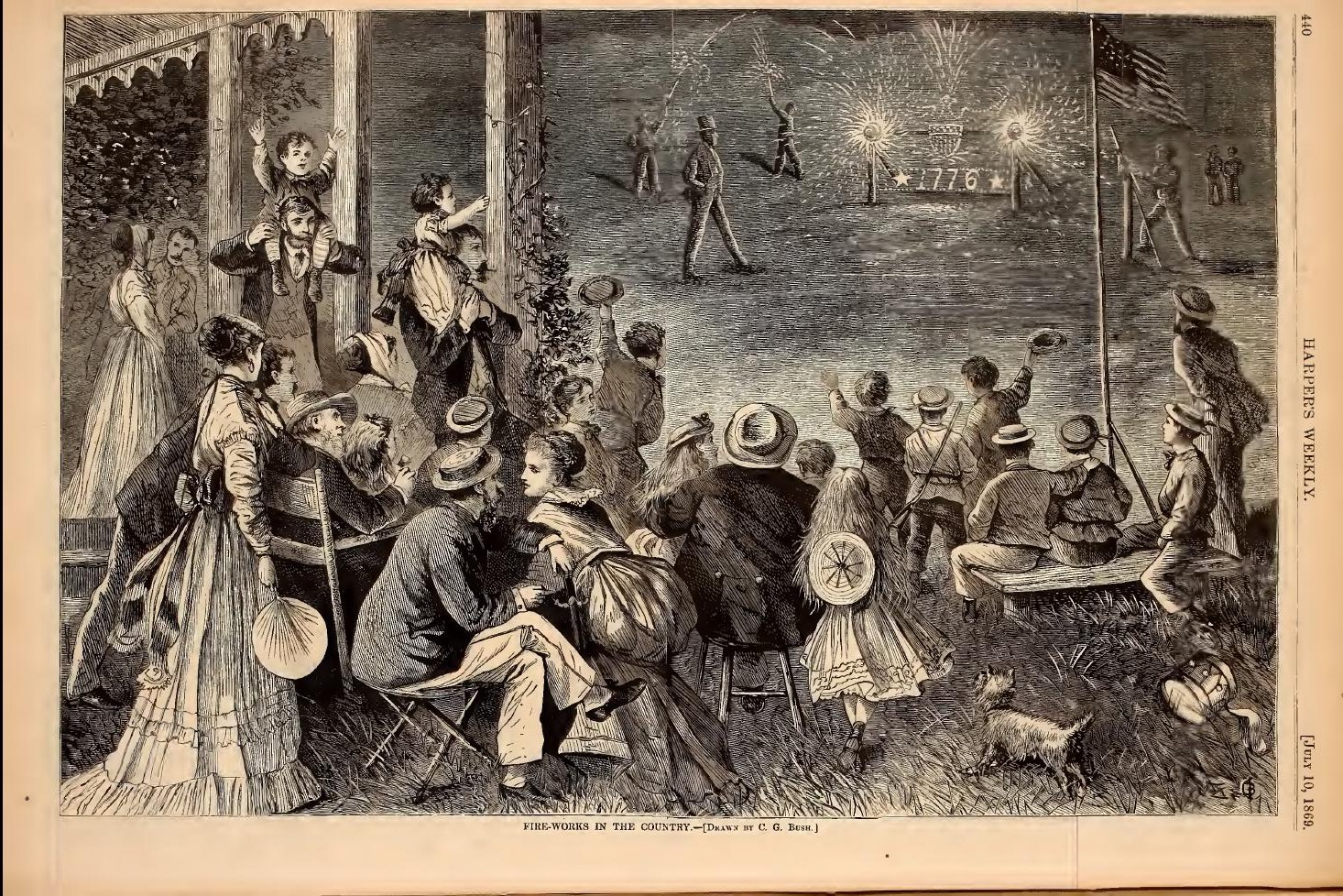
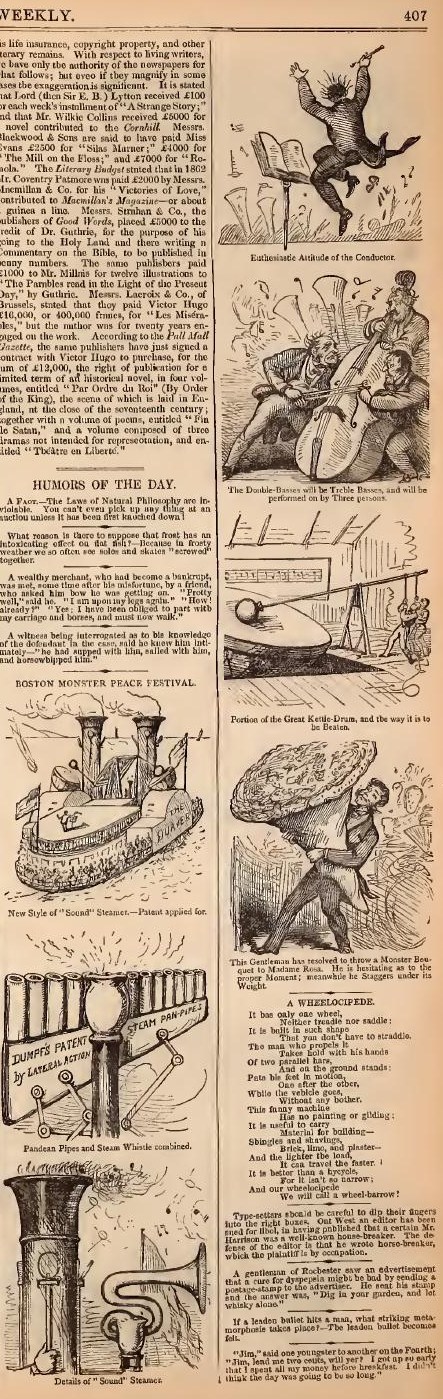
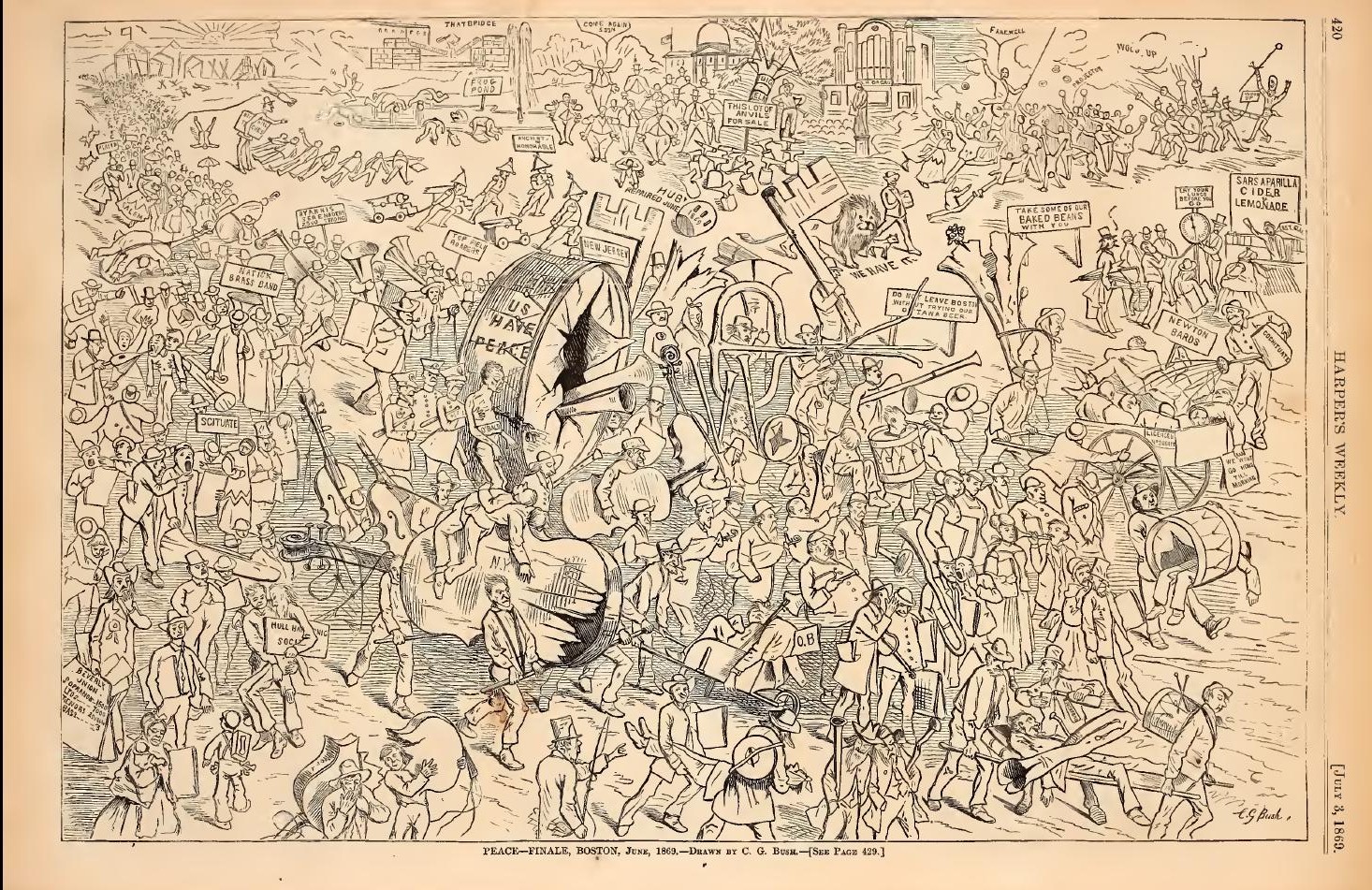
Well, the Jubilee is over. It is now a part of the history of noise-making Boston. Our artist, Mr. BUSH, has on page 420 illustrated the finale of the whole affair.

they had the music in them

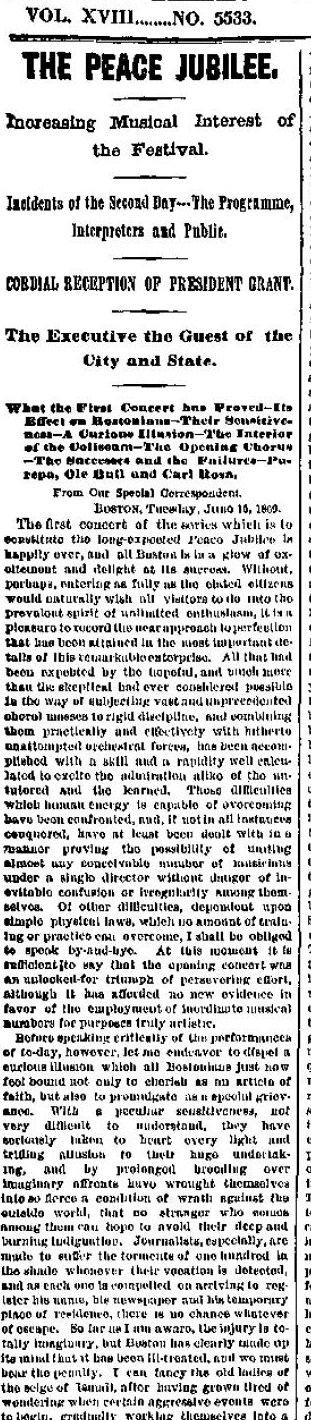
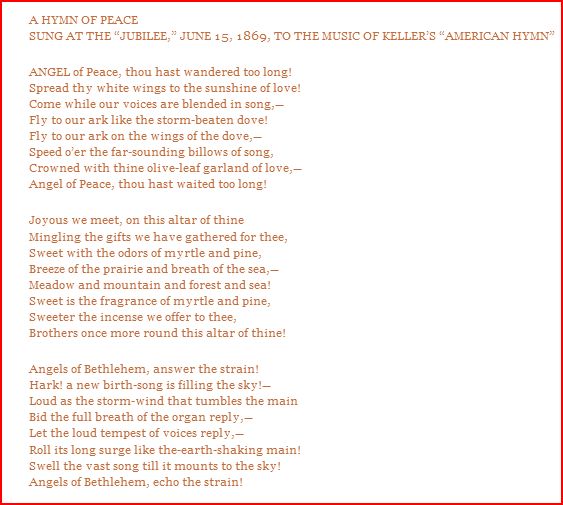
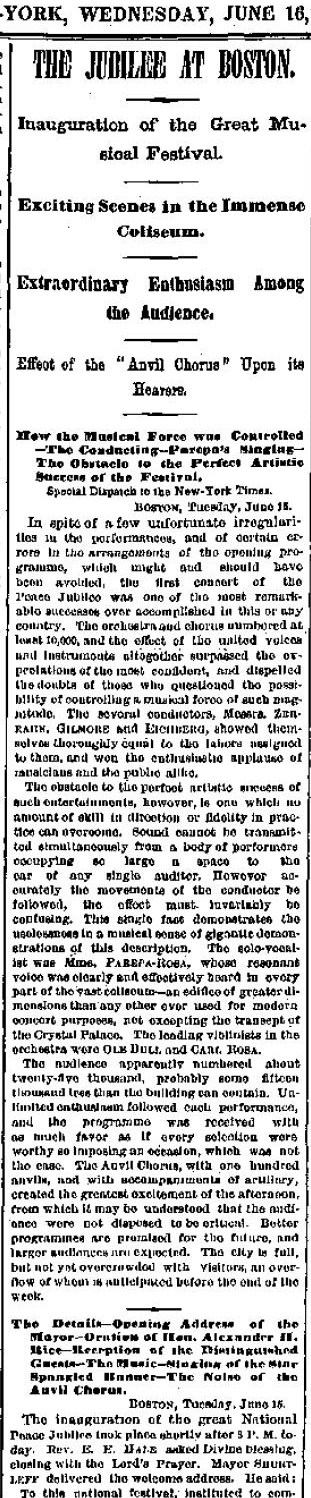
According to front pages of The New-York Times President Grant (“Let us have peace” was part of his Republican presidential nomination acceptance letter in 1868) attended the Jubilee, I think on the second day, and then visited a couple other Massachusetts cities – Worcester and Springfield – before returning to the White House. According to shmoop Oliver Wendell Holmes, Sr. did write a poem for the festival. A Hymn of Peace was performed on the first day, set to Matthias Keller’s “American Hymn.”

by Oliver Wendell Holmes, Sr.

The New-York Times
June 16, 1869

The New-York Times
June 17, 1869

__________________________

In its coverage Harper’s Weekly included another poem, apparently recited on the first day. This one was written by Susan J. Adams and began with the quote from Abraham Lincoln about “the mystic cords of memory” and “the better angels of our nature.” For the poet “The Northern Lights are blending With the rays of the Southern Cross” “And the Summer of Peace is come!”

big music

completed Coliseum

“Feet shod swift for destruction
Now tread the paths of peace”

a really big show

Harper’s Weekly

June 26, 1869

_______________________________________

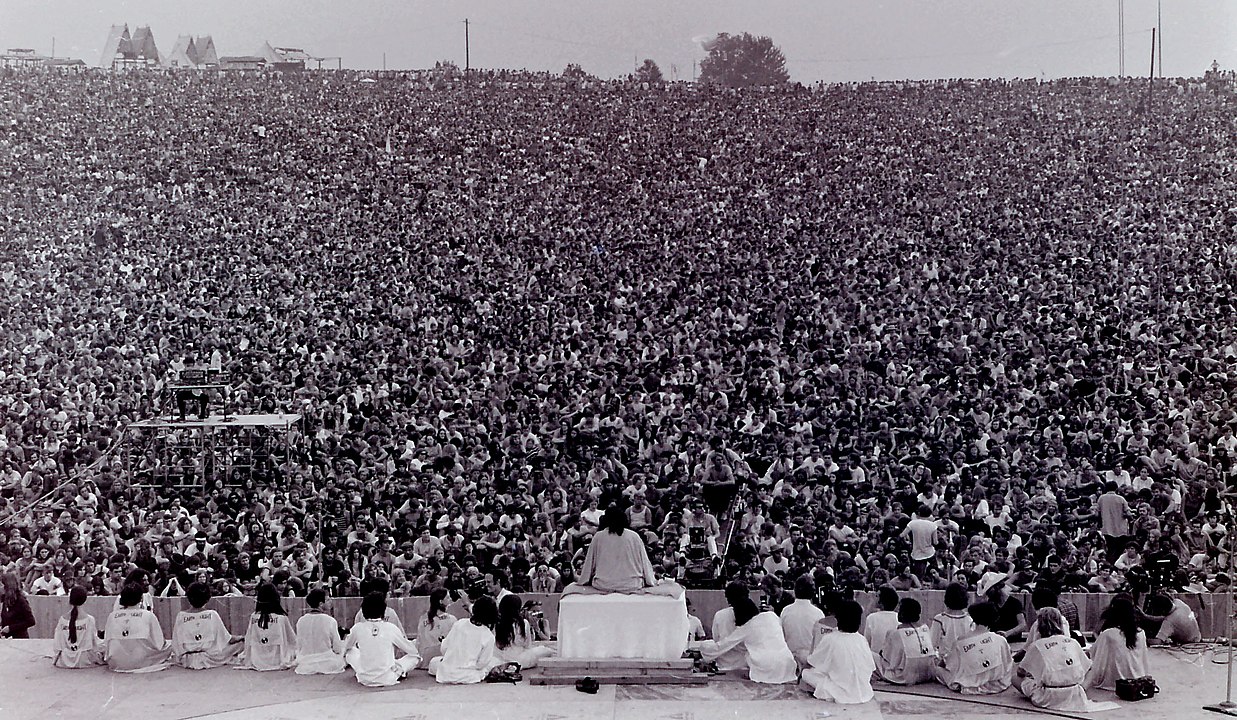
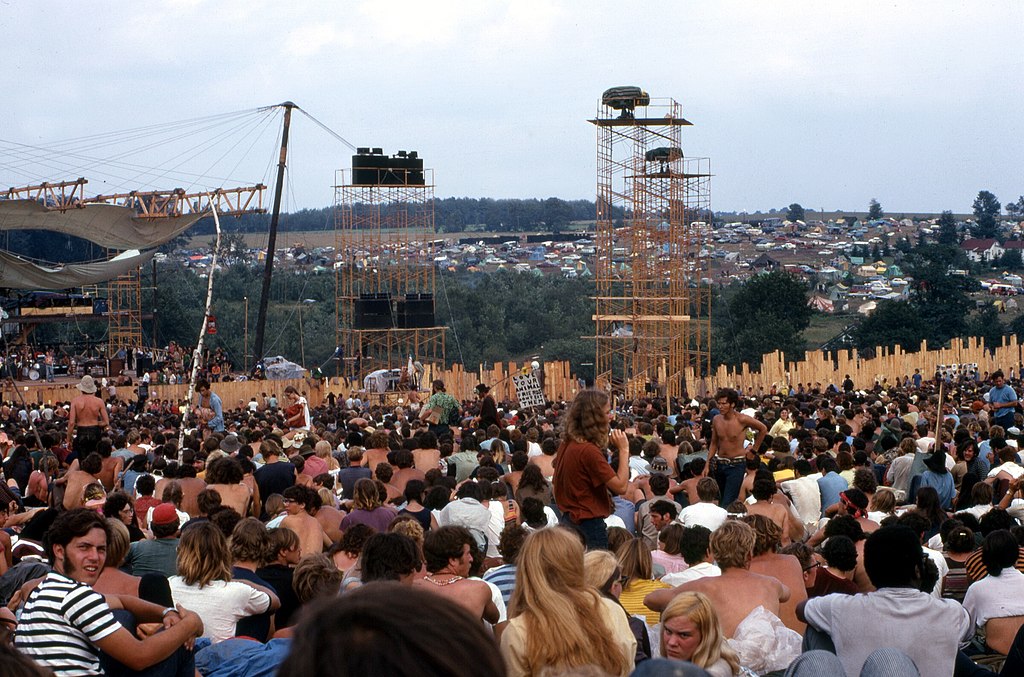
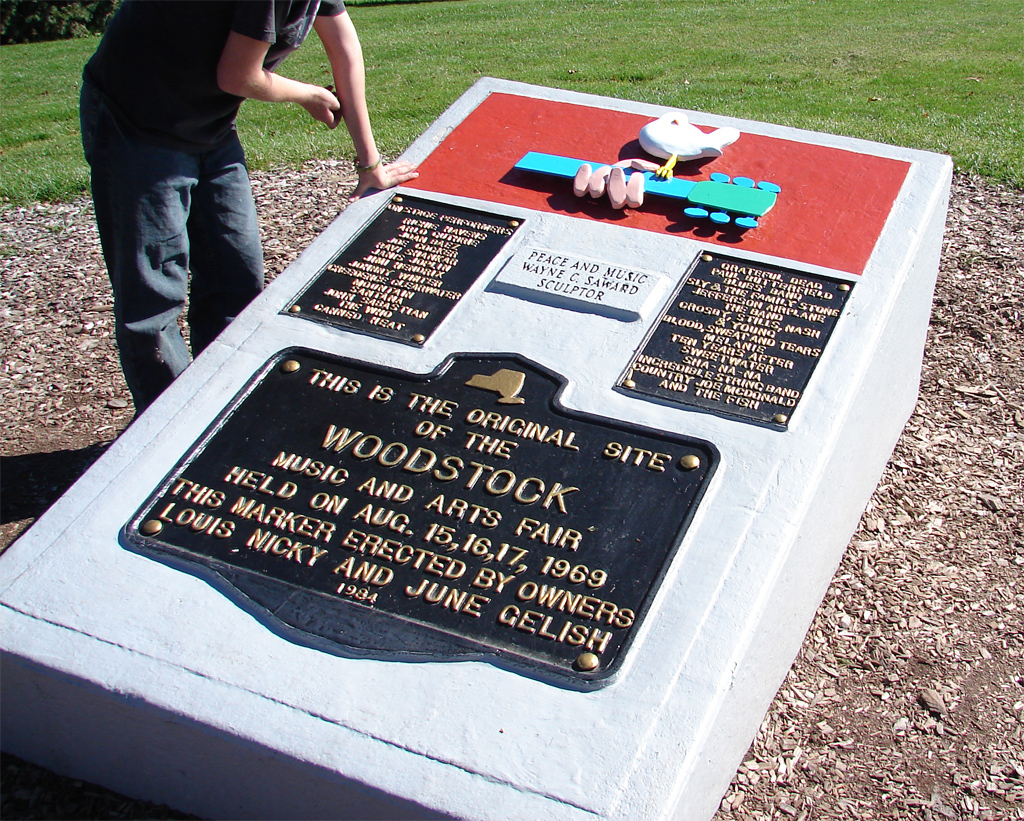
The shmoop link alludes to it. 100 years later another monster musical festival was held. It was also dedicated to peace, and whatever structures were needed were also temporary. But the 1969 show wasn’t performed in an urban setting – it was held on a 600 acre dairy farm in New York State. Although there was a lot of music spread over three or four days, somehow I don’t think the Anvil Chorus featured prominently. According to Wikipedia, in an audience of over 400,000 there were two births, two deaths, and four miscarriages during Woodstock.

Swami Satchidananda’s opening invocation, an OM of peace

big sound without big organ

a more permanent structure

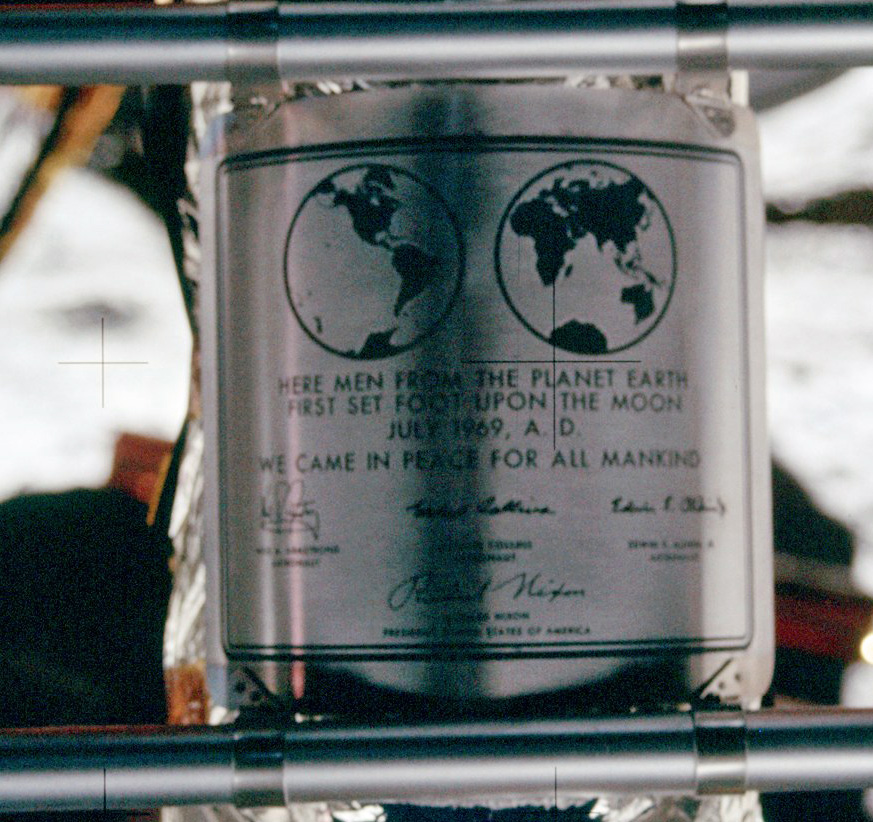
You can find the peace poem by Oliver Wendell Holmes at Project Gutenberg. The Woodstock images are from the Wikipedia article: Mark Goff’s photo of Swami Satchidananda – you can read more about him at his website; Woodstock Whisperer’s picture of Joe Cocker performing is licensed by Creative Commons; the commemorative plaque. All the Harper’s Weekly material is from 1869 and can be found at the Internet Archive. From the Library of Congress: rehearsal from the June 5, 1869 issues of Frank Leslie’s Illustrated Newspaper; the big crowd, completed Coliseum, and the big bass drum

and the beat goes on

Posted in 150 Years Ago This Month, Aftermath, Postbellum Society, Reconstruction | Tagged , , , , , , , , , , | Leave a comment

prize fliers

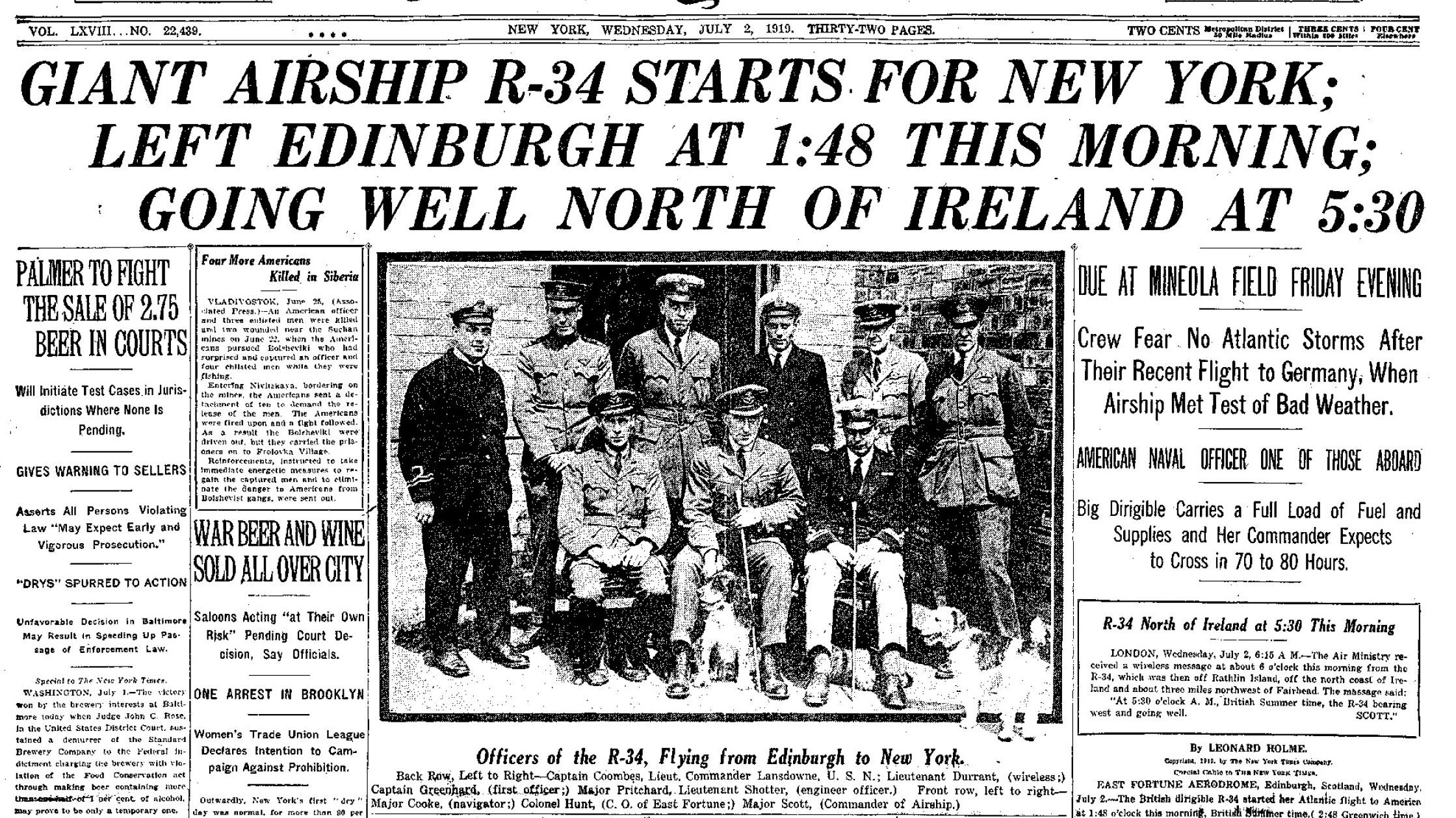
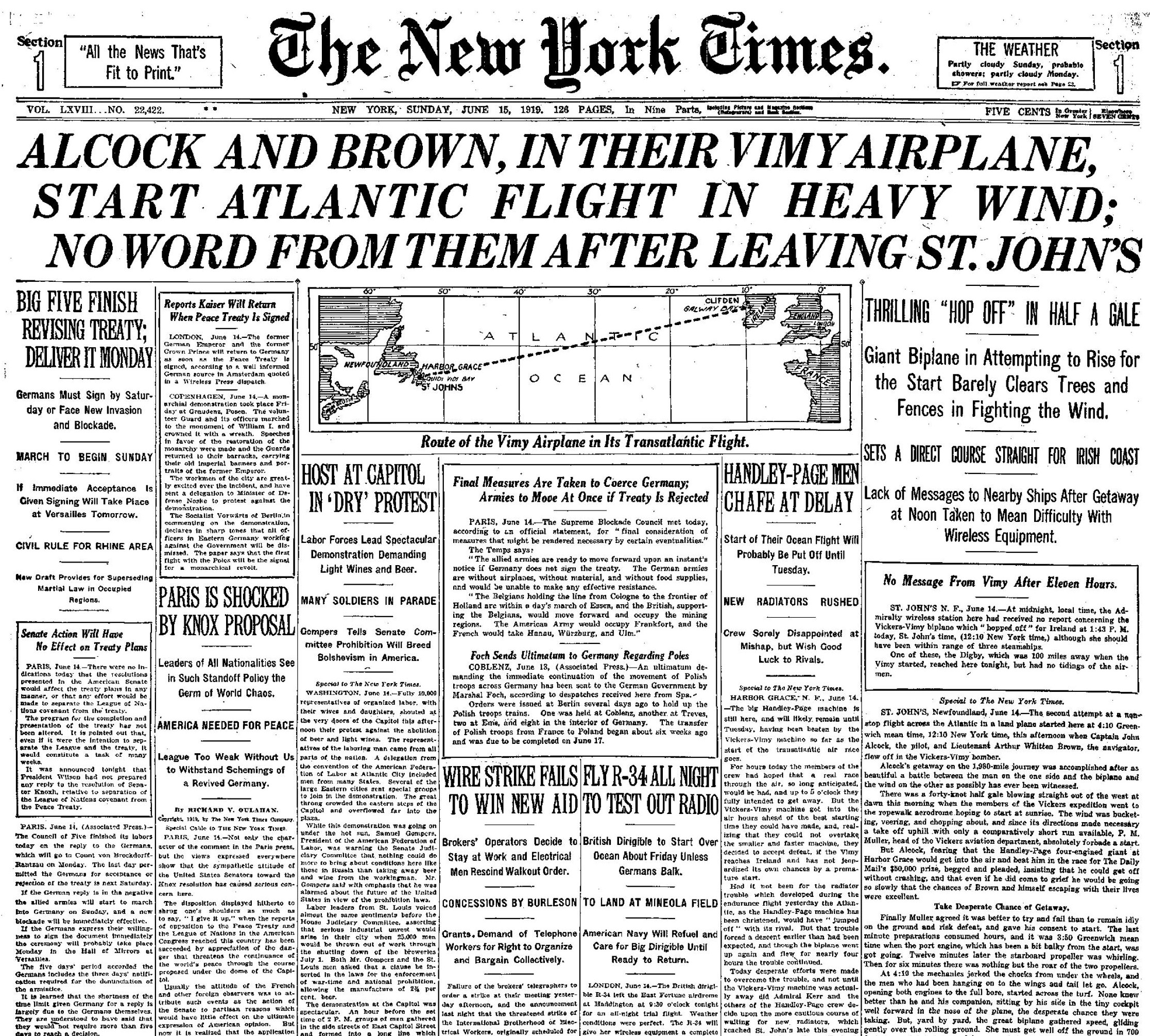
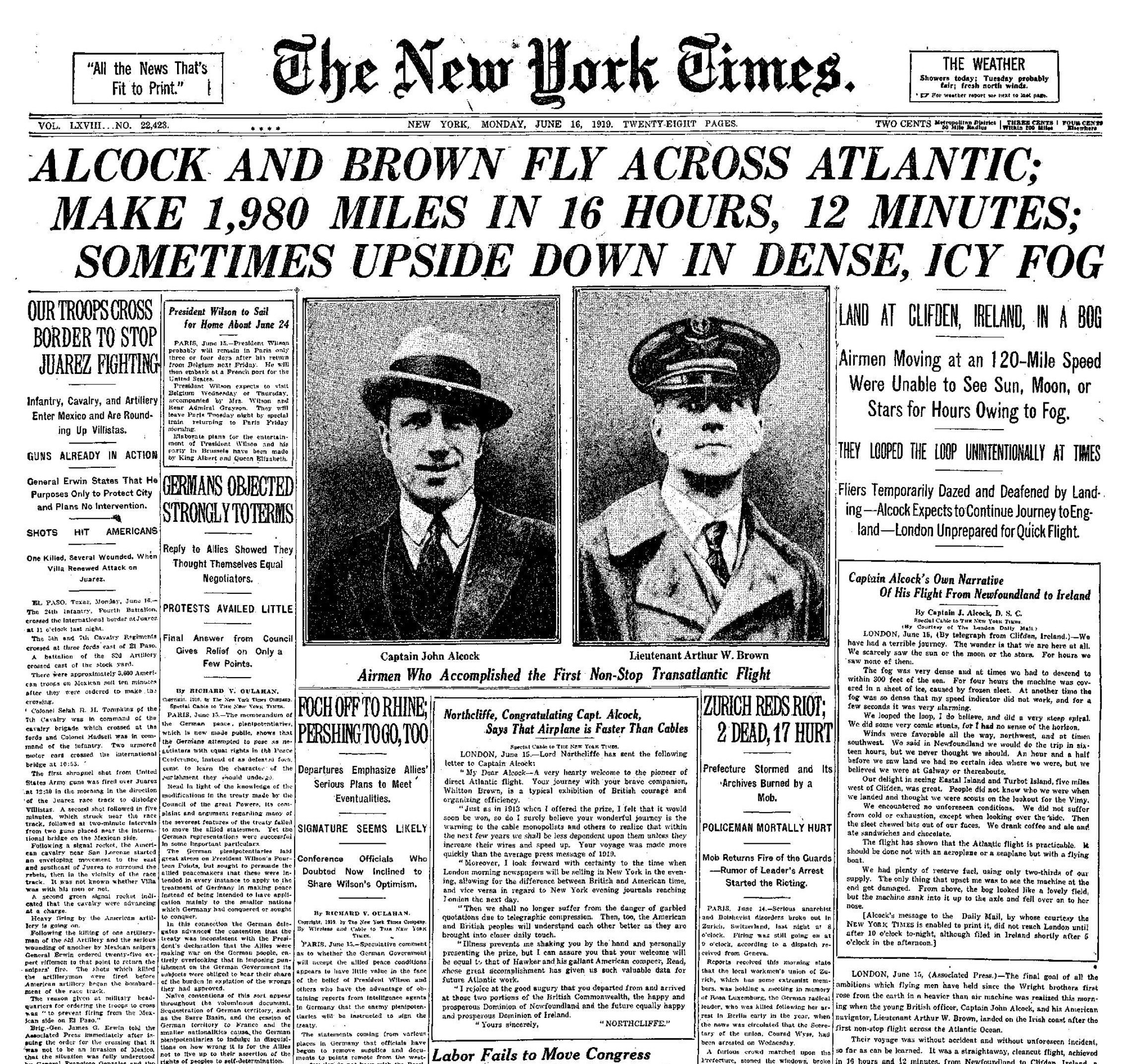
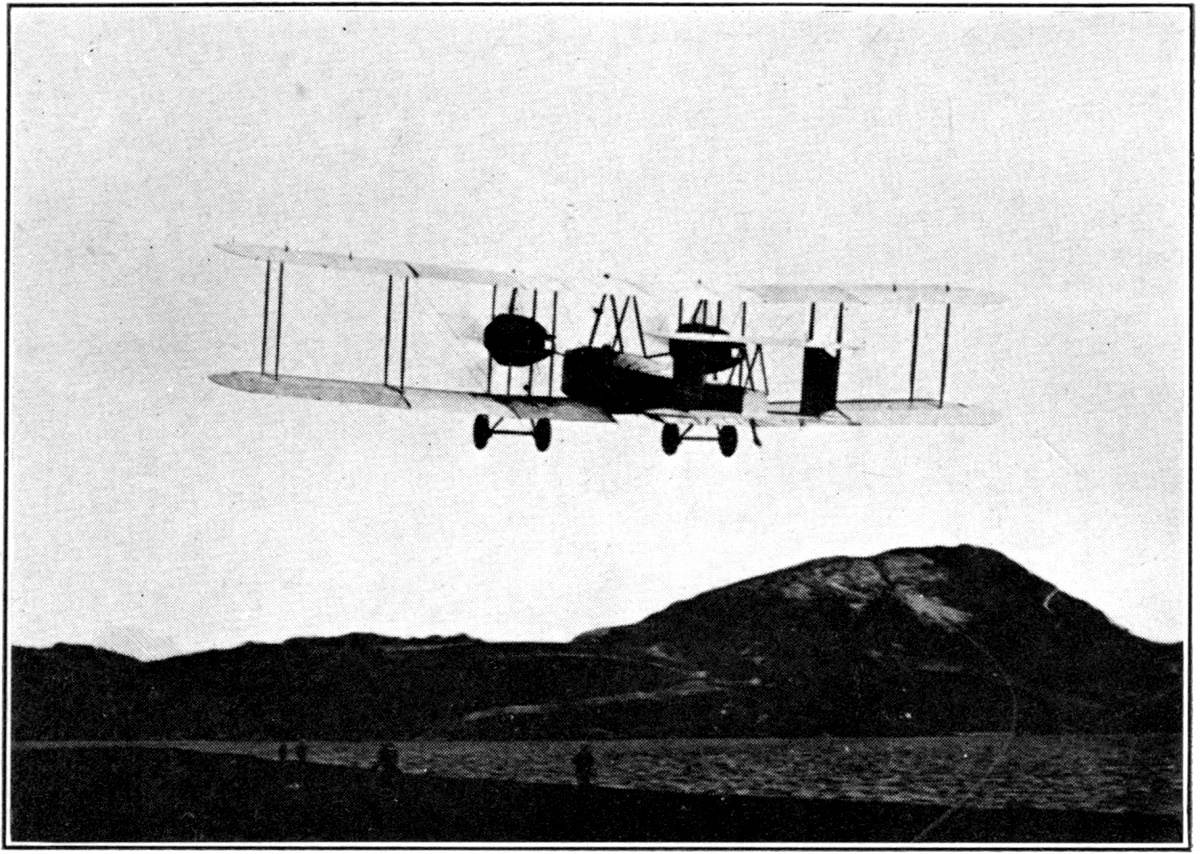
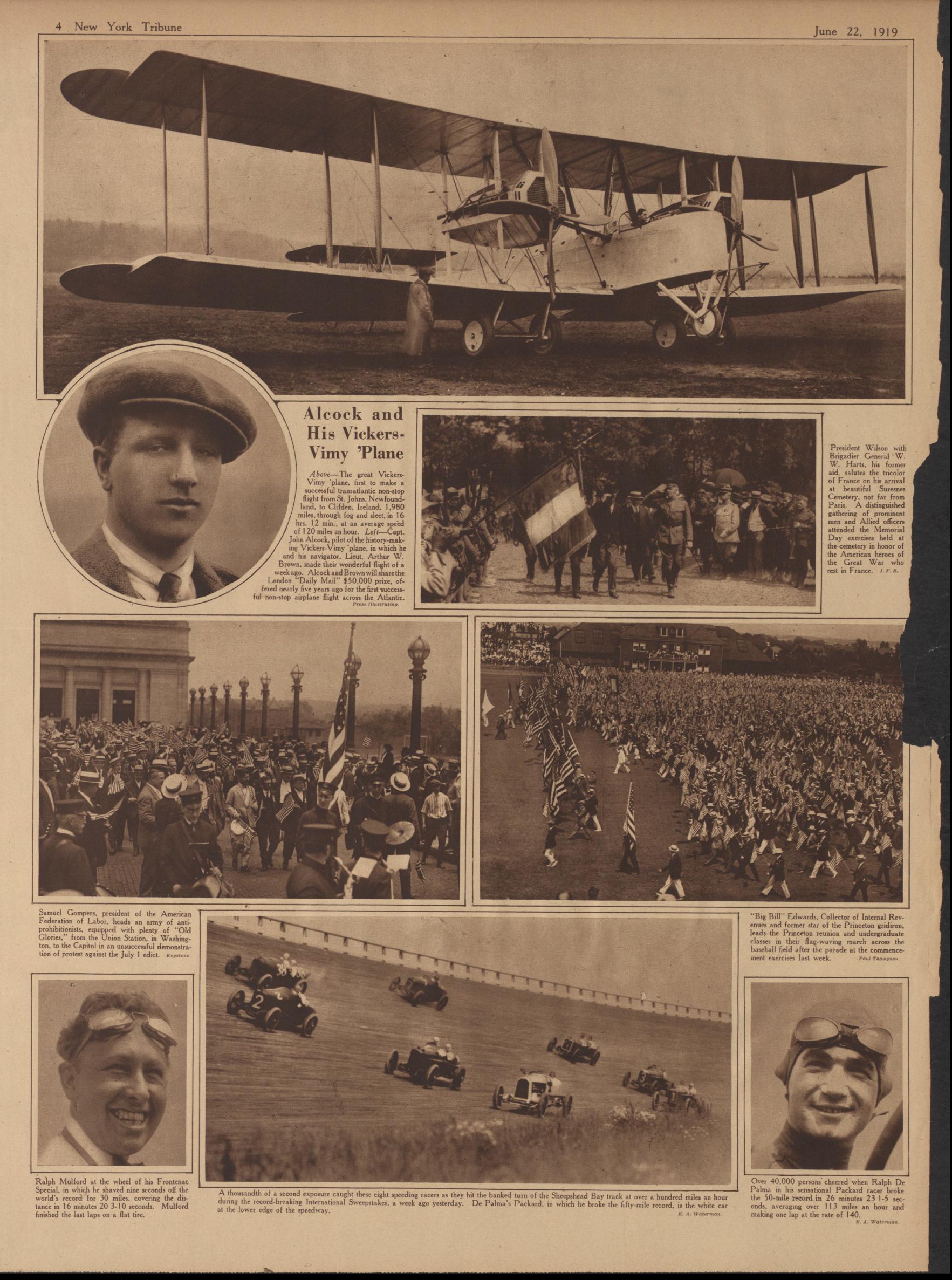
World War I was disruptive, and while it was a boon to aviation, it caused the postponement of an aerial competition. In 1913 the Daily Mail offered a prize of £10,000 to “the aviator who shall first cross the Atlantic in an aeroplane in flight from any point in the United States of America, Canada or Newfoundland to any point in Great Britain or Ireland in 72 continuous hours.” The contest was back on after the Armistice was signed. There were at least a couple serious attempts in May 1919, but the prize wasn’t won until the next month. Between June 14 and June 15, 1919 two British citizens, John Alcock and Arthur Whitten Brown, successfully made the first non-stop transatlantic flight by flying from Newfoundland to Ireland in about sixteen hours.

The New York Times June 15, 1919

The New York Times June 16, 1919

Wikipedia describes the crossing:

“SLOW RISING NEARLY CAUSED DISASTER AT THE START OF THE GREAT FLIGHT”

It was not an easy flight. The overloaded aircraft had difficulty taking off the rough field and only barely missed the tops of the trees. At 17:20 the wind-driven electrical generator failed, depriving them of radio contact, their intercom and heating. An exhaust pipe burst shortly afterwards, causing a frightening noise which made conversation impossible without the failed intercom.

At 5.00 p.m., they had to fly through thick fog. This was serious because it prevented Brown from being able to navigate using his sextant. Blind flying in fog or cloud should only be undertaken with gyroscopic instruments, which they did not have. Alcock twice lost control of the aircraft and nearly hit the sea after a spiral dive. He also had to deal with a broken trim control that made the plane become very nose-heavy as fuel was consumed.

At 12:15 a.m., Brown got a glimpse of the stars and could use his sextant, and found that they were on course.Their electric heating suits had failed, making them very cold in the open cockpit.

Then at 3:00am they flew into a large snowstorm. They were drenched by rain, their instruments iced up, and the plane was in danger of icing and becoming unflyable.The carburettors also iced up; it has been said that Brown had to climb out onto the wings to clear the engines, although he made no mention of that.

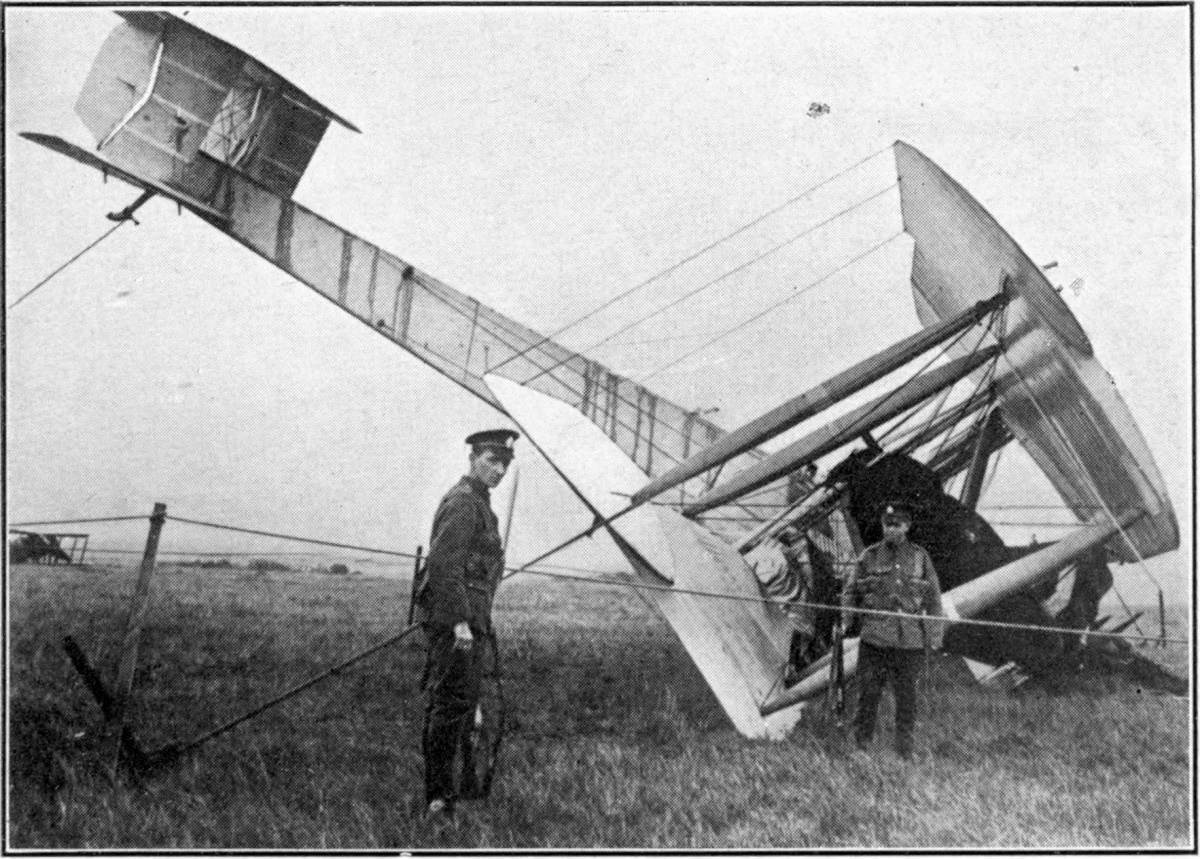
They made landfall in County Galway, crash-landing at 8:40 a.m. on 15 June 1919, not far from their intended landing place, after less than sixteen hours’ flying time. The aircraft was damaged upon arrival because of an attempt to land on what appeared from the air to be a suitable green field, but which turned out to be Derrygilmlagh Bog, near Clifden in County Galway in Ireland …

“THE TRANSATLANTIC FLIGHT ENDED WITH A CRASH IN AN IRISH BOG”

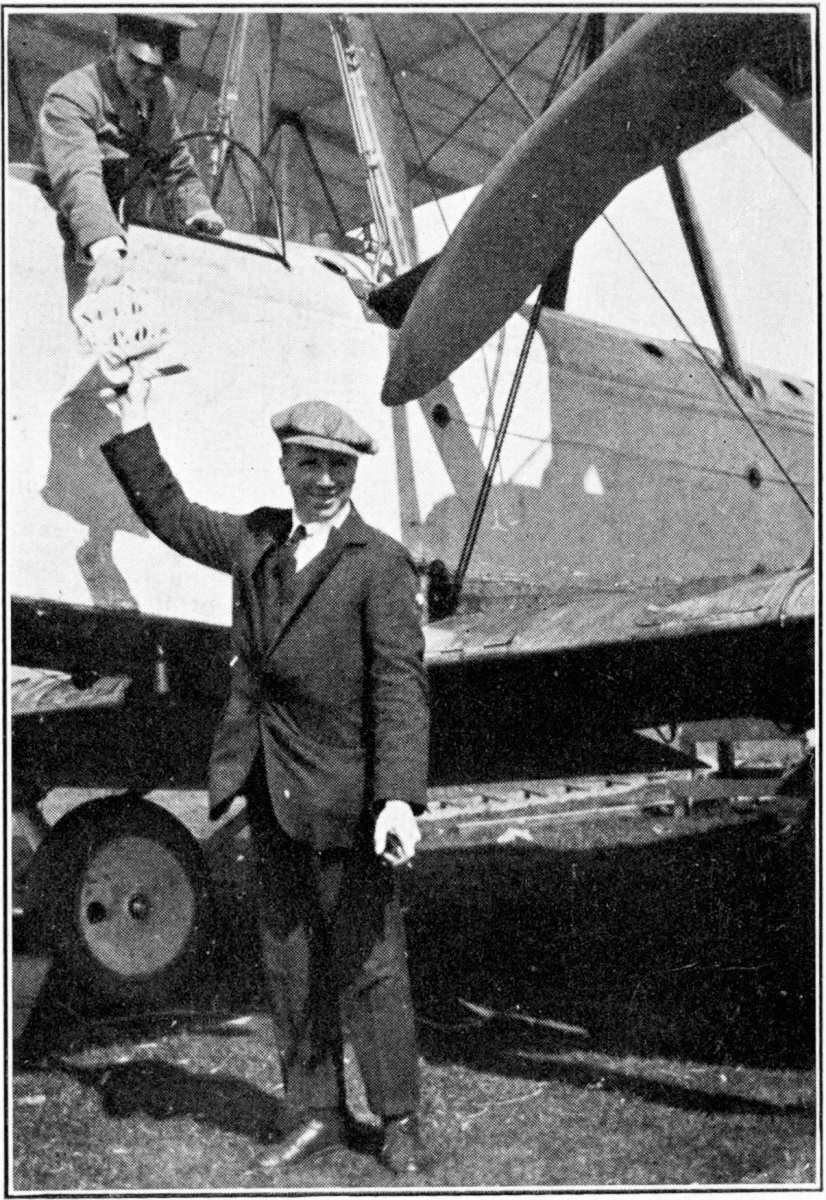
The aviators were not hurt in the crash. However, John Alcock was killed on December 18, 1919 when the new Vickers amphibious aircraft he was piloting crashed in a fog. He was headed to Paris for an aeronautical exhibition. In his 1920 book Flying the Atlantic in Sixteen Hours (at Project Gutenberg) Sir Arthur Whitten Brown described the prize-winning flight, discussed the navigation of aircraft, and analyzed the possibilities of commercial transatlantic aviation. After the transatlantic flight and initial celebratory activities the aviators needed a good night sleep. Sir Whitten Brown described a phenomenon that is certainly still a part of air travel. Nowadays people call it jet lag:

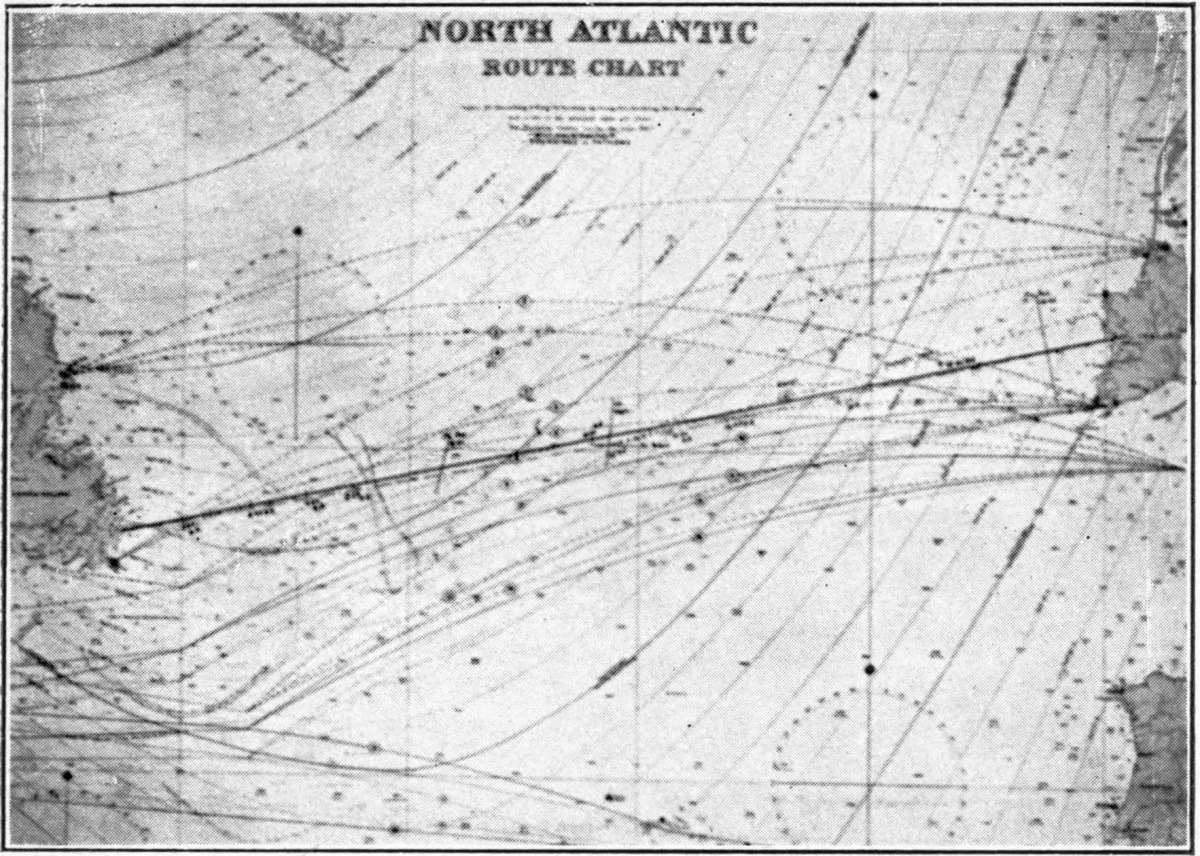
CHART OF THE NORTH ATLANTIC SHOWING COURSE OF THE FLIGHT

The wayside gatherings seemed especially unreal—almost as if they had been scenes on the film. By some extraordinary method of news transmission the report of our arrival had spread all over the district, and in many districts between Clifden and Galway curious crowds had gathered. Near Galway we were stopped by another automobile, in which was Major Mays of the Royal Aëro Club, whose duty it was to examine the seals on the Vickers-Vimy, thus making sure that we had not landed in Ireland in a machine other than that in which we left Newfoundland. A reception had been prepared at Galway; but our hosts, realizing how tired we must be, considerately made it a short and informal affair. Afterwards we slept—for the first time in over forty hours.

Alcock and I awoke to find ourselves in a wonderland of seeming unreality—the product of violent change from utter isolation during the long flight to unexpected contact with crowds of people interested in us.

To begin with, getting up in the morning, after a satisfactory sleep of nine hours, was strange. In our eastward flight of two thousand miles we had overtaken time, in less than the period between one sunset and another, to the extent of three and a half hours. Our physical systems having accustomed themselves to habits regulated by the clocks of Newfoundland, we were reluctant to rise at 7 A. M.; for subconsciousness suggested that it was but 3:30 A. M.

This difficulty of adjustment to the sudden change in time lasted for several days. Probably it will be experienced by all passengers traveling on the rapid trans-ocean air services of the future—those who complete a westward journey becoming early risers without effort, those who land after an eastward flight becoming unconsciously lazy in the mornings, until the jolting effect of the dislocation wears off, and habit has accustomed itself to the new conditions.

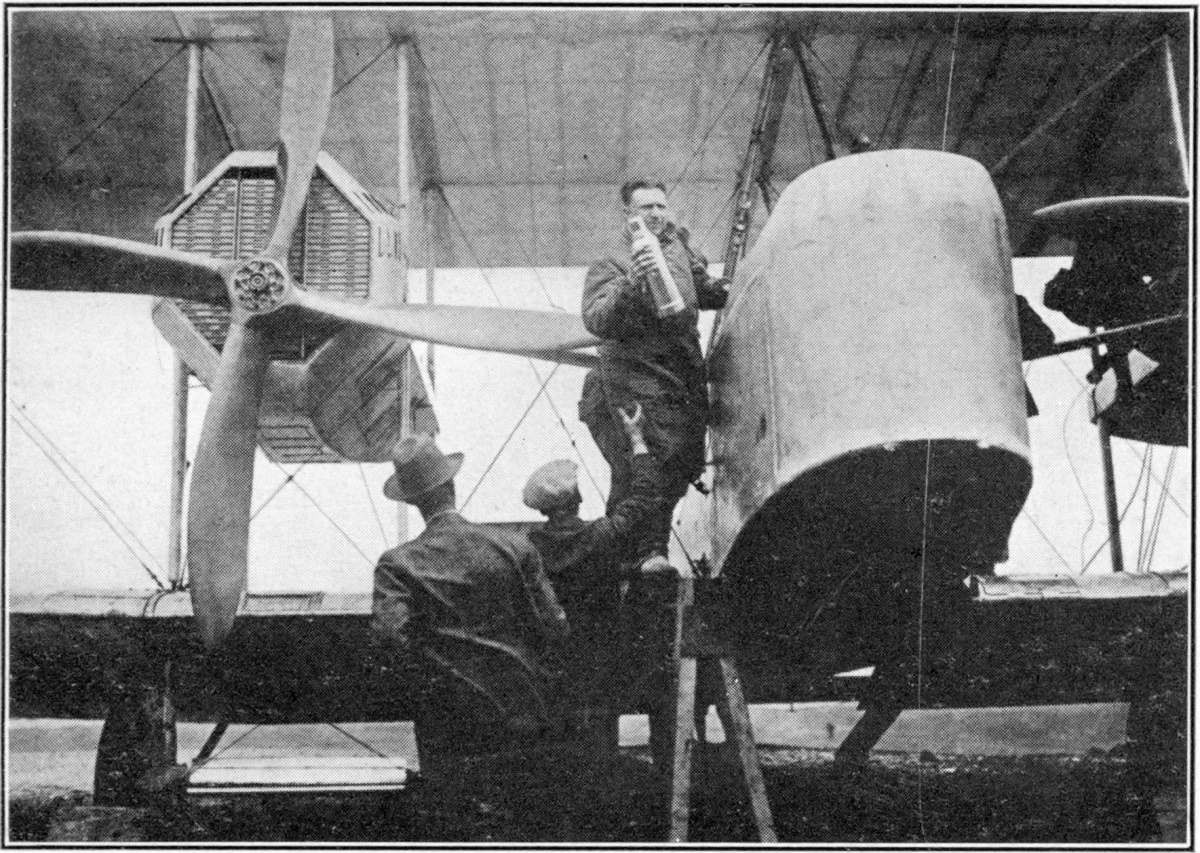
HOT COFFEE WAS TAKEN ABOARD

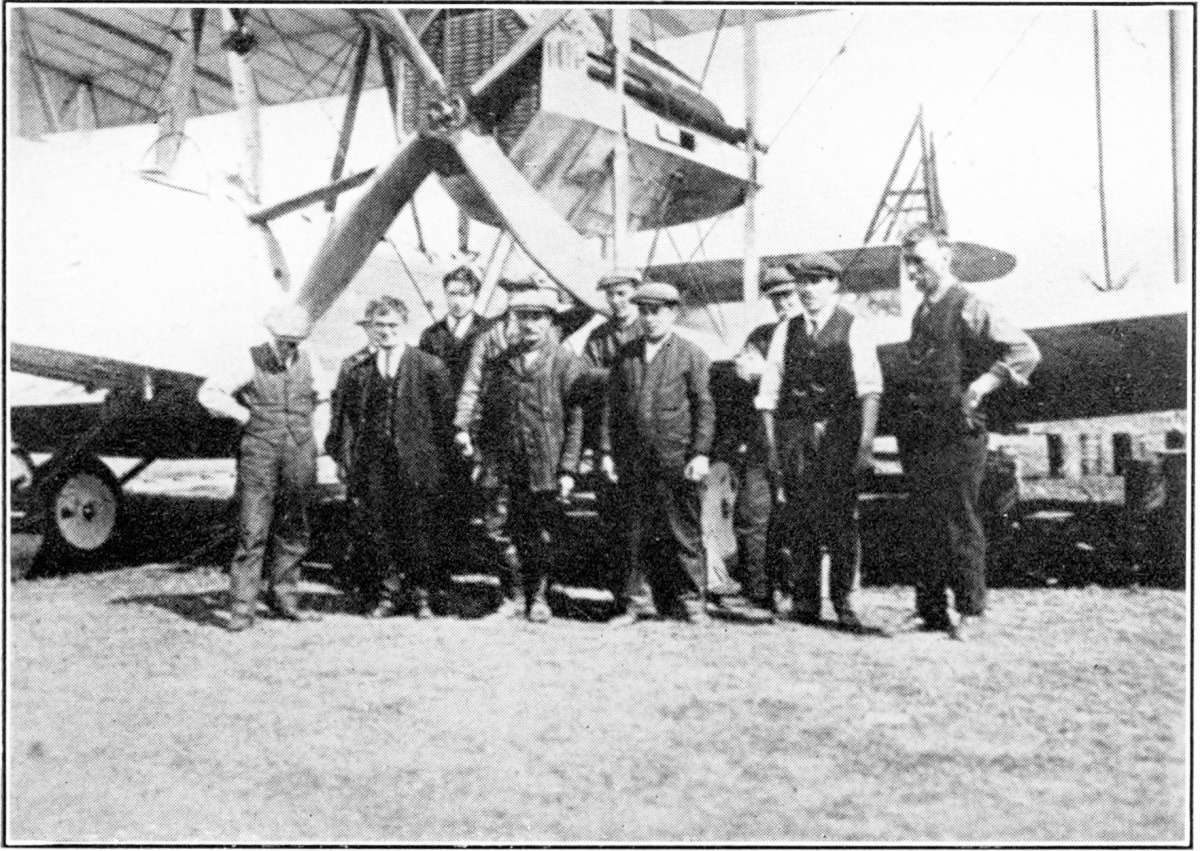
THE MEN WHO WORKED WITHOUT GLORY TO MAKE THE FLIGHT POSSIBLE

SHIPPING THE FIRST DIRECT TRANSATLANTIC AIR MAIL

Wikipedia referenced the section I quoted at The Aviation History Online Museum,Flightglobal, and ireland.com
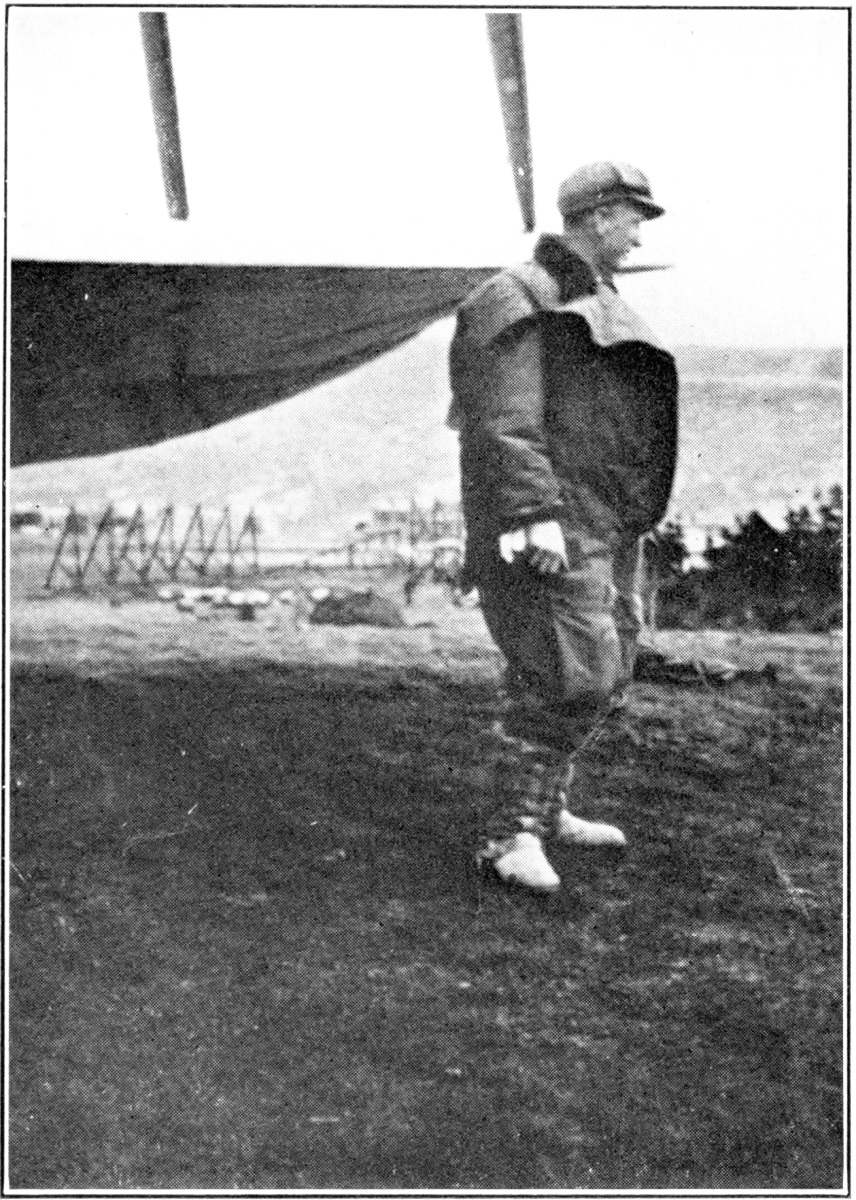
All the images with the all-caps captions come from Sir Arthur Whitten Brown’s book. The page from the New York Tribune can be found at the Library of Congress. The Trib really exaggerated the size of the prize. The bottom of the page shows some usually earth-bound vehicles that were approaching the Vicker-Vimy speed at times.

New York Tribune June 22, 1919

THE LATE CAPT. SIR JOHN ALCOCK JUST BEFORE STARTING

Posted in 100 Years Ago, Technology, World War I | Tagged , , , | Leave a comment

a patriotic peace

This year I’m reading a book published in 1945. In this morning’s selection author Daniel Russell wondered if war was ever worth it. World War I showed that “[t]here is small place for flags and bugles.” He reviewed the horrors of the Second War that was then torturing the world. And then:

“Let us have peace.”

Since men go to war in the name of patriotism, it is well to remember what patriotism is and what it is not. Tolstoi believed that hate and contempt for others was inherent in it, and so he hated it. What he hated, in reality, was nationalism overemphasized and on the wrong track.

Patriotism is love of country.

It is the love of country expressing itself in service.

It dedicates itself to the prevention and final abolition of war.

It thrills to the war drums when they must be beaten, but it joins in the words spoken by an American soldier, words whose simplicity does not disguise the hatred of war born in the speaker’s own experience of it through the grim years of strife: “Let us have peace.”[1]

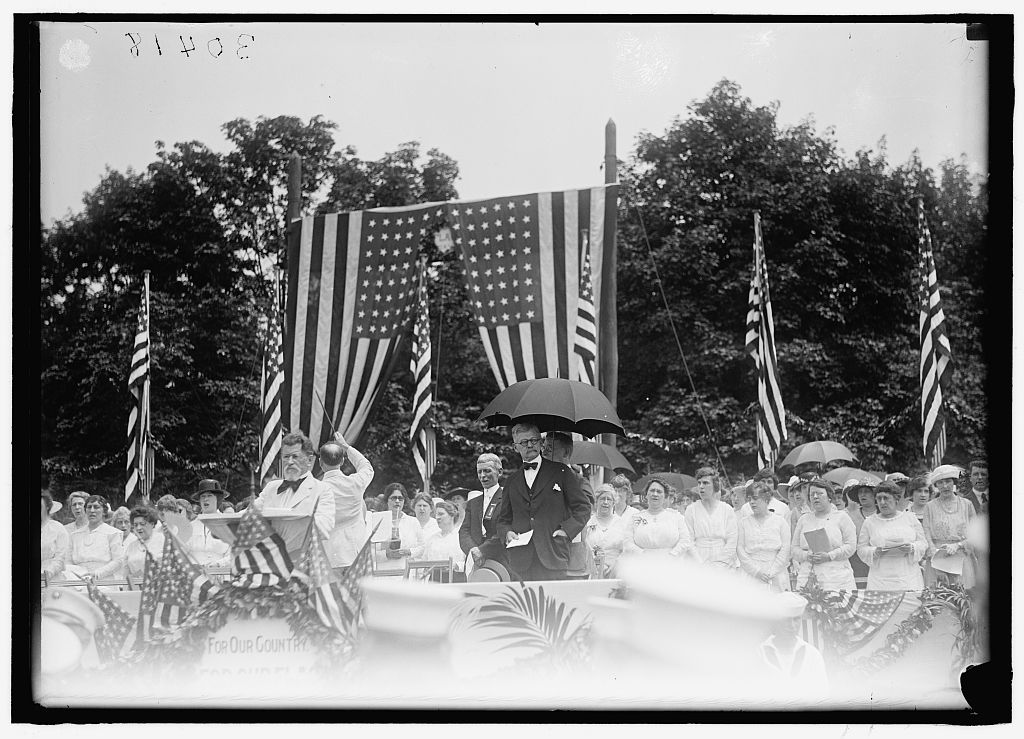
Flag Day Exercises, 1919

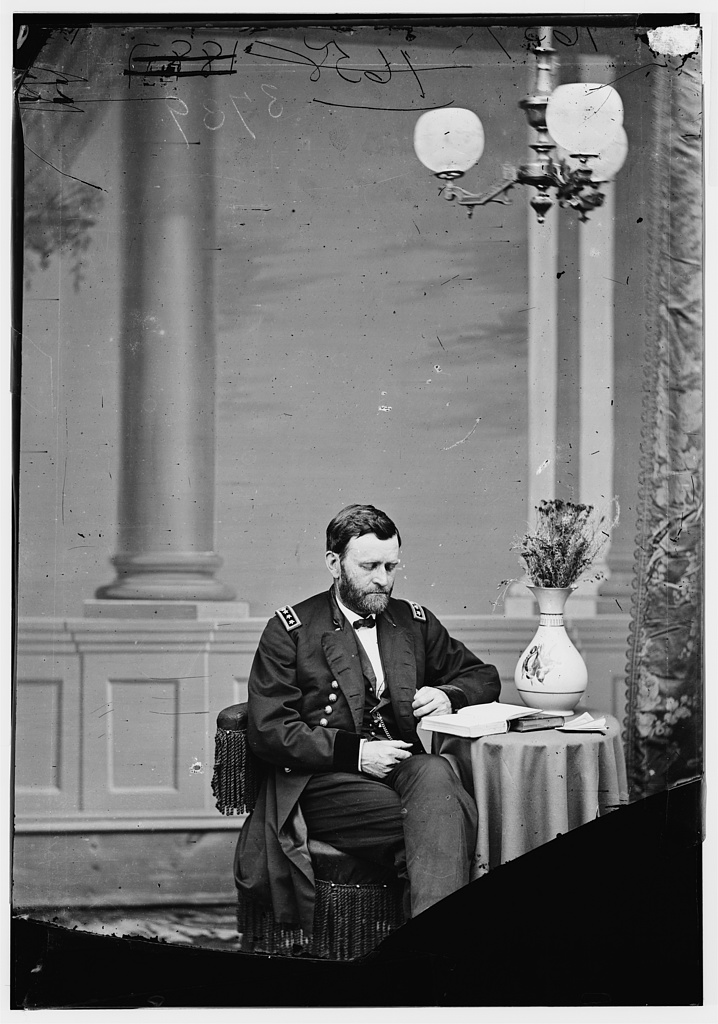
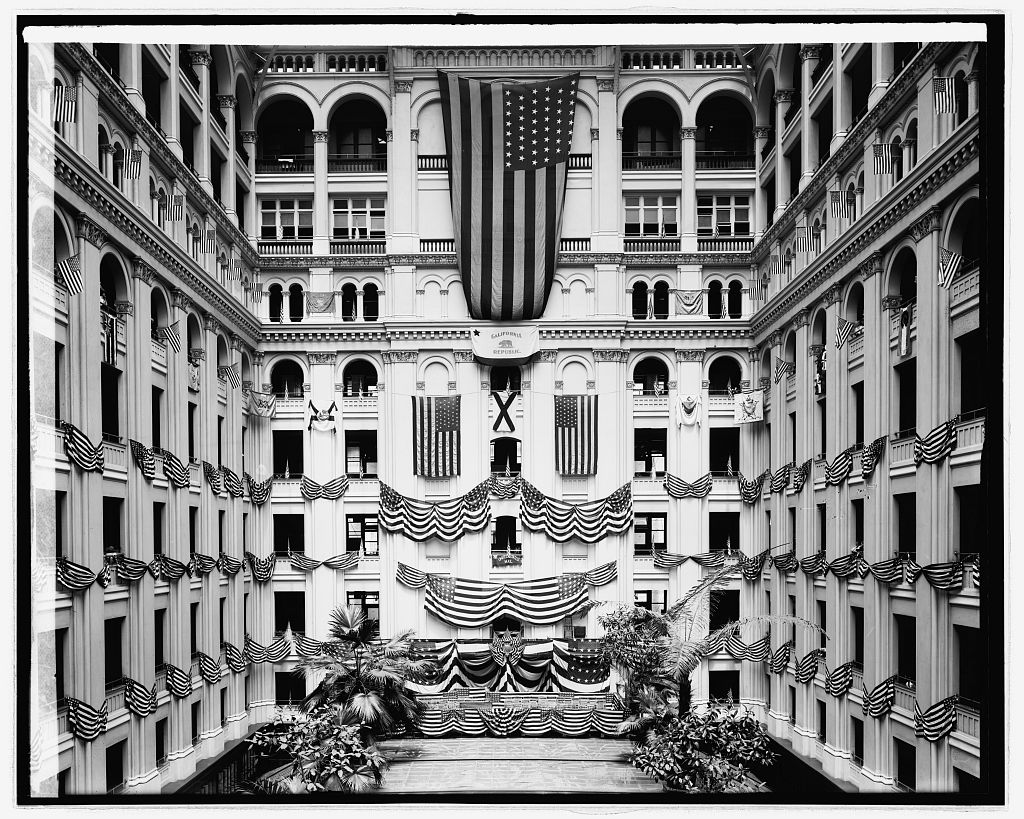
From the Library of Congress: General Grant; 1919 Flag Day exercises (Vice-President Marshall in dark suit with bow-tie); at the D.C. Post Office
I thought I was onto something unique, but I just found out you can buy Mr. Russell’s book on Amazon

Washington, D.C. Post-office
Flag day 1913

  1. [1]Russell, Daniel Meditations for Men Brief Studies of Religion and Life. Nashville: Abingdon Press, 1945. Print. page 268.
Posted in Aftermath, American History, American Society | Tagged , | Leave a comment

more trans in transportation

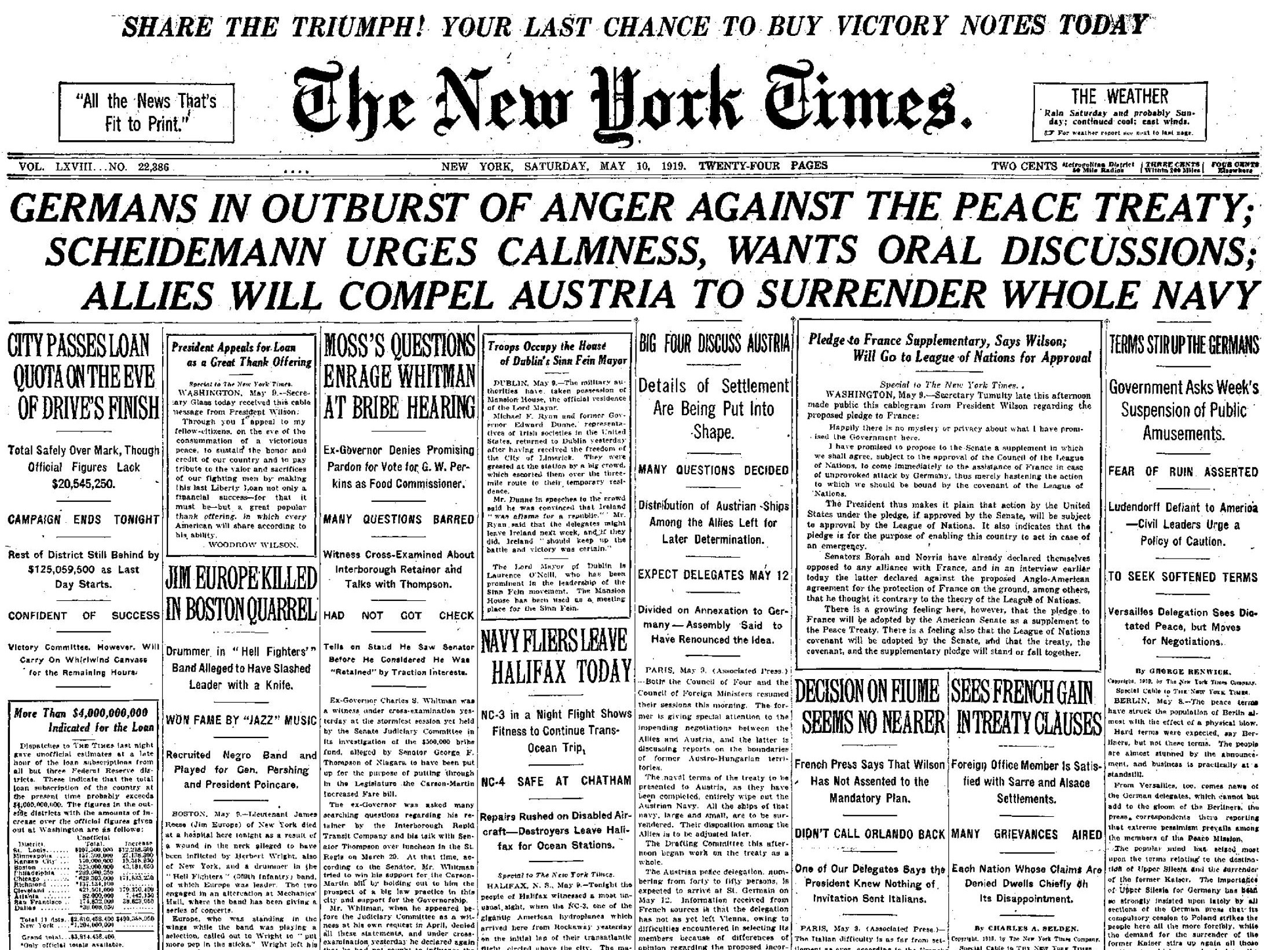
Our society seems to like historical anniversaries [1], so I wondered if May 1919 headlines in The New York Times would mention the 50th anniversary of the completion of the United States’ First Transcontinental Railroad. I searched in vain. Certainly there were many momentous events in the aftermath of World War I, but I didn’t even notice a little blurb on the margins, such as “The Golden Spike fifty years on. See Page B2.”

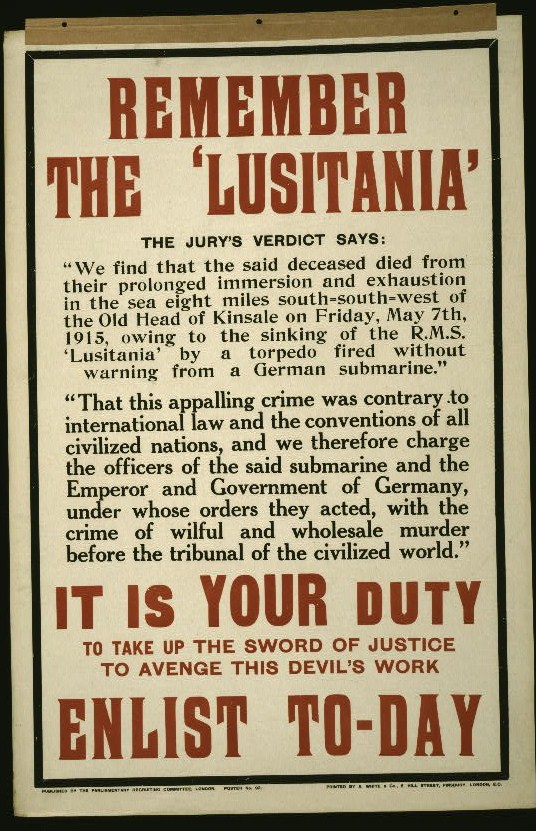
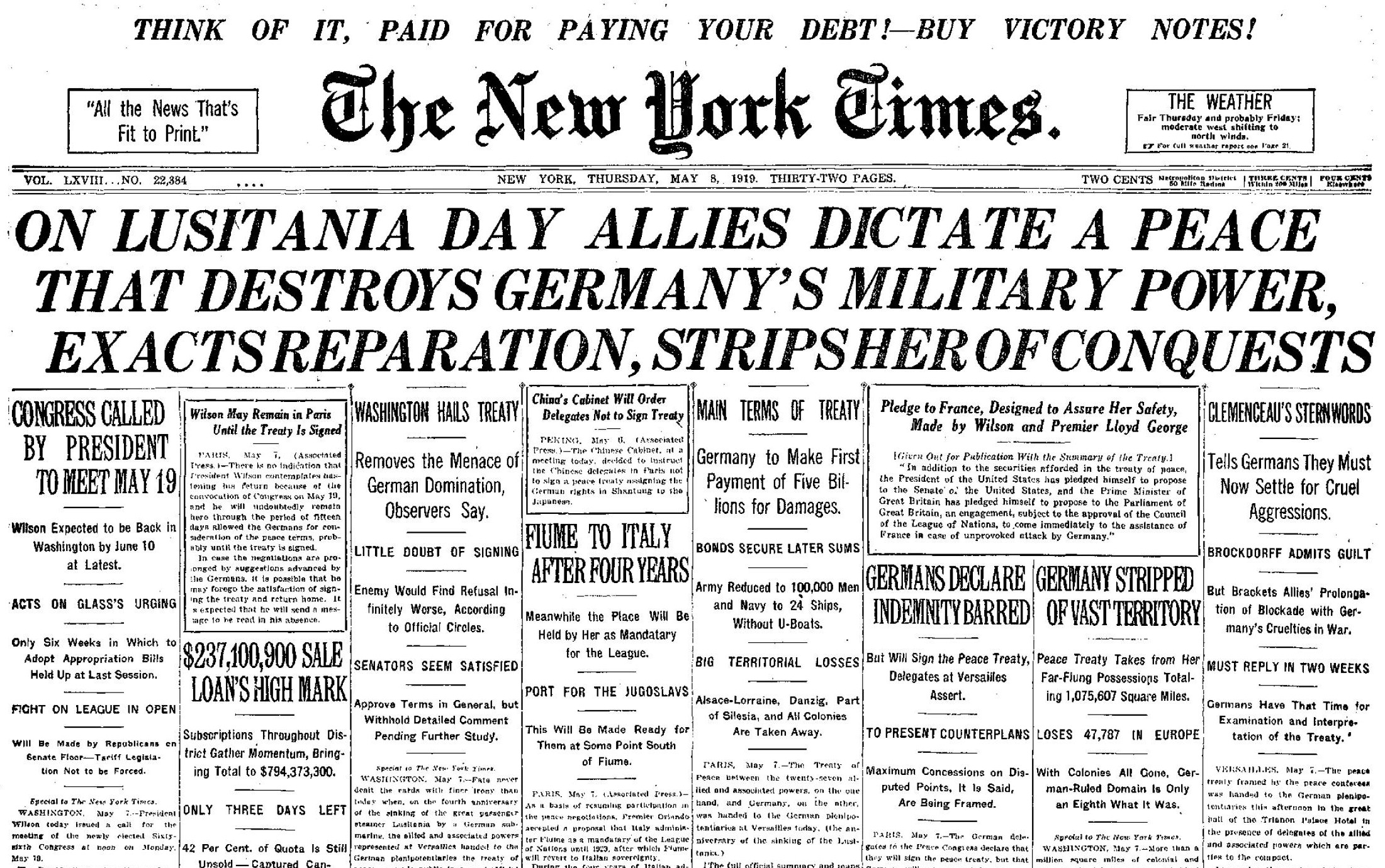
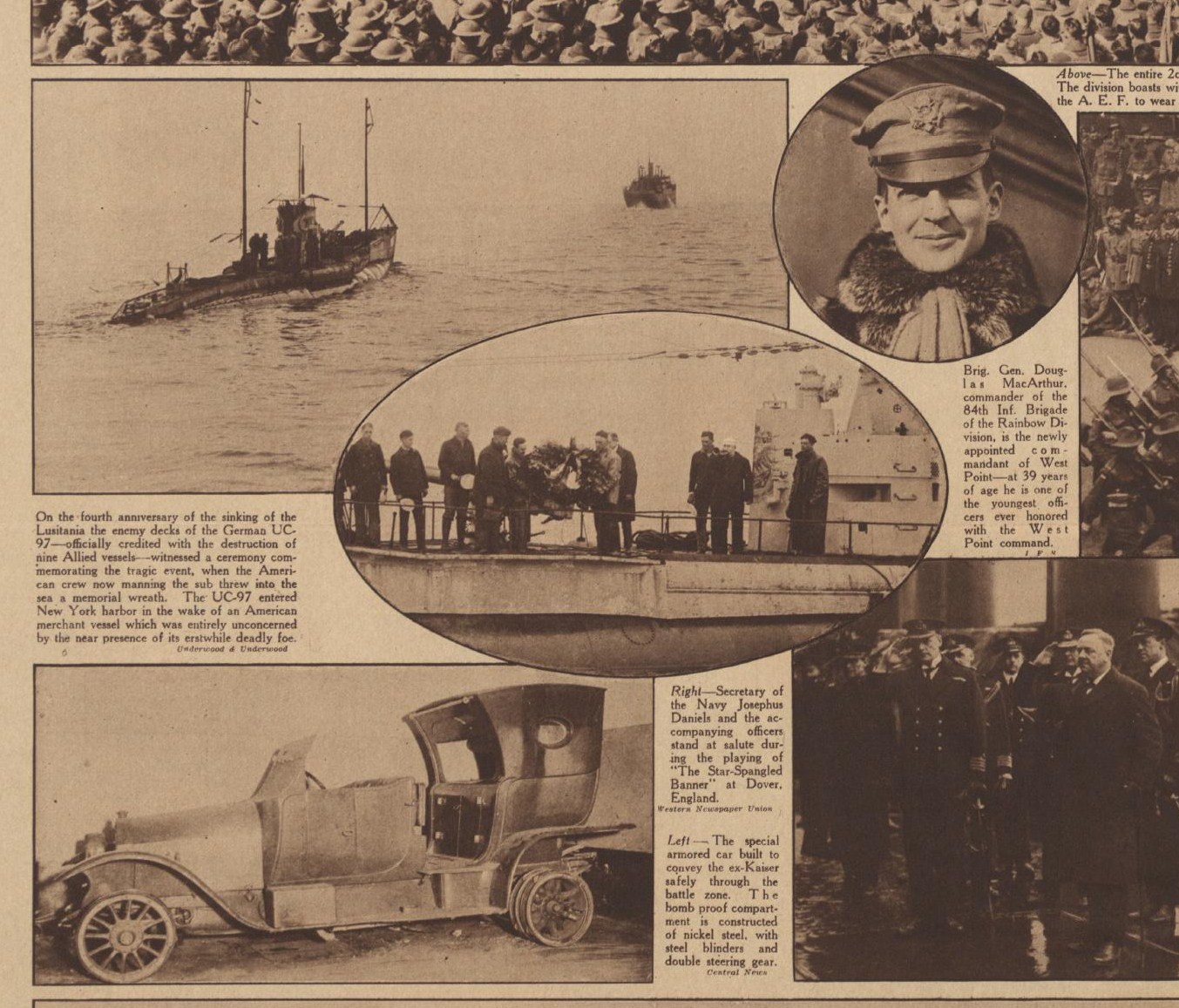
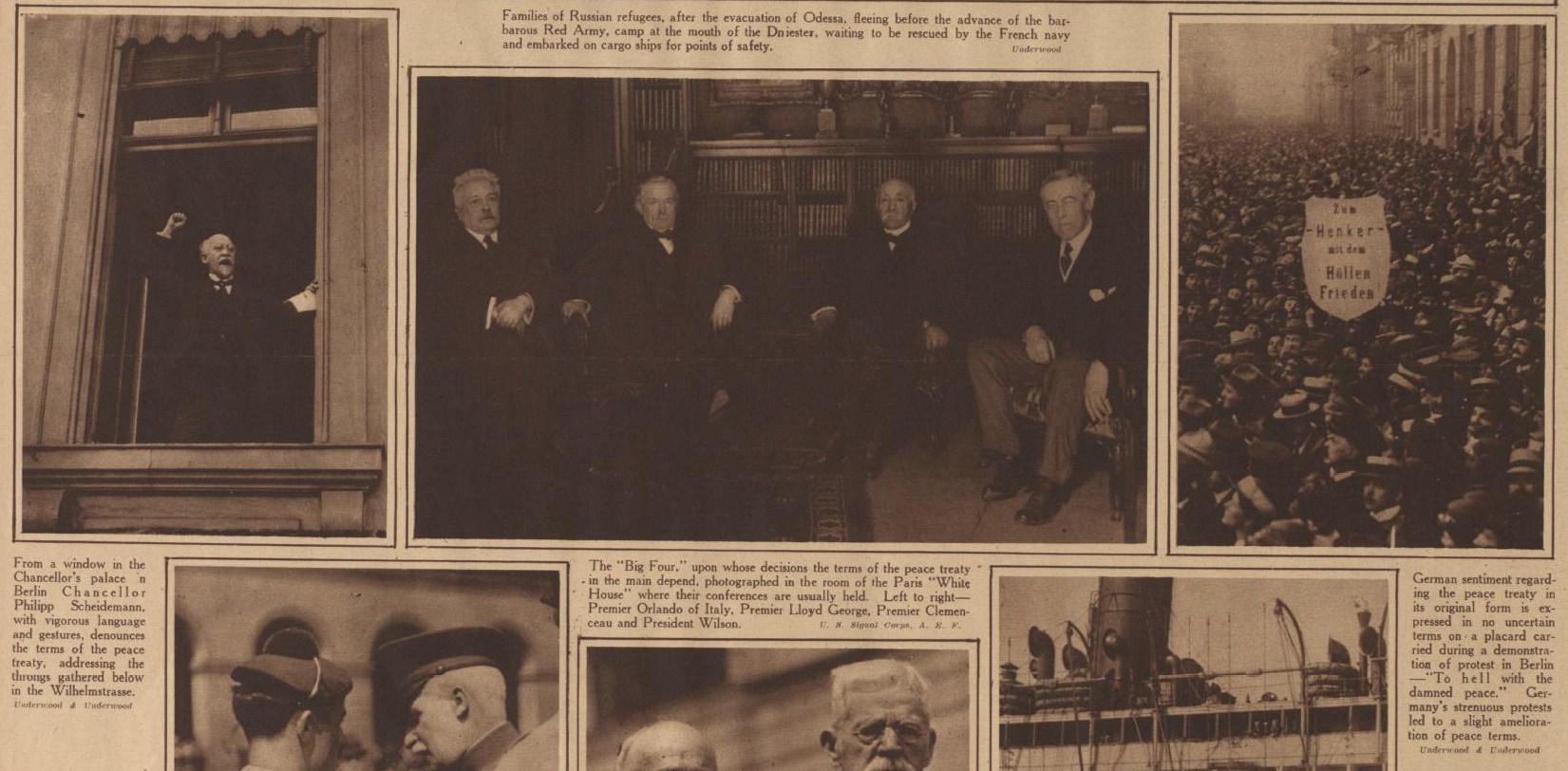
However, the Times did observe another historical anniversary – on the fourth anniversary of the sinking of the Lusitania, the United States and its allies imposed its peace on Germany, despite German protests. As the month of May wore on there were a few minor negotiations about the proposed treaty terms.

unforgiveable

The New York Times
May 8, 1919

The New York Times
May 10, 1919

_______________________________

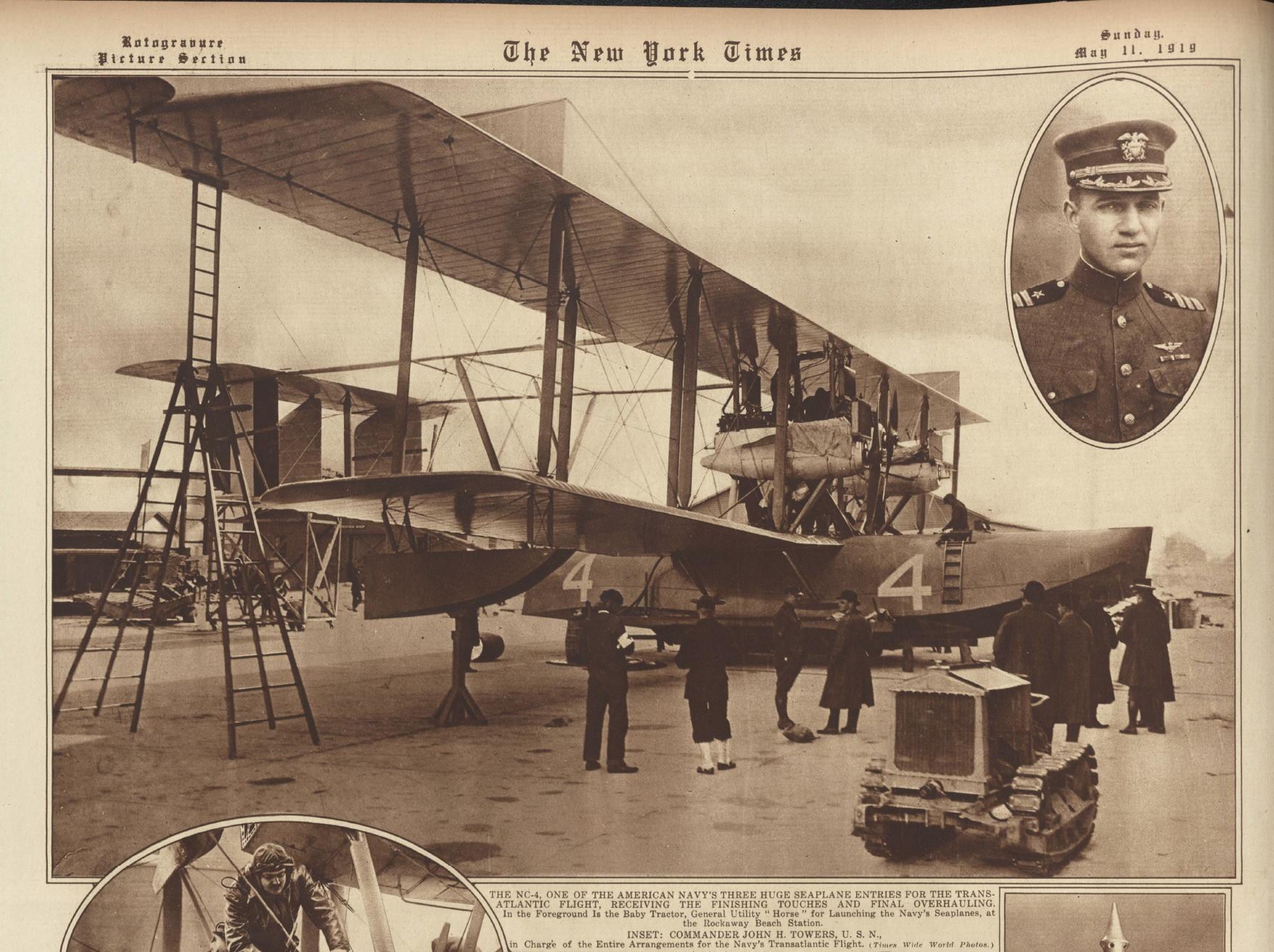
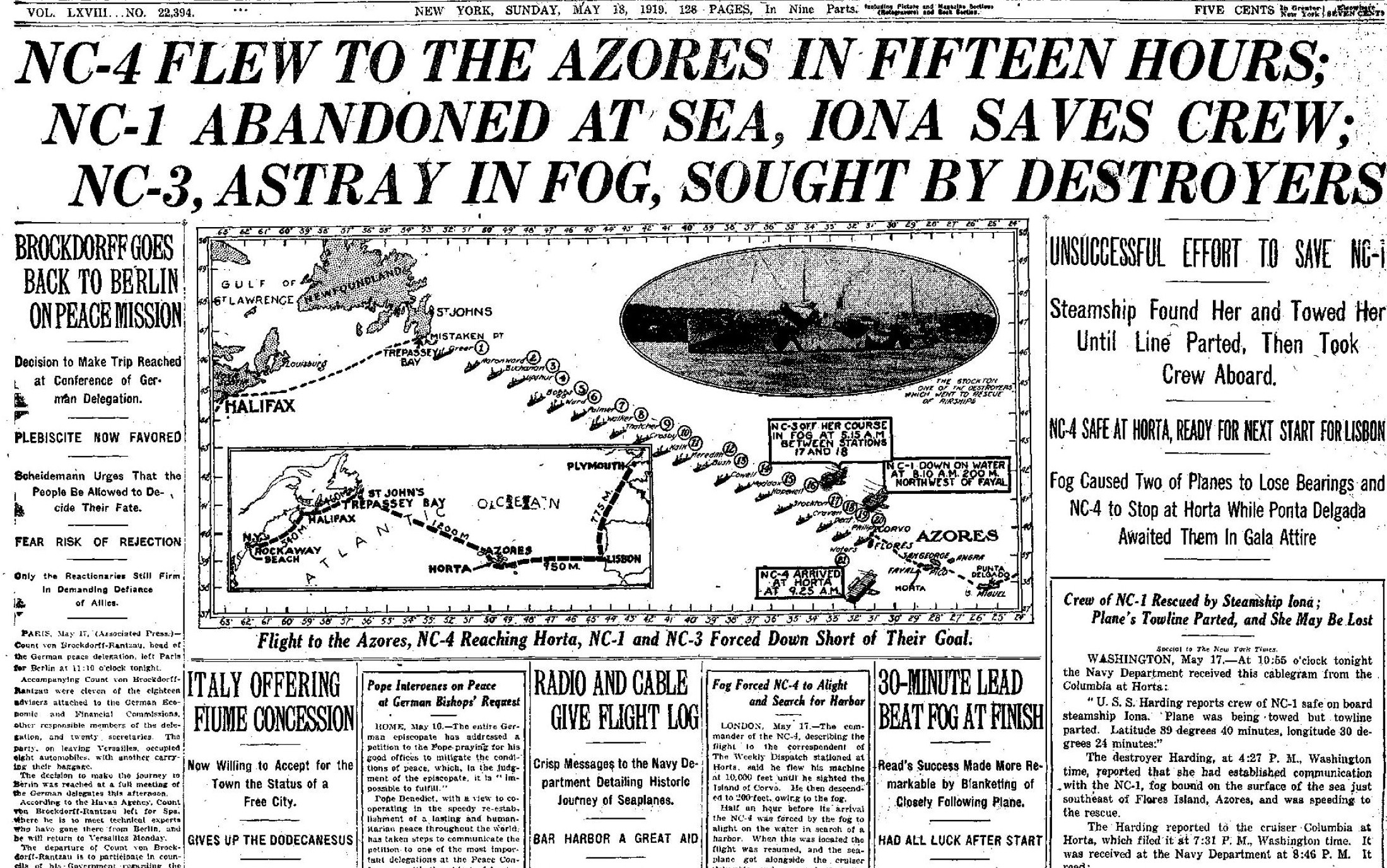
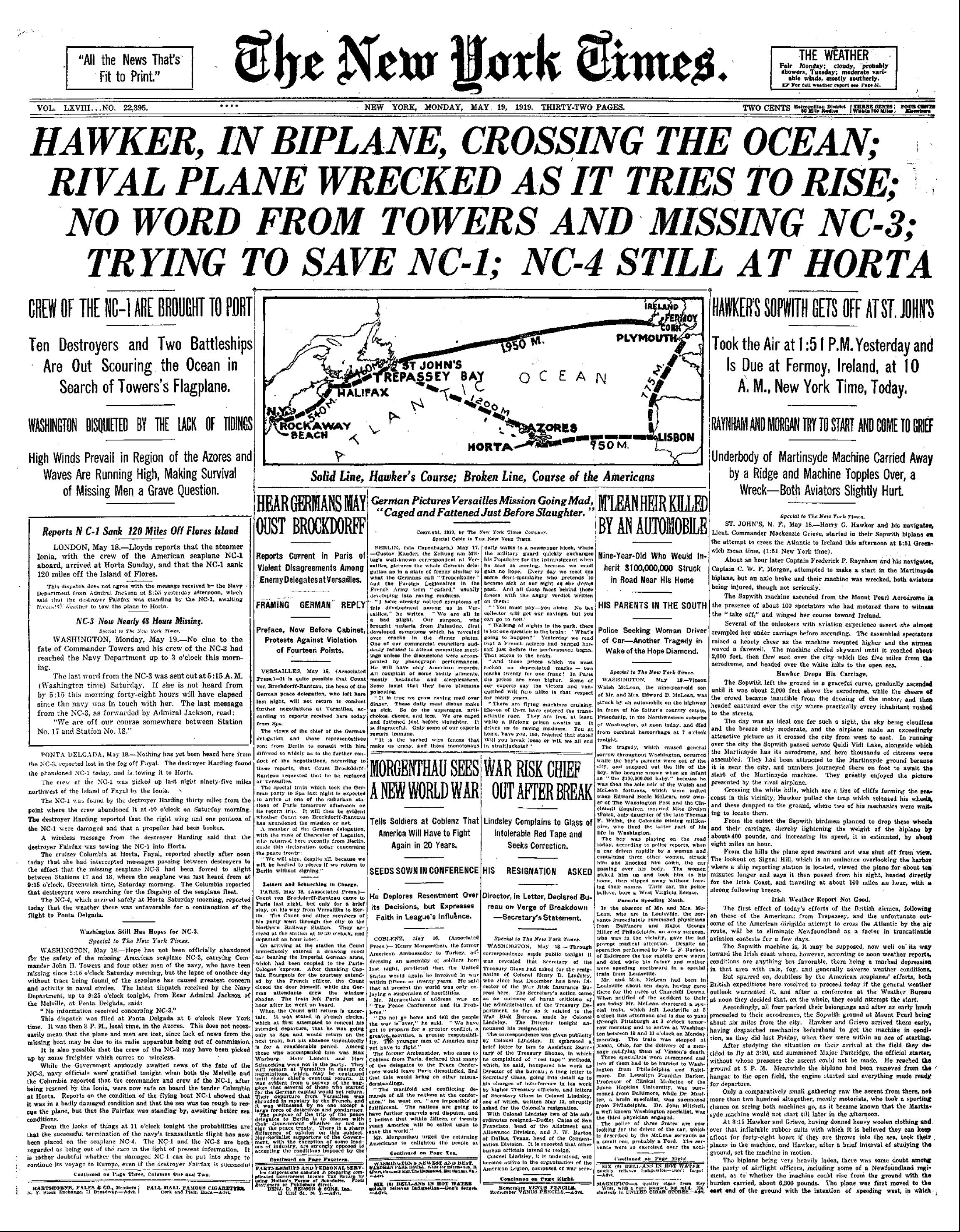
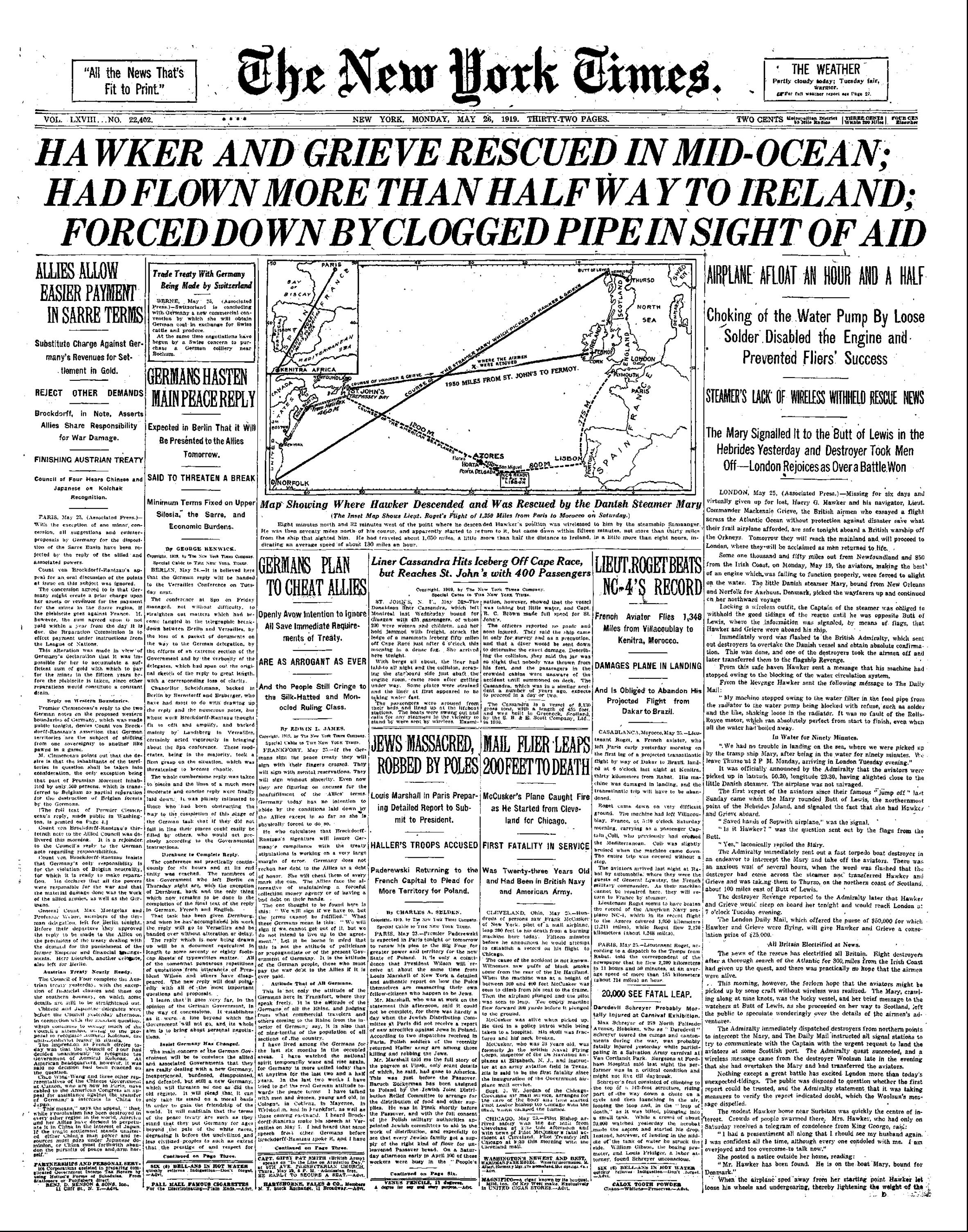
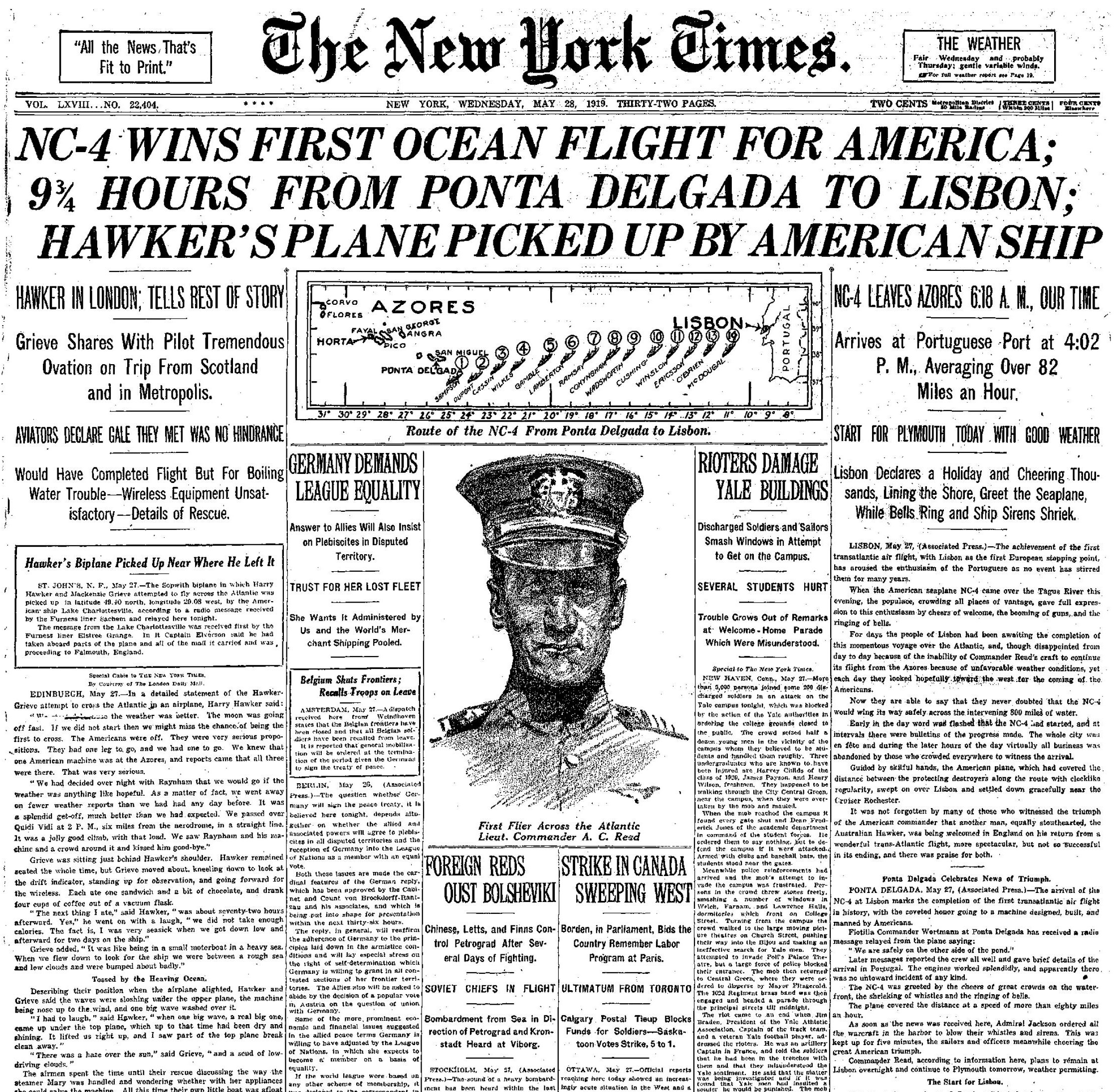
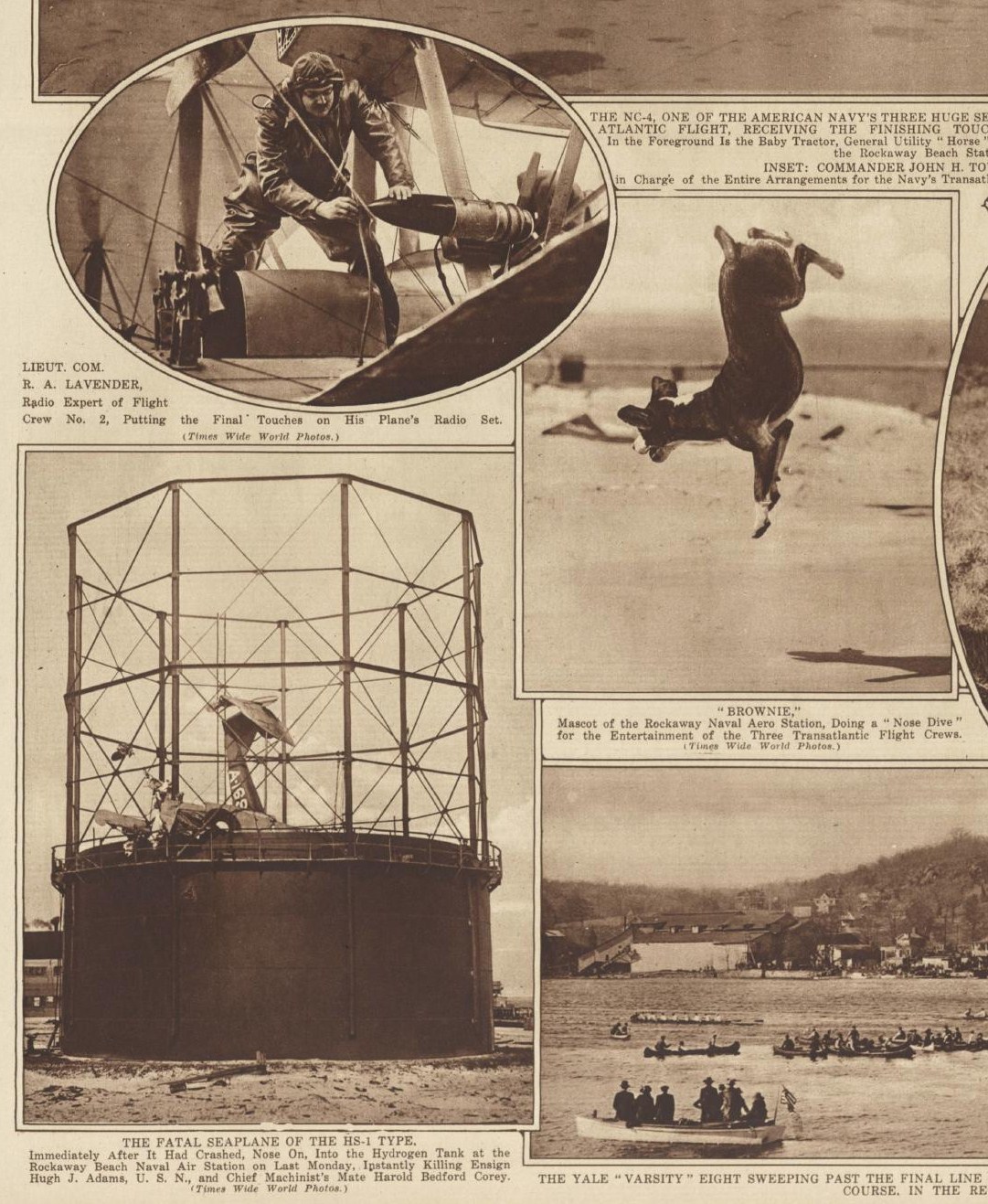
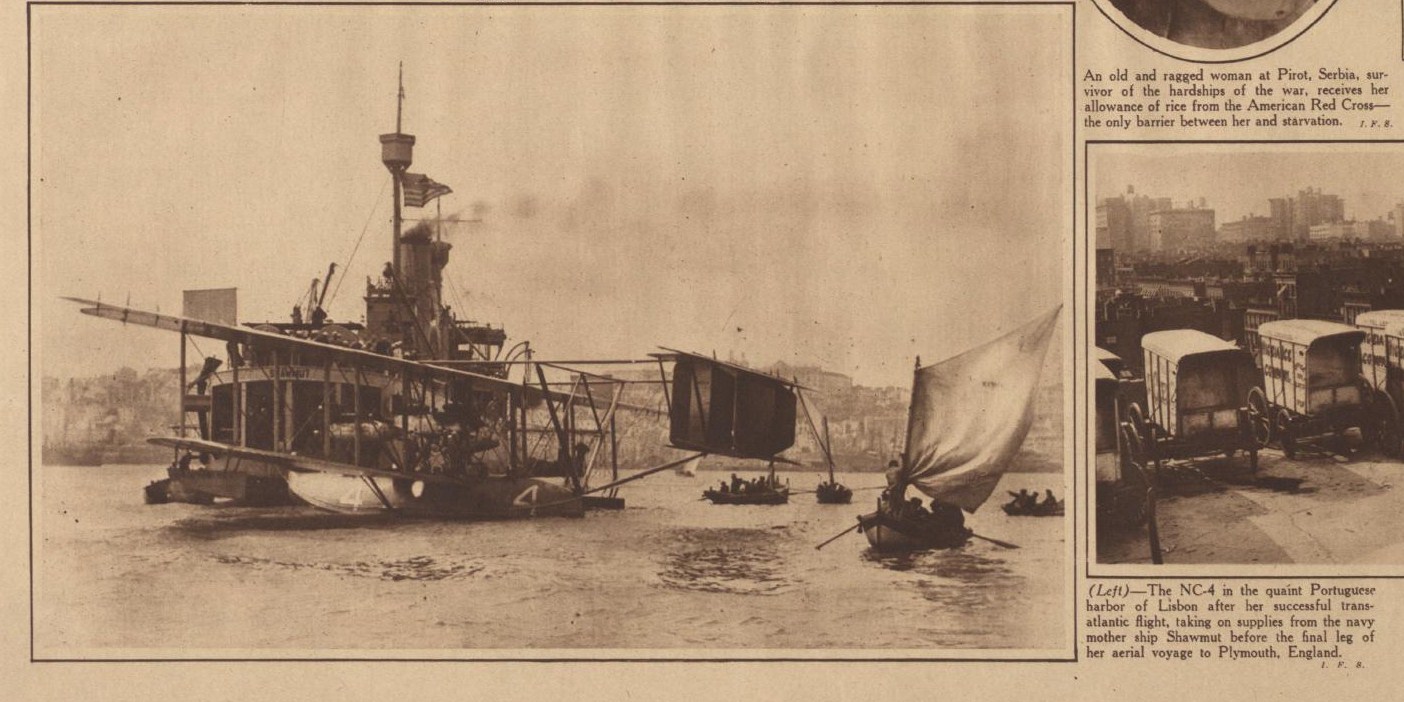
And the newspaper was keenly interested in another feat of transportation technology – the first transatlantic airplane flight. It was quite a competition. The first success was a flight with many legs and with several men on-board. In fact, it was very much an organizational effort. The NC-4 was one of three seaplanes started by the United States Navy. Many ships were out in the ocean trying to keep track of the planes.

The New York Times
May 11, 1919

Wikipedia summarizes, the NC-4’s accomplishment:

First transatlantic flight
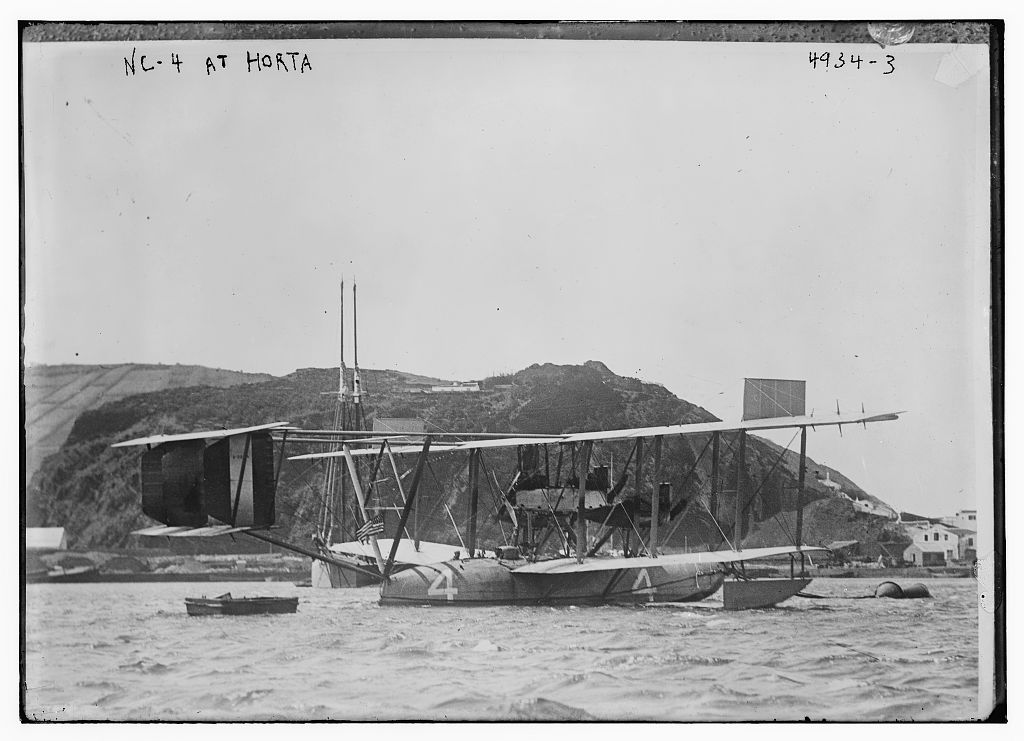
On 8–31 May 1919, the U.S. Navy Curtiss NC-4 flying boat under the command of Albert Read, flew 4,526 statute miles (7,284 km) from Rockaway, New York, to Plymouth (England), via among other stops Trepassey (Newfoundland), Horta and Ponta Delgada (both Azores) and Lisbon (Portugal) in 53h 58m, spread over 23 days. The crossing from Newfoundland to the European mainland had taken 10 days 22 hours, with the total time in flight of 26h 46m. The longest non-stop leg of the journey, from Trepassey, Newfoundland, to Horta in the Azores, was 1,200 statute miles (1,900 km) and lasted 15h 18m.

The New York Times
May 18, 1919

The New York Times
May 19, 1919
new world war prophesied

The New York Times
May 26, 1919

The New York Times
May 28, 1919

NC-4 at Horta in Azores

the Wright stuff

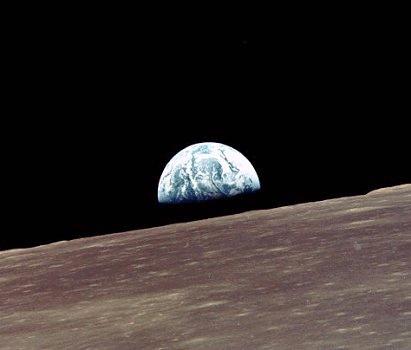
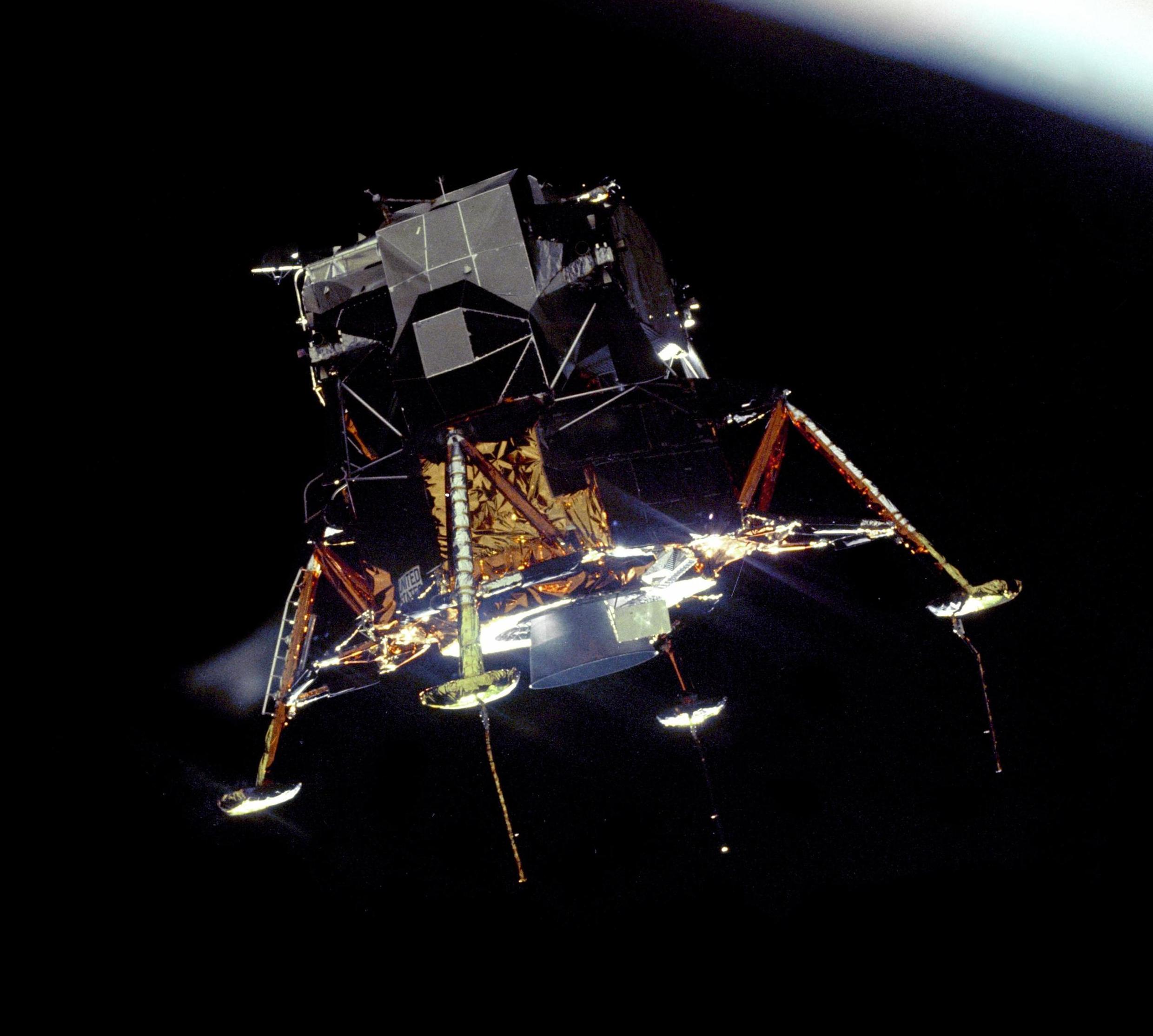
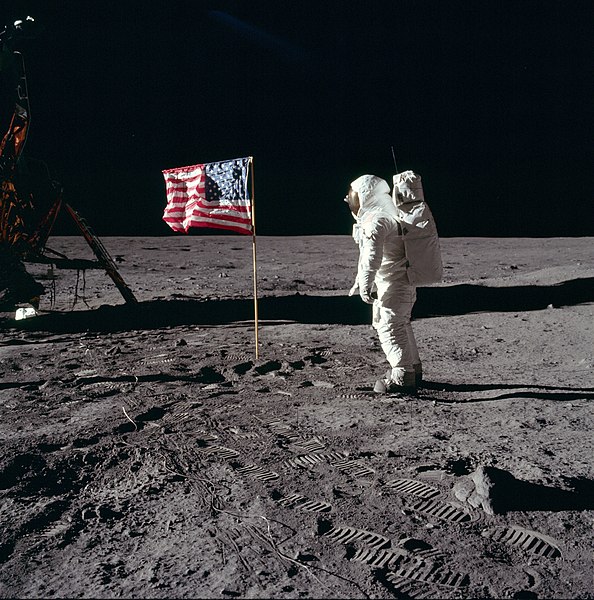
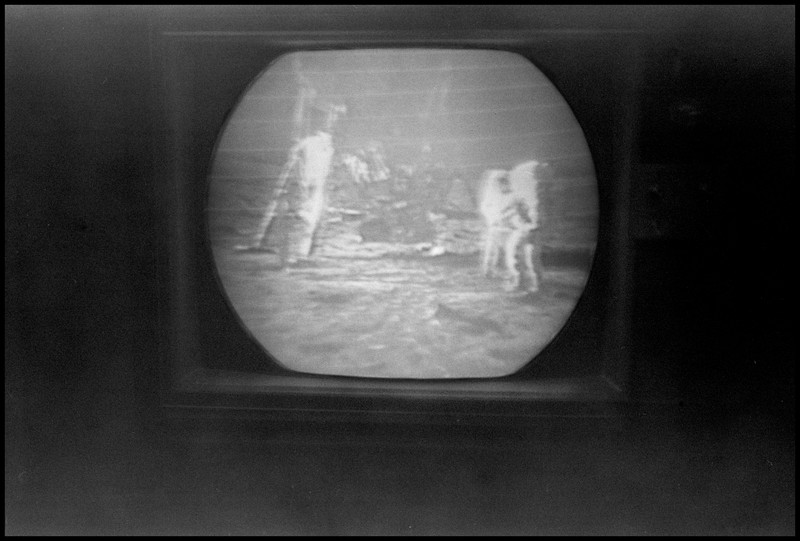
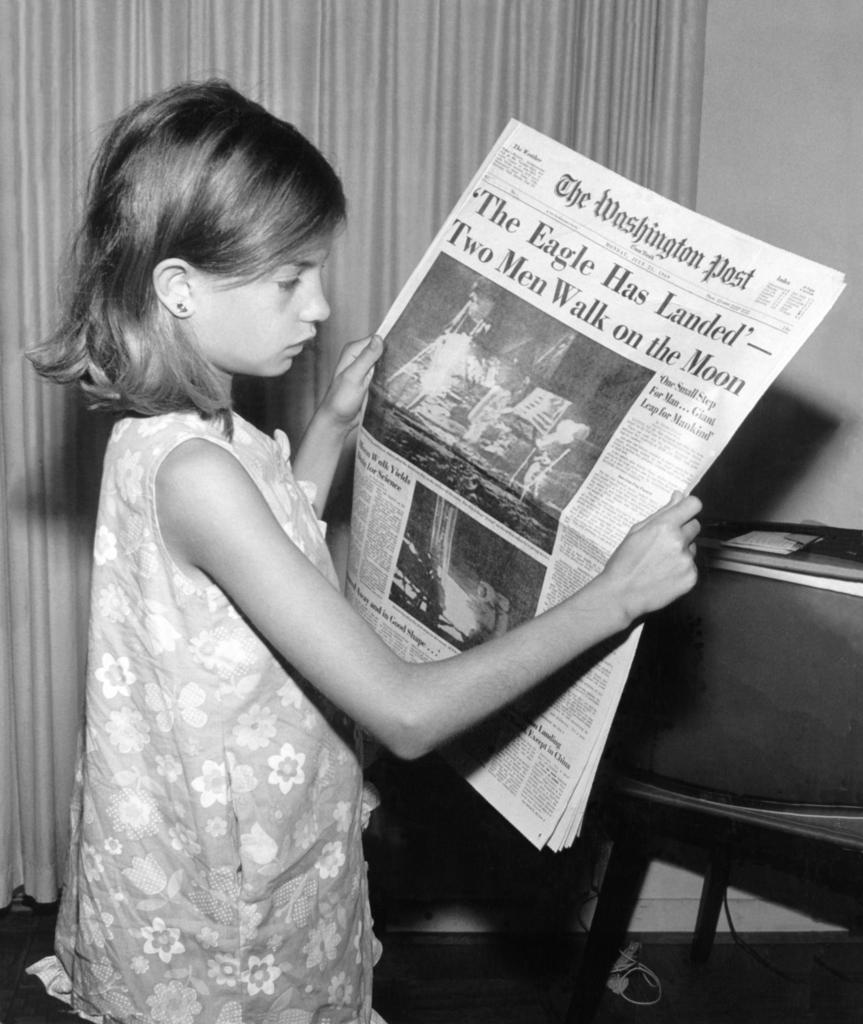
Fifty years later earthlings anticipated an even longer journey, one with fewer legs even though it hopefully was going to be a round trip. The first leg was a whopper, at least 225,000 miles, but the second was relatively tiny as two men in an Eagle were scheduled to descend to the surface of the moon. This journey was also very much an organizational effort. In fact, the prior December three “astronauts” practiced that gigantic first leg. While they were orbiting the moon, they took a photograph of the earth.

earth from moon orbit

I thought of Rev. Dr. Francis Vinton’s sermon with the completion of the transcontinental railroad: “Three thousand two hundred and eighty-five miles of continuous railway within four degrees of latitude and fifty degrees of longitude in the temperate zone.” The crew of the Apollo 8 caught a lot more than that in a snapshot.
When I saw the image of the crashed seaplane, I thought of Walter Cronkite with tears in his eyes telling us about a crash during the Gemini stage of NASA’s moon campaign. It probably was the 1966 NASA T-38 crash
Henry Morgenthau Sr., who predicted a second world war in 15 or 20 years, served as the United States diplomat to the Ottoman Empire from 1913-1916 and reported the Armenian massacre as genocide.
According to the May 29, 1919 issue of The New York Times, Harry Hawker, who with navigator Kenneth Mackenzie Grieve, crashed during their attempt to win the Daily Mail £10,000 prize for the first flight across the Atlantic in “72 consecutive hours,” bashed the U.S. Navy effort. He “deprecated the organization which had won for the United States the honor of the first crossing of the Atlantic by a heavier than air machine.
He held that it was not a serious attempt, with a ship stationed at “every twenty yards.” Also, “if you put a ship every fifty miles it shows you have no fight in your motor.” One reason that the NC-4 wasn’t eligible for the prize is because it took longer than 72 hours.

The New York Times
May 11, 1919

New York Tribune
May 18, 1919

New York Tribune
May 18, 1919
commemorate the Lusitania

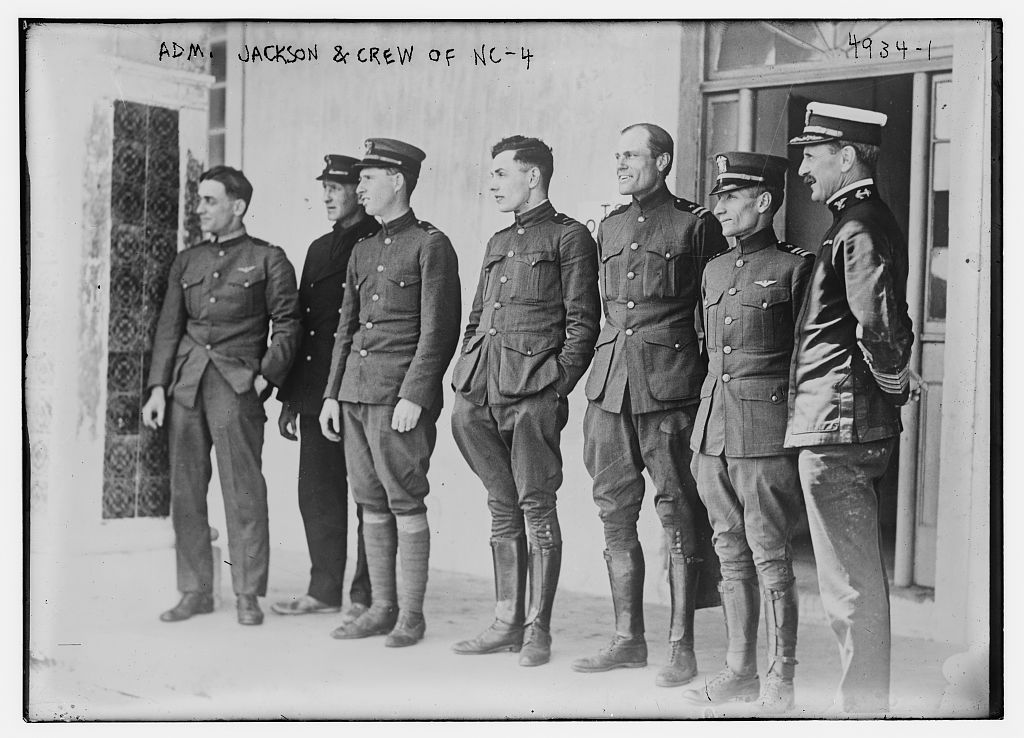
I got the earth image at Wikipedia. From the Library of Congress: recruiting poster; NC-4 at Horta; it’s crew; Times May 11th; Trib May 18th, June 15th, June 22nd

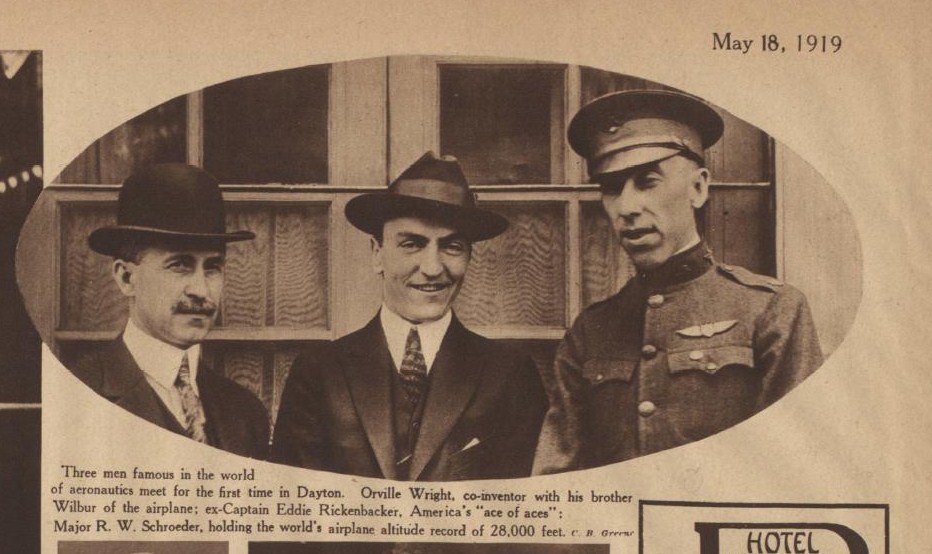
famous flyers
(Trib May 18, 1919)

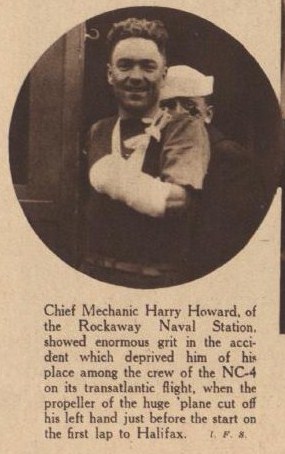
gritty mechanic
(Trib May 18, 1919)

NC-4 at Lisbon
(Trib June 15, 1919)

have I seen this before? (New York Tribune June 22, 1919)

July 8, 2019: I’m adding a couple pictures from the July 20, 1919 issue of the New York Tribune at Library of Congress.

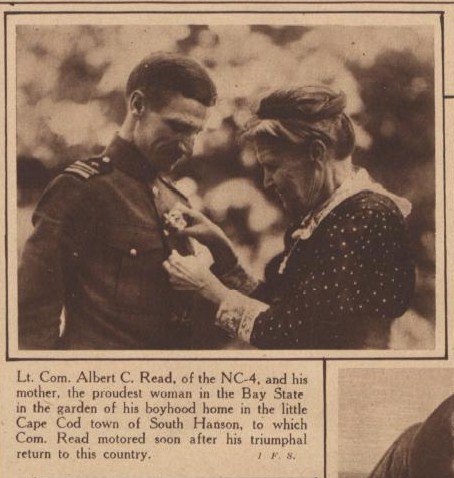
on Cape Cod

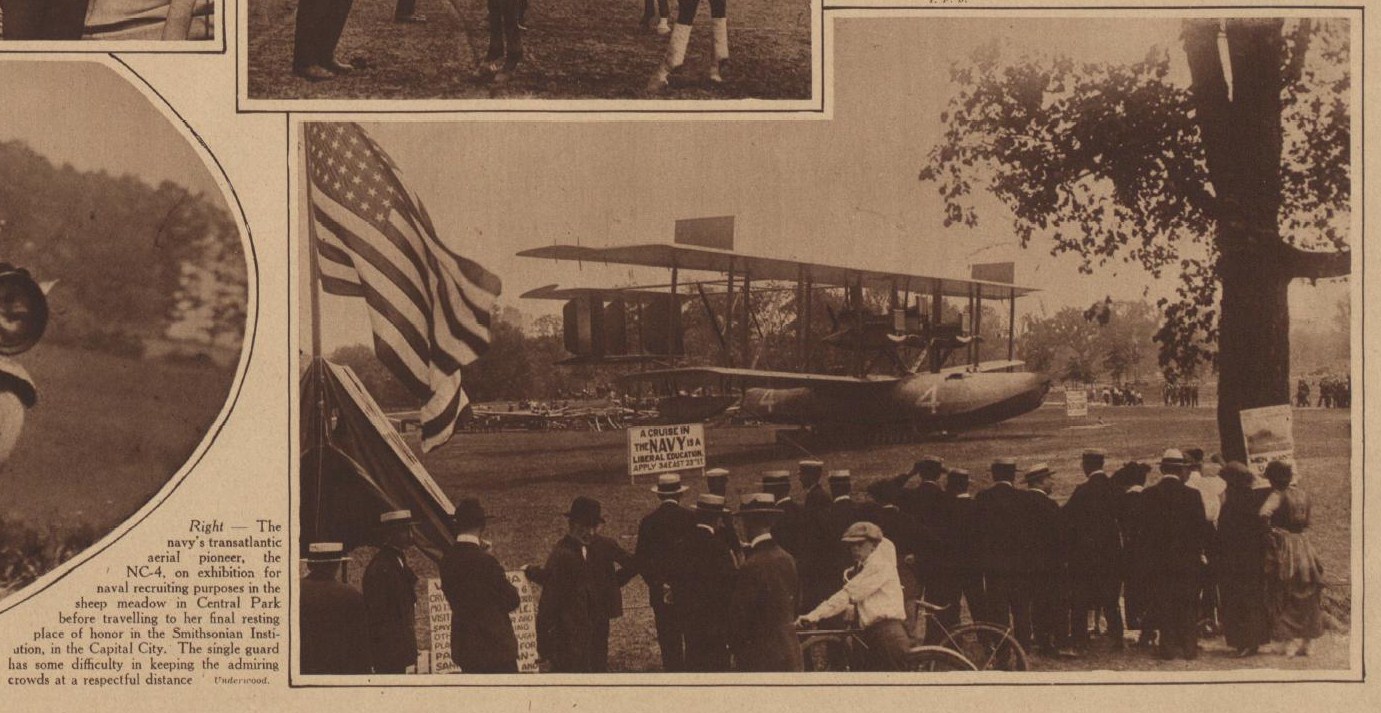
Smithsonian bound

  1. [1]at least Sumpter does
Posted in 100 Years Ago, Technology, World War I | Tagged , , , , , , , , , , , , | Leave a comment

divergent decoration

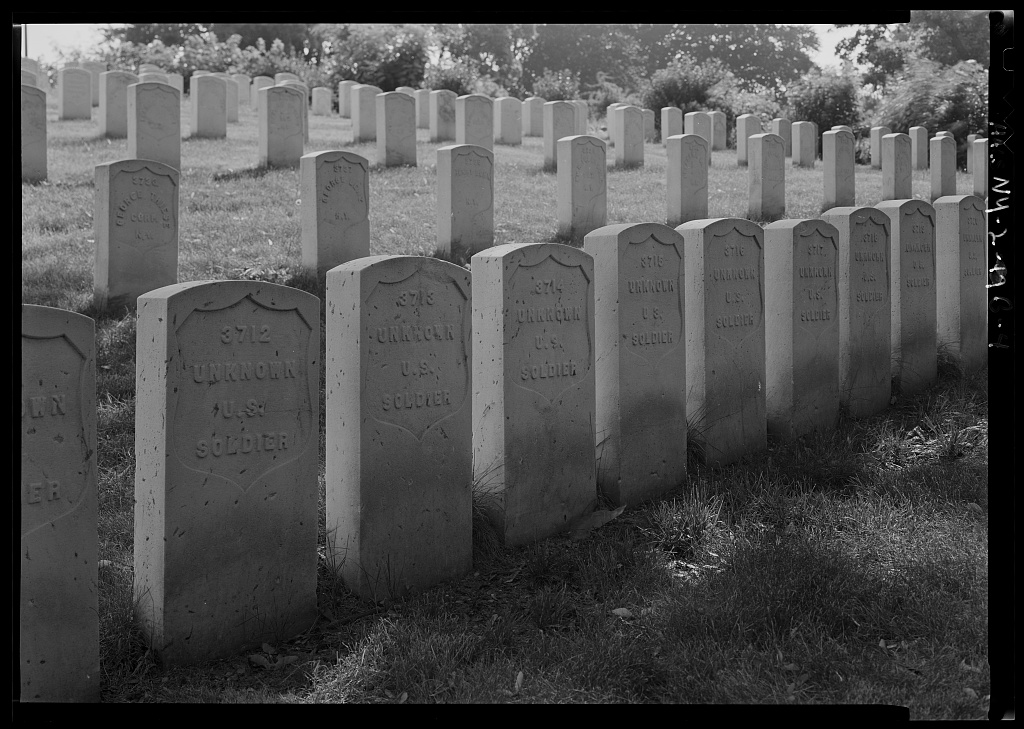
unknowns at Cypress Hills

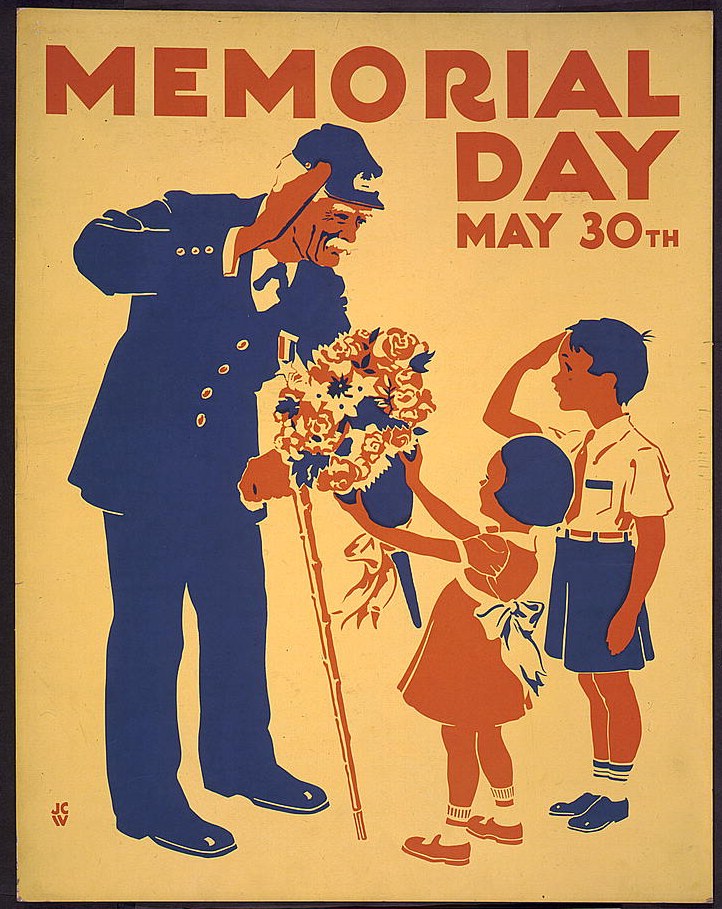
150 years ago today a large procession traveled from Manhattan to Brooklyn to honor the memory and decorate the graves of thousands of soldiers who died during the American Civil War.

From the June 19, 1869 issue of Harper’s Weekly:

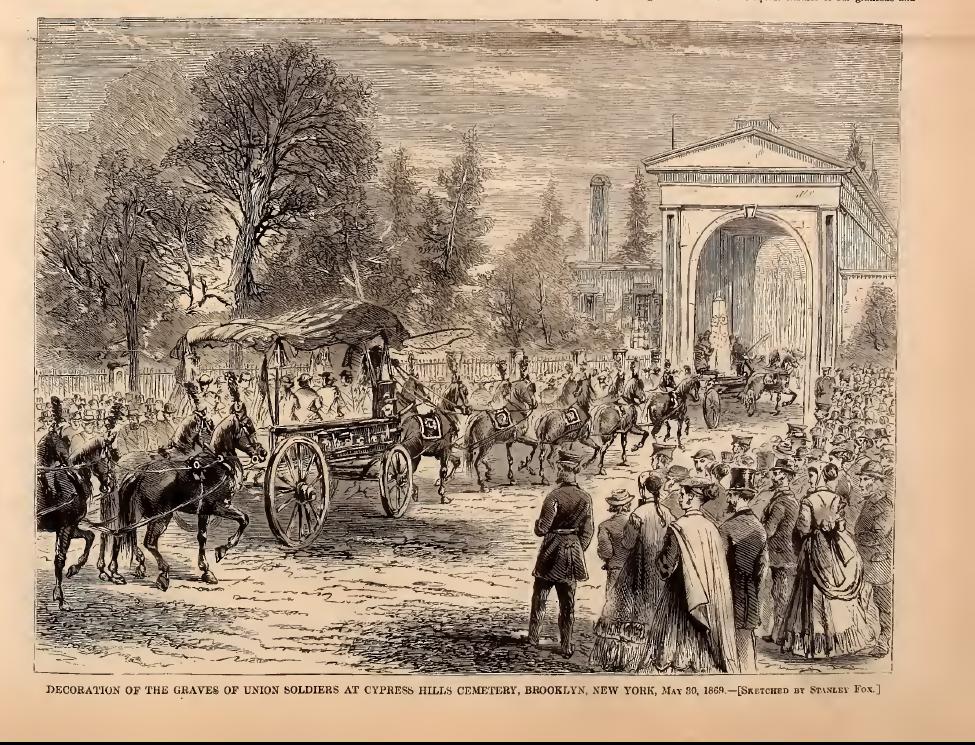
DECORATION EXERCISES AT CYPRESS HILLS CEMETERY.

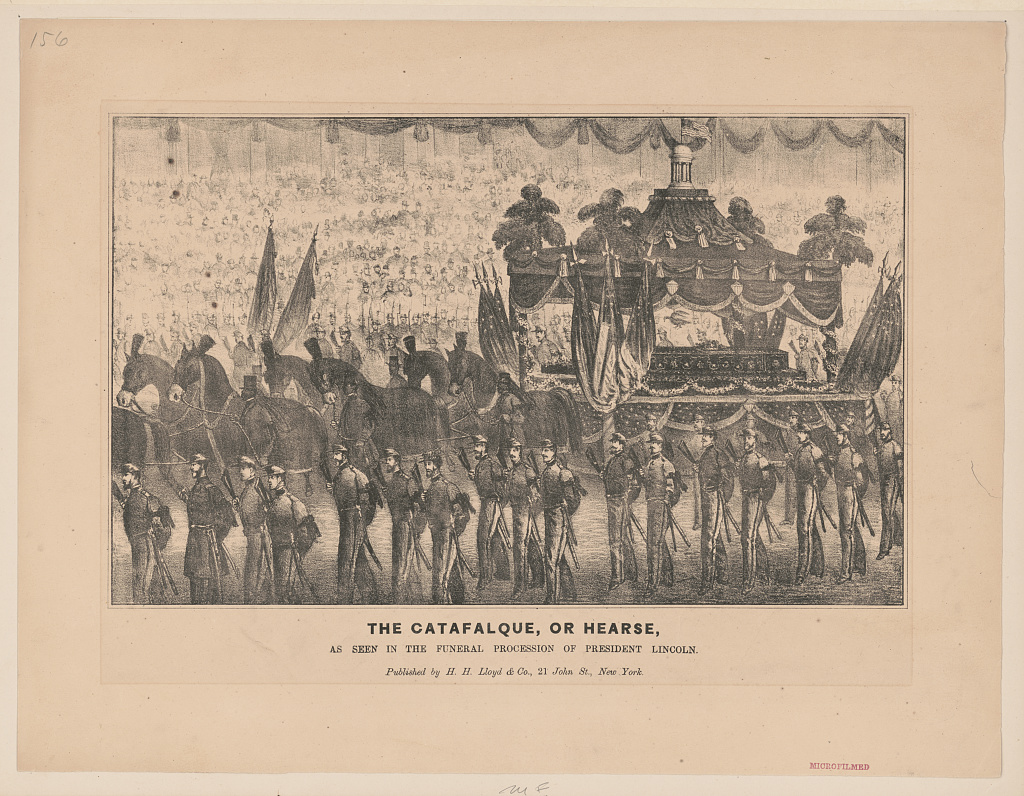
The day appointed for the decoration of the graves of Union soldiers (May 30) was universally observed. We give on this page an illustration of the decoration at Cypress Hills Cemetery, Brooklyn, New York. The procession started from Union Square in this city about noon. The First Division was headed by Major-General ALEXANDER SHALER and his staff, mounted, which comprised four companies of United States Marines, accompanied by their famous band, under the command of Lieutenant-Colonel BROOME; a squad of the Washington Gray Troop, commanded by Major KENT, and a troop of the Third Cavalry. Following up the rear of the division was General VARIAN and General BURGER, accompanied by several officers of their staffs. In the Second Division, seated in carriages, were the officers of the Memorial Executive Committee, and the orators of the day, Major-General DANIEL E. SICKLES and Grand Commander Colonel EDWARD B. LANSING. The catafalque used at the obsequies of President LINCOLN, decorated with flowers in monumental form, was drawn by eight white horses furnished by Dodd’s Express Company. Seventy-five boys of the Union Home and School, orphans of deceased Union soldiers, were in uniform, under the command of one of their own number. Fifty girls from the same school were in three of the large Erie Railroad express wagons, which were handsomely decorated with flags and bunting. One of the wagons was drawn by ten black horses. There were also two wagons filled with flowers.
Abraham Lincoln’s catafalque

For a long time before the head of the procession reached the portals of the cemetery the grounds were alive with people. Many had brought carriage-loads of flowers with them to decorate the graves. Many who had come afoot brought their modest floral offerings too, and more than one narrow grave was beautifully decked long before the hour for the ceremonies had arrived.

When the different organizations composing the procession had been properly disposed about the mound overlooking the soldiers’ graves, the services were opened by the singing of a hymn. After which a prayer was offered by the chaplain of the G.A.R., and a beautiful hymn sung by the soldiers’ orphans from the Union Home at Carmansville.

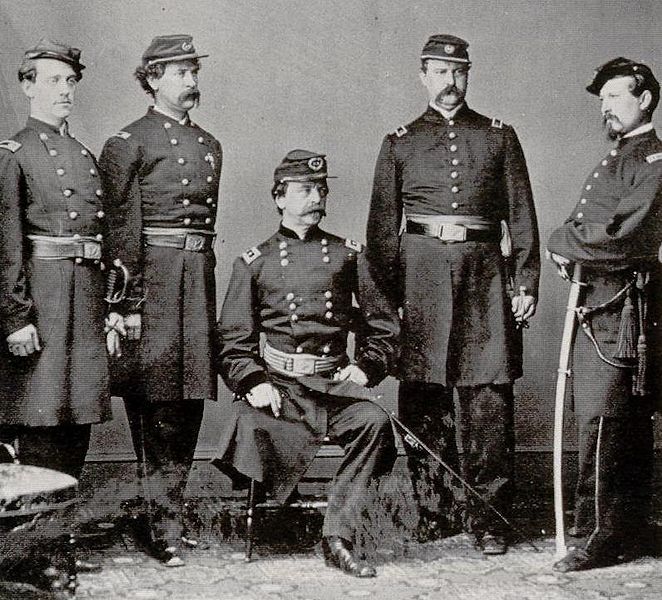
1863 photo of Daniel Sickles and his staff after the battle of Gettysburg

after Gettysburg and before “Our Memorial-day”

General SICKLES then advanced and addressed the assemblage. He said: “We stand where more than 3,000 soldiers of the Republic are buried. We come to scatter upon their graves the mute but eloquent tributes of our gratitude and affection. We bring with us the standards under which many of them fell – and here, too, are many of their children, whom it is our duty to care for and to cherish. Soldiers are here, merchants, men in all walks of life, all united to-day in asserting their sympathy for the object which has called us together. Our Memorial-day is of special interest to us, whose comrades lie buried here. We mourn the loss of friends who have fought side by side with us, our tears bedew the flowers we lay upon their quiet graves, but our grief is mingled with the pride we feel when we think of the noble services of those who did not die in vain when struggling to aid in the salvation of our country. The magistrate who enforces the laws, who wields the sword of justice to the end that the welfare of society may be preserved, is a benefactor; but the men who fill these graves are greater benefactors by far. They fought that the laws might be observed. They gave up home and life for country, and we enjoy to-day the fruits of their exertions, and may we ever hold them in grateful remembrance.

General SICKLES closed with an eloquent appeal in behalf of the soldiers’ orphans, claiming that their can be no more graceful or grateful service than to care for these children of the Republic, whose fathers died that the Republic might live.

The following is the hymn sung at the opening of the exercises:

Love unchanging for the dead,
 Lying here in gloried sleep,
Where the angels softly tread,
 While their holy watch they keep.

Wreaths we bring that ne’er shall fade,
 Greener with the passing years,
Brighter for our sorrow’s shade,
 Jeweled with our fallen tears.

Dying that the truth might live,
 Here they rest in Freedom’s name,
Giving all that man can give –
 Life for Glory’s deathless fame.

Bend in love, O azure sky!
 Shine, O stars! at evening-time!
Watch where heroes calmly lie,
 Clothed with faith and hope sublime.

God of nations bless the land
 Thou hast saved to make us free!
Guide us with thy mighty hand,
 Till all lands shall come to THEE!

Sabbath Day journey

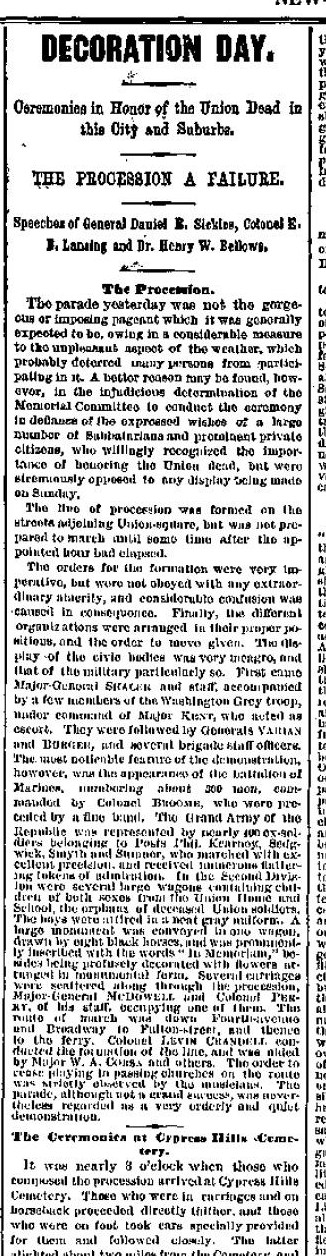
Nowadays the ceremony at Cypress Hills seems to have been solemn and appropriate, but at the time it was somewhat controversial. According to the May 31, 1869 issue of The New-York Times, The Procession A Failure. Many people opposed parading on Sunday:

The Procession.

The parade yesterday was not the gorgeous or imposing pageant which it was generally expected to be, owing in a considerable measure to the unpleasant aspect of the weather, which probably deterred many persons from participating in it. A better reason may be found, however, in the injudicious determination of the Memorial Committee to conduct the ceremony in defiance of the expressed wishes of a large number of Sabbatarians and prominent private citizens, who willingly recognized the importance of honoring the Union dead, but were strenuously opposed to any display being made on Sunday. …

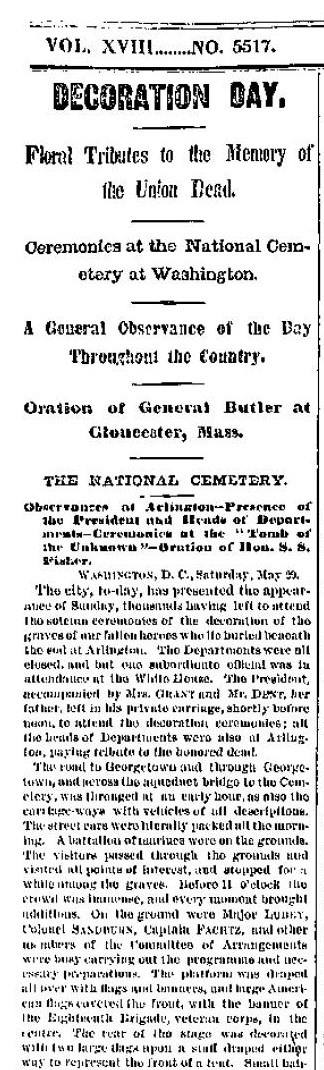
A day earlier the same newspaper reported that Decoration Day at Arlington, attended by President Grant and with ceremonies at the “Tomb of the Unknown,” was observed a day earlier on a Saturday:

Washington, D. C., Saturday, May 29th:

The city, to-day, has presented the appearance of Sunday, thousands having left to attend the solemn ceremonies of the decoration of the graves of our fallen heroes who lie buried beneath the sod at Arlington. The Departments were all closed, and but one subordinate official was in attendance at the White House. …

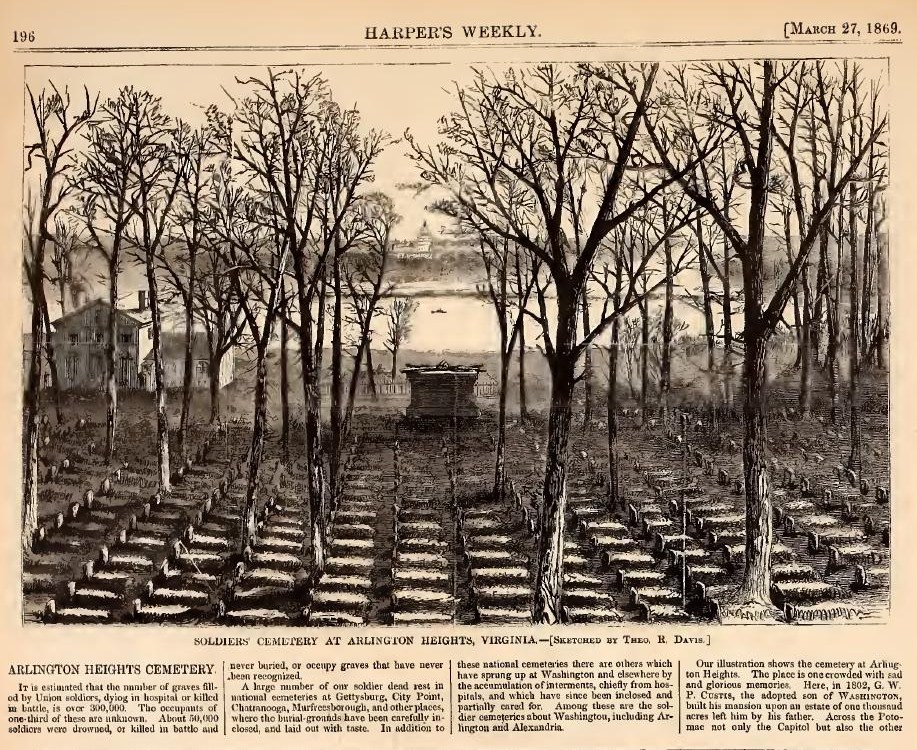
graves along the Potomac

The New-York Times
May 30, 1869

The New-York Times
May 31, 1869

Harper’s Weekly concluded

That might be an advantage of always celebrating Memorial Day on Monday, at least I don’t know of any religions that use Monday as Sabbath.
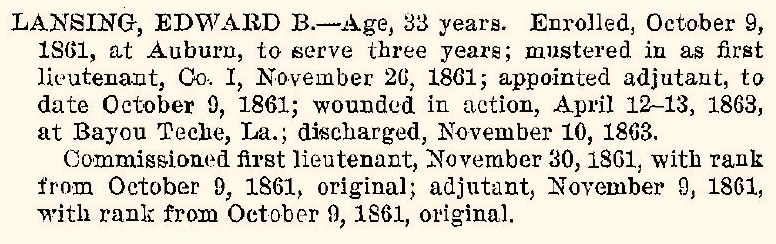
According to New York Department Sons of Union Veterans of the Civil War (SUVCW) Edward B. Lansing “was the 3rd Department Commander of the GAR in New York State.” He served in the 75th New York Infantry Regiment and “was wounded in action April 12 – 13, 1863 at Bayou Teche, La.” That was probably part of the Battle of Fort Bisland. He is buried at Fort Hill Cemetery in Auburn, New York. The Fort Hill link provides a photo of the grave marker and an obituary. In addition to serving in the GAR, Colonel Lansing practiced law in Brooklyn until his death in 1887 at age 58.

wounded in Louisiana

William Henry Seward and Harriet Tubman are also buried at Fort Hill. More information about Carmansville is available at Gothamist.
You can find all the material from Harper’s Weekly in 1869 at the Internet Archive. From the Library of Congress: graves at Cypress Hills; President Lincoln’s catafalque; General Sickles and staff; Work Projects Administration poster from 1936 or 1937. The cutout from the 75th’s roster is found at the New York State Military Museum.

give or take a day or a few

Posted in 150 Years Ago This Week, Aftermath, Veterans | Tagged , , , , , , , , , , , , | Leave a comment

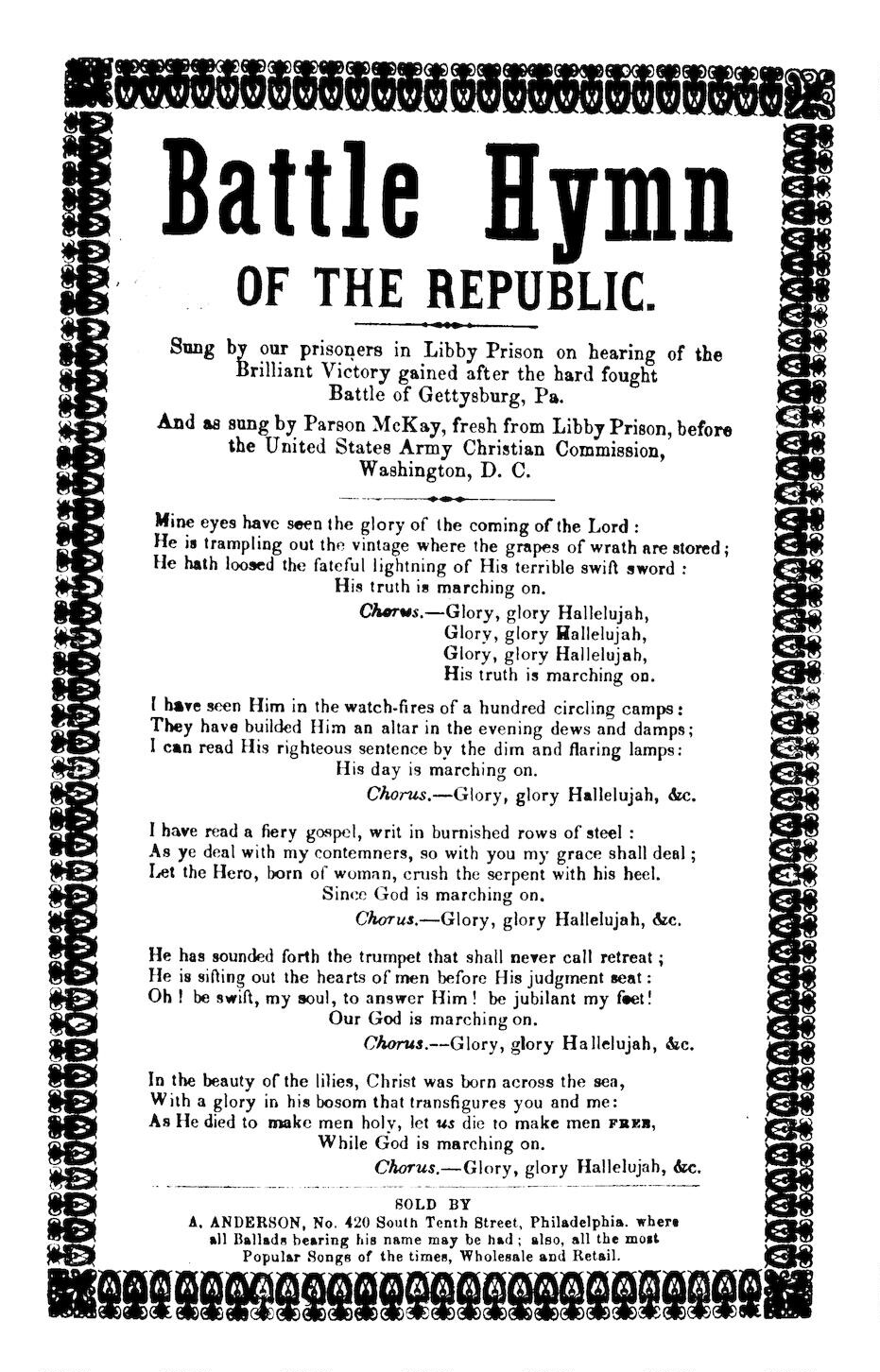
battle hymns

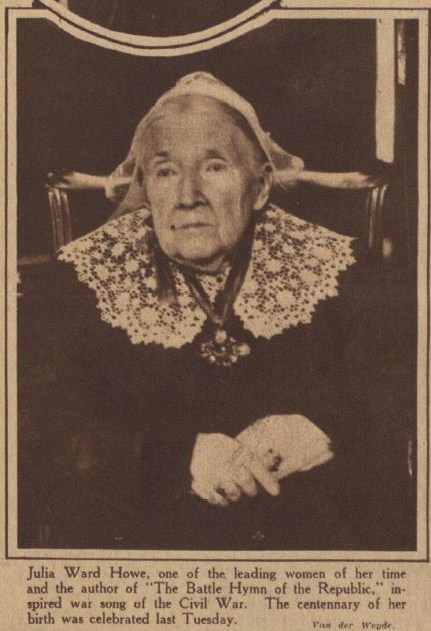
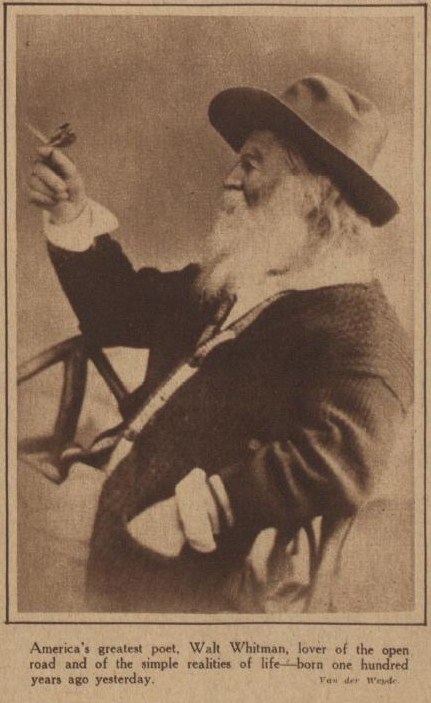
In its June 1, 1919 issue the New York Tribune commemorated the birth centenaries of two well-known Civil War-era Americans.

Julia Ward Howe

Walt Whitman

______________________________

According to Wikipedia, Julia Ward Howe was a poet, author, abolitionist, and advocate for women’s suffrage:

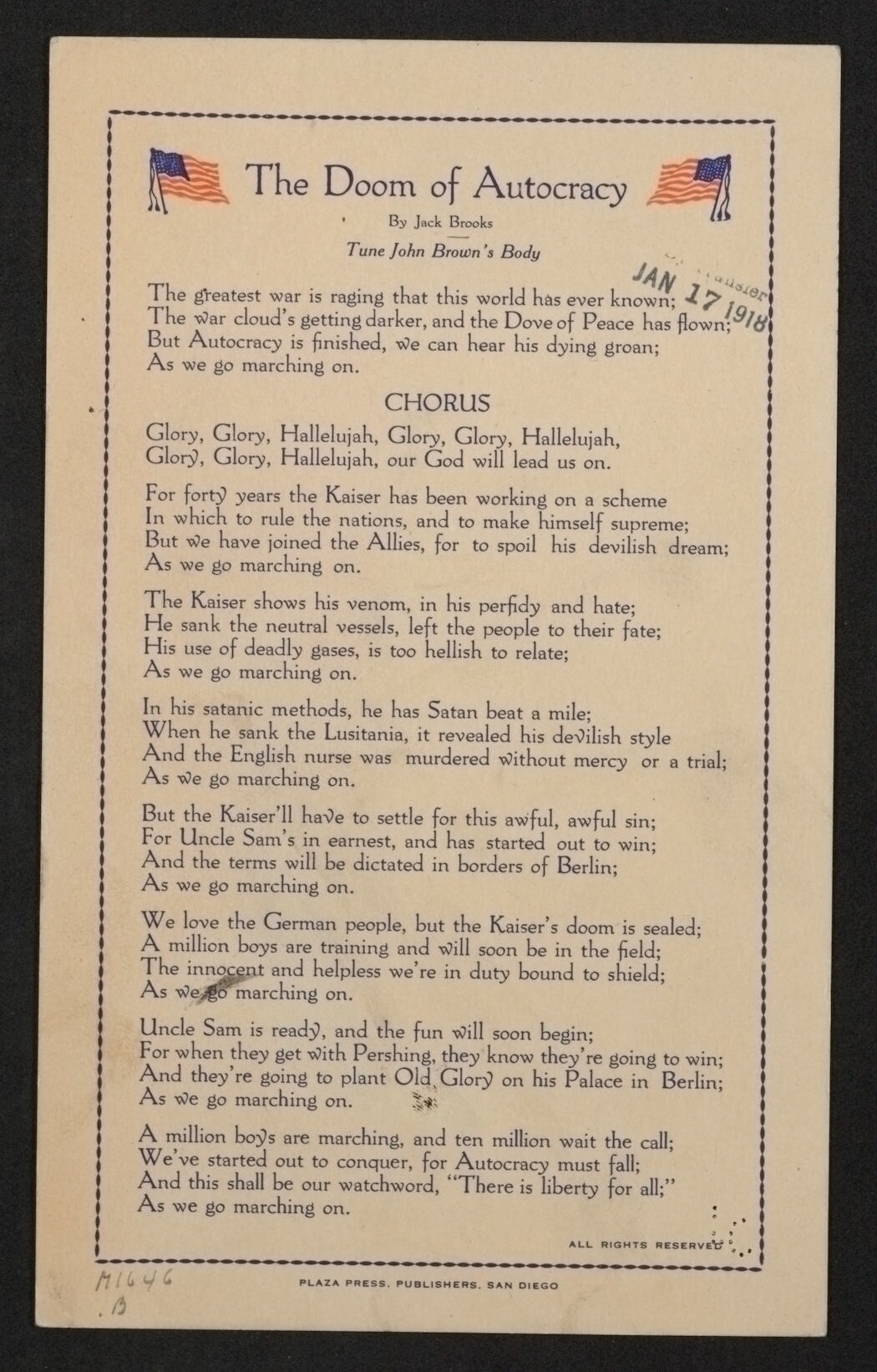
She was inspired to write “The Battle Hymn of the Republic” after she and her husband visited Washington, D.C., and met Abraham Lincoln at the White House in November 1861. During the trip, her friend James Freeman Clarke suggested she write new words to the song “John Brown’s Body”, which she did on November 19. The song was set to William Steffe’s already-existing music and Howe’s version was first published in the Atlantic Monthly in February 1862. It quickly became one of the most popular songs of the Union during the American Civil War.

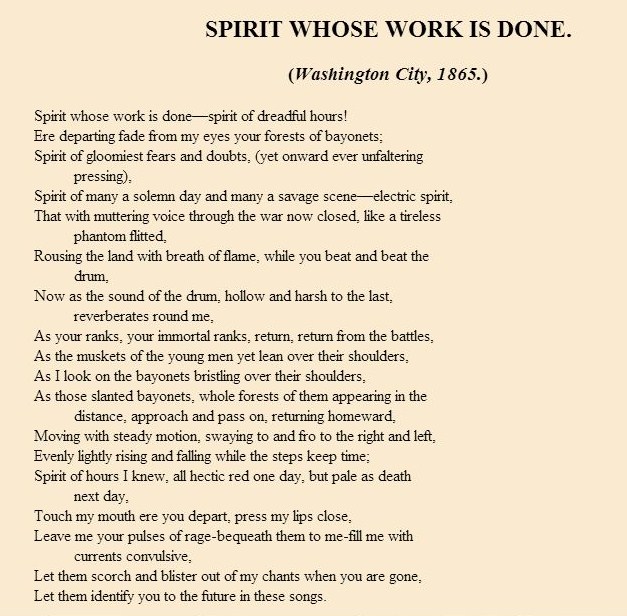
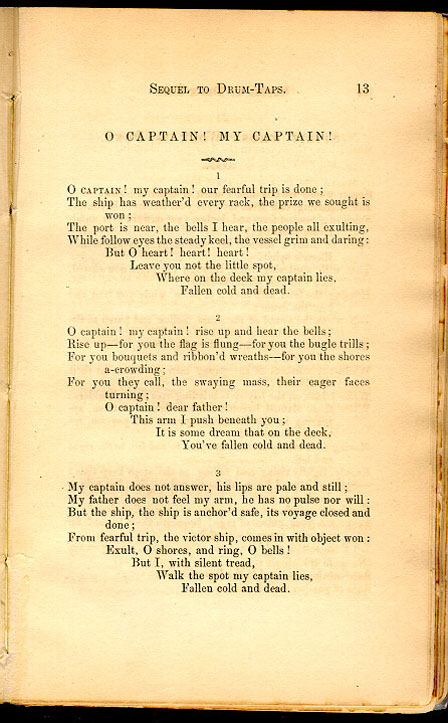
The Encyclopædia Britannica included Walt Whitman in its 100 most influential Americans as “Poet, journalist, and essayist whose verse collection Leaves of Grass is a landmark in the history of American literature.” The Civil War had a big impact on his life. The encyclopedia got the dates wrong (I think), but in 1863 Walt visited his brother wounded at Fredericksburg; he got a temporary job in Washington, D.C. “He spent his spare time visiting wounded and dying soldiers in the Washington hospitals, spending his scanty salary on small gifts for Confederate and Unionist soldiers alike and offering his usual ‘cheer and magnetism’ to try to alleviate some of the mental depression and bodily suffering he saw in the wards.”[1]. Drum Taps is a collection of Walt Whitman’s war poems.

truth and consequences

done but not forgotten

____________________________________

death of an inspiration

hymn adapted (again)

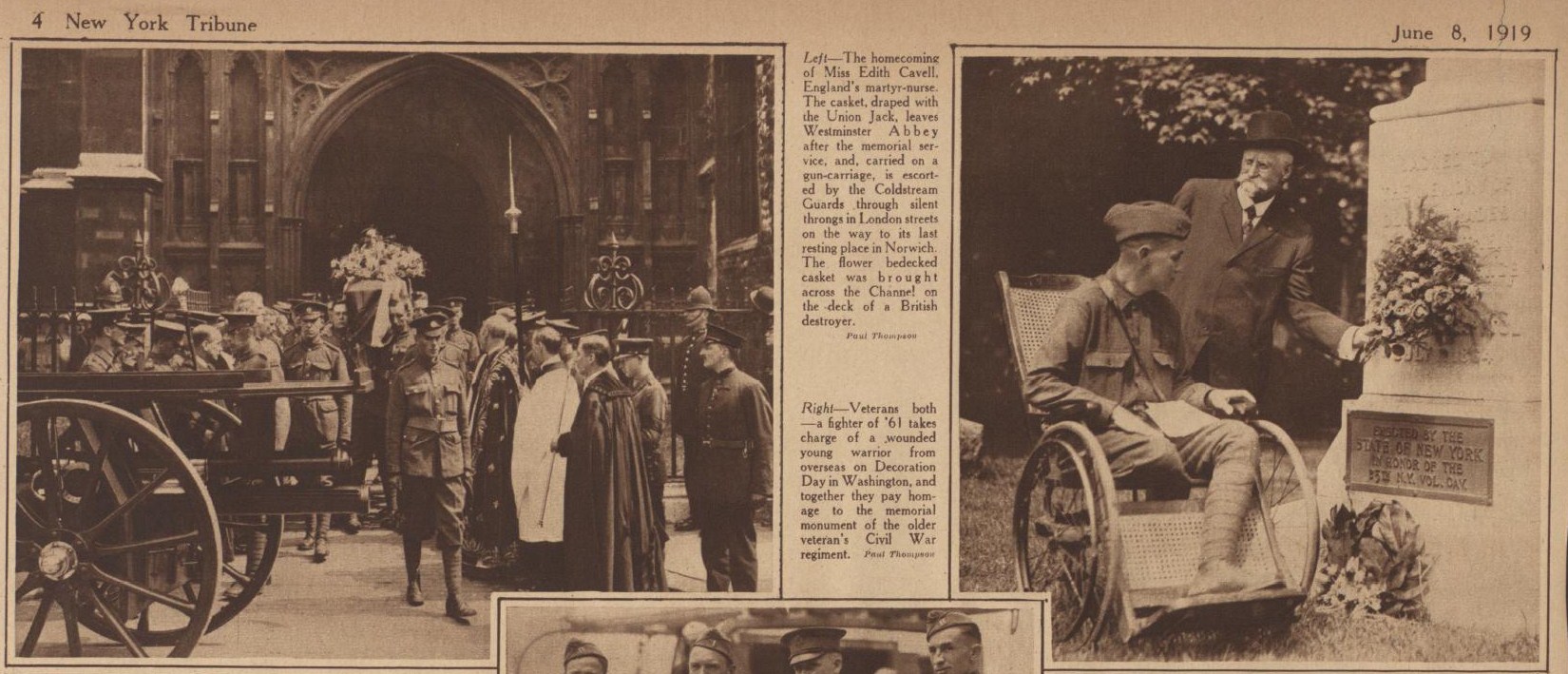
New York Tribune , June 8, 1919

It seems as if Julia Ward Howe and her poem are still influential, too. You can hear several renditions at YouTube. A woman in the choir sung it as a solo during communion at a church service I attended yesterday.
Walt Whitman’s poems: “Spirit Who’s Work Is Done” was published in Drum Taps. I found it at Project Gutenberg. You can browse over to The Walt Whitman Archive to view “O Captain! My Captain!”
From the Library of Congress: The Battle Hymn with the Libby Prison connection; the hymn adapted for World War I; the clipping from the June 8, 1919 issue of the New York Tribune.
The clipping includes a memorial service for Edith Cavell, a British nurse, who “is celebrated for saving the lives of soldiers from both sides without discrimination and in helping some 200 Triple Entente soldiers escape from German-occupied Belgium during the First World War, for which she was arrested. She was accused of treason, found guilty by a court-martial and sentenced to death. Despite international pressure for mercy, she was shot by a German firing squad. Her execution received worldwide condemnation and extensive press coverage.” The adapted battle hymn referred to her, “The English nurse was murdered without mercy or a trial;”Apparently she did have a court-martial
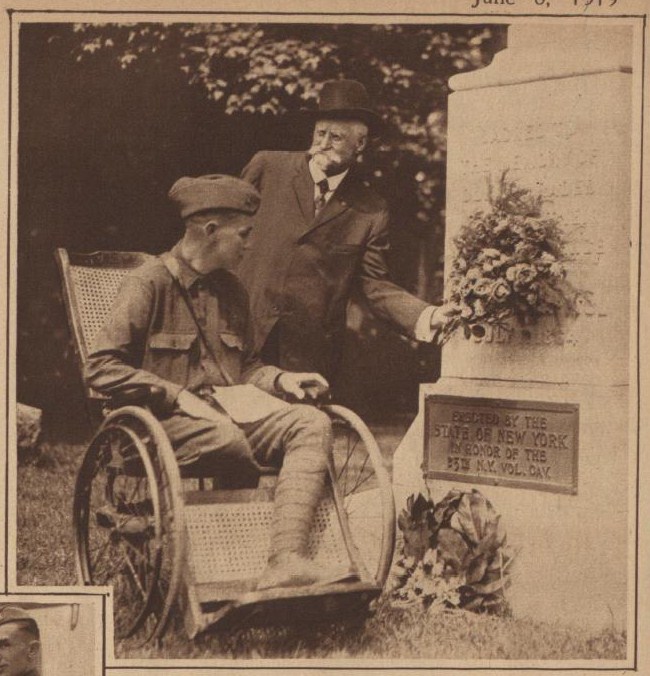
The second picture in the clipping shows a wounded doughboy and an old cavalryman placing a wreath on a monument for what looks like the 23rd New York Volunteer Cavalry. I haven’t been able to find out whether the monument still exists or where exactly it was (is).

Decoration Day 1919, Washington, D.C.

  1. [1]Encyclopædia BritannicaThe Encyclopædia Britannica Guide to The 100 Most Influential Americans.Philadelphia: Running Press Book Publishers, 2008. Print. page 166.
Posted in 100 Years Ago, American Culture, American Society, Monuments and Statues, World War I | Tagged , , , , , , , | Leave a comment

At the junction …

… Promontory junction

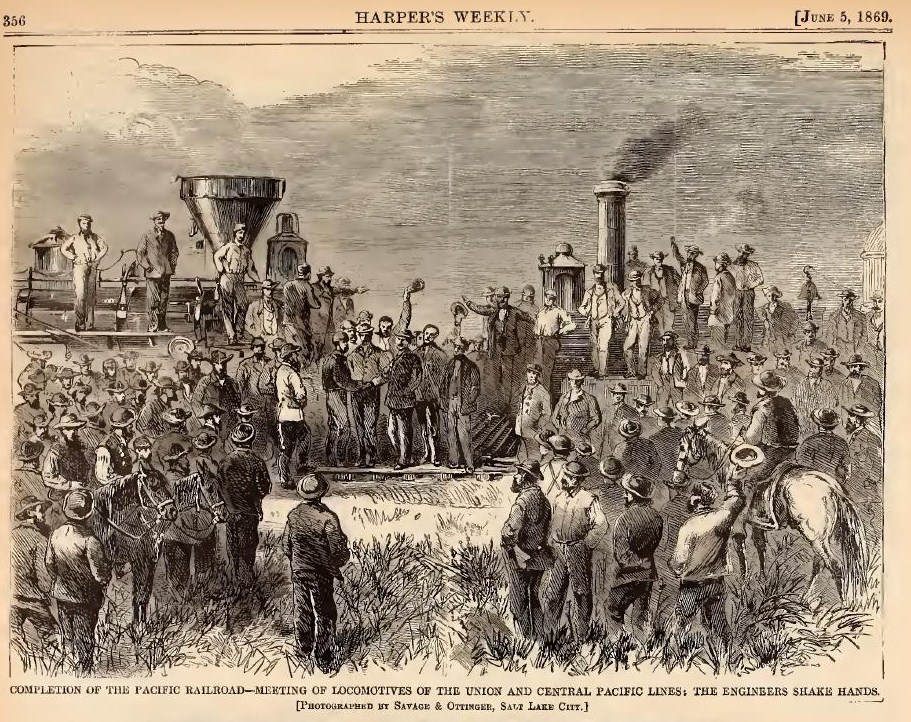
North and South America had been a big impediment to free-flowing and relatively quick world trade. Even though way back in 1513 an expedition led by Vasco Núñez de Balboa discovered how near the Atlantic and Pacific oceans were to each other at the Isthmus of Panama, it was difficult to cross that malarial land. The dream was to build a canal through the isthmus, but that was still a dream in the mid-nineteenth century, when America developed a 3,000 mile railroad network to connect the two oceans. 150 years ago today the final ceremonial work was done on the first transcontinental railroad.

hw 6-5-1869 p356 (https://archive.org/details/harpersweeklyv13bonn/page/n5)

going coastal

From the May 29, 1869 issue of Harper’s Weekly:

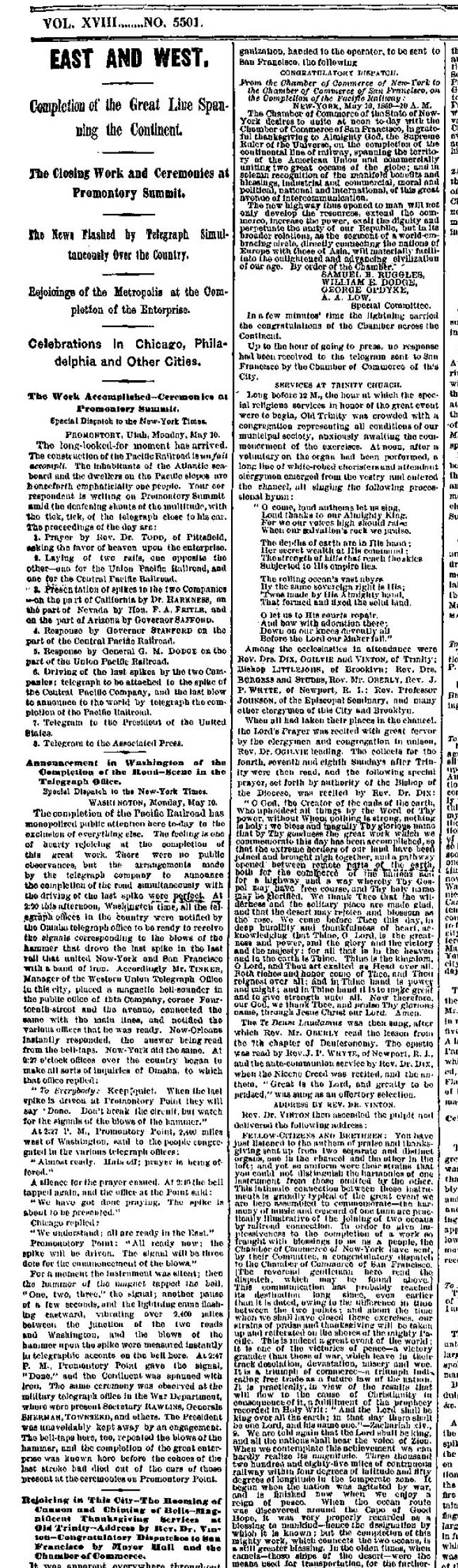
NYT 5-11-1869g

Telegraph said “Done”
NY Times May 11, 1869

THE PACIFIC RAILROAD.

The foremost of the great projects for connecting by rail the Atlantic and Pacific coasts was realized May 10. At ten minutes past 3 o’clock P.M., at Promontory Point, Utah, the last rail was laid. The last spikes driven were presented by Nevada and Arizona. That from Nevada was of silver. “To the iron of the East and the gold of the West,” said the Hon. T.A. TUTTLE, representing that State, Nevada adds her link of silver to span the continent and wed the oceans.” By a connection of the telegraph with the last spike (a gold one, from California), the last blow given announced to the world the completion of the grand enterprise. A prayer was said by Rev. Dr. TODD, of Pittsfield; then the two last rails were laid simultaneously, one opposite the other – one for the Union Pacific Railroad, and one for the Central Pacific Railroad; the presentation of spikes and the responses followed; then the last spikes were driven by the two companies, and telegrams were sent to the President of the United States and to the Associated Press.

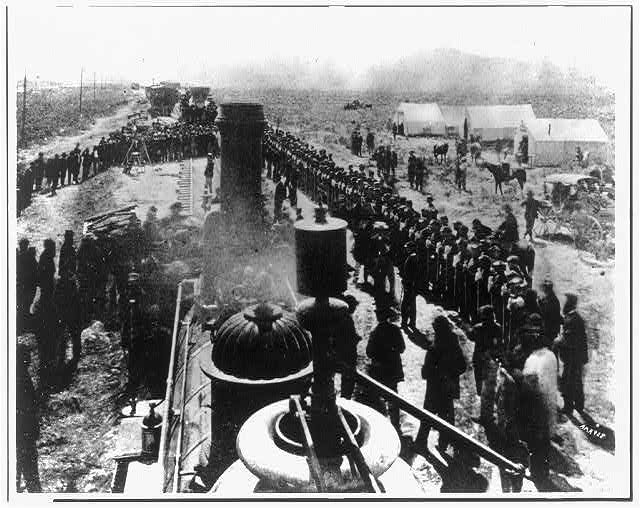
Ceremony at "wedding of the rails," May 10, 1869 at Promontory Point, Utah (1869 May 10; LOC: https://www.loc.gov/item/2004679791/)

“Ceremony at ‘wedding of the rails,’ May 10, 1869 at Promontory Point, Utah”

This remarkable event was celebrated with especial enthusiasm in Chicago and other Western cities. But in New York city, already the metropolis of a continent, but by this enterprise rendered the centre of the world’s commerce, the news was calmly received; and, as on the occasion of the capture of Richmond, the event was celebrated by the singing of anthems, and not by a loud uproar. A salute was fired in City Park; peals were rung from Trinity chimes, and a religious service was held in Trinity Church. The remarks made by the Rev. Dr. VINTON were so appropriate that we quote here a portion of his address:

This is, indeed, a great event of the world: It is one of the victories of peace – a victory grander than those of war, which leave in their track desolation, devastation, misery, and woe. It is a triumph of commerce – a triumph indicating free trade as a future law of the nation. … When we contemplate this achievement we can hardly realize its magnitude. Three thousand two hundred and eighty-five miles of continuous railway within four degrees of latitude and fifty degrees of longitude in the temperate zone. It began when the nation was agitated by war, and is finished now when we enjoy a reign of peace. When the ocean route was discovered around the Cape of Good Hope, it was very properly regarded as a blessing to mankind – hence the designation by which it is known; but the completion of this mighty work, which connects the two oceans, is a still greater blessing. In the olden times, when camels – those ships of the desert – were the means need for transportation, for the furtherance of commercial traffic, it was found that wherever the caravans stopped there would spring up cities, and there would be evidences of civilization. So with this great work. It will populate our vast territory, and be the great highway of the nations; their merchants will cross it to trade with us. But there is another aspect in which we view it as a blessing, and in connection with which we esteem it of still greater importance. It will preserver the union of these States. Philosophers tell us, and we know it to be true, that where there are rivers which diverge in their courses, and have separate and distinct outlets (as in Europe), there the nations become diffused, and the peoples are separated and disunited. But where, on the contrary, the topography is such that the rivers all flow into one common central basin, there is necessarily a concentration of interests [?] and of peoples, and that territory is marked out by God to be under one Government. By the operation of this natural law we must regard it as decreed that there shall ever be a unity of people and government in all that territory which lies between the Alleghanies and the Rocky Mountains. Beyond these lofty heights, however, we find the rivers diverging, as in Europe, and, following the rule that obtains in the Old World, there might be a diffusion of interests and a separation of governments in that section of the country divided from us by the Sierra Nevada and the Rocky Mountains. But this railway counteracts such natural tendency to disunion, has prevented a separation, and binds the States of the Atlantic and Pacific into one nation. Roman roads unified and consolidated the Roman Empire. They were made by the ambition of Emperors for the necessities of war and commerce; but, under Divine Providence, they were the highways along which the Apostles and the missionaries of Christ carried the good tidings of salvation to the tribes of the peoples. So this Pacific Railway is a means, under Divine Providence, for propagating the Church and the Gospel from this, the youngest Christian nation, to the oldest land in the Orient, now sunk in Paganism and Idolatry, and so will revive the worship of the Triune God – the God of our salvation – in the farthest East – the birth-place of Christianity.
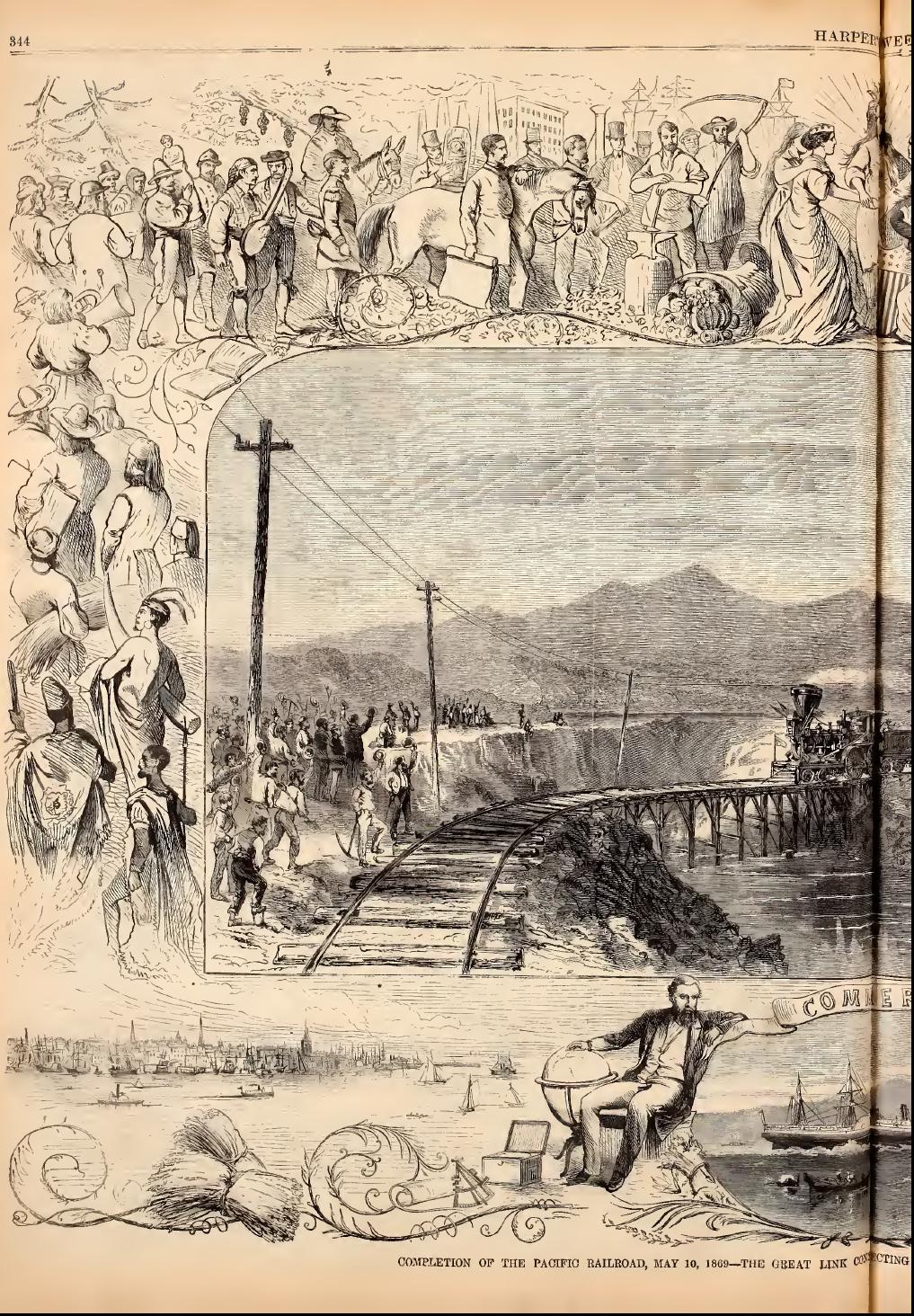
hw 5-29-1869 p344 (https://archive.org/details/harpersweeklyv13bonn/page/n5)

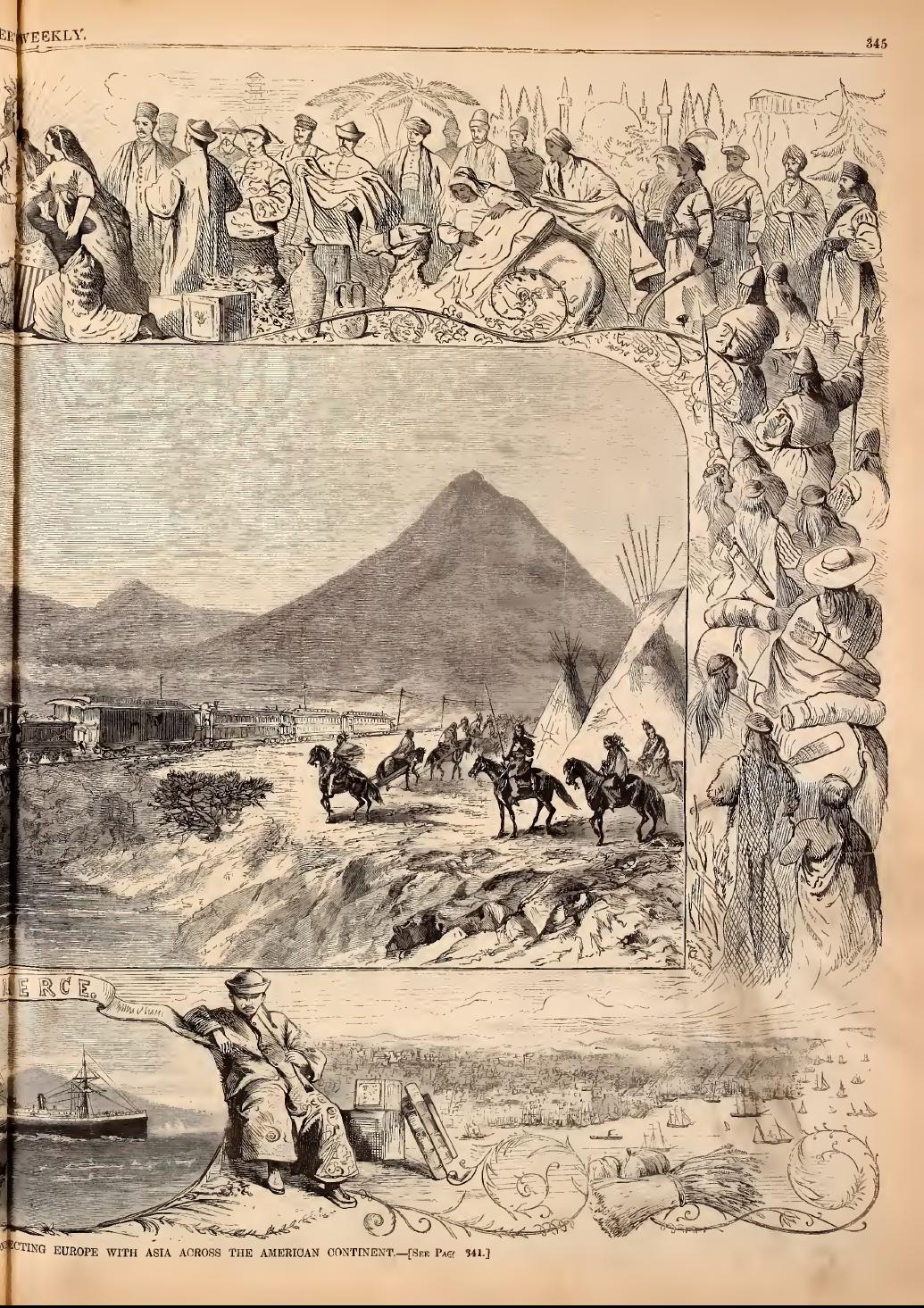
“the Continent spanned with iron”

hw 5-29-1869 p345 (hw 5-29-1869 p344 (https://archive.org/details/harpersweeklyv13bonn/page/n5))

and the Globe a little smaller?

__________________________________

Let us glance at the history of this enterprise. It is closely connected with the political developments of the last twenty years. At the close of the Mexican war, in 1848, California, New Mexico (including Arizona), and Texas were added to our territory, so that from the 32d to to the 42d parallel of latitude there was no foreign domain between the Mississippi and the Pacific coast. The very next year thousands of miners from every quarter of the globe flocked to the goldfields of California; the greater number by sea, but very many through the Eastern States and over the unexplored regions of the far West, by what soon came to be known as the overland route. The necessity for a trans-continental route then became evident. Hon. THOMAS H. BENTON, of Missouri, introduced a bill into the Senate in 1850, authorizing what may be called a stepping-stone railroad, consisting of links of railroad interrupted occasionally by what were then supposed to be insuperable natural obstacles. Three years later Congress appropriated $150,000 for six surveys for proposed routes for Pacific railroads, to be carried out by the War Department, of which JEFFERSON DAVIS was then Secretary. Among those who had been prominent in advocating the claims of this enterprise before the people was ASA WHITNEY. Congress, in 1854, appropriated $190,000 more, and three additional surveys were made.

The great problem of the engineers was how to overleap the Rocky Mountains, running through the centre of the vast trans-Mississippi region, which contains two-thirds of our entire territory. The Pacific surveys proved that this great grizzly bear had a very broad back, that the slope up his sides was very gradual, and that his spine did not extrude unpleasantly in the centre, but lay, on the contrary, rather sunk between two rows of muscles or mountains on either side.

But very soon the Southern disunion sentiment cast a cloud over the political sky, and in this connection the important question arose, How would the Pacific States stand? Their isolated position was keenly felt, and thus an additional motive offered for a railroad between the Atlantic and Pacific coasts. The importance of California was beginning to be understood. Her gold, her cereals, her grape culture, her trade with Eastern Asia; all these facts commanded attention. She stood the test of the Civil War, and proved herself loyal. Her own growing importance led her not to isolate herself, but, on the other hand, to seek a more rapid and convenient communication with the East. It was discovered that there was a practicable railroad route across the snow-clad Sierra through Donner Pass, midway between San Francisco and Virginia City. Some of the richest of California merchants pledged their entire fortunes to the realization of this project, the State Legislature gave its support, and Congress was asked to grant a fitting subsidy.

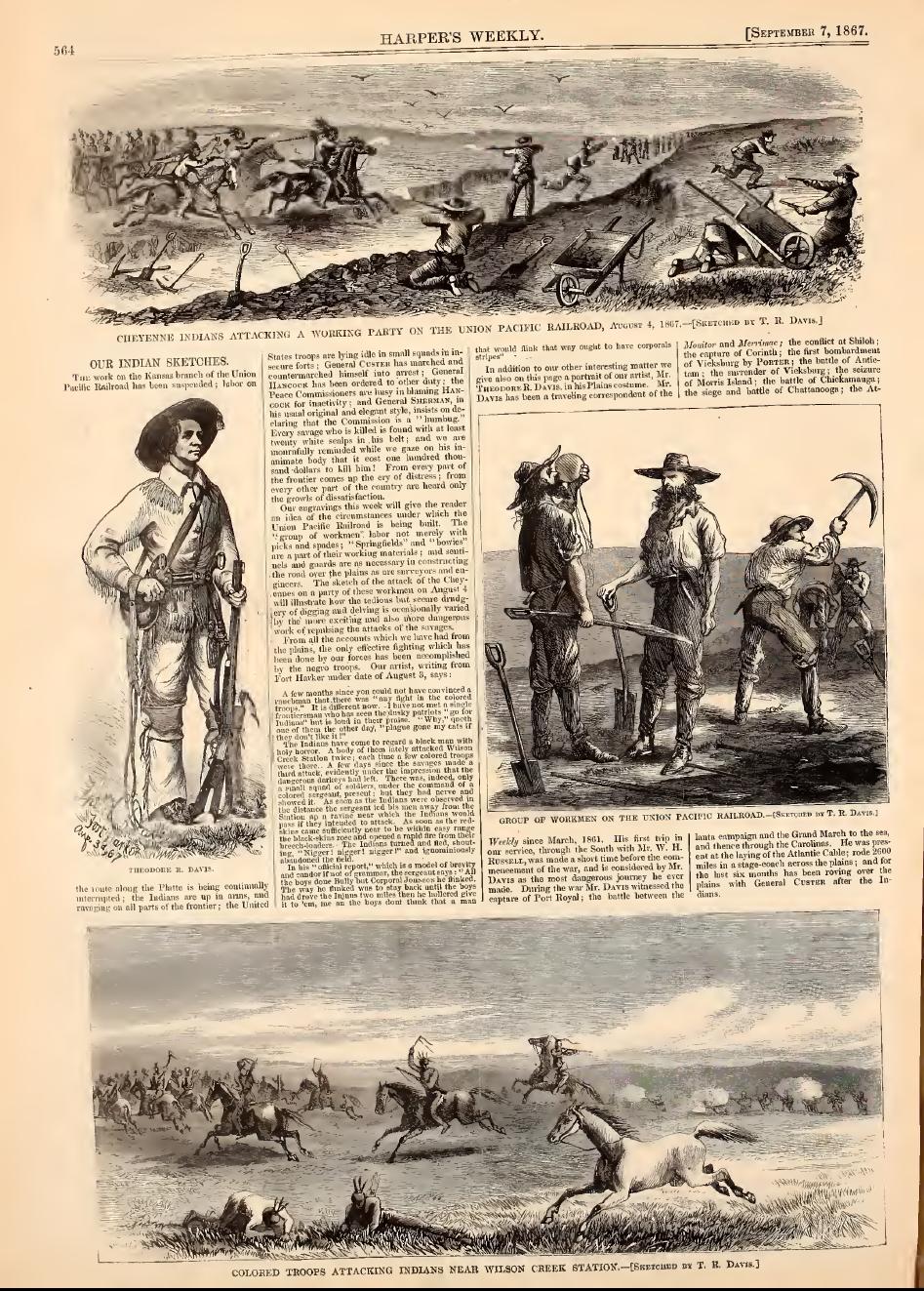
hw 9-7-1867 p564(https://archive.org/details/harpersweeklyv11bonn/page/n6)

whose public land? whose right of way?

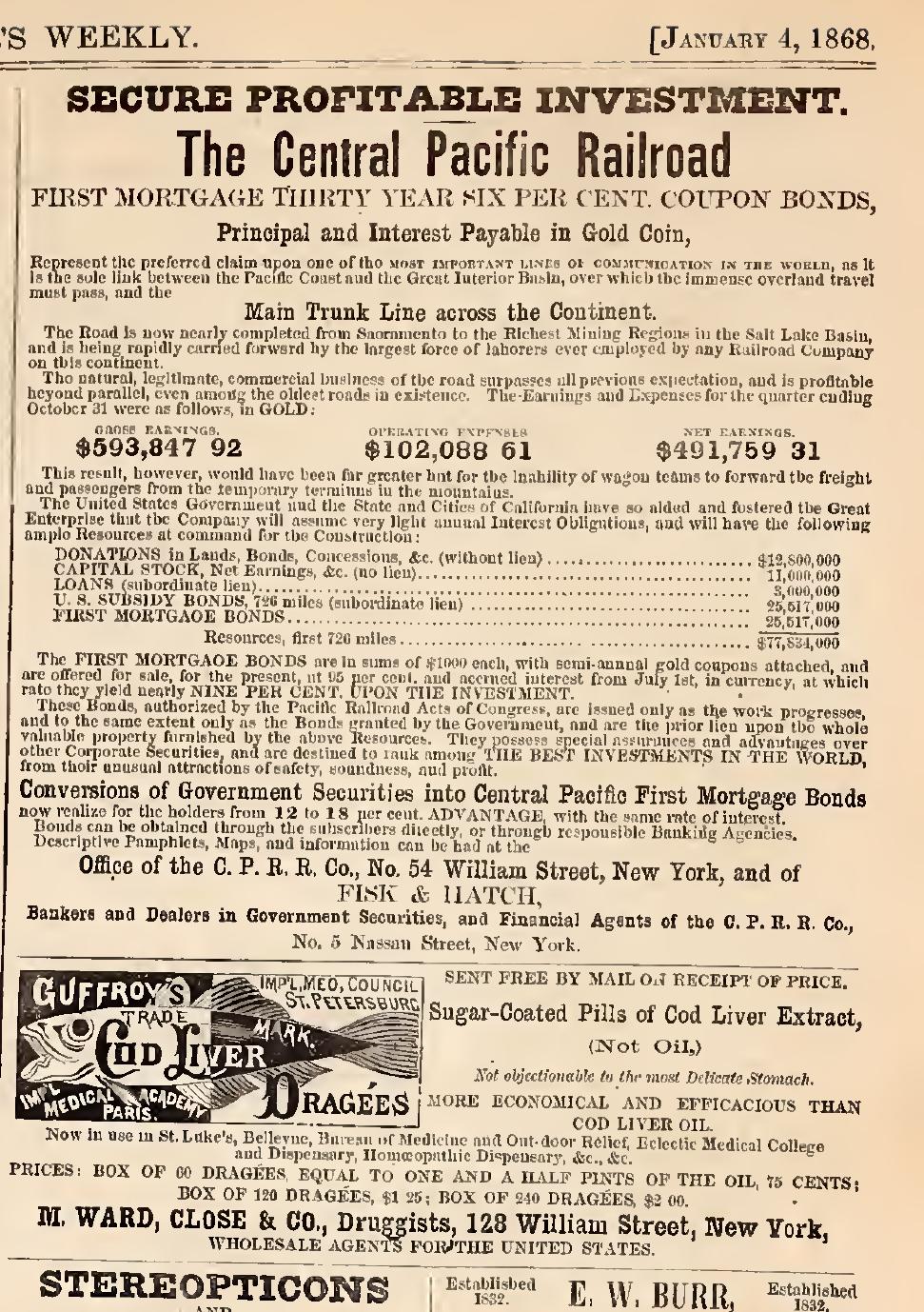
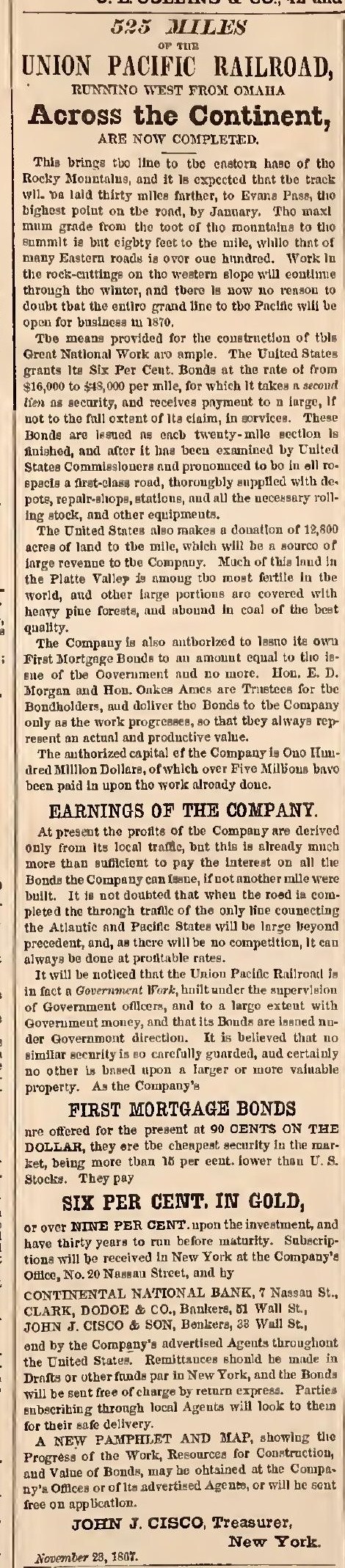
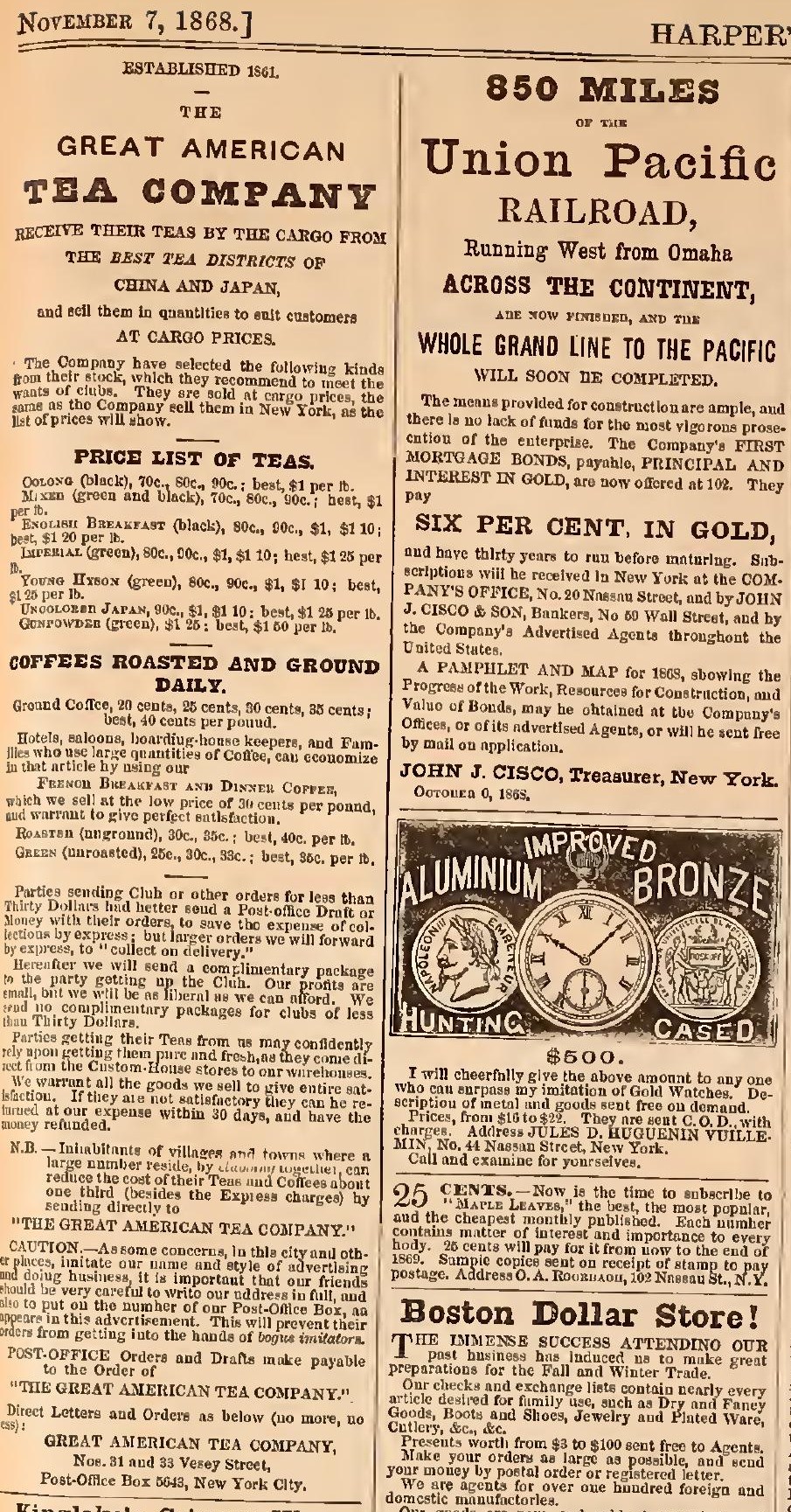
It is needless here to describe the conflict which then sprang up between Chicago and St. Louis, each of which (the former backed by New York and the Northwest, and the latter by Philadelphia and the Middle States) sought to gain control of the eastern branch that was to meet and unite with that already proceeding from San Francisco. This was in 1862, when the Government was spending daily $2,000,000 in gold for the suppression of the Rebellion. It was in the midst of such a contest as this that in July, 1862, President LINCOLN signed the act granting a charter to the proprietors of the Pacific Railroad Companies. The Chicago capitalists had gained the victory, and Omaha (on the Missouri River) was fixed upon as the eastern terminus of the road to Sacramento, 1721 miles distant. But St. Louis was to be provided for by a subsidized branch line, to connect with the main line on or about the 100th meridian. This was called the Eastern Division of the Union Pacific Railroad. The line from Sacramento to meet the Union Pacific was called the Central Railroad. These three companies were all chartered and stood on an equal footing as regarded land-grants, loans, mortgages, etc. Congress conferred upon the three companies the right of way, an absolute grant of 12, 800 acres per mile of the public lands traversed, and authorized a special issue of six per cent. United States bonds, proportioned to each company according to the length and difficulty of the lines, to be delivered as the work progressed. The bonds issued by the companies themselves were given the position of a first mortgage. The two classes of bonds and the other capital for the construction of the Union and Central Pacific roads amount in round numbers to $150,000,000, about equally divided between the two.

hw 1-4-1868 p16

Harper’s Weekly
January 4, 1868

hw 1-18-1868 p47

Harper’s Weekly
January 18, 1868

hw 11-7-1868 p719

Harper’s Weekly
November 7, 1868

__________________________

These two roads have been completed and the through line regularly established. On the very day of the opening an invoice of tea from Japan was shipped from San Francisco for St. Louis. The next day a telegram was received at the Post-office Department, Washington, from Promontory Point, stating that the mails had been delivered at that place for San Francisco. The cost of transmitting the mails by the Butterfield route was $1100 per mile by the year; by the railroad it is only $2oo per mile. The transportation of Government supplies and troops is diminished in the same ratio.

The advantages of the new route thus opened are obvious. Communications between Calcutta, Hong-Kong, and Liverpool will be measured by days instead of weeks. Facilities for the interchange of merchandise will tend to the rapid development of our national resources. Immigration will receive the aid of a most powerful auxiliary. What will grow out of the close connection thus established with Eastern Asia time alone can reveal. We are not disposed to be imaginative. Looking only to what is real and tangible, it is certain that no work of this century can compare in the grandeur both of the undertaking and of its probable results with the Pacific Railroad.

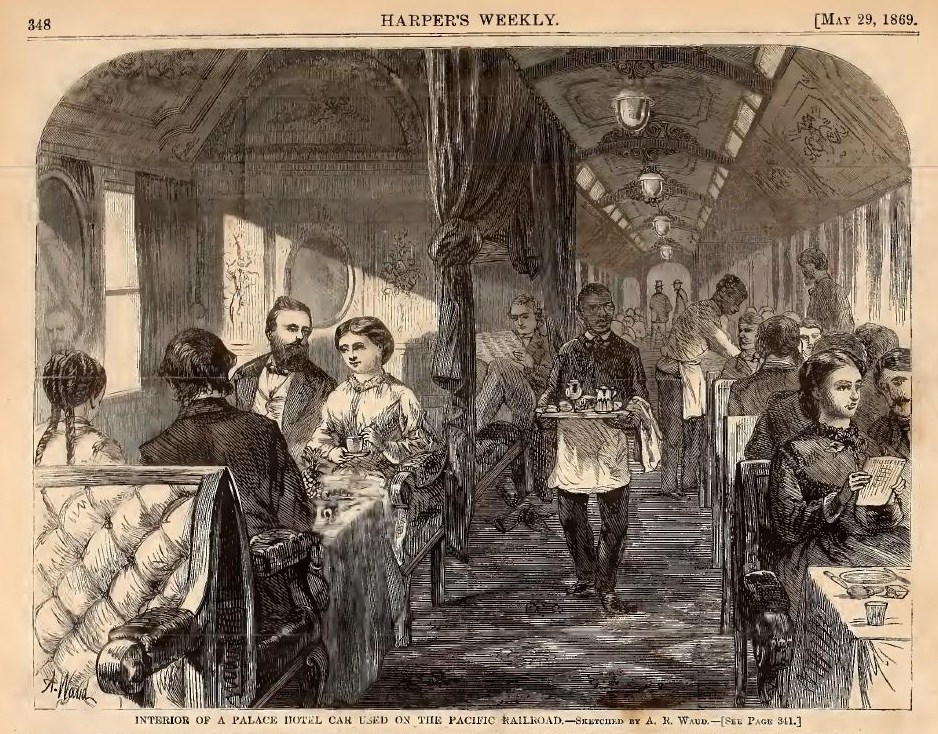
One of our illustrations on page 348 shows the interior of one of PULLMAN’S Palace Hotel Cars. These cars have all the accommodations of a first-class steamer – state-rooms with spring-beds, and meals served to passengers upon tables completely furnished. The passenger from Chicago to San Francisco will take a state-room, go to bed at night, and have breakfast, dinner, and supper on board the train while flying across the continent.

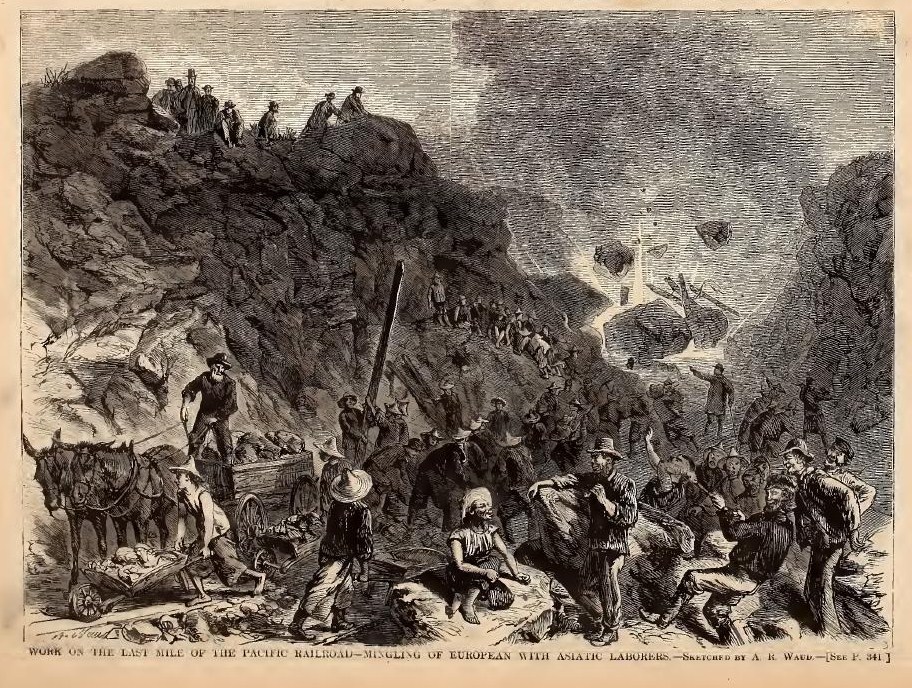
The other illustration on the same page shows the workmen – a medley of Irishmen and Chinamen – engaged in constructing the last line of the railroad. Thus the very laborers upon the road typify its significant result, bringing Europe and Asia face to face, grasping hands across the American Continent.

hw 5-29-1869 p348(https://archive.org/details/harpersweeklyv13bonn/page/n5)

not your father’s covered wagon

hw 5-29-1869 p348b (https://archive.org/details/harpersweeklyv13bonn/page/n5)

diversity in the workplace

I wish I’d thought about this post about two years ago. There’s a lot of information out there – The Transcontinental Railroad includes a brief summary. I wish I’d known about all the Youtube videos available. Sunday I watched about a 45 minute History Channel program. One Blue-Gray takeout from the summary and the show: the Union Pacific’s labor shortage was greatly alleviated when the Civil War ended and a whole bunch of battle-hardened ex-soldiers (North and South) were looking for work. The Central Pacific solved the labor issue with Chinese men. It was very difficult work on both lines. The Union Pacific commemorated the 1862 adoption of the railroad act with a Youtube video that mentioned Abraham Lincoln not only kept North and South united but signed the railroad act that would eventually unite East and West
About four years after the Civil War 150th I once again saw that beautiful word “Sesquicentennial” – this time at the Golden Spike National Park
The last rail - the invocation. Fixing the wire, May 10th, 1869 (Sacramento, Calif. : Golden State Photographic Gallery, [between 1865 and 1869]; LOC: https://www.loc.gov/item/2005683025/)

“The last rail – the invocation. Fixing the wire, May 10th, 1869”

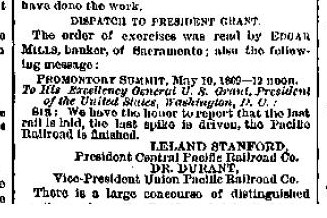
NYT 5-12-1869

informing President Grant
NY Times May 12th

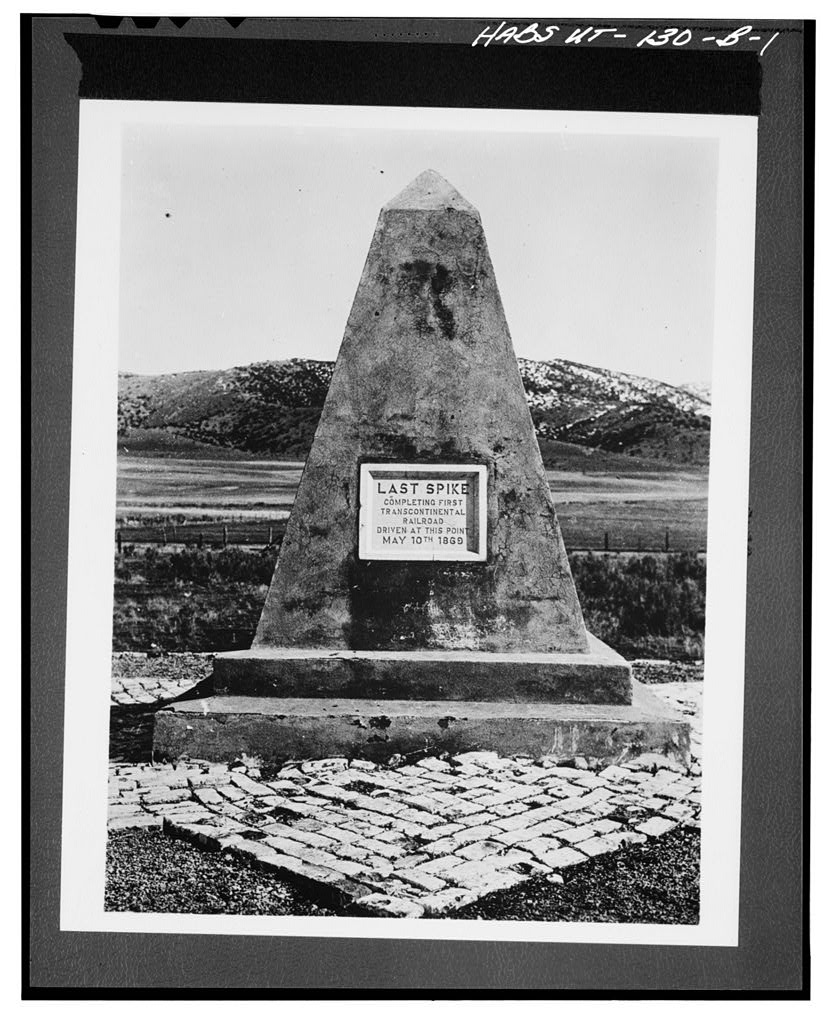
. DETAILED ELEVATION OF SOUTH FACE - Golden Spike, Monument, State or County Road 504, Brigham City, Box Elder County, UT (https://www.loc.gov/resource/hhh.ut0367.photos/?sp=1)

they were driven

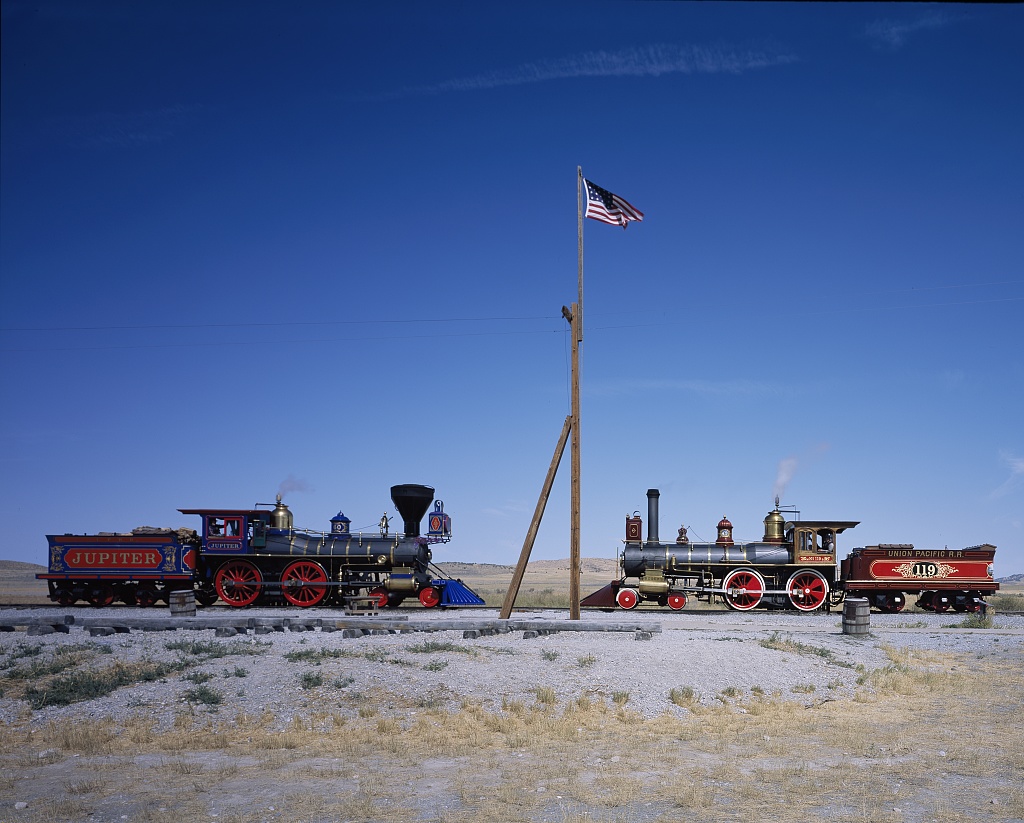
The Harper’s Weekly material can be found at the Internet Archive: 1867, 1868, and 1869. From the Library of Congress: wedding, the last rail, obelisk, and Carol M. Highsmith’s photograph of the two engines
A meeting of the engines at the Golden Spike National Historic Site, Utah (Highsmith, Carol M.,; LOC: https://www.loc.gov/item/2011631570/)

“A meeting of the engines at the Golden Spike National Historic Site, Utah”

Posted in 150 Years Ago This Week, Aftermath, Postbellum Society, Technology | Tagged , , , , , , , , , , , , , | Leave a comment

Hayti bound

hw may 1, 1869 page 285 (https://archive.org/details/harpersweeklyv13bonn/page/n5)

Harper’s Weekly
May 1, 1869

From the May 1, 1869 issue of Harper’s Weekly:

EBENEZER D. BASSETT.

Very fitly a colored man of the highest eminence has been appointed Minister from this country to Hayti. Mr. BASSETT, whose portrait we give on page 285, is a fine mathematician, and is well versed in classic literature. He has for some time been President of the “Institute for Colored Youth” in Philadelphia – a high school maintained by the philanthropy of the Quakers, where young negroes receive a college education gratis. Seventeen of Mr. BASSETT’S graduates are now teaching in Delaware.

According to the U.S. State Department, “President Ulysses S. Grant appointed Ebenezer Bassett as the U.S. Minister to Haiti and the Dominican Republic in 1869. He was the first African American to serve as a U.S. diplomat anywhere in the world.”

Mr. Bassett served as Minister to Hayti for the entire eight years of the Grant presidency. According to Black Past it wasn’t exactly a cushy post. During a Haitian internal conflict his home was under siege by Haitian troops for five months until “Bassett negotiated Canal’s [a former coup leader] safe release for exile in Jamaica.”

Le Port au Prince (c1755; LOC: https://www.loc.gov/item/74692171/)

“Le Port au Prince. 1755”

Distinguished colored men (New York : Published by A. Muller & Co., c1883 (Chicago, Ills. : Geo. F. Cram) )

Mr. Bassett et al.

Main St., Port-au-Prince, Hayti, W.I. (c[1901] ; LOC: https://www.loc.gov/item/2016798787/)

Main St., Port-au-Prince c.1901

William S. McFeely touched on the Bassett appointment in his biography of Frederick Douglass. After President Grant took office black leaders were hoping to receive some appointments, especially to the black republic of Haiti. Mr. Douglass and others who were interested in the post each claimed disinterest and deferred to the other black leaders. When Grant named Bassett, George T. Downing asked Senator Charles Sumner to get Douglass nominated instead. “When the request went to the White House, Grant, laconically and accurately, reported that he was having too much trouble getting other appointments confirmed to withdraw one that seemed safe, and refused,”[1]
The map below of a good chunk of Hispaniola comes from 1861’s A Guide to Hayti, which you can find at HathiTrust. The book was edited by journalist and antislavery activist James Redpath, who, in 1860,

toured Haiti as a reporter and returned to the United States as the official Haitian lobbyist for diplomatic recognition, which he secured within two years. He simultaneously served as director of Haiti’s campaign to attract free black emigrants from the United States and Canada. His Guide to Hayti (1860) is an anthology of articles by various authors on a wide range of Haitian subjects. Redpath hoped that immigration of skilled blacks to Haiti would elevate conditions there and dispel racial prejudice in the United States. After the Civil War, he abandoned his ideas when he recognized that North American blacks preferred to remain at home.

When the book was first published in 1860 there were a lot of unfree blacks in the United States. Mr. Redpath’s introduction sees hope in Haiti:
THERE is only one country in the Western World where the Black and the man of color are undisputed lords; where the White is indebted for the liberty to live to the race which with us is enslaved; where neither laws, nor prejudices, nor historical memories, press cruelly on persons of African descent; where the people whom America degrades and drives from her are rulers, judges, and generals; men of extended commercial relations, authors, artists, and legislators; where the insolent question, so often asked with us, “What would become of the Negro if Slavery were abolished?” is answered by the fact of an independent Nationality of immovable stability, and a Government inspired with the spirit of progress. The name of this country is HAYTI….
You can view all the Harper’s Weekly content from 1869 at the Internet Archive. From the Library of Congress: map of Port au Prince; Ebenezer Bassett is directly below Frederick Douglass in the picture of distinguished men; the main drag
Hayti c1860 (http://hdl.handle.net/2027/loc.ark:/13960/t4gm9150h)

Hayti (C.1860)

  1. [1]McFeely, William S. Frederick Douglass. New York: W. W. Norton & Company, 1991. Print. page 270.
Posted in 150 Years Ago, Aftermath, Postbellum Politics, The Grant Administration | Tagged , , , , | Leave a comment

good question

Way back in its October 24, 1868 issue Harper’s Weekly seemed a bit miffed by a letter from Georgia, which asked a question: if universal suffrage for black men is such a good thing, why doesn’t the North adopt it? The editorial responded by saying that although voting qualifications were up to the States, the federal government had more say in the ex-Confederacy because of all the blood and treasure expended during the rebellion. The argument also touched on the original 1787 Constitutional compromise – if Georgia decides not to allow black men to vote, it can’t still count the African-American population to determine the number of representatives in Congress and the Electoral College. Because the Southern States wanted to do that, Congress passed the Reconstruction Acts. The editorial seemed to give New York State a pass (“Colored suffrage is a matter of State policy in the largest sense.”) but did say that it urged the people of New York State to adopt “perfect equality at the polls” (at least for men).

The paper seems to have modified its position somewhat a few months later. In its February 13, 1869 issue Harper’s Weekly commented on a pending revision to the New York State constitution. Although a state constitutional convention had agreed to a new constitution in 1868, it hadn’t been voted on yet. If a bill in the state legislature passed, there would be an election with two ballot boxes – one for the new constitution as a whole and one for a clause that would eliminate the property qualification for black men:

…It is time that the absurd and barbarous discrimination against certain voters because of the color of their skin should be abolished, and it is humiliating that in such a State as New York there should be such a blot upon the present Constitution. A colored citizen, however intelligent, industrious, and prosperous, must have lived twice as long in the State as the rest of us and pay a tax, which is imposed upon nobody else, as the price of the right of suffrage. …

So the paper stuck to its guns that New York voters should ensure equal voting rights for all adult male citizens, but in a second editorial on the same page it seemed to no longer maintain that voting rights law was only a state issue. It endorsed the suffrage amendment that had  been recently introduced in Congress. Harper’s saw the proposed 15th amendment to the United States Constitution as sort of a natural extension of Republican Party ideals and reconstruction policy. Congress had the power to legislate equal suffrage, but an amendment would be more permanent and less objectionable to those who thought states should have the right to determine voting qualifications. The amendment wouldn’t infringe on the people’s right to determine suffrage because it would enforce the will of the people as a whole nation.

… The amendment is a also a measure of wise consolidation. It touches no right of which any State can justly be jealous, or which it can reasonably deny to the United States. The first essential condition of a popular national government is the equality of its citizens equally secured. Ours, indeed, is not a national government in the simplest form; but, on the other hand, it is not a league nor a confederacy of States. It is a national Union. It has a national substance and necessity, and the attempt to regulate a national policy upon the theory of State sovereignty as hitherto maintained is futile. The adoption of the amendment will be the declaration of the people that they perceive the legitimate conditions of a truly national Union.

It will also tend rapidly to remove an exciting question from politics. It is plain now that the current of our political progress, for more than a generation, has been toward the political equality of all the people. The Democratic party, which is the organized opposition to this result, has been constantly defeated upon every field, but still perplexes and delays it. The Democratic representatives in Congress voted in a body against the amendment, upon the ground that it was a subject to be left to the States, thus conceding to possible majority in a State the right to deprive a citizen of the United States of his share in its government, and to establish an unrepublican form if it should choose. But the Republican party, whose watchword is a constantly enlarging liberty as a condition of increasing intelligence, moves with the fraternal spirit of the age, and will not have accomplished its work until it has placed the United States in the hands of all the people.

According to Wikipedia Congress passed the amendment on February 25 and 26, 1869. The New York state legislature ratified it on April 14th. In its May 1, 1869 issue Harper’s Weekly claimed that the Democratic party was using racial fears and prejudices to oppose the Equal Suffrage amendment in the states. (There seems to be a contradiction between the Wikipedia article and the paper’s claim that twenty-one states had already ratified the amendment.)

hw 10-24-1868 p674 (https://archive.org/details/harpersweeklyv12bonn)

Harper’s Weekly
October 24, 1868

hw2-13-1869page99 (https://archive.org/details/harpersweeklyv13bonn/page/n5)

Harper’s Weekly
February 13, 1869

hw 5-1-1869 page 274(https://archive.org/details/harpersweeklyv13bonn/page/n5)

Harper’s Weekly
May 1, 1869

Of course, eventually the suffrage amendment did become the 15th to the U.S. Constitution, but, according to the Historical Society of the New York Courts’ website, New York didn’t adopt a new constitution in 1869. The 1846 state constitution was still operational. Here’s what it had to say about suffrage:
ARTICLE II.
Section 1. [Qualifications of voters.]—Every male citizen of the age of twenty-one years, who shall have been a citizen for ten days, and an inhabitant of this state one year next preceding any election, and for the last four months a resident of the county where he may offer his vote, shall be entitled to vote at such election in the election district of which he shall at the time be a resident, and not elsewhere, for all officers that now are or hereafter may be elected by the people; but such citizen shall have been, for thirty days next preceding the election, a resident of the district from which the officer is to be chosen for whom he offers his vote. But no man of color, unless he shall have been for three years a citizen of this state, and for one year next preceding any election shall have been seized and possessed of a freehold estate of the value of two hundred and fifty dollars, over and above all debts and incumbrances charged thereon, and shall have been actually rated and paid a tax thereon, shall be entitled to vote at such election. And no person of color shall be subject to direct taxation unless he shall be seized and possessed of such real estate as aforesaid.
§ 2. [Exclusion from right of suffrage.]—Laws may be passed, excluding from the right of suffrage all persons who have been or may be convicted of bribery, larceny, or of any infamous crime; and fordepriving every person who shall make, or become directly or indirectly interested in, any bet or wager depending upon the result of any election, from the right to vote at such election.
§ 3. [Right of suffrage not affected by certain occupations and conditions.]—For the purpose of voting, no person shall be deemed to have gained or lost a residence by reason of his presence or absence, while employed in the service of the United States; nor while engaged in the navigation of the waters of this state, or of the United States, or of the high seas; nor while a student of any seminary of learning; nor while kept at any almshouse or other asylum, at public expense; nor while confined in any public prison.
§ 4. [Registration of voters.]—Laws shall be made for ascertaining, by proper proofs, the citizens who shall be entitled to the right of suffrage hereby established.
§ 5. [ Elections to be by ballot.]—All elections by the citizens shall be by ballot, except for such town officers as may by law be directed to be otherwise chosen.
Voting rights were a major issue during the 1821 New York State constitutional convention:
The changes in the suffrage, however, aroused much more controversy and proved far more significant. The old constitution prescribed the possession of a twenty-pound freehold or the payment of a yearly rent of forty shillings as qualifications of voters for assemblymen. To vote for senator and governor the citizen had to possess still more property. To the dismay of the Federalists, the Republicans advocated clauses permitting voters to qualify by payment of taxes, by service in the militia, by work on the roads, or by established residence. In short, the Republicans were proposing the equivalent of universal manhood suffrage for white voters.
During the convention the Federalists didn’t deny that all citizens had rights to life and liberty but maintained that property owners had rights that poor people didn’t. Chancellor James Kent noted that in 1820 the population of New York City was almost six times larger than in 1773. “It is rapidly swelling into the unwieldy population, and with the burdensome pauperism, of a European metropolis. New-York is destined to become the future London of America; and in less than a century, that city, with the operation of universal suffrage, and under skillful direction, will govern this state.” Mr. Kent also warned that universal suffrage couldn’t be tried experimentally – once voting rights increase they can’t be removed – except “by the strength of the bayonet.”
Democratic-Republican Erastus Root denied that property had anything to do with suffrage. “…We are all of the same estate – all commoners.” The Federalists lost the battle. The constitution retained property qualifications for black men, but “virtual universal suffrage was established for white males.”[1]
Going back a bit further, yesterday I found out that the handwritten manuscript draft of New York’s first constitution is on display this week at the New York State Museum and State Archives in Albany. “The complete, official text was published as the state constitution in Fishkill in 1877. It was officially adopted in Kingston on April 20, 1777, establishing New York as a state.” There is no extant final copy; historians think it might have been destroyed in Fishkill. (The Post-Standard (Syracuse, New York) April 14, 2019 page A2). Get a glimpse here; read the finished document here – it includes the Declaration of Independence.
  1. [1]Ellis, David M., James A. Frost, Harold C. Syrett, and Harry J. Carman. A Short History of New York State. Ithaca, New York: Cornell University Press, 1957. Print. page 147.
Posted in 150 Years Ago This Month, Aftermath, Postbellum Politics, Postbellum Society, Reconstruction | Tagged , , , , , , , , , , , | Leave a comment

feeding frenzy

You could say it’s a (very brief) tale of five Union generals. When Ulysses S. Grant became President of the United States in March 1869 he promoted his friend William T. Sherman to be the Commanding General of the U.S. Army. Phil Sheridan replaced Sherman as head of the Military Division of the Missouri. I’m not sure if an army man would consider this a promotion or not, but John Schofield, who served as Andrew Johnson’s last Secretary of War, was told to go west and take General Sheridan’s place as head of the Department of Missouri. And, according to the March 27, 1868 issue of Harper’s Weekly, General George Custer was still out west pursuing hostile natives:

ISSUING BEEF TO THE INDIANS
AT MEDICINE BLUFF CREEK.

Our correspondent writes from Medicine Bluff Creek, where the different bands of Comanche, Kiowa, Apache, and Arrapahoe Indians are assembled, prior to their location on the reservations allotted them, and thus describes the scene which we present on page 205:

“The Indians are daily supplied with rations of beef, which is killed and piled up in a convenient location for distribution. Sometimes we issue the beef on the hoof, and the Indians kill it for themselves; but they seem to prefer to have the labor of killing and quartering done by our butchers, as they can then come for and receive the quantity that they may be apportioned to them. Nearly a hundred head of cattle are daily slaughtered to feed these, for the time, friendly Indians, who besides this draw rations of flour and bread. The Cheyennes have not yet come in. General CUSTER has gone after them to bring them in, quietly if possible; if not, he will attempt to force them.”

Our late Secretary of War is to take the field against the Indians in place of General SHERIDAN.

hw 3-27-1869 p204 (https://archive.org/details/harpersweeklyv13bonn/page/n5)

it’s a snap – beefeaters on the plains

According to A.J. Langguth President Grant appointed a couple other Civil War officers after he took office:

As commissioner of Indian affairs, he named Brigadier General Ely S. Parker, a full-blooded Seneca from Galena. Grant had already checked with his new attorney general for reassurance that an Indian – not considered a citizen for tax purposes – was eligible for the appointment. Judge [Ebenezer Rockwood] Hoar, finding no precedent to cite, ruled in Parker’s favor.

To collect customs taxes at the Port of New Orleans … Grant turned to Pete Longstreet. Besides being one of Grant’s oldest friends, Longstreet had been the one Confederate general to urge his fellow Southerners to accept the Reconstruction Acts.[1]

Wikipedia says:
1) James Longstreet“was one of a small group of former Confederate generals, including James L. Alcorn and William Mahone, to join or ally with the nationally dominant Republican Party during the Reconstruction era. He endorsed Grant for president in the election of 1868, attended his inauguration ceremonies in Washington, D.C., and six days later was appointed by Grant as surveyor of customs in New Orleans. For these acts he lost favor with many white Southerners.”
2) Much of William T. Sherman’s “time as Commanding General was devoted to making the Western and Plains states safe for settlement through the continuation of the Indian Wars, which included three significant campaigns: the Modoc War, the Great Sioux War of 1876, and the Nez Perce War. The displacement of Indians was facilitated by the growth of the railroad and the eradication of the buffalo. Sherman believed that the intentional eradication of the buffalo should be encouraged as a means of weakening Indian resistance to assimilation. He voiced this view in remarks to a joint session of the Texas legislature in 1875. However he never engaged in any program to actually eradicate the buffalo.”
3) Ely S. Parker “was present when Confederate general Robert E. Lee surrendered at Appomattox Courthouse in April 1865. He helped draft the surrender documents, which are in his handwriting. At the time of surrender, General Lee “stared at me for a moment,” said Parker to more than one of his friends and relatives, “He extended his hand and said, ‘I am glad to see one real American here.’ I shook his hand and said, ‘We are all Americans.’ Parker was brevetted brigadier general of United States Volunteers on April 9, 1865, and of United States Army March 2, 1867.”
In the preface to his 1896 From Manassas to Appomattox: Memoirs of The Civil War in America (at Project Gutenberg) James Longstreet saw some good in the  Civil War:
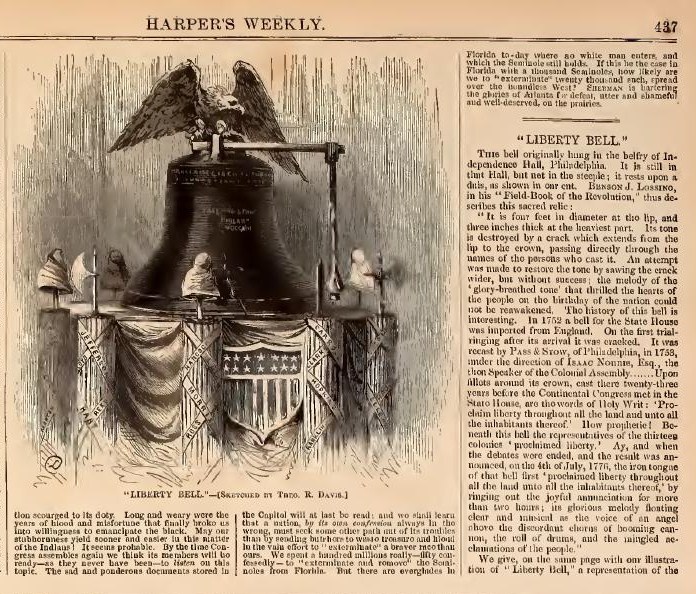
It is not my purpose to philosophize upon the war, but I cannot refrain from expressing my profound thankfulness that Providence has spared me to such time as I can see the asperities of the great conflict softened, its passions entering upon the sleep of oblivion, only its nobler—if less immediate—results springing into virile and vast life. I believe there is to-day, because of the war, a broader and deeper patriotism in all Americans; that patriotism throbs the heart and pulses the being as ardently of the South Carolinian as of the Massachusetts Puritan; that the Liberty Bell, even now, as I write, on its Southern pilgrimage, will be as reverently received and as devotedly loved in Atlanta and Charleston as in Philadelphia and Boston. And to stimulate and evolve this noble sentiment all the more, what we need is the resumption of fraternity, the hearty restoration and cordial cultivation of neighborly, brotherly relations, faith in Jehovah, and respect for each other; and God grant that the happy vision that delighted the soul of the sweet singer of Israel may rest like a benediction upon the North and the South, upon the Blue and the Gray.
496px-Ely_S._Parker (https://en.wikipedia.org/wiki/Ely_S._Parker)

Ely S. Parker

General James Longstreet (General_James_Longstreet (https://en.wikipedia.org/wiki/James_Longstreet#/media/File:General_James_Longstreet.jpg)

James Longstreet

James Longstreet (http://www.gutenberg.org/files/38418/38418-h/38418-h.htm)

Lee’s very old war horse

I’m not exactly sure where Medicine Bluff Creek is, but based on a recommendation at the U.S. Army site, it might be close to present day Fort Sill.
According to the Library of Congress, Ely S. Parker contributed a narrative of the Appomattox surrender to the annual commemoration of General Grant’s birthday in 1893.
ESParkerp1(LOC: https://www.loc.gov/resource/mss23333.a01_0381_0395/?st=gallery)

at Farmville

ESParkerterms (LOC: https://www.loc.gov/resource/mss23333.a01_0381_0395/?st=gallery)

surrender terms carbon-copied

ESParker request (LOC: https://www.loc.gov/resource/mss23333.a01_0381_0395/?st=gallery)

General Schofield was Commander of the Army in 1893

You can see the text and image from the March 27 1869 issue of Harper’s Weekly at the Internet Archive
The portrait of James Longstreet as an old man and his wounding at the Wilderness also come from his memoirs at Project Gutenberg
THE WOUNDING OF GENERAL LONGSTREET AT THE WILDERNESS, MAY 6, 1864. (http://www.gutenberg.org/files/38418/38418-h/38418-h.htm page 565)

God bless the Blue and Gray

  1. [1]Langguth, A.J. After Lincoln: How the North Won the Civil War and Lost the Peace. New York: Simon & Schuster, 2014. Print. pages 254.
Posted in 150 Years Ago, Aftermath, Postbellum Society | Tagged , , , , , , , , , , , , | Leave a comment