Pottsville people power

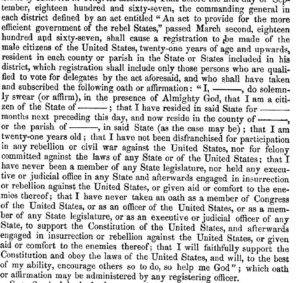
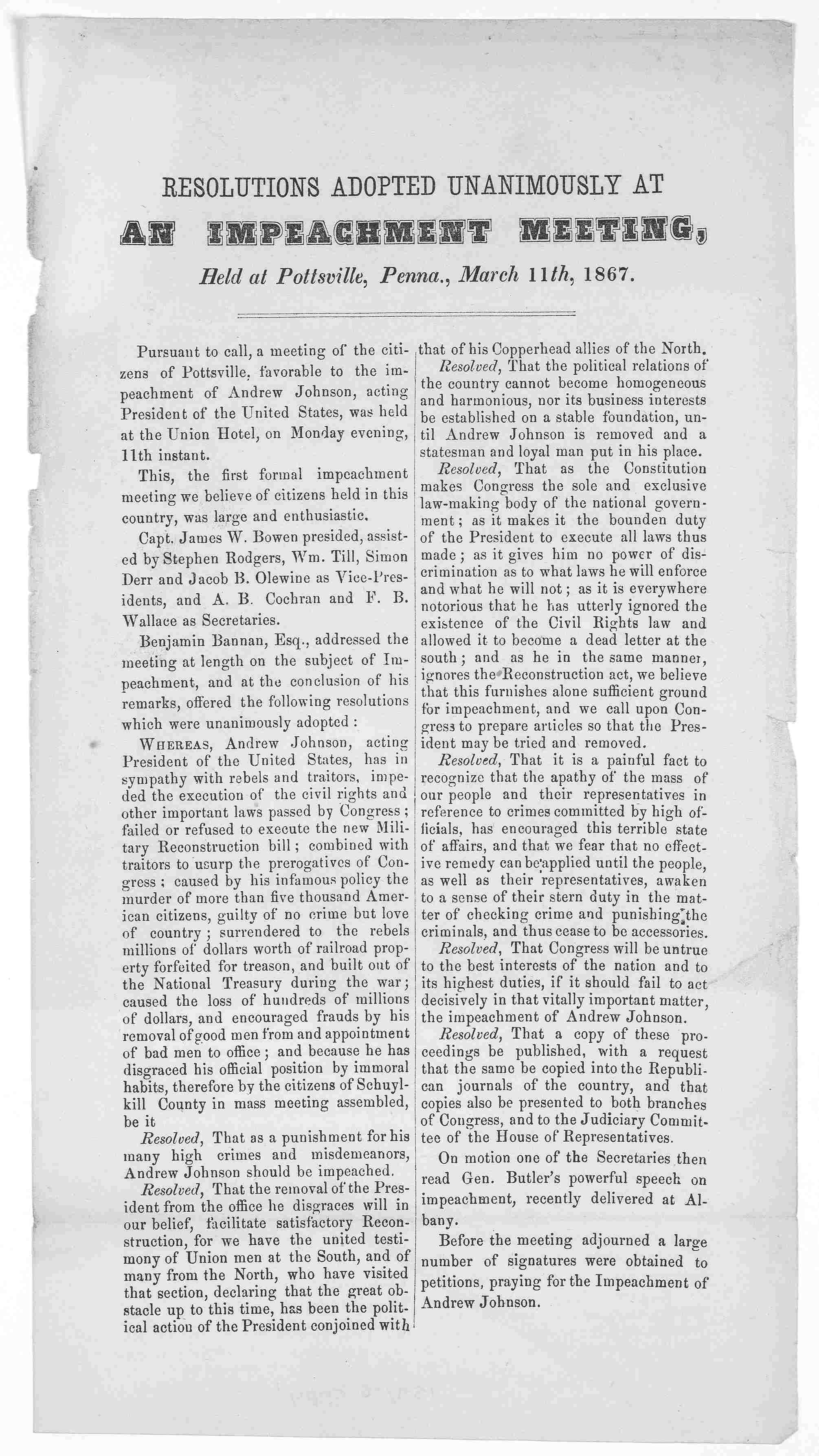
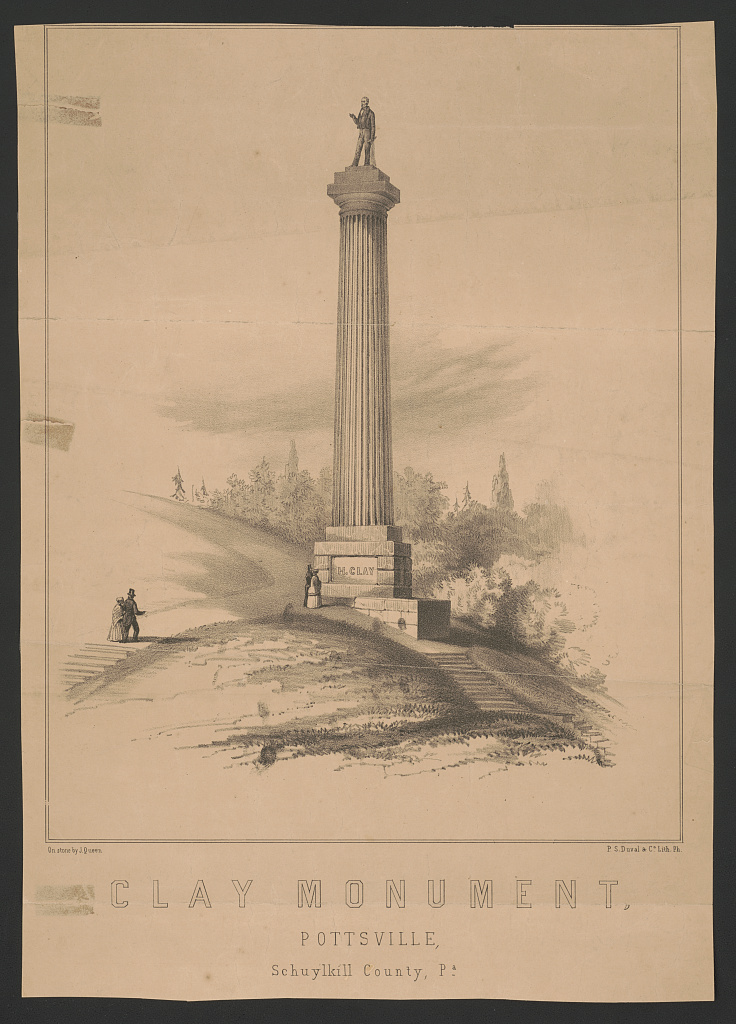
It wasn’t just well-known radicals in and out of Congress. According to documentation at the Library of Congress, on March 11, 1867 some people in Pottsville, Pennsylvania promulgated a series of resolutions calling for the impeachment of President Andrew Johnson.

pottspaimpeach (LOC: https://www.loc.gov/item/rbpe.15901500/)

selective enforcement an impeachable offense

Benjamin F. Butler reportedly delivered his speech in Albany on March 2nd, allegedly implying that even bad political speeches were impeachable offenses.

Here’s a little on impeachment maneuvers in Congress 150 years ago. From The New-York Times March 7, 1867:

WASHINGTON.

Republican Congressional Caucus – …

Special Dispatch to the New-York Times.

WASHINGTON, Wednesday, March 6.

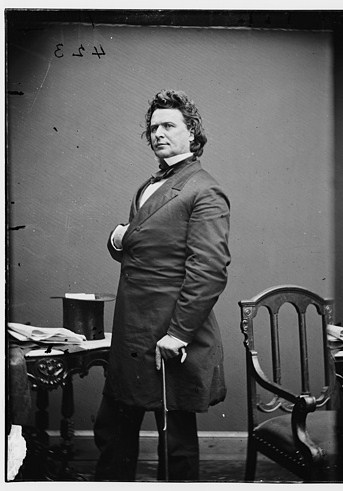
Hon. James Mitchell Ashley of Ohio, Editor of Dispatch & Gov. of Territory of Montana, Born: 1824, Died: 1896 ([ca. 1860-1865; LOC: https://www.loc.gov/item/brh2003000190/PP/)

going after the Acting President

The Republican House caucus to-night was largely attended, and was a very lively affair, lasting until 11 o’clock until it adjourned. To begin with, it is proper to state that a secret caucus of extreme Radicals, called by BEN. BUTLER, was held this morning, for the purpose of ascertaining whether the projects for taking the impeachment investigation out of the hands of the Judiciary Committee, and putting it in the hands of a Select Committee of Thirteen, stood any chance of success. [That possibility was shot down, so Mr. Butler stood little chance “to cut a figure” in the impeachment investigation because he was unlikely to be appointed to the Judiciary Committee.] On the assembling of the caucus to-night ASHLEY opened with a ruse, by moving a resolution that the Judiciary Committee be appointed by the Speaker, to whom should be referred the record of the impeachment investigation as far as proceeded with in the last Congress. This ASHLEY did simply for the purpose of keeping both organizations in the hands of men of his ilk, for COVODE immediately moved a resolution that a select Committee of Thirteen be appointed for the impeachment investigation, when ASHLEY showed his colors and said he preferred that. [“after a long and somewhat bitter discussion,” the caucus decided that the Speaker should appoint the members of the Judiciary Committee] …

According to Hans L. Trefousse, radical Ohio Representative James Mitchell Ashley “had been instrumental in the passage of the Thirteenth Amendment. Perfectly fanatical in his advocacy of extreme measures, Ashley had convinced himself that all presidents who had died in office had somehow been done in by their successors, and Lincoln was no exception. It was he who finally brought the first successful resolution looking toward impeachment.” [On January 7, 1867 Representative Ashley introduced a resolution impeaching “Andrew Johnson, Vice President and Acting President of the United States”. His resolution was referred to the Judiciary Committee.[1]

https://www.loc.gov/item/2014649375/

no more compromises

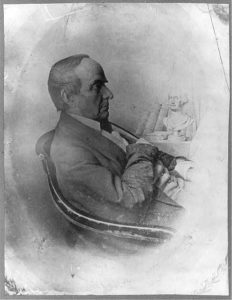
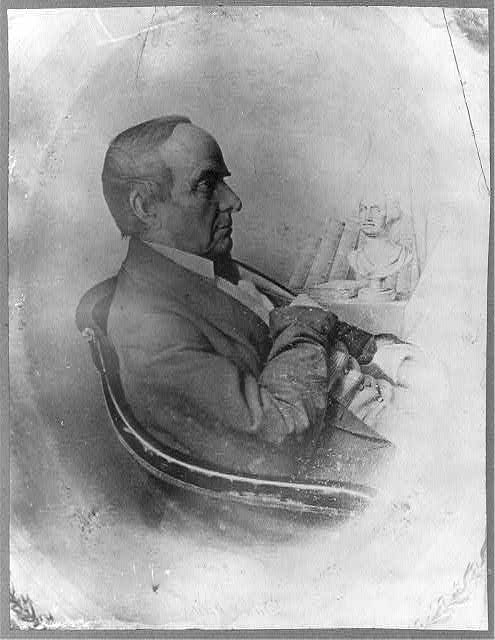
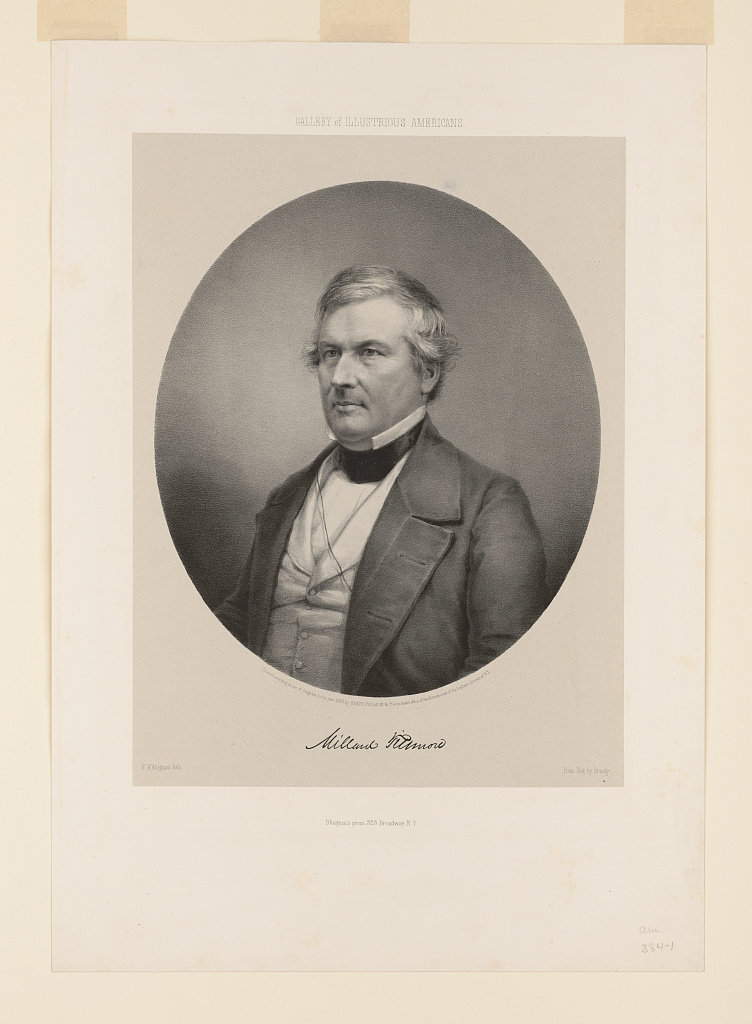
Millard Fillmore / F. D'Avignon lith. ; from Dag. by Brady. (323 Broadway N.Y. : D'Avignon's press, c1850.; LOC: https://www.loc.gov/item/00650922/)

murderer most foul?

From the Library of Congress: James M. Ashley, the Henry Clay monument in Pottsville, and Millard Fillmore
  1. [1]Trefousse, Hans L. Andrew Johnson: A Biography. New York: W.W. Norton & company, Inc., 1997. Print. pages 282-283.
Posted in 150 Years Ago This Week, Aftermath, Postbellum Politics, Postbellum Society, Reconstruction | Tagged , , , , , , , , , | Leave a comment

“it is our country”

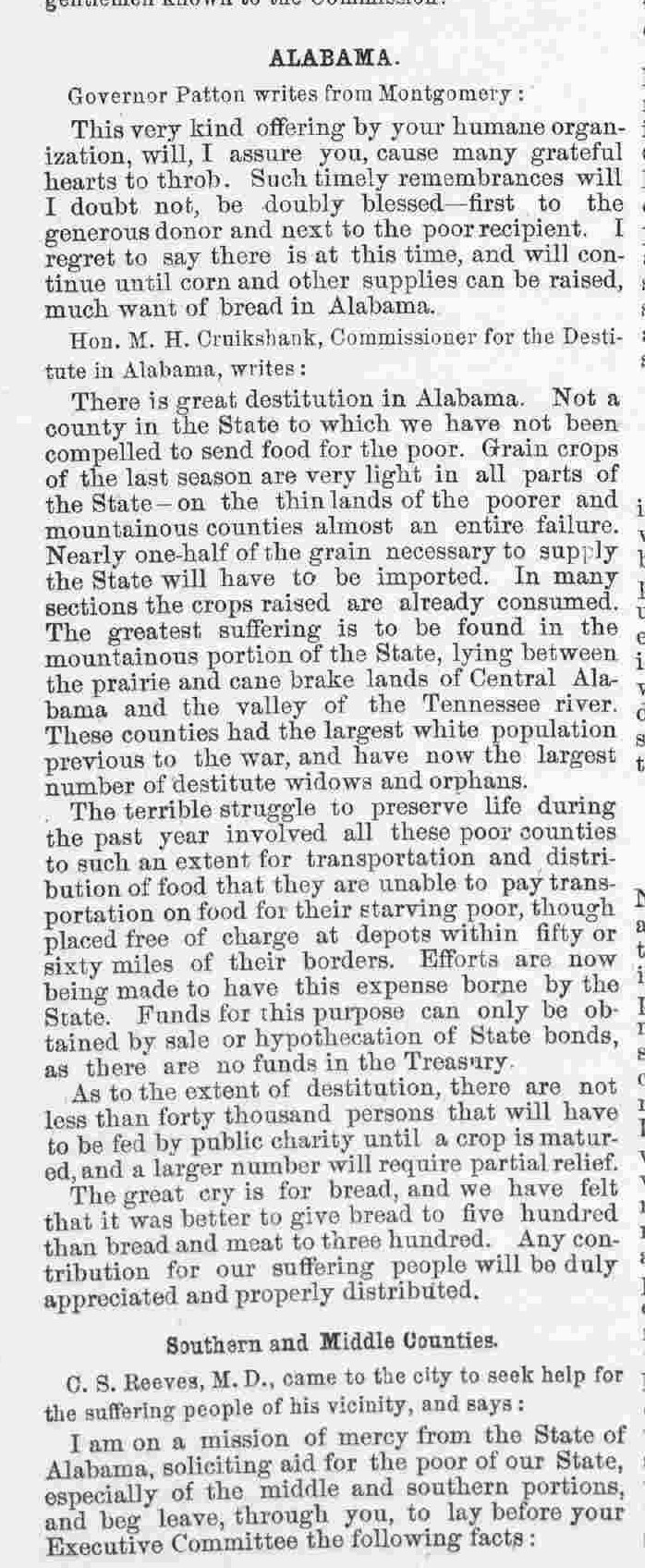
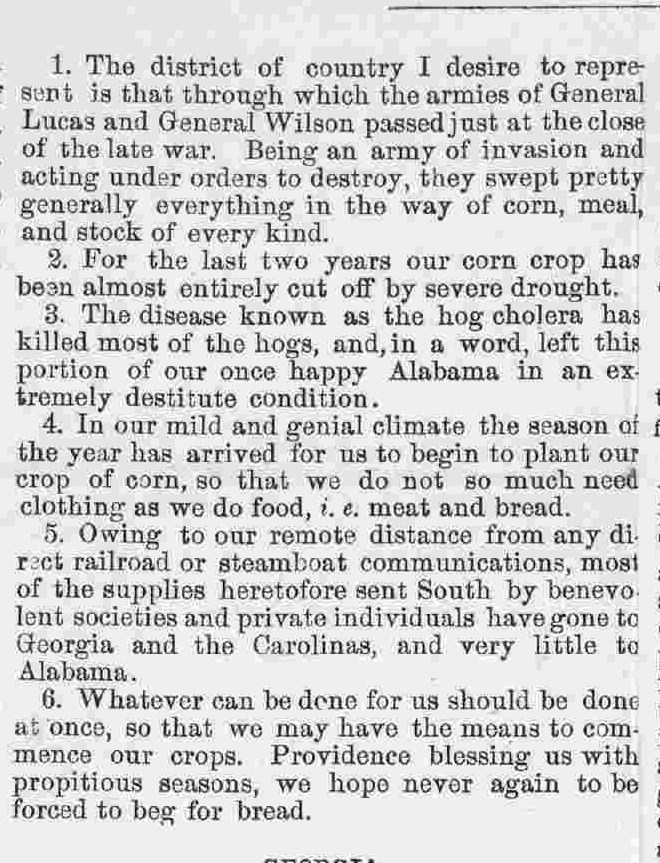
On March 7, 1867 the Southern Famine Relief Commission published a fact sheet about the severe destitution in the South, especially in Alabama, Georgia, and the Carolinas. General O.O. Howard wrote that although his Freedmen’s Bureau was for the most part taking care of the basic needs of freedmen and loyal refugees, he did think that other Southerners were in extreme want, even widows and orphans in the planter class. The fact sheet printed information from first-hand accounts in the four states. The sheet closes by requesting donations to the organizations treasurer, who had already received $55,000 and purchased 50,000 bushels of corn. Since more was desperately needed, all churches were urged to take up collections on Sunday, March 17th.

Here’s the Alabama section of the report:

alapart1 (LOC: https://www.loc.gov/item/rbpe.12701300/)

contributions bless donors and recipients

alapart2 (LOC: https://www.loc.gov/item/rbpe.12701300/)

war, drought, and hog cholera

______________________________________________

According to the February 25, 1867 issue of The New-York Times the same U.S. Congress that had enacted legislation dividing the South into five military districts and requiring the passage of the would-be Fourteenth Amendment also provided a U.S. Navy ship for the Southern Famine Relief Commission to get food and supplies South:

Immediate Aid for the South.

The concurrent resolution that passed the Senate and House of Representatives, permitting the Secretary of the Navy to place a national vessel at the disposal of the Southern Famine Relief Commission, justifies the members of that Committee in making a personal and peremptory appeal for immediate relief. The vessel will be in readiness this week. Shall it be sent South with less than a full load, or shall it go burdened with material, tangible evidence of fraternal regard and sectional sympathy? Already large sums of money have been given for the relief of the poor and destitute of the South, but it is like a drop in the bucket. Vastly more is needed to make the aid effective, and now is the time to give it.

The Committee, through Mr. JAMES M. BROWN, of No. 61 Wall-street, will receive contributions of cash, provisions, clothing, boots and shoes – anything and everything that can suggest itself to men in behalf of other men in need – and faithfully apply whatever is sent.

In other days our people have generously sent aid to starving Ireland. They are now preparing to exhibit their sympathy with the struggling Cretan Christians by a practical demonstration; and no one supposes that they would decline to give of their bounty to anybody and everybody in any other country. Why, then, should this home charity, or rather this home duty, be comparatively unheeded? It would be wholly foreign to our habit, our thought, our honor, to permit a half-laden vessel to go from the land of plenty to the land of poverty, and we urgently second the appeal of the Commission that each and every citizen send at once his mite, or his fair proportion, in the furtherance of this cause, which is at once pleasurable and imperative.

The March 23, 1867 issue of Harper’s Weekly (page 179) exhorted readers to attend church on March 17th ready to contribute to help “our unfortunate brethren” and seemed to have a similar mindset to that of Congress:

While we oppose to the utmost the political policy which would intrust [sic] reconstruction exclusively to those who were lately in rebellion, and while the social condition of the Southern States undoubtedly demands the measures of the military bill, we do not in the least forget the sufferings of thousands and thousands of the people in those States, and we earnestly press upon the absolute necessity of immediate relief. The accounts from many parts of the South are most melancholy. …

The February 16, 1867 issue of Harper’s (page 99) more fully expounds its view of Reconstruction and famine relief. I can see how a Southerner could think it’s a bit much. After explaining that the magazine was not vengeful but only wanted to ensure that the war’s hard-fought victory for justice was maintained, it went on: “We would feed, and clothe, and teach. We would invest the truth of our political convictions with all the glory of sympathy and humanity. We would show that our doctrine of equal human rights has a moral foundation by an exhaustless beneficence.” [and more] After detailing the famine in the South: “And it is our country; and these are our people; and they are people against whom inexorably fighting we have at last prevailed, and people who must remain one with us.”
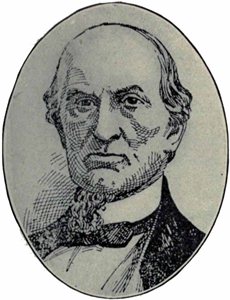
The entire famine fact sheet appears at the Library of Congress; the portrait of Robert M. Patton at Project Gutenberg
Posted in 150 Years Ago This Week, Aftermath, Postbellum Society, Reconstruction | Tagged , , , , , , , | Leave a comment

Wade in waiting?

150 years ago today the 39th U.S. Congress ended and the 40th convened. This was an unusual move, but Congress wasn’t taking any chances. In the last days of the 39th, Congress enacted measures that curtailed President Johnson’s policies and power. It ended the president’s lenient reconstruction by dividing the South up into 5 military districts and making readmission to the Union dependent on passage of the 14th Amendment to the federal Constitution. Congress severely limited presidential power to appoint and fire officeholders and even impinged on his authority as Commander-in-Chief. Apparently the legislators wanted to keep up the pressure and keep their eyes on Mr. Johnson: “Unwilling to allow the president the customary intervals between sessions of Congress in March and December, the lawmakers took advantage of a seldom-used clause in the Constitution to convene sooner.” [1]

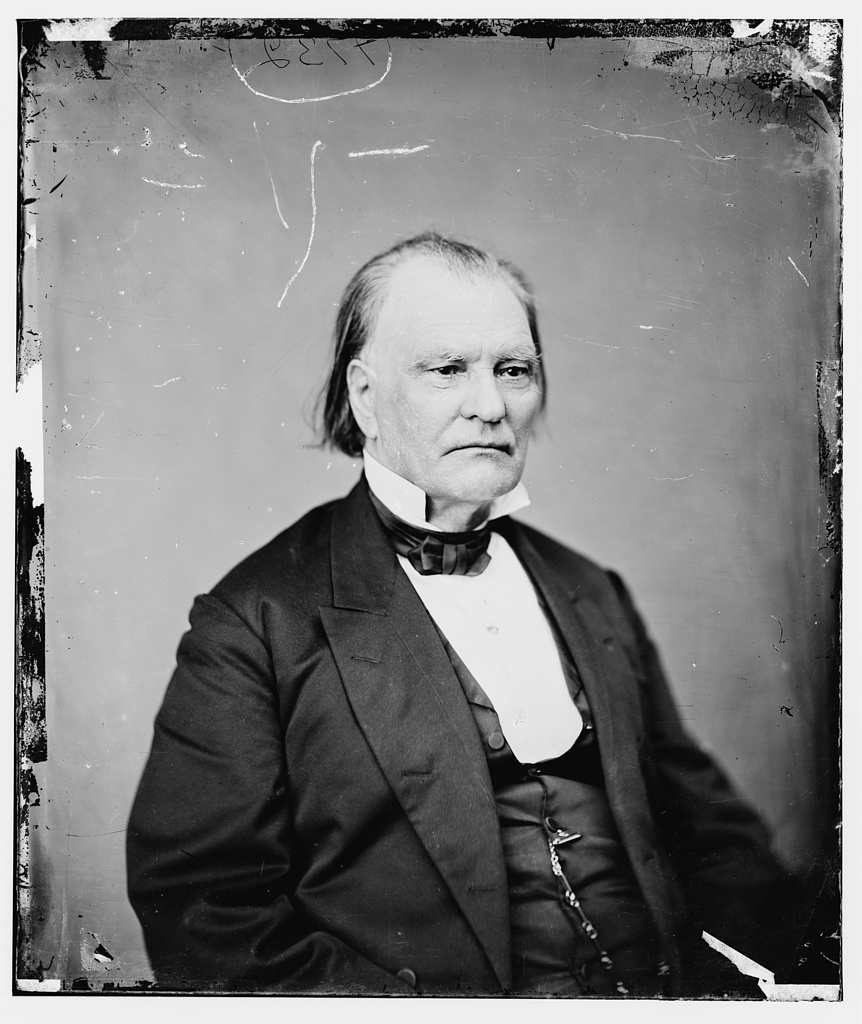
Hon. Benj. Franklin Wade of Ohio (between 1860 and 1875; LOC: https://www.loc.gov/item/brh2003001179/PP/)

advanced for his age

You can read about the last and first day of Congress in the March 5, 1867 issue of The New-York Times. In the House incoming Representative James Brooks said the 40th “was in danger of placing itself on record, not as a rump Congress, but the rump of a rump Congress. He admitted its de facto power, but denied that it had an authority as a de jure body, and presented a protest signed by the Democratic members against the organization of the House while seventeen States were unrepresented.” [I thought it was ten states.] Schuyler Colfax was re-elected Speaker.

“The Senate organized promptly at 12 o’clock, Hon. B.F. WADE in the chair, as President pro tem., having been elected to that position this morning during the last hour of its session. During Andrew Johnson’s administration the President pro tem. was especially important – under the law of the time that officeholder was next in order of succession to the Presidency. If Andrew Johnson was ever impeached and convicted, Mr. Wade would become president. Benjamin Franklin “Bluff” Wade , was “the old Ohio radical whose ideas about female suffrage and the relationship between capital and labor were so advanced that his election [to President pro tem.] has been called a turning point in the impeachment process. Chosen because of his radicalism, he nevertheless frightened less outspoken colleagues.”[2]

It wasn’t until the February 1967 adoption of the Twenty-fifth Amendment to the United States Constitution that the issue of the missing vice-president was rectified: “Under Section 2, whenever there is a vacancy in the office of Vice President, the President nominates a successor who becomes Vice President if confirmed by a majority vote of both Houses of the Congress.”
Other sources say that Senator Wade was elected President pro tem. on March 2, 1867.
The photograph comes from the Library of Congress
  1. [1]Trefousse, Hans L. Andrew Johnson: A Biography. New York: W.W. Norton & company, Inc., 1997. Print. page 276.
  2. [2]ibid. page 287.
Posted in 150 Years Ago This Week, Aftermath, Postbellum Politics, Reconstruction | Tagged , , , , , , , , | Leave a comment

in (and out) like a lion

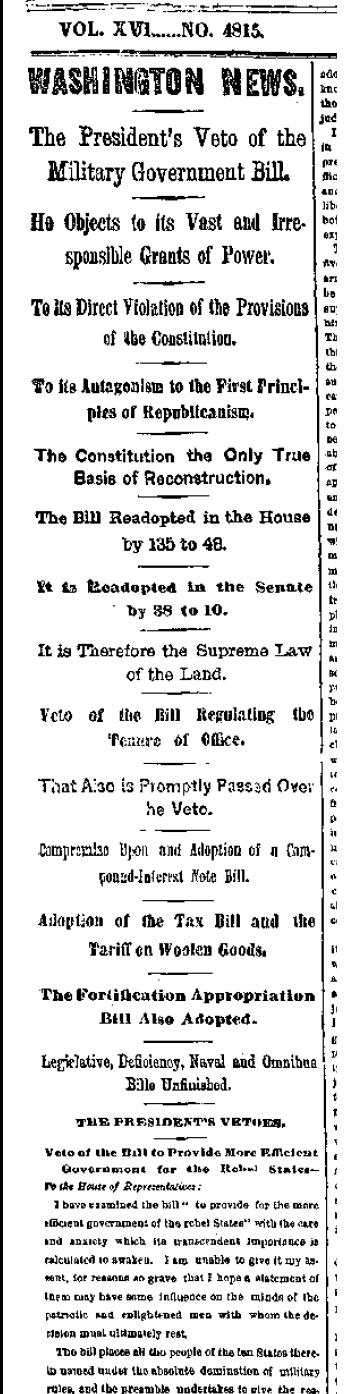
NY Times March 3,1867

NY Times March 3,1867

On March 2, 1867 Andrew Johnson vetoed two bills as the 39th Congress was wrapping up its business. Both vetoes were immediately overridden by Congress.

The Tenure of Office Act limited the President’s power to terminate certain appointees without the Senate’s consent:

That every person holding any civil office to which he has been appointed, by and with the advice and consent of the Senate, and every person who shall hereafter be appointed to any such office and shall become duly qualified to act therein, is and shall be entitled to hold such office until a successor shall have been appointed by the President, with the advice and consent of the Senate, and duly qualified; and that the Secretaries of State, of the Treasury, of War, of the Navy, and of the Interior, the Postmaster-General, and the Attorney-General shall hold their offices respectively for and during the term of the President by whom they may have been appointed and for one month thereafter, subject to removal by and with the advice and consent of the Senate. [from the veto message]

Congress was especially interested in protecting Secretary of War Edwin M. Stanton, the most radical member of President Johnson’s cabinet. According to Hans L. Trefousse, all cabinet members opposed the bill, including the Secretary of War. However, Mr. Stanton refused the president’s request that he write the veto message because he was real busy and the rheumatism in his arm was acting up. William H. Seward wrote the “exemplary” veto message (at Project Gutenberg). John Bigelow watched the Congressional override proceedings and was impressed by the contempt Congress had for the president. [1]

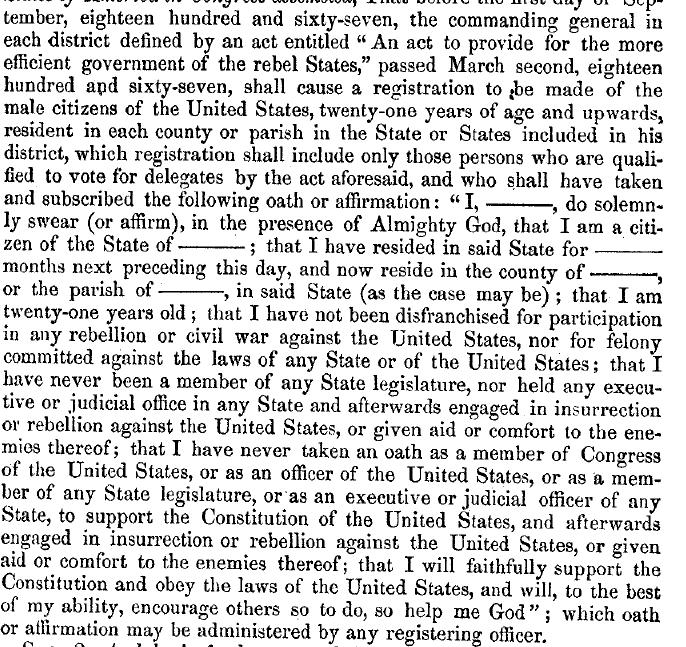
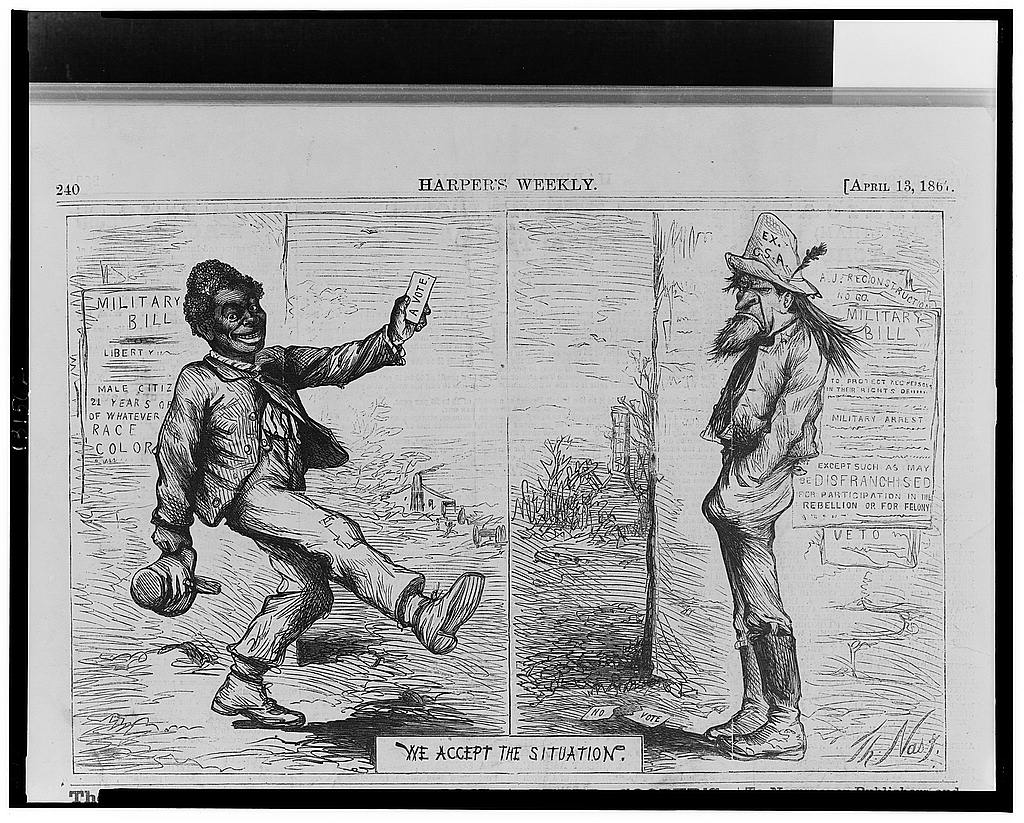
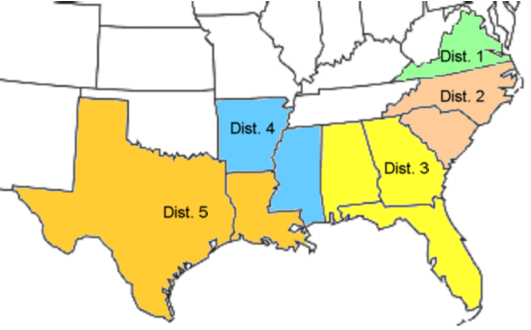
President Johnson also vetoed “An act to provide for the more efficient government of the Rebel States”, which was the first of the Reconstruction Acts. The first law divided the South into five military districts. “In addition, Congress required that each state draft a new state constitution, which would have to be approved by Congress. The states also were required to ratify the Fourteenth Amendment to the United States Constitution and grant voting rights to black men.”

Here’s a Southern take on the law by Walter L. Fleming in his 1905 Civil War and Reconstruction in Alabama (pages 473-474):

The Military Reconstruction Bills

US_Reconstruction_military_districts (https://en.wikipedia.org/wiki/File:US_Reconstruction_military_districts.png)

congressional redistricting

The Radicals in Congress triumphed over the moderate Republicans, the Democrats, and the President, when, on March 2, 1867, they succeeded in passing over the veto the first of the Reconstruction Acts. This act reduced the southern states to the status of military provinces and established the rule of martial law. After asserting in the preamble that no legal governments or adequate protection for life and property existed in Alabama and other southern states, the act divided the South into five military districts, subject to the absolute control of the central government, that is, of Congress. Alabama, with Georgia and Florida, constituted the Third Military District. The military commander, a general officer, appointed by the President, was to carry on the government in his province. No state interference was to be allowed, though the provisional civil administration might be made use of if the commander saw fit. Offenders might be tried by the local courts or by military commissions, and except in cases involving the death penalty, there was no appeal beyond the military governor. This rule of martial law was to continue until the people should adopt a constitution providing for enfranchisement of the negro and for the disfranchisement of such whites as would be excluded by the proposed Fourteenth Amendment to the United States Constitution. As soon as this constitution should be ratified by the new electorate (a majority voting in the election) and the constitution approved by Congress, and the legislature elected under the new constitution should ratify the proposed Fourteenth Amendment, then representatives from the state were to be admitted to Congress upon taking the “iron-clad” test oath of July 2, 1862. And until so reconstructed the present civil government of the state was provisional only and might be altered, controlled, or abolished, and in all elections under it the negro must vote and those who would be excluded by the proposed Fourteenth Amendment must be disfranchised.

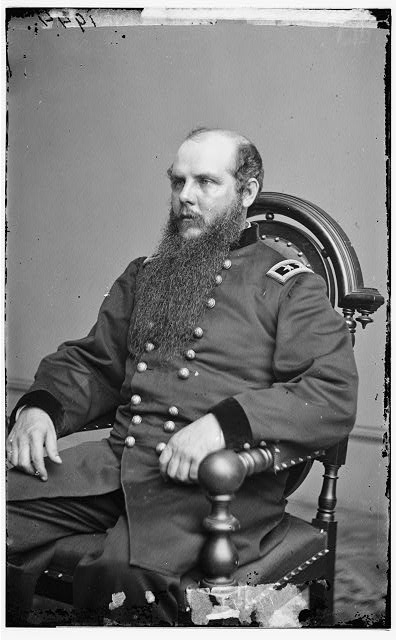
The President at once (March 11, 1867) appointed General George H. Thomas to the command of the Third Military District, with headquarters at Montgomery, but the work was not to General Thomas’s liking, and at his request he was relieved, and on March 15 General Pope was appointed in his place. Pope was in favor of extreme measures in dealing with the southern people and stated that he understood the design of the Reconstruction Acts to be “to free the southern people from the baleful influence of old political leaders.”

The act of March 2 did not provide for forcing Reconstruction upon the people. If they wanted it, they might initiate it through the provisional governments, or if they preferred, they might remain under martial law. While all people were anxious to have the state restored to the Union, most of the whites saw that to continue under martial law, even when administered by Pope, was preferable to Reconstruction under the proposed terms. Consequently the movement toward Reconstruction was made by a very small minority of the people and had no chance whatever of making any headway.

You can also read the veto message of the Military Government bill at Project Gutenberg. Mr. Trefousse wrote that President Johnson wrote the document with the help of Jeremiah S. Black and Attorney General Henry Stanbery[2]

An editorial in the March 5, 1867 issue of The New-York Times reviewed the bills passed at the end of the 39th Congress:

The Session.

It’s the same old story. A session begun lazily winds up with speed of a high-pressure engine. …

The settlement of the reconstruction question would alone invest it with importance. The mode of settlement is not as we would have it. It conflicts with preconceived notions of republicanism, and awakens a painful, anxious interest in the future of the South. But, rough though it be – harsh and despotic as it undeniably is – it is preferable to prolonged uncertainty or delay. Even Radical reconstruction, with military government as its initiatory process and universal negro suffrage as its inevitable object, is better than the indefinite exclusion of ten States, or the absence of specific declarations touching their reorganization. Congress has fixed its policy, and with the President’s help, must work it out. From this responsibility there can be no escape. The work must go forward from this day, on the basis constructed; and the wisdom or folly of the policy must be determined by its fruit. How it shall operate upon the South – whether as an irritant, necessitating the vigorous exercise of the military power, or as a stimulant, producing the healthy counteraction which shall render military authority unnecessary – depends upon the South itself. It may resist and suffer, or it may submit and regain peace and prosperity. Congress has acted intelligibly, and in a certain sense thoroughly according to the judgment of a majority, and though the Southern people may lose, they cannot possibly profit, by failing to comply with the terms prescribed. …

Waging a quiet but uncompromising war with the President, Congress has not only enacted a measure crippling his power of removing and appointing in the civil branches of the Government, but has also tacked to the Army Appropriations Bill a clause diminishing his authority as Commander-in-Chief over the General, and otherwise over the army. An opinion prevailed that the latter measure would encounter a pocket veto. The exigencies of the service, however, rendered the loss of the appropriation undesirable, and the President yesterday signed the bill under protest. …

Congress added to the military appropriations a requirement that the president issue orders to the army through the general-in-chief (Ulysses S. Grant), who had to be stationed in Washington, D.C. [3]

Jengod’s map of the military districts is licensed by Creative Commons
  1. [1]Trefousse, Hans L. Andrew Johnson: A Biography. New York: W.W. Norton & company, Inc., 1997. Print. page 277.
  2. [2]ibid. page 280.
  3. [3]ibid. page 277.
Posted in 150 Years Ago This Week, Aftermath, Postbellum Politics, Reconstruction | Tagged , , , , , , , , | Leave a comment

and the freedmen are ignorant?

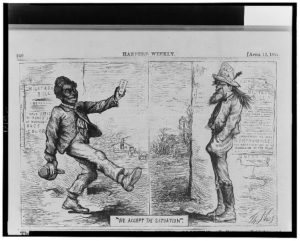
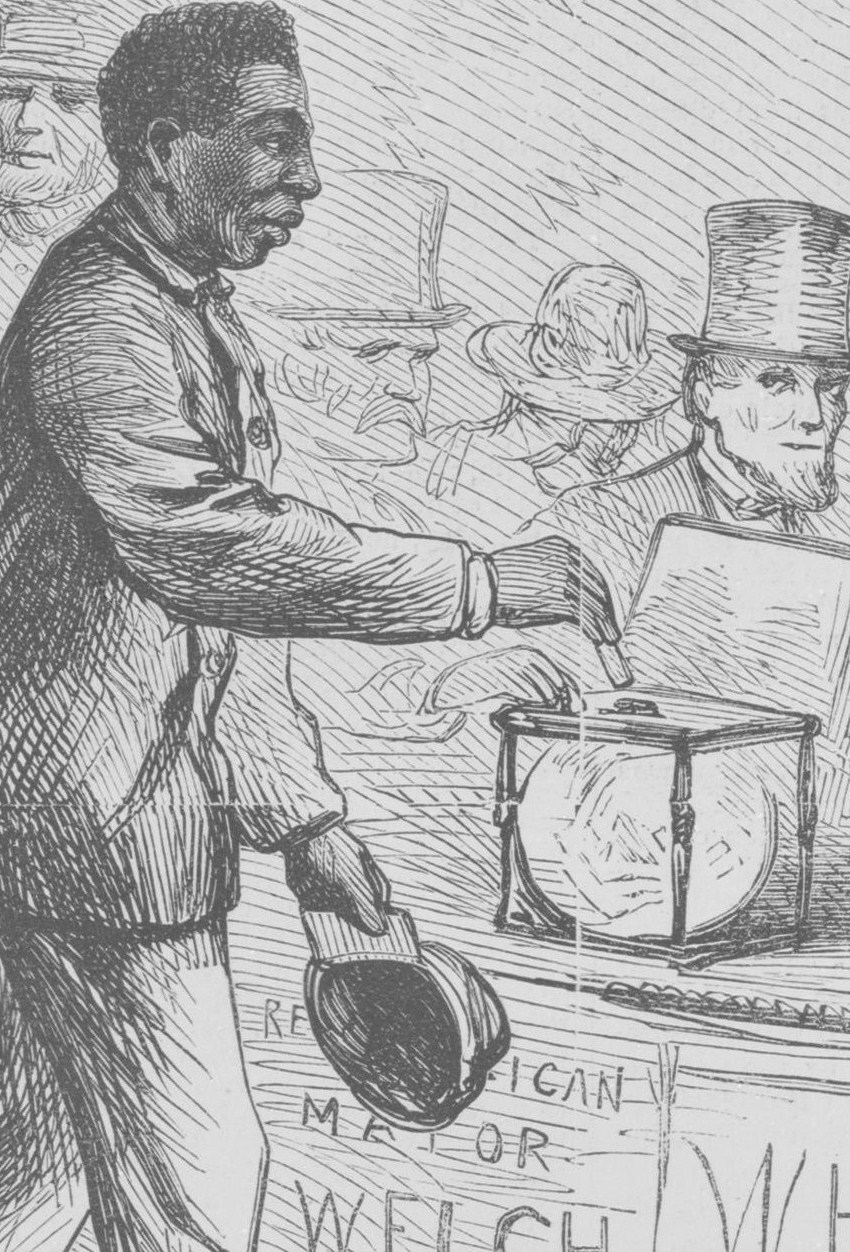
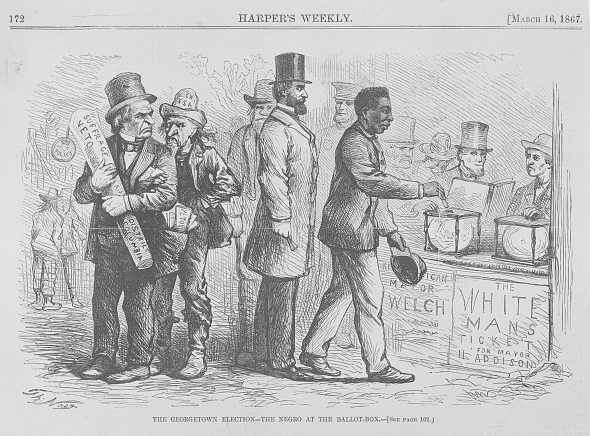
The Georgetown elections - the Negro at the ballot-box / Th. Nast. (- Illus. in: Harper's weekly, v. 11, no. 533 (1867 March 16), p. 172; LOC: https://www.loc.gov/item/2010652200/)

“justice is the best policy”

In January 1867 the United States Congress passed a law over President Johnson’s veto that guaranteed the right to all men in the District of Columbia “without any distinction on account of color or race.” 150 years ago today black men voted for the first time in an election in Georgetown. According to one editorial, white men in Georgetown who boycotted the election because of the black voters sort of shot themselves in the foot. From The New-York Times February 27, 1867:

… Special Dispatches to the New-York Times.

WASHINGTON, Tuesday, Feb. 26. …

THE ELECTION IN GEORGETOWN.

The Georgetown election, which took place yesterday, affords some curious and amusing instances of the extremes to which men, calling themselves white, and believing themselves possessed of sense, will be led by their passions and prejudices. The Republican candidate, Mr. CHARLES D. WELSH, who planted himself squarely on the platform of negro suffrage, was elected by ninety-six majority; and the same party elected seven out of eleven members of the Common Council. The entire vote was about 1,900, while the registry was over 2,300. It is an indisputable fact that the colored vote, only about 900 of the aggregate, was thoroughly polled, for they were at the polls early, and brought out every man in their eagerness to improve the first opportunity for the exercise of the long-sought boon of free suffrage. The presence of the colored men at the polls was so distasteful to the whites that many refused to vote while a black voter was near the ballot-box, and at least three hundred registered white men refused to go near the polls. The result was that they were beaten, as they deserved to be, when they really had it in their own power to beat their opponents. A few men have even gone so far as to threaten to discharge some of their colored employees because they dared to vote at all. One of this class was brought to his senses this morning by being informed by two of his best customers, that if he carried his politics into his business to that extent, they would also carry their politics into his business by withdrawing their patronage. …

The Georgetown elections - the Negro at the ballot-box / Th. Nast. ( Illus. in: Harper's weekly, v. 11, no. 533 (1867 March 16), p. 172; LOC: https://www.loc.gov/item/2010652200/)

Andy-proof election

Thomas Nast’s cartoon was published in the March 16, 1867 issue of Harper’s Weekly. On page 162 in the same issue the magazine reported that the election showed “that the colored citizen is intelligent enough to know his interest, and independent enough to act accordingly. The horrible consequences of the vice and ignorance of colored voters are not yet apparent” – they didn’t seem beholden to “massa.” The freedman’s conduct was dignified, decorous, and restrained. Because some Baltimore and Washington roughs and bullies had threatened to show up, 150 policemen were on hand. There were sneers and insults, which the freedmen disregarded, and “the peace was not broken.” The election “was an ample vindication of the wisdom of Congress in passing the suffrage bill, and of those who insist that justice is the best policy.”

Slavery was abolished in the District of Columbia on April 16, 1862.

Johnson's Georgetown and the city of Washington : the capital of the United States of America. (New York : A.J. Johnson, [1867] ; LOC: https://www.loc.gov/item/88693495/)

a land where all men can vote (1867 D.C.)

Check out the cartoon and map at the Library of Congress
Posted in 150 Years Ago This Week, Aftermath, Postbellum Politics, Postbellum Society, Reconstruction | Tagged , , , , , | Leave a comment

at the great white father’s

aj and dacotahs (LOC: )

peace and amity at White House

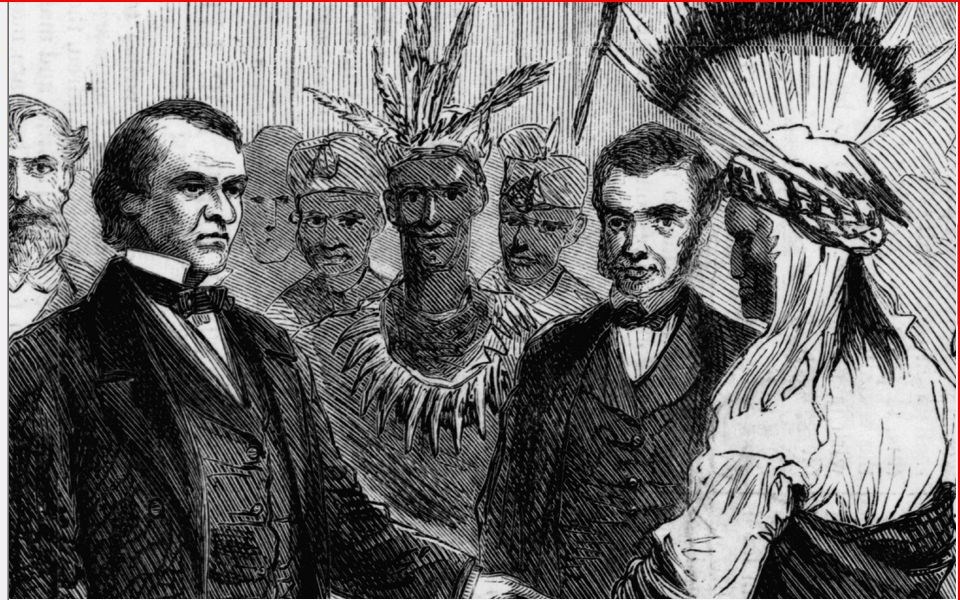
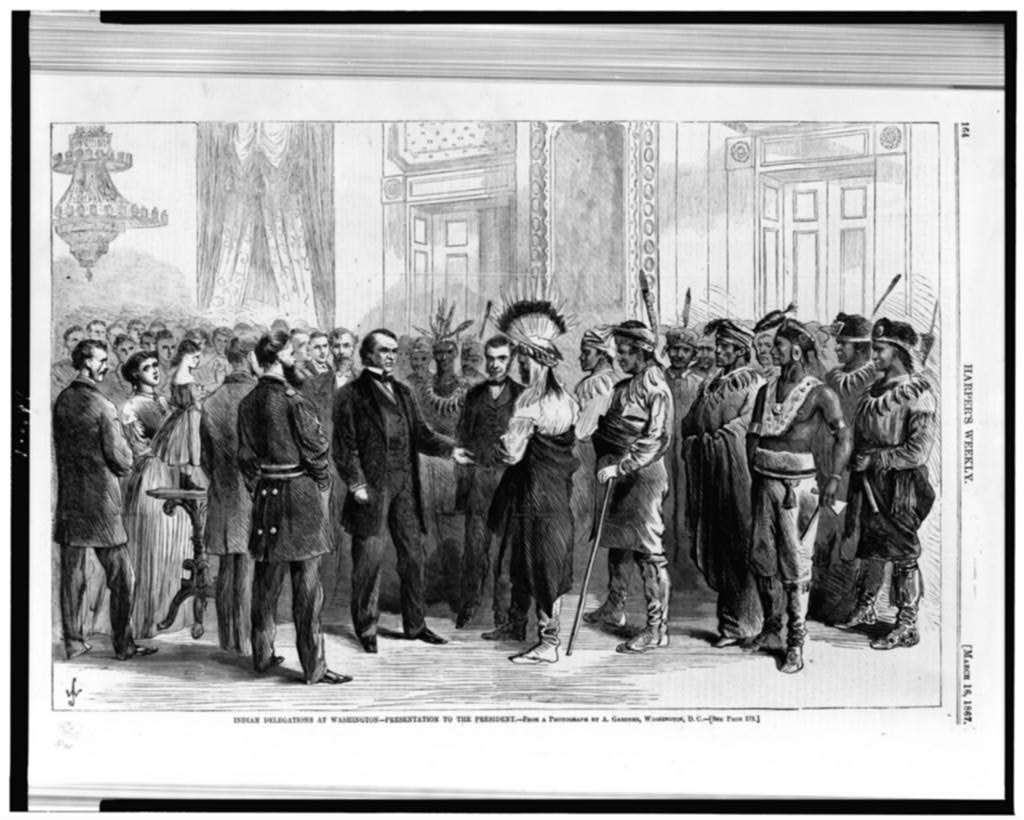
In February 1867 a delegation of about 100 Native Americans were in Washington, D.C. on treaty-making business with the Indian Bureau. 150 years ago today they visited President Johnson at the White House. According to the February 24, 1867 issue of The New-York Times. The natives, about half of whom were “in full Indian costume,” were accompanied by Secretary of the Interior Orville Hickman Browning and Commissioner of Indian Affairs Lewis Vital Bogy. Commissioner Bogy told the president that the Indians wanted to pay their respects to “their great father,” “the big chief of the nation.” Mr. Bogy said the Indians looked to the great father “for protection and care. Our government looks upon these people as dependents and wards of the nation, and since I have held the responsible under you as Commissioner of Indian Affairs, I have endeavored to give to them that to which they are justly entitled.”

The natives approved the commissioner’s words upon translation. President Johnson told the Indians that the government and the natives’ great father would “cultivate peace and amity between the races, although the United States has grown strong and powerful in its march onward, and your tribes have greatly diminished, there will be nothing left undone that a great and powerful nation can do, for the care and protection of its wards.”

Indian delegations at Washington--presentation to the president / From a photograph by A. Gardner, Washington, D.C. ( Illus. in: Harper's weekly, 1867 March 16, p. 164. ; LOC: https://www.loc.gov/item/93500617/)

first peoples, first wards of the nation?

The image of the reception was published in the March 16, 1867 issue of Harper’s Weekly. On page 173 the periodical noted that the Indians were Sioux and Yancton from Dacotah accompanied by the territorial governor. “The reply of the President, unlike most of his speeches, also met with approval.”

Posted in 150 Years Ago This Week, Aftermath, Postbellum Society | Tagged , , , | Leave a comment

used furniture

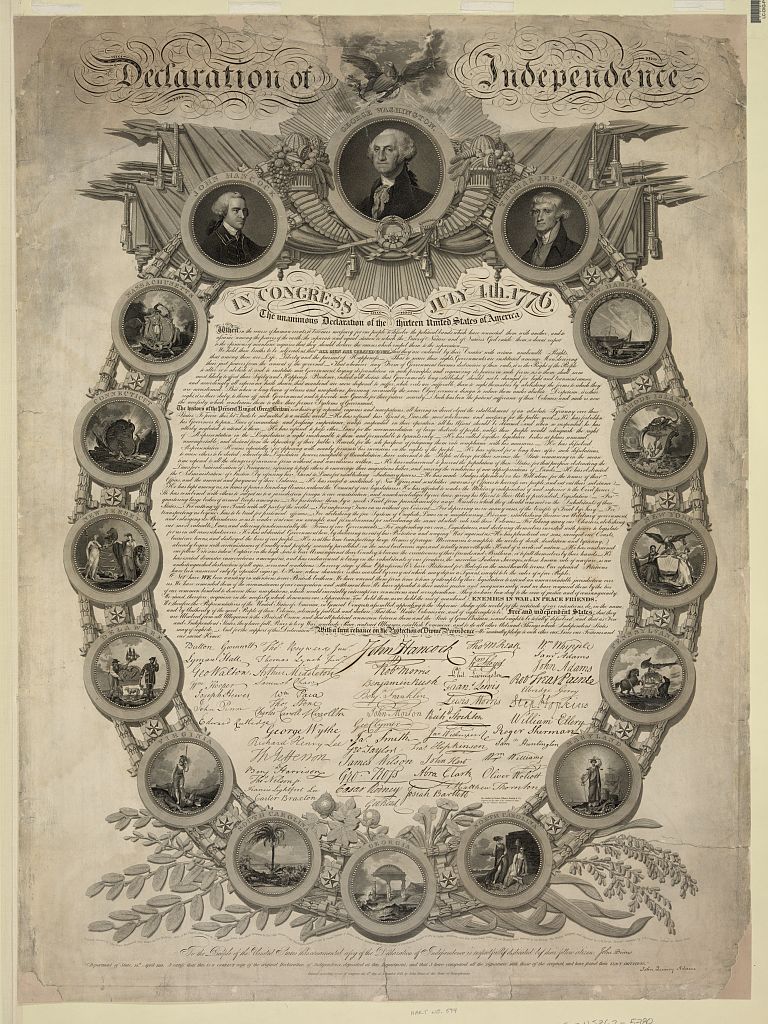
Declaration of Independence (John Binns, United States : s.n., c1818, published 1819; LOC: https://www.loc.gov/resource/pga.01013/)

Hancock and Washington (and Jefferson)

According to the February 23, 1867 issue of The New-York Times, even though Washington’s Birthday had been a legal holiday in the state for four years, New York City’s celebration was rather subdued. Customs were slow to change and the snow storm of the previous two days certainly put a damper on it. A lot of people were staying inside, probably reading President Washington’s “Farewell Address.” About two hundred disabled veterans attended a feast put on by the “Soldiers’ and Sailors’ Relief Agency.” In addition to a delicious menu the disabled veterans were provided a perennial stream of lager, and “one glass of whisky, two cigars and a paper of Cornish’s chewing tobacco.”

The same article included some snapshots from cities around the old United States. Three cities below Mason-Dixon observed the day. Charleston’s observance included “an oration before survivors of the Washington Light Infantry.

Here’s a paragraph in the same article from up North:

Observance of Washington’s Birthday.

PHILADELPHIA, Friday, Feb. 22.

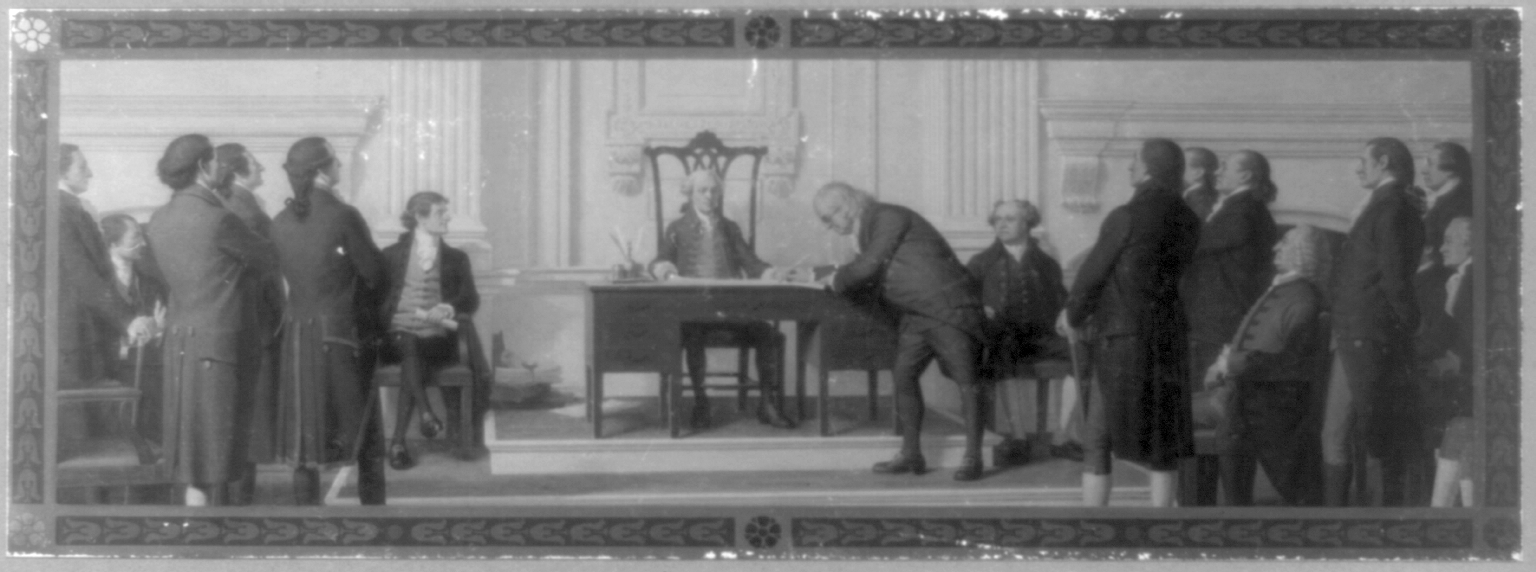
To-day is observed as a holiday by the banks and Courts. The public and private buildings display flags. The formal presentation of HANCOCK’S chair, and the table on which the Declaration was signed, was made by LEWIS W. HALL, the Speaker of the State Senate, in Independence Hall. The response was made by Mayor MCMICHAEL.

You can glimpse these items at the University of South Florida and Temple University

Benjamin Franklin signing the Declaration of Independence (c1911.;LOC: https://www.loc.gov/item/96508610/)

well-used furniture

Posted in 150 Years Ago This Week, Aftermath, American History, Postbellum Society | Tagged , , , , , | Leave a comment

cotton-picking wages

Scenes on a cotton plantation / sketched by A.R. Waud. left ( Illus. in: Harper's weekly, 1867 Feb. 2, pp. 72-73. ; LOC: https://www.loc.gov/item/96513748/)

Harper’s Weekly, 1867 Feb. 2, p. 72

Scenes on a cotton plantation / sketched by A.R. Waud. left ( Illus. in: Harper's weekly, 1867 Feb. 2, pp. 72-73. ; LOC: https://www.loc.gov/item/96513748/)

Harper’s Weekly, 1867 Feb. 2, p. 73

Almost two years after the Civil War ended Alfred R. Waud was still providing illustrations from the front for Harper’s Weekly. Back in January his drawings of a rice plantation in Georgia were published. The February 2, 1867 issue of Harper’s Weekly (page 69) included Mr. Waud’s observations of southern cotton plantations. “These pictures were mainly taken upon the Buena Vista plantation, in Clarke County, Alabama.” The accompanying text went on to explain the process of growing cotton and processing it into bales for shipment and sale. The picture of the plantation graveyard for “defunct negroes” shows the rail fence above the graves to keep away marauding animals. The former slaves put a mattock and a spade on each new grave for fourteen days to prevent “premature resurrection of the corpse”. Cotton growing was still profitable in the South, even with free labor replacing slavery:

picking cotton (Illus. in: Harper's weekly, 1867 Feb. 2, pp. 72-73. ; LOC: https://www.loc.gov/item/96513748/)

wage earners

… One man to ten acres is considered sufficient – if they work. A good hand before the war was worth $1500 in gold, which, at the Alabama rate of interest – 8 per cent. – was $120 a year, besides the clothing, taxes, doctor’s bill, loss of time during sickness, insurance, etc. The same hand can now be hired for $10 a month in currency; pay’s his own doctor’s bill and taxes, clothes himself, deducts all time lost by sickness, and if he dies is his own loss – a consoling reflection to some planters.

Horses and mules can be purchased for less in currency than they could before the war, while provisions are about the same when reduced to a gold basis. The richest lands are for sale for prices one half to one third less than before the war. …

According to Walter L. Fleming in his 1905 Civil War and Reconstruction in Alabama (pages 322-324) many Yankees took advantage of the cheap land:

Planter and overseer ( Illus. in: Harper's weekly, 1867 Feb. 2, pp. 72-73. ; LOC: https://www.loc.gov/item/96513748/)

immigrants from the North?

Immigration to Alabama

As soon as the war was ended, there was an influx of northern men and northern capital into Alabama. Cotton was selling at a fabulous price,—40 to 50 cents a pound, $200 to $250 a bale,—and the newcomers expected to make fortunes in a few years. They were welcomed by the planters who wanted to sell or to lease their plantations, which, for want of funds, they were unable to cultivate. General Swayne said that in 1866 there were 5000 northern men in Alabama engaged in trading and planting. They were sought for as partners or as overseers by those who hoped that northern men could control free negro labor. Lands were sold or leased at low prices, and many soldiers, especially officers, decided to buy land and raise cotton. Numbers of large plantations in the Black Belt were bought or leased by officers of the army, all of whom had lofty ideas as to what they were going to do. The soil was fertile, cotton was selling for high prices, and the free blacks, they were sure, would work for them out of gratitude and trust. They wanted to help reconstruct southern industry, and to show what could be done toward developing the great natural resources of the state. They embarked in large enterprises, and as long as their money lasted bought everything that was offered for sale. Their success or failure was dependent largely upon the negro laborer, who was to make the cotton, and the new planters made extraordinarily liberal terms with him. They dealt with the negro as if he were a New Englander with a black skin, and they purchased expensive machinery for him to use. They would not listen to southern advice, but went as far as possible to the opposite extreme from southern methods of farming. All suggestions were met with the assurance that the southern man was used only to slaves, and could not know how free men would work.

Reports, generally false and made mainly for political purposes, were continually published by the northern press in regard to the ill treatment of northern men who wished to make their homes in the South. But not a single authenticated case of violence to such persons can be found to have taken place in Alabama.

Cotton gin ( Illus. in: Harper's weekly, 1867 Feb. 2, pp. 72-73. ; LOC: https://www.loc.gov/item/96513748/)

rum gin?

In some localities, on account of bands of outlaws, for several months after the war it was not safe for any stranger to settle. The ignorant whites had no liking for the northern men (and may not have to this day). The better class of people was in favor of much immigration from the North, and Governor Parsons made a tour through the North to induce northern men and capital to come to Alabama. The people had no capital, and wanted to induce those who possessed it to come and live in the state. The testimony of travellers was that the accounts of cruelty and intolerance toward northerners were almost entirely false; that they were welcomed if they did not attempt to stir up trouble between the races. The refusal of Congress to recognize the state government and the rejection of the members elected to Congress caused a fresh outburst of bitter feeling against the North; but General Swayne, who had the best opportunities for observation, said that rudeness and insult and the occasional attentions of a horse-thief were the worst things that had happened to the northern settlers.

fleming (http://www.gutenberg.org/files/41680/41680-h/41680-h.htm#Page_359)

southwesterly Clarke County

These northern men meant well but, as a rule, were incompetent as farmers and business men. Consequently they failed, and most of them never quite understood the reasons for their failure. They knew next to nothing of plantation economy, and the negroes were their only teachers. Most of them were from the West, and had never seen cotton growing before. It was almost pathetic to see these 5000 northerners risking all they possessed upon their faith in the negro, and losing. The northern merchant gave the negro unlimited credit and lost; the planter gave his tenant all he asked for, whenever it pleased him to ask. The farm stock was driven to camp-meetings and frolics while the grass was killing the cotton. Mills and factories were built and negro laborers employed, but the negroes, because of a lack of quickness and sensitiveness of touch, proved to be unfit for factory work. Besides, the noise of the machinery made them sleepy, and it was beyond their power to report for work at a regular hour each morning. At first, the negroes showed great confidence in the northern man and were glad to work for him, but too much was required of them, and after a year or two the disgust was mutual. The revulsion of feeling following failure and disappointment and ostracism injured the South by creating hostile opinion in the North. Nearly all the northern men went home, but the less desirable ones remained to assist in the political reconstruction of the state, when many of them became state officials.

work time (Illus. in: Harper's weekly, 1867 Feb. 2, pp. 72-73. ; LOC: https://www.loc.gov/item/96513748/)

a time to labor

The above stories are two tiny snapshots of the complex change in Southern society from slavery to free labor, and it would seem that people’s prejudices made the problem more complicated. In his book on Reconstruction Eric Foner details the complexity and some of the prejudices in a section entitled Masters Without Slaves[1] Mr. Foner writes about the Northerners who moved South and invested their money in cotton production. The Yankees were generally welcomed at first:

… most Southern planters recognized that Northern investment, ironically, was raising land prices and rescuing many former slaveholders from debt – in a word. stabilizing their class. What most annoyed Southern whites was the newcomers’ sublime confidence that they knew better than former slaveowners how to supervise free black labor. “They believed, in their supercilious folly,” one planter later wrote, “that they could get along with the free negroes as laborers, and teach the Southerners how to manage them.”

Southern planters predicted that the newcomers would soon complain about the character of black labor, and they were not far wrong. …

The blacks preferred a more irregular pace of work and wanted to “direct their own labor.”[2]

The February 2, 1867 Harper’s Weekly piece concluded that even with free labor cotton growing should be a profitable business, but the current growing season was the worse since 1846. Mr. Foner says that 1866 and 1867 were terrible years for cotton because of the weather and the army worm. “Many planters suffered devastation losses in these years.”[3]
A current study finds that blacks spend more time not working at work than whites (although they labor more than Hispanics). Daniel Hamermesh, one of the researchers, was quickly “labelled a racist in an online forum popular among economists.” That’s not fair because Mr. Hammeresh sort of puts blacks and Hispanics on a pedestal – he wants everyone to work less. [4] Are the critics racist in a way because they assume the white work ethic is superior?A?h6>

Also, I have learned that some people might consider my title racist
Thomas Nast, a cartoonist for Harper’s Weekly, highlighted southern white mistreatment of blacks. According to the Library of Congress Mr. Nast also produced a Grand Caricaturam, a series of paintings on American History. One of his paintings portrayed King Cotton as dependent on slavery.
King Cotton (by Thomas Nast; LOC: https://www.loc.gov/item/2009617745/)

a king without a country?

___________________________________________________

[Gettysburg, Pa. Alfred R. Waud, artist of Harper's Weekly, sketching on battlefield] (by Timothy H. O'Sullivan, 1863 July; LOC: https://www.loc.gov/item/cwp2003000198/PP/)

Waud I see

Rice culture on the Ogeechee, near Savannah, Georgia / Sketched by A.R. Waud. ( Illus. in: Harper's weekly, v. XI, no. 523 (1867 January 5), p. 8. ; LOC: https://www.loc.gov/item/2015647678/)

growing rice in Georgia

Also from the Library of Congress: Timothy H. O’Sullivan’s photograph of Alfred R. Waud “taking pictures” at Gettysburg in 1863; rice cultivation in Georgia. The map can be found at Project Gutenberg
  1. [1]Foner, Eric. Reconstruction: America’s Unfinished Revolution, 1863-1877. New York: HarperPerennial, 2014. Updated Edition. Print. pages 128-142.
  2. [2]ibid pages 137-138.
  3. [3]ibid pages 140-141.
  4. [4]“United States: Working and race; Colouring in.” The Economist 4 February 2017: 26-27. Print.
Posted in 150 Years Ago This Month, Aftermath, Postbellum Society, Reconstruction, Southern Society, Technology | Tagged , , , , , , , , , | Leave a comment

no, no

National map of the territory of the United States. (1867; LOC: https://www.loc.gov/item/2002628194/)

territorial ambitions

150 years ago this week President Andrew Johnson kept chalked up a couple more vetoes by opposing statehood bills for Colorado and Nebraska. You can read both veto messages at the Miller Center of the University of Virginia (Colorado andNebraska). The president didn’t think either state was populous enough to support a state government; In the Colorado message he included a protest from inhabitants who were concerned about the expenses of state government. Mr. Johnson was also concerned that the population of each territory was well below the number that would allow a state to gain another representative in the U.S. House (127,000 in 1867).

In both cases the United States Congress submitted bills to the president that would make Colorado and Nebraska states only if their respective legislatures enacted laws ensuring voting rights regardless of race or color. President Johnson objected to this because the U.S. Constitution gave individual states the right to determine voting qualifications. Since Congress was changing the state constitution which Nebraskans adopted, the president wondered whether the mandated change in the electoral law should be put before the voters in Nebraska as a referendum.

Here is President Johnson’s Nebraska message from Project Gutenberg:

WASHINGTON, January 29, 1867.

To the Senate of the United States:

I return for reconsideration a bill entitled “An act for the admission of the State of Nebraska into the Union,” which originated in the Senate and has received the assent of both Houses of Congress. A bill having in view the same object was presented for my approval a few hours prior to the adjournment of the last session, but, submitted at a time when there was no opportunity for a proper consideration of the subject, I withheld my signature and the measure failed to become a law.

It appears by the preamble of this bill that the people of Nebraska, availing themselves of the authority conferred upon them by the act passed on the 19th day of April, 1864, “have adopted a constitution which, upon due examination, is found to conform to the provisions and comply with the conditions of said act, and to be republican in its form of government, and that they now ask for admission into the Union.” This proposed law would therefore seem to be based upon the declaration contained in the enabling act that upon compliance with its terms the people of Nebraska should be admitted into the Union upon an equal footing with the original States. Reference to the bill, however, shows that while by the first section Congress distinctly accepts, ratifies, and confirms the Constitution and State government which the people of the Territory have formed for themselves, declares Nebraska to be one of the United States of America, and admits her into the Union upon an equal footing with the original States in all respects whatsoever, the third section provides that this measure “shall not take effect except upon the fundamental condition that within the State of Nebraska there shall be no denial of the elective franchise, or of any other right, to any person by reason of race or color, excepting Indians not taxed; and upon the further fundamental condition that the legislature of said State, by a solemn public act, shall declare the assent of said State to the said fundamental condition, and shall transmit to the President of the United States an authentic copy of said act, upon receipt whereof the President, by proclamation, shall forthwith announce the fact, whereupon said fundamental condition shall be held as a part of the organic law of the State; and thereupon, and without any further proceeding on the part of Congress, the admission of said State into the Union shall be considered as complete.” This condition is not mentioned in the original enabling act; was not contemplated at the time of its passage; was not sought by the people themselves; has not heretofore been applied to the inhabitants of any State asking admission, and is in direct conflict with the constitution adopted by the people and declared in the preamble “to be republican in its form of government,” for in that instrument the exercise of the elective franchise and the right to hold office are expressly limited to white citizens of the United States. Congress thus undertakes to authorize and compel the legislature to change a constitution which, it is declared in the preamble, has received the sanction of the people, and which by this bill is “accepted, ratified, and confirmed” by the Congress of the nation.

The first and third sections of the bill exhibit yet further incongruity. By the one Nebraska is “admitted into the Union upon an equal footing with the original States in all respects whatsoever,” while by the other Congress demands as a condition precedent to her admission requirements which in our history have never been asked of any people when presenting a constitution and State government for the acceptance of the lawmaking power. It is expressly declared by the third section that the bill “shall not take effect except upon the fundamental condition that within the State of Nebraska there shall be no denial of the elective franchise, or of any other right, to any person by reason of race or color, excepting Indians not taxed.” Neither more nor less than the assertion of the right of Congress to regulate the elective franchise of any State hereafter to be admitted, this condition is in clear violation of the Federal Constitution, under the provisions of which, from the very foundation of the Government, each State has been left free to determine for itself the qualifications necessary for the exercise of suffrage within its limits. Without precedent in our legislation, it is in marked contrast with those limitations which, imposed upon States that from time to time have become members of the Union, had for their object the single purpose of preventing any infringement of the Constitution of the country.

Union Pacific Rail Road, map of a portion of Nebraska Territory, showing surveys and location of lines by Peter A. Dey, C.E. (n.p., 1865?; LOC:  https://www.loc.gov/item/98688831/)

“a central position on the great highway that will soon connect the Atlantic and Pacific States”

If Congress is satisfied that Nebraska at the present time possesses sufficient population to entitle her to full representation in the councils of the nation, and that her people desire an exchange of a Territorial for a State government, good faith would seem to demand that she should be admitted without further requirements than those expressed in the enabling act, with all of which, it is asserted in the preamble, her inhabitants have complied. Congress may, under the Constitution, admit new States or reject them, but the people of a State can alone make or change their organic law and prescribe the qualifications requisite for electors. Congress, however, in passing the bill in the shape in which it has been submitted for my approval, does not merely reject the application of the people of Nebraska for present admission as a State into the Union, on the ground that the constitution which they have submitted restricts the exercise of the elective franchise to the white population, but imposes conditions which, if accepted by the legislature, may, without the consent of the people, so change the organic law as to make electors of all persons within the State without distinction of race or color. In view of this fact, I suggest for the consideration of Congress whether it would not be just, expedient, and in accordance with the principles of our Government to allow the people, by popular vote or through a convention chosen by themselves for that purpose, to declare whether or not they will accept the terms upon which it is now proposed to admit them into the Union. This course would not occasion much greater delay than that which the bill contemplates when it requires that the legislature shall be convened within thirty days after this measure shall have become a law for the purpose of considering and deciding the conditions which it imposes, and gains additional force when we consider that the proceedings attending the formation of the State constitution were not in conformity with the provisions of the enabling act; that in an aggregate vote of 7,776 the majority in favor of the constitution did not exceed 100; and that it is alleged that, in consequence of frauds, even this result can not be received as a fair expression of the wishes of the people. As upon them must fall the burdens of a State organization, it is but just that they should be permitted to determine for themselves a question which so materially affects their interests. Possessing a soil and a climate admirably adapted to those industrial pursuits which bring prosperity and greatness to a people, with the advantage of a central position on the great highway that will soon connect the Atlantic and Pacific States, Nebraska is rapidly gaining in numbers and wealth, and may within a very brief period claim admission on grounds which will challenge and secure universal assent. She can therefore wisely and patiently afford to wait. Her population is said to be steadily and even rapidly increasing, being now generally conceded as high as 40,000, and estimated by some whose judgment is entitled to respect at a still greater number. At her present rate of growth she will in a very short time have the requisite population for a Representative in Congress, and, what is far more important to her own citizens, will have realized such an advance in material wealth as will enable the expenses of a State government to be borne without oppression to the taxpayer. Of new communities it may be said with special force—and it is true of old ones—that the inducement to emigrants, other things being equal, is in almost the precise ratio of the rate of taxation. The great States of the Northwest owe their marvelous prosperity largely to the fact that they were continued as Territories until they had growth to be wealthy and populous communities.

ANDREW JOHNSON.

On the other hand, President Johnson didn’t veto the Territorial Suffrage Act of January 10, 1867. The bill, which prohibited “denial of the elective franchise in any of the Territories of the United States, now or hereafter to be organized, to any citizen thereof on account of race, color, or previous condition of servitude,” became law without the president’s signature.

Congress voted to override the Nebraska veto – the territory would soon become the 37th state. Congress did not override the Colorado veto.

Nebraska state seal (https://en.wikipedia.org/wiki/File:Nebraska-StateSeal.svg)

lesson learned

Posted in 150 Years Ago This Week, Aftermath, Postbellum Politics, Reconstruction | Tagged , , , | Leave a comment

corrections

From The New-York Times January 24, 1867:

No More Negroes to be Sold in Maryland …

ANNAPOLIS, Wednesday, Jan. 23.

The Maryland Legislature have passed an act abolishing an article in the code permitting the sale of negroes into slavery as punishment for crime. There will hereafter be no distinction in the State in the mode of punishing white and black criminals.

The Senate adopted a report against suspending bounties to colored soldiers. …

According to a Thomas Nast cartoon in the January 12, 1867 issue of Harper’s Weekly the Maryland legislature’s action was not a mere formality:

<em>Harper's Weekly</em> January 12, 1867 (LOC: https://www.loc.gov/item/93507943/)

Harper’s Weekly January 12, 1867

Maryland ratified the Thirteenth Amendment to the United States Constitution on February 3, 1865. The Amendment abolished slavery, except as punishment for crime. According to William Starr Myers in his 1909 The Self-Reconstruction of Maryland
1864-1867
(Page 180), the Maryland legislature passed an act dealing with the status of the black population on March 24, 1865. Former slaves were to be treated just like white folks, except that they couldn’t testify at trials of white people and they could be “sold for crime for the same period that a white man might be confined in the penitentiary for the same offence.”

Slavery is dead(?) / Th Nast. ( Illus. in: Harper's weekly, 1867 Jan. 12, p. 24. ; LOC: https://www.loc.gov/item/93507943/)

Harper’s Weekly January 12, 1867

According to the same cartoon convicted freeman were being whipped as punishment:

whipping Slavery is dead(?) / Th Nast. ( Illus. in: Harper's weekly, 1867 Jan. 12, p. 24. ; LOC: https://www.loc.gov/item/93507943/)

Harper’s Weekly January 12, 1867

______________________________________________

In his biography of Andrew Johnson, Hans L. Trefousse wrote that the relatively soft terms of presidential reconstruction made the South more resistant to change. An observer noted that

immediately after the war, the Southern leaders had been thoroughly subdued. Expecting no mercy from the government, they were prepared to submit to anything, even Negro suffrage, they thought would be required of them. “But the more lenient the government, the more arrogant they became.”

The president’s approach to reconstruction accorded with his beliefs about states’ rights, but this “reanimated Southern resistance and fatally undermined efforts to integrate freedmen into society.”[1] Once they were freed, President Johnson was never going to push for greater rights for the former slaves.

You can take out a much larger version of the Thomas Nast cartoon at the Library of Congress, which also provides the September 1940 photograph of “John Dyson, FSA (Farm Security Administration) borrower, playing the accordion. He was born into slavery over eighty years ago. Saint Mary’s County, Maryland”
John Dyson, FSA (Farm Security Administration) borrower, playing the accordion. He was born into slavery over eighty years ago. Saint Mary's County, Maryland (1940 Sept.; LOC: https://www.loc.gov/item/fsa2000041990/PP/)

free in Maryland

  1. [1]Trefousse, Hans L. Andrew Johnson: A Biography. New York: W.W. Norton & company, Inc., 1997. Print. pages 232 and 233.
Posted in 150 Years Ago This Week, Aftermath, Postbellum Politics, Postbellum Society, Reconstruction, Southern Society | Tagged , , , , , , | Leave a comment