“Egotistic to the point of mental disease”

Way back in April 1866 and probably at least in part responding to President Johnson’s February 19th veto of the Freedmen’s Bureau bill and his belligerent attitude in a Washington’s Birthday message, a The Atlantic Monthly, VOL. XVII.—APRIL, 1866—NO. 102 severely criticized the president and argued that Congress was a more legitimate representative of the people because Congressmen were more directly elected by the people.

In an issue from 150 years ago this month and undoubtedly published even before Andrew Johnson’s damaging Swing Around the Circle, the periodical continued its attack as the 1866 elections drew near. The article is about 4600 words. Here are a few extracts from The Atlantic Monthly, VOL. XVII.—SEPTEMBER, 1866—NO. CVII:
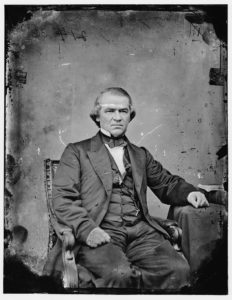
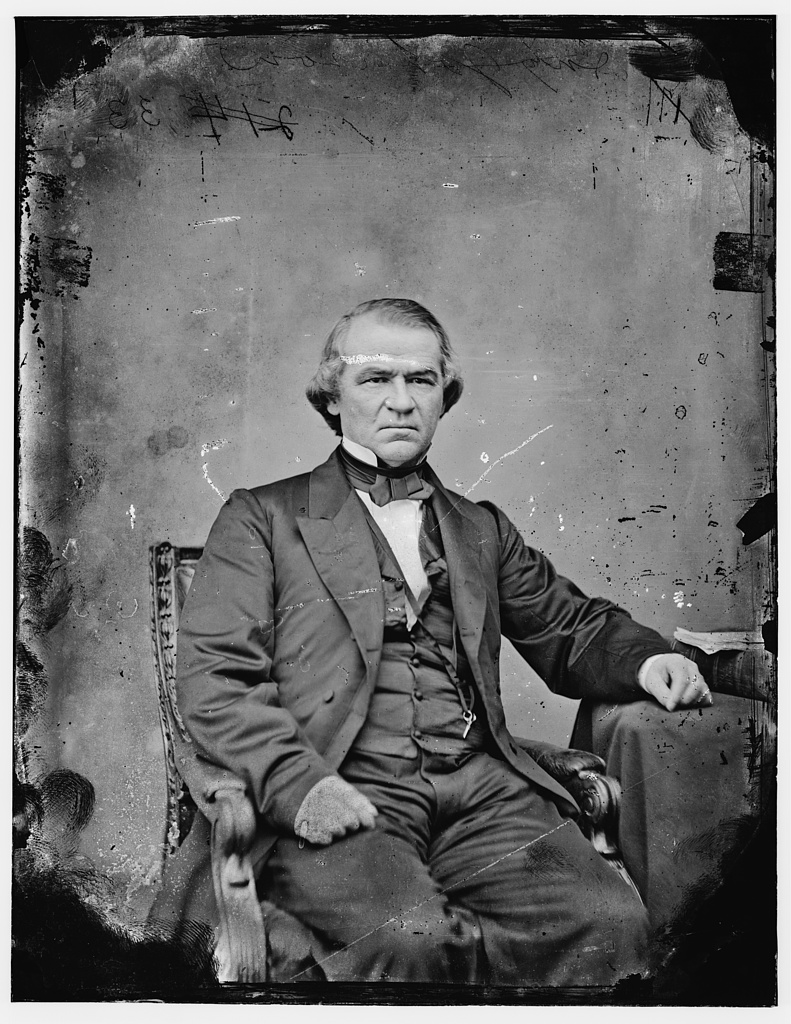
Hon. Andrew Johnson (between 1860 and 1875; LOC: https://www.loc.gov/item/brh2003000892/PP/)

“evil developed in him”

THE JOHNSON PARTY.

The President of the United States has so singular a combination of defects for the office of a constitutional magistrate, that he could have obtained the opportunity to misrule the nation only by a visitation of Providence. Insincere as well as stubborn, cunning as well as unreasonable, vain as well as ill-tempered, greedy of popularity as well as arbitrary in disposition, veering in his mind as well as fixed in his will, he unites in his character the seemingly opposite qualities of demagogue and autocrat, and converts the Presidential chair into a stump or a throne, according as the impulse seizes him to cajole or to command. Doubtless much of the evil developed in him is due to his misfortune in having been lifted by events to a position which he lacked the elevation and breadth of intelligence adequately to fill. He was cursed with the possession of a power and authority which no man of narrow mind, bitter prejudices, and inordinate self-estimation can exercise without depraving himself as well as injuring the nation. Egotistic to the point of mental disease, he resented the direct and manly opposition of statesmen to his opinions and moods as a personal affront, and descended to the last degree of littleness in a political leader,—that of betraying his party, in order to gratify his spite. He of course became the prey of intriguers and sycophants,—of persons who understand the art of managing minds which are at once arbitrary and weak, by allowing them to retain unity of will amid the most palpable inconsistencies of opinion, so that inconstancy to principle shall not weaken force of purpose, nor the emphasis be at all abated with which they may bless to-day what yesterday they cursed. Thus the abhorrer of traitors has now become their tool. Thus the denouncer of Copperheads has now sunk into dependence on their support. Thus the imposer of conditions of reconstruction has now become the foremost friend of the unconditioned return of the Rebel States. Thus the furious Union Republican, whose harangues against his political opponents almost scared his political friends by their violence, has now become the shameless betrayer of the people who trusted him. And in all these changes of base he has appeared supremely conscious, in his own mind, of playing an independent, a consistent, and especially a conscientious part.

Indeed, Mr. Johnson’s character would be imperfectly described if some attention were not paid to his conscience, the purity of which is a favorite subject of his own discourse, and the perversity of which is the wonder of the rest of mankind. As a public man, his real position is similar to that of a commander of an army, who should pass over to the ranks of the enemy he was commissioned to fight, and then plead his individual convictions of duty as a justification of his treachery. …

The party which, under the ironical designation of the National Union Party, now proposes to take the policy and character of Mr. Johnson under its charge, is composed chiefly of Democrats defeated at the polls, and Democrats defeated on the field of battle. The few apostate Republicans, who have joined its ranks while seeming to lead its organization, are of small account. Its great strength is in its Southern supporters, and, if it comes into power, it must obey a Rebel direction. …
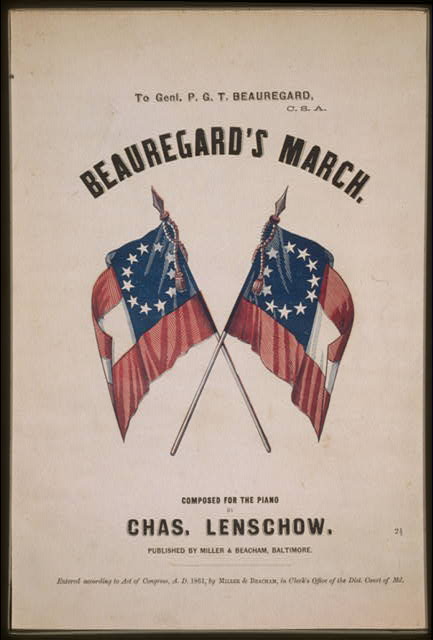
Beauregard's march (c1861; LOC: https://www.loc.gov/item/92504728/)

States weren’t rebellious?

In the minority Report of the Congressional Joint Committee on Reconstruction, which is designed to supply the new party with constitutional law, this theory of State Rights is most elaborately presented. The ground is taken, that during the Rebellion the States in which it prevailed were as “completely competent States of the United States as they were before the Rebellion, and were bound by all the obligations which the Constitution imposed, and entitled to all its privileges”; and that the Rebellion consisted merely in a series of “illegal acts of the citizens of such States.” On this theory it is difficult to find where the guilt of rebellion lies. The States are innocent because the Rebellion was a rising of individuals; the individuals cannot be very criminal, for it is on their votes that the committee chiefly rely to build up the National Union Party. …

In fact, all attempts to discriminate between Rebels and Rebel States, to the advantage of the latter, are done in defiance of notorious facts. If the Rebellion had been merely a rising of individual citizens of States, it would have been an insurrection against the States, as well as against the Federal government, and might have been easily put down. In that case, there would have been no withdrawal of Southern Senators and Representatives from Congress, and therefore no question as to their inherent right to return. …

The doctrine of the unconditional right of the Rebel States to representation being thus a demonstrated absurdity, the only question relates to the conditions which Congress proposes to impose. Certainly these conditions, as embodied in the constitutional amendment which has passed both houses by such overwhelming majorities, are the mildest ever exacted of defeated enemies by a victorious nation. … [The 14th amendment sent to the states earlier in 1866 for ratification is a moderate, non-radical proposal] …
https://www.loc.gov/item/95512439/

Iago at work

But whatever view may be taken of the President’s designs, there can be no doubt that the safety, peace, interest, and honor of the country depend on the success of the Union Republicans in the approaching elections. The loyal nation must see to it that the Fortieth Congress shall be as competent to override executive vetoes as the Thirty-Ninth, and be equally removed from the peril of being expelled for one more in harmony with Executive ideas. The same earnestness, energy, patriotism, and intelligence which gave success to the war, must now be exerted to reap its fruits and prevent its recurrence. The only danger is, that, in some representative districts, the people may be swindled by plausibilities and respectabilities; for when, in political contests, any great villany is contemplated, there are always found some eminently respectable men, with a fixed capital of certain eminently conservative phrases, innocently ready to furnish the wolves of politics with abundant supplies of sheep’s clothing. These dignified dupes are more than usually active at the present time; and the gravity of their speech is as edifying as its emptiness. Immersed in words, and with no clear perception of things, they mistake conspiracy for conservatism. Their pet horror is the term “radical”; their ideal of heroic patriotism, the spectacle of a great nation which allows itself to be ruined with decorum, and dies rather than commit the slightest breach of constitutional etiquette. This insensibility to facts and blindness to the tendency of events, they call wisdom and moderation. Behind these political dummies are the real forces of the Johnson party, men of insolent spirit, resolute will, embittered temper, and unscrupulous purpose, who clearly know what they are after, and will hesitate at no “informality” in the attempt to obtain it. To give these persons political power will be to surrender the results of the war, by placing the government practically in the hands of those against whom the war was waged. No smooth words about “the equality of the States,” “the necessity of conciliation,” “the wickedness of sectional conflicts,” will alter the fact, that, in refusing to support Congress, the people would set a reward on treachery and place a bounty on treason. “The South,” says a Mr. Hill of Georgia, in a letter favoring the Philadelphia Convention, “sought to save the Constitution out of the Union. She failed. Let her now bring her diminished and shattered, but united and earnest counsels and energies to save the Constitution in the Union.” The sort of Constitution the South sought to save by warring against the government is the Constitution which she now proposes to save by administering it! Is this the tone of pardoned and penitent treason? Is this the spirit to build up a “National Union Party”? No; but it is the tone and spirit now fashionable in the defeated Rebel States, and will not be changed until the autumn elections shall have proved that they have as little to expect from the next Congress as from the present, and that they must give securities for their future conduct before they can be relieved from the penalties incurred by their past.

You can get a better look at and read more about the Thomas Nast cartoon that was published in the September 1, 1866 issue of Harper’s Weekly at HarpWeek. From The Library of Congress: portrait, piano march music, blockage
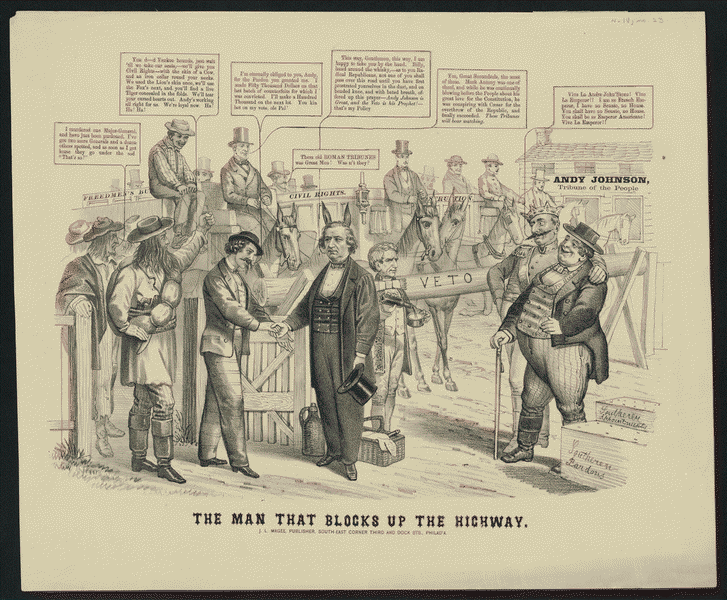
The man that blocks up the highway. (1866; LOC: https://www.loc.gov/item/scsm000329/)

impediment

Posted in 150 Years Ago This Month, Aftermath, Postbellum Politics, Reconstruction | Tagged , , , | Leave a comment

one nationality

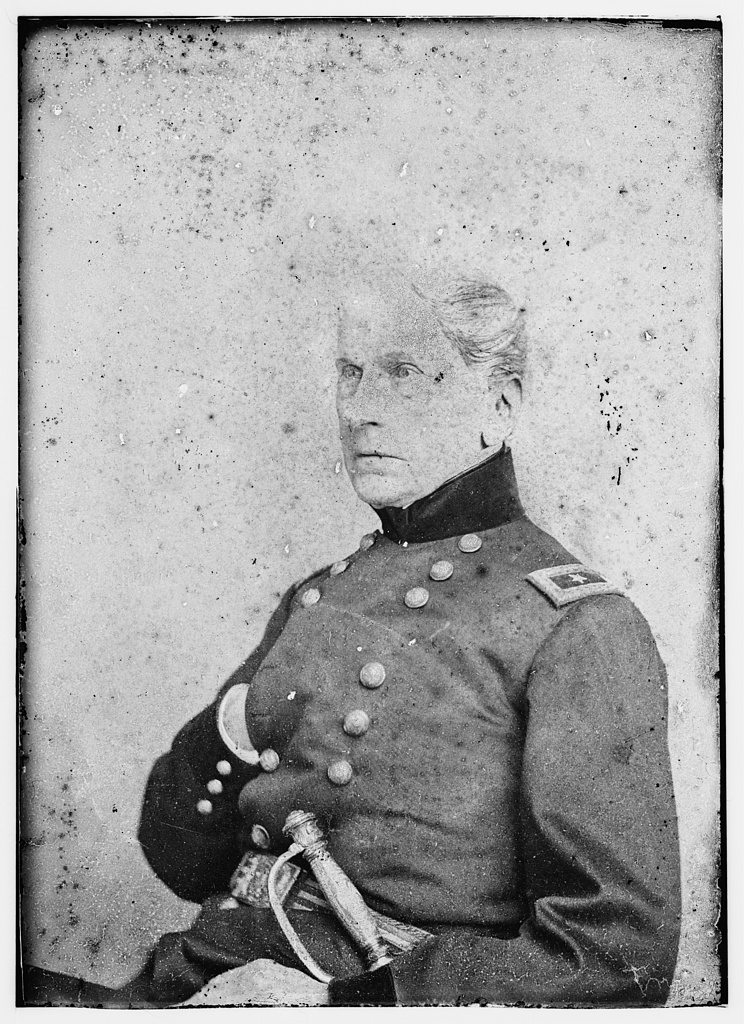
Gen. J.E. Wool (between 1855 and 1865; LOC: https://www.loc.gov/item/brh2003003720/PP/)

General Wool still on fire

From a Seneca County, New York newspaper in September 1866:

The Second Campaign for the Union.

The noblest soldiers in the army of the Union, assembled in convention at Cleveland on Monday, the 17th, inst., for the purpose of giving their influence in favor of a speedy settlement of the questions before the country. They fought to keep the States in the Union. Congress has thus far determined to keep the States out of the Union.

The veteran General Wool was called upon to preside temporarily, and his speech on taking the chair was worthy the fire of his best days. The Convention cheered the old hero to the echo.

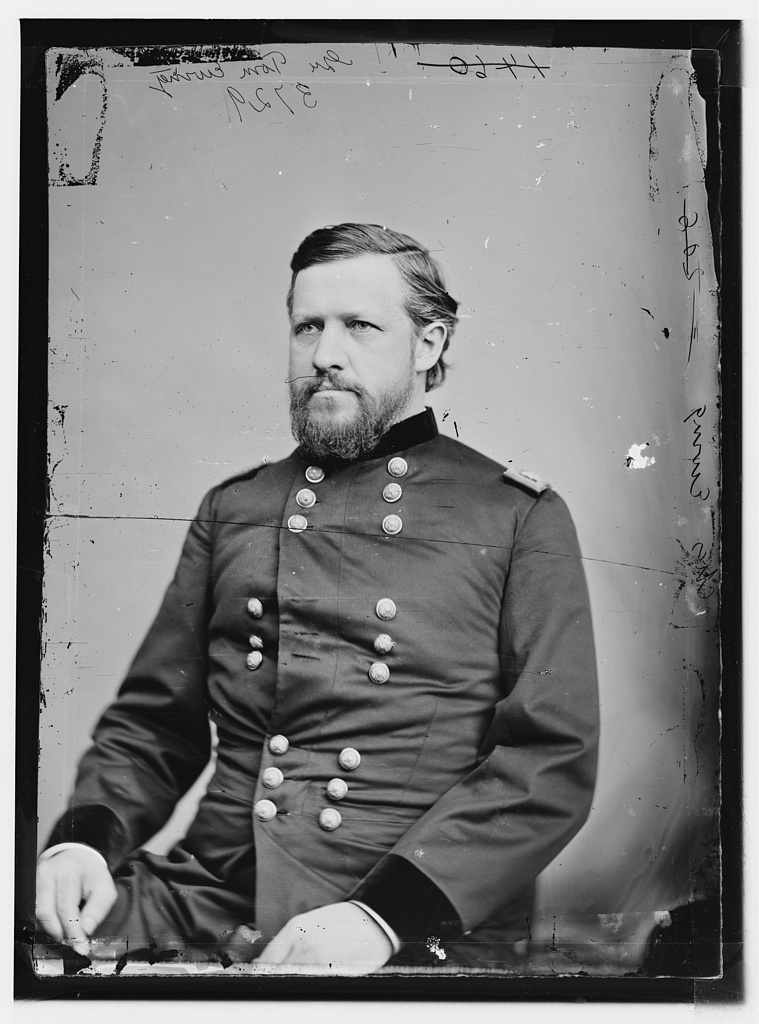
General Thomas Ewing, U.S.A. (between 1860 and 1875; LOC: https://www.loc.gov/item/brh2003001318/PP/)

perpetual Union

Gen. Ewing, of Kansas, in the course of an eloquent speech, said: “What bound us together in that conflict of arms? Not hatred of slavery, for on that ground we differed; not love of war, for we all desired peace; not hatred of the Southern people, for they were our countrymen. No, it was the sentiment of nationality – determination that the Union should be preserved and made perpetual. That was the only purpose of the war known or recognized by the army and navy of the United States. That was the sentiment that raised all our armies, and was the soul of them all. Neither army, nor navy, nor people had any other purpose. ***** Congress still wishes to blow the embers of war, while Johnson desires peace. They will have no peace except on terms which secure party and sectional dominion, while Johnson desires union on the basis of the Constitution. The Secessionists drove the States into rebellion by the old cry of “Abolitionist,” while the Radicals keep the Union separated by the still more dreaded cry of “traitor.” That cry had no terror to the soldiers. Their oath taken on entering the army bound them to preserve the Union by every means in their power. They owed allegiance rather to the Constitution than to philanthropic theories, however right. To save the Constitution they were ready to strike hands with the Democratic party and labor with it so long as they remained true to the Union.”

The more than 179,000 black federal soldiers and sailors who fought during the war undoubtedly fighting for the Union but probably especially to defeat slavery and the slave-holding Confederacy.

You can read more of the Wool and Ewing speeches in the September 18, 1866 issue of The New-York TimesAccording the the September 19, 1866 issue of The New-York Times the convention ended on the 18th. The Cleveland convention received a dispatch from a Memphis convention of former Confederate soldiers. Three cheers were given for Ned Forrest (The only name I recognized).

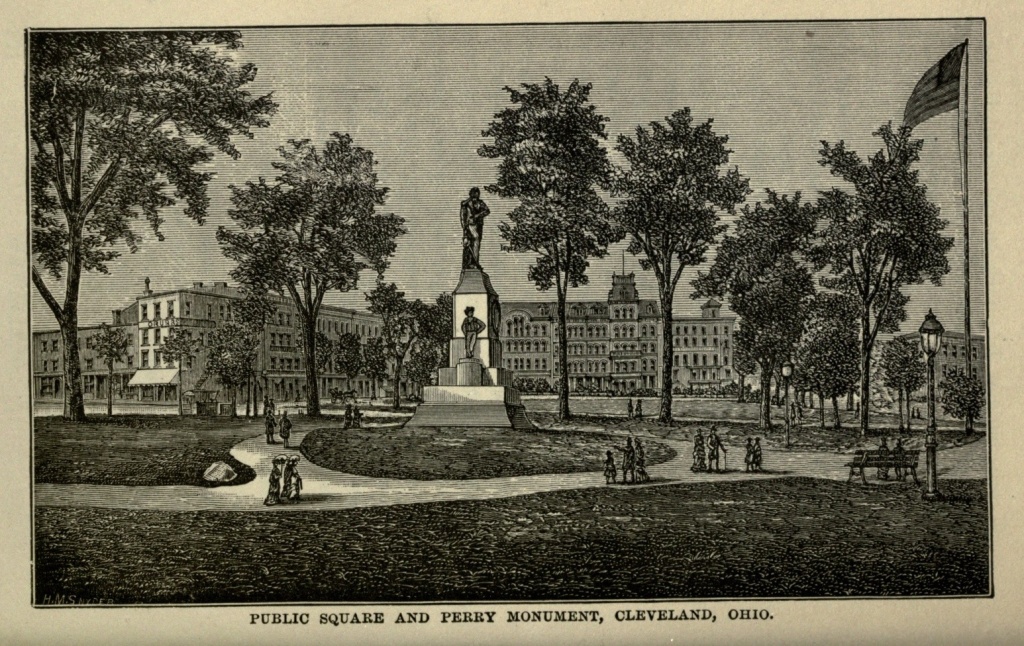
PUBLIC SQUARE AND PERRY MONUMENT, CLEVELAND, OHIO. (1886; Project Gutenberg: http://www.gutenberg.org/files/35575/35575-h/35575-h.htm#Page_150)

commemorating a famous sailor from John E. Wool’s first war

John Ellis Wool and Thomas Ewing Jr. appear courtesy of the Library of Congress. The Cleveland image comes from Peculiarities of American Cities , by Willard Glazier (1886; page 150). The Perry Monument was erected in 1860 and stayed at different places on the Public Square until 1892.
Posted in 150 Years Ago This Week, Aftermath, Postbellum Politics, Reconstruction | Tagged , , , , , , , , , , | Leave a comment

straggling home

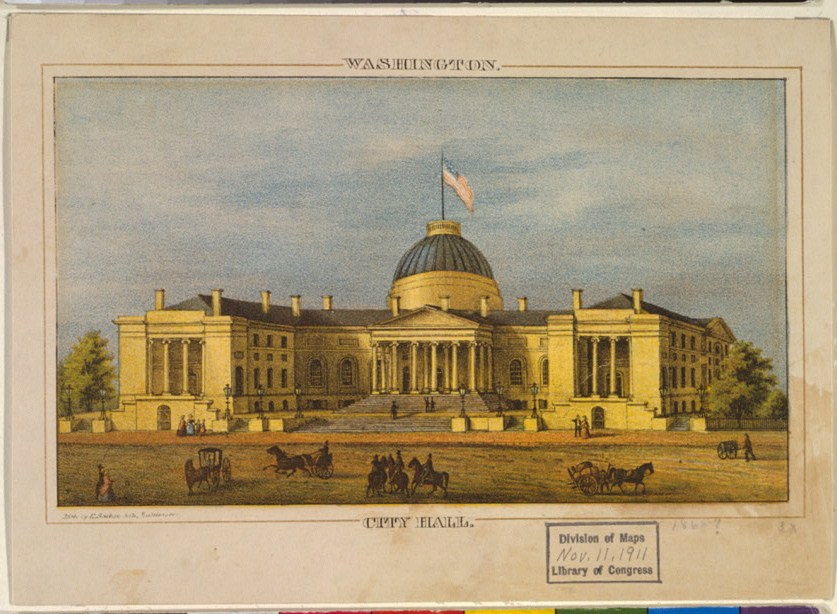
City Hall - Washington / lith. by E. Sachse & Co., Baltimore. (ca. 1866; LOC: https://www.loc.gov/item/00650403/)

two hour wait at City Hall

150 years ago today President Andrew Johnson’s Swing Around the Circle tour concluded. According to the September 16, 1866 issue of the The New-York Times crowds in York Pennsylvania, Baltimore and Washington were mostly supportive with no reported heckling. From York: “Here, as at all other places on the route, the cheers for Gen. GRANT exceeded.”

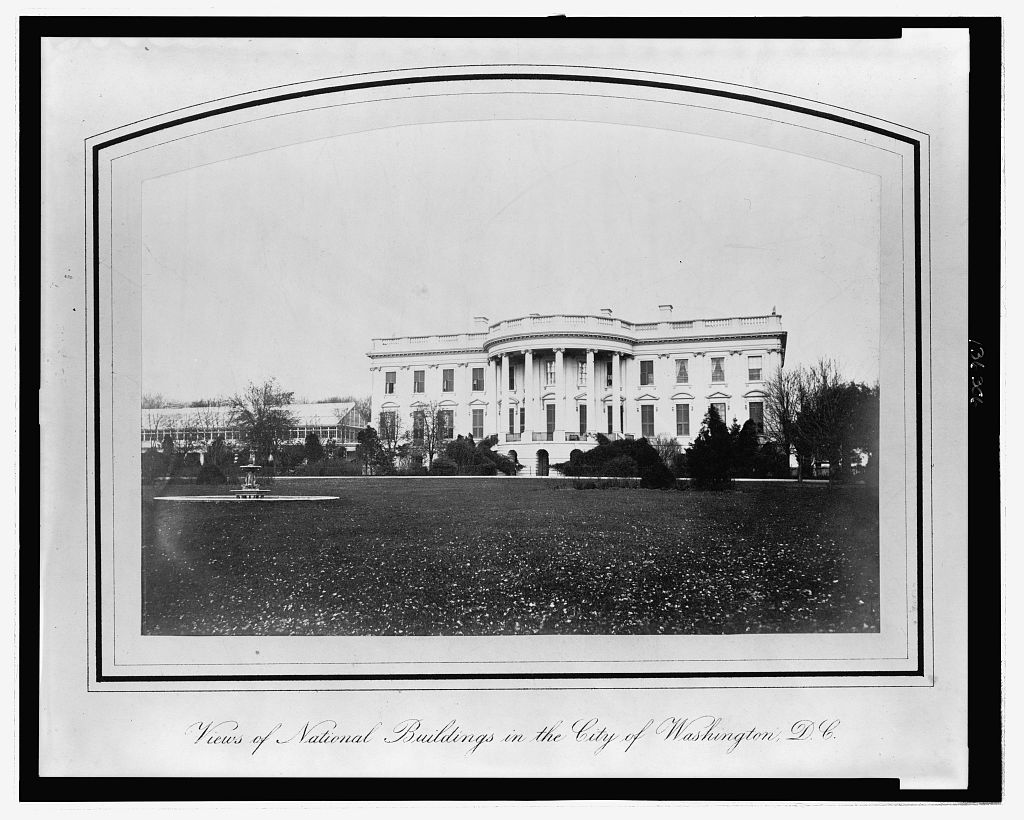
But not everything went according to plan. “The Presidential Party came back in a somewhat straggling fashion”. An extremely ill Secretary Seward got back early and was to brought to his home by ambulance. General Grant did not attend a banquet in Baltimore and also got back to DC before the president’s train. Secretary Welles and Admiral Farragut hung with Mr. Johnson all the way to the White House. The reception in Washington was not as impressive as it might have been because the presidential train was two hours late. Many people at the depot and City Hall got tired of waiting and went home. Even so, crowds were large and quite enthusiastic all along the procession and at the White House, where President Johnson thanked the crowd (daily eye-witnesses to how he performed on the job)and stuck to the message he asserted all along the tour:

… All I can promise you for the future is that that [sic] there will be a continuance of my conduct in the past. I have tried to discharge my official duties in compliance with the Constitution and the principles which I deemed to be right. I will add that the sentiment which you exhibit to-night is not peculiar to yourselves, but that which pervades the country wherever I have been. My own opinion which has gone abroad to the country with regard to sustaining a government of constitutional law is unmistakable and not to be misunderstood; and I believe the day is not distant when the judgment of the American people will be made manifest that this Union must be restored – that peace and prosperity and harmony must again prevail throughout the United States. I believe I can safely testify that the greater portion of your fellow-citizens that I have visited, and I have seen millions of them since I left you, will accord with you in sustaining the principles of free Government in compliance with the Constitution of the country. …

An American History textbook states that many people got tired of President Johnson harping on the Constitution and shows a Harper’s Weekly political cartoon in which Mr. Johnson is portrayed as a parrot repeating “Constitution”. [1]

President's house (ca. 1866; LOC: https://www.loc.gov/item/2006679469/)

home sweet home

  1. [1]Garraty, John A., and Robert A. McCaughey. The American Nation: A History of the United States, Seventh Edition. New York: HarpersCollins Publishers, 1991. Print.page 455.
Posted in 150 Years Ago This Week, Aftermath, Postbellum Politics, Reconstruction | Tagged , , , , , , , , | Leave a comment

Johnstown calamity

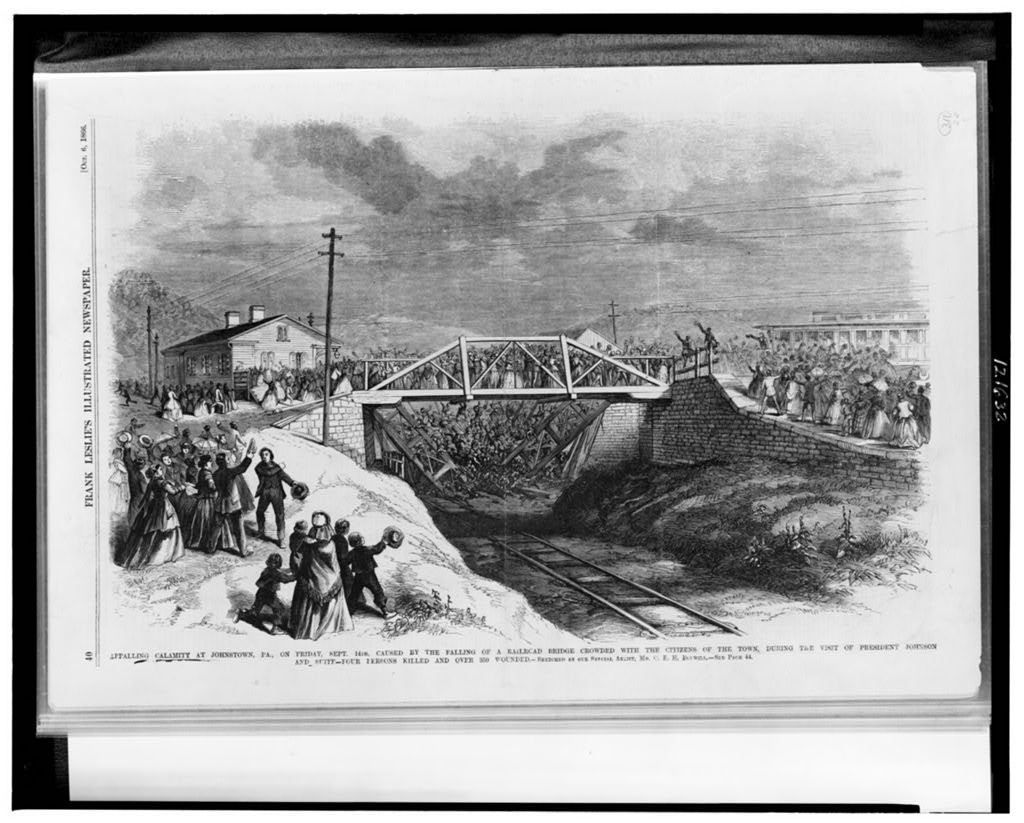
Could it get any worse? 150 years ago today Andrew Johnson’s Swing Around the Circle tour rolled on from Pittsburgh to Harrisburg, PA. According to the September 15, 1866 issue of The New-York Times the crowds were generally enthusiastic along the 260 mile route. At Johnstown at least 3000 mostly supportive citizens cheered as Senator Edgar Cowan introduced President Johnson as “the great Tribune of the American people.” General Grant and Admiral Farragut were cheered, but then a temporary platform for the audience that spanned an old canal collapsed. About four hundred people were standing on the platform when it gave way; it was about a twenty-foot drop. A second section of the platform collapsed after the first. People were buried in the rubble. “Men and women were seen with helpless children in their arms, their clothes and faces blackened by the coal dirt against which they had fallen.”

Appalling calamity at Johnstown, Pa., on Friday, Sept. 14th, caused by the falling of a railroad bridge crowded with the citizens of the town, during the visit of President Johnson and suite - four persons killed and over 350 wounded / sketched by our special artist, Mr. C.E.H. Bonwill. (Illus. in: Frank Leslie's illustrated newspaper, v.23, 1866 Oct. 6, p. 40. ; LOC: https://www.loc.gov/item/98510867/)

Johnstown September 14, 1866

The train, after remaining several minutes, moved on, the work of rescue being still in progress, and a number of wounded and of dead apparently being borne away. The train was obliged to move to keep the time-table right to avoid accidents. There was, therefore, no opportunity to ascertain the extent of the accident. the President instructed Deputy Marshal O’BEIRNE to remain at Johnstown to learn the particulars and to extend all possible aid to the sufferers.

Even though the train had to follow its time-table, “[to] appearances, however, Johnson had callously abandoned the scene of massive casualties.”

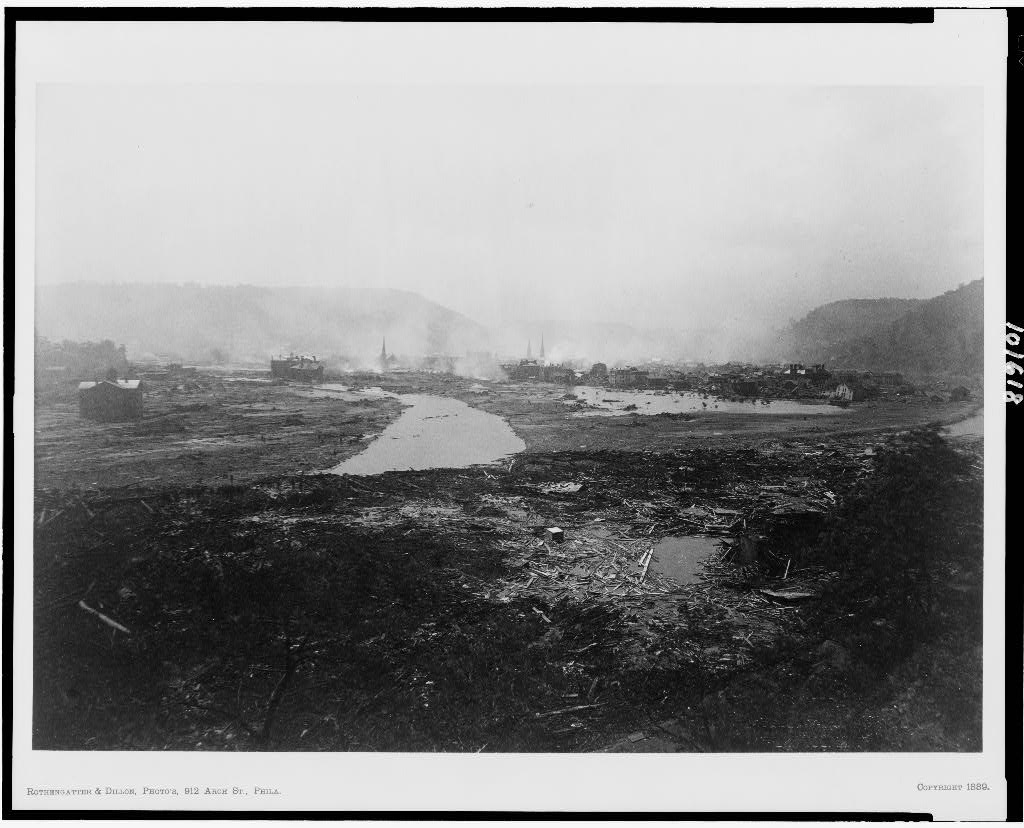
The Library of Congress provides the images: the 1866 “bridge” collapse, which was published in Frank Leslie’s illustrated newspaper, v.23, 1866 Oct. 6, p. 40 and which reported four killed and over 350 people wounded; and ruins from the more well-known 1889 Johnstown Flood.
The ruins at Johnstown, after the flood May 31, 1889 / Rothengatter & Dillon, photo's, Phila. (https://www.loc.gov/item/90712948/)

Johnstown 1889

Posted in 150 Years Ago This Week, Aftermath, Postbellum Society, Reconstruction | Tagged , , , , , , | Leave a comment

“not entire cordiality”

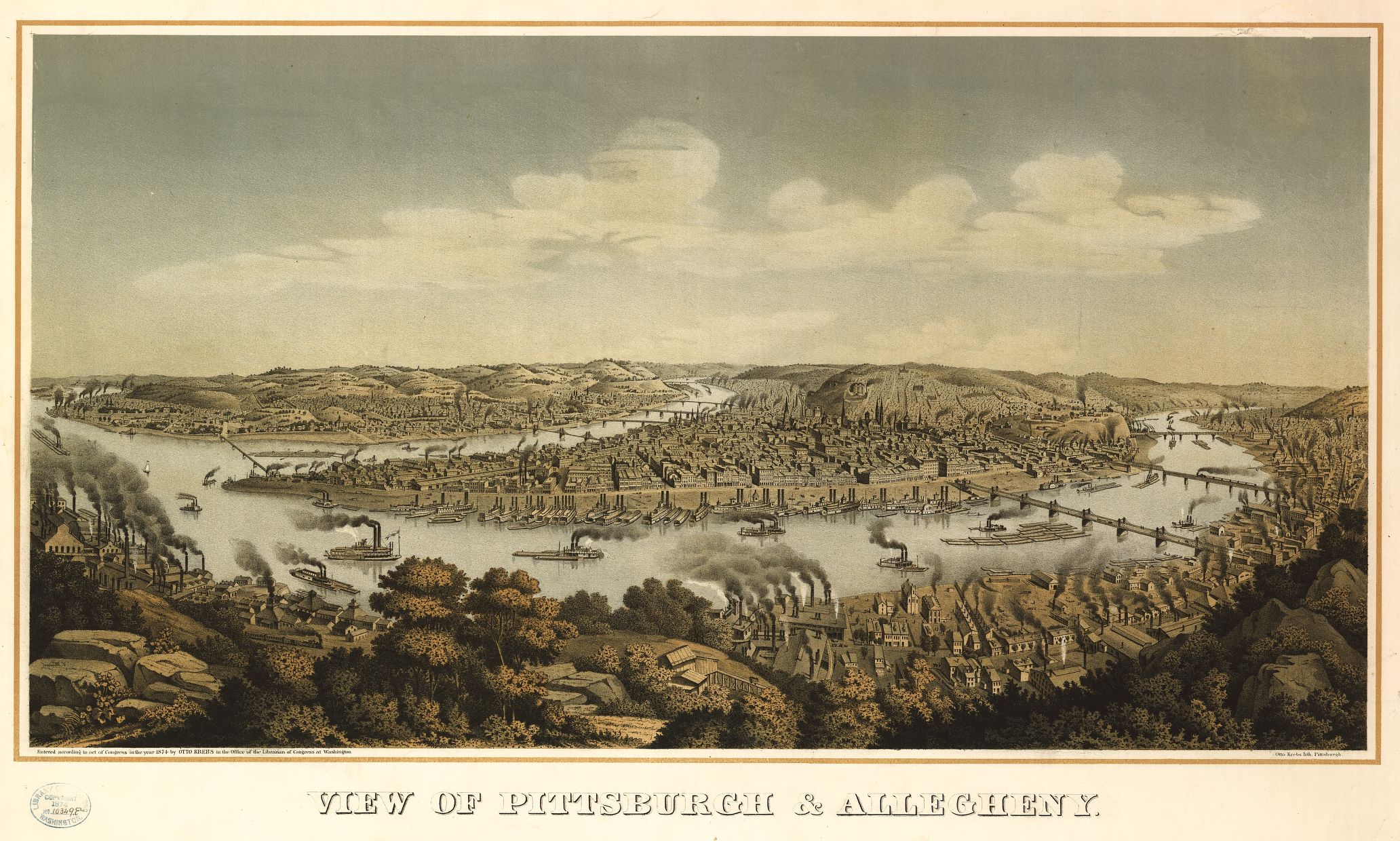
View of Pittsburgh & Allegheny / Otto Krebs lith., Pittsburgh. (c1874; LOC: https://www.loc.gov/item/94513615/)

Pittsburgh in the 1870s

It was more of the same 150 years ago today as President Andrew Johnson’s Swing Around the Circle rode the rails from Columbus, Ohio to Pittsburgh. According to the September 14, 1866 issue of The New-York Times the tour met supporters and opponents along the route.

Apparently only a few persons assembled at New Market, Ohio, but they “had posted a placard containing the words ‘New-Orleans’ ‘New Orleans.'” Someone in the crowd propose three cheers for Thaddeus Stevens. General McCallum announced that the President would have nothing to say to the crowd since they disrespected him. The audience called for Custer. General Custer said, “‘I was born two miles and a half from here, but I am ashamed of you.’ The cars then moved on.”

Four or five thousand people received the presidential party in Steubenville, Ohio. Mr. Johnson chose not to bicker with the surly elements in the crowd. He thanked his supporters then reportedly waxed stoically poetic regarding the hecklers:

“Shall I set my like upon a throw
Because a bear is rude and surly? No
A clever, sensible, well-bred man
Will not insult me, nor no other can!”

The president then quietly went back inside the train.

Posted in 150 Years Ago This Week, Aftermath, Postbellum Politics, Reconstruction | Tagged , , , , | Leave a comment

polite disagreement

Cincinnati c1866

Cincinnati c1866

150 years ago Andrew Johnson’s Swing Around the Circle was rolling and floating along. Unlike Cleveland and St. Louis, President Johnson didn’t care to make a stand against the hecklers who confronted him in Indianapolis on September 10th. As some in the crowd constantly shouted and finally told the president to shut up, Mr. Johnson quietly left the hotel balcony and stayed inside for the rest of the night. The presidential faced less vocal opposition the next couple days. The September 12, 1866 issue of The New-York Times reported that all Indianapolis newspapers regretted the violence in the crowd the night before and reported on the enthusiastic reception the president received in Louisville when it arrived about 4 PM on the 11th.

According to the September 13, 1866 issue of The New-York Times 150 years ago today President Johnson and entourage visited Cincinnati and Columbus. On the evening of the 11th the party left Louisville on the steamer Uncle Sam (or United States in a dispatch from the Associated Press in the same story) and arrived in Cincinnati about 9 AM on the 12th. “Notwithstanding the Common Council refused to extend the municipal hospitalities, the reception was very fine, and the collection of people very large.”

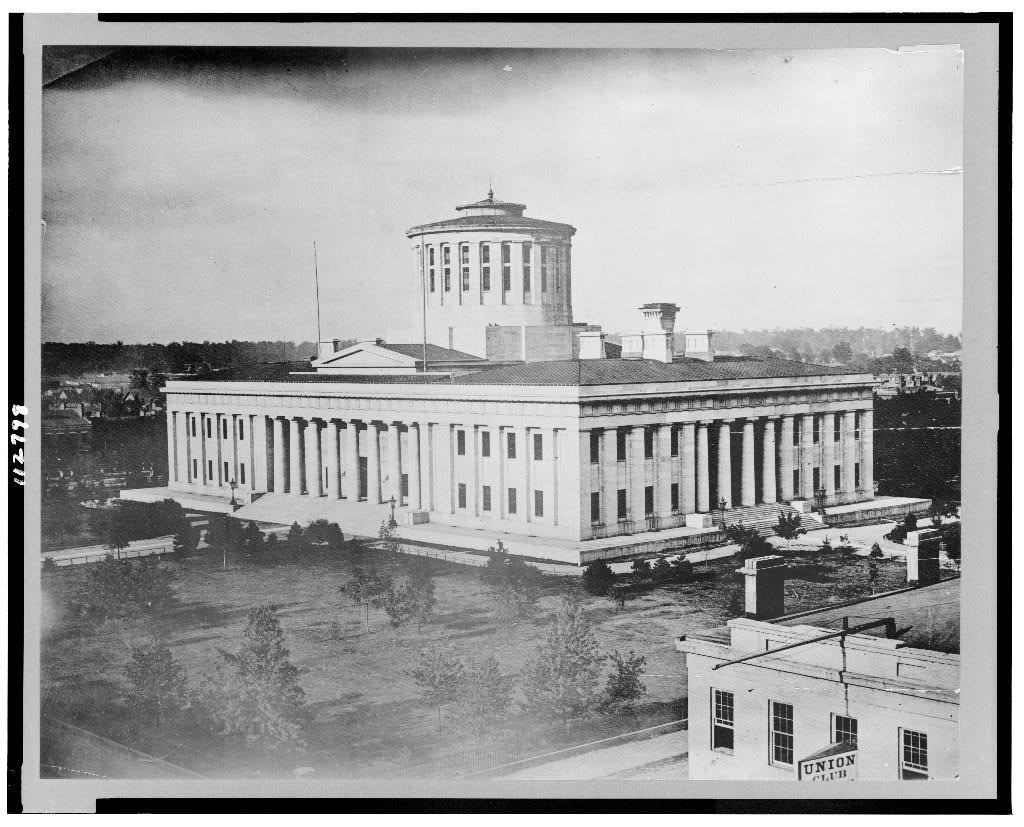
State Capitol, Columbus, Ohio (ca. 1860; LOC: https://www.loc.gov/item/95501378/)

State Capitol, Columbus, Ohio (ca 1860)

The group arrived in Columbus, Ohio about 4 PM later that day. The mayor welcomed the president at the state-house. “Both here and in Cincinnati the utmost respect was manifested. If Ohio people do not agree wholly with what he says, they are dignified and respectful in their entertainment of different opinions.” President Johnson spent the night at the Neil House, where he was reportedly visited by one of his former slaves, “a former chattel of his” almost 100 years old. “The old lady like to have collapsed with joy when she grasped the hand of her former owner. ‘O,’ said she, ‘he was a might kind master to his niggers.'”

If you read the New York Times reports of the President’s trip over the past few days you will realize that it sure seems like I was wrong to post on September 1st that General Grant left the tour at Saint Louis. He was reportedly with the group in Indianapolis and rejoined the group in Cincinnati. He went to the theater there and refused to see a group of soldiers who called for him outside the theater. He told their commander: “Sir, I am no politician. The President of the United States is my Commander-in-Chief. I consider this demonstration in opposition to the President …”

Posted in 150 Years Ago This Week, Aftermath, Postbellum Politics, Reconstruction | Tagged , , , , , , | Leave a comment

beacon

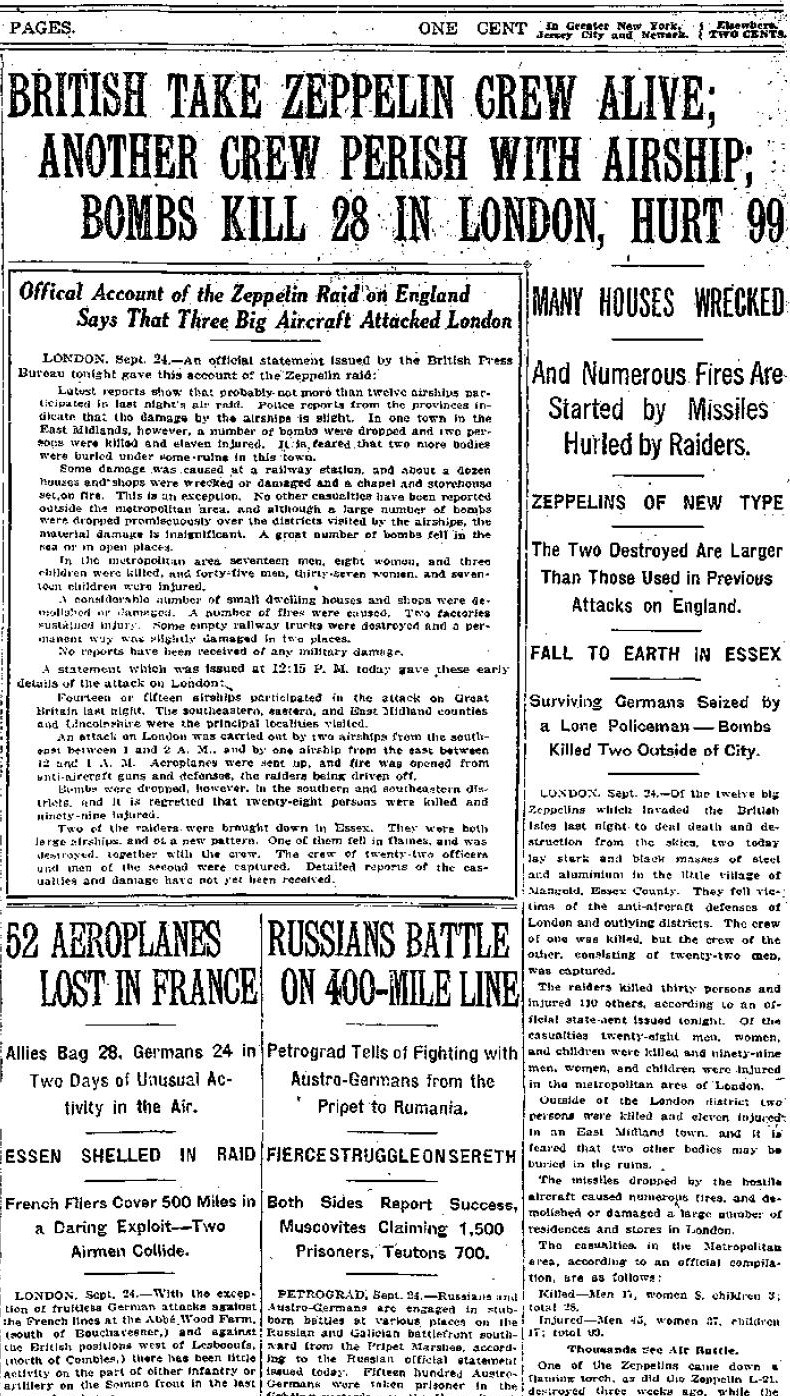
ny-tribune-september-10-2016

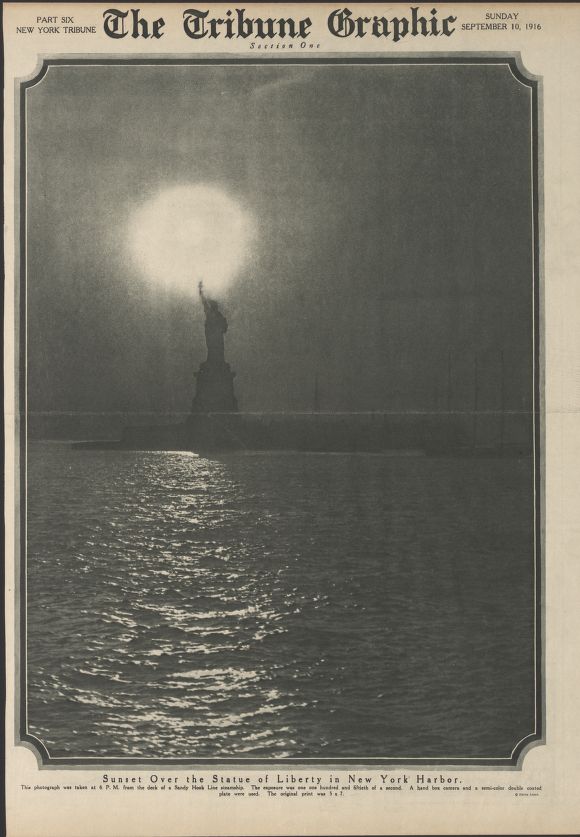
NY Tribune September 10, 1916

You can check out the New York Tribune from 100 years ago today at the Library of Congress
Posted in 100 Years Ago, American Culture | Tagged | Leave a comment

“A Terbulent Crowd”

American Heroes page 280 (http://www.gutenberg.org/files/35742/35742-h/35742-h.htm#Page_280)

on a rail road again

150 years ago today Andrew Johnson’s Swing Around the Circle tour rode the rails from St. Louis to Indianapolis. According to the September 11, 1866 issue of The New-York Times crowds were enthusiastic and polite along the way, especially enthusiastic for Ulysses Grant. Paris, Illinois, Where General Grant raised a company early in the war, displayed a transparency in his honor. At Greencastle, Indiana “The applause was terrific. The President was repeatedly cheered, and so especially was Gen. GRANT.”

Thousands greeted the train when it stopped in Indianapolis. The presidential party proceeded to Bates House along the crowded streets, “escorted by political associates and others bearing torches, variegated lanterns and transparencies.” Thousands were gathered at the hotel, crying for “JOHNSON and GRANT, those for the latter preponderating.” When the president was introduced on the hotel balcony he was “received with a few groans, huzzas for JOHNSON, cries for Gen. GRANT, and some rude remarks. The President said:

[Andrew Johnson, half-length portrait, facing left] / A. Bogardus & Co., 872 B'way, cor. 18th St., N.Y. (New York : A. Bogardus & Co., [between 1865 and 1880]) (LOC: http://www.loc.gov/item/2004678590/)

always seem outnumbered?

FELLOW-CITIZENS: [Cries for GRANT.] It is not my intention [Cries of “Stop,” “Go on”] to make a long speech. If you give me your attention for five minutes [Cries of “Go on;” “No no; we want nothing to do with traitors,” “GRANT, GRANT,” “JOHNSON,” and groans,] I would like to say to this crowd here to-night, [Cries of “Shut up; we don’t want to hear from you JOHNSON! GRANT! JOHNSON! GRANT! GRANT!”]

The President paused a few moments, and then retired from the balcony.

If President Johnson wasn’t in a bellicose mood that night, the same couldn’t be said for some of the people in the crowd, even after the president left the balcony. David Kilgore unsuccessfully tried to smooth things out and also left the balcony. Even though a Marshal and his men were reportedly patrolling the streets, shots were fired in the crowd. Transparencies were knocked down with clubs; the holder of a transparency inscribed “JOHNSON, welcome – the President.” was thrown down and shot at. More gunshots ensued; one man was shot in the heart, others wounded.

Posted in 150 Years Ago This Week, Aftermath, Postbellum Politics, Reconstruction | Tagged , , , , | Leave a comment

Judas and Saint Louis

150 years ago today Andrew Johnson’s Swing Around the Circle proceeded from Springfield, Illinois to St. Louis. According to the September 10, 1866 issue of The New-York Times everything went well as the people of Alton, Illinois gave the president an enthusiastic reception. St. Louis warmly welcomed the traveling party as they boarded the Andy Johnson for another warm reception, and there were more positive speeches and a “superb collation on board the Ruth, which was lashed to the Andy Johnson.” After the presidential flotilla docked the people of St. Louis cheered loudly as Andrew Johnson and entourage proceeded through the streets to the Lindell Hotel. Everything went well until President Johnson gave a speech from the balcony of the Southern before a 10:00 PM “grand banquet”. When the president said he thought the time had come for peace, “when the bleeding arteries should be tied up,” a voice called out, “New Orleans”. That allusion to the July 30, 1866 race riot really seemed to rile up Mr. Johnson. (It might not have helped that the crowd cried for Seward when the president started his explanation of the riot. He blamed New Orleans on the Radical Congress that planned it, on incendiary speeches in New Orleans that incited blacks “to arm themselves and prepare for the shedding of blood,” and the illegal convention that was the initial focus of the violence. He seemed to imply that the convention’s goal was to give blacks the right to vote. Then the president said he had been criticized and called traitor because he twice vetoed the Freedmen’s Bureau bill:

Charles Sumner (between 1855 and 1865; LOC: v)

Christ figure?

… I have been traduced; I have been slandered; I have been maligned; I have been called JUDAS ISCARIOT, and all that. Now. my country-men here to-night, it is very easy to call a man “Judas,” and cry out “traitor,” but when he is called upon to give arguments and facts, he is very often found wanting. Judas Iscariot! Judas! There was a Judas once, one of the twelve apostles. Oh yes; the twelve apostles had a Christ. [A voice – “and a Moses, too.” Laughter.] The twelve apostles had a Christ, and he never could have a Judas unless he had twelve apostles. If I have played the Judas, who has been my Christ that I have played the Judas with? Was it THAD. STEVENS? Was it WENDELL PHILLIPS? Was it CHARLES SUMNER? [Hisses and cheers.] Are these the men that set up and compare themselves with the Saviour of Man, and everybody that differs with them in opinion, and that try to stay and arrest their diabolical and nefarious policy, to be denounced as a Judas? …

Modern historians focus on the St. Louis speech. Walter Stahr calls St. Louis “an even lower point” (than Cleveland) for the swing tour.[1]
Eric Foner references the Judas allusion as part an example of President Johnson’s “unique blend of self-aggrandizement and self-pity.” [2]

  1. [1]Stahr, Walter Seward: Lincoln’s Indispensable Man. 2012. New York: Simon & Schuster Paperbacks, 2013. Print. page 473.
  2. [2]Foner, Eric. Reconstruction: America’s Unfinished Revolution, 1863-1877. New York: HarperPerennial, 2014. Updated Edition. Print. page 265.
Posted in 150 Years Ago This Week, Aftermath, Postbellum Politics, Reconstruction | Tagged , , , , , | Leave a comment

radical convention

NY Times September 8, 1866

NY Times September 8, 1866

During the 1866 campaign season a “radical convention” met in Philadelphia from September 3-7. Southern “loyalists” participated; it seems they were loyal to Congress and the radical Republican approach to Reconstruction. Here is Charles Ernest Chadsey’s 1896 take on President Johnson’s “Swing Around the Circle” followed by his explanation of the Philadelphia radical convention. From The Struggle between President Johnson and Congress over Reconstruction (pages 95-100):

But his indiscretions did not end with speeches before his sympathizers. Two weeks later he started on a trip, nominally to assist in the ceremony of laying the cornerstone of the Douglas monument in Chicago. As a matter of fact, however, he was merely taking advantage of an opportunity to defend his policy publicly. Johnson was of too impassioned a nature to be able to judge as to how far the President of the United States could afford to adopt the methods of the stump speaker. All constraint was thrown away, and he acted at many times the part most natural to him, that of a popular orator addressing the masses. His speeches at no time lacked clearness. All could see where he stood, and nothing was left for speculation.

His first important effort while on his journey was at New York on August 29, where he responded to a toast proposed by the mayor of the city. In this speech he defined the issue as follows: “The rebellion has been suppressed, and in the suppression of the rebellion it [the government] has * * * established the great fact that these States have not the power, and it denied their right, by forcible or peaceable means, to separate themselves from the Union. (Cheers, ‘Good!’) That having been determined and settled by the Government of the United States in the field and in one of the departments of the government—the executive department of the government—there is an open issue; there is another department of your government which has declared by its official acts, and by the position of the Government, notwithstanding the rebellion was suppressed for the purpose of preserving the Union of the States and establishing the doctrine that the States could not secede, yet they have practically assumed and declared and carried up to the present point, that the Government was dissolved and the States were out of the Union. (Cheers.) We who contended for the opposite doctrine years ago contended that even the States had not the right to peaceably secede; and one of the means and modes of possible secession was that the States of the Union might withdraw their representatives from the Congress of the United States, and that would be practical dissolution. We denied that they had any such right. (Cheers.) And now, when the doctrine is established that they have no right to withdraw, and the rebellion is at an end * * * we find that in violation of the Constitution, in express terms as well as in spirit, that these States of the Union have been and still are denied their representation in the Senate and in the House of Representatives.” Then, speaking of the people of the South: “* * Do we want to humiliate them and degrade them and drag them in the dust? (‘No, no!’ Cheers.) I say this, and I repeat it here to-night, I do not want them to come back to this Union a degraded and debased people. (Loud cheers.) They are not fit to be a part of this great American family if they are degraded and treated with ignominy and contempt. I want them when they come back to become a part of this great country, an honored portion of the American people.”

Another representative speech was the one which he made in Cleveland on September 3: “I tell you, my countrymen, I have been fighting the South, and they have been whipped and crushed, and they acknowledge their defeat and accept the terms of the Constitution; and now, as I go around the circle, having fought traitors at the South, I am prepared to fight traitors at the North. (Cheers.) God willing, with your help we will do it. (Cries of ‘We won’t.’) It will be crushed North and South, and this glorious Union of ours will be preserved. (Cheers.) I do not come here as the Chief Magistrate of twenty-five States out of thirty-six. (Cheers.) I came here to-night with the flag of my country and the Constitution of thirty-six States untarnished. Are you for dividing this country? (Cries of ‘No.’) Then I am President, and I am President of the whole United States. (Cheers.)”

Speeches of this nature, coming at a time when the outrages in the South had so greatly incensed the North, had a most depressing influence upon the fortunes of the National Union party, and failed utterly in the object for which they were intended. The trip proved to be a grave political mistake. The undignified spectacle of a President receiving coarse personal abuse and retorting in scarcely less coarse expressions was quickly taken advantage of by his opponents; and the phrase “swinging around the circle” has assumed historic dignity as a description of his journey.

The Radical Convention in Philadelphia, September 3d, 1866 (1866; LOC: https://www.loc.gov/item/2008661699/)

radicals’ opponents trying to make political hay

4. The “off year” national convention plan adopted by the National Union Club was immediately accepted by the congressional party, which was no less active in preparations for the struggle. On July 4, the same day on which the Democratic congressmen issued their address to the people, representative Southern Unionists, supporters of Congress, issued a call to “the Loyal Unionists of the South,” for a convention to be held in Philadelphia on September 3. The call stated that the convention was “for the purpose of bringing the loyal Unionists of the South” into conjunction with the true friends of republican government in the North. “* * The time has come when the restructure of Southern State government must be laid on constitutional principles. * * * We maintain that no State, either by its organic law or legislation, can make transgression on the rights of the citizen legitimate. * * * Under the doctrine of ‘State sovereignty,’ with rebels in the foreground, controlling Southern legislatures, and embittered by disappointment in their schemes to destroy the Union, there will be no safety for the loyal element of the South. Our reliance for protection is now on Congress, and the great Union party that has stood and is standing by our nationality, by the constitutional rights of the citizen, and by the beneficent principles of the government.”

The convention met at the time appointed, with representatives present from all the lately insurrectionary States. James Speed of Kentucky, Attorney-General until July 18, was elected permanent chairman. For purposes of co-operation, the Northern States had been invited to send delegations, and all responded. Thus the convention was as truly national as the “National Union” convention of August 14 had been. It was decided, however, that for the purpose of rendering the declaration of the Southern Unionists more significant, the Northern and Southern Unionists should hold their sessions separately, and Governor Curtin of Pennsylvania was accordingly elected chairman of the Northern section.

[Full view of U.S. Capitol from southwest (ca.1866; LOC: v)

home of the “sole power” to readmit southern states

The resolutions of the Southern section were reported by Governor Hamilton of Texas, chairman of the committee on resolutions, and they naturally endorsed the action of Congress in its entirety. While demanding the restoration of the States, they declared Johnson’s policy to be “unjust, oppressive, and intolerable,” and that restoration under his “inadequate conditions” would only magnify “the perils and sorrows of our condition.” They agreed to support Congress and to endeavor to secure the ratification of the 14th Amendment. Congress alone had power to determine the political status of the States and the rights of the people, “to the exclusion of the independent action of any and every other department of the Government.” “The organizations of the unrepresented States, assuming to be state governments, not having been legally established,” were declared “not legitimate governments until reorganized by Congress.” In addition to these resolutions, an address “from the loyal men of the South to their fellow-citizens of the United States,” was prepared and adopted after the formal adjournment of the convention. This reaffirmed, in far stronger terms, the condemnation of President Johnson, specifying many ways in which he had wrought injury to them, and closing with the following significant and powerful declaration: “We affirm that the loyalists of the South look to Congress with affectionate gratitude and confidence, as the only means to save us from persecution, exile and death itself; and we also declare that there can be no security for us or our children, there can be no safety for the country against the fell spirit of slavery, now organized in the form of serfdom, unless the Government, by national and appropriate legislation, enforced by national authority, shall confer on every citizen in the States we represent the American birthright of impartial suffrage and equality before the law. This is the one all-sufficient remedy. This is our great need and pressing necessity.”

It has been reported that at 4:20 PM 150 years ago today President Johnson and entourage arrived in Springfield, Illinois, where Democrats did their best to extend a cordial greeting and Republicans did their best to snub the president but welcome his traveling companions.

Capitol of Illinois, no. 26 (May 1865?; LOC: https://www.loc.gov/item/2015645313/)

Illinois state capitol in Springfield (probably 1865 in mourning for Abraham Lincoln)

Posted in 150 Years Ago This Week, Aftermath, Postbellum Politics, Reconstruction | Tagged , , , , , | Leave a comment