European vacation

The June 7, 1865 issue of The New-York Times devoted two-thirds of its front page to publicizing steamship lines that offered Americans pleasant postbellum getaways:

The Way to Europe.

Enterprise and Prosperity of the Transatlantic Steamship Companies.

Great Ferries Across the Ocean.

Extensive Preparations and Extra Accommodations for the Summer Travel.

Interesting Facts Concerning the Seven Prominent Lines.

Unprecedented Rush of Americans to the Old World.

Thousands of our citizens who had no heart for making pleasure trips abroad during the past four year of internecine strife, are, now that the war is happily ended, casting about for the best, the safest, the cheapest and the most expeditious means of making the Transatlantic trip. For the especial benefit of this class, we have collected a variety of information concerning the several steamship lines, now in operation between this country and Europe, and publish it to-day, confident that it will prove timely and useful, not only to those who are contemplating a voyage across the Atlantic, but also to the general reader. We give an account of the seven leading steamship lines, all of which, it will be seen, are owned entirely by foreign companies; a fact which should carry with it considerable humiliation to ourselves as a maritime people. …

One of the companies mentioned in the article was the Cunard Line. The sinking of its Lusitania was a major event in another war fifty years on.

You can read about steamers crossing the Atlantic in 1870 here

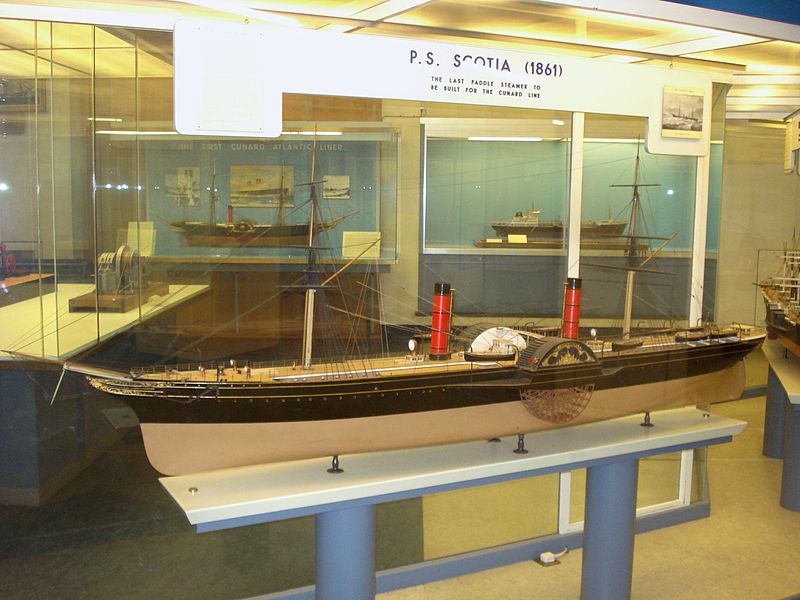
800px-SS_Scotta_1861_model

model of Cunard’s 1860s RMS Scotia

I’m looking forward to my rapidly approaching vacation. I don’t anticipate taking a slow boat to Europe anytime soon but plan to fully enjoy an extended working vacation.
Posted in 150 Years Ago This Week, Aftermath, Northern Society | Tagged , | Leave a comment

“dislocating his already swollen wrist”

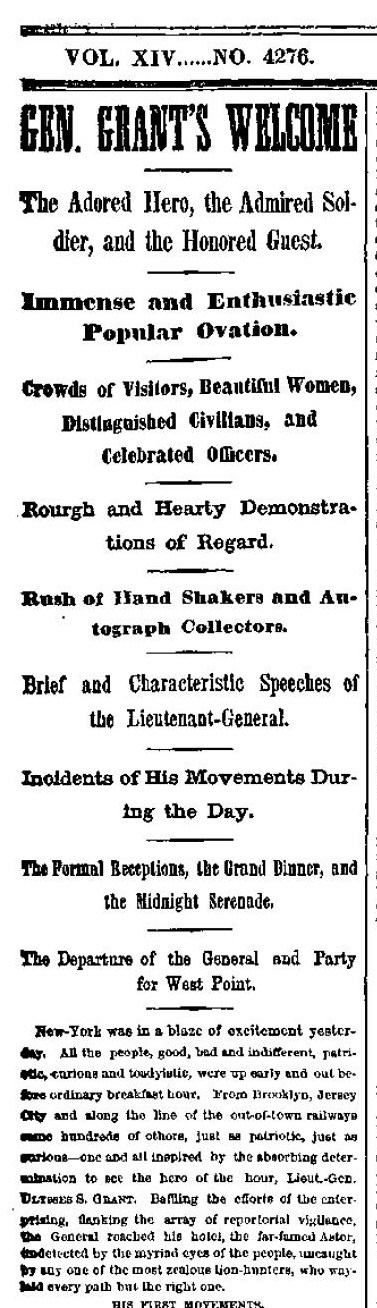
Grant in Gotham NY Times 6-8-1865

New York Times June 8, 1865

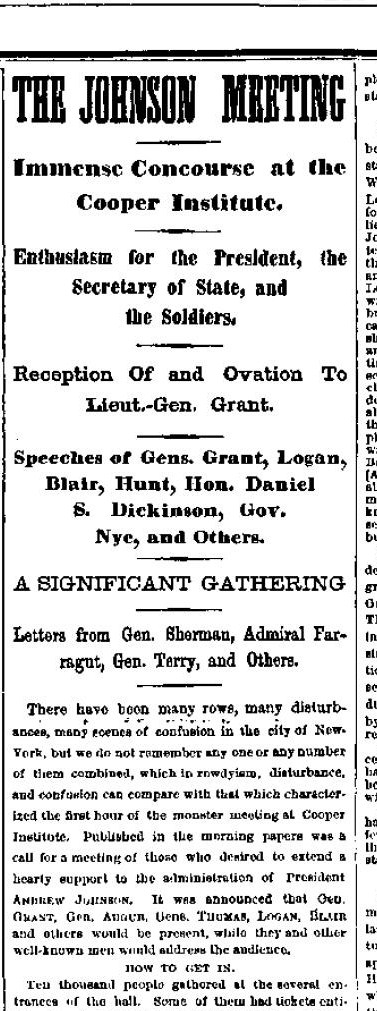
150 years ago yesterday Gotham “was in a blaze of excitement” – Lieutenant-General Grant was in town! (and by the way there was a monster meeting at the Cooper Institute to show support for President Johnson and his administration; the president was in attendance along with General Grant and others). On June 8, 1865 General Grant traveled to West Point, where he met General Winfield Scott. He was again mobbed by folks who wanted to shake his hand and maybe get an autograph.

From The New-York Times June 9, 1865:

GEN. GRANT’S MOVEMENTS.; His Successful Strategy and Quiet Rest at the Astor House. Sail Up the Hudson and Visit to West Point. Interview with Gen. Scott Review of the Cadets Levees and Great Crowds. HIS DEPARTURE FOR ALBANY.

Gen. GRANT, true to his great reputation as a “flanker,” completely outmanoeuvred New-York, by leading the public to suppose, through the newspapers, that he had left the city at midnight of Wednesday, on his way to West Point. In reality, he slept quietly at the Astor House until 6 o’clock yesterday morning, when he proceeded up the river on his projected visit. As a piece of pure strategy this manoeuvre ought to rank high among the many similar achievements of the Lieutenant-General.
Johnson at Cooper NY Times 6-8-1865

NY Times June 8, 1865

On Wednesday night, after the ceremony of the serenade was over, and the gallant Seventh Regiment, with their magnificent band had departed for their several homes, the General threw out reliable flankers, and posting a strong rear guard, he contrived to move his forces, unperceived by the admiring enemy, eluding the vigilance of the public by throwing himself into a feint movement looking toward departure by the steamer Henry Burden, while he, in reality, executed a masterly forced march, and so gained one of Mr. STETSON’s cosy and comfortable rooms, where, quite exhausted, he sought that repose so necessary after the fatiguing and arduous labors of the day.

At 6 o’clock yesterday morning, the General and his party were up, and after making a hurried breakfast at the Astor House, proceeded very quietly to the government wharf, Castle Garden, where Gen. DIX’s convenient and rapid little dispatch steamer, the Henr[y] Burden, was lying, awaiting the arrival of the distinguished party to carry them to West Point. Precisely at 7 A.M. the Burden cast loose, and heading up stream, was soon on her rapid way up the Hudson.

This saucy little dispatch steamer which conveyed the Lieutenant-General to West Point, has quite an interesting history. Her captain was the First Engineer of the first Union gunboat which fired a shot in the late war, on board the Freeborn, commanded by Commodore WARD, and he served with distinction on that craft in the Potomac flotilla.

The Henry Burden was the first boat to go to Aiken’s Landing to exchange prisoners, and for some time the different negotiations of the Commissioners of Exchange were held on board. It is also a singular fact that upon the Burden the celebrated trial of Capt. BEALE, who was hung on Governor’s Island for piracy, was held as she lay moored to the dock at Port Lafayette. She also had performed efficient service in transporting state prisoners to the fort for safe-keeping. In this neat little craft. Gen. DIX lately made the tour of his Department, and the general history of the steamer is very interesting.

West Point in 1862  (between 1910 and 1920]; LOC: http://www.loc.gov/item/hec2009000820/)

“West Point in 1862 ” (Library of Congress)

Very few persons witnessed the departure of Gen. GRANT and his friends from either the hotel or the steamer, and it evidently gratified the Lieut.-General very much to find that he would not have to undergo the terrible ordeal of the day previous, of which he no doubt retained a very lively recollection. As the carriages left the Astor House, the few who did catch a glimpse of the General seemed much surprised no doubt thinking him already gone, and before they recovered from their surprise the party had disappeared. At the battery a small police force were on hand to afford the party proper protection, but it was not found necessary, as very few people were about, and those that were did not seem to be aware of the presence of the man whom they all wanted so much to see. …

The trip up the lovely Hudson was greatly enjoyed by the General and his friends. All the way up the Burden was saluted by every passing steamer, for it was evidently known that the swift-going craft, so daily decorated with flags, had on board the Commanding General of the armies of the United States.

As the steamer neared the little unpretending landing at West Point, the crowd on shore congregated at every available point, seemingly determined to see the General as often as they could. As was the case when Gen. SHERMAN visited the Academy, Gen. GRANT was met at the wharf by Adjutant BOYNTON, who escorted the party to Gen. CULLUM’s residence, the Superintendent of the Academy, where they remained for some little time.
6-8-1865general-scott-grant

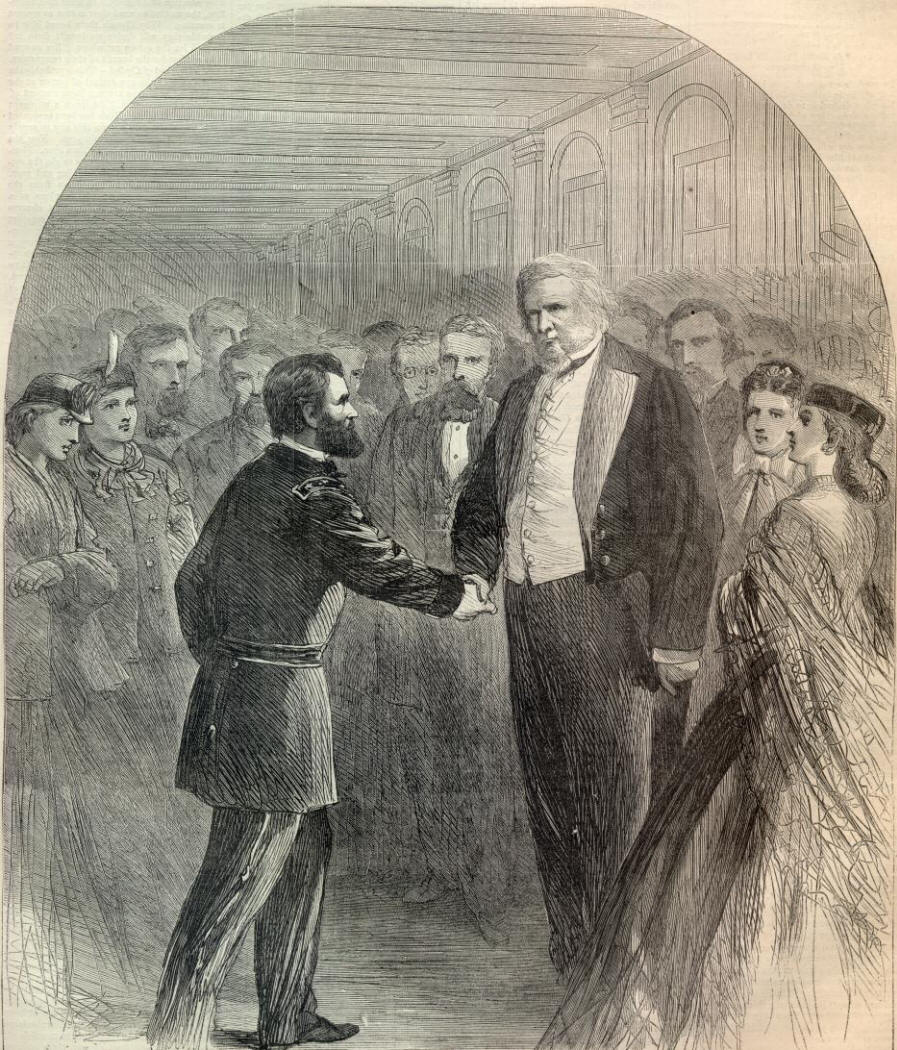
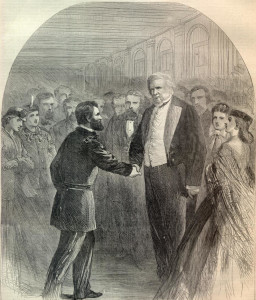
LIEUTENANT-GENERAL GRANT VISITING GENERAL SCOTT AT COZZENS’S H0TEL, WEST POINT JUNE 8, 1865,… .]

Gen. GRANT then accepted the use of Mr. SAMUEL SLOAN’s carriage, and accompanied by that gentleman and family, Mrs. GRANT, Gen. AUGUR, Gen. CULLTM, and Col. BADEAU, of his staff, he rode down to Cozzen’s Hotel and visited Lieut.-Gen. SCOTT, who received him with great cordiality. The meeting of the two Lieutenant-Generals was interesting in the extreme — the venerable and aged General, representative of a bygone day, recalling the historic names of Lundy’s Lane, and of the many Mexican battle-grounds on which he nobly sustained the glory and honor of the nation. His visitor, low-sized, quiet and unobtrusive, listening with attentive and respectful ear to the words of welcome uttered by the grand old soldier, made the spectator contrast the two representative men, and recall the many glorious deeds each had performed. As one gazed upon them, he could not but remember the gigantic strides the nation had made in the art of war, and the wide difference between the campaigns of the two Generals then conversing together.

Gen. SCOTT said but little, merely expressing his gratification at seeing Gen. GRANT once more, and his pleasure at finding him in such good health after the arduous campains and perils he had undergone. Gen. GRANT said less. The interview was quite informal and sociable.
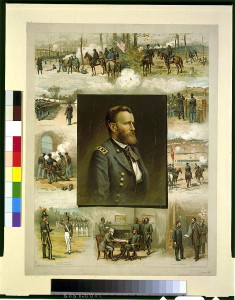
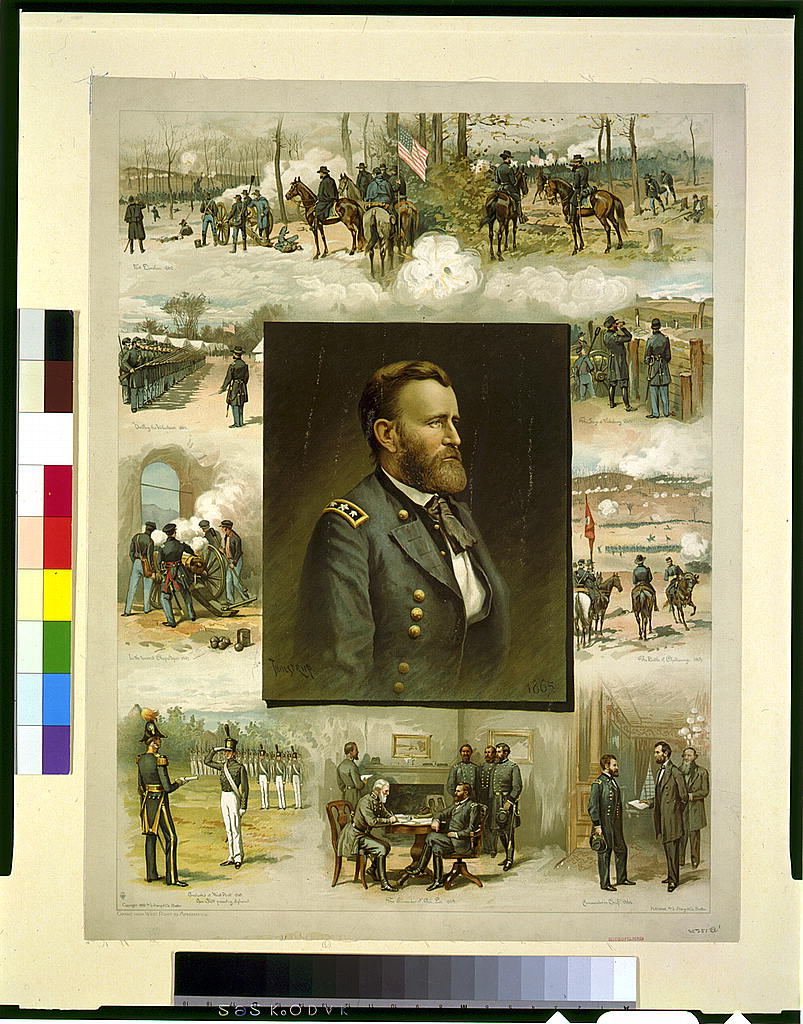
Grant from West Point to Appomattox  (1885; LOC: http://www.loc.gov/item/93504389/)

and back to West Point (“Grant from West Point to Appomattox”. 1885, Library of Congress)

Returning from Cozzen’s Gen. GRANT visited the library where the daily examination of cadets was proceeding, and the crowd were kept back by a cordon of sentries. Afterwards Gen. GRANT accompanied Gen. CULLOM through the different buildings, expressing himself pleased at everything he saw. On going over to Roe’s Hotel the General unconsciously fell into a snare, for the crowd now became colossal in its proportions, swarming about the hotel, peeping into the windows, crushing through the doors, and climbing the piazzas, one and all intent upon seeing the General, and behaving in the delightful manner customary with the dear curious public.

Finding that the crowd would not be satisfied with a mere glimpse, the General consented to hold a short levee for the gratification of the people when the scene of Wednesday were repeated. The crowd shook the General’s hand almost to the vage [verge?] of dislocating his already swollen wrist, and besieged him for his autography, until his good nature gave way and the levee came to on untimely end.

The General escaped to the rear piazza, and flattered himself that he could rest for a time in quiet. But no; the crowd surged through the passage, and a heavy column swept round the wing, and he found himself forced to surrender as unconditionally as he had compelled his adversaries in the field. Another half hour was thus wearily spent, when the General was relieved most opportunely by the arrival of the Board of Visitors and the Academic Board, who carried Gen. GRANT off in triumph to the main parlor, where the party enjoyed a social chat. …

The scene of the dinner was an extraordinary one. At either end of the hall are two large windows, and at each of these windows an eager crowd stood cramming and pushing, all intent upon seeing the man of the day and of the hour. Gesticulating, struggling, swearing and entreating, these crowds toiled and sweeted at their self-imposed task, never tiring or becoming discouraged. As each successful sight-seer fell back with a sigh, his place was quickly filled by a new-comer.

While the dinner was in progress, the already large crowd was still further increased by the arrival of the Daniel Drew, from Albany, which steamer touched at the landing about four o’clock, and disgorged some five or six hundred passengers, who, on their gaining the hotel, became quite fierce in their persistent endeavors to gain a sight of the General. As it was fast nearing the time for the review and drill of the cadets the crowd gradually forsook the vicinity of the hotel and repaired to the parade-ground, where the band had already made its appearance. Only a few insatiable mortals remained to do honor to the General.

The dinner came at length to an end by Gen. SCHENCK proposing the health of Gen. GRANT, the guest of the day, which was drank with much enthusiasm, but no response was made to the toast by the taciturn tactician, and so the dinner party adjourned. The General soon after entered a carriage and drove rapidly through the crowd to Gen. CULLOM’s residence, to await the review.

This review and exhibition drill of the cadets of the Academy deserves a more extended notice than our present limits will permit. Suffice it to say that the music was splendid; the appearance of the cadets, in their neat uniform of grey and white, was admirable, and their drill and movements the acme of perfection. The programme consisted of the regulation review in column, at “rear open order,” the marching salute in common time and at the double-quick. The battalion was afterward put through a choice variety of tactical manoeuvres, by their commandant. Col. BLACK. The performance evinced the careful drill and discipline, of the cadets to a remarkable degree. After the review and drill, the customary dress parade was gone through with, and the parade being dismissed by the Cadet-Adjutant, Mr. HULL, the graduating class for the present year grounded arms, and marched forward to greet the Lieutenant-General, who was supported by Leiut.-Gen. SCOTE. This part of the day’s proceedings was a most pleasing sight. Gen. GRANT then shook hands with the class in turn, addressing each, as they were introduced by Gen. CULLOM, in a few kind words, sending each young cadet away with a flushed and happy face.

Thus closed the visit of Gen. GRANT, and the crowd at last began to disperse. The steamer Mary Powell, on her way to Rondvt, touched at the wharf and loaded herself down to the gunwales with passengers, being compelled to draw out into the stream without several hundred people, who could be seen hurrying down the hill to get on board. The little ferry-boat West Point did a large business in carrying visitors to and fro, being compelled to run from either bank of the river incessantly.

At 7 o’clock Gen. GRANT drove down in Gen. CULLOM’s carriage to the ferry and crossed over to Garrison’s, to await the up train for Albany. In the carriage were Mrs. GRANT, and Gens. CULLOM and AUGER. The crowd upon the ferry boat was terrific, so much so that Gen. GRANT’s friends were very apprehensive for his safety. On board the boat the scene was quite ludicrous, for the never-satisfied people gathered round the carriage, and stood staring stolidly at the General, who took the matter very coolly, meanwhile puffiing, defiantly puffiing away, at the never-absent cigar.

Guarded by his aids and personal friends the General contrived to remain in comparative quiet until the arrival of the express train, when he escaped into the sleeping-car, where berths had been reserved for the party. Amidst a wild and thrilling cheer from the crowd the train moved off, and so ended the General’s visit. The down trains for New-York were fearfully jammed by the crowds returning to the city, and it was difficult for one to gain a foothold let alone a seat.

Among the many items of interest consequent upon the examination of the class of 1865, is the getting up of a superb series of seventy-two albums, containing views of West Point scenes and buildings, and the carte de visites of the entire class. These albums are gotten up in the highest style of the art by Mr. M.B. BRADY, the distinguished photographer of Broadway. Nothing could be finer than the execution of these interesting collections of photographs, and they will form valuable mementoes to the members of the class.

The TIMES is under many obligations to Capt. C.B. SPENCER, of the Henry Burden, for courtesies extended to its representative while on board the excursion steamer.

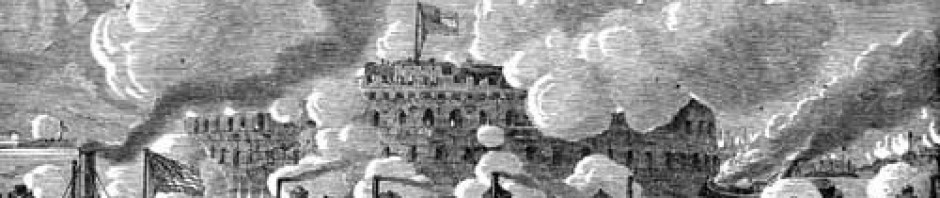
The image of the two Lieutenant-General meeting was published in the June 24, 1865 issue of Harper’s Weekly at Son of the South.
Posted in 150 Years Ago This Week, Aftermath, Northern Society | Tagged , , , , , | Leave a comment

southern social war?

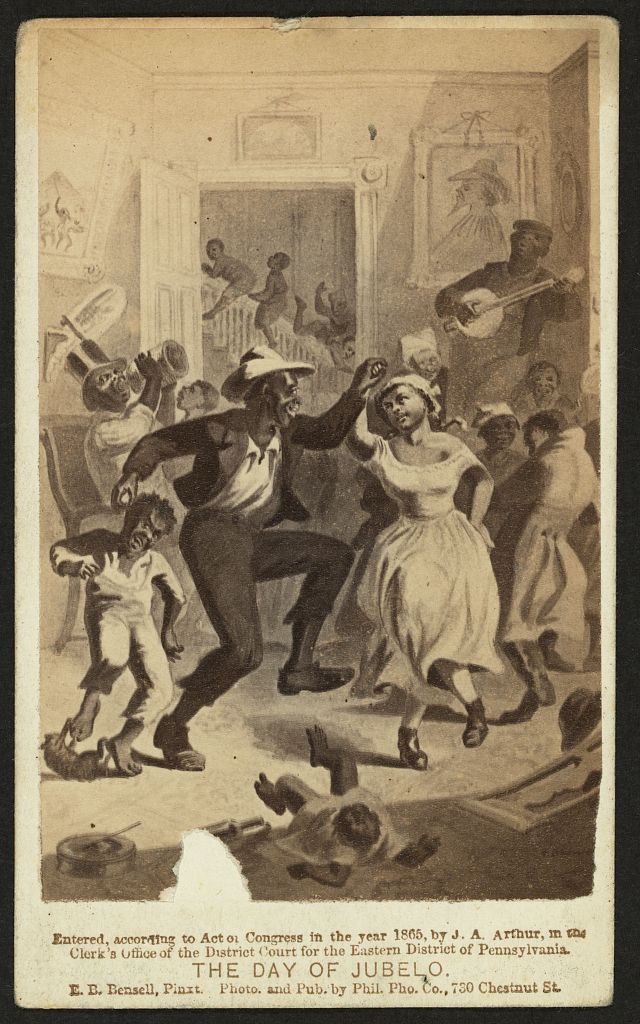
The day of Jubelo / E. B. Bensell, pinxt ; photo. and pub. by Phil. Pho. Co., 730 Chestnut St.  (1865; LOC: http://www.loc.gov/item/2010647792/)

“The day of Jubelo” (c.1865, Library of Congress)

The National Government “has freed the four millions of slaves by its own deliberate acts, and it is bound to take care that this freedom shall benefit, and not injure them.” – hopefully with the support of the state governments in the South and with the help of philanthropic organizations.

From The New-York Times June 6, 1865:

The Government and the Freedmen.

The opinion has recently been expressed by Maj.-Gen. JOSEPH JOHNSTON, one of the foremost of the Southern leaders, that a social war between the whites and blacks of the South is probable. There is reason to fear that this expectation widely prevails throughout the South. It was an universally accepted axiom there, long before the rebellion, that emancipation would result in one of two things–either amalgamation or extermination. That was the feeling even two or three generations ago, when slavery was admitted to be a positive evil; and it was the standing argument against disturbing the existing order of things. In fact the North, too, had the same opinion. Four years ago there were probably not ten thoughtful men in the North who had the conviction t[???] immediate and universal emancipation would be safe for Southern society. It was this fear of the social danger that would result which constrained Mr. LINCOLN to insist so strongly as he at first did upon supplementing emancipation with some great plan of colonizing the freedmen abroad.

Joseph E. Johnson [i.e., Johnston] / engraved & published by William Sartain, 728 Sansom St., Philada. (http://www.loc.gov/item/91732234/)

predicts social war between Southern blacks and whites

Whether emancipation is or is not fraught with this danger cannot be determined. Sufficient time has not elapsed since the close of the war for the two races to realize their new relations, and develop the spirit which will hereafter actuate them. Both races now find themselves wholly occupied in keeping themselves and those dependent upon them from starvation. All evil passions are absorbed by the physical necessity of cooperating for the common subsistence. But it is by no means certain that peace would continue after the present pinch has passed away. The whites, as soon as they can breathe a little more freely, would naturally reassert their superiority, and try to resume their old habits of control; and the blacks would naturally make the most of their new independence, and indulge themselves largely in defiance and opposition. There might, perhaps, be motives of self-interest that would restrain all such tendencies. If men were always governed by what is really for their own good, there would be no cause for any apprehension that the two races in our Southern States would not adapt themselves to each other and live in harmony. But the whites have not the pliant disposition, nor the blacks the wise understanding that can guarantee any such result. The only safe way is to assume that danger may arise, and to take timely measures to avert it.

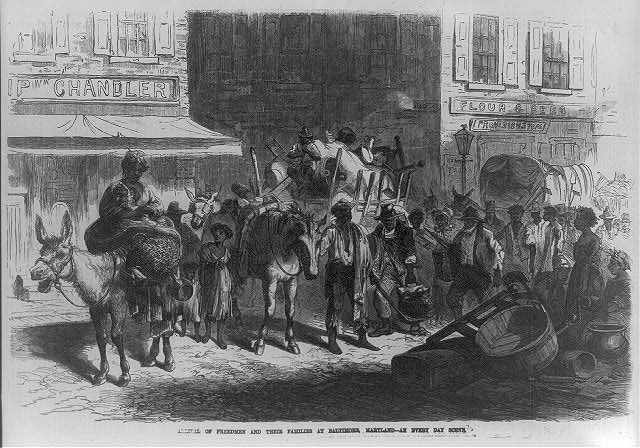
Arrival of freedmen and their families at Baltimore  ( Illus. in: Frank Leslie's illustrated newspaper, vol. 21 (1865 Sept. 30), p. 25.; LOC: http://www.loc.gov/item/2001697357/)

“Arrival of freedmen and their families at Baltimore” (Frank Leslie’s September 30, 1865 (Library of Congress))

This business must devolve primarily upon the National Government. It is, in fact, a responsibility which the government cannot avoid, even if it would. It has freed the four millions of slaves by its own deliberate acts, and it is bound to take care that this freedom shall benefit, and not injure them. To transport them from the country is impracticable; and even if it were not, it would be barbarous to drag them from the soil against their will. Nor can the government leave them, without help or guidance, adrift in the social chaos around them, or at the mercy of the stronger race. This would be a flagrant inhumanity. There is no alternative but for the government both to protect and to direct them. The last Congress never did a wiser thing than to establish a special bureau in the War Department for this particular purpose. Yet this bureau will have most difficult work to accomplish. Its means are greatly disproportioned to the end it must secure. With the close of the war, of course all war powers must cease. With the rehabilitation of the Southern States, of course all of the reserved rights of the States must revive. These rights, it has always been recognized, embrace all the domestic affairs of each State. It is not easy to see how the National Government could constitutionally exercise a particular control over a certain portion of the population of a State, not extending to all. Again, it is not easy to see how the National Government could constitutionally maintain a system of education for the blacks, such as is necessary to fit them for permanent, orderly, self-sustaining freedom. Certainly the power of providing for popular instruction is not among the grants to the government enumerated in the Federal constitution. The only practicable method of meeting the various difficulties is, on the one hand, for the government to secure, as far as possible, an understanding with the States before they are restored to their position, that they will not obstruct but cooperate with it in its efforts to protect and keep in check the freedmen; and, on the other hand, for it to cooperate with benevolent associations which will take it upon themselves to give to the freedmen industrial guidance, mental and moral instruction. The Southern people have as yet shown no signs of opposition to the management of the freedmen by the Washington authorities. With the regulations that prevent the freedmen from crowding into the cities, and compel them to work in their old neighborhoods either for themselves or on hire, the whites are every way satisfied. It is believed that the loyal men, into whose hands the government of all the Southern States will go, will recognize the policy of furthering, by legislative enactments, the policy of the National Government, not only in preventing vagabondage, but in improving the general condition of the negro.

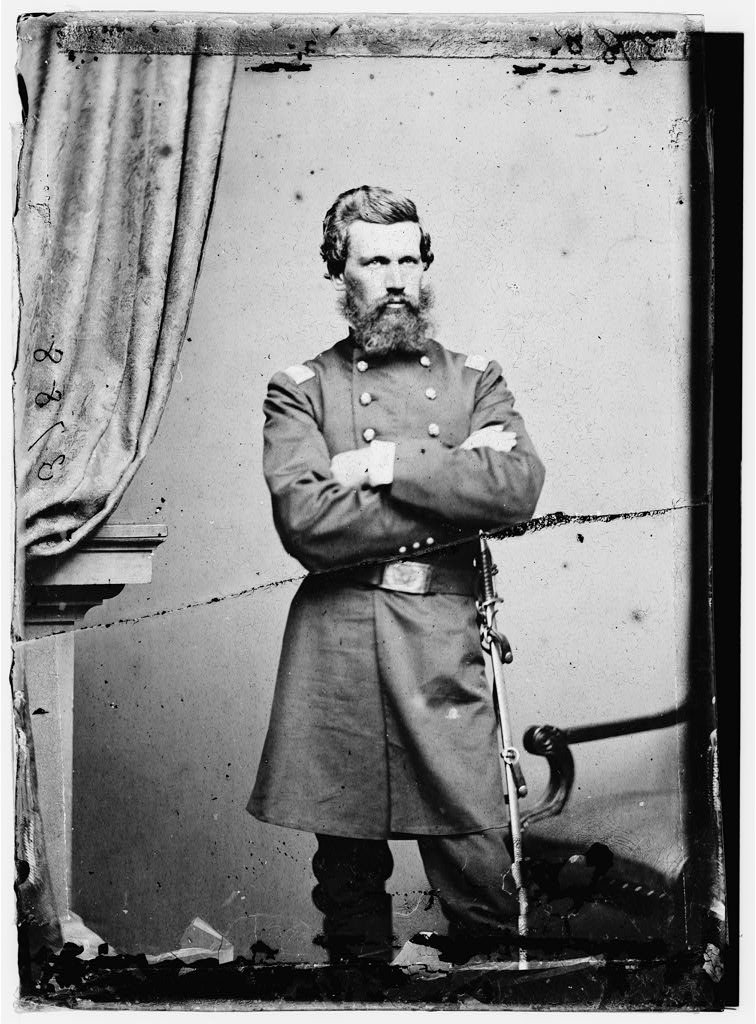
O.O. Howard (between 1860 and 1870; LOC: http://www.loc.gov/item/cwp2003003603/PP/)

more battles ahead for General Howard?

But the government must find its main help in the voluntary associations for the benefit of the freedmen. There is no object that begins to appeal to every patriot and philanthropist with any such force as this. It is the universal testimony of all officers and civilians who have had the opportunity of observing, that the freedmen are, to a surprising degree, eager to learn, and quick to learn; and that when they have any suitable direction, and the means of working, they adapt themselves to their new condition with extraordinary facility. But they are now in the extremest need of teachers, and sympathetic guardians, and the implements of labor. The government has made a beginning toward the supply of implements, by directing that all the shovels and axes, and other tools, of the disbanded armies, shall be turned over to the use of the freedmen. It has done most admirably, too, in detailing so able and so thoroughly faithful an officer as Major-Gen. HOWARD to the management of the Freedmen’s Bureau. The army officers which he will detail for the local superintendencies will doubtless be men of his own true stamp. But, at most, the active sphere of that bureau is very limited. It is indispensable as a protector and an ally, but the main work must be done by private agencies. Hundreds of teachers ought to be sent South by the Northern people before this year closes. Hundreds of thousands of dollars ought to be raised by voluntary contributions, for relieving the physical necessities of the freedmen, furnishing them with the implements necessary to make a start in life, and paying the slender salaries of the teachers. This is an imperative duty. The manner in which it is met will be a practical test of the real friendship of the North for the race, over whom more words of compassion have been uttered than for all the world besides. As we act, so will it be determined whether our anti-slavery spirit came from hate of the slaveholder or love of the slave.

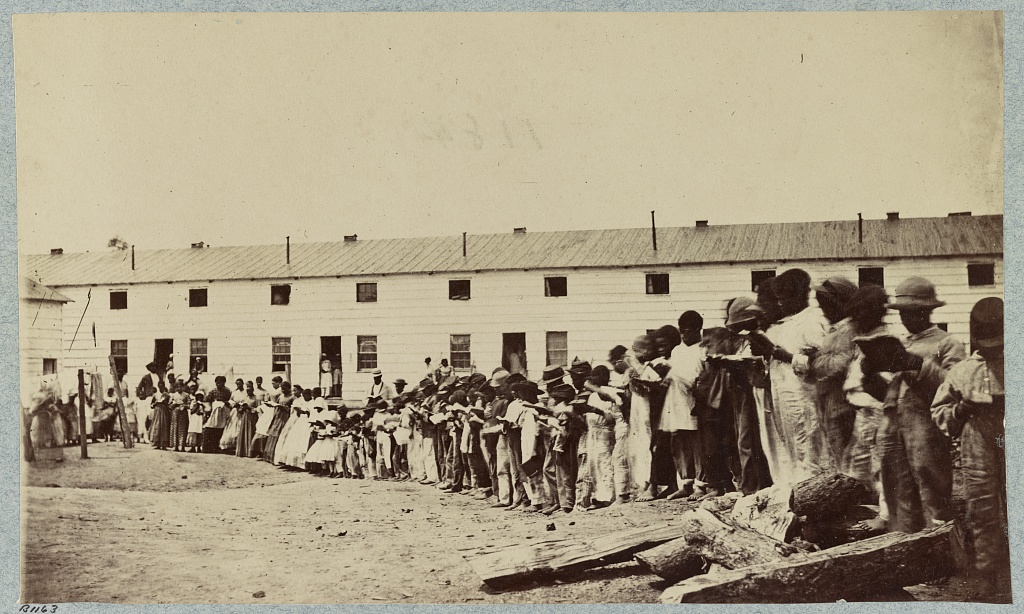
Freedman's Village, Arlington, Va. (photographed between 1861 and 1865, printed between 1880 and 1889; LOC: http://www.loc.gov/item/2014645761/)

“Freedman’s Village, Arlington, Va. ” (Library of Congress)

You can read more about the Arlington Freedman’s Village at the National Park Service

Posted in 150 Years Ago This Week, Aftermath, Reconstruction, Southern Society | Tagged , , , , , , , | Leave a comment

suffering exodus

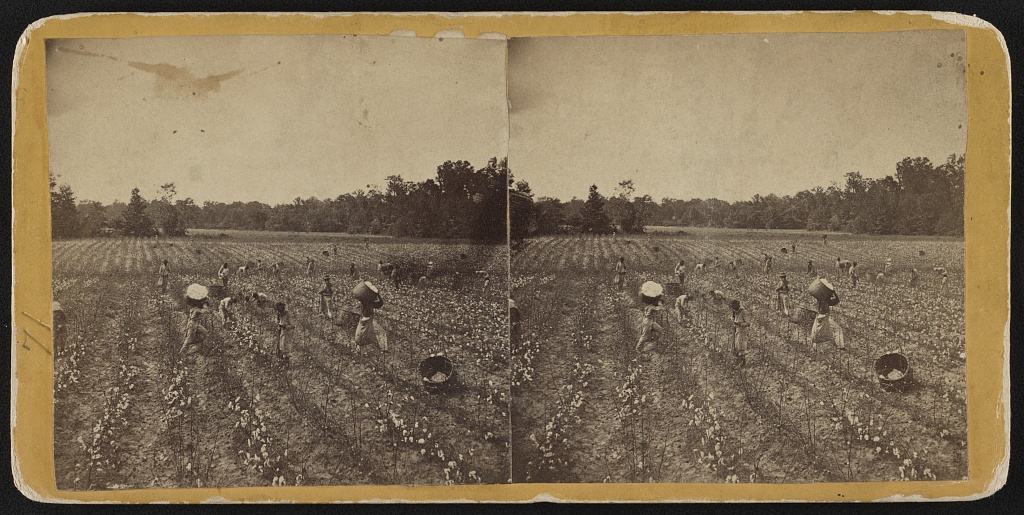
Picking cotton near Montgomery, Alabama  (1860s; LOC: http://www.loc.gov/item/2012648057/)

“Picking cotton near Montgomery, Alabama ” “Stereograph shows African Americans, possibly slaves, working in a cotton field.” (sometime between 1860 and 1870 (Library of Congress))

From The New-York Times June 6, 1865:

The Destitution of the Freedmen in Alabama.

The following letter has been received by Mr. F.G. SHAW, the President of the National Freedman’s Relief Association. It discloses a state of things which loudly calls for relief. The rooms of this association are at No. 76 John-street.

HEADQUARTERS ARMY AND DIVISION WEST MISSISSIPPI, MOBILE, Alabama, May 16, 1865.

SIR: There are thirty thousand poor freedmen now thrown upon our hands in this State. They will be able only to get bread this year; clothing and learning must come from the government, or from the benevolent hearts of merciful loyal people.

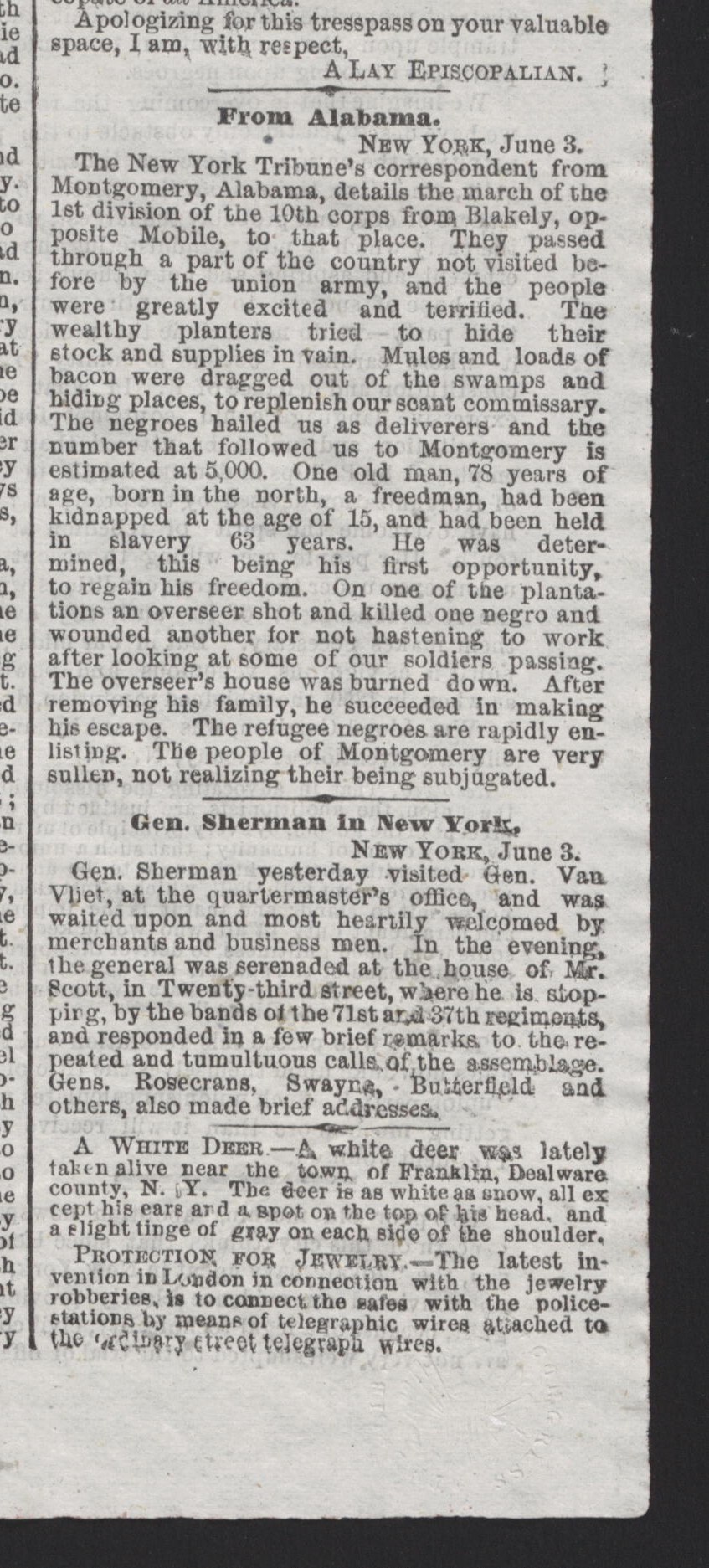
The advance of the army from Mobile upward, was the occasion for the flight of nearly all the colored people from their homes. The roads are filled with thousands upon thousands. The exodus of olden time was nothing compared with this.

chtimes 6-5-1865

Chicago Times June 5, 1865

But when I speak of the suffering endured by them, I must acknowledge that it weakens me. I am hardly able to tell it. Many have starved to death in their flight. Mothers, exhausted themselves, left their children on the roadside to die. Soldiers have paused in their march, and with kindly souls, dug graves in which to bury them. The old slaveholders, confused by the defeat of their armies, mad at the loss of “their property,” impoverished and humbled, give but little mercy to the people whose lives they formerly held. I see freedmen every day who come scarred, mangled, bleeding from the brutal treatment of their oppressors.

There never was presented to any people so vast a field for the exercise of benevolence as is presented here in the South to-day, to the good Christian people of this world.

Will you be kind enough simply to let these facts be known throughout the North? I am sure they will speak for themselves. I wish I had clothing for thirty thousand people at this moment.

I leave for Montgomery to-day, and will enlarge on this sad picture from there.

I am, in great haste, very truly yours,

THOMAS W. CONWAY,

General Superintendent Freedmen.

Posted in Aftermath, Reconstruction, Southern Society | Tagged , , , , , | Leave a comment

how big the burden?

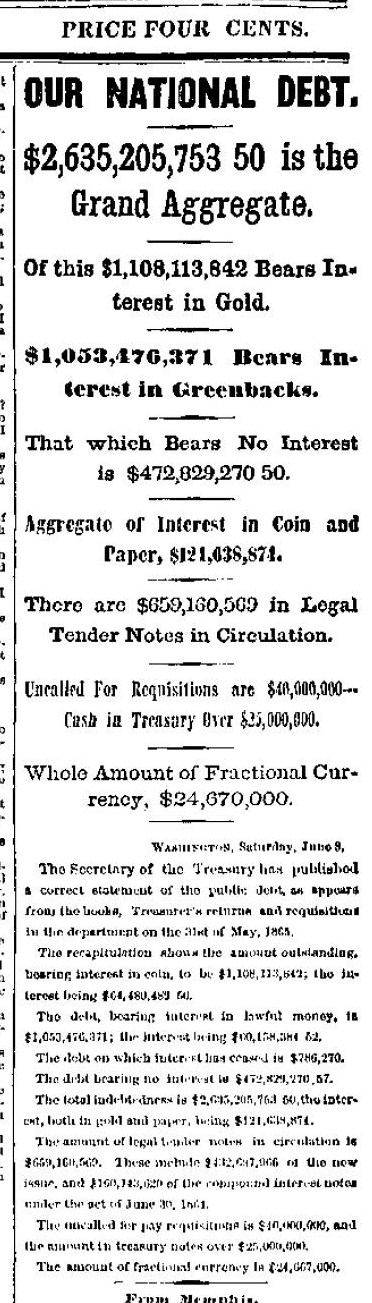
NY Times 6-4-1865

NY Times 6-4-1865

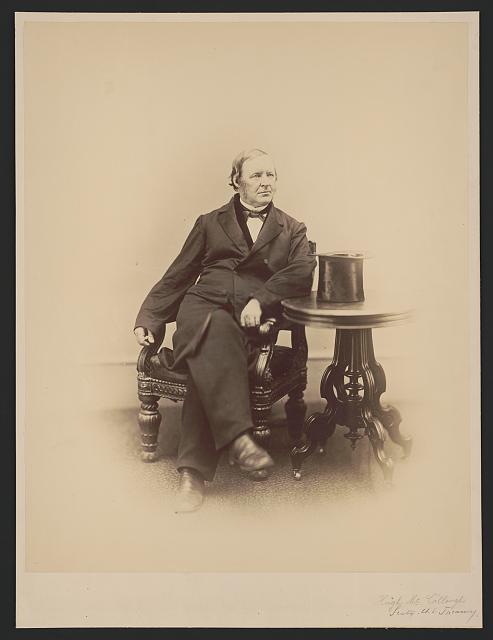
The June 4, 1865 issue of The New-York Times headlined the huge national debt that Secretary of the Treasury Hugh McCulloch reported. The following article (which we know was published sometime in May) argued that the burden of a nation’s debt is relative to its productive capacity. The United States was continuing to grow and was using technology to become increasingly productive. Consequently, its tax base was growing and large enough to pay the debt.

From The Atlantic Monthly, VOL. XV.—JUNE, 1865.—NO. XCII.:

MODERN IMPROVEMENTS AND OUR NATIONAL DEBT.

At the commencement of the Rebellion it was the general opinion of statesmen and financiers in other countries, and the opinion of many among ourselves, that our resources were inadequate to a long continuance of the war, and that it must soon terminate under pecuniary exhaustion, if from no other cause. Our experience has shown that this view was fallacious. After having sustained for several years the largest army known to modern times, our available resources seem to be unimpaired. The country is, indeed, largely in debt; but its powers of production are so great that it can undoubtedly meet all future demands as easily as it has met those of the past.

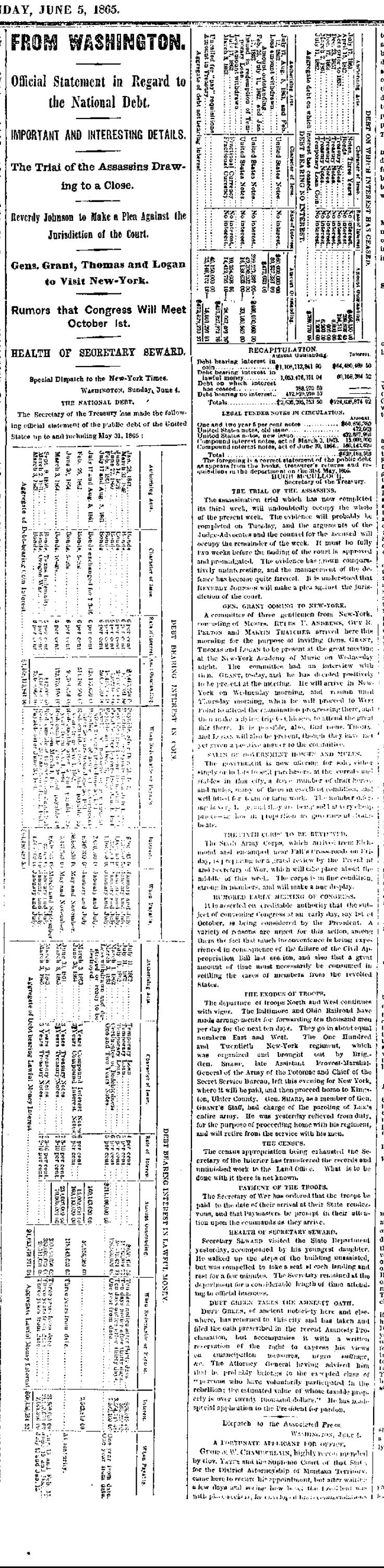
NY Times 6-5-1865

Breaking down $2.6 billion (NY Times 6-5-1865)

The ability or inability of a nation engaged in war to sustain heavy public expenses is to be measured not so much by its nominal debt as by the relation which the sum of its production bears to that of its necessary consumption. A nation heavily in debt may continue to make large public expenditures and still prosper and increase in wealth, if its powers of production are correspondingly large also. It is a fact of the most encouraging kind, that the power of production exhibited by the United States far exceeds, in proportion to their population, that of any other nation heretofore involved in a long and costly war. The case which most nearly approaches ours, in this regard, is that of England, during her war with Napoleon, from 1803 to 1815. But since the termination of that long contest, the progress of discovery, improvements in the machinery and in the processes of manufacture, more effective implements of agriculture, the general introduction of railways,[H] and other time- and labor-saving agencies, together with the constantly increasing influence of the applied sciences, have so augmented the productive power of humanity, that the experience of the most advanced nations fifty years ago furnishes no adequate criterion of what the United States can do now.

It is not easy to determine the precise ratio in which production has been increased by these instrumentalities. It is unquestionably very large,—not less, probably, than threefold. That is to say, a given population, including all ages and conditions, can produce the articles necessary for its subsistence, such as food, clothing, and shelter, to an extent three times as great, with these agencies, as it could produce without them. Hence it appears, that, if the people of the loyal States could return to the standard of living that prevailed fifty years ago, the amount of their production would be sufficient to subsist not only themselves, but twice as many more in addition. To accomplish this, they would have, indeed, to devote themselves more to the production of articles of prime necessity and less to those of mere ornament and luxury. That they have the productive energy necessary to such a result there can be no doubt.

Portrait of Hugh McCulloch, Secretary of the U.S. Treasury (by Alexander Gardner, ca. 1865; LOC:  LC-DIG-ppmsca-39365)

“Portrait of Hugh McCulloch, Secretary of the U.S. Treasury” (ca. 1865, Library of Congress)

This encouraging view of our condition is fully sustained by official statements, which show that the industrial products of the country increase in a greater ratio than the population. In 1850 the aggregate value of the products of agriculture, mining, manufactures, and the mechanic arts, in the United States, was $2,345,000.000. In 1860 the aggregate was $3,756,000,000. This is an increase in ten years of sixty per cent, whereas the increase of population during that decade was only thirty-five and a half per cent. Thus we see that during the ten years ending with 1860—the date of the last census—the products of the industry of the country increased almost twice as fast as the population increased. If to this we add the remarkable fact that the value of taxable property increased during the same period a hundred and twenty-six per cent, we have striking proof of the existence of a vast and rapidly increasing productive power,—a power largely due to the influence of those improvements which have been alluded to.

One obvious effect of war is to transfer a portion of labor from the sphere of effective production to that of extraordinary consumption. To what extent the relations of production and consumption among us have been changed during the present contest it is impossible to state. That consumption has been largely increased by our military operations is apparent to all. It is equally apparent that production also has been augmented, though not, perhaps, to the same extent. The extraordinary demand for various commodities for war purposes has brought all the producing agencies of the country into a high state of activity and efficiency, giving to the loyal States a larger aggregate production than they had before the war. Of mining and manufactures this is unquestionably true. As regards the products of the soil, the Commissioner of Agriculture, in his Report for 1863, says,—”Although the year just closed has been a year of war on the part of the Republic, over a wider field and on a grander scale than any recorded in history, yet, strange as it may appear, the great interests of agriculture have not materially suffered in the loyal States…. Notwithstanding there have been over a million of men employed in the army and navy, withdrawn chiefly from the producing classes, and liberally fed, clothed, and paid by the Government, yet the yield of most of the great staples of agriculture for 1863 exceeds that of 1862…. This wonderful fact of history—a young republic carrying on a gigantic war on its own territory and coasts, and at the same time not only feeding itself and foreign nations, but furnishing vast quantities of raw materials for commerce and manufactures—proves that we are essentially an agricultural people; that three years of war have not as yet seriously disturbed, but rather increased, industrial pursuits; and that the withdrawal of agricultural labor, and the loss of life by disease and battle, have been more than compensated by machinery and maturing growth at home, and by the increased influx of immigration from abroad.”

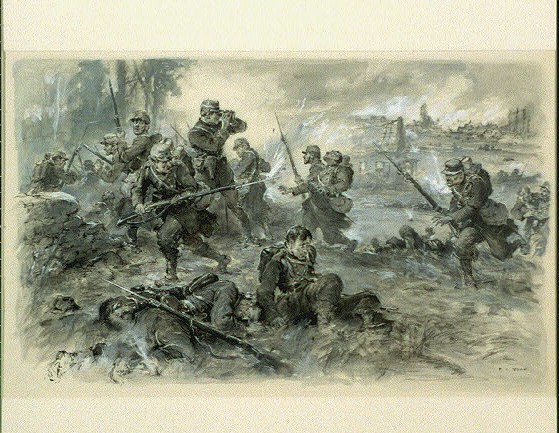
Civil War battle

“extraordinary consumption”

In illustration of the character of those agencies to which we owe the remarkable and gratifying results thus portrayed by the Commissioner, I give the following official statement in regard to two of the more prominent modern implements of agriculture. Mr. Kennedy, in his Census Report for 1860, informs us “that a threshing-machine in Ohio, worked by three men, with some assistance from the farm hands, did the work of seventy flails, and that thirty steam-threshers only were required to prepare for market the wheat crop of two counties in Ohio, which would have required the labor of forty thousand men.” As it took probably less than two hundred men to work the machines, the immense saving in human labor becomes instantly apparent.

Again, in his last Patent-Office Report, Mr. Holloway states “that from reliable returns in his possession it is shown that forty thousand reapers were manufactured and sold in 1863, and that it is estimated by the manufacturers that over ninety thousand will be required to meet the demand for 1864”; and these machines, he says, will save the labor of four hundred and fifty thousand men.

If the aggregate produce of the loyal States, notwithstanding the large amount of labor that has been withdrawn from production by the demands of the war, is actually greater than ever before, and if, as we have already shown, the sum of that produce is three times as great as the people of those States, using proper economy, would necessarily consume, surely no one should feel any anxiety in regard to the ability of the United States to meet all their pecuniary obligations. …

We need but a resolute and united purpose to sustain with comparative ease our national burdens, whatever may be their extent. Those who doubt this under-estimate not only the magnitude of our national resources, but the powerful aid which modern improvements lend to their development.

FOOTNOTES:

[H] Some estimate of the influence of railways alone may be formed by reference to the following statement, which occurs in an address of Robert Stephenson before the Institution of Civil Engineers, in 1856:—

“The result, then, is, that, upon the existing traffic of the United Kingdom of Great Britain, railways are affecting a direct saving to the people of not less than forty million pounds per annum; and that sum exceeds by about fifty per cent the entire interest of our national debt. It may be said, therefore, that the railway system neutralizes to the people the bad effects of the debt with which the state is incumbered. It places us in as good position as if the debt did not exist.”

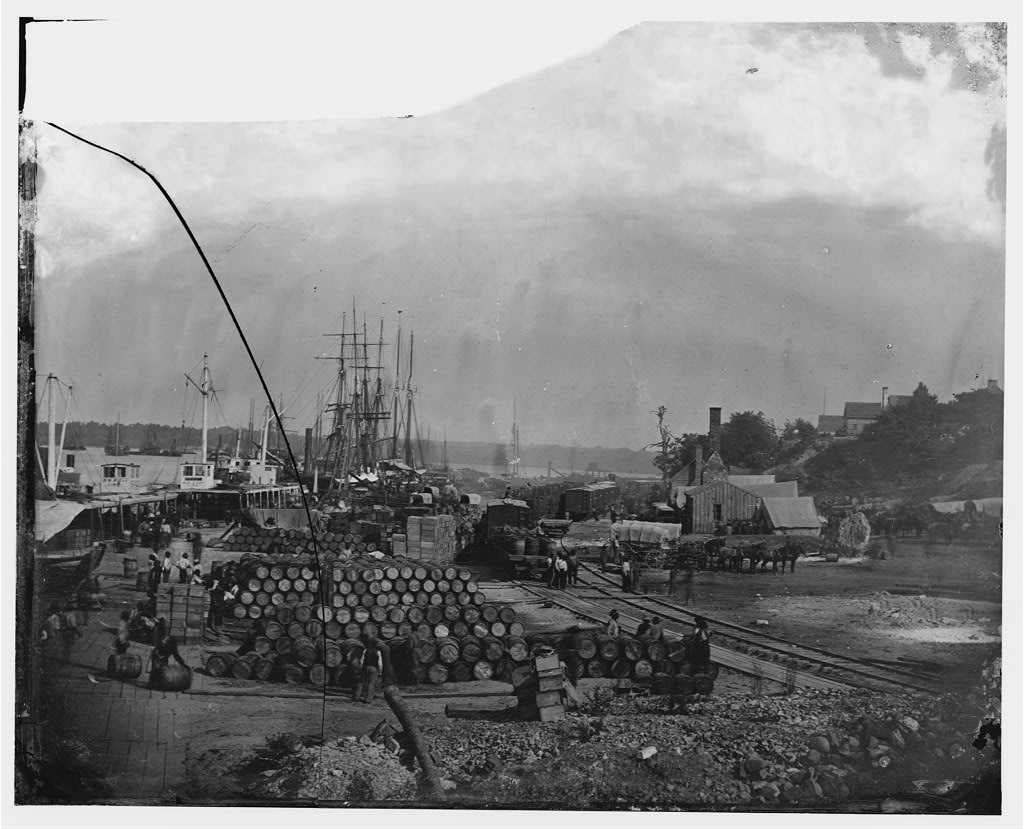
City Point, Va. Federal supplies deposited on the landing (1864 July.; LOC: v)

from producers to consumers (“City Point, Va. Federal supplies deposited on the landing” July 1864, Library of Congress)

Posted in 150 Years Ago This Week, Aftermath, Northern Society | Tagged , , | Leave a comment

General Grant agrees

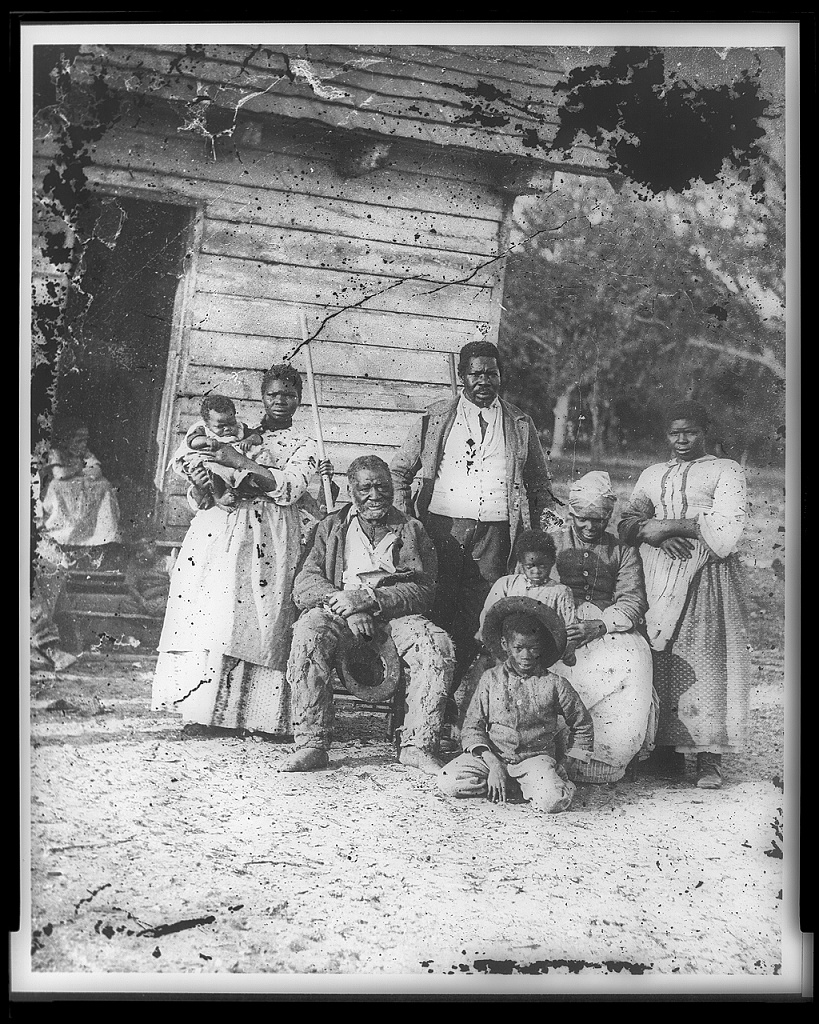
Five generations on Smith's Plantation, Beaufort, South Carolina (by Timothy H. O'Sullican; 1862, printed later; LOC: LC-DIG-ppmsc-00057)

casus belli ? (“Five generations on Smith’s Plantation, Beaufort, South Carolina”, 1862, Library of Congress)

150 years ago yesterday General Grant issued a congratulatory order to the troops. He zeroed in on slavery as the “the cause and pretext of the rebellion.” From The New-York Times June 5, 1865:

THE LIEUT.-GENERAL TO OUR ARMIES.; Grant to the Armies of the United States. Their Glorious Services Nobly Acknowledged.Their Great Achievements and Priceless Legacy.

WASHINGTON, Sunday, June 4.

Gen. GRANT has issued the following congratulatory address to the armies.

WAR DEPARTMENT, ADJUTANT-GENERALS OFFICE, WASHINGTON, D.C., June 2, 1865.

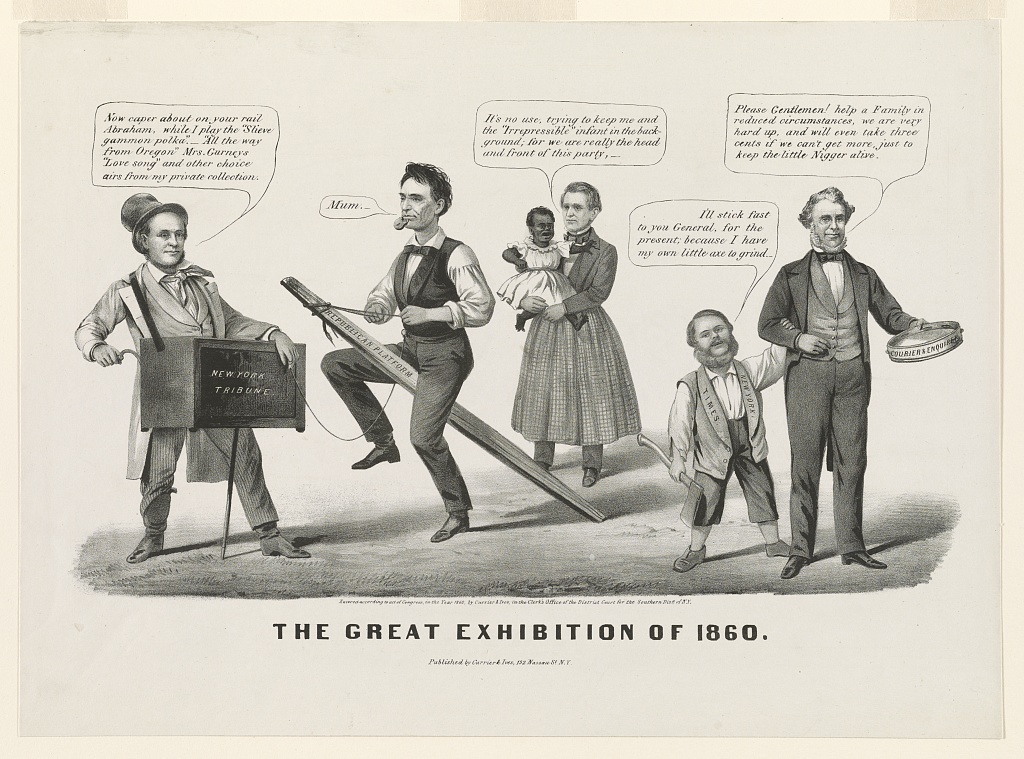
"The great exhibition of 1860 " (LC-DIG-pga-04861 )

Mr. Seward declared the conflict irrepressible

GENERAL ORDERS, No. 108 [18?]. — Soldiers of the Armies of the United States: — By your patriotic devotion to your country in the hour of danger and alarm, your magnificent fighting, bravery and endurance, you have maintained the supremacy of the Union and the Constitution, overthrown all opposition to the enforc[e]ment of the laws, and of the proclamations forever abolishing slavery, the cause and pretext of the rebellion, and opened the way to the rightful authorities to restore order and inaugurate peace on a permanent and enduring basis on every foot of American soil. Your marches, sieges and battles, in distance, duration, resolution and brilliancy of results, dim the lustre of the world’s past military achievements, and will be the patriot’s precedent in defence of liberty and right in all time to come. In obedience to your country’s call, you left your homes and families and volunteered in its defence. Victory has crowned your valor, and secured the purpose of your patriotic hearts; and with the gratitude of your countrymen and the highest honors a great and free nation can accord, you will soon be permitted to return to your homes and families, conscious of having discharged the highest duty of American citizens. To achieve these glorious triumphs, and secure to yourselves, your fellow countrymen and posterity, the blessings of free institutions, tens of thousands of your gallant comrades have fallen, and sealed the priceless legacy with their lives. The graves of these a grateful nation bedews with tears, honors their memories, and will ever cherish and support their stricken families. U.S. GRANT, Lieut.-General.

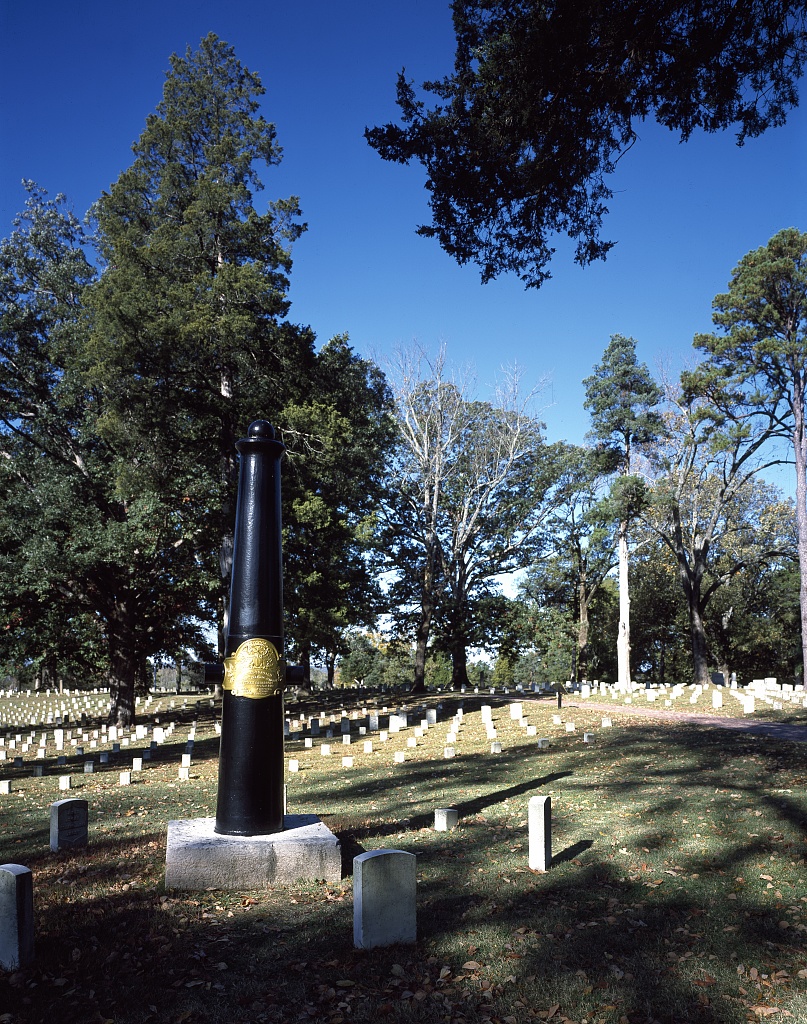
More than one-third of the headstones at Shiloh National Cemetery in Tennessee mark graves of unknown Union soldiers (by Carol M. Highsmith, Library of Congress)

“More than one-third of the headstones at Shiloh National Cemetery in Tennessee mark graves of unknown Union soldiers” (by Carol M. Highsmith, Library of Congress)

You can read all about the 1860 political cartoon at the Library of Congress.

From William H. Seward’s 1858 Irrepressible speech:

… Thus these antagonistic systems are continually coming into closer contact and collision results.

Shall I tell you what this collision means? They who think that it is accidental, unnecessary, the work of interested or fanatical agitators, and therefore ephemeral, mistake the case altogether. It is an irrepressible conflict between opposing and enduring forces, and it means that the United States must and will, sooner or later, become either entirely a slave-holding nation or entirely a free-labor nation. Either the cotton and rice-fields of South Carolina and the sugar plantations of Louisiana will ultimately be tilled by free labor, and Charleston and New Orleans become marts for legitimate merchandise alone, or else the rye-fields and wheat-fields of Massachusetts and New York must again be surrendered by their farmers to slave culture and to the production of slaves, and Boston and New York become once more markets for trade in the bodies and souls of men.

It is the failure to apprehend this great truth that induces so many unsuccessful attempts at final compromise between the slave and free States, and it is the existence of this great fact that renders all such pretended compromises, when made, vain and ephemeral. …

Posted in 150 Years Ago This Week, Aftermath, Northern Society, Veterans | Tagged , , | Leave a comment

“perhaps necessary that we should pass through this last ordeal”

NY Times 6-2-1865

NY Times 6-2-1865

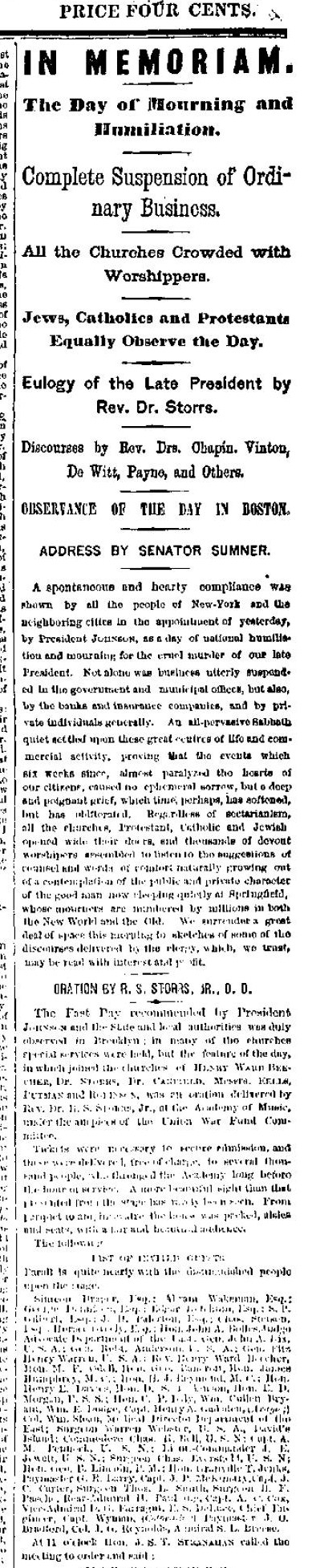
Things are thankfully winding down here but wanted to mention that 150 years ago today I could have read all about the June 1st Day of Humiliation and Prayer called by President Johnson for the purpose of mourning the assassination of Abraham Lincoln. Here’s a report of Frederick Douglass’s speech at the Cooper Institute the evening of June 1st.

From The New-York Times June 2, 1865:

FRED. DOUGLAS ON PRESIDENT LINCOLN.; Vast Gathering at the Cooper Institute. The Speaker’s Views on the Future of His Race. MR. LINCOLN AND COLORED PEOPLE.

[?]and was occupied by about one hundred persons, beside a select class of young ladies, who sang several airs during the evening. Dr. TYNG, President ACTON of the Police Department, GEORGE W. BLUNT, and other prominent citizens, occupied seats on the stage.

The exercises were opened with prayer by Mr. JOHN PETERSON.

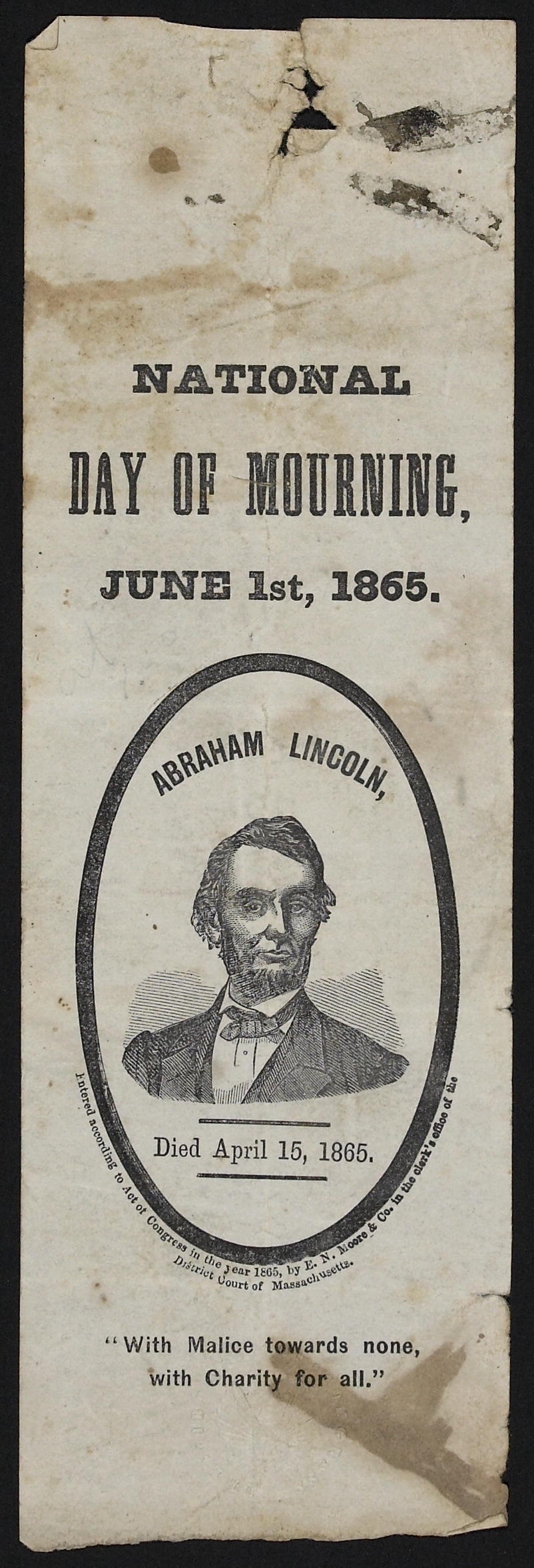
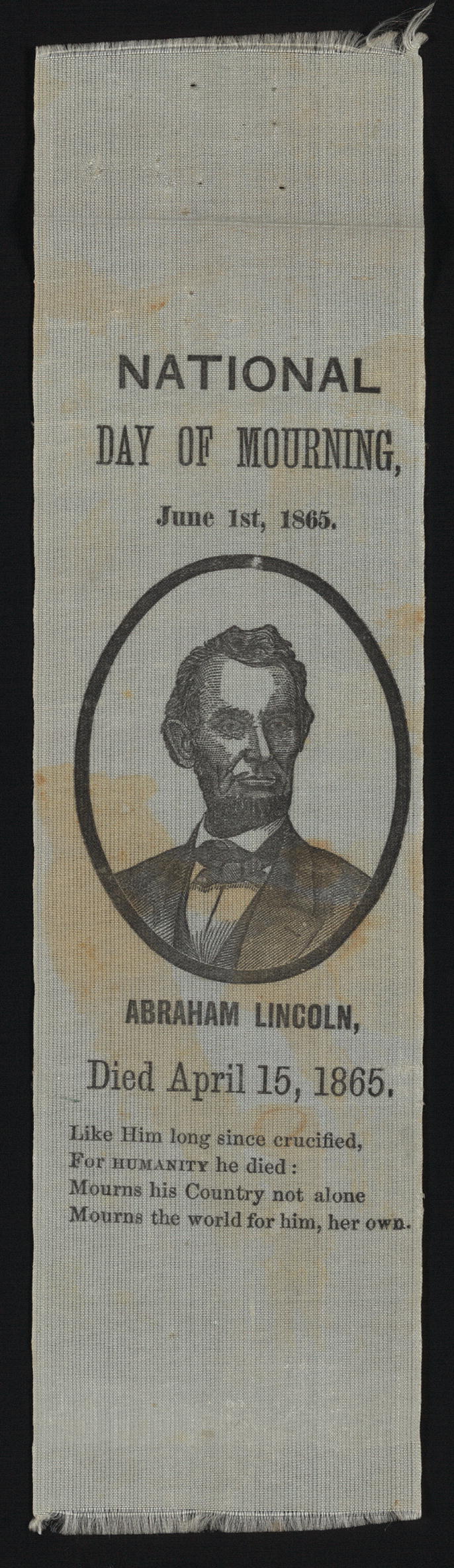
AL mourning ribbon

(Library of Congress)

The Chairman, Mr. RANSOM F. WAKE, read the committee’s statement in connection with the refusal of the Common Council Committee to assign colored societies, &c., a place in the funeral procession. The paper denounced the action of the Common Council Committee in unmeasured terms. The document was too long to give it place in our columns.

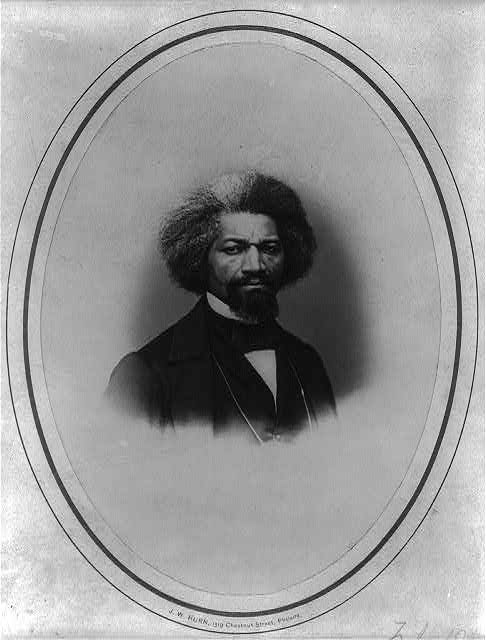
The chairman introduced the orator of the evening, FREDERICK DOUGLAS, in a few complimentary words. Mr. DOUGLAS was warmly applauded on advancing to the front of the platform. He said that he felt a certain degree of embarrassment in appearing before the audience on this occasion. It was a time when the rarest gifts, the highest eloquence, and the greatest genius the country had produced might fail under the dignity and grandeur of this occasion. It was one of the principal themes which was destined to interest and thrill the hearts of men in the coming ages. If ABRAHAM LINCOLN had died by any ordinary ill by which men are ordinarily removed; if, after a successful life, he had reached the good old age of which his constitution gave promise; if he had lived to see the work he had inaugurated, completed, in a certain degree, his death would have been grand. But ABRAHAM LINCOLN died by the red hand of violence, without warning. He was assassinated — murdered without personal hate — for no man that knew ABRAHAM LINCOLN could hate him. He died because he was the President of the United States, duly elected. For this he was killed — murdered — assassinated. This is the great, all-commending reason why we pay homage to his memory. For this reason men everywhere pay homage to his memory as a glorious martyr of freedom and human rights. In this view we should consider him. The most the speaker could do in a time like this, when the press, the pulpit and the platform are employed on this one theme, was to give back to the country the thoughts and feelings derived from the country. The speaker was but as the wave of the ocean, deriving his strength from the sea. All over the country men are thinking of ABRAHAM LINCOLN, their martyred President. Statesman, scholars, poets, as never before, are paying tributes to the memory of our martyred President. It was proper, as it was well deserved on his part, and it was beautiful on our part.

Head-and-shoulders portrait of Frederick Douglass (Philadelphia? : J.W. Hurn?, ca 1870; LOC: LC-USZ62-24165)

New York City excluded blacks from procession for President Lincoln???

6-1mourning

(Library of Congress)

Mr. DOUGLASS said that it was well that the colored people should have a voice in these marks of respect to our martyred President. No people as a class have more reason to lament his death and revere his memory than the colored people of the United States. They were the only people prohibited from publicly expressing their regret and sorrow at the death of the President. It was hardly worth while for him to denounce the action of the authorities of New-York in excluding the colored people from the procession, but if be should say anything it would be that it was the most disgraceful and scandalous proceeding ever exhibited by people calling themselves civilized. [Applause.] The speaker inquired, What was ABRAHAM LINCOLN to the colored people? And what was he to them compared to the long line of his predecessors, who were the servile and abject devotees of the slave power? ABRAHAM LINCOLN was unsurpassed by any in his interest for the white man, and was emphatically the black man’s President. He was the first of the long line to show any respect to the rights of the black man, or to acknowledge that he had any rights the white man ought to respect. Let the whi[t]e man do all it is possible to perpetuate his memory, but let the colored people have space for one stone to give some intimation of the great reverence and love, the colored people have for ABRAHAM LINCOLN. Those love most who receive most. [Applause.] The lecturer said that the most affecting incident he had heard was that of a poor colored woman who was found weeping near the Presidential mansion. When asked why she wept, she replied, “We have lost our Moses.” The answer was given, “God will send you another.” The woman quickly said, “I know that, but we had him already.” [Applause.] The speaker continued and said the colored people believed in ABRAHAM LINCOLN, had loved him even when he smote and wounded them. They thoroughly trusted and believed in him; but it was no blind belief, unsupported by reason. They caught a glance of him in the beginning, and viewed him in the light of his great mission, they trusted as men seldom trust. They would have been pleased if he had confined his reasons to other motives than expediency or military necessity, but they wanted to see the grand fact that slavery was being abolished. They saw good in the fact that he was plucking out the writing of ages — prejudice; they saw three millions made free and given the right to defend their freedom with the rifle and cartridge-box. They saw good in the fact that the power of the rebellion has been ground to powder and blown away as dust before the North wind. They took no captious exception to incidents connected with their transition from slavery to freedom. Mr. DOUGLASS said he would not speak to them as colored men, but as men among men; as fellow-citizens having the same glory in the common interests of the country as other men. From this standpoint the prospect is bright and glorious for the future greatness of the nation. In alluding to the death of Mr. LINCOLN, the speaker said that nothing could have produced greater consternation. Although we had not yet reached land, we might say that we had survived the agony of the fierce and sanguinary rebellion, with a prospect of peace. If we are wise and great, will it be disturbed by the proud and insolent oligarchy of the South? Already the key-note of Justice has been sounded; already order has come out of confusion, and the law has become a terror to evil-doers; traitors and assassins — male or female — whether in male or female attire — are to be punished. [Applause.] Slavery has been blotted out and abolished forever, and the negro is to be enfranchised and clothed with all the dignity of the American citizen. [Applause.] The poor whites of the South, who have been looked down upon and oppressed by the slaveholders, are also to be lifted up from their social and political debasement. Henceforth there should be no North, no South, no East, no West in American politics, but it should [b]e a nation of all for all. We shall stand as a power among the nations of the earth. The lecturer pictured a glowing future for our country, and said that in the assassination of ABRAHAM LINCOLN there was a bow of promise. It was perhaps necessary that we should pass through this last ordeal. Mr. DOUGLASS spoke of the hostility of foreign nations to the government, and their doubts of the success of the nation to withstand the ordeal, and said that the oppressed of other lands were stretching forth their hands for freedom since our success had become evident. In alluding to the cause of the rebellion, Mr. DOUGLASS said that it was beyond human power to have prevented it. It was a part of, and grew out of, fundamental errors in our system. We had reaped what we had sown. We could no more evade this war than we could evade our antecedents. Slavery was the seed of rebellion and assassination. We should learn a lesson from the war, and in the reconstruction of the States, not incorporate, any vestige of slavery in it, to hand down to our children. In our system was a gigantic evil which we had to put away, — peaceably if we could, forcibly if we must. In conclusion Mr. DOUGLASS passed a high eulogium on the independence, integrity, and kindness of Mr. LINCOLN’s character, illustrating his remarks by several anecdotes of his own experience with the late President.

At the close of the lecture Mr. DOUGLASS was warmly applauded.

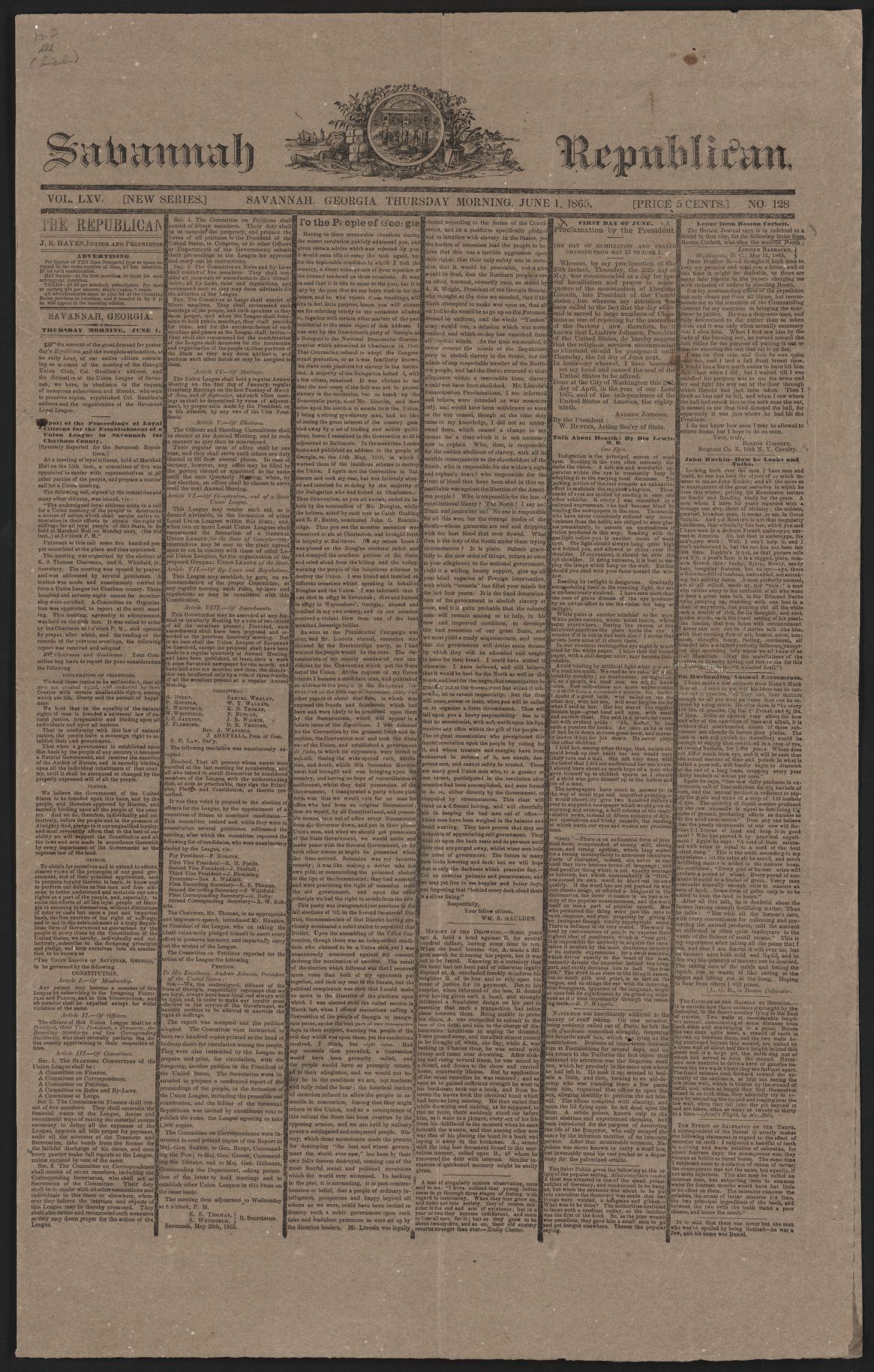
Savannah Republican 6-1-1865

mourning columns in Georgia (Savannah Republican 6-1-1865)

Posted in 150 Years Ago This Week, Aftermath, Northern Society, Reconstruction | Tagged , , , , , | Leave a comment

“live in legend and story”

laurel_leaf

From a Seneca County, New York newspaper in June 1865:

Our Returning Soldiers.

Regiment by regiment the gallant soldiers who have by their heroism and fortitude saved saved our common Government are returning home. They come to lay aside the implements of war and resume their places as citizens. They have nobly done their work as soldiers and now they quietly leave the profession to which they have added a new lustre, and take up again their old vocations or enter upon new spheres of duty. No soldiers ever earned a more honorable repose. They have fought with an unparalleled energy and determination, and their intrepid courage and unwavering fortitude have commanded the admiration of the world. They have suffered and endured without a murmur, knowing that their imperiled Government had need of heavy sacrifices, and their unswerving fidelity has entitled them to the laurel wreath of honor.

Let these brave fellows – heroes of many a hard-fought battle field, which will live in legend and story as long as the race lives – who return to us bronzed with the exposure of camp and bivouac – with ranks fearfully shattered and rent – meet with a warm, hearty, enthusiastic welcome. And though they return with a rollicking spirit and that freedom which they have learned amid the stern conflicts of martial strife, they should be none the less gratefully received.

In pathetic contrast is their return to their going out, when their ranks were full, their uniforms bright, and their hearts all aglow with wild visions of the “pomp and circumstance of glorious war.” Many, very many, of their number have found soldiers graves, unmarked and unknown; some have wasted in hospitals and from thence wandered forth into the valley of the shadow. To their companions who return, the public owe a lasting debt of love and gratitude. Their signal services have entitled them to the highest consideration, and let us see that they receive their full reward.

I copied that over Saturday afternoon at the Seneca Falls library. Returning home I discovered that Eric at Civil War Daily Gazette had crossed his finish line. I remember that when the site started out Eric wondered if he’d be able to publish a daily article for the duration of the war – longer in fact than most students attend college to earn a Bachelor’s degree (and I’m pretty sure they wouldn’t have to turn in a paper every day).

Congratulations to Eric on his success. I thought of the above article when I read that the Gazette had accomplished its mission. Eric did help keep the history of the Civil War alive by telling a factual story of the conflict day-by-day for pretty nearly 55 straight months.

I respect Eric’s achievement and can only imagine the hard work and endurance required to pull it off. I’m not sure if the Gazette itself will “live in legend and story,” but the comments of his readers on that last post show how much his web site was truly appreciated. The publishers of the “Daily News” sites to the right probably did need a lot of the qualities of the soldiers praised in the above article – like commitment and fortitude.

Thanks for helping your readers understand how the war “did really happen.” Good luck on your future endeavors!

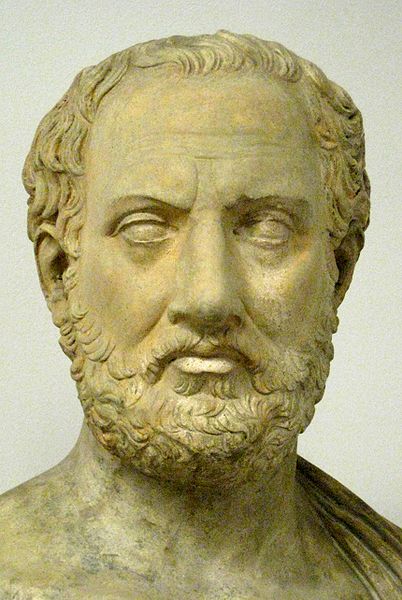
I shall be content if those shall pronounce my History useful who desire to give a view of events as they did really happen, and as they are very likely, in accordance with human nature, to repeat themselves at some future time – if not exactly the same, yet very similar.

THUCYDIDES: Historia, bk. 1. [1]

This is the plaster cast bust currently in exposition of Zurab Tsereteli's gallery in Moscow (part of Russian Academy of Arts), formerly from the collection of castings of Pushkin museum made in early 1900-1910s.  Original bust is a Roman copy (c. 100 CE) of an early 4th Century BCE Greek original, and is located in Holkham Hall in Norfolk, UK.

committed to scientific history

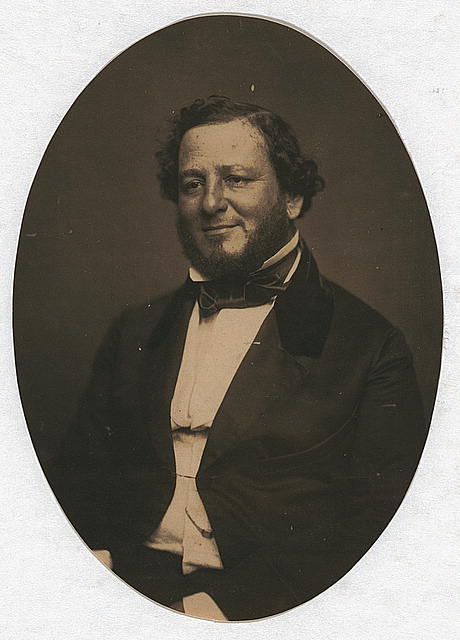
Judah P. Benjamin, Senator from Louisiana, half-length portrait (ca. 1856; LOC: LC-DIG-ppmsca-05642)

‘tickled pink by your site, Eric”

_______________________________________________________________________
The image of Thucydides is licensed by Creative Commons
WPClipart provides the image of the laurel wreath
  1. [1]Seldes, George, compiler. The Great Quotations. 1960. New York: Pocket Books, 1967. Print. page 478.
Posted in 150 Years Ago This Month, Aftermath, Northern Society, Veterans | Tagged , | Leave a comment

shotgun shorts

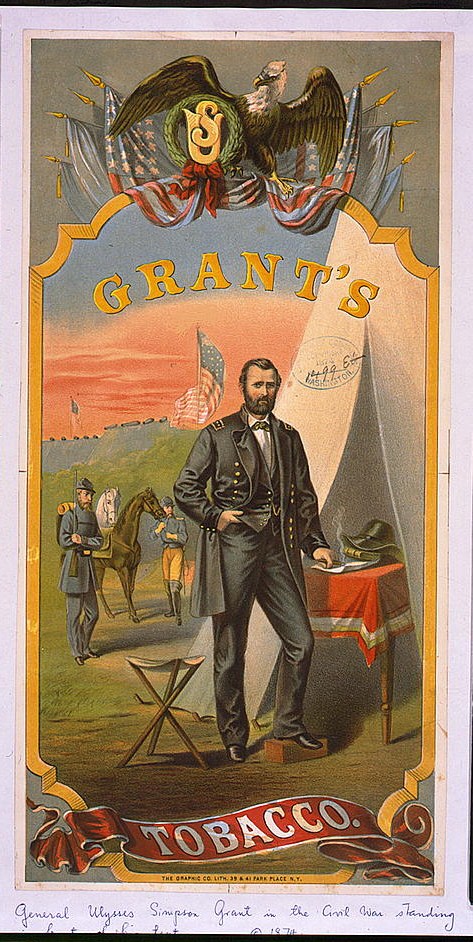
Grant's tobacco / The Graphic Co. lith., N.Y.  (c.1874; LOC: http://www.loc.gov/item/96507231/)

Beware of Trojans sending gifts (c.1874, Library of Congress)

This article would have been published earlier than May 30, 1865 because even folks up here in New York state would already have known that Jefferson Davis was captured.

From a Seneca County, New York newspaper in May 1865:

The first man killed in the late war was Daniel How, of New York, at Fort Sumter in 1861, by premature discharge of a gun. His name has been frequently and erroneously reported as Hough.

Some citizens of Troy on Saturday last forwarded to General Grant a present that will “take his fancy.” It is a box of cigars, 100 in numder [sic], of the finest brand, and costing $100. Each cigar has a paper holder, and the box itself is got up “regardless of expense.”

The Washington Intelligencer of Wednesday, says the government has thirty-three millions of gold on hand. It is known that the government is prepared to pay the coin interest due in July.

The Rochester Union mentions it as a note-worthy fact that President Johnson’s appointments of assessors and collectors for Virginia, are in every instance Virginians. The ultra radical plan of Sumner &Co., was to fill all these places with “patriots” from the North.

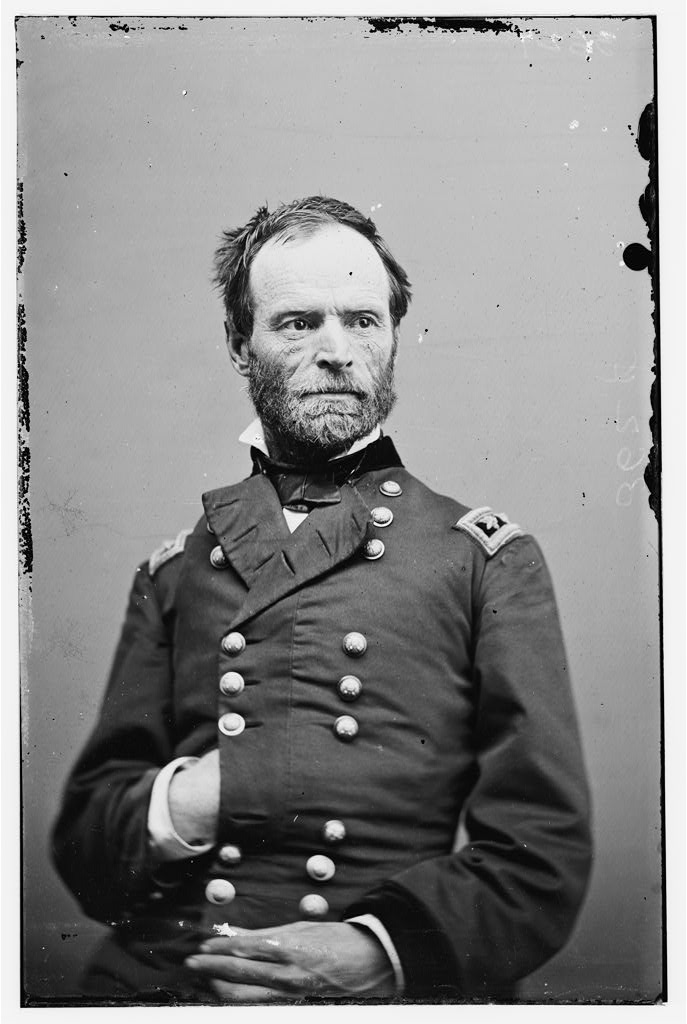
William T. Sherman (between 1860 and 1870; LOC: http://www.loc.gov/item/cwp2003003502/PP/)

be like Napoleon

Large numbers of army and navy officers are daily sending their resignations to their respective departments, which accept them as fast as received.

Gen. Sherman captured more cannon without a battle than Napoleon ever took in any three of his heaviest battles.

The Grand Chapter of Free Masons of the State of Maine have voted the sum of $300 to Dr. Mackey of Charleston for his great service to the Union prisoners during the war.

Jef. Davis’s whereabouts are still a mystery. At key West, on the 1st inst., there was a rumor that he was making for the Florida Coast with a view to escape in a small vessel to Cuba.

Stanton’s odious censorship of the telegraph continues. He uses it to puff himself and his department and detract from his associates.

A Nevada paper says that at night the streets of Virginia City, in that State, resound with screams of women whose husbands are beating them.

The Western widows are calling indignation meetings with reference to the advent of Massachusetts girls. The male persuasion is too scarce for the home market.

Miss Anna E. Dickinson has sent $922,36, the proceeds of one of her lectures at the Philadelphia Academy of Music, to the Mayor of that city, to be added to the fund for the erection of a monument to President Lincoln.

“How long will it take me to go to Richmond?” asked an eager officer at City Point of a veteran brigadier holding command there, soon after we got the good news. “I can’t say how long it will take you, was the answer; it has taken me three years and eleven months.

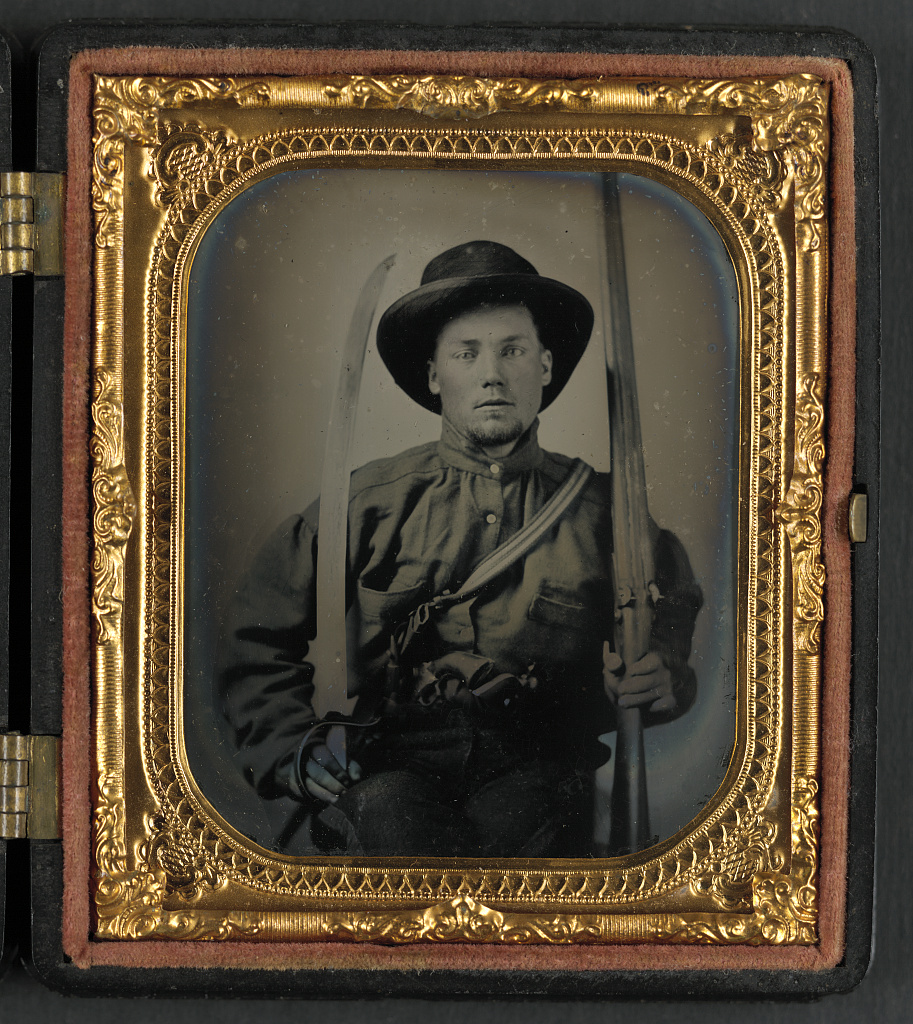
Unidentified soldier in Confederate uniform with double barrel shotgun, Bowie knife, and two pistols (between 1861 and 1865; LOC: http://www.loc.gov/item/2015645466/)

“Unidentified soldier in Confederate uniform with double barrel shotgun, Bowie knife, and two pistols” (Library of Congress)

No portraits of Booth, or any rebel officer or soldier are to be exposed for sale in the middle military division, by order of Major General Wallace.

A couple of scoundrels in Burlington county, N.J., have been collecting subscription [sic] for a monument to President Lincoln, and pocketing them.

General Grant has ordered Major General Dana, commanding the Department of the Mississippi, to report at his place of residence, and appointed Gen. Warren to that command.

150 years later we now know that Daniel How’s real name was Daniel Hough, apparently.

Cigars probably helped General Grant endure the war; they almost certainly contributed to his terminal throat cancer.

Another short clipping in the Seneca Falls, New York paper said that General Dana was under arrest in Vicksburg for his involvement in the Sultana Disaster, but he reportedly “resigned from the U.S. Army on May 27, 1865, and became a miner.”

Posted in 150 Years Ago This Month, Aftermath, Reconstruction | Tagged , , , , , , , , , | Leave a comment

last step in Connecticut?

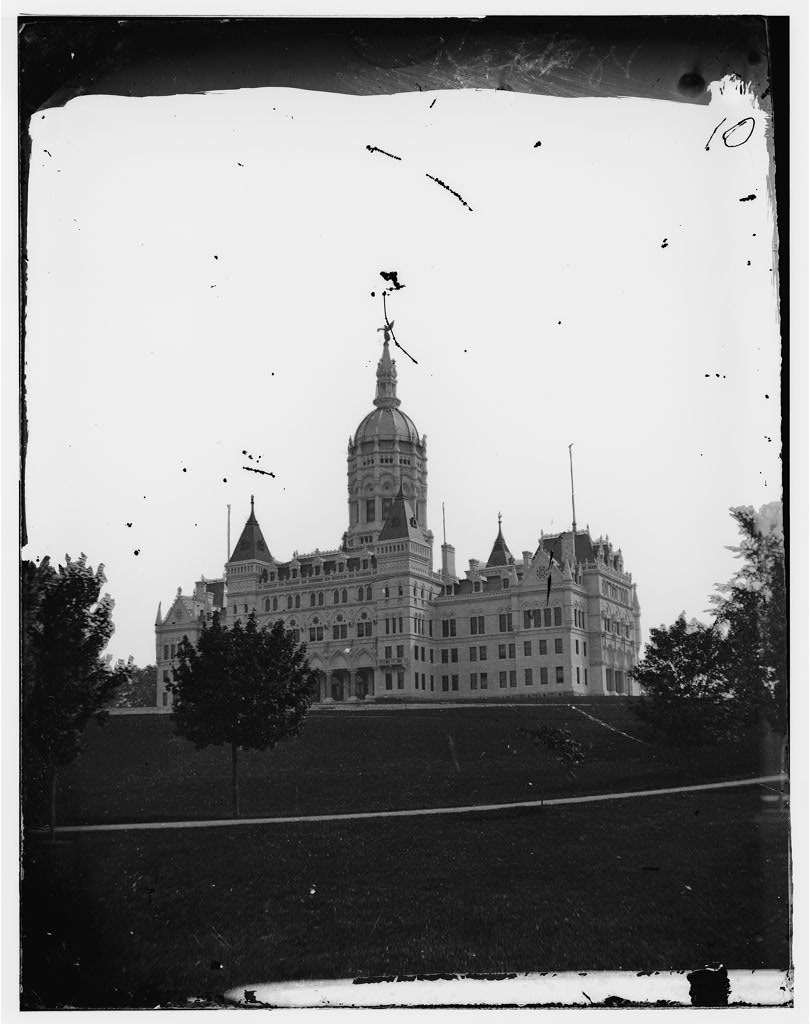
State Capitol Connecticut  (between 1861 and 1869; LOC: http://www.loc.gov/item/cwp2003005490/PP/)

“State Capitol Connecticut ” (c.1861, Library of Congress)

From the May 29, 1865 issue of The Chicago Times. (at the Library of Congress):

The legislature of Connecticut, now in session, has before it a proposition to amend the state constitution so as to give the right of voting to colored persons. It will probably pass without much opposition, as the only remaining step in the march of progress of the republican party.

You can read a July 7, 1865 clipping at University of Detroit Mercy that said Copperheads were going to battle against the proposed amendment. It compared Connecticut and New Hampshire to North and South Carolina, but praised New Hampshire’s indomitable John Parker Hale

Posted in 150 Years Ago This Week, Aftermath, Northern Politics During War, Northern Society, Reconstruction | Tagged , , , , , | Leave a comment