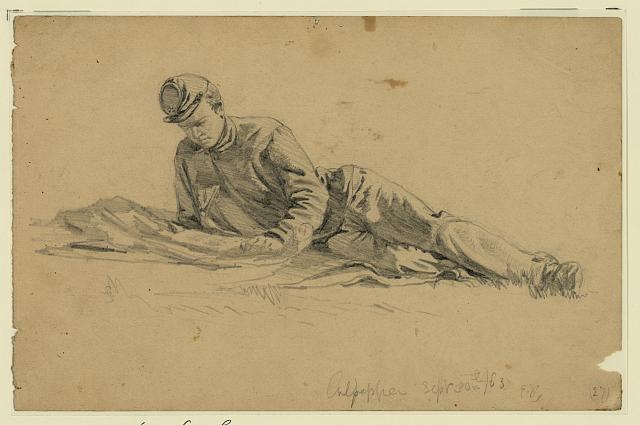
News from home (by Edwin Forbes, 9-30-1863; Library of Congress)
News from home (by Edwin Forbes, 9-30-1863; Library of Congress)
Where’s Morgan (and Hines)?
Maybe John Hunt Morgan and his confederates didn’t escape through a sewer under the Ohio Penitentiary; it might have been an air chamber. Maybe the escapees didn’t head to Kentucky right after the break-out; they might have gone north first.
From the Richmond Daily Dispatch December 5, 1863:
Escape of Gen. Morgan from the Ohio Penitentiary — he telegraphs his arrival in Canada.
Major General John Morgan, with Captains J. C. Bennett, S. B. Taylor, Ralph Sheldon, T. I. Hines. L. Q. Hokersmith, and S. T. Magee, made his escape from the Ohio penitentiary at Columbus, on Fridaynight, and has reached Toronto, Canada, with his companions. With his usual good humor, he telegraphed from Toronto to Columbus that they needn’t put themselves to any further trouble on his account. A telegram from Cincinnati gives the following description of the manner of his escape:
Col. Dick Morgan (a brother of Gen. John Morgan) and six Captains were confined in the lower range of cells, and with knives dog through the floor of the cell, which was composed of cement and nine inches of brick. Underneath the cell was an air chamber, running the whole length of the building. This was known to them. When once in the chamber they dug through the earth to the outside wall. Gen. Morgan occupied the cell over Col. Morgan’s. On Fridaynight, as the prisoners were locked up for the night, Gen. Morgan was allowed to exchange cells with Dick, who, everything being prepared, permitted his brother to take his place.
Some time during the night the prisoners crawled through the hole they had dug under the wall, and which they had carefully concealed. Taking ropes with them, they escaped from prison immediately between the main building and the female department. When once in the yard, escape was comparatively easy. They went to the southwest corner of the outer wall, near the big gate, threw their rope over the top, where it secured itself on one of the spikes, and by the aid of timber near at hand they clambered to the top and easily descended outside. There are no guards on the outer walls after certain hours. The prisoners were dressed in citizens’ clothes, not prison uniform.
Être comme Valjean!
Captain Hines, who is a mason and bricklayer, had charge of the work which resulted in the escape of the prisoners. A note was left for the warden, of which the following is a copy:
Castle Marion, cell no. 20,
November 27, 1863.
Commencement–Nov. 4, 1863.Conclusion– Nov. 20, 1863. Number of hours for labor per day, three. Tools, two small knives. “La patience amer mais sou fruit est doux.” (Patience is bitter, but its fruit is sweet.)
By order of my six honorable confederates.
T. Henry Hines, Capt. C. S. A.
It is written that Thomas Henry Hines surmised the existence of the air chamber under the prison because the cell floors weren’t damp or moldy. “He had been reading the novel Les Misérables and was said to be inspired by Jean Valjean and Valjean’s escapes through the passages underneath Paris, France.” After Toronto Hines and Morgan headed home. Hines was captured in Tennessee but escaped the night of the day he was caught. Hines plotted mayhem for the Union during the rest of the war.
Here’s a photograph that was apparently taken 150 years ago today, “The day when water was first turned into the aqueduct”:
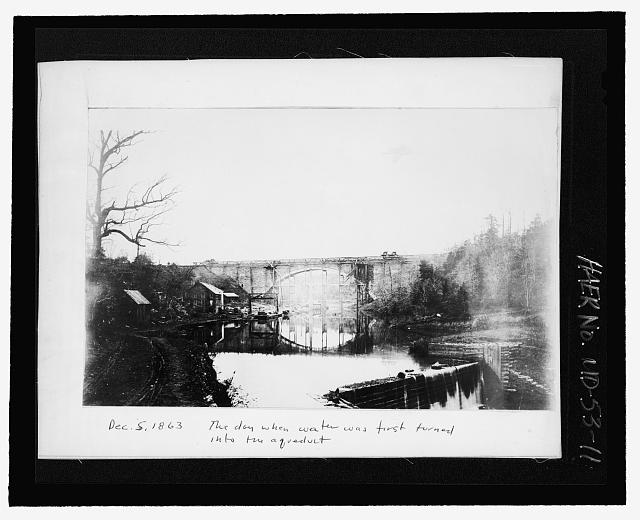
water over the creek
And here’s some supporting evidence from The New-York Times December 6, 1863:
NEWS FROM WASHINGTON. …
OUR SPECIAL WASHINGTON DISPATCHES.
WASHINGTON, Saturday, Dec. 5. …
THE POTOMAC FOR DRINK.
Water from the Potomac was let into the Washington Aqueduct to-day. Heretofore the city has been supplied, though insufficiently, from neighboring creeks. The event was formally celebrated, the proceedings closing with a Corporation dinner. …
This is sort of a break from the war – but sort of not, and not just because it was undoubtedly a good idea to keep the United States’ capital well-watered. Work on the Washington Aqueduct “began in 1853 under the supervision of “Montgomery C. Meigs“, who served as Union Quartermaster General during the Civil War. The Georgia-born engineer remained loyal to the United States. We last heard from him in November 1863 when Meigs reported the Union success at Chattanooga to Secretary of War Stanton. According to the Wikipedia link the Washington Aqueduct was Meigs’ favorite antebellum project.
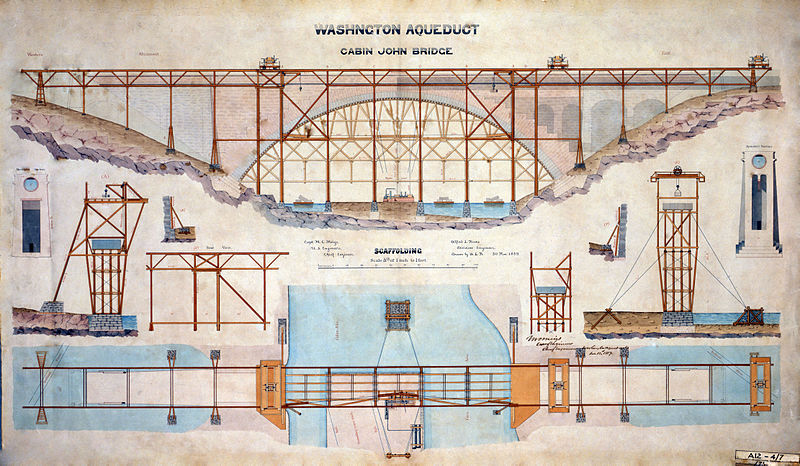
Rives’ 1859 drawing
The photo shows the Union Arch Bridge, which was designed by Alfred Landon Rives, a Virginian (son of William Cabell Rives ) who went with his state and eventually became “acting chief of the Engineer Bureau of the Confederate States”. Because of the war Rives’ name was replaced on a stone tablet on the bridge with Esto Perpetua. Furthermore, Jefferson Davis’ name was removed from a second tablet on the bridge that commemorated political leaders at the bridge work’s commencement and completion. Jefferson Davis was U.S. Secretary of War in 1853.
President Theodore ordered Davis’ name restored to the tablet in 1908. The Washington Aqueduct was fully completed in 1864 and is still in operation today.
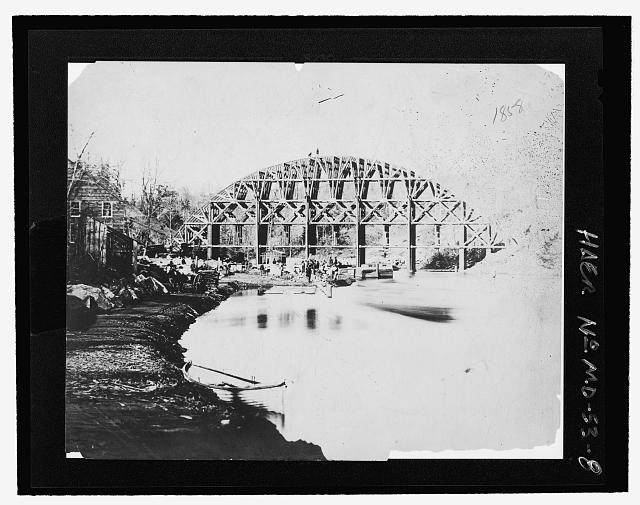
dinosaur of 1858
… a distinct possibility
Beware the dilapidated bridge. Inflation was hitting lumber prices in the Richmond area, but bridge owners were better off paying for repairs to avoid more costly lawsuits in the future.
From the Richmond Daily Dispatch December 4, 1863:
Mayo’s bridge
is becoming “more holy” than agreeable to those who have to cross it night and day. The flooring in many places is badly worn, and if not promptly repaired serious accidents may occur. Lumber is awfully high now, but bridge owners must buy at any price, or run the risk of serious accidents and law suits for heavy damages.
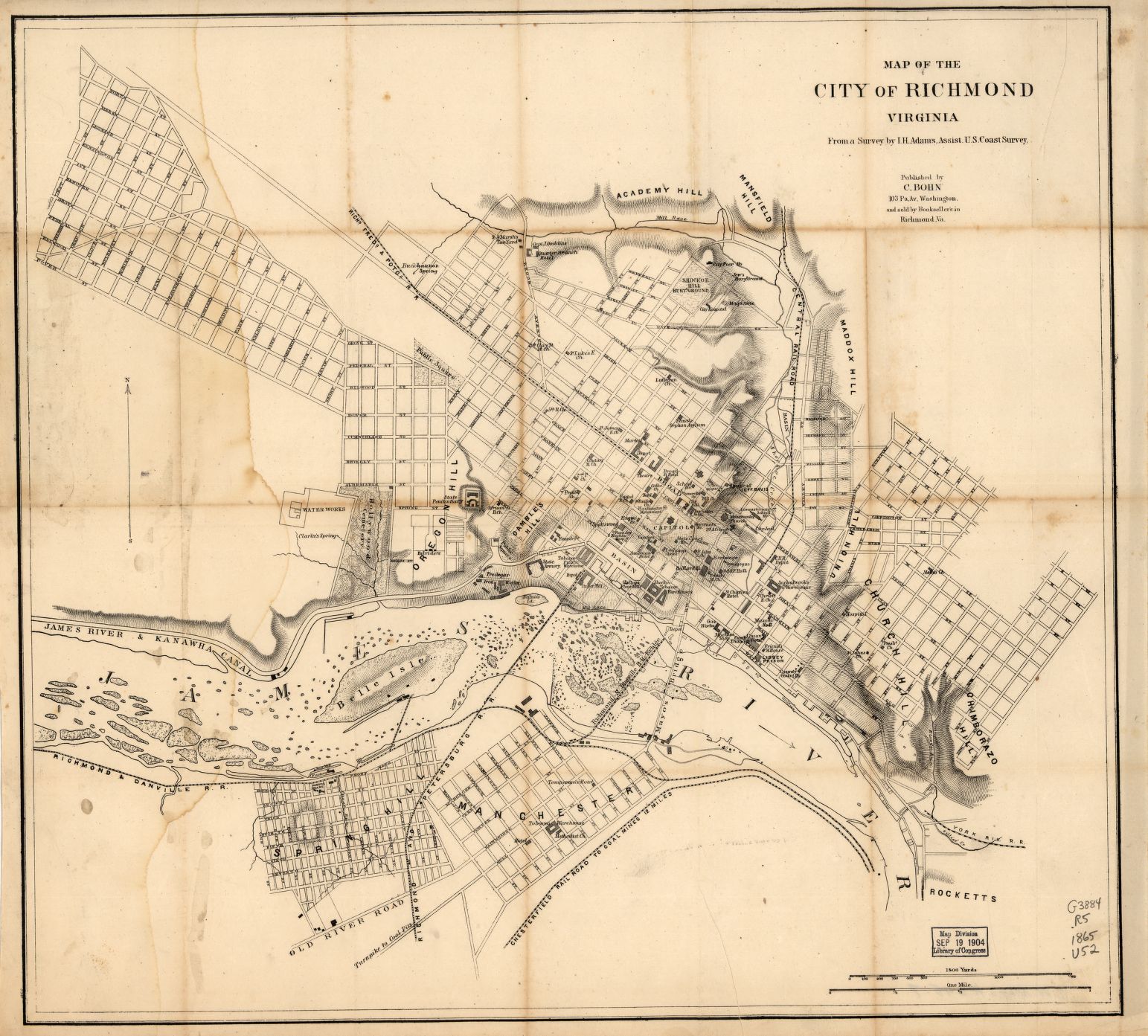
Mayo’s across the James
“I hate victims who respect their executioners.”
– Jean-Paul Sartre
150 years ago a Southern newspaper tried to reconcile rebel guerrilla attacks against civilians with notions of Southern chivalry. How to do it? Blame the Yankees- William Quantrill and his band were fighting Yankees with Yankee tactics.
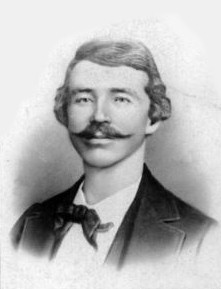
“Avenging Angel”
From the Richmond Daily Dispatch December 3, 1863:
Quantrell.
The humane and benevolent Abolitionists are grievously distressed and exasperated at the method of war adopted by the Missouri guerilla chieftain, Quantrell. That execrated warrior seems to have fashioned his campaigns after the Yankee system, to have infringed their patent right of barbarous and savage warfare. We can scarcely be expected to credit their accounts of the proceedings of any Confederate warrior, but, to some extent, believe it possible that Quantrell may have departed from the general Confederate custom of fighting wolves and hyenas according to the rules of the knightly tournament. Having to deal with Jim Lane and other incendiaries and murderers of that stamp, Quantrell fights them with their own weapons, exacts an eye for an eye and a tooth for a tooth, and pays the debt of retaliation with the most scrupulous sense of justice and to the last farthing. Whenever the Yankees hang a Confederate Quantrell hangs a Yankee, whenever a Confederate house is burned down a Yankee dwelling shares the same fate, and whenever a Yankee officer issues an order for Quantrell’s execution, as soon as caught, it is a lucky thing for the Yankee if he is not strangled by his own rope. Gen. Blount, who lately issued such an order, was himself caught before the ink was dry, and, attempting to escape, was provalled upon to stop by a shower of buckshot. Of course this uncivil conduct of Quantrell must meet the reprobation of all civilized mankind. He ought to allow his people and himself to be strung up and shot down like dogs, and ask pardon of the Yankees for putting them to such an expenditure of rope and powder. But he is a peculiar man, with a strange, savage sense of tit for tat, and lives in a wild country, where every one executes justice with his own hands. He is said to have suffered grievous wrongs at the hand of the enemy at the beginning of this war, and to understand how to right his wrongs in the only manner that barbarians can appreciate. The Yankees hold him in wholesome awe. He is as secretive and cunning as themselves, and makes retribution the study and passion of his life. They would give a round sum for Quantrell’s scalp, but the brains under that scalp are too much for them, and the men that seek his life are apt to fall into his hands. We observe that Quantrell makes no speeches and utters no threats, but retaliation is the law of his existence. He does not seem to be ambitio[u]s in the least, nor to be at all covetous of glory; but, on the contrary, to hold the pomp and circumstance of war in low esteem. He is the Avenging Angel of the wild Western border, and is destined, we trust, to scourge to the death the outlaws and murderers who have made Missouri and Kansas shudder with their crimes.
William Quantrill and his guerrilla force raided Lawrence, Kansas in August 1863. Quantrill said the motivation for the Lawrence Massacre was “To plunder, and destroy the town in retaliation for Osceola.”. Jim Lane led a plundering attack with executions on Osceola, Missouri in September 1861. You can read a Northern account of the attack on Lawrence at Son of the South
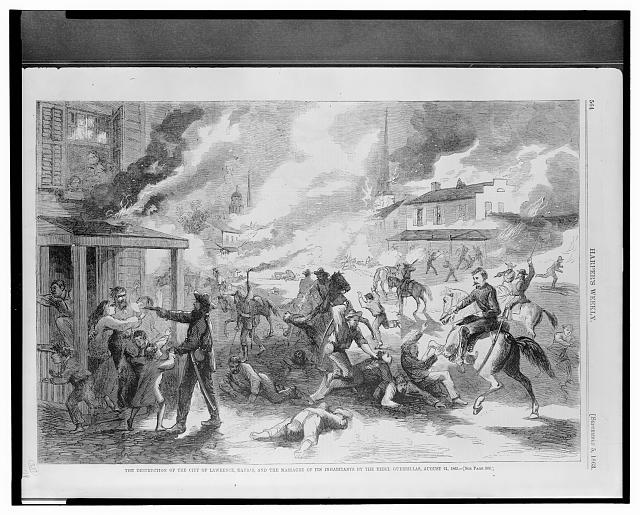
Lawrence – no ” knightly tournament”
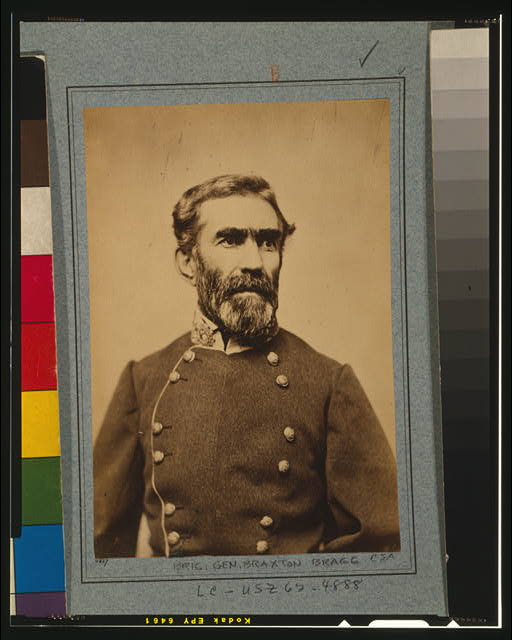
old porcupine heading to Richmond
“In an emotional ceremony, General Braxton Bragg surrenders command of the Army of Tennessee to General William J. Hardee at Dalton, Georgia[1]”
From the Richmond Daily Dispatch December 8, 1863:
Farewell order of Gen. Bragg.
The following is Gen. Bragg’s farewell order to his army:
General Order, No. 214.
Upon renewed application to the President his consent has been obtained for the relinquishment of the command of this army. It is accordingly transferred to Lieut. General Hardee.
The announcement of this separation is made with unfeigned regret. An association of more than two years, which bold together a commander and his trusted troops, cannot be severed without deep emotion. For a common cause, dangers shared on many hard fought fields have cemented bonds which time can never impair. The circumstances which render this step proper will be appreciated by every good soldier and true patriot. The last appeal the General has to make to the gallant army which has so long nobly sustained him, is to give his successor that cordial and generous support so essential to the success of your arms. In that successor you have a veteran whose brilliant reputation you have aided to achieve. To the officers of my General Staff, who have so long, zealously, and successfully struggled against serious difficulties to support the army and myself, is due, in a great degree, what little success and fame we have achieved. Bidding them and the army an affectionate farewell, they have the blessings and prayers of a grateful friend.
Braxton Bragg.
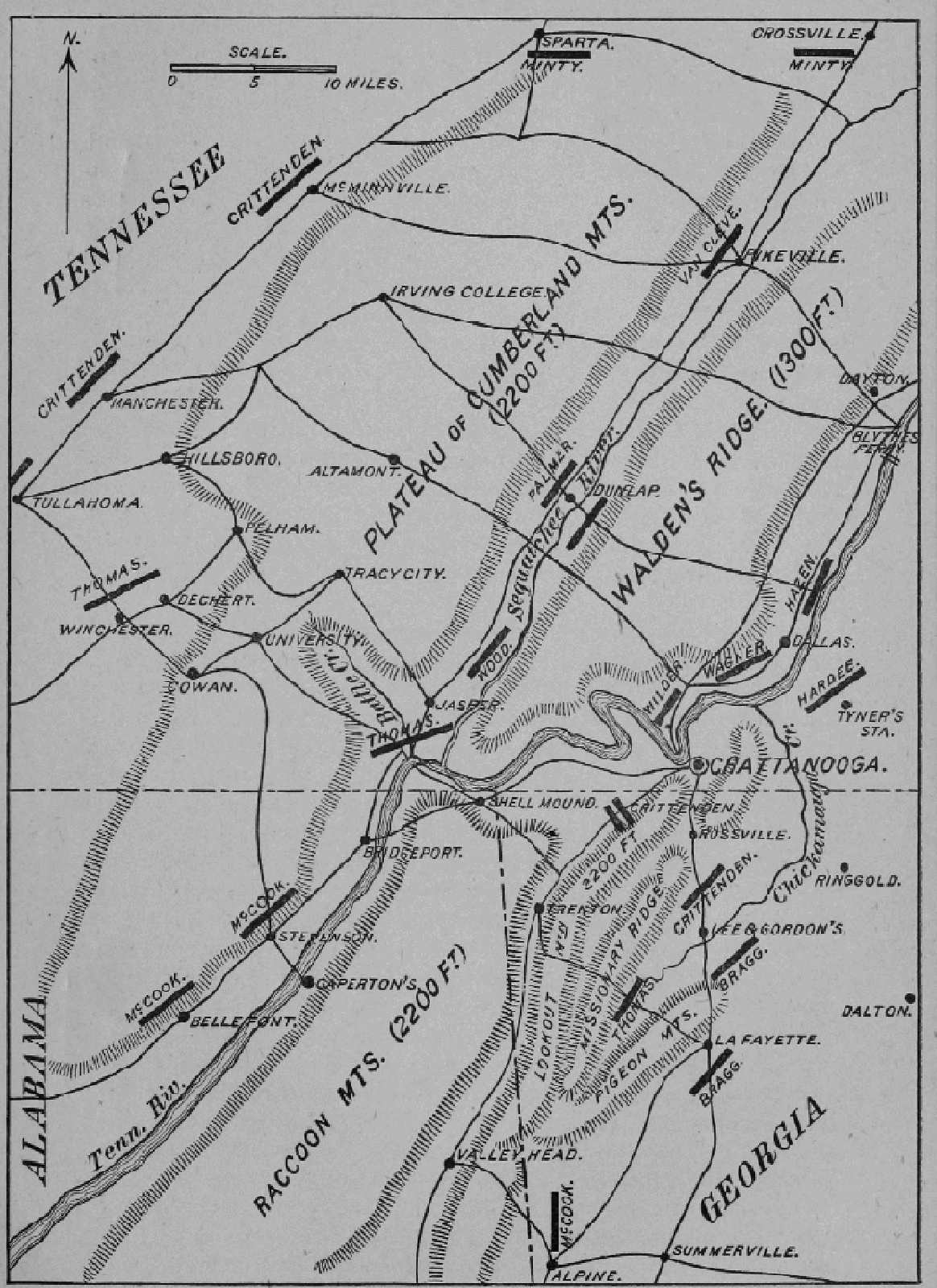
land of the last straw
On assuming command, Lt. Gen. Hardee issued the following General Order:
Soldiers of the Army of Tennessee:General Bragg having been relieved from duty with the army, the command has devolved upon me. The steady courage, the unsullied patriotism of the distinguished leader who has shared your fortunes for more than a year, will long be remembered by this army and the country he served so well. I desire to say, in assuming the command, that this is no cause for discouragement. The overwhelming numbers of the enemy forced us from Missionary Ridge, but the army retired intact and in good heart. Our losses are small, and will be rapidly repaired. The country is looking upon you. Only the weak tide need be cheered by constant success. Veterans of Shiloh, Perryville, Murfreesboro’, and Chickamauga, require no such stimulant to sustain their courage. Let the past take care of itself. We can and must take care of the future.
[Signed,]
W. J. Hardee.
Braxton Bragg would head to Richmond, where he became military adviser to Jefferson Davis. William J. Hardee only accepted overall command of the Army of Tennessee on a temporary basis. President Davis would have to pick a more permanent replacement.
You can read a thorough and even-handed analysis of Braxton Bragg’s generalship at The Cincinnati Civil War Round Table. Grady McWhiney begins his piece with a Confederate girl’s first impression:
As the Confederacy was dying, A Georgia girl wrote in her diary: “Generals Bragg and Breckinridge are in the village with a host of minor celebrities. General Breckinridge is called the handsomest man in the Confederate army, and Bragg might be called the ugliest. He looks like an old porcupine.”
And Bragg could be prickly. I’m pretty sure I’ve heard Civil War historian Gary Gallagher say part of the reason for that is that Bragg never really felt physically well because of untreated and/or untreatable ailments.
A coincidence that Breckinridge and Bragg are next to each other in the following photomontage:
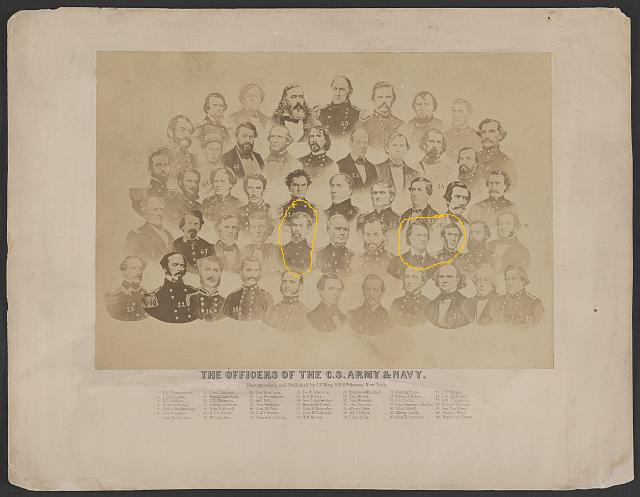
Hardee, Breckinridge, and Bragg
Power of the Press
In the 1863 fall elections the Union ticket (Republicans and War Democrats) swept all New York statewide offices. Here a Democrat newspaper believes the problem to be Abolitionists sending their journals to families across the country with the help of the Republican bureaucracy. To prevent Union tickets from winning big in the 1864 elections, which include the U.S. presidential contest, the editorial urges its readers to supply their neighbors with Democrat papers. Unfortunately the following clipping got cut off in midstream.
From a Seneca County, New York newspaper in November or December 1863:
The Duty of the Hour.
We have repeatedly urged upon our conservative friends the manifest propriety of liberally advocating sound Democratic principles. This is the only hope we have of overcoming the madness and folly of the hour. The Abolitionists fully understand the power of the press and they lose no opportunity to advance their own dangerous dogmas in this particular manner. – They have devised a systematic plan for flooding the country with papers teaching fanaticism in all its various forms, and the great retenue [sic] of postmasters, provost marshals, collectors, &c., &c., gives them superior advantages over their opponents. – The only way to counteract them is by increased watchfulness and energy. If the circulation of Democratic newspapers could be increased full one half, we should sweep the abolition party forever into oblivion. – Democrats, therefore should lose no time in seeing that every locality and neighborhood are supplied with sound Democratic journals, and we appeal to our friends to give this matter their serious attention. If any family be unable to take such a paper, efforts should be made to supply it for the coming year, at all avents [sic]. Let not the enemy sow tares among you. We believe there is a concerted plan now being carried out to poison the minds of every Democratic family that can be reached, by sending it some abolition newspaper. This should be prevented by a prompt and general effort to do exactly the opposite. One half of the next year’s campaign may be considered done when conservative men have thoroughly supplied their respective neighborhoods with papers of sound political principles. When this accomplished our friends can drop politics for the … [cut off here].
Another clipping near this one in the notebook basically equated War Democrats with Abolitionists.
I haven’t seen any evidence of Republican newspapers in the Civil War clippings notebook in the Seneca Falls library, but in a different notebook I was excited to see the front page of a Seneca County Free Soil newspaper from 1848. *** 12/02/2013: Yesterday I checked it out again. The Masthead from the October 3, 1848 issue:
A Political and Family News Journal, Published every Friday Morning, at Seneca Falls, New York. – Terms: $1,50 in advance, or $2,00 at the end of the year.
It wasn’t just in Seneca Falls that people were already planning for the 1864 elections. Would other Republicans oppose President Lincoln’s renomination?
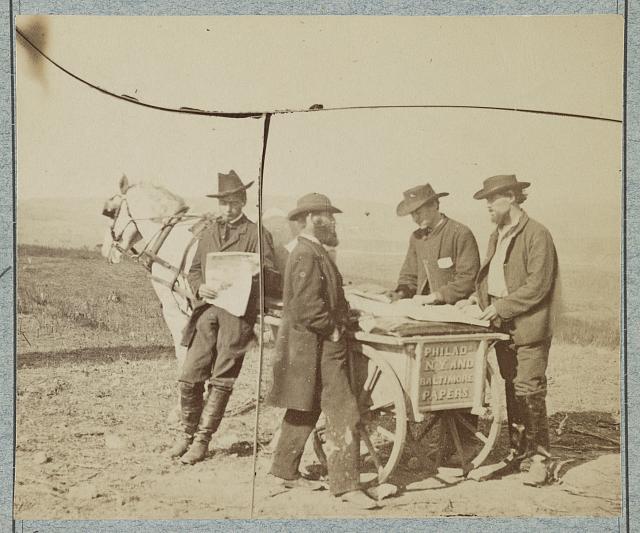
newspaper man at Union camp in Culpeper, Va. November 1863 (Library of Congress)
From the Richmond Daily Dispatch November 12, 1863:
The Presidential question.
A Washington telegram to the Herald says:
The political cauldron is beginning to boil here. Parties and factions are preparing for the final struggle. It is a noticeable fact that, among the wire workers already actively engaged, Chase in the Cabinet, and Banks in the field, are now the only opponents of the re-election of Mr. Lincoln, who have preserved the organization which supported them in the Chicago Convention. They are in fact the only Presidential candidates who appear now to have organized parties at their backs. The Chase forces are marshalled from the Northwest, and those of Banks come from the New England States. The contest is being rapidly developed. The fears of Mr. Lincoln’s advocates are that he may be slaughtered in the house of his friends.
________________________________________________
![Bird's eye view of Mauch Chunk, from Mount Pisgah tow[ard Le]high Gap in the distance (between 1857 and 1867; LOC: LC-DIG-ppmsca-19632)](https://www.bluegrayreview.com/wp-content/uploads/2013/11/19633r.jpg)
Mauch Chunk between 1857 and 1867 (Library of Congress)
From The New-York Times November 7, 1863:
The Origin of the Troubles Terrible Outrages The Results of Copperhead Teachings.
BEAVER MEADOWS, Friday, Nov. 5, 1863.
Banks Township, Carbon County, Pennsylvania, is a mining region of little note, yet a district lively with work, and embracing within its narrow circuit some of the richest coal orchards in Pennsylvania. Perched on the very highest portion of land in the State, in a cold and desolate r[e]gion, peopled only by Irish, Welsh and German miners, and the few agents and owners of the mines, but little that transpires below ever comes up here. If the half which has occurred here within the past three months ever came down to the press and the news marts of the people below, a very edifying comment upon the beneficent influence of Copperhead teachings upon their innocent disciples would be furnished, the incendiary followers of WOODWARD, HORATIO SEYMOUR, &c. It is not exaggeration to say, that here in Banks Township, situate, lying, and being but one hundred and twenty miles from New-York City, and but one hundred miles from Philadelphia, a reign of mob-law, as full of incidents of riotous brutality, and daily scenes of cola[d] blooded and deliberate murder has long existed, equaling the records of any period of equal length in any territory of the same size in Eastern Tennessee. …
The success of this insolent violation of law and order inaugurated the reign of terror which has settled down on this district. Mob orators from Mauch Chunk have told these deluded miners that “they must not submit to the Lincoln tyranny, that the object is to draft every Democrat, that they must stand in the doors and resist every officer connected with the draft who comes near them,” &c., &c. The results of this dissemination of the cardinal doctrines of Copperheadism are briefly summed up in the following statement of facts: …
Mauch Chunk was renamed Jim Thorpe, Pennsylvania after the famous athlete’s death in 1953.
![FOOTBALL PLAYER [Jim Thorpe] (by Harris & Ewing, between 1910 and 1920; LOC: LC-DIG-hec-13257)](https://www.bluegrayreview.com/wp-content/uploads/2013/11/13257r.jpg)
Town’s namesake circa 1910’s (Library of Congress)
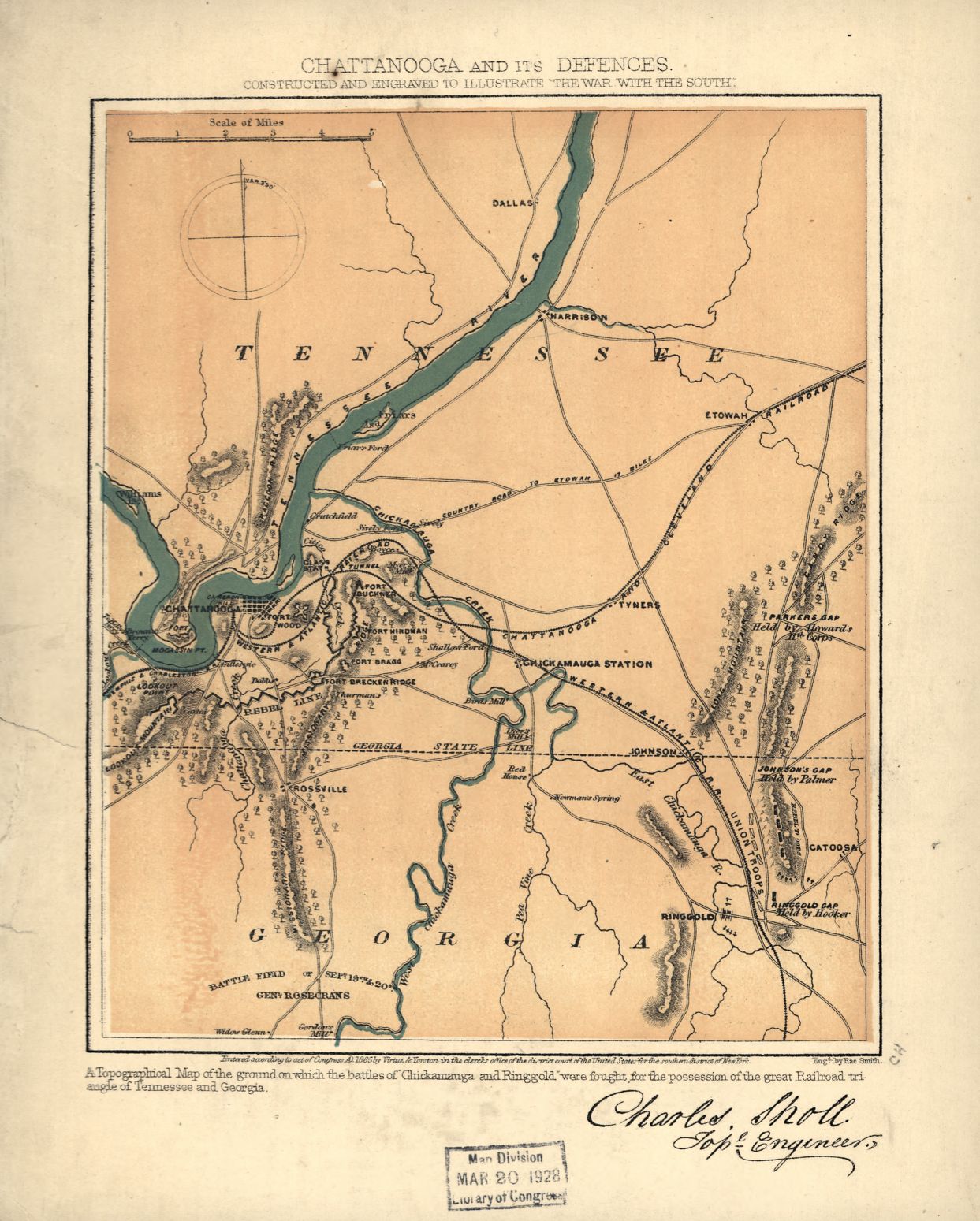
Union troops are in Ringgold but far from Atlanta
After their victory at Chattanooga Federal troops pursued the retreating rebels into Georgia. 150 years ago today the “Sallust” correspondent of the Richmond Daily Dispatch telegraphed home a description of the situation. It was published last in a series of telegrams from the front.
From the Richmond Daily Dispatch December 1, 1863:
Latest from General Bragg.
[from our Own Correspondent.]
Dalton, Ga., Nov.27th, 1863.
–The army reached Ringgold last night without molestation until near the town, when our rear was attacked. …
[Third Dispatch.]
Resaca, Nov.29.
![[Battle of Ringgold, Ga.] (by Alfred R. Waud, 1863 November 27; LOC: LC-DIG-ppmsca- 21308)](https://www.bluegrayreview.com/wp-content/uploads/2013/11/21308r.jpg)
Union forces slowed up at Ringgold
–The enemy retired to Ringgold after their bloody defeat by Gen. Cleburne, who captured 300 prisoners, four flags, and killed and wounded 1,500.
Their advance is now at Ringgold, and our advance is near them. They destroyed the bridge when they retreated.
The Confederate army is in position at Dalton and in front of it. All the trains are ordered back to Resaca, (ten miles in rear of Dalton.)
The enemy cannot advance without the railroad, and they have no cars. There is no reason to apprehend an advance now, if at all, this winter.
The rains are heavy, and the roads horrible.
It is bitter cold, and shoes and blankets are needed for our suffering soldiers.
Sallust.
The next day Sallust expanded on the telegram and pondered whether Union General Grant would try to advance further toward Atlanta during the coming winter. The correspondent believed the odds were against it because of the difficulty of repairing railroads and/or foraging and crossing rivers during winter. The cold weather is already affecting the Confederate army short of blankets and shoes lost on the retreat.
From the Richmond Daily Dispatch December 7, 1863:
From Gen. Bragg’s army.
[from our Own Correspondent.]
Resaca, Ga., Nov.30, 1863.
The news from the front, a telegraphic synopsis of what I sent you last night, is of an encouraging and reassuring character. The enemy’s advance forces, after their bloody repulse between Tunnel Hill and Ringgold by Cleburne, retreated to the mountain pass at the latter place, where they still remained at last advices. They destroyed the bridges as they retired, thus showing that they do not propose to follow us further at present, and that they are not willing for the Confederates to get at them. Our rear is on this side of the burnt bridges beyond Tunnel Hill, where it presents a stern and defiant front. The main army is encamped around Dalton, where General Bragg has established his headquarters. The trains and such forces as had reached Resaca have been ordered back to the same place, and I shall follow as soon as my horse is in condition to travel.
The opinion was advanced in my telegram last night that there was no reason to apprehend an immediate advance of the Federal army. Such is still my conviction. If the army could not be subsisted at Chattanooga without the aid of the railroad from that point to Bridgeport, neither can it be subsisted at Dalton or Kingston without the possession of the Western and Atlantic road, and a sufficient number of locomotives and cars for the transportation of supplies. These locomotives and cars Gen. Grant has not and probably cannot procure for some time. Rolling stock which would answer for one road would be inadequate for two. The Federal commander will find it necessary, therefore, in order to an advance into the country, to accumulate supplies at Chattanooga, to repair the railway bridges which his advance forces have already destroyed in the vicinity of Ringgold, and such others as the Confederates may destroy, and to provide a sufficient number of care and engine to transport supplies for his troops.
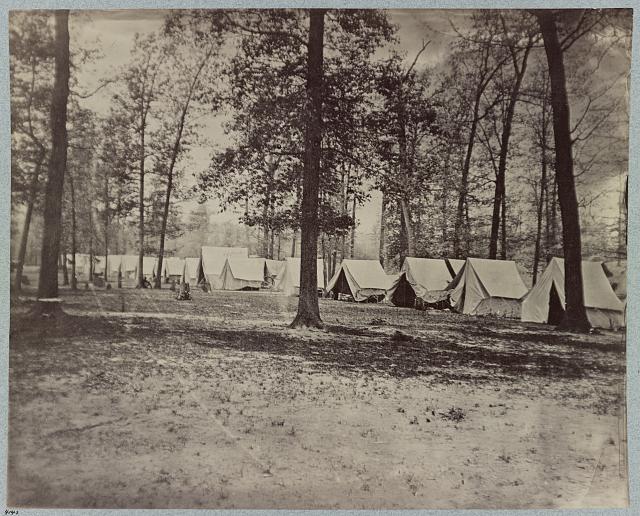
“Headquarters of Gen. Geo. H. Thomas, Ringgold, Georgia” (Library of Congress)
In advancing this opinion, I take it for granted that he must advance, if at all this winter, by the railroad route, and not by Willis Valley, in the direction of Rome. The roads by the latter route, if not impassable in winter to heavily laden army wagons, are of such a character as to render it difficult, if not impossible, to subsist as large an army as his by wagon trains alone. Indeed, if Gen. Grant had intended to move directly upon Rome, Stevenson, and not Chattanooga, would have been chosen as his base of supplies, and, in that event, the struggle for Lookout Mountain and Missionary Ridge would not have been necessary.
But will Gen. Grant advance at all this winter? [It] is impossible, of course, for any one except the Federal commander himself to answer this interrogatory, though it is permissible for us to speculate upon his probable designs, with the aid of such lights as are furnished by his previous conduct and present situation. Omitting, as unnecessary to the argument, any inferences that might be drawn from his former campaigns, it is sufficient to say that he has neither the supplies nor the transportation to enable him at this time to move upon Atlanta, the acknowledged goal of his ambition and the desires of his Government. To advance along the railroad at this inauspicious season of the year, and repair the road as he moves, would be a herculean task — a task, let us hope, far beyond his power of accomplishment. It is one hundred and thirty-eight miles from Chattanooga to Atlanta; the wagon made are inferior, and the intervening country is traversed by several and numberless water courses.
Can he cross this wide track under the heavy rains and frequent snows of winter? If he cannot, will he tempt to march a part of the way now, and the remainder in the spring? The suggestion was made some time ago, in one of these letters, that his efforts this fall would probably be limited to an attempt to get possession of the region of country lying west of the west branch of the Chickamauga, and that early next spring he would put his army in motion towards the great railway centre at the Confederacy. Can he do more than this now? The district from this place to Chattanooga, fifty miles in width, has been stript of its supplies, and an invading army would have to bring along with it all it required for its support. Grant may make an effort, however, to get possession of Dalton, the point where the Georgia and East Tennessee road unites with the Western and Atlantic road, and even to reach the Etowah river; but there is no reason to believe that he will attempt to go further now. The immediate possession of Dalton was doubtless one of the objects of his pursuit of Gen. Bragg since it would have cut off all communication by railway with Knoxville, and all possibility of succor to Gen. Longstreet.
That an effort will be made to capture Long street and his command, there is no room to doubt. At last accounts, the 23d inst., Knoxville was completely invested by the Confederates, who were only waiting for reinforcements, then about due, to make an assault upon the town. An intelligent officer, who left on that day, is very confident that the attack, if not prevented by the success of the enemy at Chattanooga, would prove successful.–Wheeler, with a portion of his command, has arrived at Dalton, having on his way chased the enemy from Cleveland and recaptured a portion of our lest wagon train.
Capt. Hoback, of the Quartermaster’s department, informs me that our total loss of wagons during the late battle, and the operations which preceded and succeeded it, was about one hundred, including ten ordnance wagons taken on Missionary Ridge. Our loss of artillery is not known to me, but I suppose it was about equal to our captures at Chickamauga — say forty guns. I will endeavor to send you a detailed account of our losses in this particular as soon as I return to D[a]lton.
The weather is exceedingly cold, and many of the troops lost their blankets and shoes in the resent fight and on the retreat. Will not the people open their hearts and purses?
Sallust.
The following cartoon was published in the December 12, 1863 issue of Harper’s Weekly (at Son of the South. Maybe it means that the North had come to realize that Chattanooga was a big victory but far from conclusive.
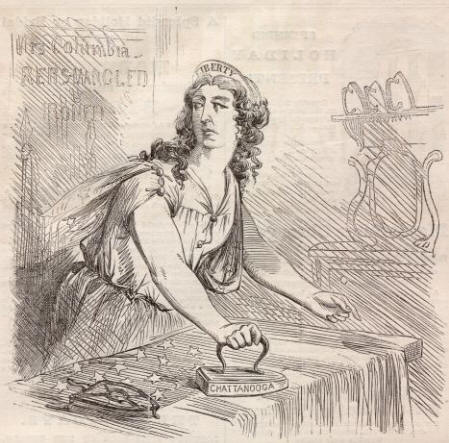
IRONICAL.
MRS. COLUMBIA. “There! Perhaps I hav’nt taken the Rebel Kink out of the Old Flag
with this BIGGEST IRON of mine!”
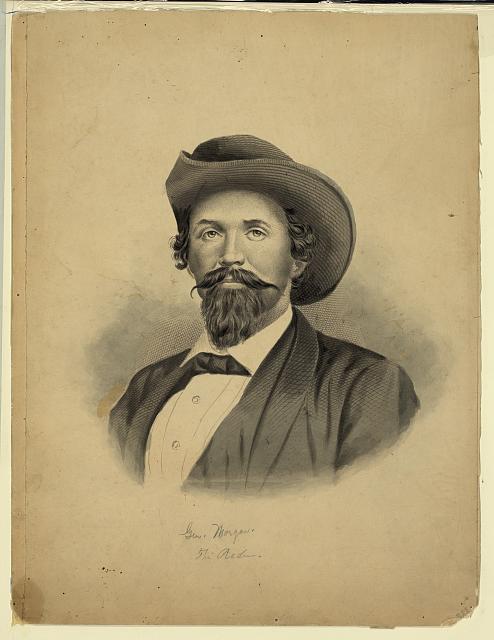
free
Morgan’s Raid through Kentucky, Indiana, and Ohio during June and July of 1863 ended when Confederate General John Hunt Morgan was captured on July 26th. He escaped from the clink about four months later.
From The New-York Times November 29, 1863:
ESCAPE OF JOHN MORGAN.; The Noted Horse-Thief and Six of his Officers Break Out of Columbus Jail. …
COLUMBUS, Saturday, Nov. 28.
Maj.-Gen. JOHN MORGAN and six of his officers — Capts. BENNETT, TAYLOR, SHELDON, HAINES, HOCKERSMITH and MAGEE — escaped from the Ohio Penitentiary this morning between 2 o’clock and daylight.
JOHN MORGAN, on retiring, changed with his brother DICK from the top cell to the lower tier. The floor of the lower cell is two and a half inches thick, in which a hole was cut, under the bed, leading down into a two and a half foot sewer, running to the main wall around the Penitentiary. This wall was cut under, and the party escaped into the open country. The night was dark, with heavy rain. All efforts are being made by the authorities for his recapture.
CINCINNATI, Friday, Nov. 28.
JOHN MORGAN and six of his officers, viz.: Capts. BENNETT, TAYLOR, SHELDON, HAYNES, HACKERSMITH, and MCGEE, escaped from Columbus Penitentiary last night, by digging through the floor of their cell to a sewer leading to the river. One thousand dollars reward is offered for the arrest of MORGAN.
Wikipedia does not mention an escape through a sewer. Instead Morgan and his confederates used a hand-made rope to climb a prison wall. “Morgan and three of his officers, shortly after midnight, boarded a train from the nearby Columbus train station and arrived in Cincinnati that morning. Morgan and Hines jumped from the train before reaching the depot, and escaped into Kentucky by hiring a skiff to take them across the Ohio River. Through the assistance of sympathizers, they eventually made it to safety in the South. ”
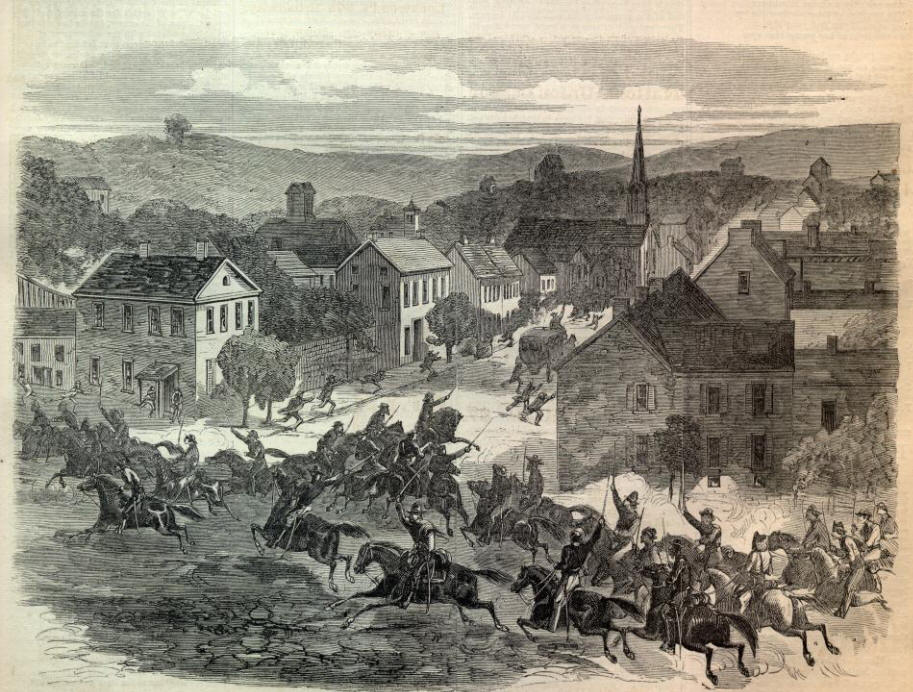
MORGAN’S RAID-ENTRY OF MORGAN’S FREEBOOTERS INTO WASHINGTON, OHIO.
The above image was published in the August 15, 1863 issue of Harper’s Weekly (at Son of the South), where you can also read more about the raid and capture. Perhaps unsurprisingly, the editors seem more upset about waging total war on defenseless civilians when the particular civilians are northerners. However, General Morgan was an equal opportunity freebooter – his men foraged from Abolitionists and Copperheads alike.
_______________________________________
_______________________________________
Mutually Assured Survival?
One rendering of the Mayflower Compact:
Modern version
In the name of God, Amen. We, whose names are underwritten, the loyal subjects of our dread Sovereign Lord King James, by the Grace of God, of Great Britain, France, and Ireland, King, defender of the Faith, etc.
Having undertaken, for the Glory of God, and advancements of the Christian faith and honor of our King and Country, a voyage to plant the first colony in the Northern parts of Virginia, do by these presents, solemnly and mutually, in the presence of God, and one another, covenant and combine ourselves together into a civil body politic; for our better ordering, and preservation and furtherance of the ends aforesaid; and by virtue hereof to enact, constitute, and frame, such just and equal laws, ordinances, acts, constitutions, and offices, from time to time, as shall be thought most meet and convenient for the general good of the colony; unto which we promise all due submission and obedience.
In witness whereof we have hereunto subscribed our names at Cape Cod the 11th of November, in the year of the reign of our Sovereign Lord King James, of England, France, and Ireland, the eighteenth, and of Scotland the fifty-fourth, 1620
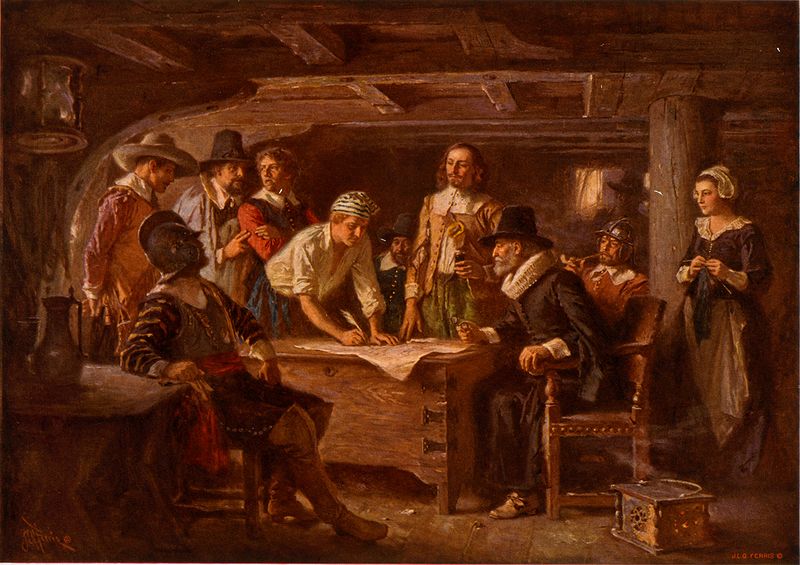
signing up for the “civil body politic” (The Mayflower Compact, 1620 by Jean Leon Gerome Ferris)
It seems that 150 years ago we were testing whether civil compacts could be abrogated.
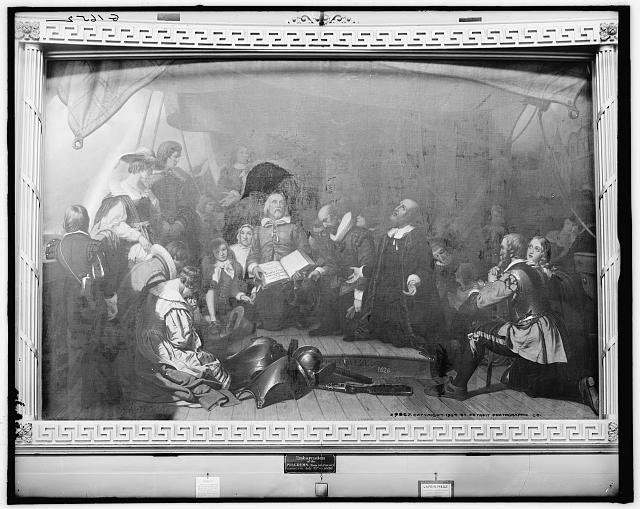
pilgrims leave Holland, July 1620 (Library of Congress)
Beware Pharaoh Seward
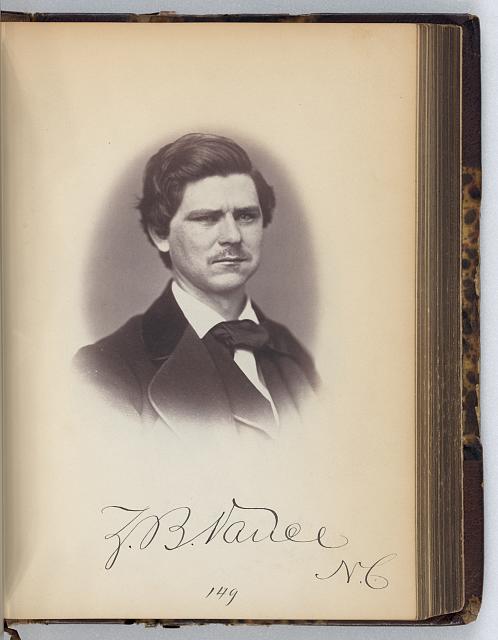
150 years ago today a Richmond newspaper published a portion of an address by North Carolina Governor Zebulon Baird Vance to the state legislature.
From the Richmond Daily Dispatch November 27, 1863:
Governor Vance’s message.
–The North Carolina Legislature assembled at Raleigh, N. C., on Tuesday last. We make some extracts from Governor Vance’s message:
The very important subject of feeding the poor, whose supporters and protectors are in the army, again demands our attention. The results the past year’s operations are most encouraging, and should serve to give our people confidence in the resources of their State. Great anxiety was fell last fall, as you know, on the subject of food, and fears were entertained that suffering, if not actual starvation, would be witnessed in many quarters. Under the authority conferred upon me by your body I purchased and stored away about 50,000 bushels of corn, 250,000 pounds of bacon, quantity of rice, &c., which I expected would go but little way in supplying the general wants. When the season closed and the new crop came in, however, to my surprise and gratification, I found that Major Hogg, Commissary of Subsistence, had only issued to the County Commissioners about one-third of the bacon less than one-half of the corn, and but very little of the rice. He reports still on hand some 70,000 lbs. of bacon, having fed a number of negroes engaged on the public works and sold to the army 100,000 lbs., with 20,000 bushels of corn. I have reason to believe that from various causes the crops this year have not been as abundant as usual, and that the public will be called on to do more than last season. But still I see no cause for alarm, and my last year’s experience has encouraged me to believe that all can be fed from our own resources by proper prudence and economy. I respectfully recommend a liberal appropriation among the several counties, according to population, for this purpose — at least double that of last year — and that I be allowed to buy and store away corn, flour, and bacon, as heretofore.
Reports are submitted herewith of the operations of the Ordnance, Subsistence, and Quartermaster Departments, which I trust you will find satisfactory. The enterprise of running the blockade and importing army supplies from abroad has proven a complete success. You will see from the report that large quantities of clothing, leather and shoes, lubricating oils, factory findings, sheet iron and tin, arms and ammunition, medicines, dye stuffs, blankets, cotton bagging and rope, spirits, coffee, &c., have been safety brought in, besides considerable freight for the Confederacy. Two thousand and ten bales of cotton have been sent to Liverpool, the proceeds of which are deposited to the credit of the State, less the amount of expenses of the vessel. With what we have imported, and the purchases in our home markets, I think I can safely say that the North Carolina troops will be comfortably clothed to January, 1865–should God in his providence so long see fit to afflict us with a continuance of the war — except as to shoes and blankets. Neither the Ordnance nor Quartermaster’s Departments placed too much reliance on foreign importation, but every effort has been made to stimulate home production.–Both the quality and quantity of arms and munitions manufactured have been improved in the past twelve months.
We know at last precisely what we would get by submission, and therein has our enemy done us good service — abolition of slavery, confiscation of property, and territorial vassalage! These are the terms to win us back. Now, when our brothers bleed and mothers and little ones cry for bread, we can point them back to the brick kilns of Egypt — thanks to Mr. Seward–plainly in view, and show them the beautiful clusters of Eschol which grow in the land of independence, whither we go to possess them. And we can remind them too, how the pillar of fire and the cloud, the conch safe guidon of Jehovah, went ever before the hungering multitude, leading away, with apparent cruelty, from the fullness of servitude. With such a prospect before them our people will, as heretofore, come firmly up to the full measure of their duty if their trusted servants do not fail them.–They will not crucify afresh their own sons, slain in their behalf, or put their gallant shades to open shame, by stopping short of full and complete national independence.
You can read the governor’s complete address at UNC. The Dispatch omitted that Mr. Vance’s request that the legislature write laws to encourage the raising of sheep because the fall of Vicksburg cut off supplies of Texas wool.
