Sickles’ turn at bat?

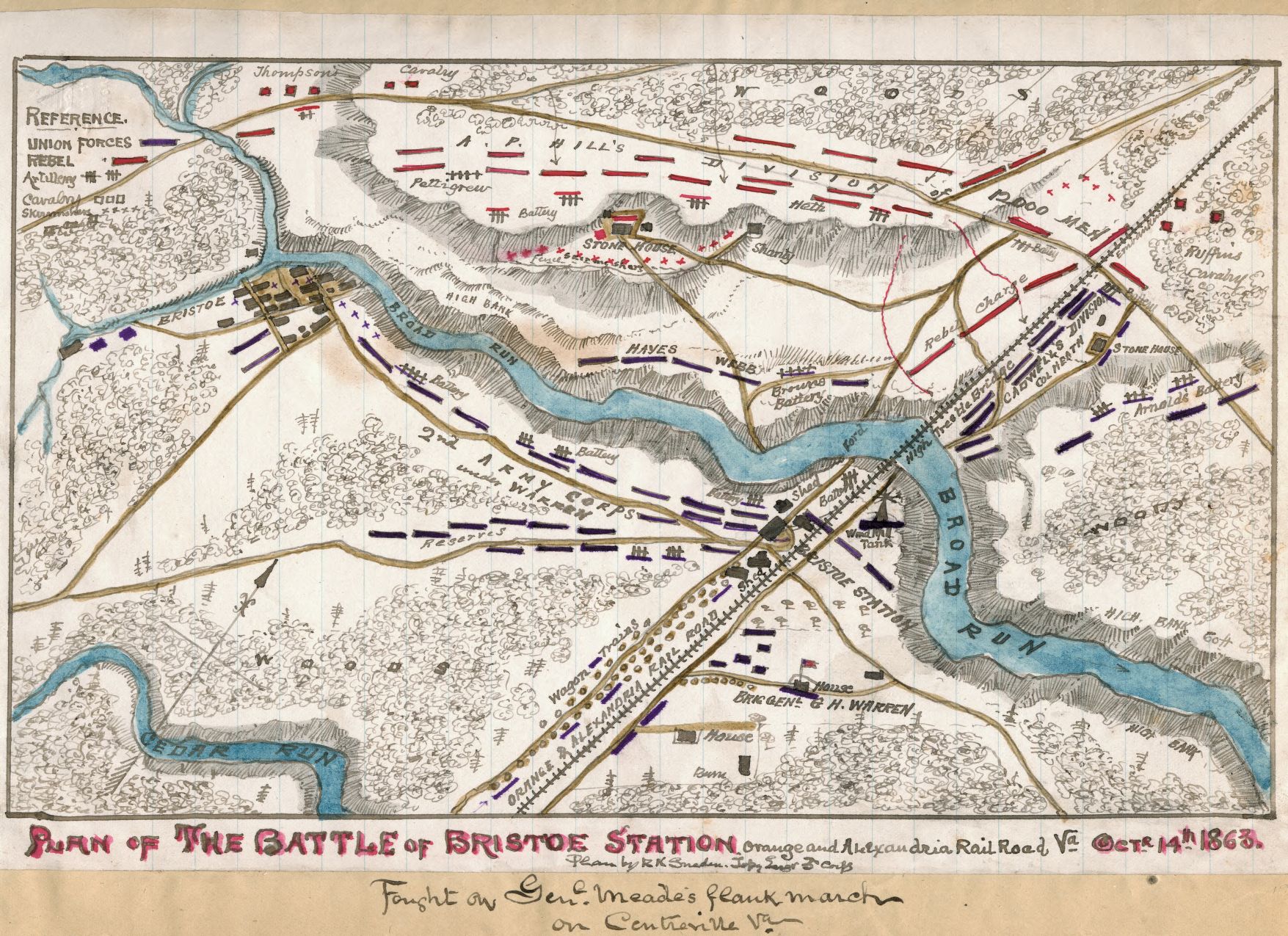
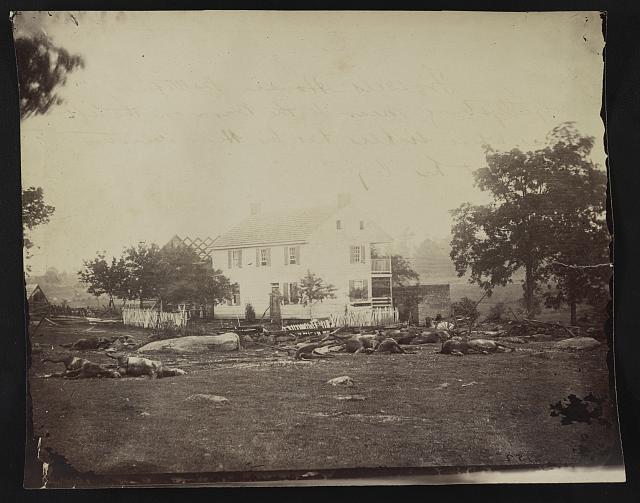
Battle of Bristoe Station (by Robert Knox Sneden c1863-1865; LOC: gvhs01 vhs00219 http://hdl.loc.gov/loc.ndlpcoop/gvhs01.vhs00219)

Bristoe Station 10-14-1863

This might not be on par with the May 1863 capture of Richmond, but here an upstate New York newspaper prints the rumor that there has been another command change in the Army of the Potomac. On the other hand, it was true that the Union and Confederate armies in Northern Virginia were once again approaching the Manassas battlegrounds as part of the Bristoe Campaign.

From a Seneca County, New York newspaper in October 1863:

Startling news from Virginia.

The news from Virginia is of the most startling character. The Army of the Potomac has been driven back to Manassas Plains and the Old Bull Run battle ground, 50 miles from the front recently occupied on the Rapidan. Lee’s whole force has again crossed the Rappahannock and from last accounts was preparing to give Meade battle. Skirmishing has been going on largely since Saturday last, in which it seems Meade has been badly worsted. – The authorities, as usual, suppress all intelligence, when disaster has befallen our arms. We have also the startling announcement that Meade has been removed from command and Gen Sickles appointed in his stead.

And, in this case, the Seneca County paper got its rumors directly from Gotham and The New-York Times of October 15, 1863:

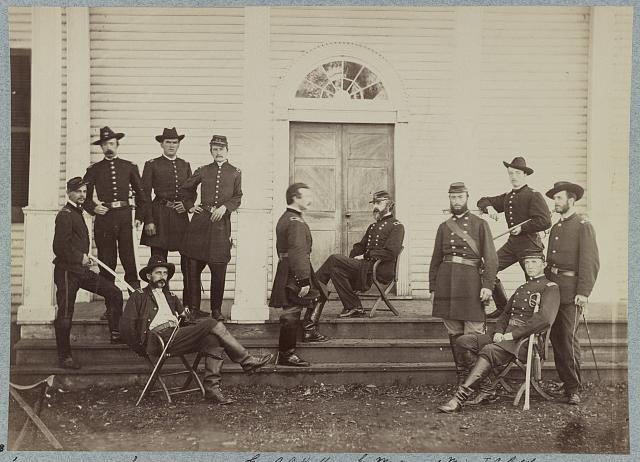
Gen. George G. Meade and staff, Culpeper, Va. Sept. 1863 (by Timothy H. O'Sullivan, 1863; LOC: LC-DIG-ppmsca-34109)

“fatal” command? (Meade and staff at Culpeper, September 1863)

BATTLE IMMINENT IN VIRGINIA.; Meade’s Army on Manassas Plains and Lee Across the Rappahannock. Our Army Stripping for the Fight. Rumor that the Battle Opened Yesterday at B[u]ll Run. OUR TRAINS ALL AT CENTREVILLE. The Cavalry Operations of Saturday and Monday. LATER. THE FIGHTING SATURDAY AND MONDAY.

WASHINGTON, Wednesday, Oct. 14.

The surplus baggage of the Army of the Potomac has been removed to the rear, and that army is stripping for fight. MEADE’s position yesterday morning was on the north bank of the Rappahannock, his right flank resting on the eastern slope of the Bull Run mountain. Since then, however, he has fallen back to the neighborhood of Manassas plains. Let’s whole force has crossed the Rappahannock, and were yesterday pressing our rear. A battle this morning was considered imminent. Our trains last night were all at Centreville.

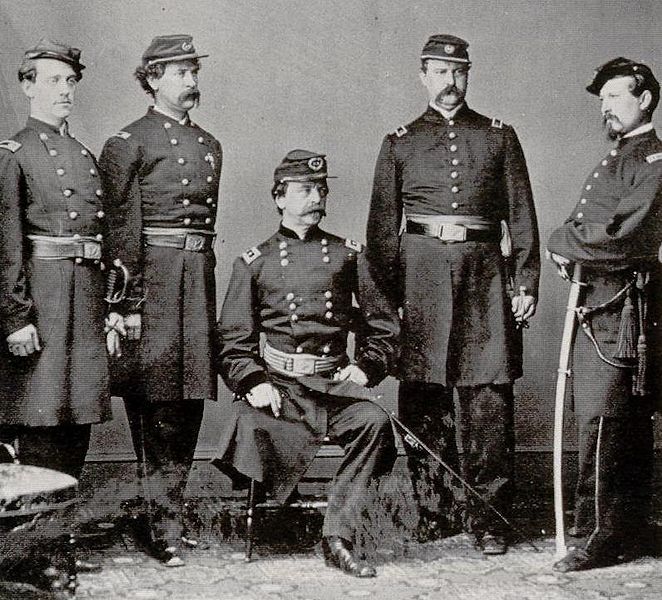
1863 photo of Daniel Sickles and his staff after the battle of Gettysburg

General Sickles with his staff

Eleven A.M. — Rumors are rife that a general engagement began at daylight this morning on the old Bull Run battle-ground.

The command of the Army of the Potomac, of course, is fatal. Gen. MEADE in his turn has been compelled to give place to some other man. His removal from command seems to have been determined on. His successor is said to be Maj.-Gen. DAN. E. SICKLES.

The next day The Times updated its information about Sickles as part of a story from Washington on October 15th:

… Maj.-Gen. DANIEL E. SICKLES, with his staff, left here for the front at 2 o’clock this afternoon. In case of a general engagement he will take command of his own corps. …

You can read about the actual events during  the October 14, 1863 Battle of Bristoe Station at Civil War Daily Gazette.

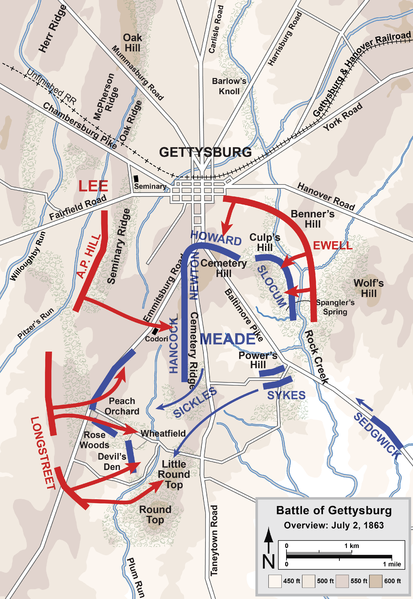
Daniel Edgar Sickles was a politician and a political general, who gained notoriety in 1859 for killing his wife’s lover, the son of Francis Scott Key. He was acquitted based on his defense of temporary insanity. On July 2, 1863 during the Battle of Gettysburg Sickles disobeyed orders by advancing his III Corps ahead of the main Federal defensive line. This created the salient in the Peach Orchard. During the July 2nd fighting Sickles right leg was hit by a cannonball and had to be amputated. He did not return to combat command during the war.

Gettysburg_Battle_Map_Day2 (Map by Hal Jespersen, www.posix.com/CW)

Sickles gets ahead July 2nd

Trossels house - battlefield Gettysburg - near to the barn on the left was where Sickles has his head quarters and lost his leg (by Timothy H. O'Sullivan, 1863 July; LOC: LC-DIG-ppmsca-35547)

dead horses near where Sickles’ leg was amputated at Gettysburg

_____________________________________________________

Hal Jespersen’s map of July 2nd at Gettysburg is licensed by Creative Commons

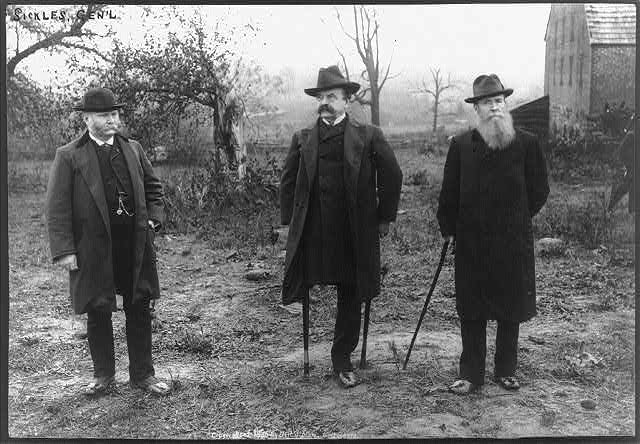
Gens. Sickles, Carr & Graham. Taken near Trostle's barn, Gettysburg Battlefield - on spot where General Sickles lost his leg, July 2nd, 1863 (c1886; LOC: LC-USZ62-69843)

The general returned (c1886) to spot where he lost his leg

Posted in 150 Years Ago This Week, Military Matters | Tagged , , , , , | Leave a comment

“Be he miser or patriot”

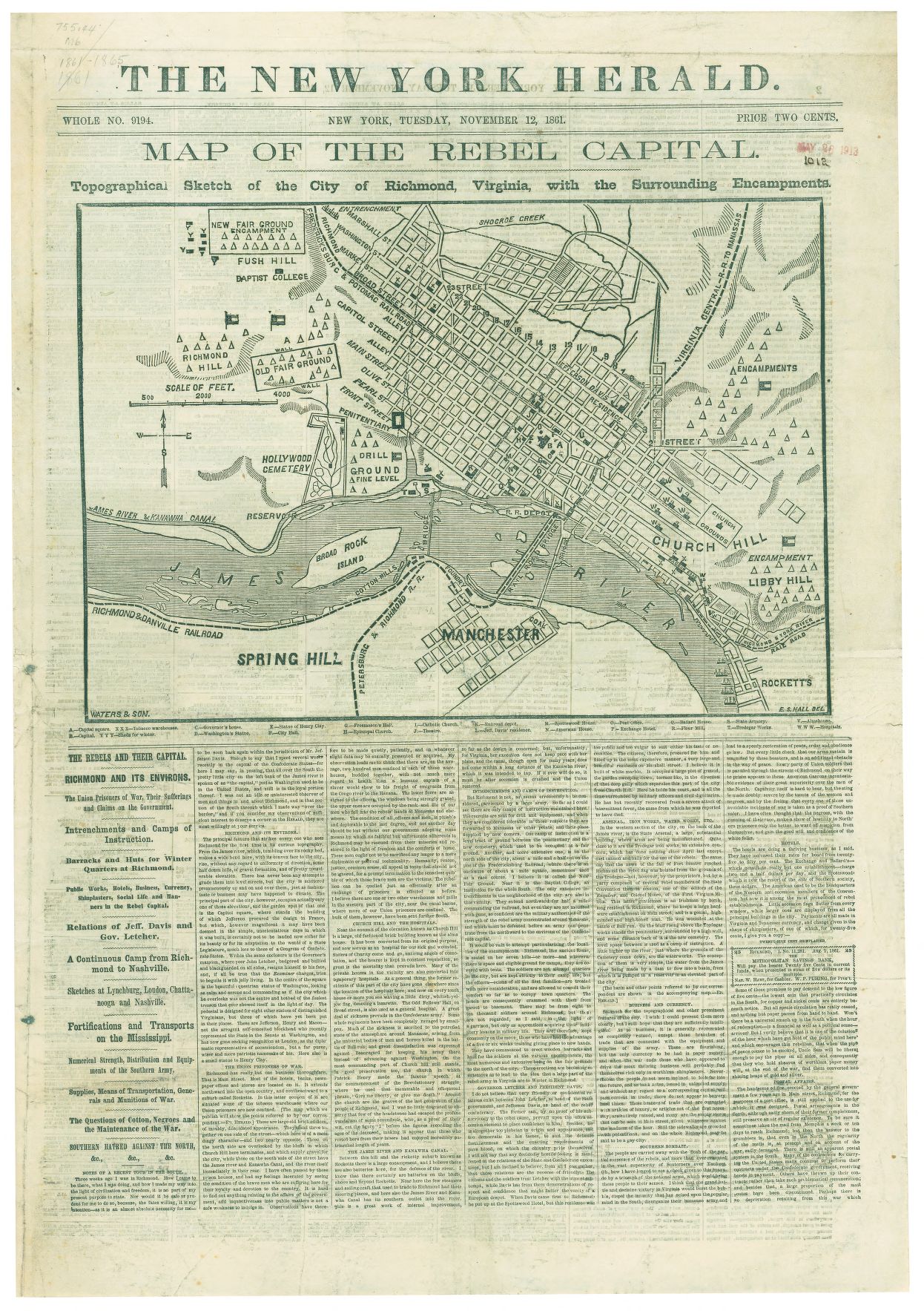
Richmond 1861 (LOC: glva01 lva00127 http://hdl.loc.gov/loc.ndlpcoop/glva01.lva00127)

NY Herald maps Richmond, November 1861

Here’s an example of an individual state trying to deal with the Confederacy’s rapid increase in the money supply. The Virginia Legislature was working on a scheme that would allow the national government to slow the printing of money by relying instead on loans and taxation. The loans would be from individual states and capitalists of the Confederacy. Each state would have a quota. The editors question whether the capitalists would go along with the plan, but argue that the rich should loan the money either out of self-interest or patriotism.

From the Richmond Daily Dispatch October 12, 1863:

Confederate currency and credit.

The depreciation of the Confederate currency, and the train of evils which flow from it, have occasioned very deep concern. The Legislature of Virginia directed its attention to the subject immediately it assembled. The finance committee of that body has had it under consideration and has consulted the financial officers of the Government, the presidents of the banks, and experienced commercial men, as to the best means to remedy those evils, already so grievous, and which threaten still greater inconvenience and distress.

We learn upon good authority that this committee has taken into favor a scheme framed by a prominent bank officer of the city (we may say Mr. Macfarland) which has for its object the diminution of the Confederate paper circulation, the stop page of the manufacture of paper money by the Government, and the resort after a time exclusively to taxation and the sale of bonds to meet the Government expenses. A scheme that will achieve those important ends will be hailed with satisfaction by the whole country, and must confer the greatest benefits upon the people and the Government. It is simple enough, but needs the concurrence of capitalists and the public to be carried into operation. It is a proposed loan of $200,000,000 to the Confederacy by the people and the States. For instance, the quota of Virginia, some $40,000,000, is to be made up of $25,000,000 by capitalists, and $15,000,000 by the State. –The State’s part to be raised by sale of bonds. It is assumed that such a loan to the Government will enable it to stop its manufacture of notes, and to gradually curtail its circulation:–its large revenue from taxation, and its liberal receipts from the tax in kind, keeping it,–favored as it will be by a very great reduction in the cost of everything from a reduction of the amount of its circulation — so nearly supplied with means for the war that it can readily sell its bonds to meet the deficit.

Whether or not the scheme will achieve this much cannot be known with certainty until it is tried. But it meets with the approval of some of the wisest financiers and bankers in the State, as well as some of the soundest political economists; and there should be no hesitation to try it. It cannot fail to improve greatly, and most opportunely, the circulating medium, and consequently to diminish most advantageously to the people and the Southern cause the cost of living. If it should not do all that is expected of it, it will, beyond all question, do this, and therefore it would amply reward the country.

Confederate States of America loan - seven per cent, February 20th 1863 - authorized by the Act of Congress C.S.A. of February 20th 1863 ( Richmond, Va. : Archer & Daly, [1863]; LOC: LC-USZ62-32897)

Will Southern capitalists invest? (bond authorized by CSA Congress in February 1863)

The question is, will capitalists agree to invest a part of their immense gains during this war in Confederate bonds? If they will do so the States will promptly do the part allotted to them in assisting the Government out of its difficulty. Every argument of self-interest, as well as patriotism, appeals to them to rally at once to the support of the Government. If the public credit is maintained they secure their large profits against the day of peace. If it is not, they will lose them irretrievably in the gulf of repudiation. We have not room to elaborate the arguments — such as the enhancement of the value of the credits they hold, so that they, in fact, part with nothing in lending to the Government; the reducing of the prices of all necessaries; the restoration of confidence; the encouragement of industry, and the establishment of cheerfulness and contentment in lieu of discontent and distrust in the public mind — We are enlisted in a cause dearer to us than life; for we peril our lives in it. –Does the man of means prize his money more than he does the blood of his children and relatives? Then let him make good his riches by helping to sustain the credit of the Government and purify the currency. If he thinks more of his country — If he considers the life streams of his own offspring dearer than the savings from his industry or his speculations — he will freely give these last to his country to help it in the prosecution of the war, that it may be terminated at the earliest day and with the greatest economy of the precious blood and the treasure of the nation. Every man who has a dollar to spare should give it heartily with some of these motives. Be he miser or patriot — a devotee of mammon or a true Christian and loyal citizen — he should not hesitate.

The proposition, we anticipate, will be laid before the Legislature at an early day. It is one that demands the promptest and most serious consideration. To be of service it must be speedily put in force. The evils it is proposed to remedy are growing with fearful rapidity. The circulation must be diminished — the system of meeting public expenses by manufacturing money must be checked or terminated, or affairs will arrive sooner than we imagine at a dead lock. The war cannot stop, indeed; but ruin will come upon the country in its financial matters, and distress will fall heavily upon all classes. What will become of the speculator? He cannot escape the storm. He must lose all as well as other people. Reduce the circulation — make one dollar worth as much as seven are now — reduce by consequence the cost of living — and you have also, by consequence, increased supplies, which will be better diffused — improved industry — better spirits amongst the people — added energy in the public defence, and renewed vigor and determination everywhere. The crisis demands an effort to accomplish all this. No man is true to his country — no man is true to his own interests and his own honor, who with holds his influence and his efforts from these objects at a time like this.

Posted in 150 Years Ago This Week, Confederate States of America, Southern Society, Uncategorized | Tagged , , , | Leave a comment

live free or riot

From the October 11, 1863 issue of The New-York Times:

Draft Riot in New-Hampshire.

ATTEMPT TO BURN A DRAFT OFFICER.

GREAT FALLS, N.H., Saturday, Oct. 10.

A mob at Jackson in this State, on Thursday night, burned the hotel where the Deputy Provost-Marshal was stopping while serving notices on drafted men. He narrowly escaped with his life. He has just passed through this place, en route for Portsmouth, to obtain necessary assistance.

__________________________________________

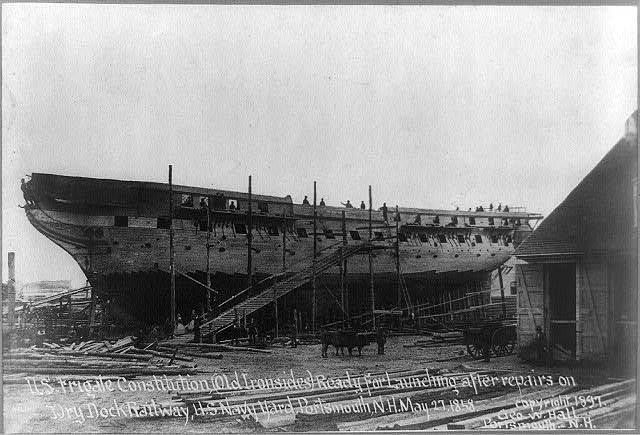
U. S. Frigate Constitution, (Old Ironsides) ready for launching after repairs on dry dock railway, U. S. Navy yard, Portsmouth, N. H. May 27, 1858 (by George W. Hall, 1858, c1897; LOC: LC-USZ62-7662)

Old Ironsides in Portsmouth for repairs, 1858

Posted in 150 Years Ago This Week, Military Matters, Northern Society | Tagged , , | Leave a comment

job security

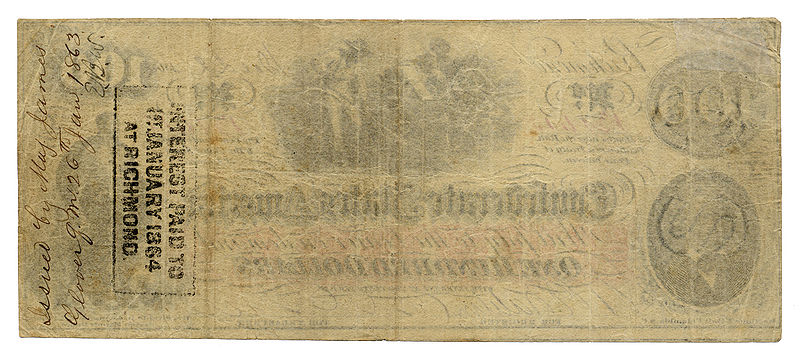
According to a chart published in the October 5, 2013 issue of The Economist, 80% of the U.S. Treasury workforce was furloughed during the government shutdown in 2013. However, “Money printers/engravers” were kept hard at it. We sure can relate to that here in 1863. The Confederate Treasury is working unceasingly to print nice new paper currency and increase the money supply.

I missed the following editorial, but I thought it was worth reprinting. Even though the Dispatch seems to be dead set against speculators bidding up the price of commodities, the editors understand, from their reading of the history of the French Revolution, that price controls won’t work . The editorial asserts that CSA Treasury Secretary Christopher Gustavus Memminger was adding twelve million dollars per week to the money supply. This together with rent controls would have disastrous consequences for boarding-house keepers:”Memminger is ripping away at the rate of twelve millions a week — his labors in bringing the currency down to the exact value of the very indifferent paper which expresses it are truly Herculean. In a few months he will bring down the dollar in assignats to one-twentieth, and then the boarding-house keeper will get exactly five dollars for feeding a hungry month a whole month. Many of them are respectable ladies, laboring to support large families. No matter. Let them suffer.”

Back of a One Hundred Dollar Confederate States of America banknote dated December 22, 1862. Issued during the American Civil War (1861–1865).

member of Memminger’s millions (CSA “greyback”of $100 note)

From the Richmond Daily Dispatch October 6, 1863:

Proceedings of the Legislature upon the subject of the currency.

–There is no more pithy and beautiful saying than that of Lord Bolingbroke. “History is philosophy teaching by example.” There is none falser or less applicable to the nature of man. No man ever learned anything but by his own experience, and nations are but assemblages of men.

Our Legislature have before their eyes the example of the most stupendous financial failure that the world ever be held. We mean, of course, that of the French Revolution. They are deliberately adopting, one after the other, all the expedients resorted to by the philosophers of the Constituent Assembly, of the National Assembly, and of the Convention — expedients which aggravated to an inconceivable degree the evils they were proposed to remedy. In the first place, they are about to place a maximum upon prices. The Convention tried that. They first put a maximum upon bread and butchers’ meat. The first consequence was to ruin the butchers and bakers, to fill the stalls with carrion and the bakers’ shops with black bread, which the near prospect of starvation alone could induce any man to eat. In a little time even this bread became so scarce that the crowds assembled at the bakers’ shops fought for it as dogs fight for a bone, and, much bloodshed having been the consequence, the wisdom of the Convention could devise no better remedy than to fix a rope to the door of each shop, and to decree that whoever could get hold of it first should be first served, and that nobody should be served who did not have it in his hand. As it cannot be expected of political philosophers and talking legislators that they should be gifted with so vulgar a quality as common sense, they overlooked the very striking probability that men would fight for the rope as frequently and as hard as they had hitherto fought for the first turn at the bread. It so happened, however, and their ingenuity not being sufficient to carry them farther, they disturbed the mob no farther, but suffered them to go on and fight in peace. To improve the quality of the bread, however, and to remedy the deficiency in the supply of that somewhat necessary article, they put a maximum also upon the products of the earth. This had an effect the contrary to that which was anticipated, for the farmers refused to produce, and the scarcity grew into famine. The guillotine, though sufficiently active, could only bring the horse to the water. It could not make him drink. The farmers would not continue their operations, simply because they were ruined by arbitrary requisitions, and could not. So the Convention took matters into their own hands, and themselves undertook to feed 630,000 people — that being the population of Paris. Our legislators propose to adopt this system most vigorously. –If they will only enact a few hundred portable guillotines into existence, and send them around to enforce the maximum, they will, no doubt, bring Richmond into the same condition that Paris was in 1793. It takes time, however, to ruin a country. We doubt whether this can be done before the winter.

The Convention took all the pensions (boarding houses) into their own hands and put a maximum upon them. This example is sedulously followed by our Legislature. They have determined that board shall not exceed a certain sum per month. This is all right, all patriotic, all just. One hundred dollars in the Memminger assignats will bring just ten dollars in specie or sterling bills. It is perfectly fair to allow no boarding-house keeper to receive a larger sum per month. This is an excellent rule, and its beauties become more and more apparent every month. Memminger is ripping away at the rate of twelve millions a week — his labors in bringing the currency down to the exact value of the very indifferent paper which expresses it are truly Herculean. In a few months he will bring down the dollar in assignats to one-twentieth, and then the boarding-house keeper will get exactly five dollars for feeding a hungry month a whole month. Many of them are respectable ladies, laboring to support large families. No matter. Let them suffer.

In the revolutionary war of ’76’82 the Legislature of Virginia abolished all auction sales by a solemn act. In twelve months after it reinstated them. They found that if producers were not allowed to sell by auction they would not produce, or would not sell at all.–But our legislators spurn examples. In France the Convention stopped all auctions, shut up all retail stores, abolished all corporations, stopped all industry, and took the whole business of the country into their own hands. Let our Legislature try the same thing. The result in France was very encouraging.–Famine, pestilence, bloodshed, and every other evil that was let out of the fabled box of Pandora pervaded the land.

Lastly, the Convention broke up all the banks and all the brokers. They guillotined every man who was convicted of selling assignats for less than their nominal value in gold. This example our Legislature could not overlook. They are devising high penalties for selling gold at a higher price than Memminger assignats. Penalties for traffic in gold have heretofore been prescribed by nearly every civilized country under the sun, and they have invariably operated as premia for the exportation of gold.

All this time the “infernal machine” is operating with the most inexorable energy. Our legislators do not reflect at all that the depreciation of the currency is the main cause of the nominal high prices, and that inflation is the cause of the depreciation.

P. S.–The foregoing article was written several days since. Its appearance has been delayed by the heavy pressure upon our limited space. The leader in yesterday’s Enquirer was of similar purport to this; yet neither was written with any knowledge of the existence of the other. The simple facts of history leading to irresistible conclusions, readily explain the coincidence.

According to Wikipedia the war forced Secretary Memminger to change his approach to funding the Confederacy:

When Jefferson Davis formed his first cabinet, Memminger was chosen as Secretary of the Treasury on February 21, 1861. It was a difficult task, in view of the financial challenges facing the Confederacy. Memminger attempted to finance the government initially via bonds and tariffs (and confiscation of gold from the United States Mint in New Orleans), but soon found himself forced to more extreme measures such as income taxation and fiat currency. Memminger had been a supporter of hard currency before the war, but found himself issuing increasingly devalued paper money, which by war’s end was worth less than two percent of its face value in gold.

Posted in 150 Years Ago This Week, Confederate States of America, Southern Society | Tagged , , , | Leave a comment

examining greenbacks?

From The New-York Times October 9, 1863:

Arrests for Defrauding the Draft.

ROCHESTER, N.Y., Thursday, Oct. 8.

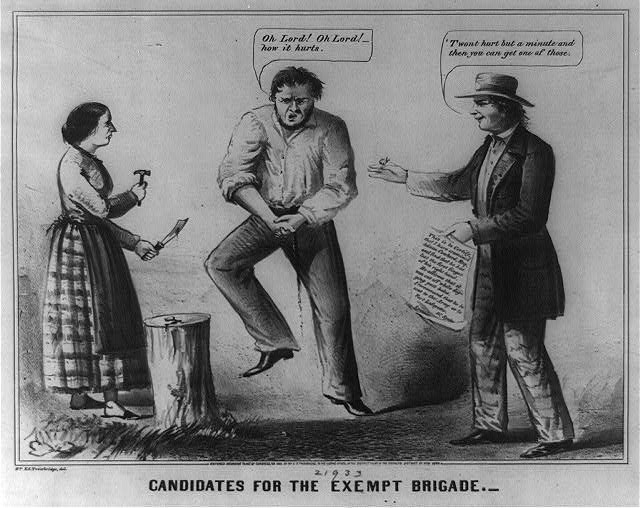
PETER P. MURPHY, examining Surgeon of the Board of Enrollment at Lockport, has been held to bail in $5,000 for accepting money; and F.F. HOYER was held to bail in the same amount for offering money to MURPHY to exempt drafted men. Their examination will be held in this city.

Candidates from the exempt brigade (1862 by W.E.S. Trowbridge; LOC: LC-USZ62-8385)

or just bribe the surgeon

You can read about the 1862 political cartoon at the Library of Congress

Posted in 150 Years Ago This Week, Military Matters, Northern Politics During War, Northern Society | Tagged , , , , | Leave a comment

beware protruding lips

Richmond was alive with the “never ending sound” of the Confederate government’s stamping presses manufacturing paper currency. But it wasn’t just the government – counterfeiters were a big problem for the CSA.

From the Richmond Daily Dispatch October 7, 1863:

More New counterfeits.

–The Wilmington (North Carolina)Journal contains a description of two new and dangerous counterfeits. These counterfeits, are especially dangerous; from the fact that spurious issues of one of them were made a year ago or more, and the discrepancies between the genuine and the counterfeit then pointed out by the papers. This new spurious issue has corrected all the errors and variations of the former counterfeits of the same date and denomination. The Journal says:

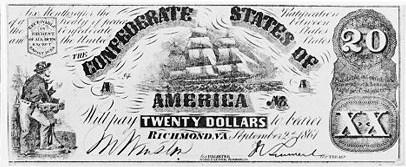
The first counterfeit is of the denomination of $100, interest bearing note, dated Sept. 1st, 1862, printed by Keatinge & Ball, Columbia, S. C. The second is a Hoyer & Ludwig$20 bill, dated Sept. 2d, 1861.

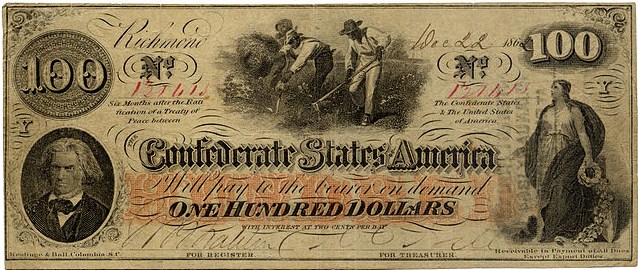
Confederate_5_and_100_Dollars (This image was included in the 2011 edition of A Short History of the Civil War by James L Stokesbury. Published by Harper, ISBN 978-0-06-206478-3.)

Is Mr Calhoun holding something in his mouth?

In the hundred dollar counterfeit the face of Mr. Calhoun, at the lower left hand corner of the bill, is very badly executed, especially the mouth, which looks as if something were held in it causing the lips to protrude. The imprint immediately under is in larger letters than in the genuine, and the b in Columbia is defective, whereas it is perfect in the genuine. In the genuine the line “with interest at two cents per day” is printed on the red shade of the large red word “hundred.” This shade does not show in the counterfeit, or, if at all, too faintly to be noticed. The whole execution of the counterfeit is inferior the that of the genuine, and the note a little smaller. The date of the genuine note is filled in Sept. 1st, that of the counterfeit Sept’r1.

The $20 is more difficult to describe and detect than the $100, and is the most dangerous counterfeit we have ever seen. We have a counterfeit and a genuine bill before us, and save that the counterfeit has been printed with too much ink, and therefore looks much blurred, it would be very difficult to distinguish the one from the other; and we are not sure that this would he a reliable test, as even the genuine bills are not always uniform in color. The only obvious difference is, that in the genuine there is a clear space between the tops of the letters in the word “America” and the waves under the large ship in the centre, whereas in the counterfeit the heads of these letters run quite up to the waves. In the counterfeit we have there is a plain unshaded capital F to the left of the large ornamented letter A, which indicates the issue of the note; in the genuine before us there is none, nor do we recollect to have seen any genuine notes with such letter. In the genuine, just above the letter A, and a little to the right, is the number 23, which is not in the counterfeit.

Photographs of six pieces of Confederate paper currency (c1875; LOC: LC-USZ62-110272)

its bogus version could have been the most dangerous counterfeit

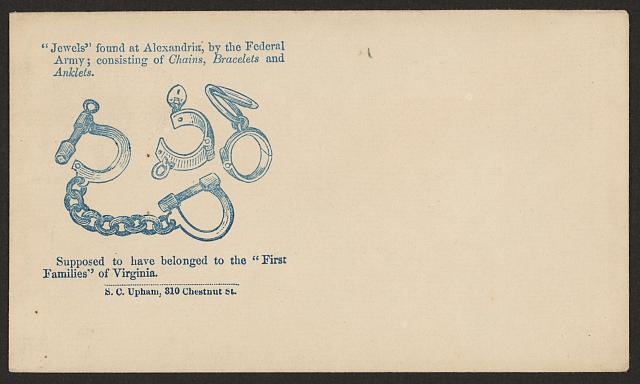
In an article at EH.net Marc Weidenmier points out that counterfeit currency probably had an impact on the Confederate money supply and the inflation rate. “The Confederacy was unable to curtail counterfeiting because they lacked the resources and equipment to produce high quality money. Counterfeiting was such a widespread problem that people sometimes joked that fake money was of higher quality than government issued currency.” The article discusses Samuel Curtis Upham, a Philadelphian who printed bogus Confederate money between June 1862 and August 1863. It is estimated that Upham printed between 1.0 and 2.5% of the Confederate money supply during that time. The CSA placed a $10,000 bounty on Upham.

You can check out one of Upham’s classified ads in Harper’s Weekly at Son of the South:

Half Price!! Half Price!!
Rebel Notes and P. O. Stamps.

Fourteen different Rebel Notes and Post Office Stamps, sent, post-paid, on receipt of twenty-five cents. Trade supplied at 50 cents per 100, or $4 per 1000. Address S. C. UPHAM, 403 Chestnut Street, Philadelphia.

__________________________________________________

"Jewels" found at Alexandria, by the Federal Army; consisting of chains, bracelets, and anklets. Supposed to have belonged to the "First Families" of Virginia (by Samuel C. Upham, between 1861 and 1865; LOC: LC-DIG-ppmsca-11320)

also engraved by Samuel C. Upham

Posted in 150 Years Ago This Week, Confederate States of America, Southern Society | Tagged , , , | Leave a comment

the looming winter

In the following letter, “O.K.” details scarcity, inflation, and speculation in Lynchburg, Virginia. The correspondent also echoes the Richmond press in his concern about how the poor can possibly cope during the coming winter given the bad economic situation. “O.K.” also tells of a free black man accused of murder who was saved from Lynch law.

From the Richmond Daily Dispatch October 7 1863:

Letter from Lynchburg.

[special Correspondence of Dispatch.]

Lynchburg, Oct.5th, 1863.

We have very little news from the army of upper East Tennessee. At last accounts our forces had advanced as far as Greenbrier, where a few prisoners were captured.

Local affairs are without special interest with the exception of the steady advance in the prices of all necessaries of life. The speculators and extortioners with us, as well as elsewhere in our beleaguered country, seem determined to involve the nation in ruin. –They permeate every channel of business. Every railroad, canal, stage or mail route, is overrun with them. The markets are completely forestalled — not a pound of butter, lard, bacon, flour, meal, leather, wool, or clothing of any description, is to be had unless it has first passed through the grasp. of their withering clutches. But it may be asked, who are they ? The answer is ready at hand — shopkeepers, traders, commission merchants and their agents. Railroad, canal, and stage route employers, from high officials down to the lowest menial on the routes, men occupying every grade of position in life, are engaged in this nefarious practice of speculation and extortion. How the poor are to live during the winter is a question that has been frequently asked in times past, but it may be pertinent to ask now, under the present aspect of affairs, how the great bulk of the population of our cities are to keep from actual starvation without a change in the present system of warfare carried on by these greedy dupes of mammon and enemies to our country. Much more might be said, but I shrink from the task; the time is not far distant when the truth of these remarks will strike hard to every heart.

The quarterly term of the Hustings Court for this city commenced its session here to-day, but little business of interest was transacted. Albert Wood a free negro, was tried for the murder of Mr. William J. Burton, company I, 30th Virginia volunteers, and sent on to the Circuit Court, which meets on the 3d of next month, for final trial.–Young Burton was from Stafford county, and was well spoken of by his comrades. On last Thursdayevening, being engaged at one of the hospitals in this city, cooking rations for his company an altercation sprung up between him and the negro, (Wood,) which resulted in his untimely death, caused by a blow dealt by a Spade in the hands of the negro. The morning after the occurrence the negro was taken from the jail by a party of the friends of Burton, and would have been summarily dealt with but for the timely arrival of Gen. Corse, who, after some trouble, rescued the negro from the fate of Lynch law. From the cast of the evidence elicited in Court to-day nothing short of a miracle will save the negro from hanging.

O. K.

You can read a good overview of Lynchburg in the Civil War at Encyclopedia Virginia. Riots may have been avoided by the wise generosity of local leaders:

In April 1862, Confederate president Jefferson Davis authorized a military draft, and resistance to this and the impressment of resources became not only common but also accepted practices. In addition, city residents came to resent the many soldiers who congregated in Lynchburg, blaming them for the rising crime rate and acts of public disorder. Inflation and supply shortages caused claims and counterclaims of speculating, price gouging, and hoarding. The poor suffered miserably, and bread riots that plagued other Southern cities were avoided only because civic leaders donated enough food to maintain some semblance of order.

Posted in 150 Years Ago This Week, Confederate States of America, Southern Society | Tagged , , , , | Leave a comment

general review

Robert E. Lee at Chancellorsville [on horseback, being cheered by troops], May 2, 1863 (c1900; LOC: LC-USZ62-51832)

“incoherent reasons”? (General Lee at Chancellorsville)

From The New-York Times October 6, 1863:

Lee’s Report.

The specific object of LEE’s Summer invasion of Pennsylvania was a matter of profound mystery and endless speculation at the time; and the mystery is not perfectly cleared up by his official report of that campaign, which has just seen the light at Richmond, and which we give in full this morning. It was thought by some that the gigantic army of the rebels, whose numbers were accurately stated by a reliable City co[n]temporary at 190,375, meant nothing less than the capture of Washington and Baltimore, the capture of Philadelphia and Pittsburgh, the capture of New-York and Boston, and, for that matter, the capture of Cincinnati and Rouse’s Point. With Panic preceding them, Death accompanying them, and Desolation following in their wake, there seemed no reason why they should not work their will and wreak their vengeance upon the North; and those who remember the history of that time will recall how the Tribune proposed to placate them in advance, and to “bow to destiny,” as impersonated in JEFF. DAVIS, in event of their “watering their horses in the Delaware.”

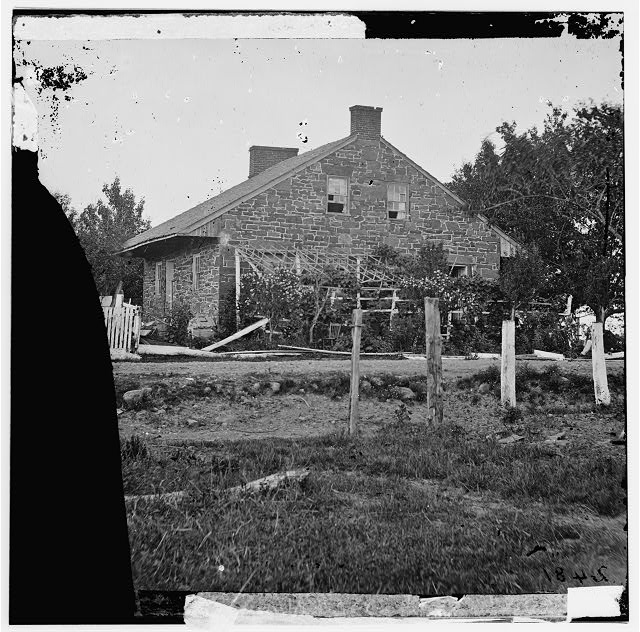
Gettysburg, Pennsylvania. Headquarters of Gen. Robert E. Lee on the Chambersburg Pike (1863 July; LOC: LC-B811- 2481)

“fair opportunity to strike a blow” (Lee’s headquarters at Gettysburg)

Gen. LEE, in the course of his report, sets forth several insufficient and incoherent reasons for his undertaking the offensive campaign of June and July. He judiciously says not a word about Washington, Philadelphia, or Baltimore; he indicates no intelligible or comprehensive scheme of operations — no object likely to be successful or decisive, or to compensate for the labors and risks he was about to assume. But he apprises us that as HOOKER’s position opposite Fredericksburgh was unassailable, it was determined to draw him from it — the execution of which purpose embraced the relief of the Shenandoah Valley, and, if practicable, the transfer of hostilities north of the Potomac; and he further thought that he might obtain an opportunity to strike a blow at HOOKER’s army, or at least compel it to leave Virginia, and so break up our plan of campaign for the Summer. In addition to this, it was hoped that “other valuable results” might be obtained. What the other hoped-for results may have been, is left to be surmised; but so far as LEE’s purpose is propounded in the ends given above, we do not think that military men who are now acquainted with the situation as it existed on both sides, will have much occasion to admire the wisdom displayed in his plan or rather his mode of operations. After these preliminary statements, Gen. LEE proceeds to give a view of the movements of each of the three corps of his army, from the line of the Rappahannock and the Rapidan across the Blue Ridge, up the Shenandoah Valley and over the Potomac; but the only thing we find indicating in any way an object or purpose beyond those mentioned, is the statement that after the whole of his army had crossed the Potomac, “preparations were made to advance upon Harrisburgh.” This purpose, however, was frustrated by the northward advance of our army as far as South Mountain, which menaced LEE’s communications with the Potomac, prevented the progress of his march, compelled the concentration of his army on the east side of the mountains, and brought about, at Gettysburgh, that “fair opportunity to strike a blow” at our army which he claims to have sought, but whose result was so different from his anticipations that it compelled him to abandon all his projects, whatever they may have been, retrace his steps to the Potomac, down the Shenandoah Valley, over the Blue Ridge Mountains, and back to the Rappahannock, from which he had set out with such high hopes fifty days before.

This report of LEE confirms the opinion universally entertained, that a grand opportunity was missed to strike a blow at his army while it was at Williamsport, making preparations to retreat across the Potomac. He confesses to his embarrassments in that position, and brings to our knowledge some whose existence we had surmised, but of which we previously had no proof. At the same time, his campaign is throughout tacitly confessed to have been a total and stupendous failure — even accepting his own confession of its objects; but we are persuaded now, as during the pendency of the campaign, that its real and final object was the capture of Washington.

Apparently, the “reliable City co[n]temporary” wasn’t so reliable. Lee’s army numbered about 75,000  during the Gettysburg Campaign. Northern journalists might have found Lee’s campaign unwise; 150 years ago today a Richmond editorial called Union generals cowards, who were already dead and putrefying – above ground. From the Richmond Daily Dispatch October 6, 1863:

The Federal Generals.

–It has been observed that not many Federal Generals have been killed in this war. The military expediency of keeping out of danger is fully appreciated by those heroes, so self-denying of glory, so generous in their distribution of the posts of honor and peril to the humble privates in their ranks. Burnside, butting the heads of his rank and file against the ramparts of Fredericksburg, and ensconcing himself in a snug covert three miles from the roar of battle, is a fair specimen of the military discretion of the Commander in Chief of the Federal forces. It is a rare thing to hear of one of them who is unmindful of the great law of self preservation. Such slaughter as has been witnessed among the common soldiers of the Yankee army has not often been witnessed, nor such exemption from peril as their leaders have enjoyed. Scott, McClellan, McDowell, Buell, Pope, Burnside, Hooker, all live, and have not even a scar to testify that they have ever been engaged in a battle of this war.

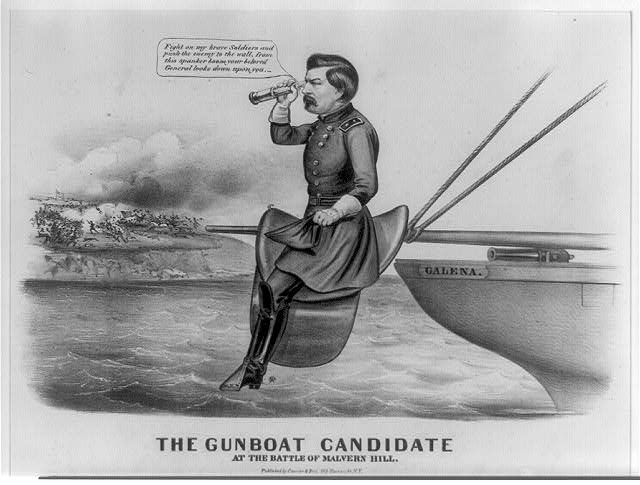
The gunboat candidate at the Battle of Malvern Hill (Currier & Ives, 1864; LOC: LC-USZ62-92038)

mausoleum piece?

And yet, though successful in escaping Confederate bullets, they are as dead, to all intents and purposes, as if they had shared the fate of the thousands whom they have driven to the slaughter. Not one of the long array we have mentioned has survived the fields of their former notoriety. Each and all of them have been paralyzed by the shock of arms which they so carefully kept out of, and laid up in a mausoleum where they are scarcely objects of curiosity to the living world. The Confederates have killed them one and all as effectually as if they had perforated their carcases with Minnie bullets. Better would it have been for their reputation to have perished in the smoke and din of battle than to go down to posterity not only defeated, but disgraced. They have purchased a few years of life at the expense of all that makes life desirable to a soldier. With them the process of decomposition has begun before death, and they are masses of living putrefaction — a stench in the nostrils of all mankind and of themselves.

Our people, therefore, need feel no discouragement if the loss of the enemy in Generals is so much less apparently than our own. In reality, it is greater. Every defeat disgraces them, drives them from their positions, and render them as impotent, and far more contemptible, than if they had been slain in battle.

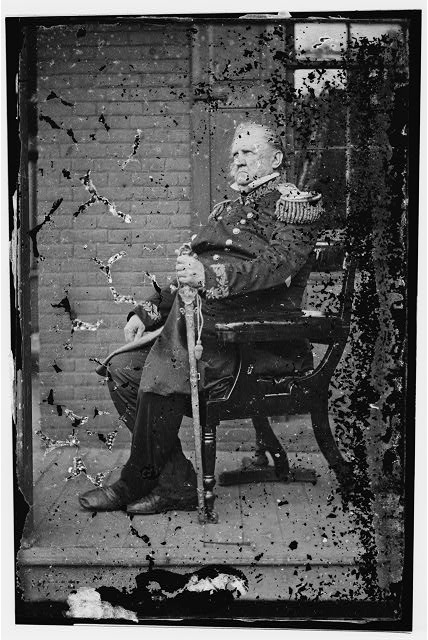
Winfield Scott leading troops into battle? in 1861?

General Winfield Scott in 1861

General Winfield Scott in 1861

The McClellan cartoon was published during the 1864 presidential campaign.

Posted in 150 Years Ago This Week, Confederate States of America, Gettysburg Campaign, Military Matters | Tagged , , , | Leave a comment

stop the misconstruction

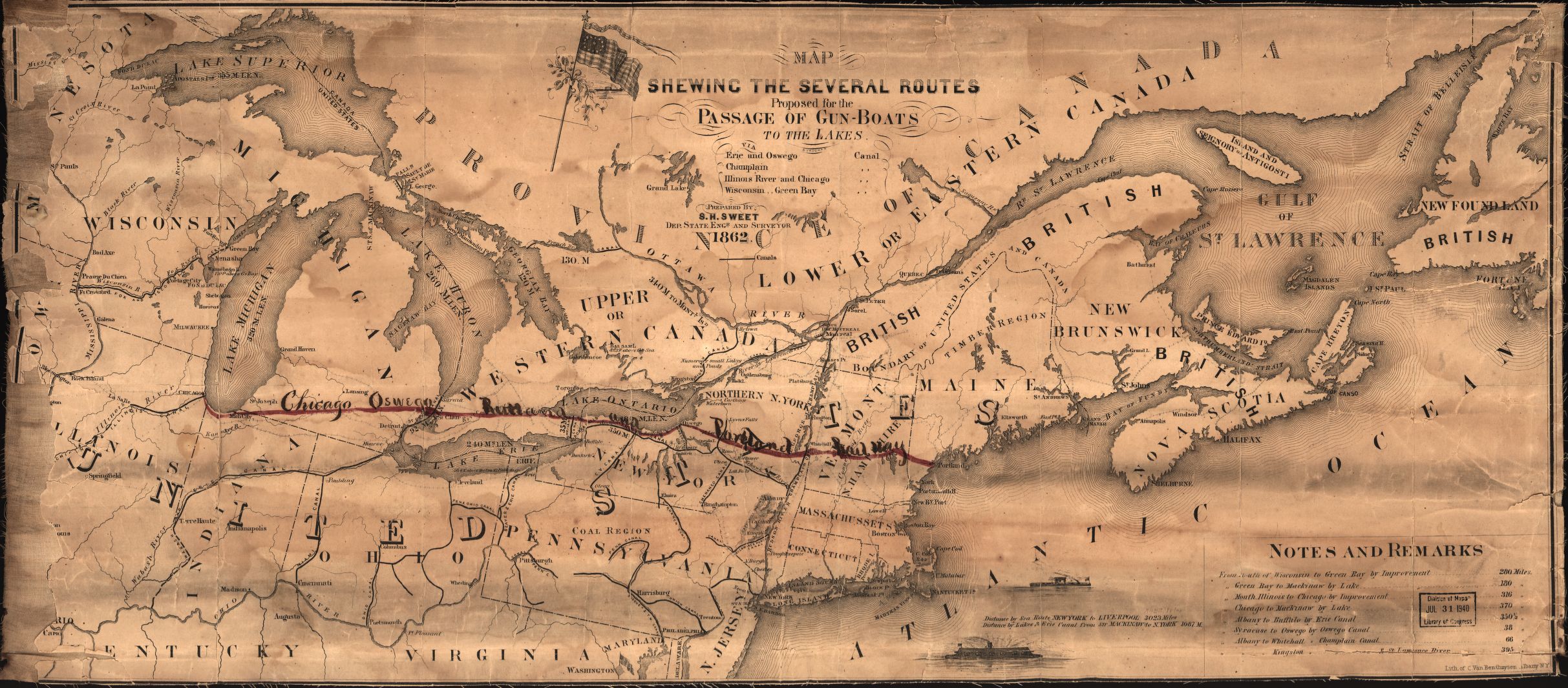
NE US and SE Canada 1862 (LOC: g3711p cw0033000 http://hdl.loc.gov/loc.gmd/g3711p.cw0033000)

New York elections will be “an omen of the future” (1862 map)

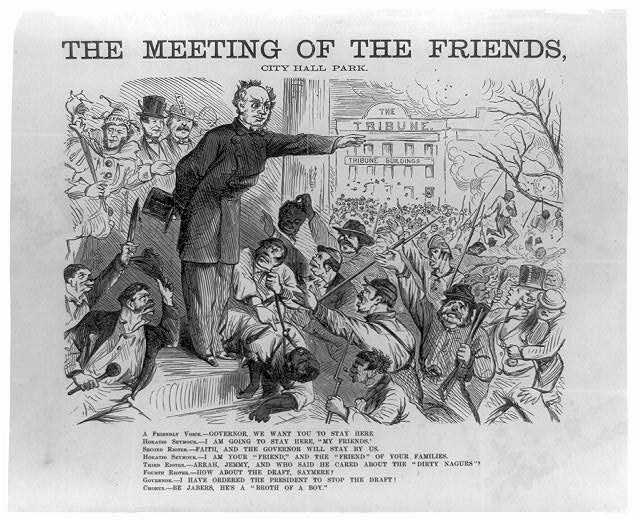
Last fall New York State elected Democrat Horatio Seymour as governor. Here the Republican-leaning New York Times sees the approaching election for members of the state legislature and for state-wide offices like comptroller as an opportunity for New York to redeem itself by sending a message of loyalty to the national cause and the national administration. In 1862 voters voted their frustration with the huge military build up and its costs. They ended up with a governor who was too friendly to the South and who called draft rioters “my friends”. The editorial contrasts the foolishly outspoken Vallandigham with the crafty Seymour.

From The New-York Times October 4, 1863:

Justice for New-York The Pending State Election.

In ordinary times such an election as New-York is about to make would excite no particular interest. But these are not ordinary times. We are in the midst of a mighty civil war, and are threatened with foreign war. It is not a question of men. The election will be one of the “signs of the times,” an omen of the future. The Administration and its enemies both make this election a trial of great national questions, and its consequences bear an important relation to our national well-being.

Gov. SEYMOUR has placed New-York in a false position toward the General Government. He has made the Empire State seem less than half loyal. We all know how SEYMOUR’s election was brought about. Thousands of honest men of all former parties, true, loyal and patriotic, cast their votes with “Copperheads” for one who seemed to represent the general discontent and irritation at the apparent want of results from our gigantic military operations and expenses. If none but Copperheads had voted for him he would have remained a private citizen. His election caused exultation among all our country’s enemies. In Richmond, in London and in Mackerelville, it was proclaimed as a defeat of “the war party,” a triumph of “the peace men.” The rebel papers in the Southern States disclaimed all affiliations with their Northern adherents, and called them “scum and rabble,” and “hyenas,” but they exulted in their success, and claimed it as a great victory to their cause. There was a good reason for this rejoicing. A man had been elected as Governor who held relations to men of outspoken disloyalty, which made his support of any “vigorous war measure” a matter of some difficulty, not to say inconsistency. The “Peace Men” were his partisans, and had supported him with a violence that did little credit to their names. They claimed him as the head of this faction, and demanded of him “a vigorous prosecution of peace.”

The meeting of the friends, City Hall Park (Probably drawn by Henry L. Stephens, New York.; LOC: LC-USZ62-96391)

Seymour’s election caused the draft riots?

We have seen some of the disastrous fruits of this triumph of malcontents and factionists. They felt strong enough to defy the Government. They openly denounced it as an intolerable tyranny, pledged themselves to resist it, and finally a body of them had the madness to plunge into general pillage and murder. For nearly one week we saw robbery, murder, and every fiendish outrage perpetrated at noonday in our streets by gangs of traitors who trampled upon the national standard like a worthless rag — everyone of whom had voted for SEYMOUR, and who all looked to him for impunity, if not for active leadership. The Governor went among them and saw their hands red with the blood of our citizens, and their faces blackened with incendiary fires, and he called them “his friends.”

It was in vain last fall that we proclaimed that the election of SEYMOUR would strengthen the rebels. Honest men, who had determined to vote for him, fired at the imputation of disloyalty, and pointed to the campaign banner: “A more vigorous prosecution of the war.” We struggled against a general depression and discouragement of public feeling. Our arms made no progress; our finances were becoming unhealthy; the rebels seemed to gain power; everything went wrong; there must be fault somewhere, and the opposition party carried the State, and placed SEYMOUR over us as our Chief Magistrate.

For nearly one year he has filled that office, and New-York has seemed but a half-hearted State. We have exhibited the extraordinary spectacle of having placed in the national armies more than 200,000 of our choicest men, every one of whom volunteered, of giving our treasure free as water, and yet to the world wearing the mask of disloyalty, and requiring 30,000 troops to enforce the laws of the United States, which Gov. SEYMOUR refused to carry out.

Our State has been put in a false position, and foully wronged by being suspected. Her Chief Magistrate, as the organ through which she spoke, has belied her opinions and convictions and intentions, and made her seem to utter sentiments which she scorns and loathes. He has lost no opportunity of boasting of what the State had done, even while protesting against nearly all war measures as encroachments upon his powers and prerogatives as Governor of a sovereign State.

For nearly a year the proud and loyal spirit of our people has writhed under the disgrace of seeming to be treacherous and semi-disloyal. We have had nearly a year of this misconstruction — this false position — and now it is for the people to right themselves before the world. SEYMOUR has made his ticket, and he has also made his plea to the public indictments against him. His speech before the Convention was his defence. He summed up his cause, and submitted it to us for our verdict. What shall that verdict be?

But it is not a question of men, or of the mere personal qualities and fitness of these men for certain offices. Great consequences loom up behind these men. We do not claim that these candidates are consciously false to the cause of the country, or that they wish for the success of the rebels. But we do claim that they represent the Opposition party. They represent the cause which all disloyal men sustain. There is not a slavetrader — there is not a rotten-hearted merchant who grows rich by smuggling his goods through the blockade; there is no Southern spy, no negro-hunter, no secret or open enemy of our country and its Government within the length and breadth of the State, who will not work and vote for these candidates. It is the Opposition party, and it will have the support of all of our enemies.

It matters little whether our enemies use the bullet or the ballot — whether the blow be struck upon a battlefield in Virginia, or at an election in New-York. Whatever weakens one side strengthens the other. No man can serve God and the Devil or stand neutral. We are either for or against the Government, and the whole continent is not large enough to contain one foot of neutral ground.

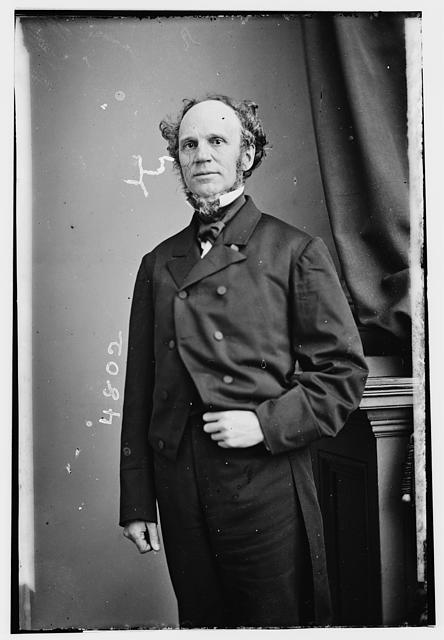
Hon. Horatio Seymour (between 1855 and 1865; LOC: LC-DIG-cwpbh-01842)

“a crafty and dexterous enemy”

We have now an opportunity to redeem New-York from misconstruction. If defeated at this election, it will be hard to persuade the country that SEYMOUR is not the representative man of his State. It will be hard to show that the National Government has not more enemies than friends in the Empire State.

Our danger at the coming election is in the fact that, like the former one, it will be involved in false issues, and mystified with false pretences. We have the plausible SEYMOUR, and not the outspoken VALLANDIGHAM, for an adversary. New-York is as loyal as Ohio, but we shall struggle under the disadvantage of contending with a crafty and dexterous enemy, who steals our flag and livery, and shouts our battle-cry, “The Union and the Constitution, and the supremacy of the laws.” Let the people beware of the enemies of the Government, and remember their acts for the past year.

The New York state conventions were held in September 1863. Democrats and the Union party (Republicans and War Democrats) nominated candidates for the state-wide offices.

You can read all the details of the political cartoon and a more balanced view of Seymour’s speech at the Library of Congress

Posted in 150 Years Ago This Week, Northern Politics During War, Northern Society | Tagged , , , , | Leave a comment

“gracious gifts”

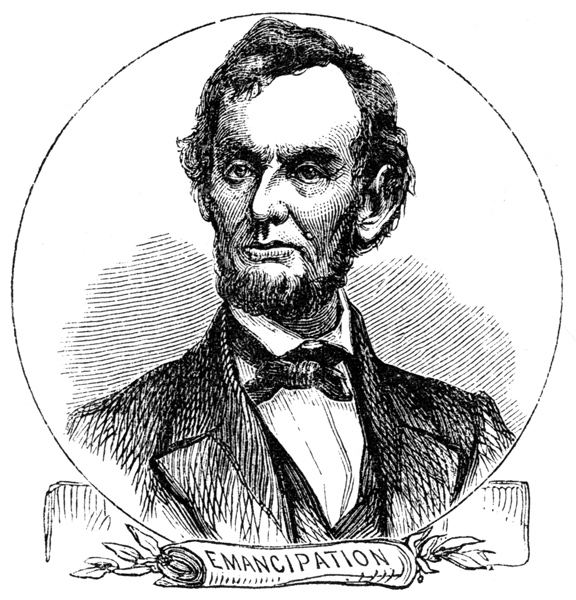
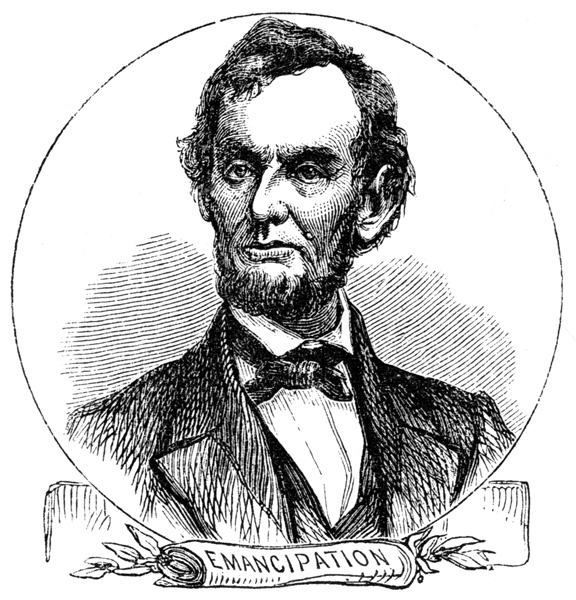
president-abraham-lincoln-6 (http://ushistoryimages.com/images/president-abraham-lincoln/fullsize/president-abraham-lincoln-6.jpg)

predicts a ” large increase of freedom”

150 years ago today President Lincoln proclaimed another day of thanksgiving for 1863.

From The Papers And Writings Of Abraham Lincoln, Volume Six:

PROCLAMATION FOR THANKSGIVING, OCTOBER 3, 1863.
BY THE PRESIDENT OF THE UNITED STATES AMERICA:

A Proclamation.

The year that is drawing towards its close has been filled with the blessings of fruitful fields and healthful skies. To these bounties, which are so constantly enjoyed that we are prone to forget the source from which they come, others have been added which are of so extraordinary a nature that they cannot fail to penetrate and soften even the heart which is habitually insensible to the ever-watchful providence of Almighty God. In the midst of a civil war of unequalled magnitude and severity which has sometimes seemed to invite and provoke the aggressions of foreign states; peace has been preserved with all nations, order has been maintained, the laws have been respected and obeyed, and harmony has prevailed everywhere except in the theatre of military conflict; while that theatre has been greatly contracted by the advancing armies and navies of the Union. The needful diversion of wealth and strength from the fields of peaceful industry, to the national defense has not arrested the plough, the shuttle, or the ship: The axe has enlarged the borders of our settlements, and the mines, as well of, iron and coal as of the precious metals, have yielded even more abundantly than heretofore. Population has steadily increased, notwithstanding the waste that has been made in the camp, the siege, and the battle-field; and the country, rejoicing in the consciousness of augmented strength and vigor, is permitted to expect a continuance of years, with large increase of freedom.

No human counsel hath devised, nor hath any mortal hand worked out these great things. They are the gracious gifts of the Most High God, who, while dealing with us in anger for our sins, hath nevertheless remembered mercy.

It has seemed to me fit and proper that they should be reverently, solemnly, and gratefully acknowledged, as with one heart and voice, by the whole American people. I do, therefore, invite my fellow-citizens in every part of the United States, and also those who are at sea, and those who are sojourning in foreign lands, to set apart and observe the last Thursday of November next as a day of thanksgiving and prayer to our beneficent Father who dwelleth in the heavens. And I recommend to them that, while offering up the ascriptions justly due to Him for such singular deliverances and blessings, they do also, with humble penitence for our national perverseness and disobedience, commend to His tender care all those who have become widows, orphans, mourners, or sufferers in the lamentable civil strife in which we are unavoidably engaged, and fervently implore the interposition of the Almighty hand to heal the wounds of the nation, and to restore it, as soon as may be consistent with divine purposes, to the full enjoyment of peace, harmony, tranquillity, and union.

In testimony whereof, I have hereunto set my hand, and caused the seal of the United States to be affixed.

Done at the city of Washington, this third day of October, in the year of our Lord one thousand eight hundred and sixty-three, and of the independence of the United States the eighty-eighth.

A. LINCOLN.

By the President: WILLIAM H. SEWARD,
Secretary of State

On the same day that President Lincoln said that the diversion of resources from peaceful industry “to the national defense has not arrested the plough, the shuttle, or the ship”, a Richmond newspaper pointed out that down South there did not seem to be enough resources to go around. If old men and boys are forced to serve in the military, how can necessary farming and manufacturing continue?

From the Richmond Daily Dispatch October 3, 1863:
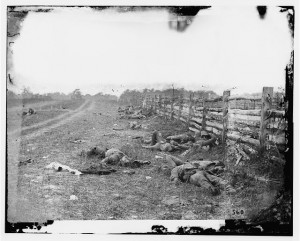
[Antietam, Md. Confederate dead by a fence on the Hagerstown road (by Alexander gardner, 1862 September; LOC: LC-DIG-cwpb-01097)

clothing auctions dreaded as much as battle

Prices of clothing and produce.

-The rapid advance in all necessaries of clothing and subsistence threatens us with great distress. There is no disguising the fact. We cannot see how unemployed persons, and how those who live on incomes and salaries, are to get along, especially at the inclement season of the year now rapidly approaching. How are they to buy shoes and clothing at present rates? Nay, how long are these rates to prevail? A great auction may in a day or two run them all up 50 per cent.! An auction thus has become to be regarded by the people with as much dread as a battle! A defeat on the battle field could hardly bring more suffering upon them. There is hardly any more encouragement to be derived from looking at the produce market. With ample supplies by the blessing of Providence, through the country, we find the receipts in this market alarmingly limited. Holders are therefore enabled to run up prices out of all reason and out of all conscience. These obstacles to oppression of a community weighing nothing with them since they care nothing for reasons and have no consciences.

We know that the currency is depreciated, but it is not depreciated as much as prices would indicate. There are causes originating in the cupidity and heartlessness of men employed in commerce and in agriculture which are weighing down the people and the cause, and which are threatening both more than the currency. Can the practices of these people be reformed? Can the distress they occasion be moderated by checking their extravagant demands upon consumers? These questions are growing daily more and more important. Something must be done. Produce must be distributed — prices must be reduced — gains must be disgorged — or there will be suffering intense, and intense suffering will beget — what? Think of it.

The necessity of Production.

–The high prices of every article of food and clothing, with a constant tendency upward, indicates to us the greatest danger of the Confederacy at the present moment. There are many sacrifices which men can make, and which a great majority of the people of this country have made, for the defence of their liberties. They can dispense with the luxuries and superfluities of life — they can give life itself for the cause of independence — but while life remains there are certain essentials which it can only surrender at the cost of extermination. In the first place the army itself must be supplied with bread and clothing, and if there were no other mouths in the country to feed, none others to be kept from nakedness, the supply of this portion of the population alone would require that the producing power of the country be carefully husbanded, and its industrial capacities developed, instead of diminished. But, besides the army, there are millions of women and children whose wants must be provided for, and who are in serious danger of suffering if the regular operations of the fields and workshops are interrupted by calling off old men and youths — incapable at best of efficient military service — from duties which they are capable of performing, and which are as essential to the welfare of the country and the success of military operations as the use of the musket and the cannon by those in the field.

Already we are beginning to feel the want of labor in those mechanical and manufacturing employments which are indispensable not only to comfort, but to existence. Every day lost by the withdrawal of operatives from factories involves a deficiency of a vast amount of fabrics necessary to the use and comfort of man, and for the supply of which we can no longer look to foreign countries. What are the people to do this winter for clothing, food, fuel, and other articles of prime necessity, if, in addition to the sufferings resulting from extortion, the few producers who are left be turned into consumers, thereby diminishing the scanty means of supply and increasing a demand which already taxes to the utmost our labor and industrial skill? We have already in the field an army large enough and brave enough to encounter and defeat our foes, and, if the present laws of Congress be faithfully executed, we do not require another man. The Northern draft is now admitted to be a failure, and our most pressing danger is the immense privation and suffering which our own people must endure if the producing power of the country be any further diminished.

This subject deserves the serious consideration of our public men. Organizations for home defence are one thing, and an important thing, but a levy, en masse of the population is at this time about as suicidal a piece of policy as the Yankees themselves could desire us to perpetrate. In noting down an amendment to the militia bill which proposed to require the same service from legislators that they demand from boys of sixteen and old men of fifty-five, legislators here expressed the opinion that there ought to be some exemptions from the service they require, and they will pardon a suffering community for believing that there are other classes — agriculturists, manufacturers, and artisans — whose producing capacity is quite as important to the general welfare as the exemption from draft of the members of the General Assembly.

Patriotism among the farmers.

–Messrs. Smith and Wigfall are doing much service in their public appeals in behalf of the cause and their arguments for the reduction of prices and the liberal distribution of the necessaries of life. Five of the largest counties in the State have in public meeting of their citizens adopted resolutions honorable to their humanity and their patriotism. Their examples should be followed universally. Old Augusta especially takes strong ground. The citizens taking part in the meeting resolved to pay in their tenthto the Government and to sell their surplus produce at the prices fixed by the Government assessors; and they further resolved to report all farmers who refused to do this to the Government officers, in order that their surplus might be impressed. Albemarle, Buckingham, Louisa, Augusta and Monroe lead the way in these honorable resolutions. If some other counties which send their produce to this city would imitate their example, the prospect here would wear a more cheerfully.
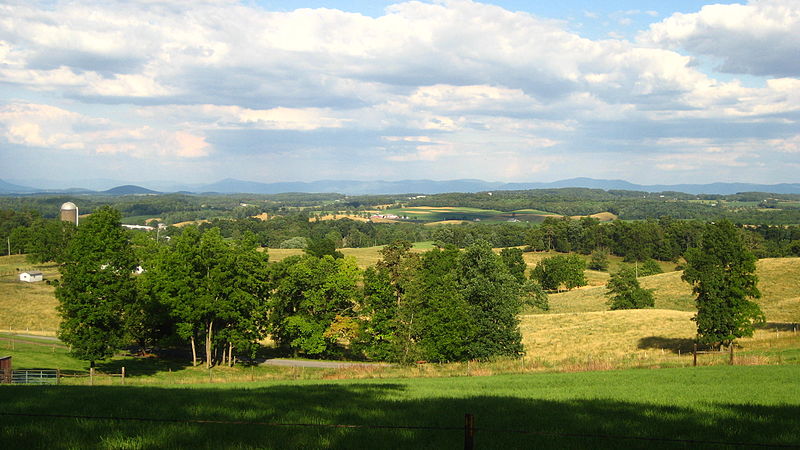
Augusta County, Virginia countryside, view from Parnassus, 2007

Old Augusta vows to pay its tenth, sell surplus at government prices, and tell on the non-compliant (photo c.2007)

The photo of Augusta County, Virginia by Hamiltonl at en.wikipedia is licensed by Creative Commons

U.S. History Images provides the Lincoln image.
Posted in 150 Years Ago This Week, Confederate States of America, Lincoln Administration, Northern Society, Southern Society | Tagged , , , , | Leave a comment