can’t carry a tune

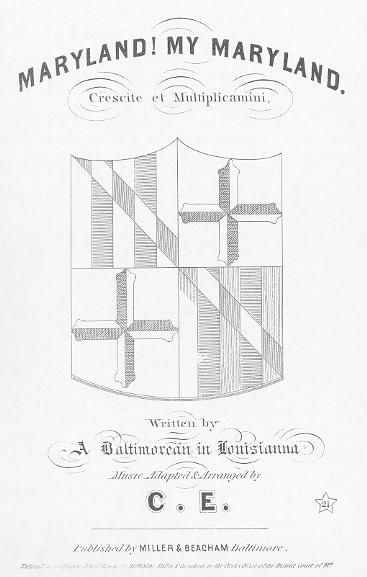
Original published by Miller & Beacham in Baltimore in 1861

banned in Baltimore

Like a song I can’t get out of my head, I just can’t seem to let go this statement about March 7, 1863:

Federal troops in Baltimore, Maryland, confiscate all song sheets that are deemed “secession music.”[1]

I have not seen much amplification anywhere, although the fact is propagated throughout the Civil War internet. Here’s an example that gives the credit to Robert Cumming Schenck, who was in command of the Union army’s VIII Corps at the time:

Gen. Robert Schenk issues orders that prohibit the sale of secession-oriented sheet music in his department, headquartered in Baltimore.

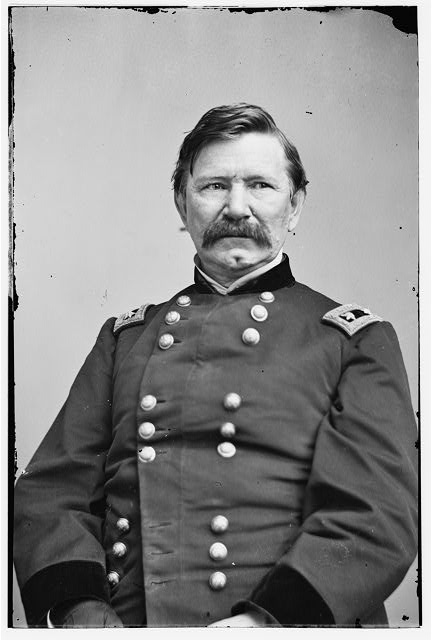
Portrait of Maj. Gen. Robert C. Schenck, officer of the Federal Army (Between 1860 and 1865; LOC: LC-DIG-cwpb-04879)

sang Lincoln’s praises; conducted operations in Baltimore for a time

According to the Wikipedia link the Ohioan political general was an early supporter of Abraham Lincoln for president:

… in September 1859, Schenck delivered a speech in Dayton regarding the growing animosity within the country. In this speech, Schenck recommended that the Republican Party nominate Abraham Lincoln for the presidency.

This was, perhaps, the first public endorsement of Lincoln for the presidency. He supported Lincoln with great ardor at the Chicago Convention in 1860 and in the campaign that followed.

After being permanently injured in the right arm at Second Bull Run:

He was unfit for field duty for six months, but was assigned to the command of VIII Corps, embracing the turbulent citizens of Maryland, repressing all turbulence and acts of disloyalty or any complicity with treason. General Schenck was not popular with the disloyal portion of the inhabitants of Maryland. In December 1863, he resigned his commission to take his seat in Congress.

I guess it is not surprising that General Schenck would find songs like Maryland, My Maryland offensive. The song is said to be referring to an unnamed Lincoln as a tyrant and despot.

  1. [1]Fredriksen, John C. Civil War Almanac. New York: Checkmark Books, 2008. Print. page 268.
Posted in 150 Years Ago This Week, Military Matters, Northern Politics During War | Tagged , | Leave a comment

fishy

I guess this “spring ahead” stuff has the old man’s system all fouled up. Sumpter quiescent?

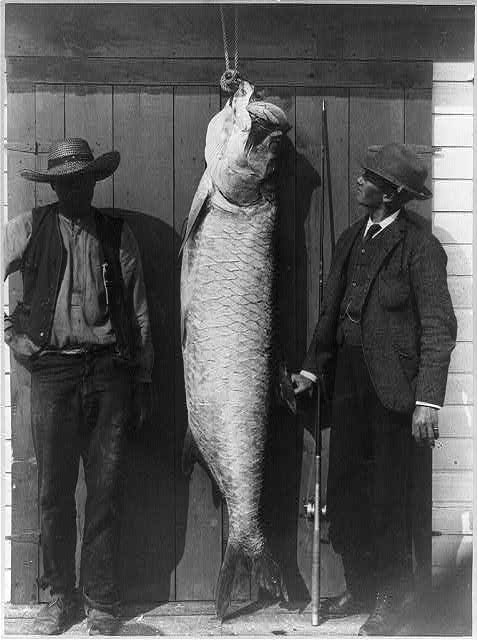
Tarpon caught by Sir Bache Cunard - St. James on Gulf, Florida (by Joseph John Kirkbride, 1889; LOC: tanding beside 7-foot tarpon. Reproduction Number: LC-USZ62-66562)

Posted in Uncategorized | Leave a comment

Webster was wrong

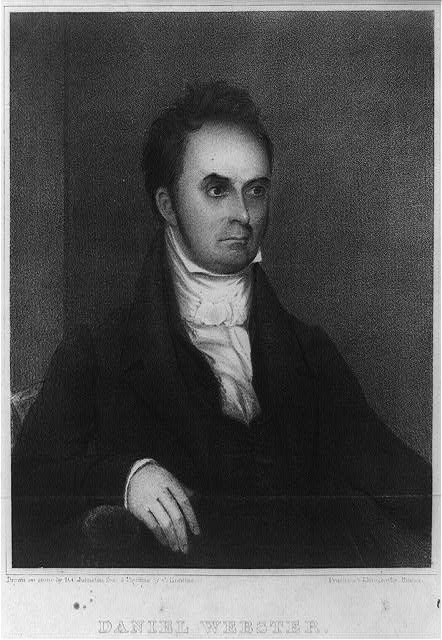
Daniel Webster (c1831 July 28; LOC: LC-USZ62-8609)

wrong

Contrary to Daniel Webster’s assertion, Liberty does not require Union, according to this Southern editorial. Also, it’s too bad the Lincoln administration is pursuing this war because in time there could have been an alliance between two strong, liberty-loving nations. On the other hand, one positive of the war is that it has increased the military might and reputation of the two sections.

From the Richmond Daily Dispatch March 9, 1863:

The European Republicans.

The almost universal sympathy of European Republicans with the United States is because they confound Liberty with Union, and consider them “one and inseparable.” The European despots revel in the scenes now occurring in America, because they labor under the same delusion. Liberty existed on this continent long before Union, and in England — from which we derived all our principles of free government — it had been the steady growth of centuries. Liberty survived the separation of England and America, and waxed stronger in both countries from that hour. Why should its influence be impaired because of the dissolution of a mere co-partnership between independent States in this hemisphere? If the Republicans of Europe took a more intelligent view of American affairs they would perceive that every principle of free Government is involved in the success of the Southern cause and the final over throw of that Union which has destroyed every vestige of liberty in its own section, and which, in the event of its triumph over the Southern Confederacy, would itself discard the very name of Union, and, transformed into a confessed military despotism, rule the South as Russia rules Poland, and AustriaHungary.

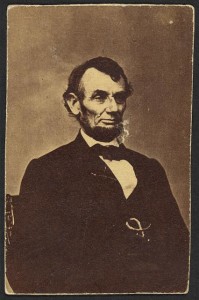
Abraham Lincoln, three-quarter length portrait, seated, facing right; hair parted on Lincoln's right side (by Anthony Berger; 1864 Feb. 9, printed later; LOC: LC-DIG-ppmsca-19190)

wrong (but really building up American military power and prestige)

Even the moral and physical weight which the Union exerted on behalf of Republicanism abroad would not have been permanently impaired if the besotted Government of Lincoln had consented to a peaceful dissolution. The two sections would then have parted friends, and perhaps formed an offensive and defensive alliance, both advancing with unchecked progress in trade and power. In progress of time there would have been two mighty Republics, whose influence and arms would have been as united and efficacious on the side of constitutional liberty as if they had remained under one Union. It is not the dissolution of Union, but the war waged by Lincoln, which has almost irreparably damaged the prestige of free institutions abroad, and seriously impaired the resources of both countries. But even the war, if the despotism at Washington would now terminate it, would increase respect at least for the military power of America abroad; and in view of the prodigious martial resources it has developed, would make the two separate Confederacies more feared in the Old World than they were under a united Government. The world did not know, we did not ourselves know, nor would we have discovered for a long time, the military capacity of the American States but for this war. Every one remembers how, as late as the Administration of Lincoln’s predecessor, British gunboats chased, stopped, and boarded American merchantmen off our own coast, with perfect impunity. It was in vain that the public press invoked Buchanan to send out a few vessels and inflict summary punishment upon the offenders. He could not be kicked or pummeled into anything more than a gentle remonstrance. Would England, with the knowledge disclosed by the present war, have ever ventured upon such indignities, or an American President, who had formed the fainest conception of the strength of his country, have failed to obtain reparation? The profound anxiety of England to avoid a collision even with the mere ramp of the United States is a suggestive contrast to the gunboat bullying of four years ago.

But of what avail to Republican ideas in Europe will be the military greatness of the United States if the South is subjugated and enslaved? A great military despotism, sympathizing with military despotisms everywhere, and having no affinities or interests in common with human freedom in any clime, will be the inevitable result of the triumph of the North. There would then be left upon the earth but one powerful free Government, that of Great Britain, for ages the ark of liberty; but how long that would last, standing alone amid a world of despotisms, no one can predict. On the contrary, let the Confederacy triumph, and even the North may be saved from itself, and the cause of constitutional liberty throughout the world receive new strength and vigor.

Daniel Webster’s January 1830 Second Reply to Hayne on the floor of the United states senate was an attack on Southern nullification, which could eventually lead to bloody civil feuds:

… When my eyes shall be turned to behold for the last time the sun in heaven, may I not see him shining on the broken and dishonored fragments of a once glorious Union; on states dissevered, discordant, belligerent; on a land rent with civil feuds, or drenched, it may be, in fraternal blood! Let their last feeble and lingering glance rather behold the gorgeous ensign of the republic, now known and honored throughout the earth, still full high advanced, its arms and trophies streaming in their original luster, not a stripe erased or polluted, nor a single star obscured, bearing for its motto, no such miserable interrogatory as “What is all this worth?” nor those other words of delusion and folly, “Liberty first and Union afterwards”; but everywhere, spread all over in characters of living light, blazing on all its ample folds, as they float over the sea and over the land, and in every wind under the whole heavens, that other sentiment, dear to every true American heart-Liberty and Union, now and forever, one and inseparable!

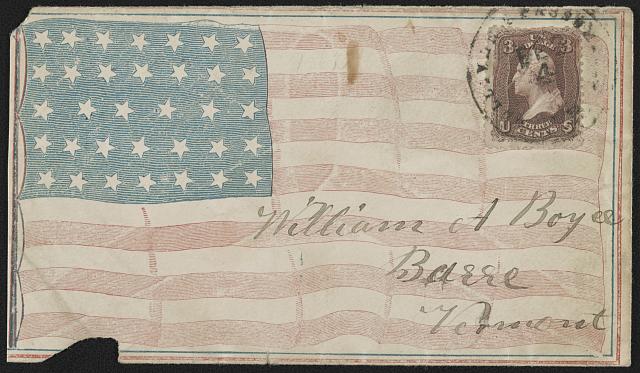
Civil War envelope showing 34-star American flag (between 1861 and 1863; LOC: LC-DIG-ppmsca-31962)

wrong (by about 13 stars)

Posted in 150 Years Ago This Week, Confederate States of America, Southern Society | Tagged , , , | Leave a comment

Work Cut Out

Just like old times – white surgeons received their degrees at a black church led by a white, slave-owning minister. But I can understand how the writer would find this ceremony, with Richmond belles checking out the new doctors, comforting after two years of war. Of course, the war was always there – it meant a big demand for the surgeons’ skill.

From the Richmond Daily Dispatch March 7 1863:

Medical College Commencement.

–The African Church was densely thronged last night by the “beauty and fashion” of the city, in consequence of the announcement, that the annual commencement exercises of the Medical College were to take place. It was a scene that forcibly reminded the spectator of “Richmond in by-gone days.” After an impressive prayer by Rev. Dr. Moore, the address to the graduating class was delivered by Professor Wellford, and listened to with deep attention. The ceremony of conferring degrees upon the band of young doctors was, as usual, the most interesting feature of the occasion to the ladies present. The band played lively airs at intervals, and everything went off to the satisfaction of all concerned.

Today’s VCU Medical Center traces its founding to 1838. It became a state institution in 1860.

Soon the Civil War erupted, and the College found itself playing an important role in the education of Confederate surgeons and in the hospital care of wounded and sick military personnel. During the Civil War, the school remained open and it graduated a class every year throughout the conflict. The MCV is the only Southern medical school still in existence to have done so. [1]

Richmond’s First African Baptist Church was founded in 1841 when white members of the original congregation established a separate church and sold the original building to the Africans.

As one of the largest meeting halls in Richmond, it was often rented for white events. Its large interior and prominent location in Richmond made it a sought after venue for events such as concerts and political rallies. The practice of renting the church was controversial among members due to the use of a church for secular events and due to the racial segregation often imposed at the events. The practice continued, however, due in part to the significant income that it provided.

John Hartwell Cocke lectured on temperance at at one of the earliest major events hosted at the church. While the government of the Confederate States of America was based in Richmond during the American Civil War, the church was often used for speeches by politicians including Governor William Smith and President Jefferson Davis. Judah Benjamin also spoke at the church to recruit blacks into the Confederate Army. …

Though it was always a Black church, it was initially led by a white minister and a board of thirty black deacons because it was illegal for blacks to preach. … The first senior minister, Robert Ryland, served from 1841 until 1865. Ryland owned slaves and believed that slavery was the best way to convert Africans to Christianity. … [2]

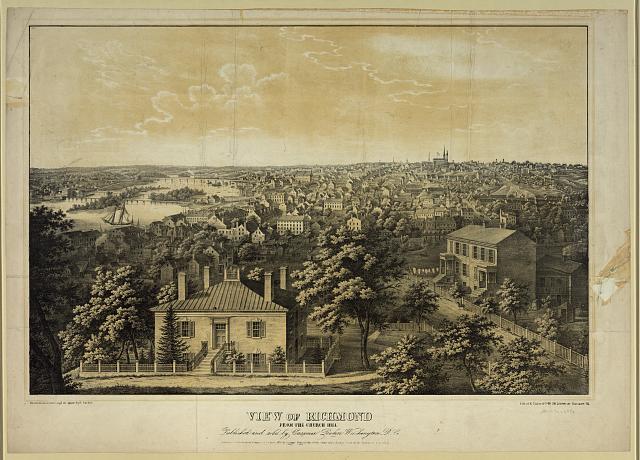
View of Richmond from the church hill (Published and sold by Casimir Bohn, c1851.; LOC: LC-DIG-pga-02597)

“Richmond in by-gone days.” c.1851

  1. [1] Wikipedia references to Hoke, Thelma (1963). The First 125 Years of the Medical College of Virginia.
  2. [2]Wikipedia references to Leveen, Lois (24 January 2011). “The North of the South” New York Times; Kimball, Gregg (2000), American City, Southern Place: A Cultural History of Antebellum Richmond, Athens, Georgia: University of Georgia Press; Furgurson, Ernest (1996), Ashes of Glory: Richmond at War (2 ed.), New York: Vintage Books
Posted in 150 Years Ago This Week, Confederate States of America, Southern Society | Tagged , , , , , | Leave a comment

“General of pluck”

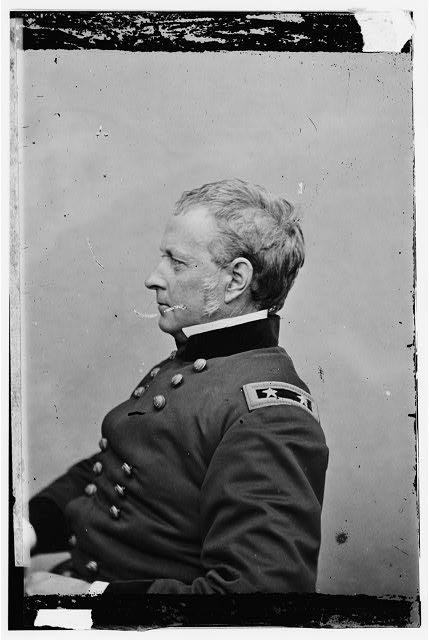
Maj. Gen. Joseph Hooker (between 1860 and 1870; LOC: LC-DIG-cwpb-06975)

looked every man in the face “as though he would look him through”

From the Richmond Daily Dispatch March 7, 1863:

The condition of the Army of the Potomac.

A letter in the New York Tribune dated from the Army of the Potomac, gives a description of the working of matters there at present. It says:

Gen. Hooker has a straightforward way of doing at things which takes with the soldier. There is no show about him. He means business in every word, look and act. An instance of this plain, business like way of his of doing things occurred a few days since under my immediate observation. He came riding along where a brigade was being reviewed by its division officer. It was a short time previous to the hour for review, and the men were standing waiting in line. He appeared attended by only a single orderly, whom he immediately dispatched on some message. –While the orderly was absent the General rode down the line, but a few feet in advance of it, looking every man in the face as though he would look him through. Nobody seemed to know him, and most supposed him to be some curiosity hunting civilian. Many wondered what that old follow wanted, and some hinted aloud that he must be rather green to be riding down a line of battle in that manner. But the attendant coming back and respectfully reporting to him, he dashed off at a full gallop, and in such a manner as to make it evident that he was not only a military man, but one of some importance withal.

It was not until some hours after, however, that it was generally known to the soldiers that their General-in-Chief had paid them a visit, and then it was interesting to listen to their comments. “Did you see old Hooker this afternoon?”? said one of them to one of his comrades. “Yes,” was the reply, “if that chap that looked at us so was him” “Well, it was, they say, and ain’t he — of a fellow to be poking his nose around in that style. Mac always used to have a string of dukes and aids and princes as long as a funeral procession when he came; but I guess old Joe travels on his own hook, and looks into things for himself.” The parties moving on, I lost the further continuance of the conversation; but it was a fair specimen of what I heard that afternoon and evening.

“Hooker gives us soft bread and potatoes, and lets us go home; he’ll do,” I heard another say in allusion to recent orders. By the by, I learn that some, more officers than men proportionately, have taken advantage of recent orders and stayed over their time, thus rendering it doubtful whether the order be continued in execution. I hope, however, that the order will not be repeated, but that the delinquents will be made to suffer. I have seen the good effects in military life of punishing the few for the benefit of the many and I have likewise seen the evil effects of punishing the many because of the sins of the few. It universally breeds dissatisfaction, for it is essentially unjust.

So far, then, as the popularity or unpopularity of the chief with the men is concerned — a point to which undue importance is attached everywhere — I for one am willing to leave the matter where it stands. Gen. Jos. Hooker will be popular with men and officers. He evinces for the men all that care for their comfort and their health which made them like McClellan, and then he is a better fighting man. The soldier likes the General of pluck. Fighting with him, like charity with the Christian, covers a multitude of sins.

I enjoyed the contrast between Hooker riding with a single orderly and McClellan with “a string of dukes and aids and princes as long as a funeral procession”; however, in the April 18, 1863 issue of Harper’s Weekly (at Son of the Southartist Alfred R. Waud described “the large train of officers that accompany the general [Hooker]”, at least in the sense of being part of the headquarters complex. The balloon party sounds like a lot of fun.

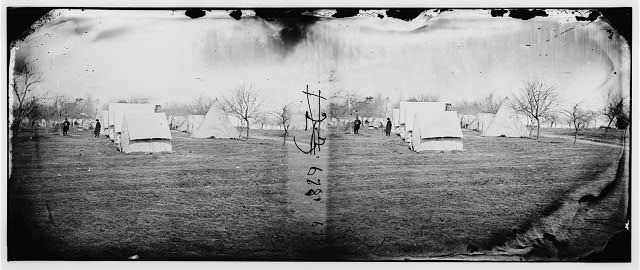
Falmouth, Va., vicinity. Balloon camp (by James F. Gibson,  1863 March; LOC: LC-DIG-cwpb-00310)

Balloon camp near Falmouth, March 1863

Posted in 150 Years Ago This Week, Military Matters | Tagged , , | Leave a comment

War power to ya

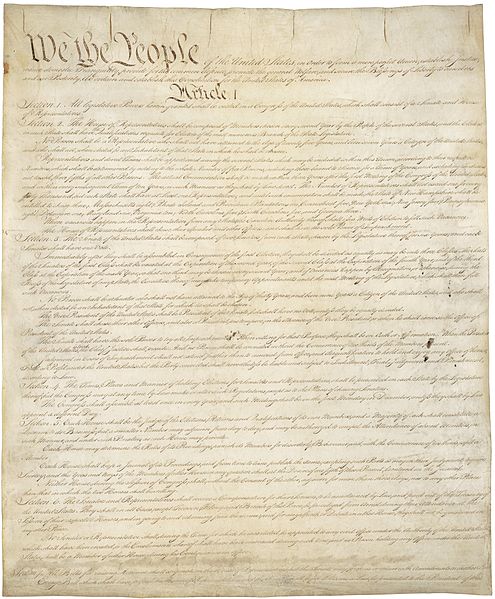
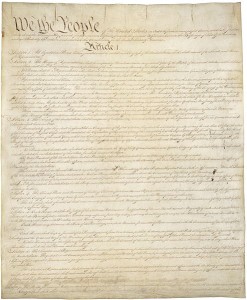
Constitution of the United States, page 1.

shush

Inter arma leges silent. [1]

As the 37th Congress closed on March 4, 1863 Northerners were aware that Congress had recently granted the President greatly increased power in order to put down the rebellion and restore the Union. Both the New York Herald and Harper’s Weekly referred to the dictatorial powers of Abraham Lincoln, but both were supportive of the enacted laws because of the demands of the war. (the Herald editorial was reproduced through the filter of the Richmond Daily Dispatch)

Here are some excerpts from the March 14, 1863 issue of Harper’s Weekly (hosted at Son of the South:

THE WORK DONE BY CONGRESS.

THE Thirty-seventh Congress of the United States has expired, having, in the short session which ended on March 4, passed some of the most momentous measures ever placed upon the statute-book. Those measures, as a whole, are equivalent to the step which, in republican Rome, was taken whenever the state was deemed in imminent danger, and which history calls the appointment of a Dictator. The President of the United States has, in effect, been created Dictator, with almost supreme power over liberty, property, and life—a power nearly as extensive and as irresponsible as that which is wielded by the Emperors of Russia, France, or China. And this is well. To succeed in a struggle such as we are waging a strong central Government is indispensable. One great advantage which the rebels have had over us is the unity of their purposes, and the despotic power of their chief. We are now on a par with them in these respects, and we shall see which is the better cause.

The measures which collectively confer upon Mr. Lincoln dictatorial powers consist, 1st, of the Conscription Act; 2d, of the Finance measures; and, 3d, of the Indemnity Act.

After reviewing the Conscription and Banking acts the article discusses the Indemnity Act or Habeas Corpus Suspension Act 1863

It is quite evident that in the face of such a state of things, and when the nation is engaged in a death-grapple of which the issue is very doubtful, the slow and cautious remedies which the law provides for the redress of wrongs in time of peace would be out of place. The country might be ruined while we were empanneling a jury to try a traitor. Inter arma leges silent.

When we undertook the war we tacitly agreed to accept it with all its evils. Prominent among these are a depreciated currency, a temporary deprivation of personal liberty, and a liability to be taken from one’s business to carry a musket in the army. These are grave inconveniences. But they are temporary and bearable; whereas the evils which would result from the disruption of the Union are lasting and intolerable. We may suffer, but our children will benefit by our suffering. Whereas if this country is severed in twain the future which lies before us is plainly depicted in the history of Mexico and Central America: incessant wars, constant subdivisions, a cessation of honest industry and agriculture, a decay of trade, a disappearance of wealth and civilization, and in their stead chronic strife, rapine, bloodshed, and anarchy. To avoid these things we can well afford for a few years to have a strong Government.
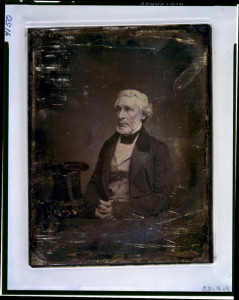
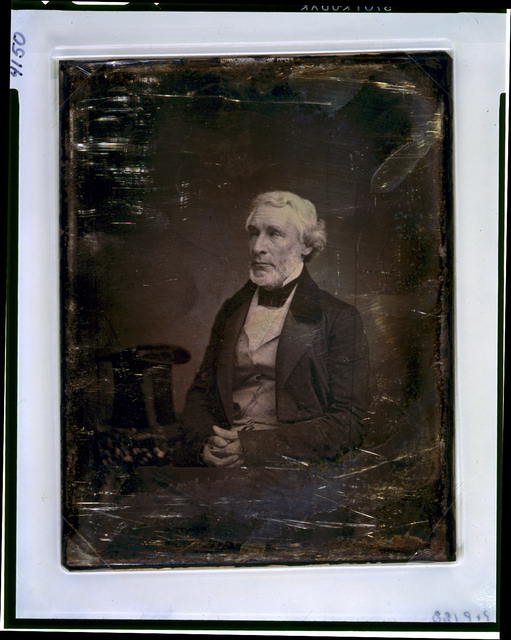
James Gordon Bennett, three-quarter length portrait, three-quarters to the left, seated, hands folded in lap, seated beside a small table with tablecloth on which rests a tall hat (between 1851 and 1852; LOC: LC-USZC4-4150)

kneeling before Czar Abraham

In supporting the temporary dictatorship the New York Herald seemed to rely on the character of Abraham Lincoln and the character of the Union troops in the field.

From the Richmond Daily Dispatch March 4, 1863:

The Herald on Abraham Lincoln as a Dictator — Bennett on his Knees to the future [C]zar of the United States.

The New York Herald, of the 27th, has the following article on Abraham’s prospects for the Dictatorship of the United States:

The important measures which have lately passed, and others which are now under consideration in the two houses of Congress, will leave no excuse for a failure on the part of the present Administration to put an end to the rebellion. With the closing of the present session President Lincoln will be practically invested with the powers of a Dictator. …

This organic instrument and the laws passed in pursuance thereof constitute the supreme law of the land. Nor do we think it can be successfully denied or contested that in straining its warlike authority to the establishment at Washington of a temporary dictatorship, Congress has in the acts indicated passed the barriers of the Constitution. The legislative power of Congress in regard to the militia, in case of rebellion or invasion, and over the financial affairs of the country, and the habeas corpus, is broad and comprehensive. It is possible that with a Napoleon or a Cromwell, clothed with this provisional dictatorship, there would be an end of our Republican institutions and the beginning of an imperial establishment; but there is not the slightest danger of the abuse of his authority by President Lincoln for ambitious purposes. We all know that his ambition is limited to the suppression of the rebellion, but if he were not, we all know that he would be powerless to employ the intelligent, liberty loving soldiers of the Union in any movement involving the suppression of our regular Presidential election. …

It made me nervous when I read William Green’s letter home from the Virginia front talking about how powerful the Administration was. When he wrote, “individuals are nothing before a vital principle” I thought that was a pretty good motto for Adolf Hitler’s Nazi program. But Bennett from the Herald would rely on another one of Green’s statements – “… the Administration. I say support it to the letter so long as the present one exists, and at another election, if it doesn’t suit, change it.”
  1. [1]translated ” in the midst of arms (i.e., in time of war) the laws are silent”
Posted in 150 Years Ago This Week, Lincoln Administration, Northern Politics During War, Northern Society | Tagged , , , , , | Leave a comment

Flour Power

From the Richmond Daily Dispatch March 5, 1863:

Flour impressment.

Major Tannahill, the Commissary of Post at Petersburg, received on Tuesday last an order to impress all the extra superfine flour in the possession of millers and merchants in that city. The price specified is $19 50 per barrel, while the market price is from $28 to 29. Not long since all the superfine flour in that city was impressed.

According to Encyclopedia Virginia

Impressment was the informal and then, beginning in March 1863, the legislated policy of the Confederate government to seize food, fuel, slaves, and other commodities to support armies in the field during the American Civil War (1861–1865). The tax-in-kind law, passed a month later, allowed the government to impress crops from farmers at a negotiated price. Combined with inflationary prices and plummeting morale following military defeats, impressment sparked vocal protests across the South. Discontent was exacerbated by what was perceived as the government’s haphazard enforcement of the law, its setting of below-market prices, and its abuse of labor. As a result, citizens hoarded goods and in some cases even impersonated impressment agents in an effort to steal commodities.

Here’s another quick story from the same issue of the Dispatch:

Death of Mrs. Edwin Booth.

–The New York Herald announces the death of Mrs. Edwin Booth. She expired on the 21st ult., at her husband’s residence, at Dorchester, near Boston. The immediate cause of her death was inflammation, contracted from a cold. Mrs Booth will be remembered as Miss Mary Devilin, a young actress of brilliant promise a few years ago. She played in Richmond several seasons, and was very popular with our play-g[oe]rs.

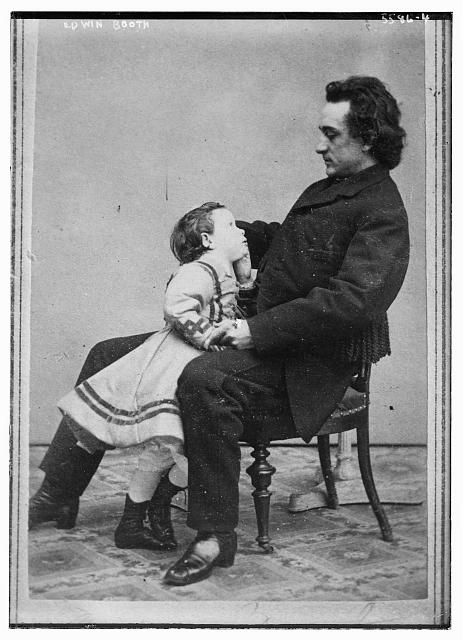
Edwin Booth (no date recorded on caption card; LOC: LC-DIG-ggbain-33336)

Edwin Booth and daughter Edwina, probably 1864

Posted in 150 Years Ago This Month, American Culture, Confederate States of America, Southern Society | Tagged , | Leave a comment

unoriginal devil

The following article finds that there was a British template for President Lincoln’s Emancipation Proclamation. Twenty-five years earlier a writer in Fraser’s magazine suggested a crusade to free American slaves as the only way the United Kingdom had a chance of beating the United States in a prospective war. The British had no hope of invading America with a conventional force and winning, at least partly because it would give France an opening to hurt British interests. However, the British might be able to lead a force of Jamaicans to spur a slave insurrection. This would destroy the American Union and further British interests – all with the veneer of a humanitarian mission.

In early 1863 the Union was no where near crushing the Southern rebellion. The Proclamation might raise havoc in the Confederate society and add many potential soldiers to the Union army. From the abolitionist perspective it was also the morally right thing to do.

From the Richmond Daily Dispatch March 4, 1863:

Servile war.

We have often referred to the fact that American abolitionism has always derived its most malignant inspirations from English abolitionism; but we were not aware until lately that even the infamous emancipation programme of Lincoln had been on one occasion recommended by high literary authority in Great Britain, as the most, and indeed the only, effectual way of carrying on war with America. A friend has put in our hands an article of Frazer’s Magazine, published at the time of the Canadian troubles in 1838, when a war between the United States and England seemed imminent, under the title of “War with America a Blessing to Mankind.”

The writer discusses, in the first place, the ordinary notion of levying war in the old fashioned style, by sending a military and naval expedition against the North. He contends that England cannot do this with any chance of success, and that she cannot afford a protracted contest with the United States, because France might embrace the opportunity of striking a blow at her ancient enemy. Ireland might attempt to secure her independence, and Russia make a demonstration upon Northern India, (considerations which have perhaps not lost their influence to this day upon the policy of England towards the United States) He then proceeds to point out “a short, sharp and decisive mode” of making war upon America as follows. After asserting that her bondmen are held in the most cruel thraldom known to mankind, and proving it by the confessions of the “Executive Committee of the American Anti-Slavery Society, ” the writer proceeds:

“It may be a doubtful point, how far another nation would be justified, in a time of peace, in embarking in a crusade of philanthropy, and endeavoring to coerce an independent people into the relinquishment of a national sin. But what possible doubt can exist as to the propriety, the expediency — nay, the absolute duty, of making a way subservient to the great and pre eminent object of freeing these three millions of cruelly oppressed human beings?

“Policy, too, not less than philanthropy, prescribes such a course of warfare. By this mode, and this only, a war with American might be brought to a speedy and inevitably triumphant close. As we have already observed, a struggle between the people of England and their descendants in America must be a fearless, a protracted, and a lamentable one. But if assailed in this quarter, a vital part is instantly and surely reached — the Union dissolved, and the war is at an end.

“Among the three millions of slaves, we may fairly calculate the adult males at nearly one million. Every man of all this multitude would eagerly rush to embrace an emancipating invader, and within a few days’ sail of their coast repose the free and happy black of Jamaica. In one morning a force of ten thousand men might be raised in this quarter, for the enfranchisement of their brethren in America. Such a force, supported by two battalions of Englishmen and supplied with 20,000 muskets would establish themselves in Carolina, never to be removed. In three weeks from their appearance the entire South would be in one conflagration. The chains of a million of men would be broken, and by what power could they ever be again riveted?

“We say that this course is dictated alike by policy, by self-preservation, and by philanthropy. By policy, for nothing would render our possessions in America so secure as the dissolution of the Union.–an inevitable result of this line of action. By self- preservation for England must not venture amidst her other difficulties, to involve herself in a protracted contest a distant quarter of the globe. By philanthropy which tells us that if, contrary to our own inclinations, we are dragged into this unnatural war, it is our duty at least to endeavor to bring good out of evil. In whatever way, then, we contemplate the subject, we come to this conclusion. If we must have a war with America, let us make it a war for the emancipation of the slaves; so shall our success be certain, and our triumph the triumph of humanity.”

These extracts exhibit the true animus of Englishlitionism and the origin of the demonize [demonic?] policy which Lincoln has adopted for the conduct of the present war. We need not point out how preposterous were the calculations of the writer founded upon the supposed readiness of the slaves for revolt. We reproduce the article for the purpose simply of “giving the devil his due,” and letting it be seen that Lincoln is not original even in his diabolism.

Posted in 150 Years Ago This Week, Lincoln Administration, Military Matters | Tagged , | Leave a comment

Still trusting the old ship

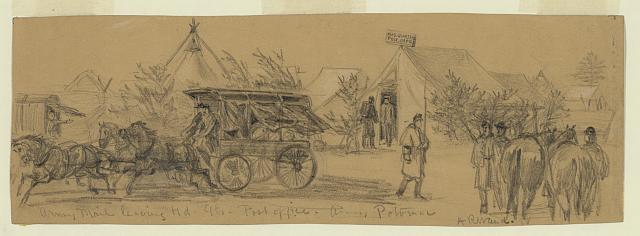
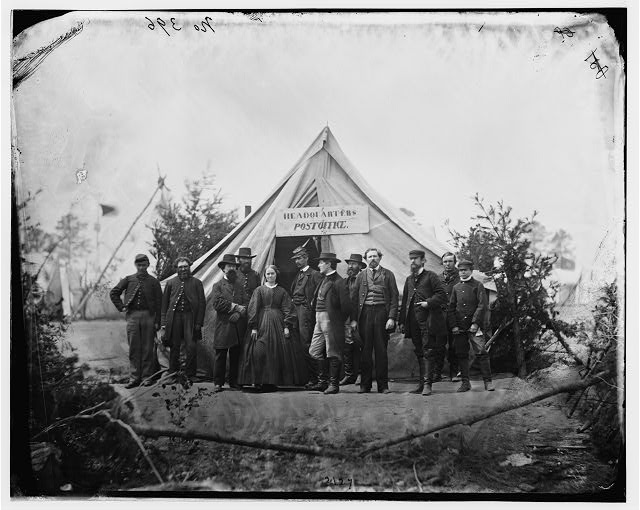
Army Mail leaving Hd.Qts. Post Office. Army Potomac (by Alfred R. Waud, 1863 ca. March,  Harper's Weekly, April 18, 1863, p. 245; LOC: LC-DIG-ppmsca-21422)

getting letters home: mail wagon leaving Falmouth

The New York 33rd Volunteer Infantry has less than three months remaining in its two year enlistment. Here’s a letter home from a member of the 33rd.

From a Seneca County, New York newspaper in 1863:

Patriotic Letter from a Soldier.

The following is a copy of a letter from a soldier in the Thirty-third to his father, at Waterloo:

CAMP NEAR FALMOUTH, VA.
March 2d, 1863.

Dear Father: – Your kind letter came to hand yesterday and was read with all pleasure. You asked me about my food and the quantities of rations; I will say that they are as good as one would ask for. “Old Joe” has ordered that we shall have four rations of fresh soft bread per week, two of fresh potatoes, and two of desicated vegetables, or potatoes instead; as good coffee as any one can wish for and enough of it; plenty of good fresh and salt beef, and as good pork as any farmer in old Seneca can produce. But I will leave that subject.

I still bunk with my old friends, Cook and Covert. We have the best house in the regiment.

You wish to know how I stand on the war, the Administration, &c. I am in favor of a vigorous prosecution of the war. I am not in favor of peace, – that is, I am opposed to all ideas of peace, unless it is a restoration of the Union and a downfall of the so-called Confederacy. I am opposed to all manner of compromises, all foreign intervention, whether by mediation or otherwise. I believe that we are able to settle our own difficulties, and believe that we have some man who is able to command this army. I am no man-lover. I love McClellan as any soldier should his leader, but to go so far as to say that no other than him can command this army, I will not say; but at the same time I cannot see why he is not the man, because he schooled himself for the task, but it seems that he did not accomplish anything, after nine months hard drill and school, and five months trial. But I am told that he has been meddled with, that his plans have been frustrated by the War Department and the Administration. I say support it to the letter so long as the present one exists, and at another election, if it doesn’t suit, change it. I believe in supporting it, because I believe it to be all powerful. The Union must be preserved at all hazards. I cannot believe that this, the greatest and best Government that ever existed has gone or or is going to ruin, as some writers from home write to their friends in the army. Such things have a bad influence upon the army in the field, and no man breathing the spirit of a true lover of his country will do it. Now the idea seems very foolish indeed, to think the great America has lost all, everything, home and integrity, and only been to war two years. As for my part, I am not afraid. I will trust the old ship and stand by her a while yet. Considering the direct and bad discouragement of a considerable portion of them and the indirect influence of bad example to which all have been exposed, the real wonder is that the general morale has fallen no lower. The indications that the Government has at last determined to correct the evils, whatever personal or party sensibility it may wound, is the most encouraging of all signs. We trust the enforcement of discipline upon all grades will here after be carried out with the sternest impartiality. It matters not where it strikes; individuals are nothing before a vital principle. Absolute subordination is the one thing needful for our national army. With it that army will be surely irresistible; without it all is at the mercy of accident. Father, I am for the Government as it was handed down to us by our forefathers. I have enlisted for this Government, not for two years, but during my natural life. One thing must be done; treason must be punished. The work should be commenced in time. The Government must exert its power in sustaining and enforcing the Constitution. Some talk of compromise; that is equal to a surrender. Why, in the language of the noble Paul Jones, “no, not surrender, we are just getting ready to fight.” So let our motto be.

Father, if you remember, I wrote to you on first going into war, that if we had all such officers as Col. R.F. Taylor, the old 33d would make her mark. As for our field and line officers, clear down to 4th Corporal, the Army of the Potomac has no better or braver or loyal men than are in the old 33d. As for myself, I hold the office of high private, and I think my prophecy as respects the mark you will all see inscribed on our banner, on our return home, (if we should be so fortunate as to return,) in letters that will be long remembered, that the 33d belonged to the Army of the Potomac.

From your ever dutiful son,

WM. H. GREEN.
Co.C, 33d Reg, N.Y.S.V.

William H. Green

” individuals are nothing before a vital principle.”

Apparently the ample provisions provided to the Army of the Potomac were appreciated by some of the local inhabitants. According to The story of the Thirty-third N.Y.S. vols.; or, two years campaigning in Virginia and Maryland (by David W. Judd (page 275)):

Falmouth, Va. Group in front of post office tent at Army of the Potomac headquarters (by Timothy H. O'Sullivan, 1863 April; LOC: LC-DIG-cwpb-03803)

Falmouth, April 1863

Posted in 150 Years Ago This Week, Military Matters, Northern Politics During War | Tagged , , , | Leave a comment

“a woman on each arm”

A couple days ago we read a report about a courageous and loyal Confederate soldier who deserted because he was concerned about his wife’s welfare. The deserter was executed. Here’s information from 150 years ago this week that indicates some soldiers deserted for more mercenary motives.

From the Richmond Daily Dispatch February 28, 1863:

Military Notices.

Three hundred Dollars reward.

I will pay $300 in cash to any one who will arrest Michael Rooney, who deserted from my company last night after having regularly entered as a substitute three days before. He is a short, thick-built Irishman and wore, when he left, a pair of blue Yankee pants, citizen’s coat, and a black wool hat, badly worn; he is 46 or 47 years old and has generally worked on railroads, he once lived in Alexandria; has recently lived in Richmond, where it is said he has a wife and two children. The above reward will be paid to any one who will lodge him in Castle Thunder or any other prison, and notify me of the same, or for his head, should he resist arrest.

Wm T Nicholson,

Capt comd’g Co. E, 37th N G Reg’t,

Lane’s Brigade, A P Hill’s Div.

February20th, 1863.

Five hundred Dollars reward.

–Deserted from comp’y E, 26th Virginia reg’t, on the 1st inst, Henry Scott, an Irishman about 47 years old, about 5 feet6½ inches high; dark-brown or black hair; bluish eyes; dark complexion; has a ship tattooed on his breast, a woman on each arm, the woman on the left arm has a child in her arms; has a star on the back of the left hand, and has lost a portion of the middle finger of the right hand.–Henry Scott was mustered as a substitute for Robt Edmundam of Halifax Co., Va. The above reward will be paid for his delivery to me at the camp of the 26th Virginia regiment, Wise’s brigade, near Chaffin’s Bluff.

John T Perrin, Capt Co B,

26th Virginia regiment.

Desert to substitute again some day? Henry Scott might have a tough time going incognito.

Posted in 150 Years Ago This Week, Confederate States of America | Tagged , | Leave a comment