“stripped off his stripes”

From the Richmond Daily Dispatch March 7, 1862:

Spirited Texan ladies.

–The “Bell County Rebels,” from Belton, Bell county, Texas, started for their rendezvous, Hempstead, some time ago, when one of their Lieutenants, James F. Hardin, a lawyer, deserted and returned to Belton. Several ladies of the place, says the Crescent) incensed to see him strutting about the streets in his uniform, got together a few days ago, and seizing him in public, stripped off his stripes, which they sent to his company, who rewarded them with a vote of thanks.

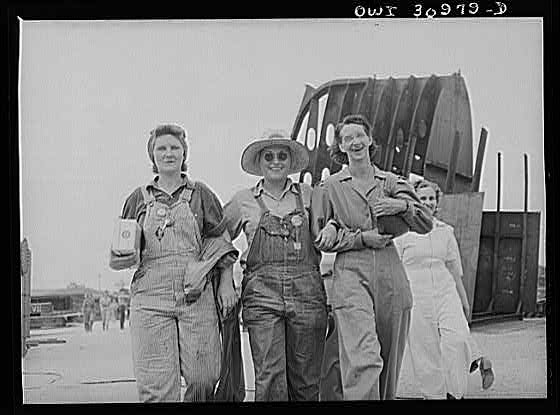
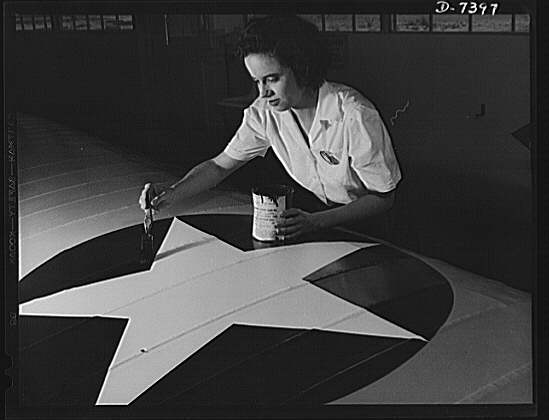
Texas women about 80 years later – still strong and patriotic

Naval air base, Corpus Christi, Texas. Women from all fields have joined the production army. Miss Grace Weaver, a civil service worker at the Corpus Christi naval air base and a school teacher before the war, is doing her part for Victory along with her brother who is a flying instructor in the Army. Miss Weaver paints the American insignia on repaired Navy plane wings (1942 Aug; LOC: LC-USE6-D-007397)

Beaumont, Texas. Women shipyard workers leaving the Pennsylvania shipyards (1943 May; LOC: LC-USW3-030979-D)

Posted in 150 Years Ago This Week, Confederate States of America, Southern Society | Tagged , | Leave a comment

“will this do to kill a Yankee?”

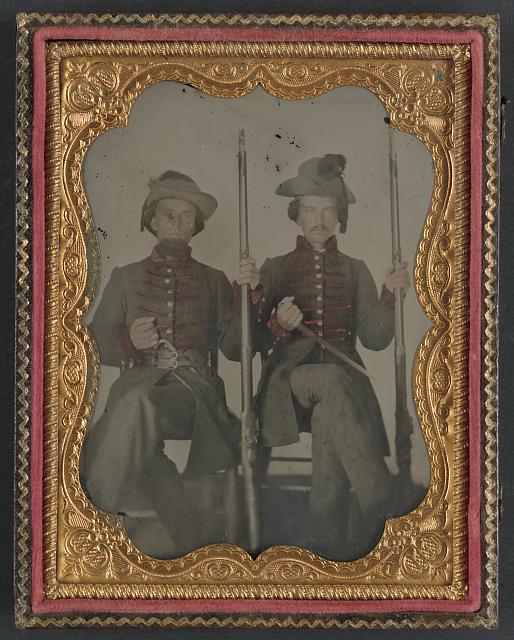
Two unidentified soldiers in Confederate uniforms with muskets and knives (between 1861 and 1865; LOC: LC-DIG-ppmsca-32480)

well-armed

From the Richmond Daily Dispatch March 6, 1862:

Return of arms.

–As we predicted in our notice, under the head of “Arming the People,” the Ordnance Department of Virginia. corner of 7th and Cary streets, was crowded yesterday with our citizens, “giving up their arms for the use of the army.”

It was, indeed, a most touching thing, to witness the ardor and eagerness with which old men, and mere boys, handed in their arms for the defence of the Confederacy and the Old Dominion. Amongst the vast majority there was no question as to the money value of the article delivered. The prevailing feeling expressed was, “will this do to kill a Yankee?”

All day long the arms came in, and right joyfully were they received by the officers of the Armory, between whom and the doners there were interchanged such expressions of good will and gratitade as caused the loss of emotion to gather in our eye, for we were for a time a spectator of the scene. God bless our people — truly are they worthy of their immortal sires.

Hereafter we shall have a word to say of the Ordnance Department of Virginia. For the present we must content ourselves with expressing our admiration of the Governor’s sagacity in organizing it.

Arms will be received to-day, and hence forth, at the Armory. Let every patriot bring in his gun and lay it on the altar of his country.

From the same issue:

Youthful Patriotism.

–While the arms were being carried to the Virginia Armory yesterday, some of the spirit of the occasion get, infused into Walter, a little son of W. M. S n Esq., who insisted on carrying his gun (a wee thing) to the Armory and giving it up, saying that he felt assured it could kill one Yankee. That’s patriotism for you.

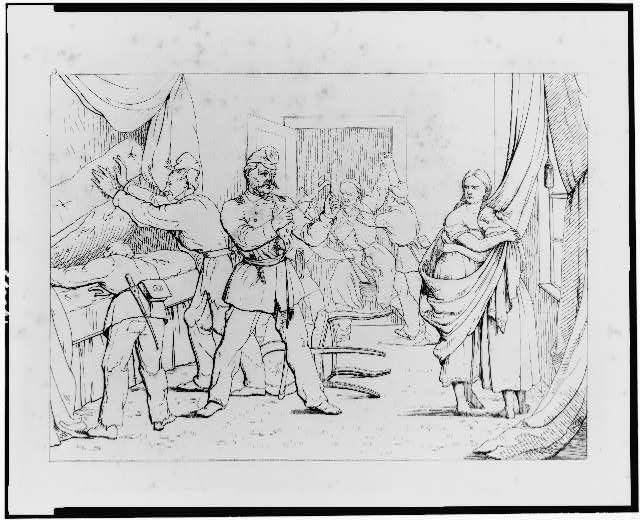
Searching for arms (Union soldiers searching a bedroom for Confederate weapons 1863; LOC: LC-USZ62-100053)

involuntary gun surrender

Posted in 150 Years Ago This Week, Confederate States of America, Southern Society | Tagged , | Leave a comment

Lemonade Factory

thank goodness for malaria and bad roads and the loss of Nashville and …

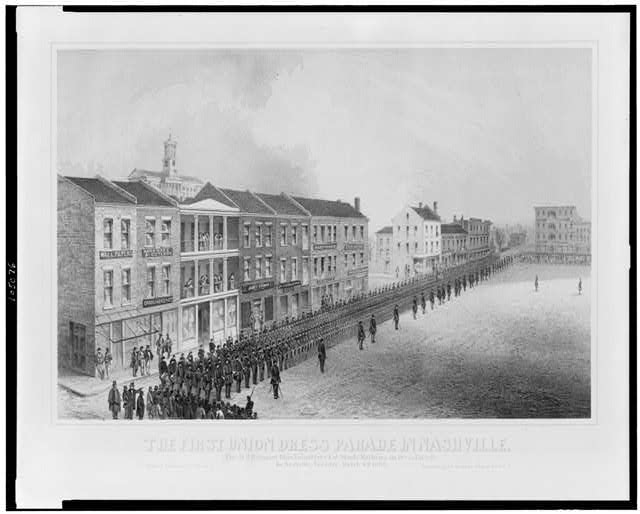
The First Union dress parade in Nashville. The 51st Regiment Ohio volunteers, Col. Stanly Mathews on dress parade in Nashville, Tuesday, March 4th 1862 (Middleton, Strobridge & Co. Lith., 1862.; LOC: LC-USZ62-105076)

Dispatch: 'right where we want 'em' - Yankees occupy Nashville

From the Richmond Daily Dispatch March 5, 1862:

The Prospect ahead.

The public mind of the entire South is fast recovering from the causeless panic occasioned by the unfortunate affairs at Roanoke Island and Fort Donelson. Considerate men see that much ultimate good may come of them, by inuring us to defeats that must often occur in a war with a power possessed of inferior numbers and superior resources of all kinds, by curing us of that rashness which our continued successes had begotten,–and, most of all, by stimulating enlistments, and thus increasing the numbers and efficiency of our armies. It is now almost certain, that by the 1st of April we shall have a larger disposable force in the field than that of our enemies; for they must retain two hundred thousand men in Maryland to guard and retain that State and the City of Washington, a hundred thousand in Kentucky and Missouri to hold those States, some twenty thousand in their various forts, and probably eighty thousand in their fleets.

Thus, their stationary force being four hundred thousand, even if their armies number seven hundred thousand, they will have a disposable force of only three hundred thousand with which to invade our interior; and, in long incursions, this will be diminished at least one third by the forces detailed to keep up communication with their bases of operation. Besides, by deferring their invasion of the South until the warm season, they will soon decimate their ranks by the malarious diseases of our climate.

Heretofore we have had to fight against superior numbers, but so soon as they quit their vessels, march into the country, and meet us in the open field, we shall outnumber them, if we please, in every conflict.

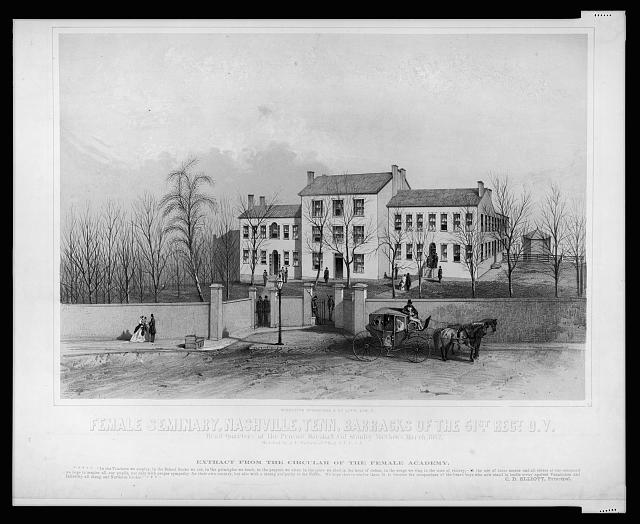
Female Seminary, Nashville, Tenn., barracks of the 51st regt. O.V. ... March, 1862 (Middleton, Strobridge & Co., lithographer 1862; LOC: LC-USZ62-135813)

Nashville's Female Seminary - now barracks of 51st Ohio

They cannot probably hold Nashville longer than the rainy season keeps the Cumberland river flooded. We know not how large an army they have there, but believe it cannot be very large. Should we be mistaken, and they attempt to hold it permanently, we ought in a few weeks to make prisoners of their whole army. Their present occupation of that city, of Fort Donelson, and of Clarksville, so divides their land and naval force as to disable them from attacking and taking Columbus, and proceeding down the Mississippi to Memphis and the cotton region.

If, with their whole land and naval force, and their eager appetite for cotton, they durst not attempt to descend that river, they will surely not now venture to do so with a crippled and divided navy and army. It may yet turn out that the fall of Fort Donelson and of Nashville will be a great gain to us, and a great misfortune to them. The whole country, from the Ohio to Nashville, is inhabited by brave men and zealous Secessionists. They cannot make that city a base of operations from which to invade the Cotton States, for in a few weeks, probably days, the Cumberland river will become unnavigable for the smallest gunboats, and they would be cut off from their Northern supplies and resources. If they attempt it even with a force of a hundred thousand men, we should at once surround them with a force of a hundred and fifty thousand, and capture their whole army. This would end the war; and we should not be surprised that it should end somewhat in this way. The North, under weight of debt and want of cotton, is becoming desperate, and will rashly quit its wooden walls ere long and march far into our interior. Then we will make prisoners of their armies, and gloriously and triumphantly wind up the war. Let faint-hearted people recollect that we never yet met them with equal numbers in the open field without defeating them, and that under the levy en masse which is now going on in the South, if they invade us by land after the 1st of April, we will meet them with superior numbers.–Our bad roads will prevent their invading us sooner.

I think there is logic in the Dispatch’s arguments, but one of the big variables 150 years ago was when the Union was going to decide it had enough.

As far as the “levy en masse” goes, the Dispatch is full of notices offering $50 bounties for volunteers. It is said that the first Conscription Act in the CSA was passed on April 16, 1862, but there is evidence that at least the threat of a draft was a motivation in March 1862. From the same issue of the Richmond Daily Dispatch:

A Card.

–The undersigned expects to fill up his company in a few days, with the best material, and those disposed to unite with him had better do so at once. To be a volunteer is a noble, proud position. To be a drafted, forced, coerced, militiaman, is almost disgraceful, when it is remembered that we are engaged in the defence of our homes and all we hold most dear in life.

Meetings will be held at my office (Law Building) next Wednesday and Saturday nights, at 8 o’clock. …

W. W. Parker, M. D.

Posted in 150 Years Ago This Week, Confederate States of America, Military Matters | Tagged , , | 1 Comment

Moses Preaches in Richmond

From the Richmond Daily Dispatch March 3, 1862:

An immense prayer meeting.

–Never in the history of Richmond was so large an assembly convened for prayer as that which took place at the First Baptist Church Friday afternoon. By four o’clock–the hour appointed for the commencement of the services — the large Church, with its galleries, holding from twelve to fifteen hundred persons, was full to overflowing, and, when it was announced that the basement would be opened, the large room which it contains was soon occupied by an additional crowd amounting to several hundred, making in all probably near two thousand persons in the house. The exercises in the upper part of the Church were conducted by Rev. Dr. Hoge, and those in the basement by Mr. John Caskie. The meetings were solemn and deeply earnest; the remarks indicated trust in the Almighty arm as the hope of the Republic, the whole scene was beautifully illustrative of patriotism, piety, and Christian union.

At the conclusion of the services, Dr. Hoge announced that there would be a meeting at the Second Presbyterian Church in the evening, conducted by Dr Burrows.

At the appointed hour this Church was full below, and nearly full in the galleries. The services were very interesting …

Moses Drury Hoge was pastor of Richmond’s Second Presbyterian Church for over fifty years. He was a Confederate chaplain and a favorite of the Stonewall brigade. During the war he ran the blockade to procure bibles for the CSA army.

Posted in 150 Years Ago This Week, Confederate States of America, Southern Society | Tagged | Leave a comment

President Seward?

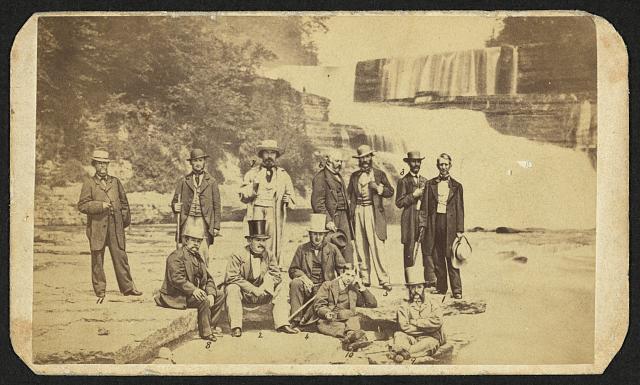
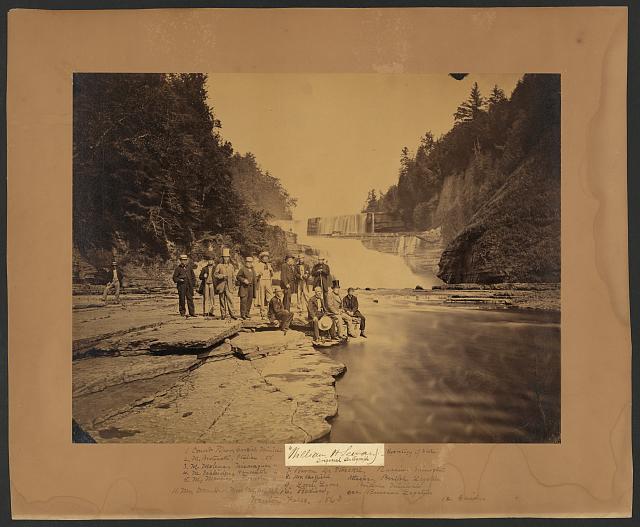
Secretary of State William Seward and a delegation of diplomats at Trenton Falls, New York (W.J. Baker ; 1863LOC: LC-DIG-ppmsca-23733)

Role player - Seward with foreign diplomats 1863

From The New-York Times March 1, 1862:

Mr. Seward and the Next Presidency.

Mr. SEWARD having been informed of the existence of a club in Philadelphia, the purpose of which was to nominate him for the next Presidency, sent the following letter to its President:

WASHINGTON, Dec. 16, 1861.

DEAR SIR: I have received the letter which was addressed to me on the 8th instant by you, an officer of a political association recently organized in Philadelphia.

You will excuse me, my dear Sir, for what may seem unkind or ungrateful in this reply to that communication, which has given me some uneasiness, and which only fails to inflict severe pain upon me, because I do not regard the movement which it describes as one of very considerable magnitude.

The club, as you inform me, have adopted a resolution to exert themselves to secure my advancement to the Presidency of the United States, and this resolution is generously based upon a high appreciation of such public services as I have hitherto attempted to perform.
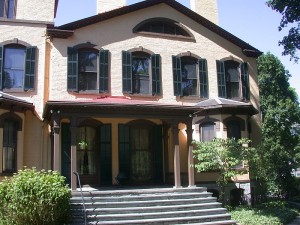
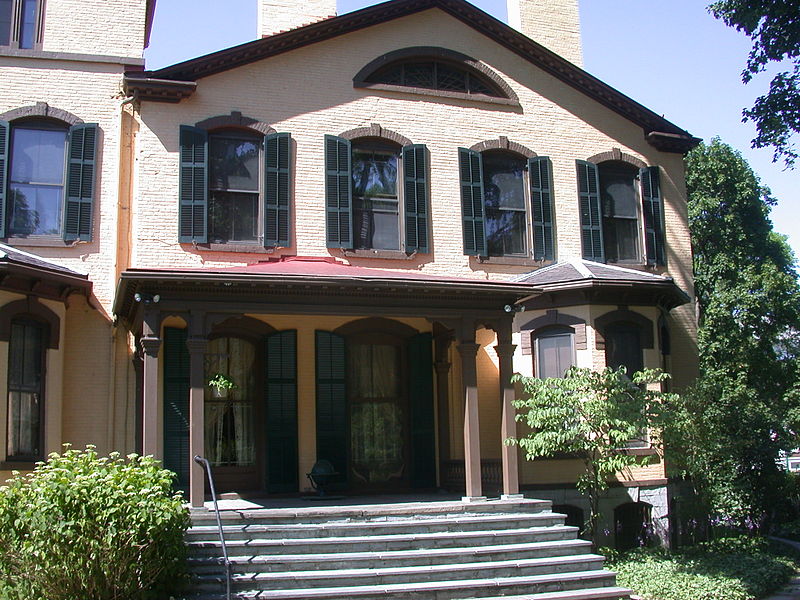
Southern Patio of the Seward House Museum in Auburn, NY (2011)

Seward not at home awaiting 'chances of public favor'

I avail myself of the good will of the club, thus flatteringly manifested, to say that I consider the proceeding as one altogether unwise, and tending to produce only public evil in a crisis when every possible path of danger ought to be carefully avoided. It is a partisan movement, and, worst of all, a partisan movement of a personal character.

If, when the present civil war was looming up before us, I had cherished an ambition to attain the high position you have indicated, I should have adopted one of two courses which lay open to me — namely, either to withdraw from the public service at home to a position of honor without great responsibility abroad, or to retire to private life, and avoiding the caprices of fortune, await the chances of public favor.

But I deliberately took another course. I renounced all ambition, and came into the Executive Government to aid in saving the Constitution and the integrity of my country, or to perish with them. It seemed to me, then, that I must necessarily renounce all expectation of future personal advantage, in order that the counsels that I might give to the President in such a crisis should not only be, but be recognized as being, disinterested, loyal and patriotic,

Acting on this principle, I shun no danger and shrink from no responsibility. So I neither look for, nor, if it should be offered to me, would I ever hereafter accept any reward.
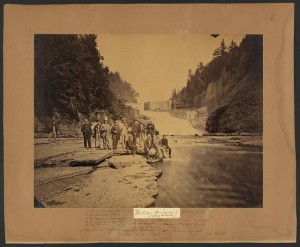
The Secretary of State and the Diplomatic Corps at Trenton Falls, New York (W.J. Baker ; 1863; LOC: LC-DIG-ppmsca-23732)

More diplomacy in Trenton Fall, New York 1863

The country is to be saved or lost by the highest efforts of public and private virtue before another Presidential election shall occur. If it shall be saved, as I believe it will, I do not fear that my zeal in that great achievement will be overlooked by the grateful generations to come after us. If, on the other hand, it shall be lost, he who shall study the causes of the great ruin shall not find among them any want of self-sacrifice on my part. I could never consent, if unanimously called upon, to be a President of a division of the Republic. I cheerfully give up my aspirations for rule in the whole Republic, as a contribution to the efforts necessary to maintain it in its integrity. I hardly need add that it results from these circumstances, that I not only ask, but peremptorily require, my friends, in whose behalf you have written to me, to drop my name, henceforth and forever, from among those to whom they look as possible candidates for National distinctions and preferments.

Very truly yours,

WILLIAM H. SEWARD.

And I thought presidential election cycles were long nowadays.

It seems that William H. Seward has changed his public demeanor since he thought he would be the Union’s savior early in 1861.

This letter reminded me of President Lyndon B. Johnson’s 1968 announcement in the midst of the Vietnam War that he would not seek re-election:

With America’s sons in the fields far away, with America’s future under challenge right here at home, with our hopes and the world’s hopes for peace in the balance every day, I do not believe that I should devote an hour or a day of my time to any personal partisan causes or to any duties other than the awesome duties of this office–the Presidency of your country.

Accordingly, I shall not seek, and I will not accept, the nomination of my party for another term as your President.

It is said that LJB’s pledge is an example of a Shermanesque statement after Civil War General William Tecumseh Sherman, who twice declined to be considered for president in the post-bellum United States. It sort of seems Secretary of State Seward had a Shermanesque statement before Sherman.

You can see a larger version of the first Trenton Falls image with numbers identifying the diplomats at Son of the South.

The photo of the Seward mansion is licensed by Creative Commons.
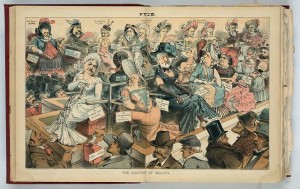
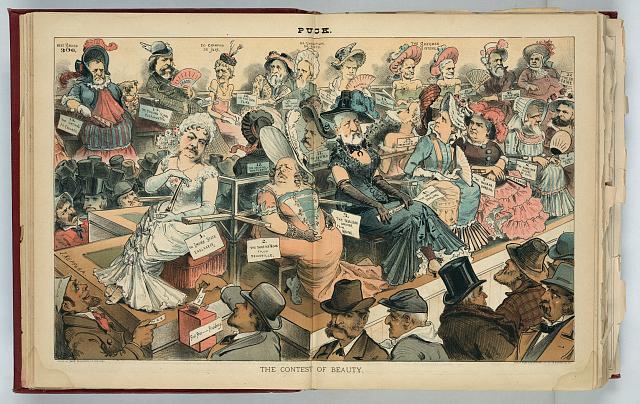
The contest of beauty (Published by Keppler & Schwarzmann, 1884; LOC: LC-DIG-ppmsca-28287)

no wonder Sherman wanted out in 1884
Posted in 150 Years Ago This Week, Lincoln Administration, Northern Politics During War | Tagged , , | Leave a comment

Smoke Break

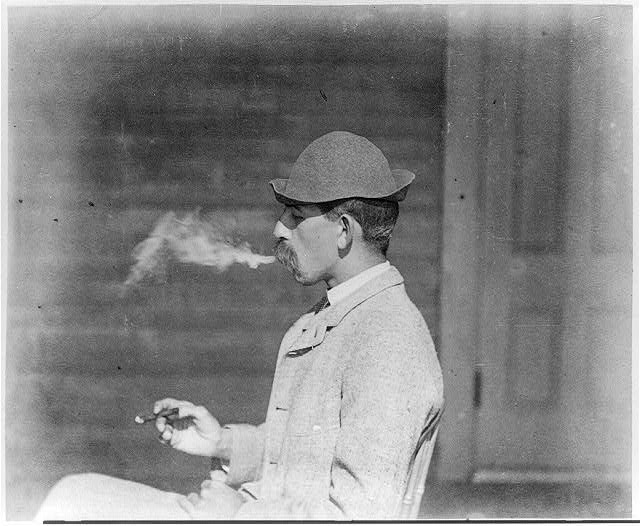
A whiff of comfort (ca. 1890; LOC: LC-USZ62-30038)

A whiff of comfort

i’M SPEECHLESS TODAY. hOPE TO HAVE SOMETHING TOMORROW.

Posted in Uncategorized | Leave a comment

150 Years Ago Today!

Posted in Uncategorized | Leave a comment

Nashville in Confederate Hands???

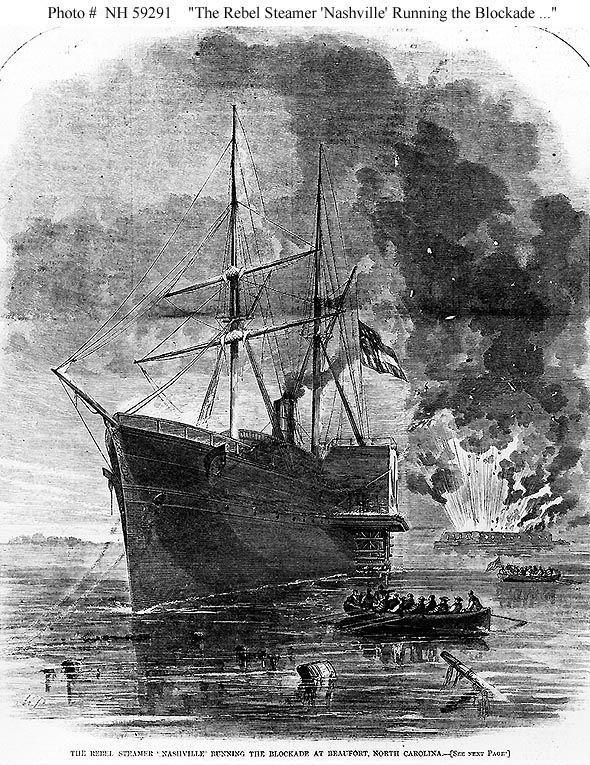
The Rebel Steamer 'Nashville' Running the Blockade at Beaufort, North Carolina. (Harper's Weekly 4-5-1862; U.S. Naval Historical Center Photograph.)

CSS Nashville making it back to Fort Macon

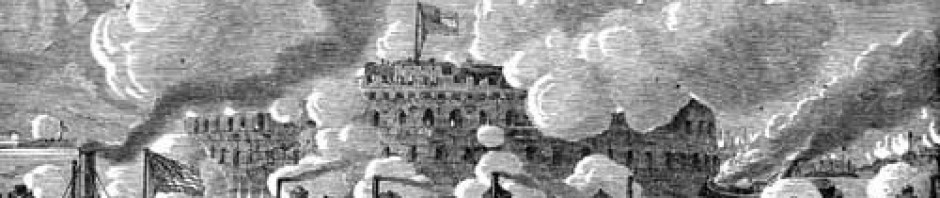
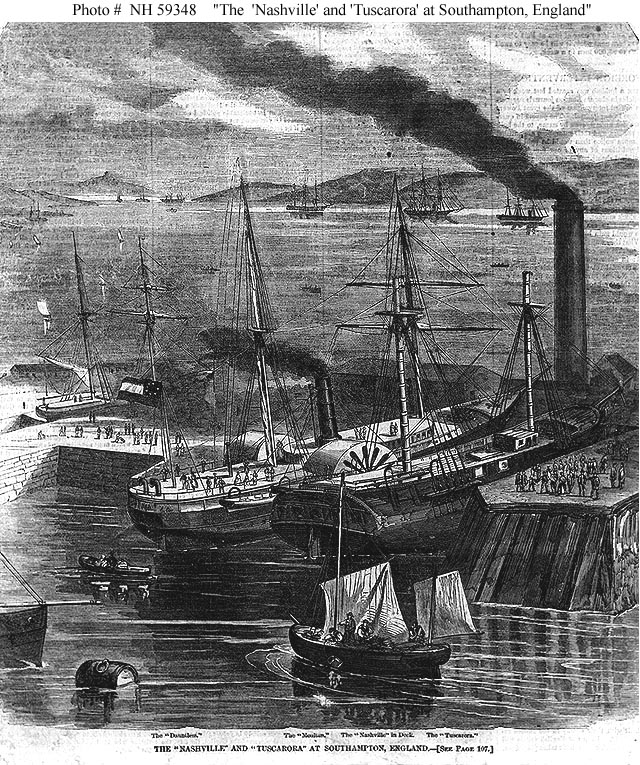
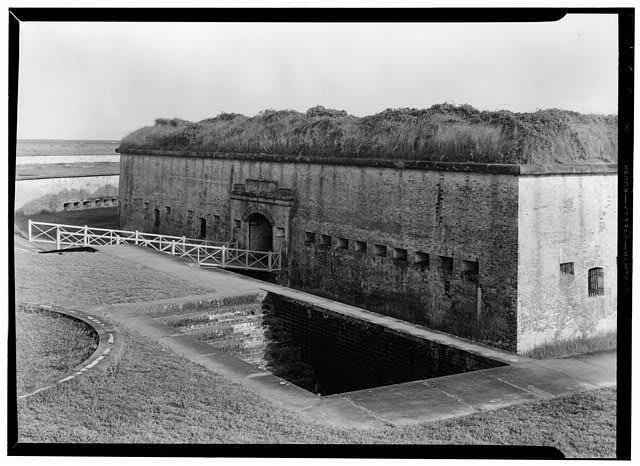
The same week that the city of Nashville fell to Union forces the CSS Nashville successfully ran the blockade after a trip to England. Apparently Captain Robert Baker Pegram used some deception to evade the blockading ship off the North Carolina coast. The ship was safe and sound at Fort Macon in Beaufort, North Carolina when this story was published.

From the Richmond Daily Dispatch March 3, 1862:

The shipsteamer Nashville.

Decidedly an improvement in the condition of the public mind was manifested Saturday by the report that the
C. S. steamer
Nashville had arrived in a Confederate port, and that her commander, Capt. Pegram, was in this city. The extensive and mischievous rumors which for some days have been busily circulated for the especial benefit of timid men and alarmists, caused this statement to be received with distrust; but when it was proven true beyond the possibility of a doubt the news was hulled with general pleasure. The news published but a few days ago was, that the Nashville had left the port of Southampton, and that twenty-four hours after the Tuscarora had started in pursuit.–The next information concerning her is that she lies safely moored under the guns of Fort Macon, Beaufort harbor, and that the gallant Pegram is in the Confederate capital. It seems that the Nashville, after leaving Southampton, steamed directly across the Atlantic. After passing Bermuda she fell in with a U. S. merchant vessel, which she captured, taking on board the stores and the crew as prisoners. On approaching the coast of Carolina came the most serious moment of the whole trip. Raising the U. S. flag and also a signal of distress, he steamed up to the blockading ship, seemingly preparing to run alongside. After coming within musket shot the Nashville changed her course, raised the Confederate flag, and soon ran out of the reach of danger. That night she lay safely under the guns of Fort Mason.

The 'Nashville' and 'Tuscarora' at Southampton (Harper's Weekly 1862; U.S. Naval Historical Center Photograph.)

Loading stamps, bank notes, weapons?

It is generally understood that the Nashville brought over several million dollars worth of Post-Office stamps, bank-note paper, dies, etc. The report that fifteen thousand stand of arms were on board is undoubtedly untrue. The Nashville was admitted into the English ports on an equality with the ships of any nation, and her officers were treated with great consideration on shore — Arms and munitions of war must have been smuggled on board in violation of the English law. To have received them would have been a breach of courtesy on the part of Captain Pegram. Besides, she is a national vessel, and would be used for fighting purposes, instead of a transport.

Capt. Pegram and Paymaster Taylor arrived in Richmond on Saturday, and have delivered the invoices and ship papers to the Treasury Department. Capt. Pegram speaks in high terms of the hospitality of the English people, and thinks the general feeling of the people is decidedly in favor of the Confederate States.

He thinks Belgium will be the first Government to recognize the South, where her interest chiefly lie.

The Sumter was at Gibraltar, and had been very active in her operations among the Federal shipping. At last accounts she had captured and destroyed twenty-one Yankee vessels.

Running out of a Confederate port, making a voyage to Europe and returning safely, Capt. Pegram has demonstrated the fact that the blockade is simply of no account and decidedly in effective.

Historic American Buildings Survey, Thomas T. Waterman, Photographer July, 1940 VIEW OF ENTRANCE AND MOAT. - Fort Macon, Bogue Point on Fort Macon Road, Beaufort, Carteret County, NC (LOC: HABS NC,16-BEAUF.V,1--1)

Fort Macon 1940

Posted in 150 Years Ago This Week, Confederate States of America, Military Matters | Tagged , , | Leave a comment

Jeff’s Doing It, Too

Suspending Writ of Habeas Corpus

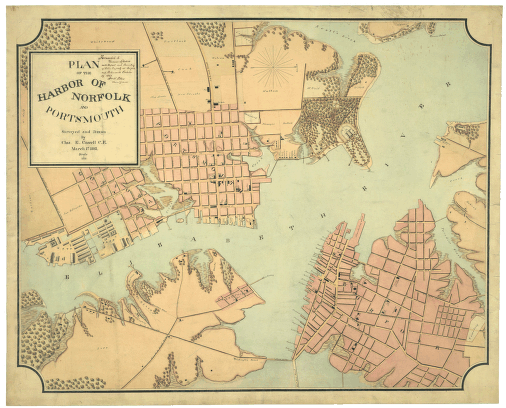
Plan of the harbor of Norfolk and Portsmouth, March 1st, 1861 / surveyed and drawn by Chas. E. Cassell, C.E. (LOC)

Norfolk and Portsmouth must be threatened by the enemy

From the Richmond Daily Dispatch February 28, 1862:

By the President of the Confederate States of America.
a proclamation.

Whereas, the Congress of the Confederate States has by law vested in the President the power to suspend the writ of habeas corpus in cities in danger of attack by the enemy:

Now, therefore, I, Jefferson Davis, President of the Confederate States of America, do hereby proclaim that martial law is extended over the cities of Norfolk and Portsmouth and the surrounding country to the distance of ten miles from said cities, and all civil jurisdiction and the privilege of the writ of habeas corpus are hereby declared to be suspended within the limited aforesaid.

This proclamation will remain in force until otherwise ordered.

In faith whereof, I have hereunto set my hand and seal, at the City of Richmond, on this twenty seventh day of February, in the year of our Lord one thousand eight hundred and sixty-two

Jefferson Davis.

Posted in 150 Years Ago This Week, Confederate States of America, Military Matters | Tagged , , | Leave a comment

His Company Torn to Shreds

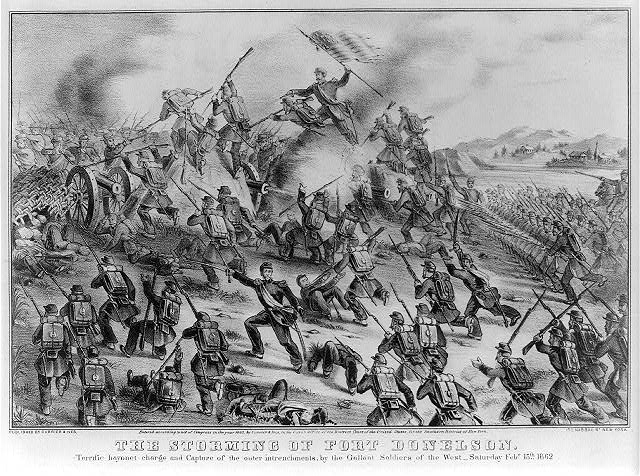
The storming of Fort Donelson: terrific bayonet charge and capture of the outer intrenchments, by the gallant soldiers of the west--saturday Feby. 15th. 1862 (Published by Currier & Ives, c1862; LOC: LC-USZ62-16919)

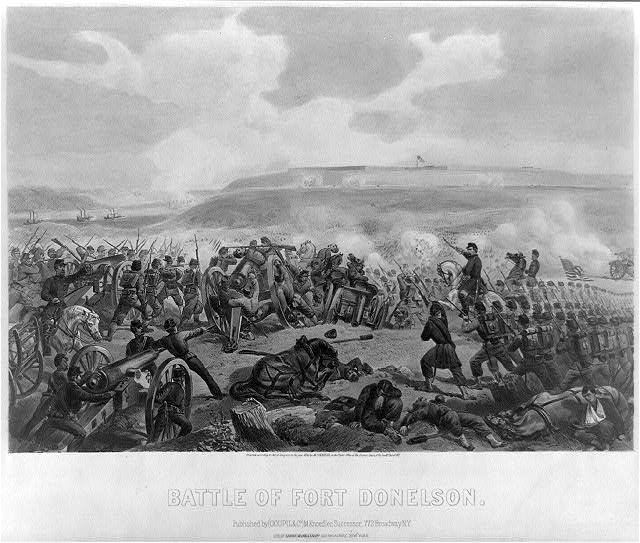
Battle of Fort Donelson

From The New-York Times February 26, 1862:

THE SAD SIDE OF THE PICTURE.

FORT DONELSON, TENN., Monday, Feb. 17, 1862.

The following private letter, written by a former attache of the New-York Post-office, presents another side of the victory gained at Fort Donelson, from that which is generally contemplated:

MY DEAR FATHER: Sad, lonely and down-hearted. I attempt to write you a few lines, to let you know I am alive and unhurt. We have had a most bloody fight; there must have been five thousand to seven thousand men killed and wounded, on both sides. But the enemy surrendered on Saturday evening, we taking about thirteen thousand prisoners. But, dear father, the hardest part of the story is, that out of eighty-five men in my company, only seven came out — the most whosesale slaughter that was ever heard of.

Battle of Fort Donelson (no date recorded on shelflist card; LOC: LC-USZ62-15605)

More of the battle

My company was the color company, at which the rebels took particular aim; as fast as one man who carried it would be shot another would take his place; but the flag was brought through. Only one hundred and sixteen remain in the Eleventh Regiment uninjured.

Do not wonder, dear father, that I am downhearted. My boys all loved me, and need I say that, in looking at the poor remnant of my company — the men that I have taken so much pains to drill, the men that I thought so much of — now nearly all in their graves — I feel melancholy. But I do not complain; God spared my life, and for what, the future must tell. I will write you soon again. The Eleventh Regiment will, I think, (what is remaining,) be left to guard the prisoners at Cairo or Alton, whilst they recruit. Whether I shall attempt to raise another company, I do not know at present. Good bye. Let the folks at home know I am safe.

Yours, affectionately,

L.D. WADDELL, Captain Co. E. Eleventh

Regiment Ill. Vol., (what is left of it.)

WM. COVENTRY H. WADDELL, Esq., New-York.

There is pretty good evidence that Captain Waddell and the rest of the 11th Illinois Infantry did not spend too much time guarding rebel prisoners.

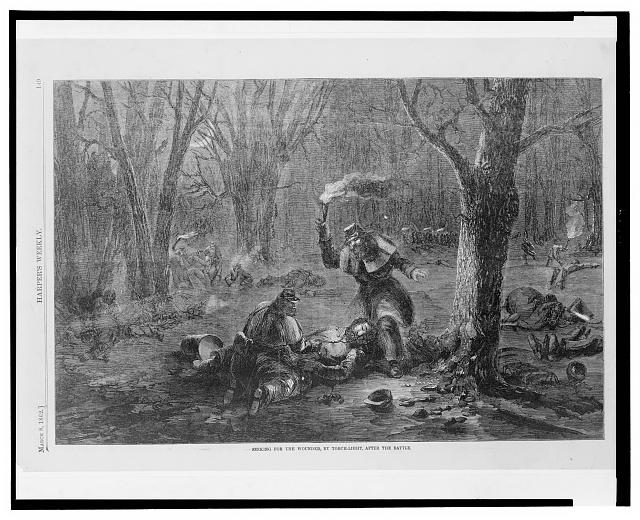
Seeking for the wounded, by torch-light, after the battle (Harper's Weekly, v. 6, no. 271 (1862 March 8), p. 149; LOC: LC-USZ62-133797)

Seeking the wounded

Posted in 150 Years Ago This Week, Military Matters | Tagged , , , | Leave a comment