Contraband Needs in South Carolina

Overseers and Durable Clothing
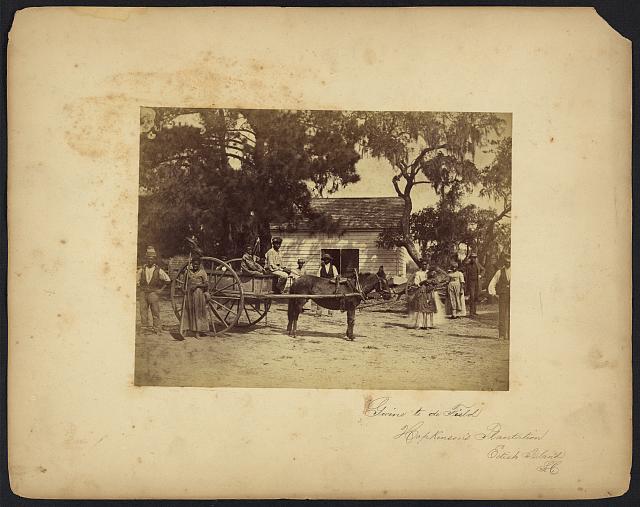
Gwine to de field, Hopkinson's Plantation, Edisto Island, S.C. (1862; LOC: LC-DIG-ppmsca-11370)

Edisto Island 1862

Union military success along the South Carolina coast created a logistics problem for General Thomas W. Sherman and Commodore Samuel F. Du Pont – as plantation owners have fled, thousands of slaves are looking for help from the Union army. The February 23, 1862 issue of The New-York Times published a couple articles on the situation. In the first the VAGABOND correspondent described the situation as he saw it:

GEN. SHERMAN’S DEPARTMENT.; The Condition of the Blacks–Their Capabilities and Inclinations–Gen. Sherman’s Course, &c.

PORT ROYAL, Tuesday, Feb. 11, 1862.
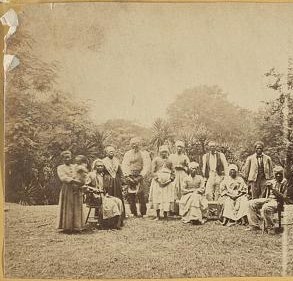
Group of old folks at home, "Old Fort" plantation, Port Royal Island, S.C. (between 1860 and 1870; LOC: LC-DIG-stereo-1s02952)

At Port Royal

Previous to forming an opinion of the plan recently promulgated by Gen. SHERMAN for the amelioration of the condition of the blacks in his command, it is necessary to contemplate some of the facts which are patent here to every one. The order, which has reached the North before this time, itself states the considerations which induced Gen. SHERMAN to take the step that probably has already been the subject of various and, perhaps, violent criticisms. The most conservative of conservatists, if he were here, would admit that it is impossible to allow the negroes deserted by their masters to remain any longer in an entirely unprotected condition. The thousands who, in various quarters, have either stayed behind when their owners fled, or come themselves within our various lines, it is manifest, to every looker-on, are unfit to care for themselves. They are in a state of imbecility and ignorance almost inconceivable, and yet show signs of apprehension that occasionally startle one, from the contrast with their ordinary stupidity. The most intelligent have repeatedly declared within my hearing that the blacks generally are unfit for self-government; that they need overseers; most of them are well enough inclined; express a willingness to work; manifest no fanciful hopes of living in utter idleness, and though the mass will doubtless need incentives, both of reward and punishment, I firmly believe that with the moderate use of both those incentives they can be induced to labor. Instances, doubtless, have occurred of stubborn negroes refusing to work; of these, who imagine themselves utterly free, and expect and intend never to work again. I have heard of one glaring instance of insubordination, where a black driver turned on a white overseer and attempted to throttle him. The instance is well authenticated, but it is solitary. However, I record it, lest, by omission, I should give an unfair coloring to events. For I have no theory to maintain, no party to support; my business and aim are simply to see, so far as may be, with unembarrassed vision, and to draw, if possible, from what I see, the deduction of an unbiased judgment.
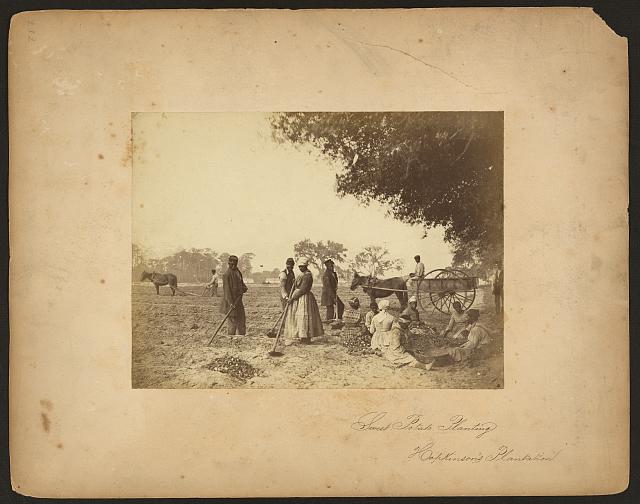
Sweet potato planting, Hopkinson's Plantation (1862; LOC: LC-DIG-ppmsca-11398)

Planting sweet potatoes on Edisto 1862

But to the negroes. Their rapidly increasing numbers makes an immense and urgent demand on those in authority. At Edisto a colony of 1,200 has been established, and there, I have repeatedly been informed, they have asked for arms to use against their former masters. At Otter Island is a colony of several hundred; in the immediate vicinity of Beaufort there must be at least five or six hundred; all over the cotton islands, on the plantations, not only have the hands remained, but crowds of fugitives still come in daily. These should not always be called fugitives, as it is not unfrequently the masters who have fled first; but at any rate here is this constantly increasing population, consuming the food left on the plantations, and certain soon to become an oppressive burden unless steps be taken to obviate such a result. General orders have indeed been issued to allow the subsistence stores found in the country to remain on the plantations for the use of the blacks, and thus the anomaly in warfare is presented of an army scrupulously respecting the stores found in a conquered territory, although those to whom the stores originally belonged were its open enemies. The blacks, however, have claims upon our sense of justice as well as on our humanity, and our considerations of selfish policy. Not only ought we to feed them as we would any other inoffensive creatures in a starving condition; not only should we supply their most immediate wants, so as not to make enemies of a most important part of the population, but there is another consideration; they have repeatedly proven themselves our friends; they have given highly important information; they continually act as guides, as scouts, as soles; they come in daily with news from Savannah and Charleston, so that the commanders of the army and navy are kept fully apprised of all important secrets in those places; they bring in newspapers from each city; it was they who disclosed the secret of Wall’s Cut, and that of Wilmington Narrows; they have told the condition of the defensive works in Savannah River; they communicated information of a concealed force in the woods near Port Royal Ferry, in January, and so saved Gen. STEVENS from an unexpected attack by the rebels; they go on all reconnoissances, not only willingly, but at their own request and earnest desire. Such people have a right that their services should in some way be recognized. They render efficient assistance to the National arms in this command, and every principle of right, every rule of policy demands that such assistance be rewarded. …

On February 23rd a meeting was held at New York City’s Cooper Institute to organize aid for the slaves:
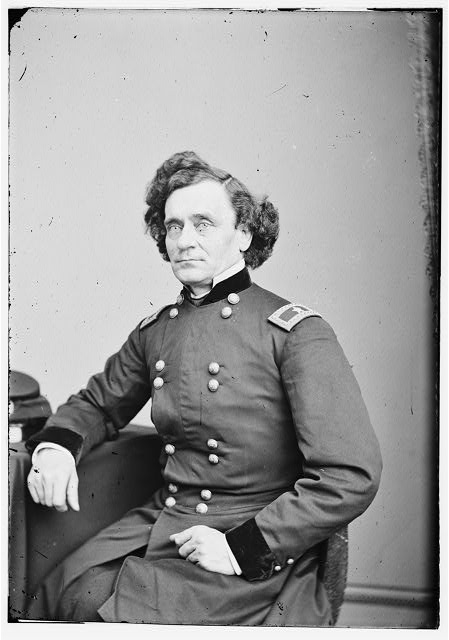
Portrait of Brig. Gen. Thomas W. Sherman, officer of the Federal Army (Between 1860 and 1865; LOC: LC-DIG-cwpb-05370)

'Please send clothes and shoes'

AID FOR CONTRABANDS AT PORT ROYAL.; Interesting Meeting at Cooper Institute Addresses by Rev. Messrs. French and Lindsay Rev. Dr. Bellows and Dr. Tyng Appointment of a Committee to Collect and Distribute Aid for the Unfortunates.

A very large meeting convened at Cooper Institute on Thursday evening, in response to the call issued with a view to secure aid for the blacks at Port Royal. …

After prayer by Rev. Mr. SLOAN, the Secretary read letters from Gen. SHERMAN and Commodore DUPONT, as follows:

PORT ROYAL, S.C., Feb. 6, 1862.

Rev. Mr. FRENCH — Dear Sir: Knowing that you feel deeply interested in the improvement of the condition of the blacks who have been abandoned in this region by their disloyal masters to a state of considerable suffering for the want of necessary clothing, I would respectfully ask your kind and imparting offices in attracting the attention of the benevolent on your return to the North to this charitable object. The Government, it is true, has sent out a quantity of clothing for the blacks in its employ, but this will fall far short of the object. The number of blacks to be provided for is great and rapidly increasing. I would suggest that the liberality you can command be confined mostly to a coarse, durable and cheap clothing, including shoes, and that there be a fair proportion of articles for women’s and children’s wear.

Trusting that you will be successful in reaching the hearts of our benevolent people at the North, to aid you in this chalritable and holy work, I remain, truly yours, J[T].W. SHERMAN,

Brig.-Gen. Commanding Exp. Corps.
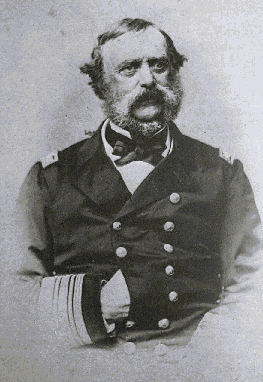
Photograph of Samuel Francis du Pont, taken October, 1862 by Frederick Gutekunst (1823 – 1917).

'1500 contrabands on North Edisto in destitute condition'


WABASH, PORT ROYAL, Feb. 4, 1862.

REV. AND DEAR SIR: It gives me great pleasure to add my recommendation to that of Gen. SHERMAN, of the within suggestion. Only yesterday, I had a letter from one of my commanding officers holding North Edisto, who reports that he had 1,500 contrabands under his charge in a very destitute condition.

Wishing you success in your philanthropic mission, and with the assurance that in all your labors here you will have my sympathy and support, I am, reverend and dear Sir, most respectfully yours,

S.F. DUPONT. …
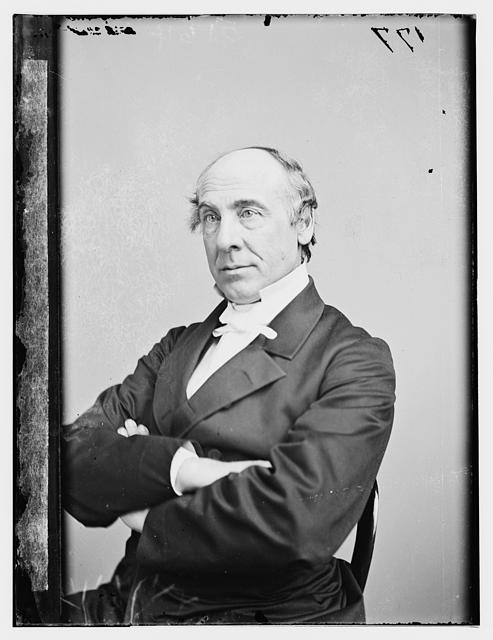
Rev. Henry Whitney Bellows (between 1855 and 1865; LOC: LC-DIG-cwpbh-02627)

Full money boxes are the most eloquent speakers

Rev. Dr. BELLOWS was next introduced, and briefly addressed the audience. He thought the money boxes full which were coming in were the most eloquent speakers. He contended that there were no difficulties in the negro question, other than those which ordinarily attend the education and improvement of human beings. The simple rule was to treat them like ourselves. [Applause.] He took occasion to allude to Senator FOSTER’s bill for the amelioration of the condition of such blacks as shall come within our lines. He wanted us to be careful, and avoid the mistake of doing too much for these blacks — of treating them as if they could not take care of themselves. He indorsed the sentiments of FREDERICK DOUGLAS, of letting the blacks alone. They required only a very little care in the transition from slaves to free men. All we need do, was to give them a start. Do justice and trust in righteousness, and the difficulties would disappear. He suggested that a petition to Congress should be extensively signed, requesting that some system of employing the blacks on the lands deserted by their owners in the vicinity of Port Royal should be adopted, stating that petitions of that character would be found at the office of the Committee, No. 320 Broadway. …

Henry Whitney Bellows was a Unitarian minister who served as president of the United States Sanitary Commission throughout the Civil War.
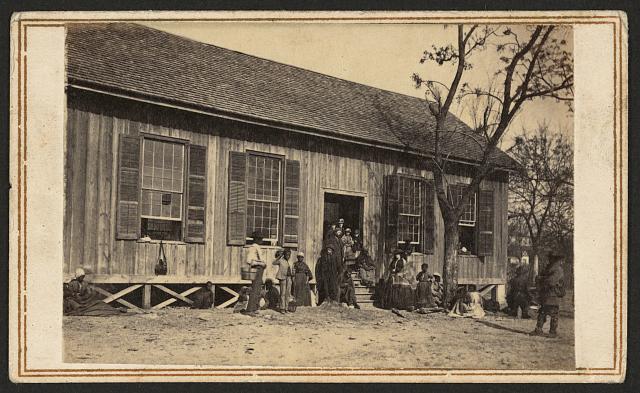
Freedmen's school, Edisto Island, S.C. (between 1862 and 1865; LOC: LC-DIG-ppmsca-11194)

Overcoming 'state of imbecility and ignorance' - school on Edisto Island
Posted in 150 Years Ago This Week, Military Matters, Northern Society, Southern Society | Tagged , , , , , | Leave a comment

Defend the Home of the Blues!

And Earn 50 Dollars Confederate

From the Richmond Daily Dispatch February 25, 1862:

R. L. I. Blues.
Rally! men of Richmond, to your country’s call.

One hundred men are wanted, at once, to fill up this glorious command, and to avenge the death of its gallant leader, Capt. O Jennings Wish [Wise], who fell whilst nobly defending the hearth-stones and fire-sides of the people of the South, who are now battling against overwhelming odds of Hessian soldiers now desecrating the soil of Virginia by their unholy tread. Will not the young men of Richmond step forward, with one accord, and enroll their names under the Southern banner? Are they willing to see the Capitol of the Old Dominion– the home of the Blues, the birth-place of their mothers and sisters — invaded and conquered by the hirelings of the Lincoln despotism, without taking up arms, and with patriotic devotion welcome their oppressors with bloody hands to hospitable graves? Better die, if needs be, with the Stars and Bars of Liberty floating over them, than tamely submit to the yoke of bondage now ready for their necks. Rally, then, young men, to the call of Gen. Wise and the cause of the South, and defend your hearth-stones from the aggressor’s tread, or fall, if needs be, in defence of all that is sacred, and dear to the Southern heart.

A Bounty of $50 will be given to all who join the company. Apply at the recruiting office, on Main street, over P. H. Taylor’s Music Store.

Lieut. R. S. Sanxay,

fe 25–6t Recruiting Officer.

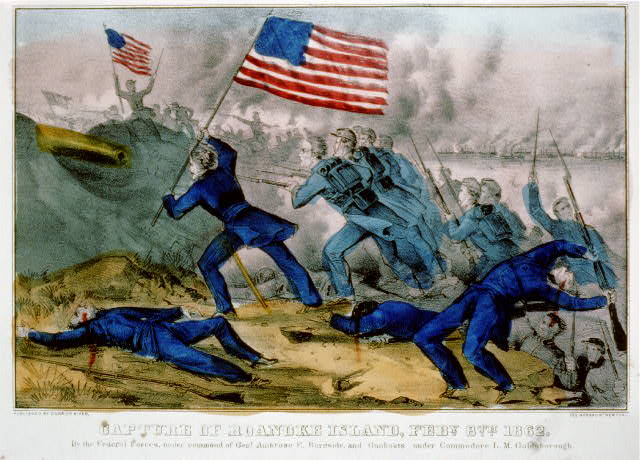
You can read a 1939 history of the Richmond Light Infantry Blues, founded in 1789, at Then and Now Richmond. Captain Obadiah Jennings Wise, the son of Henry Wise, was mortally wounded during the Battle of Roanoke Island. He had been an editor of the Richmond Enquirer. It is said that the blues fought in seven major Civil War battles. “By the surrender at Appomattox in 1865, the Blues had been reduced to 16 battle-weary veterans.”

Capture of Roanoke Island, Feby. 8th 1862: By the federal forces, under Command of Genl. Ambrose E. Burnside, and gunboats under Commodore L.M. Goldsborough (Currier & Ives, (1862?); LOC: LC-USZC2-2038)

Battle of Roanoke Island

Posted in 150 Years Ago This Week, Military Matters, Southern Society | Tagged , , | Leave a comment

Guardians of the Technology

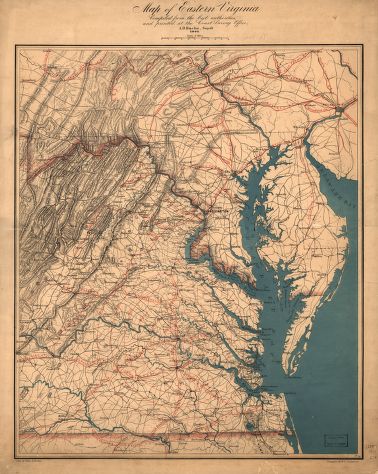
Eastern Virginia 1862 with Maryland's eastern shore (LOC)

Guarding the telegraph on the Delmarva Peninsula

From the Richmond Daily Dispatch February 24, 1862:

Guarding the telegraph.

The Second regiment E. S. Home Guards, Col. Wilkins, is detailed for duty to guard the telegraph line from Salisbury, Maryland, to Cape Charles, Virginia. Headquarters at Drummond town; Lieutenant-Colonel at Newtown, Major at Eastville; one half of the command will be stationed below and one-half above Drummondtown.

Posted in 150 Years Ago This Week, Military Matters | Tagged , | 2 Comments

Father of His Countries

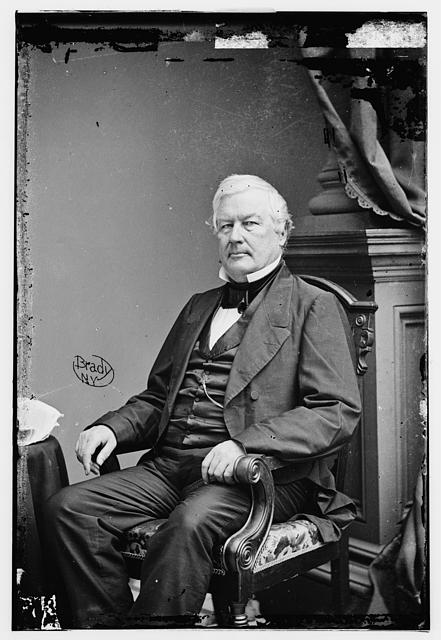
Pres. Millard Fillmore (between 1855 and 1865; LOC: LC-DIG-cwpbh-00698)

Ex-President Fillmore read GW's Farewll Address in Buffalo

150 years ago today there were celebrations throughout the Union (including the Border States) to honor the 130th anniversary of George Washington’s birth. Many localities featured the public reading of Washington’s Farewell Address per a proclamation by President Lincoln. Part of the Washington’s Address:

The unity of government which constitutes you one people is also now dear to you. It is justly so, for it is a main pillar in the edifice of your real independence, the support of your tranquility at home, your peace abroad; of your safety; of your prosperity; of that very liberty which you so highly prize. But as it is easy to foresee that, from different causes and from different quarters, much pains will be taken, many artifices employed to weaken in your minds the conviction of this truth; …

On the other hand, in Richmond, Virginia Jefferson Davis delivered his inaugural address as the first elected president of the Confederacy. The South now considers its government permanent. From the Richmond Daily Dispatch February 24, 1862:

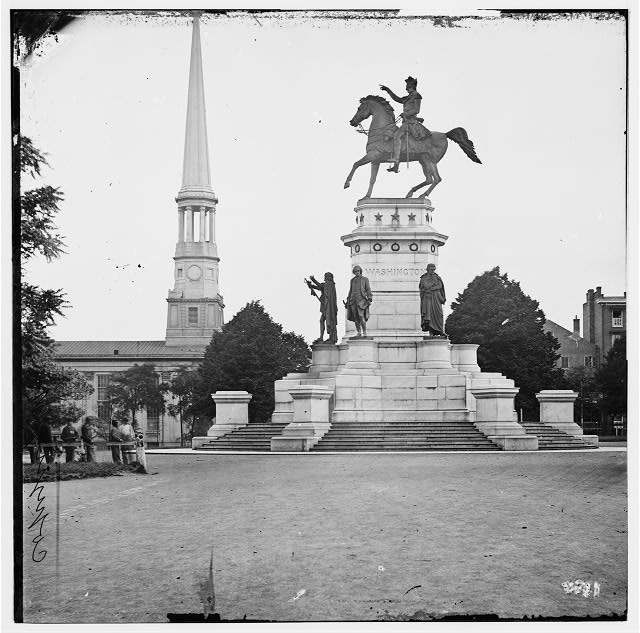
Richmond, Va. Washington Monument; St. Paul's Church in left background (1865; LOC: LC-DIG-cwpb-02525)

Site of President Davis' inaugural address

Inaugural Address of President Jefferson Davis,
delivered in Richmond, February 22, 1862.

Follow-Citizens On this, the birth-day of the man most identified with the establishment of American independence, and beneath the monument erected to commemorate his heroic virtues and those of his compatriots, we have assembled to usher into existence the permanent Government of the Confederate States. Through the instrumentality, under the favor of Divine Providence, we hope to perpetuate the principles of our Revolutionary Fathers. The day, the memory’ and the purpose, seem fitly associated.

It is with mingled feelings of humility and pride that I appear to take, in the presence of the people and before high Heaven, the oath prescribed as a qualification for the exalted nation to which the unanimous voice of the people has called me. …

Fellow-citizens, after the struggles of ages had consecrated the right of the Englishman to Constitutional. Representative Government, our colonial ancestors were forced to vindicate that birthright by an appeal to arms. Success crowned their efforts, and they provided for their posterity a peaceful remedy against future aggression.

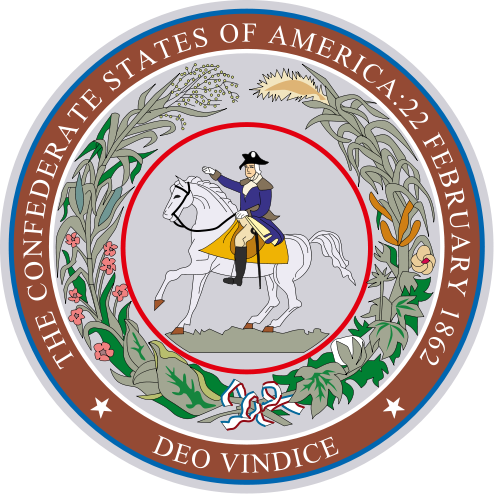
Seal_of_the_Confederate_States_of_America (The seal itself was first engraved in 1864.)

Seal proclaims CSA - 150 years ago today: "God will vindicate"

The tyranny of an unbridled majority, the most odious, and least responsible form of despotism has denied us both the right and the remedy; therefore, we are in arms to renew such sacrifices as our fathers made to the holy cause of Constitutional liberty. At the darkest hour of our struggle the Provisional gives place to the Permanent Government. After a series of successes and victories, which covered our arms with glory, we have recently met with serious disasters.–But in the heart of a people resolved to be free, these disasters tend but to stimulate to increased resistance.

To show ourselves worthy of the inheritance bequeathed to us by the patriots of the Revolution, we must emulate that heroic devotion which made reverse to them but the crucible in which their patriotism was refluxed. [Applause.] …

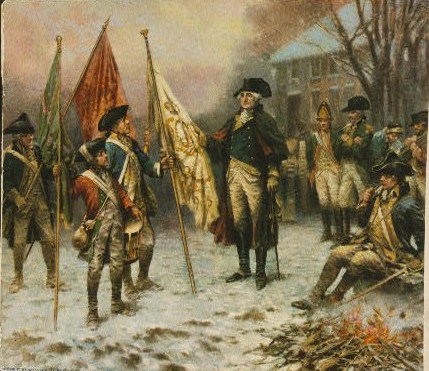
Washington inspecting the captured colors after the battle of Trenton (Percy Moran c1914 Aug. 10; LOC: LC-USZC4-11107)

He had to spend some time in Yankeedom

Posted in 150 Years Ago This Week, Confederate States of America, Northern Society, Southern Society | Tagged , , | Leave a comment

Sitting on a Seat of War

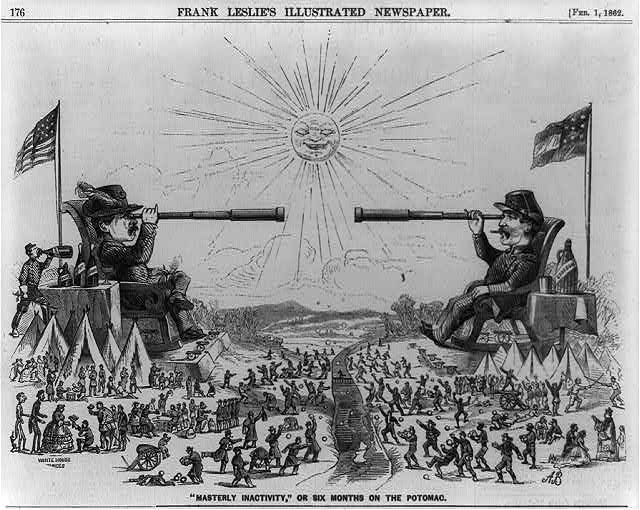
'Masterly inactivity,' or six months on the Potomac caricature of inactivity of Confederate and Union soldiers on both sides of the Potomac River (Illus. in: Frank Leslie's illustrated newspaper, vol. 13 (1862 Feb. 1), p. 176;LOC: LC-USZ62-82807)

A spyin' in the sun

Not exactly President George W. Bush and Vladimir Putin but here George McClellan and P.G.T. Beauregard appear to be gazing into each others’ eye.

This cartoon was published on February 1, 1862 and it is already out of date. By February 18th P.G.T. Beauregard, the rebel commander in the cartoon, was in Jackson, Tennessee on his way to taking command of the Confederate left in the western theater. Also, shortly after this came out in Frank Leslie’s Weekly, Union successes at Forts Henry and Donelson cheered the North. Nevertheless, I think this shows the importance of Northern Virginia to northern perceptions of how the war was progressing (or not). “On to Richmond”

_______________________________________________________
An Execution

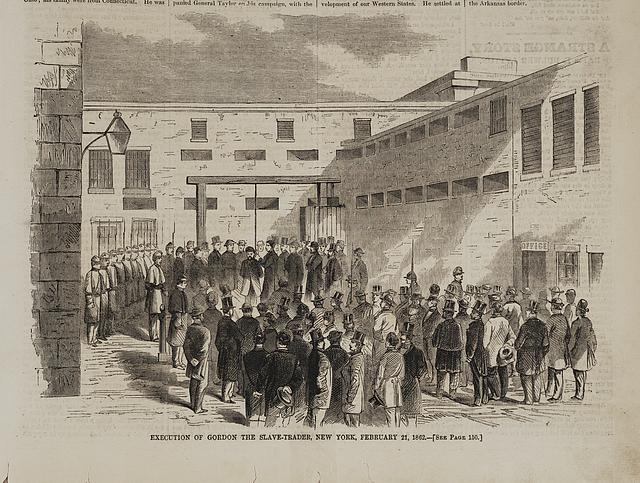
150 years ago today Nathaniel Gordon, a convicted slave trader, was hanged in New York City for violating the Piracy law of 1820. He was the only person executed under the law for engaging in the slave trade. You can read Harper’s Weekly’s account at Son of the South. The same issue has a cartoon lauding General Grant’s success at Fort Donelson. On this page you can also see ads for the soldiers’ bullet proof vest and Kentucky bourbon.

Execution of Gordon the slave-trader, New York, February 21, 1862 (Illus. in: Harper's weekly, v. VI, no. 271 (1862 March 8), p. 157 (bottom); LOC: LC-DIG-ds-00692)

Slave-trader executed

Posted in 150 Years Ago This Week, Lincoln Administration, Military Matters | Tagged , , , | Leave a comment

“No Illumination”

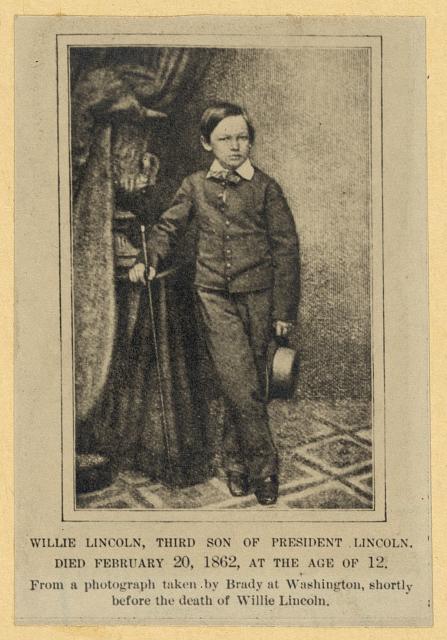
Willie Lincoln, third son of President Lincoln. Died February 20, 1862, at the age of 12 (between 1890 and 1940; LOC: LC-DIG-ppmsca-19390)

Willie Lincoln

In 1862 Congress authorized the expenditure of $1,000 to illuminate public buildings in Washington, D.C. on the evening of February 22nd in commemoration of George Washington’s Birthday. However, members of the cabinet requested that those plans for the public buildings be called off out of respect for President Lincoln in his “affliction”. 150 years ago today William Wallace “Willie” Lincoln died, possibly of typhoid fever.

From The New-York Times February 22, 1862:

NEWS FROM WASHINGTON.; Sympathy of Congress for the President and his Family. …

WASHINGTON, Friday, Feb. 21.

The funeral of the President’s son will take place next Monday.

NO ILLUMINATION.

The following was addressed to the Senate and House of Representatives, but Congress adjourned before it was transmitted to them:

The President of the United States was last evening plunged into affliction by the death of a beloved child. The Heads of Departments, in consideration of this distressing event, have thought it would be agreeable to Congress, and to the American people, that the official and private buildings occupied by them, should not be illuminated in the evening of the 22d inst. (Signed)

WM. H. SEWARD, S.P. CHASE,

E.M. STANTON, GIDEON WELLES,

EDWARD BATES, M. BLAIR.

WASHINGTON, Feb. 21, 1862.

The Cabinet held their meeting at the State Department. The public buildings will not therefore be illuminated, the arrangements for that purpose being suspended.

You can read more about Willie’s death at Abraham Lincoln Online. Typhoid fever was also a common disease and cause of death for soldiers in the Civil War.

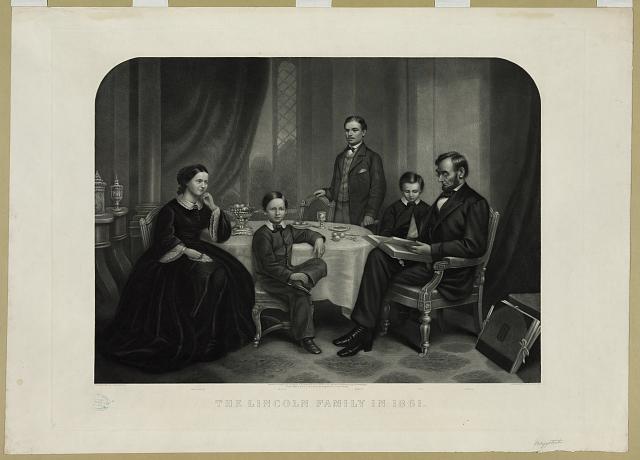
Lincoln family in 1861 (New York : J.C. Buttre, 48 Franklin St., c1873; LOC: LC-USZ62-5409)

First Family in 1861. Willie next to Mary.

Willie and Tad Lincoln, sons of President Abraham Lincoln, with their cousin Lockwood Todd (1861; LOC: LC-DIG-ppmsca-19235)

Willie standing - with cousin Lockwood Todd and brother Tad

Posted in 150 Years Ago This Week, Lincoln Administration | Tagged , | Leave a comment

Provisional No More

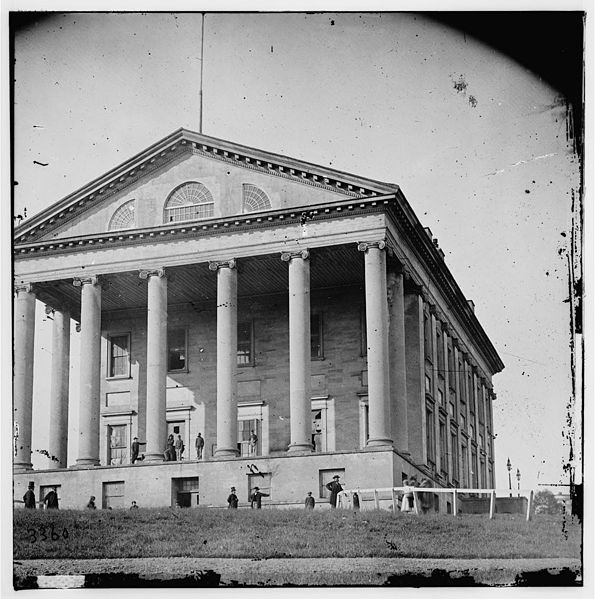
Capitol in Richmond - 1865

Where CSA Congress met (1865 photo)

150 years ago today the first elected Confederate Congress convened in Richmond, Va. From the Richmond Daily Dispatch February 19, 1862:

Confederate Congress.
first session.

Yesterday along before the hour arrived, a large crowd had assembled at the Capitol to witness the inauguration of the Permanent Government of the Confederate States, in the convocation and organization of the new Congress. The hall of the House of Representatives, for half an hour previous to the tap of the Speaker’s gavel, was a complete jam, the crowd consisting of the members elect, the members of the Virginia Legislature, citizens, and last, though not least, a considerable number of ladies — all anxious to witness the proceedings incident to an occasion so interesting, and yet so solemn and impressive. Dense as was the throng, and meagre as the accommodations were, there was not the slightest demonstration of disorder, and everything passed off quietly.

Senate.

Tuesday, Feb. 18, 1862.

The Senate convened at noon. The Vice President elect of the Confederate States, Hon. A. H. Stephens, in the Chair.

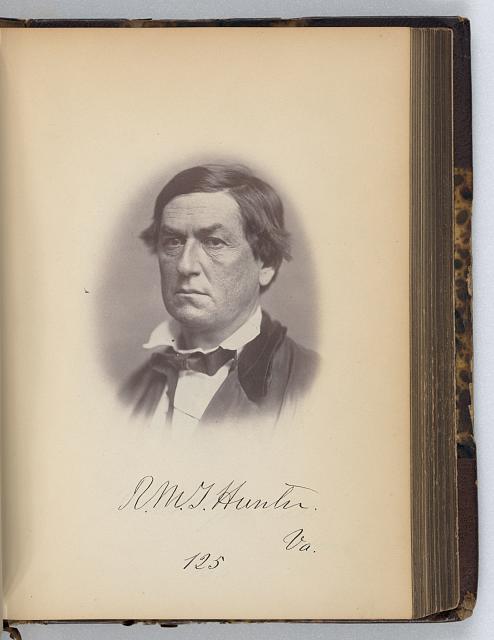
R.M.T. Hunter, Senator from Virginia, Thirty-fifth Congress, half-length portrait (1859; LOC: LC-DIG-ppmsca-26664)

Senate's President Pro Tempore - Robert M.T. Hunter

The Vice President, under the authority of the Constitution, formally opened the session of the Senate. He called the attention of Senators to the published acts passed by the Provisional Congress, and caused the temporary clerk to read the last clause of the permanent Constitution; also, the act of the Provisional Congress putting in operation the permanent Government of the Confederate States, and the act supplemental to the same.

The roll being called, the following Senators answered to their names:

* Arkansas–Mr. Mitchell and Mr. Johnson.
* Florida–Mr. Maxwell and Mr. Baker.
* Georgia–Mr. Hill
* Kentucky–Mr. Simms.
* Louisiana–Mr. Sparrow.
* Mississippi–Mr. Brown.
* Missouri–Mr. Clark and Mr. Peyton.
* North Carolina–Mr. Davis and Mr. Dortch
* South Carolina–Mr. Barnwell and Mr. Orr.
* Tennessee–Mr. Haynes and Mr. Henry.
* Texas–Mr. Oldham.
* Virginia–Mr. Hunter and Mr. Preston.

Nineteen Senators being present, (a quorum,) the oath to support the Constitution was then administered. The Senators taking the oath in parties of four at a time.

The Vice President announced that the first business before the Senate was the election of a President of the Senate pro tempore.

Mr. Davis, of North Carolina, moved that the Hon. R. M. T. Hunter, of Virginia, be unanimously chosen President of the Senate pro tempore. Carried. …

Another article in the same edition detailed activities in the House:

House of Representatives.

At 12 o’clock precisely, the House was called to order by Hon. Howell Cobb, of Georgia, the presiding officer of the late Provisional Congress, who stated that it was made his duty by an act of the Provisional Congress to preside over the Permanent Congress until its organization. An earnest and impressive prayer was delivered by the Rev. Mr. Duncan, of the M. E. Church.

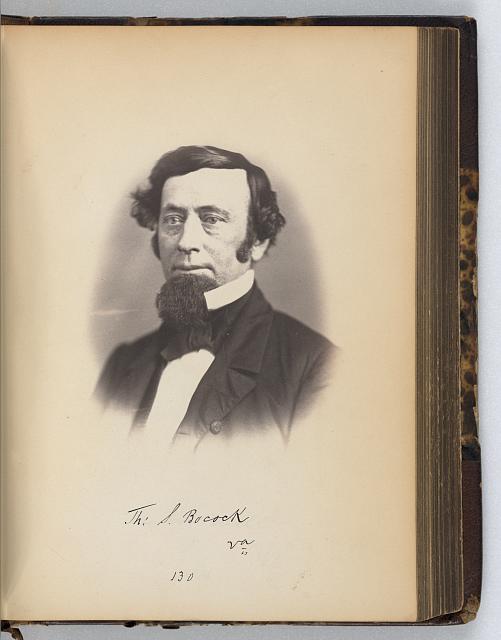
Thomas S. Bocock, Representative from Virginia, Thirty-fifth Congress, half-length portrait (1859; LOC: LC-DIG-ppmsca-26669)

Speaker Thomas H. Bocock warns about members' self-control

The call of the roll of the members was then commenced, and at its conclusion the presiding officer announced that a quorum was present, after which he proceeded to administer the following oath, which was done by calling up the delegations from the several states of the Confederacy:

“You and each of you do solemnly swear that you will support the Constitution of the Confederate States: So help you God.”

This was the most deeply impressive part of the whole ceremony. As the delegation from each State gathered around the desk of the Speaker, a solemn stillness pervaded the entire hall, and the whole crowd, members and spectators, seemed to feel the responsibility which rests upon this new, and as yet untried, body.

Each delegation having thus reverently qualified to assume the high and honorable [ responsiblity ] of supporting the Constitution of the new Government, Mr. Cobb announced that the next duty devolving upon them was the election of a Speaker to preside over their future deliberations.

The nomination of candidates for Speaker being in order, Mr. Foote, of Tennessee, offered a resolution declaring Hon. Thos. S. Bocock, of Virginia, the choice of the House for Speaker. The resolution of Mr. Foote was adopted with but one or two dissenting voices, and Mr. Bocock was duly declared the Speaker elect of the first Congress under the permanent Government of the Confederate States. …

After assuming the Chair, the new Speaker delivered the following patriotic address, which was listened to with marked attention, and was received, at its conclusion, with warm applause:

Gentlemen of the House of Representatives:…

The unanimity with which you have made this election is a happy augury of the spirit with which your proceedings will be governed. This is no time for resentments, no time for jealousies or heart-burnings. Influenced by a great common purpose, sharing together the same rich hope, and united by a common destiny, let us hush every murmur of discontent and banish every feeling of personal grief. Here let us know no man, save as a co-laborer in the same great cause, sustaining those whom circumstances may designate to go forward; seeking nothing for the sake merely of personal gratification, but willing rather to yield everything for the public good; “in honor preferring one another.”

That some of you, influenced by momentary impulse, should grow restive under the enforcements of those rules which you may make for your own government, would be a matter neither of surprise nor of complaint. But he will prove himself either a weak or a bad man who; on reflection, fails to call back his wayward spirit and subject it to necessary restraint. Submission to constituted authority is the primary necessity in all communities, and self-control is the chief lesson of individual life.

In the light of passing events, we can measure the height and the depth of the excellence intended to be conveyed, when it is said, “Better is he who ruleth his own spirit than he who taketh a city.” …

The Dispatch did not mention either Alabama senator being present. Virginian Robert Mercer Taliaferro Hunter had been serving as CSA Secretary of State since July 1861. Thomas Stanley Bocock was another Virginian. Bacock was the prosecuting atttorney for Appomattox County in 1845 and 1846. He served in U.S. House from 1847 until 1861. Bacock was nominated for U.S. House Speaker in 1859 but withdrew after several ballots failed to elect anyone. The well-known Louis Wigfall slipped into his senate seat after the session began and took the oath after voting for the various offices was completed.

Richmond, Va. Residence of Alexander H. Stephens, Vice President, C.S.A. (1865 April; LOC: LC-DIG-cwpb-00441)

Richmond home of Alexander H. Stephens

Posted in 150 Years Ago This Week, Confederate States of America, Southern Society | Tagged , , , | Leave a comment

Singing and Laughing with Fred.

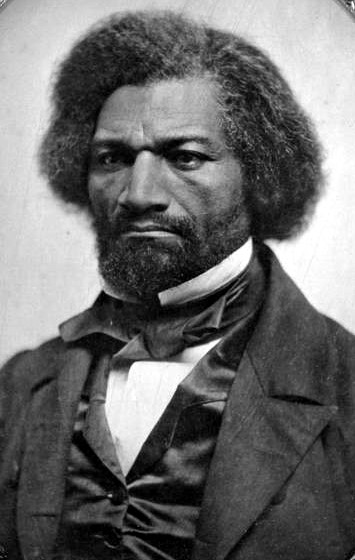
Frederick Douglass 1856

Native American?

From The New-York Times February 13, 1862:

FRED. DOUGLASS ON THE WAR.; An Interesting Meeting at the Cooper Institute A Speech by Fred. Douglas Songs by the Hutchinsons.

A very large audience assembled at the Cooper Institute last evening, on the occasion of the lecture of FRED. DOUGLASS on “The War.” A somewhat unusually large number of policemen were visible in all portions of the house, although the necessity for their presence was not apparent.

Rev. H.H. GARNET, after a song by the HUTCHINSONS, which was well received, introduced the speaker, with an explanation of the necessity that existed for a change in the programme. He stated that a communication had been received which rendered it certain that it would not be consistent with the safety of white and colored citizens of the South for the deserter from the rebel ranks to appear, as was proposed, in the clothes in which he fought.

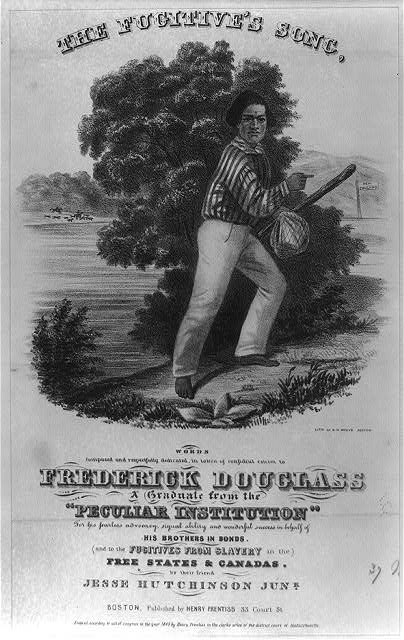
The fugitive's song (A sheet music cover illustrated with a portrait of prominent black abolitionist Frederick Douglass as a runaway slave.1845; LOC: LC-USZ62-7823)

Fred as runaway on sheet music by Jesse Hutchinson, Jr

Mr. DOUGLAS, in commencing, said that at the time he proposed to speak, the victories of Fort Henry and Roanoke Island had not been fought, and even those victories had not removed the somewhat sombre view which he took of the war. This war had developed our patience. [Laughter.] He was not here to find fault with the Government; [t]hat was dangerous. [Laughter.] Such as it was, it was our only bulwark, and he was for standing by the Government. [Applause.] He would not find fault with Bull Run, Ball’s Bluff or Big Bethel, but he meant to call attention to the uncertainty, and vascillation and hesitation in grappling with the great question of the war — Slavery. The great question was, “What shall be done with the slaves after they are emancipated?” He appeared as one who had studied Slavery on both sides of Mason and Dixon’s line. He considered himself an American citizen. He was born on the most sacred part of the soil. [Laughter and applause.] There was nothing in the behavior of the colored race in the United States in this crisis, that should prevent him from being proud of being a colored citizen of the United States. [Ap- plause.] They had traitors of all other nations in Fort Lafayette as cold as Stone — [laughter] — but they had no black man charged with disloyalty during this war. Yet, black men were good enough to fight by the side of WASHINGTON and JACKSON, and were not good enough to fight beside MCCLELLAN and HALLECK. [Laughter.] But, he would not complain — he only threw out these hints. [Laughter.] The question was simply whether free institutions and liberty should stand or fall. Any peace without emancipation would be a hollow peace. Even that rhinoceros-hided place, Washington, had by a species of adumbration, come to realize this truth. [Laughter.] What had Slavery done for us, that it had any claim upon us that we should spare it? Tens of thousands of American citizens were now taking their first lessons in Anti-Slavery. He held up in a ludicrous vein the tenderness of many who, like the New-York Herald, would hang a rebel and confiscate all his property — except his slaves. Slavery had kept our army quiet for seven months, and displaced good and loyal men by incompetent and disloyal ones. The question was, What shall be done with the 4,000,000 slaves if emancipated? He might ask what shall be done with the 350,000 slaveholders? His plan was, after the slaves were emancipated to let them alone, do nothing with them. [Laughter.] Let them take care of themselves as others do. [Applause.] The other day a man approached him, evidently taking him for an Indian, and the following scene took place:

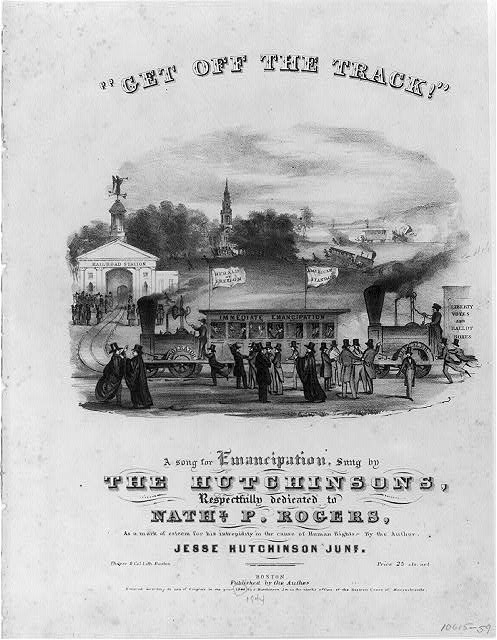
"Get off the track!" A song for emancipation, sung by The Hutchinsons, . . . (1844; LOC: LC-USZ62-68922 )

Train ride to immediate emancipation

STRANGER — Halloa, come from way back, eh?

FRED stood quiet and looked as much like an Indian as he could.

STRANGER — Come from way back. Indian, eh?

FRED — No, Nigger.

The stranger fell back as if he had been shot. [Laughter.]

Mr. DOUGLASS made an elaborate argument in support of the capacity of the black race for self-government. He thought that if the slave could take care of his master and mistress, he could take care of himself. MCDONOUGH’s slaves, eighty-four in number, had bought their own liberty in fourteen years, and their master made money enough out of them to buy a gang twice as large. [Applause and hisses.] But, should the freed slaves stay here? Yes. They wouldn’t take up more room than they do now. They had made the South, and were entitled to stay there. If Mr. BLAIR’s bill was passed it would be a dead letter. Even slaveholding Maryland had refused to send away her free colored population, because their toil was the wealth of the State. There were some 5,000,000 colored people on this continent and the adjacent islands, and it would take a great many ships to take them away. [Laughter.] Protestant America could at least do as. well by the negro as Catholic Brazil. But over the bleeding back of the negro, the American nation was to learn lessons of liberty that could be learned in no other way.

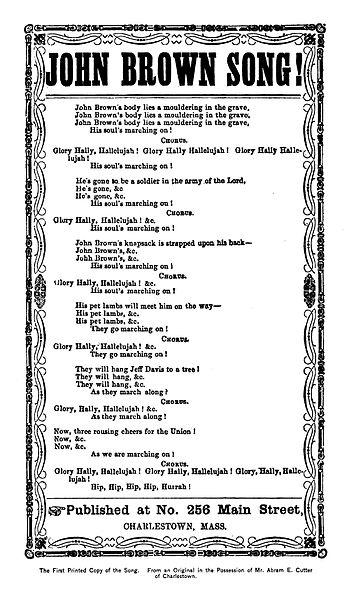
Original-john-brown-words according to george-kimball

Hutchinsons perform at Cooper Institute

As the hour was late, he said he would take his seat without reading the very brilliant peroration which he had prepared.

The HUTCHINSONS then sang the song of JOHN G. WHITTIER, “pronounced incendiary by a Pro-Slavery General.” The audience applauded every verse as it was rendered with thrilling effect.

The audience then called for the John Brown song, which was rang amid much applause, after which the meeting separated.

The Hutchinson Family Singers were a popular American singing group that began performing in 1840. Apparently the family had a long association with Frederick Douglass:

At the urging of Jesse Hutchinson, the group took up various causes. Among these were abolitionism, temperance, and women’s rights. … They traveled with Frederick Douglass in England in 1845 and stayed for almost a year. Original songs such as “Get Off the Track!”, “Right over Wrong”, and “The Slave’s Appeal” addressed these issues. Abby Hutchinson wrote “Song of Our Mountain Home” in 1850. It includes the line, “Among our free hills are true hearts and brave, / The air of our mountains ne’er breathed on a slave.”

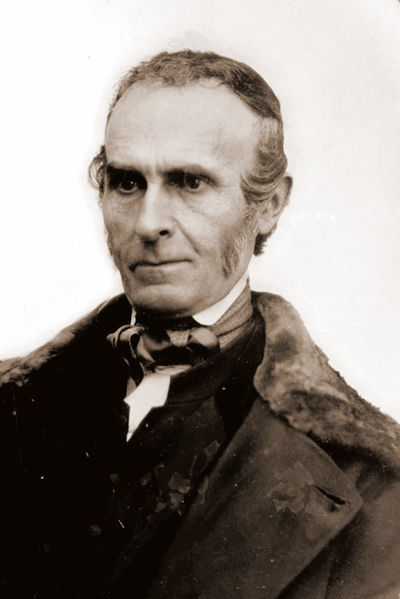
John_Greenleaf_Whittier_BPL_ambrotype,_c1840-60-crop

John Greenleaf Whittier

Poet, journalist, politician John Greenleaf Whittier was deeply involved with the abolitionist cause from 1833 until about 1845 when he had a nervous breakdown at least partially due to being “mobbed, stoned, and run out of town” for his abolitionist activities. In 1839 he helped found the Liberty Party, which eventually became the Free Soil Party.

I don’t know which Whittier work the Hutchinsons sang. It could have been “The Branded Hand” commemorating Sea Captain John Walker’s attempt to sail some slaves to freedom in the Bahamas in 1844.

A more current poem (published in the February 1862 edition of The Atlantic Monthlywould have been “At Port Royal 1861”, which included “Song of the Negro Boatmen” (see Whittier Wikipedia link).

Unlike George Ticknor and Jim Lane Frederick Douglass and the Hutchinsons favored immediate emancipation and thought the freed slaves would do just fine if left alone.

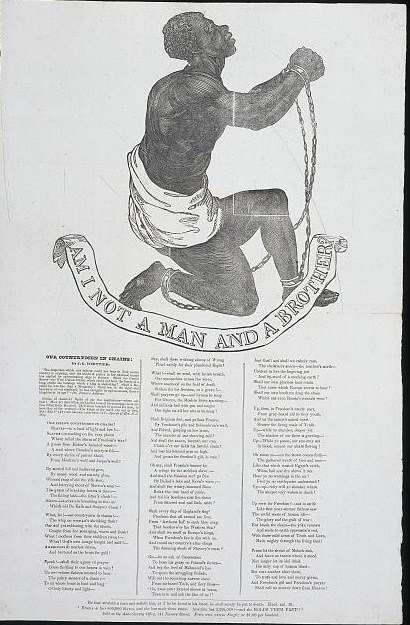
Am I not a man and a brother? (appears on the 1837 broadside publication of John Greenleaf Whittier's antislavery poem, "Our Countrymen in Chains."; LOC: LC-USZC4-5321)

Whittier's 'Our Countrymen in Chains' 1837

Posted in 150 Years Ago This Week, Northern Society | Tagged , , , , , | Leave a comment

Jim Lane: Manservants and Reservations

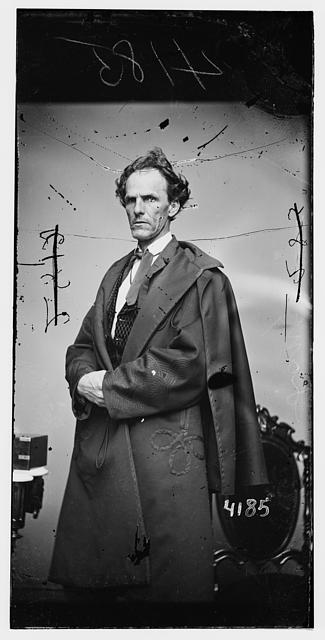
James Lane (between 1855 and 1865; LOC: LC-DIG-cwpbh-01176)

Crusader - his knights errant need 34,000 squires

From the Richmond Daily Dispatch February 13, 1862:

What to do with our slaves.

–Jim Lane made a speech last month at St. Louis, in which he said:

“There are in the South 680,000 strong and loyal male slaves, who have fed and clothed the rebel army, and have as good as fought on their side. Government now proposes that those loyal slaves shall feed and clothe our army and fight upon our side. The other day, while I was talking with the President, Old Abe said to me, “Lane, how many black men do you want to have to take care of your army?” I told him as my army would number 34,000, I proposed to have 34,000 contrabands, in addition to my teamsters and wagon masters. I consider every one of my soldiers engaged in this glorious crusade of freedom a knight errant, and entitled to his squire to prepare his food, black his boots, load his gun, and take off his drudgery. Vanity and pride are necessary adjunct of the soldier, and I do not propose to lower him by mental offices, nor compel him to perform the duties of the slave. So, while I shall elevate the slave by giving him his freedom and making a man of him, I shall also elevate the soldier and leave him no work to do but fighting. [A voice in the crowd, “What are you going to do with the niggers?”]

The General, singling out the owner of the voice, and pointing his long finger at him, replied: “Ah, my friend, you are just the man I have been looking for. I will tell you what I am going to do with them. I am going to plant them on the soil of the gulf coast, after we have got through this war, let them stay and cultivate the land; have Government extend a protection to them, as it does to the Indians, and send superintendents and Governors among them and pay them wage for their labor. There could be no competition between black and white labor.”

Apparently Kansas Senator and General James Henry Lane’s thought evolved during 1862. He authorized the formation of the 1st Regiment Kansas Volunteer Infantry (Colored), which

was recruited without federal authorization and against the wishes of Secretary of War Edwin M. Stanton. James H. Lane, recruiting commissioner for Kansas territory north of the Kansas River, on August 4, 1862 authorized raising the regiment. It was the first African-American regiment to fight in combat with white soldiers during the Civil War, in the skirmish at Island Mound, in Bates County, Missouri.

Posted in 150 Years Ago This Week, Military Matters, Northern Society | Tagged , , | 1 Comment

Not an Abolitionist in the American Sense

George Ticknor

Free labor has made North rich and strong

A letter to Britain 150 years ago this week.[1]

To Sir Charles Lyell.

Boston, February 11, 1862

MY DEAR LYELL,-No doubt, I ought to have written to you before. But I have had no heart to write to my friends in Europe, since our troubles took their present form and proportions. …

You know how I have always thought and felt about the slavery question. I was never an Abolitionist, in the American sense of the word, because I never have believed that any form of emancipation that has been proposed could reach the enormous difficulties of the case, and I am of the same mind now. Slavery is too monstrous an evil, as it exists in the United States, to be reached by the resources of legislation. … I have, therefore, always desired to treat the South with the greatest forbearance, not only because the present generation is not responsible for the curse that is laid upon it, but because I have felt that the longer the contest could be postponed, the better for us. I have hoped, too, that in the inevitable conflict with free labor, slavery would go to the wall. I remember writing to you in this sense, more than twenty years ago, and the results thus far have confirmed the hopes I then entertained. The slavery of the South has made the South poor. The free labor of the North has made us rich and strong.

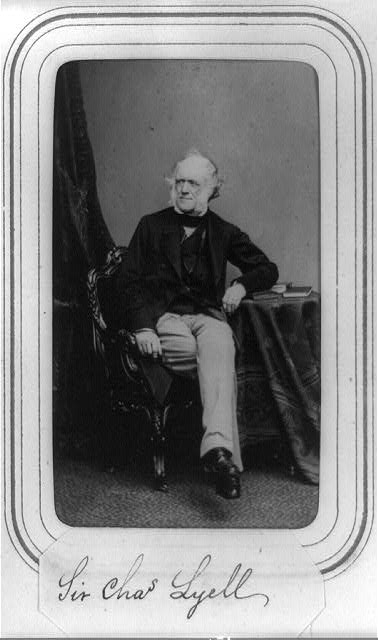
Sir Charles Lyell, full-length portrait, seated at small table, facing left (between 1857 and 1875; LOC: LC-USZ62-98523)

Sir Charles Lyell

But all such hopes and thoughts were changed by the violent and unjustifiable secession, a year ago; and, since the firing of the first gun on Fort Sumter, we have had, in fact, no choice. We must fight it out. Of the results I have never doubted. We shall beat the South. But what after that? I do not see. It has pleased God that, whether we are to be two nations, or one, we should live on the same continent side by side, with no strong natural barriers to keep us asunder; but now separated by hatreds which grow more insane and intense every month, and which generations will hardly extinguish. …

You can read more of this letter at Google Books starting on page 446.

Free labor might have been leaving slavery in its dust, but that apparently wasn’t affecting planters – and slavery was an ingrained southern institution. There was never a national consensus on the need for a reasonable emancipation.

George Ticknor was born in Boston and died in Boston, but he traveled throughout Europe, was a Harvard professor, and helped establish the Boston Public Library. He was known for his history of Spanish literature.

Scottish-born Charles Lyell was the foremost geologist of his time.

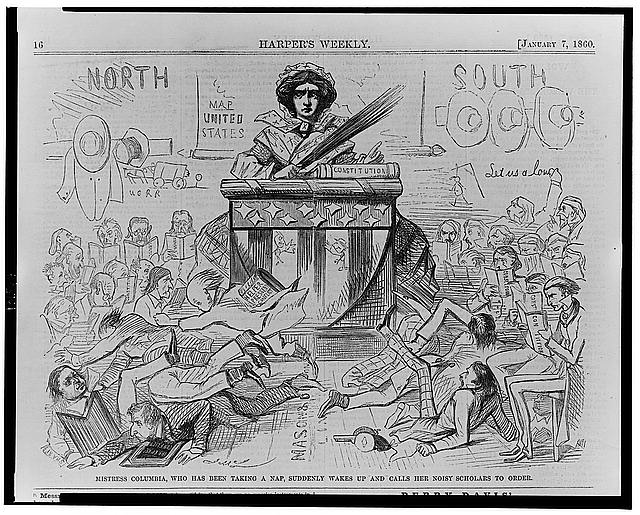
Mistress Columbia, who has been taking a nap, suddenly wakes up and calls her noisy scholars to order (Illus. in: Harper's weekly, v. 4, no. 158 (1860 January 7), p. 16; LOC: LC-USZ62-131564)

Mason-Dixon line - 'no strong natural barrier' to separate North and South (1860 cartoon)

  1. [1]Henry Steele Commager and Erik Bruun,eds.,The Civil War Archive. New York: Black Dog & Leventhal,2000. pp. 354-355.
Posted in 150 Years Ago This Week, American Society | Tagged , , , | Leave a comment