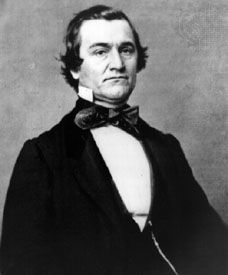
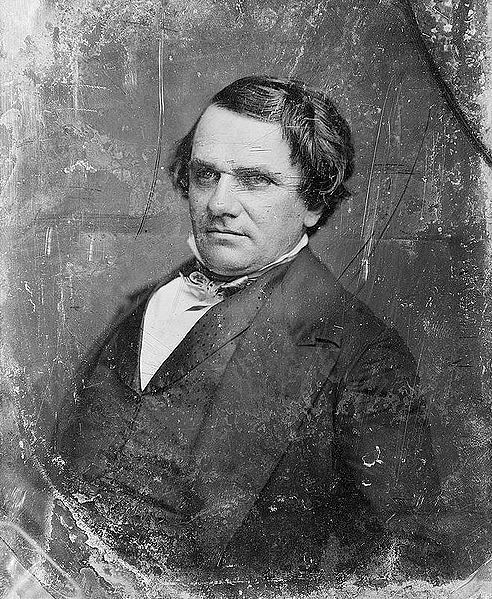
William Lowndes Yancey was a well-known Fire-Eater. Fire-Eaters were a group of Southerners who strongly supported states rights, slavery and the resumption of the slave trade, and eventually secession. On October 23, 1860 (about two weeks before the presidential election) Yancey gave a speech in Lexington, Kentucky in front of four thousand people. The New-York Times. reported on the speech in its issue of October 27, 1860. Pontiac, The Times correspondent sort of played stenographer and wrote up the basic ideas from Yancey’s speech. He pretty much had to condense the speech – Yancey “spoke for two hours and a quarter with much energy and power”.
Here are some excerpts from Pontiac’s report:
Mr. YANCEY began by stating the object of his ex-
tensive speech-making. It is, ostensibly, to bring
about such a union of the Breckinridge, Bell and
Douglas parties as will overcome the unconstitutional ,
sectional, Abolition and Disunion Party of the North,
and thus rescue the Constitution and the Union. He
has no personal ambition, no desire for place. For
many years he has pursued the even tenor of his way
in the paths of private life, and nothing but the perils
to the Constitutional basis of our Government has
now brought him out. He would assail or abuse no-
body, but he will defend himself and his cause against
those who aim to stab the Constitution through its
breast.
Slavery is the agitating and all-controlling question
of American parties. It is a living, practical , trans-
cendent issue. The entirely sectional, grasping and
rapacious Republican Party, which is very likely to
win, is for nullifying the Fugitive Slave law, and for
prohibiting Slavery in the Territories and in the Dis-
trict of Columbia, and the Slave-trade between the
States! Twelve of their fifteen or more States have
passed laws nullifying the Fugitive Slave act . Ag-
gression on Slavery is the Republicans’ philosophy
and policy. This is so, though slaveholding is a con-
stitutional right, entitled to recognition and protection
from all branches of the Government .
The Breckinridge Party has some appreciation
of the inestimable dignity and importance of Slavery.
Nothing but extermination can remove or get rid of
the 4,000,000 slaves in the South. They are worth,
according to Virginia prices, $2,800,000,000.
The Black-Republican cloud is hovering over OUT
border, ready to burst in thunder, lightning and tem-
pest upon us ! What shall be done?
Mr. BRECKINRIDGE is the only contending and avail-
able candidate against Mr. LINCOLN. He is the only
strong man we have. He is the man to unite the
South and save the South! BELL has no chance of
carrying Tennessee; she will go against him by at
least 10,000. Mr. YANCEY believes that the chances
in Kentucky of “her honored and cherished son ”
are the best! Kentucky and Missouri are the only
doubtful Southern States; all the rest are sure for
BRECKINRIDGE! LINCOLN may get 16 States – DOUGLAS
will get nothing. PONTIAC.
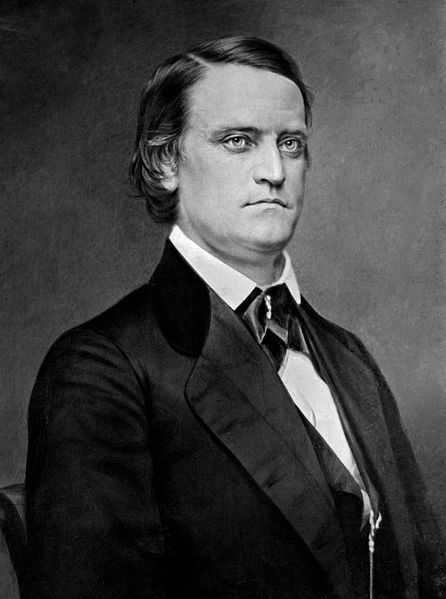
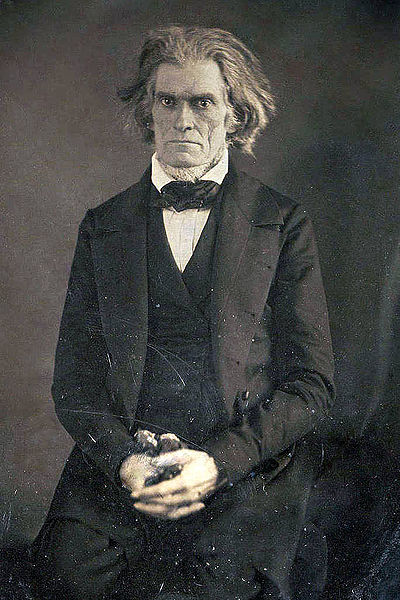
John Breckinridge
As a matter of fact Kentucky did not go for its native son Breckinridge. Bell won Kentucky, Tennessee, and Virginia. I just noticed something else that points out the North’s dominance in the nation and in the war that was to come: The Wikipedia article about the 1860 Election
gave a recap of the popular vote. Seventy percent of the voters voted for either Lincoln or Douglas, the Northern Democrat.
My last post talked about the value of cotton and slaves to the southern economy. Here Yancey states that the market value of slaves is almost 3 billion dollars.
Another thing that struck me was Yancey’s discussion of nullification. History books tell us that the southern states were the nullifiers, but Yancey says that northern states nullified the Fugitive Slave Act. Could this be true?
Wikipedia to the rescue again. Several northern states passed Personal Liberty Laws in response to the Fugitive Slave Act. These laws put up roadblocks to effective enforcement of the law without actually invoking the doctrine of nullification. Encyclopedia.com has more information on this.
Recurring Theme
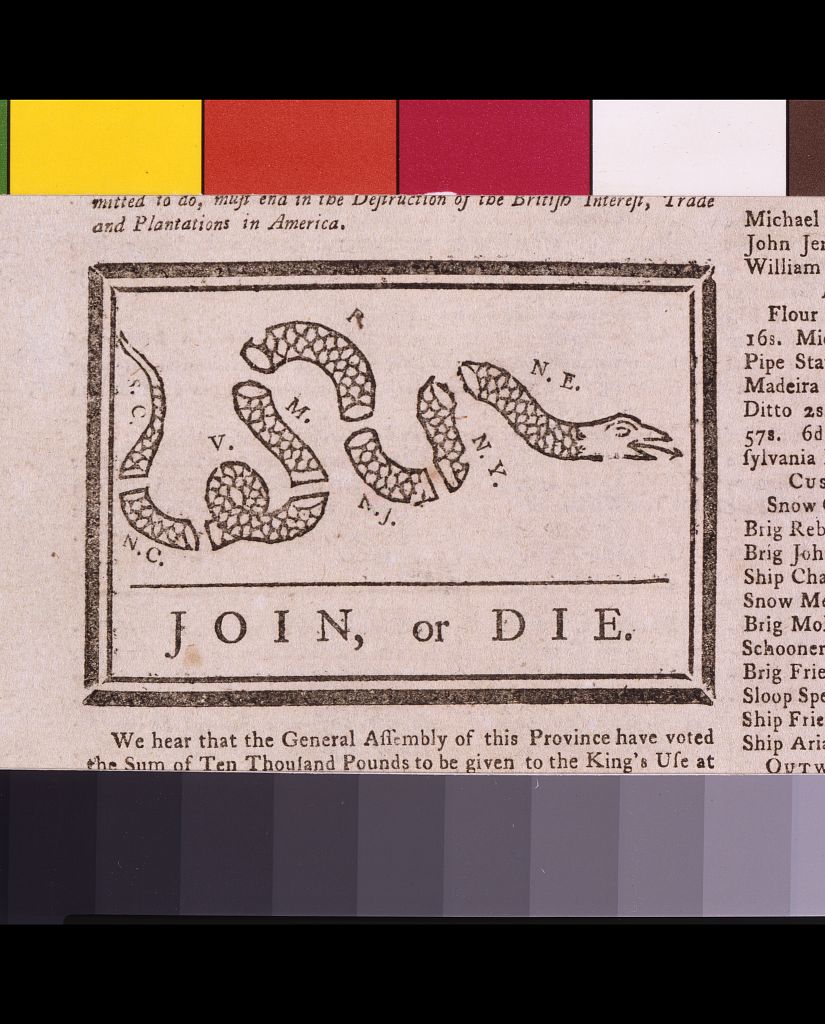
The relationship between the states and the federal government seems to be one of the major themes of U.S. history. At the signing of the Declaration of Independence Ben Franklin allegedly said: “We must, indeed, all hang together, or assuredly we shall all hang separately”. After the Revolutionary War the Constitutional Convention of 1787 tried to improve the Articles of Confederation, which had turned out to be too state-centric.
And on through the Civil war to the present day. This year the state of Arizona passed a law that the state said was intended to enforce the federal immigration laws that the U.S. government was not enforcing. Also this year, several state attorney generals are challenging the constitutionality of Obamacare.
The Great Nullifier
What’s more, this week TOCWOC – A Civil War Blog featured an article with the provocative title, “Time for another John C. Calhoun?” and links to Tom Woods’ site and his article about state nullification.
And it’s really not just an American phenomenon. One of the major ongoing stories in The Economist is the relationship of the member nations to the European Union. How much sovereignty is each nation willing to give up for the sake of the Union?
As always, it would be great to hear what you think. Thanks!
Recently I posted an excerpt from the October 18, 1860 issue of The New-York Times. about the Minute Men in South Carolina. In the same issue The Times published more Southern reaction to the big Republican victories in the state elections of Pennsylvania, Ohio, and Indiana. The reaction varied, but there was definitely talk of disunion. I think it would have been reasonable to wonder if the American flag was going to lose some of its 33 stars.
The New-Orleans Picayune did not think Lincoln could be elected, but, if he were elected, it did not think the majority of Southerners would support secession. Lincoln’s election would be lawful. There was a hint that the Picayune thought the Southern states should secede if the Fugitive Slave act were repealed.
The Nashville Union said the threat of “Black Republicanism” should cause everyone in the South to put aside party differences and unite to protect their constitutional rights.
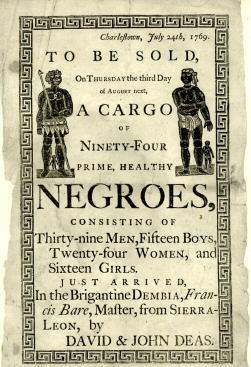
18th century auction
The Richmond newspaper used an economic and financial argument to warn about what would happen if Lincoln became president.
From The New-York Times. October 18, 1860:
The Richmond Examiner seizes the occasion to urge the claims of BRECKINRIDGE and LANE.
Then commenting on the pecuniary pressure in the South,
and charging it upon the prospect which there is of
the Federal Government changing hands, it says:
“If a financial pressure of continuous and general
character follows the election of LINCOLN, the days of
this Union are not only numbered, but they will be
very few. With a fall in the price of cotton and negroes,
there will come popular discontent, and against
the Government which has produced the convulsion
that discontent will be directed. In the South, the
capitalists who now dread disunion and convulsion
most, who are always opposed to disturbance, will be
the first to cry for war or separation. The Northern
man will have to whistle for his debt. Civil commotion or
war is always a stay law, and often an extinguisher
of the debt, without the payment of money.
Such a motive is a low and a bad one, but it is operative
in all revolutions, and it is not to be forgotten
when men are seriously calculating the probable results
of political or social acts. We say to the capitalists
in both sections, if you wish to enjoy your capital
—to the laborer, if you wish to get wages—to the
tradesman, if you wish to make profit—do you prevent
the election of LINCOLN; and we sincerely believe that
this can now be done, if at all, only by voting for
BRECKINRIDGE and LANE.”
Reading this editorial from the Richmond newspaper that equates cotton and black people as commodities immediately reminded me of my trip to Fort Sumter in 1996. I was enjoying walking around Charleston. Then I remember walking by what apparently was the Old Slave Mart. Seeing an actual slave market made a bad part of our history a bit more real – not just something to read from a book. The Richmond editorial’s concern about the price of slaves affected me in a similar way.
Apparently, however, it is not that uncommon to analyze the prices of cotton and slaves in the pre-Civil War South. Yesterday afternoon I had a serendipitous experience. I worked on this post for awhile before going to the dollar-a-bag used book sale at our local library. At the sale I opened up a big green book to a chart that compared the price of cotton and slaves from 1802-1860! What a coincidence!
The book turns out to be what I take to be a high school textbook from 1990: The American Nation, A History of the United States by John A. Garraty and Robert A. McCaughey. The book covers a lot about the economics of slavery. The main idea is that as the demand for cotton rose and the efficiency of (slave) labor rose because of the cotton gin, the demand for and price of slaves skyrocketed. The chart I mentioned shows that while the price of cotton remained fairly steady during the first part of the 19th century, the price of a “Prime Field Hand” tripled from $600 in 1802 to about $1800 in 1865. Elsewhere the authors note that the slave price reflected the increase in value of southern agricultural output. They calculate the “crop value per slave” – it rose from $15 in the early part of century to more than $125 in 1859.
I was startled when I read the line about the price of “cotton and negroes”; however, given the importance of cotton to the South’s economy, I can see why those calculations were being made. It is like calculating labor costs nowadays – except that nowadays the wages go to the laborer.
As always I’d like to hear what you think.
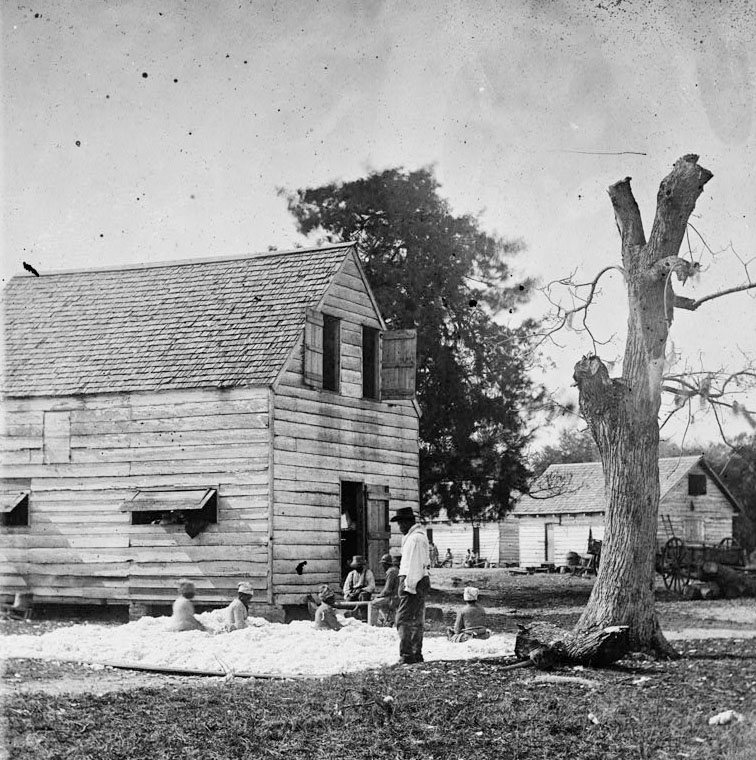
Cotton and Negroes
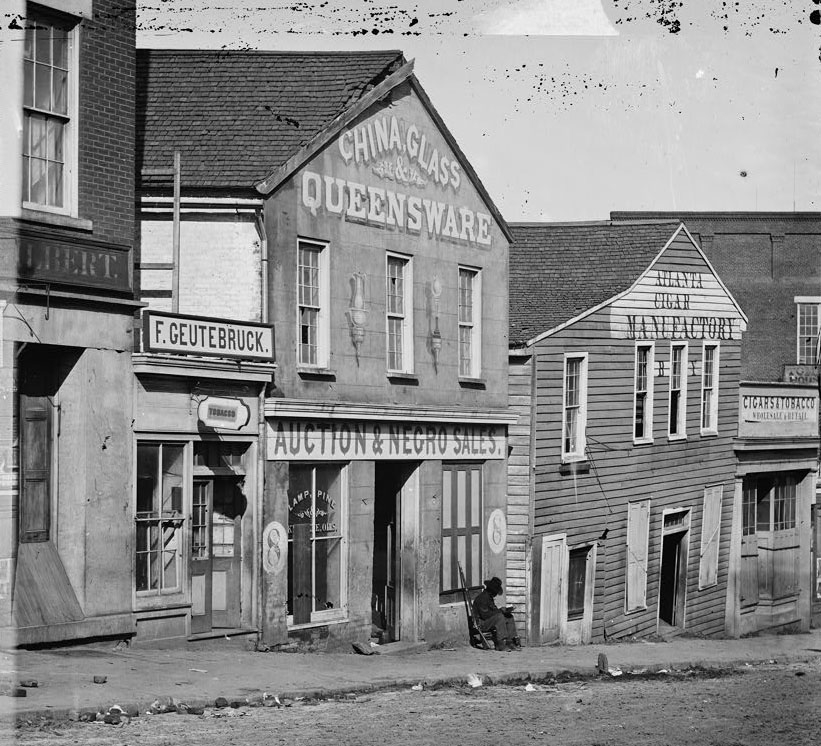
Auction House
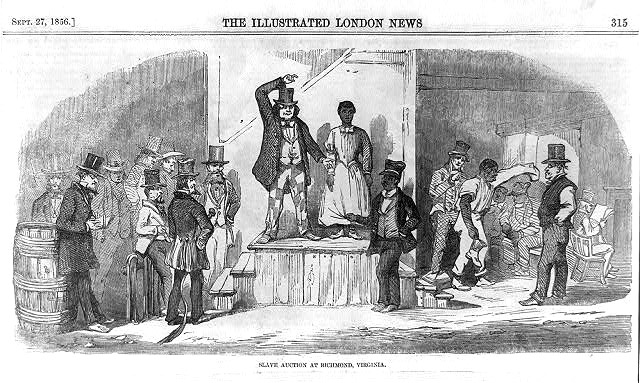
Slave Auction
Great Sites
I’ve been getting some excellent public domain photos from Shmoop
According to the October 24, 1860 issue of The New-York Times. there was a huge Fusion demonstration in New York the night before. 25,000 supporters of Douglas, Breckenridge, and Bell-Everett marched through the city streets to counteract the prior pro-Lincoln Wide-Awake rally a couple weeks before. More from the Times:
THE PROCESSION.
The moon was as bright, the stars as numerous and
the sky as cloudless, last night , as on the occasion of
the great Wide-Awake parade. The clerk of the
weather , assuredly, is no partisan. The monster pro-
cession of the combined Douglas, Breckinridge and
Bell-Everett forces which marched through our
streets last night , had no need of torches, calcium
lights and variegated pyrotechnics. Yet they
were displayed in profusion. The pageant
was gotten up regardless of expense, and was a decided success. The thoroughfares through which it
passed were again rivers of flame rolling between
black banks of packed humanity. The women that
were in the streets—and their name was many myriads
—received a sparking from the hundreds of Roman
candles, that was much more ardent than agreeable.
The whole town seemed on fire for Fusion, just as
one night, a few weeks ago, it seemed redolent of
Republican resin.
The increasing likelihood that Lincoln would be elected was having a similar result in the South (also from the October 24, 1860 of The New-York Times.):
UNION MOVEMENT IN GEORGIA.
Hon. B. H. HILL spoke at Atlanta (Ga.) on the
evening of the 17th inst., and at the close of his ad-
dress the following resolution was adopted with great
enthusiasm:
Resolved by the Citizens of Atlanta composing this
meeting, That the Executive Committees of the seve-
ral parties having Electoral tickets for President and
Vice-President, in Georgia, be and they are hereby re-
spectfully and earnestly requested to meet at an early
day, at some central and convenient point, and form
an Electoral ticket out of the three tickets now before
the people of Georgia, to be voted for by our whole
people, irrespective of party; or, if that be found im-
practicable, that they pledge their candidates, if suc-
cessful, to cast the vote of our College for that candi-
date for the Presidency—whether BELL, BRECKINRIDGE
or DOUGLAS—who may be most likely to defeat the
election of our common enemy—ABRAHAM LINCOLN.
A Great Site
Seven Score and Ten focuses on events 150 years ago. When I decided to look at events 150 years ago I did not realize there were other sites doing similar things. I hope to complement these sites. A lot of history was happening back then. Seven Score and Ten has more information on the Fusion movement in New York.
Meandering through the Seneca Fall (NY) public library recently I noticed a shelf filled with some interesting-looking notebooks (no, not laptops, actual old-fashioned three-ring binders). These binders contained archival material from the village historian. They were arranged by date from the 1700’s through the 2000’s. My heart jumped a bit – not exactly like a kid in a candy store, more like the actual young me: when our family went on vacations I apparently grabbed all the tourist brochures and pamphlets I could fit into my pockets. I eagerly got the binder that included 1860 and started browsing. The notebook contained many clippings from local newspapers.
One article mentioned a meeting of the Little Giants. Unfortunately there was no information about the actual date of publication, but the clipping was identified in ink as 1860. 250 supporters of Stephen A. Douglas, the Little Giant, from Seneca Falls traveled by boat on the Cayuga and Seneca Canal to neighboring Waterloo. [11-11-2020 – the supporters were from Seneca Falls, not Mr. Douglas.] They joined up with about 250 Waterloo residents for a torchlit procession and speeches.
The Little Giant
The same binder had an article reporting on a pole raising by the Little Giants of the 4th Ward. It was a beautiful hickory pole 150 feet in length. The Democrat Party used hickory poles in honor of Andrew Jackson, “Old Hickory”. See this article about Pole Raising
I’ve been reading a lot about the Wide-Awakes recently, but I have not seen any mention of a corresponding group that supported Douglas. There is information at Yates County, NY, in the Civil War that Douglas visited Yates and Ontario counties (near Seneca Falls) in September, 1860, but nothing about “The Little Giants”.
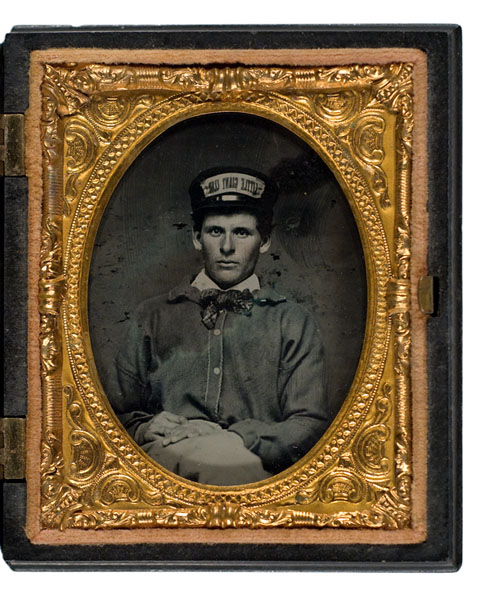
I googled and yahooed and binged. I eventual found a bit more information about the Little Giants. Cowan’s Auctions sold an ambrotype of a Little Giants club member in 2009.
Little Giants club member
Cowan’s explains that they have seen several images of Wide-Awakes, but this is the first of a Douglas supporter.
If anyone has any information about an official organization supporting Douglas calling itself The Little Giants and paralleling the Wide-Awakes, I’d like to hear about it.
Extra! Extra!
I’m not sure about the legality of publishing the photo of the ambrotype, but it seems that the ambrotype has the value
The Yates County site describes several pole raisings in that county during the 1860 campaign
The Seneca County Little Giants did not affect the election outcome in Seneca County- according to Wikipedia Lincoln carried every county in the Finger Lakes area and almost all counties in New York State.
For an interesting political cartoon that combines “base ball” and the 1860 election check out the Civil War site at Dickinson College
With the presidential election less than three weeks away the tension in the country keeps on building:
From The New-York Times., October 18, 1860:
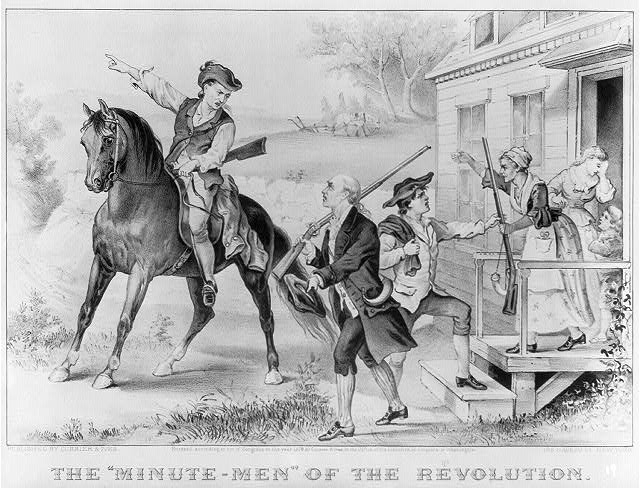
MINUTE MEN IN SOUTH CAROLINA.
The Charleston Mercury thus notices a new movement in the “Carolina State: ”
” We are glad to see the people of our State everywhere preparing for the crisis which is at hand. As an offset to the ‘Wide Awakes ‘ of the North, ‘Minute Men’ are organizing in all the Principal districts
of South Carolina. Their object is to form an armed body of men, and to join in with our fellow-citizens, now forming in this and our sister States as ‘ MinuteMen, ‘ whose duty is to arm, equip and drill, and be ready for any emergency that may arise in the present perilous position of the Southern States. In Kershaw, Abbeville and Richland Districts the organization is already complete and powerful, embracing the flower of the youth, and led on by the most influential citizens. The badge adopted is a blue rosette, two and a half inches in diameter, with a military button in the centre, to be worn upon the side of the hat. Let the important work go bravely on, and let every son of Carolina prepare to mount the blue cockade.”
The correspondent of the Savannah Republican writes from Columbia, S. C. :
” An association of ‘ Minute Men’ was formed here last week, which already numbers about three hundred members. They have meetings nearly every night,and I learn that more than sixty men were initiated last night. Similar associations are being formed in various parts of the State, and the movement is spreading rapidly. I cannot better describe its objects than by copying the preamble to the constitution:
” We, the undersigned citizens of South Carolina, in view of the impending crisis, necessarily incident upon the election of a Black Republican to the Presidency of these United States; and in view of our duties to our section, ourselves and our dearest interests, which must fall in the event of the triumph of Northern fanaticism, hereby form ourselves into an association, under the name and style of the ‘Minute Men ;’ and do further solemnly pledge ‘ our lives our fortunes, and our sacred honor,’ to sustain Southern constitutional equality in the Union, or, failing in that, to establish our independence out of it ” –
The members are required to wear a blue cockade on the left side of the hat ; and, also, as soon as possible, to procure a Colt’s revolver, a rifle, or some other approved firearm. A public demonstration is to be made on Friday night ; and, if one may be permitted to judge from the blue cockades seen about the streets, the demonstration will be an important one, not only in numbers, but in the character of the men composing it. In public procession, the members are required to “carry a lantern, flambeau, or other demonstrative implement” appropriate to the occasion.
For a scholarly analysis of how the Minute Men in South Carolina’s Upcountry were involved in the secession movement check out this article from The Journal of Southern History at BNET
Paramilitary organizations seem to have been widespread throughout the United States in 1860. The Seneca Falls, New York newspaper in 1860 mentioned a “Jackson Guard”. It also reported on a company of Zouaves that was being formed locally.
Confederate Secession Cockades reviews the history of cockades (including the meaning of macaroni in “Yankee Doodle Dandy”) and has some Civil war era photos of people wearing cockades.
Fannie A. Beers was a woman from the North who married a Southerner. She nursed Confederate soldiers during the Civil War. Project Gutenberg publishes her Memories, which does mention Minute Men and blue cockades
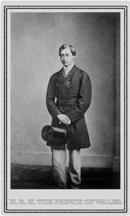
A few days ago I reviewed The New York Times The Complete Front Pages 1851-2008 for articles from 150 years ago this week. It was a bit challenging finding Civil War related articles because much of the front pages were devoted to covering in great detail the visit of the Prince of Wales to New York City.
The Times reporter says that some people were inordinately excited about seeing a real live prince who might one day be king. The reporter says that even people of greater intelligence were motivated by the goodwill New Yorkers feel toward the prince’s country and toward his mother, Queen Victoria. What a difference eighty-four years makes! The Declaration of Independence is largely an indictment of the many crimes of George III, the prince’s great grandfather. Three Times issues during the week devoted their entire front pages to the prince’s New York City visit.
Actually, there was quite a bit of Civil war related news during the rest of the week. From the October 11, 1860 Times: Arrests were made in a suspected “negroe” insurrection in the Norfolk, Virginia area. Confessions (some of them extorted) of the arrested blacks indicated that some free persons (some of them free “negroes”) instigated the plot. Some citizens of the area formed “Vigilance” patrols to investigate and suppress the insurrection. One of the patrols shot a white man dead and wounded a free “negroe” at a campsite that some of the insurrectionists were using.
Also on October 11th The Times reported on October election results from a few states. Apparently some states held elections for state offices (including U.S. House Representatives) in October. To learn more about this I found a great site – The American Civil War, which focuses on one event for each day 150 years ago. According to The Times there were “Heavy Popular Majorities for the Lincoln Cause.” However, the paper also reported that the Pennsylvania and Ohio delegations to the U.S. House would each lose two Republican members to Anti-Republicans.
The October 17th issue of The Times was full of election news. There was a large Republican rally in Auburn, New York (William Seward’s home-town) the night before. “The Wide-Awake procession was large and enthusiastic. Nearly ten thousand people were in attendance.” According to Wikipedia Auburn’s population in 1860 was 10,986. A very big rally indeed!
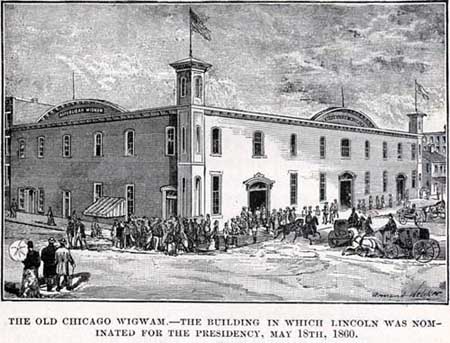
The Wide-Awakes were also reported as being active in Springfield, Illinois. They marched to Lincoln’s home to cheer for the Republican victories in Ohio, Pennsylvania, and Indiana. Later at the Wigwam they heard speeches. The Wide-Awakes were also presented with “an excellent photograph of the cabin in Kentucky in which Mr. Lincoln was born.” “The enthusiasm could not be repressed until a late hour of the night.”
The Wigwam in Chicago
Extra Things
1) To see an engraving of the prince visiting Washington’s tomb during the prince’s grand North American tour check out the Civil War page of Dickinson College
2) The October 17th issue of The Times reported on a local “Base Ball match”. The box score reported outs and runs per player; even 150 years ago base ball was a nine inning game with three outs per half-inning; the offenses predominated – the final was 17-15.
3) Below the box score was an announcement of a newly formed cricket club, which was set to play their first game. The team included many base ball players. Cricket seems appropriate the week of the prince’s visit.
Sometimes I have a tendency to act like I can make my own omens. At any rate, I thought it would have a nice symmetry if the first book I officially read after I started this site was Lee and Grant by Gene Smith: a book about two famous representatives of the Blue and the Gray or, in this case, the Gray and the Blue.
It seems like most of the reading I do nowadays is in bits and pieces during lunch break. So far I’ve enjoyed the book very much. I have read to the point in 1859 when Lee gets a message that he is supposed to report at once to the Secretary of War because of the trouble at Harper’s Ferry.
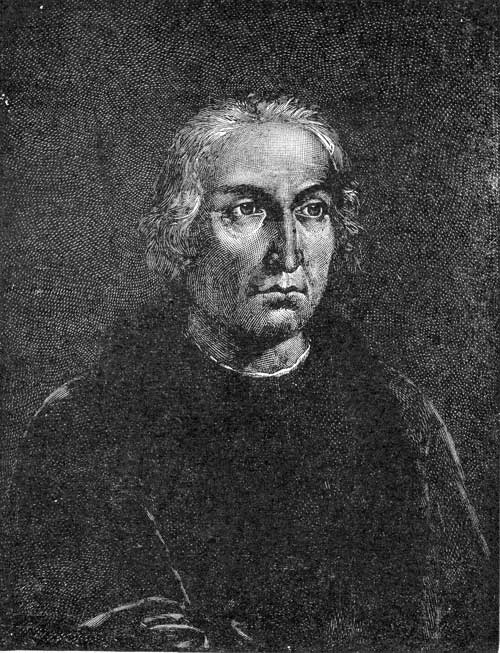
Christopher Columbus
On this Columbus Day weekend I decided to share a little bit of what I’ve learned so far.
Grant did not say much as a child and was considered a dullard while he was growing up. Children converted his name from Ulysses to “Useless”. Gene Smith describes Grant as less than ordinary as a child except for his ability to handle horses.
I never realized how accomplished Lee was in seemingly all areas of his life. His father, Light Horse Harry Lee, essentially abandoned his family. Therefore, beginning as a child of six Lee helped his invalid mother run the household. At West Point he had a career that has never been surpassed according to Smith. He was at the top of his class in every subject. He never had a demerit, and yet, he was also liked by his classmates. After he graduated he had a successful career as an army engineer. In fact, he is credited with having saved St. Louis as an inland port by building jetties and breakwaters to control the Mississippi
The War with Mexico
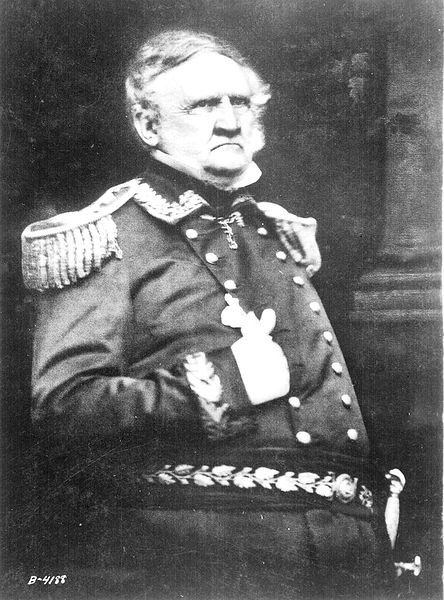
General Winfield Scott
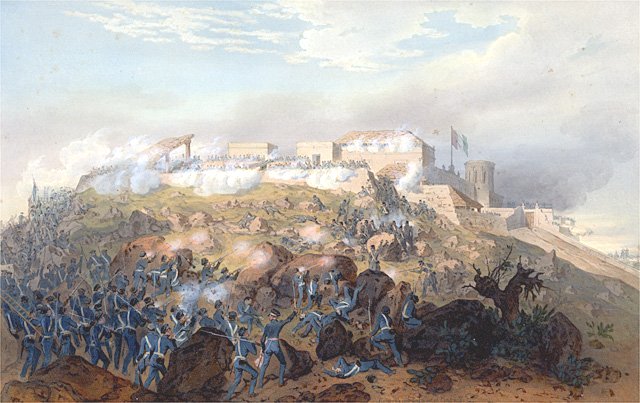
Although both Lee and Grant disagreed with the U.S. fighting the Mexican War, they both helped the Americans win. Lee and Grant both were part of General Winfield Scott’s command during the Mexico City campaign. Lieutenant Grant was a regimental quartermaster but took some tactical initiative during the battle of Chapultepec: he noticed a church belfry with a commanding view of part of the defenders’ position. He led a group of men who assembled a howitzer in the belfry and drove some Mexicans from a gate.
General Winfield Scott said without Lee the Americans would not have captured Mexico City. His actions during the campaign were truly courageous. I’m not going to mention all his heroic feats, but the “boy of great promise” was certainly living up to his potential during the Mexican War.
Battle of Chapultepec
As far as I know, the only time Lee and Grant met before Appomattox was during the Mexico City campaign. Grant reported to Scott’s headquarters in a sloppy uniform. Colonel Lee was perfectly uniformed and mildly rebuked Grant by reminding the quartermaster that the general’s orders were that officers report to headquarters in full uniform.
The Fluidity of U.S. Grant’s Name, or who in the world was H.U.G.?
Grant was not born U.S. Grant. In fact, one of the most striking things I’ve read in the book so far is that for six weeks the baby Grant had no name. Then the extended family got together, put their choices on paper, and drew a name out of a hat. Grant was given a trunk to take to West Point. His correct initials were on the trunk – H.U.G. Grant did not want to be picked on by his fellow cadets for HUG, so he changed the initials to U.G.H. Obviously Grant had more name changes in store.
But I got to thinking:if Grant had stayed H.U.G., what would the newspapers have done after Fort Donelson? U.S. was Unconditional Surrender. What about H.U.?
The best I could do was Highly Uncompromising. What do you think?
Thanks to Karen’s Whimsey for the public domain photo of Christopher Columbus: Public Domain Images .
Many years ago in college freshman remedial English class our instructor asked us which of the books we had read during class we most enjoyed. I think, with many of my classmates, I voted for Voltaire’s Candide. It was short and made strong points with its satire.
Our professor said that his favorite was The Odyssey. I think his point was that as we grew older we might be more inclined to enjoy a long book that we could read on a cold winter night curled up by the fire.
I have not reread The Odyssey so far, but about 10 years ago I did read the late Civil War writer Shelby Foote’s immense three volume The Civil War: A Narrative. I think I read a volume, then took a break for a couple months before starting the next section. I remember enjoying the book and Mr. Foote’s vast knowledge of the Civil War.
You can get an idea of Mr. Foote’s mastery and the detailed account of the war he provides by looking at the titles of the three volumes. Each volume is arranged by the battles they cover. For example, the first book is subtitled Fort Sumter to Perryville. I had heard of Fort Sumter, Fredericksburg, and Appomattox; I sure never had heard of Perryville, Meridian, or Red River.
I like all the maps in the books. In the Bibliographical Note at the end of Volume 1 Mr Foote explains that he is not an historian – he is a writer. He says he is a novelist, but that he always stuck to the facts in his book about the war. That is important to me. I can appreciate both fiction and history, but I think a history should be as factual as possible.
Recently Daniel Sauerwein at Civil War History shared a YouTube video featuring various comments by Shelby Foote. Here’s the YouTube video:
I think it’s a great video that in less than 10 minutes says a lot about Shelby Foote: his great sense of humor; his total mastery of the subject – he can relate small incidents on the one hand, and on the other hand, make serious points with total conviction. I also got the impression that Mr. Foote was proud to be a Southerner but prouder to be an American. He alludes to this at the end of the Bibliographical Note I mentioned above. He says, “I am a Mississippian.” However, he hopes that any bias readers notice will be no more than “the average American’s normal sympathy for the underdog in a fight.”
I understand his statement about the North fighting the war with one hand behind his back. He mentions that the Harvard-Yale boat race happened in the spring of 1864 and none of the team members had to enlist. I read an article recently that shows that apparently quite a few young college men in the North did volunteer and serve and die during the war.
Hamilton College is a small school in Clinton, New York. The Summer 2009 issue of Hamilton Alumni Review (pages 16-18) published an excerpt from a book by Professor Maurice Isserman about Hamilton’s involvement in the Civil War. He states that about 225 Hamilton Alumni served in the Union army during the war, and 11 alumni served with the Confederacy.
Hamilton is small now, but it was much smaller in the 1860’s. There were about 30 men in each class. Mr. Isserman says that 19 alumni died in battle or prison; an unknown number died because of sickness.
I’m not trying to argue Mr. Foote’s point – I am sure that the North was nowhere near as pressed as the South. I just want to add something to the view of Northern college participation.
There are thousands of books about the Civil War, so I’m not sure how soon I’ll have a chance to curl up by the fire on a winter night and reread Mr Foote’s narrative of the war that was such an important part of America’s Odyssey. Of course, it might take even longer because I don’t have a fireplace, although it does often get cold in the Finger Lakes.
Addenda
1) The Hamilton College library has some primary Civil War related material as part of it’s Digital Collections
2) Daniel Sauerwein mentioned that he was made aware of the Shelby Foote video by Kevin Levin at Civil War Memory
3) In that last paragraph of the Bibliographical note I mentioned above, Mr. Foote mentions that he knew Confederate veterans, although by 1958 they were all dead. He says that the veterans respected the Union soldiers, but that Reconstruction eventually killed all that respect. Sometimes, as someone interested in the Civil War, it’s easy for me to focus on the battles and not pay enough attention to what happened before and after. The Civil War is colorful with all the battles and personalities involved. I can see that Reconstruction was not some abstract concept.
4) One of the things I love about YouTube is all the live music clips, especially from the long ago of my youth. To listen to some music that was screaming through my soul the night before we graduated from high school (and to see a very large Confederate battle flag) just press on the arrow:
Wandering through our local public library a few weeks ago I came across a big gray book with a very big title: The New York Times The Complete Front Pages 1851-2008. The pages of the book display selected front pages from the newspaper; the book includes three DVDs which include all the front pages.
The paper was first published on September 18, 1851. It was called New-York Daily Times. You could buy a copy for one cent.
By October 4, 1860 the paper had changed its name to The New-York Times. and the price had already doubled to two cents. The entire front page was devoted to the upcoming presidential election, specifically a procession of Wide-Awakes the evening before. According to the newspaper there were “Twelve Thousand Torchmen in Procession.”
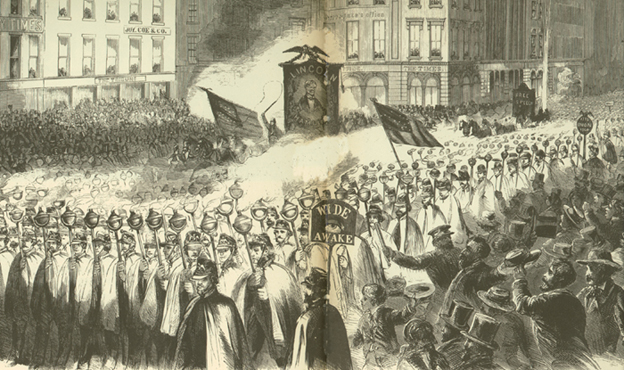
As I’ve mentioned, I am not a historian and I never remember learning about the Wide-Awakes. Wikipedia has a good description of the movement. This public domain engraving is from the Wikipedia entry:
Wide-Awakes Torch Procession ca. 1860
The main point I got after browsing through the article is that there were vocal supporters of all the presidential candidates that expressed their opinions in response to the demonstration. Also, there was a state-by-state tally of marchers. The total was 12,200 and they came from several states. The 1860 election definitely aroused people’s passions.