no respect

Group of Negros on their way to the cotton field, St. Helena Is. [i.e. Island], S.C. (Photograph shows freedmen on the Marion Chaplin Plantation on St. Helena Island, South Carolina.; LOC: https://www.loc.gov/item/2015646735/)

“Group of Negros on their way to the cotton field, St. Helena Is. [i.e. Island], S.C.” – Library of Congress

It was pitiful enough to find so much idleness, but it was more pitiful to observe that it was likely to continue indefinitely. The war will not have borne proper fruit, if our peace does not speedily bring respect for labor, as well as respect for man.

One of President Andrew Johnson’s objections to the Freedmen Bureau extension bill was that the Bureau would allow freedmen to rely on outside help for their survival: “The idea on which the slaves were assisted to freedom was that, on becoming free, they would be a self-sustaining population. Any legislation that shall imply that they are not expected to attain a self-sustaining condition must have a tendency injurious alike to their character and their prospects.” In the fall of 1865 a correspondent from Massachusetts spent three months in three Southern states. He found plenty of idle freedmen. but he tried to understand why this was and discovered that it wasn’t just the blacks – whites were just as likely to shirk work. The following is about the last third of the long report.

City of Atlanta, Ga., no. 1 / Photo from nature by G. N. Barnard. ([1866]; LOC: https://www.loc.gov/item/2008679857/)

“Illustration showing the destroyed Atlanta roundhouse, with steam engines and train cars in place but with collapsed stone walls.” – Library of Congress

From The Atlantic Monthly, VOL. XVII.—FEBRUARY, 1866—NO. C.:

THREE MONTHS AMONG THE RECONSTRUCTIONISTS.

I spent the months of September, October, and November, 1865, in the States of North Carolina, South Carolina, and Georgia. I travelled over more than half the stage and railway routes therein, visited a considerable number of towns and cities in each State, attended the so-called reconstruction conventions at Raleigh, Columbia, and Milledgeville, and had much conversation with many individuals of nearly all classes.

I.

I was generally treated with civility, and occasionally with courteous cordiality. I judge, from the stories told me by various persons, that my reception was, on the whole, something better than that accorded to the majority of Northern men travelling in that section. Yet at one town in South Carolina, when I sought accommodations for two or three days at a boarding-house, I was asked by the woman in charge, “Are you a Yankee or a Southerner?” and when I answered, “Oh, a Yankee, of course,” she responded, “No Yankee stops in this house!” and turned her back upon me and walked off. …

[the end of section III.]

The really bad feature of the situation with respect to the relations of these States to the General Government is, that there is not only very little loyalty in their people, but a great deal of stubborn antagonism, and some deliberate defiance. Further war in the field I do not deem among the possibilities. Be the leaders never so bloodthirsty, the common people have had enough of fighting. The bastard Unionism of North Carolina, the haughty and self-complacent State pride of South Carolina, the arrogant dogmatism and insolent assumption of Georgia,—how shall we build nationality on such foundations? That is the true plan of reconstruction which makes haste very slowly. It does not comport with the character of our Government to exact pledges of any State which are not exacted of all. The one sole needful condition is, that each State establish a republican form of government, whereby all civil rights at least shall be assured in their fullest extent to every citizen. The Union is no Union, unless there is equality of privileges among the States. When Georgia and the Carolinas establish this republican form of government, they will have brought themselves into harmony with the national will, and may justly demand readmission to their former political relations in the Union. Each State has some citizens, who, wiser than the great majority, comprehend the meaning of Southern defeat with praiseworthy insight. Seeing only individuals of this small class, a traveller might honestly conclude that the States were ready for self-government. Let not the nation commit the terrible mistake of acting on this conclusion. These men are the little leaven in the gross body politic of Southern communities. It is no time for passion or bitterness, and it does not become our manhood to do anything for revenge. Let us have peace and kindly feeling; yet, that our peace may be no sham or shallow affair, it is painfully essential that we keep these States awhile within national control, in order to aid the few wise and just men therein who are fighting the great fight with stubborn prejudice and hidebound custom. Any plan of reconstruction is wrong which accepts forced submission as genuine loyalty, or even as cheerful acquiescence in the national desire and purpose.

IV

Before the war, we heard continually of the love of the master for his slave, and the love of the slave for his master. There was also much talk to the effect that the negro lived in the midst of pleasant surroundings, and had no desire to change his situation. It was asserted that he delighted in a state of dependence, and throve on the universal favor of the whites. Some of this language we conjectured might be extravagant; but to the single fact that there was universal good-will between the two classes every Southern white person bore evidence. So, too, in my late visit to Georgia and the Carolinas, they generally seemed anxious to convince me that the blacks had behaved well during the war,—had kept at their old tasks, had labored cheerfully and faithfully, had shown no disposition to lawlessness, and had rarely been guilty of acts of violence, even in sections where there were many women and children, and but few white men.

Yet I found everywhere now the most direct antagonism between the two classes. The whites charge generally that the negro is idle, and at the bottom of all local disturbances, and credit him with most of the vices and very few of the virtues of humanity. The negroes charge that the whites are revengeful, and intend to cheat the laboring class at every opportunity, and credit them with neither good purposes nor kindly hearts. This present and positive hostility of each class to the other is a fact that will sorely perplex any Northern man travelling in either of these States. One would say, that, if there had formerly been such pleasant relations between them, there ought now to be mutual sympathy and forbearance, instead of mutual distrust and antagonism. One would say, too, that self-interest, the common interest of capital and labor, ought to keep them in harmony; while the fact is, that this very interest appears to put them in an attitude of partial defiance toward each other. I believe the most charitable traveller must come to the conclusion, that the professed love of the whites for the blacks was mostly a monstrous sham or a downright false pretence. For myself, I judge that it was nothing less than an arrant humbug.
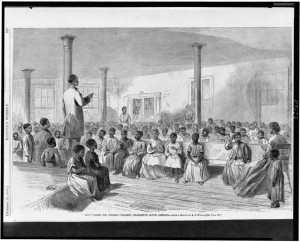
"Zion" school for colored children, Charleston, South Carolina / from a sketch by A.R. Waud. ( Illus. in: Harper's weekly, v. 10, 1866 Dec. 15, p. 797. )

“‘Zion’ school for colored children, Charleston, South Carolina / from a sketch by A.R. Waud.” – Library of Congress

The negro is no model of virtue or manliness. He loves idleness, he has little conception of right and wrong, and he is improvident to the last degree of childishness. He is a creature,—as some of our own people will do well to keep carefully in mind,—he is a creature just forcibly released from slavery. The havoc of war has filled his heart with confused longings, and his ears with confused sounds of rights and privileges: it must be the nation’s duty, for it cannot be left wholly to his late master, to help him to a clear understanding of these rights and privileges, and also to lay upon him a knowledge of his responsibilities. He is anxious to learn, and is very tractable in respect to minor matters; but we shall need almost infinite patience with him, for he comes very slowly to moral comprehensions.

Going into the States where I went,—and perhaps the fact is true also of the other Southern States,—going into Georgia and the Carolinas, and not keeping in mind the facts of yesterday, any man would almost be justified in concluding that the end and purpose in respect to this poor negro was his extermination. It is proclaimed everywhere that he will not work, that he cannot take care of himself, that he is a nuisance to society, that he lives by stealing, and that he is sure to die in a few months; and, truth to tell, the great body of the people, though one must not say intentionally, are doing all they well can to make these assertions true. If it is not said that any considerable number wantonly abuse and outrage him, it must be said that they manifest a barbarous indifference to his fate, which just as surely drives him on to destruction as open cruelty would.
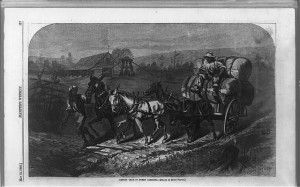
Cotton team in North Carolina ( Illus. in: Harper's weekly, 1866 May 12, p. 297. ; LOC: https://www.loc.gov/item/93513244/)

“Cotton team in North Carolina” – Library of Congress

There are some men and a few women—and perhaps the number of these is greater than we of the North generally suppose—who really desire that the negro should now have his full rights as a human being. With the same proportion of this class of persons in a community of Northern constitution, it might be justly concluded that the whole community would soon join or acquiesce in the effort to secure for him at least a fair share of those rights. Unfortunately, however, in these Southern communities the opinion of such persons cannot have such weight as it would in ours. The spirit of caste, of which I have already spoken, is an element figuring largely against them in any contest involving principle,—an element of whose practical workings we here know very little. The walls between individuals and classes are so high and broad, that the men and women who recognize the negro’s rights and privileges as a freeman are almost as far from the masses as we of the North are. Moreover, that any opinion savors of the “Yankee”—in other words, is new to the South—is a fact that even prevents its consideration by the great body of the people. Their inherent antagonism to everything from the North—an antagonism fostered and cunningly cultivated for half a century by the politicians in the interest of Slavery—is something that no traveller can photograph, that no Northern man can understand, till he sees it with his own eyes, hears it with his own ears, and feels it by his own consciousness. That the full freedom of the negroes would be acknowledged at once is something we had no warrant for expecting. The old masters grant them nothing, except at the requirement of the nation,—as a military and political necessity; and any plan of reconstruction is wrong which proposes at once or in the immediate future to substitute free-will for this necessity.

Three fourths of the people assume that the negro will not labor, except on compulsion; and the whole struggle between the whites on the one hand and the blacks on the other hand is a struggle for and against compulsion. The negro insists, very blindly perhaps, that he shall be free to come and go as he pleases; the white insists that he shall come and go only at the pleasure of his employer. The whites seem wholly unable to comprehend that freedom for the negro means the same thing as freedom for them. They readily enough admit that the Government has made him free, but appear to believe that they still have the right to exercise over him the old control. It is partly their misfortune, and not wholly their fault, that they cannot understand the national intent, as expressed in the Emancipation Proclamation and the Constitutional Amendment. I did not anywhere find a man who could see that laws should be applicable to all persons alike; and hence even the best men hold that each State must have a negro code. They acknowledge the overthrow of the special servitude of man to man, but seek through these codes to establish the general servitude of man to the commonwealth. I had much talk with intelligent gentlemen in various sections, and particularly with such as I met during the conventions at Columbia and Milledgeville, upon this subject, and found such a state of feeling as warrants little hope that the present generation of negroes will see the day in which their race shall be amenable only to such laws as apply to the whites.
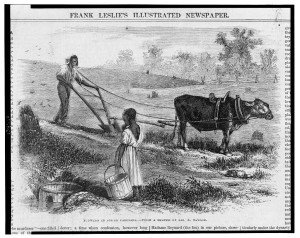
Plowing in South Carolina / from a sketch by Jas. E. Taylor. ( Illus. in: Frank Leslie's illustrated newspaper, v. 23, no. 577 (1866 October 20), p. 76.; LOC: https://www.loc.gov/item/2004669782/)

“Plowing in South Carolina / from a sketch by Jas. E. Taylor.” – Library of Congress

I think the freedmen divide themselves into four classes: one fourth recognizing; very clearly, the necessity of work, and going about it with cheerful diligence and wise forethought; one fourth comprehending that there must be labor, but needing considerable encouragement to follow it steadily; one fourth preferring idleness, but not specially averse to doing some job-work about the towns and cities; and one fourth avoiding labor as much as possible, and living by voluntary charity, persistent begging, or systematic pilfering. It is true, that thousands of the aggregate body of this people appear to have hoped, and perhaps believed, that freedom meant idleness; true, too, that thousands are drifting about the country or loafing about the centres of population in a state of vagabondage. Yet of the hundreds with whom I talked, I found less than a score who seemed beyond hope of reformation. It is a cruel slander to say that the race will not work, except on compulsion. I made much inquiry, wherever I went, of great numbers of planters and other employers, and found but very few cases in which it appeared that they had refused to labor reasonably well, when fairly treated and justly paid. Grudgingly admitted to any of the natural rights of man, despised alike by Unionists and Secessionists, wantonly outraged by many and meanly cheated by more of the old planters, receiving a hundred cuffs for one helping hand and a thousand curses for one kindly word,—they bear themselves toward their former masters very much as white men and women would under the same circumstances. True, by such deportment they unquestionably harm themselves; but consider of how little value life is from their stand-point. They grope in the darkness of this transition period, and rarely find any sure stay for the weary arm and the fainting heart. Their souls are filled with a great, but vague longing for freedom; they battle blindly with fate and circumstance for the unseen and uncomprehended, and seem to find every man’s hand raised against them. What wonder that they fill the land with restlessness!

City of Atlanta, Ga., no. 2 / Photo from nature by G. N. Barnard. ([1866]; LOC: https://www.loc.gov/item/2008679858/)

“Illustration showing a street corner in Atlanta with a destroyed bank building, intact neighboring buildings and shops, and covered wagons.” – Library of Congress

However unfavorable this exhibit of the negroes in respect to labor may appear, it is quite as good as can be made for the whites. I everywhere found a condition of affairs in this regard that astounded me. Idleness, not occupation, seemed the normal state. It is the boast of men and women alike, that they have never done an hour’s work. The public mind is thoroughly debauched, and the general conscience is lifeless as the grave. I met hundreds of hale and vigorous young men who unblushingly owned to me that they had not earned a penny since the war closed. Nine tenths of the people must be taught that labor is even not debasing. It was pitiful enough to find so much idleness, but it was more pitiful to observe that it was likely to continue indefinitely. The war will not have borne proper fruit, if our peace does not speedily bring respect for labor, as well as respect for man. When we have secured one of these things, we shall have gone far toward securing the other; and when we have secured both, then indeed shall we have noble cause for glorying in our country,—true warrant for exulting that our flag floats over no slave.

Meantime, while we patiently and helpfully wait for the day in which

“All men’s good shall
Be each man’s rule, and Universal Peace
Lie like a shaft of light across the land,”

there are at least five things for the nation to do; make haste slowly in the work of reconstruction; temper justice with mercy, but see to it that justice is not overborne; keep military control of these lately rebellious States, till they guaranty a republican form of government; scrutinize carefully the personal fitness of the men chosen therefrom as representatives in the Congress of the United States; and sustain therein some agency that shall stand between the whites and the blacks, and aid each class in coming to a proper understanding of its privileges and responsibilities.

Freedom on the plantation ([Charleston, S.C.?] : [publisher not identified], [between 1863 and 1866]; LOC: v)

“Freedom on the plantation” – Library of Congress
Posted in 150 Years Ago This Month, Aftermath, Postbellum Society, Reconstruction, Southern Society | Tagged , , , | Leave a comment

at any cost, except

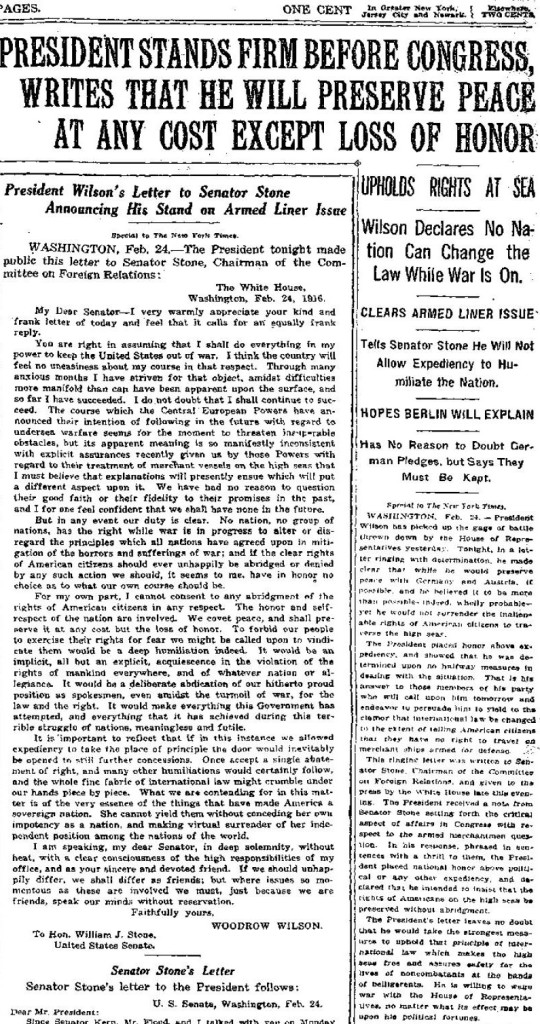
We covet peace, and shall preserve it any cost but the loss of honor.

For a little variety … A year and a half after the First World War began and during the week when the Battle of Verdun began America’s President Woodrow Wilson wrote a letter declaring that he would do whatever it took to keep the United States out of the war unless the nation’s honor was at stake. Apparently there was a discrepancy between Germany’s earlier assurances and a newer statement about its use of “undersea warfare” – it was going to use its U-Boats to sink armed merchant ships.

NY Times February 25, 1916

NY Times February 25, 1916

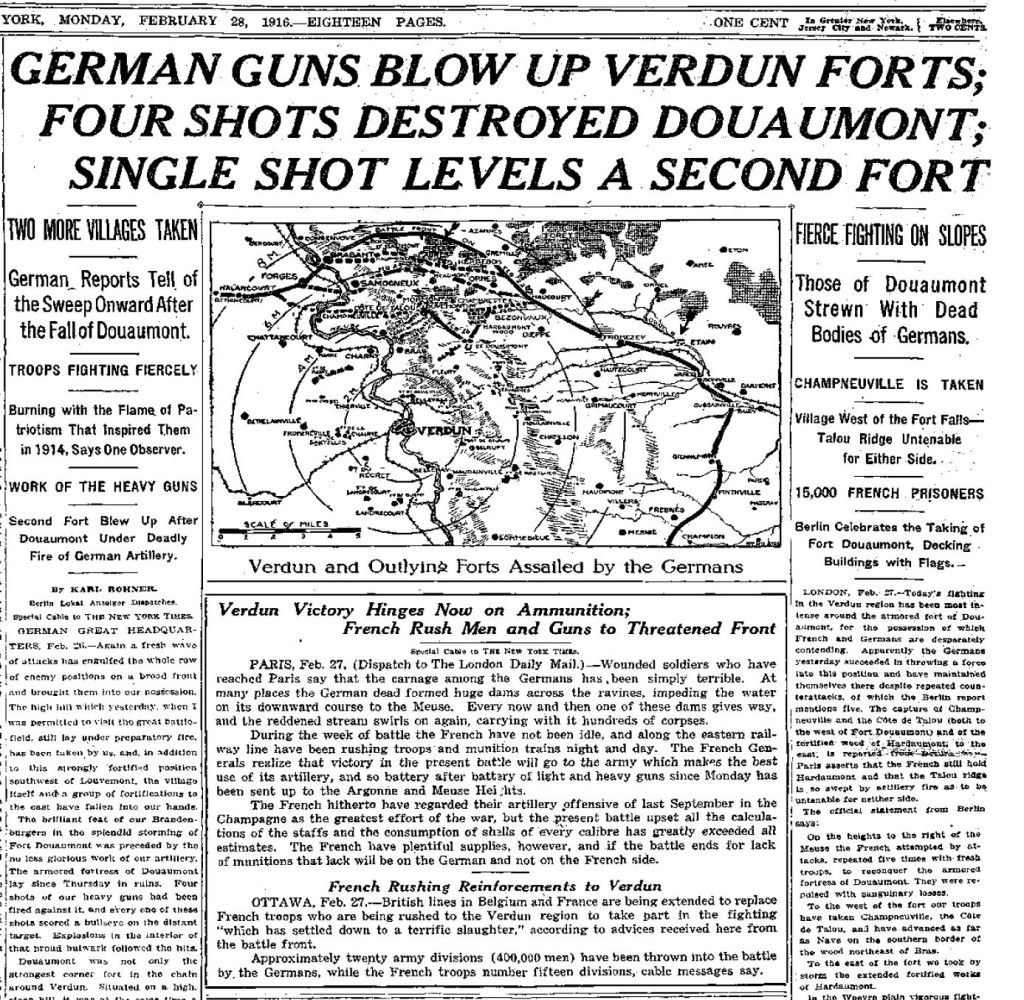
NY Times February 28, 1916

NY Times February 28, 1916

Posted in World War I | Tagged , , | Leave a comment

birthday bashing

NY Times February 21, 1866

NY Times February 21, 1866

Back in 1861 even small towns celebrated Washington’s Birthday with cannon fire and bells. Five years later there were definitely some fireworks in Washington, D.C. as a crowd looked for a speech from President Andrew Johnson. It was a couple days after the Senate failed to override the president’s veto; Andrew Johnson used the occasion to bash his opponents by likening some named radicals to Southern rebels. Even moderate Republicans viewed the speech as something like a declaration of war. Here is a bit of the impromptu speech (from Teaching American History):

… We find that, in fact, by an irresponsible central directory, nearly all the powers of Government are assumed without even consulting the legislative or executive departments of the Government. Yes, and by resolution reported by a committee upon whom all the legislative power of the Government has been conferred, that principle in the Constitution which authorizes and empowers each branch of the legislative department to be judges of the election and qualifications of its own members, has been virtually taken away from those departments and conferred upon a committee, who must report before they can act under the Constitution and allow members duly elected to take their seats. By this rule they assume that there must be laws passed; that there must be recognition in respect to a State in the Union, with all its practical relations restored, before the respective houses of Congress, under the Constitution, shall judge of the election and qualifications of its own members. What position is that? You have been struggling for four years to put down the rebellion. You denied in the beginning of the struggle that any State had the right to go out. You said that they had neither the right nor the power to go out of the Union. And when you have settled that by the executive and military power of the Government, and by the public judgment, you turn around and assume that they are out and shall not come in. (Laughter and cheers.)

I am free to say to you, as your Executive, that I am not prepared to take any such position. I said in the Senate, at the very inception of the rebellion, that States had no right to go out and that they had no power to go out. That question has been settled. And I cannot turn round now and give the direct lie to all I profess to have done in the last five years. (Laughter and applause.) I can do no such thing. I say that when these States comply with the Constitution, when they have given sufficient evidence of their loyalty, and that they can be trusted, when they yield obedience to the law, I say, extend to them the right hand of fellowship, and let peace and union be restored. (Loud cheers.) I have fought traitors and treason in the South; I opposed the Davises and Toombses, the Slidells, and a long list of others whose names I need not repeat; and now, when I turn round at the other end of the line, I find men I care not by what name you call them (A voice “Call them traitors”) who still stand opposed to the restoration of the Union of these States. And I am free to say to you that I am still for the restoration of this Union; I am still in favor of this great Government of ours going on and following out its destiny. (A voice “Give us the names.”)

A gentleman calls for their names. Well, suppose I should give them. (A voice “We know them.”) I look upon them I repeat it, as President or citizen as being as much opposed to the fundamental principles of this Government, and believe they are as much laboring to pervert or destroy them as were the men who fought against us. (A voice “What are the names?”) I say Thaddeus Stevens, of Pennsylvania (tremendous applause) I say Charles Sumner (great applause) I say Wendell Phillips, and others of the same stripe, are among them.

Here is an 1896 summary from The Struggle between President Johnson and Congress over Reconstruction by Charles Ernest Chadsey:

On February 22 [President Johnson] made a speech in which he not only attacked by name certain leading politicians, but also criticised in terms the legislative branch of the government. This speech marks a distinct epoch in the history of the struggle between the President and Congress. Prior to it, the latter, although conscious of the rapid divergence of the paths each was following, and determined to render as nugatory as possible the President’s policy, had not permitted the feeling of personal antagonism to influence its actions to any great extent. But from this time forth the lines were sharply drawn, culminating in the impeachment. Johnson bitterly hated the Joint Committee on Reconstruction. The very manner in which it had been authorized—through a concurrent resolution instead of a joint resolution for the purpose of preventing executive action—had embittered him; the principles which its majority represented and the personnel of the committee were equally distasteful to him.

In connection with the speech of February 22, it should be noticed that Mr. Stevens had two days before introduced a concurrent resolution, which passed the House, providing that no senators or representatives were to be admitted until Congress should declare the State entitled to representation. Such a provision, the practical effect of which would be to place the subject in the exclusive control of the Joint Committee on Reconstruction, Congress, as we have seen, struck out of the resolution authorizing that committee’s appointment. The President had good reason to believe that Mr. Stevens’ resolution would pass the Senate, as it did on the 2d of March, and he looked upon it as one more step in the usurpation of power by an “irresponsible directory.” Sensitive to all tendencies towards centralization, he saw in the power granted to the committee, and the measures proposed by it, a tendency towards the conditions against which he had spoken on April 21, 1865, when he said: “While I have opposed dissolution and disintegration on the one hand, on the other I am equally opposed to consolidation, or the centralization of power in the hands of a few.”

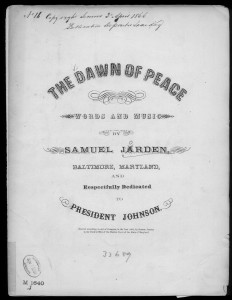
The Dawn of peace (LOC: https://www.loc.gov/item/ihas.200001472/)

The Dawn of Peace?

Public sentiment in Washington was very hostile to the Freedmen’s Bureau, and on February 22 a mass-meeting was held to express popular approval of the action of the President in vetoing the bill. Adjourning to the White House, the crowd congratulated Johnson with tumultuous enthusiasm. A man more cautious would have limited his reply to a temperate expression of his views; but Johnson, ever eager to pose as the leader of the people, was led by the enthusiasm of the moment to abandon himself entirely to his prejudices, aggravated as they were by the circumstances above mentioned. Thus, on the anniversary of Washington’s birthday, a day when he should have particularly refrained from partisan politics, he took occasion to assail the committee violently, declaring that the end of one rebellion was witnessing the beginning of a new rebellion; saying that “there is an attempt now to concentrate all power in the hands of a few at the federal head, and thereby bring about a consolidation of the Republic, which is equally objectionable with its dissolution. * * * The substance of your government may be taken away, while there is held out to you the form and the shadow.” He described the Joint Committee as an “irresponsible central directory,” which had assumed “nearly all the powers of Congress,” without “even consulting the legislative and executive departments of the Government. * * * Suppose I should name to you those whom I look upon as being opposed to the fundamental principles of this Government, and as laboring to destroy them. I say Thaddeus Stevens, of Pennsylvania; I say Charles Sumner, of Massachusetts; I say Wendell Phillips, of Massachusetts.”

6. After the President had thus publicly stigmatized the opponents of his policy as instigators of a new rebellion, and classed Stevens, Sumner and Wendell Phillips as traitors to be compared with Davis, there could be no hope of reconciliation, and the Republican party grimly settled down to fight for its principles. The first important measure to take effect was the civil rights bill.

Posted in 150 Years Ago This Week, Aftermath, Postbellum Politics, Postbellum Society, Reconstruction | Tagged , , , , , , , , , | Leave a comment

veto takes

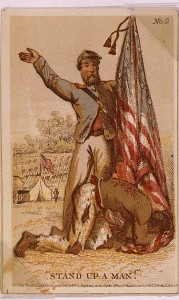
Stand up a man! (c1863.; LOC: v)

also the Bureau’s goal?

On February 19, 1866 President Andrew Johnson vetoed the Freedmen’s Bureau Extension bill. Here is a review of commentary from more modern scholars.

Walter Stahr points out that Mr. Johnson vetoed the bill because he agreed with Southern whites who hated the bureau “meddling in their domestic affairs” and with Democrats who disagreed with the expansion of federal power. The president also wanted those groups to support him on the 1868 election. President Johnson asked for draft veto messages from several advisers, including William H. Seward. Mr. Johnson used some of the Secretary of State’s technical arguments, but the main point of the final veto message was that Congress had no power to legislate about reconstruction until all the southern states were represented in Congress[1]

According to Eric Foner, “In appealing to fiscal conservatism, raising the specter of an immense federal bureaucracy trampling on citizen’s rights, and insisting self-help, not dependence on outside assistance, offered the surest road to economic advancement, Johnson voiced themes that to this day have have sustained opposition to federal intervention on behalf of blacks.” The veto intensified the bitterness between President and Congress; apparently because of President Johnson’s insistence on seating southern representatives, William P. Fessenden pointed out that Mr. Johnson “will and must … veto every other bill we pass” concerning Reconstruction. President Johnson sincerely thought that the Bureau was unconstitutional and encouraged the freedmen to be lazy. He underestimated moderate Republican support for “federal protection for freedmen.”[2]

Adam Tuchinsky contrasts the views of two New York newspapers on the Freedmen’s Bureau, which “was the first federal agency charged with caring for the social welfare of citizens; grounded in the idea of social rights, it was naturally quite controversial on ideological grounds.” The New-York Times, which “had been pushing a proto-social Darwinist brand of laissez-faire liberalism for more than a decade,” agreed with President Johnson that Bureau reduced the freed people to an almost childlike dependency. Horace Greeley’s New-York Tribune disagreed because the formerly enslaved had been unable to develop any of the necessary skills for self-reliance: “‘Deplorable necessities of the Blacks result from their life-long subjection to cruel social and political disabilities,’ the Tribune insisted. ‘Give the Blacks their honest due to-day, and they as a race would need none of your alms.'”[3]

[Horace] Greeley statue, Tribune Office (between ca. 1910 and ca. 1915; LOC: https://www.loc.gov/item/ggb2005019292/)

Tribune: Blacks don’t want your alms in the long run

Is it racist to hope that someday the federal government will be able to stop intervening “on behalf of blacks”?
The ca.1910-1915 photo of the Horace Greeley statue can be found at the Library of Congress, where, if you browse the stacks, you can read that the statue was moved in 1916
The image of the whipped slave and soldier can also be found at the Library

  1. [1]Stahr, Walter Seward: Lincoln’s Indispensable Man. 2012. New York: Simon & Schuster Paperbacks, 2013. Print. page 458.
  2. [2]Foner, Eric. Reconstruction: America’s Unfinished Revolution, 1863-1877. New York: HarperPerennial, 2014. Updated Edition. Print. pages 248-49.
  3. [3]Tuchinsky, Adam. Horace Greeley’s New-York Tribune: Civil War-Era Socialism and the Crisis of Free Labor. Ithaca: Cornell University Press, 2009. Print. pages 176-177.
Posted in 150 Years Ago This Week, Aftermath, Postbellum Politics, Postbellum Society, Reconstruction | Tagged , , , , , | Leave a comment

just saying no

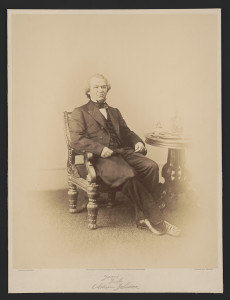
Portrait of Andrew Johnson / A. Gardner, photographer, 511 Seventh Street, Washington. (1866; LOC: https://www.loc.gov/item/2002736311/)

opposed to making the Bureau “a permanent branch of the public administration, with its powers greatly enlarged.”

150 years ago today President Andrew Johnson vetoed legislation that would have extended the jurisdiction of the Freedmen’s Bureau. Here is an 1896 summary. (However, the date of the veto is the 19th) From The Struggle between President Johnson and Congress over Reconstruction by Charles Ernest Chadsey:

4. The objectionable “black laws” of the Southern States, and the many tales of the oppression and cruel treatment of negroes, brought about a strong sentiment in favor of legislation by Congress giving additional protection to the freedman. The Act of March 3, 1865, had established in the War Department a “Bureau for the relief of Freedmen and Refugees,” which was “to continue during the present war of rebellion, and for one year thereafter.” This bureau was to assume control of all abandoned or confiscated lands in the insurrectionary States, and to assign tracts not to exceed forty acres each to freedmen and refugees at an annual rent of not more than six per cent. of the value. The occupants were to be allowed to purchase the land at any time within three years. The bureau was also authorized to supervise all matters that might concern freedmen and refugees from any of the rebel States or from districts occupied by the army, and to furnish supplies to such as were in need.

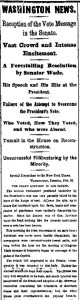
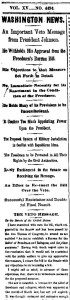
NY Times February 20, 1866

NY Times February 20, 1866

To extend the powers of this bureau and to continue it in operation until affairs had resumed their normal course, appeared to be a practicable way to protect the emancipated race. A bill to this effect was introduced in the Senate by Mr. Trumbull on January 5, 1866, and the Senate proceeded to its consideration on the 12th. With certain amendments the bill passed the Senate on the 25th by a vote of 37 to 10. The Select Committee on Freedmen to which the Senate bill had been referred by the House, reported on January 30 a substitute bill. This passed the House on the 6th of February by a vote of 136 to 33; it was amended by the Senate on the 7th, the House concurring on the 9th. It was vetoed by the President on the 10th, and the Senate on the 10th attempted to pass the bill over the veto. The result showed 30 votes in favor, 19 against, less than a two-thirds majority, and the bill thus failed to become a law.

The bill as presented to the President for his signature was entitled “An Act to amend an act entitled ‘An act to establish a Bureau for the relief of Freedmen and Refugees,’ and for other purposes.” It continued in force the act of March 3, 1865, and extended the jurisdiction of the bureau to freedmen and refugees in all parts of the United States. The President was authorized to “divide the section of country containing such refugees and freedmen into districts, each containing one or more States, not to exceed twelve in number, and, by and with the consent of the Senate, appoint an assistant commissioner for each of said districts;” or in the discretion of the President “the bureau might be placed under a commissioner and assistant commissioner to be detailed from the army.” Districts when necessary were divided into sub districts under agents. Military jurisdiction and protection were to extend over all connected with the bureau. Unoccupied public lands in the Southern States, not to exceed three million acres, were to be set apart for freedmen. Military protection was to be extended over all persons denied civil rights on account of race, color or previous servitude, and punishment was provided for those who deprived such parties of their civil rights.

The debates on this bill, occurring as they did before the President’s speech of February 22, which will hereafter be noticed, lacked the great bitterness which was frequently manifested in the later days of the session. The fact that the veto message was received before the 22d accounts for the failure of the attempt to override it.

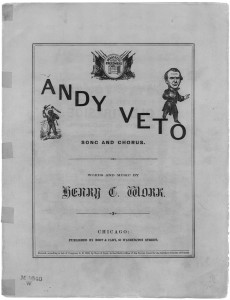
Andy veto (Root & Cady, Chicago, 1866. ; LOC: https://www.loc.gov/item/ihas.200002334/)

and the freedman hailed Columbia

The bill itself was moderate, the freedmen obviously needed the legislation, but the President considered the principles at stake of sufficient importance to justify him in further antagonizing Congress. His veto message cited a number of reasons for withholding the executive approval. In the first place he claimed that there was no immediate necessity for the measure. Then it also contained provisions which were unconstitutional and unsuited to accomplish the desired end. His chief objection, of course, was based upon the continuance of military jurisdiction into a time of peace. This he declared clearly unconstitutional, a violation of the right of habeas corpus and of trial by jury; and he added that “for the sake of a more vigorous interposition in behalf of justice we are to take the risks of the many acts of injustice that would necessarily follow from an almost countless number of agents, * * * over whose decisions there is to be no supervision or control by the federal courts. * * * The country has returned or is returning to a state of peace and industry, and the rebellion is in fact at an end. The measure, therefore, seems to be as inconsistent with the actual conditions of the country as it is at variance with the Constitution of the United States.” He considered the provisions which proposed to take away land from its former owners without due process of law, unconstitutional. Other more general objections were mentioned, such as the immense patronage created and immense expense involved, the dangerous concentration of power in the Executive, and the ethical objection that legislation which implies that the freedmen “are not expected to attain a self-sustaining condition must have a tendency injurious alike to their character and their prospects.”

The original Freedmen’s Bureau extension bill is available from the Library of Congress

You can read all of President Johnson’s veto message at Online Library of Liberty

Posted in 150 Years Ago This Week, Aftermath, Postbellum Society, Reconstruction | Tagged , , , | Leave a comment

president’s day

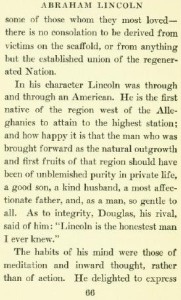
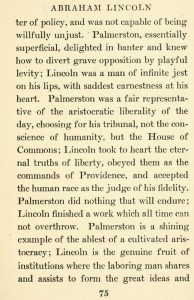
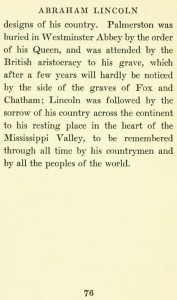
Big doings in Washington, D. C. 150 years ago today as the nation’s capital commemorated the birthday of the martyred Abraham Lincoln. George Bancroft, who delivered one of the main addresses found both strengths and weaknesses in Mr. Lincoln’s personality but
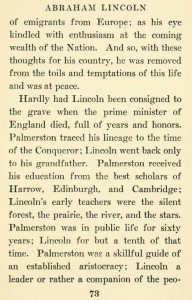
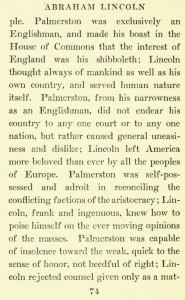
maintained that the late president’s character was thoroughly American. Mr. Bancroft closed his oration by comparing Abraham Lincoln favorably with Lord Palmerston, the president’s contemporary across the pond.

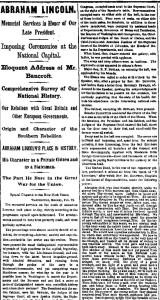
NY Times February 13, 1866

NY Times February 13, 1866

Bancroft1 2_12_1866 page 66

thoroughly American

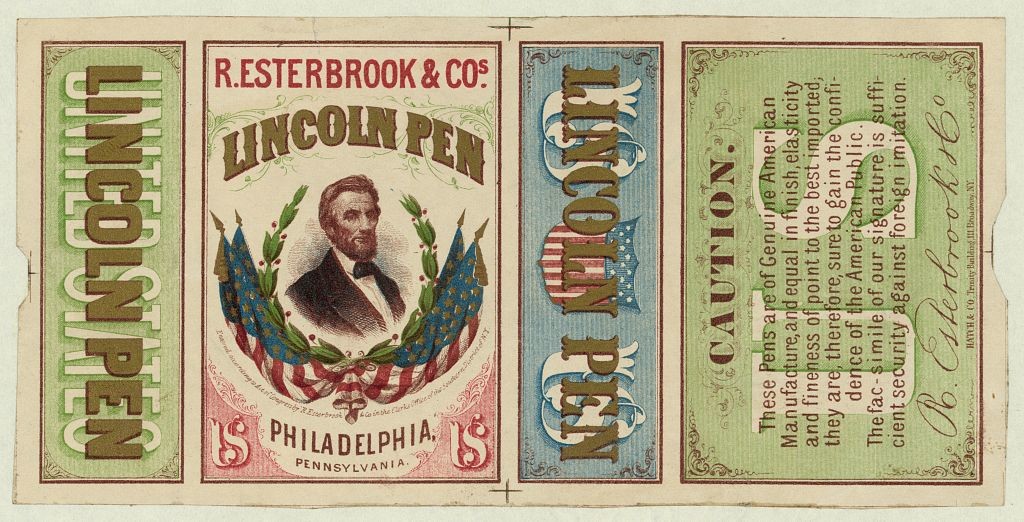
R. Esterbrook & Cos. Lincoln Pen, Philadelphia, Pennsylvania  (LOC: http://www.loc.gov/item/2009630145/)

made in America

Bancroft73

Bancroft74

Bancroft75

Bancroft75

[Abraham Lincoln] (1890; LOC: http://www.loc.gov/item/2009630138/)

“honestest” Abe remebered “by all the peoples of the world”, including the Brits

Posted in 150 Years Ago This Week, Aftermath, American Culture, Postbellum Society | Tagged , , | Leave a comment

tailor retailored?

NY Times February 8, 1866

NY Times February 8, 1866

In February 1866 a Convention of Colored Men met in Washington, D.C. to protest the South’s Black Codes[1]. On February 7th a delegation of participants met with President Johnson.

From The Struggle between President Johnson and Congress over Reconstruction by Charles Ernest Chadsey:

On February 7, 1866, a delegation of colored representatives from fifteen States and the District of Columbia called upon President Johnson in order to present their wishes concerning the granting of suffrage to their race. Geo. T. Downing and Frederick Douglass acted as spokesmen. In reply, President Johnson described his sacrifices for the colored man, and went on to express his indignation at being arraigned by incompetent persons. Although he was willing to be the colored man’s Moses, he was not willing “to adopt a policy which he believed would only result in the sacrifice of his [the colored man’s] life and the shedding of his blood.” The war was not waged for the suppression of slavery; “the abolition of slavery has come as an incident to the suppression of a great rebellion—as an incident, and as an incident we should give it the proper direction.” He went on to state that the negro was unprepared for the ballot, and that there was a danger of a race war. The States must decide for themselves on the question of the franchise. “Each community is better prepared to determine the depository of its political power than anybody else, and it is for the legislature * * * to say who shall vote, and not for the Congress of the United States.”[97] [Edward McPherson, History of the Reconstruction, 52-56]

This plain statement of his opposition to negro suffrage greatly added to Johnson’s unpopularity. This was not due to the fact that his views on that subject had not been made public before, for he never had tried to conceal his attitude towards any of the questions before the people. But the attitude of the people themselves had greatly changed since the ill treatment of the freedmen and the objectionable legislation of the Southern States had been placed vividly before the public through the newspapers. The sentiment in favor of the extension of the franchise had rapidly gained strength; and the attitude of the President, made conspicuous anew by his almost harsh reply to so prominent a delegation representing such a wide extent of territory, called forth much hostile criticism, which, added to the vigorous letter published by the delegation in reply to the President, aided in unifying the opposition to him.

According to William S. McFeely, George T. Downing told the president that black people “should be given the vote ‘with which to save ourselves.'” President Johnson became angry and stated that if blacks were allowed to vote there would be a race war between poor whites and poor blacks. President Johnson stated that the majority will should prevail in each state. Mr. Downing said that blacks were the majority in South Carolina. To the president’s suggestion that the freed slaves emigrate, Frederick Douglass

countered with a suggestion that struck at the heart of all that was tragic in Andrew Johnson – and in his South – saying that if poor black people and poor white people were given the vote, they would unite to achieve the justice denied them by the rich. Johnson, once an indentured servant learning the craft of tailoring, had himself smarted under such denial of justice, but he was not going to have a former slave tell him so. He had been willing to advocate black rights during the war as a way to affront rich Confederates of western Tennessee; he could not take the next step – a step back, the tailor thought – and stand equal with the caulker, achieving true democracy. The meeting ended, according to Douglass, “not without courtesy,” but with nothing more.[2]

  1. [1]McFeely, William S. Frederick Douglass. New York: W. W. Norton & Company, 1991. Print. page 247.
  2. [2]ibid. pages247-248.
Posted in 150 Years Ago This Week, Aftermath, Reconstruction | Tagged , , , , , | Leave a comment

“power to enslave”

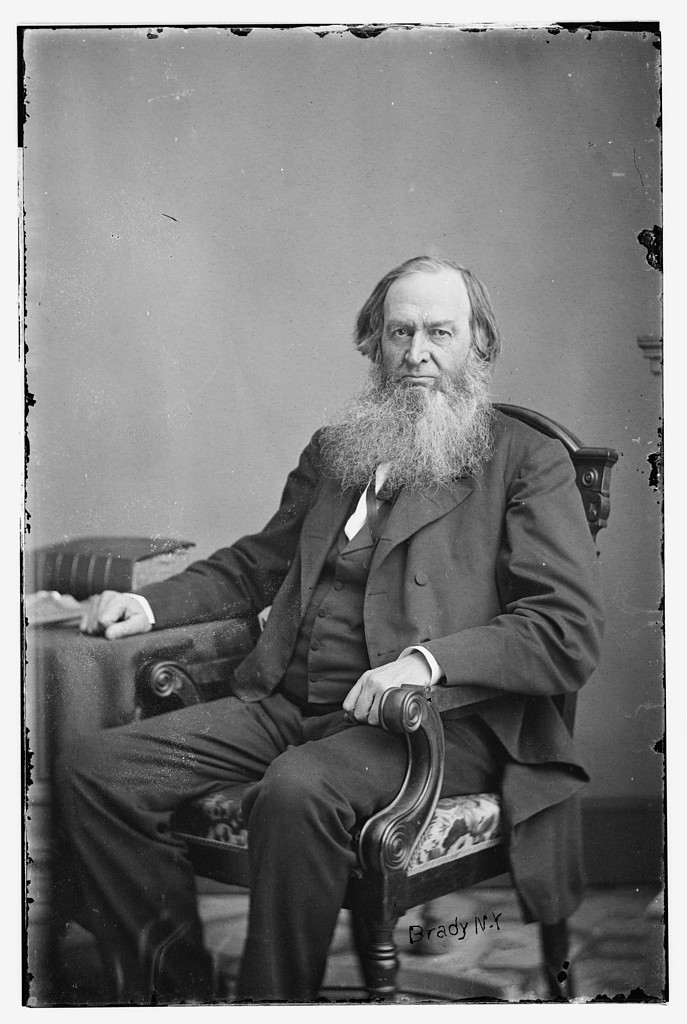
Hon. Gerrit Smith of N.Y. (between 1855 and 1865; LOC: http://www.loc.gov/pictures/item/brh2003004625/PP/)

freedom meaningless without political power

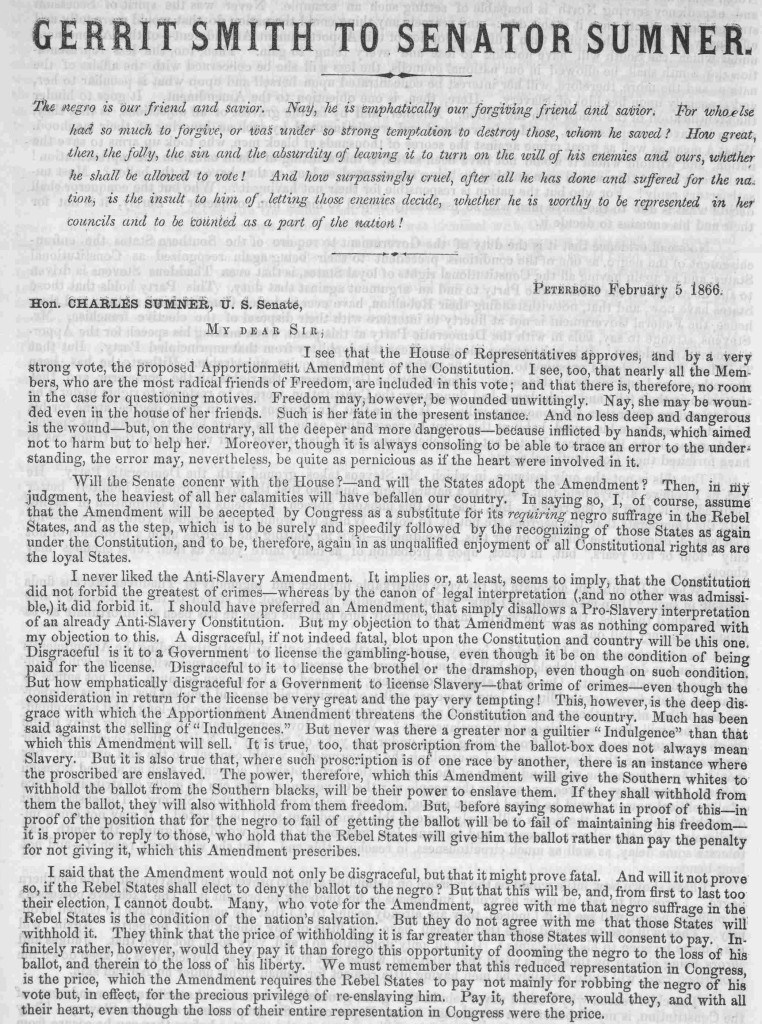
In early 1866 Congress debated a proposed Constitutional amendment that that would change the apportionment of representatives to Congress. According to the February 1, 1866 issue of The New-York Times the text read:

ARTICLE – . Representatives and direct taxes shall be apportioned among the several States which may be included within this Union according to their respective numbers, counting the whole number of persons within each State, excluding Indians not taxed: Provided, that when the elective franchise shall be denied or abridged in any State on account of race or color, all persons of such race or color shall be excluded from the basis of representation.

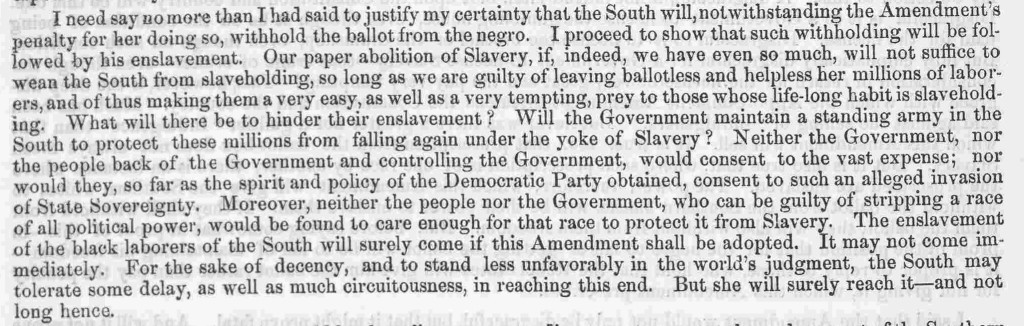
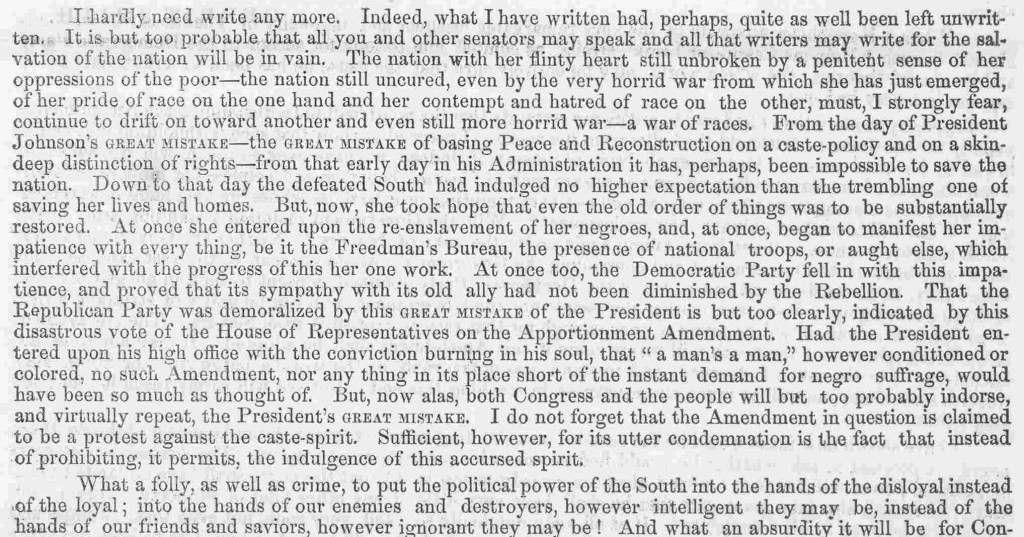
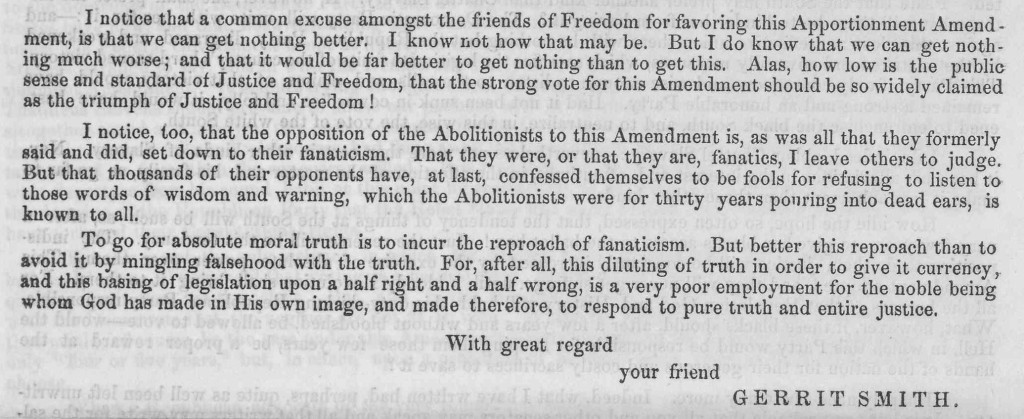
The proposal would explicitly void the Constitution’s language that counted slaves as three-fifths of a person for determining apportionment and tried to influence Southern states to allow freedmen to vote. 150 years ago today abolitionist Gerrit Smith wrote Senator Charles Sumner that he was opposed to the “Apportionment Amendment” because it did not explicitly enfranchise all black men. It was a long letter. Here are a few cuttings:

1GSmith2-5-1866

don’t trust the rebels

2GSmith2-5-1866

ballotless = helpless

3GSmith2-5-1866

“President Johnson’s GREAT MISTAKE”

4GSmith2-5-1866

don’t dilute the truth

It looks like this proposed amendment became the basis for Section 2
of the Fourteenth Amendment, which explicitly applied only to males.

The Gerrit Smith Estate is a national Historic Landmark in Peterboro, New York, where you can also visit the The National Abolition Hall of Fame and Museum

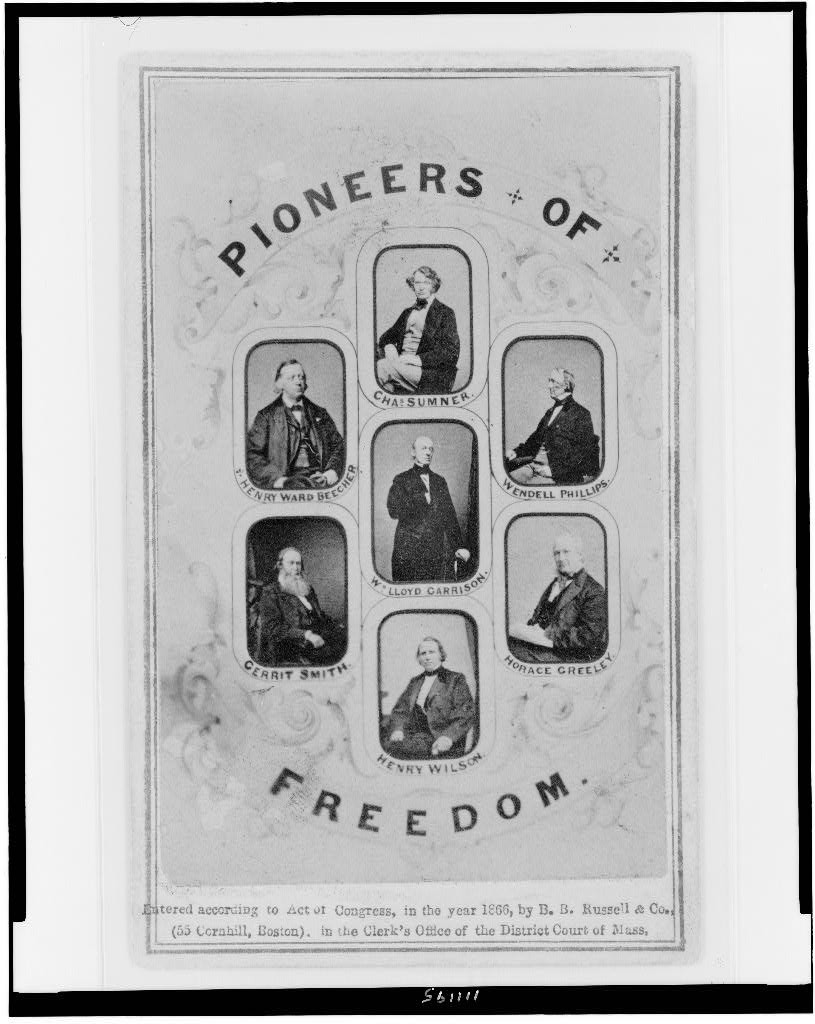
Pioneers of freedom (1866; LOC: http://www.loc.gov/item/94507586/)

a pioneer from Peterboro (1866, Library of Congress)

You can read Gerrit Smith’s entire letter at the Library of Congress
Posted in 150 Years Ago This Week, Aftermath, Reconstruction | Tagged , , , , , , | Leave a comment

misguided tour?

In a review of a Northern periodical the Richmond Daily Dispatch of December 23, 1865 said visiting yankees ought to be wary of trusting too much in their tour guides:

Periodicals.

–The January number of the Atlantic Monthly is upon our table. This is one of the most pretentious, as it is the ablest, of the Northern monthlies. It is the representative of Boston literary taste and talent. Typographically, it is the very neatest, and is from the publishing house of Ticknor & Fields. Of course it partakes of the anti-Southern sentiment, which predominates in the American Athens, and can hardly do justice to the South in any matter relating to National politics. In other respects it is entertaining even here, and maintains a most respectable position in the world of Literature.

Wilderness map (LOC: http://www.loc.gov/item/99446368/)

The Wilderness

The present number of the Atlantic offers an inviting bill of fare. One of its articles is a sketch of the battle-field of the Wilderness. The writer was aided in his survey of it by one Elijah, whose poor horse and buggy transported the two from Fredericksburg to the field. The traveler makes an entertaining sketch of the journey. In his statement about the scene of battle, he puts great faith in the stories of his guide, who had been recommended to him as one familiar with the locality. And this reminds us of a story — a true one–which should warn sensation-seekers in battle-fields not to believe every thing that guides tell them. This story is as follows:

A Confederate General recently met an Irishman who had served gallantly under him in the war. He was seated on the box of a hack, wielding the whip over a pair of horses that had not been over-fed. Hailing him, and interchanging expressions of mutual satisfaction at meeting, the General inquired: “And how are you getting along, Pat?”

“Finely, General,” said he. “I took to this business immediately [ after ] the evacuation, and I have made twenty dollars a day by visiting the battle-fields. You know, General, I know nothing about them, yet I take travelers to them, and talk as if I know’d everything. I took a party of Bostonians the other day to the Sivin Pines, and showed the hottest part of the fight. I saw a pile of bones in the midst of it that belonged to some animal or other, and pointing to them, said: “There lay the bones of the vilest rebel Gineral that fell in the fight. You think, Gineral, they didn’t believe it, and each of them put a piece of the bones in his carpet-bag to take home wid him?”

Well, to sensation-hunters and writers it matters very little whether they get the truth or not. The fiction is better than fact, if the fiction is the more startling of the two. So we commend Pat to all of this class — he will be sure to give them capital for a thrilling narrative. …

Much of the Atlantic article is a description of the journey from Fredericksburg to the Wilderness battlefield. Even the Yankee author knew he had to take his guide’s information with a grain of salt. Elijah got McLaws confused with Magruder. (page 41). As the duo neared the Wilderness the author reflected on General Grant’s approach to the battles against General Lee’s army in the spring of 1864:

… The Battle of Bull Run in 1861, Pope’s campaign, and Burnside’s defeat at Fredericksburg in 1862, and, lastly, Hooker’s unsuccessful attempt at Chancellorsville in the spring of 1863, had shown how hard a road to Richmond this was to travel. Repeatedly, as we tried it and failed, the hopes of the Confederacy rose exultant; the heart of the North sank as often, heavy with despair. McClellan’s Peninsular route had resulted still more fatally. We all remember the anguish and anxiety of those days. But the heart of the North shook off its despair, listened to no timid counsels; it was growing fierce and obdurate. We no longer received the news of defeat with cries of dismay, with teeth close-set, a smile upon the quivering lips, and a burning fire within. Had the Rebels triumphed again? Then so much the worse for them! Had we been once more repulsed with slaughter from their strong line of defences? Was the precious blood poured out before them all in vain? At last it should not be in vain! Though it should cost a new thirty years’ war and a generation of lives, the red work we had begun must be completed; ultimate failure was impossible, ultimate triumph certain.

[Gen. Ulysses S. Grant in military uniform] / M.B. Brady & Co. National Photographic Portrait Galleries, No. 352 Pennsylvania Av., Washington, D.C. & New York. (1865; LOC: http://www.loc.gov/item/2013648326/)

no hesitating, no higgling

This inflexible spirit found it embodiment in the leader of the final campaigns against the Rebel capital. It was the deep spirit of humanity itself, ready to make the richest sacrifices, calm, determined, inexorable, moving steadily towards the great object to be achieved. It has been said that General Grant did not consider the lives of his men. Then the people did not consider them. But the truth lies here: precious as were those lives, something lay beyond far more precious, and they were the needful price paid for it. We had learned the dread price, we had duly weighed the worth of the object to be purchased: what, then, was the use of hesitating and higgling?

We were approaching the scene of Grant’s first great blow aimed at the gates of the Rebel capital. On the field of Chancellorsville you already tread the borders of the field of the Wilderness,—if that can be called a field which is a mere interminable forest, slashed here and there with roads.

Passing straight along the plank road, we came to a large farm-house, which had been gutted by soldiers, and but recently reoccupied. It was still in a scarcely habitable condition. However, we managed to obtain, what we stood greatly in need of, a cup of cold water. I observed that it tasted strongly of iron.

“The reason of that is, we took twelve camp-kettles out of the well,” said the man of the house, “and nobody knows how many more there are down there.”

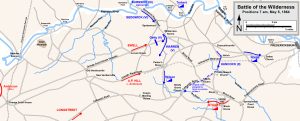
Wilderness_May5_0700 (https://en.wikipedia.org/wiki/File:Wilderness_May5_0700.png)

into the wilderness (Locust Grove in center)

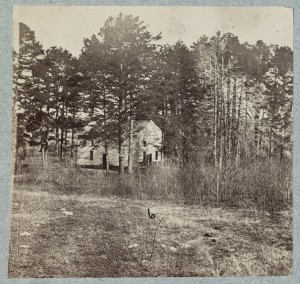
The place is known as Locust Grove. In the edge of the forest, but a little farther on, is the Wilderness Church,—a square framed building, which showed marks of such usage as every uninhabited house receives at the hands of a wild soldiery. Red Mars has little respect for the temples of the Prince of Peace.

“Many a time have I been to meet’n’ in that shell, and sot on hard benches, and heard long sermons!” said Elijah. “But I reckon it’ll be a long while befo’e them doo’s are darkened by a congregation ag’in. Thar a’n’t the population through hyer thar used to be. Oncet we’d have met a hundred wagons on this road go’n’ to market; but I count we ha’n’t met mo’e ‘n a dozen to-day.”

Wilderness Church (LOC: http://www.loc.gov/item/2012646926/)

“Wilderness Church ” (Library of Congress)

Not far beyond the church we approached two tall guide-posts erected where the road forks. The one on the right pointed the way to the “Wilderness National Cemetery, No. 1, 4 miles,” by the Orange Court-House turnpike. The other indicated the “Wilderness National Cemetery, No. 2,” by the plank road.

“All this has been done since I was this way,” said Elijah.

We kept the plank road,—or rather the clay road beside it, which stretched before us dim in the hollows, and red as brick on the hillsides. We passed some old fields, and entered the great Wilderness,—a high and dry country, thickly overgrown with dwarfish timber, chiefly scrub oaks, pines, and cedars. Poles lashed to trees for tent-supports indicated where our regiments had encamped; and soon we came upon abundant evidences of a great battle. Heavy breastworks thrown up on Brock’s cross-road, planks from the plank road piled up and lashed against trees in the woods, to form a shelter for our pickets, knapsacks, haversacks, pieces of clothing, fragments of harness, tin plates, canteens, some pierced with balls, fragments of shells, with here and there a round-shot, or a shell unexploded, straps, buckles, cartridge-boxes, socks, old shoes, rotting letters, desolate tracts of perforated and broken trees,—all these signs, and others sadder still, remained to tell their silent story of the great fight of the Wilderness.

A cloud passed over the sun: all the scene became sombre, and hushed with a strange brooding stillness, broken only by the noise of twigs crackling under my feet, and distant growls of thunder. A shadow fell upon my heart also, as from the wing of the Death-Angel, as I wandered through the woods, meditating upon what I saw. Where were the feet that wore those empty shoes? Where was he whose proud waist was buckled in that belt? Some soldier’s heart was made happy by that poor, soiled, tattered, illegible letter, which rain and mildew have not spared; some mother’s, sister’s, wife’s, or sweetheart’s hand, doubtless, penned it; it is the broken end of a thread which unwinds a whole life-history, could we but follow it rightly. Where is that soldier now? Did he fall in the fight, and does his home know him no more? Has the poor wife or stricken mother wailed long for the answer to that letter, which never came, and will never come? And this cap, cut in two by a shot, and stiff with a strange incrustation,—a small cap, a mere boy’s, it seems,—where now the fair head and wavy hair that wore it? O mother and sisters at home, do you still mourn for your drummer-boy? Has the story reached you,—how he went into the fight to carry off his wounded comrades, and so lost his life for their sakes?—for so I imagine the tale which will never be told.

And what more appalling spectacle is this? In the cover of thick woods, the unburied remains of two soldiers,—two skeletons side by side, two skulls almost touching each other, like the cheeks of sleepers! I came upon them unawares as I picked my way among the scrub oaks. I knew that scores of such sights could be seen here a few weeks before; but the United States Government had sent to have its unburied dead collected together in the two national cemeteries of the Wilderness; and I had hoped the work was faithfully done.

“They was No’th-Carolinians; that’s why they didn’t bury ’em,” said Elijah, after a careful examination of the buttons fallen from the rotted clothing.

The ground where they lay had been fought over repeatedly, and the dead of both sides had fallen there. The buttons may, therefore, have told a true story: North-Carolinians they may have been: yet I could not believe that the true reason why they had not been decently interred. It must have been that these bodies, and others we found afterwards, were overlooked by the party sent to construct the cemeteries. It was shameful negligence, to say the least.

The cemetery was near by,—a little clearing in the woods by the roadside, thirty yards square, surrounded by a picket-fence, and comprising seventy trenches, each containing the remains of I know not how many dead. Each trench was marked with a headboard, inscribed with the invariable words,—

“Unknown United States soldiers, killed May, 1864.”

Elijah, to whom I read the Inscription, said, pertinently, that the words, United States soldiers indicated plainly that it had not been the intention to bury Rebels there. No doubt: but these might at least have been buried in the woods where they fell.

As a grim sarcasm on this neglect, somebody had flung three human skulls, picked up in the woods, over the paling, into the cemetery, where they lay blanching among the graves.

Close by the southeast corner of the fence were three or four Rebel graves, with old headboards. Elijah called my attention to them, and wished me to read what the headboards said. The main fact indicated was, that those buried there were North-Carolinians. Elijah considered this somehow corroborative of his theory derived from the buttons. The graves were shallow, and the settling of the earth over the bodies had left the feet of one of the poor fellows sticking out.

The shadows which darkened the woods, and the ominous thunder-growls, culminated in a shower. Elijah crawled under his wagon; I sought the shelter of a tree: the horse champed his fodder, and we ate our luncheon. How quietly upon the leaves, how softly upon the graves of the cemetery, fell the perpendicular rain! The clouds parted, and a burst of sunlight smote the Wilderness; the rain still poured, but every drop was illumined, and I seemed standing in a shower of silver meteors.

The rain over and luncheon finished, I looked about for some solace to my palate after the dry sandwiches, moistened only by the drippings from the tree,—seeking a dessert in the Wilderness. Summer grapes hung their just ripened clusters from the vine-laden saplings, and the chincapin bushes were starred with opening burrs. I followed a woodland path, embowered with the glistening boughs, and plucked, and ate, and mused. The ground was level, and singularly free from the accumulations of twigs, branches, and old leaves, with which forests usually abound. I noticed, however, many charred sticks and half-burnt roots and logs. Then the terrible recollection overtook me: these were the woods that were on fire during the battle. I called Elijah.

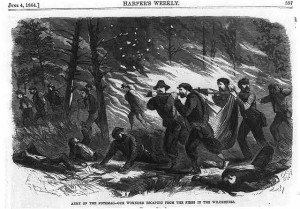
Army of the Potomac - Our wounded escaping from the fires in the Wilderness (LOC: http://www.loc.gov/item/2002736804/)

“Army of the Potomac – Our wounded escaping from the fires in the Wilderness ” Library of Congress”

“Yes, all this was a flame of fire while the fight was go’n’ on. It was full of dead and wounded men. Cook and Stevens, farmers over hyer, men I know, heard the screams of the poor fellahs burnin’ up, and come and dragged many a one out of the fire, and laid ’em in the road.”

The woods were full of Rebel graves, with here and there a heap of half-covered bones, where several of the dead had been hurriedly buried together.

I had seen enough. We returned to the cemetery. Elijah hitched up his horse, and we drove back along the plank road, cheered by a rainbow which spanned the Wilderness and moved its bright arch onward over Chancellorsville towards Fredericksburg, brightening and fading, and brightening still again, like the hope which gladdened the nation’s eye after Grant’s victory.

Hal Jespersen’s map of the battle is licensed by Creative Commons
Posted in 150 Years Ago This Month, Aftermath, Battlefields | Tagged , | Leave a comment

oysters for the vet

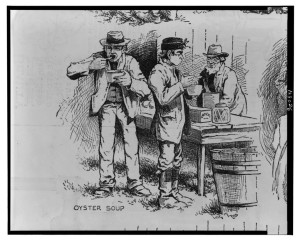
Oyster soup / drawn by H.M. Wilder ; sketch by B. McCord. ( Illus. in: Harper's weekly, v. 31, no. 1588 (1887 May 28), p. 389; LOC: http://www.loc.gov/item/2001695513/)

good in soup, too

Even Sumpter will rouse himself for a delicious meal. Also, the following reminded me of local charity dinners nowadays.

From a Seneca County, New York newspaper in (probably) January 1866:

DONATION TO A SOLDIER. – A donation and oyster supper will be given at the house of Darrow lay, (Trexler’s old stand) about two miles north of this village [Seneca Falls], on Thursday evening of next week, for the benefit of Chauncey. T. Lay, a disabled soldier.

Mr. Lay entered the service in 1864, having enlisted in the 50th Engineer regiment, but was soon prostrated by disease which resulted in partially paralyzing both limbs, from the effects of which he has never wholly recovered. He is almost entirely unable to earn a livelihood for himself and family in consequence of his long sickness. He is a worthy man and should receive a generous response from his friends and neighbors on this occasion.

50th Engr. Lay

disease disabled Mr. Lay

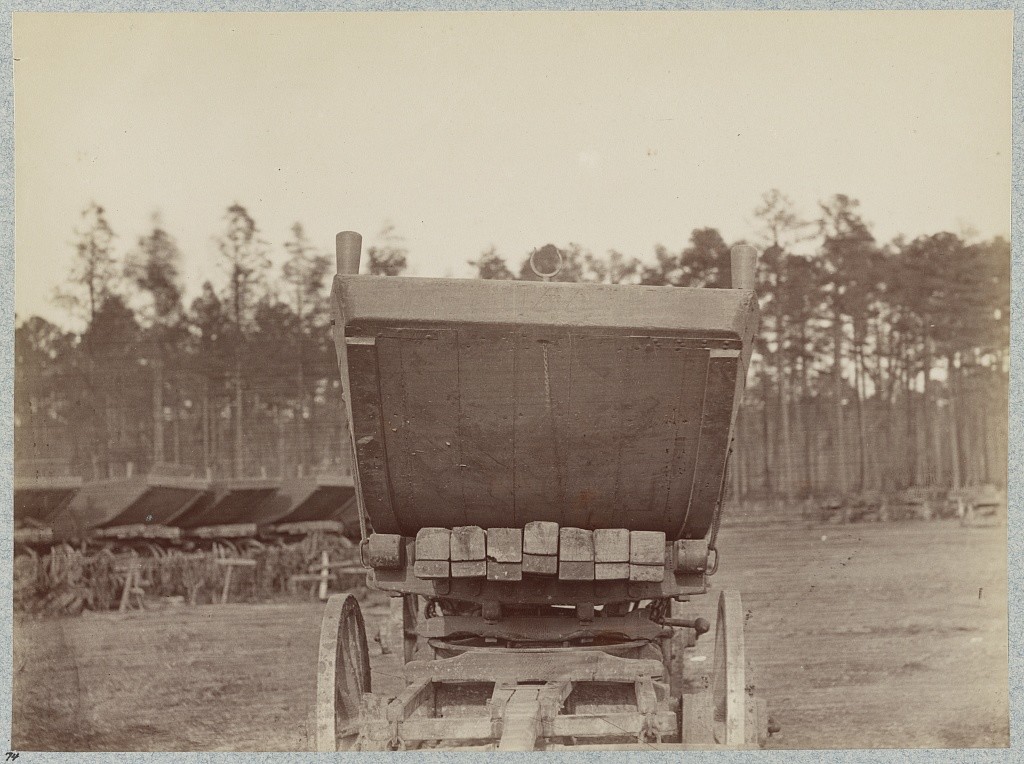
Pontoon wagon and boat, 50th New York Engineers, Rappahannock Station, Va., March, 1864 (LOC: http://www.loc.gov/item/2012649812/)

“Pontoon wagon and boat, 50th New York Engineers, Rappahannock Station, Va., March, 1864 ” (Library of Congress)

The handwriting on the clipping might possibly say June instead of Jan 1866, but I’m plenty hungry enough now. Mr. Lay’s bio can be found in the 50th Engineers roster at the New York State Military Museum. The Library of Congress served the oyster soup. – and Timothy H. O’Sullivan’s photograph of pontoon wagon and boat.
Posted in 150 Years Ago This Month, Aftermath, Veterans | Tagged , , | Leave a comment