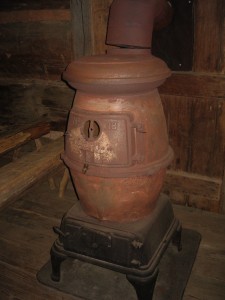
hot stove

PotbellyStove (https://en.wikipedia.org/wiki/Hot_stove_league#/media/File:PotbellyStove.jpg)

come and listen to a story about a man named Zip

I embrace hibernation. Reconstruction lacks the excitement of the combined naval-infantry assault on Fort Fisher (already a year ago), and it’s harder to find material. I might be historied out, but lying dormant for a bit sure seems good to me. As a matter of fact, since it is said to be about 15° F. with wind outside, this morning might not be a bad time to find a hot stove and talk some baseball.

Last week I was reading a pretty local newspaper (the paper version, of course) and noticed the following in an article by Dennis Randall that featured Weedsport, New York historical trivia:

I have to stop sometime, so I’ll wind up with the fact that Harry “Zip” Northrop played with the Weedsport Watsons baseball team for several years before joining the Cuban Giants. Mr. Northrop was of the same family that inspired the book and movie “12 Years a Slave.” We have a depiction of him in our museum, with him dressed in his trademark red and blue (one of each) stockings. He said he did that so everyone would know which player he was — never mind the fact that he was the only black player on the team, and one of only very few playing organized baseball at that time.

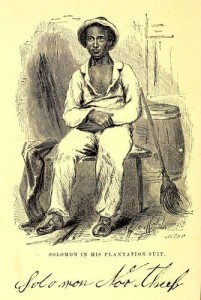
i002 (http://www.gutenberg.org/files/45631/45631-h/45631-h.htm#img002)

Zip’s grandfather – from the book

You can read much more about Harry “Zip” Northrop at Agate Type. The digital version of the Weedsport article includes a link to information about 12 Years a Slave, the movie about Solomon Northup, Zip’s grandfather. The movie was based on Solomon’s account, which you can read at Project Gutenberg

Mr. Randall also wrote about a couple famous businessmen:

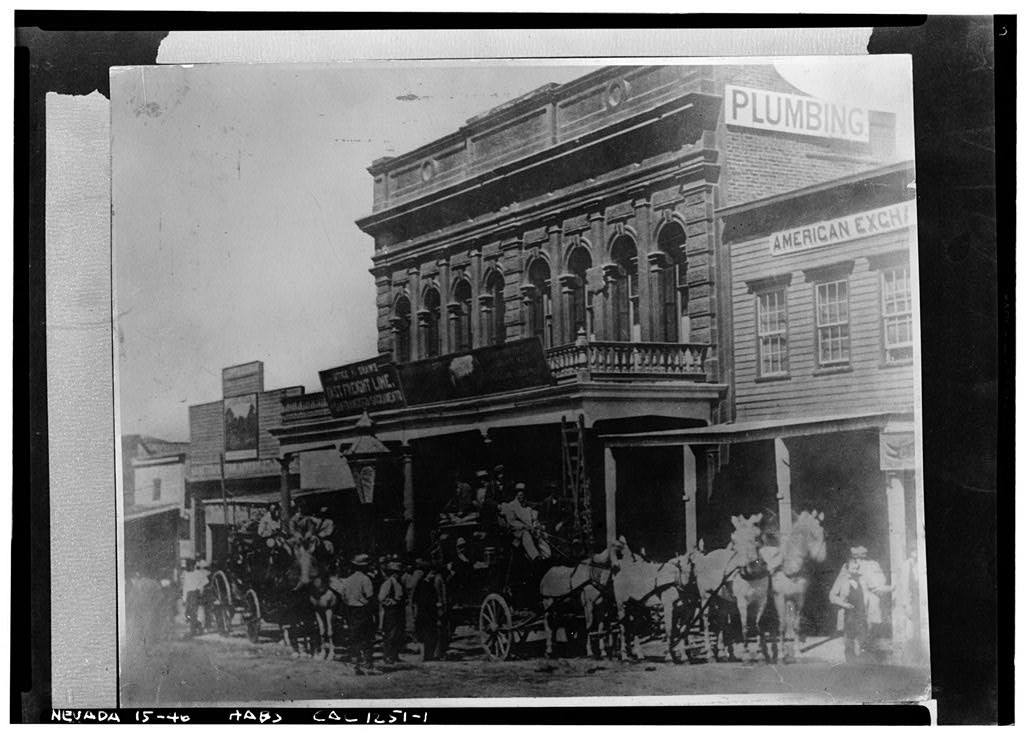
When the Auburn & Syracuse Railroad began business in 1839, William G. Fargo, of Weedsport, became the first freight agent. He would later team up with Henry Wells, of Port Byron, to form the famous Wells-Fargo Co.

I mention this because the same newspaper I looked at last week had an article from Mike Riley of the Port Byron Historical Society. Port Byron was the next port west of Weedsport on the original and Old Erie Canal. Mr. Riley was concerned about falling younger membership in his organization:

I can tell you that the future looks bleak as our membership ages, and I wonder what will happen to our history as people are not replaced. Do kids still go into college to study history? If so, why are they not seeking out local historic societies and museums to get some good hands-on experience? Do our educators even suggest this?

We can see by the numbers of “likes” and views on Facebook and blogs that people really enjoy seeing history, and we know that genealogy is a growing hobby, so why don’t people want to help save their community history? Understanding your family history is great, but being able to place their history within the context of local and national history really helps to complete the story.

Wells Fargo Building, C Street, Virginia City, Storey County, NV (c.1866; LOC: http://www.loc.gov/item/nv0009/)

“Wells Fargo Building, C Street, Virginia City, Storey County, NV ” Library of Congress)

I’m a long way from the younger generation; there’s a lot to be said for hibernation; but I think maybe I could at least observing some history while I’m still breathing.

i_107_large (http://www.gutenberg.org/files/41008/41008-h/41008-h.htm#Page_107)

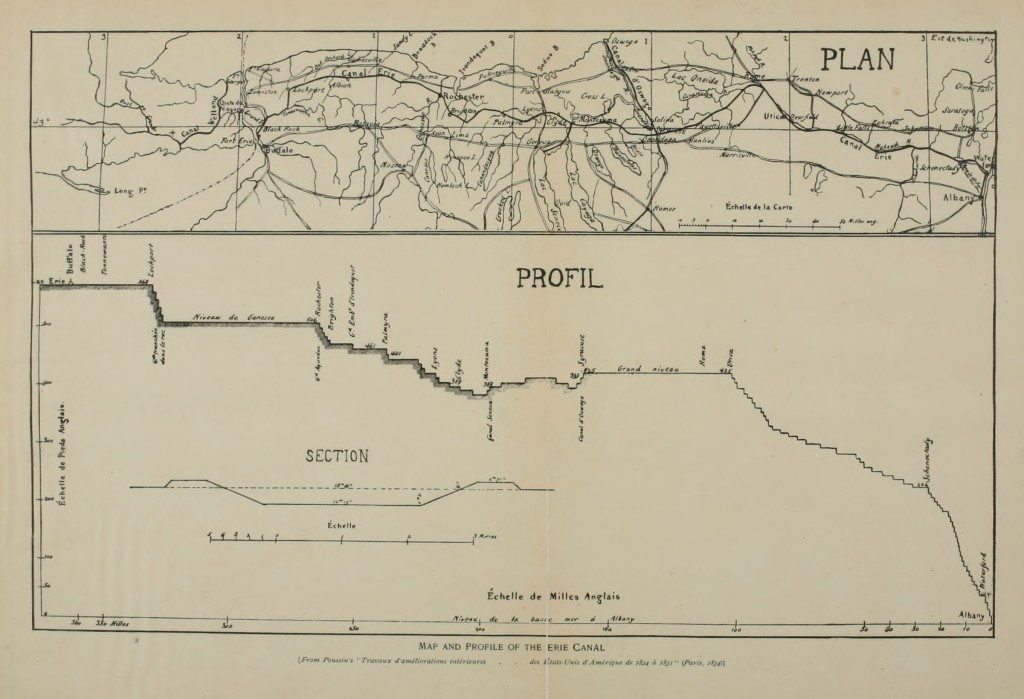
Port Byron and then Weedsport just to the east of Montezuma

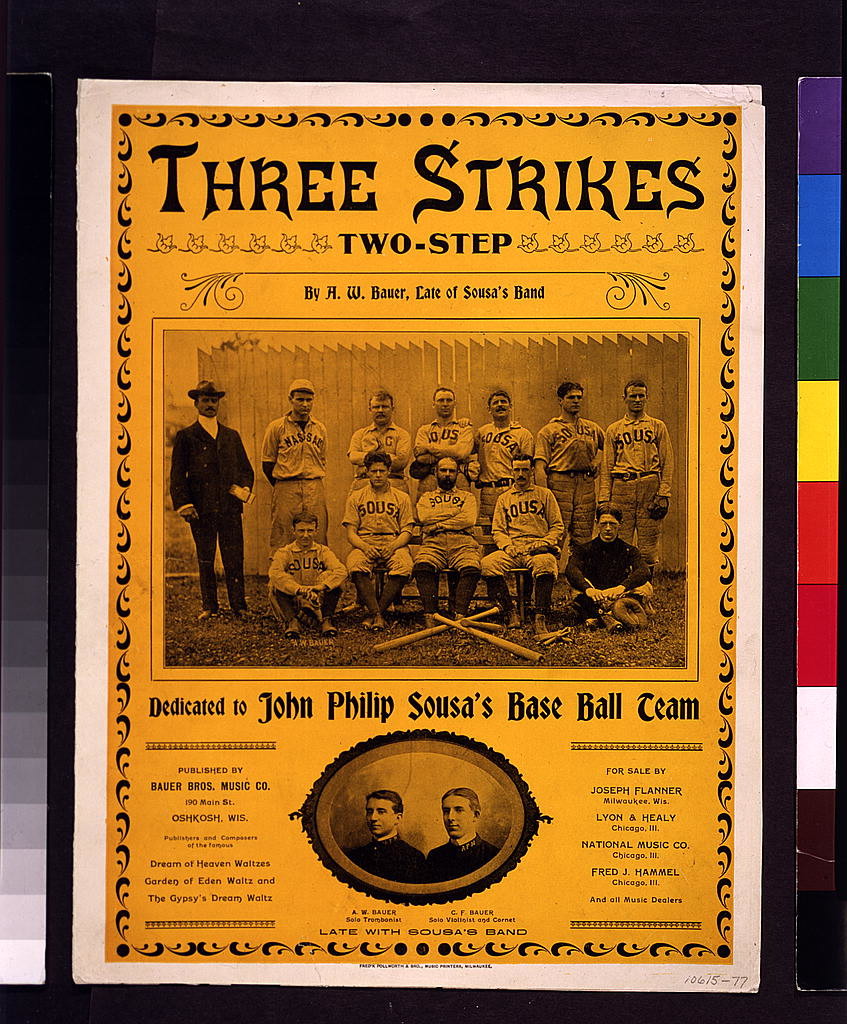
Three strikes two-step, by A.W. Bauer, late of Sousa's band--Dedicated to John Philip Sousa's baseball team / Fred'k Pollworth & Bro., music printers, Milwaukee.  (LOC: http://www.loc.gov/item/95505022/)

these gentlemen might have needed the different colored stockings

____________________________________________________
____________________________________________________

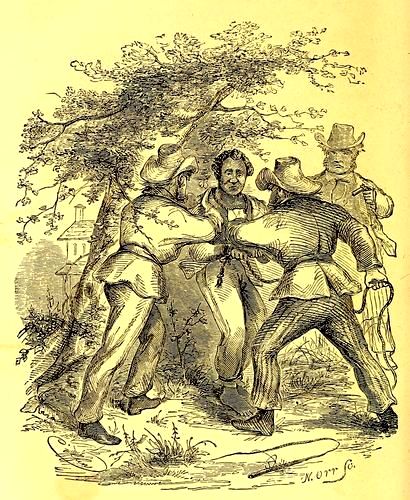
i122 (http://www.gutenberg.org/files/45631/45631-h/45631-h.htm#img122)

“CHAPIN RESCUES SOLOMON FROM HANGING.”from Twelve Years a Slave

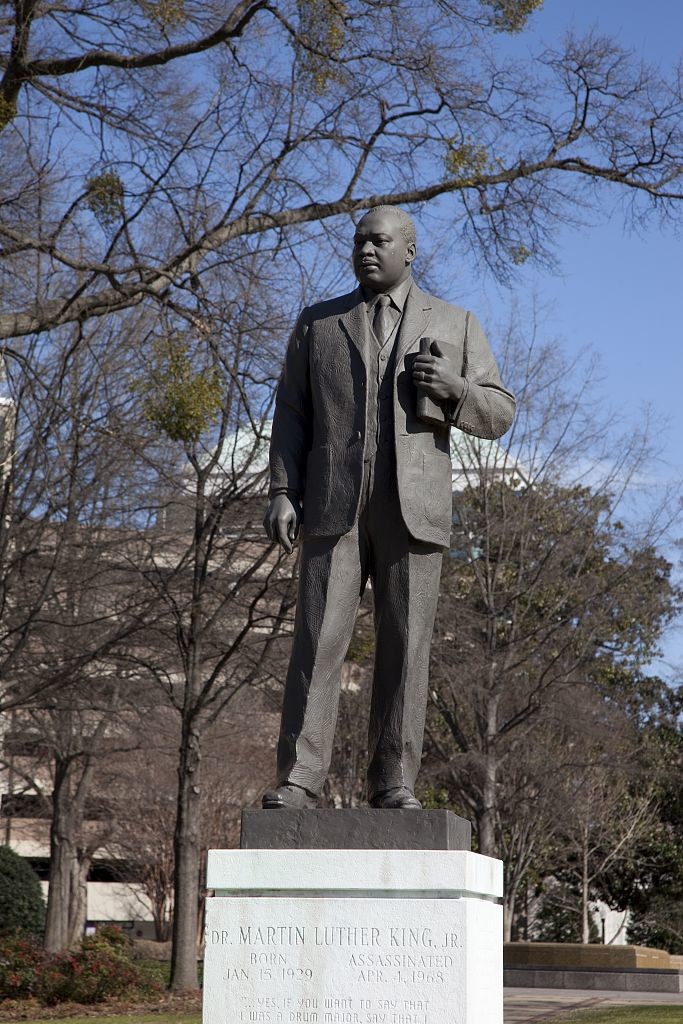
“… hate destroys the hater as well as the hated.” – Martin Luther King, Jr.

Statue of Dr. Martin Luther King, Jr., in the Kelly Ingram Park, Birmingham, Alabama (by Carol M. Highsmith; LOC: http://www.loc.gov/item/2010636932/)

“Statue of Dr. Martin Luther King, Jr., in the Kelly Ingram Park, Birmingham, Alabama ” (Library of Congress)

Posted in American Culture, American History, American Society | Tagged , , , , , , , | Leave a comment

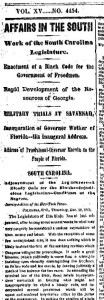
“the Government of Freedmen.”

NY Times January 4, 1866

NY Times January 4, 1866

150 years ago this week New Yorkers could read about South Carolina’s enactment of a Black Code for the governance of freedmen. Eric Foner summarizes the code, which:

contained provisions, such as prohibiting the expulsion of aged freedmen from plantations, designed to reinvigorate paternalism and clothe it with the force of law. It did not forbid blacks to rent land, but barred them from following any occupation other than farmer or servant except by paying an annual tax from $10 to $100 (a severe blow to the free black community of Charleston and to former slave artisans). The law required blacks to sign annual contracts and included elaborate provisions regulating relations between “servants” and their “masters,” including labor from sunup to sundown and a ban on leaving the plantation, or entertaining guests upon it, without permission of the employer. A vagrancy law applied to unemployed blacks, “persons who lead idle or disorderly lives,” and even traveling circuses, fortune tellers, and thespians.[1]

“[T]he most flagrant provisions of the Black Coded never went into effect.”General Dan Sickles, head of the Freedmen’s Bureau in South Carolina, suspended South Carolina’s code, apparently by the end of 1865.[2]

Reportedly, a border state enforced a black code as early as 1864. From the Richmond Daily Dispatch July 24 1864:

Black Codes in slave and Fare [Free] States.

The New York Commercial says:

A few days ago a colored clergyman from Canada, Mr. Kinnard, attended the Methodist Conference of colored ministers at Philadelphia. Mr. Kinnard was born in Delaware, and after the conference visited his old home. At Camden he was arrested under the black code of Delaware, and was fined fifty dollars and costs for coming into the State.–In default of ability to pay the fine he was sold, and was purchased by the brother of the man who emancipated him. He released him, and gave a bond that Mr. Kinnard should leave the State at once. Mr. Kinnard then went to Washington and sought redress, as a British subject, from Lord Lyons. The case is very properly regarded as an illustration of the infamous crimes against human rights and personal liberty of which slavery is capable.

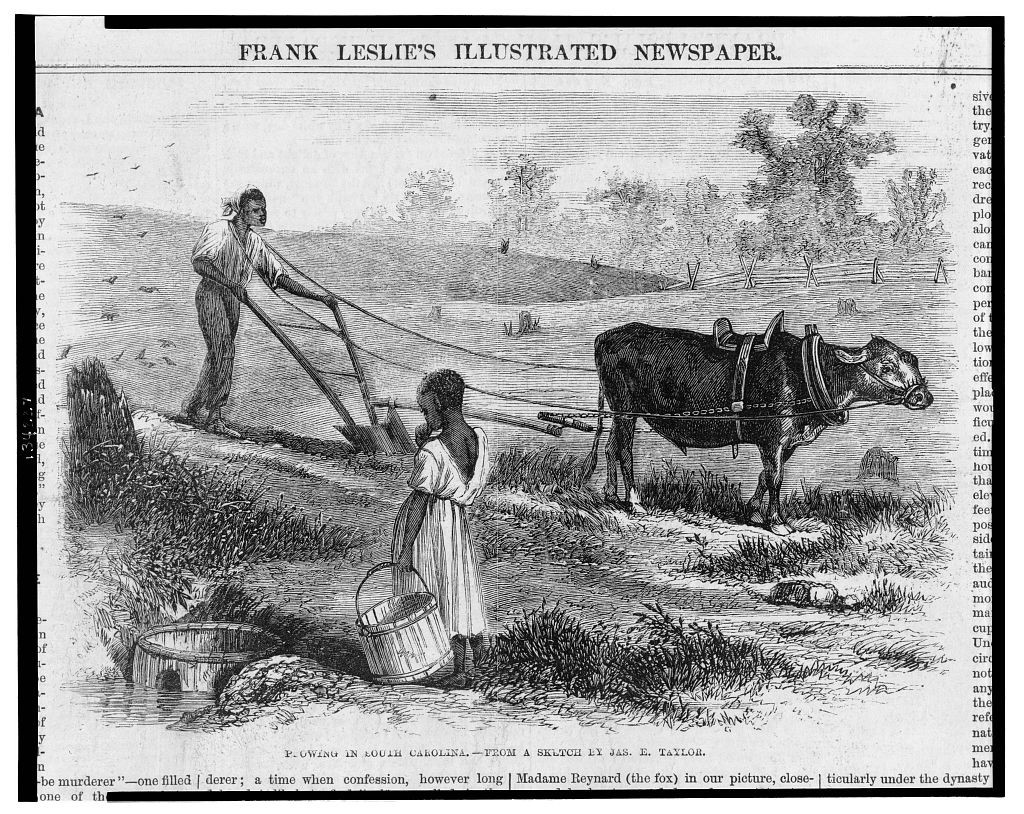
Plowing in South Carolina / from a sketch by Jas. E. Taylor. ( Illus. in: Frank Leslie's illustrated newspaper, v. 23, no. 577 (1866 October 20), p. 76. ; LOC: http://www.loc.gov/item/2004669782/)

no fee to farm

The image of “Plowing in South Carolina” was published in Frank Leslie’s illustrated newspaper, v. 23, no. 577 (1866 October 20), p. 76. and can be found at the Library of Congress
  1. [1]Foner, Eric. Reconstruction: America’s Unfinished Revolution, 1863-1877. New York: HarperPerennial, 2014. Updated Edition. Print. page 200.
  2. [2]ibid. page 208-209 and Wikipedia link
Posted in 150 Years Ago This Week, Aftermath, Postbellum Society, Reconstruction, Southern Society | Tagged , , , , , | Leave a comment

new year mystery

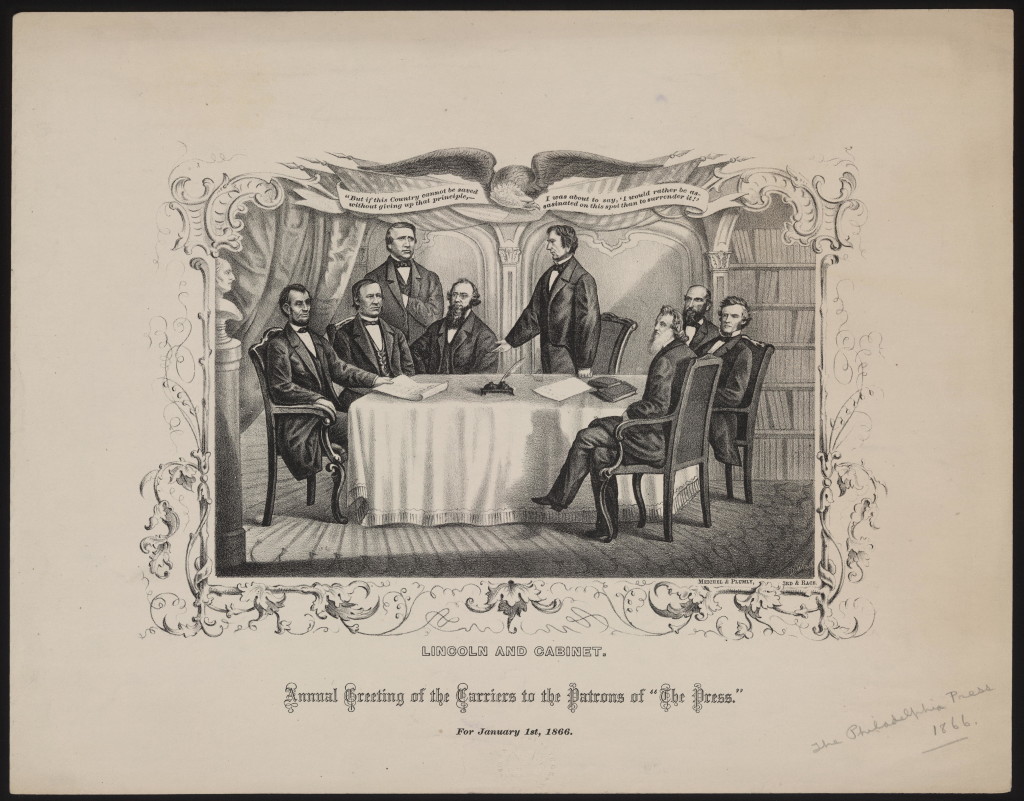
Lincoln and cabinet. Annual greeting of the carriers to the patrons of "The Press." For January 1st, 1866. (LOC: http://www.loc.gov/item/scsm000760/)

“Lincoln and cabinet. Annual greeting of the carriers to the patrons of “The Press.” For January 1st, 1866. ” (Library of Congress)

This cartoon recalls President- elect Lincoln’s address at Philadelphia’s Independence Hall on February 22, 1861, but you could look at it in a Janus-like way. Mr. Lincoln was assassinated in 1865 because of his principles. Looking ahead he is certainly an American icon and represents the supremacy of the federal government over the states. He had the will to keep the Union united and would do whatever he could to further that cause.

You can check out this image at the Library of Congress
Posted in 150 Years Ago This Week, Aftermath | Tagged , | Leave a comment

work on

Thankfully the American Civil War ended in 1865. Apparently the federal government felt it could let down its defenses a bit on the nation’s northeast corner. From the Richmond Daily Dispatch December 30, 1865:

The coast batteries in Maine dismantled.

Belfast, Me., December27.

–Under the supervision of Major Gardner, United States army, the batteries in this city and at other points on the coast of Maine are being dismantled. The guns have been carried to Fort Knox.

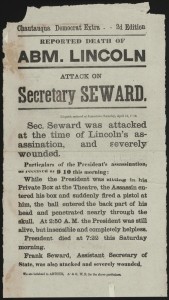
Reported death of Abm. Lincoln. Attack on Secretary Seward. (LOC: http://www.loc.gov/item/scsm000517/)

Chautauqua Democrat Extra, April 15, 1865 (Library of Congress)

Thankfully the war ended in 1865, but Secretary of State William H. Seward endured a devastating year:

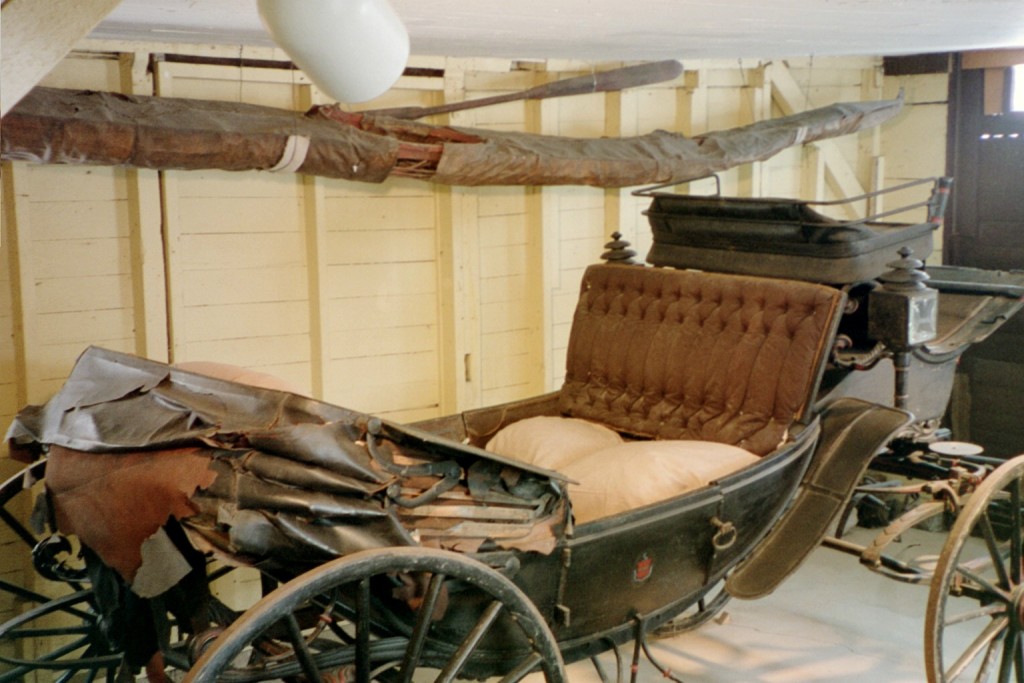
Seward was tested in 1865 as few men are ever tested: by the carriage accident, by the attack of the assassin, by the near death of his son Frederick, by the death of his good friend and leader Lincoln, and then by the death of his wife Frances [on June 21st]. Although he attended church regularly, he was not an especially religious man, and it does not seem that that he found much solace in religion in this hour of trial. He seems instead to have found comfort in his work, to which he returned as soon as possible after his own injuries and his wife’s funeral. …[1]

SewardCarriage (https://en.wikipedia.org/wiki/File:SewardCarriage.JPG)

Seward’s bad 1865 started with a carriage accident

_____________________________________________
_____________________________________________

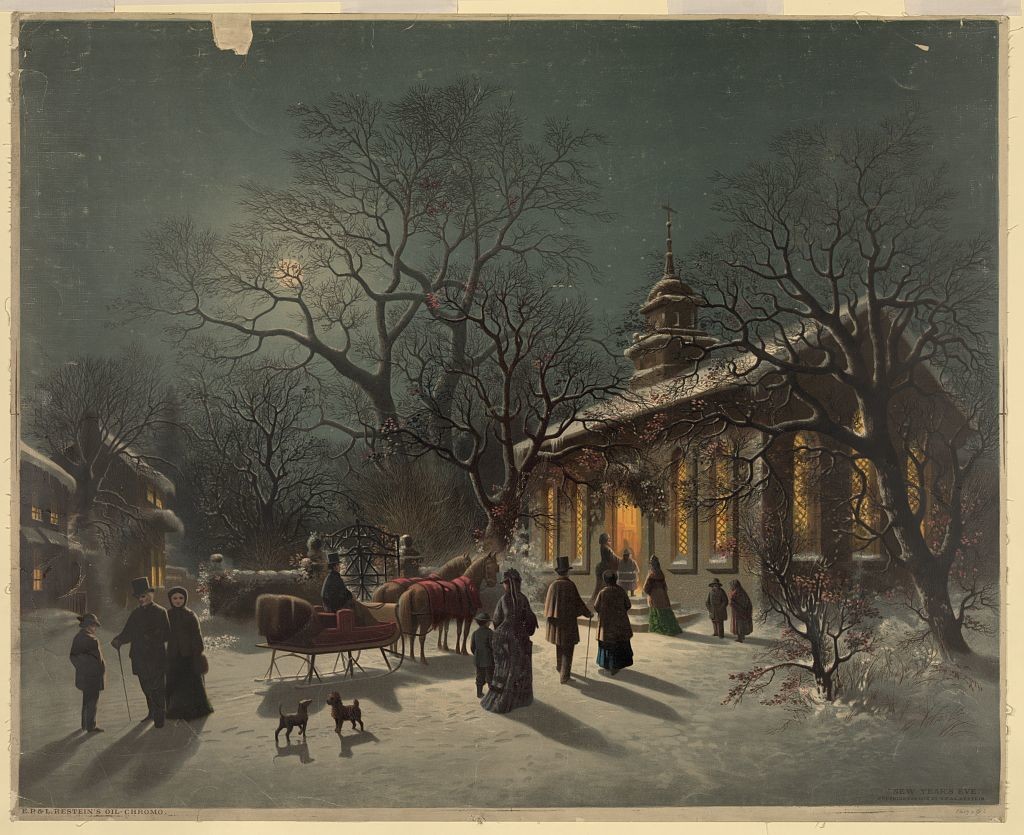
New Year's Eve (c.1876; LOC: http://www.loc.gov/item/2003677747/)

“New Year’s Eve ” (c1876, Library of Congress)

The image of the carriage is licensed by Creative Commons. According to the Wikipedia article about the William H. Seward House Museum: “This carriage was involved in an accident that severely injured Seward leaving him bed ridden the night Lincoln was shot, when another conspirator attacked Seward with a knife.”
  1. [1]Stahr, Walter Seward: Lincoln’s Indispensable Man. 2012. New York: Simon & Schuster Paperbacks, 2013. Print. page 440.
Posted in 150 Years Ago This Week, Aftermath | Tagged , , , | Leave a comment

Virginia freedmen

From the Richmond Daily Dispatch December 30, 1865:

The freedmen’s Bureau of Virginia.

The reader will find in this morning’s paper the purport of the report of Colonel Brown, Assistant Commissioner of the Freedmen’s Bureau for the State of Virginia, made to his superior, Major-General Howard. It is a remarkable paper. Fair in some things — not at all so in others.

In the preface to the report as to the condition of society in Virginia [this poor society of Virginia is become the subject of a great deal of investigation!] the Colonel, in very strong language, represents the state of the black population, of half a million, as anything but encouraging to those who came here” to provide “for their protection, elevation and government.” “Suddenly freed,” he says, “from the bonds of a rigorous control, acquainted with no law but that of force, ignorant of the elementary principles of civil government, and of the first Duties of Citizenship, without any provision for the future wants of themselves and families, and entertaining many false and extravagant notions in respect to the intentions of the Government towards them.” [For which latter, according to GeneralGrant, we are in a great degree indebted to the Freedmen’s Bureau and its agents!]

This is a very strong statement of the condition of the blacks when they fell into the hands of the Bureau. It is too highly colored even to be just to them; for they were acquainted with other influences than force. They were familiar with kindness and the stimulant afforded by persuasion, gentle usage, abundant food and clothing, and even generous rewards for good conduct. They knew as much of all the humane stimulants to good conduct and faithfulness as any laborers on the face of this earth.

Nor were they so entirely ignorant. But what is proposed as a remedy for these poor beings who are ignorant of the elementary “principles of civil government and the first Duties of Citizenship?” Why, to confer upon them the Right of Suffrage! Does Colonel Brown think that would heal them? We imagine not, from the portrait he has drawn.

With reference to the conduct of the citizens towards these unfortunate people, Colonel Brown is not just. He transposes his paragraphs — makes the majority a minority, and inputs to the majority the conduct and policy of the minority. He states, with rather the air of complaint, that the citizens generally afforded no assistance in meeting the “difficulties” presented by the negro. Yet he answers his own complaint by confessing immediately afterwards, that, being “stripped, to a great extent, of their resources by the operations of the war, they were unable to allow these people their just dues, much less any charitable assistance.”–Had he made the expression stronger — had he stated that the people were stripped of nearly everything: all their money; all their valuables; their horses and cattle; nearly all their provisions; and had not enough to supply their own wants, to relieve their own sufferings, he would not have exceeded the fact. Yet, these people must have assisted the blacks. For how else did they live? They did not, it is true, assist those who rushed to the camps and the cities. They became a burthen to the Government and the objects of the protecting care of the Bureau.–But those that remained in the country, and assisted to cultivate the farms and to produce something to keep themselves as well as others from starving, enjoyed with the owners a part of the scant supplies left by the war in the country.

The meetings alluded to by Colonel Brown, fixing rates and making pledges about renting lands to freedmen, must have been few indeed. We never heard of more than, probably, two, possibly three, and those only small neighborhood affairs. Whatever was the policy, the people of Virginia are in no wise responsible for it.

Colonel Brown truly describes the conduct of the people of Virginia when he speaks of a “numerically small” class, who “not only accepted the situation, but, with a wise foresight and a noble patriotism, were ready to co-operate with the Government for the speediest restoration of tranquillity and law.” This was the majority–not a “numerically small” class. Colonel Brown either speaks from prejudice, or he has not had the opportunity of seeing the people and judging them fairly. We know nothing of Colonel Brown whatever, and do not presume that he would wailfully misrepresent this people. –But unintentionally, we suppose, he has done injustice to them.

The people of Virginia have as much kind feeling for their late slaves as any other people in the United States–not even excepting that unparalleled race of philanthropists who live east of the Hudson river; and any representation of facts which is inconsistent with this, is both unjust and untrue. The people of this State know the negro better than any other — they know his capacity and his wants, and can now take care of him better, and settle him down in his new relation with as much consideration for his welfare, and more forecast and judgement than any of those persons in other States who are making him their everlasting topic — and the everlasting cause of accusation and vituperation of the people of the South. When is this sort of warfare to cease? Are we never to have rest? Is it not enough that the slave, originally imported by Northern men in Northern ships and sold to the South, is set free? Is it not enough that we, submitting to results, are struggling in earnestness and sincerity, as well as in poverty, to restore plenty and order to the land — that order and plenty without which there is no rest, no satisfaction, no support for white or black? Is it not enough that we submit to the Constitution and the laws, and have solemnly and irrevocably abolished slavery and involuntary servitude from the land? Will not all this do? And must we still be assailed — our peace and quiet, and the safety and order of the country, disturbed by this execrable crusade? What do the people who are enlisted in it desire to do? Do they wish to continue the breach between the sections? Do they wish to perpetuate hate?

We trust and believe that the better judgement of the majority will soon put an end to this state of things. We even hope that the men who control the Freedmen’s Bureau will, through their intercourse with the South, become liberalized and enlightened on the policy that is best for the negro and best for the country. Let them but emulate the unprejudiced judgment, the fair and earnest disposition, of General Grant, and they will honor themselves and truly subserve the peace and welfare of our country.

Posted in 150 Years Ago This Week, Aftermath, Postbellum Society, Reconstruction, Southern Society | Tagged , , , , | Leave a comment

“a dirty Yankee trick”

From the Richmond Daily Dispatch December 30, 1865:

Arrival of Captain Semmes.

Washington, December29.

–Captain Semmes arrived here last night by the train from New York, in charge of a guard of United States Marines, and was at once taken to the navy-yard, where he was placed, temporarily, in a room hastily fitted up in the dispensary building, where a guard was placed over him. Semmes was arrested at his residence, about four miles from Mobile, on the 15th instant, on an order from the Navy Department. He expressed great astonishment, and claimed that the arrest was in violation of his parole. His daughter was violently bitter, and said it was a dirty Yankee trick to arrest her father. He was given until twelve o’clock next day to arrange his family matters; after which he was brought away. On the passage from Mobile to New York he was quite cheerful, expressing his readiness to stand trial, and his belief that the arrest was entirely illegal.

Posted in 150 Years Ago This Week, Aftermath, Postbellum Politics, Postbellum Society, Reconstruction | Tagged , , | Leave a comment

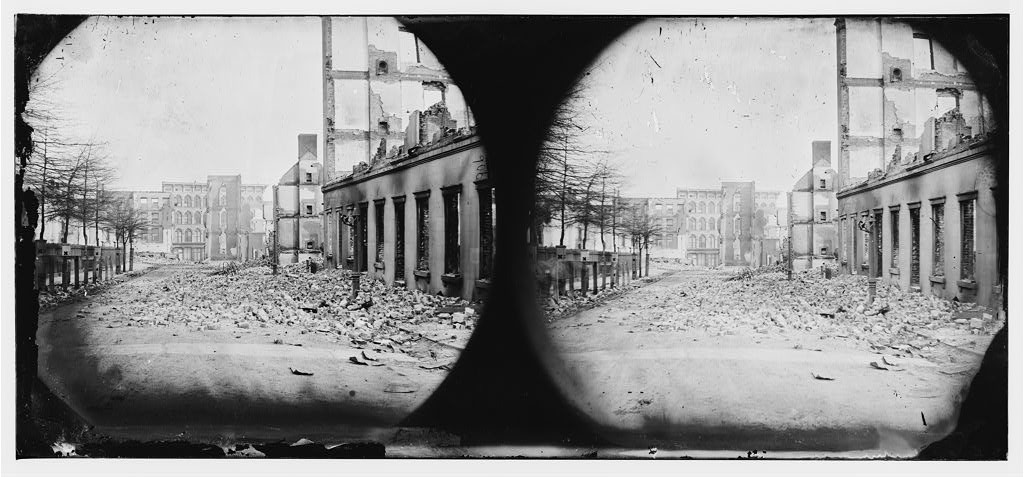
tidings: dreadful … and glad?

Richmond, Virginia. Burnt district  (1865; LOC: http://www.loc.gov/item/cwp2003005698/PP/)

“Richmond, Virginia. Burnt district ” (Library of Congress)

From the Richmond Daily Dispatch December 25, 1865:

Christmas.

Merry Christmas polka  (1882; LOC: http://www.loc.gov/item/sm1882.20715/)

just another song and dance?

It would seem a remorseless piece of irony to extend to our people the usual greeting of “A Merry Christmas.” In the midst of a land desolated by the iron foot-prints of war, with half a million of their best and bravest sleeping in bloody graves, with a funeral pall hanging in every house where the Christmas garlands once were wreathed, with universal poverty in the place of universal plenty, and dark and threatening clouds still brooding over their future, it seems like the utterance of heartless sarcasm to exclaim, “A Merry Christmas.”

Yet, it was in the moral midnight of the world that the Christmas star first rose. It was upon an altar whose prestige had departed, that its mild lustre first fell, illuminating it with a glory such as the first temple had never known. It was amid the jarring discords of political and civil strife that those melodies of Heaven first broke upon the a[ir]–“Peace on earth, good will among men.”

Richmond, Virginia. Almshouse (1865; LOC: http://www.loc.gov/item/cwp2003005601/PP/)

“Richmond, Virginia. Almshouse” (Library of Congress)

Our modern mode of celebrating this great Christian Anniversary may be incongruous and inconsistent in times like these; but Christmas, in its true method of observance, is the very festival for periods of darkness and tribulation. It brings its gold and frankincense and myrrh not to kings in their purple, but to poverty in its lowliest estate. It converts the stable into a palace and the manger into a throne. It leads us to the feet of Him who came to “visit us in great humility,” who rejoiced in the companionship of the sorrowful and meek, whose miracles were performed not only to attest his mission, but to relieve human afflictions, and who will come again, in glorious majesty, to reward suffering virtue and to vindicate the ways of Go[d] to man.

I[f], then, we are not able to celebrate this anniversary with the exuberant joyousness of former years, it may, at least, bring us consolation in our sadness; it may teach us the lessons of charity and praise which the hosts of Heaven chanted over the cradle of the Son of God; it may inspire us with hope of a day when the sword shall be beaten into a plough share and nations shall not learn war any more; and it may admonish those whose habitations yet echo with the voices of joy and gladness to arrest the melodies of their mirth till they have heard and stilled the wintry wails of poverty and sorrow at their doors.

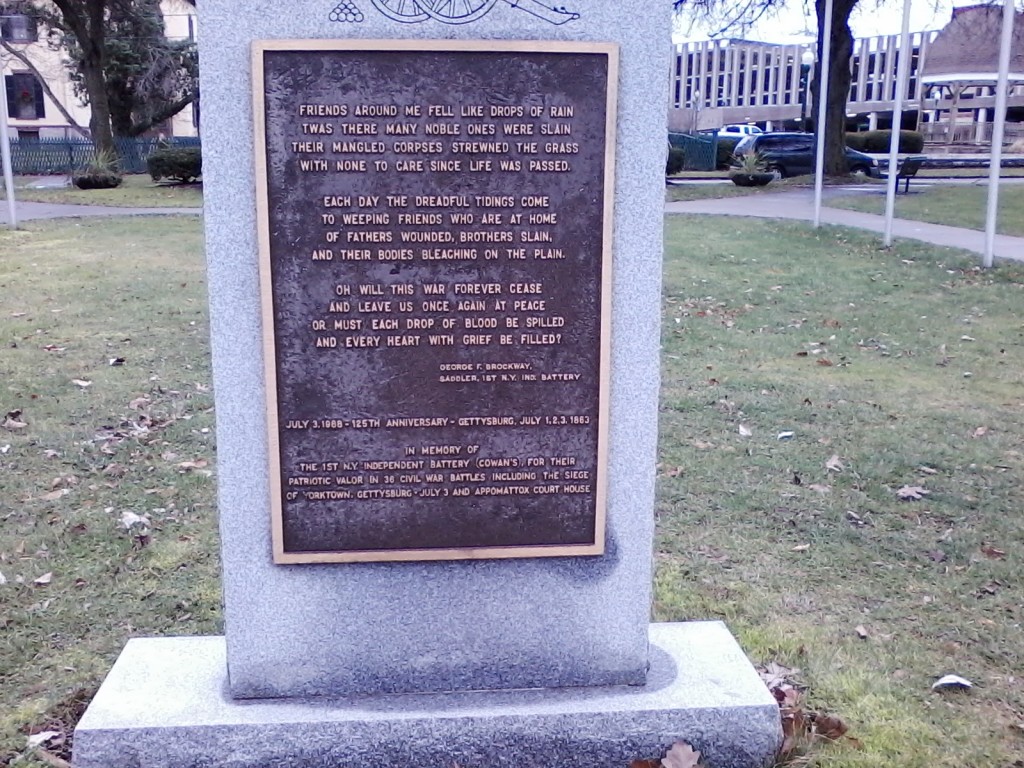
A Northern soldier also experienced the “iron foot-prints of war” first hand and longed for peace:

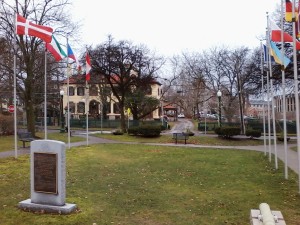
Veterans Memorial Park Auburn NY (December 23, 2015

“dreadful tidings”

More images from the Veterans Memorial Park in Auburn NY:

Veterans Memorial Park, Auburn NY (December 23, 2015)

Seward House in the background

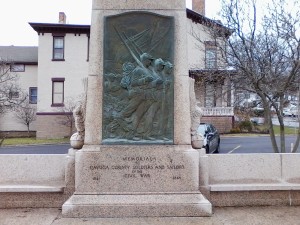
Veterans Memorial Park, Auburn NY (December 23, 2015)

directly opposite the poetic plaque at Auburn, New York’s Veterans Memorial Park

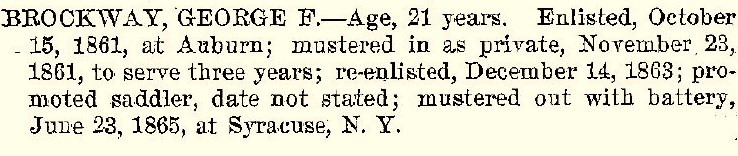
George F. Brockway

three and a half years of it

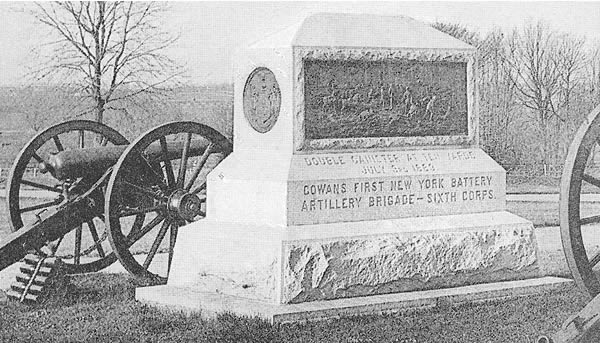
Organized in the fall of 1861 the New York 1st Independent Battery
Light Artillery
served for the duration and was finally mustered out in June 1865. You can also see the unit’s Gettysburg monument at the New York State Military Museum. The accompanying text points at the link out that the battery plugged a whole in the nick of time during Longstreet’s July 3rd assault.

1stIndBatMonument (http://dmna.ny.gov/historic/reghist/civil/artillery/1stIndBat/1stIndBatMonument.htm)

cannon fire in close quarters

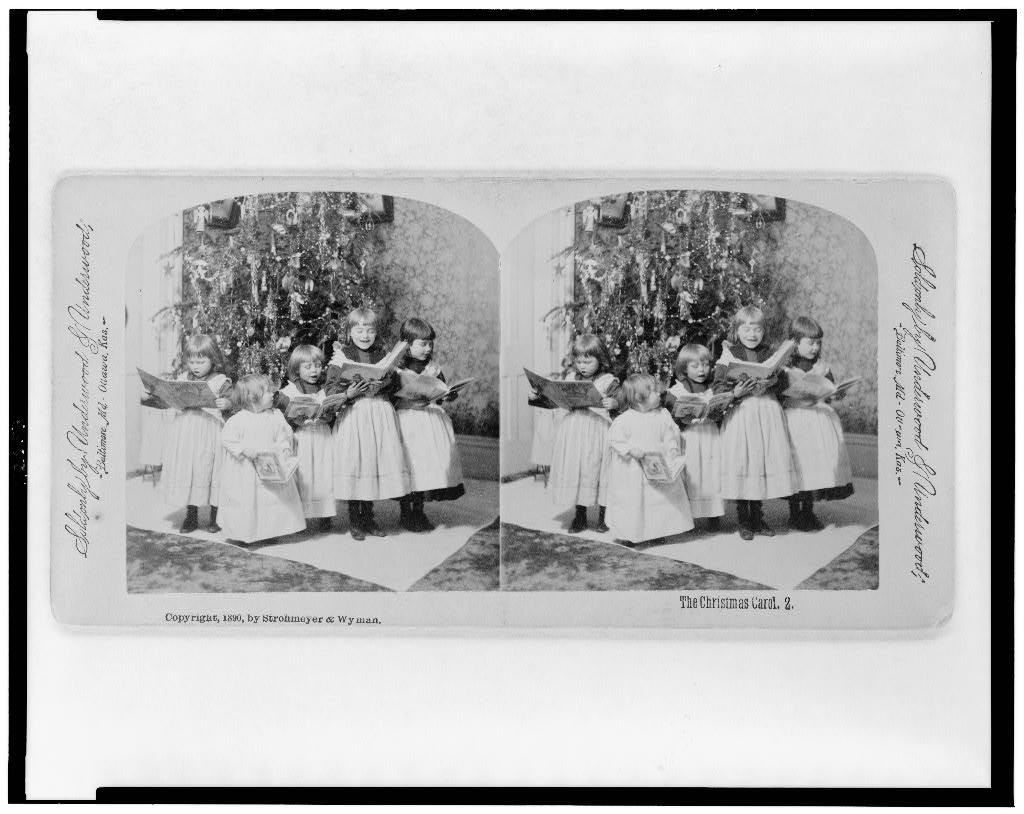
The Christmas carol  (1890; LOC: http://www.loc.gov/item/95502853/)

Merry Christmas anyway!

Posted in 150 Years Ago This Week, Aftermath, Postbellum Society, Reconstruction, Southern Society | Tagged , , , , | Leave a comment

a saint for the impecunious

illo_png8 (http://www.gutenberg.org/files/17382/17382-h/17382-h.htm)

“bounteous, obliging disposition,”

From the Richmond Daily Dispatch December 23, 1865:

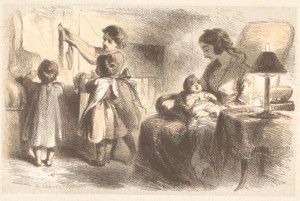
The great problem of Christmas, with all who are not afflicted by the general malady of chronic impecuniousness, is what to buy for a Christmas present. The patron saint, Kriss Kringle, St. Nicholas, or by whatever other name that most charming and amiable of all the saints is known, must find Christmas the most perplexing of all the festivals. We mean no disrespect to the other saints who figure on the church calendar when we bestow upon this one special commendation. But Kriss Kringle or St. Nicholas is the only one of them whose acquaintance we ever made, or who ever visits the earth in a tangible shape. Certainly, if the other canonized persons resemble him in a bounteous, obliging disposition, we should be very glad to be on intimate terms with them all.
illo_png5 (http://www.gutenberg.org/files/17382/17382-h/17382-h.htm)

“an immensity of stockings to be hung “

There are an immensity of stockings to be hung up Sunday night [December 24, 1865], an illimitable forest of Christmas trees to be planted, and innumerable millions of little children whose hearts are beating wildly at this moment with conjectures of Kriss Kringle’s designs with reference to those stockings and trees. We are not more astonished at the sublime unselfishness and inexhaustible resources of Kriss, than his extraordinary ability to surmount the great difficulty of Christmas– what to buy. Somehow or other, he generally does work out that perplexing problem, and generally to the satisfaction of all concerned. What a deal of time he must spend in studying the shop windows and inspecting the bewildering variety of their attractions! Sometimes, when his funds are low, the good saint must be a sad as well as a puzzled saint, yet he never appears to us more amiable than just then.–To see him trudging along, and trying to make some little children happy, but without the means to do it as he would wish, is a sight that must enlist the sympathy of all his brother saints, and, no doubt, will induce them all, one of these days, to open their purse-strings, and make it even with those little children, who seem to be somewhat neglected now.

After all, the best [ Chritmas ] [sic] gift is the love and affection that prompt the outward tokens and impart value to them, if they are ever so cheap and commonplace. But it ought not to be forgotten by those who have the means to give, that there are many habitations in this city in which no stockings can be hung up, no Christmas tress planted, and whose inmates would be only too happy to obtain the bare means of life. There can be no difficulty in solving the question–what Christmas gift to bestow upon them.

The historical Saint Nicholas lived from March 15, 270 – December 6, 343 in modern day Turkey. He is appropriately a patron saint of children, as well as several other groups of people.

From In God’s Garden Stories of the Saints for Little Children by Amy Steedman:

SAINT NICHOLAS
illo_png3 (http://www.gutenberg.org/files/17382/17382-h/17382-h.htm)

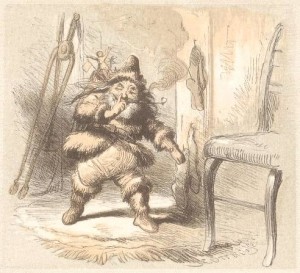
latter day Saint Nicholas

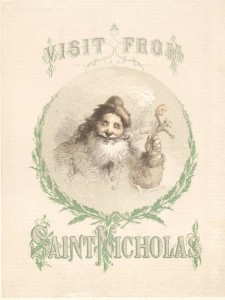
Of all the saints that little children love is there any to compare with Santa Claus? The very sound of his name has magic in it, and calls up visions of well-filled stockings, with the presents we particularly want peeping over the top, or hanging out at the side, too big to go into the largest sock. Besides, there is something so mysterious and exciting about Santa Claus, for no one seems to have ever seen him. But we picture him to ourselves as an old man with a white beard, whose favourite way of coming into our rooms is down the chimney, bringing gifts for the good children and punishments for the bad.

Yet this Santa Claus, in whose name the presents come to us at Christmas time, is a very real saint, and we can learn a great deal about him, only we must remember that his true name is Saint Nicholas. Perhaps the little children, who used to talk of him long ago, found Saint Nicholas too difficult to say, and so called him their dear Santa Claus. But we learn, as we grow older, that Nicholas is his true name, and that he is a real person who lived long years ago, far away in the East.

The father and mother of Nicholas were noble and very rich, but what they wanted most of all was to have a son. They were Christians, so they prayed to God for many years that he would give them their heart’s desire; and when at last Nicholas was born, they were the happiest people in the world.

They thought there was no one like their boy; and indeed he was wiser and better than most children, and never gave them a moment’s trouble. But alas, while he was still a child, a terrible plague swept over the country, and his father and mother died, leaving him quite alone.
451px-Icon_c_1500_St_Nicholas (https://en.wikipedia.org/wiki/File:Icon_c_1500_St_Nicholas.JPG)

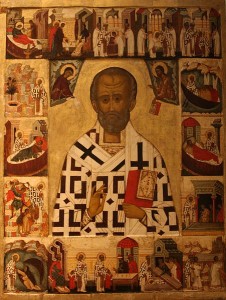
Saint Nicholas as icon

All the great riches which his father had possessed were left to Nicholas, and among other things he inherited three bars of gold. These golden bars were his greatest treasure, and he thought more of them than all the other riches he possessed.

Now in the town where Nicholas lived there dwelt a nobleman with three daughters. They had once been very rich, but great misfortunes had overtaken the father, and now they were all so poor they had scarcely enough to live upon.

At last a day came when there was not even bread enough to eat, and the daughters said to their father:

‘Let us go out into the streets and beg, or do anything to get a little money, that we may not starve.’

But the father answered:

‘Not to-night. I cannot bear to think of it. Wait at least until to-morrow. Something may happen to save my daughters from such disgrace.’

Now, just as they were talking together, Nicholas happened to be passing, and as the window was open he heard all that the poor father said. It seemed terrible to think that a noble family should be so poor and actually in want of bread, and Nicholas tried to plan how it would be possible to help them. He knew they would be much too proud to take money from him, so he had to think of some other way. Then he remembered his golden bars, and that very night he took one of them and went secretly to the nobleman’s house, hoping to give the treasure without letting the father or daughters know who brought it.

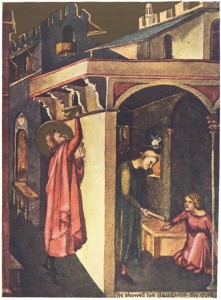
To his joy Nicholas discovered that a little window had been left open, and by standing on tiptoe he could just reach it. So he lifted the golden bar and slipped it through the window, never waiting to hear what became of it, in case any one should see him. (And now do you see the reason why the visits of Santa Claus are so mysterious?)

Inside the house the poor father sat sorrowfully watching, while his children slept. He wondered if there was any hope for them anywhere, and he prayed earnestly that heaven would send help. Suddenly something fell at his feet, and to his amazement and joy, he found it was a bar of pure gold.

‘My child,’ he cried, as he showed his eldest daughter the shining gold, ‘God has heard my prayer and has sent this from heaven. Now we shall have enough and to spare. Call your sisters that we may rejoice together, and I will go instantly and change this treasure.’
Saint Nicholas (http://www.gutenberg.org/files/36674/36674-h/36674-h.htm#page84)

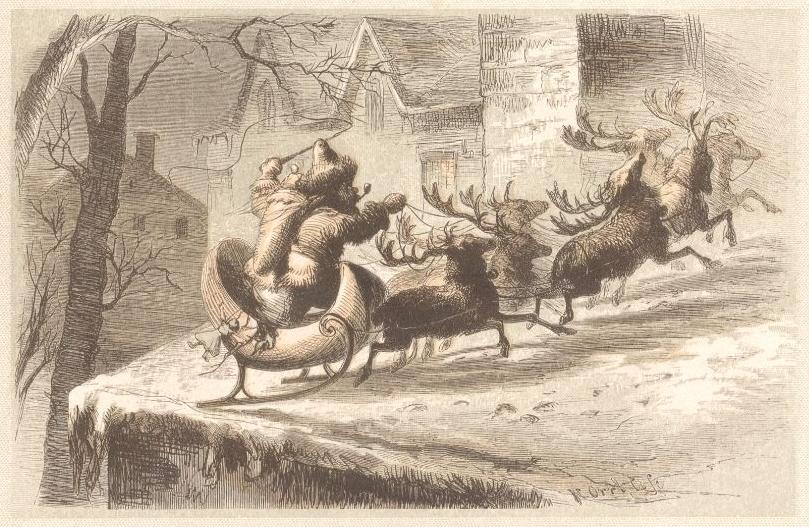
in lieu of a chimney … and flying reindeer

The precious golden bar was soon sold to a money-changer, who gave so much for it that the family were able to live in comfort and have all that they needed. And not only was there enough to live upon, but so much was over that the father gave his eldest daughter a large dowry, and very soon she was happily married.

When Nicholas saw how much happiness his golden bar had brought to the poor nobleman, he determined that the second daughter should have a dowry too. So he went as before and found the little window again open, and was able to throw in the second golden bar as he had done the first. This time the father was dreaming happily, and did not find the treasure until he awoke in the morning. Soon afterwards the second daughter had her dowry and was married too.

The father now began to think that, after all, it was not usual for golden bars to fall from heaven, and he wondered if by any chance human hands had placed them in his room. The more he thought of it the stranger it seemed, and he made up his mind to keep watch every night, in case another golden bar should be sent as a portion for his youngest daughter.

And so when Nicholas went the third time and dropped the last bar through the little window, the father came quickly out, and before Nicholas had time to hide, caught him by his cloak.

‘O Nicholas,’ he cried, ‘is it thou who hast helped us in our need? Why didst thou hide thyself?’ And then he fell on his knees and began to kiss the hands that had helped him so graciously.

But Nicholas bade him stand up and give thanks to God instead; warning him to tell no one the story of the golden bars.

This was only one of the many kind acts Nicholas loved to do, and it was no wonder that he was beloved by all who knew him. …
illo_png7 (http://www.gutenberg.org/files/17382/17382-h/17382-h.htm)

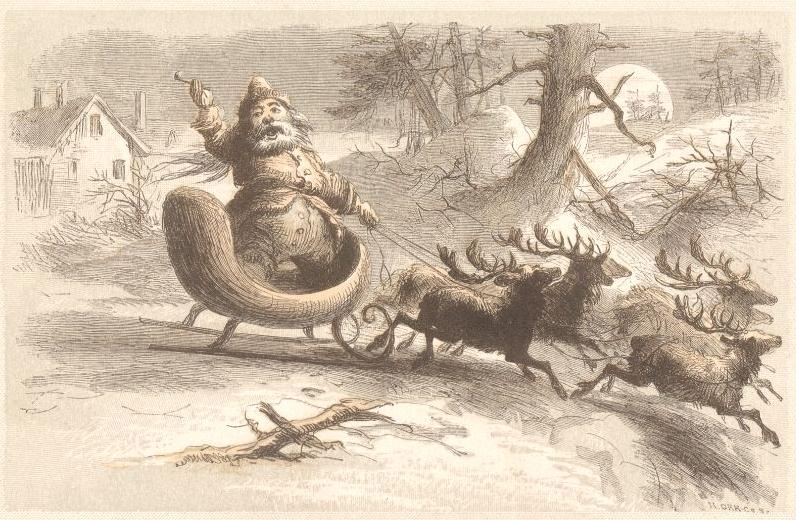
flying reindeer

Clement Clarke Moore’s story sure had taken over the public imagination since its initial anonymous publication in 1823. The image of saint Nicholas as icon is licensed by Creative Commons
illo_png9 (http://www.gutenberg.org/files/17382/17382-h/17382-h.htm)

Merry Christmas to all!
Posted in 150 Years Ago This Week, Aftermath, American Culture, Southern Society | Tagged , | Leave a comment

General Grant reports

150 years ago this week reports by President Johnson and General Grant on the condition of the South were published.

From The New-York Times December 20, 1865:

THE THIRTY-NINTH CONGRESS; Important Message from the President on Reconstruction. He Favors the Immediate Restoration of All the State Governments in the South.Lieut.-Gen. Grant Takes the Same Ground in His Report. Senator Sumner Makes a Bitter Attack on the President.The House Adopts a Joint Resolution for an Amendment to the Constitution.The Payment of Rebel War Debts to be Forever Prohibited.The Washington and New-York Air Line Railroad Bill Passed by the House. FIRST SESSION. THE NORTHEASTERN FRONTIER. A UNIFORM MILITIA SYSTEM. THE FREEDMEN’S BUREAU. COAL LANDS. THE COURT OF CLAIMS. THE REGULAR ARMY. AMENDMENT OF THE PENSION LAWS THE NAVY REGISTER. THE SUPERINTENDENT OF THE PUBLIC PRINTING. THE HOLIDAY RECESS. BILL TO SECURE FREEDMEN’S RIGHTS. VOLUNTEER GENERALS. THE COMMITTEE ON RECONSTRUCTION. SOUTHERN REPRESENTATION. A MESSAGE FROM THE PRESIDENT. THE SOUTHERN DELEGATIONS. THE TAX ON DOMESTIC MAUNFACTURES.

The message of the President was then read, as follows:

To the Senate of the United States:

In reply to the resolution adopted by the Senate on the 12th, I have the honor to state that the rebellion waged by a portion of the people against the properly constituted authorities of the Government of the United States, has been suppressed; that the United States are in possession of every State in which the insurrection existed; and that, as far as could be done, the courts of the United States have been restored, post-offices reestablished, and steps taken to put into effective operation the revenue laws of the country. As the result of the measures instituted by the Executive with the view of inducing a resumption of the functions of the States comprehended in the inquiry of the Senate, the people in North Carolina, South Carolina, Georgia, Alabama, Mississippi, Louisiana, Arkansas and Tennessee, have recognized their respective State Governments, and are yielding obedience to the laws and Government of the United States with more willingness and greater promptitude than under the circumstances could reasonably have been anticipated. The proposed amendment to the constitution providing for the abolition of slavery forever within the limits of the country, has been ratified by each one of these States, with the exception of Mississippi, from which no official information has been received; and in nearly all of them measures have been adopted, or are now pending, to confer upon the freedmen the privileges which are essential to their comfort, protection and security. In Florida and Texas, the people are making commendable progress in restoring their State Governments, and no doubt is entertained that they will at an early period be in a condition to resume all of their practical relations with the Federal Government. In that portion of the Union lately in rebellion the aspect of affairs is more promising than, in view of all the circumstances, could well have been expected. The people throughout the entire South evince a laudable desire to renew their allegiance to the government and to repair the devastations of war by a prompt and cheerful return to peaceful pursuits. An abiding faith is entertained that their actions will conform to their professions, and that in acknowledging the supremacy of the constitution and the laws of the United States, their loyalty will be unreservedly given to the government, whose leniency they cannot fail to appreciate and whose fostering care will soon restore them to a condition of prosperity. It is true that in some of the States the demoralizing effects of the war are to be seen in occasional disorders; but these are local in character, not frequent in occurrence, and are rapidly disappearing as the authority of the civil power is extended and sustained. Perplexing questions were naturally to be expected from the great and sudden change in the relations between the two races; but systems are gradually developing themselves, under which the freedman will receive the protection to which he is justly entitled, and by means of his labor make himself a useful and independent member of the community in which he has his home. From all the information in my possession, and from that which I have recently derived from the most reliable authority, I am induced to cherish the belief that sectional animosity is surely and rapidly merging itself into a spirit of nationality, and that representation, connected with a properly adjusted system of taxation, will result in a harmonious restoration of the relations of the States to the National Union.

WASHINGTON, D.C., Dec. 18, 1865.

REPORT OF GEN. GRANT.

Mr. COWAN then called for the reading of a report made to the President by Gen. GRANT, concerning his late visit in the South.

Gen. GRANT’s report was read as follows:

HEADQUARTERS ARMY OF THH UNITED STATES, Tuesday, Dec. 18, 1865.

His Excellency A. Johnson, President of the United States:

SIR: In reply to your note of the 18th inst., requesting a report from me giving such information as I may be possessed of coming within the scope of the inquiries made by the Senate of the United States in their resolution of the 12th inst., I have the honor to submit the following with your approval, and also that of the honorable Secretary of War.

Portrait of Ulysses S. Grant (by Alexander Gardner, ca. 1865]; LOC: http://www.loc.gov/item/2004674419/)

freedmen’s bureau’s performance – inconsistent

I left Washington City on the 27th of last month, for the purpose of making a tour of inspection throughout some of the Southern States lately in rebellion, and to see what changes were necessary in the disposition of the military forces of the country, now these forces could be reduced, and expenses curtailed, &c.; and to learn, as far as possible, the feelings and intentions of the citizens of these States toward the General Government. The State of Virginia being so accessible to Washington City, and information from this quarter, therefore, being readily obtained. I hastened through the State without conversing or meeting with any of its citizens. In Raleigh, N.C., I spent one day; in Charleston, S.C., two days; and in Savannah and Augusta, Ga., each one day. Both in traveling and whilst stopping I saw much and conversed freely with the citizens of those States, as well as with officers of the army who have been stationed among them.

The following are the conclusions come to by me: I am satisfied that the mass of the thinking men of the South accept the present situation of affairs in good faith. The questions which have hitherto divided the sentiments of the people of the two sections — Slavery and State rights, or the right of a State to secede from the Union — they regard as having been settled forever by the highest tribunal — arms — that man can resort to. I was pleased to learn from the leading men whom I met, that they not only accepted the decision arrived at as final, but, now the smoke of battle has cleared away, and time has been given for reflection, that this decision has been a fortunate one for the whole country, they receiving the like benefits from it with those who opposed them in the field and in the council. Four years of war, during which law was executed only at the point of the bayonet throughout the States in rebellion, have left the people possibly in a condition not to yield that ready obedience to civil authority that the American people have generally been in the habit of yielding. This would render the presence of small garrisons throughout those States necessary until such time as labor returns to its proper channel, and civil authority is fully established. I did not meet any one, either those holding places under the government or citizens of the Southern States, who thought it practicable to withdraw the military from the South at present. The white and the black mutually require the protection of the General Government. There is such universal acquiesence in the authority of the General Government throughout the portions of the country visited by me, that the mere presence of a Military force, without regard to numbers, is sufficient to maintain order. The good of the country requires that the force kept in the interior, where there are many freedmen (elsewhere in the Southern States than at forts upon the sea-coast no force is necessary) should all be white troops. The reasons for this are obvious, without mentioning many of them. The presence of black troops lately slaves demoralizes labor, both by their advice and furnishing in their camps a resort for the freedmen for long distances around. White troops generally excite no opposition, and therefore a small number of them can maintain order in a given district. Colored troops must be kept in bodies sufficient to defend themselves. It is not the thinking men who would do violence toward any class of troops sent among them by the General Government; but the ignorant in some places might; and the late slave, too, who might be imbued with the idea that the property of his late master should by right belong to him, at cast [least?] should have no protection from the colored soldiers. There is danger of collision being brought on by such causes. My observations lead me to the conclusion that the citizens of the Southern States are anxious to return to self government within the Union as soon as possible; that whilst reconstructing they want and require protection from the government; that, they think, is required by the government and is not humiliating to them as citizens; and that if such a course was pointed out they would pursue it in good faith. It is to be regretted that there cannot be a greater commingling at this time between the citizens of the two sections, and particularly of those intrusted with the law-making power. I did not give the operations of the Freedmen’s Bureau that attention I would have done if more time had been at my disposal. Conversations, however, on the subject, with officers connected with the bureau, led me to think that in some of the States its affairs have not been conducted with good judgment or economy, and that the belief widely spread among the freedmen of the Southern States that the lands of their former owners will, at least in part, b[e] divided among them, has come from the agents of this bureau. This belief is seriously interfering with the willingness of the freedmen to make contracts for the coming year. In some form the Freedmen’s Bureau is an absolute necessity until civil law is established and enforced, securing to the freedmen their rights and full protection. At present, however, it is independent of the military establishment of the country, and seems to be operated by the different agents of the bureau according to their individual notions. Everywhere Gen. HOWARD, the able head of the bureau, made friends by the just and fair instructions and advice he gave. But the complaint in South Carolina was that when he left, things went on as before. Many, perhaps the majority of the agents of the Freedmen’s Bureau, advise the freedmen that by their own industry they must expect to live. To this end they endeavor to secure employment for them, and to see that both contracting parties comply with their engagements. In some cases, I am sorry to say the freedman’s mind does not seem to be disabused of the idea that the freedman has the right to live without cars or provision for the future. The effect of the belief in the division of the lands is idleness and accumulation in camps, towns and cities. In such cases I think it will be found that vice and disease will tend to the extermination or great destruction of the colored race. It cannot be expected that the opinions held by men at the South for years can be changed in a day. And therefore the freedmen require for a few years not only laws to protect them, but the fostering care of those who will give them good counsel, and on whom they can rely. The Freedmen’s Bureau being separated from the military establishment of the country, requires all the expense of a separate organization. One does not necessarily know what the other is doing, or what orders they are acting under. It seems to me this could be corrected by regarding every officer on duty with troops in the Southern States, as agents of the Freedmen’s Bureau, and then have all orders from the head of the bureau sent through the department commanders. This would create a responsibility that would create uniformity of action throughout the South, would insure the orders and instructions from the head of the bureau being carried out, and would relieve from duty and pay a large number of employes of the government.

I have the honor to be, very respectfully, your obedient servant, U.S. GRANT,

Lieutenant-General. …

The Daily Dispatch summarized these reports here

Alexander Gardner’s photo of General Grant is found at the Library of Congress
Posted in 150 Years Ago This Week, Aftermath, Postbellum Politics, Postbellum Society, Reconstruction, Southern Society | Tagged , , , , , | Leave a comment

another man without a country?

View of Johnson's Island, near Sandusky City, O. (1865; LOC: http://www.loc.gov/item/99447489/)

recalcitrance in Lake Erie


From the Richmond Daily Dispatch December 22, 1865 (page 1):

The last Confederate prisoner.

–The last Confederate prisoner of war has been released, on condition that he would leave the country. The Baton Rouge Gazette of the 5th says:

A letter received by Mr. G. Gusman, of this city, from his son, Captain A. L. Gusman, of the Confederate army, conveys the intelligence that the brave young captain has been released from Fort Delaware on parole, and on condition further that he is to leave the United States within fifteen days from the date of the release.

Captain Gusman was for a long while confined as a prisoner on Johnson’s Island, and was one of the two who persisted in refusing to take the oath of allegiance to the Government. He was subsequently transferred to Fort Delaware, where he was confined for several months previous to his release.

The Advocate says that Captain Gusman left New York for Vera Cruz on the steamship Moro Castle, to join [Allen?] and Magruder.

Apparently Antoine L. Gusman eventually returned to the United States. You can read some background at The South’s Defender, including information that he is buried in Baton Rouge. Also, Mr. Gusman refused to take the oath twice in June 1865 while confined at Johnson’s Island in Ohio.

[July 12, 2025: I changed the Daily Dispatch link to the Library of Congress and made a few changes after looking at the paper. Governor Allen(?) is probably Henry Watkins Allen, ]

Posted in 150 Years Ago This Week, Aftermath, Postbellum Society, Reconstruction, Southern Society, Veterans | Tagged , , , , , | 1 Comment