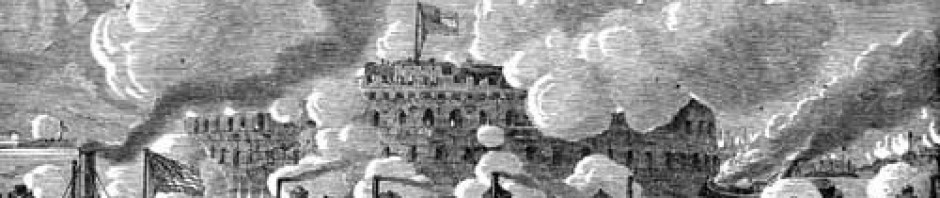
From a Seneca County, New York newspaper in April 1864:
AT HOME. – Lieut. WM. VAN RENSSELEAR of the 50th Engineer Regiment, is at home on a brief furlough.
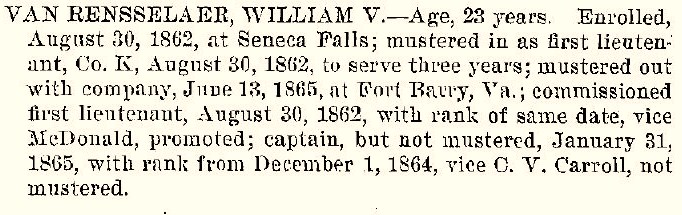
William V. Rensselear
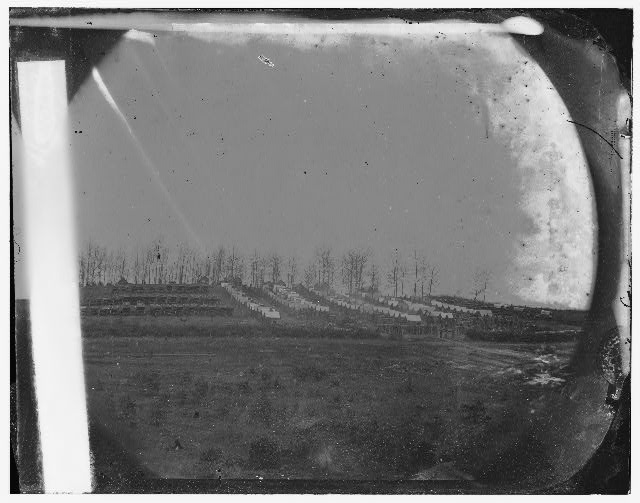
50th New York Engineers’ camp at Brandy Station, April 1864
From a Seneca County, New York newspaper in April 1864:
AT HOME. – Lieut. WM. VAN RENSSELEAR of the 50th Engineer Regiment, is at home on a brief furlough.
William V. Rensselear
50th New York Engineers’ camp at Brandy Station, April 1864
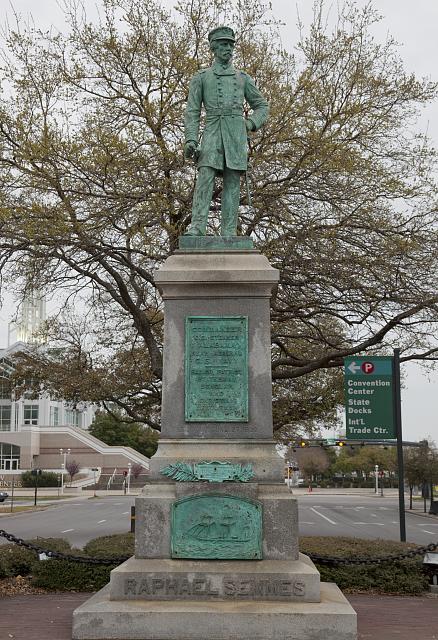
guano captured (statue in Mobile, Alabama)
The CSS Alabama is still at work disrupting commerce on the high seas. Here’s how Raphael Semmes, the ship’s commander, remembered the pursuit and capture of a boat full of fertilizer 150 years ago this week.
From Memoirs of Service Afloat, During the War Between the States (1869) (pages 748-749) by Raphael Semmes:
On the 22d of April, having reached the track of the homeward-bound Pacific ships of the enemy, we descried an unlucky Yankee, to whom we immediately gave chase. The chase continued the whole night, the moon shining brightly, the breeze being gentle, and the sea smooth. The Yankee worked like a good fellow to get away, piling clouds of canvas upon his ship, and handling her with the usual skill, but it was of no use. When the day dawned we were within a couple of miles of him. It was the old spectacle of the panting, breathless fawn, and the inexorable stag-hound. A gun brought his colors to the peak, and his main-yard to the mast. The prize proved to be the ship Rockingham, from Callao, bound to Cork for orders. Her cargo consisted of guano from the Chincha Islands, and there was an attempt to protect it. It was shipped by the “Guano Consignment Company of Great Britain.” Among the papers was a certificate, of which the following is the purport: One Joseph A. Danino, who signs for Danino & Moscosa, certifies that the guano belongs to the Peruvian Government; and Her Britannic Majesty’s Consul at Lima, certifies that the said Joseph A. Danino appeared before him, and “voluntarily declared, that the foregoing signature is of his own handwriting, and also, that the cargo above mentioned is truly and verily the property of the Peruvian Government.” This was about equal to some of the Yankee attempts, that have been noticed, to cover cargoes. With the most perfect unconcern for the laws of nations, no one swore to anything. Mr. Danino certified, and the Consul certified that Mr. Danino had certified. Voila tout! We transferred to the Alabama such stores and provisions as we could make room for, and the weather being fine, we made a target of the prize, firing some shot and shell into her with good effect; and at five P. M. we burned her, and filled away on our course.
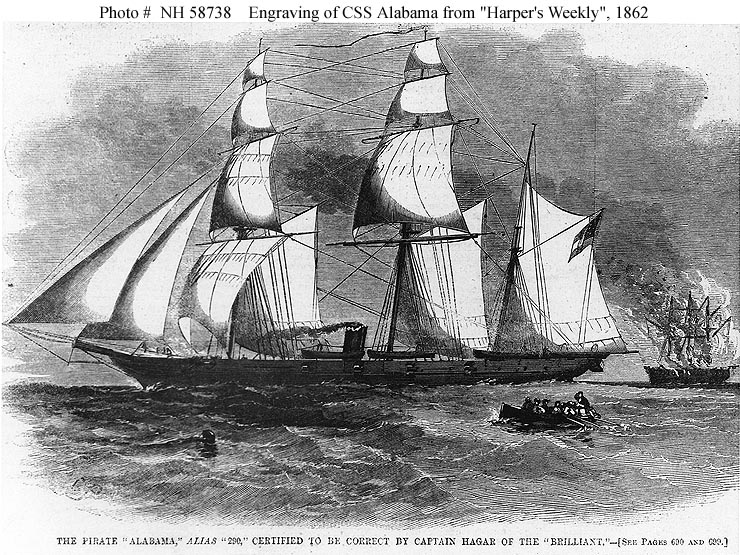
“inexorable stag-hound” in 1862
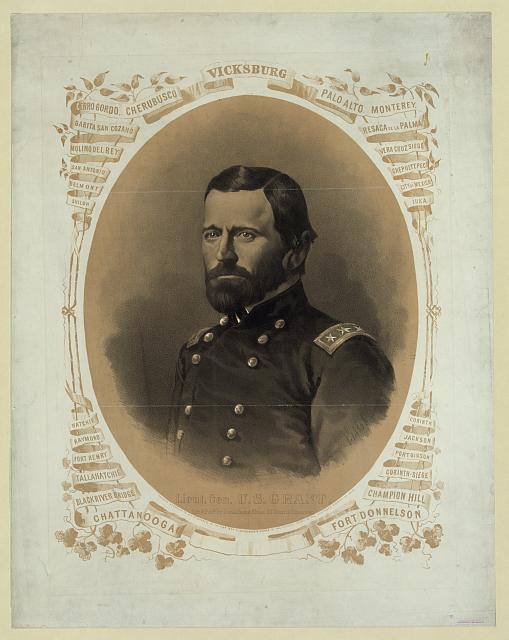
“natural qualities of a high order”
150 years ago today General Meade provided another balanced assessment of his new boss.
From The Life and Letters of George Gordon Meade … (page 191):
HEADQUARTERS ARMY OF THE POTOMAC, April 24, 1864.
Cram and John Cadwalader arrived yesterday afternoon. To-day Cram went to church with me, where we heard an excellent from a Mr. Adams, a distinguished Presbyterian clergyman from New York. After church I drove Cram and Cadwalader to Culpeper, where we paid a visit to General Grant. After coming away, I plainly saw that Cram was disappointed. Grant is not a striking man, is very reticent, has never mixed with the world, and has but little manner, indeed is somewhat ill at ease in the presence of strangers; His early education was undoubtedly very slight; in fact, I fancy his West Point course was pretty much all the education he ever had, as since his graduation I don’t believe he has read or studied any. At the same time, he has natural qualities of a high order, and is a man whom, the more you see and know him, the better you like him. He puts me in mind of old Taylor, and sometimes I fancy he models himself on old Zac.
Yesterday I sent my orderly with Old Baldy to Philadelphia. He will never be fit again for hard service, and I thought he was entitled to better care than could be given to him on the march. …
Well, there is evidence that Old Baldy was with General Meade on the upcoming march.
Cram was probably Mrs. Meade’s brother-in-law.
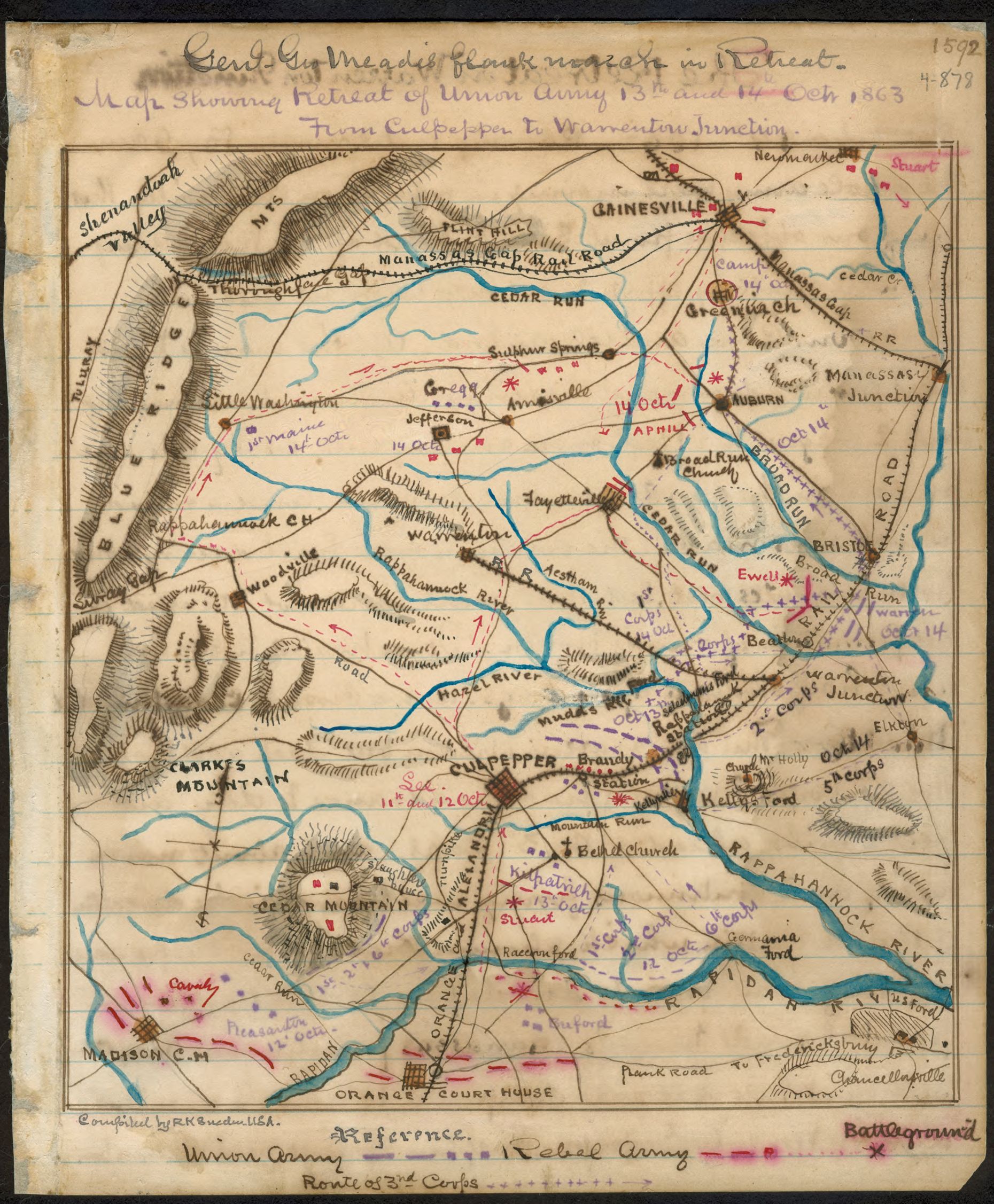
by Robert Knox Sneden
From the Richmond Daily Dispatch April 23 1864:
From Northern Virginia.
Orange C. H., April 23d.
–Observations from Clark’s Mountain disclose no change in the Yankee camps. It is reported that the enemy will begin to-day moving up their rear, preparatory to an advance. Nothing is going on in our front indicating an immediate advance. The roads are dry and hard. The weather beautiful.
Meanwhile people in Richmond could read that the new man in charge of those Yankees was considered a second-rate blunderer by some in the North and by a French critic.
From the Richmond Daily Dispatch April 22, 1864:
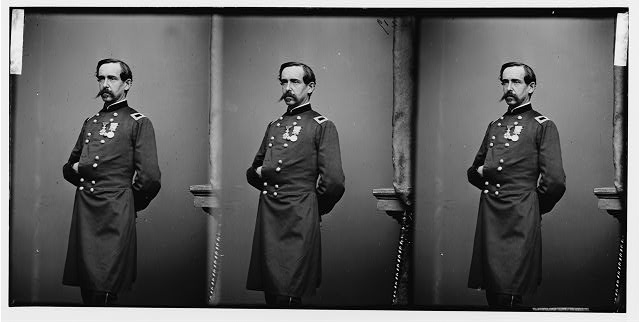
everyone’s a critic (Gustave Paul Cluseret)
Gen. Grant.
–Among military men at the North Grant is not regarded as a genius. The new Fremont organ in New York, the New Nation, devotes a considerable space in every issue to a denunciation of the policy which has placed the whole military operations of the Federals in the control of a “second-rate General.” One General Cluseret, an old French army officer, now in the Federal service, writes a series of articles to this paper on Grant. He shows that Grant blundered for months over an unnecessary canal, opposite Vicksburg, wasting thousands of lives thereby, and abandoning the project eventually; that the victory at Chattanooga was due to the previous disposition of the Federal troops by General Rosecrans, and that General Buell really commanded at Shiloh. General Cluseret pronounces Rosecrans the only eminent military genius in the Federal army. Just now Rosecrans is on the retired list for his Chickamauga disaster.
You can see a view from Clark’s Mountain here.
NY Times 4-23-1864
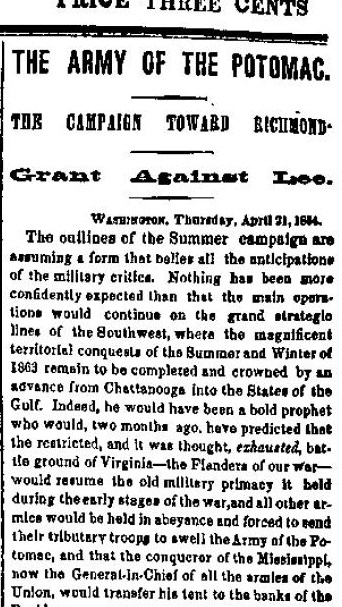
150 years ago this week a Northern paper expressed surprise that General Grant would focus his attention on the worn-out Virginia theater. After all, the new Commander-in-Chief of all the Union armies was from out west, where most the momentum was in 1863.
From The New-York Times April 23, 1864:
THE ARMY OF THE POTOMAC.; THE CAMPAIGN TOWARD RICHMOND. Grant Against Lee.
WASHINGTON, Thursday, April 21, 1864.
The outlines of the Summer campaign are assuming a form that belies all the anticipations of the military critics. Nothing has been more confidently expected than that the main opera- tions would continue on the grand strategic lines of the Southwest, where the magnificent territorial conquests of the Summer and Winter of 1863 remain to be completed and crowned by an advance from Chattanooga into the States of the Gulf. Indeed, he would have been a bold prophet who would, two months ago, have predicted that the restricted, and it was thought, exhausted, battle ground of Virginia — the Flanders of our war — would resume the old military primacy it held during the early stages of the war, and all other armies would be held in abeyance and forced to send their tributary troops to swell the Army of the Potomac, and that the conqueror of the Mississippi, now the General-in-Chief of all the armies of the union, would transfer his tent to the banks of the Rapidan.
Yet such is the simple statement of the actual situation. When NAPOLEON was carrying on simultaneous operations in Italy and Germany, the army into which he threw the reinforcement of his presence became immediately the principal army; the other and its operations became subordinate and subsidiary. So, had GRANT remained at Chattanooga, as was expected, the Summer battle-fields would have been in Tennessee; but having vaulted into Virginia, the Army of the Potomac is now the cynosure of all eyes. The present preparations give promise that a series of operations will soon be initiated, the most formidable, the most exciting and the most intense of the war — the most formidable in respect to the proportions of the contending forces, the most exciting on account of the skill of the two great players pitted against each other, and the most intense and obstinate on account of the immediate stake at issue, and the vastness of the ulterior results that must come from this colossal passage at arms.
Gen. GRANT aims to take Richmond and destroy the army of LEE, which is, and has been the head and front of all the power and prestige of the rebel cause. …
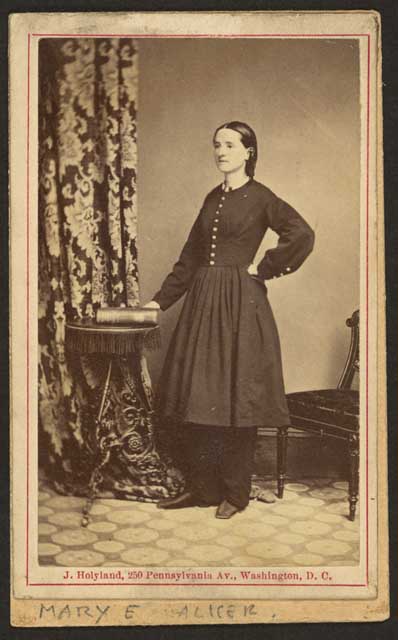
wearing more physiological female attire
The dates in the following articles don’t seem to match up just right, but it does seem that by 150 years ago tonight a Yankee female surgeon was locked up in Castle Thunder.
From the Richmond Daily Dispatch April 22, 1864:
Female Yankee Surgeon.
–Dr. Mary E Walker, Assistant Surgeon in the Yankee army of Tennessee, captured a few days ago near Tunnel Hill, was received in this city last evening, and was committed to the female department of Castle Thunder. She was dressed in male attire, except a Gipsey hat, and wore a handsome black Talma. As she passed down the streets to the Castle in charge of a detective the odd figure she cut attracted a great crowd of negroes and boys, who beset her path to such a degree as much to obstruct her progress. She was very indignant at having been taken prisoner, protesting that at the time of her capture she was on neutral ground.
From the Richmond Daily Dispatch April 25, 1864:
Letter from Dr. Mary E. Walker.
–We have received the following letter from Dr. Mary E. Walker, prisoner of war in Castle Thunder. The utter ignorance of our reporter with reference to the “physiological” adaptation of ladies’ dresses must be urged as his excuse for the grave mistake complained of by the fair writer — the scientific and physiological bloomer who, like an unfortunate exotic, blooms solitary and out of place in our inhospitable latitude:
Castle Thunder, Richmond, April 21st, 1864.
Editor of Richmond Dispatch:
Sir
–Will you please correct the statement you made in this morning’s Dispatch, in regard to my being “dressed in male attire.” As such is not the case simple justice demands a correction.
I am attired in what is usually called the “bloomer” or “reform dress, ” which is similar to other ladies’, with the exception of its being shorter and more physiological than long dresses.
Yours, etc., etc.,
Mary E. Walker, M. D.,
52d Ohio Vols, U. S. A.
It is written that Mary Edwards Walker became the first female army surgeon in September 1863 when she was hired by the Army of the Cumberland.
Walker was later appointed assistant surgeon of the 52nd Ohio Infantry. During this service, she frequently crossed battle lines, treating civilians. On April 10, 1864 she was captured by Confederate troops and arrested as a spy, just after she finished helping a confederate doctor perform an amputation. She was sent to Castle Thunder in Richmond, Virginia and remained there until August 12, 1864 when she was released as part of a prisoner exchange. She went on to serve during the Battle of Atlanta and later as supervisor of a female prison in Louisville, Kentucky, and head of an orphanage in Tennessee.
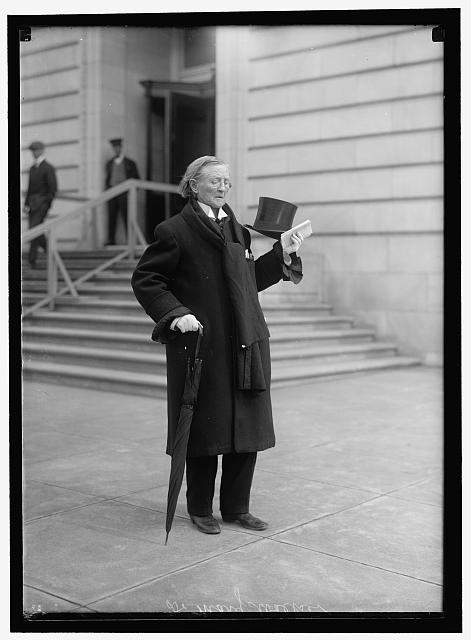
between 1911 and 1917
Mary Walker was awarded the Medal of Honor in 1865. After the war Dr. Walker’s activities became increasingly political. Clothing was controversial in the nineteenth century. Dr. Walker “wore the bloomer dress until the late 1870s, when she began dressing in men’s clothes. She was arrested for impersonating a man several times, although she argued that Congress had awarded her special permission to dress in this way.”
Mary Walker was born and was buried in Oswego, New York.
Mary, the family
In April 1864 a Democrat newspaper in Seneca County, New York reprinted some alleged investigative journalism by a New York City publication:
Treason at the White House.
The Tribune a few days ago asserted that Mrs. J. Todd White, a sister of Mrs. Lincoln, who lately went South by way of Fortress Monroe, had abused her pass and carried a large quantity of contraband goods through to the enemy. The World noticing the story, ventured to pronounce it, on its merits, a Tribune romance, but in its issue on Friday, after having investigated the matter, declares that the truth is even more damaging than appeared from the Tribune’s statement. The following are the somewhat startling facts vouched for by the World: –
Mrs. J. Todd White, a sister of Mrs. President Lincoln, was a rebel spy and sympathizer. When she passed into the confederacy a few days ago, by way of Fortress Monroe, she carried with her in her trunks all kinds of contraband goods, together with medicines, papers, letters, etc., which will be doubtless of the greatest assistance to those with whom she consorts.
When Gen. Butler wished to open her trunks, as the regulations of transit there prescribe, this woman showed him an autograph pass or order from President Lincoln enjoining upon the federal officers not to open any of her trunks, and not to subject the bearer of the pass, her packages, parcels or trunks to any inspection or annoyance. Mrs. White said to Gen. Butler, or the officers in charge there, in substance, as follows: “My trunks are filled with contraband, but I defy you to touch them. Here” (pushing it under their noses) “here is the positive order of your master!”
Mrs. White was thus allowed to pass without the inspection and annoyance so peremptorily forbidden by President Lincoln in an order written and signed by his own hand, and to-day the contents of his wife’s sister’s trunks are giving aid and comfort to the enemy – nor the least is the shock which these facts will give to the loyal hearts whose hopes and prayers and labors sustain the cause which is thus betrayed in the very White House.
Mr. Lincoln’s White House has confirmed that the president did issue a pass to Martha Todd White but states that the contraband rumors were exaggerations by political opponents, including the New York World. Mr. Lincoln was running for re-election in 1864.
Civil War historian Harold Holzer has written that the World also used racial fears to try to influence the 1864 election.
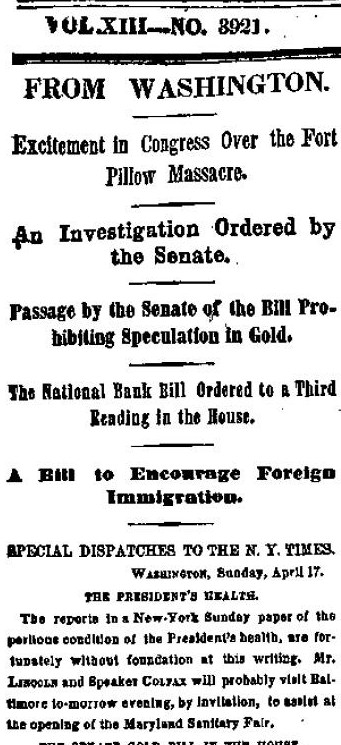
The president not sick, going to visit Baltimore
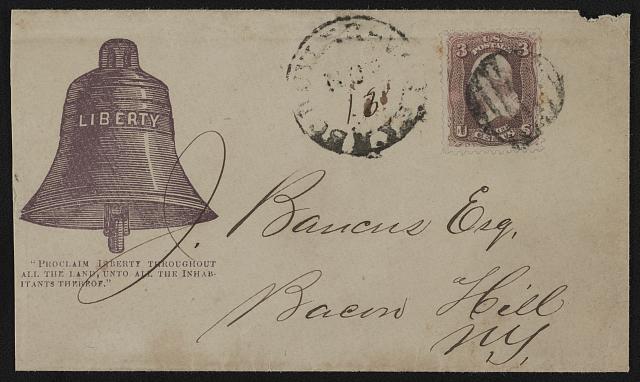
150 years ago Sanitary Fairs were held throughout the North to support the work of the United States Sanitary Commission. President Lincoln spoke a few words when Baltimore opened its version on April 18th. There might never be an authoritative, all-encompassing definition of liberty, but Mr. Lincoln implied that liberty did not involve the right to enslave other people. There would seem to be another definition involved – in the president’s dictionary black people were human beings, too, and gradually taking on more rights and responsibilities, as I believe can bee seen in Mr. Lincoln’s relatively long coda, in which he discussed the recent and rumored Fort Pillow massacre. The president also said that the government was going to get the facts about the alleged slaughter before taking revenge.
From The Papers And Writings Of Abraham Lincoln, Volume Seven:
LECTURE ON LIBERTY
ADDRESS AT SANITARY FAIR IN BALTIMORE,
APRIL 18, 1864.
LADIES AND GENTLEMEN:—Calling to mind that we are in Baltimore, we cannot fail to note that the world moves. Looking upon these many people assembled here to serve, as they best may, the soldiers of the Union, it occurs at once that three years ago the same soldiers could not so much as pass through Baltimore. The change from then till now is both great and gratifying. Blessings on the brave men who have wrought the change, and the fair women who strive to reward them for it!
But Baltimore suggests more than could happen within Baltimore. The change within Baltimore is part only of a far wider change. When the war began, three years ago, neither party, nor any man, expected it would last till now. Each looked for the end, in some way, long ere to-day. Neither did any anticipate that domestic slavery would be much affected by the war. But here we are; the war has not ended, and slavery has been much affected how much needs not now to be recounted. So true is it that man proposes and God disposes.
![Illustrated Civil War "Union Envelopes"]: "Jewels" of the "1st Families" of Va., consisting of [slave] "chains, bracelets, & anklets" (between 1861 and 1865; LOC: LC-USZ62-53594)](https://www.bluegrayreview.com/wp-content/uploads/2014/04/3b01564r.jpg)
at liberty
But we can see the past, though we may not claim to have directed it; and seeing it, in this case, we feel more hopeful and confident for the future.
The world has never had a good definition of the word liberty, and the American people, just now, are much in want of one. We all declare for liberty; but in using the same word we do not all mean the same thing. With some the word liberty may mean for each man to do as he pleases with himself, and the product of his labor; while with others the same word may mean for some men to do as they please with other men, and the product of other men’s labor. Here are two, not only different, but incompatible things, called by the same name, liberty. And it follows that each of the things is, by the respective parties, called by two different and incompatible names—liberty and tyranny.
The shepherd drives the wolf from the sheep’s throat, for which the sheep thanks the shepherd as his liberator, while the wolf denounces him for the same act, as the destroyer of liberty, especially as the sheep was a black one. Plainly, the sheep and the wolf are not agreed upon a definition of the word liberty; and precisely the same difference prevails to-day among us human creatures, even in the North, and all professing to love liberty. Hence we behold the process by which thousands are daily passing from under the yoke of bondage hailed by some as the advance of liberty, and bewailed by others as the destruction of all liberty. Recently, as it seems, the people of Maryland have been doing something to define liberty, and thanks to them that, in what they have done, the wolf’s dictionary has been repudiated.
It is not very becoming for one in my position to make speeches at length; but there is another subject upon which I feel that I ought to say a word. A painful rumor, true, I fear, has reached us, of the massacre, by the rebel forces at Fort Pillow, in the west end of Tennessee, on the Mississippi River, of some three hundred colored soldiers and white officers [I believe it latter turned out to be 500], who had just been overpowered by their assailants [numbering 5000]. There seems to be some anxiety in the public mind whether the Government is doing its duty to the colored soldier, and to the service, at this point. At the beginning of the war, and for some time, the use of colored troops was not contemplated; and how the change of purpose was wrought I will not now take time to explain. Upon a clear conviction of duty I resolved to turn that element of strength to account; and I am responsible for it to the American people, to the Christian world, to history, and in my final account to God. Having determined to use the negro as a soldier, there is no way but to give him all the protection given to any other soldier. The difficulty is not in stating the principle, but in practically applying it. It is a mistake to suppose the Government is indifferent to this matter, or is not doing the best it can in regard to it. We do not to-day know that a colored soldier, or white officer commanding colored soldiers, has been massacred by the rebels when made a prisoner. We fear it, we believe it, I may say,—but we do not know it. To take the life of one of their prisoners on the assumption that they murder ours, when it is short of certainty that they do murder ours, might be too serious, too cruel, a mistake. We are having the Fort Pillow affair thoroughly investigated; and such investigation will probably show conclusively how the truth is. If after all that has been said it shall turn out that there has been no massacre at Fort Pillow, it will be almost safe to say there has been none, and will be none, elsewhere. If there has been the massacre of three hundred there, or even the tenth part of three hundred, it will be conclusively proved; and being so proved, the retribution shall as surely come. It will be matter of grave consideration in what exact course to apply the retribution; but in the supposed case it must come.
[There was a massacre of a black company and their officers at Fort Pillow—they were prisoners who later on, the day of their capture, were ordered executed. The black soldiers were tied alive to individual planks—then man and plank were cobbled up like cord wood and burned. The white officers were shot. D.W.]
You can find out more about the Baltimore Fair and Maryland women in the Civil War at the University of Maryland’s library.
a matter of definition
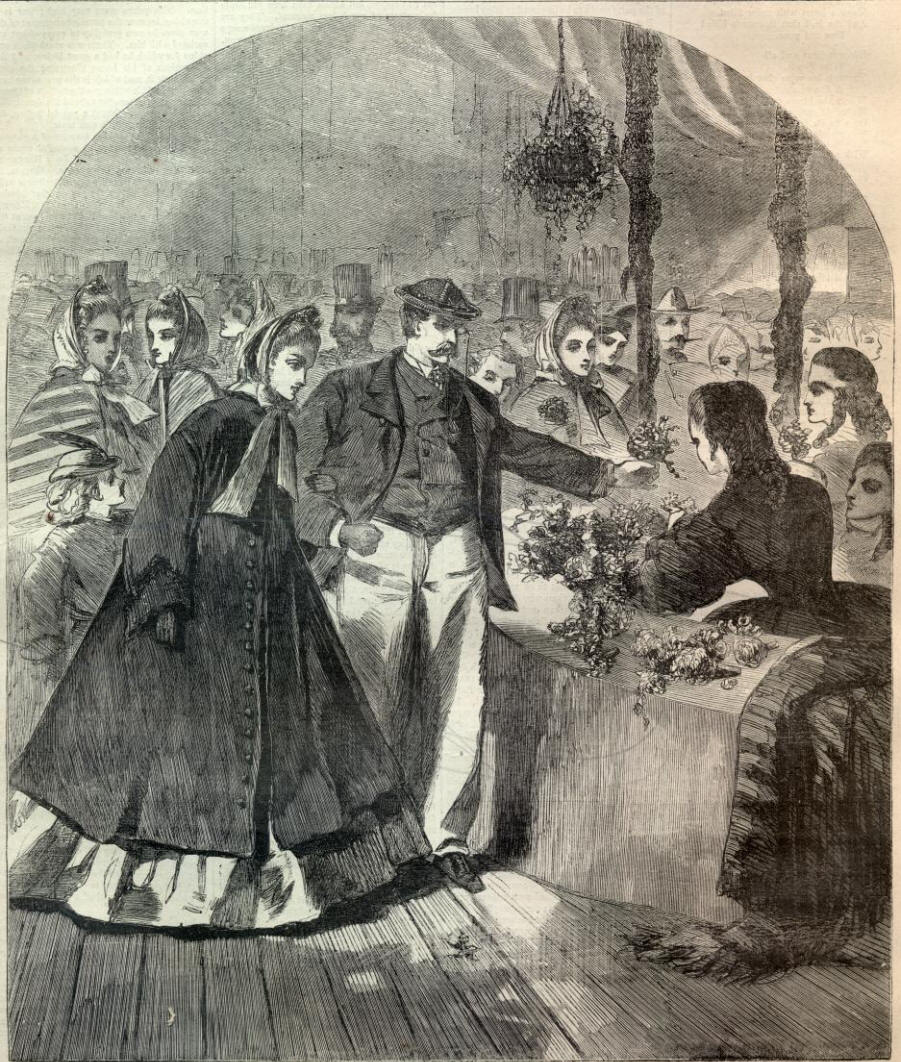
FLORAL DEPARTMENT OF THE GREAT FAIR.
From the Richmond Daily Dispatch April 16, 1864:
A picture of the condition of Yankeedom.
The New York Herald, of Monday last, in an editorial article, draws the following picture of the drunken war carnival in the United States:
What is the present condition of the country?–In the midst of a gigantic war, draining the loyal States of hundreds of thousands of their most vigorous men, and thousands of millions of money, we are enjoying a carnival of unbounded prosperity. On every hand extravagance, prodigality and speculation prevail. Delirium reigns in Wall street, and among the giddy throngs of Broadway, and amid the splendors and the surging multitudes at the great Fair, in a word, from the Atlantic to the Pacific, the madness of unlimited treasures rules the hour. Glorious spectacle this, and yet a most fearful delusion. It is like the feast of Belshazzar, while the legions of our irresistible enemy are gathering under the city walls.
From the same issue:
The speculation in New York.
A letter dated New York, the 12th inst., says:
This has been one of the most exciting days in Wall street and business circles within the memory of the oldest inhabitant. Gold, foreign exchange, breadstuffs, and nearly every other description of merchandise, indeed, have experienced an enormous advance, under the influence of which people seem to be growing absolutely wild. Almost every man you meet in the street or on the corner is a speculator — that is, an “operator for a rise”–for the time being; absolutely carried away with the one great idea, how to get rich all of a sudden, without reaching the grand result in the regular way, by the sweat of the face.
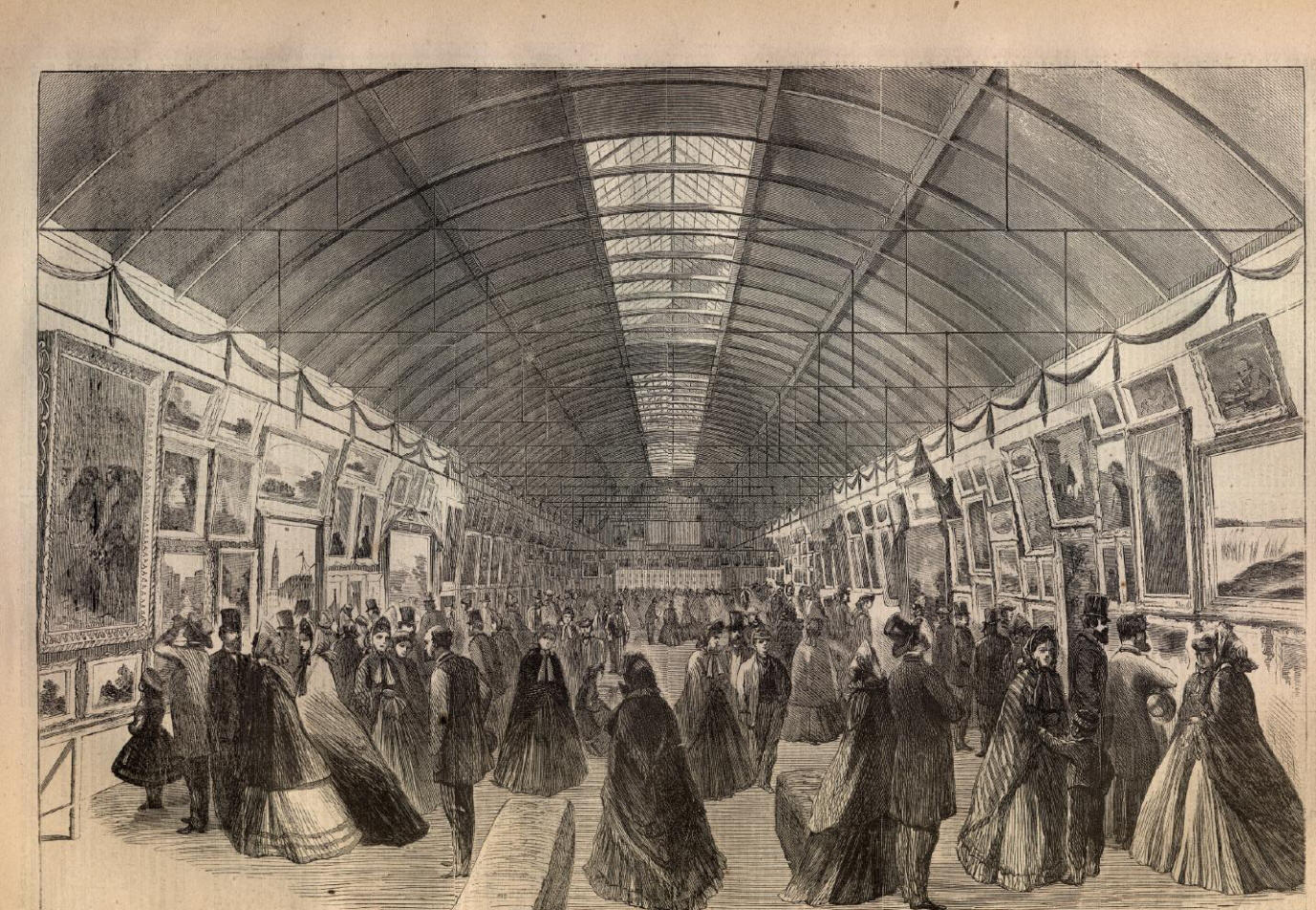
PICTURE-GALLERY OF THE FAIR, FOURTEENTH-STREET BUILDING
The above images are from the April 16, 1864 issue of Harper’s Weekly (at Son of the South) and depict New York’s Metropolitan Sanitary Fair.
___________________________________________
![[Brandy Station, Va. Dinner party outside tent, Army of the Potomac headquarters] (by Timothy H. O'Sullivan, 1864 April; LOC: LC-DIG-cwpb-00725)](https://www.bluegrayreview.com/wp-content/uploads/2014/04/00725r.jpg)
“Brandy Station, Va. Dinner party outside tent, Army of the Potomac headquarters” (April 1864)
a mother that just won’t let go (1863 map)
In preparation for spring campaigning New York’s First Veteran Cavalry is severely reducing its baggage.
From a Seneca County, New York newspaper:
From the First Veterans.
CAMP QUITS, MARTINSBURG, VA.
April 16th, 1864.
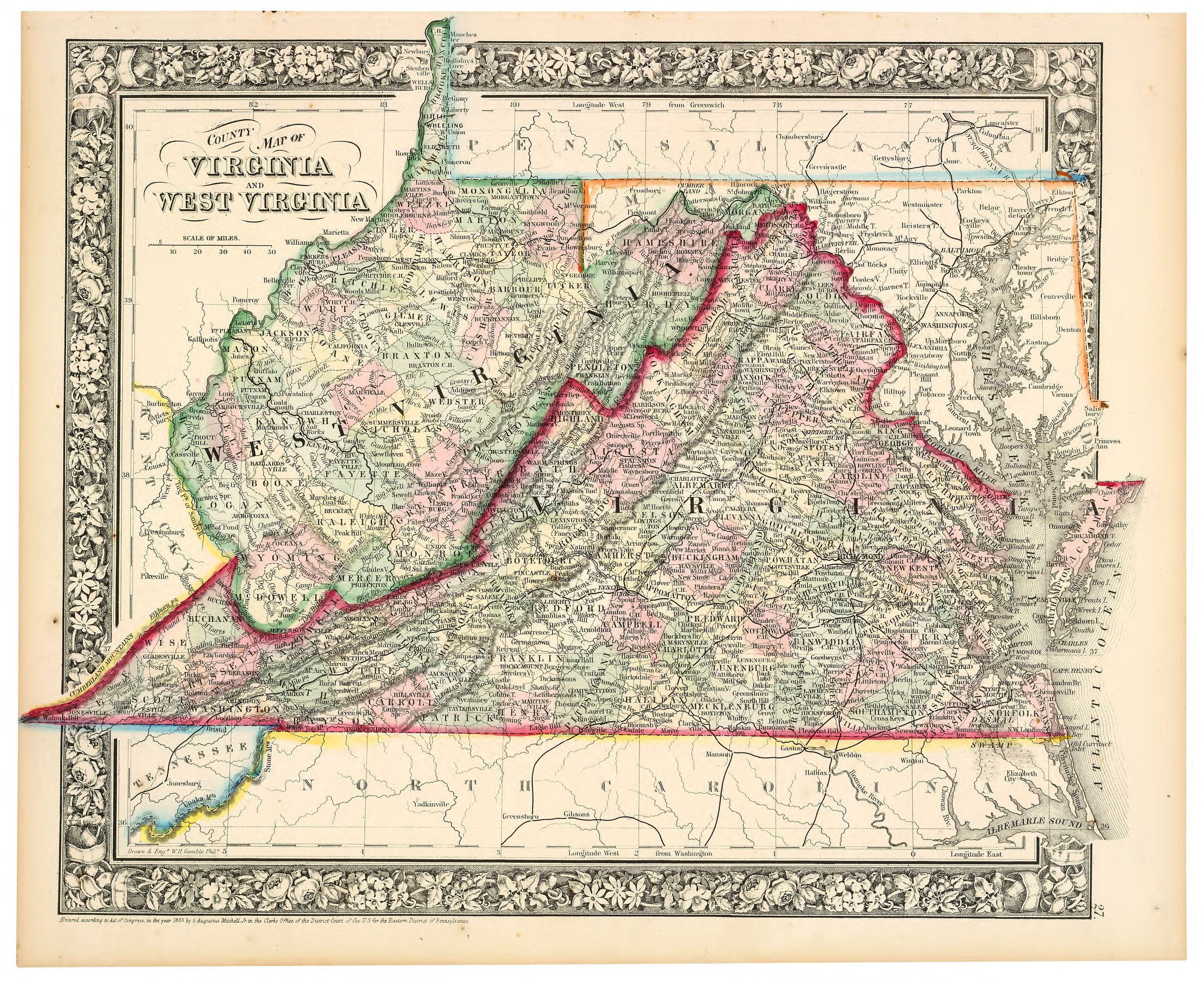
FRIEND STOWELL: – The 1st Veterans having been transferred to General Averill’s command, on Saturday the 8th inst., we struck tents, packed our saddles and took up the line of march for Martinsburg, amid a pitiless rain storm and through horrible roads that had been “soaking” for the last two weeks, and as somebody says, when the venerable mother of Presidents has taken a few drops too much, she is rather too affectionate, and sticks to one quite too persistently to be agreeable. However, we worked along and reached here just before dark.
Since we arrived we have been putting ourselves in fighting trim. Reducing our baggage, and getting rid of all surplus equipage preparatory to the grand campaign which is soon to open and for which such immense preparations have been made.
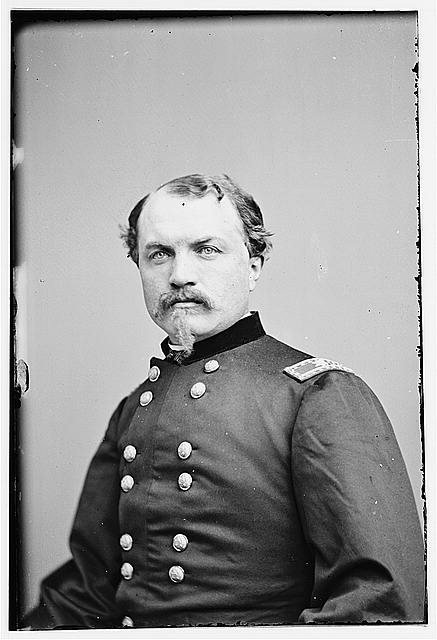
General Averell
In accordance with special order No. 22, an order already somewhat famous among among [sic] us, our teams have all been turned in, and little tents d’ambri or Butterflies, as they are familiarly known, have taken the place of the comfortable wall and wedge tents we have been living in all winter. – Every man’s baggage is cut down to one change of under-clothing, a single blanket, pouches and his half of a tent, so that he now literally carries his house, bed and wardrobe upon his back. In fact we have named this “Camp Quit,” for we have been obliged to quit almost everything, and to cap the climax, after to-day, no officer or man is allowed to enter a house under any pretext whatever. I reckon “special order No. 22” will not soon be forgotten.
For two or three days we have been expecting to move upon the enemy, our horses saddled, and as the boys say, one foot in the stirrup, but we are not off yet, although we probably shall be ere this reaches you. Where we are going, of course, is not allowed to be made public, but you will soon hear of the Veterans in a new field of operations, and I hope we will be able to accomplish all that is expected of us.
Lt. Col. Platner is still in command of the regiment and is a very popular and efficient commandant. Capt. Ed. Comstock of Binghamton, has been elected Major to fill the vacancy occasioned by the death of Major Sullivan. He is a jolly young fellow and a brave soldier.
The regiment is in splendid condition and ready to open the ball. Company K, “O.K.”
SENECA
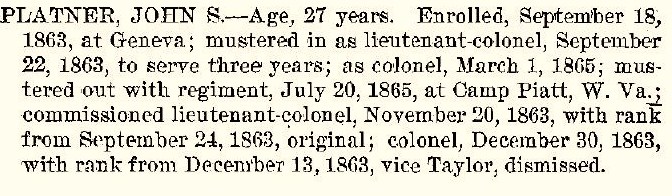
Lt. Col. Platner in command
General Averill is probably William Woods Averell. Given the extreme mud of the Virginias it might not be a coincidence that during his postbellum career, “He is most famous as the inventor of American asphalt pavement.” He was born and buried in Steuben County, New York.
