Aprilpole

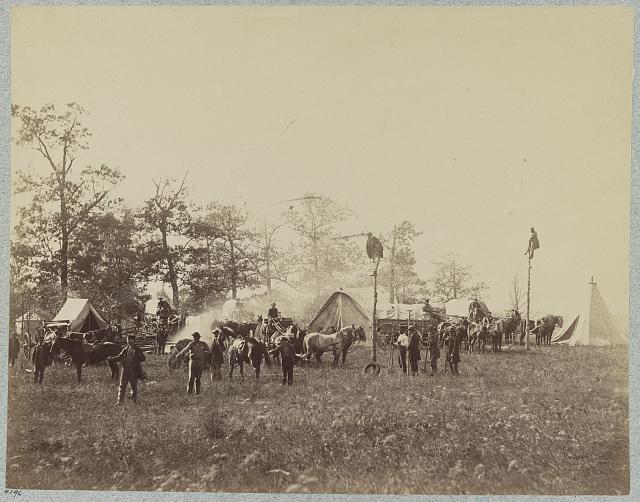
A photograph of the “Military telegraph construction corps” taken by Alexander Gardner in April 1865:

Military telegraph construction corps (by Alexander Gardner, April 1865; LOC: LC-DIG-ppmsca-33168)

Military telegraph construction corps

You can read more about this photograph at the Cornell Library. Apparently as the Overland campaign began in May 1864 a new insulated wire began being used by the telegraph corp. The wire could be placed on a mule’s back and run off quite easily. Earlier wire had to be dispensed from a wagon.

Read a lot more about the Union telegraph work at civilwarsignals

Posted in 150 Years Ago This Month, Military Matters | Tagged , , | Leave a comment

farm administration

Bureaucracy: Interpret, Enforce, Modify

In February 1864 the Confederate Congress passed a 35 page Law In Regard To Taxes, Currency and Conscription. The Bureau of Conscription apparently changed the rules for farm exemptions a month or so afterwards. Contiguous small farms that did not employ enough field hands to earn an overseer exemption on their own merits, could amalgamate numbers and one overseer for the two farms could avoid the army.

From the Richmond Daily Dispatch April 13, 1864:

Interesting to Farmers.

–The following extract from Circular No. 8, issued from the Bureau of Conscription, dated March 13th, 1864, contains useful information to agriculturists having a less number than fifteen hands:

Schedule of Terms.–When there are two or more farms continuous, or within five miles of each other, measuring from the homesteads, having on each five or more hands, amounting in the aggregate to fifteen hands, or where one person has two or more plantation within five miles of each other, having an aggregate of fifteen or more hands, there may be detailed one person as overseer or manager of the two or more farms: provided there is on neither of the farms a white male adult, declared by the Enrolling Officer and temporary Board capable of managing the farms with a reasonable efficiency, not able to military duty: and provided the person detailed was, on the first day of January, 1864, either owner, manager, or overseer, residing on one of the farms: and provided the owners of said farms shall execute a joint and several bond, on the terms prescribed for the owners of fifteen hands, except that such persons shall not be allowed the privilege of commutation provided in the 4th article of the 10th section of the act recited, (17th February, 1864.)

I’m pretty sure that the 4th article is really the 5th article of section 10 on pages 32 and 33 of the law (at the link above). That article seems to have been written with the idea of getting as many men in the army without damaging food production too much.

Posted in 150 Years Ago This Week, Confederate States of America, Southern Society | Tagged , , | Leave a comment

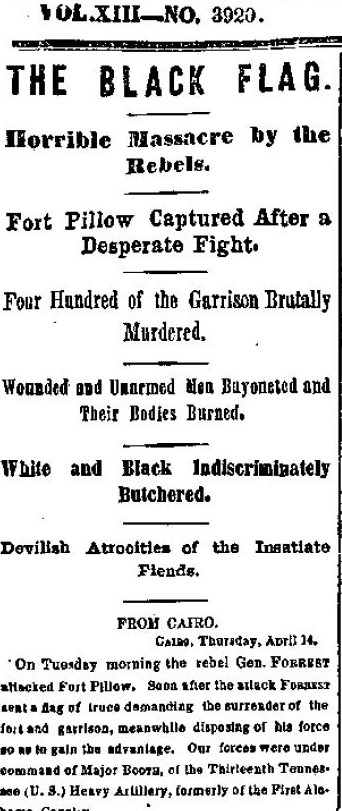
“an indiscriminate slaughter”

“The fort ran with blood.”

From the Richmond Daily Dispatch April 18, 1864:

The capture of Fort Pillow

Mobile, April 16.

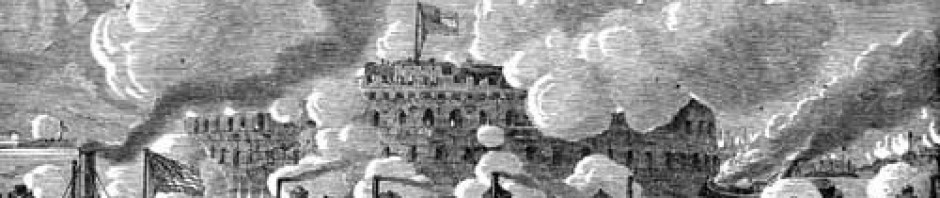
–A special dispatch to the Advertiser and Register from Fort Pillow, 12th [13th?], says: Forrest attacked this place with Chalmers’s division yesterday. The garrison consisted of three hundred white and four hundred negro troops. The fort refusing to surrender was carried by storm. Forrest led Bells brigade and Chalmers led McCullough’s. They both entered the fort simultaneously, and an indiscriminate slaughter followed. One hundred prisoners were taken, the balance of the garrison were slain. The fort ran with blood. Many jumped into the river and were drowned or shot in the water. Over one hundred thousand dollars worth of stores were taken. Six guns were captured. The Confederate loss was 75. Lieut Col. Read, of the 5th Mississippi, was mortally wounded.

From the Richmond Daily Dispatch April 20, 1864:

The capture of Fort Pillow.

The following official dispatch with reference to the capture of Fort Pillow, sixty miles above Memphis, was received at the General’s office last night:

Demopolis Ala., April19.

To Gen. S. Cooper:

The following dispatch has just been received from Gen. Forrest, dated Jackson, Tenn., April 15th.

L. Polk,

Lieutenant General.

[General Nathan B. Forrest] (LOC: LC-DIG-ppmscd-00082)

500 killed, 100 prisoners, and 100 drowned conscription avoiders

“I attacked Fort Pillow on the morning of the 12th inst., with a part of Bell’s and McCulloch’s brigades, numbering–, under Brig. Gen. J. R. Chalmers. After a short fight we drove the enemy, seven hundred strong, into the for[t], under cover of their gunboats, and demanded a surrender, which was declined by Major L. W. Booth, commanding U. S. Forces. I stormed the fort, and after a contest of thirty minutes captured the entire garrison, killing five hundred and taking one hundred prisoners, and a large and just of quartermaster stores. –The officers in the fort were killed, including Major Booth. I sustained a loss of twenty killed and sixty wounded. Amongst the wounded is the gallant Lieut. Col. Wm. M. Reid, whilst leading the 5th Mississippi.–Over one hundred citizens, who had fled to the fort from conscription, ran into the river and were drowned. The Confederate flag now floats ever the fort.

(Signed) “N. B. Forrest,

“Major General.”

From the Richmond Daily Dispatch April 26, 1864:

The Fort Pillow affair.

A. B. Witmore of the United States navy, writes to the Memphis Argus, the following account of the Fort Pillow fight:

The combined forces of Major Gen. Forrest, Chalmers, McCulloch and Porter, numbering seven or eight thousand, made an assault on our fortifications at about six P. M. [?], on the 12th. Our forces consisted of 250 whites and 350 blacks. The United States steamer New. Era, lying off the fort, shelled the rebels and drove them from the position which they had gained on the south side of the fort. They again assaulted our works from the north side, and owing to the timber it was impossible for the guns of the New Era to dislodge them, though a continual shower of shell and shrapnel was rained down on them.

The garrison was so small, and the rebel force so overwhelming, the enemy gained our works about 3,30 P. M, and the gallant few who were left alive were taken prisoners. The guns of the fort consisted of two twelve pounder howitzers, two ten pound, rifled, and two ten pounder Parro[t], six pieces in all. Major Booth and two Captains of the 6th United States artillery, colored, were killed early in the fight, also two Lieutenants of the 6th were severely wounded.

Capts Bradford and Porter, Adjutant Lemmon, and Lieut Barr, of the 13th Tennessee cavalry, were killed and some others, who could not be identified. Maj Bradierd [Bradford] , commanding the post, was taken prisoner, and is reported by rebels as having been paroled, with the liberty of their camps, and violating it by escaping last night; but I was told that he was taken out and shot late in the evening.

Capt Young, Provost Marshal, was taken prisoner slightly wounded and paroled, with the liberty of their camps, and allowed to see his wife. He says that our forces behaved gallantly throughout the whole action. Our loss in killed exceeds two hundred.

He also stated that Gen. Forrest shot one of his own men for refusing quarters to our men.
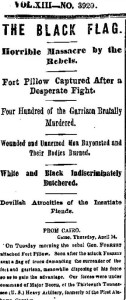
NY Times April 16 1864

NY Times April 16 1864

Lieut Commander Thos Patterson, commanding naval station at Memphis, sent the shipsteamer Platte Valley, with U. S. shipsteamer Sliver Cloud in tow, with ammunition to Fort Pillow. When we [?] arrived in sight of the fort the commissary and other public buildings, with some twelve stores and private property, were in flames, and the rebels were seen moving about applying torches to the barracks, stables and huts.

We threw shells for thirty minutes at detached squads, when a flag of truce appearing we ceased firing and sent a boat ashore. It presently returned with a communication from Gen. Forrest, saying that a large number of our wounded were suffering for want of proper care, and that he would allow us to bury our dead and remove our wounded under a flag of truce, on our agreement that we would not remove anything from the battle field. Capt Ferguson, knowing that our shells would explode among our wounded, causing greater loss of life, agreed to the proposal. Major Anderson, aid to Gen. [F]orrest, drew up the agreement giving us possession of the fortifications and landing till 5 P. M, the truce to end at that hour. The rebels were efficient, and aided us as much as possible in our work. The wounded who were able to walk generally came down the bluff road, supported on either side by a rebel soldier.

He then appends a list of the wounded sent to Cairo by the [P]latte Valley, and remarks:

I know that in storming a fort, where such desperate resistance is offered as was here offered, many must full, but in this instance it looks to me more like indiscriminate butchery than honorable warfare, Now that the excitement is over, the thought of those charred bodies, together with the nause[a] by the stench of roasting human flesh, and two hundred or more bodies, mangled and dying, pleading for quarters, with distorted faces, bayonetted eyes, broken skulls,&c, I am sick and can write no more.
Posted in 150 Years Ago This Week, Military Matters | Tagged , , | Leave a comment

martyr on the home front

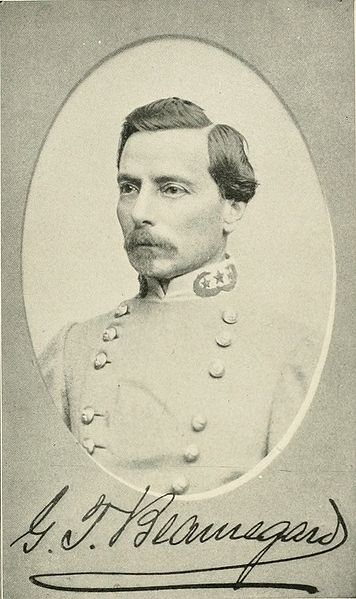
PGTBeauregard (File from The Photographic History of The Civil War in Ten Volumes: Volume One, The Opening Battles   . The Review of Reviews Co., New York. 1911. p. 142.)

hopes to rescue his wife’s “hallowed grave” from Yankee pollution

For well over a year General P. G. T. Beauregard had been in command of the successful defense of Charleston and Fort Sumter from Union assault. 150 years ago today people in Richmond could read his impassioned letter in response to his wife’s March 2nd death in Union-occupied New Orleans.

From the Richmond Daily Dispatch April 11, 1864:

Letter from Gen. Beauregard.

–The following letter has been received by the committee in reply to the resolutions adopted at the meeting of Louisianian in Mobile on the 19th ult., and forwarded by them to Gen. Beauregard:

Charleston, March 28th, 1864.

Gentlemen:

Accept for yourselves, and for the other officers and soldiers from Louisiana, who met with you at Mobile on the 19th instant, my heartfelt thanks for the lofty and touching sentiments expressed in the resolutions which you were pleased to pass on the occasion of the sad event which has torn from me a most dear and beloved wife, and from the State to which she belonged, one of its brightest jewels and ornaments. Mrs. Beauregard died a martyr to our cause. Her continued and long separation from the chosen one of her heart, under the trying circumstances she had to pass through, was more than her care-worn and enfeebled condition could endure. Yet she departed not from life without giving utterance to her undiminished devotion to that noble cause, and to her unshaken faith in its ultimate triumph. She was a true and fervent patriot. The foul breath of even the most vile among the vilest of our enemies never could taint the pure atmosphere that surrounded her.

How bright, how glorious I would deem the day on which it were given to me, at the head of my brave and so hard tried compatriots, to rescue, with her hallowed grave, the noble State that bestowed such honors upon her remains, from the footsteps of the foe who pollutes them by his presence.

with sincere esteem and

Sincere acknowledgments,

I remain, yours most truly,

G. T. Beauregard.

Major Hy. St. Paul, Capt j. T. Purves, Lieut charles Arroyo, committee, Mobile, Ala.

I haven’t seen any evidence that the occupiers singled out Caroline Deslonde Beauregard as a target for any special oppression; just persevering through the pain of Yankee control of New Orleans was probably sacrifice enough. I think there’s a good chance that “the most vile among the vilest of our enemies” could be an allusion to Benjamin Butler. Butler’s successor, Nathaniel Banks, might still have been vile, but, after Caroline’s funeral attended by 6,000 people, he did provide “a steamer to carry her remains to her native parish.”

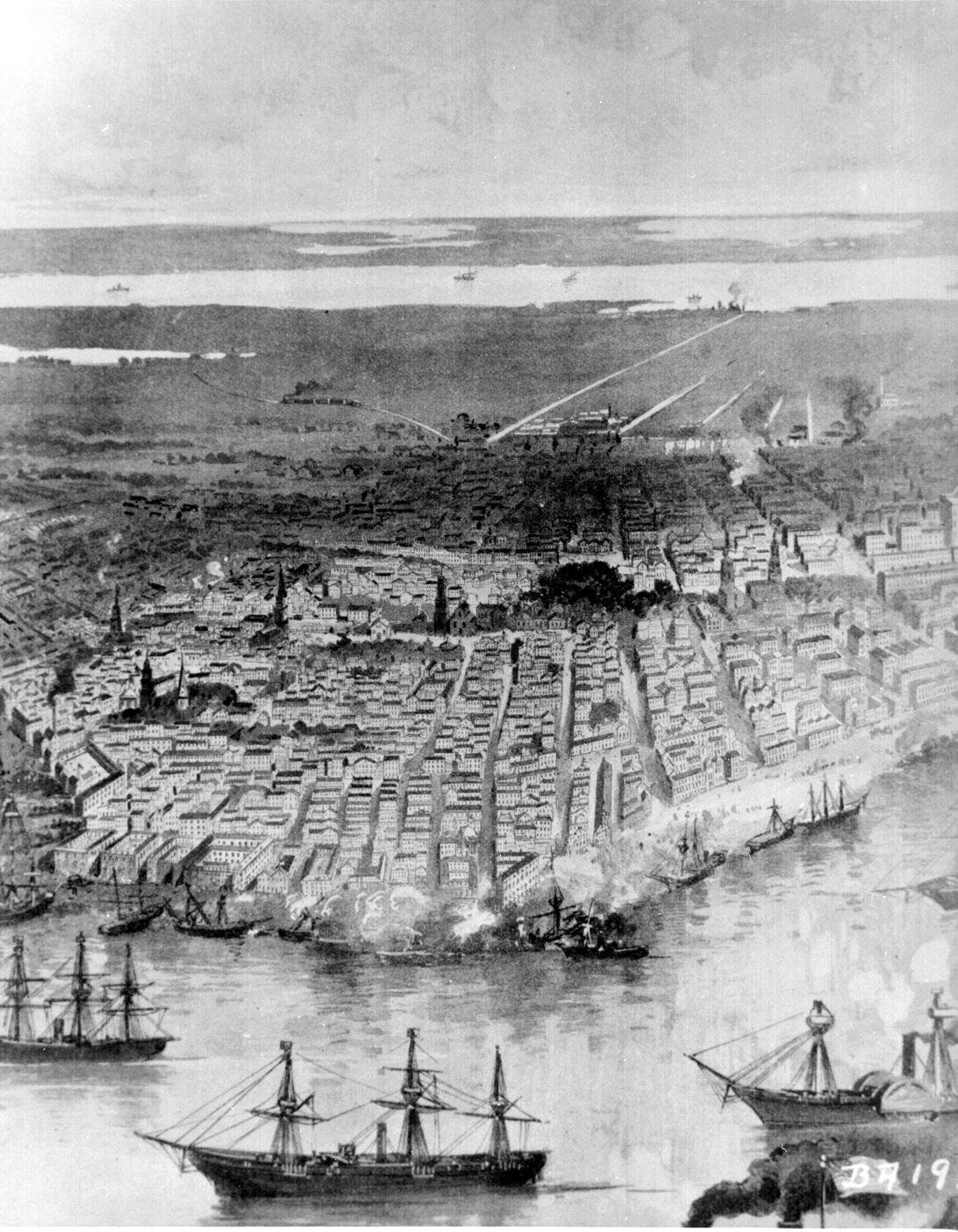
New_orleans_1862 (http://www.archives.gov/research/american-cities/images/american-cities-014.jpg)

“Panoramic View of New Orleans-Federal Fleet at Anchor in the River, ca. 1862.”

Posted in 150 Years Ago This Week, Confederate States of America, Southern Society | Tagged , , | Leave a comment

“equal liberty before the laws”

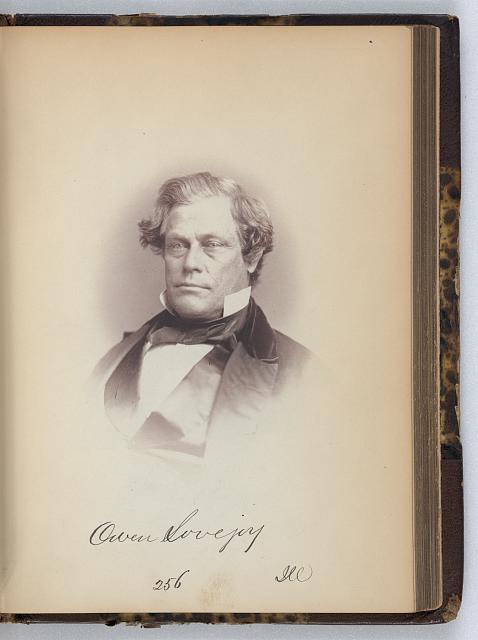
Owen Lovejoy, Representative from Illinois, Thirty-fifth Congress, half-length portrait (by Julian Vannerson, 1859; LOC: LC-DIG-ppmsca-26795)

moral heroism

The April 9, 1864 issue of Harper’s Weekly (at Son of the South) eulogized an abolitionist Congressman from Illinois:

OWEN LOVEJOY.

IN OWEN LOVEJOY the cause of Democracy loses a noble champion. From the moment that he rose from the side of his brother, murdered by the hate of free Democratic principles, down to the last time that be opened his lips to speak, he was the cheerful, steady, fervent advocate of the great American principle. A characteristic and faithful American, whoever studies his character will see the kind of moral heroism and dignity produced by our distinctive principles.

In his earlier career he was a clergyman, and he did not leave his faith behind him, but took it with him into Congress as he carried thither his generous heart, gemal temper, and trenchant speech. His companions in Congress of every party-sympathy mingled their regrets over his grave. Mr. ODELL, of New York, in whose neighborhood, in Brooklyn, Mr. LOVEJOY died, said that his efforts to suppress the rebellion were paramount to every other consideration. Mr. PENDLETON, of Ohio, said that what Mr. LOVEJOY believed he expressed, and was at all times prepared to defend his positions. Mr. STEVENS, of Pennsylvania, said that he was not afraid to vindicate the right any where. Mr. FARNSWORTH, of Illinois, knew him as, a good neighbor. Mr. ALLEN, of Illinois, found him always pushing vigorously on to promote what he thought the interests of his country and race. Mr. WASHBURNE, of Illinois, declared him wise, vigilant, incorruptible.

They are noble words to be truly spoken of any man; nor will any one doubt that they were true of him. His name as the brother of ELIJAH P. LOVEJOY—as much a martyr to liberty as NATHAN HALE–and for his own brave words and unspotted life, will be always noted in our history. The laborers are called away, but the work goes on. Devotion to the Democratic principle of equal liberty before the laws must be its own reward. With OWEN LOVEJOY it was so. His steady soul pursues its career ; but wherever it may be, its faith in the love of God and the brotherhood of men is no surer than when his visible life illustrated it.

Owen Lovejoy:

was an American lawyer, Congregational minister, abolitionist, and Republican congressman from Illinois. He was also a “conductor” on the Underground Railroad. After his brother Elijah Lovejoy was murdered in November 1837 by pro-slavery forces, Owen became the leader of abolitionists in Illinois. … Owen was present on the night of November 7, 1837 when his brother Elijah was murdered while trying to defend the printing press of the Illinois Anti-Slavery Society from an angry mob. He is reported to have sworn on his brother’s grave to “never forsake the cause that had been sprinkled with my brother’s blood.”

After the pro-slavery mob in Alton, Illinois shot and killed Elijah Parish Lovejoy, it destroyed Elijah’s printing press and threw the pieces into the Mississippi. Owen and his brother Joseph wrote Memoir of the Rev. Elijah P. Lovejoy; who was murdered in defence of the liberty of the press, at Alton, Illinois, Nov. 7, 1837. As you can see from the link I threw into the Harper’s piece Wendell Phillips defended Elijah for sacrificing his life defending the freedom of the press.

Posted in 150 Years Ago This Week, Northern Society | Tagged , , , , , , | Leave a comment

no gray area

Gen. Lew Wallace (Hartford, Conn. : The War Photograph & Exhibition Co., No. 21 Linden Place, [between 1861 and 1865]; LOC: LC-DIG-stereo-1s02866 )

‘no political rights for rebels and traitors’

Baltimore erupted in April 1861 as Northern troops marched through it on their way to defend the United States’ capital. Three years later, the recently appointed military commander in Baltimore apparently was trying to make it clear that he wasn’t going to play any games.

From the Richmond Daily Dispatch April 8, 1864:

The prospect for Baltimore.

–The people of Baltimore have a gloomy prospect before them just now. Maj. Gen. Lew Wallace has been appointed military Governor of that department, and we find the following in the Baltimore American concerning his entering on his duties:

The new commandant of this military department, Major Gen. Lew Wallace, in his response to the welcome extended to him by the City Council yesterday, made the following explicit declaration of his views with regard to the political rights of the disloyal

“He held that a rebel and a traitor had no political rights.”

We therefore regard this declaration of Major General Wallace as a significant intimation of his intention to prevent all who have taken part in the rebellion, or who have, by their sympathy or their acts, given aid and comfort to the enemy, and who have rejoiced over our defeats and mourned over our victories, from enjoying the political rights they have clearly forfeited. Every one of them are still rebels at heart, and their votes will be given only to the detriment of the wishes and purposes of all truly loyal citizens. After the war is over it will be time enough to take into consideration the future political rights of rebels and traitors.–Whilst it lasts they have, in the language of Gen Wallace, “no political rights.”

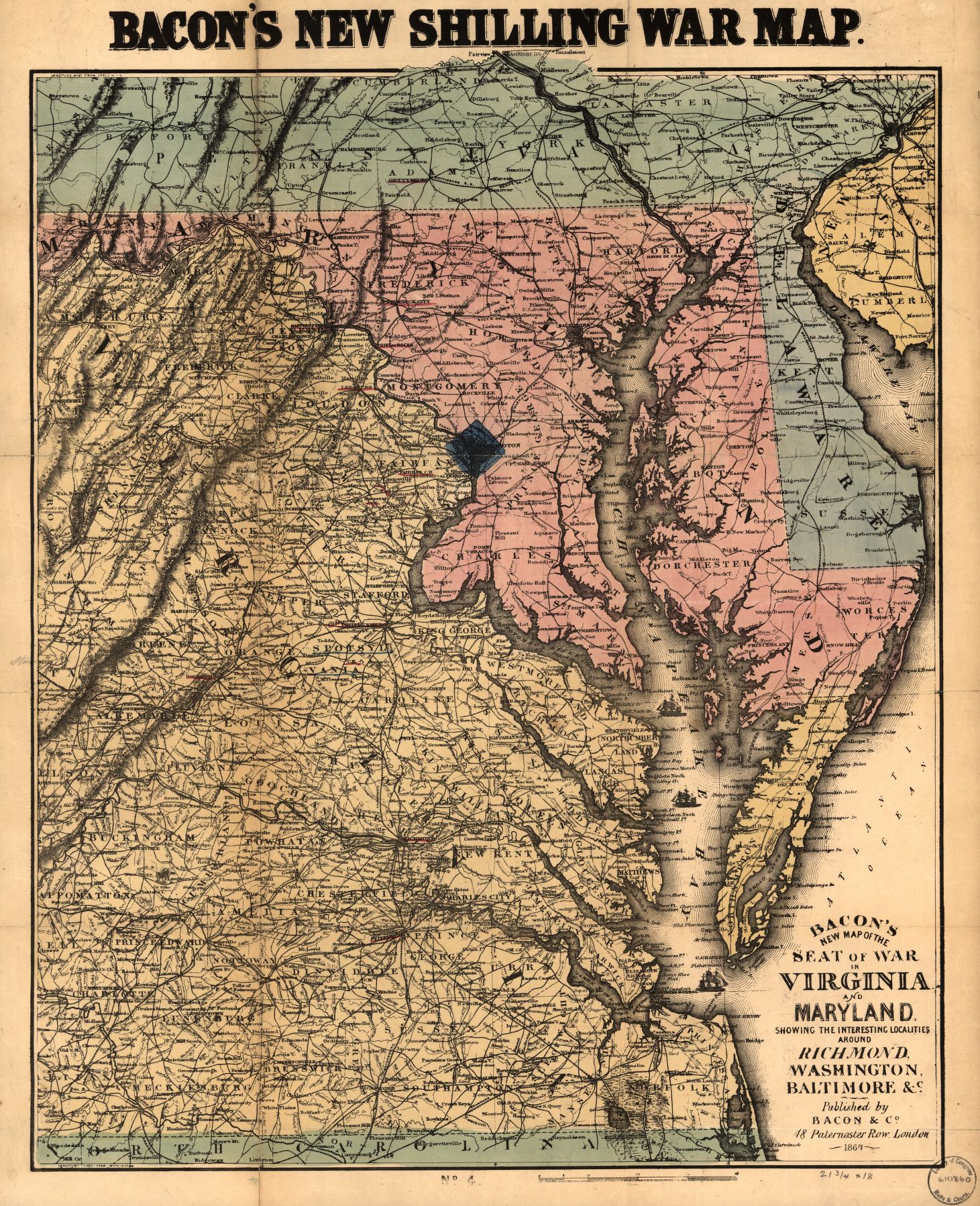
VA-MD 1864(http://www.loc.gov/item/99448888/)

still a seat of war in 1864

Posted in 150 Years Ago This Week, Military Matters | Tagged , | Leave a comment

angel arguments

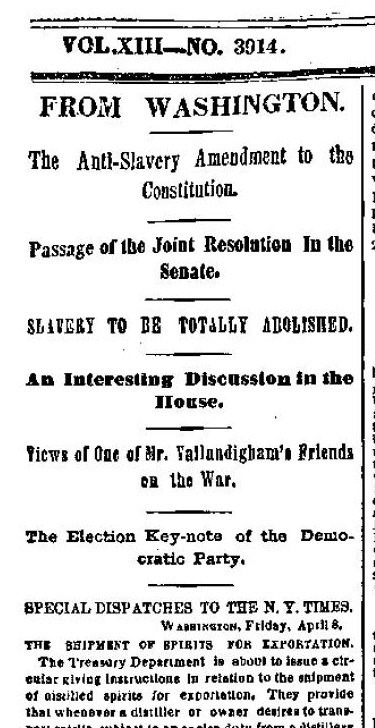
NYT 4-9-1864

em>The New-York Times April 9, 1864

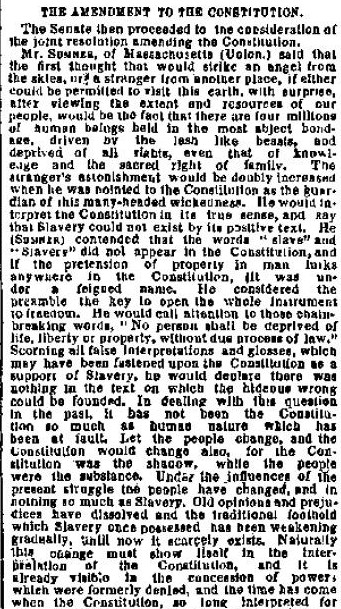
150 years ago today the first Constitutional step was taken to amend the Constitution regarding slavery. The United States Senate passed a resolution to make the Constitution explicitly forbid slavery throughout the United States. The Thirteenth Amendment would eventually become law in December 1865. In the debate on the resolution Charles Sumner said a visiting angel or any other stranger to earth would be shocked at 4 million people in bondage, “driven by the lash like beasts, and deprived of all rights, even that of knowledge and the sacred right of family. The stranger’s astonishment would be doubly increased when he was pointed to the Constitution as the guardian of this many-headed wickedness.”

The Harper’s Weekly of April 23, 1864 (at Son of the South) focused on the arguments of the senators who voted against the resolution:

THE AMENDMENT TO THE CONSTITUTION.

3g02525r

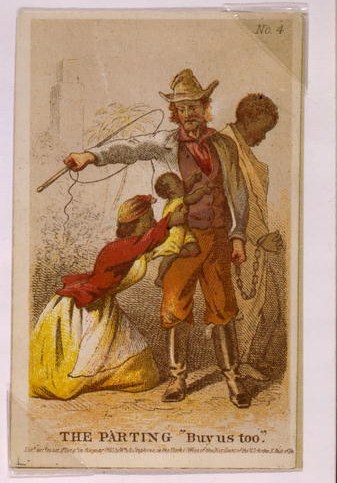
“sacred right of family”?

ON the 8th of April, 1864, at the close of the third year of a civil war produced by the tragical and futile effort to unite in one peaceful government the principle of the fullest popular freedom and of the most abject despotism, the Senate of the United States, by a vote of thirty-eight to six, proposed to amend the Constitution in the manner itself provides, for the purpose of prohibiting slavery in the United States. That nothing might be wanting to the moral grandeur and dignity of the occasion, the resistance offered to this truly American act by the truly un-American advocates of human slavery was as contemptible as the system itself is revolting.

Of the six Senators who voted against the resolution four made brief speeches. Mr. POWELL, of Kentucky, said that if there had been no Abolitionists there would have been no rebellion : an inanity too incredible. Mr. SAULSBURY, of Delaware, proposed to secure liberty of speech and of the press; and reestablish the principles of the Missouri Compromise—which was a proposition to feed a fire with water. For how can slavery and free speech coexist? Mr. DAVIS, of Kentucky, declared the constitutional abolition of slavery a wicked and unjust act, against which he was aware the protest of an angel would be of no avail ; forgetting that the only angel who would have wished to protest was named LUCIFER, and fell from heaven. Mr. M’DOUGALL, of California, announced that he was devoted to human freedom, and therefore, as a true friend of man, should vote in favor of slavery.

Sumner  NY Times 4-8-1864

what Sumner said

And this was the expiring gasp in the United States Senate of the infernal iniquity to whose service the clear, cold casuistry and subtle sophistry of CALHOUN was formerly devoted ; before which WEBSTER used to bow ; from whose snare the human-hearted CLAY could never break away; which, by the universal obsequiousness of the American people, had succeeded in coiling its horrid folds around all our liberties, and from whose fatal embrace this war is the struggle of the national life to escape. Yet that final escape is worth the war. The innumerable hearts that are broken, the countless homes that are desolate in our own land, and the earnest friends in other countries who understand the scope of the struggle, will own that when the great act initiated by the Senate is completed, the costly sacrifice of youth and hope and love is not in vain, and that the future of equal justice which this measure secures is well bought by all the blood and sorrow of the war.

The issue is at last openly joined. If the House fail to concur by the necessary two-thirds vote, the Congressional elections of next autumn will turn upon the question of the Constitutional Amendment, and the vote of this spring shows what the result will be.

In the South April 8, 1864 was observed “as a day of humiliation, fasting, and prayer.”

From the Richmond Daily Dispatch April 11, 1864:

Day of fasting and prayer.

–As far as could be judged from outward appearances, Friday was universally observed in this city in accordance with the suggestions of the President’s proclamation. All places of business were closed, and there was divine service in all the churches at the usual hour of the morning.

At 8 o’clock, P. M., the Rev. Dr. J. L. Burrows, of the Baptist church, preached at the Theatre to an immense audience, among whom were a great number of ladies. In a few minutes after the doors were opened, every seat and every available foot of space in the building was occupied, and it is estimated that between eight hundred and a thousand persons were turned away from the doors, being unable to gain admittance because of the crowd. Dr. Burrows delivered a discourse of an hour and a quarter in length, from XXVI. Leviticus, 23, 24.

From Leviticus 26:

23 And if ye will not be reformed by me by these things, but will walk contrary unto me;

24 Then will I also walk contrary unto you, and will punish you yet seven times for your sins.

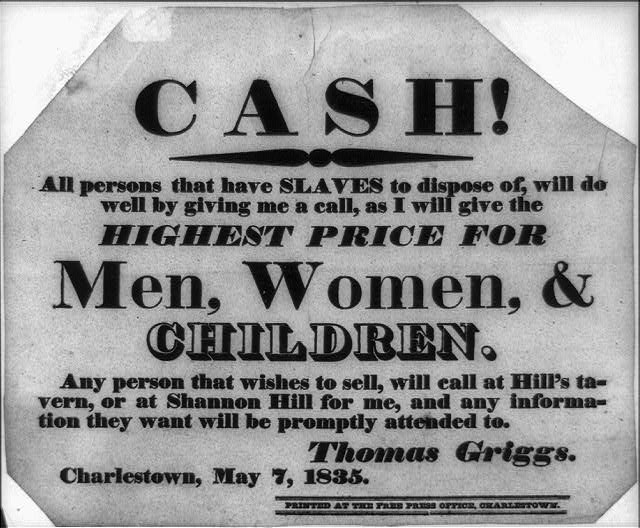
Cash! All person that have slaves to dispose of, .

commodities no more?

Posted in 150 Years Ago This Week, Confederate States of America, Northern Politics During War, Northern Society, Southern Society | Tagged , , | Leave a comment

just deserts

“Tell all my friends to come out of the woods”

Regardless of how factual the following letter may have been, it would certainly seem to have had propaganda value as Confederate armies prepared for the upcoming spring campaigns. The Dispatch would have liked it also because the paper would much prefer to have army numbers increased by rounding up deserters instead of by drafting newspapermen.

From the Richmond Daily Dispatch April 7, 1864:

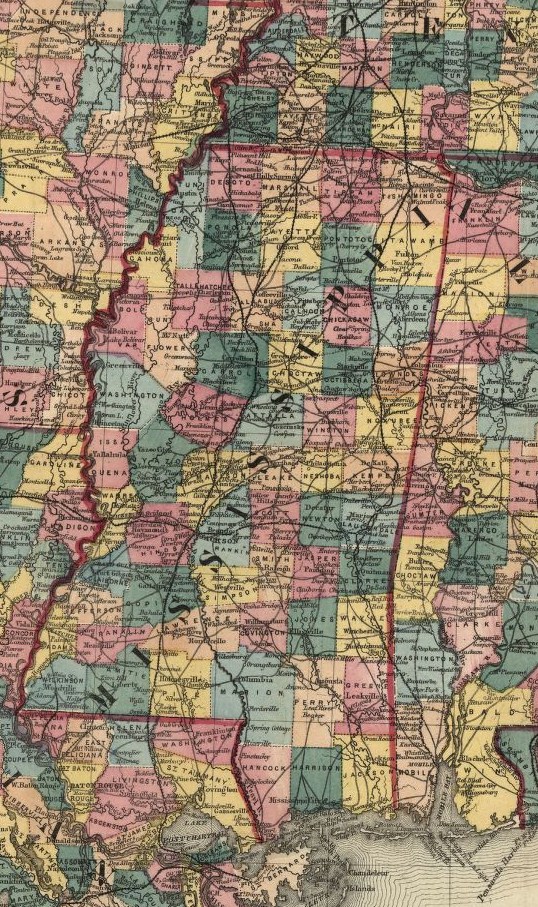
Mississippi 1864 (by Created / Published     Cincinnati, E. Mendenhall, 1864.; LOC: http://www.loc.gov/item/gm70005001/)

“had been hiding in the woods in Mississippi.” (1864 map)

Last letter of a Deserter.

–Our cavalry, under Col. H. Maury, recently captured a number of deserters from the Confederate army, who had been hiding in the woods in Mississippi. One of them, named Mitchell, was among those who were hung. The following is a copy of a letter written by him just before his execution:

Jones County, March12, 1864

My Dear Wife:

–I avail myself, through the kindness of a friend and minister, to write you a few lines, the last communication you will ever have from me on this earth. It is very painful for me never to see you any more, and in this I bid you a final farewell.

My child! my only child! be a good girl and try to meet me in heaven!

My dear wife, I can only say to you that I am gone to eternity ere you read this letter, and I wists you to do the best you can in this world and try to meet me in the better land. I have a strong hope that I shall be better off. I am going to hang by the neck, which is a torture to my body; but, thank God, the immortality cannot be tortured in this life or in this world. I want you all to get home to heaven when you die.

I have but a short time to reflect, and my mind is very much disturbed and must omit many things that I would like to say. I wish all my friends better than to come to share my fate. I want my relations to take warning by me not to come to my end. I advise my brothers to come in and give up if they can be pardoned, and hear there is a pardon for all that are not caught in arms. Tell all my friends to come out of the woods; it is a bad life and I have come to a bad end, and it may overtake them also. So farewell, my wife and child, for the last time, and may heaven bless you.

Your own dear husband,

H. Mitchell.

Posted in 150 Years Ago This Week, Confederate States of America, Military Matters, Southern Society | Tagged | Leave a comment

one nation …

According to the Library of Congress, on March 26, 1864 President Lincoln met with three prominent Kentuckians who disagreed with the federal policy of recruiting Kentucky slaves for the Union army. Newspaper editor Albert G. Hodges was so impressed with the president’s response that he asked Mr. Lincoln for it in writing. From The Papers And Writings Of Abraham Lincoln, Volume Seven:

TO A. G. HODGES.
EXECUTIVE MANSION, WASHINGTON, April 4, 1864.

A. G. HODGES, ESQ., Frankfort, Kentucky:

MY DEAR SIR:—You ask me to put in writing the substance of what I verbally said the other day, in your presence, to Governor Bramlette and Senator Dixon. It was about as follows:

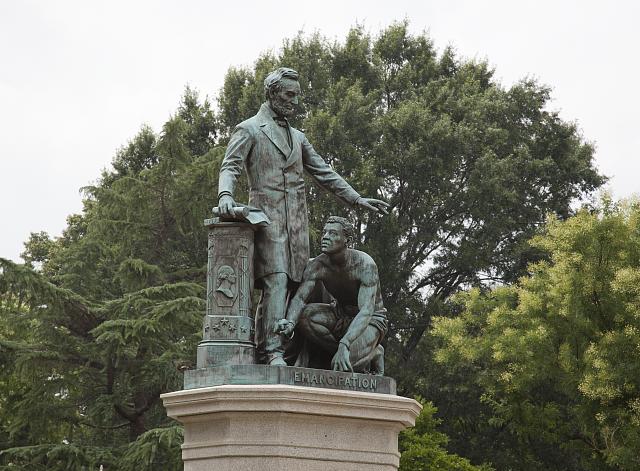
Statue of Abraham Lincoln, Lincoln Park, Washington, D.C. (by Carol M. Highsmith, 2010; LOC: LC-DIG-highsm-10341)

slavery is wrong; preserving the Constitution requires preserving an intact nation; we have 130,000 more troops and laborers for the Union military

“I am naturally anti-slavery. If slavery is not wrong, nothing is wrong. I cannot remember when I did not so think and feel, and yet I have never understood that the Presidency conferred upon me an unrestricted right to act officially upon this judgment and feeling. It was in the oath I took that I would to the best of my ability preserve, protect, and defend the Constitution of the United States. I could not take the office without taking the oath. Nor was it my view that I might take an oath to get power, and break the oath in using the power. I understood, too, that in ordinary civil administration this oath even forbade me to practically indulge my primary abstract judgment on the moral question of slavery. I had publicly declared this many times, and in many ways. And I aver that, to this day, I have done no official act in mere deference to my abstract judgment and feeling on slavery. I did understand, however, that my oath to preserve the Constitution to the best of my ability, imposed upon me the duty of preserving, by every indispensable means, that government, that nation, of which that Constitution was the organic law. Was it possible to lose the nation and yet preserve the Constitution? By General law, life and limb must be protected; yet often a limb must be amputated to save a life; but a life is never wisely given to save a limb. I felt that measures, otherwise unconstitutional, might become lawful, by becoming indispensable to the preservation of the Constitution, through the preservation of the nation. Right or wrong, I assumed this ground, and now avow it. I could not feel that to the best of my ability I had even tried to preserve the Constitution, if, to save slavery, or any minor matter, I should permit the wreck of government, country, and Constitution, altogether. When, early in the war, General Fremont attempted military emancipation, I forbade it, because I did not then think it an indispensable necessity. When, a little later, General Cameron, then Secretary of War, suggested the arming of the blacks, I objected, because I did not yet think it an indispensable necessity. When, still later, General Hunter attempted military emancipation, I again forbade it, because I did not yet think the indispensable necessity had come. When, in March, and May, and July, 1862, I made earnest and successive appeals to the Border States to favor compensated emancipation, I believed the indispensable necessity for military emancipation and arming the blacks would come, unless averted by that measure. They declined the proposition, and I was, in my best judgment, driven to the alternative of either surrendering the Union, and with it the Constitution, or of laying strong hand upon the colored element. I chose the latter. In choosing it, I hoped for greater gain than loss, but of this I was not entirely confident. More than a year of trial now shows no loss by it in our foreign relations, none in our home popular sentiment, none in our white military force, no loss by it any how, or anywhere. On the contrary, it shows a gain of quite one hundred and thirty thousand soldiers, seamen, and laborers. These are palpable facts, about which, as facts, there can be no caviling. We have the men; and we could not have had them without the measure.

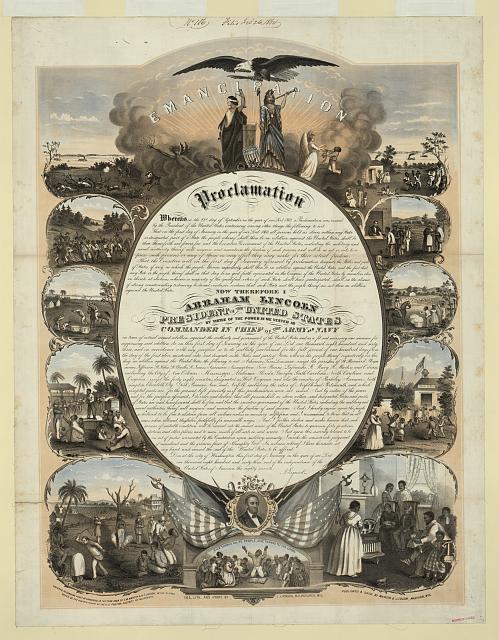
Emancipation Proclamation (Madison, Wis. : Martin & Judson, c1864 Feb. 26; LOC: LC-DIG-pga-02040)

“laying strong hand upon the colored element”

“And now let any Union man who complains of the measure test himself by writing down in one line that he is for subduing the rebellion by force of arms; and in the next, that he is for taking these hundred and thirty thousand men from the Union side, and placing them where they would be but for the measure he condemns. If he cannot face his case so stated, it is only because he cannot face the truth.”

I add a word which was not in the verbal conversation. In telling this tale I attempt no compliment to my own sagacity. I claim not to have controlled events, but confess plainly that events have controlled me. Now, at the end of three years’ struggle, the nation’s condition is not what either party, or any man, devised or expected. God alone can claim it. Whither it is tending seems plain. If God now wills the removal of a great wrong, and wills also that we of the North, as well as you of the South, shall pay fairly for our complicity in that wrong, impartial history will find therein new cause to attest and revere the justice and goodness of God.

Yours truly,

A. LINCOLN.

150 years ago today the president explained that it was not in his power to free all slave children:

TO MRS. HORACE MANN.
EXECUTIVE MANSION, WASHINGTON, April 5, 1864.

MRS HORACE MANN:

MADAM:—The petition of persons under eighteen, praying that I would free all slave children, and the heading of which petition it appears you wrote, was handed me a few days since by Senator Sumner. Please tell these little people I am very glad their young hearts are so full of just and generous sympathy, and that, while I have not the power to grant all they ask, I trust they will remember that God has, and that, as it seems, he wills to do it.

Yours truly,

A. LINCOLN.

Posted in 150 Years Ago This Week, Lincoln Administration, Military Matters, Northern Society | Tagged , , , , , , | Leave a comment

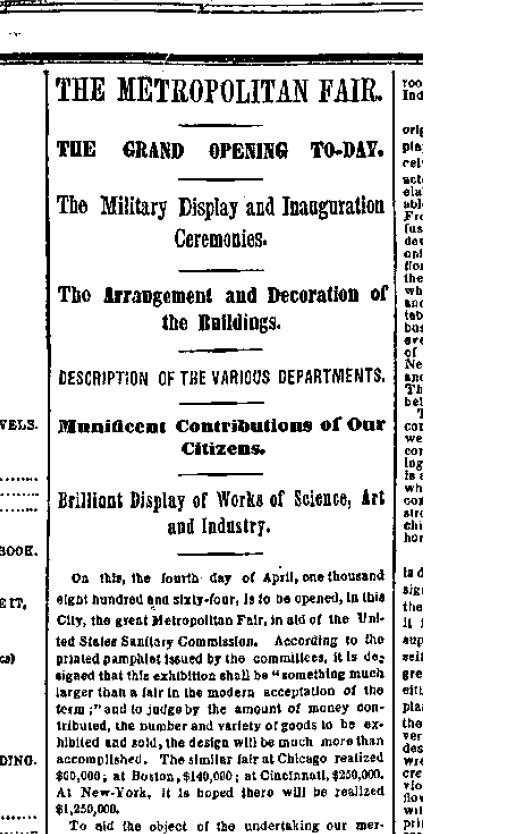
aiming for $1,250,000

NY Times, Metropolitan Fair 1864

The New-York Times April 4, 1864

150 years ago cities throughout the North held fairs to raise funds for the healing work of the United States Sanitary Commission. A fair opened in Brooklyn back on Washington’s birthday. 150 years ago today the Metropolitan Sanitary Fair began across the East River on Manhattan. Gotham wasn’t planning on being outdone. According to The New-York Times of April 4, 1864:

The similar fair at Chicago realized $[6?]0,000; at Boston, $140,000; at Cincinnati, 250,000. At New-York, it is hoped there will be realized 1,250,000.

If you browse over to Son of the South you can see many images of the big doings in many of the April 1864 issues of Harper’s Weekly. The newspaper also listed cash contributions to the cause by businesses involved in the “Book Trade.”

The Metropolitan Sanitary Fair - the Indian Department [NYC. Indians dancing on stage] (Illus. in: Frank Leslie's illustrated newspaper, vol. 18, no. 446 (1864 Apr. 16), p. 49; LOC: LC-USZ61-1861)

Indians dancing on stage at the fair ( Frank Leslie’s illustrated newspaper, 4-16-1864)

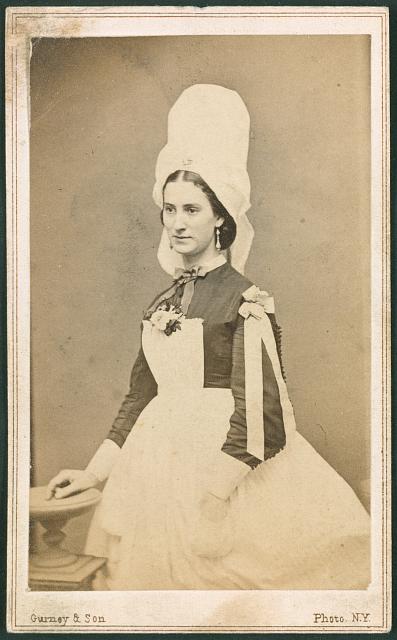
Costume of ladies' at the Normandy stand, Metropolitan Fair, April 1864 ( Photographed by J. Gurney & Son, N.Y. in aid of the U.S. Sanitary Commission at the New York Metropolitan Fair, April 1864; LOC:  LC-DIG-ppmsca-31222)

“Costume of ladies’ at the Normandy stand, Metropolitan Fair, April 1864

Posted in 150 Years Ago This Week, Northern Society | Tagged , | Leave a comment