Campaign Literature

Extra_Billy_Smith-Virgini

I’d like to campaign more, but I’ll be busy fighting Yankees

From the Richmond Daily Dispatch February 13, 1863:

To the Voters of Virginia.

–Fellow-citizens: Having been requested by many of you to become a candidate for the office of Governor at the regular election in May next, I respectfully announce that I cheerfully yield to such request, and, in the event of my election, will diligently and to the best of my ability perform the duties of the position.

I am sensible of the responsibilities which I announce my willingness to assume. I am painfully aware of the g[al]lant struggle which is in progress, and that it may be my duty to assume such responsibilities without counting the cost to myself. In such event I shall unhesitatingly do so, only asking the liberal construction of my fellow-citizens for my vindication and defence.

I regret that it will not be in my power to appear among you and address you upon public affairs. But, having deemed it my duty to adhere to the army, to which, after a confinement of some months, I am about to return, I shall not have an hour to spare for any other purpose. I regret this the less, however, as I flatter myself that I am sufficiently well known to you in person, or by reputation, to enable you to exercise the sovereign power of suffrage with all proper intelligence.
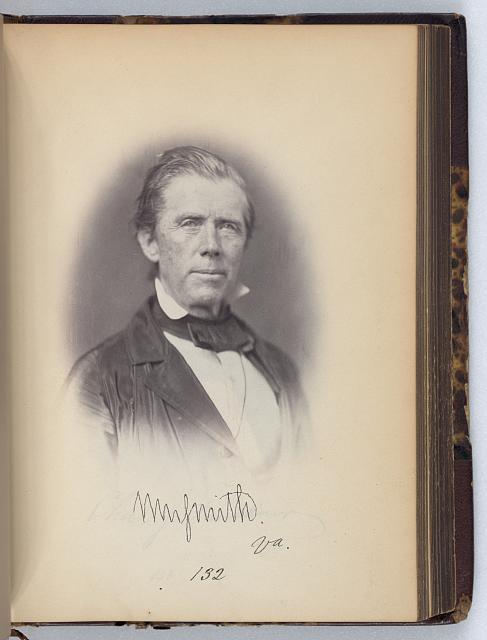
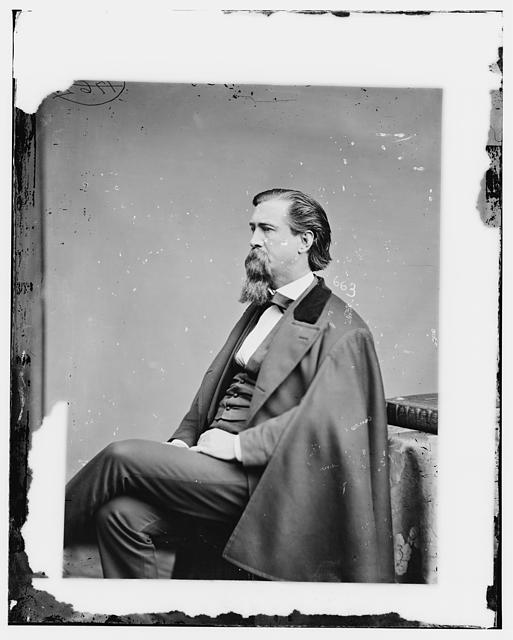
William Smith, Representative from Virginia, Thirty-fifth Congress, original signature (by Julian Vannerson, 1859; LOC: LC-DIG-ppmsca-26671)

an extra Billy (as (Democratic) United States representative from Virginia in 1859)

With no parties to divide us — with but one great impulse — that which seeks to protect our liberties and establish our independence — we surely can work together with one will to realize this vital consummation. At any rate, if elected, I shall seek to deserve your confidence by devoting to the duties of my position all the powers of mind and body which I possess.

Believing, if true to ourselves, that a gracious Providence will crown our righteous and glorious efforts with success, I have the honor to be, most respectfully and cordially, your fellow-citizen.

William Smith.

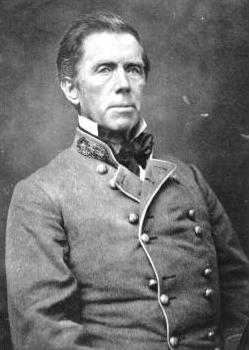
William “Extra Billy” Smith was “the oldest Confederate general to hold field command in the American Civil War”. He suffered three wounds at Antietam but returned to the field in March (after serving in the Confederate Congress during his recuperation). He won the May 1863 gubernatorial election; he resigned his field command on July 10, 1863. Mr Smith went to Richmond in time to serve as Virginia’s governor from January 1, 1864 until the end of the war.

You can learn a great deal about Extra Billy at his website.

It is debatable whether the lack of defined political parties in the Confederacy had a positive or negative impact.
Posted in 150 Years Ago This Week, Confederate States of America, Southern Society | Tagged , | 2 Comments

‘then comes marriage’

Civil War wedding

March 18, 1863

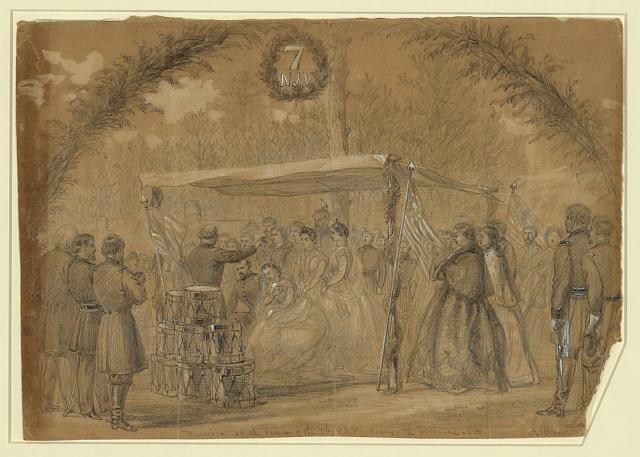
This imaged was published in the April 4, 1863 issue of Harper’s Weekly. You can view Alfred R. Waud’s picture full-size and read his accompanying description of the wedding at Son of the South:

Few persons are wedded under more romantic circumstances than Nellie Lammond and Captain De Hart. He could not get leave of absence, so she came down like a brave girl, and married him in camp.

Posted in Military Matters | Tagged | Leave a comment

Fan Mail

The Ladies’ Aid Society in Canandaigua, New York began 1863 by attending a P. T. Barnum lecture and by writing an adoring letter to the deposed General George B. McClellan.

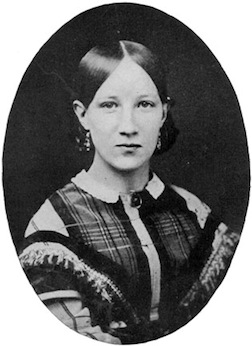
Caroline Cowles Richards, 1860

Big Admirer of Little Mac

From Village Life in America 1852-1872 by Caroline Cowles Richards (149-151):

January 13.—P. T. Barnum delivered his lecture on “The Art of Money Getting” in Bemis Hall this evening for the benefit of the Ladies’ Aid Society, which is working for the soldiers. We girls went and enjoyed it.

February.—The members of our society sympathized with General McClellan when he was criticised by some and we wrote him the following letter:

“Canandaigua, Feb. 13, 1863.

“Maj. Gen. Geo. McClellan:

“Will you pardon any seeming impropriety in our addressing you, and attribute it to the impulsive love and admiration of hearts which see in you, the bravest and noblest defender of our Union. We cannot resist the impulse to tell you, be our words ever so feeble, how our love and trust have followed you from Rich Mountain to Antietam, through all slanderous attacks of traitorous politicians and fanatical defamers—how we have admired, not less than your calm courage on the battlefield, your lofty scorn of those who remained at home in the base endeavor to strip from your brow the hard earned laurels placed there by a grateful country: to tell further, that in your forced retirement from battlefields of the Republic’s peril, you have ‘but changed your country’s arms for more,—your country’s heart,’—and to assure you that so long as our country remains to us a sacred name and our flag a holy emblem, so long shall we cherish your memory as the defender and protector of both. We are an association whose object it is to aid, in the only way in which woman, alas! can aid our brothers in the field. Our sympathies are with them in the cause for which they have periled all—our hearts are with them in the prayer, that ere long their beloved commander may be restored to them, and that once more as of old he may lead them to victory in the sacred name of the Union and Constitution.

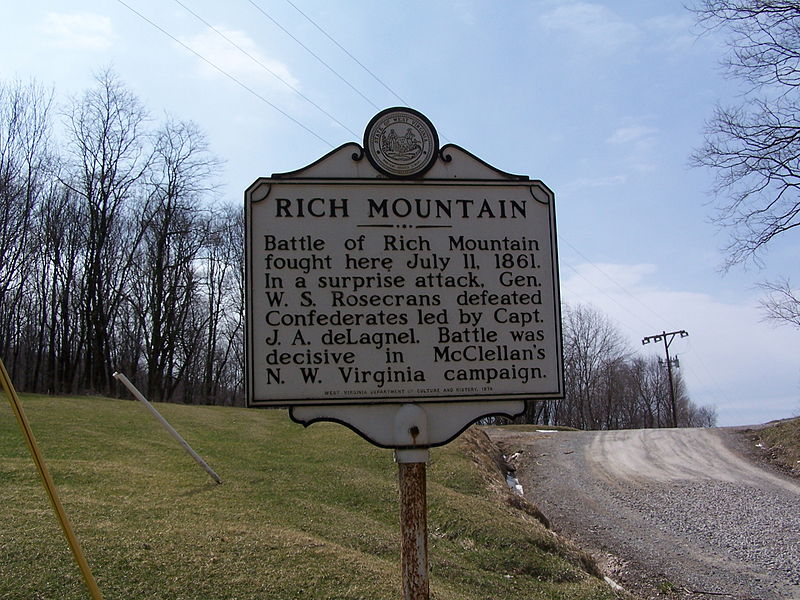
Historical marker on Rich Mountain

where fame began

“With united prayers that the Father of all may have you and yours ever in His holy keeping, we remain your devoted partisans.”

Signed by a large number.

The following in reply was addressed to the lady whose name was first signed to the above:

“New York, Feb. 21, 1863.

“Madam—I take great pleasure in acknowledging the receipt of the very kind letter of the 13th inst., from yourself and your friends. Will you do me the favor to say to them how much I thank them for it, and that I am at a loss to express my gratitude for the pleasant and cheering terms in which it is couched. Such sentiments on the part of those whose brothers have served with me in the field are more grateful to me than anything else can be. I feel far more than rewarded by them for all I have tried to accomplish.—I am, Madam, with the most sincere respect and friendship, yours very truly,

Geo. B. McClellan.”

The general always seems to care for and respect his troops. Maybe too much.

According to Wikipedia’s account of McClellan’s early work in northwest Virginia (with references to George B. McClellan: The Young Napoleon by Steven W. Sears):

His forces moved rapidly into the area through Grafton and were victorious at the tiny skirmish called the Battle of Philippi Races, arguably the first land conflict of the war. His first personal command in battle was at Rich Mountain, which he also won, but only after displaying a strong sense of caution and a reluctance to commit reserve forces that would be his hallmark for the rest of his career. His subordinate commander, William S. Rosecrans, bitterly complained that his attack was not reinforced as McClellan had agreed. Nevertheless, these two minor victories propelled McClellan to the status of national hero. The New York Herald entitled an article about him “Gen. McClellan, the Napoleon of the Present War.”

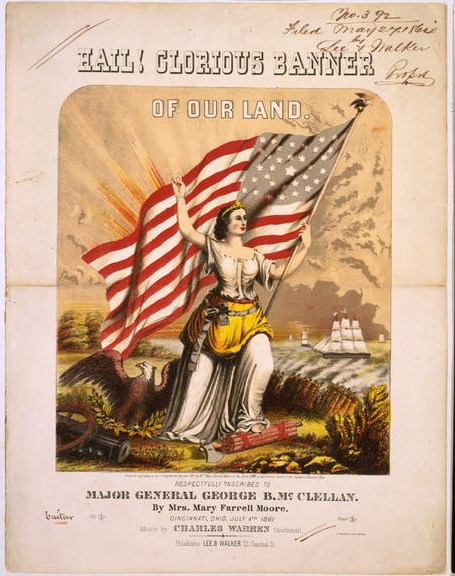
Hail! Glorious banner of our land Respectfully inscribed to Major General George B. McClellan - By Mrs. Mary Farrell Moore, Cincinnati, Ohio, July 4th 1861 (Philadelphia : Lee & Walker, c1861; LOC: LC-USZC4-1739)

early adulation: Respectfully inscribed to Major General George B. McClellan, July 4, 1861

Brian M. Powell’s photo of the Rich Mountain maker is licensed by Creative Commons

Posted in 150 Years Ago This Week, Northern Society | Tagged , , , | Leave a comment

Happy Birthday, Mr. Perseverance

150 years ago today Abraham Lincoln completed 54 earthly years. Nowadays his brief bio is used as an inspirational piece – the story of a person who sort of failed his way to the top. He definitely kept on learning and then worked his way up in politics. When he became president he had to overcome all sorts of opposition to keep the Union together. Politicians need thick skins.

From the Richmond Daily Dispatch February 2, 1863:

Is he a man or a dog?

A Northern paper informs us that the President of the Yankees, after reading some severe strictures upon his character in one of the newspapers exclaimed, “Am I Abraham Lincoln, or am I a dog?”

We trust that the natural philosophers of Doodledom will make haste to assist their master in the solution of this open question. It is one which involves not only his own status, but the classification of the entire race of which he is the representative dog, or man, as the case may be — They have deliberately elected as their Chief Magistrate a nondescript, who is himself unable to decide whether he is a man or a dog. Posterity, judging them by their actions, will never believe that either Abraham or his followers were men.–But it does not follow, because they are not entitled to the name of men that they are dogs.–We should be loath to do such injustice to “those American citizens” of canine descent whom Nature has denied the means of defending themselves from the imputation implied in the inquiry, “Am I Abraham Lincoln, or am I a dog?” Abraham is certainly not a dog — at all events, not a dog of the higher classes. He is no dog of St. Bernard or Newfoundland, for his instincts are destructive not conservative, and his manners lack the majestic dignity and repose of those benevolent and magnanimous creatures. He is not a bulldog nor a mastiff; for while he is more ferocious than either, he is neither honest nor brave. He is not a shepherd’s dog, for he worries and scatters instead of guiding and guarding the sheep. He has gone [?] of the vulgar habits of dogs and like the dog in the fable, he jumps into the stream after the shadow of meat, and loses the substance. But the good sense and affectionateness of even the lowest order of ours are beyond the capacity of the Yankee President. On the whole, we should be inclined to answer the question. “Am I Abraham Lincoln or am I a dog?”–you are Abraham Lincoln.

Posted in 150 Years Ago This Month, Confederate States of America, Southern Society | Tagged | Leave a comment

Congressman Stonewall Jackson?

Hon. D.W. Voorhees (between 1860 and 1875; LOC: LC-DIG-cwpbh-00479)

Wabash fireball

From Indiana???

From the Richmond Daily Dispatch February 10, 1863:

Stonewall Jackson’s Popularity.

A few days since a lady who came through the lines at Fredericksburg under flag of truce, brought a message from Hon. D. W. Voorhees, of Indiana, to Gen. Jackson, to the effect that he (Stonewall) was the only man living who could beat him (Voorhees) in his Congressional district, so great is the admiration of the distinguished chieftain in the Northwest.

Daniel Wolsey Voorhees was a Copperhead Democrat representative in the U.S. House throughout the Civil War. Wikipedia quotes from Kenneth M. Stampp, Indiana Politics during the Civil War (1949):

There was an earthy quality in Voorhees, “the tall sycamore of the Wabash.” On the stump his hot temper, passionate partisanship, and stirring eloquence made an irresistible appeal to the western Democracy. His bitter cries against protective tariffs and national banks, his intense race prejudice, his suspicion of the eastern Yankee, his devotion to personal liberty, his defense of the Constitution and state rights faithfully reflected the views of his constituents. Like other Jacksonian agrarians he resented the political and economic revolution then in progress. Voorhees idealized a way of life which he thought was being destroyed by the current rulers of his country. His bold protests against these dangerous trends made him the idol of the Democracy of the Wabash Valley. (p. 211)

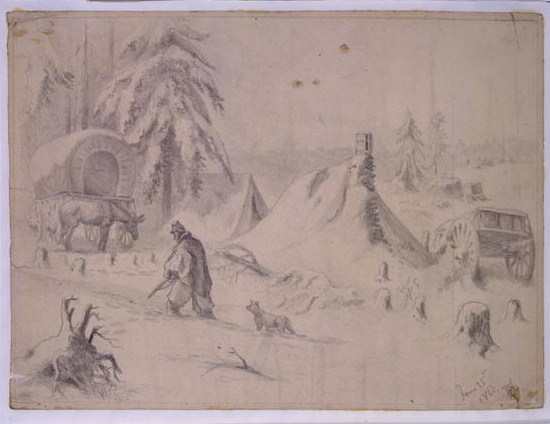
Winter camp near Stoneman's Switch, Falmouth, Va. (by Edwin Forbes, 1863 Jan. 25; LOC: LC-USZC4-4226)

Union side of the Rappahannock, January 25, 1863

Posted in 150 Years Ago This Week, Northern Politics During War | Tagged , , , | Leave a comment

Pressman Promoted

From a Seneca County, New York newspaper on February 7, 1863:

Promoted.

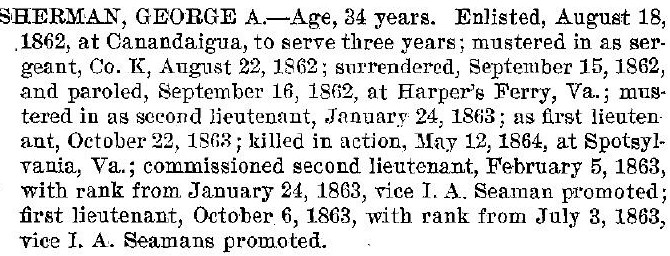
We are pleased to learn that GEORGE A. SHERMAN, formerly foreman in this office, who volunteered last summer as a private in Company K, 126th Regiment, has been promoted to the rank of Second Lieutenant, in place of H. CLAY LAWRENCE, resigned.

This promotion has, no doubt, been well earned; for Lieut SHERMAN is a true man, faithful and thorough in everything he undertakes. – Canandaigua Times.

Mr. SHERMAN is an old resident of this place, and was connected with the REVEILLE office as foreman for more than six years. – His many friends here will be glad to hear of his good fortune.

The 126th New York Infantry was one of the green Union Regiments that were surrendered with the rest of the garrison at Harper’s Ferry in September 1862 and imprisoned in Chicago’s Camp Douglass for a couple months. However, it is said that the 126th did the most fighting at Harper’s Ferry:

The regiment left the state on Aug. 26, 1862, and took part in its first fighting during the siege of Harper’s Ferry, where it received the brunt of the enemy’s attack and suffered a large share of the casualties at Maryland and Bolivar heights. It lost 16 killed and 42 wounded during the fighting, and was surrendered with the rest of the garrison on Sept. 15. The men were immediately paroled and spent two months in camp at Chicago, Ill., awaiting notice of its exchange. As soon as notice of its exchange was received in December, it returned to Virginia, encamping during the winter at Union Mills.

You can read a letter from a member of the 126th written at Camp Douglass at Yates County, NY, in the Civil War. The letter backs up the idea that the 126th bore the brunt of the rebel attack at Harper’s Ferry. The regiment was sad about being called “the Harper’s Ferry cowards” and longed to get back into battle. Lieutenant Sherman would fight with the 126th until May 1864.

George A. Sherman

a faithful and true man killed at Spotsylvania

_________________________________________

I just found a bit more about the mustering in of the 126th at Project Gutenberg (Caroline Cowles Richards, Village Life In America 1852-1872 page 143):

July, 1862.—The President has called for 300,000 more brave men to fill up the ranks of the fallen. We hear every day of more friends and acquaintances who have volunteered to go.

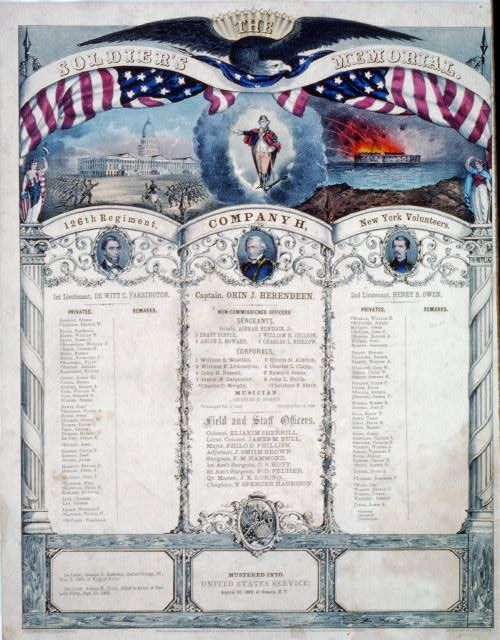
August 20.—The 126th Regiment, just organized, was mustered into service at Camp Swift, Geneva. 144Those that I know who belong to it are Colonel E. S. Sherrill, Lieutenant Colonel James M. Bull, Captain Charles A. Richardson, Captain Charles M. Wheeler, Captain Ten Eyck Munson, Captain Orin G. Herendeen, Surgeon Dr. Charles S. Hoyt, Hospital Steward Henry T. Antes, First Lieutenant Charles Gage, Second Lieutenant Spencer F. Lincoln, First Sergeant Morris Brown, Corporal Hollister N. Grimes, Privates Darius Sackett, Henry Willson, Oliver Castle, William Lamport.

Dr. Hoyt wrote home: “God bless the dear ones we leave behind; and while you try to perform the duties you owe to each other, we will try to perform ours.”

We saw by the papers that the volunteers of the regiment before leaving camp at Geneva allotted over $15,000 of their monthly pay to their families and friends at home. One soldier sent this telegram to his wife, as the regiment started for the front: “God bless you. Hail Columbia. Kiss the baby. Write soon.” A volume in ten words.

The soldier's memorial - 126th Regiment, Company H., New York Volunteers (Published by Currier & Ives, c1862; LOC: LC-USZC2-3295)

“God bless you. Hail Columbia. Kiss the baby. Write soon.”

Posted in 150 Years Ago This Week, Military Matters | Tagged , , | Leave a comment

Can’t win for orating

Hon. Clement Laird Vallandigham [?] of Ohio (between 1855 and 1865; LOC: LC-DIG-cwpbh-01193)

dreamer

A different manifest destiny: “America, like the Old World, is to be settled by many nations.”

Clement Vallandigham and his fellow Peace Democrats were criticized in much of the North for being de facto agents of disunion, because the South was never going to peacefully rejoin the Union. Here’s a Southern editorial that agreed with that part of Northern pro-war opinion.

From the Richmond Daily Dispatch February 7, 1863:

Can the Union of these States be restored?

In his late great speech, Mr. Vallandigham says: “Many States and peoples ones separated have become united through the course of ages through natural causes, and without conquest; But I remember a single instance only, in history, of States or people once united and speaking the same language, who have been forced permanently asunder by civil strife or war, unless they were separated by distance or vast natural boundaries. And who now, North or South, in Europe or America, looking into history, shall say that because of civil war the union of these States is impossible ? War, indeed, while it lasts, is disunion, and, if it lasts long enough, will be final and eternal separation first, and anarchy and despotism afterwards.”

The exception to the general rule, which Mr. Vallandigham lays down, is, doubtless, Germany, the people of which speak all the same language, and yet are separated into a score of States. It is obvious why he selected this case to make an exception of it. It is the strongest in point for those who believe that secession is inevitable, and has often been used as an example. It could be gotten rid of in no other way than by shoving it aside into a limbo of exceptions, where it might be left to sleep in oblivion. But it will not thus be passed over. –The case of Germany is strictly analogous to the case of the late United States. It was originally composed of a number of small principalities each independent of the other, and managing its own internal affairs in its own way, while all acknowledged a sort of allegiance to the Emperor of Germany. The thirty years war and the peace of Westphalia broke up this arrangement, and separate kingdoms grew up in Germany, who ever since have been negotiating and fighting with each other as independently as France and England might have done. They are in fact so many distinct nations. Germany, however, is not the only example. All Italy speaks the same language, and until three or four years ago it had been separated into a number of States for centuries. It was all united under the Roman Government. Let us try a separate existence four or five hundred years, as the Germans and Italiana did.

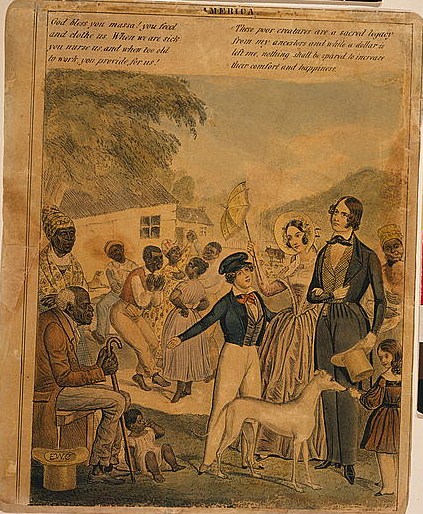
America (by Edward Williams Clay, c.1841; LOC:  LC-USZC4-5950)

” The population of the South is homogeneous.”

Mr. Vallandigham makes a great mistake in supposing this to be a civil war. It is not a civil war. It is a sectional war. It is a war between two peoples who are as distinct as the Russians and the Danes, or the Saxons and Dutch. Nor do we speak the same language. The language of the South is the English language. The language of the North is English, Dutch, German, Spanish–a compound, in a word, of every known language and dialect in the world. The population of the South is homogeneous. That of the North is more heterogeneous than that of the Austrian Empire. The great wonder is not that the two sections have fallen asunder at last but that they held together so long. It would be almost as rational to form the whole continent of Europe into a single State, and then expect it to continue such.

Mr. Vallandigham takes up the old geographical argument on which General Webb used to filiate with so much unction, and which was adopted by Lincoln in his last annual Message. Nothing can form the boundaries, it seems, of States but great landmarks. All the communities living on a great river must belong to the same Government. Certain elevations or natural water sheds control everything in the direction in which the water from them flows. Any man who knows anything of history and geography knows that this style of argument is perfectly ridiculous. How many nations are there on the Rhine? How many on the Danube? How many on the Po? Where is the grand natural division between Spain and Portugal? Between France and Belgium? Between Bavaria and Austria? Between Germany and Russia? As for the water shed argument, it is sufficient to know that Switzerland is the water-shed of all Western Europe.

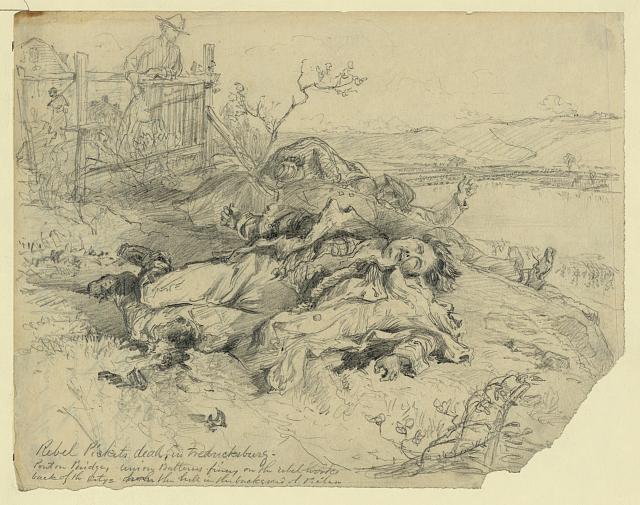
Rebel pickets dead, in Fredericksburg. Pontoon bridge, Union batteries firing on the rebel works back of the city. From the hill in the background of picture (by Alfred R. Waud, 1862 December; LOC:  LC-DIG-ppmsca-21123 )

“not a civil war”

The lines of demarcation arise from the character of the people. If they are hostile to each other they do not want waters or mountains to separate them. If they are not, waters and mountains can not keep them asunder. The idea that this whole continent is to be occupied by one nation is simply preposterous. In five thousand years the world has never seen such a thing as 200,000,000 of people speaking the same language and enjoying free institutions, all under the same Government. It is a dream of Utopian folly to suppose that it ever can exist. The separation has begun, and it will continue. America, like the Old World, is to be settled by many nations. Such is its destiny.

You can read a description of the plantation image at Library of Congress

Posted in 150 Years Ago This Week, Confederate States of America, Southern Society | Tagged , , | Leave a comment

Death of an Irish woman

I’m not sure how much of a mystery the death turned out to be, but this story would seem to indicate that Union troops were finally getting paid and sending remittances back to their loved ones.

From a Seneca County, New York newspaper on February 7, 1863:

Sudden Death.

Mrs. ANN RYAN, an Irish woman, died very suddenly at the house of Martin Mortimer, in this village, on Wednesday morning. The circumstances attending her death have excited the suspicion of the authorities, and an investigation is now going on before Justice Clark.

Mrs. RYAN has been an inmate of the County House for some time past. A few days since she received a letter from her husband, who is a member of the 3d New York Artillery, stating that she would find an allotment of $20 at the Auburn Savings Bank, for her use. On Tuesday she went to Auburn, drew the money, and during the day returned to this village. In the evening she went with Mrs. Mortimer to several different places to do some trading, after which they both returned home. Some time during the night Mrs. RYAN died, the Mortimers alleging that her death took place about 3 o’clock on Wednesday morning, and that for some time previous she appeared to be in great distress from long and continued vomiting. She was buried on Wednesday by the Overseer of the Poor. The whole affair will be thoro’ly investigated.

Posted in 150 Years Ago This Week, Military Matters, Northern Society | Tagged , , , , | Leave a comment

A cold night in Richmond

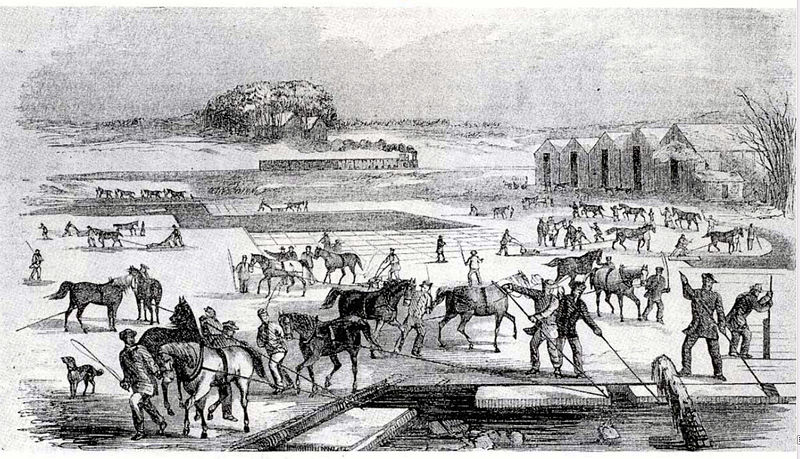
 Ice Harvesting, Massachusetts, early 1850s (Gleason's Drawing Room Companion, 1852, p.37)

don’t need these Yankees for ice either!

From the Richmond Daily Dispatch February 5, 1863:

The coldest night.

–Tuesday night was the coldest one since 1857. This fact was ascertained by a comparison of the thermometer at the City Water Works, where the mercury in the tube indicated eight degrees below zero. Should the present weather continue, our soldiers in the field must suffer considerably. The signs of the times indicate that we shall be afforded more opportunities than we care to embrace for getting in a supply of ice sufficient to last through the summer months.

You can read about the Ice trade at Wikipedia and Ice Harvesting at Historic Sodus Point.

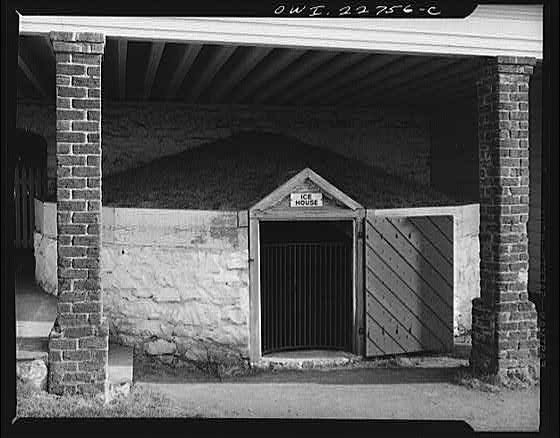
Charlottesville, Virginia. Ice house at Monticello, home of Thomas Jefferson (by John Collier 1943, Apr; LOC:  LC-USW3-022756-C)

keeping it cold at Monticello

Posted in 150 Years Ago This Week, Confederate States of America, Military Matters, Southern Society | Tagged , , , | Leave a comment

Jeff didn’t build that

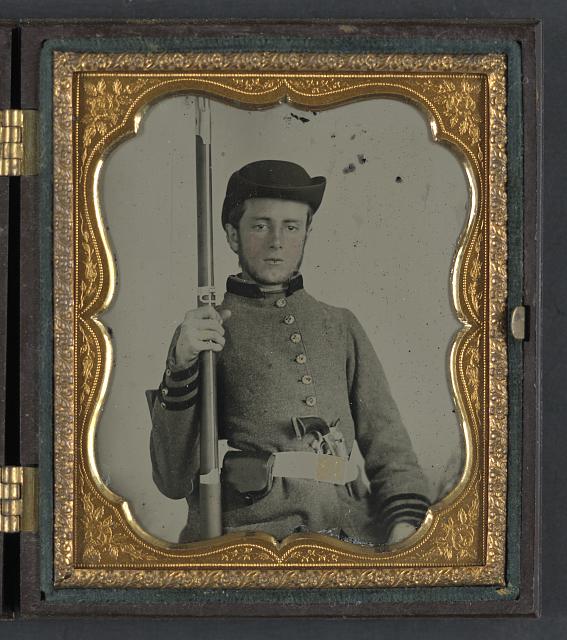
Private Peter Lauck Kurtz of Company A, 5th Virginia Infantry Regiment, in uniform with musket and revolver (between 1861 and 1865; LOC: LC-DIG-ppmsca-32596)

“best and bravest” for eleven dollars a month

From the Richmond Daily Dispatch February 5, 1863:

To the Confederate Congress.

Repeal the whole exemption law passed October, 1862; you will thereby add 100,000 more men to the army. Your provise [proviso?] against extortion is not worth a cent. Go to our court-houses and churches, see the number of young and likely men staying behind our army privileged by that long exemption act. There is no positive need for one in a hundred of them. Exempt no man on account of his trade, occupation, or office, either State or Confederate. If he be so necessary at home, let him hire a substitute. Equalize the burthen of the war.–Make every person pay one halfe his net gains into the Confederate Treasury made in any manner since April1st, 1861. This war has been the lever of manufacturers and speculators to make fortunes out of the misfortunes of their country, while thousands of the best and bravest men we have have freely given up their blood and their lives in their country’s defence, many of them leaving poor and helpless wives and orphan children behind them. Shall those who staid behind, protected in making fortunes, refuse to give one-half their profits to their country made during this want [war?] Pay the President and every [eleven?] dollars per month and soldier’s rations, and recommend the several States to pay, from Governors down, the same. This will reduce our expenses many millions per annum — Every man, after paying his debts, shall invest one-half his money in Confederate bonds, bearing 5 per cent. interest. Pass and execute these laws, and in six months we will have our fifteen Southern States and as many Northwestern and Middle ones as we will let in, and an honorable peace.

A Farmer.

The farmer is probably exempt but not making a fortune on the food he is supplying his country. I’m assuming the part of this piece that mentioned the president is advocating paying all civil servants eleven dollars a month because that was privates’ pay until June 1864. According to bluegrass.net one of the ways exemption was unfair is that some states that opposed the draft added sham members to the lists of their civil servants:

Many Southerners, including the governors of Georgia and North Carolina, were vehemently opposed to the draft and worked to thwart its effect in their states. Thousands of men were exempted by the sham addition of their names to the civil servant rolls or by their enlistment in the state militias. One general described a militia regiment from one of these states as having “3 field officers, 4 staff officers, 10 captains, 30 lieutenants, and 1 private with a misery in his bowels.” Ninety-two percent of all exemptions for state service came from Georgia and North Carolina.

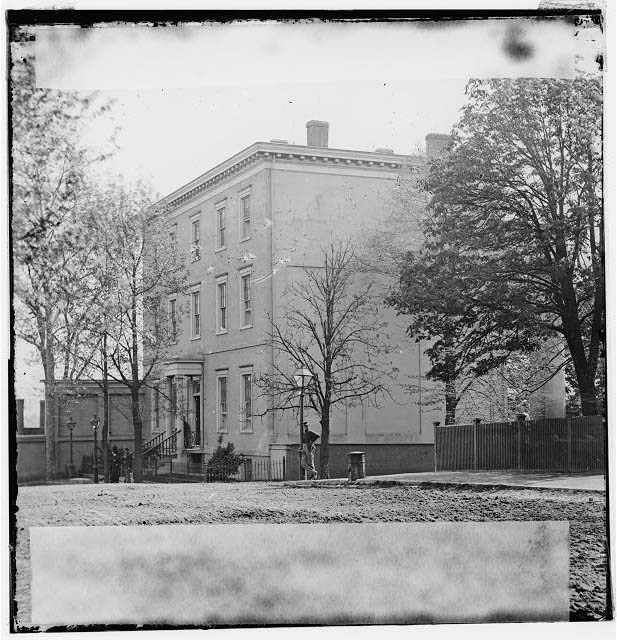
Richmond, Va. Residence of Jefferson Davis (1201 East Clay Street); a closer view (1865; LOC: LC-DIG-cwpb-02919)

where Jeff Davis lived in Richmond

Posted in 150 Years Ago This Week, Confederate States of America, Southern Society | Tagged , , | Leave a comment