Doing the Dirgey Work

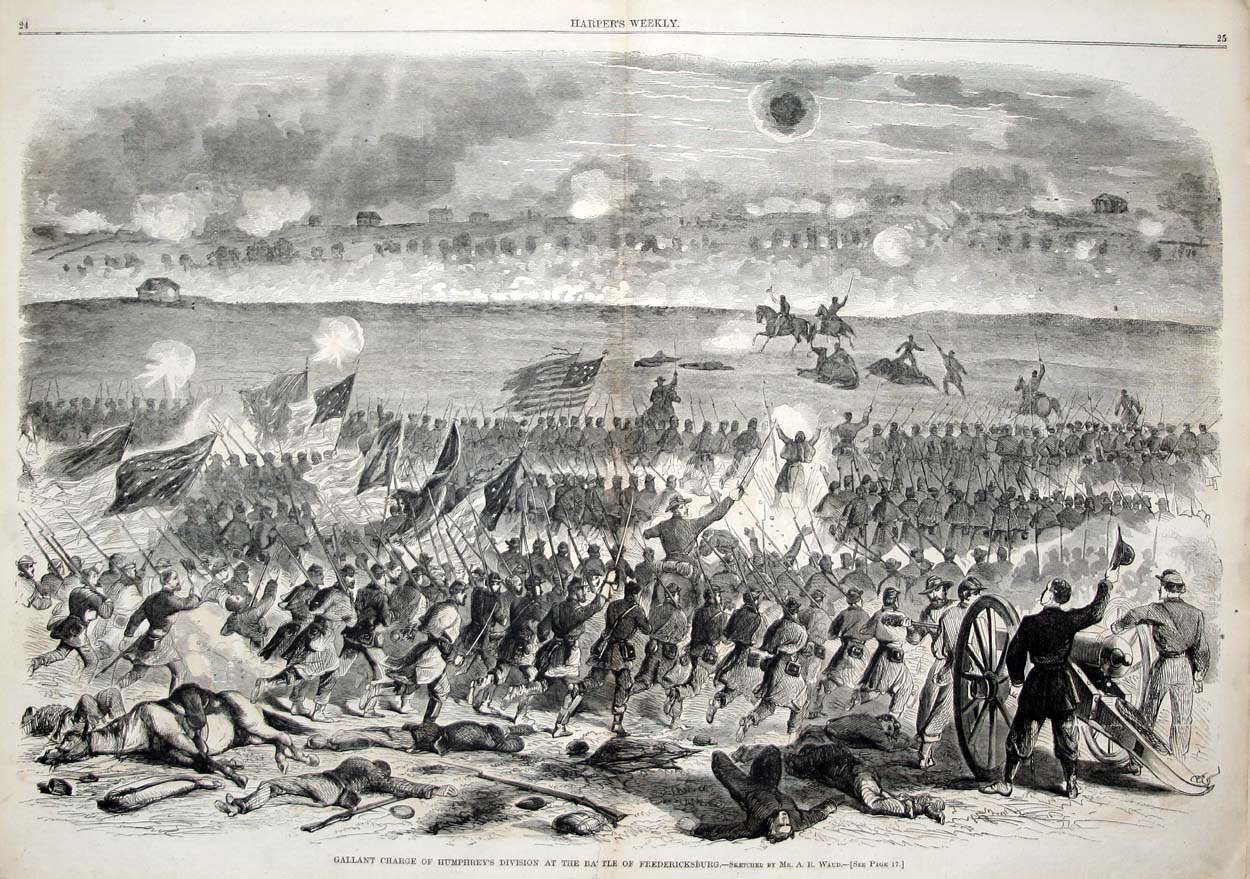
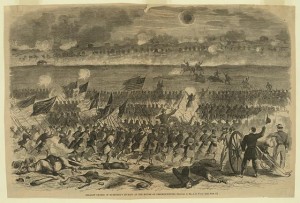
Gallant Charge of Humphrey's Division at the Battle of Fredericksburg (by  Alfred R. Waud, Harper's Weekly, January 10, 1863, p. 24-25; LOC:  LC-DIG-ppmsca-22479 )

gallant and futile charge

150 years ago today citizens in the Confederate capital were getting more news of the Battle of Fredericksburg and starting to make more sense of their victory and their losses. From the Richmond Daily Dispatch December 15, 1862:

From Fredericksburg.
Great fight on Saturday.
the enemy repulsed at all points.
&c., &c., &c., &c.

Great anxiety prevailed in the community on Saturday, to hear further and more satisfactory reports from the seat of war, as precious rumors had induced the supposition that a general and decisive engagement was imminent; but no intelligence of a reliable character could be obtained until 9 o’clock P. M., at which hour the following dispatches were received at the War Department by General Cooper.
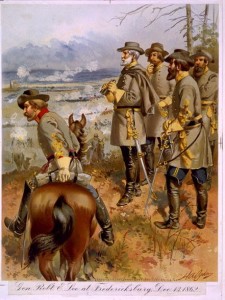
Gen. Robt. E. Lee at Fredericksburg, Dec. 13, 1862 (by Henry Alexander Ogden, c1900; LOC: LC-USZC4-1976 )

‘the enemy being repulsed at all points. Thanks be to God!”

To General Cooper:

At 9 o’clock this morning the enemy attacked our right wing, and as the fog lifted the battle ran along the whole line from right to left until 6 P. M., the enemy being repulsed at all points. Thanks be to God!

As usual, we have to mourn the loss of many of our brave men.

I [ expect ] the battle will be renewed at daylight to-morrow morning.

R. E. Lee.

The highly gratifying nature of these dispatches only increased the general desire to learn something further, and throughout the day the bulletin boards in front of the various newspaper offices were surrounded by eager crowds in search of later intelligence. The War office was also besieged by anxious inquirers, but nothing of an official character was disclosed.
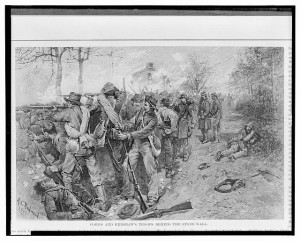
Cobb's and Kershaw's troops behind the stone wall (by Allen Christian redwood, c1894; LOC: LC-USZ62-134479)

repulsing the Yankees with ‘terrible slaughter’

A telegraphic dispatch was received at the office of the Provost Marshal at 7 o’clock last night, stating that five ambulance trains were then between Hanover Junction and Guinea Station on their route to Richmond. Up to the hour of 12 o’clock P. M. none of the trains had arrived, though a large number of ambulances and backs were still awaiting them to convey the wounded to Seabrook’s Hospital. …

A soldier of A. P. Hill’s division says the enemy charged our men in their rifle pits and entrenchments nine times, and were repulsed with terrible slaughter, until our ammunition gave out, when our men were again charged in overwhelming force and driven back. But having obtained more ammunition, our forces in their turn charged the enemy and drove them from the works in great disorder, taking a large number of prisoners. …

Gen. Cobb was killed. Gen. Hood is also reported killed, but the rumor lacks confirmation. Gen. Gregg was mortally wounded.

Arrival of bodies.

The 5 o’clock train yesterday afternoon brought down the bodies of several officers. Among them were those of Brig.-Gen. Thos. R. R. Cobb, of Ga., and Capt. D’Aquin, of the Louisiana Guard Artillery.
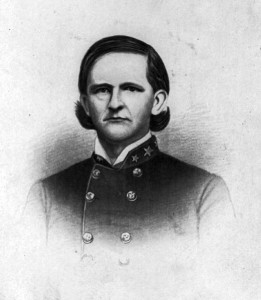
Gen. T.R.R. Cobb (no date recorded on caption card; LOC: LC-USZ62-80578)

Thomas R. R. Cobb

Thomas Reade Rootes Cobb was “an American lawyer, author, politician, and Confederate officer …” Before the war he was well-known for his Inquiry into the Law of Negro Slavery in the United States (1858), which was

[t]he only legal defense of slavery produced by a southerner, Cobb’s treatise covered a vast range of arguments, from historical precedent and property rights to black inferiority.

Despite his arguments that the concept of slavery was good and formed the foundation of all great civilizations, Cobb deemed only African slavery to be acceptable in practice because he believed that God intended for blacks to be inferior to whites. Enslavement allowed white Christian masters to “improve” their slaves.

In his introduction to this book Cobb traces slavery back to Genesis and notes that the slave trade is at least as old as Joseph’s sale to merchants from Midian, who then sold him to Egypt.
___________________________________________________

Gen. Burndside [sic] visiting Gn. Franklin giving him the order to evacuate his position-on the battlefield on the right, Sunday Eve., all at rest (by Arthur Lumley, 1862 ca. December 14; LOC: LC-DIG-ppmsca-20776 )

deciding to recross the Rappahannock

150 years ago tonight the Union army moved back from Fredericksburg to the Falmouth side of the Rappahannock. From a Seneca County, New York newspaper in December 1862:

Our Army Retreats.

The Army of the Potomac evacuated their position on Monday night, and re-crossed the Rappahannock. The movement was a perilous one, but it was conducted in safety. The storm and the darkness of the night prevented the enemy from obtaining knowledge of our movement. The pontoon bridges were removed, thus cutting off all communication between the two shores. It is stated that our wounded are all safe on this side of the river.
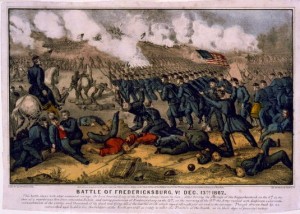
Battle of Fredericksburg, Va. Dec 13th 1862 (Currier & Ives, 1862; LOC: LC-USZC4-3365)

butchered

A correspondent of the Tribune in describing the struggle on Saturday says, “it is not too strong an expression to say that in this battle we were butchered.” He says General French went into the action with 7,000 men. To-night, two days after the battle, but 1,200 men have reported to him!

The entire loss in the corps of Gen. Couch, consisting of the divisions of Gens. Howard, French, and Hancock, and which on the morning of the battle contained 40 regiments, old and new, amounting to at least 20,000, is about 10,000!

I think the official reports will not vary from this estimate more than 500 above or below the number.
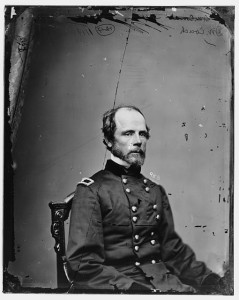
Gen. D.N. Couch, U.S.A. (between 1860 and 1865; LOC: LC-DIG-cwpbh-03196)

his corps chewed up

The losses in Gen. Reynolds’ corps of Franklin’s grand division, which were at first supposed to be but two thousand are to night considered by some of Franklin’s staff officers nearly 4,000.

The same correspondent places the total loss at 13,500. The slaughter is described as terrible, and the disaster more humiliating than any that has befell us during the war.

Darius Nash Couch watched much of the action on December 13th from the cupola of Fredericksburg’s courthouse. Observing the repulse of French’s troops Couch reportedly said, it was “as if the division had simply vanished.”
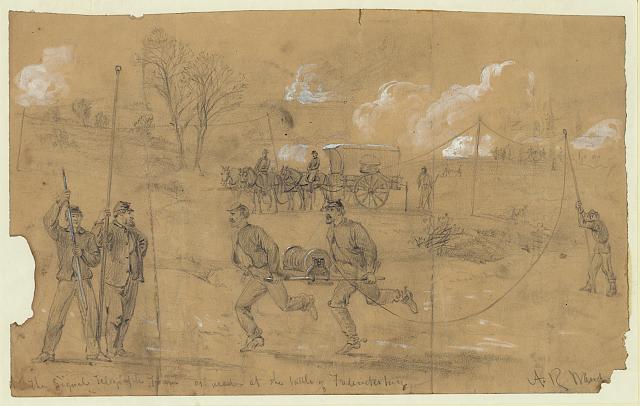
The signal telegraph train as used at the battle of Fredericksburg (by Alfred R. Waud, Harper's Weekly, January 24, 1863, p. 53; LOC: LC-DIG-ppmsca-21453)

Bad News: Union signal telegraph on December 13, 1862
Posted in 150 Years Ago This Week, Battle of Fredericksburg, Military Matters | Tagged , , , | Leave a comment

Localized Tally

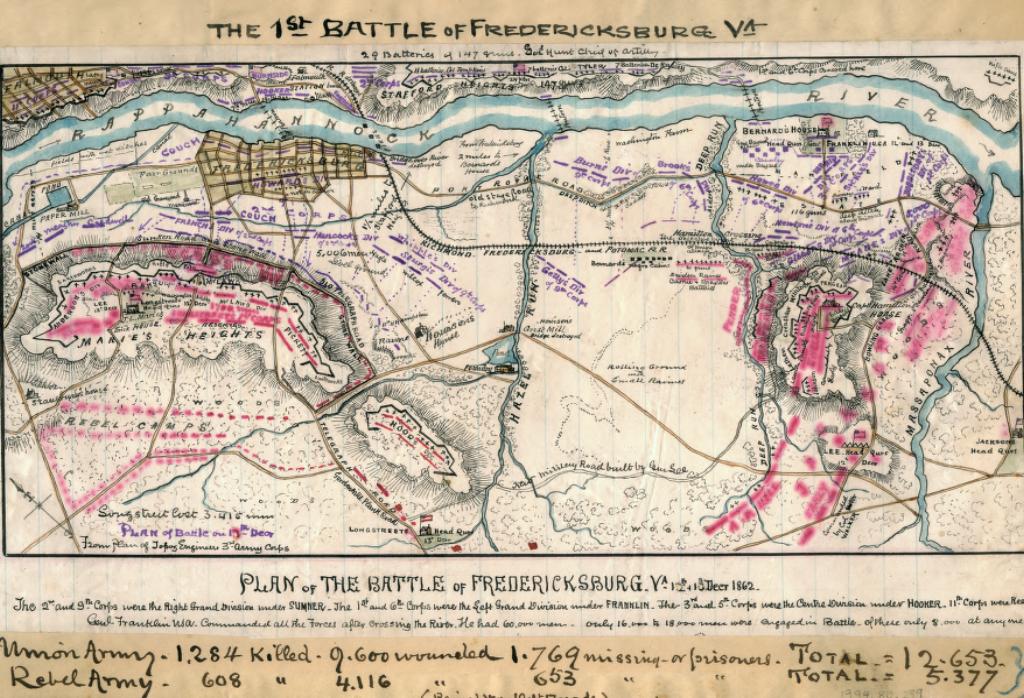
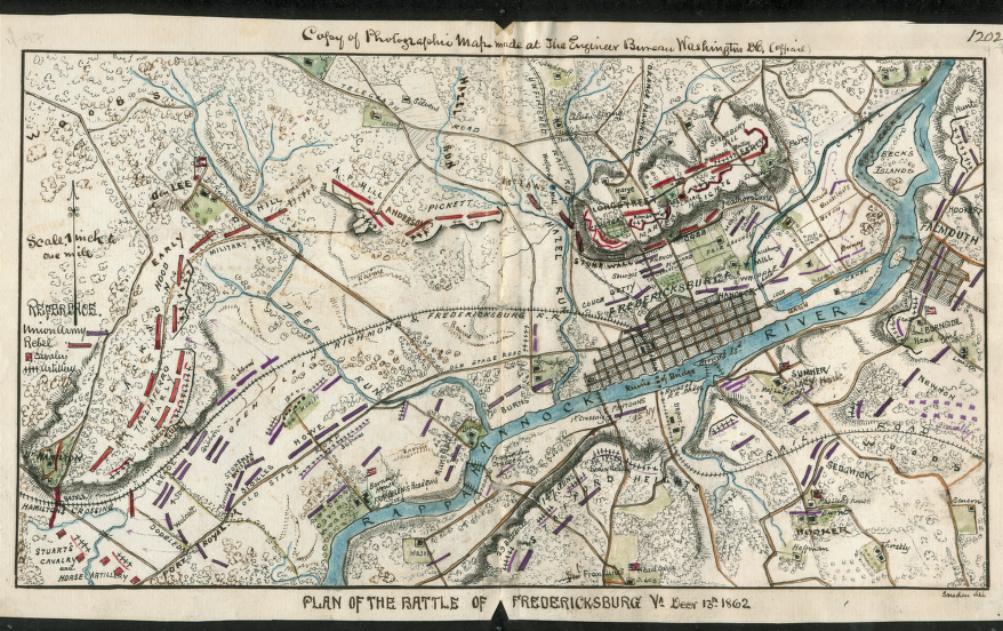
Plan of the Battle of Fredericksburg, Va., Decr. 13, 1862 by Robert Knox Sneden (LOC: gvhs01 vhs00123 http://hdl.loc.gov/loc.ndlpcoop/gvhs01.vhs00123)
150 years ago today Federal and Confederate generals were deciding their next steps in the aftermath of the December 13th slaughter at Fredericksburg, news of which would start making its way back to the public(s) at large.

Here’s a couple stories from Seneca County, New York newspapers from December, 1862. The first article relates to the December 11th Union construction of pontoon bridges across the Rappahannock:

Wounded at Fredericksburg.

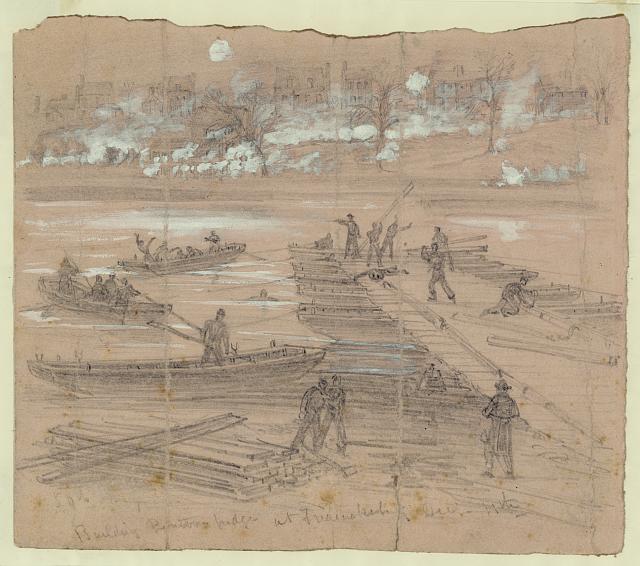
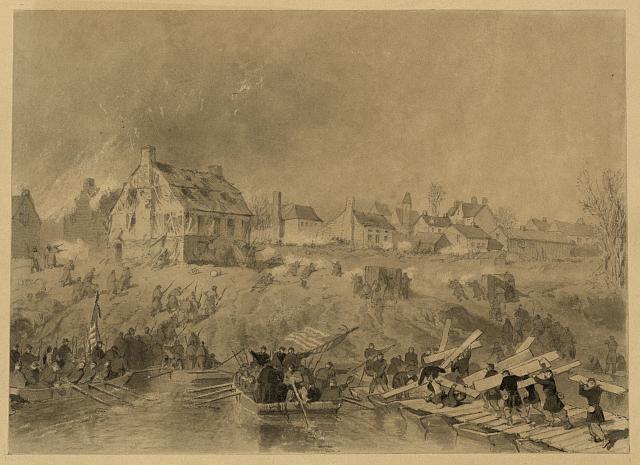
Building pontoon bridges at Fredericksburg Dec. 11th. ([1862] December 11, by Alfred R. Waud; LOC: LC-DIG-ppmsca-21209)

The 50th NY Engineers at work December 11, 1862

The telegraph in giving an account of the operations of the Engineer Corps, in throwing pontoon bridges across the Rappahannock furnishes a list of those killed and wounded by the rebels in this hazardous undertaking. Among the number was was the name of Capt. JAMES H. MCDONALD, of this village attached to Stuart’s Engineer Regiment. He was wounded in the arm though not seriously, as we are glad to learn. In a letter to his wife, dated Fredericksburg, Dec. 12th, he says: “yesterday morning about half-past five o’clock, while taking my men on to a pontoon bridge that we were constructing for the second time in the face of the enemy’s fire, I received a rifle ball through my elbow. – It is not serious so far as I can learn from the doctors. Yours, very tired,

JAS. H. MCDONALD

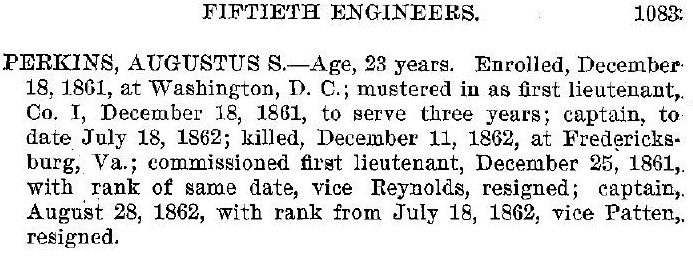
P.S. – Sterling Wickes slightly wounded. Capt. Perkins, that you saw, is killed. Capt. Brainard and myself are the only officers wounded. Lost thirty men.”

Capt. PERKINS is from Geneva, and was shot through the head. STERLING WICKES is a resident of this place.

You can read a good account of the December 11th action at The Civil War 150th Blog.

George Dashiell Bayard, Union General

George Dashiell Bayard

The most prominent officer killed at the battle of Fredericksburg was Brig. Gen. GEORGE D. BAYARD, one of the most gallant cavalry officers of the regular army. He was a native of this village, and a son of SAMUEL BAYARD. He graduated at West Point in 1856. In 1861 he was promoted to a captaincy of the Fourth United States Cavalry and soon made Brigadier General. Gen. BAYARD was a gallant and meritorious officer.

An article about George D. Bayard by David Lay at The Bivouac includes the following:

Brigadier-General Bayard commanded cavalry brigades in the Department of the Rappahannock, Mountain Department, Army of Virginia, and Army of the Potomac. Bayard and his Cavalry Brigade opened the Battle of Fredericksburg on December 13, 1862, holding the Rebels until the Federal infantry could be positioned. He was struck in the hip by a shell fragment later that afternoon while at Major-General Franklin’s headquarters in a grove of trees near Fredericksburg, and died the following day, within days of his pending marriage. General Franklin reported of Bayard “the loss of this gallant young general is a severe blow to his arm of the service, and in him the country has lost one of its most dashing and gallant cavalry officers”.

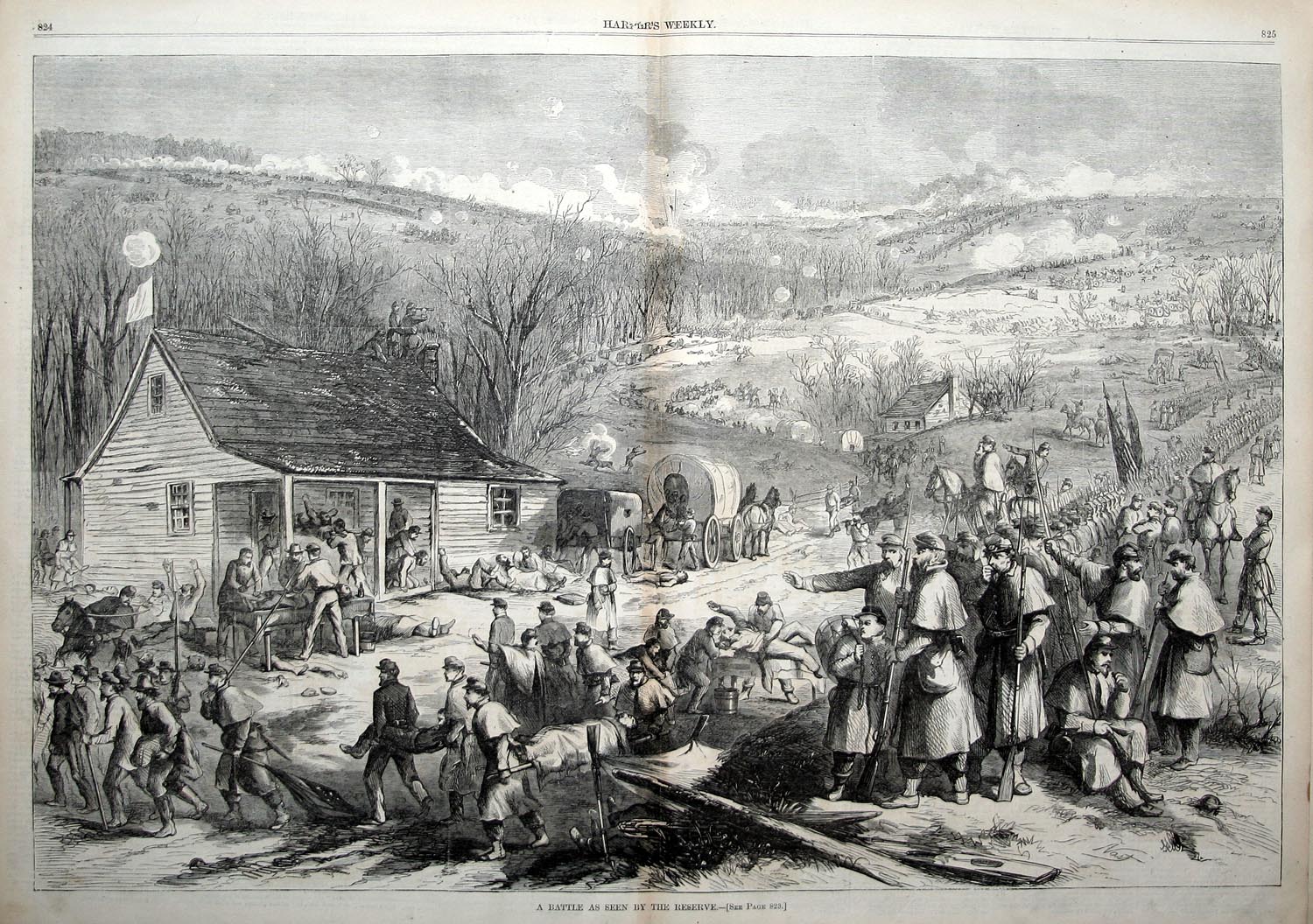
A Battle As Seen By The Reserve by Thomas Nast (Harper's Weekly,  December 27, 1862)

Dead and Wounded at a generic battlefield

This image by Thomas Nast is hosted at Son of the South. The same December 27, 1862 issue of Harper’s Weekly includes Nast’s description of the scene.

Posted in 150 Years Ago This Week, Battle of Fredericksburg, Military Matters | Tagged , , , , , | Leave a comment

“beautiful and sharp fighting”

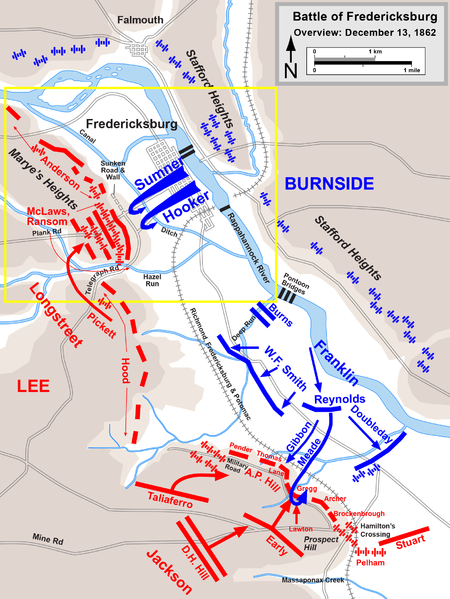
Fredericksburg-Overview (by Hal Jespersen)

33rd NY supported batteries in W.F. Smith’s Corps

150 years ago today a great Union blood bath occurred at the Battle of Fredericksburg. Belonging to W.F. Smith’s XI Corps, the 33rd New York Infantry Regiment supported artillery in William Franklin’s Left Grand Division. A quick recap of the battle: Franklin’s grand division failed to exploit a temporary breakthrough by troops under Gordon Meade. The Union right futilely tried many times throughout the day to dislodge Confederates concentrated behind a stone wall on Marye’s Heights.

From a Seneca County, New York newspaper in 1862:

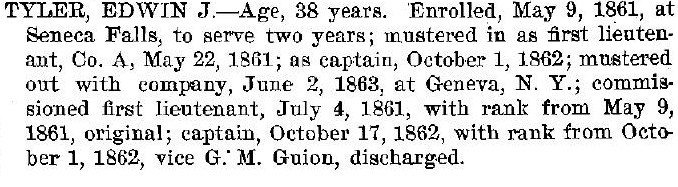
Letter from Capt. Tyler.

The following letter was written by Capt. E.J. Tyler, the second day after the battle of Fredericksburg. It is dated Dec. 15th, and addressed to his father:

We have been to the front for two days, most of the time supporting the batteries, and under a fierce fire of artillery. Our Brigadier-General (Vinton) is severely if not fatally wounded, and the Brigade is now under Gen. Neil. The 33d is fortunate, as usual, in slight loss. The Brigade I think will lose lightly; but as a whole, there has been some beautiful and sharp fighting as I ever saw. We have driven them back from the river about two miles, into their fortified position, and they are yet fighting like the very devil. We tried them with our best troops for two days, and our men fought desperately and none ever fought better, but still they hold most of their line of defences. Our loss much be much greater than theirs for they fought most of the time under some sort of cover.

Our division was relieved this morning before daylight, and are now in the rear to get a little rest, which gives me his opportunity to say all right with me, and none seriously hurt in the company thus far.

The weather has moderated and is much warmer, and snow has disappeared.

Hastily, E.J. TYLER.

At Fredericksburg on December 13, 1862 Francis Laurens Vinton “…was severely wounded while leading his regiment in a gallant charge. Disabled by his wound for many months, and incapacitated for further service, he resigned from the Army in May, 1863.”

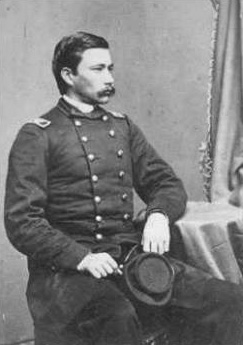
Edwin J. Tyler

Our correspondent took Captain Guion’s place

Here’s an excerpt from The story of the Thirty-third N.Y.S. vols.; or, two years campaigning in Virginia and Maryland (by David W. Judd (page 248)) that describes the 33rd’s experience during the battle:

Instead of being posted some distance to the rear Colonel Taylor was ordered close up to the guns and the men lay almost beneath the caissons. Shot and shell were whizzing, screaming, crashing, and moaning all around them, but they manfully maintained their position, receiving the fire directed upon the artillerists. Towards noon a 64-pounder opened from the hill directly back of Fredericksburg. The first shell struck a few feet in front of the Regiment, the second fell directly in their midst, plunging into the ground to the depth of three feet or more. The enemy had obtained most perfect range, and would have inflicted a great loss of life, had not the monster gun very fortunately for us exploded on the third discharge. The guns which the Thirty third supported were repeatedly hit by the enemy, whose batteries could be distinctly seen glistening in the edge of the woods a mile distant.

One round shot struck the wheel of a caisson, smashing it to atoms, and prostrating the “powder boy,” who was taking ammunition from it at the time. Had the missile gone ten inches further to the left, it must have exploded the caisson and caused fearful havoc among the Thirty-third. Here Colonel Taylor lay with his men for many long hours, exposed to the fury of the rebel cannoniers, without shelter or protection of any kind, until the after part of the day, when they were relieved by the Forty-third New York Col Baker and fell back to the second line of battle. …

Fred12131862 (by Robert Knox Sneden; gvhs01 vhs00221 http://hdl.loc.gov/loc.ndlpcoop/gvhs01.vhs00221 )

map with casualties

"Gallant Charge of Humphrey's Division at the Battle of Fredericksburg." (by Alfred R. Waud, Harper's Weekly, January 10, 1863 p24)

Storming Marye’s Heights on Union Right

This image was published in the January 10, 1863 issue of Harper’s Weekly and is hosted at Son of the South. Hal Jespersen’s map at the top is licensed by Creative Commons.

Posted in 150 Years Ago This Week, Battle of Fredericksburg, Military Matters | Tagged , , , | Leave a comment

Richmond is ours!

Presidential Prophecy?

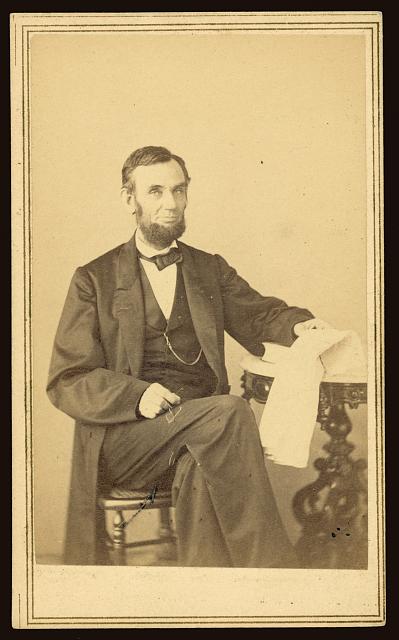
Abraham Lincoln, U.S. President. Seated portrait, holding glasses and newspaper, Aug. 9, 1863 (by Alexander Gardner, Washington, D.C., 1863, printed later; LOC: LC-DIG-ppmsca-19206)

1863: rose-colored spectacles removed

From The New-York Times December 13, 1862:

NEWS FROM WASHINGTON.; What the President Says About Affairs at Fredericksburgh. …

WASHINGTON, Friday, Dec. 12.

WHAT THE PRESIDENT SAYS.

Upon receiving the news from Fredericksburgh last evening, the President is said to have remarked, ” The rebellion is now virtually at an end,” and to have added a prophesy that Richmond would be in possession of the Union troops before the first of January.

ANXIETY FOR THE NEWS.

The city to-day has been in a state of feverish anxiety for news from Fredericksburgh. This feeling increased towards night, in consequence of the [???] of the Government, and rumors put [???] circulation by secesh sympathizers, of successes by the rebels, and evening closed without bringing relief to the minds of the people generally, as nothing positive transpired till a very late hour. Citizens of New-York City go to bed, to-night, generally as well informed of to-day’s operations as those of Washington, and the dispatches sent to the TIMES to-night will give them, to-morrow morning, a clearer knowledge of the situation than the public here can be expected to possess. As we close there is general evidence that all is well with our army, and every indication of stirring and decisive events to-morrow. …

That kind of extreme over-confidence doesn’t sound too much like Abe Lincoln to me; he seems much more realistic in this message to Fernando Wood from 150 years ago today (at Project Gutenberg):

TO FERNANDO WOOD.
EXECUTIVE MANSION, WASHINGTON DECEMBER 12, 1862.

HON. FERNANDO WOOD.

MY DEAR SIR:—Your letter of the 8th, with the accompanying note of same date, was received yesterday. The most important paragraph in the letter, as I consider, is in these words:

“On the 25th of November last I was advised by an authority which I deemed likely to be well informed, as well as reliable and truthful, that the Southern States would send representatives to the next Congress, provided that a full and general amnesty should permit them to do so. No guarantee or terms were asked for other than the amnesty referred to.”

I strongly suspect your information will prove to be groundless; nevertheless, I thank you for communicating it to me. Understanding the phrase in the paragraph just quoted—”the Southern States would send representatives to the next Congress”—to be substantially the same as that “the people of the Southern States would cease resistance, and would reinaugurate, submit to, and maintain the national authority within the limits of such States, under the Constitution of the United States,” I say that in such case the war would cease on the part of the United States; and that if within a reasonable time “a full and general amnesty” were necessary to such end, it would not be withheld.

I do not think it would be proper now to communicate this, formally or informally, to the people of the Southern States. My belief is that they already know it; and when they choose, if ever, they can communicate with me unequivocally. Nor do I think it proper now to suspend military operations to try any experiment of negotiation.

I should nevertheless receive with great pleasure the exact information you now have, and also such other as you may in any way obtain. Such information might be more valuable before the 1st of January than afterwards.

While there is nothing in this letter which I shall dread to see in history, it is, perhaps, better for the present that its existence should not become public. I therefore have to request that you will regard it as confidential.

Your obedient servant,
A. LINCOLN.

Back to Fredericksburg

As Union troops crossed the Rappahannock 150 years ago today they pillaged the city of Fredericksburg. According to Shelby Foote [1] as the federals were having their fun in the old colonial town, they began to wonder why the Confederates were not putting up any resistance. Some thought it was because they were out of artillery shells or General Lee was trying to influence Europeon opinion by contrasting the Yankee barbarity with Southern restraint. “Still another, a veteran private, had a different idea. ‘Shit’, he said. ‘They want us to get in. Getting out won’t be so smart or easy. You’ll see.'”

Night. The sacking of Fredericksburg-- & biovace[sic]of Union troops (by Arthur Lumley, 1862 December 12; LOC: LC-DIG-ppmsca-20787)

marauders’ row

  1. [1]The Civil War: A Narrative, Volume II Fredericksburg to Meridian (New York: Vintage Books, 1986), 30.
Posted in 150 Years Ago This Week, Battle of Fredericksburg, Military Matters | Tagged , , , | Leave a comment

Why They Moved Hospital

Building pontoon bridges at Fredericksburg Dec. 11th. (By Alfred R. Waud; LOC: LC-DIG-ppmsca-21209)

trying to bridge the Rappahannock

150 years ago today General Burnside’s Union Army of the Potomac tried to cross the Rappahannock to attack General Lee’s Army of Northern Virginia in the vicinity of Fredericksburg. You can read a good account at Civil War Daily Gazette. Here’s a letter home from a member of the 50th New York Engineers, one of the regiments tasked with constructing the pontoon bridges.

From a Seneca County, New York newspaper in December 1862:

From S.W.E. VIELE.

CAMP AT FALMOUTH STATION, FREDERICKSBURG, Va.

Tuesday, Dec. 16, 1862.

DEAR PARENTS. – You have no doubt received my letter of last Thursday, and that told you that the battle of Fredericksburg had began. If you have not received that you have certainly heard of this battle through the papers. So considering all things I will write only the personal not the general particulars.

Last Wednesday morning myself and four others were ordered to move the hospital from White Oak Church to Falmouth Station; why, we knew not.

We did not go back to camp till nearly 12 o’clock that night, when we found all the boys gone with the pontoon boats, except a few left as guards, then we knew why we had moved the hospital to Falmouth, but little did we dream how soon it was to be used. – In the morning at 4 o’clock, we were aroused by the roar of cannon, and the continuous discharge of rifles. Soon the wounded and stragglers began to arrive in camp, when we received the news of our Captain’s death and other wounded. At that I sat down and wrote to you to let you know that I was all safe and sound as yet, and then started for the battle ground at Falmouth, distant 5 miles. Mother, you will say I did wrong in thus voluntarily exposing myself, but I could not stay at camp incurring risk, and think that my companions in arms were risking life and limb.

I first went to the hospital and saw my beloved Captain Perkins, and found that a ball had struck him in the side of the neck glancing down into the shoulder, killing him at once. He only said: “Boys take care of yourselves,” and died. his body has been sent home. Then I went to the bridge; there were six companies to lay three bridges. – Co.’s I,A,C,, and G, laid two bridges side by side. Co.’s K and F laid their bridge at the lower end of the town, while we laid our bridge at the upper end of the town, and the whole 15th reg.,, and a company of regular engineers managed to lay two bridges several miles below out of all danger. Our companies got their bridge half way across when a whole regiment of Sharpshooters opened fire on each bridge. The river here is about 20 rods wide, and the enemy were on a bank about as high as the American House hill. – The first round they fired was too low, and struck the water. The second volley went over their heads – this volley killed our Captain; then the order was given to fall back, which was obeyed with a will.

Attack on Fredericksburg (by Alonzo Chappel, December 1862; LOC: LC-DIG-ppmsca-22752)

“the boys charged up the bank on a run, firing as they went”

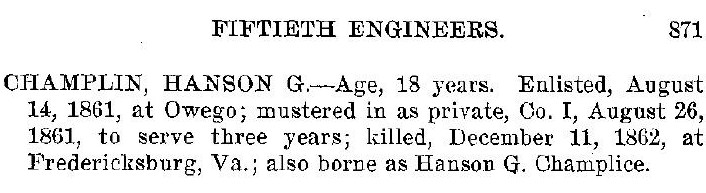
Nothing more was done until 2 P.M., when the artillery opened on the town, and such a continuous rain of shot and shell for over an hour, but few towns ever received. This drove most of the enemy beyond the town. The town lies very much like Waterloo, stretching along the river like the north half, and it is about the size of Geneva. – When the artillery quit firing, our boys volunteered to take some soldiers across in boats before beginning work on the bridge. Some of the 51st N.Y., and 7th Michigan volunteered to go. They went all safe until over half way across, when some Sharpshooters concealed in rifle pits fired on them, but nothing could stop those boys from crossing. Just as the boat touched the bank, they received another volley, killing the best man in Co. I, named Camplain; he was from Oswego. On seeing him fall, the boys charged up the bank on a run, firing as they went. Martin Mathews was one of the first to touch the other shore, and took the first prisoner taken in Fredericksburg. As soon as the others landed we went to work at the bridge and rushed it across “right smart;” then the troops crossed as fast as possible, and soon had possession of the town, the rebels falling back to their entrenchments on a hill behind the town. As soon as we had laid the bridge I went up into the town to see how things looked – and such a sight! dead Rebels lying in the street and houses, killed by the artillery, and you cannot imagine how they were cut and torn to pieces. I picked up a good English Enfield Rifle.

The loss of our Regiment was eight killed and 40 or 50 wounded, including Captain Perkins killed, Captain McDonaldwounded in the left arm quite badly, but will not lose his arm, and one other Captain wounded in the arm.

The whole loss on the Union side was 100 killed; the Rebel loss 1,000, that is, in laying the bridge; that was Thursday. Saturday the great battle of Fredericksburg was fought and Gen. Burnside fell back under cover of the town, and the night of the 15th his whole army recrossed the river.

The weather is warm daytime, and at night freezes a very little, but we have blankets enough to keep warm and comfortable.

Your son,

EDWARDS.

A New-York Times correspondent covered the events of the entire day. It’s a very thorough article; I’m just showing a bit of the beginning and the end.

From The New-York Times December 13, 1862:

THE OPERATIONS OF THURSDAY.; Fall Particulars from Our Special Correspondent.

FREDERICKSBURGH, Va., Thursday Night, Dec. 11.

Street in Fredericksburg, Va., showing houses destroyed by bombardment in December, 1862 (photographed 1862, [printed between 1880 and 1889]; LOC: LC-DIG-ppmsca-32890)

‘“living” Fredericksburgh “no more.” A city soulless …’

I localize this letter Fredericksburgh, but it is assuredly “living” Fredericksburgh “no more.” A city soulless, rent by wrack of war, and shooting up in flames athwart night’s sky, is the pretty little antique spot by the Rappahannock, erewhite [erstwhile] the peculiar scene of dignified case and retirement. …

Although we are not yet fully informed of the present positions of the enemy, there seems to be good ground to claim that Gen. BURNSIDE has succeeded in outgeneraling and outwitting them. His decoys to make them believe that we were about to cross our main force at Port Conway, seem to have succeeded admirably. I suppose there is no harm now in my mentioning that among the ruses he employed was sending down, day before .yesterday, to Port Conway, three hundred wagons, and bringing them back by a different road, for the sole purpose of making the rebels believe that we were about to cross the river at that point. To the same end, workmen were busily employed in laying causeways for supposed pontoon bridges there, while the gunboats were held as bugaboos at the same place. Completely deceived by these feints, the main rebel force, including JACKSON’s command, seems to have been two or three days ago transferred twenty or twenty-five miles down the river. It must be remembered, however, that without the utmost celerity on our part they can readily retrieve this blunder by a forced march or two. Signal gun, at 6 o’clock this morning, gave them the cue to what was going on, and doubtless they have not been idle during the intervening hours. To-morrow will disclose what unseen moves have been made on the chess-board. W.S.

An editorial lauding the volunteers who drove the rebel snipers out of town from The New-York Times December 14, 1862:

HONORS TO HEROES.–

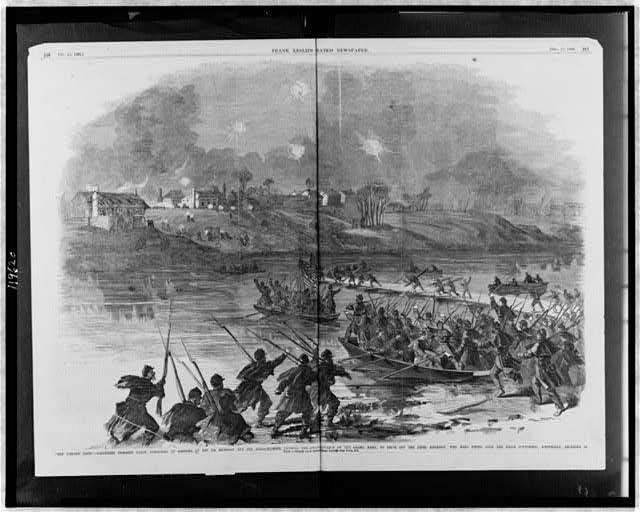
Every one who read the [???] account given by our Virginia correspondent, yesterday, of the unsurpassed coolness and valor displayed by the “forlorn hope” of 400 men, who crossed the Rappahannock in small boats, in face of the fire of the rebel sharpshooters, and drove them pellmell through Fredericksburgh, must have felt that these were heroes who, indeed, merited the recognition of their country. From the moment that the men of the Seventh Michigan sprang from their crouching places behind the rocks on the north bank of the river, and rushing for the pontoon boats, pushed them into the water, and leapt into them, all the time under the enemy’s fire — through that solemn scene when the first boat-load of gallant fellows pushed off amid the crack! crack! of a hundred rebel rifles, followed quickly by another and another boat-load, up to the moment when, rushing from their boats, amid the applauding shouts of our army which was watching them, they swept up the hill, on the further side of the river, and, musket in hand, fell upon the skulking rebels and killed, captured, or chased them all from their lurking places — everything through the whole affair was as fine as ever was anything in military history.

“It was,” said our correspondent, “an authentic piece of human heroism which moves men as nothing else can.” And as to its effect, he added: “The problem (of our army crossing the river) was now solved. This flash of bravery has done what scores of batteries and tons of metal had failed to accomplish. The country,” continued our correspondent, “will not forget that little band.” We hope the country will not forget them. Had these men been under NAPOLEON, their valor would have been signalized and honored on the spot; had they been in any European service, they would have received such token of recognition as would have filled them with pride for life, and been an heirloom for posterity; had they even been on the enemy’s side, they would have won the “cross” which the rebels give to their bravest. In our army, and on our side, we fear that all the recognition and reward these men will ever receive for their day’s service, will be to be kept waiting half a year or more for the forty cents they earned by it. It is a shame. If there can be no other reward, they certainly deserve the thanks of Congress as much as some of the big Generals who have received them. They would thus have their names enrolled on the national record as having at least deserved well of their country.

"The forlorn hope" - volunteer storming party, consisting of portions of the 7th Michigan and 19th Massachusetts, crossing the Rappahannock in advance of the Grand Army, to drive off the Rebel riflemen, who were firing upon the Union pontoniers, Wednesday, December 10 (by Henri Lovie, Frank Leslie's illustrated newspaper, 1862 Dec. 27, pp. 216-217; LOC: LC-USZ62-119620)

“The forlorn hope”

50th New York Engineers in Lead Story

Edward Viele

Our Correspondent

Augustus Perkins

Viele’s beloved captain

Hanson Champlin

best man in Company I

Martin Matthews

took a rebel as prisoner

Posted in 150 Years Ago This Week, Battle of Fredericksburg, Military Matters | Tagged , , , , , | Leave a comment

Tom Jackson’s Shoeless Troops

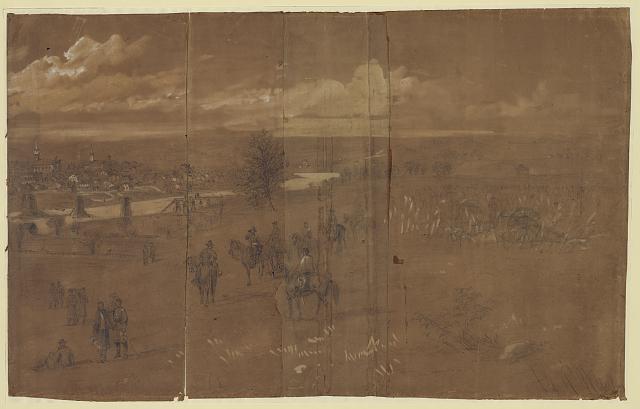
Fredericksburg, VA (by Alfred R. waud, Harper's Weekly, December 20, 1862, pp. 808-809; LOC: LC-DIG-ppmsca-22583)

cautious Yankees looking at Fredericksburg

Federal attack at Fredericksburg not imminent – plenty of time to get shoes to Stonewall’s soldiers

For about three weeks the Richmond Daily Dispatch has published a daily paragraph “From Fredericksburg.” News has leaked back that Union General Burnside had sent some troops south along the Rappahannock, but the Dispatch didn’t think the union army would cross the river any time soon and even conjectured that Burnside was another extremely cautious McClellan. Conditions have improved for the southern soldiers, but apparently some in Stonewall Jackson’s corps are still without shoes.

From the Richmond Daily Dispatch December 9, 1862:

From Fredericksburg.

The only report received from Fredericksburg by the train last night was one to the effect that the main body of the enemy’s army was moving down the Rappahannock in the direction of Port Royal, where it is conjectured they will attempt to construct their pontoon bridges, under protection of their gunboats. Beyond this single rumor, everything is represented at a stand- still, with little probability of a fight, which has been so eagerly looked for the past week. It would seem that Burnside like his predecessor, finds a little caution necessary in his operations against Richmond.

From the Richmond Daily Dispatch December 10, 1862:

From Fredericksburg.

Matters around Fredericksburg have undergone at change, if the reports brought from there yesterday are correct. The Federal army has yet made no attempt to cross the Rappahannock, and will not probably for some time to come. The condition of our own army is represented on the whole as very good, a great improvement having taken place in the past two weeks in their supply of clothing and blankets.

From the same issue:

An Appeal to officers.

Lieut. Carpenter, of Hay’s brigade, Louisiana volunteers who arrived in this city on official business on Monday evening last, reports that a large number of the faithful and tried soldiers of Gen. Jackson’s corps are yet without shoes, and their feet exposed to the severe cold of the past three days. That the Government is doing what it is for the comfort of its soldiers we have no reason to doubt, and that in a short time it will be able to relieve the wants of these gallant men we have good reason to believe; but how much more quickly on the desirable object be accomplished with the co-operation of the people.

It has been suggested to us by an officer in the army who has made many sacrifices during the war and who is now entirely cut off from his private resources, that a great deal might be done by the officers who receive liberal pay. This officer has already left $50 at this office for the object proposed although his own pay is only $110 per month. If each officer in the army, from Lieutenant up to General, would contribute to the extant of his means, and in proportion to the pay he receives, thousands of men who are now treading the earth barefooted might be comfortably shod.–And whilst we throw out this suggestion to the officers we urge the people to co-operate in a measure so important to the comfort of the soldiers, and so essential to their own liberties.

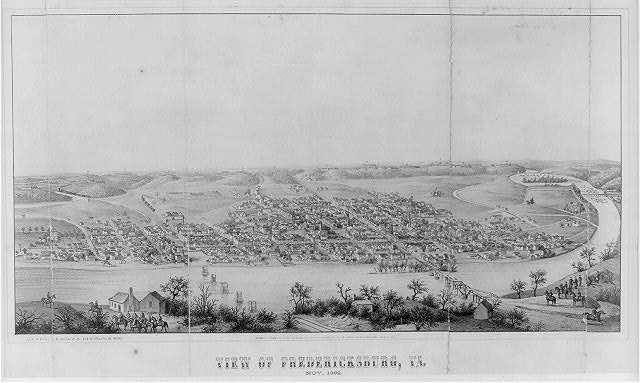
View of Fredericksburg, Va - Nov. 1862 (no date recorded on shelflist card; LOC: LC-USZ62-49914)

standing still?

Posted in 150 Years Ago This Week, Battle of Fredericksburg, Military Matters | Tagged , , , | Leave a comment

All Quiet

“all is quiet” on the Fredericksburg Front

From the Richmond Daily Dispatch December 8, 1862:

From Fredericksburg.

The regular train on the Fredericksburg road was greatly delayed beyond its usual time of arrival last night. Advices from that quarter, how ever, repeat the story that “all is quiet,” and that no active movements are in progress.

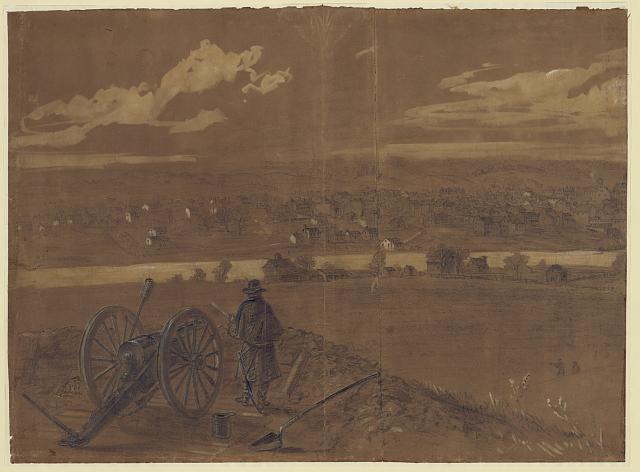
Fredericksburg, Va. (by Alfred R. Waud, Harper's Weekly, December 20, 1862, pp. 808-809; LOC: LC-DIG-ppmsca-22582)

looking peaceful from Union artillery perspective, too

Posted in 150 Years Ago This Week, Battle of Fredericksburg, Military Matters | Tagged | Leave a comment

Uncompromising

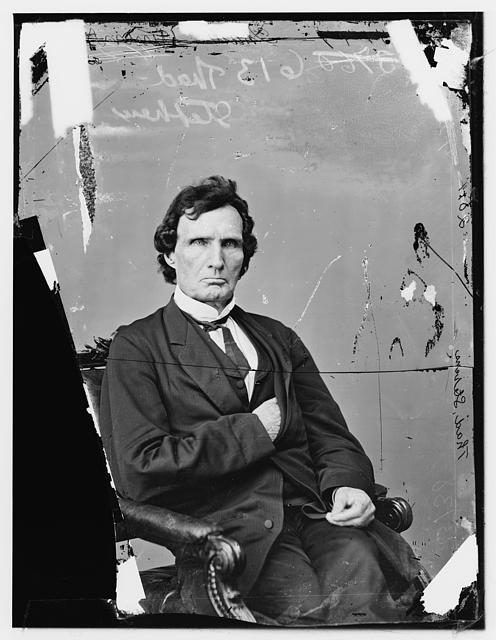
Hon. Thaddeus Stevens of Penn. (between 1860 and 1875; LOC: LC-DIG-cwpbh-00460)

territorial compromise = high crime

From The New-York Times December 8, 1862:

TO THE ASSOCIATED PRESS. … MR. STEVENS’ RESOLUTION. NAVAL ORDERS.

WASHINGTON, Sunday, Dec. 7

The resolution of Representative STEVENS, denouncing as guilty of a high crime any person in the Executive or Legislative branch of the Government who shall propose to make peace, or shall accept or advise the acceptance of any such proposition, on any other basis than the integrity and entire unity of the United States and the Territories, as they existed at the time of the rebellion, the consideration of which has been postponed till Tuesday week, will probably be fully discussed, as several members are already preparing to speak upon the subject. This resolution is not supposed to be aimed at the Administration, as its position is known to be that no peace is admissible at the cost of a single acre of the Union.

MR. VALLANDIGHAM’S RESOLUTION.

The resolution of Mr. VALLANDIGHAM, proposing a Convention of the States, and which is pending from the last session, will soon come up for consideration in the House.

Capt. JOHN A. WINSLOW has been ordered to the command of the screw-sloop Kearsage, vice Capt. PICKERING, detached and ordered home.

Thaddeus Stevens got right to work in the December 1862 legislative session. I’m not sure how far this resolution went, but by December 8th the House passed Stevens’ Habeas Corpus bill, which sought to make the president non-liable for his suspension of habeas corpus without Congressional approval. After compromise with the senate version of the bill, President Lincoln signed the resulting Habeas Corpus Suspension Act into law on March 3, 1862. The law specifically “authorized the president of the United States to suspend the privilege of the writ of habeas corpus in response to the United States Civil War …”

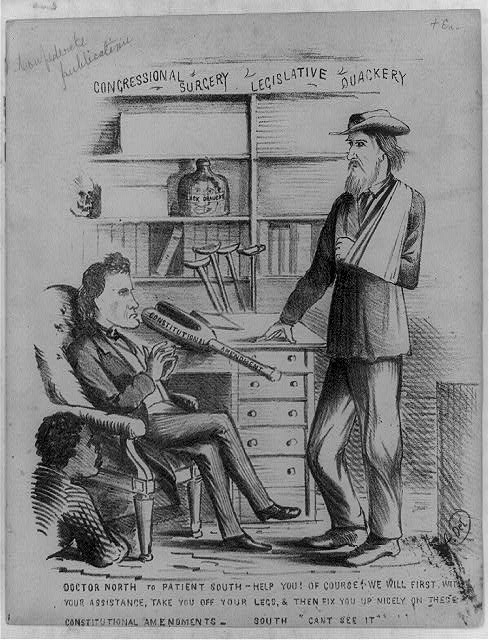
Here’s a political cartoon featuring Stevens from before the war started. You can read about it at the Library of Congress.

Congressional surgery. Legislative quackery (1860 or 186; LOC: LC-USZ62-89571)

The doctor is in

Posted in 150 Years Ago This Week, Northern Politics During War | Tagged , , , , | Leave a comment

Vulture

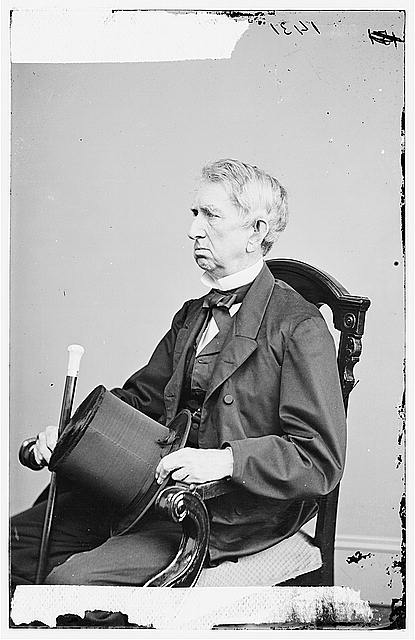
Portrait of Secretary of State William H. Seward, officer of the United States government (Between 1860 and 1865; LOC: LC-DIG-cwpb-04948)

vulture perches on the fragments of the country he destroyed

Vilifying the ‘virtual’ northern president, who’s actions are a stimulant to ‘determined resistance’

From the Richmond Daily Dispatch December 5, 1862:

The next Yankee President.

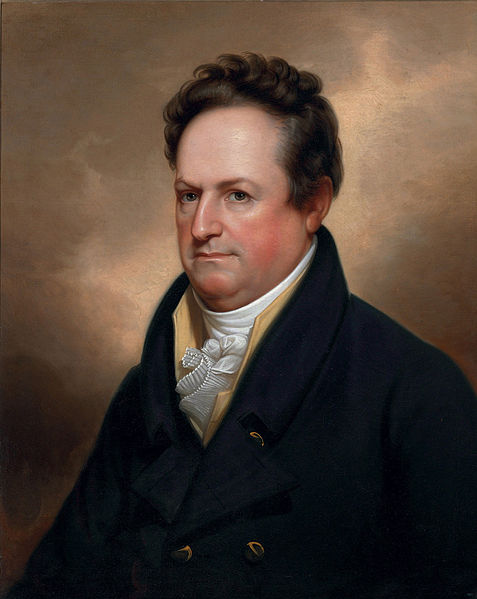
Of course-Wm. H. Seward has not sold himself to the Devil for nothing. The Presidency has been the object of his life, and, from the beginning, he has deliberately and systematically sacrificed his soul for the attainment of this object. He commenced his career in New York at a time when politics in that State were comparatively pure, and when the public theatre was occupied by personages of lofty moral port and commanding intellectual stature. There were statesmen in that day; m[e]n who comprehended justice, truth, and honor; who had convictions and principles, and who acted upon them; who loved their country, and were no place hunters. They were men to whom their State, after she had given them the highest offices in her gift, was infinitely more indebted than they to her. Such was DeWitt Clinton, who made New York an empire. It was the ambition of men in those days to make a country, not to be made by it. Such was not the aim of Wm. H. Seward. His has been not only the grovelling last of the demagogue for selfish elevation, but a Satanic determination to unmake his country if necessary to the making of himself. He deliberately chose the demoralization and disorganization of society as the means of elevating himself, until he at last succeeded in undoing the work of Washington, and in rending the old Republic in fragments, that he might perch his dwarfish figure upon the colossal rules [ruins?]. Other statesmen have identified their names with some measure which, in their opinion at least, promised to increase the greatness and glory of the country. But nothing creative or beneficent ever proceeded at any time from Wm. H. Seward. If he has any genius, it is for destructiveness, for pulling down not building up. He has the countenance of a vulture and the instincts of one. He has sought to overthrow those Institutions of the Southern States which had given wealth and power to the whole nation; but has he ever had the capacity to propose anything in their place? Has he ever been able to suggest that anything but anarchy and ruin would be the result of his success? Yet he has deliberately sought this result, and involved the whole land in war, to secure his own elevation to a position which he could never have obtained by legitimate means. It would be idle to deny that he is now virtually the President, but his triumph will not be complete till he is President in name as well as in fact, till the South is subjugated, and he rules by Northern votes and bayonets over the whole of the old Union.

DeWitt Clinton by Rembrandt Peale (1823)

anti-Seward: noble ditch digger helped “make a country”

In spite of the terrific price he has paid for the gratification of his ambition, it is not yet certain that Seward will be the next Yankee President. The reward of his iniquity is not yet secured. If the war of invasion should fail, the arch traitor will sink to a deep of infamy, even in his own section, compared with which the reputation of Benedict Arnold is honor and renown. So far from being President, he would not be able to live in his own State, and might consider himself lucky if he escaped with his head to foreign exile. No man is more sensible than himself of the personal consequences of failure, and it is to save himself from the gulf of perdition that yawns at his feet, that he is urging on with convulsive energy the blood- hounds of war. It is not the least of the many stimulants of the South to the most determined resistance, that the defeat of the Yankees will be the personal and political ruin of the wicked author of the troubles we are suffering, who, keeping himself aloof from the trials and perils in which he has involved others, can receive no other retribution in this world than the final disappointment of that ambition which has led him to the perpetration of the most unparalleled crimes.

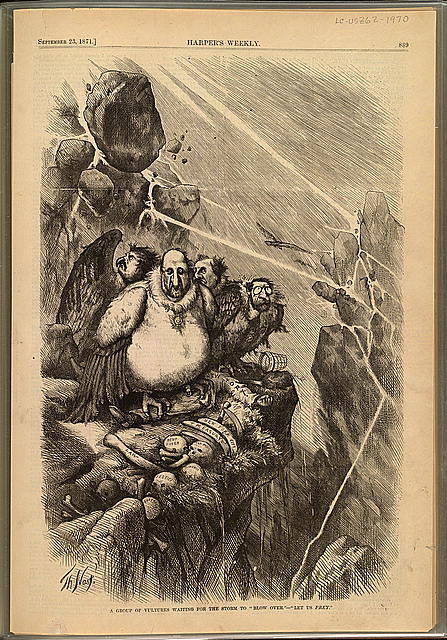
A group of vultures waiting for the storm to "Blow Over" - "Let Us Prey" (Thomas nast, Harper's weekly, v. 15, no. 769 (1871 September 23), p. 889; LOC: LC-DIG-ppmsc-05890)

Boss Tweed nine years later like southern speculators in 1862?

Extortionists down South

In the same issue the Dispatch criticizes the more faceless Southerners who are believed to be ripping off their countrymen, especially the poor. The editors call for arbitrary central government action:

The Spirit of speculation.

The speculation and extortion now so shamelessly rife bode more evil to the Southern cause than all the armies of the enemy. We will not ask how the poor are to live if the present prices of articles essential to life continue; for that, unless the Government and community step in to their support, as is done in England, will be an impossibility. But now those in moderate circumstances, and who, in ordinary times, are comparatively comfortable — a class which comprises the majority of the Southern people — how they will manage to keep soul and body together, if articles of vital necessity continue as high through the winter as they are now, is more than we can imagine. We should like to see some measure adopted by the Government, no matter how arbitrary, which would save the country from the most formidable of all the peri[l]s by which it is surrounded.

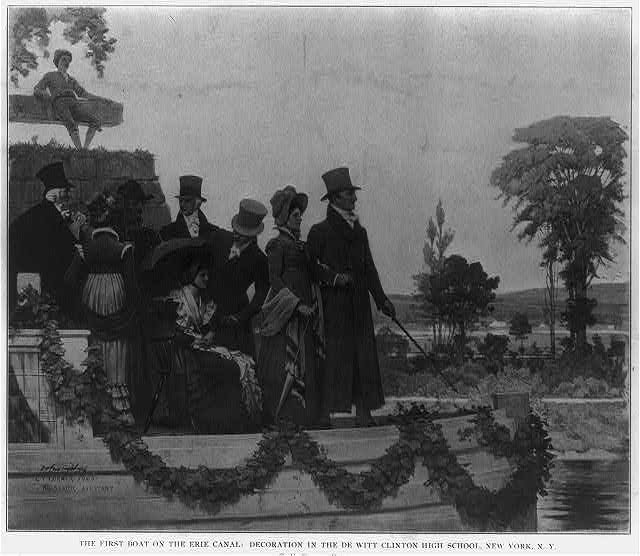
According to Wikipedia, at least one modern historian agrees with the Dispatch on the impact of DeWitt Clinton, who was instrumental in the construction of the Erie Canal. In What Hath God Wrought: The Transformation of America, 1815–1848 (2007 p. 241) Daniel Walker Howe wrote: “The infrastructure he worked to create would transform American life, enhancing economic opportunity, political participation, and intellectual awareness.”

The first boat on the Erie Canal: Gov. DeWitt Clinton and guests (c1905; LOC: LC-USZ62-80635)

Dewitt Clinton, probably on first trip along the entire length of the canal

Posted in 150 Years Ago This Week, Confederate States of America, Southern Society | Tagged , , , , | Leave a comment

ready for “curly-head”

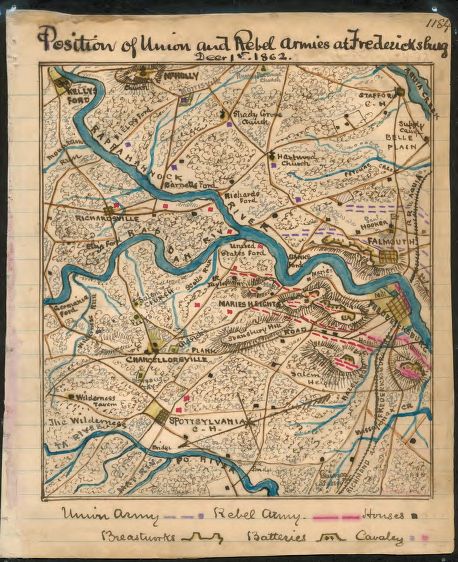
Position of Union and Rebel armies at Fredericksburg, Decr. 1st 1862. (by Robert Knox Sneden; LOC: gvhs01 vhs00122 http://hdl.loc.gov/loc.ndlpcoop/gvhs01.vhs00122 )

getting ready for a battle even more beautiful than Second Manassas

From the Richmond Daily Dispatch December 3, 1862:

From Fredericksburg.

[Correspondence of the Richmond Dispatch.]

Camp near Fredericksburg, Nov. 29.

We came here last Saturday, and the indications were that we would have a fight next day. Reveille was ordered at 4½ o’clock and break fast at daybreak, horses to be hitched, and everything in the battery ready for action. As the gray dawn broke in the clear eastern sky, we listened to hear the whizzing of the first great shell, which we were to consider notice to mount and take our guns rapidly to our destined position in the line of battle. Presently the sun came up, and soon the anticipations of a fight passed away. Day after day the story is repeated, but each time attracts less attention.

Camp of 110th Pennsylvania Inf'y near Falmouth, Va., Dec. 1862 (photographed 1862, [printed between 1880 and 1889]; LOC: LC-DIG-ppmsca-33114)

Abolitionists in camp near Falmouth

I have been down several times to view the Abolitionisms [Abolitionists] on the other side. From the hills on this side we have a fine view. It is true that these hills are much farther from the river than those on the Stafford side, but they are nevertheless commanding and nearly as high. Between our range and the river there are beautiful flats, of from three quarters to a mile and a quarter wide. At the foot of this range of broken hills runs a canal, which would greatly obstruct the passage of infantry as well as artillery. If the fight comes off here I would advise you to come up and wintriness [witness] the grand and sublime special. There is a position commanding a full view of almost the entire line of battle. An artillery duel might be carried on here for a fortnight without any definite result. What we want to see is the infantry cross the river. We expect a most lively time then. The last battle of Manassas has been called the “most beautiful fight of the war, but a fight here will be more beautiful still, in my judgment, as well by reason of the result as the position of the parties. There is a ford on the left, near Falmouth, where infantry might cross, but the banks are so steep on the other side that artillery cannot be brought over.

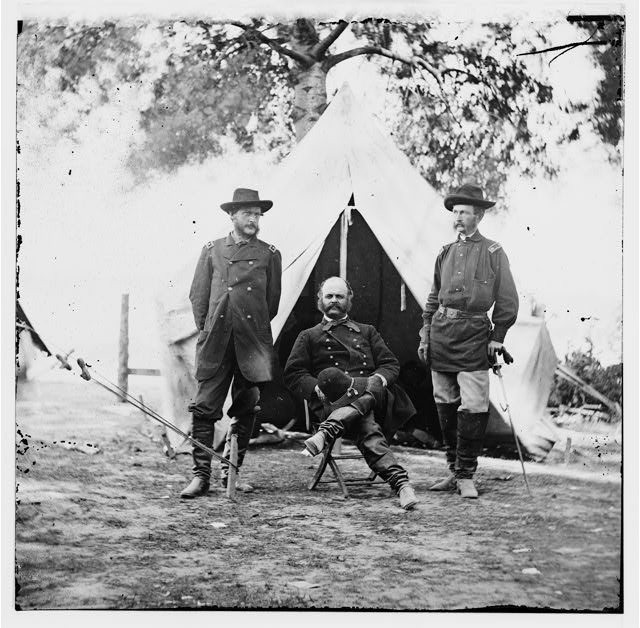
Warrenton, Virginia. Gen. Ambrose E. Burnside and staff officers (1862 Nov; LOC: LC-DIG-cwpb-01704)

“That d — d curly-head Burnside.”

Yesterday I saw a Yankee brigade on dress parade, Most of the camps are a mile or so back from the river, among the pines, as indicated by the smoke from their fires; but there are a few regiments nearer the river, in ravines and clumps of trees. They come daily down to the river bank. One of our men asked one of the Yankees, the other day, who was in command? He replied “That d — d curly-head Burnside.” I understand the Federal are deserting daily. Some say the main body have gone down the river — for what purpose I cannot imagine, I first saw the light on the banks of the Rappahannock, and know the river pretty well. Light artillery and sharpshooters will be of great service if the enemy expect to use transports on the river, as I presume they will be compelled to do, the railroad to Aquia Creek not being sufficient.

If the enemy will not consent to cross so long as we oppose him, General Lee may invite him over by falling back a little. Burnside, it seems, is pledged to advance, and if he delay it much longer he will get stuck in the mud. I have my doubts about the crossing or attempting to cross here; but others, better informed, think he will.

Our army is in good condition, the men being rapidly supplied with shoes and blankets. Socks are in great demand, In one company of 80 Lien, 31, had no socks. Friends at home should supply the demand. The Government has done admirably well in the supply of the heavier articles of clothing, and if Gov. Letcher’s advice is taken, the others will come.

Since I last wrote you, Col S. D. Lee, of South Carolina commander of an artillery battalion, has been ordered to Vicksburg and promoted to a Brigadier; and Lieutenant-Colonel E P. Alexander, late on Gen. Lee’s staff, has been put in command of this battalion While the battalion regrets the transfer of Col. (now General) Lee to an other command, yet we think he has been sent to the right place.

Edward P Alexander The Photographic History of The Civil War in Ten Volumes: Volume Five, Forts and Artillery   . The Review of Reviews Co., New York. 1911. p. 61)

getting his artillery ready

Col Alexander, our new commander, graduated second in his class at West Point, and in addition to the control of this battalion, has in a few days past been put in command of all of Gen. Longstreet a artillery, besides being connected with the Orderliness Department. He has rather more than one man can do. He was assigned to our battalion about a fortnight ago. The equipment of this battalion is very fine. The following are the batteries — half of the guns were captured: Jordan’s hatt’s, Monday’s, [ Eubanks,s, ]Parker’s, and Woolfolk’s. In the battalion there are 760 men and 410 horses and mules. To supply the command with forage demands a good deal of energy on the part of the Quartermaster. Lieut. P. A. Franklin, of Parker’s battery, has been lately commissioned Quartermaster, with the rank of Captain, and Sergeant George E. Saville has been elected to fill his place in the battery. The health of the battalion is remarkably good, In the company to which I belong there is not a man unfit for duty.

A. B. C.

Edward Porter Alexander resigned his federal army commission when he learned that his native Georgia had seceded. As “an artillery battalion commander under Lieutenant General James Longstreet, … his strategic placement of artillery helped the Confederates win at Fredericksburg. His Military Memoirs of a Confederate was published in 1907. You can read it online.

By 1907 Mr. Alexander looked at events this way in his introduction:

One thing remains to be said. The world has not stood still
in the years since we took up arms for what we deemed our
most invaluable right that of self-government. We now
enjoy the rare privilege of seeing what we fought for in the
retrospect. It no longer seems so desirable. It would now
prove only a curse. We have good cause to thank God for our
escape from it, not alone for our sake, but for that of the whole
country and even of the world.

Had our cause succeeded, divergent interests must soon have
further separated the States into groups, and this continent
would have been given over to divided nationalities, each weak
and unable to command foreign credit. Since the days of
Greece, Confederacies have only held together against foreign
enemies, and in times of peace have soon disintegrated. It
is surely not necessary to contrast what would have been our
prospects as citizens of such States with our condition now as
citizens of the strongest, richest, and strange for us to say
who once called ourselves ” conquered ” and our cause ” lost ”
the freest nation on earth.

I’m mostly of the “let them go” philosophy. but even I’m thankful that the United States was a united nation when World War II came around.

Posted in 150 Years Ago This Week, Battle of Fredericksburg, Military Matters | Tagged , , | Leave a comment