We support the troops

From the Richmond Daily Dispatch December 3, 1862:

Negro Patriotism.

–Benj. Marable, Esq., of Halifax county, Va. has four negro men who, for some time, have been engaged working on the fortifications at Richmond. A few days ago they came up home on a visit, and finding good warm clothing, excellent shoes and socks made for them they generously declined them, on condition that their master would send them to the suffering soldiers who, they said, needed them much more than they did. They had seen suffering soldiers, and in touched their hearts to compassion; besides they want the South to conquer. Now. how many miserable money grabbers and Shylocks, with white skin, but hearts blacker than the hied of these contrabands, would have been as self-sacrificing, generous, and magnanimous? Not one! The articles thus contributed by these colored would buy several barrels of corn, at the price — Let many “white” man think of this. –Milton Chronics.

Matching Gift Opportunity

From the same issue:

A Liberal Proposition.

–At a meeting of citizens, held on Wednesday evening, Major W. T Sutherlin proposed that he would contribute $2,500 worth of leather to the Confederate Government, to be made into shoes for the soldiers and their families, provided the citizens of Danville would contribute an additional $2,500 for similar purposes, to make the amount donated to this praiseworthy object from the citizens of the town $5,000 He, however, expresses his purpose to contribute the $2,500, whatever might he the action of other citizens.–Danville (Va) Register.

I’m not sure how much leather $2500 Confederate would buy in late 1862, but here’s evidence that inflation was even affecting the newspaper business:

The Dispatch.

The immense increase in the cost of everything which goes to make up the newspaper makes it impossible to continue our present terms and publish a sheet which can reflect credit on the publishers and be gratifying to the reader. The present appearance and arrangement of the Dispatch is not at all agreeable to the editors, and cannot give satisfaction to the public. The better to accommodate it to the order of the day, and to improve it and increase its interest, we have determined to adopt the following as our table of rates:

Subscription.
Daily paper, per annum $8.00
Daily paper, six months 5.00
Daily paper, three months 3.00
Daily paper, one months 1.00
Semi Weekly paper, per annum 5.00
Weekly paper, per annum 3.00

Advertising.
One square, of eight lines, first insertion 75 cts.
Each continuance 50 cts.

These terms are not advanced in proportion to the general enhancement of everything. They will better accommodate the paper to the exigency of the times, and enable us to make such improvement in each of its departments as will be gratifying both to our readers and ourselves. These improvements will more than compensate for the moderate advance in our charges.

Posted in 150 Years Ago This Week, Confederate States of America, Southern Society | Tagged | Leave a comment

Cavalry Along the Rappahannock

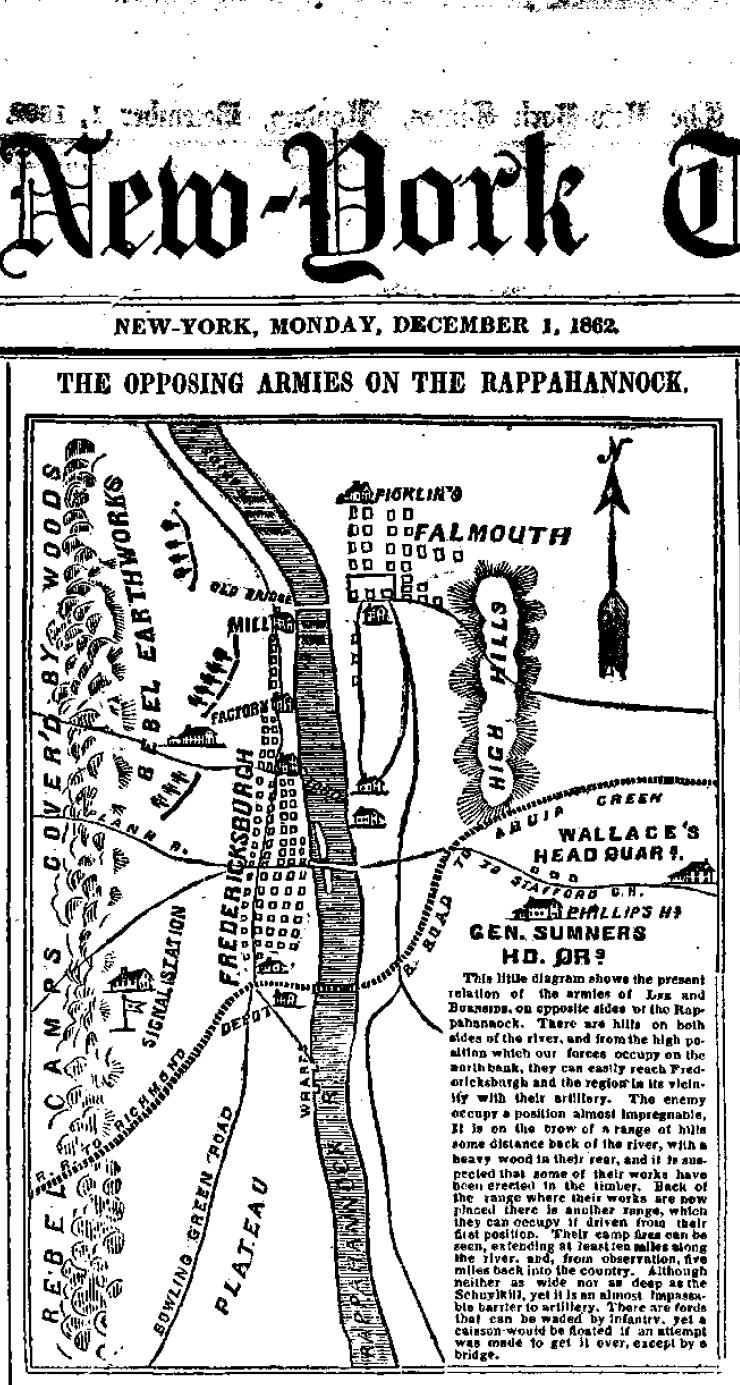
Fredericksburg (The New-York Times 12-1-1862)

“The enemy occupy a position almost impregnable.”

150 years ago today there was a lot of information in The New-York Times about the situation near Fredericksburg, Virginia, where the Confederates under General Lee and General Burnside’s Union army faced each other on either side of the Rappahannock River. Here’s a bit about a Union cavalry scouting party’s work. From The New-York Times December 1, 1862:

LETTER FROM BURKE’S STATION.; Operations of the Harris Light Cavalry.

BURKE’S STATION, FIVE MILES FROM THE

POTOMAC, AND ELEVEN FROM FREDERICKSBURGH, Thursday, Nov. 27, 1862.

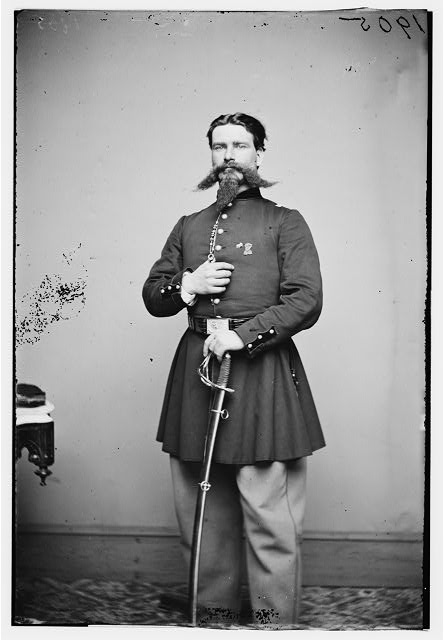
An important expedition sent out several days since, has just returned here from the country around the mouth of the Rappahannock. On Wednesday, the 19th inst., Gen. BAYARD was ordered to send a portion of his cavalry in a southerly course from Falmouth, for the purpose of clearing out any rebel stragglers, and watching, the movements of the enemy on the other side of the Rappahannock. The force consisted of ten squadrons of the Harris Light Cavalry, led by Major H. HARHAUS, a gallant officer, and about the same number of the First New-Jersey Cavalry, all under command of Col. KARGA. [???] Falmouth on Thursday morning, the 20th, turning off on the crossroad leading to King George Court-house and Port Conway. The men proceeded on their way until night, when they encamped on Col. TAYLOR’s farm. Scouting parties were sent out in the direction of King George and Port Conway. On the next day small squads of men were also sent in various directions. One of these discovered that the rebels had collected on this side of the river 15,000 bushels of wheat and corn, to be forwarded toward Richmond. A long row of teams were discovered on the opposite shore of the Rappahannock, waiting to receive the grain. One hundred and fifty rebel cavalry were also discovered in the rear of Port Royal, opposite to Port Conway, whose mission was to guard this wagon train.

Col. Percy Wyndham, 1st N.J. Cavalry (Col. Percy Wyndham, 1st N.J. Cavalry; LOC: LC-DIG-cwpb-05866)

Colonel Sir Percy Wyndham, Englishman helping out the Union cause

No sooner were the cavalry seen than Col. KARGA determined to shell them. The ten pieces of flying artillery accompanying the expedition were masked in a squadron of the Harris Light Cavalry, which cautiously proceeded in the direction of Port Conway, On reaching the bank of the river the guns were quickly unlimbered, placed in position, sighted, and before the rebels on the opposite side dreamed of our presence two shells were dropped among them; such a skedaddling on a small scale has not been witnessed during the war. The men, some with horses and some without, fled in all directions, to the infinite amusement of our men. The force returning to Col. TAYLOR’s farm at night (Saturday,) and reconnoitering parties were thrown down the Neck as far as Mathias Point. A large amount of whisky, fancy goods, boots, shoes and contraband articles of every description, were found secreted in barns and other places. Maj. HARHAUS of the opinion that notwithstanding the blockade an immense amount of illegal traffic is carried on across the Potomac. One hundred and fifty hogs belonging to the Confederate Government, were also secured. The enemy’s camp fires were visible all along the opposite shore of the Kappahannock, indicating the presence of a very large force. Refugees and contrabands, who had escaped through the rebel lines, informed our officers that the enemy were bringing up which was done [?]. On the afternoon of the 16th, Lieut. [?] all their available force from Richmond, intending to make the fight in the vicinity of Fredericksburgh. The men reached their encampment a short distance from here, much exhausted by their five day’s operations. The Eighth Pennsylvania Cavalry have been sent out to complete the good work commenced.

During the week prior to this expedition, the Harris Light Cavalry were busily employed in finding the fords on the Rappahannock above Fredericksburgh. …

2nd New York Cavalry Regiment was also known as the Harris Light Cavalry after Ira Harris, a U.S. senator from New York.

At the time of this story Col. Sir Percy Wyndham, a rascal from England, was leading a brigade in General George Dashiell Bayard’s division.

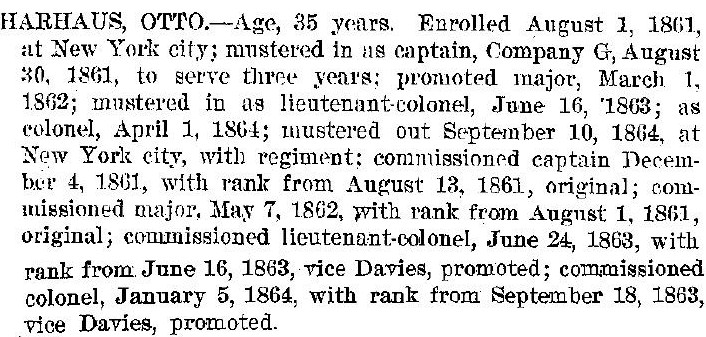
Otto Harhaus

Otto Harhaus, Harris Light Cavalry

Posted in 150 Years Ago This Week, Battle of Fredericksburg, Military Matters | Tagged , , | Leave a comment

Pressure pointed

"Masterly inactivity," or six months on the Potomac [caricature of inactivity of Confederate and Union soldiers on both sides of the Potomac River] (rank Leslie's illustrated newspaper, vol. 13 (1862 Feb. 1), p. 176; LOC: LC-USZ62-82807)

no repeat of last winter, please!

Counting the reasons not to go into winter quarters

150 years ago this week citizens in Richmond could read this recap of the New York Herald’s case for immediate attacks by the federal armies. From the Richmond Daily Dispatch December 1, 1862:

The Herald on a speedy advance.

The New York Herald says the people of the loyal States of the Union, as manifested in the late elections, demand an active prosecution of this war East and West. They expect it, too, from the promises held out by the Government, from its vast preparations made and its formidable aggressive movements afoot by land and sea. Particularly in reference to the grand Army of the Potomac! this belief of a forward movement entertained, regardless of the snows, rains, frosts, and thaws of a Virginia winter. The pressing necessities no less than the present advantages of the Government forbid the idea that three or four months are to be wasted in winter quarters. It continues:

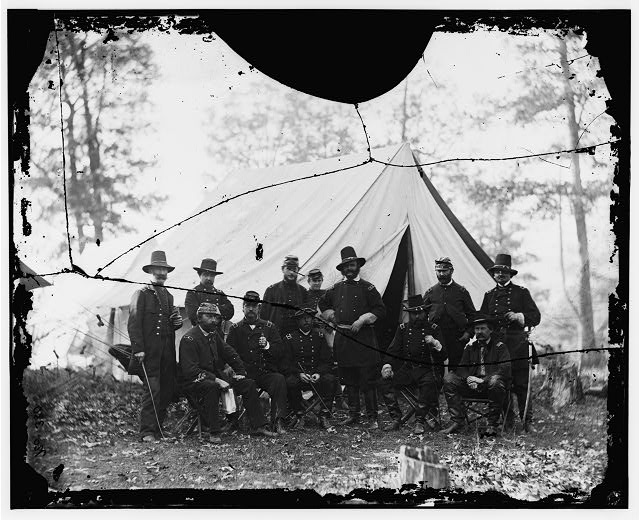
Warrenton, Virginia. Headquarters, Army of the Potomac. Generals, Ambrose E. Burnside, Winfield S. Hancock, Darius N. Couch, Edward Ferrero, Marsena R. Patrick, Orlando B. Willcox, John Cochrane, John Buford and others (1862 Nov; LOC: LC-DIG-cwpb-04384)

Burnside, et. al. at Warrenton, November 1862

The depreciation of our paper money — federal and local; the pressure of the national tax bill upon all the business avocations of the loyal States; the doubts and misgivings resulting from the continuance of a powerful rebel army between Washington and Richmond; the enormous sums of money required to maintain the opposing army of the Union, and the heavy reinforcements of men demanded from time to time to repair its losses, whether fighting or inactive will suggest some of the necessities for active operations, regardless of wind or weather. The impression is widely entertained, and we think it well established in truth, that the Union army in Virginia is stronger and better prepared now for the work of a triumphant campaign than it ever has been heretofore, or is likely to be hereafter. The experience of last summer’s campaign on the Richmond peninsula has also proved that if he would escape the deadly malaria of those swamps, and those tropical rains which render them almost impassible, Gen. Burnside must avail himself of the advantages of the winter season for his advance upon the rebel capital.***

Let Washington be rendered perfectly safe without requiring Gen. Burnside to keep a sharp eye in that direction while advancing upon Richmond, and let him be further assisted with a co- operating land and a naval force by way of the James and York rivers, and his advance upon the rebel capital will be the death blow to the rebellion. The army Lee, if not captured or destroyed at Richmond, will be enveloped by forces sufficient to capture it or scatter it to the [w]inds; and, with the loss of this army, the suffering and exhausted people of the rebellions South themselves come to the rescue. They will recognize in the results of the late New York and other elections of the Northern States a guarantee of security in the Union, and they will adopt the saving alternative of submission.

But time is precious. The condition of the Federal Treasury and of the currency of the country; the heavy drain upon the resources of the loyal States required to sustain our immense fleets and armies in the field, admit of no inactivity, no waste of time, money, men, and opportunities, by waiting upon the elements. We must during this winter, if not before the expiration of the present year convince the people of the South of the folly of further resistance, and England and France of the folly of intervention, or we know not what may be the consequences.

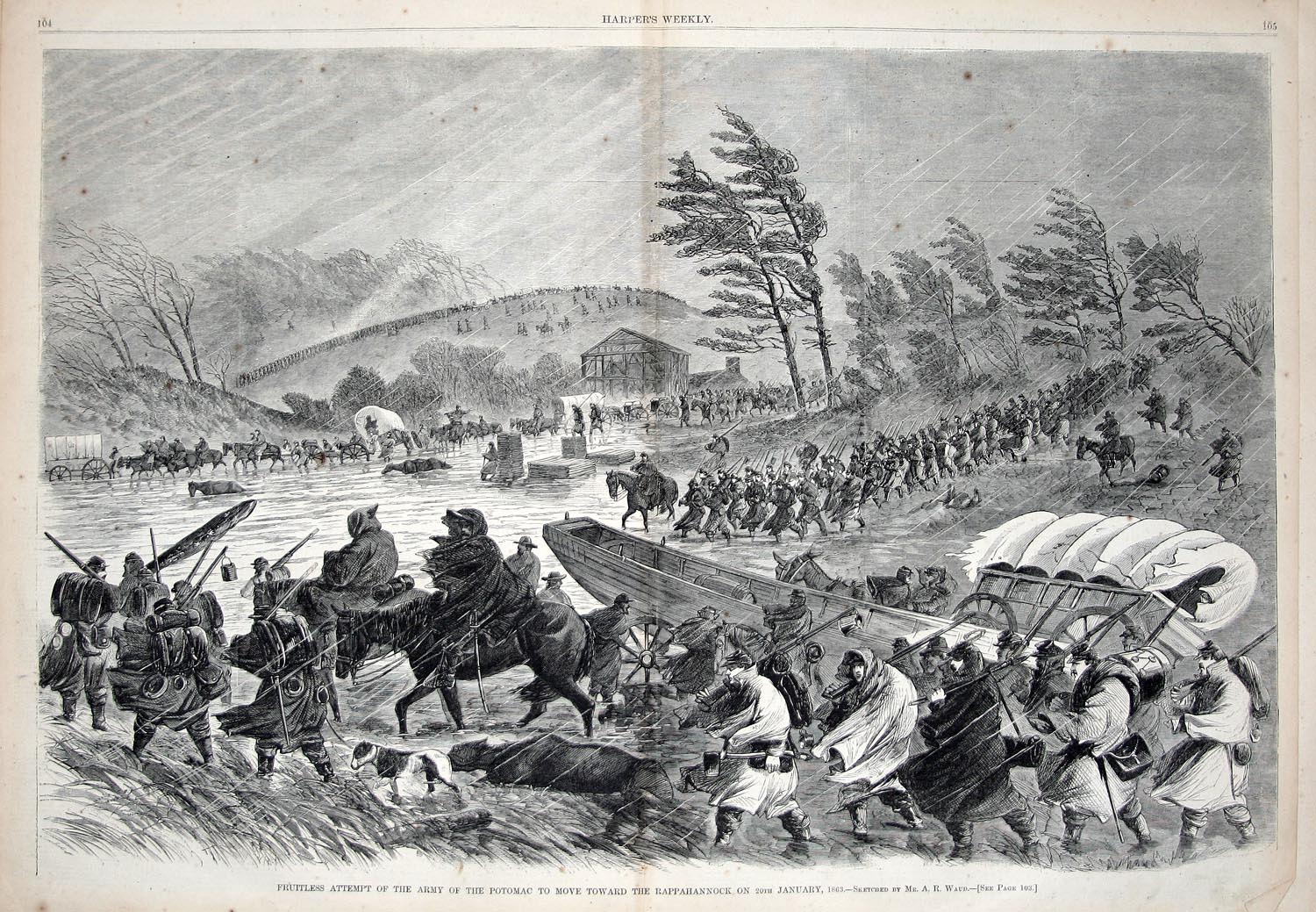
crossing-rappahannock 1-20-1863 (Harper's Weekly 2-14-1863)

beats malaria

This image depicts a scene from January 20, 1863 and is found at Son of the South.

Posted in 150 Years Ago This Month, Battle of Fredericksburg, Military Matters, Northern Politics During War | Tagged , , , | Leave a comment

Purdy Promoted

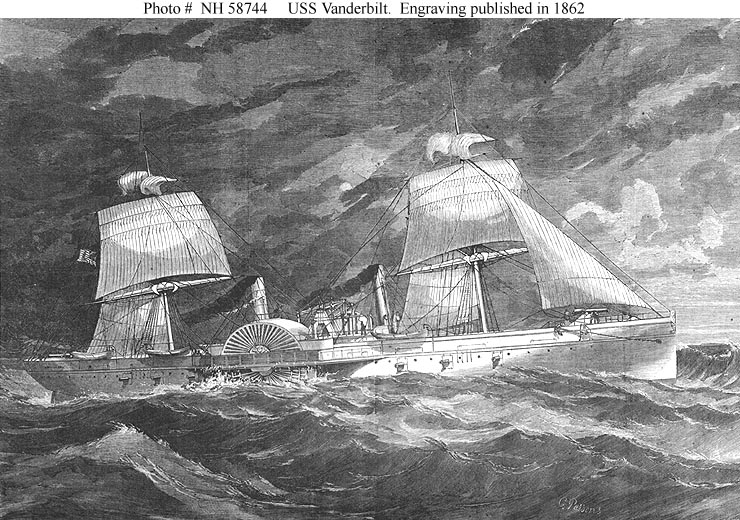
USS Vanderbilt (1862-1873)  Line engraving by G. Parsons, published in "Harper's Weekly", November 22,1862, depicting the ship at sea.

searching for the elusive Alabama

From a Seneca County, New York newspaper in November 1862:

Promoted.

William B. Purdy, eldest son of A.S. Purdy, of this village, who enlisted in the Navy, as a marine, from the city of Hartford, Conn., where he has been employed as a book-keeper for the past two o[r] three years, last week received, through his friends in Hartford, from Secretary Welles, a commission as Assistant Paymaster in the Volunteer Navy. This will, no doubt, be pleasing news to “Will.” when he hears of it, he b[e]ing now at sea in The Vanderbilt, hunting the pirate Alabama. We hope he will receive the former and capture the latter, and that, too soon. – Ovid Sentinel.

Hopefully Mr. Purdy was more successful at his new pursuit than the USS Vanderbilt, which

spent the last two months of 1862 and all of 1863 searching in the Atlantic Ocean and West Indies for the Confederate cruiser Alabama. While this extended cruise did not produce an encounter with the elusive enemy warship, Vanderbilt did capture three merchant ships suspected of blockade running or other traffic with the enemy, including steamer Peterhoff in February 1863; steamer Gertrude in April; and bark Saxon in October 1863.

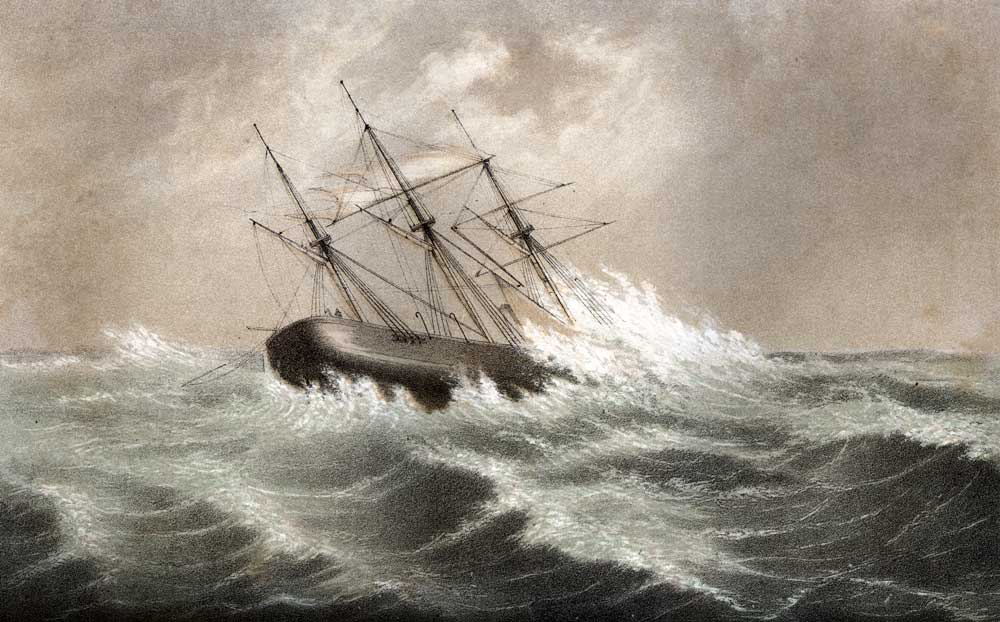
The October 20, 1862 issue of the Richmond Daily Dispatch published a good deal of information about the CSS Alabama and its captain, Raphael Semmes, “… sports a huge moustache the ends of which are waxed in a manner to throw that of Victor Emanuel entirely in the shade, and it is evident that it occupies much of his attention.” You can see the waxed moustache (page ii) and read a good account of the Alabama and Semmes in an online pamphlet at The Navy Department Library. Perhaps the biggest threat to the ship as of 150 years ago today was a cyclone the Alabama endured on October 16, 1862. Semmes wrote about the storm in a book (around page 472 and following) at Project Gutenberg.

CSS Alabama in the 10-16-1862 cyclone (http://www.gutenberg.org/files/34827/34827-h/34827-h.htm)

Storm harassing the Alabama

Posted in 150 Years Ago This Month, Naval Matters, Northern Society | Tagged , , | Leave a comment

the greenbacks are in the mail

What do you tell the “butcher and baker, and kerosene seller”?

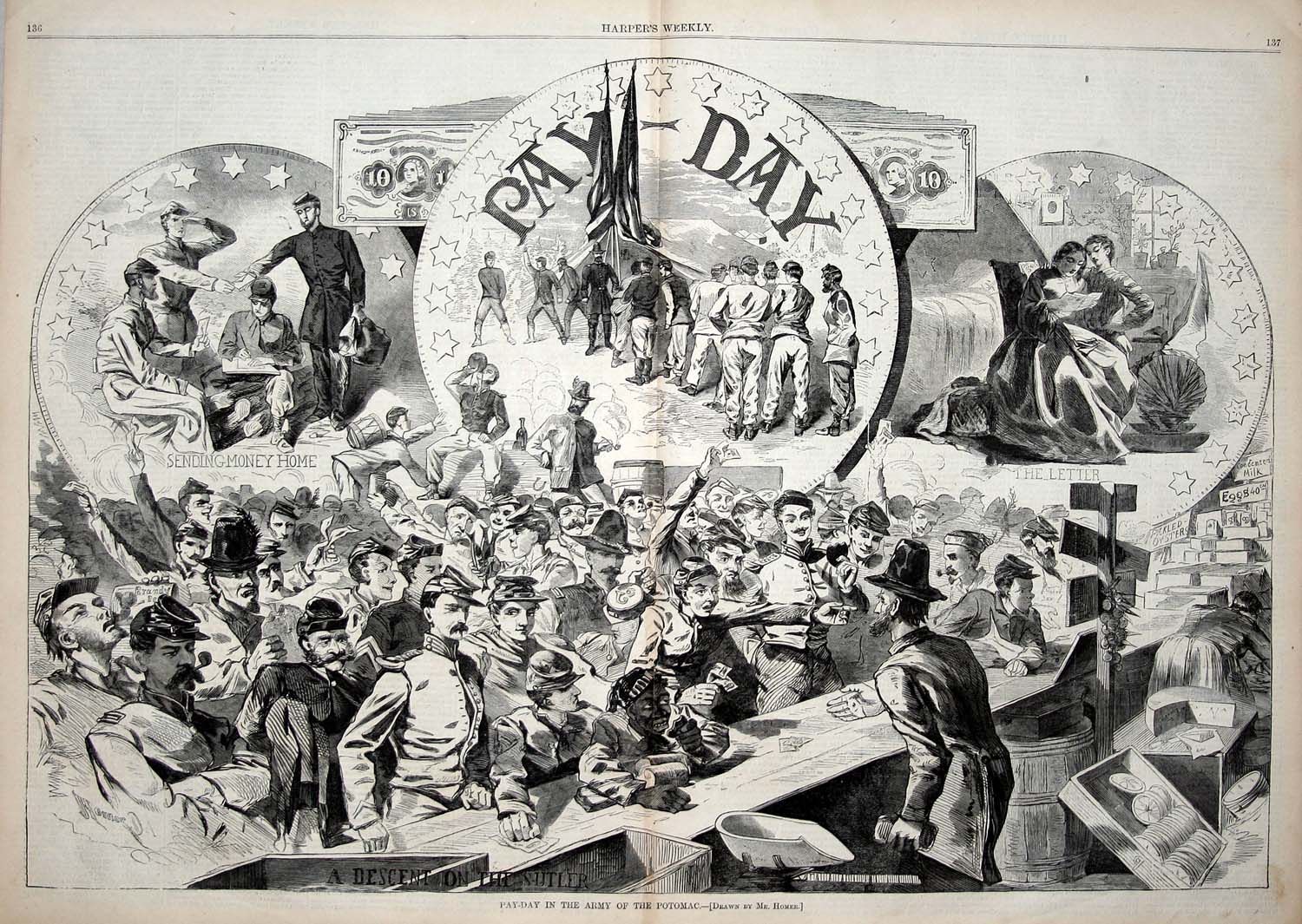
It is said that pay in the Union army was usually behind schedule. Here a soldier’s wife explains the issue on the home-front and shows that the army would probably more effective (with possibly fewer desertions?) if soldiers did not have to worry about the financial situation of their families. She closes with an appeal to the power of the press – “H.J.R.” was Henry Jarvis Raymond, founder of The New-York Times and a bigwig in Republican politics.

From The New-York Times November 28, 1862:

Soldiers’ Pay–An Appeal from the Wife of a Soldier.

To-the Editor of the New-York Times:

May a woman be allowed to ask if no means can be devised of paying the soldiers more promptly?

To the poorer class, who can come forward and claim the State pay, which is disbursed often and liberally, the tediousness of waiting for a “soldier’s package, supposed to contain,” may not seem so great a trial. But there are hundreds to whom Government pay would be all sufficient for the maintenance of their families, could they but receive it oftener and regularly.

How painful it must be to the loved ones we have sent forth with a “God-speed” to the good cause, to write home again and again, “We are expecting the Paymaster every day.” “We are to be paid on the 15th.” “We hear the Paymaster is coming next week, sure,” &c., &c. These assurances to be again repeated by us to “butcher and baker, and kerosene seller,” raising their hopes only to be blasted many times, like our own. I do not speak of these trials as endured by the immaculate shoulder-strap gentry who [???] get to Washington, and, understanding how to unwind “red tape.” to the pay department. and are resplendent with bran-new “greenbacks,” but of those officers in particular who are at their posts, encouraging “the boys” that “the Paymaster will be here in a little while, now” — men who will be, aye, and have been, true soldiers, but who know that duty would be more cheerfully performed, could they feel “all right about home.”

Many of the regiments at Suffolk, for instance, have received no pay for over four months, and I know of families who are sufferring for these very means, but who feel no right to ask for the State aid, only asking for their own honestly earned pay.

And now, when we are looking for “forward movements,” and skirmishing and great battles, and praying. each one in the selfishness of our [???], that our loved ones may be spared, is not this anxiety heightened [???] to these who are forming in line of battle, and to us who only watch and wait, by the thought of [???] poverty that would follow disaster?

Of course, in time, by studying out the proper channel in which to make application, one could receive all “arrears of back pay,” but, I repeat, it would not prevent immediate want. Before another stop is taken, surely every man should be paid, and our soldiers would “forward to Richmond,” with lighter hearts, and there would be heavier purses in some of these far away homes.

Cannot “H.J.R.” bring this neglected (?) matter before the powers that be?.

Many would sincerely thank him for his influence, and none more sincerely than

A SOLDIER WIFE.

CAMBRIDGE, Nov. 24, 1862.

The following is an illustration by Winslow Homer in the February 28, 1862 issue of Harper’s Weekly (at Son of the South).

By Winslow Homer, Harper's Weekly, 2-28-1862

pay-day is a yay-day

Posted in 150 Years Ago This Week, Military Matters, Northern Society | Tagged , , | Leave a comment

Thanksgiving near Portsmouth

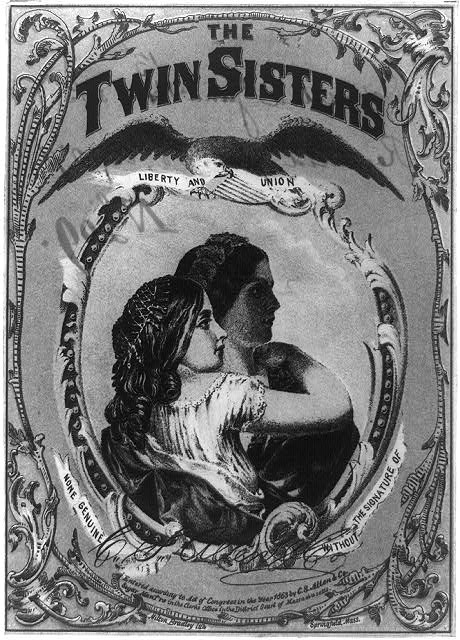
The twin sisters liberty and union (1863; LOC: LC-USZ62-90679)

worth fighting for

Last week The Civil War 150th Blog compared the official Union and Confederate Thanksgivings in 1862. Presidents Lincoln and Davis were thankful for military victories and proclaimed days of Thanksgiving in April and September respectively. Thanksgiving days were pretty fluid back then, but here’s evidence that there was some tradition for a fowl feast on a Thursday late in November.

The writer concludes with passionate words about fighting for “Union and Liberty” that has nothing to do with freeing slaves.

From a Seneca County, New York newspaper in 1862:

Letter from the 148th Regiment.

CAMP FOLGER, NEAR PORTSMOUTH, Va,

Thursday, Nov. 27, 1862.

EDITOR REVEILLE: – As many of the readers of your paper are particularly interested in the 148th reg. N.Y.V., we beg leave to say a few words through its columns relative to this band of patriots. We are very comfortably and quietly situated some two miles from the city of Portsmouth, upon the same grounds we pitched our tents the 12th of October last. The time of our sojourn here has been passed in studying the arts of war, under the instruction of our able and gentlemanly Lt. Col. Guion. We think tht the “rebs” would deem the 148th of no little consequence if they were called to contend with them on the battle field.

It is unusually quiet with us to day, the ordinary camp duties are dispersed with to give us ample opportunity to palatably prepare the turkey, chicken, goose or duck (as the case may be) procured for our thanksgiving dinner.

We are blessed with general good health at present, our sick list numbers as low as it has at any time since the organization of the Regt. We have lost but three by death since leaving the Empire State. A general feeling of regret pervades the whole Regiment at present on account of the resignation of our Q.M., Lieut. E. Woodsworth. He was obliged to leave his post, on account of the duties devolving upon him proving too arduous for his present state of health. He has at all times, and in all places, shown himself a perfect gentleman, and ever will be held in grateful remembrance by every member of the 148th Regt. In concluding this hastily written article we will say that we deem the cause which has prompted us to leave our homes, kindred and friends, a glorious one. We have sworn to hold no truce with traitors until the sunshine of peace shall again illuminate our now distracted land, and “Union and Liberty” once more be the watchword from ocean to ocean, and from the lakes to the gulf. We are ready and willing to wield the sword, even to the death, not for the “nigger,” but for the maintainance of those national laws which for nearly a century has given us protection and unbounded prosperity.

A MEMBER OF THE 148th

The 148th was a new regiment that “chiefly engaged in garrison duty at Suffolk, Norfolk and Yorktown, Va.” during the fall of 1862 and all of 1863. George Murray Guion has made the transition from Captain in the “old” 33rd regiment to Lieutenant Colonel of the 148th.

Civil War envelope showing Columbia with American flag, laurel wreath, eagle, and cannon with message "Liberty and Union" (Boston : J.M. Whittemore & Co., [between 1861 and 1865]; LOC: LC-DIG-ppmsca-31711)

Posted in 150 Years Ago This Week, Military Matters, Northern Society | Tagged , , , , | Leave a comment

Enemy Campfires Increasing

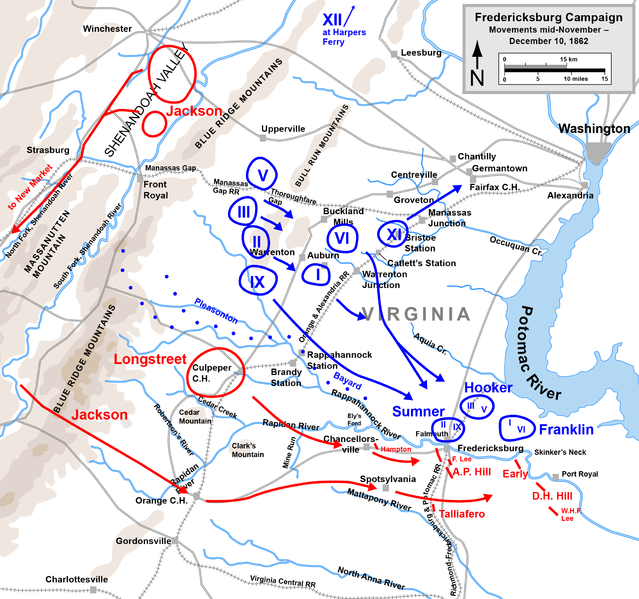
Fredericksburg_Campaign_initial_movements by Hal Jespersen

converging on the Rappahanock: ‘The camp fires of the enemy are constantly increasing within sight of Falmouth’:

From a Seneca County, New York newspaper in 1862:

From Gen. Burnside’s Army.

FALMOUTH, Va. Nov. 26.

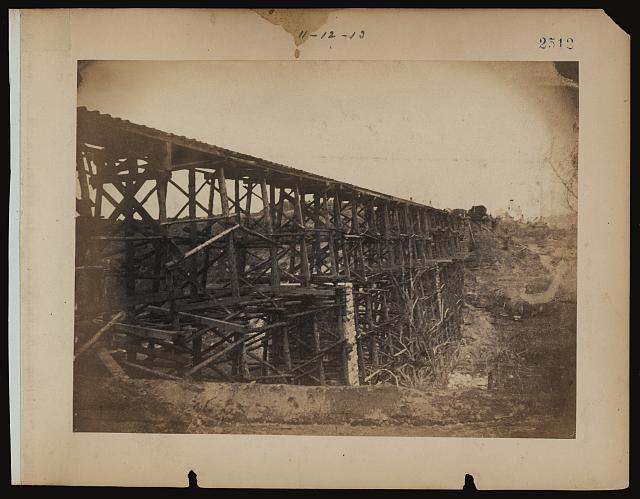
It is expected the railroad will be finished to-morrow from Acquia Creek to the Rappahannock, opposite Fredericksburg. The bridge over Potomac Creek was reported this morning as nearly completed. The cars carry supplies as far as Brook’s Station, six miles from Acquia Creek, which greatly accomodates our troops.

Notwithstanding the late bad condition of the roads, quartermasters supplies have been promptly furnished. Long lines of roads have been corduroyed, under direction of Colonel Ingalls, chief quartermaster of the army, and are in good condition.

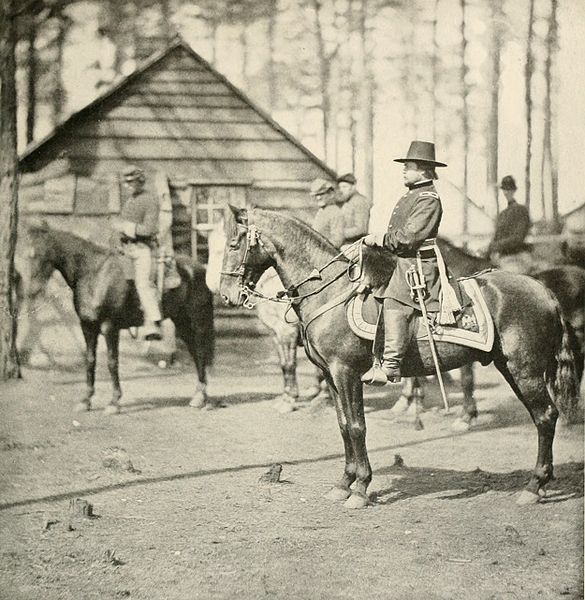
Union Major General Rufus Ingalls (File from The Photographic History of The Civil War in Ten Volumes: Volume Four, The Cavalry   . The Review of Reviews Co., New York. 1911. p. 306.)

not horsin’ around – Rufus Ingalls

The camp fires of the enemy are constantly increasing within sight of Falmouth, affording indications of the augmentation of the rebel forces. Lee has joined Longstreet and A.P. Hill. D.H. Hill and Jackson are known to be on the way thither.

Yesterday the enemy were busily engaged in constructing additional works in the rear and to the left of Fredericksburg.

The cars bring troops and supplies regularly to the rebel troops, stopping at a point three miles from the town.

Rufus Ingalls was promoted to Chief Quartermaster of the Army of the Potomac in August, 1862. In 1864 he would be responsible for building up the federal supply depot at City Point.

Building corderoy [sic] roads from Belle Plain to Frederickburgh [sic] (H.Q.) (by Arthur Lumley, between 1860 and 1865; LOC: LC-DIG-ppmsca-20775)

Building a corduroy road

Military railroad bridge across Potomac Creek, on the Fredericksburg Railroad (by Andrew J. Russell, ca. 1862 or 1863; LOC: LC-DIG-ppmsca-10321)

Bridging Potomac Creek

The map by Hal jespersen is licensed by Creative Commons.

Posted in 150 Years Ago This Week, Battle of Fredericksburg, Military Matters | Tagged , , , | Leave a comment

“visited by this fiendish invasion”

View of lower end of Fredericksburg, [...] (Feb. 1863; LOC: LC-DIG-cwpb-03551)

“clothed in mourning and tribulation”

150 years ago today the Richmond Daily Dispatch reported on Union General Burnside’s demand that Fredericksburg, Virginia surrender or else risk being bombed. The Dispatch report stated that the Yankees lobbed a few shells toward the railroad depot where a train full of fleeing citizens was departing. The editors editorialized about the condition of this town associated with George Washington’s youth.

From the Richmond Daily Dispatch November 24, 1862:

Fredericksburg.

The condition of this once happy and beautiful Virginia town must excite the sympathy of every Southern heart. It was the home of Washington in childhood, the home of that mother whose elevated character and wise training prepared the Father of his Country for the great part he played in human affairs. It may be that the home in which she lived, and in which she trained her illustrious son for his lofty mission, that the very monument erected to her memory, have been demolished by the cannon of a people who owe to Washington their freedom and independence! The town itself, though without commercial importance, has always been remarkable for the intelligence, refinement, and moral elevation of its community — We have never known a town so free from the usual vices of towns, or more distinguished for its hospitality and household virtues. Exile, desolation, and ruin are the fate with which such a town has been visited by this fiendish invasion, whilst the Northern cities, reeking with moral corruption, are exuberant with pleasure and gaiety. Washington, the central fountain of all the bloodshed, misery, and crime of this inhuman war, is said to be the scene of extraordinary festivities, whilst innocent Southern cities are clothed in mourning and tribulation. But there is justice in Heaven, and although it may be long delayed, it will come at last, and virtue be triumphantly vindicated, and vice receive its deserved recompense.

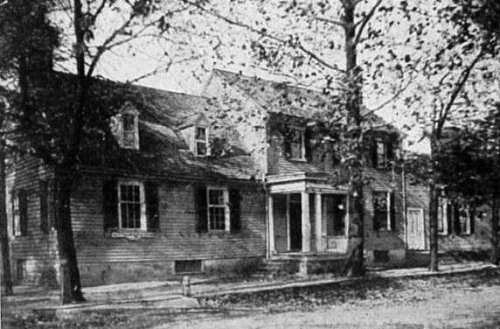
It is said that the young George Washington actually lived for a time at Ferry Farm in Stafford County across the river from Fredericksburg. In 1772 George purchased this house for his mother in Fredericksburg.

Mary Washington House (corner of Charles and Lewis streets, Fredericksburg)

Where George’s mother lived from 1772 until her 1789 death

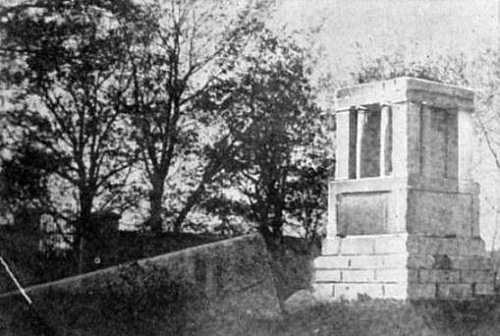
The following is the grave monument begun for Mary Washington in 1833. It was never finished but replaced by an obelisk dedicated in 1894.

Mary Washington Monument began in 1833 (Washington Avenue, Fredericksburg)

“It may be … that the very monument erected to her [Mary Washington’s]memory, ha[s] been demolished by the cannon of a people who owe to Washington their freedom and independence!

There is a lot of information about Fredericksburg at Project Gutenberg.

Posted in 150 Years Ago This Week, Battle of Fredericksburg, Military Matters, Southern Society | Tagged , , | Leave a comment

Wrap it up!

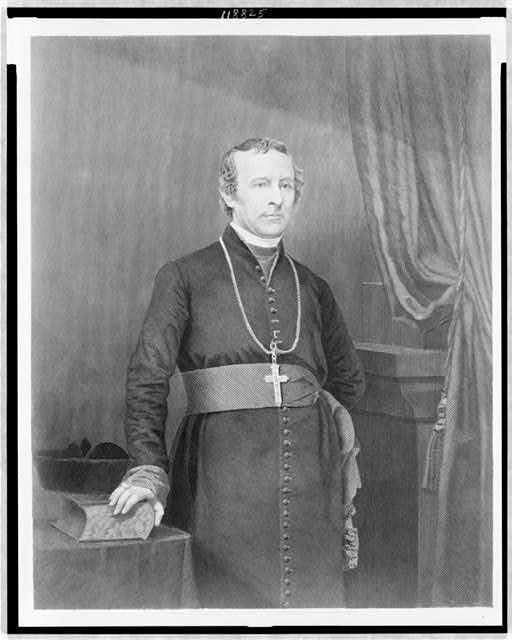
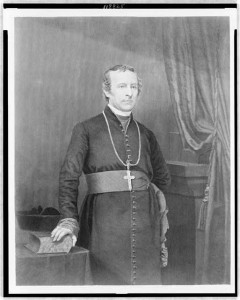
The most Revd. John Hughes--Archbishop of New York (by J.B. Forrest, c1863; LOC: LC-USZ62-118825)

“for a vigorous prosecution of our melancholy war”

From the Richmond Daily Dispatch November 22, 1862:

Archbishop Hughes Fears a foreign War.

Under date of November 1st,Archbishop Hughes has written a letter to Secretary Seward. He reiterates the stern views he has always held of the necessities of the times, and in the course of his letter speaks with a warning voice of the dangers of foreign intervention, cautioning the Government to be prepared for startling emergencies. He says:

It is just one year and eight days since it was desired, by a telegraphic communication, that I should visit the city of Washington on public business. I obeyed the summons. I spoke my mind freely. It was thought that, in the perils of the nation at that time, I could be useful in promoting the interests of the commonwealth and of humanity if I would consent to go to Europe and exercise whatever little influence I might possess in preventing France and England from intermeddling in our sad quarrel.

It has, no doubt, escaped your memory that during the fourteen or fifteen hours which I spent in Washington, I declined the acceptance of what would be to persons not of my rank a great honor. I did not absolutely refuse before deciding, but I wished to consult one or two persons very near and dear to me in New York. Finally, and at the very last hour, there was a word uttered to me, not by any special member of the Cabinet to which you belong, but by the authority which it possesses, to the effect that my acting as had been suggested was a personal request, and would be considered as a personal favor. In three minutes I decided that, without consulting anybody, I should embark as a volunteer to accomplish what might be possible on the other side of the Atlantic in favor of the country to which I belong.

What occurred on the other side, I think it would be at present improper for me to make public. I am not certain that any word, or act, or influence of mine has had the slightest effect in preventing either England or France from plunging into the unhappy divisions that have threatened the Union of these once prosperous States. On the other hand, I may say that no day — no hour, even — was spent in Europe in which I did not, according to opportunity, labor for peace between Europe and America. So far that peace has not been disturbed. But let America be prepared. There is no love for the United States on the other side of the water. Generally speaking, on the other side of the Atlantic the United States are ignored, if not despised[,] treated [i]n conversation in the same contemptuous language as we might employ towards the inhabitants of the Sandwich Islands, or Washington Territory, or Vancouver’s Island or the settlement of the Red River, or of the Hudson’s Bay Territory.
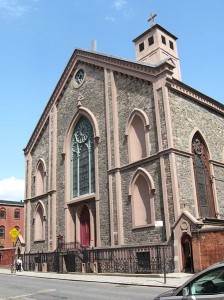
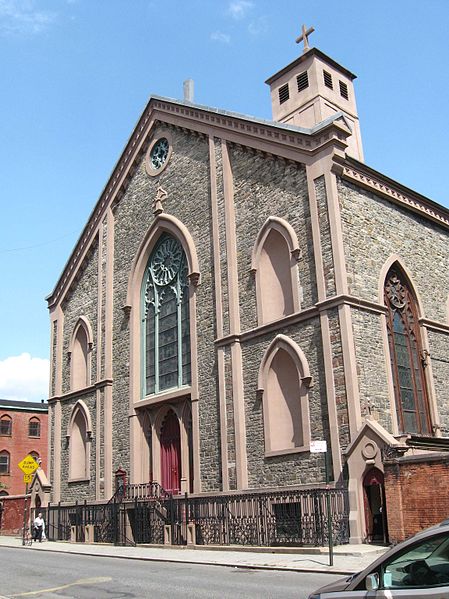
Old St. Patrick's Cathedral by Jim Henderson, 2008

where the bishop preached – old St. Patrick’s (2008)

This may be considered very unpolished, almost unchristian, language proceeding from the pen of a Catholic Archbishop. But, my dear Governor, it is unquestionably true, and I am sorry that it is so. If you in Washington are not able to defend yourselves in case of need, I do not see where, or from what source, you can expect friendship or protection. Since my return I made a kind of familiar address to my people, but not for them exclusively, in St.Patrick’s Cathedral. Some have called it not a sermon, but a discourse, and even a war blast, in favor of blood spilling. Nothing of that kind could be warranted by a knowledge of my natural temperament or of my ecclesiastical training. From the slight correspondence between us, you can bear me witness that I have pleaded in every direction for the preservation of peace, so long as the slightest hope for its preservation remained. When all hope of this kind had passed away I was for a vigorous prosecution of our melancholy war so that one side or the other may find itself in the ascendancy.

The Bishop closes his letter by urging a vigorous prosecution of the war, considering the most humane battle to be that which ends the strife.

Irish-born John Joseph Hughes served as Bishop of New York from 1842 until his death in 1864. The bishop was pro-Union but anti-abolition. Mr. Lincoln and New York provides a good overview of Hughes’ 1861-62 mission to Europe. It apparently was a cordial if inconclusive visit. He had one audience with France’s Napoleon III.

You can read the August 1862 sermon which Hughes alludes to at The New York Times. He expressed his concern about foreign intervention like this:

… I do say to every man, if they do interfere, and if they interfere successfully — if the country and the Government are not maintained by every sacrifice that is necessary to maintain them, then your United States will become a Poland — then it will become divided — then the strife will multiply across every border; every State or every section will claim to be independent and make itself an easy prey for those who will turn and appropriate the divisions of the people of this country for their own advantage. …

During the 1840’s “Dagger John” defended the old St. Patrick’s Cathedral (archdiocesan seat until 1879) from a threat by anti-Catholics to burn it down by motivating at least three thousand Catholics to arm themselves and guard the church.

In this 1844 cartoon (details at Library of Congress) the bishop wasn’t taking any guff from James Gordon Bennett and the New York Herald.
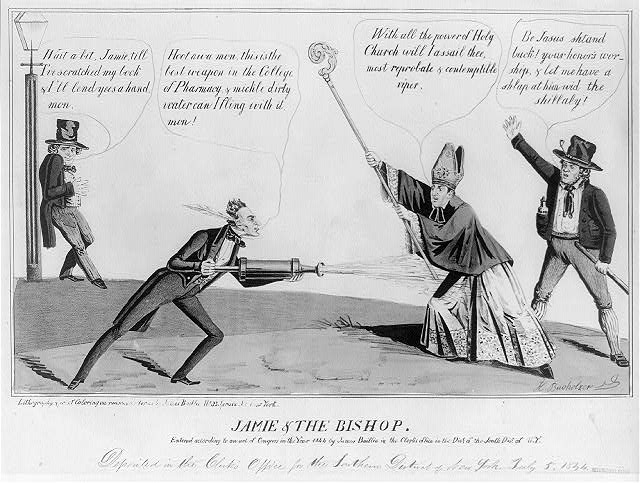
Jamie & the bishop (1844; LOC: LC-USZ62-28015)

James Gordon Bennett vs. Dagger John

In its January 16, 1864 obituary Harper’s Weekly found his speech during the 1863 New York City draft riots to be objectionable, but otherwise

..we think it would be difficult to point to a single important act in his long administration that was not wise and politic, and which, viewed from his own standpoint, was not right and honorable. He died as he had lived, a true man, and a sincere Christian.
Posted in 150 Years Ago This Month, Northern Politics During War, Northern Society | Tagged , , , , | Leave a comment

Nation’s Abundance, Army’s Impedimenta

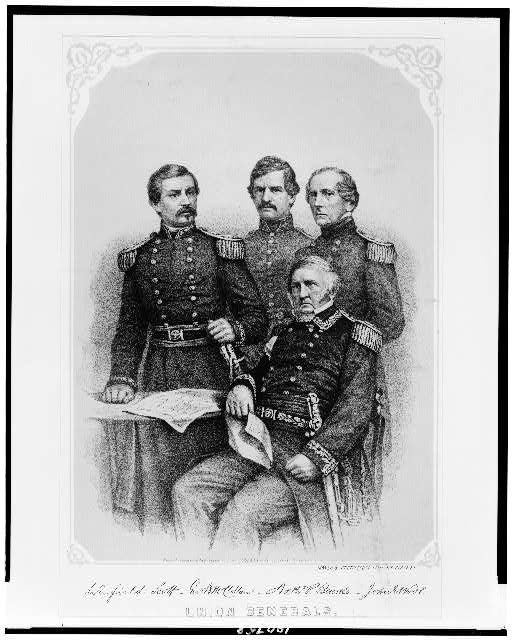
Union generals (McClellan, Banks, Wool, Scott; Boston : B.B. Russell, c1861.; LOC: LC-USZ62-100758)

The slow and/or the old

Don’t be like Mac.

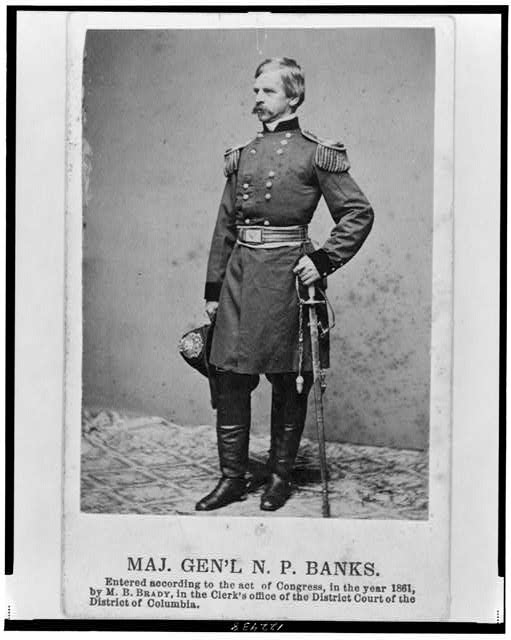
A couple weeks after relieving the dilatory George McClellan from command of the Army of the Potomac, President Lincoln advises Nathaniel Banks to stop requisitioning supplies, stop procrastinating, and get his Army of the Gulf sailing toward New Orleans.

From THE PAPERS AND WRITINGS OF ABRAHAM LINCOLN at Project Gutenberg:

DELAYING TACTICS OF GENERALS
TO GENERAL N. P. BANKS.

EXECUTIVE MANSION, WASHINGTON, November 22, 1862.

MY DEAR GENERAL BANKS:—Early last week you left me in high hope with your assurance that you would be off with your expedition at the end of that week, or early in this. It is now the end of this, and I have just been overwhelmed and confounded with the sight of a requisition made by you which, I am assured, cannot be filled and got off within an hour short of two months. I enclose you a copy of the requisition, in some hope that it is not genuine—that you have never seen it. My dear General, this expanding and piling up of impedimenta has been, so far, almost our ruin, and will be our final ruin if it is not abandoned. If you had the articles of this requisition upon the wharf, with the necessary animals to make them of any use, and forage for the animals, you could not get vessels together in two weeks to carry the whole, to say nothing of your twenty thousand men; and, having the vessels, you could not put the cargoes aboard in two weeks more. And, after all, where you are going you have no use for them. When you parted with me you had no such ideas in your mind. I know you had not, or you could not have expected to be off so soon as you said. You must get back to something like the plan you had then, or your expedition is a failure before you start. You must be off before Congress meets. You would be better off anywhere, and especially where you are going, for not having a thousand wagons doing nothing but hauling forage to feed the animals that draw them, and taking at least two thousand men to care for the wagons and animals, who otherwise might be two thousand good soldiers. Now, dear General, do not think this is an ill-natured letter; it is the very reverse. The simple publication of this requisition would ruin you.

Very truly your friend,
A. LINCOLN.

Toward the end the president seems to be appealing to the political nature of his political general. General Banks not have beat the opening of Congress, but he did have some ships heading south by early December. James M. McPherson says Banks was sent to the Gulf “fresh from defeats by Stonewall Jackson in Virginia” [1]. In the December 6, 1862 issue of Harper’s Weekly (at Son of the South) a biography of Banks attributes his defeat to Jackson to being outnumbered and has high hopes for his work in New Orleans:

General Banks has now been appointed to the command of a Great Southern Expedition, part of which has already sailed. That he will be heard from in a manner which will rejoice the Northern heart no one who knows his lucky star can doubt.

Major General N.P. Banks, full-length portrait, standing, facing left (c1861; LOC: LC-USZ62-122438)

lucky star

  1. [1]Battle Cry of Freedom,New York: Ballantine Books, 1989. Print.p.624
Posted in 150 Years Ago This Week, Lincoln Administration, Military Matters | Tagged , , | Leave a comment