Any day now

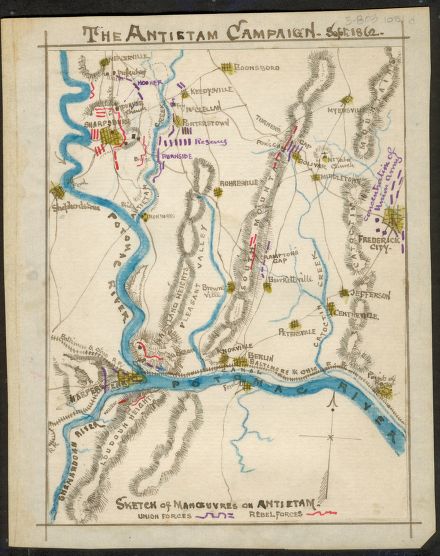
The Antietam Campaign - Sept. 1862 (by Robert Knox Sneden; LOC: gvhs01 vhs00111 http://hdl.loc.gov/loc.ndlpcoop/gvhs01.vhs00111)

“Both Sides, Now”

Civil War Daily Gazette has been doing a great job giving us the interplay between President Lincoln and General McClellan as the president tries to gently goad his general into getting the army south of the Potomac and attacking the rebel army. Here’s a telegram the president sent to Little Mac 150 years ago today while the army was still astride the river (at Project Gutenberg Volume 6):

TELEGRAM TO GENERAL G. B. McCLELLAN.
EXECUTIVE MANSION, WASHINGTON, October 29, 1863.

MAJOR-GENERAL McCLELLAN:

Your despatches of night before last, yesterday, and last night all received. I am much pleased with the movement of the army. When you get entirely across the river let me know. What do you know of the enemy?
A. LINCOLN.

It might be a while. I’m not sure how well McClellan responds to vague timetables, but he probably wouldn’t respond at all to more definite orders from the Civilian-in-Chief. Lincoln keeps wanting to make contact with the Confederate Army of Northern Virginia to kill some more rebels. It is said that Lincoln and McClellan had very different ideas how the war should be conducted.

Posted in 150 Years Ago This Week, Lincoln Administration, Military Matters | Tagged , , | Leave a comment

Heroes Three

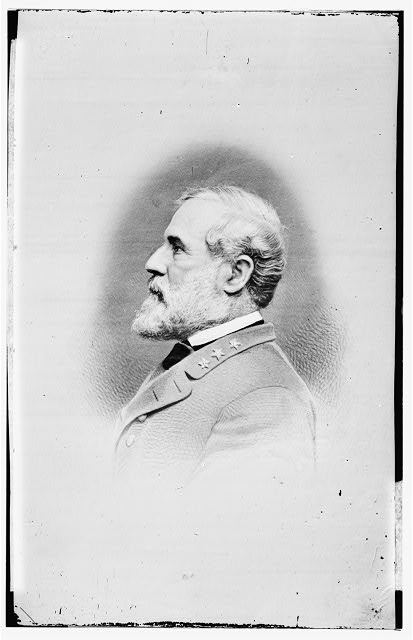
Robert E. Lee, C.S.A. (between 1860 and 1870; LOC: LC-DIG-cwpb-07494)

“Washingtonian dignity”

From the Richmond Daily Dispatch October 27, 1862:

Pictures of Southern Generals.

–The Columbus (Ga.)Times publishes from the pen of its army correspondent, the following pictures of three of our prominent Generals:

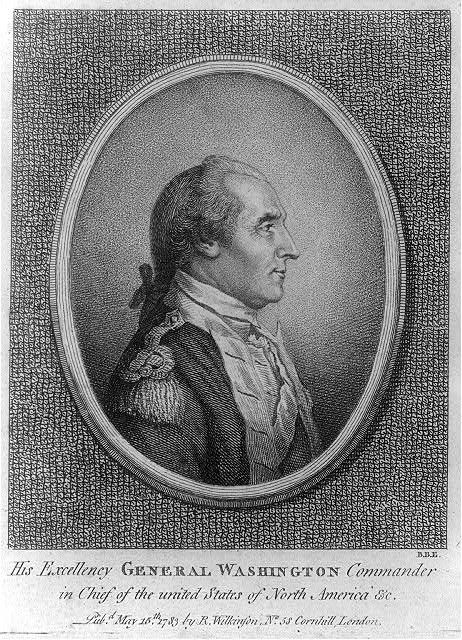
Gen. Lee has, I believe, won his way to everybody’s confidence. In appearance he is tall, portly, and commanding. His dress is usually a plain Brigadier’s uniform, a black felt hat, with the brim turned down, and he wears a short grizzled beard all round his face. He has much of the Washingtonian dignity about him, and is much respected by all with whom he is thrown. At Sharpsburg I saw him on the field during the heat of the action. He was surrounded by his staff and a perfect squadron of couriers. He was engaged in calmly viewing the storm of battle, and giving orders in a manner of cool reliance. Aids and couriers were hurrying to and from the right, left and centre, and the whole disposition of forces seemed under his perfect control.

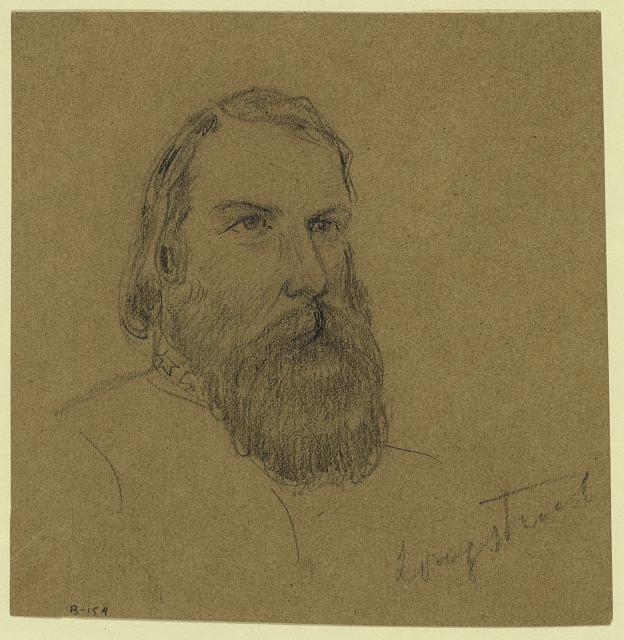
Confederate General James Longstreet (by Alfred R. Waud, between 1861 and 1865; LOC: LC-DIG-ppmsca-20278)

“none can equal him in forcing a strong and well fortified position”

Gen. Longstreet is stout and fleshy, and of good height, and has a quiet, courageous look. He seems full of thought and of decision, and his face makes an agreeable impression alike on new and old acquaintances. He is characteristically a fighting man — none can equal him in forcing a strong and well fortified position, and Gen, Lee showed his appreciation of an old tried soldier, when he patted him on the shoulder after the late battle and said, “My old war horse!” In this engagement he was second in command of the army, and his old corps keenly felt the need of his able handling.

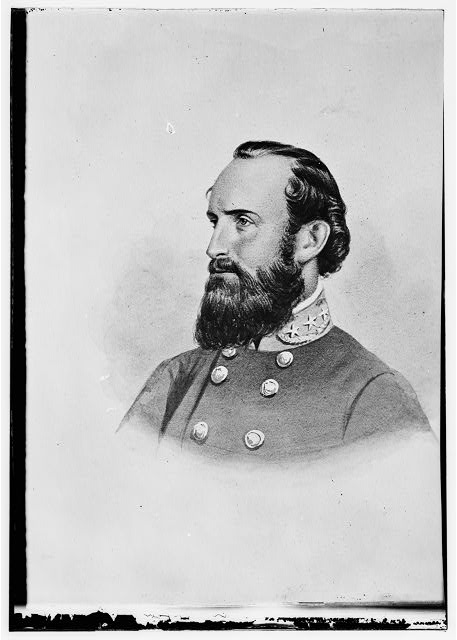
Thomas Jonathan "Stonewall" Jackson CSA; LOC: between 1860 and 1870; LOC: LC-DIG-cwpb-07477)

clown act on hold

I was surprised at Stonewall Jackson’s appearance. He has been described as a sort of clown. I never yet saw him riding with his knees drawn up like a monkey, and his head resting upon his breast. He has a first-rate face, and seems a plainly dressed Captain of Cavalry, with an unpretending Staff. His uniform is fine enough, certainly, for the hard life he leads. But the imagination is piqued, you know, by the absence of pretension, as “a King in gray clothes,”Stonewall don’t like to come about the army much. The boys keep him bareheaded all the time. When they begin to cheer him be usually pulls off his hat, spurs his fine horse, and runs through the howls which meet him at every step (for some five miles) as hard as he can go.

________________________________________________

His excellency General Washington commander in chief of the united States of North America &c. (London : Pub'd. by R. Wilkinson, No. 58 Cornhill, 1783 May 15th; LOC: LC-USZ62-45479)

Washingtonian dignity

Posted in 150 Years Ago This Week, Confederate States of America, Military Matters, Southern Society | Tagged , , , | Leave a comment

Rejoice! (at least for today)

Reasons to procrastinate – the president marks the ways

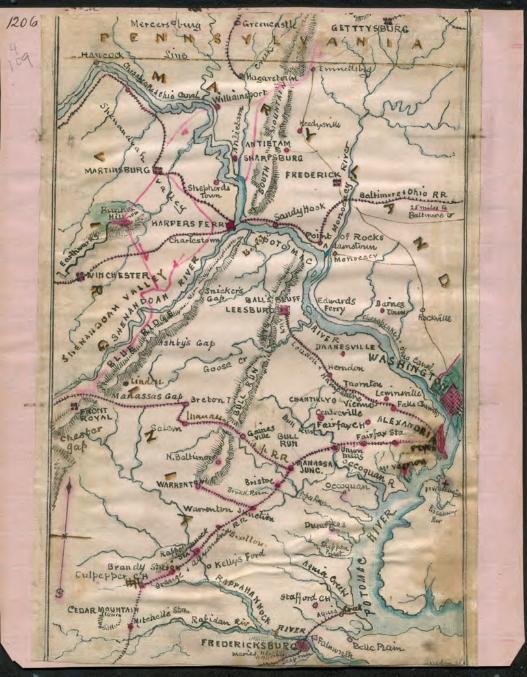
Map of the Potomac River by Robert Knox Sneden (gvhs01 vhs00125 http://hdl.loc.gov/loc.ndlpcoop/gvhs01.vhs00125 )

The Potomac – a barrier being breached?

150 years ago this President Lincoln resorted to sarcasm to try to get George McClellan and his Army of the Potomac south of the Potomac.

As the Stars and Bars Blog points out, General McClellan started moving his army across the Potomac 150 years ago today. Here’s some telegraphic messages from President Lincoln to his general from October 26th and 27th, 1862 (at Project Gutenberg):

TELEGRAM TO GENERAL G. B. McCLELLAN.
EXECUTIVE MANSION WASHINGTON, October 26, 1862. 11.30am

MAJOR-GENERAL McCLELLAN:

Yours, in reply to mine about horses, received. Of course you know the facts better than I; still two considerations remain: Stuart’s cavalry outmarched ours, having certainly done more marked service on the Peninsula and everywhere since. Secondly, will not a movement of our army be a relief to the cavalry, compelling the enemy to concentrate instead of foraging in squads everywhere? But I am so rejoiced to learn from your despatch to General Halleck that you begin crossing the river this morning.
A. LINCOLN.

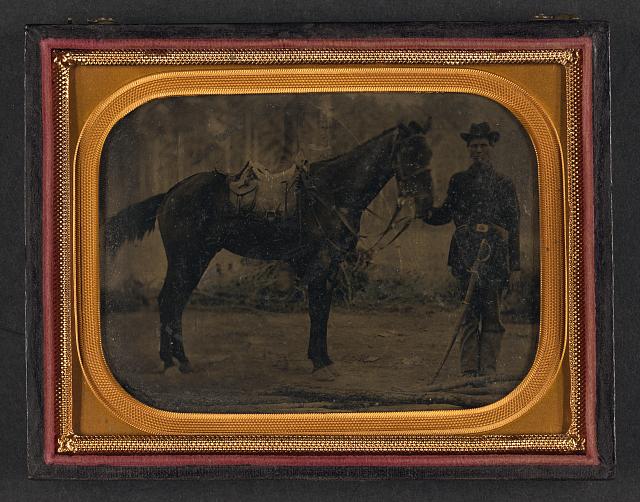
Unidentified soldier in Union uniform with cavalry saber standing next to horse fitted with McClellan saddle (between 1861 and 1865; LOC: LC-DIG-ppmsca-37119 )

“too much fatigued to move”?

TELEGRAM TO GENERAL G. B. McCLELLAN.
EXECUTIVE MANSION, WASHINGTON, October 27, 1862, 12.10

MAJOR-GENERAL McCLELLAN:

Yours of yesterday received. Most certainly I intend no injustice to any, and if I have done any I deeply regret it. To be told, after more than five weeks’ total inaction of the army, and during which period we have sent to the army every fresh horse we possibly could, amounting in the whole to 7918, that the cavalry horses were too much fatigued to move, presents a very cheerless, almost hopeless, prospect for the future, and it may have forced something of impatience in my despatch. If not recruited and rested then, when could they ever be? I suppose the river is rising, and I am glad to believe you are crossing.
A. LINCOLN.

TELEGRAM TO GENERAL G. B. McCLELLAN.
EXECUTIVE MANSION, WASHINGTON, October 27, 1862. 3.25pm

MAJOR-GENERAL McCLELLAN:

Your despatch of 3 P.M. to-day, in regard to filling up old regiments with drafted men, is received, and the request therein shall be complied with as far as practicable.

And now I ask a distinct answer to the question, Is it your purpose not to go into action again until the men now being drafted in the States are incorporated into the old regiments?
A. LINCOLN

There was definitely a debate about whether it would be better to fill up old regiments or form new ones. President Lincoln would probably say that the Southern army is in at least as bad a condition, so press ahead.

From rejoicing to believing the army is probably heading south to hearing about another possible delay – all in about 28 hours (thanks to the telegraph).

Posted in 150 Years Ago This Week, Lincoln Administration, Military Matters, Uncategorized | Tagged , , | Leave a comment

Duelling Artillerymen

Intra-regimental “Affair of Honor”: 1st South Carolina Artillery’s second-in-command takes out his superior officer

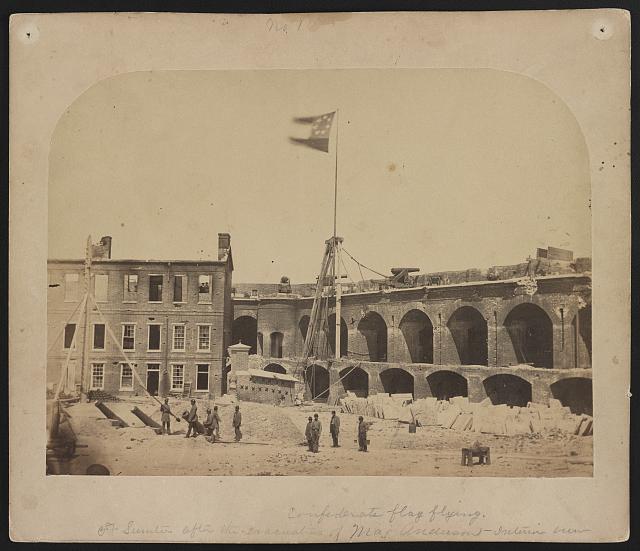
Confederate flag flying. Ft. Sumter after the evacuation of Maj. Anderson - interior view (by Alma A. Pelot, 1861 April 16; LOC: LC-DIG-ppmsca-32284)

source of Confederate pride … and the Rhett-Calhoun bad blood

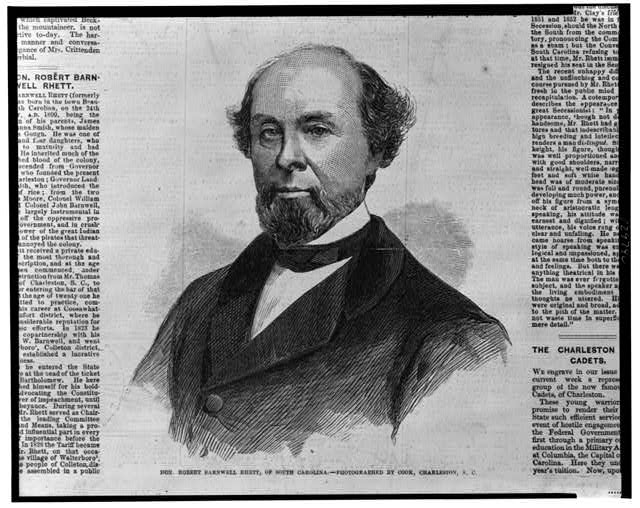
It seems noteworthy when the son of the famous secessionist fire-eater Robert B. Rhett kills the nephew of John C. Calhoun, the great champion of Southern states’ rights and promoter of nullification. The duel in this report happened in September. It was reported in Richmond 150 years ago yesterday.

From the Richmond Daily Dispatch October 24, 1862:

The duel at Charleston.

–The late fatal duel at Charleston, S. C., resulting in the death of Col. W. R. Calhoun, of the 1st Reg’t S. C. Artillery, at the hands of Maj. Alfred Rhett, of the same regiment, did not obtain much publicity through the papers of that city. A correspondent of the Mobile Advertiser, writing from Charleston, says it is to be the subject of legal investigation, the first case of that kind in the city courts for twenty years. The letter says:

Hon. Robert Barnwell Rhett, of South Carolina (Frank Leslie's illustrated newspaper, v. 11, no. 272 (1861 February 9); LOC: LC-USZ62-129740)

Alfred’s dad

Besides the principals and their surgeons, it is said there were six gentlemen present at the meeting–three State Senators, the Speaker of the House of Representatives of North Carolina a leading member of the State Convention, and a Captain Two of the Senators also hold commissions as officers of the army. The arrangements of the meeting were conducted throughout with the nicest regard for the etiquette of the “code,” and I have heard of several of those who were on the ground who express their belief that a more fairly-fought duel never occurred. Major Rhett, the challenged party, waived the “drop” shot, which he preferred, and shot the “rise.” He was dressed in full uniform; Col. Calhoun in citizen’s dress. Both fired almost simultaneously, Major Rhett in an instant after Col. Calhoun. The latter missed, and fell with a ball through the middle of his body. He survived only about an hour.

John C. Calhoun (ca. 1850; LOC: LC-USZ62-76296)

William Ransom’s uncle

The quarrel which led to this unfortunate result is said to have had its origin as long ago as April, 1861, at the time of the bombardment of Fort Sumter, in what Major Rhett considered repeated official trespasses of his inferior officer. These led to the use, on his part, of offensive language; and the repetition since of these alleged trespasses, and the offensive words by which they were met, have aggravated and complicated the affair. No explanation was asked or given. The immediate cause of meeting was a recent duel between Maj. Rhett and a friend of Col. Calhoun, who, though aware of the existing difficulty, had enlogized Col. Calhoun in the presence of Maj. Rhett. Therefore, Maj. Rhett repeated his previous denunciation of Col. Calhoun, which the friend of the latter resented as an insult to himself, and demanded satisfaction. In this first duel Maj. Rhett received two fires of his adversary; be himself flying his second shot in the air. Here the meeting ended. In both duels Major Rhett was peremptorily challenged. It is said that in the latter affair it was proposed on the part of the challenger that firing in the air should not be allowed.

Rhett: The Turbulent Life and Times of a Fire-Eater by William C. Davis reviews the duel on page 507. The source of the problem began in 1861 because Alfred resented the West Point educated Calhoun being promoted over him at Fort Sumter Bad words between Alfred and Calhoun’s friend caused the first duel in August 1862. Davis and the Dispatch both noted that Robert B. Rhett’s Charleston Mercury failed to report the duel.

Alfred Rhett lived to be promoted to Colonel and to be captured at the Battle of Averasboro in March 1865.

Confederate artillery near Charleston, S.C. (1863(?), printed later; LOC: LC-USZC4-4606)

Confederate artillerymen

Posted in 150 Years Ago This Month, Confederate States of America, Southern Society | Tagged , , , , , | Leave a comment

“nothing alike but their mutual hate”

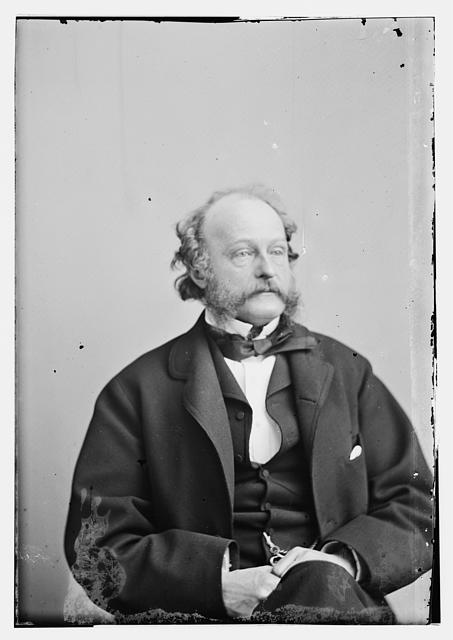
Hon. John Van Buren (between 1855 and 1865; LOC: LC-DIG-cwpbh-02326)

Prince John: let the South go in peace

From the Richmond Daily Dispatch October 23, 1862:

“Depart in Peace.”

The New York Herald has one of its characteristic sneers at the willingness expressed by John Van Buren, if the Federal should capture Richmond, and the South should still refuse to come under the Union, to endorse the language once expressed by General Scott, “Wayward sisters, depart in peace.” Nothing will satisfy the Herald but the complete and thorough subjugation of the Southern States.

Nevertheless, the best policy, simply as policy, to say nothing of right and justice, which the Lincoln Government could have pursued at the time of his inauguration, and at any time since, would have been to permit the South to depart in peace.–The Government would have lost nothing by that policy, which it could have preserved by any other, and it would have saved the hundreds of thousands of lives and the hundreds of millions of treasure which the adoption of coercive measures has cost. So it will be to the end. Peace now, late as it is, is a better policy for the North than war. The South is never to be re-united to the old Union, except by the extermination of its whole people.–And when this is accomplished, of what value will the Union be to the North? With the whole framework of Southern society overthrown, the proprietors and directors of the labor dead or exiled, and the laborers themselves turned loose, what practical gain will ensure to the North? Their success would be as destructive to them as their defeat.–Why, then, push on to the bitter end this war of coercion, which is as senseless as it is brutal? Why, then, persist in Inflicting upon us protracted sufferings and loss of life, unless it be to gratify a mere spirit of revenge and inhumanity?

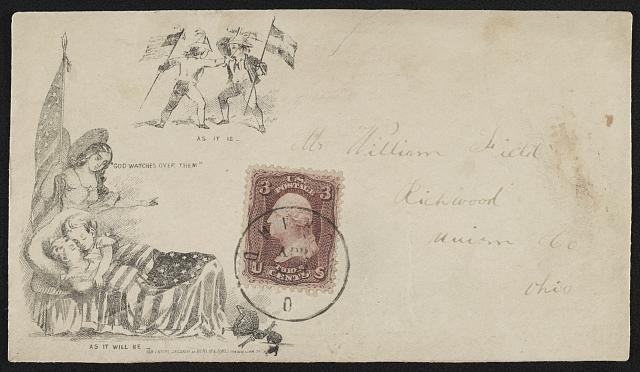
Civil War envelope showing angel holding American flag watching over sleeping children with broken doll on floor; also two boys sparring, one with Union flag and the other with Confederate flag; with messages "As it is," "God watches over them," and "As it will be" (New York : Berlin & Jones, between 1861 and 1865; LOC: LC-DIG-ppmsca-31828)

not according to today’s editorial

It must be evident enough by this time, to the most uncompromising coercionists, that their policy annihilated the Union sentiment of the South the moment it was adopted, and that every hour the war has continued has put the two people further and further apart, until now there is a gulf between them as wide and impassable as that between Lazarus and Dives. There are no two nations of Europe which have ever hated each other with more intense and implacable hate than North and South. There are no two nations in Europe more dissimilar, politically, socially, in almost every other respect that can be named. The two races, apart from their present hostility, do not think alike, do not look alike, do not even talk alike, and have nothing alike but their mutual hate. It is useless to attempt the union of such opposing elements. Better let them part in peace.

I’m pretty sure the Dispatch is casting the South in the role of Lazarus.

John Van Buren, the second son of Martin Van Buren was nicknamed “Prince John” because he danced with Queen Victoria in 1838. Along with his father, John was active in the Free Soil party. On October 17th the Dispatch published a letter in which Prince John seemed to conditionally offer to join a New York regiment. I’m not sure if was tongue-in-cheek or princely coquetry. (See yesterday’s post for an editorial accusing the Lincoln administration of coquetry)

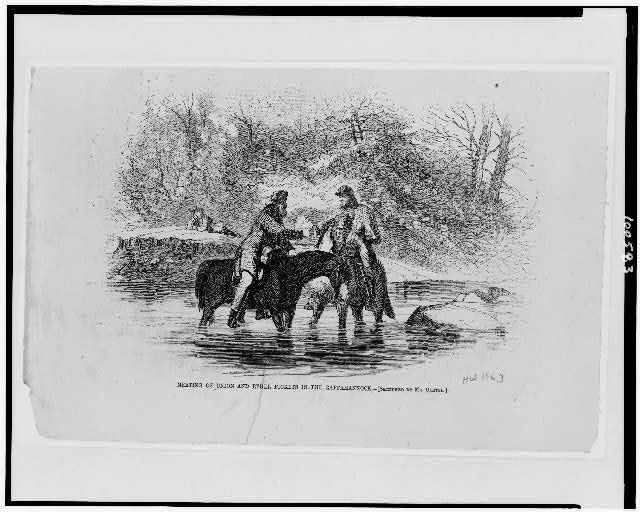
Meeting of Union and Rebel pickets in the Rappahannock (sketched by Mr. Oertel, published 1863; LOC: LC-USZ62-100583)

Don’t think, look, talk alike?

Posted in 150 Years Ago This Week, Confederate States of America, Southern Society | Tagged | Leave a comment

Ebony Idol

Racial Politics in the 1862 Elections

Lincoln's Last Warning [Pres. Lincoln about to cut down tree (slavery) - warning a man to come down from the tree] (Harper's Weekly, v. 6, (1862 October 11), p. 656; LOC: LC-USZ62-48218)

Republicans show true colors

From a Democrat-oriented Seneca County, New York newspaper in 1862:

Abolition and Amalgamation.

These beautious and fragrant twins, – offsprings of the Republican party, have taken a fixed position among the political facts of the day. President LINCOLN, after a season of heartless coquetry with the conservative sentiment of the country, has finally proclaimed the end aim of this war to be the abolition of slavery; and the establishment of the negro element, as an independent governing power in the far off South. To accomplish this, the blood and treasure of the north is to be poured out like water. For this end, thousands of the best lives in this country are to be sacrificed and tens of thousands of millions of dollars wrested from the people by a hungry hoard of Republican tax-gatherers, are to be spent. – One tenth of the proceeds of the industry of the country are to be annually taken from the people to pay the interest on current expenses; and a debt, as unending as the returns of the seasons, is to be fastened upon the future. Verily, the good time foretold by songsters, has come. Free speech and a free press, aye, even free white men, have ceased to be; but in their place we have free plunder for partizans, free taxes for the people, and free negroes to support. Let no Republican henceforth utter the stereotyped lie, that he is not an abolitionist, and that he detests political amalgamation. We do not mean that the rank and file of the Republican voters intend to favor these things, but we do mean, and the result proves that we are right, that every vote cast for the Republican ticket, with Abolitionist WADSWORTH at its head, promotes this end and nothing else. Look at Massachusetts, – the advance guard of the party. At the late Republican State Convention, two or more full-blooded negroes were accredited as delegates. Is this not amalgamation with a vengeance? Let the worshippers of the Ebony Idol deny it, if they can. We trust the people, while marking these events, will not forget the cost. To the taxes direct and indirect, greater than any other nation on the globe, now about to be collected, must be added, not only the expenses in life and time and treasure of the war, and the cost of slaves LINCOLN proposes to buy of his favorites, but also the increased price of the necessaries of life – 30 cents per pond for coffee – 30 cents per yard for sixpenny cotton goods, &c., &c., &c. Verily, are not the good people paying pretty dear for this Republican whistle? Farmers and laboring men, how do you like it? Just ask your Republican neighbor how he likes it, and see how he will grin, though he bears it, for bear it he must.

Emancipation of the slaves, proclamed [i.e. proclaimed] on the 22nd September 1862, by Abraham Lincoln, President of the United States of North America (J. Waeshle, [ca. 1862]; LOC:LC-DIG-ppmsca-19391)

then comes amalgamation .. and a seat at Republican convention

The Ebony Idol was an anti-Uncle Tom’s Cabin novel published in 1860. The University of Virginia site is one place it is reproduced.

So far the only other use of the term amalgamation I have seen is in an editorial in the Richmond Daily Dispatch from October 8, 1862. The editors’ point is that conservative Democrats are greater hypocrites than cowardly abolitionists because Democrats in the Union army are just as likely to help “contrabands” escape their masters: “Wherever the Federal conservative armies have come, they have swept the land clean of the negroes and set an example of amalgamation which any decent Abolitionist would have shrunk from. ”

A month ago Seven Score and Ten posted an editorial from a Ohio newspaper that had a similar tone to the Seneca County Democrat opinion. The Ohio paper did not use the term amalgamation, but it was concerned about farmers employing black men to take the place of white men presumably serving in the Union military.

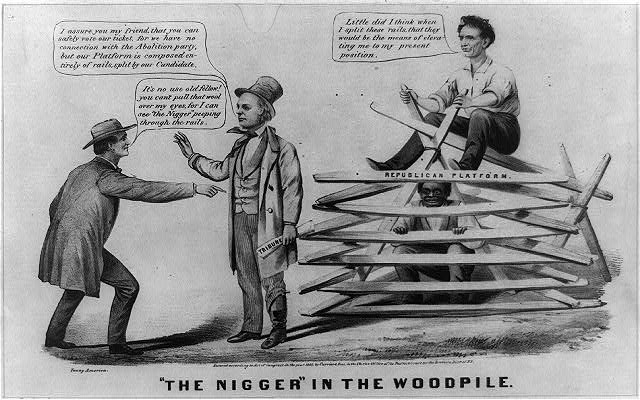
The following cartoon from the 1860 presidential campaign expresses a similar concern to the Seneca County editorial from 1862.

"The nigger" in the woodpile (by Louis Maurer, New York : Currier & Ives, c1860; LOC: LC-USZ62-8898)

can’t trust Republican words

Posted in 150 Years Ago This Month, Northern Politics During War | Tagged , , , | Leave a comment

On the Waterfront and Elsewhere

From the Richmond Daily Dispatch October 20, 1862:

Scarcity of laborers at the North.

–In some portions of the State workmen are scarce, in consequence of the drain for the war. The laborers upon the wharves of this city have a society which numbers over 500 members, who are pledged not to work for less than 25 cents per hour. Shoemakers are in demand in all the manufacturing towns, and we hear of places where masons and other mechanics cannot be obtained at any price.–The same state of affairs exists in other States, and especially in large cities.–Boston Traveller.

But the labor scarcity did not lead directly to higher wages. In Battle Cry of Freedom[1] James M. McPherson discusses inflation in the North. On the whole, wages did not keep up with price inflation, even though it would seem as if there would be labor scarcity because immigration subsided and huge numbers of men served in the military. There were three reasons for the wage lag: 1) some slack in the economy from the Panic of 1857 and the secession crisis 2) mechanization – unfortunately for the shoemakers in this story, the Blake-McKay machine for sewing uppers to soles greatly reduced the time required for that process 3) the employment of women in all sorts of occupations. However, the dock workers in this story might have been better off. Strikers in skilled trades and heavy industries did achieve some wage increases, especially in 1863-64.

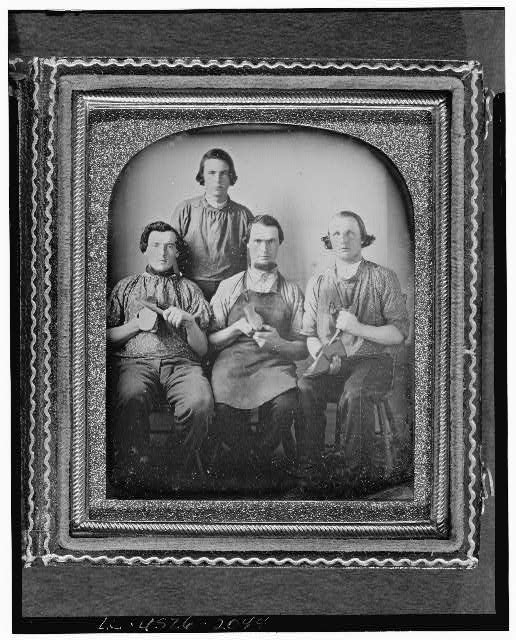
Occupational group portrait of four shoemakers, one full-length, standing, other three seated, holding shoes and shoe making equipment (between 1840 and 1860; LOC: LC-USZC4-3946)

endangered species?

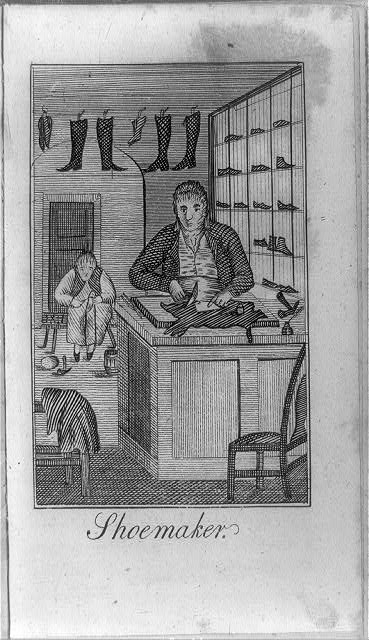
Shoemaker cutting out an upper leather of a shoe and journeyman joining the upper leather to the sole of a shoe(1807; LOC: LC-USZ62-95355 )

Cobblers in 1807

___________________________________________________

  1. [1]New York: Ballantine Books, 1989. Print. pages 448-50.
Posted in 150 Years Ago This Week, Northern Society | Tagged , , | Leave a comment

How suspenders worked

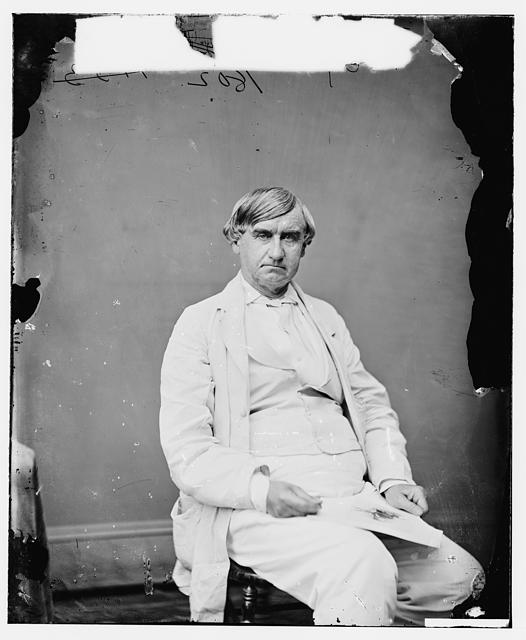
Judge Joseph Holt (between 1860 and 1875; LOC: LC-DIG-cwpbh-00547)

new Judge Advocate General writes a letter

In August 1862 Secretary of War Stanton ordered arrests for disloyal practices and the suspension of the writ of habeas corpus in those cases. Here’s how that worked out in practice at least in this case (and to the extent that the Richmond Daily Dispatch is telling it straight). [1]

From the Richmond Daily Dispatch October 18, 1862:

Tyranny at the North–military Vs. Judiciary.

Lincoln and his soldiery are triumphant — that is, over their own Constitutions, laws, and people.–A case in point has just occurred. which we find recorded in the Northern papers. A Mr. Nathaniel Batchelder having been arrested for alleged disloyal practices, a writ of habeas corpus was issued by Judge Bell, Chief Justice of New Hampshire, on the return of which the following was read:

Judge Advocate General’s Office, September 13, 1862.

Hon. J. H. Ela, U. S.Marshal, Rochester, N. H.:

Sir:

Your telegram to the Secretary of War, under date of the 10th inst, relative to the write of habeas corpus, issued in the case of Nathaniel Batchelder, arrested for disloyal practices, has been referred to this office for reply.

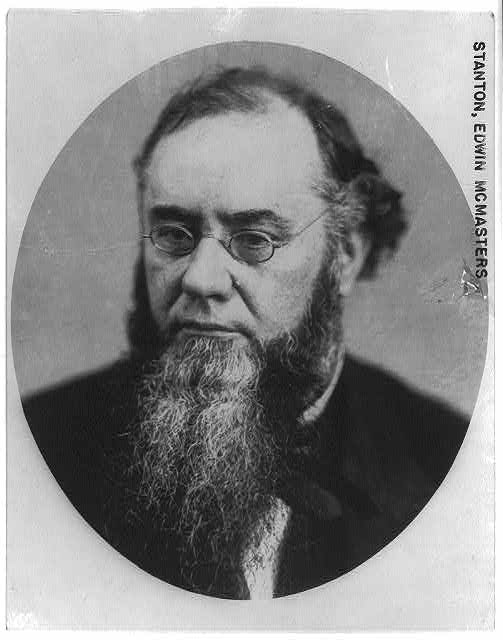
Edwin M. Stanton (c1898; LOC: LC-USZ61-985)

don’t be afraid to call on military against the civil authority

The Secretary of War directs me to inform you that, by an order issued under the authority of the President of the United States, a printed copy of which is enclosed, the writ of habeas corpus has been suspended in all cases of arrest for “disloyal practices” to which class of offences that of Nathaniel Batchelder manifestly belongs. The Secretary instructs me to say that to the writ of habeas corpus, issued by Chief Justice Pell (Bell) you should return these facts as your warrant for holding the prisoner in custody. Should any attempt be made, after the return, to release the prisoner by the civil authority, which is not anticipated, the Secretary directs that you appeal for support and protection in the discharge of your duties to the military force of the United States in your vicinity.

Very respectfully, your ob’t servant.

J. Holt, Judge Advocate Gen.

The New Hampshire Patriot reports the decision thus:

After argument by counsel, the Chief Justice said that it seemed to him inexpedient, and useless to the prisoner, to issue an order for an attachment which could not be enforced; that the Government of the United States had plainly expressed its determination to resist by force any attempt of the civil authority to deliver the prisoner, and that he received this not as a threat, but as the announcement of a settled resolution, which, with the vast armies under their control, they had the ability to execute against any power which the State can command for the enforcement of the law. He therefore declined to take further action in the case.

Joseph Holt, who was appointed Judge Advocate General on September 3, 1862, got right to work – in this case he seems to be mostly conveying Secretary Stanton’s decision.

The Davis administration suspended habeas corpus in the Confederacy at various times and places, too.

  1. [1]10-20-2012: It looks like the Dispatch is telling it as straight as The New-York Times.
Posted in 150 Years Ago This Week, Lincoln Administration, Northern Politics During War, Northern Society | Tagged , , , | Leave a comment

Friday Three Pack

It’s been a shooting war cum blockade for well over a year. Nevertheless, on a Friday night in Richmond 150 years ago this week you could still catch a show at a local theater – and in this case ticket proceeds will help people suffering in Wilmington.

From the Richmond Daily Dispatch Friday, October 17, 1862:

For the benefit of the Wilmington sufferers.

–The proprietor of the Varieties intends to devote the proceeds of to night’s performances to the benefit of the sufferers by the yellow fever now raging at Wilmington, N. C. The plays on the occasion are “Green Bushes; or, One Hundred Years,” and the well known nautical drama of “Black Eyed Susan.”

According to NCPedia the yellow fever that raged through Wilmington in 1862 was probably caused by sick crew members on a blockade runner (mosquitoes transmit). Wilmington had become an important base for blockade runners. And blockade runners were having some success – General Beauregard (based in Charleston 150 years ago) was getting some merchandise from Paris.

From the same issue of the Dispatch:

Present from Beauregard to Stonewall Jackson.

–Gen. Beauregard has presented to Gen. Jackson a splendid silver mounted pistol, of a new pattern, made in Paris expressly for Jackson. It is a revolver, navy size, constructed to threw balls as a caution throws grapeshot. With this formidable weapon an officer hard pressed in action might destroy half a dozen enemies at a single discharge. An appropriate inscription is engraved on the silver plating.

Every issue of the Dispatch seems to have notices of rewards paid for the apprehension of runaway slaves. My take on this one: it’s not just the Lincoln administration – there were other stakeholders that would have appreciated it if the beleaguered General McClellan had his army farther south:

Runaways. three hundred Dollars reward

Left my dwelling, in Richmond, SundayeveningOctober 12th, my negro man, George Yaies about 20 years old, yellow complexion, about 5 feet 8 to 10 inches high, a scar on his nock under his jaw, and has a cock of cross eye.

Also, two Negro men left my farm, about two miles out of town about the same time of day-One man, Morton, aged about 24 or 25 years, black, about 5 feet10 inches high; no scars recollected; and boy, Dick, 18 years of age, about 5 feet 6 or 7 inches high, black, and had on when he left a deep blue jacket, with brass buttons, and black glaze cap.

Morton is recently from Culpeper county, Va. and Dick I bought from Feigner county, near Warrenton, Va., last January. George was raised by me in Richmond.

I have no doubt but all three are aiming to make their escape to the Yankees by way of Gordonsville and Culpeper. I will give $100 for neck of the delivered to me in Richmond or secured in get them again.

Silas Conomundeo.

Posted in 150 Years Ago This Week, Confederate States of America, Southern Society | Tagged , , , , | Leave a comment

For the Union at the Union

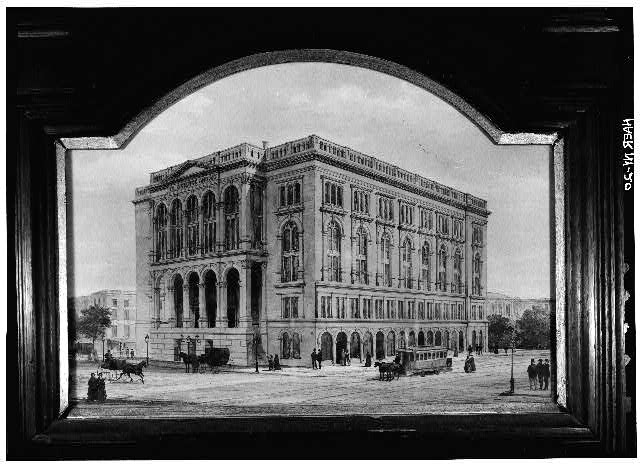
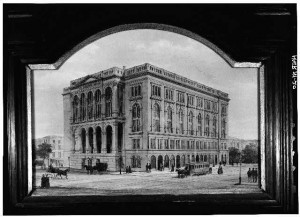
- Cooper Union for the Advancement of Science & Art, Third & Fourth Avenues, Astor Place, Seventh Street, New York, New York County, NY (LOC: HAER NY,31-NEYO,81--31)

Big site of the big Dem meeting

During the 1862 election season Democrats in the small town of Seneca Falls, New York formed a McClellan Club. A couple weeks later Democrats in the big town of New York had a big rally. The resolutions adopted by the two meetings were similar. However, the New York City Democrats did not mention General McClellan, but they did argue that the Supreme Court should decide on the constitutionality of the Lincoln administration’s suspension of habeas corpus. They strongly support a war to preserve the Union and the Constitution but not a war to interfere with any existing (peculiar) institutions.

From the Richmond Daily Dispatch October 17, 1862:

Great Democratic meeting in New York.

The New York Herald, of the 14th, has an account of a Democratic mass meeting there the night before, with the following caption:

“The Unterrified in Council — Immense Gathering of the Democracy at the Cooper Institute–The Hall of the Union and the Surrounding Streets Crowded — The New Wide Awakes — Bonfires, Bengola Lights, Torches, Calcium Lights, Rockets and Roman Candles to Brighten the Path of the Union for the Democratic Masses — Speeches of Horace F. Clark, Horatio Seymour, John Van Buren, and Richard O’Gorman.”
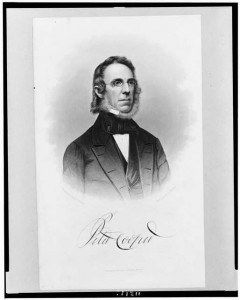
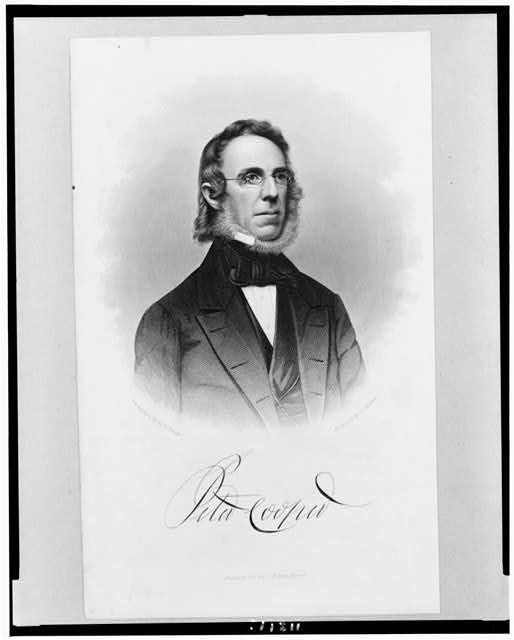
Peter Cooper, head-and-shoulders portrait, facing right (by John Chester Buttre (from Brady photo), between 1850 and 1890; LOC: LC-USZ62-112198)

no spitting, please

The meeting opened with the following incident:

Capt. Rynders read a note from Mr. Peter Cooper, requesting that the audience would abstain from spitting on the seats or carpet. “Knowing you all,” said the Captain, “to be gentlemen who are to be hung shortly, I thought I would make known the request.”

The following resolutions were then read and adopted as the resolutions of the meeting:

Resolved, That as we desire a vigorous prosecution of the present war, the conservative citizens of this city will continue cheerfully the support already given to it, by contributions of men and treasure; but we will at the same time insist on the fulfillment by the present Administration of the solemn pledge almost unanimously given by the Congress of the United States: “That this war is not waged on their part in any spirit of oppression, or for any purpose of overthrowing or interfering with the rights and established institutions of the States, but to defend and maintain the supremacy of the Constitution, and to preserve the Union, with all the dignity, equality, and rights of the several States unimpaired, and that as soon as these objects are accomplished the war ought to cease.”
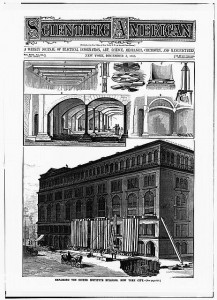
- Cooper Union for the Advancement of Science & Art, Third & Fourth Avenues, Astor Place, Seventh Street, New York, New York County, NY (LOC: HAER NY,31-NEYO,81--30)

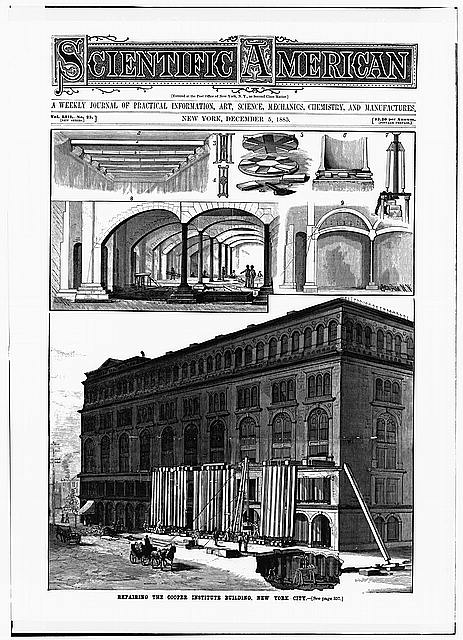
Cooper’s Institute being repaired

Resolved, That the investigations by Congress and the State Legislatures have disclosed the existence of fearful and unexampled corruption and extravagance; that unless these enormous frauds be checked the whole country must be involved in bankruptcy and dishonor; that we would be faithless to the principles of honesty and economy in the administration of public affairs if we did not expose and denounce these wrongs on the industry of the great masses of the people, and that, in the language of our friends of New Jersey, we solemnly protest against such reckless extravagance and in famous peculation.

Resolved, That we highly approve of, and cheerfully endorse, the truthful arguments against wholesale emancipation presented by President Lincoln, in his interview with the “Chicago delegation” in the month of September last, satisfied as we are, in the language of the President himself, “that the measure must be necessarily inoperative” and inexpedient, and that “no possible good can result from the issuing of such a proclamation.”

Resolved, That, in the language of the revisers of the statutes of this State, “the writ of habeas corpus is the great bulwark of personal liberty to the citizen;” that of in England it points out to the humblest individual in the realm effectual means as well to release himself, though committed by the king in council, as to punish those who unconstitutionally misuse him, then in this republican country it should at least be as effective to protect an American citizen from arrest upon mere suspicion or of disloyal practices, even by the highest officers in the land; that we hold that the privilege of the writ of habeas corpus can only be suspended by act of Congress, and that the question of the power of the President to suspend it must be decided by the Supreme Court–a decision to which both the President and ourselves must yield.
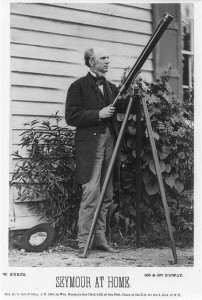
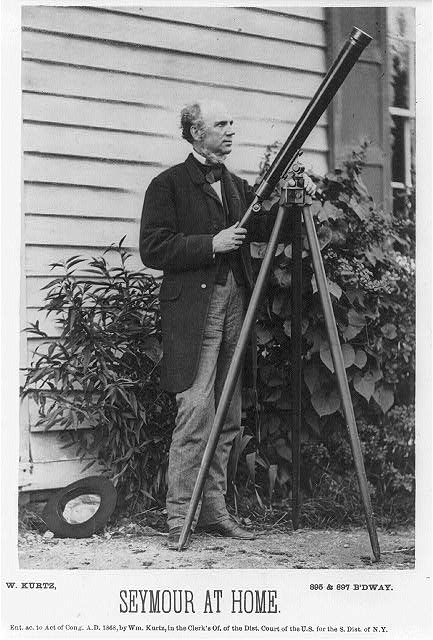
Seymour at home (c1868; LOC: LC-USZ62-63458)

let Supreme Court decide lawfulness of Lincoln’s proclamations


Resolved, That, faithful to our own record, we renew our vows of loyalty to the Union and the Constitution, and stand now, as ever, supporting the strong arm of the Government as the only breakwater between the constitutional rights of the people of the United States and the rising flood of overwhelming force and lawlessness.

Resolved, That in the nomination of Seymour and Wadsworth by the respective parties of the State, the line is distinctly and clearly drawn between those who believe in the Constitution as it is and the Union as it was, and the men who seek to establish in their stead a new Constitution and a new Union.

Resolved, That we recommend to the electors of this State the ticket nominated at Albany, on the ground that its election will tend to check extravagance and corruption in public officers, give new vigor to the prosecution of the war, and assure the people that the Union and the Constitution for which our fathers made sacrifices still live in all their original vigor.

Gov. Seymour, the candidate for Governor, made a speech tallying with the resolutions, in which he announced that, if the Supreme Court approved Lincoln’s proclamations, the people would submit to them; if it did not, they would not submit. …

Peter Cooper (1791-1883) “was an American industrialist, inventor, philanthropist, and candidate for President of the United States.” He designed and built Tom Thumb, an early American steam locomotive. He founded Cooper Union in 1859. Lincoln’s speech there in February, 1860 is considered a stepping stone toward his election as U.S. president.
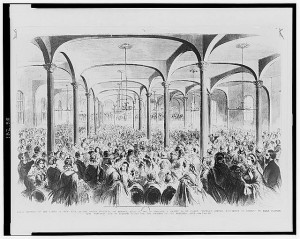
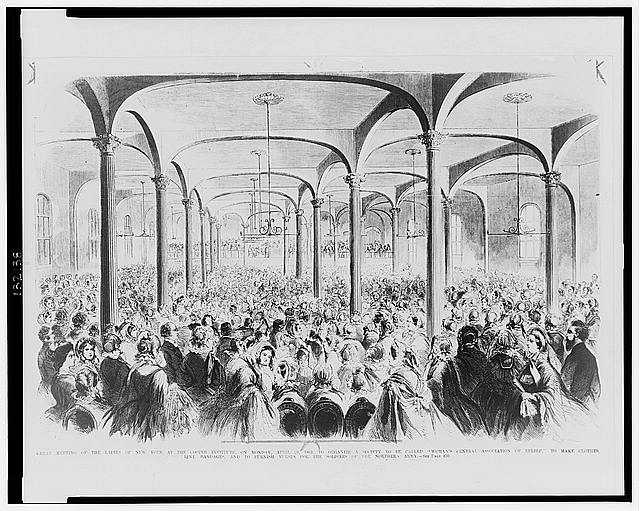
Great meeting of the ladies of New York at the Cooper Institute, on Monday, April 29, 1861, to organize a society to be called "Women's Central Association of Relief," to make clothes, lint bandages, and to furnish nurses for the soldiers of the Northern Army (1958 May 10, [from an engraving done in 1861; LOC: LC-USZ62-132138)

1861 meeting at Cooper Union
Posted in 150 Years Ago This Week, Northern Politics During War | Tagged , , , | Leave a comment