‘Cause Canada’s a long way off?

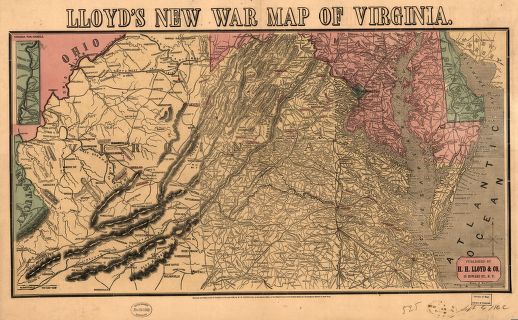
Lloyd's new war map of Virginia.c.1862 (LOC: g3881s cw0464000 http://hdl.loc.gov/loc.gmd/g3881s.cw0464000 )

gun play in Patrick County

Some Virginians use a little self-help to avoid Confederate conscription:

From the Richmond Daily Dispatch October 14, 1862:

Resistance to the enrolling officers — man killed, &c.

Patrick C. H., Va., Oct. 10, 1862.

We have considerable excitement here. The enrolling officers in making an arrest last Sunday night, were resisted. A pistol was snapped by a man by the name of Jack Bryant, at one of the officers, Jones, who fired upon Bryant, inflicting a mortal wound. The two prisoners arrested by them, Moore and Roarer, were started for this place in charge of one of the party, (Mr. Hatcher,) when near the top of the Bull, mountain, he was fired upon by a party of two men in ambush. He returned the fire, dismounting and taking advantage of his horse, but was forced to save himself by taking to his heels; his horse having been so badly wounded that it was with difficulty he could be gotten from the field. Young Hatcher escaped unhurt, except the effect of the race. The prisoners escaped. One of them, Rorer, is said to have received a severe wound from his friends in the bushes. The county is thoroughly aroused the sheriff is active in arresting these men. The ring leader was arrested Wednesday night, and made his escape. He was fired upon, the effect unknown.

Southern "volunteers" (Published by Currier & Ives, [1862?]; LOC: LC-USZ62-9636)

Enrolling officers – beware the ambushers

You can read about the cartoon at the Library of Congress

Posted in 150 Years Ago This Week, Confederate States of America, Southern Society | Tagged , | Leave a comment

Pick and Choose Constitution

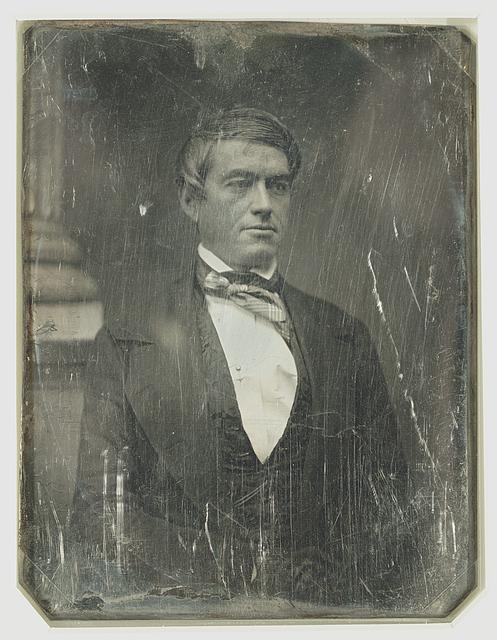
Cassius Marcellus Clay, half-length portrait, three-quarters to the right (between 1844 and 1860; LOC: LC-DIG-ds-01227)

Float back from Russia, sting Seymour like a bee

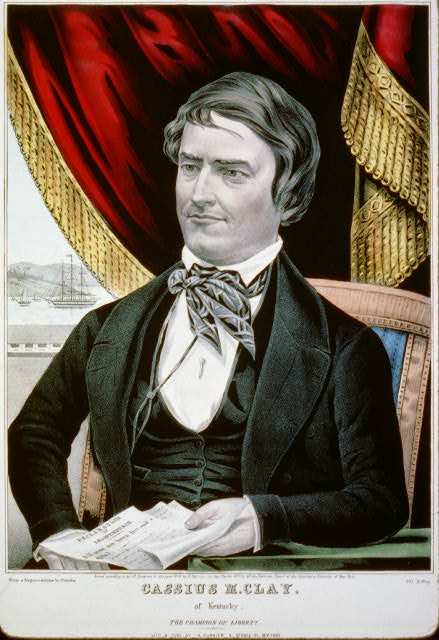
Native Kentuckian Cassius Marcellus Clay “was a paradox, a southern aristocrat who became a prominent anti-slavery crusader”. While attending Yale he heard William Lloyd Garrison speak and decided to become an abolitionist. He served as a Kentucky state representative and published an anti-slavery newspaper. He was frequently attacked and received death threats for his views.

President Lincoln appointed Clay as ambassador to Russia, but he returned to the United States in 1862. The following article reports on a speech gave in New York City. Mr Clay criticized Democrats like New York gubernatorial candidate Horatio Seymour for opposing Lincoln’s emancipation proclamation on the grounds it was unconstitutional – why didn’t such Democrats complain about the southern states breaking the Constitution by seceding?

From the Richmond Daily Dispatch October 13, 1862:

Speech of Cassius M. Clay on the proclamation.

In New York, Tuesday night, at the Academy of Music, after a red-hot speech from Gen. Duryea, Major General Cassius M. Clay, of the U. S. Army, addressed the meeting. We make a few extracts from his speech, as reported:

He confessed that, as a military measure, he had never placed much importance on a decree of emancipation; but this he did know, that the rebels and their sympathizers did. Look at the curses, the impotent rage manifested at the South, and then say whether they consider it a brutum fulmen, a useless thing or no. These men who would have the Union as it was say that the thing is unconstitutional. Ah! have they at last shown some respect for that sacred instrument? (Applause.) These servile tools of a despotic power have at last grown conscientious about the Constitution! Those who formed the Government did not speak of the independent sovereignties of South Carolina or Virginia, did they? What were the great powers of sovereignty? The power of making war and peace, making treaties, issuing coin, keeping armies and navies. &c., did not belong to the people of South Carolina, or Virginia, but belonged to us, “the people of the United States.” When the South assumed those powers, and levied war upon the Government, where were then your Seymour and these men who denounce the proclamation? (Applause; cries of “Where were they?” “Hit them again.”) He claimed that all the acts of the President were in accordance with the spirit of the Constitution of the United States. It was complained that the habeas corpus act had been suspended; but did not the Constitution say that it should not be suspended, except in case of invasion or rebellion, and he asked would it be said that there was no rebellion? (A voice–“That’s the talk.”) The President had the power to do as he had done, and if a precedent was wanted they would make this the precedent forever. So far from finding fault with Abraham Lincoln, he rather found fault with him that he had not suspended the habeas corpus, not by a dash of the pen, but by the rope round the necks of these traitors.

A voice–“We’ll hang them yet.”

Mr. Clay–“Yes, sir, the hanging of such men as Seymour and Wood would have saved thousands of honest lives.”

Cassius M. Clay of Kentucky: The champion of liberty (N. Currier, 1846; LOC: LC-USZC2-2047)

The champ

Mr. Clay–That is true philanthropy. (Applause and laughter.) Go to the battle-field and you find thousands of brave and generous men sinking into the grave through the action of this rebellion, and yet there is no cry about the Constitution being violated by the South. Life, liberty and property had been sacrificed, and yet these men are silent about it; but when we defend ourselves against these plotters and scoundrels, and seek to defend the life of the nation, we are told it is unconstitutional. Why, would we confiscate all other sorts of property and refuse to touch slavery? So far as these slaves are property — putting the question on the low material basis — we have as much right to say to these slaves, “Run for it,” as we have to take the horses and mules who draw the cannon of the rebels. But when we put the question upon a higher basis much better right have we to say to these men. “Defend yourselves and fight for you liberties” (Applause)

Mr. Lincoln, in the charity of his heart, which is a large one, and the strength of his intellect, which is a great one–he is both great hearted and great needed– (applause)–had said to these slave-holders, “I would that you would be persuaded to do right. Liberate your slaves, return to our family circle; we will share our last dollar with you, and you will be none the worse for being magnanimous and just” The rebels had ninety days to decide upon his offer. Let them return to their allegiance and be saved. They had ninety days to do it in. If New York should in the fortune of this struggle be threatened with the terrors of war, the women and children might perhaps have one hour or six hours given them to seek a place of safety.–But these rebels get ninety days to prepare themselves and to avoid the evil. They may send their women and children into the possessions of their allies, the English. (His[s]es) Was not time enough given to them? How much more did they want?–How would the proclamation affect the nation in the matter of foreign intervention? He had precious little confidence in the aristocracy, the ruling classes of England, whether the Government was against slavery or for slavery. …

Give us the Constitution as it is, the Constitution as our fathers made it, and the Union as our fathers intended that it should be — a Union of free men. –Said James Madison: “I put not again the word Slave in the Constitution, because when this institution shall have ceased to exist, then let the memory of it also be forever banished from our records”–(Applause) There is but one peace — that is the peace of justice. There is but one secure basis of liberty and union — that is the unity of a common love of humanity, and the true and faithful, open, avowed, manly declaration of our fathers again reiterated, that “all men are created free and equal, entitled to life, liberty, and the pursuit of happiness.” (Applause) What a grand destiny-awaits us thirty-three States and about as many millions. Before many a man and woman who listens to me to night shall have gone to their last resting place, there will be a hundred millions of freemen bound together under a common flag and a common principle. Whose heart does not expand, whose intellect does not brighten, whose aspirations do not go up to the great and good God [ that that ] consummation may be perfected, that we may be one people, that there may prevail, not only over all this continent, but over the whole world, “liberty and union, now and forever, one and inseparable.” …

Detail of Preamble to Constitution of the United States

Madison didn’t put “slave” in Constitution

More notes: 1) We mentioned a surprisingly well-received anti-slavery extension speech Clay gave in Washington City back in January, 1861. 2) Clay would go back to Russia from 1863-1869. 3) In the New York speech we linked to here Clay gave kudos to Russia’s Alexander II who emancipated the serfs in 1861.

Posted in 150 Years Ago This Week, Northern Politics During War, Uncategorized | Tagged , , , , | Leave a comment

Pinpoint the problem

It’s not a surprise that were issues with medical care in the Confederate armies. Here the Confederate administration is asking for more specifics about bad surgeons and pointing out that disease is rampant in the Union military as well.

From the Richmond Daily Dispatch October 13, 1862:

The Medical staff of the army.

–The following is the copy of a letter writer by an aid decamp of President Davis to a prominent physician of Macon county, Ala., and will explain itself:

Richmond, Sept. 1, 1862.

Dear Sir.

–I am directed by the President to inform you that your letter of August 21, 1862, is received, and the suggestions in it considered. Your strictures on the management of the medical staff of the army are perhaps severe, but not uncalled for. Many incompetent men have doubtless been appointed surgeons, but where is a competent surgeon or physician whose services have been rejected? The trouble is partly owing to the insufficient supply of medical and surgical skill in the country for an army of the size of that in the field. If, however, instead of a general censure, you would take the pains to single out and fix on any one or more surgeons the charges you make against them all, the public service would be subserved thereby.–If persons, who are aware of acts of negligence or brutality on the part of surgeons would trouble themselves to establish the fact by proof, the offender would receive the punishment due his crime or error, and become an example and a warning.

It is to be doubted whether our armies have suffered more than other armies in like situations. In less than three months McClellan has lost in front of Richmond, principally by disease, soldiers variously estimated by the Yankees at from 100,000 to 170,000 men. He has, by the most favorable accounts to him, lost two thirds of his army. This has occurred, too with unlimited resources and supplies for the care and preservation of health and mastering disease. I merely mention this to show you that disease which afflicts us does not space the enemy.

Your letter has been laid before the Surgeon-General for his information.

I have thus answered your letter at length by instructions from the President, and am directed by him to thank you for your interest in the health and welfare of our soldiers in the field.

Very respectfully, your obd’t serv’t,

Wm Preston Johnston,

Aide-de-camp to President Davis.

William Preston Johnston was captured with Jefferson Davis at the war’s end and sent to Fort Delaware. In the 1880s he worked as president of Louisiana State university and then as president of Tulane University.

Surgeon General Samuel Preston Moore “transformed the medical corps into one of the most effective departments of the Confederate military and was responsible for saving thousands of lives on the battlefield.” And he had some really cool mutton chops

Posted in 150 Years Ago This Week, Confederate States of America, Southern Society | Tagged , , , , | Leave a comment

The New Wide-Awakes?

During the 1860 election campaign the Wide Awakes “was a paramilitary campaign organization affiliated with the Republican Party”. The following editorial is concerned that the Republican-led federal government is wide awake to punishing dissenting opinion.

From the Richmond Daily Dispatch October 11, 1862:

The horrors of Fort Lafayette–a Bold voice at the North.

The New York Weekly Caucasian, published by the former proprietors of the Day Book and News, has not yet been suppressed by the Lincoln Government, though, from the following article, we should think its season will be brief:

Few people know, or even think, of the suffering men, pining for liberty, in Fort Lafayette, and none realize how cruelly and harshly they are reported to be treated. …

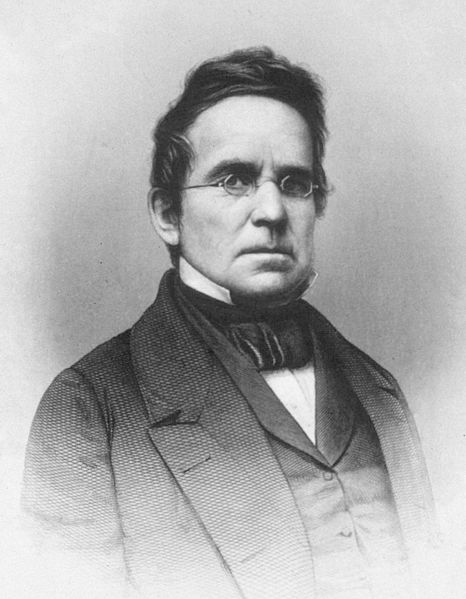
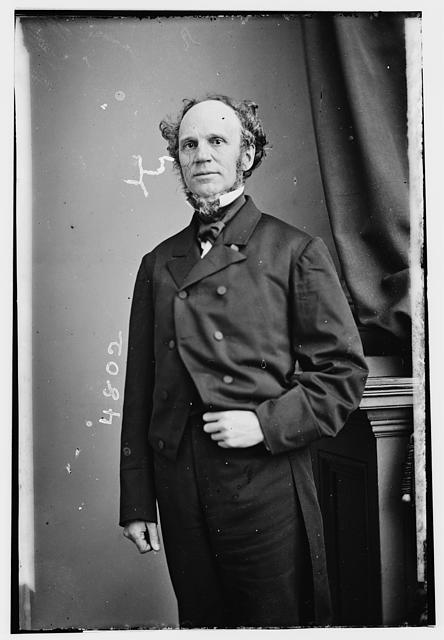
Edson Baldwin Olds (June 3, 1802 – January 24, 1869) Engraved by J.C. Buttre, http://ihm.nlm.nih.gov/images/B20287

opinions have consequences

A few days since some Black Republican speculators in the substitute business, who had violated the orders of the War Department, were sent to Fort Lafayette. The Abolition papers, however, made a great howl over it, and they have been released. There are, however, scores of better men and truer patriots in there than those released, in whose behalf not a word is uttered. There is Judge Carmichael, of Maryland, Guilty of what! Why, of the gross crime (1) of telling the Grand Jury of his county what the law in relation to arrests was. For months has Judge C. suffered the horrors of the Bastile, for simply doing his duty. Is it possible, therefore, that the recent Republican outburst of indignation against arbitrary arrests proceeds from any regard for the principles of civil liberty? No, it is the grossest hypocrisy. They wish only Democrats to be imprisoned. If they are sincere, why do they not ask for the release of Dr. Edson B. Olds, of Ohio, now in the fort, for simply expressing an opinion against the Administration?–How many more good and true men are also in the same gloomy prison walls, against whom no charges are preferred, we can only conjecture. We hear every day of men arrested in different parts of the country. They are spirited away, their friends and their families know not whither. Some dark and no some prison vault receives them, and they are buried alive! Where is D. A. Mahoney, Esq., of the Dubuque Herald, the central organ of the lowa Democracy? Where is Mr. D. Sherwood, editor of the Fairfield (Iowa) Union, recently snatched from his family by the Lincoln Kidnappers? Where is Judge Allen, member of Congress recently elected from Southern Illinois? We might increase this list indefinitely, but it is not necessary.–If there is but one man unjustly deprived of his liberty, it ought to arouse every American to instant action. The principle is the same. Our liberties are overthrown, and the rights of the individual are left to the whim or caprice of some upstart official. There is a day of retribution coming, however, for the murderers of liberty and the persecutors of Democrats amongst us. As Mr. Valiandignam says in his excellent speech, which we publish this week, “the measure they have meted out to us shall be measured to them again.” Yes, that it will, “shaken down and pressed together.””The arrest of Dr. Olds,” chuckles the Abolition tyrants of the Evening Post,”and the summary squelching of Charles Ingersoll, show that the Government is wide awake!” Yes, indeed, it is wide awake. It can conquer unarmed men, and that seems to be about the extent of its victories. It can send posses of kidnappers to the houses of quiet citizens in the North, gag them, and bind them, and immure them in forts and fortifications; but it has not the ability, with hundreds of thousands of troops, to keep the Confederates from besieging the National Capital. It can wreak a petty vengeance upon some individual, who has had too much honesty to bend before its usurpations; but it is incompetent to save the country from the calamities which menace it. It loves duplicity and deceit, and pays a high premium for them, in the person of the renegade Democrats who go over to it for plunder and pelf; but it especially hates manliness and honesty, and persecutes every individual who possesses enough of these qualities to tell it of its faults or rebuke its follies. It has finally convicted itself of party favoritism by releasing from imprisonment men of its own party and retaining Democrats in custody, though the offences charged were the same in both cases. Dr. Olds, of Ohio, is charged with discouraging enlistments, yet he is imprisoned, while Black Republicans are released! It is no wonder that some of its own party papers are calling for the resignation of a President who has allowed the Government to degenerate into an organization which would seem to exist, just now, mainly for the persecution of those who have intelligence enough to see the truth, and manliness enough to utter it.

New York weekly Caucasian, “An Anti-abolition, Democratic Union paper”, was published from 1861-1863.

Edson Baldwin Olds had been a Democrat Representative from Ohio mostly during the early 1850’s.

Richard Bennett Carmichael was a Maryland judge who got into trouble for instructing a grand jury to indict the federal officers who arrested hecklers at a Unionist rally. In May 1862 federal troops entered Carmichael’s courtroom. the judge was pistol whipped and dragged off. He was detained in various prisons until December 1862.

Posted in 150 Years Ago This Week, Civil War prisons, Lincoln Administration, Northern Society | Tagged , , , , , | Leave a comment

Stop Drunk Ambulance Driving

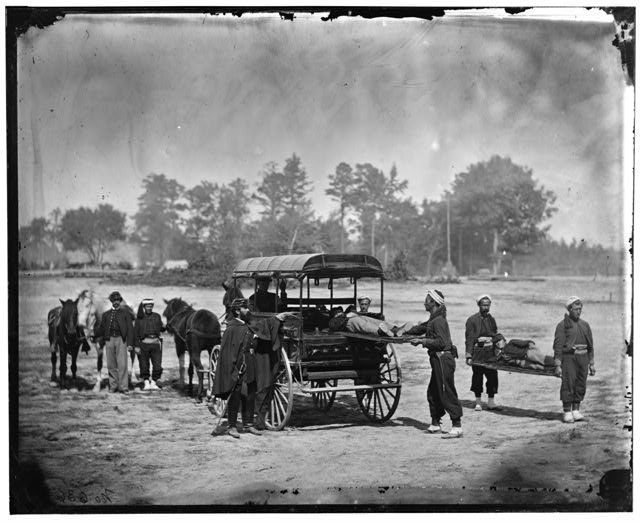
Unknown location. Zouave ambulance crew demonstrating removal of wounded soldiers from the field; another view (Between 1860 and 1865; LOC: LC-DIG-cwpb-04095)

goal: a better-trained and more professional ambulance service

According to Civil War Home, in August 1862 General McClellan ordered the creation of a more professional ambulance corps for the Army of the Potomac under the supervision of the army’s medical director. Apparently the results were still not too good. Here are some excerpts from an editorial arguing for the creation of an ambulance corps under the direction of the Surgeon General.

From The New-York Times October 10, 1862:

An Ambulance Corps.

We have every reason to expect that the hardest fighting of the war will occur within the ensuing ninety days. We sometimes talk of a million of men in arms, and of the movements of such columns as have never before been seen in hostile array, as though so many complicated masses of inanimate machinery were about to be brought into collision, to settle some mooted question of physical force, merely. How many of us attempt to estimate the amount of human suffering that must ensue? How many realize the fact that in less than ninety days from this time sixty or seventy thousand of our friends and brethren may be stricken down in battle — thousands to find soldiers’ graves, and more, by their wounds and sufferings, to become the objects of an anxiety and solicitude which shall sadden thousands of households. When our relatives are about to go forth to the fight, we are clamorous in our demands that they shall be armed and equipped with all the appliances of sturdy soldiers. Government gathers its stores of food, clothing and ammunition, and distributes them by the usual avenue. Hospitals are erected at points more or less remote from the scenes of probable conflict in obedience to the dictates of sanitary science, and thousands of medical men are drawn from the pursuits of peaceful practice to contribute their skill upon the battle-field.

Now, what does all this mean, unless it be to put our brave soldiers in fighting trim and to provide for them when they fall at the post of duty? …

Portrait of Brig. Gen. William A. Hammond, Surgeon-General, officer of the Federal Army (Between 1860 and 1865; LOC: LC-DIG-cwpb-05202)

600 untended wounded still on ground at Second Bull Run a week later

We hear a good deal from very high sources about discouraging enlistments, and all good citizens acquiesce in the exercise of the War Power to prevent such treasonable operations; but if the scenes of the second Bull Run and Antietam battle-fields are reenacted, verily an outburst of popular indignation, taking its keynote from the unavailing groans of the wounded and dying, will do more to discourage enlistments in one moment, than substitute associations and the schemes of rebel sympathizers could in forty years. The wounded must be cared for, — the Surgeon-General has indicated how it may be done by the organization of an Ambulance and Field Hospital Corps.

The Sanitary Commission has written, talked and worked for a similar plan for more than a year. The argument brought against the plan, that it will add to the already monstrous transportation of the army, is devoid of foundation. …

It is preposterous, it is criminal, to deny to the Medical corps a sufficient number of vehicles to insure the transportation of the means for saving life and alleviating suffering. It is cruel and barbarous to deny to the wounded the means of conveyance from where they fell like heroes to where they can be treated like Christians. For nearly a week the wounded lay upon the second Bull Run field, starving and dying, awaiting the arrival of ambulance trains, and when they came they were made up of hacks, omnibuses and ambulance wagons, manned by men and boys, all of whom were ignorant of the first principles of the ambulance practice, and many utterly inhuman, and not a few drunk.

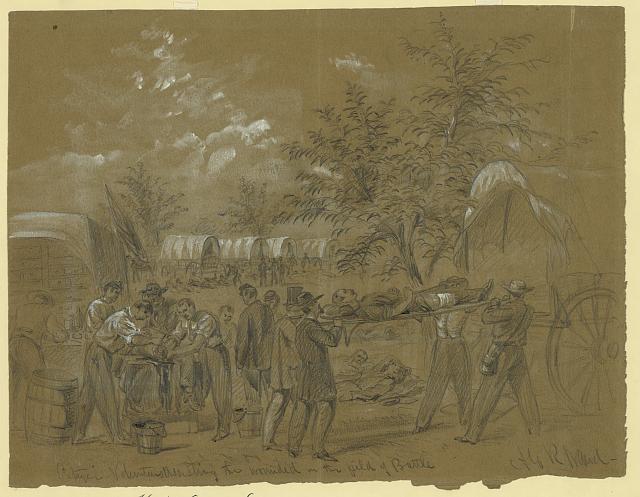
Citizen volunteers assisting the wounded in the field of Battle (by Alfred R. Waud, 1862 September 17; LOC: LC-DIG-ppmsca-21468)

citizens helped out at Antietam

After Antietam, nine or ten thousand wounded men lay for days, mostly unsheltered, in the open air, awaiting the arrival of aid and comfort, ministered to by surgeons not one of whom would have had the appliances most essential to their art and efficiency if it had not been for the Sanitary Commission. Life was lost that might have been saved, and yet no blame must attach to the Medical Bureau. Without an ambulance corps, it cannot perform its high functions. You might as well expect a crowd of eager miners, with their bare hands and no tools, to penetrate the beds of an exploded coal mine in search of dying comrades, as to expect surgeons to meet the demands of suffering upon the battlefield without the facilities of an organized ambulance corps.

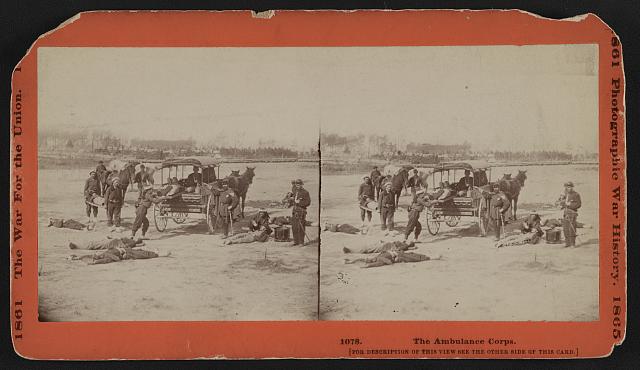
The Ambulance Corps. (bt William Frank Browne, between 1861 and 1869; LOC: LC-DIG-stereo-1s02808)

The Ambulance Corps.

The corps should consist of picked men, drilled for the work and officered by medical men. Instead of being an incumbrance to the army, it would not only return to the ranks ten or twelve thousand men, who now, in response to the dictates of humanity, or upon pretence of helping a stricken comrade, straggle to the rear, but relieve our commanders from a vast deal of the irregular but otherwise necessary assistance of an endless number of volunteer and temporary helpers. Such a corps could carry shelter, food, stimulants and surgical appliances, and answer at once the cry for help which now arises in piteous accents from every new battle-ground.

The following letter from the Surgeon General also appears at Civil War Home:

SURGEON-GENERAL’S OFFICE,
September 7,1862.

HON. EDWIN M. STANTON,
Secretary of War.

SIR : I have the honor to ask your attention to the frightful state of disorder existing in the arrangement for removing the wounded from the field of battle. The scarcity of ambulances, the want of organization, the drunkenness and incompetency of the drivers, the total absence of ambulance attendants are now working their legitimate results-results which I feel I have no right to keep from the knowledge of the department. The whole system should be under the charge of the Medical Department. An ambulance corps should be organized and set in instant operation. . . . Up to this date six hundred wounded still remain on the battlefield, in consequence of an insufficiency of ambulances and the want of a proper system for regulating their removal in the Army of Virginia. Many have died of starvation ; many more will die in consequence of exhaustion, and all have endured torments which might have been avoided. I ask, sir, that you will give me your aid in this matter ; that you will interpose to prevent a recurrence of such consequences as have followed the recent battle-consequences which will inevitably ensue on the next important engagement if nothing is done to obviate them.

I am, sir, very respectfully, your obedient servant,
WILLIAM A. HAMMOND,
Surgeon-General.

William Alexander Hammond served as Surgeon General from 1862-1864. Union field commanders gradually improved the quality of the ambulance services under their supervision. Congress acted to officially establish an ambulance corp in March 1864.

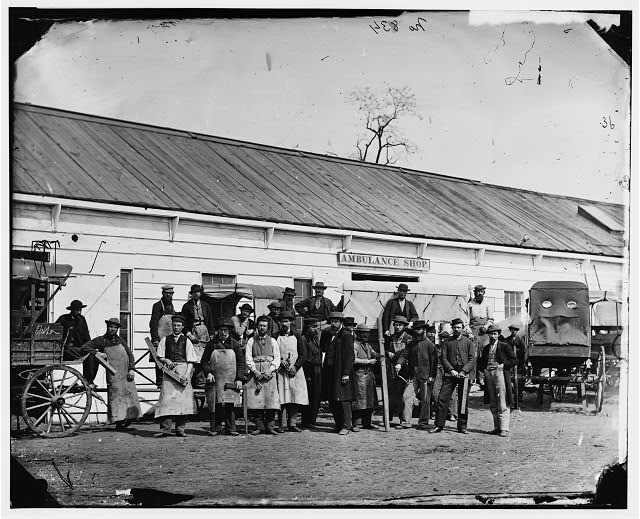
Washington, D.C. Workmen in front of the Ambulance Shop (1865 April; LOC: LC-DIG-cwpb-04256)

putting the ambulance in ambulance corps – at Washington City, April 1865

Posted in 150 Years Ago This Week, Military Matters | Tagged , , , , | Leave a comment

Calling all men, women, and speculators!

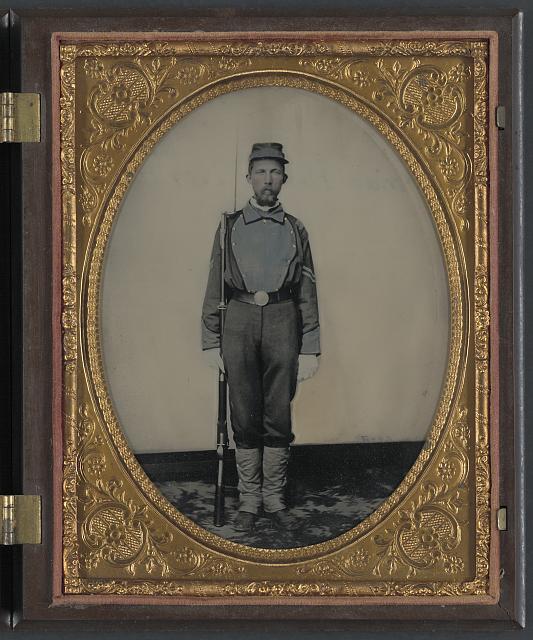
Corporal Samuel H. Overton of A Company, 44th Virginia Infantry Regiment and A Company, 20th Battalion Virginia Heavy Artillery Regiment in uniform and kepi with bayoneted musket (by Charles R. Rees, between 1861 and 1862; LOC: LC-DIG-ppmsca-32457)

well-equipped and well-shod at first

The Army of Northern Virginia is in dire need of clothing, shoes, and blankets. By this time the North discouraged goods sent to soldiers as at best ineffectual and a logistics problem. Here a Richmond paper urges the entire Southern populace (even soulless speculators) to send whatever supplies they can.

From the Richmond Daily Dispatch October 9, 1862:

Clothing for the army.

The Savannah Republican publishes an energetic appeal from an army correspondent dated at Winchester to the people of the Confederate States–men, women, and even speculators, who being presumed to have no souls, are, of course, not to be considered as either men or women — to exert themselves to the utmost extent of their ability in procuring clothing for our army. Whatever can be done, he says, must be done at once. “Not one moment can be lost that will not be marked, as by the second-hand of a watch, with the pangs of a sufferer. Already the hills and valleys in these high latitudes have been visited by frost, and the nights are uncomfortably cool to the man who sleeps on the ground. Come up, then, men and women of the South, to this sacred duty. Let nothing stand between you and the performance of it. Neither pride nor pleasure, nor personal case and comfort, should withhold your hands from this holy work. The supply of wool and leather we know is limited, but do what you can, and all you can, and as soon as you can. If you cannot send woolen socks, send half woolen or cotton socks, and so with under-clothing, coats, and pants If blankets are not to be had, then substitute comforts made of oznaburg stuffed with cotton. Anything that will keep off the cold will be acceptable. Even the speculator and extortioner might forego their gains for a season and join in this religious duty. If they neither clothe the naked, nor feed the hungry, who are fighting for their freedom, and for their homes and property, what right have they to expect anything but eternal damnation, both from God and man?

“If the army of Virginia could march through the South just as it is — ragged, and almost barefooted and hatless, many of them limping along, and not quite well of their wounds or sickness yet cheerful and unwilling to abandon their places in the racks, their clothes riddled with bullets, and their banners covered with the smoke and dust of battle, and shot into latters, many of them in scribed with Williamsburg, ‘Seven Pines.’ ‘Galses’s Mill,’ ‘Garnett’s Farm,’ ‘Front Royal,’ ‘McDowell,’ ‘Cedar Run,’ and other glorious fields — if this army of veterans, thus shed and lead, with tattered and forms and banners, could march from Richmond to the Mississippi, it would produce a sensation that has no parallel in history since Peter the Hermit led his swelling hosts across Europe to the rescue of the Holy Sepulchre. ” …

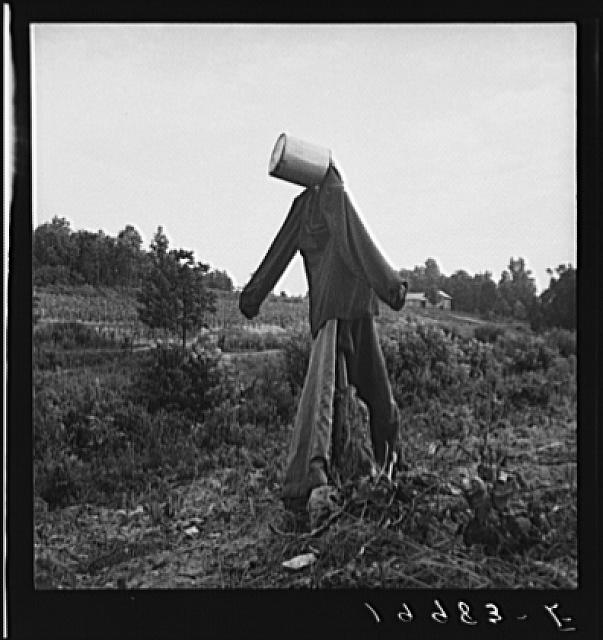
Scarecrow on a newly cleared field with stumps near Roxboro, North Carolina (by Dorthea Lange, U.S. Farm Security Administration/Office of War Information Black & White, 1939 July; LOC: LC-USF34-019983-E)

scarecrow in North Carolina, 1939

We are no alarmists; we are aware that Congress has taken measures since the letter from which the above extracts are made was written. But this is a subject of such vast importance that it must be taken into consideration by everybody. That army — that glorious army — must be clad and must be shod. Upon it depends the glory alike, and salvation of our country. Posterity will scarcely believe that the wonderful campaign which has just ended, with its terrible marches and desperate battles, was made by men, one-fourth of whom were entirely barefooted, and one-half of whom were as ragged as scarecrows. Yet, who ever heard of such valor, such constancy, such devotion, such an entire absence of all complaints. We cease to wonder at the number of stragglers when we hear how many among them were shoeless, with stone bruises on their feet.

Men and women of the South, to the Rosene, to the rezone! [rescue?]

Posted in 150 Years Ago This Week, Confederate States of America, Southern Society | Tagged , | Leave a comment

Battling the Blockade … and Yellow Fever

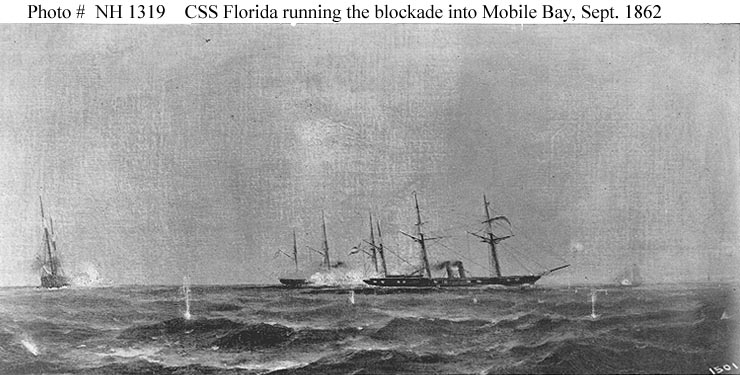
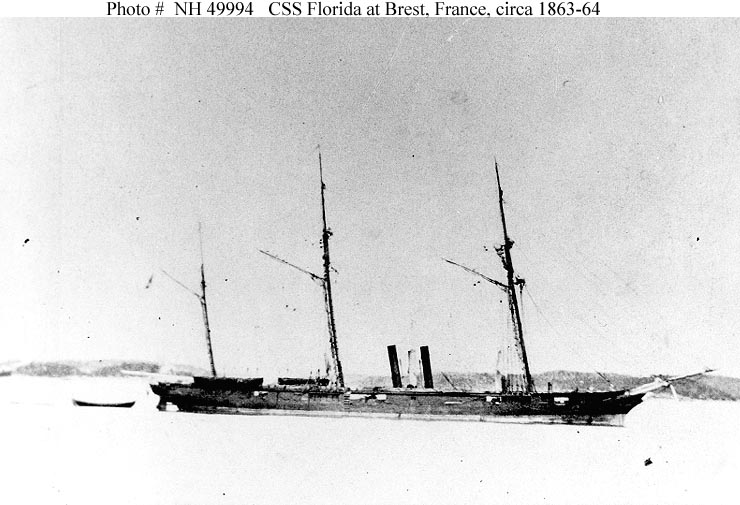
CSS Florida (1862-64)  (19th Century photograph of a painting depicting Florida running past the Federal blockader USS Oneida to escape into Mobile Bay, Alabama, 4 September 1862. On this occasion, Florida also evaded USS Winona and USS Rachael Seaman.  U.S. Naval Historical Center Photograph)

Running the blockade at Mobile

It’s month old news but a fresh source of Confederate pride for the Dispatch editors. From the Richmond Daily Dispatch October 8, 1862:

Brilliant Naval exploit.

We doubt whether the late exploit of the Confederate shipsteamer Florida, in running the blockade of Mobile, has ever had, in all its features, any parallel in naval annals. Manned by a crew of laborers, unable to fire a gun, and commanded by a captain sick with yellow fever, she run the gauntlet of four Federal steamers, and was chased and pounded by them for four mortal hours, and yet, through the masterly handling of her sick captain, escaped.–Capt. Moffit has made himself a name by this remarkable achievement. If he can do such things without guns or seamen and down himself with the yellow fever, what may we not expect of him when the Florida is ready for a fight and her commander is restored to health? May the hour be near!

John Newland Maffitt, 1819-1886 (no date recorded on caption card; LOC: LC-USZ62-72757)

damn the yellow fever, …

The CSS Florida was not able to fight back when it ran the blockade on September 4 because much of the crew, including its commanding officer, John Newland Maffitt, was sick with yellow fever and because it was not properly outfitted to use its guns.

You’d have to say the editors were right to expect a lot. On January 16, 1863 the repaired and properly outfitted ship escaped Mobile. From then until August the Florida with Maffitt at the helm captured 22 prizes.

Commander Maffitt, who joined the U.S. navy as a 13 year old midshipman, resigned his commission in 1861 to join the Confederate navy. Maffitt had to relinquish command of the Florida because of ill-health later in 1863; later in the war he commanded the Albemarle. In 1886 Maffitt died in Wilmington, North Carolina – a city that was afflicted with yellow fever 150 years ago this month (from the same issue of the Dispatch):

Progress of the yellow fever at Wilmington.

A telegram from a friend informs us that, on the 6th instant, there were 63 new cases of fever in Wilmington, N. C., and the physicians there estimated the number of cases now in the city at 400. For the week ending with the 3d instant, there were 267 new cases, and 82 deaths, showing a mortality equal to 30 per cent. The weather on Saturday was very hot, and the nights during the week had been foggy with heavy dews. Efforts for the relief of the plague-stricken city are being made in various cities. From Petersburg, Va., 20 barrels of flour have been sent, and Goldsboro’, N. C., has appointed a committee to forward provisions. The gloom of the plague is not regarded by the thieves. Three stores were broken open in Wilmington on Friday night.

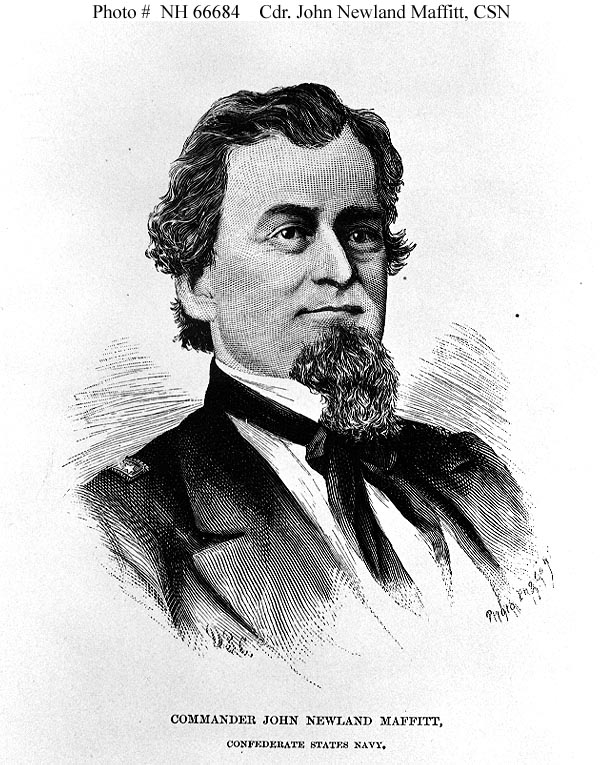
Commander John Newland Maffitt, CSN  Engraving published circa the later 19th Century.  U.S. Naval Historical Center Photograph.

‘Prince of Privateers’

CSS Florida (1862-1864) Photograph taken at Brest, France, circa August 1863-February 1864. (U.S. Naval Historical Center Photograph.)

At rest at Brest

Posted in 150 Years Ago This Week, Naval Matters | Tagged , , , , , | Leave a comment

Who would Jeff Davis vote for?

Hon. Horatio Seymour (between 1855 and 1865; LOC: LC-DIG-cwpbh-01842)

He’s got Jeff’s vote locked up

Democrat Horatio Seymour opposed Republican James S. Wadsworth in the 1862 race for New York governor. 150 years ago this week the Republican-leaning New-York Times published an editorial about a month from Election Day. There are three classes of Seymour supporters – rebel sympathizers, Democrats who prefer party over the nation, and those dissatisfied with the Lincoln administration. The editorial concludes by showing the fallacy of the anti-administration class and then says that a vote for Seymour is a vote to aid and abet the rebels.

From The New-York Times October 5, 1862:

What the Opposition is Composed of.

Now, these men [those upset with Lincoln’s administration], assuming them to be loyal In heart, show a most extraordinary want of logic in the conclusion to vote for SEYMOUR, which they draw from their premises. Granted that the Administration has erred, has been too Pro-Slavery, or too Anti-Slavery, has been too energetic or not enough so, the conclusion to vote for SEYMOUR is a non sequitur. It is as if a man, because doctors are guilty of malpractice sometimes, should help a vessel with the yellow fever on board to run the Quarantine. It is as if burglars should break into our house, and one of the inmates, being dissatisfied with the actions of the Police, should join with the thieves and trip up the officers’ heels.

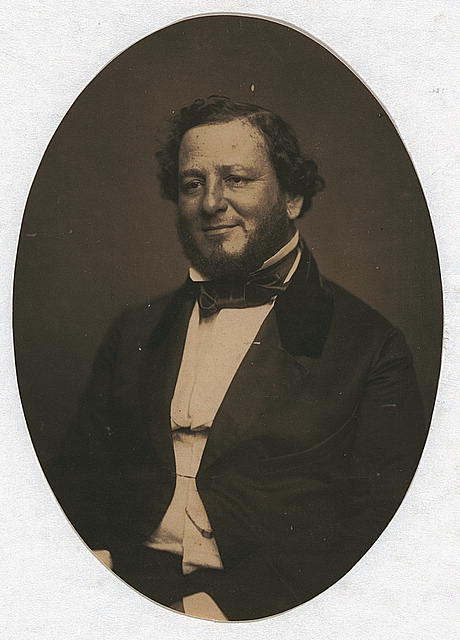
Judah P. Benjamin, Senator from Louisiana, half-length portrait (ca. 1856; LOC: LC-DIG-ppmsca-05642)

CSA Secretary of State – Seymour’s election sure to keep him smiling

Now, all these three classes of men are excessively indignant at being told that they are aiding and abetting the rebels. But this is the fact, and it is no answer for them to say that they have given their money and sent their sons to the war. ARNOLD gave his money and his blood for the country, but none the less did he help the enemy when he offered to give up West Point. And so the men who seek the election of SEYMOUR, whether they mean it or not, are helping the rebels, no matter what they have done before to hurt them. We wish that every one who proposes to vote for SEYMOUR would ask himself the question, What would JEFF. DAVIS advise me to do, if I were to ask him? Which vote would do most to please FLOYD and BENJAMIN, and TOOMBS and WISE, and LETCHER and the whole gang of thieving, perjured rebels, who have brought the country to this pass? Which vote would win for me the approbation of the I Richmond newspapers? Which vote would gratify most and encourage most the rebel Generals? No honest man can answer these questions in any way but one. A vote for SEYMOUR will insure to any one the applause of the whole rebel crew. It is enough for us, and it seems to us that it must be enough for any man who loves his country, to know that this is so to insure our supporting WADSWORTH with all our energies. Show us what the rebels would have us do. We want nothing else to send us in the opposite direction.

__________________________________

James S. Wadsworth (between 1861 and 1864)

‘nothing but blows for rebels’

Here’s an earlier Times editorial on the race. The Republican convention was held in Syracuse on September 24th. General Wadsworth was nominated, although John Adams Dix was also considered, even after receiving votes at the Constitutional Union party’s convention on September 9th. This piece points out that the Syracuse convention enthusiastically supported President Lincoln’s September 22nd Emancipation Proclamation.

From The New-York Times September 26, 1862:

The State Canvass.

The State canvas is fairly opened, and according to all appearances it bids fair to be one of the most hotly contested which we have ever known. The spirit and temper of the Syracuse Convention indicated a purpose, on the part of the War Unionists of all political parties, who were there represented, to join issue directly with the peace and submission Democrats, and to give them as sharp a fight as they may desire.

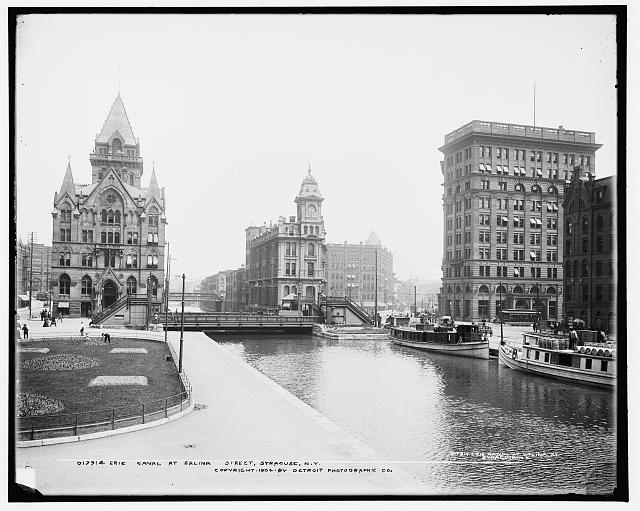
Erie Canal at Salina Street, Syracuse, N.Y. (Detroit Publishing Co. c1904; LOC: LC-DIG-det-4a12105)

A canal ran through it (Syracuse about 1904)

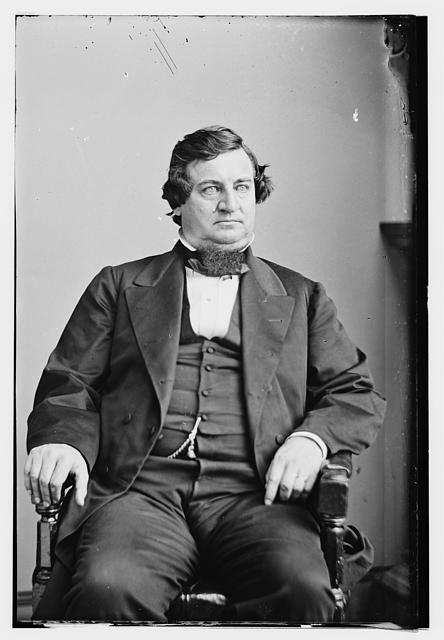
Gen. WADSWORTH, their candidate for Governor, is a thoroughly representative man, -devoted heart, soul, and fortune to the crushing of the rebellion, and not disposed to make terms of any sort with traitors in arms. Unlike Gov. SEYMOUR, he has nothing but blows for rebels, and gives the Government of his country a hearty and unqualified support. He is widely known as an able, generous, liberal man, perfectly independent in feeling as in fortune, and deserving the universal confidence and esteem which he enjoys. LYMAN TREMAIN, the candidate for Lieutenant-Governor, is fresh from the ranks of the Democratic Party, a lawyer of ability, and a man of commanding influence and popularity through a very large section of the State.

Hon. Lyman Tremain of N.Y. (between 1855 and 1865; LOC: LC-DIG-cwpbh-01902)

fresh from Democrat ranks

The Convention was large, able, perfectly harmonious, and intensely enthusiastic in support of the Government, and especially in approval of the President’s proclamation emancipating the slaves of obdurate rebels. A portion of the delegates deemed it expedient to nominate Gen. DIX, in order to give the loyal Democrats an opportunity to stand by the Government without forfeiting their party preferences. With this exception, there was not the slightest difference of opinion as to principles or policy in the Convention, — and when a very large majority of the delegates overruled this suggestion, nothing was left but the most complete and unanimous enthusiasm in support of the ticket and the cause.

The canvass opens in a manner to give assurance that we shall crush out treason at home as effectually as we hope to crush the more open and manly rebellion beyond our borders.

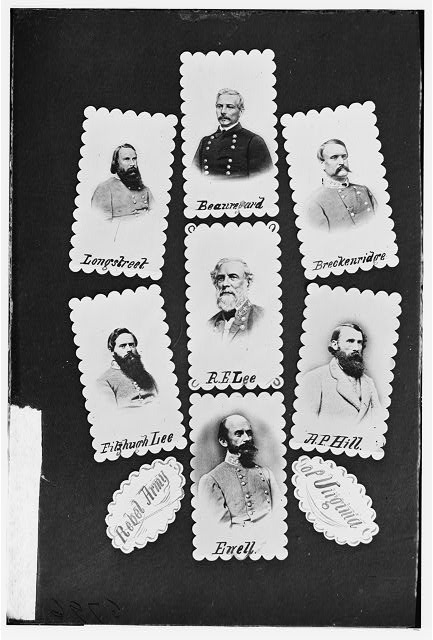
Rebel Army of Virginia: Longstreet, Beauregard, Breckenridge, Fitzhugh Lee, R.E. Lee, A.P. Hill, and Ewell (between 1860 and 1870; LOC: LC-DIG-cwpb-07618)

more open and manly rebels

Posted in 150 Years Ago This Week, Northern Politics During War | Tagged , , | Leave a comment

“Three cheers for the hope of America”

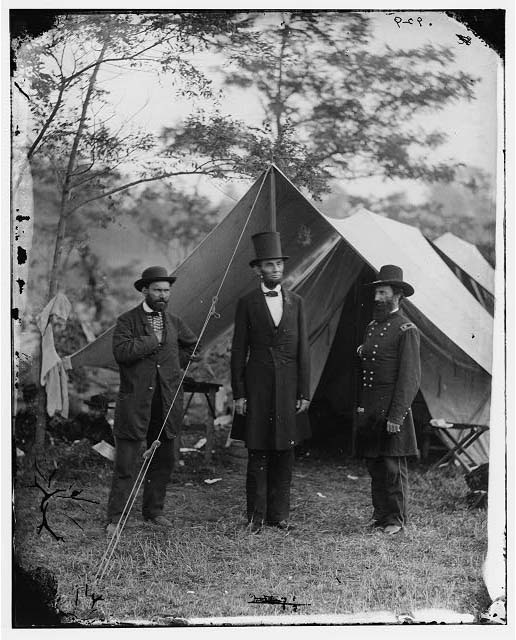
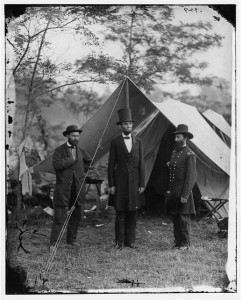
Antietam, Md. Allan Pinkerton, President Lincoln, and Maj. Gen. John A. McClernand; another view (by Alexander gardner, 1862 October 3; LOC: LC-DIG-cwpb-04326)

‘hope of America’ at Antietam

President Lincoln stopped in Frederick, Maryland on his way back to the nation’s capital after vising General McClellan and the Army of the Potomac at Antietam. Our correspondent saw the brief storm that hit Frederick during the president’s visit as sort of an omen – “our dark day of sorrow” will pass. President Lincoln is also taking the long view – this stormy war will be worth it for the next thousand generations.

From The New-York Times October 5, 1862:

AN OVATION TO THE PRESIDENT.; Enthusiastic Reception in Frederick on His Return to Washington. Two Brief Speeches Made by Him.

WASHINGTON, Saturday, Oct. 4.

We have received the following dispatch from our special correspondent, dated FREDERICK, Md., Saturday, Oct. 4.

The President’s visit to Frederick was one of the most joyous and enthusiastic ever witnessed in this city, and must have presented a startling contrast to those who, but a few days ago, saw the Union flag trailed in the dust at the feet of rebels’ horses.
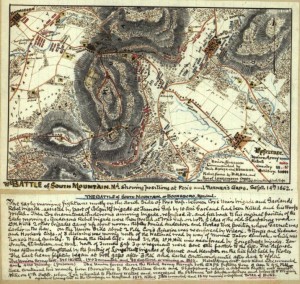
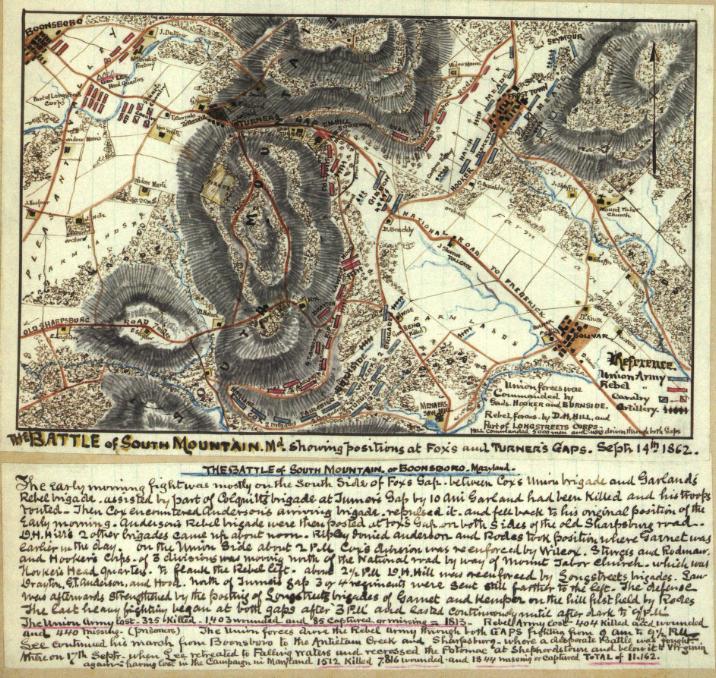
The Battle of South Mountain Md. : showing positions at Fox's and Turner's Gaps, Sept. 14th 1862. by Robert Knox Sneden (betweeen 1862-1865; LOC: gvhs01 vhs00298 http://hdl.loc.gov/loc.ndlpcoop/gvhs01.vhs00298 )

Lincoln and McClellan inspected South Mountain

The town was in great excitement a great part of yesterday, and to-day also, momentarily expecting the President’s arrival. He was accompanied today by Gen. MCCLELLAN and Staff to the South Mountain, where, after a minute survey of the battle-field, the parties separated, the President proceeding, with his escort, to this place.

He arrived in Frederick this evening at 4 2/4, accompanied by Maj.-Gen. McClernand, Col. L.S. Marther, Chief of Artillery, of McClellan’s Staff; Capt. W. Rives, Aid to McClellan; Capt. Derrickson, of the One Hundred and Fiftieth Pennsylvania; John W. Garrett, President of the Baltimore and Ohio Railroad; Marshal Lamon, of the District of Colombia; Hon. O.M. Hatch; Secretary of State, or Illinois; J.P. Kennedy, Superintendent of the Census, and a body of cavalry. The party entered Frederick by Patrick-street, passed through Court and Church streets, and then stopped at Mrs. RAMSEY’s house, to see Gen. HARTSUFF, who was wounded at Antietam. Here the President, being called on, made the following speech:
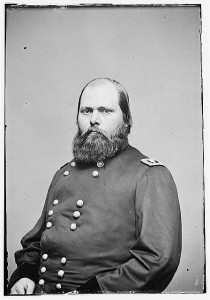
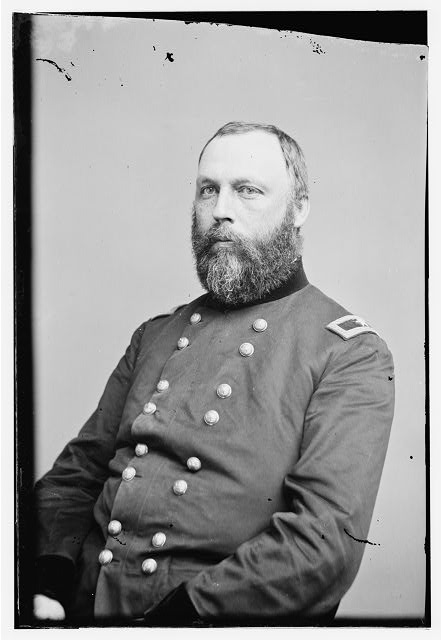
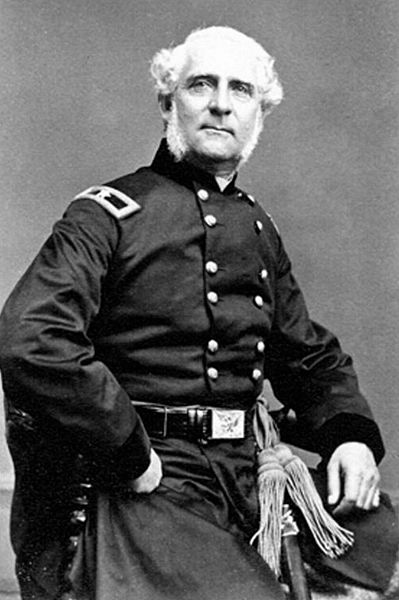
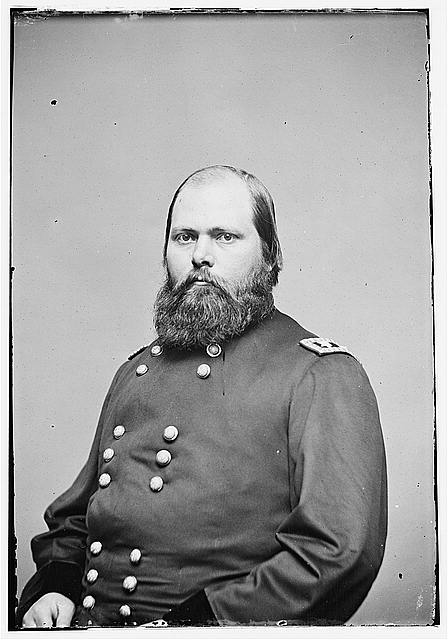
G.L. Hartsuff (between 1860 and 1870; LOC: LC-DIG-cwpb-05150)

recuperating at Mrs. Ramsey’s

“In my present position it is hardly proper for me to make speeches. Every word is so closely noted that it will not do to make trivial ones, and I cannot be expected to be prepared to make a matured one just now. If I were as I have been most of my life, I might, perhaps, talk amusing to you for half an hour, and it wouldn’t hurt anybody; but as it is, I can only return my sincere thanks for the compliment paid our cause and our common country.”

From this place they proceeded along First-street: then down Market-street to the railway station, where hundreds were congregated, cheering vociferously, and the windows everywhere crowded with a most excited and enthusiastic crowd — the ladies especially exhibiting every symptom of delight.

Just at this period the sky became overcast with clouds of inky blackness, and a tornado came up, sending the dust in blinding gusts, and accompanied by a short but heavy rain. By the time the President reached the Station it had already blown over — ominous of the brightness that is to succeed our dark day of sorrow.

At the Station, being loudly called for, he made the following remarks:
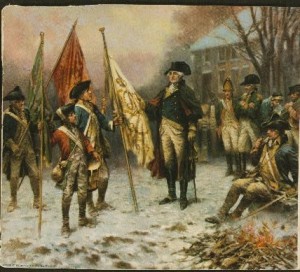
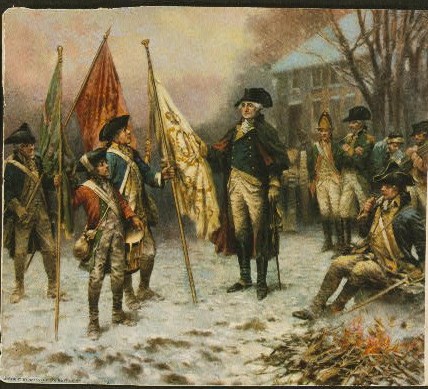
Washington inspecting the captured colors after the battle of Trenton (by Percy Moran, c1914 Aug. 10; LOC: LC-USZC4-11107)

bequeathed ‘glorious institutions’ for the next thousand generations

FELLOW-CITIZENS: I see myself surrounded by soldiers, and a little further off I note the citizens of this good city of Frederick, anxious to hear something from me. I can only say, as I did five minutes ago, it is not proper for me to make speeches in my present position. I return thanks to our soldiers for the good service they have rendered, for the energies they have shown, the hardships they have endured, and the blood they have so nobly shed for this dear Union of ours; and I also return thanks not only to the soldiers, but to the good citizens of Maryland, and to all the good men and women in this land, for their devotion to our glorious cause. I say this without any malice in my heart, to those who may have done otherwise. May our children and our children’s children to a thousand generations continue to enjoy the benefits conferred upon us by a united country, and have cause yet to rejoice under those glorious institutions bequeathed us by WASHINGTON and his compeers. Now my friends, soldiers and citizens, I can only say once more, farewell.

At the conclusion of this speech, which was delivered standing at the end of the car, the President, entered amid the acclamations of the crowd, and the train moved off. Once again he appeared, waving his hat, and continued doing so until the train was lost in the distance.

“Three cheers for the hope of America,” was called out by one stentorian voice in front of Mrs. RAMSEY’s house, and the reception which our President received here shows that that is the estimate put upon him by the good people of Frederick, and indeed the whole of Maryland.
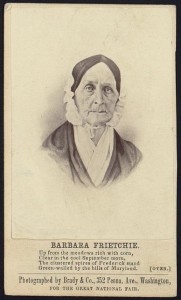
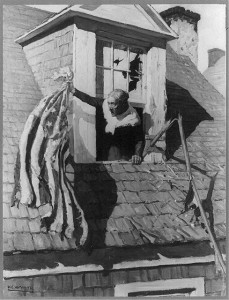
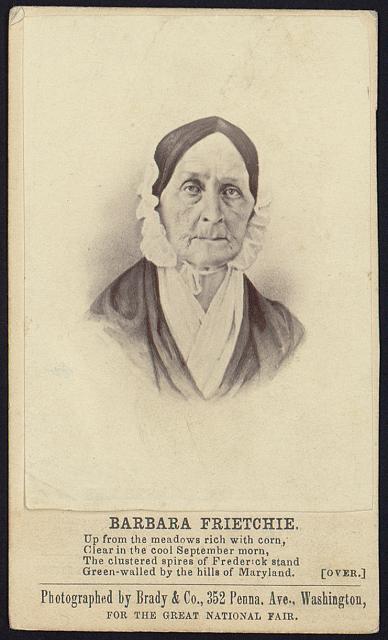
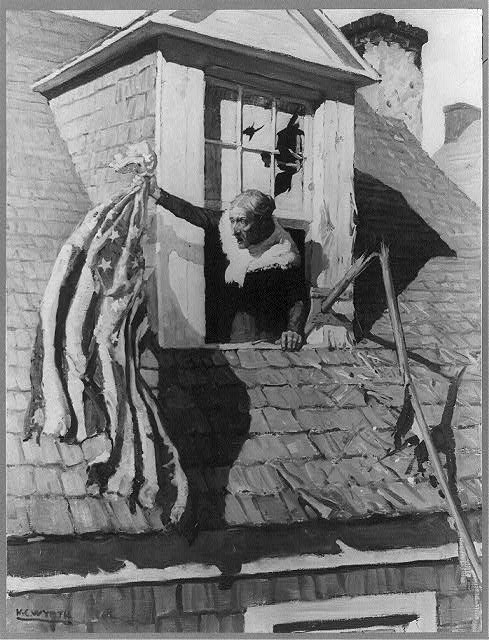
Barbara Frietchie (1862?, printed 1863 or 1864; LOC: LC-DIG-ppmsca-07770)

famous Frederick Unionist

Barbara Fritchie waving tattered U.S. flag from window. Frederick, Md., Sept. 1862 (c1922; LOC: LC-USZ62-57781)

mythic incident symbolizing Northern patriotic sentiment in Frederick

____________________________________

Barbara Fritchie died in December 1862 at the age of 96.

George Lucas Hartsuff was born in Tyre, New York in Seneca County in 1830. His family moved to Michigan in 1842. Hartstuff graduated from West Point in 1842. The 48th Pennsylvania Infantry discusses Hartstuff at Antietam. The wound to his left hip took eight months to heal. He was unable to walk until February, 1863.

_______________________________________
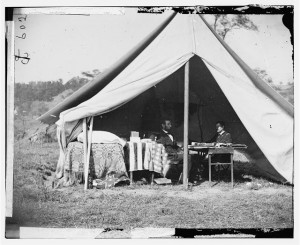
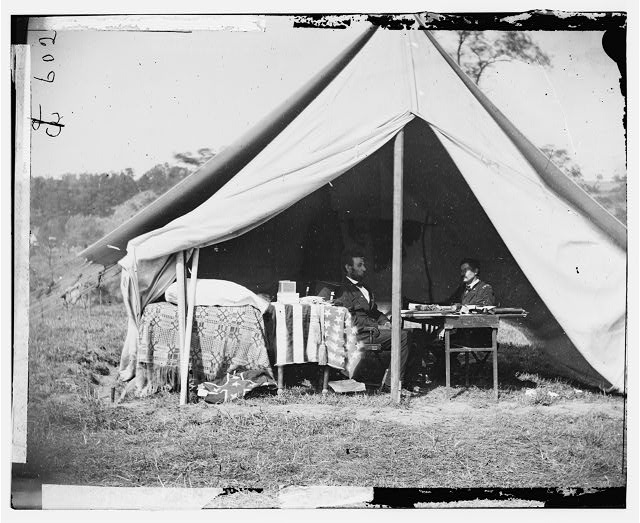
Antietam, Md. President Lincoln and Gen. George B. McClellan in the general's tent; another view (by Aleaxander Gardner, 1862 October 3; LOC: LC-DIG-cwpb-01131)

‘and now he wants me to show him South Mountain’
Posted in 150 Years Ago This Week, Maryland Campaign 1862, Military Matters | Tagged , , , , , , | Leave a comment

Cutting Wires

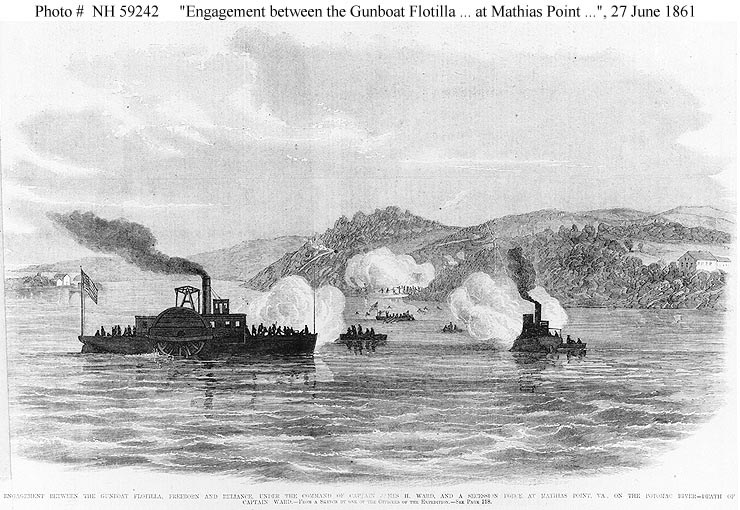
According to the Naval Historical Center, “A landing party from Thomas Freeborn cut telegraph lines stretching from Occoquan and Fredericksburg, Va., to Richmond, Va., on 4 October 1862.”

It’s already been 15 months since the Freeborn’s commander, James Harmon Ward, was mortally wounded at Mathias Point.

"Engagement between the Gunboat Flotilla, Freeborn and Reliance, under the Command of Captain James H. Ward, and a Secession Force at Mathias Point, Va., on the Potomac River -- Death of Captain Ward.", 27 June 1861

Thomas Freeborn on left

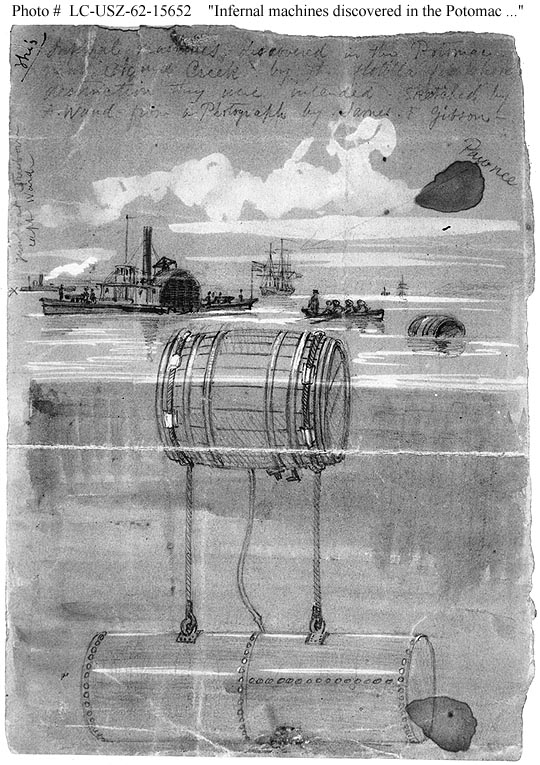
"Infernal machines discovered in the Potomac near Aquia Creek by the flotilla for whose destruction they were intended'"  Sketch by A. Waud from a photograph by James F. Gibson, 1861

And speaking of technology

Posted in 150 Years Ago This Week, Military Matters | Tagged , , , | Leave a comment