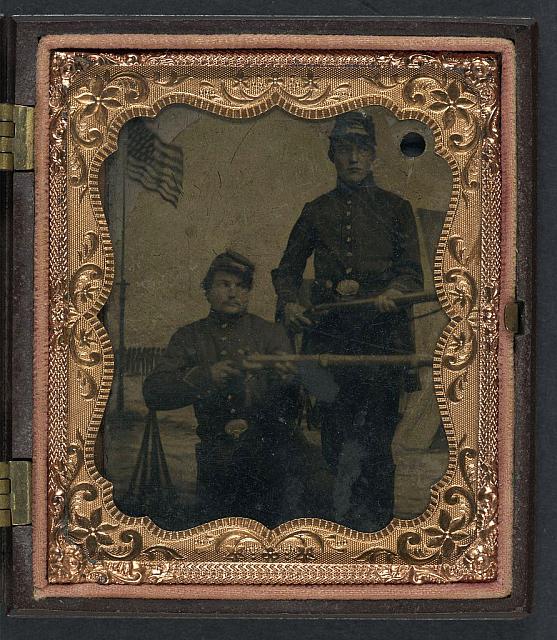
Brothers in the 14th Indiana Infantry Company D
According to 14th Indiana Volunteers Phillip Letsinger was killed at Antietam.
Brothers in the 14th Indiana Infantry Company D
According to 14th Indiana Volunteers Phillip Letsinger was killed at Antietam.
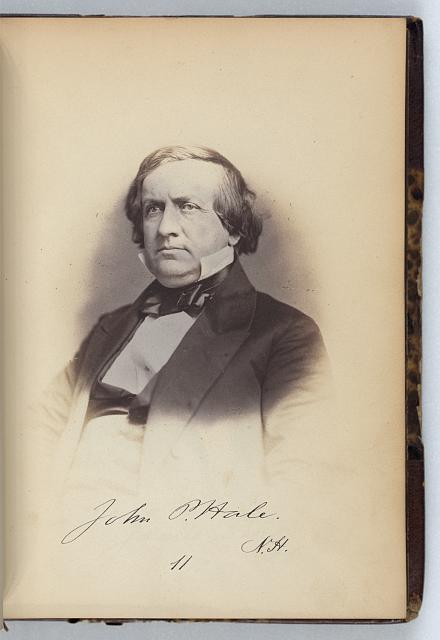
headed to Fort Warren?
According to this report, an Albany, New York newspaper thinks the Confederacy is doing as well as it is in the rebellion because its government is non-partisan and set up on a war footing. The Lincoln administration, on the other hand, is preoccupied with partisan politics and the spoils system.
From the Richmond Daily Dispatch September 20, 1862:
The contrast.
[From the Albany (N. Y.) Atlas.]
At a public meeting in New Hampshire, Senator Hale of that State is reported to have said: “I may be ordered to Fort Warren for the expression I am about to make, but I do not hesitate to declare that there is nothing that can parallel the exhibition of ability, vigor and resource shown by the Confederate Government, except the incapacity and imbecility of our own.”
Senator Hale has not yet been sent to Fort Warren, and will not be. That place is reserved for Democrats, who, at some former day, may have offended a Cabinet officer, and who are badgered with false charges of disloyalty now.
What is the secret of the contrast between rebel efficiency and governmental helplessness? When the Confederate Government was organized, the opposition was at once associated in the administration. Stephens, who ran with Douglas, was made Vice President. A Cabinet of all parties was constructed. When Cabinet officers were proved insufficient, they were dismissed. Laggart Generals were cashiered, deserters shot, peculators punished. The South was organized on a war basis.
President Lincoln, on the other hand, made up his Cabinet out of the dead-wood of the Chicago Convention. Seward, Chase, Cameron, Bates, were all his rivals, and enemies of each other — all disappointed and rejected men! These worn-out politicians had their followers to provide for; and they fed them upon the plunder of the treasury — upon the commissariat of the army — upon the spoils of patronage. In the crisis the first battle of Bull Run, the President was engaged in settling paltry claims of partisans to post-offices; and, fourteen months later, when Washington was in hourly danger of capture, was busy making up partisan lists of Tax Collectors, and Assessors — selecting them upon occasion from the exposed and condemned shoddy contractors.
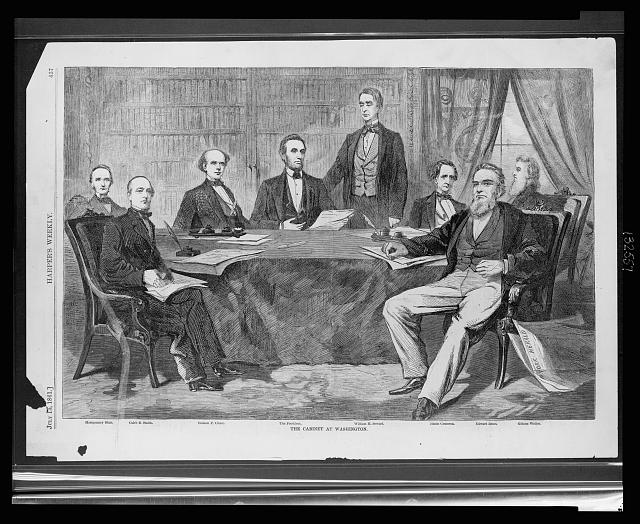
dead-wood
One Army, at a conjuncture when the fortunes of the whole contest were depending upon it, has been sacrificed to political jealousies. Another General whose name has always been associated with defeat has been kept in command by the Nepotism of Cabinet ministers! All the while the energies of the Government have been directed against the press, or the free discussion of citizens, or to seconding the private revenges and political hates of men who have secretly instigated accusations against their neighbors. Never on so great an occasion had an administration confined itself to such paltry objects!
But did not Mr. Lincoln preface his inaugural oath by the declaration that he considered the decision of the Supreme Court, in regard to the subject of slavery, as not binding upon him; while he felt bound to obey the instructions of the Chicago platform? A stream never rises higher than its fountain; nor an administration, than its head.
All this while the people have placed in the hands of the President, at Washington, unlimited resources of men and money, arms, ships, and public credit.
It is customary to say in excuse for the present state of affairs that the Confederacy has exhibited unexpected resources. True; but has not the North shown a power and wealth of means equally surprising? We have raised armies such as Europe never equalled; navies which have never been surpassed in extent or in the use of modern improvements of warfare. We have spent money at a rate that startles the most extravagant schemers of the Old World. There is not an invention of war.–plated ship, mammoth gun, marine ram, ærial [aerial?] telegraph, balloon of reconnaissance, diving ball, or pontoon — which we have not had. No army ever marched, no navy ever sailed with such pay or provision or armament as ours.
We stood as immeasurably above our adversaries in resources on the last day’s battle at Bull Run as a year ago. We are now as far above them as at any time, if we had men in charge of public affairs capable of handling there resources. There, and there alone, the contrast lies between ourselves and our adversaries.
John Parker Hale was the nominee of the Free Soil party in 1852 and later became a Republican. President Lincoln appointed Mr. Hale as minister to Spain in 1865.
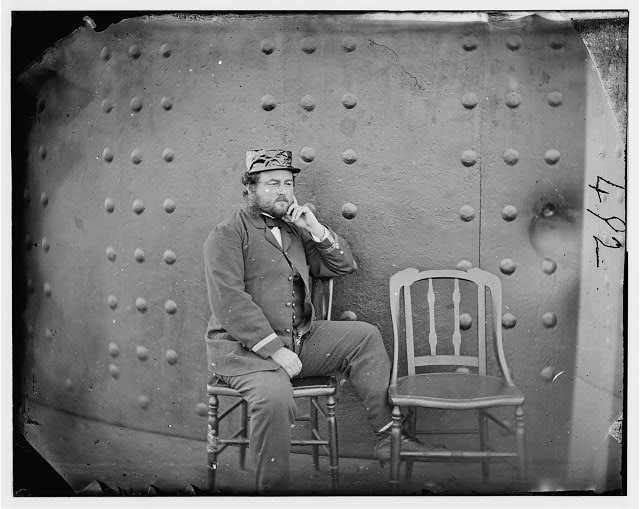
on board a famous ‘plated ship’ – there’s (many) more where that came from
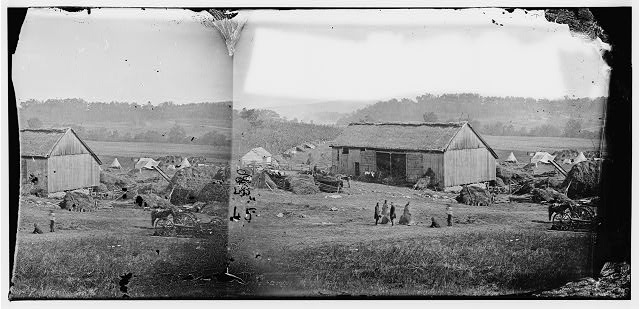
temporary hospital after the battle
150 years ago today George M. Guion wrote a report for his hometown newspaper about the casualties his unit suffered during the Battle of Antietam.
From a Seneca County, New York newspaper in 1862:
Letter from Captain Guion.
BATTLEFIELD OF SHARPSBURG,
September 19, 1862.
EDITOR REVEILLE: – Enclosed I send you a list of the killed, wounded and missing in Co. A, during the battle of the 17th:
Killed – Charles P. Siegfred [Seigfred?], Frank Reynolds.
Wounded – Jacob Bay, head, severe; Thos. W. Clark, head, slight; Chas. F. Smith, thigh, severe; Wm. F. Hecker, head, severe; J.W. Hendricks, leg, slight; John Coshen, head, severe.
Missing – Patrick Anderson, supposed to be wounded.
Our Brigade lost about 350 men, of which number 44 are from the 33d.
I cannot speak too highly of the firmness and unflinching bravery displayed by those under my command during the entire action, and especially while under the fire of the enemy’s artillery and infantry. All did nobly, and none more so than those whose names are mentioned above, fully sustaining their well earned reputation of “veterans.” The remains of the two who fell while gallantly fighting for the cause so dear to us all, were removed from the field and buried in a neighboring cemetery. The wounded are all in the hospitals receiving the best possible attention.
Your in haste,
G.M. GUION,
Capt. Co. A, 33d N.Y.S.V.

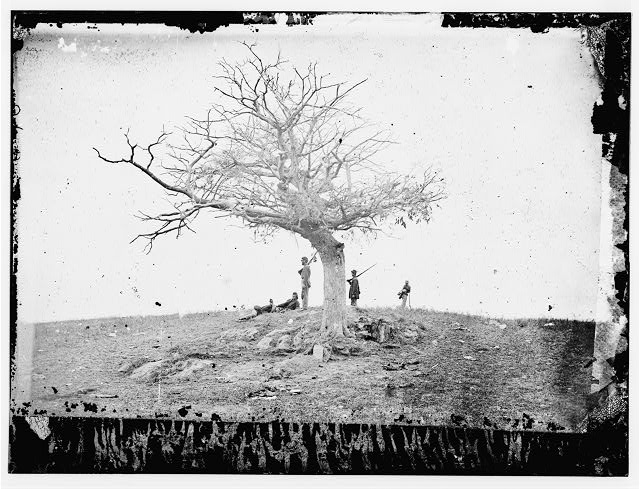
‘fell while gallantly fighting for the cause so dear to us all’

another gallant veteran ‘buried in a neighboring cemetery’
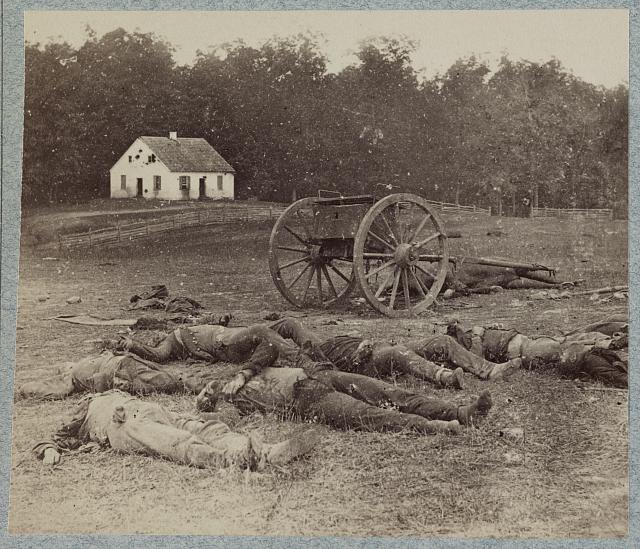
At Dunker church
Without a telegraph connection it took a long time for news to travel 150 years ago. I did not see an “extra”; there was not much accurate news about the Battle of Antietam in the Dispatch for a few days after it was fought. There seems to have been quite a few rumors about the battle both North and South.
From the Richmond Daily Dispatch September 18, 1862:
Thanksgiving day.
To-day being the day appointed for Thanksgiving by the President, no paper will be issued from this office to-morrow. Should any news of interest transpire it will be issued in an extra.
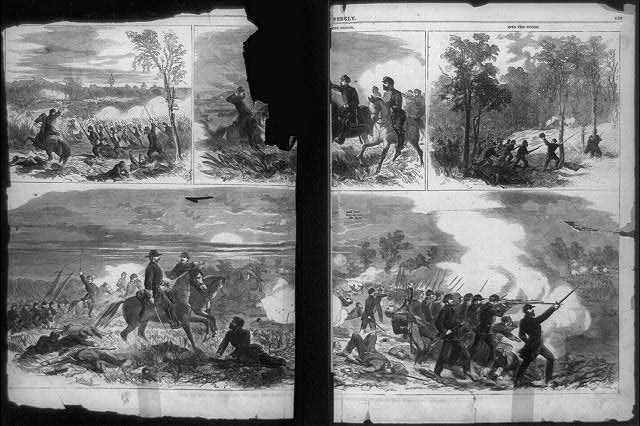
Drawing it for the North
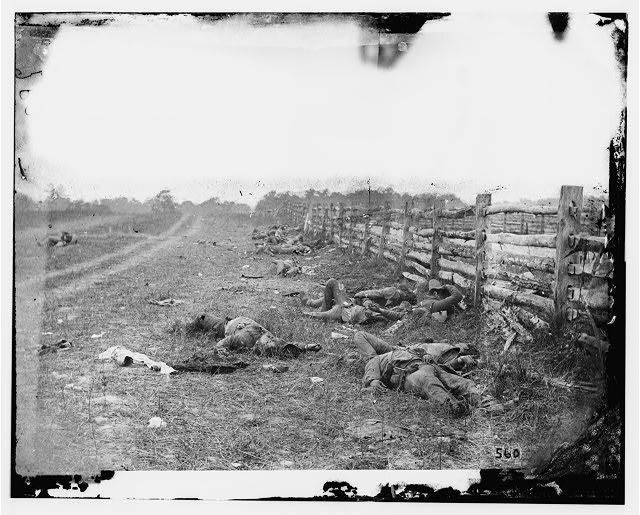
A few of the rebel dead
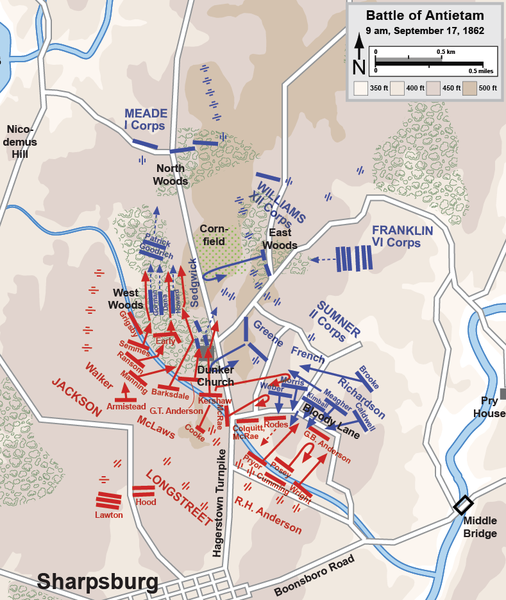
The 33rd fighting in Franklin’s corps
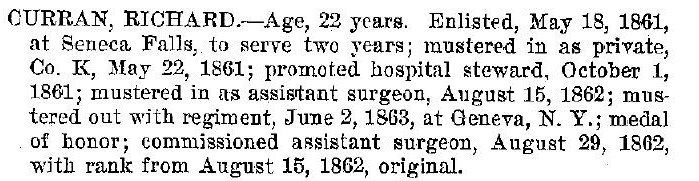
A severe and unexpected volley from the woods on our right struck full on the Seventy-seventh and Thirty-third New York, which staggered them for a moment, but they closed up and faced by the rear rank, and poured in a close and scorching fire, driving back and scattering the enemy at this point. As soon as my line was formed, facing the belt of the woods and the open ground to its right, the men were ordered down. Pickets were posted on the crest of a small hill along our front, and all kept in readiness to hold firmly to the position or to attack. A battery of the enemy advanced and played with severity along my flank and through the line of the Twentieth New York, which, from the nature of the ground, was compelled to refuse its left, and thus received the fire along its entire front. Sharpshooters from the woods to the right and to the extreme left also opened upon us. Shell, grape, and canister swept from left to right. The practice of the enemy was rapid and very accurate, and in a short time our loss was very heavy, and the dead and wounded encumbered our ranks. They were carried to the rear to a temporary hospital, where Asst. Surg. Richard Curran, Thirty-third New York Volunteers, was assiduous in his attention to the wounded.
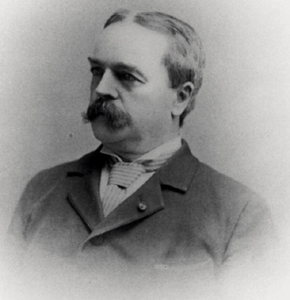
Richard J. Curran
Asst. Surg. Richard Curran, Thirty-third New York Volunteers, was in charge of our temporary hospital, which unavoidably was under fire but he attended faithfully to his severe duties, and I beg to mention this officer with particular commendation. His example is but too rare, most unfortunately.
Richard Curran would be awarded the Medal of Honor for his heroism in caring for the wounded at Antietam. You can read an excellent article about Mr. Curran at Irish in the American Civil War. He tells about his experience during the battle in Deeds of valor:
how America’s heroes won the Medal of Honor edited by Walter Frederick Beyer, Oscar Frederick Keydel (page 81). These two links show an image of Curran’s “Improvised Straw-Stack Hospital”
Richard Curran
Hal Jespersen’s map is licensed by Creative Commons
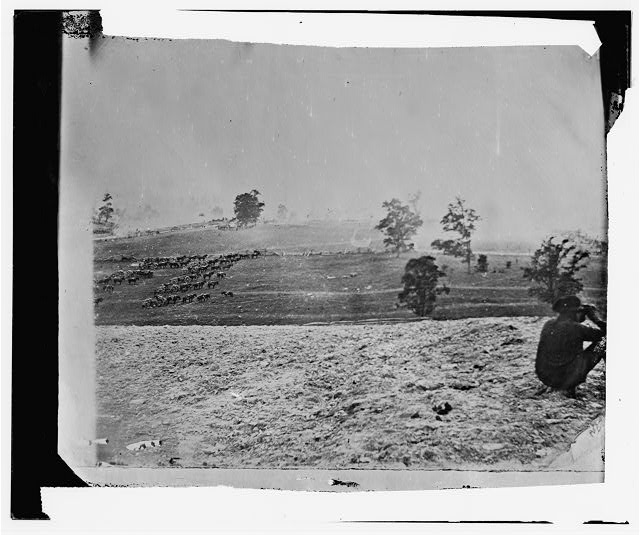
Somewhere on the battlefield of September 17, 1862
150 years ago today George McClellan ordered Joseph Hooker’s corps of the Union Army of the Potomac to cross Antietam Creek at the north bridge near Sharpsburg, Maryland, where the Confederate Army of Northern Virginia was congregating. There was little fighting on the 16th, but after nightfall Colonel Hugh McNeil of the Pennsylvania “Bucktails” was killed as he led his regiment against some rebels.
From a Seneca County, New York newspaper in 1862:
Death of Col. McNeil.
A telegraph dispatch from the headquarters of the Army of the Potomac gives intelligence of the death of Colonel MCNEIL, the commander of the justly celebrated “Bucktail” regiment, while leading a charge at the head of his men, near Antietam Creek.
HUGH WATSON MCNEIL was a son of Rev. Archibald McNeil, a Cameronian clergyman, and was born in Seneca County N.Y., in 1860. He was educated at Yale College, and entered upon the study of the law in the office of Clarence W. Seward, at Auburn. In 1857 he commenced practice in this city, but was obliged to abandon his profession two years afterward by reason of his health. He removed to Warren County, Pennsylvania, and engaged in banking. In 1860 he made the tour of that State stumping for Lincoln and Hamlin. He was an eloquent and effective orator.
Upon the breaking out of the rebellion he enlisted as a private in a company known as “wildcats,” commanded by Captain Stone, which was afterward incorporated with the famous Bucktail regiment. In a short time he was chosen first lieutenant, and then captain. In this capacity he led the regiment in a magnificent bayonet charge at Drainsville. Upon the resignation of E. Joy Morris, the colonel of the Bucktails, Charles J. Biddle, was elected to Congress from the Second District of Pennsylvania, and captain McNeil was chosen his successor, overstepping Lieutenant Colonel Kane, now Brigadier general, who was not a popular officer.
While the regiment was lying at Fredericksburg, in McDowel[l]’s corps, Colonel McNeil was prostrated by typhoid fever, and did not rejoin his regiment till after the repulse of General McClellan before Richmond. He engaged with enthusiasm in all the subsequent movements.
The Pennsylvania Bucktails accompanied General Hooker in the recent expedition up the Potomac in quest of S[t]onewall Jackson. On Tuesday they came up with the enemy under the command of General Lee, near Sharpsburg. The Federal Troops were disposed in the order of battle, General Hooker’s corps on the extreme right. In the afternoon they crossed Antietam Creek, three miles east of Keetsville. The Bucktails were at the front. The action commenced at dark and lasted two hours. Colonel McNeil had just charged upon the rebel forces, driving them back half a mile, when he received his death wound.
Col. McNeil was not married. His father and four sisters survive him. He was a daring and intrepid officer, a generous friend and kinsman, and was cordially esteemed wherever he was known. He was the idol of his family and regiment, and his loss cannot be replaced.
Eve. Post.
Col. McNeil was buried with military honors at Auburn on Tuesday last.
There is quite a lot of contradictory information about Colonel McNeil out there, but it seems pretty certain that he did die on the evening of the 16th. The Pennsylvania Reserve Volunteer Corps has a good write-up, as does Pennsylvania Civil War 150.
09-21-2012: I just found out that the Eve. Post article was very similar to one in The New-York Times.
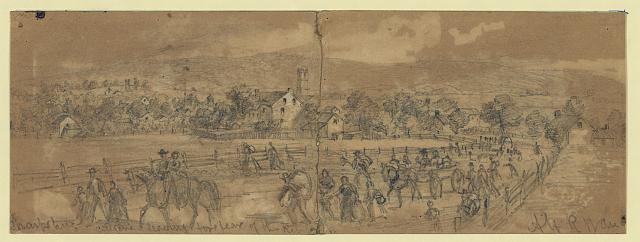
Young Napolean to the rescue? Sharpsburg citizens fleeing the rebel army
Just save the American republic and millions yet to be born
From the Richmond Daily Dispatch September 16, 1862:
The young Napoleon Redivivus.
McClellan, like the straw to the drawing man, is again important at the North. The Herald, of Thursday, has four articles, occupying as many columns, on the renewed lustre of this star. In one of them it says:
Now is the time for him to prove himself not only a great General, but a statesman worthy of the occasion and of the responsibility which he has assumed. The safety of the country is entrusted to him. He is bound to see that no insidious enemy lurks behind about his base of operations. His own security and the security of his army are involved, and the fate of the republic itself is at stake. He is master of the situation. He is the only man in whom the troops and the country have confidence as a General for-the chief command of the army in the field. He has a right to demand indemnity for the past and security for the future, and he ought not to rest satisfied till he is assured by facts, not mere promises, that his plans shall not be interfered with hereafter. The game is now in his hands, and unless he plays his best trump and disposes effectually of the radicals, as he has the power to do, they will soon dispose of him by striking him down in the very crisis of the campaign now opened in Maryland, on which hang the destinies of the American republic and of millions of the human race yet unborn.
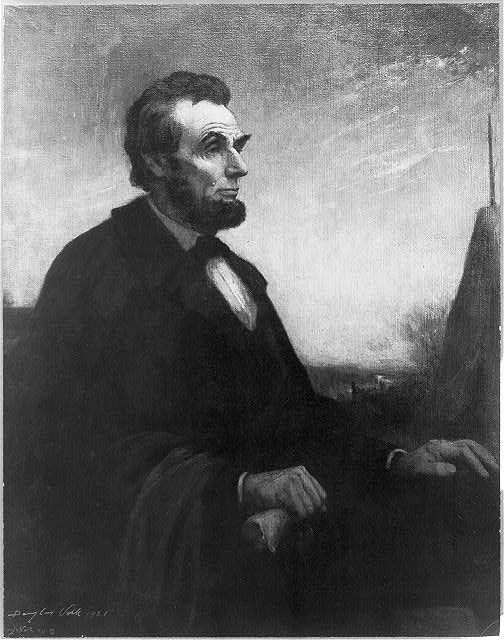
No ‘direct revelation’ on offer: pondering the pros and cons of an Emancipation Proclamation
In this letter dated 150 years ago yesterday President Lincoln admits to some religious folk from Chicago that the question of proclaiming liberty to the slaves “is on my mind, by day and night, more than any other.” But he thinks a proclamation issued in early September 1862 would be kind of like grasping at straws because “I cannot even enforce the Constitution in the rebel States”. He’s also concerned about the effect of emancipation on Union sentiment in the border states. Moreover, as the president wrote the following, Lee’s rebel army was advancing in the border state of Maryland. Pennsylvanians are anticipating an invasion.
President Lincoln believes he has the constitutional power to do anything that will help him put down the rebellion; he admits that slavery is the sine qua non of the rebellion. Now might be a bad time, but the question of a proclamation is still “under advisement”.
From THE PAPERS AND WRITINGS OF ABRAHAM LINCOLN at Project Gutenberg:
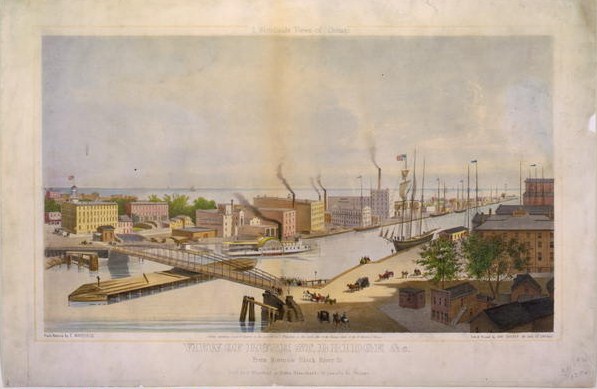
A Chicago view (circa 1861)
September 13,1862.
The subject presented in the memorial is one upon which I have thought much for weeks past, and I may even say for months. I am approached with the most opposite opinions and advice, and that by religious men, who are equally certain that they represent the Divine will. I am sure that either the one or the other class is mistaken in that belief, and perhaps in some respects both. I hope it will not be irreverent for me to say that if it is probable that God would reveal his will to others, on a point so connected with my duty, it might be supposed he would reveal it directly to me; for, unless I am more deceived in myself than I often am, it is my earnest desire to know the will of Providence in this matter. And if I can learn what it is I will do it! These are not, however, the days of miracles, and I suppose it will be granted that I am not to expect a direct revelation. I must study the plain physical facts of the case, ascertain what is possible, and learn what appears to be wise and right.
The subject is difficult, and good men do not agree. For instance, the other day, four gentlemen of standing and intelligence from New York called as a delegation on business connected with the war; but before leaving two of them earnestly besought me to proclaim general emancipation, upon which the other two at once attacked them. You know also that the last session of Congress had a decided majority of antislavery men, yet they could not unite on this policy. And the same is true of the religious people. Why, the rebel soldiers are praying with a great deal more earnestness, I fear, than our own troops, and expecting God to favor their side: for one of our soldiers who had been taken prisoner told Senator Wilson a few days since that he met nothing so discouraging as the evident sincerity of those he was among in their prayers. But we will talk over the merits of the case.
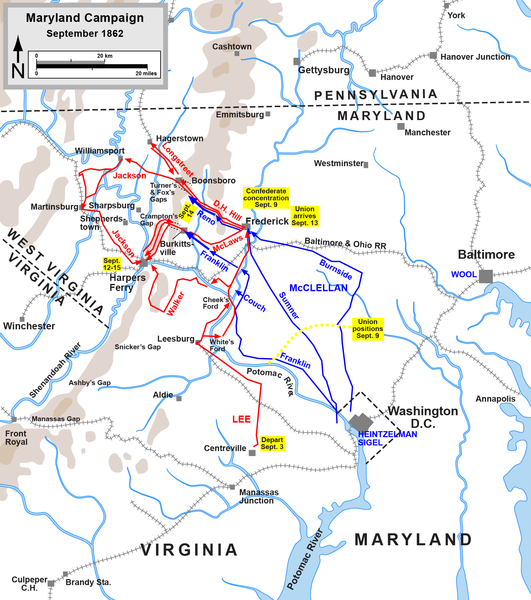
Whose Maryland? – not to mention that the president can’t enforce US Constitution in the rebellious states
What good would a proclamation of emancipation from me do, especially as we are now situated? I do not want to issue a document that the whole world will see must necessarily be inoperative, like the Pope’s bull against the comet! Would my word free the slaves, when I cannot even enforce the Constitution in the rebel States? Is there a single court, or magistrate or individual that would be influenced by it there? And what reason is there to think it would have any greater effect upon the slaves than the late law of Congress, which I approved, and which offers protection and freedom to the slaves of rebel masters who come within our lines? Yet I cannot learn that that law has caused a single slave to come over to us. And suppose they could be induced by a proclamation of freedom from me to throw themselves upon us, what should we do with them? How can we feed and care for such a multitude? General Butler wrote me a few days since that he was issuing more rations to the slaves who have rushed to him than to all the white troops under his command. They eat, and that is all; though it is true General Butler is feeding the whites also by the thousand; for it nearly amounts to a famine there. If, now, the pressure of the war should call off our forces from New Orleans to defend some other point, what is to prevent the masters from reducing the blacks to slavery again? for I am told that whenever the rebels take any black prisoners, free or slave, they immediately auction them off. They did so with those they took from a boat that was aground in the Tennessee River a few days ago. And then I am very ungenerously attacked for it! For instance, when, after the late battles at and near Bull Run, an expedition went out from Washington under a flag of truce to bury the dead and bring in the wounded, and the rebels seized the blacks who went along to help, and sent them into slavery, Horace Greeley said in his paper that the government would probably do nothing about it. What could I do?
Now, then, tell me, if you please, what possible result of good would follow the issuing of such a proclamation as you desire? Understand, I raise no objections against it on legal or constitutional grounds; for, as commander-in-chief of the army and navy, in time of war I suppose I have a right to take any measure which may best subdue the enemy; nor do I urge objections of a moral nature, in view of possible consequences of insurrection and massacre at the South. I view this matter as a practical war measure, to be decided on according to the advantages or disadvantages it may offer to the suppression of the rebellion.
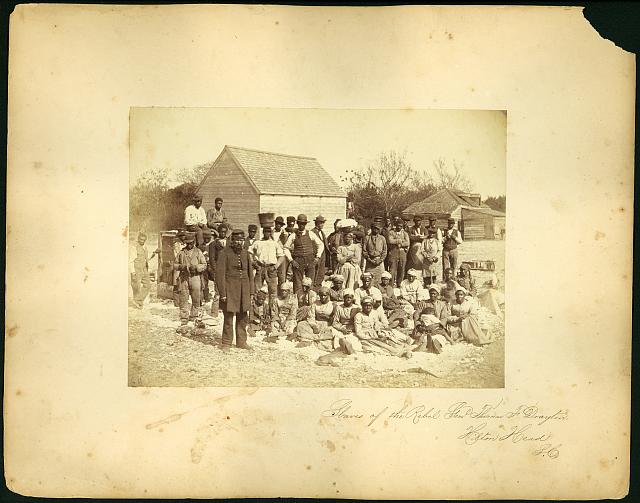
sine qua non
I admit that slavery is the root of the rebellion, or at least its sine qua non. The ambition of politicians may have instigated them to act, but they would have been impotent without slavery as their instrument. I will also concede that emancipation would help us in Europe, and convince them that we are incited by something more than ambition. I grant, further, that it would help somewhat at the North, though not so much, I fear, as you and those you represent imagine. Still, some additional strength would be added in that way to the war, and then, unquestionably, it would weaken the rebels by drawing off their laborers, which is of great importance; but I am not so sure we could do much with the blacks. If we were to arm them, I fear that in a few weeks the arms would be in the hands of the rebels; and, indeed, thus far we have not had arms enough to equip our white troops. I will mention another thing, though it meet only your scorn and contempt. There are fifty thousand bayonets in the Union armies from the border slave States. It would be a serious matter if, in consequence of a proclamation such as you desire, they should go over to the rebels. I do not think they all would—not so many, indeed, as a year ago, or as six months ago—not so many to-day as yesterday. Every day increases their Union feeling. They are also getting their pride enlisted, and want to beat the rebels. Let me say one thing more: I think you should admit that we already have an important principle to rally and unite the people, in the fact that constitutional government is at stake. This is a fundamental idea going down about as deep as anything.
Do not misunderstand me because I have mentioned these objections. They indicate the difficulties that have thus far prevented my action in some such way as you desire. I have not decided against a proclamation of liberty to the slaves, but hold the matter under advisement; and I can assure you that the subject is on my mind, by day and night, more than any other. Whatever shall appear to be God’s will, I will do. I trust that in the freedom with which I have canvassed your views I have not in any respect injured your feelings.
Hal Jespersen’s map is licensed by Creative Commons
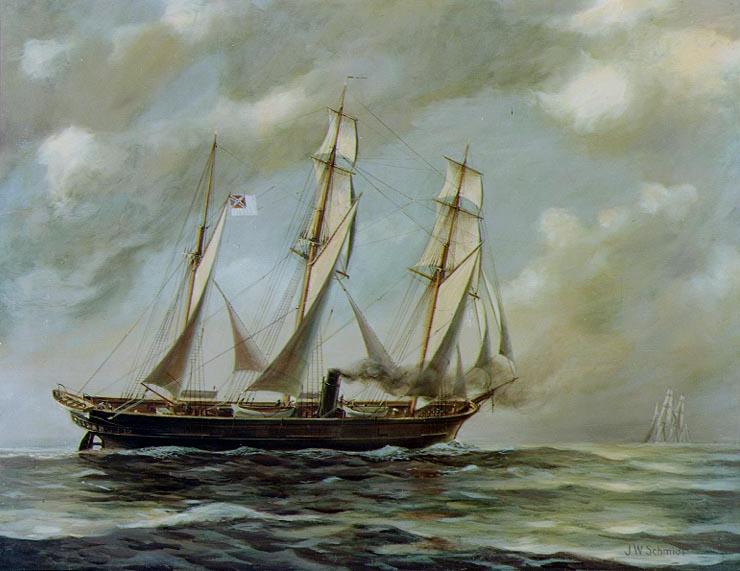
Alabama’s motto: “Aide-toi et Dieu t’aidera” (God helps those who help themselves)
150 years ago this month the CSS Alabama, commissioned on August 24, 1862 as a commerce raider and commanded by Raphael Semmes, began its career by capturing Yankee whaling ships around the Azores. The captured ships were burned after securing the crews. The Alabama’s first success occurred on September 5th when it captured the Ocmulgee; 150 years ago today it captured the Altamaha. In Memoirs of service afloat during the war between the states Semmes writes about capturing the whaling ships in the Azores and says (p. 237), “Chasing a sail is very much like pursuing a coy maiden, the very coyness sharpening the pursuit.”
Here’s Semmes’ (p. 238) on 150 years ago today:
… the welcome cry of “sail ho ! ” again rang from the masthead, and making sail in the direction indicated by the look-out, we soon discovered that the chase was a whaler. Resorting to the usual ruse of the enemy’s flag, the stranger did not attempt to escape, and in an hour or two more, we were alongside of the American whaling brig Altamaha, from New Bedford, five months out. The Altamaha had had but little success, and was
comparatively empty. She did not make so beautiful a bonfire, therefore, as the other whalers had done.
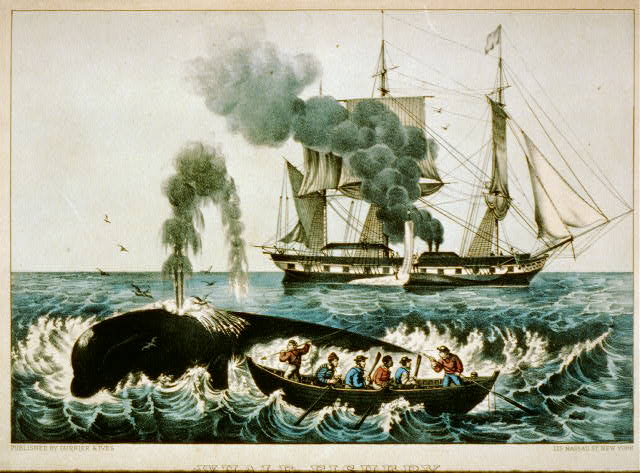
Coy maiden belches smoke
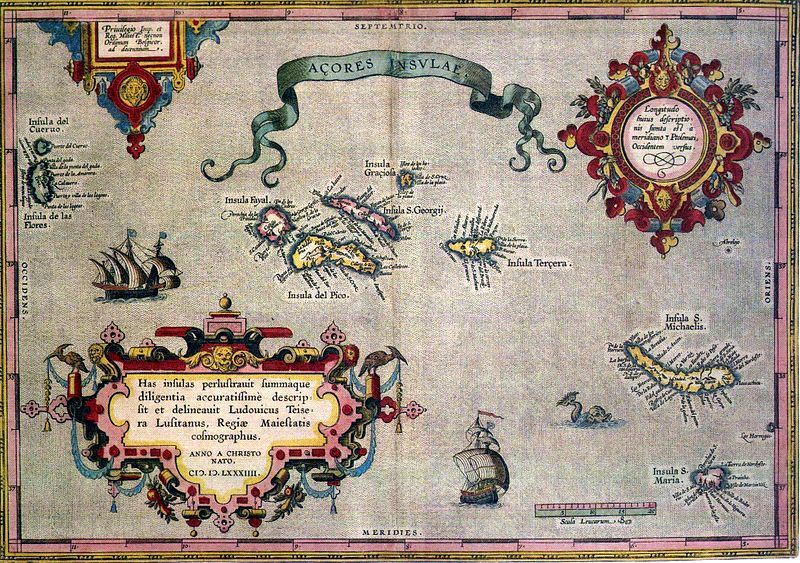
1584 map of the Azores
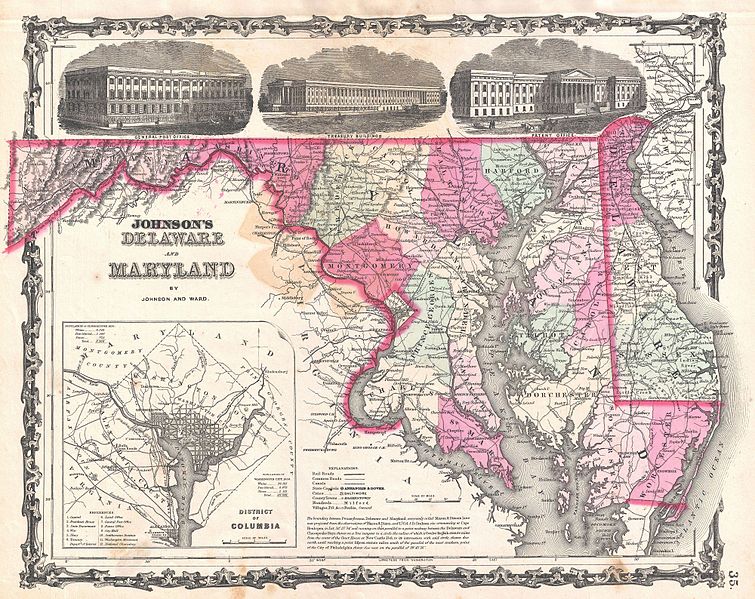
New seat of war – ‘down-trodden Maryland’
And time for a little retaliation
The Richmond editors are rallying the citizens to support the Confederate armies as they move to the offensive. I like the image of the Union army being like an eternal tide that advances into Virginia, gets its nose bloodied, recedes … but keeps on coming back.
From the Richmond Daily Dispatch September 11, 1862:
The forward Movement.
For a year and a half the South has stood upon the defensive, and contented itself with parrying the blows aimed against it by a gigantic adversary. Thanks to the protecting hand of Presidency and the unsurpassed heroism of a gallant and devoted people, the rushing tide of invasion has been rolled back, and victory after victory illumined our banners. But the successive retreats of our enemies have only been the ebb of a tide which has returned as regularly as it has retired, and bade fair to be of everlasting recurrence. In the meantime, a large portion of our territory has been exposed to the ravages of a brutal foe, and outrages committed upon peaceful and unoffending citizens which would have disagreed the barbarian of the dark ages. Impunity only added new stimulus to the ferocity of the foe, until the heart of civilization has been sickened by the cruel excesses which they have committed, and from which no age nor sex have escaped. But the war has now assumed a new phase. The victories which Providence has vouchsafed our arms have enabled us to assume the aggressive, and the theatre of war is now transferred from Virginia to the soil of down-trodden Maryland, where the first blood in the second war of independence was spilled, and where a kindred and gallant people have been made to suffer every evil and humiliation which could be inflicted by a foe bloated with triumph and demonize with malice and revenge. The hour of Maryland’s deliverance, long deferred, has come at last; the Confederate armies are upon her soil, and a noble people long crushed under the heel of despotism, will soon have the opportunity of rising upon their tyrants and meting out to them with compound interest the just punishment of their crimes.
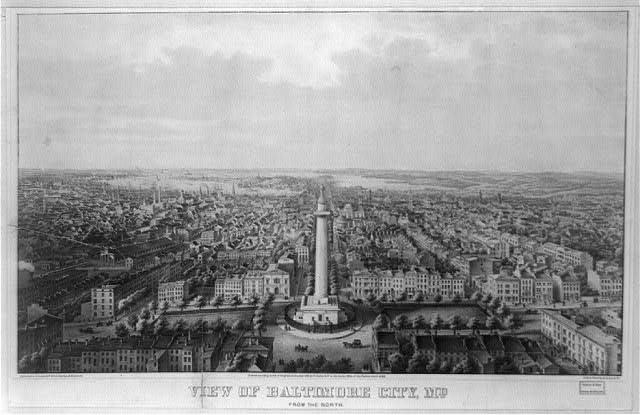
Where first blood spilled on 4-19-1861(1862 image)
With the deliverance of Maryland will came that of Western Virginia, and our glorious old Commonwealth will soon, we trust, become “one and indivisible,” in action as in heart. The best of domestic traitors will be summarily routed out, and the gallant mountaineers will rally to the defence of their liberties, and swell the columns of the great army whose banners are now moving forward for the redemption of our whole land, and for righteous retribution upon a merciless and inhuman foe. We have not the shadow of a doubt that Western Virginia will ere long break the shackles which bind her hands, and that our sister, Kentucky, with the advance of the Army of the West, will shake off her ignominious bondage, and stand proudly erect, “redeemed, regenerated and disenthralled” When that suspicious hour arrives, let the tyrants tremble! They have hitherto known nothing of war but through the blatant editorials of their newspapers and the lying reports of their Generals. No roof of them has been fired, no women unsuited, no field desolated, no town and its helpless inhabitants bombarded. They will now be permitted to taste some of the peculiar sweets of the strife and carnage which they have invoked, and whilst we shall not imitate their own violation of the rules of humanity and civilized warfare, we trust that our Generals will prove themselves as sagacious, thorough, and vigorous, in a war of invasion, as they have already been in a war of defence. In that event, Lincoln’s new levies of six hundred thousand raw troops will be scattered by our trained veterans like chaff before the whirlwind, and the terms of peace dictated to a haughty and imbecile tyrant upon his own soil.
We have no apprehensions that the change from defence to the aggressive will increase the appetite of the Northern people for this war. We have already had evidence enough that their own security has stimulated them to increased ferocity and revenge. They have proved themselves insensible to the distastes of honor, justice, and compassion; and men who are to such influences, can only be operated upon by their fears. No argument can reach their understanding but bayonets and cannon at their own thresholds, and no defence of the South inspire them with respect, but that which throttles them under their own roof trees, and makes them realize in their own persons and property the horrors they have visited upon Southern soil.
Now is the time to strike the telling and decisive blows of the war. Our Generals are impressed with the fact; our soldiers burn with impatience to retaliate, upon Northern ground, our innumerable wrongs, and to bring this war to a close upon the spot where it commenced, and where alone it, can be ended.


