Chicago Stampede Squelched

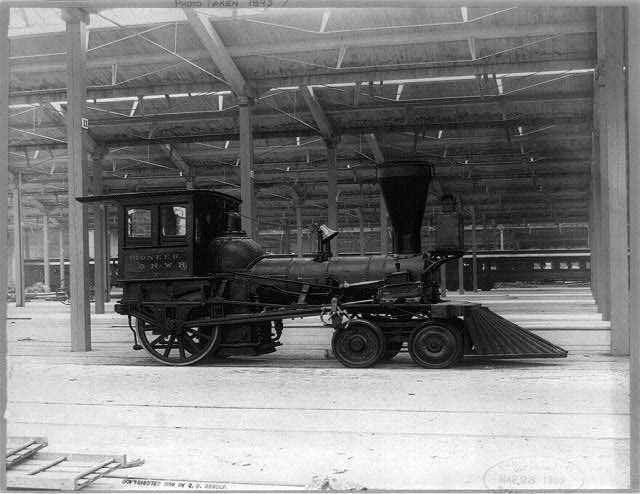
Pioneer locomotive C. & N.W. R.R. First locomotive to run out of Chicago, built ca. 1862 (c1898; LOC: LC-USZ62-88928)

Schedule for Canada, perchance?

From the Richmond Daily Dispatch August 26, 1862:

Martial law in Chicago — an attempted stampede to Canada, and how it was stopped.

[From the Chicago Times.]

Immediately after the reception in this city of the order from the War Department, concerning persons subject to military duty who might contemplate and attempt an escape from the country, in order to avoid the impending draft, C. P. Bradley, Superintendent of the Chicago Police, prepared to enforce the order in all cases that come within his jurisdiction. The order was received yesterday afternoon about 5 o’clock. Between that hour and sunset quite a number of men in the city, not liking the appearance of things military hereabouts, prepared to leave for Canada, or some other portion of the globe where drafting is not at present a needful regulation. But unfortunately for these would be excursionists, the vigilant eye of the newly constituted Provost Marshal was upon them — Learning that there would probably be a stampede at night, by the Michigan Central and Michigan Southern Railroads, Capt. Bradley took the precaution to have a posse of his men stationed at each depot, a short time before the departure of the evening train.
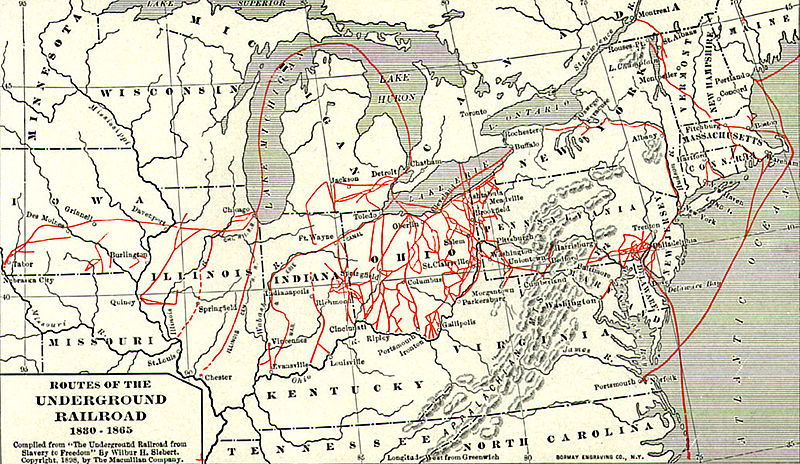
http://history.sandiego.edu/gen/CWPics/86139.jpg Compiled from "The Underground Railroad from Slavery to Freedom" by Willbur H. Siebert Wilbur H. Siebert, The Macmillan Company, 1898

Lake Michigan a path for others with reason to get to Canada

Capt. Nelson, of the first precinct polices, was stationed with a posse of the police at the Michigan Central Depot, while Sergeant Beade had an inferior force at the Michigan Southern Depot. At eight o’clock both trains were entered and a rigid scrutiny was had of all outgoing passengers. This resulted in the street of thirty men, who had tickets to Detroit, and who were at once taken in custody and marched under guard to the Central police station for further examination. A few of those arrested, however, were soon discharged, having furnished satisfactory evidence of their loyalty.–Most of them, however, were deemed guilty of attempting to escape from the jurisdiction of the United States, contrary to the order from the War Department. They were accordingly confined in the county jail for the night, and this morning will be conveyed to Camp Douglas, sworn into the service, and made to do military duty for the term specified in the order for the draft.

Two shippropellers, the Galens and Acme, left this port yesterday afternoon, loaded with passengers, most of whom are supposed to be on their way to another clime. A tug was dispatched last evening in search of these propellers, with orders to bring them to and take in custody all persons unable to give satisfactory reasons for their departure. This game, however, will be blocked to-day, as a tug, carrying a six-pound cannon, will be stationed at the entrance of the harbor, and overhaul every passenger boat and vessel that passes out.
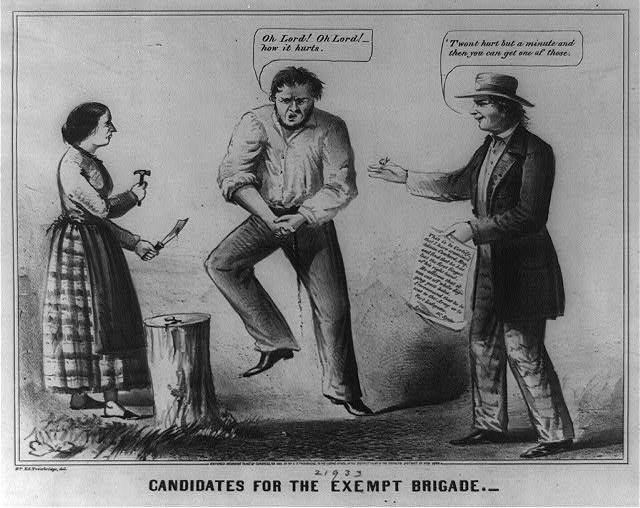
Candidates from the exempt brigade (1862 by W.E.S. trowbridge; LOC: LC-USZ62-8385)

Couldn’t make his “way to another clime”?

Our citizens may as well bring their friends to a realication [realization?] of the fact that Chicago is virtually under martial law. Captain Bradley is now clothed with the powers of a Provost Marshal, and in future no male citizen between the ages of eighteen and forty-five years will be permitted to leave the city, on any route leading east, or on any of the lake boats, without a pass from the proper source.

We find that this sudden arrest of fugitives, in conformity to the new order, will operate as a complete cheek upon all attempts to escape from the country to avoid the draft. The authorities are in earnest about his matter, and such cowardly sneaking as was manifested last night and during the whole of the past week will be at once stopped.

This running away from duty has been practiced in most instances by wealthy men, while the poor men have been left to become the victims of the draft. In future there will be no more sneaking, no more running away, no matter what may be the wealth of the individual.

This article seems supportive of the Union war effort, but it is said that in 1861 the Chicago Times

began espousing the Copperhead point of view in supporting Southern Democrats and denounced the policies of Abraham Lincoln. General Ambrose Burnside suppressed the paper in 1863 because of its hostility to the Union cause, but Lincoln lifted the ban when he received word of it.

According to History of the Chicago police from the settlement of the community to the present time, under authority of the mayor and superintendent of the force Cyrus P. Bradley was Chicago’s First Chief of Police (p.75). This book seems to back up the Chicago Times article:

Before the war he was a member of the Light Artillery, which became known as batteries “A” and “B,” but he did not go into actual service. When the war broke out he was superintendent of police, and did valuable service as provost marshal, “by placing an ironbound embargo,” says his biographer, “upon fugitives from the draft. Policemen were placed at all the depots and on vessels in the harbor, and all persons subject to the draft were compelled to show they Avere not leaving to avoid service.” He resigned the superintendency in 1862, was afterward elected secretary of the Police Board, continuing in that capacity till 1864, and from that date to his death was connected with the government secret service, doing splendid work in the detection of counterfeiters. He died March 6, 1865. (pp.75-76)
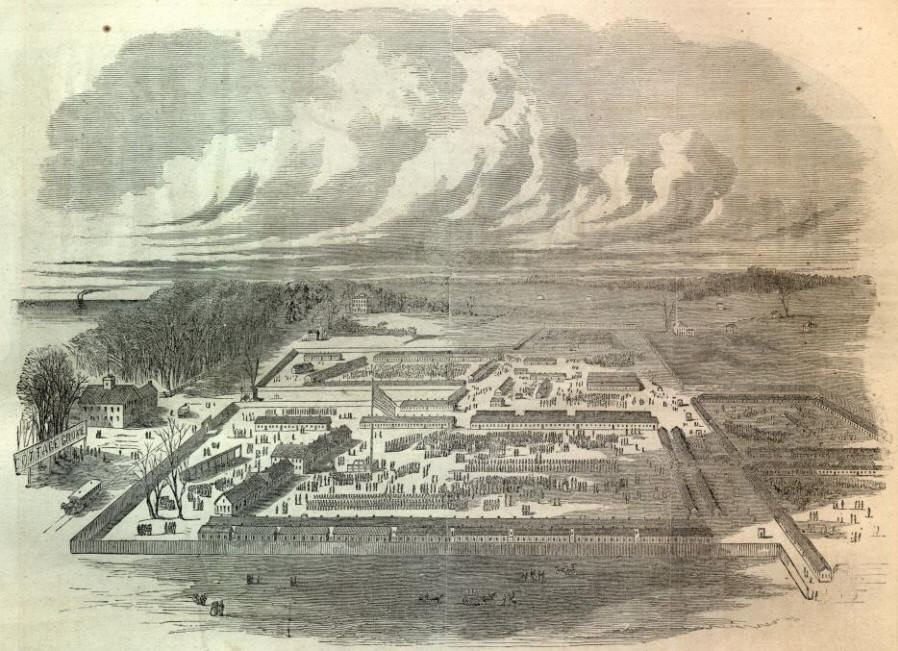
CAMP DOUGLAS, NEAR CHICAGO, ILLINOIS, WHERE SEVEN THOUSAND REBEL PRISONERS ARE QUARTERED. (Harper's Weekly Apri 5, 1862)

Would-be draft dodgers temporarily held at Camp Douglas

This image of Camp Douglas is hosted at Son of the South

You can read a description of the political cartoon at the Library of Congress
Posted in 150 Years Ago This Month, Lincoln Administration, Northern Society | Tagged , , , , | Leave a comment

Nice Try

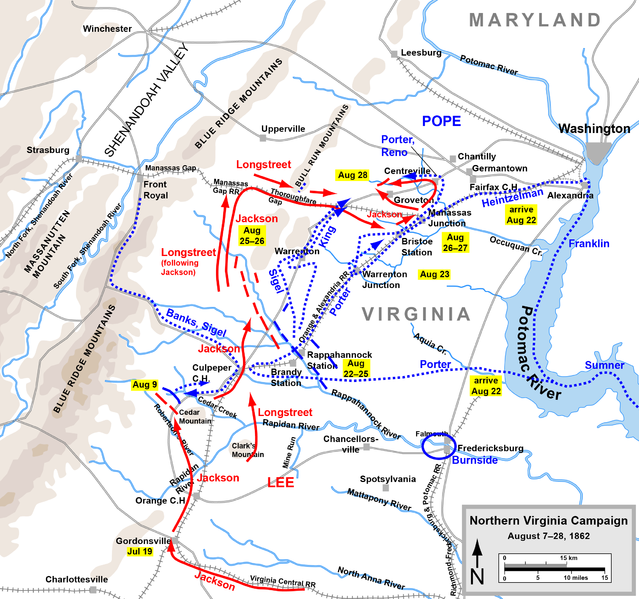
Northern_Virginia_Campaign_Aug7-28 by Hal Jasperson (Map of the Northern Virginia Campaign of the American Civil War. Drawn by Hal Jespersen in Adobe Illustrator CS5. Graphic source file is available at http://www.posix.com/CWmaps/)

whole lotta marchin’ goin’ on … despite the forged orders

I don’t know how true this is, but it is a pretty creative way to try to hinder the Confederate advance in northern Virginia.

From the Richmond Daily Dispatch August 27, 1862:

A Daring spy Hung.

A man named Mason, a resident of Fairfax county, Va., but a native of Pennsylvania, was [h]ung near Gordonsville a few days since. The division commanded by Gen. Longstreet was pushing for a point which it was known the enemy desired to reach and occupy. As the column was pressing forward a courier, pretending to have orders from Gen. Lee, halted each brigade until he reached the last, when Longstreet, observing the movement, desired to know what it meant. He was told that General Lee had ordered the halt, and upon demanding to know the authority for the order from General Lee, was pointed to the courier, who had not had time to make his escape. The man was immediately arrested by Longstreet, who frustrated his designs. He was examined and condemned on the spot. Forged orders to both Jackson and Hill were found on his person, those for Longstreet having been delivered, and he acknowledged that he had been acting as a Confederate scout for eleven months, and all that time was a traitor and a spy. He was then condemned and executed in about fifteen minutes.

The map by Hal Jasperson is licensed by Creative Commons

Posted in 150 Years Ago This Month, Confederate States of America, Military Matters | Tagged , , , | Leave a comment

The Perilous Chesapeake

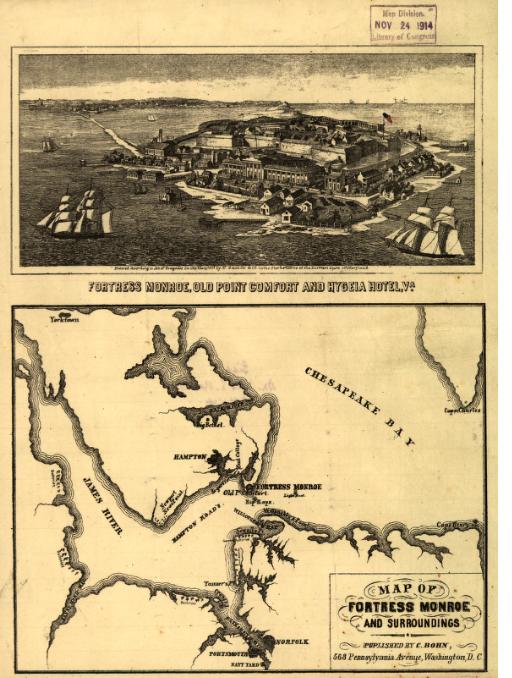
Map of Fortress Monroe and surroundings by Casimir Bohn, 1861; g3884h cw0544000 http://hdl.loc.gov/loc.gmd/g3884h.cw0544000

Captain McDonald’s departure point

From a Seneca County, New York newspaper in August 1862:

Letter from Capt. McDonald.

We are permitted to publish the following extract from a letter written by Capt. MCDONALD to his wife in this village:

FORTRESS MONROE, Aug. 25, 1862.

*** I have just one moment to write you a line. Capt. Spalding left me and my Co. here a few days ago, with orders to take a steamer and bring six large barges to Acquia Creek, loaded with Engineer property. I started on the evening of the 23d, and the next morning, while on the Chesapeake Bay, was overtaken with a furious gale, losing two of my barges, with everything on board, and, what is more than all, I lost one of my best men, Albert Kissinger. I have written to his mother. I have found that my pastimes, on this occasion, were of some service to me. You know how found I am of sailing. Well, in this terrible and fearful gale I was able to remain col and calm, while many were crying in despair about me. If I had not been use to rough weather on the water I do not know but I too, would have been excited. I had forty teamsters from the country with me and they gave me more trouble than all the rest. My soldiers moved when and where I told them to, and kept quiet, rendering me much service by their manly conduct. I tell you, I felt proud of them. They kept their eyes on me, and moved promptly to the pumps, or elsewhere as I ordered them.

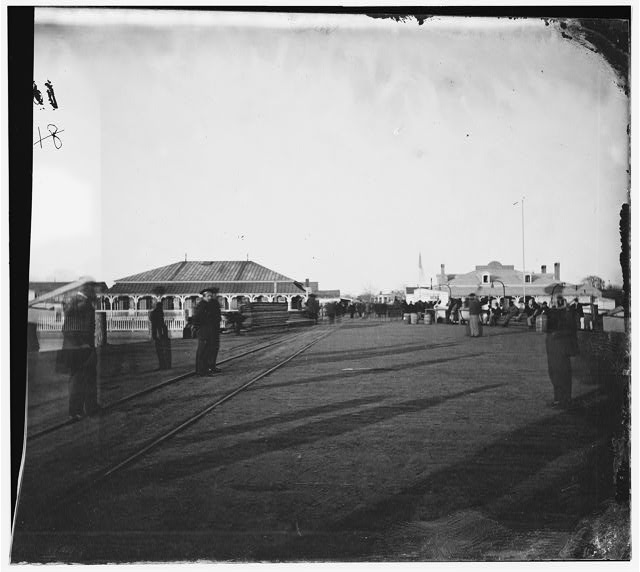
Fort Monroe, Virginia. Wharf (1864 Dec; LOC: LC-DIG-cwpb-01241)

Wharf at Fort Monroe, December 1864

While we were pitching about on some huge wave I thought there were dear ones at home whose hearts would have to ache soon. But thank a merciful Providence, we were saved, with sad hearts at the loss of poor Kissinger, who perished before my eyes. I had called to the men on the barges behind me to cut away the ropes, and called Kissinger until I was voiceless. Two more barges sank as soon as we got them to dock. many of the men lost everything which they had. We, no doubt, would all have perished had not a large steamer been sent to tow us in. – The waves were so high that we could not be taken off the barges without endangering both boats. I expect to leave for Acquia Creek day after to-morrow if the weather will permit, and a good steamer to take me, but we will not go without.

JAS. H. MCDONALD,
Capt. Co. K, 50th N.Y.V.E.

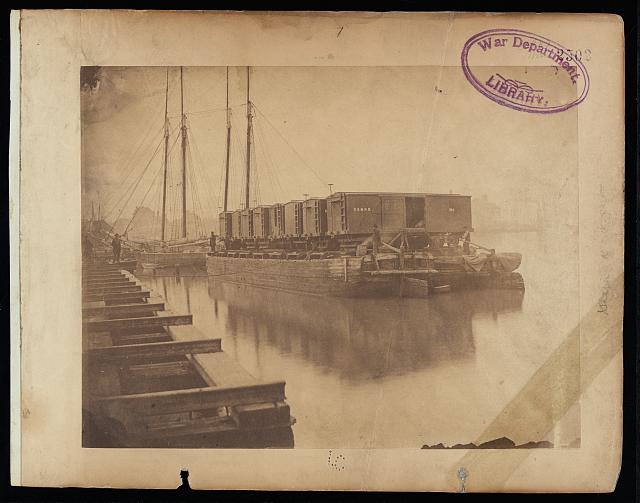
Transportation on the Potomac. Cars loaded at Alexandria can be carried on barges or arks to Aquia Creek, and sent to stations where the Army of the Potomac is supplied, without break of bulk (ca. 1862 or 1863 by Andrew J. Russell; LOC:  LC-DIG-ppmsca-10301)

A Civil War barge – I don’t think Captain McDonald had any railroad cars

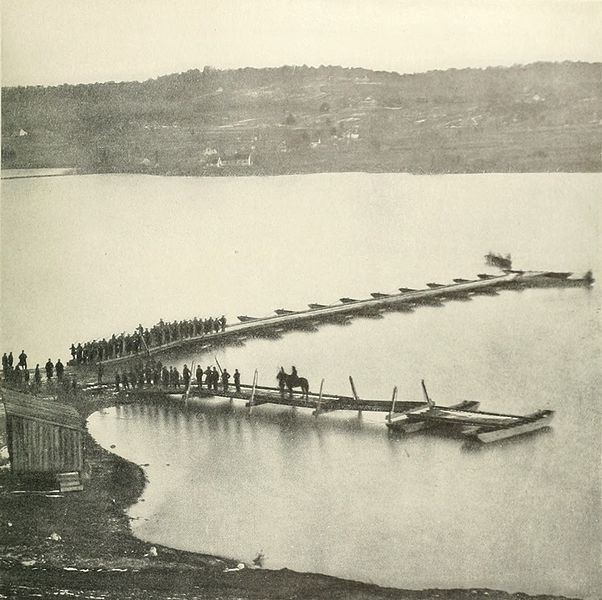
Aquia Creek Landing (Aquia Creek Landing in Union control in February 1863 (File from The Photographic History of The Civil War in Ten Volumes: Volume Two, Two Years of Grim War. The Review of Reviews Co., New York. 1911. p. 90)

The captain’s destination – Acquia Creek Landing, February 1863

Albert Kissinger

James H. McDonald

Posted in 150 Years Ago This Week, Military Matters | Tagged , , , , , | Leave a comment

Deadline: October 1st

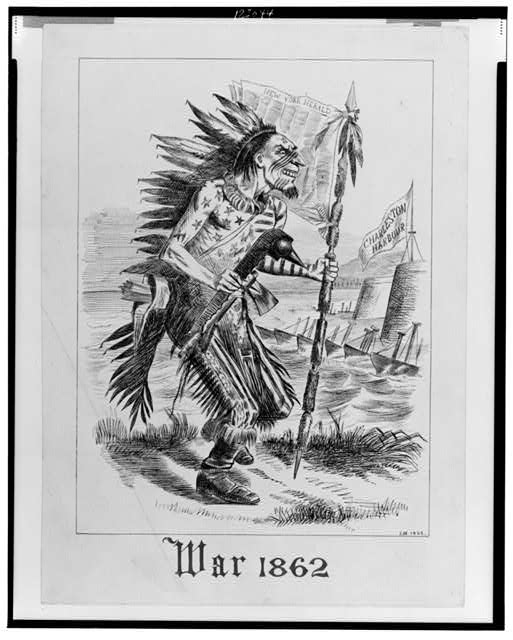
War 1862 (1862; LOC: LC-USZ62-123044)

Herald on the (Broadway) warpath

Lee’s army should be demolished by then.

The following is said to be an editorial published in the New York Herald apparently sometime around the First of August. It shows the importance of the Virginia theater in the northern public’s view of the war, the overestimate of the rebel army strength, and presumably an overly optimistic view of the time necessary to minimally train new recruits. And the Herald doesn’t even mind that President Lincoln has dictatorial powers as long as Lee’s army gets crushed and the Union gets restored. From the Richmond Daily Dispatch August 23, 1862:

The Herald on the “Fresh Start.”

[From the New York Herald.]

President Lincoln has the confidence of the country. No man doubts his honesty or his patriotism. Down to the recent seven days bloody battles near Richmond he may, perhaps, have shared with the whole people of the North the belief that this war in a week or two would be substantially ended; but those memorable seven days have convinced him, as they have convinced the North and all our loyal States, that we had vastly underrated the numbers of the rebel army and exaggerated our own. But if, in anticipation of a crowning victory at Richmond, the energies and vigilance of the Administration in regard to our army were slackened, the severe disappointment which followed has brought its compensating reaction. It has taught us — Government and people — that while our war like means, resources, and facilities are absolutely overwhelming, they go for nothing unless we bring them to bear in superior strength against the active forces of this rebellion.

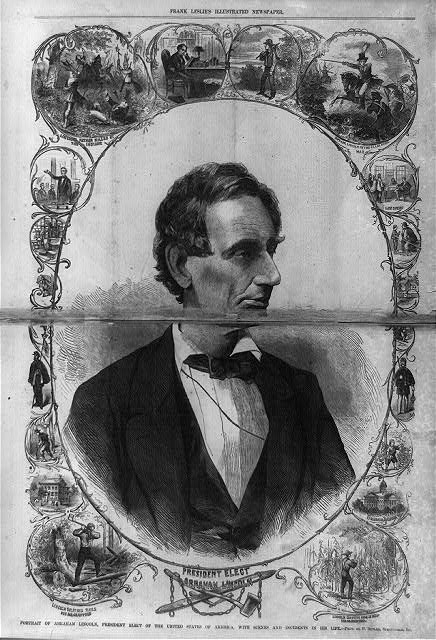
President elect, Abraham Lincoln Portrait of Abraham Lincoln, President Elect of the United States of America, with scenes and incidents in his life -- phot. by P. Butler, Springfield, Ill. (Frank Leslie's illustrated newspaper, v. 11 (1861 March 9), pp. 248-49; LOC: LC-USZ62-6868)

‘our modest and unpretending President’ (early 1861 image)

Here, then, government and people, we take a new departure, and enter upon a new campaign equal to the full measure of the great work before us. The whole strength of the rebellion is now staked upon its great army in Virginia. We have only to demolish that army in order to end the war. Granted that it is an army of three hundred thousand men; we see no reason why it should be permitted to hold Virginia beyond the 1st of October.President Lincoln has the power and the means to put to flight and disperse this defiant rebel army within the next sixty days. Congress has invested him with absolute authority over the men, money, means, and facilities of the nation of every kind for a brief and overwhelming campaign. At this moment no monarch in Christendom, not even the Emperor of Russia, possesses a more ample range of authority than our modest and unpretending President. This authority has been bestowed upon him to save the life and restore the health and integrity of the nation. With the free and full consent of our twenty-three millions of loyal people, Congress has given to President Lincoln these powers, means, and responsibilities of a temporary dictator; and our loyal people look to him with confidence for the most beneficent results to the country and to mankind in the speedy restoration of the Union.

The new campaign opens with every promise of success. The Government appears at length to be fully impressed with the pervading spirit of our loyal States; and our worthy President, fully realizing the dangers and demands of the crisis, and the means and great advantages within his grasp, is proceeding to business in the most satisfactory way. The great issue in his hands is the life or death of the nation and its popular institutions; and the reward that invites him on in his path of duty is a place in the affections of mankind second only to that of Washington.

You can read about the political cartoon at the Library of Congress.

One of the great things about Civil War Daily Gazette is its maps. You can get a much more accurate estimate of Lee’s numbers and the location of his army 150 years ago today there.

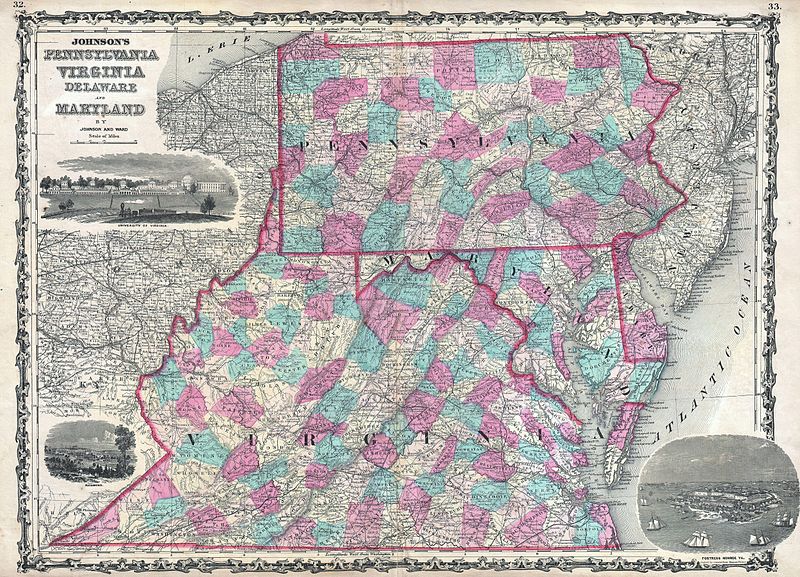
You can read about the following map at Wikimedia Commons.

1862_Johnson_Map_of_Virginia,_Maryland,_Delaware_and_Pennsylvania_-_Geographicus_-_VAPAMD-johnson-1862 (Johnson, A. J., Johnson's New Illustrated (Steel Plate) Family Atlas with Descriptions, Geographical, Statistical, and Historical. (1862 A. J. Johnson & Ward edition)

Old Dominion just one of 34 United States, albeit one with a large rebel army that needs to be crushed.

Posted in 150 Years Ago This Month, Military Matters, Northern Politics During War, Northern Society | Tagged , , , , | Leave a comment

Not even good for cannon fodder?

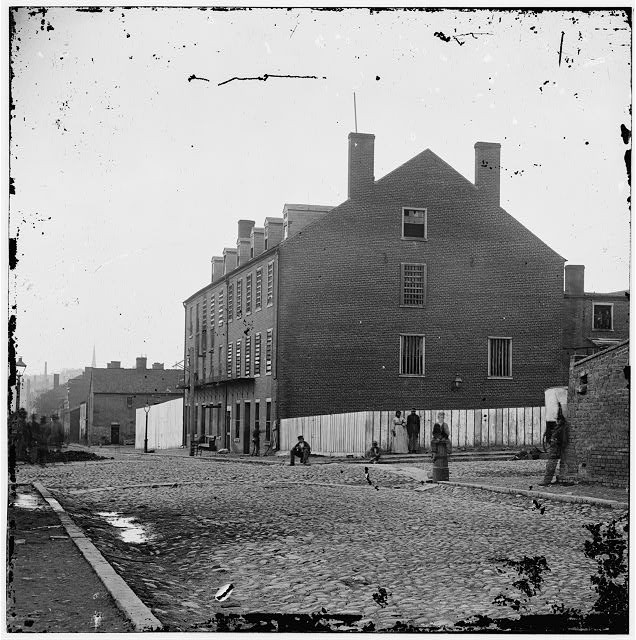
Richmond, Virginia. Castle Thunder. (Converted tobacco warehouse for political prisoners) (1865 Apr; LOC: LC-DIG-cwpb-02893)

Castle Thunder in April 1865

The South doesn’t much cotton to dissenting opinions either.

From the Richmond Daily Dispatch August 22, 1862:

Arrival of Domestic Traitors.

Fifteen citizens of Green county, Va., arrived here yesterday, guarded by soldiers, and were consigned to quarters in Greanor’s factory. The batch were sent thither by General Humphrey Marshall, for expressing Union sentiments and displaying various Yankee proclivities not consistent with their duty as citizens of the Confederate States.–The average age of the men was about nineteen years, the oldest being about twenty-four years of age. All of them are subject to the Conscript law; but it is doubtful, after the experience our authorities have had in the matter of improvising soldiers out of similar material, whether they would be of any use to the Confederacy in a military point of view.

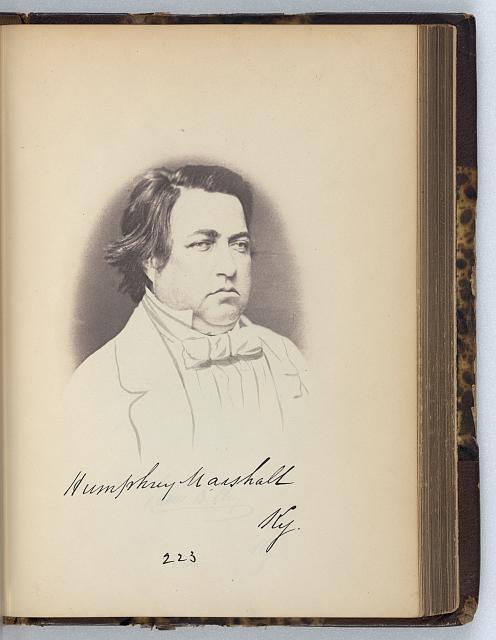
Humphrey Marshall, Representative from Kentucky, Thirty-fifth Congress, half-length portrait (1859; LC-DIG-ppmsca-26762)

Marshall’s plan – send Union lovers to Castle Thunder

According to George W. Alexander and Castle Thunder: A Confederate Prison and Its Commandant by Frances H. Casstevens, Greanor’s Tobacco Warehouse formed the core of Castle Thunder, which opened in August 1862 (p 48). Capt. George W. Alexander served as commandant of Castle Thunder. Captain Alexander was investigated for brutality in 1863 by order of the Confederate House of Representatives. He was cleared of the charges. The Union used the prison for its own detainees after Richmond was captured in April 1865.

Humphrey Marshall was a West Point graduate who served in the Mexican-American War. He represented Kentucky in the U.S. House of Representatives for much of the 1850’s.

Posted in 150 Years Ago This Month, Confederate States of America, Southern Society | Tagged , , , , | Leave a comment

The Beat Goes On

Death by disease; recruiting for an “old” regiment.

Two from Seneca County, New York newspapers in August 1862:

Death of a Volunteer.

We regret to state that CHAS. SALVAGE, a volunteer from this village in Capt. MURRAY’s Company, 50th Regiment, died here on Tuesday morning. He returned home sick some two weeks ago, and has not been able to leave his bed since his arrival here. His funeral services were held at Trinity Church, on Wednesday, rev. Mr. GUION officiating. His age was twenty years.

Charles Salvage

Corporal Salvage came home sick

__________________________________________________________

Third N.Y. Artillery.

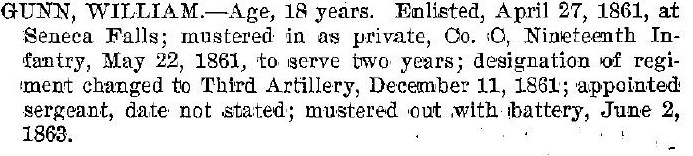
Sergeant Wm. GUNN, Jr. returned home on Tuesday for the purpose of recruiting for the 3d N.Y. Artillery, now stationed at Newbern, N.C. He has opened an office at Stafford’s Hotel in this village. The 3d Artillery comprises the old 19th regiment, and there are many serving in the ranks from our county. Those who are desirous of enlisting in the Artillery, will find no better opportunity than the one offered by Sergeant Gunn. Volunteers who enlist in this arm of the service receive a bounty of two hundred and seventy-seven

William Gunn

Young Gunn came home to recruit

The $277 bounty seems like a pretty good deal considering that Union privates earned $13 per month and, according to The Cincinnati Civil War Round Table, in 1861 “Average incomes ranged from $300.00 to $1,000.00 per year.” This article by William C. Moffat, Jr. points out that bounties were the carrot to the stick of the draft. At least early in the war there was a stigma attached to the idea of being drafted.

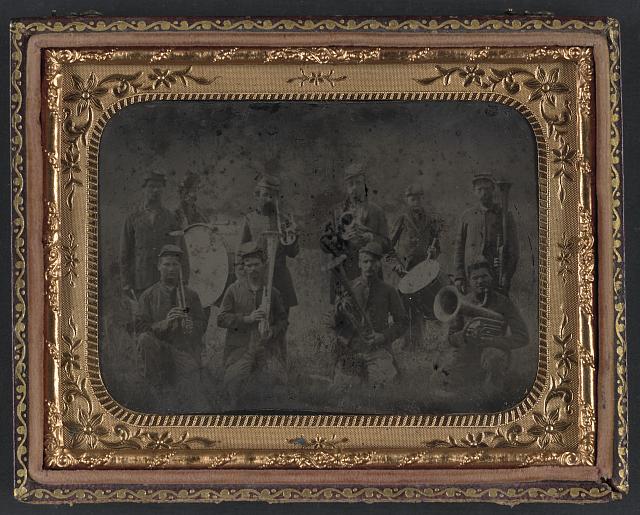
Ten unidentified soldiers that form a Union regimental band with saxhorns and drums (between 1861 and 1865; LOC: LC-DIG-ppmsca-32063)

and the band played on


__________________________________________
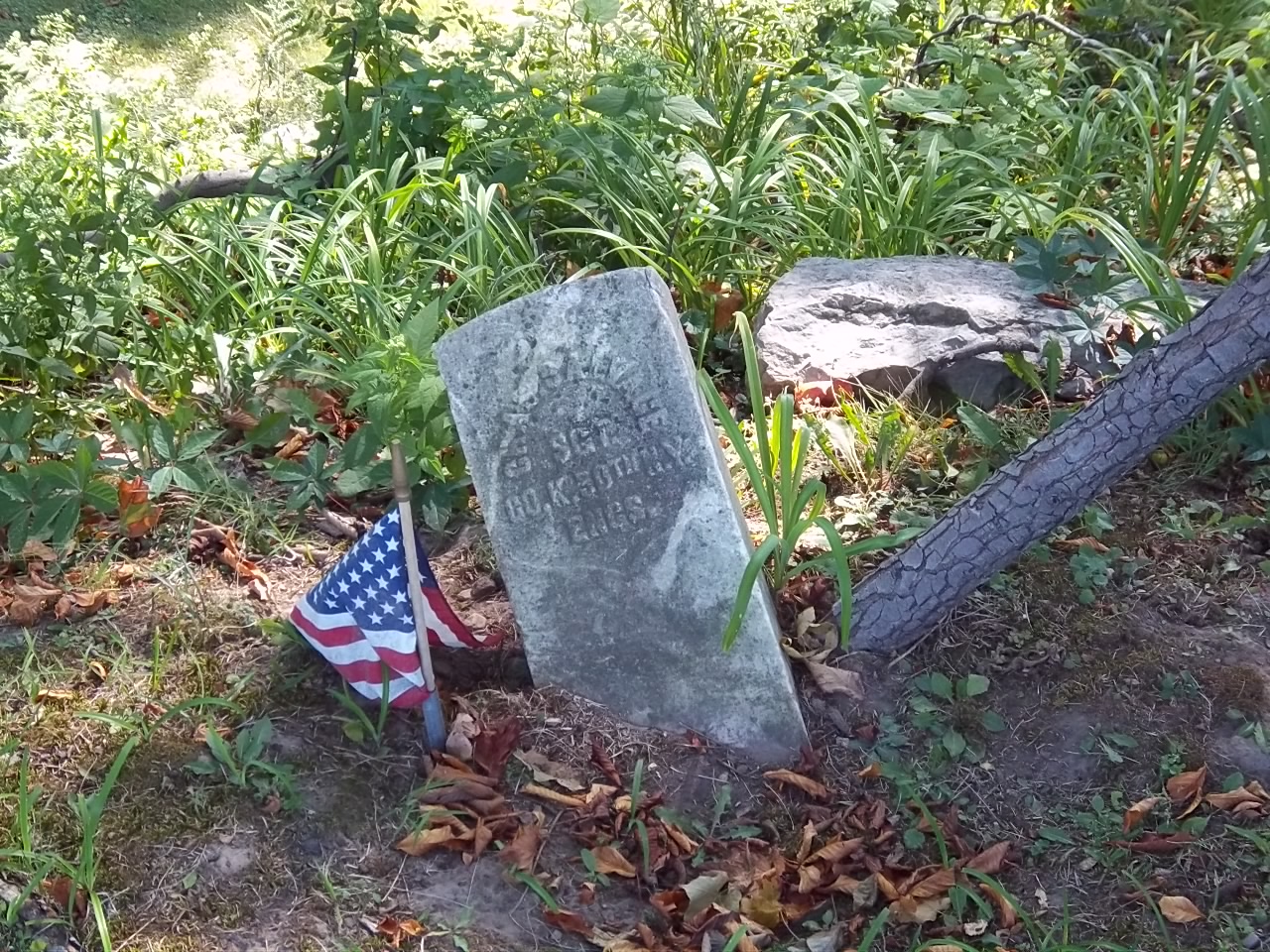
Charles Salvage, Restvale Cemetery, Seneca Falls, NY 9-2-2012

Charles Salvage

10-08-2012: I found young Salvage’s grave at Restvale Cemetery in Seneca Falls on 9-2-2012. His tombstone reads:

CHAS. SALVAGE
SGT.
CO.K. 50th N.Y.
ENGS.

Somehow, someway he got promoted

Posted in 150 Years Ago This Month, Military Matters, Northern Society | Tagged , , , , , | Leave a comment

Don’t pray for our enemy

From the Richmond Daily Dispatch August 18, 1862:

“Sketch of Dabney Carr Harrison.”

This is the title of one of the most touching and beautiful portraitures ever drawn of the life and death of a Christian hero. The author is the Rev. Dr. Hoge, of this city.

William Hoge was the author. His brother Moses was a well-known Richmond preacher and Confederate chaplain. Dabney Carr Harrison, a Presbyterian minister, served as a captain in the 56th Virginia Infantry until he was mortally wounded at Fort Donelson.

William J. Hoge preached at New York City’s Brick Church from 1859 until July 1862. A thoughtful and well-referenced post at The Treasure of Lars Porsena discusses William Hoge’s predicament as a Southern sympathizer working in a Northern church when the broke out:

According to Vander Velde, Hoge upset the congregation by praying for Confederate leaders as well as those of the United States under the Biblical injunction to pray for those in authority, and soon left the church.

His last sermon in New York occurred on July 21, 1861, the day of the First Battle of Bull Run.

William Hoge then worked as a minister and chaplain in Virginia until he died in 1864.

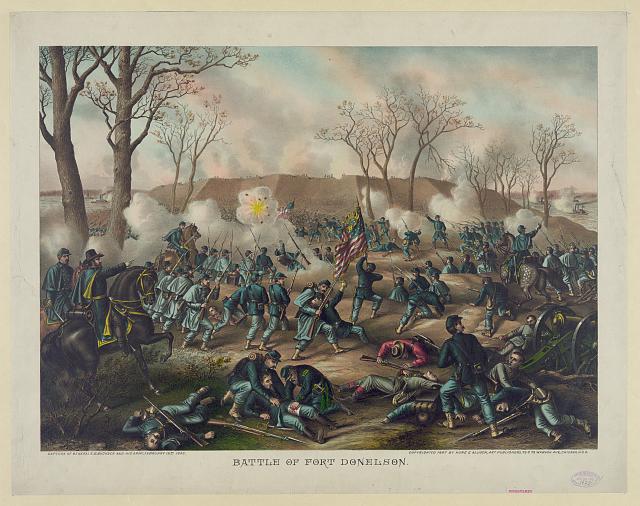
Battle of Fort Donelson--Capture of Generals S.B. Buckner and his army, February 16th 1862 (c1887. by Kurz & Allison; LOC: LC-DIG-pga-01849)

the battle where Captain Harrison fell

Posted in 150 Years Ago This Week, Confederate States of America, Northern Society | Tagged , , , | Leave a comment

Take it to the northern armies

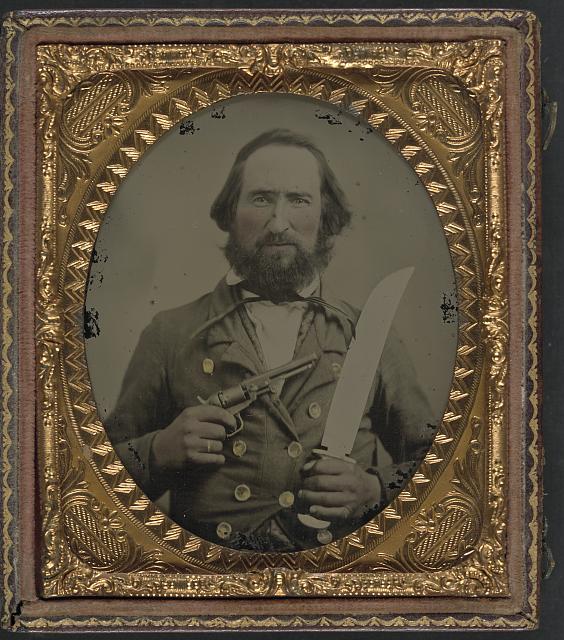
Unidentified soldier in Confederate uniform with large Bowie knife and revolver (between 1861 and 1865; LOC: LC-DIG-ppmsca-32061)

Hunt down the Yankees

A reason for the South to take the offensive right away

Strike the northern armies before they can train the 600,000 new recruits

From the Richmond Daily Dispatch August 18, 1862:

The New Yankee army.

The desperate efforts of the Lincoln Government to create another invading army of colossal proportions should be met by the most prompt action of our armies now in the field. These immense levies will only be formidable if we give them time by drill and discipline to be transformed into soldiers. At present they are unaccustomed to the use of arms, and, in the field, their large numbers would only be an element of confusion and weakness. But the experience of the last year has shown that the very same materials which were dispersed like chaff before the whirlwind on the red fields of Manassas can be converted, by systematic training into fighting men of no ordinary character. Whatever we have to do in neutralizing the enemy’s advantage of fresh numbers must be done now, by instant, energetic, and decisive action. The North has everything to gain, we everything to lose by delay. We may as well assume at once that the men called for by Lincoln will be forthcoming.–Whether they will be worth anything to his cause depends upon whether we at once hunt down his armies already in the field, or permit them to become the nucleus of another and more immense aggregation of physical power.

Posted in 150 Years Ago This Week, Confederate States of America, Military Matters | Tagged , | Leave a comment

Burnside: “fill up the old regiments”

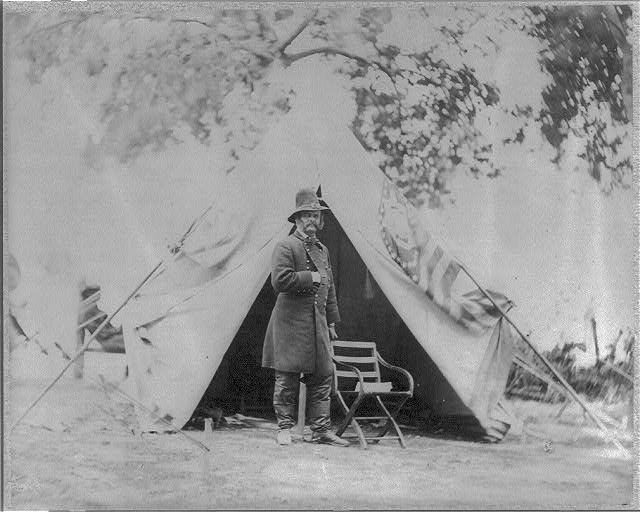
General Ambrose Burnside, 1862 from The Photographic History of The Civil War in Ten Volumes: Volume Two, Two Years of Grim War . The Review of Reviews Co., New York. 1911. p. 88.

fill ‘er up

The politics of recruitment.

From a Seneca County, New York newspaper in August 1862:

The Thirty-Third Regiment.

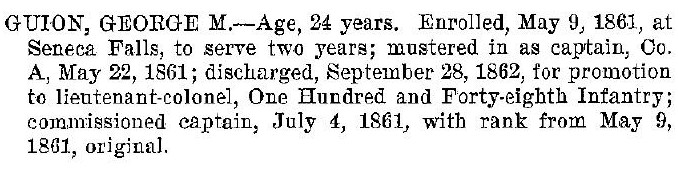
The Thirty-Third Regiment is commanded by brave and experienced officers. It has received honor and renown upon the field of battle. To-day it ranks second to no other regiment in point of discipline and gallantry. Disease and death, however, have so thinned its ranks, that barely half its maximum number remain to cope with the enemy. Shall this brave regiment suffer for the want of more men? Shall we quarrel and wrangle over the organization of a new regiment, when every consideration of justice demands that the 33d shall be recruited to its original strength? By no means. Capt. GUION and his heroic men are entitled to better treatment at our hands. Their pluck and gallantry, and heroism have called forth our gratitude and praise. Nobler and braver soldiers are nowhere to be found. Shall we not strengthen their hands before elevating to place men without experience or capacity? We cannot afford to organize a new regiment in this District for the purpose of creating positions for political favorites. The sacrifice would be too great.

Capt. MCGRAW is in want of more men. His company has been very much reduced and it should be a matter of pride for us to supply the places of those stricken down by disease and death. Capt. MCGRAW is a brave and true soldier. His company is a band of heroes, nobly and willingly fighting for the land of their adoption. Shall they be reinforced? That’s the question for us to determine, and at once. Gen. BURNSIDE, in his speech in New York, on Tuesday, said the best advice he could give was to “fill up the old regiments.” Do this, he said, and all will be well. Will it be done? Let the citizens of our vicinity determine whether the 33d Regiment shall be recruited to its maximum standard, or whether we shall fritter our strength away in quarreling over the organization of a new regiment that certain political favorites may obtain place and position.

It wasn’t just General Burnside. Footnote 4 at the the 1862 Northern Draft page at The American Civil War expands on Pennsylvania Governor Curtin’s belief that it would be easier to fill up the old regiments than form new ones because of the demand for men to help with the upcoming harvest:

This was an ongoing struggle throughout the recruiting and drafting in the North in those months: many in the Army and the government wanted to see the old regiments replenished. They argued that veterans could show new recruits the ropes more quickly, and McClellan estimated one recruit into an old regiment was worth two in a new one. The old established regiments also had valiant reputations that would be a spur to volunteers. But new regiments meant new commissions, new officers, and there was much political pressure in that direction.

In Battle Cry of Freedom James McPherson makes a similar point in discussing the confusing, carrot and stick approach of Northern recruitment in 1862:[1]

Most of the volunteers were recruited by the time-honored method of organizing new regiments with their complement each of thirty-odd officers’ commissions as political plums. Some of these new regiments became crack units by 1863, but in the process they had to go through the same high-casualty trial-and-error experiences as their 1861 predecessors.

As it turns out, Captain Guion of the old 33rd was going to become Lieut. Colonel of the new 148th New York Infantry Regiment, which Colonel William Johnson received authority to recruit on August 20, 1862.

George Murray Guion

George Murray Guion

Ambrose Everett Burnside, 1824-1881, Major General, full-length portrait, standing in front of tent, arm bent with hand in coat, facing right (no date recorded on caption card; LOC: LC-USZ62-50365)

when not in New York City

  1. [1]Battle Cry of Freedom Ballantine Books, New York, 1989 pp.492-493
Posted in 150 Years Ago This Month, Military Matters, Northern Politics During War | Tagged , , , , , | Leave a comment

Suprise Party

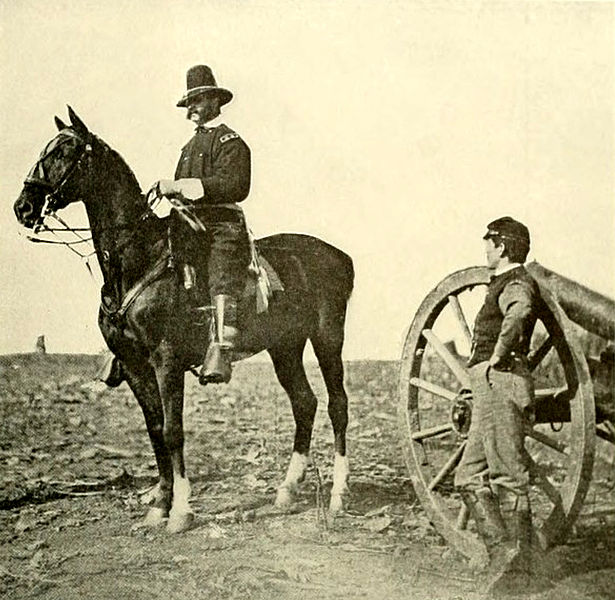
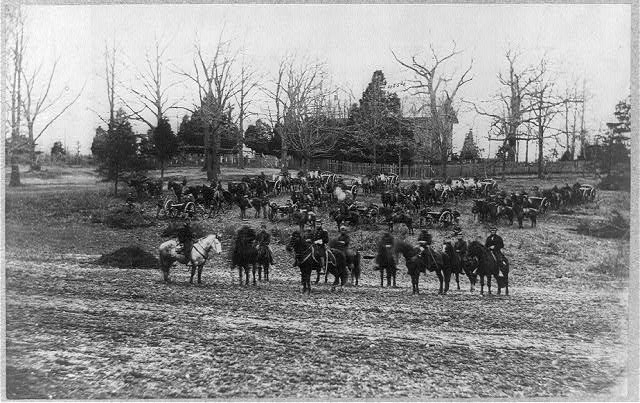
Union artillery unit posed with cannons and horses (between 1861 and 1865, ca. 1890 printing; LOC: LC-USZ62-97596)

unidentified Union artillery

From a Seneca County, New York newspaper August 21, 1862:

From the Third Artillery

PRESENTATION OF A SABRE.

Newbern, N.C., Aug. 16, 1862.

Editor Courier: – Allow me, through your columns, to narrate a little incident which may not be wholly uninteresting to many of your readers. Said incident, I think, may be classed under the head of “surprise parties.” I had thought surprise parties were wholly domestic institutions, yet during my sixteen months of service I have attended many of them, at some of which there was “a Heap” [?] more powder and lead than crinoline and calico; but at the last – and a very pleasant one it was – there was deecidedly more “cold steel” than either of the aforesaid commodities.

On Tuesday last the members of Battery C, 3d N.Y. Artillery, presented one of their officers, as a testimonial of their friendship and esteem, a beautiful sabre, sash and belt. While the band, who kindly officiated on the occasion, discoursed their fine music, the Company were marched to the officers’ quarters and the sabre was presented with an appropriate speech. The surprise was complete and the boys enjoyed hugely the confusion of the recipient. With a few brief words of thanks and a look which conveyed a deeper meaning than the most flowery speech could have implied, the officer withdrew amid the deafening cheers of the Company. The sabre is a splendid specimen of workmanship, manufactured at the well-known house of Schuyler, Hastly & Co.[Schuyler, Hartley and Graham?], and procured at a cost of $80.

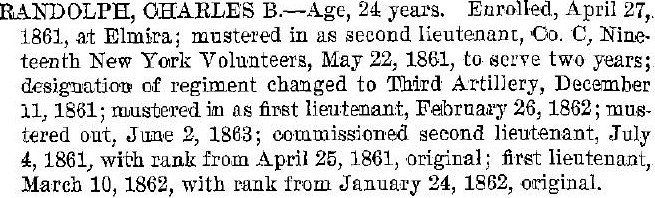
Such incidents as these, while they not only serve to render more pleasant the life of a soldier, are strikingly illustrative of the love and unity which exists throughout our mighty army. The presentation was almost wholly unanimous, and we gave it feeling assured that it would never meet with dishonor at the hands of our kind and gallant officer, Lieut. Charles B. Randolph.

TYPO

Charles B. Randolph

kind and gallant officer

You can learn more about the possible sabre manufacturer (or importer) here.

Posted in 150 Years Ago This Week, Military Matters | Tagged , , , | Leave a comment