Coffee Concoction

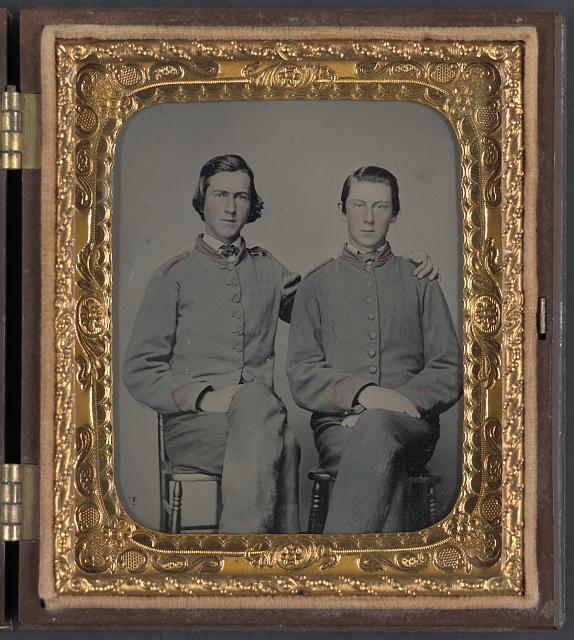
Private William Savage Moore of Richmond "Parker" Virginia Light Artillery Battery, 1st Company Howitzers Virginia Light Artillery Battery, and I Company, 15th Virginia Infantry Regiment and his brother in early Richmond depot shell jackets (between 1861 and 1865; LOC: LC-DIG-ppmsca-32465)

Would appreciate a good cup of 1/3 java

Seven Score and Ten has published some interesting southern coffee substitutes. The following is a letter from a patriotic Confederate woman, who shares her recipe, encourages the good women of Richmond to manufacture the stuff, and thinks a regiment should be detached for the purpose of distributing it to the thirsty troops. From the Richmond Daily Dispatch May 22, 1862:

To the women of Richmond.

–The time has come when every woman should do her duty in this struggle for our country’s independence. There are many things her hands can do, which will as materially aid our cause as if she were a soldier with musket in hand. The battle will be brought right to our doors. Let every woman, then, in this city, who possesses the ability, prepare coffee, bread, and whatever else she may have to give, for our dear loved ones, who offer their precious bodies a wall of defence for our homes.

One-third pure coffee, the rest wheat or rye, rightly prepared, will furnish strengthening drink, which will add greatly to their comfort. Let the coffee be browned a little, then add the wheat or rye, toasting them together. In this way the taste of the coffee is imparted to the grain. Grind or pounder well. To one measure of coffee add eight of boiling water. Let it boil well, stirring it down until the entire scum disappears, when it will look clear. Add a little cold water, let it stand until it settles, and you have quite nice coffee.

Now, will not every woman at once toast her coffee, grind it, and have it ready for use? Surely all the milk carts, molasses barrels on carts, and any conveyance one may think of, can carry it to some places designated; when some persons, whose business it shall be, may portion it out. If a regiment were detailed for this business, it would do good service.–But as one begrudge her little mile of coffee. Their are some persons who have not the material, but who would gladly prepare it. Let, then, any more fortunes neigh her, who can spare of her little, pass it over is willing hands, longing to do something for our noble cause. Did the men go — the courageous and fear not.” A Wife and Movers [Mother?].

Could be a good way for the rebels to get some cereal with their morning brew.

I like the way the woman quietly understood and mentioned that the federal armies were zeroing in on the capital. Richmond is a big target and she’s “standing in”.

_________________________________________________________

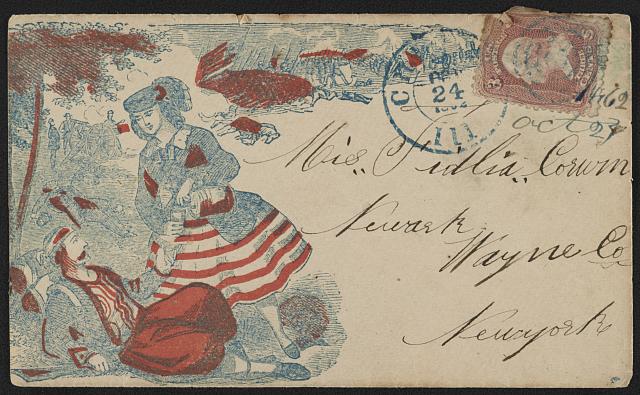
Civil War envelope showing woman pouring a drink for a wounded soldier as a battle rages in the background (1862 October; LOC: LC-DIG-ppmsca-31964)

Union take on beverages for the troops

Posted in 150 Years Ago This Week, Confederate States of America, Southern Society | Tagged , | Leave a comment

Death of a Sharpshooter

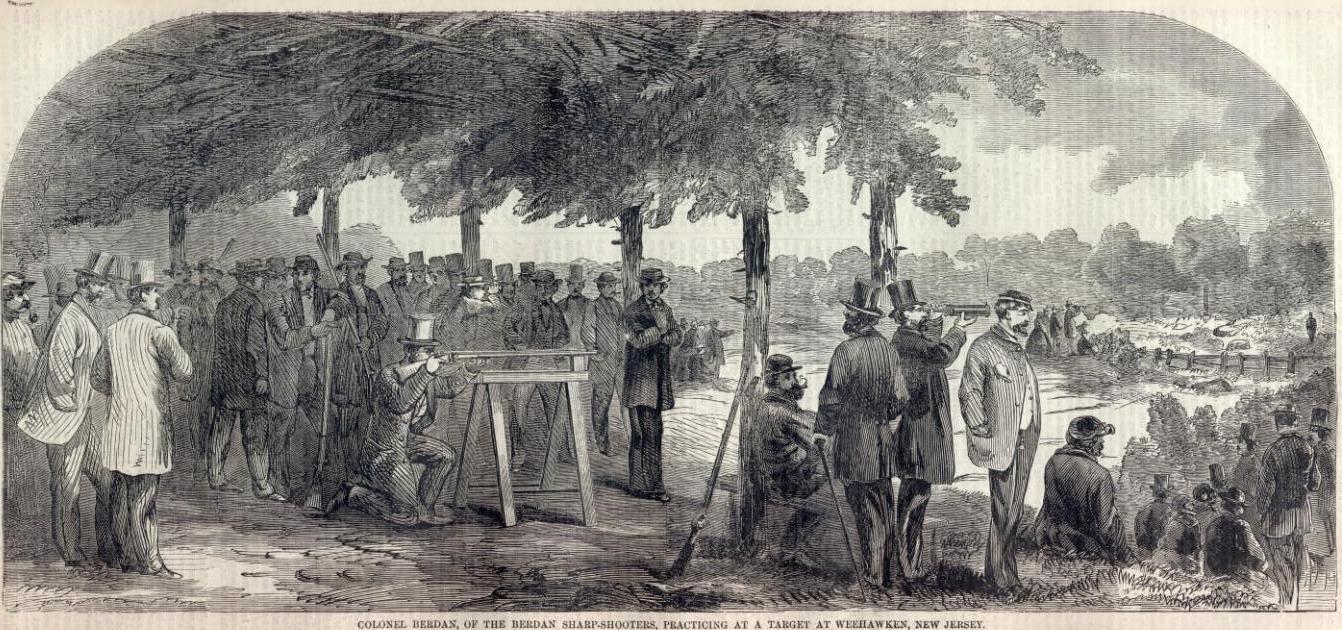
Col Berdan practicing in New Jersey 1861 (Harper's Weekly 8-24-1861)

Col. Berdan in 1861: a sighted target practice

We’ve had stories about the Berdan’s Sharpshooters before. Here’s a story from the South about a Yankee marksman getting a dose of his own medicine from a rebel Kentuckian.

From The New-York Times May 21, 1862:

BERDAN’S SHARPSHOOTERS.

From the Petersburgh Express.

A gentleman informs us of the death of one of MCCLELLAN’s sharpshooters, on the peninsula, under circumstances which possess interest sufficient to give them to the public. Several of our men, it seems, were killed while going to a spring near by, but by whom no one could imagine. It was at last determined to stop this inhuman game, if possible, even at the cost of killing the hireling himself, who was thus, in cold blood, butchering our men. So a sharp look out was kept for this sharpshooter; and the next time he fired, the smoke of his rifle revealed the locality of his pit. That night a pit way dug by the Confederate soldiers, commanding the position of the Yankee sharpshooter, and arrangements made to get rid of the annoying creature. For this purpose a young Kentuckian was placed in our pit, with a trusty rifle, and provisions enough to last him until the next night. Next morning early, a man was dispatched as usual with two buckets to go to the spring. He had proceeded about two hundred yards, when the Yankee marksman elevated himself, and placing his rifle to his shoulder, was about to pull trigger, but the Kentuckian was too quick for him, for the pulled his trigger first, and simultaneously therewith the Yankee fell. Upon repairing to the spot — which the Kentuckian did immediately — he discovered a rifle-pit, and a sturdy Yankee in it, in the last agonies of expiring nature. The pit was provided with a cushioned chair, pipes and tobacco, liquors and provisions, but the rifle which had been used was really a valuable prize. It was of most superb manufacture, and supplied with the latest invention — an improved telescopic sight upon its end. The pit had been dug at night, and its occupant had been provisioned at night, so but for a sharp lookout for the smoke of his gun, there is no saying how long this Yankee vandal would have enjoyed the luxury of killing Southern men, without even a chance of losing his own worthless life. We are gratified to know that he at last met with so righteous a fate.

Good fringe benefits for a sharpshooter, I guess, at least until you become a target yourself.

You can read about telescopic sights in the Civil War here. The History Channel Club has a good overview of Civil War Snipers. California Joe is another Berdan’s Sharpshooter who was at work before Richmond. You can read about his exploits in an August 1862 edition of Harper’s Weekly at Son of the South.

The image above is also from Son of the South. The accompanying Harper’s article mentions the idea of camouflage (green uniforms in summer and gray the rest of the year) and different sites depending on range and day/night conditions.

Posted in 150 Years Ago This Week, Military Matters, Peninsula campaign 1862 | Tagged , | Leave a comment

Ghent Aid

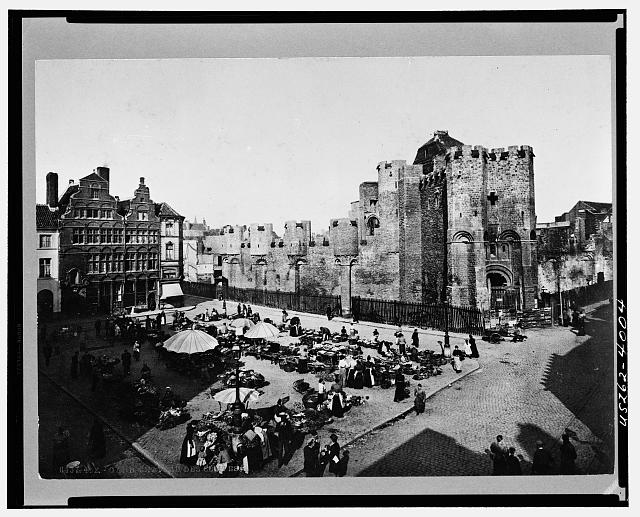
Market square by the Chateau des Comtes in Ghent, Belgium (1890; LOC: LC-USZ62-4004)

Ghent 1890

Fundraising Concerts for Beleaguered Textile Workers

Like the Lancashire Cotton Famine the American Civil War was disrupting cotton-based business in Belgium.

From the Richmond Daily Dispatch May 19, 1862:

Destitution of the Artisans of Belgium

–The Belgian Minister of War has addressed to the Generals commanding territorial divisions, Generals of infantry and cavalry, and to all the chiefs of corps, the following circular:

Brussels, April 8, 1862.

Gentlemen:

The war in America has produced an unfortunate crisis in the cotton manufactures of all countries. The town of Ghent has, in particular, suffered much from that crisis, and it is urgent to assist the numerous and brave workmen by demanding of public charity resources which the deficiency of work has completely dried up. I have thought that the army would be disposed to lend its assistance to any measure that would tend to alleviates those sufferings; and in order to enable each to bring his offering to the gallant army of labor. I have decided that in each garrison possessing a band of music arrangements shall be made for organizing a concert, the product of which shall be applied to the assistance of the working population of Ghent. Have the goodness, gentlemen, to take, in that which concerns you, the necessary steps for the execution of this project.

Chalazal.

Posted in 150 Years Ago This Week, Foreign Relations | Tagged , | Leave a comment

Bull Hamlin?

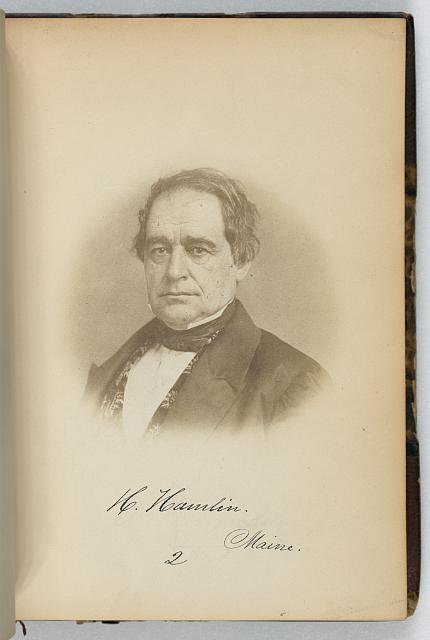
Hannibal Hamlin, Senator from Maine, Thirty-fifth Congress, half-length portrait (1859; LOC: LC-DIG-ppmsca-26541)

Those were the days of power and patronage

Yesterday morning I was reading a review of Robert Caro’s latest book on the life of Lyndon B. Johnson. Daniel Patrick Moynihan is said to have described LBJ’s descent from Senate Majority Leader to the sideline job of vice-president as like a “bull castrated very late in life”. That got me thinking about the man elected vice-president 100 years before Johnson. I’ve seen very little about Hannibal Hamlin since before President Lincoln’s inauguration.

There is an excellent biography of Hamlin at the United States Senate site. Although not majority leader, Hamlin was serving in the U.S. senate when he was elected as vice-president. He bemoaned his loss of power and patronage:

When the Senate convened on the Fourth of July in 1861 to take the legislative actions necessary for raising and funding an army for the Union, Vice President Hamlin discovered that he had far less power and patronage as vice president than he had as a senator. The loss of patronage particularly galled Hamlin, who was “noted for his fidelity to political friends.” He also felt unhappy over being relegated to serving as an inactive observer of events. Hamlin considered himself the most unimportant man in Washington, ignored equally by the administration and the senators. He called his job “a fifth wheel on a coach” and identified the vice president as “a contingent somebody.”

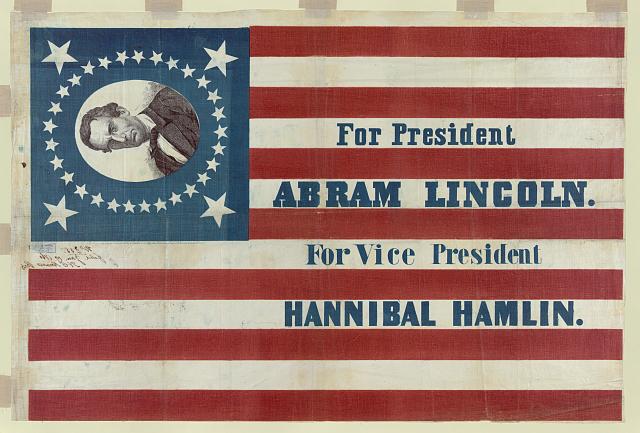
For president, Abram Lincoln. For vice president, Hannibal Hamlin (c1860; LOC: LC-DIG-pga-01637)

Where's the 'nullity'?


He considered his job a “nullity” and was so bored presiding over the senate that he often left for Maine well before the end of a session.

(The same site says that Hamlin pushed Lincoln to issue an Emancipation Proclamation. Lincoln asked Hamlin to dinner to show him a first draft and asked for his Veep’s suggestions.)

One of the things I’ve enjoyed about working on this site so far is the unexpected pleasures. One I especially liked was the sleigh procession that escorted Mr. Hamlin to the railroad station in Bangor, Maine as he began his trek to Washington to take up his job as vice-president. I loved the intertwining of the two technologies – from horse power to steam power. I got sentimental thinking about the outpouring of support for the native son. But the article at the senate site kind of rounded out the story – maybe some of those supporters were looking for a federal gig. As it turned out, a vice-president did not have too much patronage power because, as Hamlin himself explained:

“Every member who has a constituency, and every Senator who represents a state, counts for more in his own locality, and with the Executive who must needs, in wielding the functions of his office, gather around him, and retain by his favors, those who can vote in Congress and operate directly upon public sentiment in their houses.”

Free speech, free soil, free men. This is to certify that [blank] is a member of the [blank] Wide-awake Club (Gavit & Co., 114 Broadway, New York, c1860; LOC: C-DIG-ppmsca-19788)

'faithful to the cause', but not going to like the sideline

Posted in American History, American Society, Lincoln Administration, Northern Politics During War | Tagged , , | Leave a comment

Picnic Perfect

Yes, we’re off-topic again:

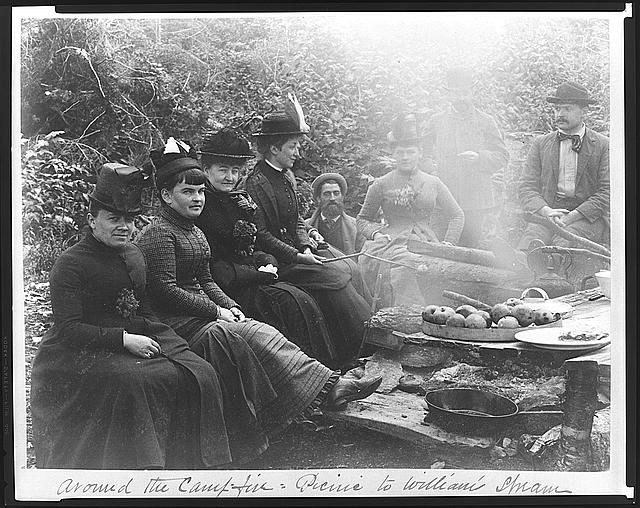
Around the campfire: picnic to William Stream (between 1884 and 1891; LOC: LC-USZ62-25360)

Maine picnic

Posted in Uncategorized | Leave a comment

Fighting It Out In the Old Dominion

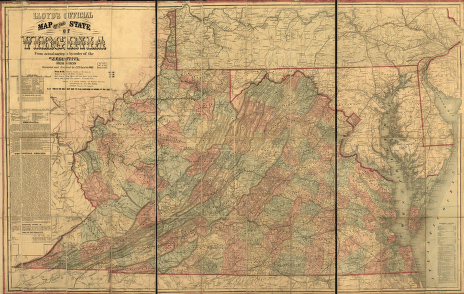
Virginia map at LOC

Old Dominion, real Old Dominion

From the Richmond Daily Dispatch May 16, 1862:

Virginia not to be surrendered.

Two gratifying papers were communicated to the Virginia Legislature yesterday — a Message from Governor Letcher, and a communication from the President of the Confederacy, giving the assurance that the army will not leave Virginia until every means has been exhausted in her defence.– The language of the President is clear and phatia [?].

We are proud of the spirit of our Governments, Confederate and State, relative to this question of holding and defending this State to the last. The army will not abandon the red soll [soli] of Virginia. That has been made the battle-ground, and on that must the enemy establish his superiority in fair fight before it will be abandoned to him. The evacuation of the see-coast positions and cities became a necessity. There was no avoiding it, in consequence of the immense advantage enjoyed by the enemy in his possession of the entire Navy of the United States, and the material and mechanical skill for the rapid construction of iron-clad gunboats, while we had neither a Navy, nor the material and the mechanical force, to enable us to compete with him in any sense. It is true, we had the Virginia; but, besides her, nothing. Her destruction, and the questions it involves, suggests matters of debate which afford neither satisfaction nor benefit now to discuss. Our inability to meet the enemy on the water, as a general question, was clear and indisputable, and the withdrawal from the sea unavoidable.

Second to Virginia is the defence of this city, for manifold reasons, and it is in keeping with the general purpose of both Governments that they should resolve to the uttermost to defend Richmond. All the means in the power of the State and the Confederacy are pledged to this, and we may be assured that the enemy will not be allowed to gratify the prominent desire of his heart, to hector and domineer over the inhabitants of this far-famed and beautiful town, until every means is exhausted.

The President nobly takes the stand, that though Richmond should fall, there are a plenty of battle-fields yet in Virginia to fight for the cause for twenty years! The sentiment is as truthful as patriotic. The Confederate Government assures us that the Old Dominion is not to be given up. God forbid that it should! It would be giving up much more than Virginia. The cause would be, indeed, itself well nigh surrendered in that event. The Government is not only just, but wise, in its determination to stand by Virginia to the last.

From the same issue:

[written for the Richmond Dispatch]
Sing not to me of hearts that Thrill
by George Whitte.

Sing not to me of hearts that thrill
To Love’s melodious alone,
That drown themselves in Passion’s wine,
And dream the world is all their own;
These — these are not the ones that write
Their names on History’s deathless page.
And give to far posterity
The gloried of (a crimson) age.
But sing to me of hearts, that while
They fender cling to those they love,
Can turn them from the lov’d one’s smile,
And in the eagle hide the dove;
Of hearts that in their country’s need
Will wait not for its stricken wail;
But, at its first proud, clarion call,
Gird on their trusty battle mail.
These — these are the heroic souls–
Shall cling unto this age sublime–
Whose names, a grateful, rescued land
Will grave upon the shaft of Time!
Yes! sing to me of hearts that dare
The “velleity thunder.” of the field–
That battling bravely, dare to die–
That dare to do all things but — yield!
Lynchburg, Va.,May 11, 1862.

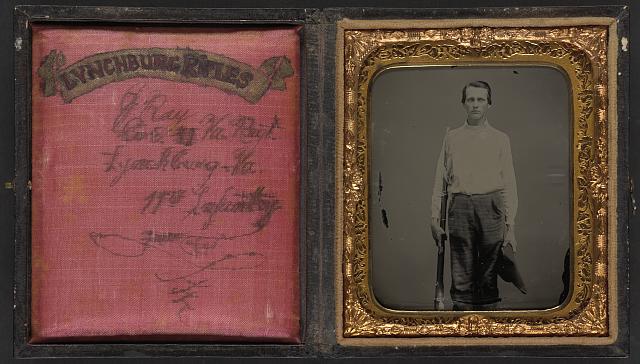
Lynchburg Rifles, J. Ray, Co. E, Va. Regt., Lynchburg, Va., 11th Infantry (between 1861 and 1865; LOC: LC-DIG-ppmsca-32488)

Hiding the dove in the eagle

Posted in 150 Years Ago This Week, Confederate States of America, Military Matters, Southern Society | Tagged , , , | Leave a comment

Valor in Defeat

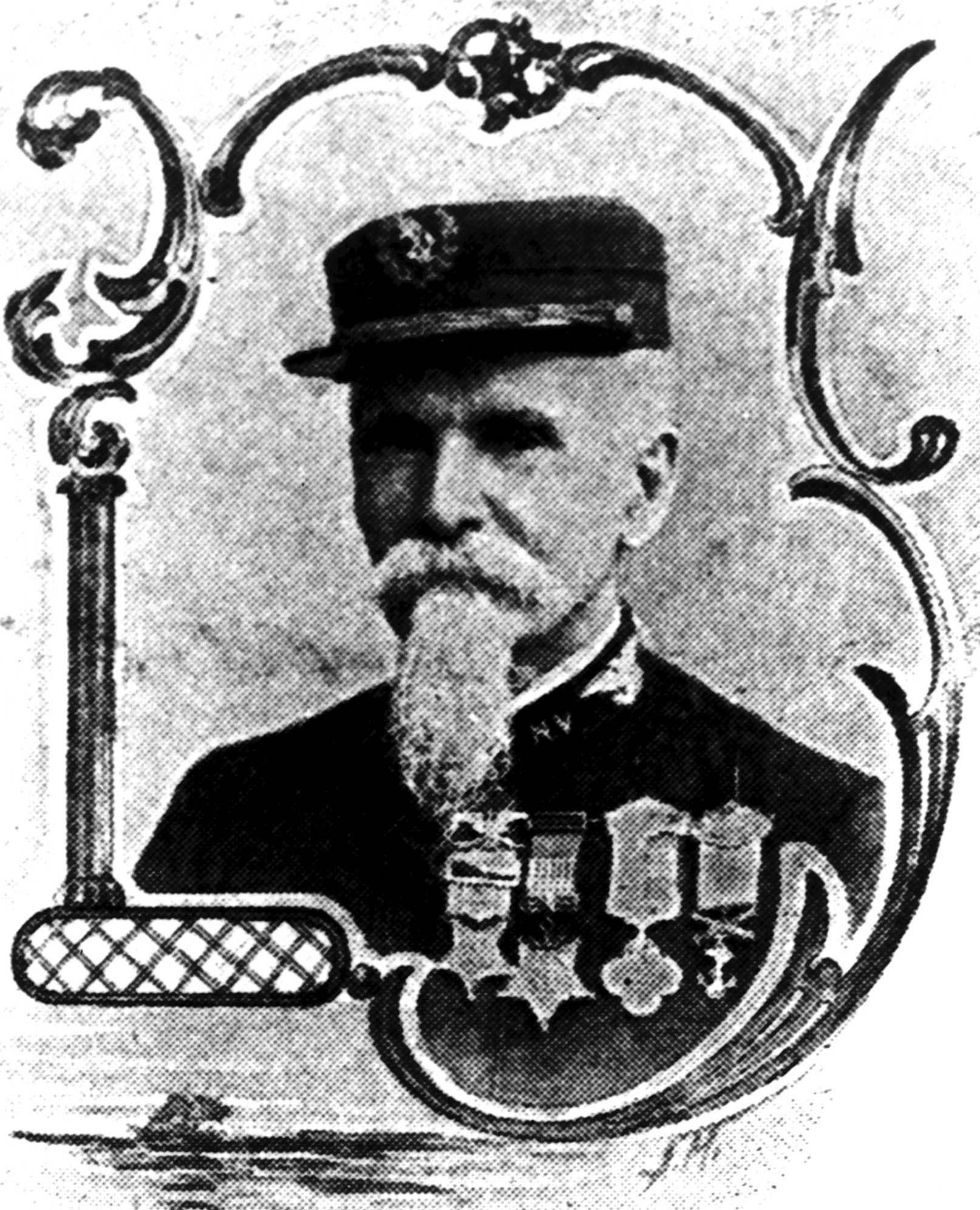
John Mackie Cpl John F. Mackie aboard the USS Galena, where he earned his Medal of Honor at the Battle of Drewry's Bluff.

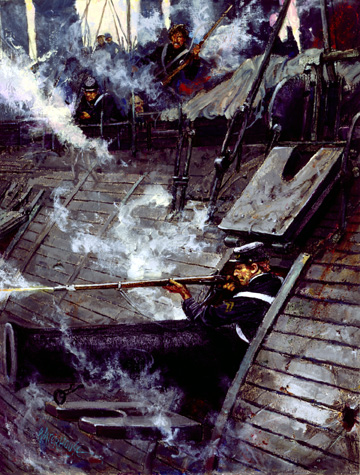
Aiming at the Confederate rifle pits onshore

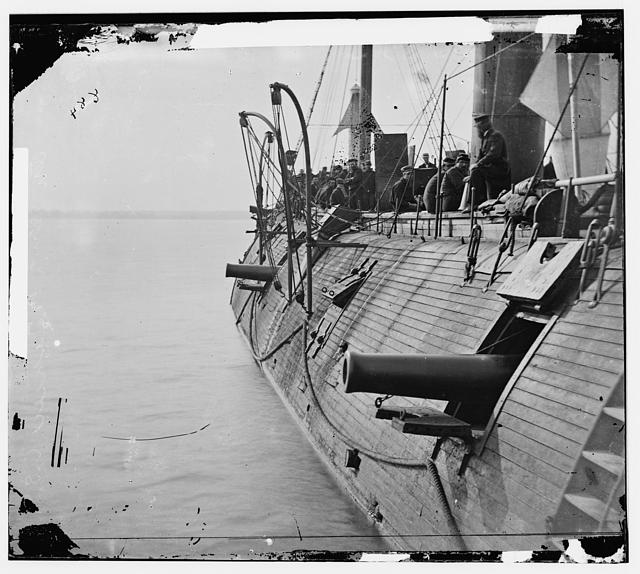
150 years ago today a Union flotilla, advancing up the James River to assault Richmond, was repulsed by the Confederates at Drewry’s Bluff. The USS Galena absorbed the brunt of the rebel fire. Marine corporal John Freeman Mackie, onboard the Galena, became the first marine awarded the Medal of Honor for his bravery during the battle. According to the US Army Center of Military History:

Citation: On board the U.S.S. Calena [Galena] in the attack on Fort Darling at Drewry’s Bluff, James River, on 15 May 1862. As enemy shellfire raked the deck of his ship, Corporal Mackie fearlessly maintained his musket fire against the rifle pits along the shore and, when ordered to fill vacancies at guns caused by men wounded and killed in action, manned the weapon with skill and courage.

You can also read Mackie’s bio at United States Marine Corps History Division, where it is said that Mackie took it upon himself to take over the heavy guns when the crews were incapacitated.

John F. Mackie

Well-deserved decorations

James River, Va. Effect of Confederate shot on Federal Ironclad GALENA (1862; LOC: LC-DIG-cwpbh-00826)

Galena after the battle

Posted in 150 Years Ago This Week, Military Matters | Tagged , , , , | Leave a comment

Big Bad Bronze John

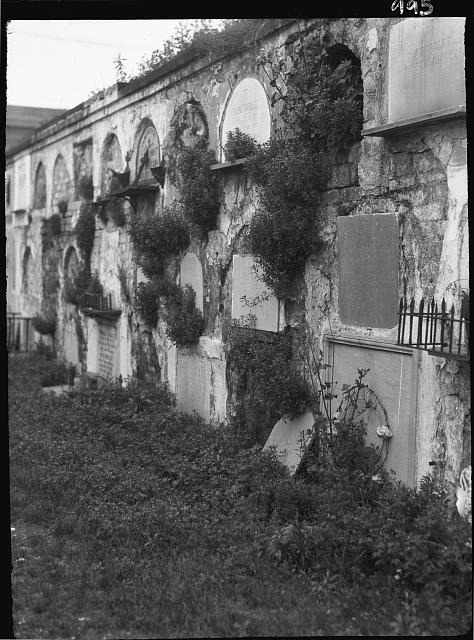
Wall tombs of the old St. Louis Cemetery, New Orleans (between 1920 and 1926; LOC: LC-G391-T-0995)

Wall tombs in St. Louis Cemetery, New Orleans c.1925

The “intolerant” Yankees are occupying New Orleans just in time for Yellow Fever season; what’s more they are putting a hospital right in a heavily populated section of the city.

From the Richmond Daily Dispatch May 14, 1862:

Advance of “Bronze John.”

The Yankee invaders are taking possession of buildings in the most populous parts of New Orleans for the purpose of establishing hospitals therein; and the papers of the city very properly protest against the proceeding. The Evans House, on Poyuras street, is thus occupied, and the Picayune says:

As to the unsuitableness of the buiding for that purpose, we have nothing to say. That is their concern, not outs. We do say, however, that the location of a military hospital on one of our leading business thoroughfares, and in the heart of the city, is very indudicious and reprehensible. It is fraught with danger, and ought to be at once abandoned. We speak plainly because we are just entering on the summer and our unhealthy season, and it is our duty at all times to protest against any measure that is calculated to jeopardize the health of the city. More especially is this duty not to be disregarded now that thousands of unacclimated persons have been thrust upon us. All the precautions which wisdom and experience have suggested have not hitherto prevented the almost annual visits of the devastating scourge of our sunny clime, and there is, in our present condition, very great reason to fear that the summer of 1862 will be frightfully memorable for the ravages of the yellow fever in New Orleans. In so former year has there been here so much food for the terrible pastilence, and we shudder when the probability of its outbreak is forced upon our attention by what we see around us. Already the effect of the climate on the strangers within our gates is apparent to every observer, and we know not at what moment the fearful harvest of death may commence.

It is not only our duty to protest against any proceeding that has a tendency to endanger the health of our fair city, but it is the duty of the dominant military authority here to be especially careful to avoid the necessity for such protest by well considered judicious sanitary regulations. The establishment of a hospital on Poydras street, between Camp and Magezene streets, a certainly not a measure calculated to give confidence to those who, by sad experience, know the critical position in which we stand at this moment, or to calm the fears of the timid and unaccilmated.

There is a lot of information about “Bronze John . . . Yellow Jack . . . the Saffron Scourge” at Haunted New Orleans Tours. The deadliest year was in 1853, when the first victim was a newly arrived Irishman – that would explain why the Picayune was so concerned about putting sick, “unaccilmated” northerners in the middle of the city. It was not until 1881 when it was first hypothesized that Yellow fever might be caused by mosquitos.

Posted in 150 Years Ago This Week, Confederate States of America, Southern Society | Tagged , , | Leave a comment

“with a yell that made the woods ring”

Map of country between Yorktown and Williamsbu[rg] in Virginia by Robert Knox Sneden (LOC: gvhs01 vhs00018 http://hdl.loc.gov/loc.ndlpcoop/gvhs01.vhs00018 )

33rd moves from Yorktown to Willimasburg

150 years ago this week members of the 33rd New York Infantry Regiment were still writing letters home about May 5th’s Battle of Williamsburg.

Here’s a couple letters published in a Seneca County, New York newspaper from 1862:

Letter from Lieut. Guion.

WILLIAMSBURG, Va., May 8, 1862

The first great battle of the Peninsula is over, and, thank God, victory rests on the banners of the army of the Union. Commencing at Yorktown on Friday, the conflict raged furiously along the lines until Saturday night, when our troops commenced crossing the Warwick River. Early on Saturday [Sunday?] morning our division crossed; and driving the enemy before us from one line of fortifications to another on rolled the army of the Union, on to Richmond. – On Monday morning the enemy rallied in great force near Williamsburg, on a line of fortifications which they deemed impregnable. We had been swerving clear around to our right, near Yorktown, and about noon the enemy succeeded in forcing back our troops upon the left. Now the battle raged terribly. The slaughter on both sides was terrible. For several hours the whole force of the rebel army were thrown upon our left, and slowly our brave troops were driven back. Nobly did they contest every inch of ground, but still the enemy was gaining every moment; when suddenly our division, which had marched at a quick step full fifteen miles through rain and mud, without a halt, opened upon the enemy’s lines, between Williamsburg and the York River, and soon occupied two of their forts. Their whole attention was now turned upon us, and the battle on the left almost closed, as the foe wheeled his huge battalions around to meet us. – Down come their whole power upon us, and the roaring of the artillery, and the rattling of the rifles, was almost deafening. About five o’clock their artillery crossed, and soon their immense force was seen sweeping down upon us like a huge wave, threatening to engulph our comparatively little band. On, On, on they came, regiment after regiment, their long lines stretching far on either side. “For Heavens’ sake stand firm, my men,” cried Col. TAYLOR, as he came riding along the lines, ” everything depends upon you,” and steadily our men awaited the shock, with bayonets fixed, resolved to stand or die, but never to show their backs to the foe. On, on they came. Only a few hundred feet separated the hostile armies, when suddenly with a shout that sounded far above the roar of our artillery, the 33d rushed forward to meet the advancing foe. When that shout went up the enemy halted, and as the 33d came, charging right in upon their very centre, the enemy turned, broke and fled,and the day was one.The shout of victory now rang all along our lines. Once more the troops upon the left rallied to the charge and the victory was complete. Night closed upon the broken, flying legions of the enemy, and the battle of Williamsburg was won.
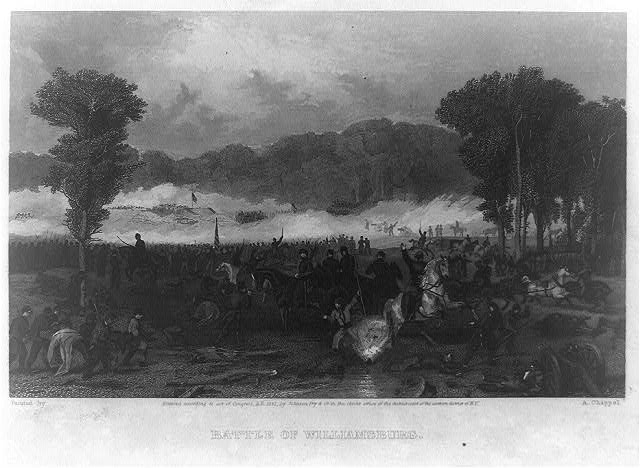
Battle of Williamsburg (c1863 by Alonzo Chappel; LOC: LC-USZ62-92942)

Battle of Williamsburg

Strange as it may seem, although the 33d dashed right in upon the enemy’s centre, and killed and wounded nearly 300 men and took 200 prisoners, we lost but 50 men in all, and very few of these were killed.

To day Gen. MCCLELLAN has been up to see us. He addressed the regiment, and thanked us for gaining the victory, and ordered that “Williamsburg” should be inscribed upon our banner. This is the proudest day of our lives. You should have seen him as he spoke to us. The words of that glorious man have more than repaid us for all the privations we have suffered. The boys fairly cried for joy, as they stood with heads uncovered while he addressed them, and it seemed as if they never could stop cheering him.

The battle-field was an awful sight yesterday. The dead and wounded lay strewed around for miles, and all day long we were busy bearying the dead, and bringing in the wounded rebels. It was a sorrowful task, but I thank God that it was not our bodies that were being thus disposed of.

Our troops are again advancing. When next we shall meet the foe we know not, but whenever it may be, the 33d will be ready for the fight.

Yours, J.M.G.
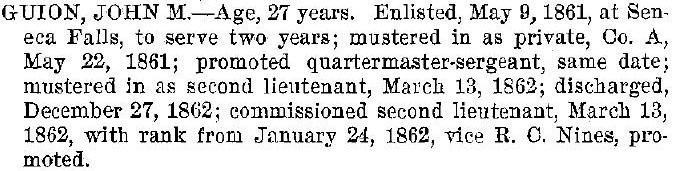
John M. Guion from 33rd muster rolls

Lieutenant Guion's bio with the 33rd

_____________________________________________
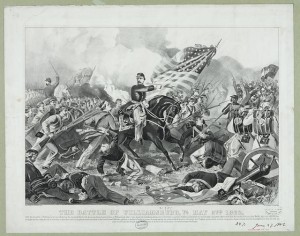
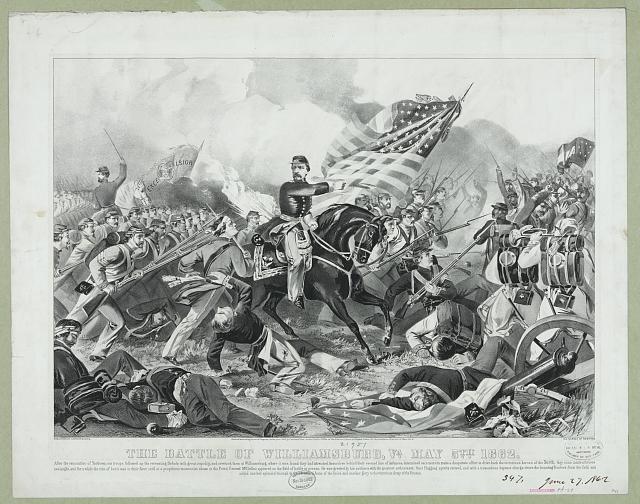
The Battle of Williamsburg, Va. May 5th 1862 (Currier & Ives, 1862; LC-DIG-pga-00615)LOC:

A different Yankee bayonet charge?

From the Thirty-Third.

DEAR WIFE:

I have received your letter and was very glad to hear from you. I suppose you have by this time received my letter informing you of the fight we had. It was a “right smart one.” We have got the name of the place inscribed on our flag. – There are two other regiments who claimed the honor of the victory. But they could not “come it.” It happened that Gen. MCCLELLAN was on the opposite side of the field, looking at us, himself, through a glass. So you see they did not make much out of their claim. He praised us up “big.” He said in our presence that we saved his whole army. It seems like a big thing that three companies should save a whole Division from being cut to pieces. There were eight regiments charging down upon us. As they came on we fell back behind a rise of ground which hid us from them. When they got pretty near the rise, we were ordered to fix bayonets, which we did in pretty quick time, (we knew what was coming.) Then the order was given to charge – we did so with a yell that made the woods ring. As soon as we gave the yell their ranks were broken and they commenced running every way, and we pouring the lead into them. There were about sixty killed in that one charge. – There was but one in our company wounded – that was ALFORD. He was wounded in the hand. There were five in the three companies wounded. I guess the Rebels won’t say anything more about Bull Run. Our cavalry pursued them for several miles and cut them all to pieces
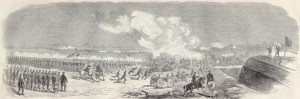
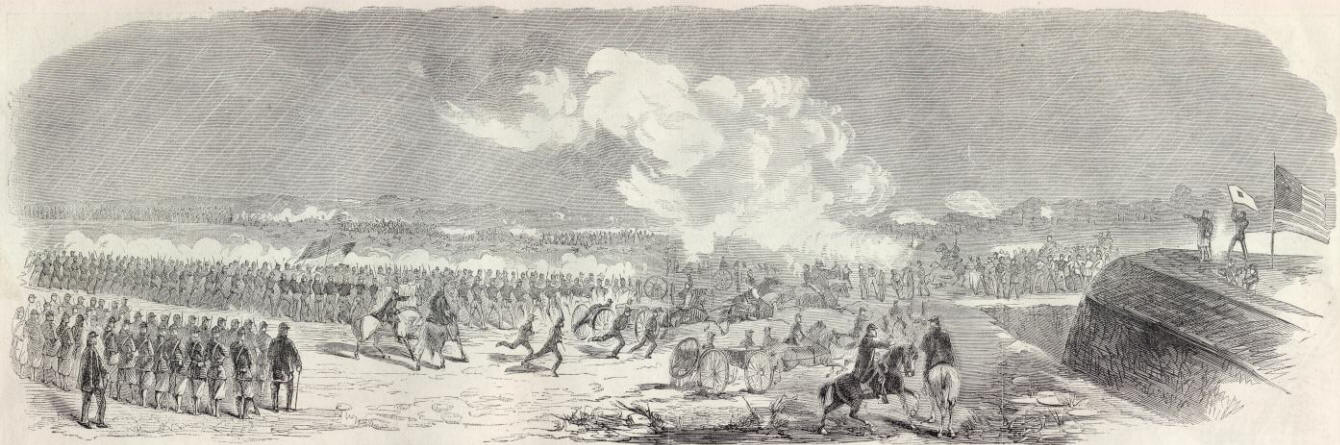
Battle of Williamsburg - Hancock's Brigade charges (Alfred R. Waud - Harper's Weekly May 24, 1862)

Hancock's Brigade charges in the rain

The road is filled with dead horses, and broken wagons and guns, and our crvalry have taken about all their cannon. *** As we march along the “contrabands” come out to see us. They say when the rebels passed some were bare-footed, and some were crying. A good many of their wounded have since died. Some of the prisoners said that they were taken,after they found out we did not kill them. They have been made to believe that we killed them as fast as we took them. ****

I heard that the Herald gave the 43d regiment the credit of making that charge. I suppose it was a mistake of the printer, as there was no 43d regiment there.

From your affectionate husband,

HENRY BELLOWS.

Henry Bellows NY 33rd

Sgt. Bellows, NY 33rd

It wasn’t just the Herald. Harper’s Weekly said that all the Union regiment’s did well but the Fifth Wisconsin and Forty-third New York really stood out.

The story of the Thirty-third N.Y.S. vols.; or, two years campaigning in Virginia and Maryland by David W. Judd (pages 88-89) gives credit to those three companies of the 33rd for inspiring Hancock’s brigade to make its charge. The author also includes General McClellan’s words to the men of the 33rd on May 7th:

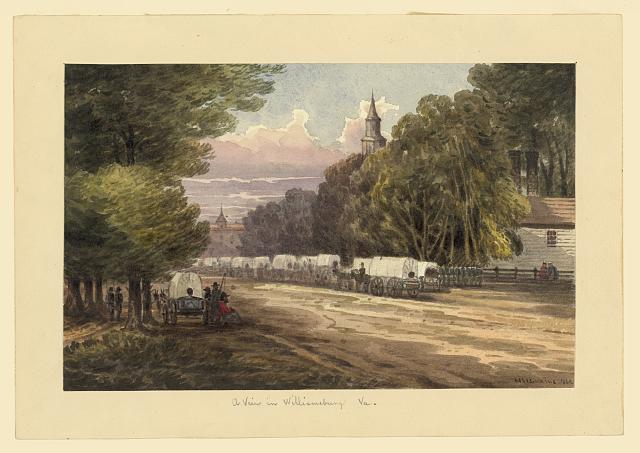
A view in Williamsburg, Va. (1862 by William McIlvaine; LOC: LC-DIG-ppmsca-20005)

Irrepressible Union wagon train rolls through the streets of Williamsburg
Posted in 150 Years Ago This Week, Military Matters, Peninsula campaign 1862 | Tagged , , , , | 1 Comment

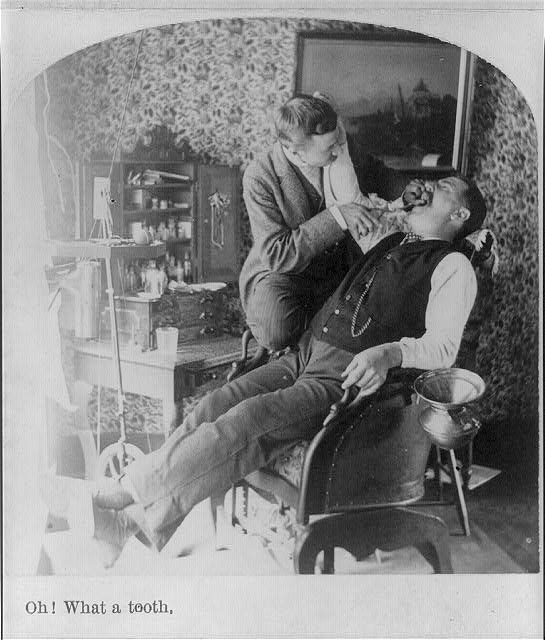
“Teeth extracted by Electricity, without pain.”

Oh! What a tooth (c1890; LOC: LC-USZ62-68282)

Getting at the root of the problem? circa 1890

From the Richmond Daily Dispatch May 12, 1862:

Artificial Teeth–the Cheoplastic and Vulcanite Process.

–G. W. Jones, Dentist, having the right for the above mode of making Teeth, and being satisfied of its absolute superiority over all other methods, can with confidence commended to those desiring full or partial sets of teeth, and especially such as may be dissatisfied with those they are now using. The perfect adaptation of the plate to the mouth, and the auction thereby secured, enables him to insert one or more teeth without clamps. This method having been adopted by those standing highest in the profession, North and South, testimonials will be given and specimens exhibited to those wishing to see them.–Sets of Teeth, on gold or any other plate, will, of course, be made for those preferring them. Filling, Cleaning, Extracting, and all other operations, gently and thoroughly performed. Teeth extracted by Electricity, without pain.

Office on Main street, opposite Corinthian Hall.

You can read about Vulcanite dentures (and see an example) at The British Dental Association. Thank the Goodyear brothers.
_____________________________________________

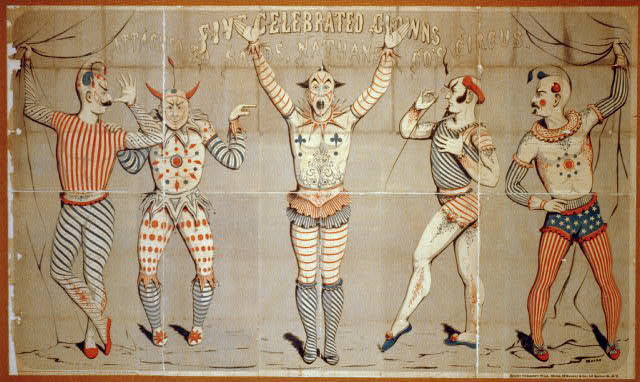
Five celebrated clowns attached to Sands, Nathans Co's Circus (Morse, M'Kenney & Company, 1856; LOC: LC-USZC4-922)

Clownin' around 156 years ago

Posted in American Culture, American Society, Southern Society | Leave a comment