Snow March: “indifferently supplied with shoes”

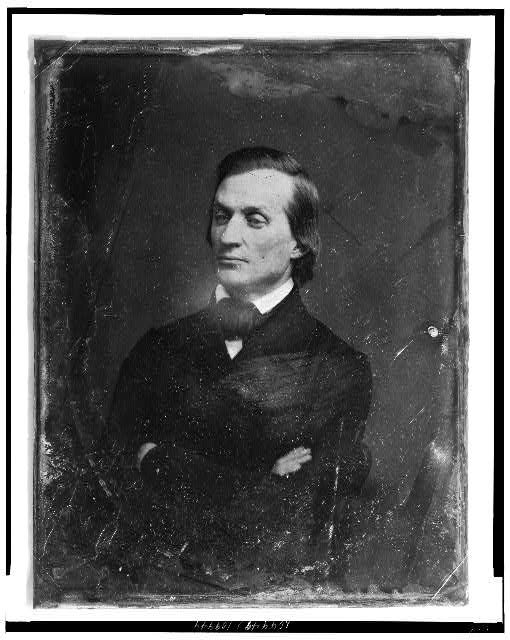
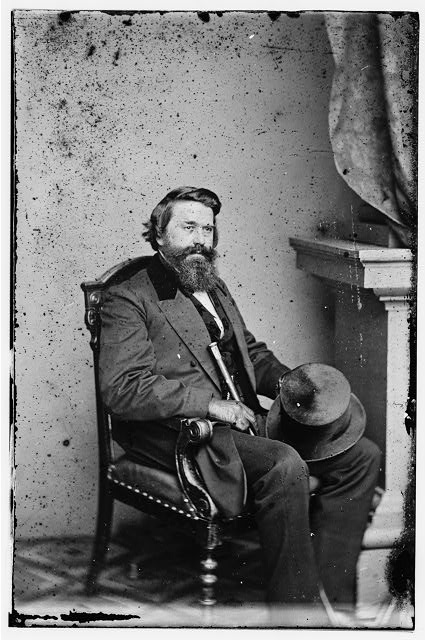
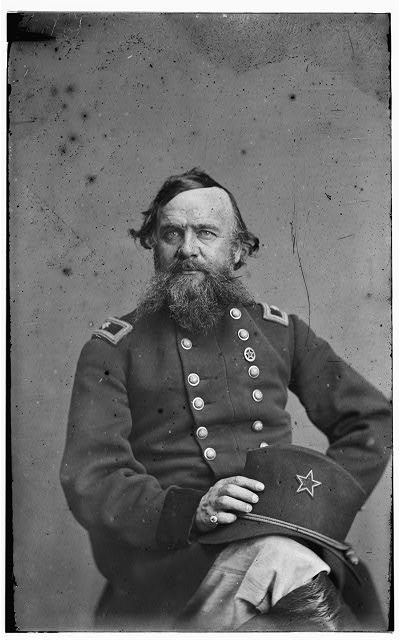
Alpheus S. Williams (between 1860 and 1870; LOC: LC-DIG-cwpb-07265)

Alpheus S. Williams

In yesterday’s post a Richmond Dispatch correspondent made the case for the CSA’s officer class to be concerned about the condition of the common soldier during the winter months. As Civil War Daily Gazette is reporting Stonewall Jackson’s troops suffered in the ice and wind as they marched south from the Potomac, after having failed to take Hancock, Maryland. The 19th New York was one of the regiments in the brigade General Banks sent to belatedly reinforce Hancock. The 19th has had a rocky time since volunteering in April, including mass desertions in the fall. The remaining troops are quite happy about their imminent conversion to artillery. But here they can still suffer as infantry on the three day march from Frederick to Hancock.

Henry Hall writes about 11 years after the events. From Cayuga in the Field (p 86-87):

Although the rebels remained quiet on the upper Potomac, they were gathering there in large force. It was deemed expedient to strengthen the Federal lines there, and Gen. Banks ordered the 3d brigade to proceed to Hancock for this purpose. Preparing two days’ rations, the brigade marched at 5 a. m. on January 6th, the 28th New York in advance, with the 5th Connecticut, 46th Pennsylvania, and 19th New York following in the order named, which was their regular order in the brigade. Camp was left standing by the 19th, for owing to the ice and snow tents could not be struck. Company F stayed to pack up and bring on the baggage. The sick were left under care of Dr. McClellan, of the 5th Connecticut. The brigade, being temporarily under the command of Col. Donnelly, of the 28th New York, made a headlong march, through snow four inches deep, over mountain ranges and rough roads to Hagerstown, The 19th, nearly starved, without sufficient rations, was, by Donnelly’s orders, kept out in the open country that night, to bivouac and freeze in the snow, sleeping by fences, in straw stacks, and some few in barns, while the other regiments were housed and fed in the village. The next day Gen. Williams overtook the command while plodding through the snow on another forced march of twenty-six miles, and at once halted it at Clear Spring, a good Union village, on the bank of the Potomac, after giving Donnelly a thorough talking to for his disgraceful treatment of the 19th. On this day’s march the men were so hungry, from failure of the commissary to supply them with rations, that Lieut.-Col. Stewart stopped a commissary wagon on the road and issued a barrel of crackers to each company, for which they were very grateful. How nice Elmira hash would have been then! At Clear Spring, churches, school houses and inns were occupied for the night. Next day the march was pushed at a rapid pace, in sight of the Potomac all day, a small force of the enemy following on the other side. Lest the confederates should open fire on the brigade with shell, it marched in open order. The 19th, being indifferently supplied with shoes, straggled somewhat on the home stretch to Hancock, but a strong rearguard prevented straying away. On a former march of the regiment — from Pleasant Valley to Hyattstown — the Surgeon obtained some one horse, two-wheeled ambulances, as traps for feigners of sickness and those shamming to be disabled. They were so hung that while going down hill the occupants would stand on their heads; going up, on their feet. The most inveterate shammer generally had his fill of false pretenses after one day’s ride in one of those “cussed machines,” and never gave out on the march so quick after that if he could help it Either its memory, or the now superior discipline of the regiment made them on this march entirely unnecessary.

The brigade entered Hancock, a little, ancient, one-horse village on the bank of the Potomac, at a point where Maryland is only three miles wide, reaching it at 3 P. M. Public buildings were assigned to the 19th, and that night the regiment nursed its frozen feet and hands in comfortable quarters.

You can see a Harper’s Weekly report on Hancock (in warmer weather) at Son of the South. The 19th would have appreciated that alcohol that was being dumped in one of the images.

A native of the Nutmeg State, Alpheus Starkey Williams moved to Detroit in 1836. He worked at a bunch of different careers:

He was elected probate judge of Wayne County, Michigan; in 1842, president of the Bank of St. Clair; in 1843, the owner and editor of the Detroit Advertiser daily newspaper; from 1849 to 1853, postmaster of Detroit.

When Williams arrived in Detroit in 1836, he joined a company in the Michigan Militia and maintained a connection to the military activities of the city for years. In 1847, he was appointed lieutenant of a regiment destined for the Mexican-American War, but it arrived too late to see any action. He also served as the president of the state’s military board and in 1859 was a major in the Detroit Light Guard.

Williams was active as a general throughout the Civil War. At The Alpheus Williams Website you can read a letter in which Williams describes the brutal conditions at Hancock.
Posted in 150 Years Ago This Week, Military Matters | Tagged , , | 2 Comments

Bohemian’s Rhapsody

The Bohemian correspondent for the Richmond Daily Dispatch will apparently no longer be reporting on the Confederate Army of the Potomac under General Joseph E. Johnston. As Bohemian says his goodbyes he offers his readers a poem about highly idealized war.

From the Richmond Daily Dispatch January 6, 1861:

Monday morning…Jan. 6. 1862.
Army of the Potomac.
[our own correspondent.]

Richmond, Jan. 3, 1862.

Auphora capita Latini; Charente rote our emcee exit

Horac[e].

Some days ago I published information regarding the winter quarters of our army, based upon the statement of a gentleman whom I supposed correctly informed upon all points connected with the disposition of troops, but I have since learned from better authority that my publication was premature, and furthermore, that it was substantially incorrect. Ten thousand rumors upon the subject are floating on the current of public talk; but they are merely exaggerated reports upon a matter no one beyond our Generals can even predicates an opinion. In my college days I recollect to have read, I think in Terrence, the saying, “Insita lomixibus libide sleadi de industria rumores”–men have in them a natural propensity for spreading rumors.

The truth of the phrase was never more apparent than at present. Men take very diminutive facts, blow them up into unusual dimensions, then set them afloat,–as school-boys inflates bladders, and use them for footballs. …

I have written all these moral reflections over the fact that I was misled, after leaving Centreville, into the statement that our army had gone into winter quarters. Speaking collectively, exactly the riverside is true. A portion of the troops have been assigned more favorable positions, but only a small portion are now engaged in the “hutting” process. Although the present prospect is quiet enough, no one can say what the winter will bring forth — whether it will be quietly spent in camp, or whether a more active policy will be inaugurated. At present winter exists only in name, but we have precedents upon which to found an opinion that there may be had weather before spring Good, comfortable quarters must be provided for our volunteers during the chilly storms of winter. No matter what course may be pursued in the conduct of the war — act on the defensive or offensive — the health and comfort of the men demand that proper shelter should be given them.

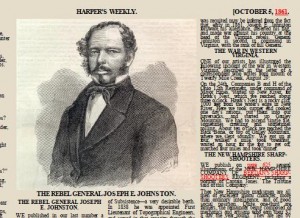
Joseph E. Johnston (Harper's Weekly 10-5-1861)

Harper's portrays Joe Johnston

If General Johnston has decided to assume the aggressive, there is no reason in the world why the men should not be allowed the privilege of making log huts to live in until he is ready to lead them into the field….

In the army of the Confederate States at the present moment, there is enrolled an amount of intelligence, conscientious conviction, earnestness of deliberate will consecrated to a holy cause, never, perhaps equalled in the history of eighteen centuries. The best blood, and the truest, most manly hearts of our Southern land, are enlisted in the defence of its honor. When we think of the chivalric noble men composing the rank and file of our army, how closely do we scan the character of the General upon whom the responsibility of their treatment rests. God forgive the commander who neglects and misuses such men while in the field! …

Like hundreds of others, I, too, can have dreams. Pardon my introducing one here.

The student’s dream.
My dreams are all of battle scene,
And through the silent night,
There breaks upon my slumbering [e]ars
The stilling sound of charging cheers
The tumult of the fight.
The [a]ir is full of waving swords–
Around my couch of sleep.
I see the polished helmets flash;
I hear the round shield’s ringing crash.
And the war cry’s made deep.
Sounds of the night I [?] they wake me not;
Yet off in dreams I rise,
A[n]d, girded with a monarch’s power,
I lead those heroes of an hour
Against a foe that flies.
I wear a crown of glory then.
And priceless diamonds gleam
On hilt and cross of that keen steel
My griping fingers thrill to feel
In the right hand of my dream.
Wildly and him the visions fade–
I mourn with waking day
To leave the throbs and thrill of strife,
To wake in dull and deedless life,
To join a world at play.
My spirit loathes its midday dream,
And curses hot are poured,
To don a tattered crown or weeds.
A schoolboy’s forge of plaited reeds,
A jester’s wooden sword:

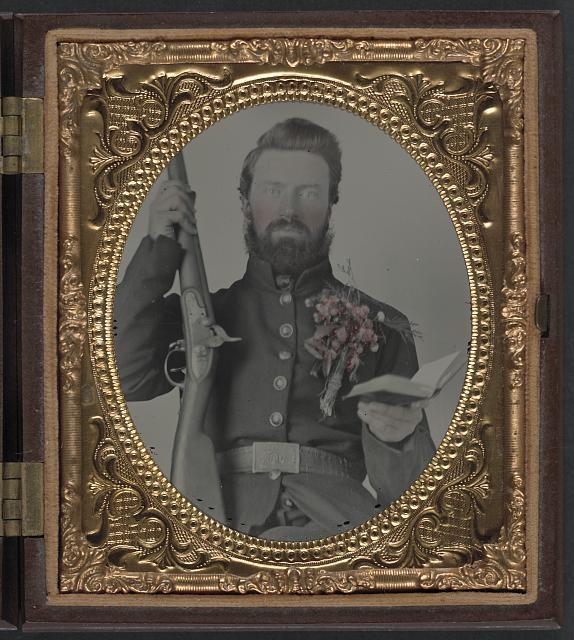
Private David Lowry, of Company E, 25th Virginia Cavalry Regiment, Company A, 41st Virginia Infantry Regiment, and Company D, 47th Virginia Infantry Regiment, in uniform and corsage of flowers with musket and book (between 1861 and 1865; LOC: LC-DIG-ppmsca-32062)

No doubt chivalric ... becoming more realistic?

There are many facts connected with the management and mismanagement of the army which I have yet to write, but for the present they must remain in my note-book. Perhaps it would be better. if they were left there altogether, but there are circumstances which remove the stamp of secrecy from many things yet untold, that as a public chronicler of daily events, I ought to give the people, but which have been withheld for prudential reasons.
Kind friends, good-bye!

Bohemian.

Posted in 150 Years Ago This Week, Confederate States of America, Military Matters | Tagged , , | 1 Comment

Southern This and That

Solon Borland, half-length portrait, facing three-quarters left (between 1844 and 1860; LOC: LC-USZ62-109949)

Solon Borland - clamping down on speculators

Speculators; VMI back at turning out officers; CSA $5 note

From The New-York Times January 5, 1862:

MISCELLANEOUS ITEMS.

The Baton Rogue Sugar Planter has been discontinued for want of paper.

Gov. LETCHER has appointed delegates to represent Virginia in the Planter’s Convention of the South to be held in Memphis next month — February.

The Richmond Dispatch suggests as the Confedare in great need of arms just now, that the guns throughout the different camps, left there by volunteers who have died or been discharged, be collected and put to use.

The Dispatch scourges “the vampires who are sucking out the life-blood of the nation,” (secesh,) and doubts “if any age of the world has witnessed a spectacle like that now complained of by our own soldiers, growing out of the difficulty of obtaining settlements, which has led to the establishment of offices in this city (as we are informed) where they go and have their claims shaved and cashed.”

Gen. BORLAND, in command at Pocahontas, Ark., has embargoed White River, to prevent speculators from monopolizing and carrying off supplies.

Alluding to the Virginia Military Institute, the Richmond Whig, of the 20th inst., says: “The patriotic Professors of this Institution, who, at the first [???] of war, betook themselves to the field, have, prompted by the same patriotic considerations, been induced to turn to the less fascinating, but not less useful labors of teaching. If the war lasts, a fresh supply of instructed officers will be continually needed, and there existed no other means for obtaining them than by the Military Institute. Persuaded of this, the Board made provisions for reopening the Institute on the 1st of January, and the full complement of students has already been engaged. President DAVIS manifested a great interest in the matter, and in the handsomest manner furloughed the Professors, all of whom are officers in the service. It was no doubt painful to there gentlemen to abandon the theatre of glory, but they did not hesitate to respond to the call of duty.

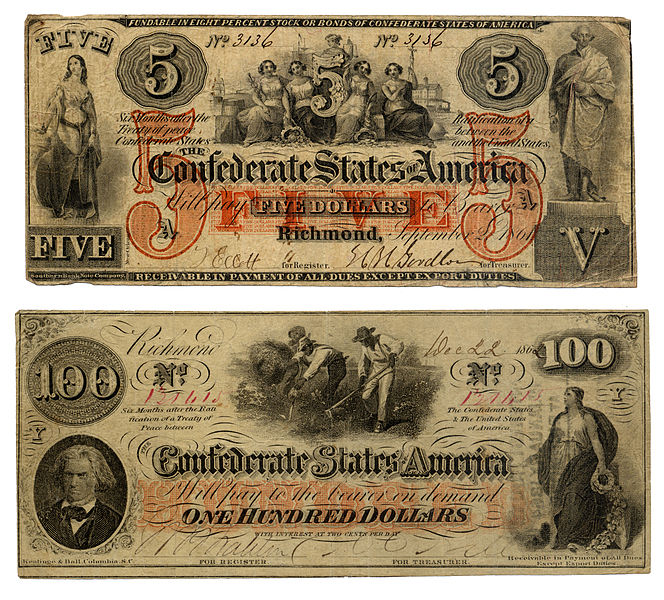
The Editor of the Lynchburgh Republican has been shown a new Confederate note of the denomination of $5, only just issued, which is one of the most perfect specimens of workmanship he has ever seen. The note is the work of the Southern Banknote Company, of New-Orleans. The vignette is composed of a group of females, while in the distance are seen a woman bearing in her hands the scales of Justice, and a vessel under sail, indicating that the true wealth of the South lies in her commerce. On the right hand of the note is an accurate likeness of the Father of his Country, the immortal WASHINGTON, and on the left the figure of a beautiful virgin. The paper is excellent, and the engraving cannot be surpassed.

Confederate_5_and_100_Dollars

CSA paper currency including that five dollar note

Solon Borland was a controversial public figure who served as US senator from Arkansas from 1848-1853. As the Civil War started Borland recruited troops in his state. Relating to this article in The Times:

While in his command position for the Northern Arkansas Militia, he ordered an embargo of goods to end price speculation, which was rescinded by Governor Rector. Borland protested that a governor could not countermand an order from a Confederate official, but in January 1862 his order was countermanded by the Confederate States Secretary of War at the time, Judah P. Benjamin. In declining health and resenting that embarrassment, Borland resigned from further service to the Confederacy in June, 1862…

Here’s a paragraph from the Baton Rouge newspaper that seems to reference the problem of getting paper to print on:

SUGAR PLANTER [WEST BATON ROUGE, LA], January 4, 1862, p. 2, c. 1
Our New Paper.—According to promise made last week, we present our readers with a colored paper. Curtailed of its fair proportions, it is a beautiful sheet, is it not?—Well! who’d have thought that we would be reduced to such stern necessity! It can’t be helped, therefore grieving over it will not help matters. When the yellow paper gives out we intend trying our hand at a new dodge in the newspaper line—nothing more nor less than using wall paper, good reader! We have bought a quantity, which if we can’t print on, we can paper our other room with. “When there’s a will there’s a way.” But the present issue—isn’t it glorious? Such nice envelope paper used for ordinary printing! As Macbeth said while gazing upon a handful of Baton Rouge shinplasters, “this is a sorry sight!”

Posted in 150 Years Ago This Week, Confederate States of America, Military Matters | Tagged , | Leave a comment

Death of a Southern Patriot from Delaware

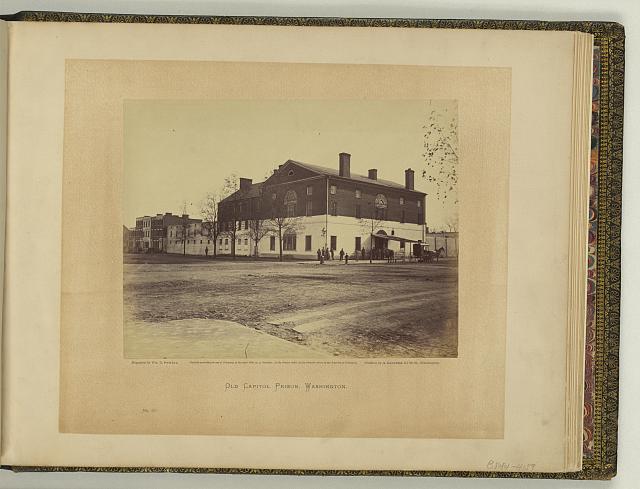
Old Capitol Prison, Washington (c1866; LOC: LC-DIG-ppmsca-12611)

Old Capitol Prison - site of Dunott's escape

From the Richmond Daily Dispatch January 4, 1862:

Death of Lieut. Dunnott.

Our readers will remember that we published, two or three weeks ago, an account of the extraordinary escape, from the Washington prison, of Lieut. H. H. Dunnott, a gallant young officer who was captured by the enemy in the battle of July 21st. We are now pained to announce his death, which occurred at the house of a friend, near Winchester, on the 29th of December, after an illness of some six weeks. The gentleman who communicates this intelligence adds that his last days were spent in earnest religious devotion, and that there is reason to believe he died a Christian. Lieut. Dunnott was a native of Delaware. He belonged to the 27th regiment Virginia volunteers, and no man was more ardent in his attachments to the cause of the South. The story of his captivity and escape will form one of the incidents in the history of the war.

You can read more about Lieutenant Dunott at The Delaware Grays in the section Delaware Confederates. He enlisted in the 27th Virginia Infantry ten days after Fort Sumter was bombarded. He was buried in the Delaware section of the Stonewall Cemetery in Winchester, Va.

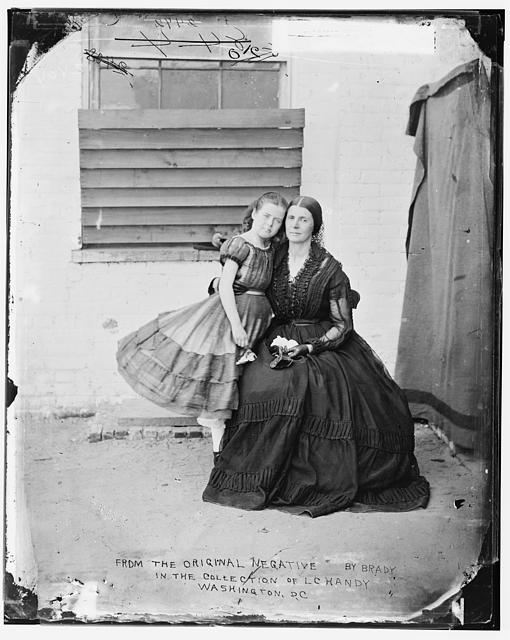
Whether or not it’s true that “Some friendly ladies in Washington, visited him in prison, fitted him out in female attire, in which disguise he escaped”, there were females imprisoned within the Old Capitol Prison. Wikipedia says there were prostitutes locked up; after Dunott’s death the southern spies Belle Boyd and Rose O’Neal Greenhow spent time there.

At The National Archives you can see a note from Lt. Dunott to Rose Greenhow. He is thanking her for a package of something that I’m not making out. 01-05-2012: The link above might not work, so if you go here and search for dunott, you should be able to find the note.

Greenhow, Mrs. & Daughter (imprisoned in old Capitol Prison in Wash. D.C.) Confederate spy (between 1865 and 1880; LOC: LC-DIG-cwpbh-04849)

Rose Greenhow and daughter at Old Capitol Prison

Posted in 150 Years Ago This Week, Confederate States of America, Military Matters | Tagged , , , | Leave a comment

(Half) Empty Nest Syndrome – Verboten!

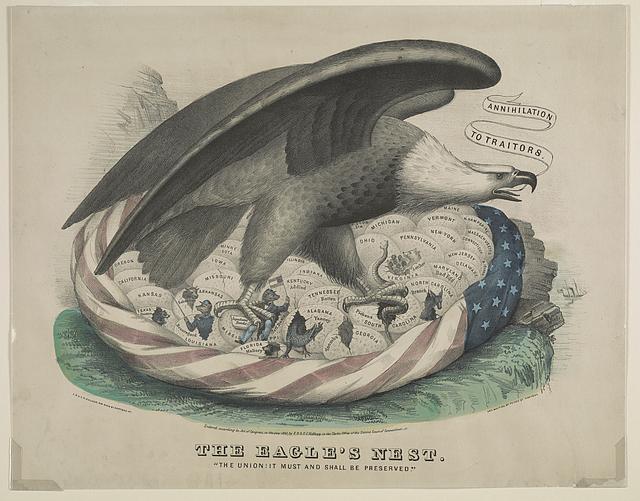
Here’s an image from last year (1861) that I missed. It is the policy of the Lincoln administration, and I would think, many Northerners agree with the sentiment given how many men have volunteered so far. As long ago as 1830 President Andrew Jackson said the Union must be preserved in a toast. Also in 1830 Daniel webster said “Liberty and Union, Now and Forever, One and Inseparable” in a speech.

The Eagle's nest The Union! it must and shall be preserved. (1861; LOC: LC-DIG-ds-00989)

Sibling rivalry


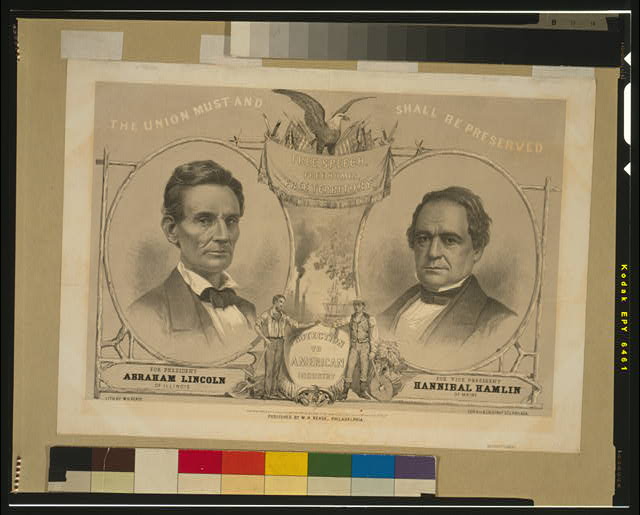
As you can see, the Lincoln administration is following through on the Republican platform of 1861:

The Union must and shall be preserved. For President Abraham Lincoln of Illinois. For Vice President Hannibal Hamlin of Maine (c1860; LOC: LC-USZC4-7996)

Sticking to their guns

Posted in American Society, Northern Politics During War | Tagged , , | Leave a comment

Telegraph Roadies

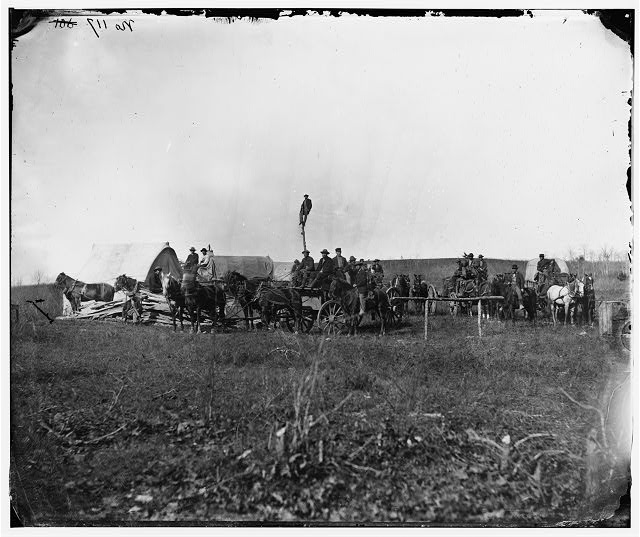
Brandy Station, Va. Wagons and men of the U.S. Military Telegraph Construction Corps (1864 February; LOC: LC-DIG-cwpb-03717)

Telegraph Construction Corps - 1864

From The New-York Times January 3, 1862:

IMPORTANT FROM WASHINGTON; … ARMY TELEGRAPHS. …

… WASHINGTON, Thursday, Jan. 2. …

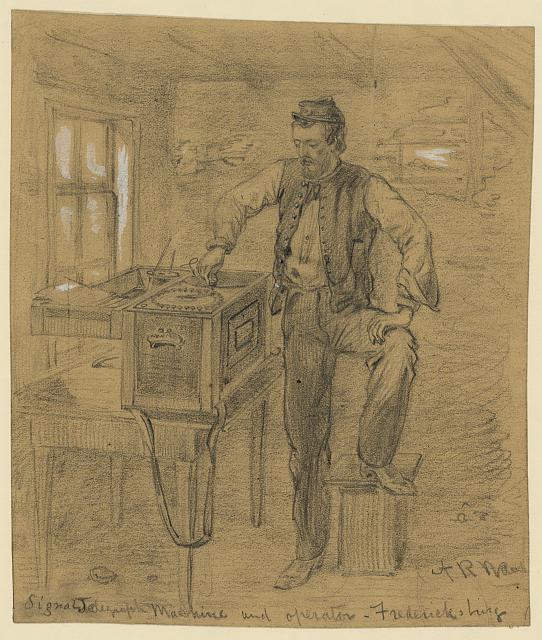
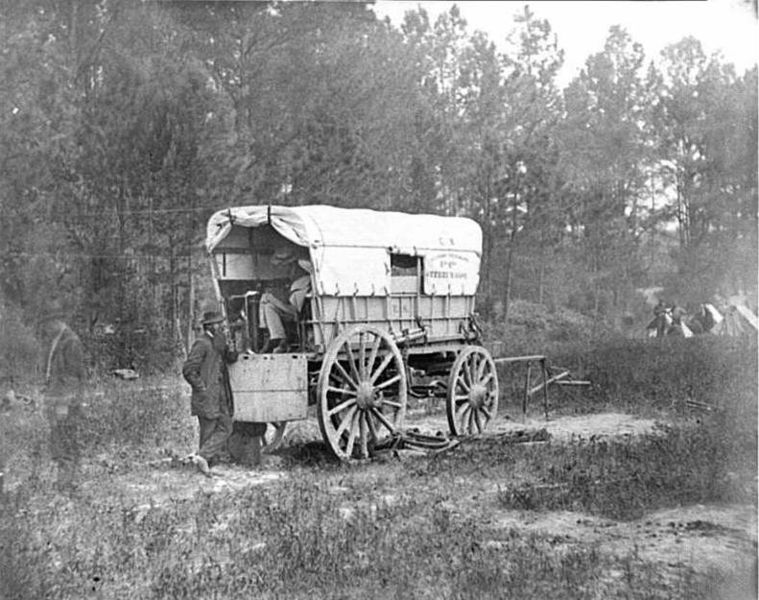
The Army Telegraph Corps have returned from Hancock, having completed telegraphic connection between Frederick and Wheeling. They will next proceed to Budd’s Ferry, and extend the telegraph line from thence to Point Lookout. A cable will be run from there to Fortress Monroe. …

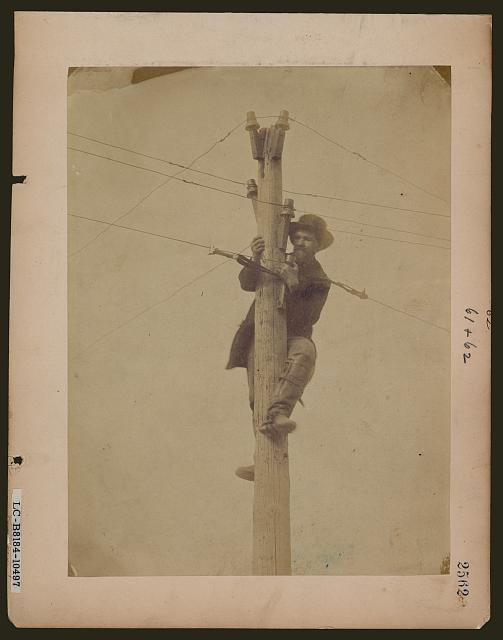
The U.S. Military Telegraph Corps included operators and the Telegraph Construction Corps, which “built a total of 15, 389 miles of field, land, and submarine telegraph lines” during the Civil War. According to Google Maps about 225 miles would have been run between Frederick, Maryland and Wheeling in western Virginia. The Construction Corps even built lines during the course of a battle. The U.S. Military Telegraph Corps was mostly a civilian organization. Both the CSA and the USA developed military signal corps during the war. There is a section on the two Civil War Signal Corps (as well as some information on the civilian Telegraph Corps) in Getting the Message Through by Rebecca Robbins Raines.

[Worker repairing telegraph line? (ca. 1862 or 1863; LOC: LC-DIG-ppmsca-10408)

Exposed position

Signal Telegraph Machine and operator - Fredericksburg (by Alfred R. Waugh, 1862 ca. December; LOC: LC-DIG-ppmsca-21043)

Letting his fingers do the talking

Petersburg, Va. U.S. Military Telegraph battery wagon, Army of the Potomac headquarters (1864 June; LOC: LC-DIG-cwpb-04330)

U.S. Military Telegraph battery wagon - Petersburg, Va., 1864

Posted in 150 Years Ago This Week, Military Matters | Tagged , , | Leave a comment

Janus Looking Ahead

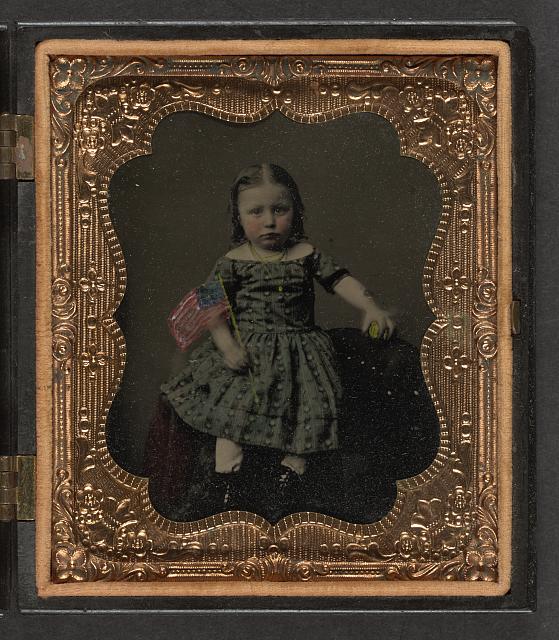
Unidentified girl in dress holding American flag and ball (between 1860 and 1870; LOC: LC-DIG-ppmsca-36923)

Training us early

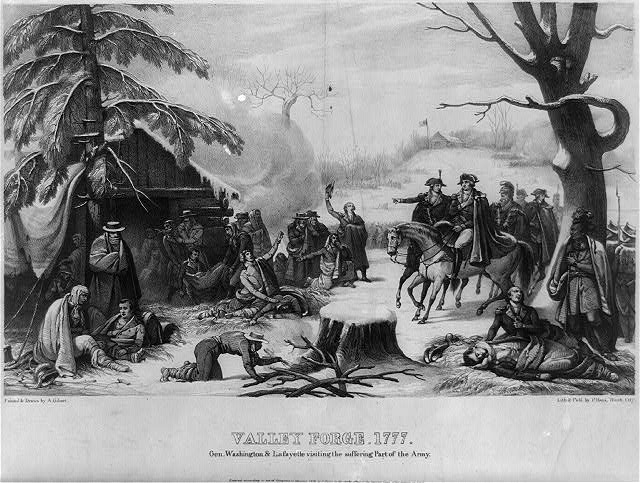
At first I thought the following would be great to include in yesterday’s post because it referred to 1861. But really this must have been a poem filled with faith and hope for the future because the Union armies had mixed success against the rebels in 1861. This isn’t really my taste in poetry, but I can see how it would help buoy the spirits of Union-loving people in Seneca County. Of course, I sort of bit on the allusion to the bloody feet at Valley Forge.

At any rate, the following was published in a Seneca County, New York newspaper sometime in 1861:

For the Courier.

THE VETERAN OF “’61.”

Father, that little flag you gave
      To brother Will and I, –
With pretty stripes of white and red
      And bit of starry sky, –
We raised upon a pole, to-day,
      And as we made it fast,
A poor old man, with but one leg,
      Came hobbling slowly past.

“That’s right, my little men,” he said –
     A tear shone in his eye, –
“Send up your tiny stars to join
     Their comrades in the sky!
For that good flag I lost this leg,
     When we the vict’ry won,
And crushed Secession’s hydra-head
     In eighteen sixty-one.

“The colors of that flag, my boys,
     Were hallowed years ago,
When from starving patriots’ feet
     Blood mingled with the snow!
Whilst for each a State a star of hope
     Shone brightly in the sky,
Directing them to ‘trust in God
     And keep their powder dry!'”

The old man told more stories, then
     Of ANDERSON the brave,
And ELLSWORTH who so sweetly sleeps
     In a patriot’s grave.
It made us wish that we were men,
     And we’ve resolved to-night,
When we get big we’ll raise our flag
     And battle for the Right!

F.M.B.

Valley Forge, 1777. Gen. Washington and Lafayette visiting the suffering part of the army (Wash(ington) City : P. Haas, 1843; LOC: LC-USZ62-819)

"Blood mingled with the snow!"

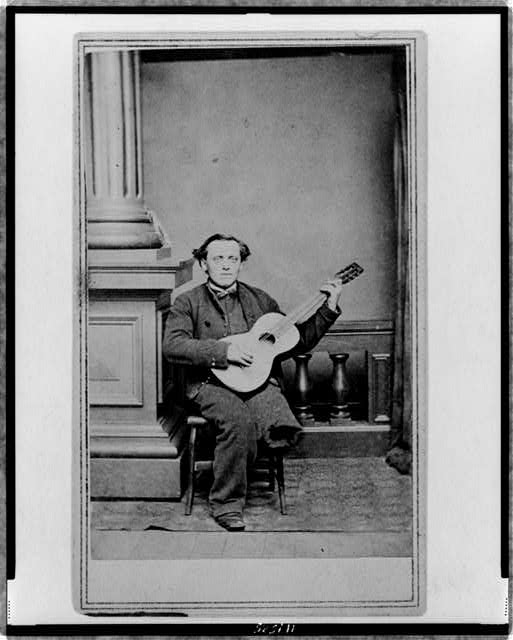
Civil War soldier, with one leg, full-length portrait, seated, facing front, holding guitar (between 1861 and 1880; LOC: LC-USZ62-119585)

Sacrifice for the Right?

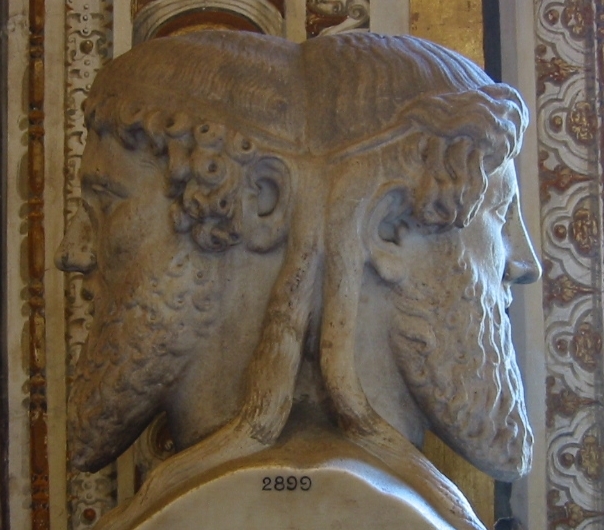
Bust of the god Janus, Vatican museum, Vatican City.

First month's namesake

My wish for whoever lands on this post: a 2012 with as much worthy peace and prosperity as possible

Posted in American Culture, American History, Northern Society | Tagged , | Leave a comment

Janus Looking Back

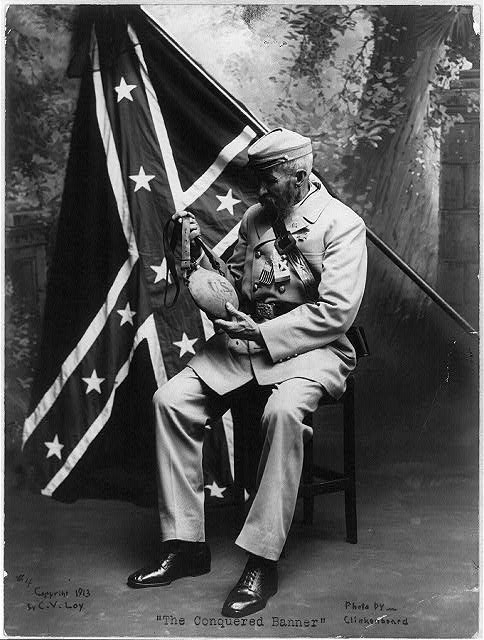
The Conquered Banner (c1913; LOC: LC-USZ62-64127)

Lookin' back

I love this photo from about 1913. It could be an exercise in a creative writing class – tell a story based on the image. An old Confederate thinking about the battle from fifty years ago. Parched and scared he ripped the US canteen from a dead Yankee. Or, they say the American Civil War was a brothers’ war because brothers were known to fight for opposing sides (although as The 48th Pennsylvania Infantry … points out it was more likely that a group of brothers would fight and die for the same country). Maybe the canteen belonged to this old man’s now deceased brother. Where’s Stephen Crane when you need him?

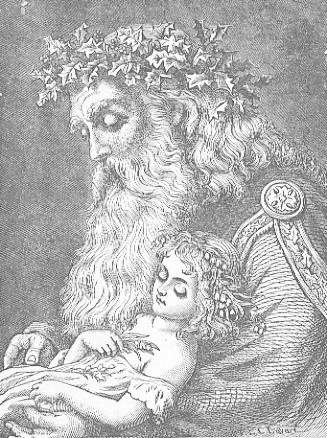
Father Time and Baby New Year from Frolic & Fun, 1897

Happy New Year!

Posted in American Culture, Confederate States of America, Southern Society | Tagged | Leave a comment

Mrs. Wigfall Makes a Flag

L.T. Wigfall, Brig. Gen. CSA (between 1860 and 1870; LOC: LC-DIG-cwpb-06774)

His bride's wedding dress used for flag

From the Richmond Daily Dispatch December 31, 1861:

Singular State flag.

–The flag of the Texas camp, at Camp Wigfall, near Dumfries, Va., is made of the bridal dress of Mrs. Wigfall. Says the correspondent of the Austin Gazette:

It bears the emblem of the “Lone Star,” and this is of pure white silk, set in blue ground; the fold are purple and white. The hearts of all are riveted to it. It never will be given up. An old war-worn warrior approached it, and as his eyes gazed steadily upon the banner, he said: “That star was made of the bridal dress of the lady of our gallant colonel. She worked it with her fair hands, and gave it to us to carry through the battles of our country. How could we fall to protect. How could we fall to protect it with our lives? No, Sir! I never failed to meet the enemy when that star was our watchword, and now when our whole South is in danger, I feel that my poor life can be given up easily upon that flag as my shroud.” The old fellow with his grey heirs, still stands before my memory. Such is the feeling of every Texan.

Originally from South Carolina Louis Trezevant Wigfall was a flamboyant, fire-eating U.S. senator from Texas until March 1861. He had an unauthorized role during the April 1861 bombardment of Fort Sumter. He then took up arms for a brief period:

… Wigfall secured an appointment to full Colonel of the 1st Texas Infantry Regiment, and a rapid promotion thereafter to Brigadier General of the “Texas Brigade” in the Confederate Army. He took up residence near his encamped troops in a tavern at Dumfries, Virginia, during the winter of 1861–1862, where he would frequently call the men to arms at midnight, imagining a Federal invasion. His nervousness was blamed on his fondness for whiskey and hard cider. He appeared visibly drunk, on and off-duty, in the presence of his men on more than one occasion. He resigned his commission in February 1862 to take a seat in the Confederate Senate, and was replaced by John Bell Hood.

I wonder if that Dumfries tavern was hopping on New Year’s Eve 1861?

The_Texas_Brigade (Hood's Texas Brigade in the winter of 1861/1862, along the Potomac River. Retouched image.)

Texans along the Potomac - Winter 1861-62

Posted in 150 Years Ago This Week, Confederate States of America, Military Matters | Tagged , , | 1 Comment

Relative Quiet in York County

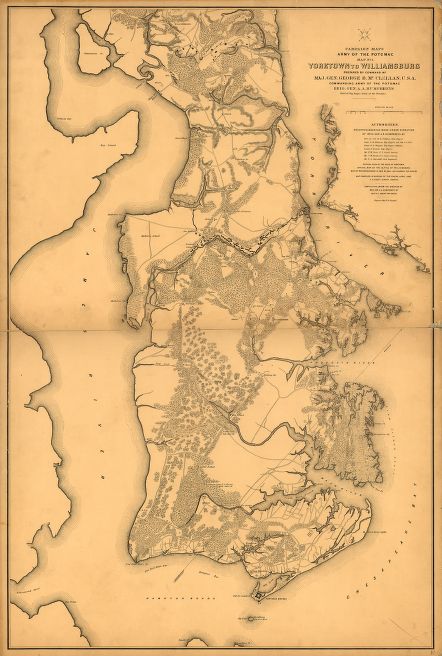
Union mapping on the Peninsula - 1862

Union mapping on the Peninsula - 1862

Some Christmas Eve southern patriotism from the Virtus correspondent of the Dispatch. Virtus does not think there will be any general advance on up the Peninsula because it is too well defended and because the Yankees seemed to be too well satisfied with just plundering the region.

From the Richmond Daily Dispatch December 30, 1861:

[correspondence of the Richmond Dispatch.]

York County, Va. Dec. 24.

For the last two or three weeks, this peninsula has been in a whirl of excitement. Rumor after rumor in rapid succession has prevailed, of an immediate attack on Yorktown. The rapid movement of troops from point to point, has led many to believe there was serious foundation for these rumors.

The military, almost without exception, have hoped there might be a fight on hand, for they are tired of the mere routine of the camp, and want something a little more stirring. Besides, they say they came here to fight, and long to meet the invaders, not doubting the result. But some of the citizens — especially those without “the lines”–have been alarmed, not doubting that if the vandals do advance, the scenes which have been enacted in the vicinity of Hampton would be repeated wherever the enemy should come. As yet, however, no very decided move has been made.–The enemy seems to be satisfied to remain within his strong holds at Old Point and Newport News.

An occasional pillaging party, however, venture a little further. On Sunday last quite a large body of this description, said to be a full regiment, ventured a little this side of New Market. They were here met by a party of about three hundred of the 8th Alabama regiment, (Col. Winston’s,) and a skirmish ensued, in which, as usual, the enemy were repulsed. Their loss I have not learned definitely. Several, however, were seen to fall. Some prisoners were taken, and, as a trophy, a United States flag was brought off by our men. One man was killed and two wounded on our side.

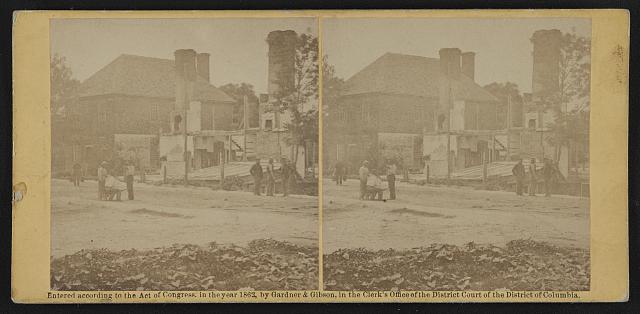
Headquarters Gen'l Magruder, Yorktown (ew York : E. & H.T. Anthony & Co., c1862; LOC: LC-DIG-stereo-1s02888)

Confederate General Magruder's Yorktown Headquarters - in stereo!

It is not necessary nor politic that any definite information should be given through the papers concerning the defences of this peninsula. I may, however, in general terms, say that they are so numerous, so strong, and so well located that, whether the attempt should be made by either river or by land, an “On to Richmond” from this quarter is among the things least to be apprehended. Batteries, masked and unmasked, are in readiness at every point, where there is the least probability of an approach; and I hazard nothing in saying that, come when or where they may, another Bethel awaits them. They seem, however, too well satisfied with such exploits as robbing hen roosts and destroying furniture to venture a battle with Southern patriots. Virtus.

The Eighth Alabama Infantry Regiment is said to be “the first Confederate regiment to be enlisted for the war.” It’s first colonel, John Anthony Winston, was a two-term Alabama governor, first elected in 1853. He had a relatively short stint serving in the army: “Disliked because he was a stern disciplinarian, he resigned on June 16, 1862 because of chronic rheumatism.”

Posted in 150 Years Ago This Week, Confederate States of America, Military Matters | Tagged , , , | Leave a comment