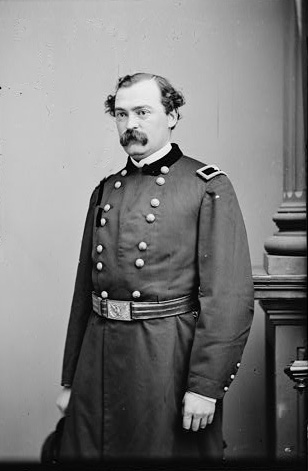
19th NY Will Convert from Infantry to Artillery

Gen. Ledlie (between 1860 and 1870; LOC: LC-DIG-cwpb-04501)

James Ledlie gets 19th changed to artillery

It’s been almost four month since we’ve heard from the 19th NY Volunteer Infantry from the Auburn, New York area. A few things have been happening, but no fighting to speak of. Since the end of September they had been stationed at Muddy Branch, a tributary of the Potomac in Maryland. The regiment’s main job was to guard the supply train that brought the goods from Washington to General Nathaniel Banks’ army.

Throughout October and November the 19th suffered mass desertions such that “by December 1, 1861 the regiment mustered only 542 men, with only 425 present fit for duty.”[1] James H. Ledlie was promoted to colonel on November 18th. In early December “Seward’s Regiment” moved from Muddy Branch to winter quarters near Frederick, Maryland. But probably the biggest news was succinctly reported earlier this week (150 years ago).

From The New-York Times December 13, 1861:

THE NINETEENTH NEW-YORK AN ARTILLERY REGIMENT.

The Nineteenth New-York Regiment, Col. LEDLIE, was to-day, by order of the War Department, changed from infantry to an artillery regiment, to comprise twelve batteries, a portion of which consists of heavy guns.

Politics apparently made this conversion possible. The following is from Cayuga in the Field, published in 1873. (Henry Hall must have gotten this account from one of the participants, presumably James Ledlie):

More ambitious plans now began to be rife in the regiment. A proposition made for conversion into artillery met with universal favor. Col. Ledlie, who was very popular in the army, and had great influence at Washington, undertook the delicate responsibility of seeing what could be done at the Capital about it.

Repairing to Washington, he met Gen. McClellan and Gov. Morgan, one day at dinner, at Mr. Seward’s. The conversation turned upon the needs of the army, and the heavy fortifications then being built for the defense of Washington. A necessity for additional engineers to build and artillerists to man these forts had then recently been made manifest to Gen. McClellan by Gen. Barry, of the Engineers. Advantage of the fact was taken by Ledlie, who with infinite tact brought forward the claims to notice of his regiment. Gen. McClellan said :

“Colonel, how would you like to have your regiment converted
to engineers?”

He replied, “If you want to do anything for me, General, I
can tell you something I would like better than that?”

“What is that ?”

“Give me authority to raise an artillery regiment.”

Gov. Morgan heartily seconded the proposition, promising to do everything in his power to aid in raising the regiment, and Sec’y Seward presented a number of forcible suggestions on the subject The subject was dismissed with an invitation to Ledlie to call and see McClellan next day.

At the appointed hour Secretary Seward accompanied him to the headquarters of the General. After a brief interview, it was arranged that an artillery regiment should be raised in New York State, 1,900 strong, with the 19th Volunteers as a nucleus, and the Adjutant-General was given instructions to make out the necessary papers. Col. Ledlie communicated the pleasing news to his officers, and on December 4th went North to raise his command.

James Ledlie was charged with dereliction of duty during the Battle of the Crater. You can read the details at the Wikipedia link above.
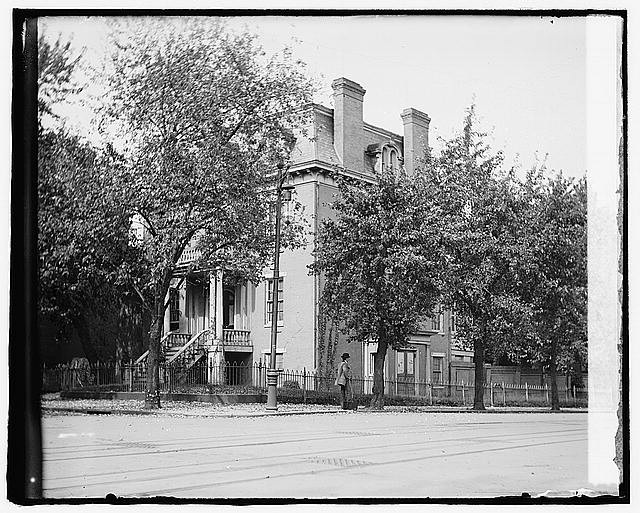
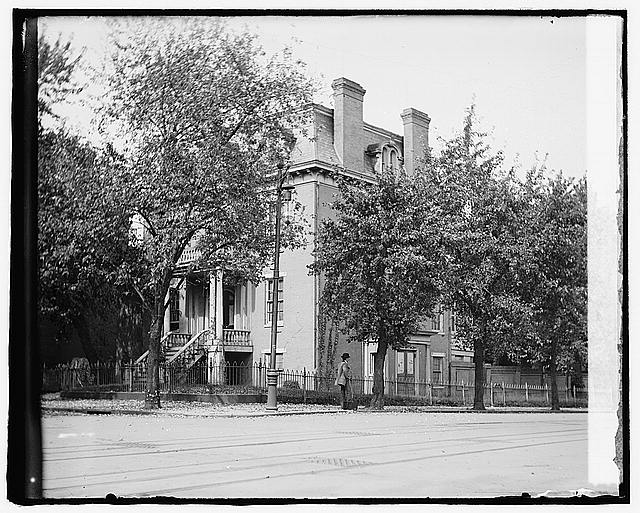
McClellan's Headquarters (1861-62), 17th & I St., S.W., Washington, D.C. (between 1918 and 1920; LOC: LC-DIG-npcc-000630

McClellan's headquarters - where the deal was finalized

  1. [1]Henry Hall and James Hall, Cayuga in the Field, 1873, Auburn, N.Y. p.80
Posted in 150 Years Ago This Week, Military Matters | Tagged , , , , | Leave a comment

Missed-cellany #1: Got Pass?

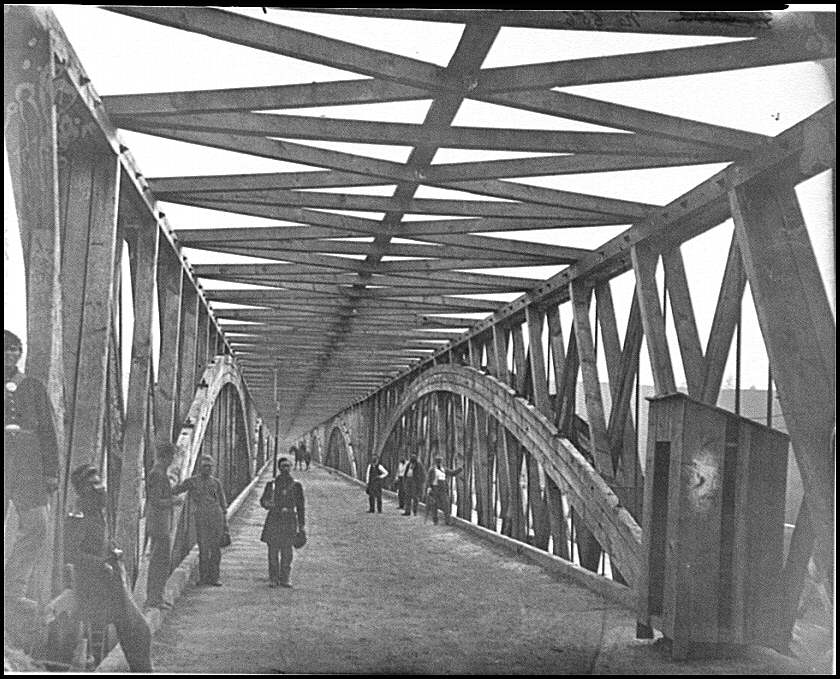
Washington, D.C. View across Chain Bridge over the Potomac (1865; LOC: LC-DIG-cwpb-04113)

Chain Bridge - 1865

I’ve mentioned that the Seneca Falls, New York public library contains a couple three-ring binders full of local newspaper clippings from the Civil War era, divided by year. At first, I did not see a specific date associated with the following article. Come to find out, I’m a couple months late.

From a Seneca County, New York newspaper October 3, 1861:

THREE CHEERS FOR DICK VAN DUSEN

– If what we hear of Dick – who belongs to Capt. Guion’s Company – be true, he has proved himself a trump, as a soldier. It is said that he was guarding the approach to the Chain bridge, on the Virginia side, when President Lincoln’s carriage, containing himself, Gov. Curtin and one or two other notables, approached to cross the bridge. Dick brought the carriage to a halt and demanded General McClellan’s pass, when he was told that the President was one of the party. “I don’t know the President,” said Dick, “but if he has a pass from Gen. McClellan he can cross the bridge – if not, he can’t – so there’s no use of talking.” Dick put himself in a position to charge bayonet, and “Old Abe” turned back and procured the required document, when the faithful sentinel said, “All right,” and the magnates went on their way rejoicing. One of Gen. McClellan’s Aids soon after rode up to Dick and inquired his name; when he replied in the most emphatic style: “My name is Richard Van Dusen, by J–, of Seneca Falls, State of New York. I belong to Company A, 33d Regiment of New York Volunteers.” We should not be surprised to learn that he had been promoted for his fidelity.

– especially given the antagonism General McClellan felt toward President Lincoln, that meddling civilian, that “rare bird” [1].

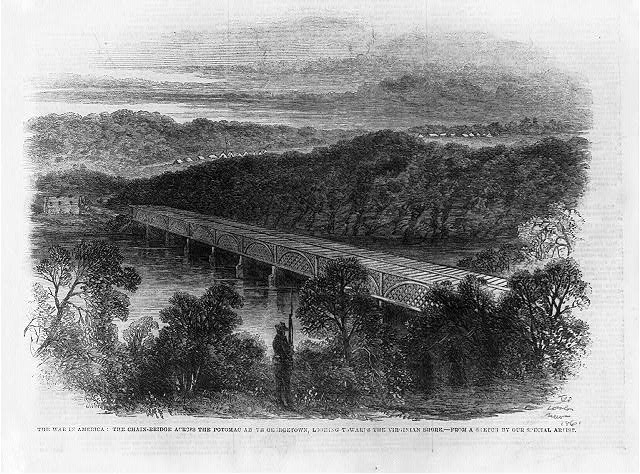
The war in America: the chain bridge across the Potomac above Georgetown, looking towards the Virginian shore (1861; LOC: C-USZ62-73343 )

Chain Bridge looking toward Virginia

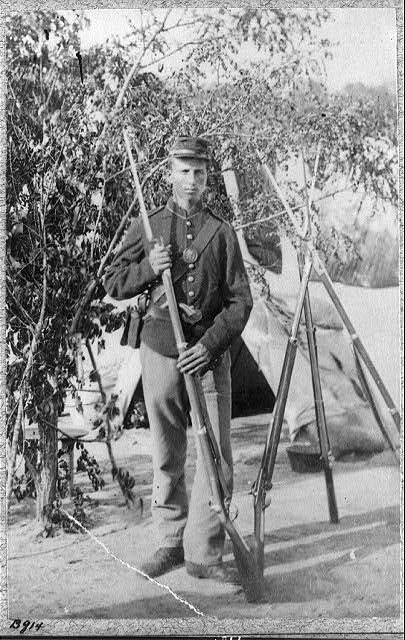
33d New York Infantry (between 1861 and 1865; LOC: LC-USZ62-99872)

soldier of 33rd New York with bayonet at the ready

Companies A and K of the 33rd New York Infantry Regiment were recruited at Seneca Falls. On August 6, 1861 the 33rd “moved to Camp Lyon near Chain bridge on the Potomac; was there assigned to Smith’s brigade and was employed in construction work on Forts Ethan Allen and Marcy during September.” During the time this story took place the regiment was quartered at Camp Ethan Allen. The following is from a report by the New York Adjutant-General in 1900 providing registers of various regiments:

Dick Van Dusen 33rd NY Infantry

Dick was one of many older volunteers

I like this story, although I have a very vague memory that I may have heard something similar before. I’m not sure; it might even have been in a different war. That reminds of something else I wanted to mention. Back in April Seven Score and Ten published an account of of Confederate troops making lemonade out of lemons by staging an official funeral procession to bury a lot of bad pickled beef. The Seneca County newspaper published a similar story from the training camp in Elmira, New York sometime after April. It doesn’t surprise me that there was bad food in both Pensacola and Elmira. Maybe the Elmira troops appropriated the funeral idea from the Confederate troops.

  1. [1]see Oates, With Malice Toward None p287-288 paperback edition
Posted in Military Matters | Tagged , , , | Leave a comment

Taunted in Toronto

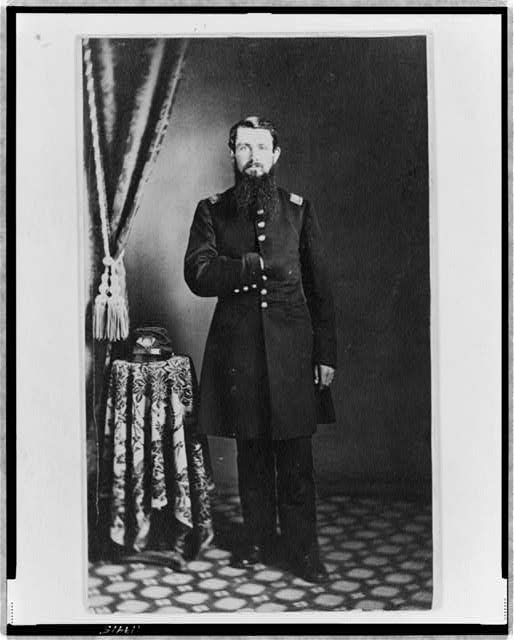
Unidentified Union officer, full-length portrait with right hand in coat, facing front (between 1860 and 1870; LOC: LC-USZ62-119415)

His only coat?

Apparently some Union soldiers are on leave in Canada – and getting razzed by a few Torontans.

From The New-York Times December 15, 1861:

HOW AMERICANS ARE TREATED IN TORONTO.

The following characteristic article appears in the Toronto Leader:

“An officer of the Federal army has been parading the streets of Toronto in full dress, these two or three days. He is in bran-new, bright and shining Yankee uniform; and some indignation has been excited by the impertinent display. It is remembered that a British officer, off duty, in his own town, wears a plain undress garb; and that in another country he would appear as an ordinary civilian. Northern officers, it is said, should behave with equal propriety. Perhaps, however, the suggestion presupposes too much. Our visitor may not have another coat. While parading King-street yesterday, several young urchins, as well as one or two “children of larger growth,” cried out loudly, “Bull Run!” but instead of blushing for his country, he seemed to acquire a more magnificent strut by the notice he attracted, uncomplimentary as it was. The display reminded one of the immortal “Petaw,” who, had he been present, would have seen his honor incontinently vanish.

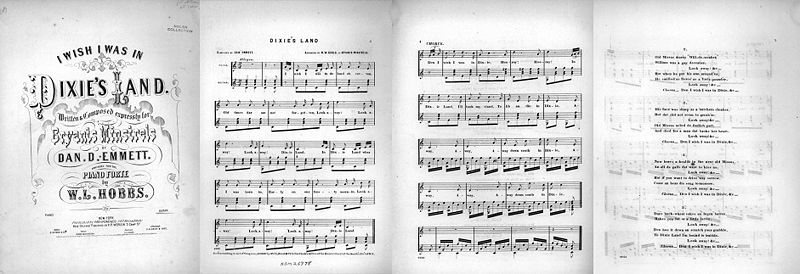
Dixe's_Land_Sheet_Music

Rousing tune in a Toronto saloon

On Friday evening last a scene occurred in one of our favorite saloons which shows the current of popular opinion in this city. A valiant warrior clothed in the blue and brass of the United States service entered and seated himself at one of the tables. A Southerner in the room — a gentleman from Louisiana unable to get home — betrayed considerable excitement, and presently called for “Dixie’s Land.” The musicians struck up the air, which in this neighborhood is understood to be particularly offensive to the North, and the voices of all in the crowded saloon joined in the loud and stirring chorus. The Yankee soldier looked abashed, and something being said about Bull Run, he soon beat a hasty retreat amid the laughter of all present.” 

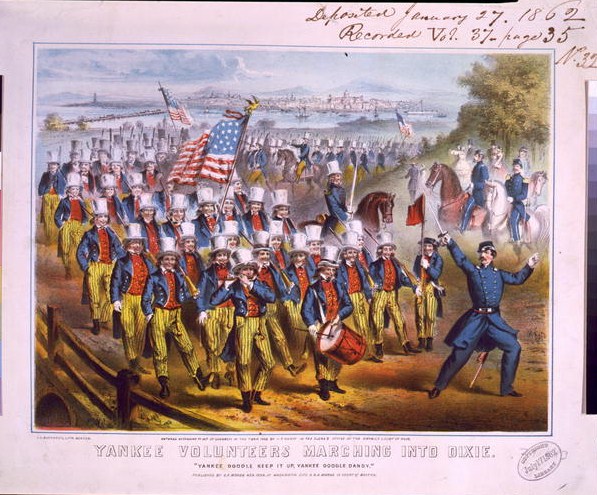
Canada was ambivalent during the American Civil War, sort of like the (Dis)united States themselves and even the song Dixie , which had both southern and northern lyrical versions during the Civil War.

Yankee volunteers marching into Dixie (music cover c.1862; LOC: LC-USZ62-4440)

1862 music cover shows army of Brother Jonathans invading Dixie - now that's brash

Posted in 150 Years Ago This Week | Tagged , , , | Leave a comment

Seminary Justice

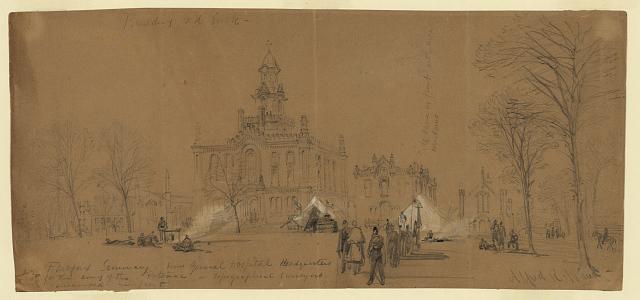
Fairfax Seminary now General Hospital Headquarters for the Army of the Potomac (Alfred R. waud between 1860 and 1865; LOC: LC-DIG-ppmsca-21051)

Fairfax Seminary

From a Seneca County, New York newspaper December 1861:

Army Correspondence

FAIRFAX SEMINARY; Va., Dec. 14.

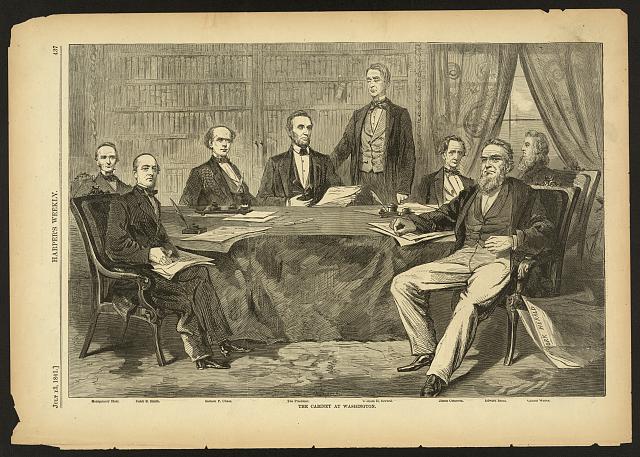
The anticipations of battle soon to be fought in Virginia, which a few days since were general throughout nearly all the camps around here, have ceased. General quiet prevails, and there is a feeling of partial indifference whether we have a fight or not. Not that there is any indifference to the cause of the Union.You can hardly find one in the ranks who does not well understand all the questions to be decided by the war. I believe a better army, – one composed of more intelligent and patriotic men – was never mustered. They are tired of inactivity. A prospect of the enemy’s advance upon us, or an order for our advance would be hailed with delight. But their confidence in the General-in-Chief is such that they are content to wait until he is ready. And if, as Mr. Seward is reported to have said, a battle and a victory would stand in the way of peace and the restoration of the Union; if our wise men can clearly see a better way than to annihilate the rebels, let it be so.

The cabinet at Washington (1861; LOC: LC-DIG-ppmsca-19482)

Leaving it to the Wise Men

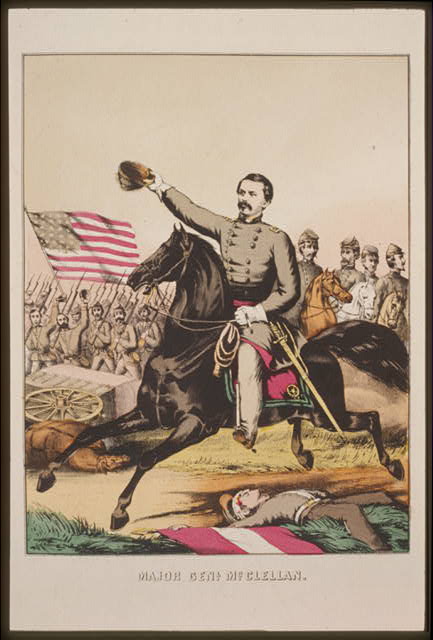
Major Genl. McClellan (1862?; LOC: LC-USZC2-3791)

General-in-Chief inspires confidence of troops

_________________________

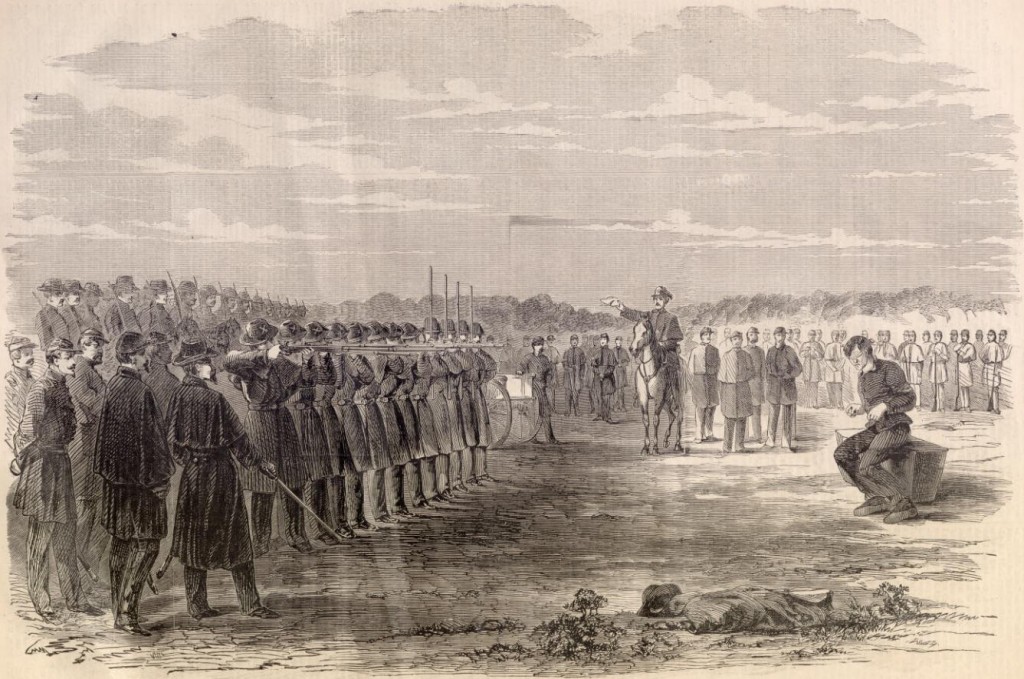
The only unusual occurrence that has transpired in this vicinity was the shooting, yesterday afternoon, of a deserter, W H Johnson of Co. D, First N.Y. cavalry (lately Lincoln cavalry) Regiment. For a long time Johnson’s conduct has been very strange, but it did not excite suspicion of disloyalty. He would frequently get away from his Company and be absent for a day or two, and no punishment would prevent a repetition when an opportunity occurred. – After his condemnation he confessed that at such times he was sending information to the rebels. While on picket duty recently, he rode beyond the Federal outposts, and was making his way toward the enemy, when he fell in with a body of Union infantry, which he mistook for a party of rebels, and said he had deserted to them. The officer in command pretended to be of the Confederate army, and to prove him, obtained much accurate information of the force and condition of the Union army. Of course he was brought back a prisoner, and yesterday, according to the sentence of the Court martial, he was shot in the presence of the whole of Gen. Franklin’s Division. The last sun of his life shone bright and beautiful upon him and the long lines of soldiers assembled to witness his execution. It was hard to see him stand before his executioners, the next moment to lie riddled with bullets. Two who lacked the courage to fire were immediately confined in irons to await their own trial. Such is the discipline required in war.

The unfortunate man died courageously, evincing a spirit worthy of a better fate. In the presence of his executioners he owned his guilt and the justice of his sentence.

firing-squad-execution on 12-13-1861

Execution of William H Johnson as he sits on his coffin

You can read an excellent article about the Execution of Pvt. William Henry Johnson at Civil War Washington, D.C.. This includes images from several period publications.

As always, the Harper’s Weekly account is provided by Son of the South. It is a detailed report.

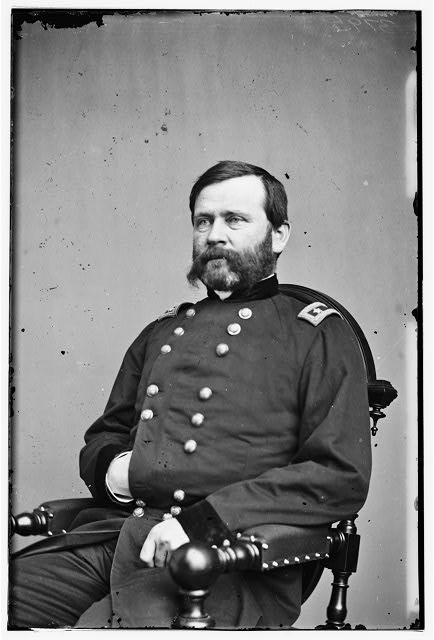
Portrait of Maj. Gen. William B. Franklin, officer of the Federal Army (Between 1860 and 1865; LOC: LC-DIG-cwpb-06688)

General Franklin - his entire division witnesses work of the firing squad

Posted in 150 Years Ago This Week, Military Matters, Northern Society | Tagged , , , , | Leave a comment

Message to Mac?

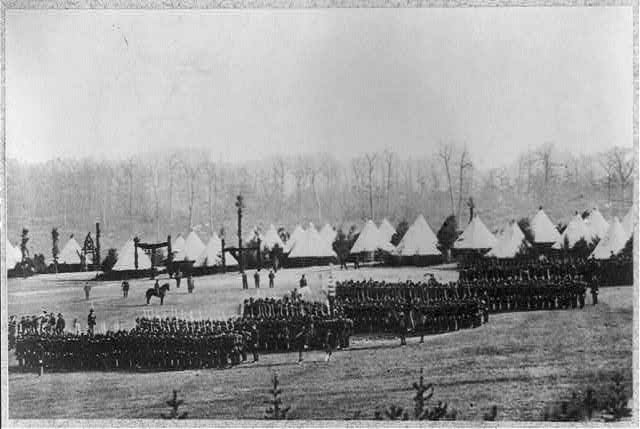
Civil War camp scene. Bird's-eye view of troops in formation and tents in backgrd (no date; LOC: LC-USZ62-82883)

Some of the 'too many'

From The New-York Times December 13, 1861:

NEWS FROM WASHINGTON….
VISIT OF THE INDIAN DELEGATES TO THE CAMPS. …

… The Indian delegates yesterday visited the camps in Virginia, and witnessed division drills and reviews. They expressed their astonishment and delight at the military power of the Government and their opinion of the statements of rebel Commissioners, by saying, “ALBERT — PIKE — lies.” One of the chiefs, with Senatorial dignity, said, “Too many — ought to move.” …

Albert Pike was a Confederate commissioner to the American Indian tribes. General George McClellan was taking his time getting the Union army “on to Richmond”.

McClellan's Headquarters (1861-62), 17th & I St., S.W., Washington, D.C. (between 1918 and 1920; LOC: LC-DIG-npcc-00063)

No place like ... headquarters

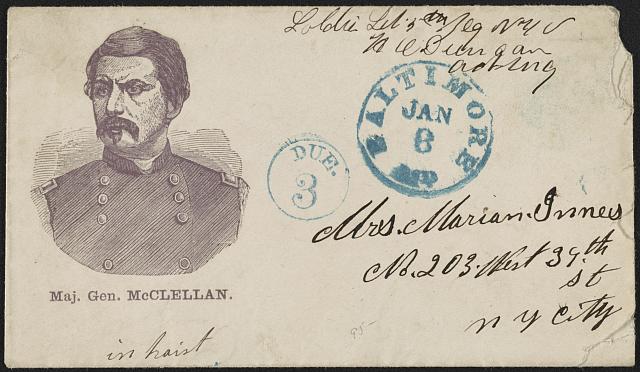
Civil War envelope showing portrait of Maj. Gen. McClellan (between 1861 and 1865; LOC: LC-DIG-ppmsca-31975)

The general moves - through the mail

Posted in 150 Years Ago This Week, Military Matters | Tagged , | Leave a comment

Fire Eats (part of) Charleston

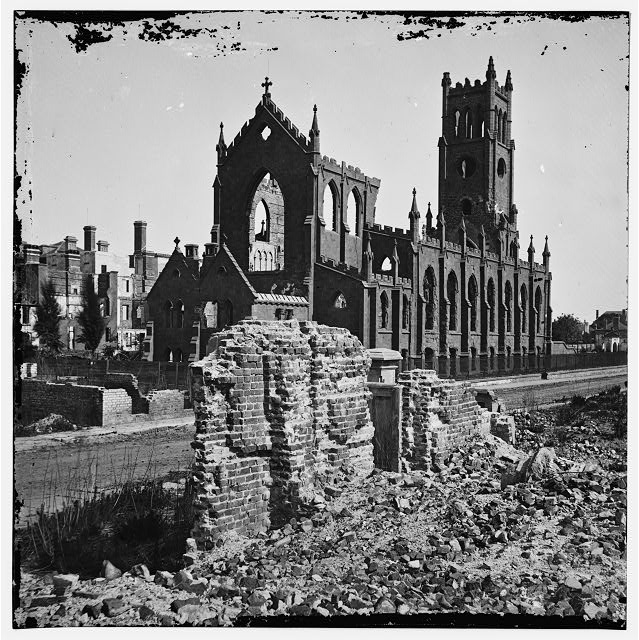
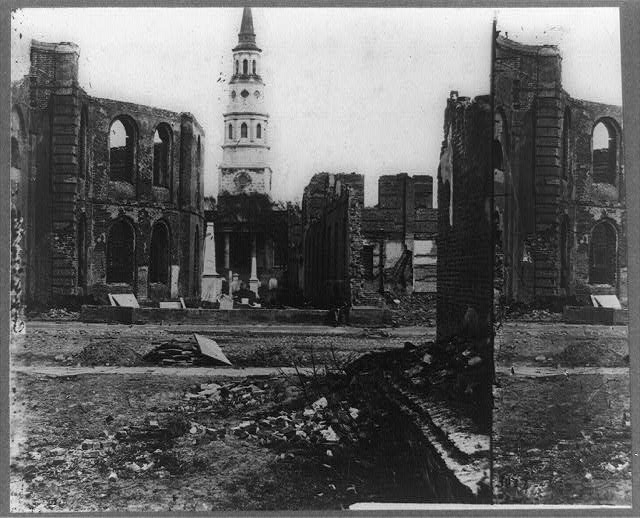
Charleston, S.C. Roman Catholic Cathedral of St. John and St. Finbar (Broad and Legare Streets) destroyed in the fire of December 1861 (Aporil 1865; LOC: LC-DIG-cwpb-03041)

Some of ruins from December 1861 fire

On the night of December 11 – 12, 1861 a large portion of Charleston, South Carolina burned. The Richmond Daily Dispatch of December 14, 1861 printed Jefferson Davis’ reaction, in which the CSA president urged Congress to appropriate some money to Charleston to help deal with the loss. Apparently the Confederacy was in debt to its member states anyway, so sending some money to the ravaged city would be sort of an early (partial) repayment to South Carolina:

The Great fire in Charleston.

…To their [?] of the Confederate States.

The calamity which has laid in waste a large portion of the city of Charleston, calls for our sympathy, and seems to justify the offer of and in the manner hereafter suggested. The State of South Carolina will no doubt desire to assist the people of Charleston in their hour of need but, as her resources are now to the utmost in resisting the invasion of her soil, the prompt intervention of this Government may not be deemed unsuitable to the occasion. The State of South Carolina, in common with the other States was made liberal advances on account of the war and this Government is unquestionably largely her debtor. With the existing pressure upon her resources, it is probable that her desire to aid the suffering city of Charleston may be restrained by other demands upon her available means. Under such circumstances. may we not exhibit our sympathy with her people by an offer to place at the control of the Legislature of the State, now in session, a portion of the sum we owe her? The magnitude of the calamity affords the reason for making an exception in her favor; and promptness of action will manifest, in the most appropriate manner, the sincerity of our regard for the people of that gallant State, and our entire sympathy in all that concerns them. I recommend, therefore, that Congress make an appropriation of such amount as may be deemed sufficient for the purpose proposed, to be placed at the control of the authorities of the State of South Carolina. Jefferson Davis.

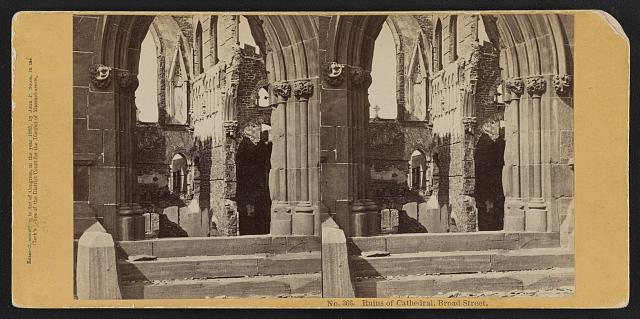
Ruins of Cathedral, Broad Street (c1865; LOC: LC-DIG-stereo-1s02488)

Still ruined over three years later

Mr. Kenner offered the following resolution to make an advance to the State of South Carolina on account of her claims against the Confederate States:

Resolved, That the sum of two hundred and fifty thousand dollars be and is hereby appropriated as an advance on account of any claims of the State of South Carolina upon the Confederate States and that the same be paid to such person as may be authorized by the Legislature of South Carolina to receive the same.

The resolution passed unanimously.

The New-York Times of December 18, 1861 has a good recap of the fire and its aftermath. It finishes with a paragraph comparing Charleston to Manhattan and then concludes, “The leaders of the rebellion were themselves going to fire the town on the approach of the National forces; so the present destruction only forestalls their action.” Union forces have had a presence in the Port Royal area since November 7th and seem to be gradually fanning out.

Thanks to the Son of the South you can read the Harper’s Weekly December 28, 1861 account of the fire and see a lot of images of pre-conflagration Charleston.

If you go to this page at Historic Charleston Foundation and put a check in “1861 Fire” you can see where the fire raged.

And it’s only about eight days until South Carolina would be celebrating one year of independence from the United States.

Ruins of Circular Church and Secession Hall, Charleston, S.C., St. Philips Church in distance (photographed 1863 April, printed later; LOC: LC-USZ62-90578)

Secession Hall in ruins

Posted in 150 Years Ago This Week, Confederate States of America, Southern Society | Tagged , , | 1 Comment

Bad Flag Day

Stars and Bars with 13 stars used November 1861-may 1863

old wine skin not fit for new wine

This editorial from the South is urging a different flag for the Confederacy. The “Stars and Bars” is too similar to the “Stars and Stripes”. Battlefield uncertainty has even included deaths from friendly fire because of the similarity (“bit the dust” was an expression used 150 years ago). Moreover, if The Confederacy is supposed to be a new venture that breaks the ties to the tyranny of the old Union, shouldn’t the CSA have a fresh flag, not a mere alteration of the despotic “Stars and Stripes”?

From the Richmond Daily Dispatch December 9, 1861:

The Confederate flag.

–We referred in our last to the peculiar difficulties, in a war between people of the same race, of distinguishing friends from foes. Numerous and melancholy have been the instances already in the present contest of friends killed by friends. These are the saddest stories of all — sad for the dead, sad for the living. At Manassas a galling fire was poured by the — Mississippi into the 8th Georgia regiment, already decimated by the enemy, and many a gallant fellow bit the dust. Surely did the former lament their mistake, but too late to recall life or heal wounds. These sad histories must have another depressing and disastrous influence. If soldiers entertain a shadow of doubt as to the character of the columns before them — if there be a remote suspicion that they may be friends — what must be the effect upon their fighting? They cannot half fight — their hands are tired, their nerves unstrung, by the cruel uncertainty. Tears of blood would not suffice could some of the harrowing incidents be here detailed, occasioned by such mistakes.

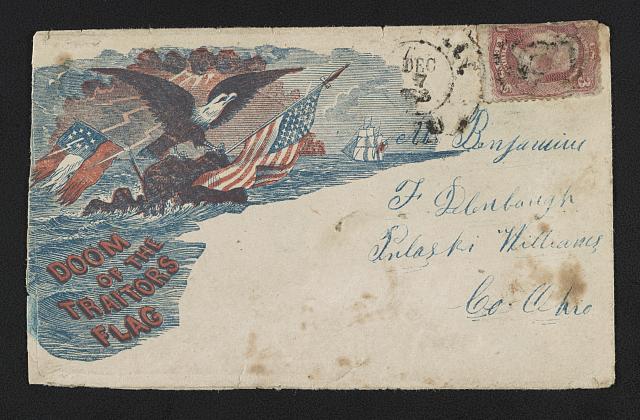
Civil War envelope showing eagle with American flag as 7-star Confederate flag is hit by lightning with message "Doom of the traitors flag" (between 1861 and 1865; LOC: LC-DIG-ppmsca-31727)

Union take on traitor flag

Numerous well authenticated instances have occurred of mistakes as to the flags, growing entirely out of their close resemblance to each other. We intended to refer to some of these at Charleston, in Western Virginia–to the case of the Minnesota regiment, which escaped capture by this means — to the capture of Col. Boone–but the single instance referred to by Gen. Beauregard himself, in a late speech, is evidence enough and to spare. In the decisive battle of the campaign (at Manassas) a body of troops were seen approaching from the rear of our left wing. Were they friends or enemies? The fate of the battle — almost of the country — depended upon the decision of this question. Although but a little over a mile off, the flag of our rapidly-approaching friends could not be distinguished from that of our foes, even by the aid of powerful glasses. Victory trembled in the balance. How awful the pause of uncertainly! It might have cost the battle. This single fact — and it is but one of many — is enough to excite one universal out-cry against the delusive flag. We have copied from that of our enemies. We have conquered in spite of it.

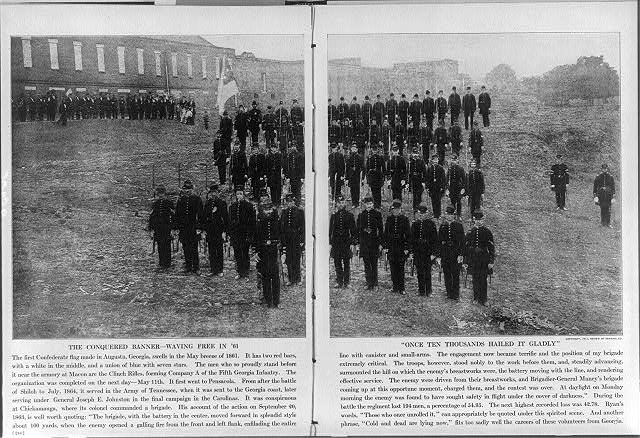
The Clinch Rifles (Co. A, 5th Georgia Infantry) in ranks outside the armory at Macon, Ga.; with the first Confederate flag. May 1861 (1861; LOC: LC-USZ62-50858)

Georgia regiment with May 1861 flag

No wonder that loads of these flags were sent to Richmond by Gen. Jos. Johnston to be altered. But in the name or wisdom, of patriotism, of common sense, let us have a flag that will do to fight under without patching. This is certainly a reasonable demand. Some even talk of a peace flag and a war flag. One flag is surely-enough, and the present is unit for either peace or war. It is so close to the old United States flag that one is on thorough in referring to it, lost he be suspected of treason. We have left the “Stars and Stripes” to our enemies, and are fighting them as the standard of bloody and implacable foes. So we are fain to talk of ours as “Stars and Bars.” How ridiculous we all feel this to be! Shall we perpetuate this nonsense — this mere make shift?

Its unfitness for a war flag is manifest and acknowledged. For what, then, is it fit? In the nature of the case, it can never excite the enthusiasm or devotion of the people. Even victory has not endeared it to them. Our forefathers, wiser than we, when they commenced to fight Great Britain did not adopt some modification of the British flag. They did not try to fight under and against the same thing at the same time. All the glorious achievements of our arms have failed to endear this flag to us. And why? There is a philosophy in it. It is because of its inseparable connection with the despotism against which we are struggling a death struggle. It has a taint about it which cannot be removed. It smells of tyranny — of the old body of death. It wants the virgin freshness of new flag. It is not the old flag, and if it were, the associations of the old have become polluted and corrupt. But we repeat, if the old flag is what we want, we don’t get it. They, our enemies, have the old flag, and we a mere copy. And just here it may be well to remark that we make as much fuss over this flag as if it were the revolutionary flag of our ancestors. But no battle of the Revolution was fought under it. It was never adopted till after peace. It is post revolutionary.

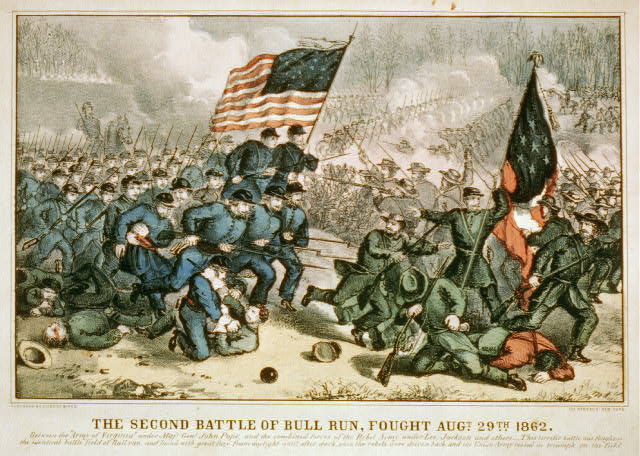
The second battle of Bull Run, fought Augt. 29th 1862. (Currier & Ives, 1862?; LOC: LC-USZC2-2991)

Too similar in heat of battle

It is high time to repair the unfortunate mistake. We have endeavored to put our new wine into fragments of old bottles. The bottles have burst, and the wine has been spilled. We have gained glorious victories, and the flag is no richer for them. It can never be made to hold. We will never get rid of the taint of that old flag. It is like a marriage ring after a divorce for infidelity. When we hate the marriage, we hate all its mementos.

There is and can be no enthusiasm for this flag, and this is the sole reason. Had we adopted a new one unbounded, independent, already the enthusiastic loyalty of the people to it would have known no bounds. We cannot afford to spill so many victories, and gain no love to the flag. Can we not design a new bottle; without taint, which can hold the loyalty and devotion of the people to the symbol of their country?

The Confederacy had a lot of flags during its four+ year history. The Richmond editor says that the South doesn’t need a “peace flag and a war flag” – but after 150 years it seems that the battle flag (which according to Wikipedia started being used in December 1861) sure became the best known and most strongly associated with the rebel cause.

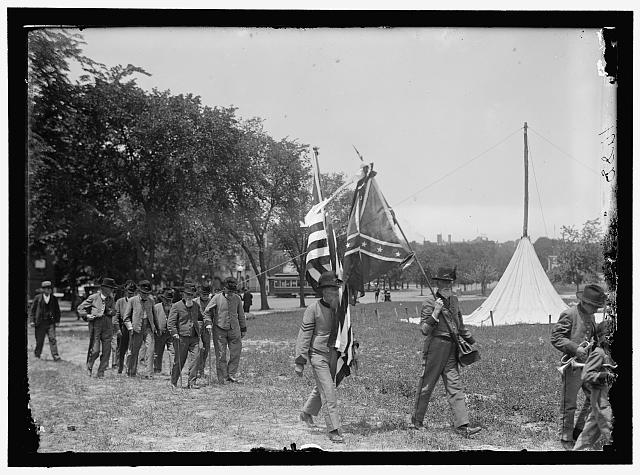
CONFEDERATE REUNION. NORTH CAROLINA VETERANS WITH FLAG (1917; LOC: LC-DIG-hec-08837)

Still flying 56 years later

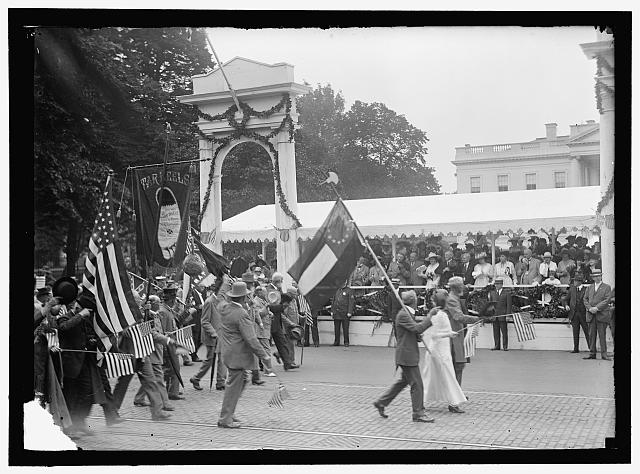
CONFEDERATE REUNION. W.E. PAYNE, WITH BATTLE FLAG (1917; LOC: LC-DIG-hec-08867)

Stars, bars, and stripes - 1917

Posted in 150 Years Ago This Week, Confederate States of America, Southern Society | Tagged | Leave a comment

Break Time

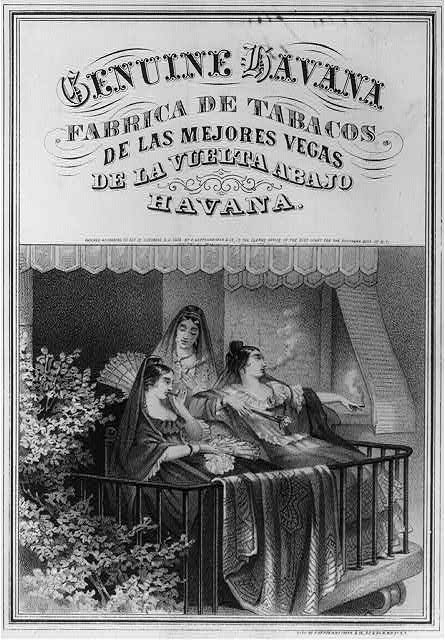
Genuine Havana ('Three Cuban beauties sitting on a balcony smoking Havana cigars'1868; LOC: LC-USZ62-78340)

Smoking Cubans

150 years ago today and over six months into the war, the Richmond Daily Dispatch was full of advertisements for a variety of products. One prominent theme was warm and water-proof gear for the military. One firm had on sale “ten very valuable Negroes”. Even with the blockade and war economy some luxuries were also on offer. W. D. Blair & Co was selling “Superior old brandy”. Foreign tobacco was also available:

Havana Cigars.

–A lot very fine Havana Cigars for sale by

Peterson & Co., Druggists.

Posted in 150 Years Ago This Week, Southern Society | Tagged | Leave a comment

Colonizing Florida?

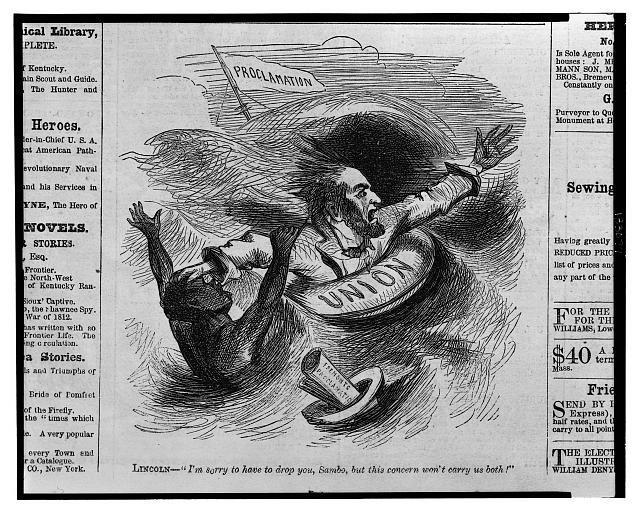
Lincoln- "I'm sorry to have to drop you, Sambo, but this concern won't carry us both!" (Frank Leslie's illustrated newspaper, 1861 Oct. 12; LOC: LC-USZ62-133077)

Abolitionist view of Lincoln's 1861 policies?

OBSERVER, a correspondent for The New-York Times thinks the Lincoln administration’s plans to colonize freed slaves would work better if the colony was in the rebel states – preferably Florida.

From The New-York Times December 8, 1861:

VIEWS FROM THE CAPITAL.; The Proposition to Colonize the Freed Slaves Florida a Proper Location for the Colony …

WASHINGTON, Thursday, Dec. 5, 1861.

The recommendation of the President to purchase a foreign territory on which to colonize the free people of color, and the slaves which are being emancipated by the rebellion of their masters evinces the conservative spirit which has ever actuated him, and gives the lie to the base falsehoods by which the traitors deluded the Southern people into an attitude of open hostility to the Government.

But in the actual condition of things, it may be doubted if the country is called upon, by a sense of justice to the rebels to incur the expense of a purchase of territory, and a transportation of the blacks beyond the limits of the Union. And the question arises, have we not within the Union, and far remote from the present loyal population of the South, the greatest abundance of territory suitable, and eminently suitable, for the abode of the negro race? What are the lowlands of South Carolina, Georgia, Alabama, Mississippi and Texas, together with the whole of Florida and Louisiana, fit for but the home of a negro population? I know that white men may live and labor in these warm and unhealthy districts; but nothing is more certain than that negroes are better adapted to them, and, indeed, eminently suited to them. These lowlands are nor the best portion of the cotton region, and I think it would be found on examination of the statistics of that culture, that much of the largest portion of the cotton crop is grown in the uplands, where white labor is practicable. I will venture to assert that the slaveholders of Texas have taken possession of the very best cotton lands in that State, and that those they have left untouched are for some reason less desirable. If, therefore, it be so important to cultivate cotton with white labor, an idea which seems to be very prevalent, the negroes must be removed. This will not be done immediately, if they are to be sent to remote regions, far beyond the limits of the Union. The most feasible scheme to get the negroes away from the healthy cotton-fields, and from the still more healthy corn, wheat and tobacco fields of the Middle and Northern Slave States, is to invite them to the rice-fields, and the swamps and hummocks of the low country. There is an ample amount of territory in these lowlands belonging to the States, and not to individuals, to support the negro population of the entire South. These swamp lands are inexhaustible in fertility, and they only need to be drained and cleared to become as productive as the valley of the Nile. If the Government desires to invest some millions in colonization here is the proper field for its operations, and by applying its capital to this purpose it will confer the triple benefit upon the country of providing permanent homes for the negroes, separating them from the whites, and at the same time opening up a new source of productive wealth — nay, it will confer still another blessing upon the country, in the substitution of cultivated fields for morasses which now reek with pestilential miasmas.

I have heretofore called attention to the fact that the Government has no right to confiscate estates except during the lifetime of the traitor. But the plan of colonization here sketched has nothing to do with the confiscation of individual property, and only proposes to seize that of the rebel States, which it may lawfully do as a means of saddling upon them the cost of the war. If individuals choose to employ the “contrabands” who come into their vicinity, they would be at liberty to do so; and on the other hand, if the vicinity of the “contraband” colony should be found incompatible with the due subordination of their slaves, more’s the pity that they ever listened to the voice of the secession syren.

By all means let the proposed colonies be within the present limits of the Union. There will be no difficulty in taking immediate possession of the Florida peninsula, and there is the place to begin the experiment. Due care should be taken to encourage labor, punish vagabondism and punish lawlessness. The dry hummocks in Florida are very fertile, and comparatively healthy. They only require to be cleared of the underbrush. …

Posted in 150 Years Ago This Week, Northern Society | Tagged | Leave a comment

Slaves’ “cat-like clinging” to Their Quarters

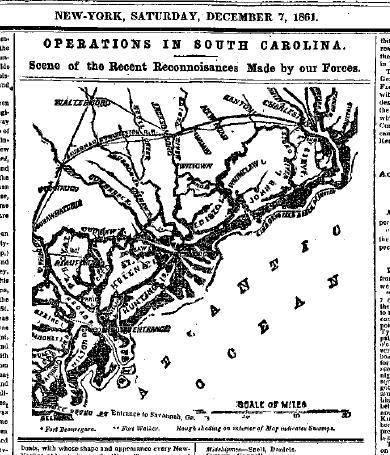
South Carolina Operations December 1861

South Carolina Operations December 1861

Since the Battle of Port Royal Union forces have been sort of making themselves at home along the South Carolina coast. The following article mentions some “reconnoissances”, one of which went as far south as Tybee Island near Savannah, Georgia. One reason I liked this article because it seems to back up some points Stephanie McCurry made in Confederate Reckoning about slaves along the South Carolina coast actively resisting their masters as Union troops advanced.

From The New-York Times December 7, 1861:

OUR PORT ROYAL CORRESPONDENCE.; Important Events of a Few Days The Reconnoissances on the Mainland The Country Deserted by the Whites, from Tybee to Charleston Quntities of Clothes Discovered Fortifications Deserted The Negroes Welcoming the Union Soldiers, &c.

HILTON HEAD, PORT ROYAL, S.C., Sunday, Dec. 1, 1861.

The events of the past few days have not been salient ones; the building of stables for eleven hundred horses, the erection of ordnance storehouses, and the appointment of cemeteries, are scarcely themes that strike the public attention, vastly important as they are to the comfort and safety of the new population landed upon this shore. The throwing up of entrenchments and the mounting of guns are more purely military in their aspect, and a complete description of the changes wrought here by the officers of the engineer and ordnance corps would undoubtedly interest the country, but prudence forbids any such detail. There are left only the reconnoissances, which have been important and extended, and a statement of the results developed by them.

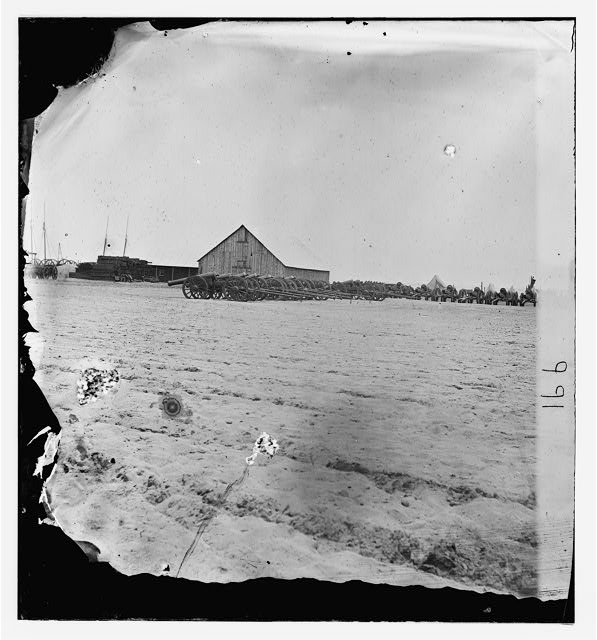
Hilton Head, South Carolina. Federal siege train (1861; LOC: LC-DIG-cwpb-00759)

Hilton Head, South Carolina. Federal siege train - 1861

The reconnoissances since my last letter have been a renewed one, under Capt. GILMORE, Chief of Engineers, to Tybee Island, and one westward, half way to Charleston, under Lieut. P.H. O’RORKE …

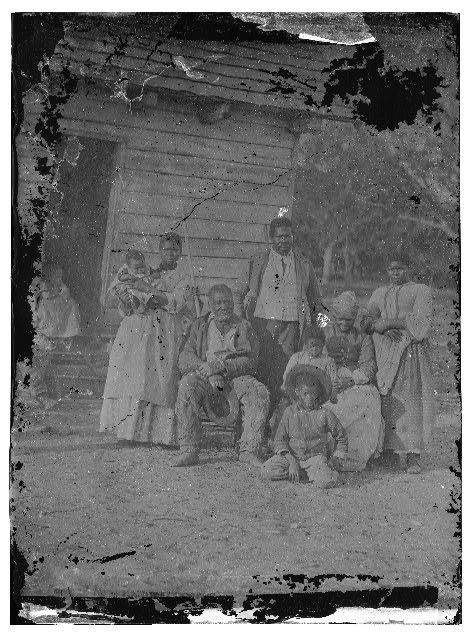
… Everywhere the whites had deserted their residences, leaving the negroes behind; in several instances they set fire to the cotton-houses at the approach of the Union forces, but with these exceptions, their property remained undisturbed. No pillaging had taken place. National troops were sometimes quartered in gentlemen’s houses, where the furniture of the drawing-rooms was scrupulously guarded from use, and the silver plate that, in their haste, was left on the sideboards, was subjected to no damage. The blacks told the same story here as everywhere else; their masters had fled with the greatest trepidation after the fall of Port Royal; had endeavored to persuade the slaves to accompany them, and had even shot some who refused. But, as elsewhere, the blacks had remained behind, and welcomed the new-comers. For seven miles further inward than it was thought advisable to advance, the whites were said to have abandoned the country.

It is thus definitely ascertained, that from Tybee Island, within a mile and a quarter of Fort Pulaski, up to Otter Point, not much more than thirty miles from Savannah, the entire seaboard of South Carolina is in our hands; her white population fled; her planters’ houses abandoned, and often pillaged by the blacks; the cotton houses frequently burned by the rebels themselves, (sometimes the cotton has been buried,) and the slave population left to take care of itself. The efforts to carry off the slaves have been in nearly every case abortive. No love for masters no fear of their cruelty, no apprehension of the Yankees has been sufficient to alarm the blacks. They all look upon us as friends; and where they do not come within our lines, say that all that restrains them is the dislike of leaving their families and the “tings” — their little property. They have a cat-like clinging to their old quarters, and do not generally manifest any desire to quit them. When they have fled in large numbers, it has been always towards our lines, but so far as I can learn it has been because of the efforts of their masters to take them off. This they resist, but they manifest, no peculiarly vindictive spirit. They complain of bad treatment, but I cannot learn that they display any desire to revenge themselves. They chuckle indeed with infinite glee over Southern disasters; they tell of the lies they told their former owners, of their pretences to love them, of their forced obedience; they believe in the power of the Unionists to overthrow the Southern rule; they are willing to act as guides or scouts, (occasionally;) to work; to give all information; and the more intelligent they are the readier to aid us. But unless provoked by the foolish attempts of the rebels to carry them off, I doubt whether they will attempt any injury to the persons of the whites. The plundering indeed presages evil, but if the rebels set the example by firing their own cotton-houses, they need not be surprised to find it imitated. If they persist in their attempts at forcibly restraining the slaves and in firing at them, the worst consequences are likely to follow.

Beaufort, South Carolina. Negro family representing several generations. All born on the plantation of J.J. Smith (1862; LOC: LC-DIG-cwpb-00737)

No place like home

The health of the command is not so good as might be desired; congestive and typhoid fevers are prevalent, but by no means epidemic. There is, however, a great lack of hospital stores, and I am authoritatively informed that the patriotism and benevolence of those at home could hardly be better employed than in providing additions to these stores. The need for such luxuries as the sick require is pressing, and even bedding, sheets, and other of the more obvious necessities of the hospital have not been furnished. Requisitions have been made for them, but months may elapse before in the official routine the command will be supplied. The women of New-York who feel inclined to devote a portion of their means or their energies to the cause, in behalf of which these men sicken and die, have here a fitting opportunity. The cause of this strange state of affairs is no neglect on the part of the present Medical Director of the command; Dr. GEO. COOPER, who was appointed to his position only a day or two before the expedition sailed from Annapolis. VAGABOND.

And I think VAGABOND is a cool pen name for a correspondent.

Posted in 150 Years Ago This Week, Military Matters | Tagged , , , | Leave a comment