Would-be Western Settlers Now Soldiers

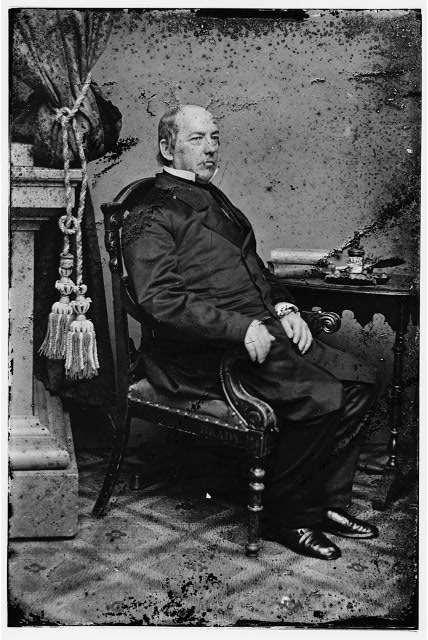
Caleb B. Smith, Sec. Of Interior (between 1860 and 1870; LOC: LC-B813- 3872 A)

Caleb Blood Smith

And the Income to Buy Public Land Is Drying Up Anyway

150 years ago federal Cabinet departments had been submitting their annual reports to the president. The report of Caleb Blood Smith, the Secretary of the Interior, shows that the war had effected the department’s various bureaus. Here’s a bit of the report.

From The New-York Times December 6, 1861:

DEPARTMENT OF THE INTERIOR.; Report of Secretary Smith.

[ABRIDGED.]

DEPARTMENT OF THE INTERIOR, Nov. 30, 1861.

SIR: The report of the operations of this Department during the fiscal year ending June 30, 1861, will exhibit a diminished amount of business in some of the most important bureaus connected with the department. This is attributable mainly to the insurrection which has suddenly precipitated the country into a civil war.

GENERAL LAND OFFICE.

The decline of business has very sensibly affected the operations of the General Land Office. Official intercourse has been entirely suspended with all the Southern States which contain any portion of the public lands, and consequently no sales have been made in any of those States.

In all the Northern States in which any of the public lands are situated, the wad [war] has almost entirely suspended sales. The demand for volunteers has called into the ranks of the army a large number of that portion of our people whose energy and enterprise in time of peace incline them to emigrate to the west and settle upon the public lands, thus laying the foundations of future prosperous communities and States. Besides, the ordinary channels of trade and commerce have been so obstructed by the war that the sources of income, from which the settlers upon the public lands have realized the means of purchasing, have been greatly diminished. …

INDIAN AFFAIRS.

Our Indian affairs arc in a very unsettled and unsatisfactory condition.

The spirit of rebellion against the authority of the Government, which has precipitated a large number of States into open revolt, has been instilled into a portion of the Indian tribes by emissaries from the insurrectionary States.

The large tribes of Cherokees, Chicasaws, and Choctaws, situated in the southern superintendency, have suspended all intercourse with the agents of the United States. …

The tribes upon the Pacific slope of the Rocky Mountains have manifested a turbulent spirit, but have committed no acts of violence. With vigilance on the part of the agents it is hoped they may be restrained from depredations upon the white settlers, and be gradually brought under the control of the laws of the United States. …

I thought it was interesting that in the section on Pensions To Soldiers Smith noted that there were still 63 Revolutionary War soldiers and over 2700 Revolutionary War widows receiving pensions. Although there was less money required to pay pensioners in 1861, Smith noted:

The casualties of the conflict in which the Government is now engaged will increase the list of pensioners very largely. The amount of the increase cannot be estimated, as it will depend upon the duration of the war.

The Interior Department was also charged with the suppression of the African Slave Trade:
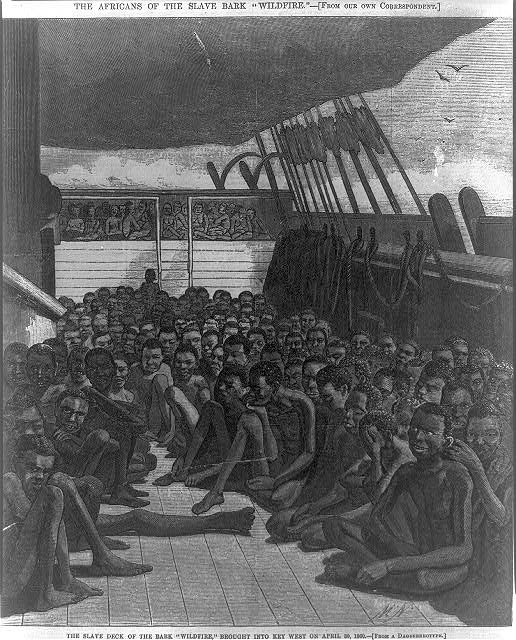
The Africans of the slave bark "Wildfire"--The slave deck of the bark "Wildfire," brought into Key West on April 30, 1860 (Harper's weekly, 1860 June 2; LOC: LC-USZ62-41678

New York conference helps marshals recognize disguised slavers

The subject was immediately taken in hand, under a deep sense of our obligation as a nation, to put an end, if possible, to this odious traffic, and with a full conviction that the power of the Government, in the hands of competent, honest and faithful officers, was adequate to the purpose. Among other things, I caused the Marshals of the loyal Atlantic States to assemble at New-York for consultation, in order to insure greater concert of action. They were thereby afforded an opportunity of inspecting vessels fully equipped for the African Slave-trade, and of seeing the arts and devices employed to disguise and conceal the real objects of their voyage, thus enabling them to detect and prevent the clearance of vessels designed for this trade. It is gratifying to know that unprecedented success has crowned the efforts of the past few months. Five vessels have been seized, tried, and condemned by the Courts. One slaver has been taken on the coast of Africa with about nine hundred negroes on board, who were conveyed to the Republic of Liberia. One person has been convicted at New-York as the captain of a slaver, having on board 800 captives, and two others, (mates, of a different vessel,) and another one at Boston for fitting out a vessel for the Slave-trade. In the first-named case the penalty is death; in the others it is fine and imprisonment. Hitherto convictions under the laws prohibiting the African Slave-trade have been very rare. …

I desire, in conclusion, to commend to your favorable notice the fidelity and zeal with which the various officers of the Department have discharged the public trusts committed to them. Their several reports herewith show the extent of their labors, and exhibit a highly satisfactory condition of the business of the different branches of the Department.

I have the honor to be, very respectfully, your obedient servant, CALEB B. SMITH,

Secretary of the Interior.

TO THE PRESIDENT.
Posted in 150 Years Ago This Week, Lincoln Administration, Northern Society | Tagged | Leave a comment

“an asylum for broken down gentlemen”?

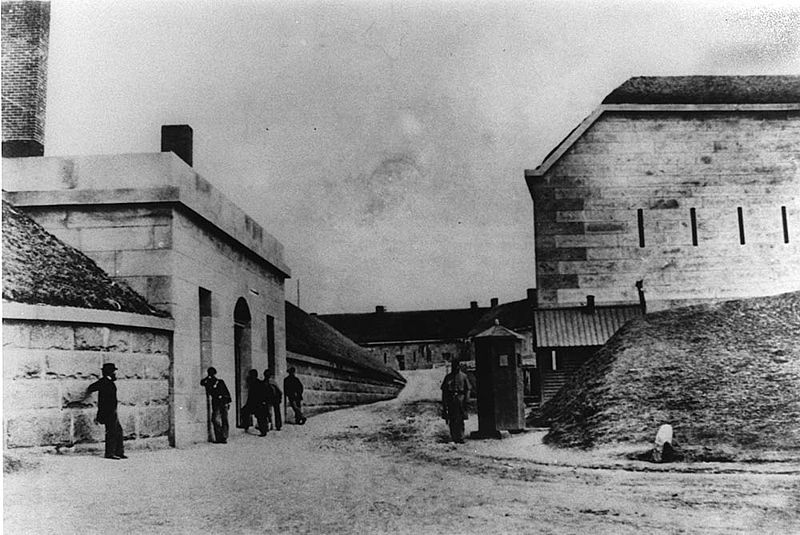
The guardhouse (left) and sentry box (on right) at the entrance to Fort Warren about 1861.

Entrance to Fort Warren about 1861

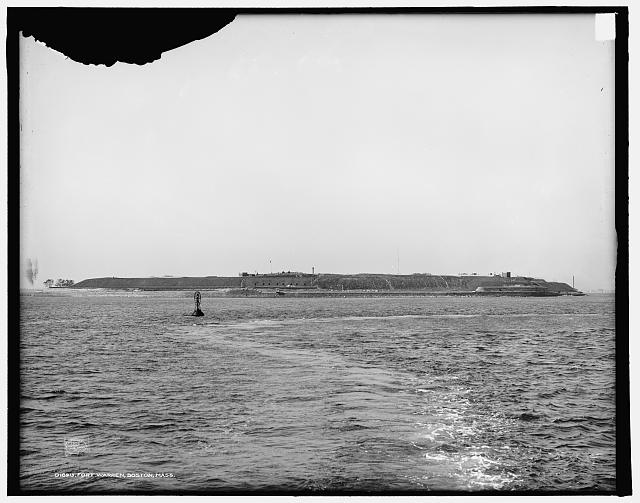
150 years ago today the Richmond Daily Dispatch reprinted an article about the conditions at Fort Warren in Boston harbor. The fort was being used to house captured Confederate troops and political prisoners. As Civil War Daily Gazette recently reported James Mason and John Slidell, captured Confederate commissioners to Europe, had been delivered to Fort Warren on November 24th. Here’s part of the reprinted article in the Daily Dispatch describing conditions at the fort:

The Imprisoned in Fort Warren–their condition.

At present there are one hundred and twenty political prisoners, between fifty and sixty rebel officers and over six hundred prisoners of war confined in the fort. On Thursday last the number was increased by the arrival of two officers and twenty-five soldiers who were taken prisoners in the night attack on Santa Rosa Island. …

These men have considerable liberty allowed them, and a portion of the parade ground is set aside for their uses. Their cooks prepare their rations by camp fires located in close proximity to their quarters.–Most of them seem quite well contented with their treatment.

Fort Warren, Boston, Mass. (c.1906; LOC: LC-D4-18913)

1906 view of the fort in Boston harbor

The political prisoners and the rebel army and navy officers are quartered in the rooms on the west side of the parade ground, intended for the garrison officers. These individuals have all subscribed to a parole of honor, in which they promise not to go upon the ramparts, converse with the sentinels, or make any attempt to communicate with the shore, in person or otherwise. Their privileges are ample, and no such restrictions are placed upon them as our brave fellows are subject to in Southern prisons. Among the prisoners are many officers lately connected with the army and navy of the United States. Before the arrival of the rebel ministers the following were the most prominent personages confined here: Ex-Minister to France Faulkner; ex-Governor Morehead, of Kentucky …

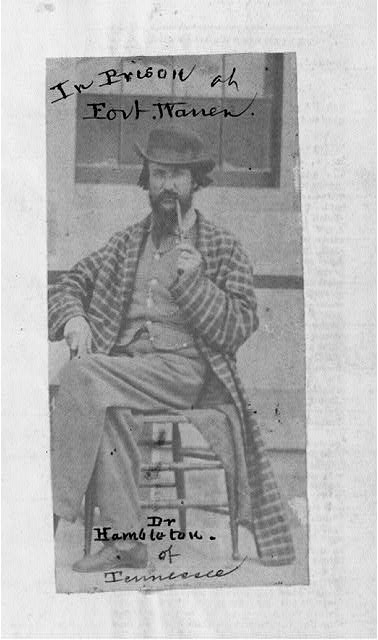
The scene of the parade ground during the day is quite animated and full of interest.–Men of all ranks and professions are here thrown together, all in a greater or less degree connected with the event which has attracted the attention of the whole world, and which has caused the blood of brothers to flow as water. A group of naval officers, recreant to their flag and their oath, may be seen pacing to and fro as if upon the deck of some noble vessel. Many of the groups are enjoying themselves in earnest conversation, while here and there may be seen little knots of persons, some rather indifferent, but yet you can almost see a lurking and revengeful fire in their eyes. As a general thing their personal appearance is not at all prepossessing. Seedy apparel is by no means uncommon, and if one did not know the character of the place he would be led to think that it was an asylum for broken down gentlemen. A clean shaven face is rarely to be met with

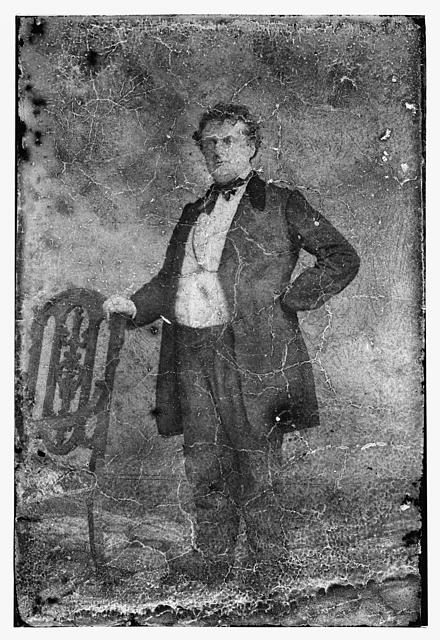
Dr. Hambleton, full lgth, seated, facing slightly left, in prison at Fort Warren, Boston, Mass. (no date recorded on caption card; LOC: LC-USZ62-65116)

A Fort Warren prisoner

This is passed away by those unhappy mortals in playing games of chance. A large portion of the day is spent in this kind of amusement, and the entire evening is spent in the same way. At ten o’clock the lights are put out, and after that time nothing is heard save the sentinels’ regular call of “All’s well.”–They are allowed newspapers and to receive letters from their friends, but previous to their being delivered to them they are carefully read by officers of the garrison. I can not conclude the description of the personnel of the prisoners without remarking that the soldier prisoners are terribly annoyed with vermin, and, despite the efforts of the officers, the evil does not seem to diminish.

The quarters selected for the use of the rebel Commissioners are precisely the same as those occupied by the other political prisoners. This room is a few doors from Colonel Dimmick’s headquarters, in the same row, or, rather, under the same roof. The building is of beautiful New Hampshire granite, the roof forming the Tremain of the work. It has but one story above ground, which is divided into several fine and airy apartments. The basement contains all the necessaries for culinary operations, with quarters for servants &c. The largest rooms are about sixteen fact square, with high billings, and lighted by two large windows. A marble mantle adorns, the room, and a large grate furnishes the convenience for a good fire. The furniture of the room consists of a plain pine table, a few camp stools, the baggage of the occupants and a low wooden bedstead. A good straw mattress, with pillows of the same material, and heavy army blankets, make up the furniture of the room.–To say the least, the quarters are much better than they deserve. As to living, they can mess with their friends at the rate of one dollar per diem, having all the staple products of the market on the table.

If they are given to the use of the weed they can indulge that taste, for smoking is allowed, but liquors are prohibited. In fact, almost everything but liberty is granted to them. …

Posted in 150 Years Ago This Week, Military Matters, Northern Society | Tagged , , , | Leave a comment

Letter from Charleston

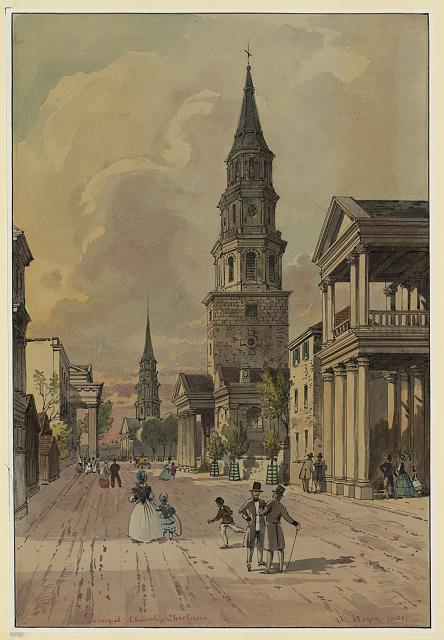
Principal church, Charleston (1861 by A Meyer; LOC: LC-DIG-ppmsca-23072)

Peaceful-looking Charleston

I’m not sure how factual this letter is, but I thought it was an interesting read, especially the two insurrectionist slaves burned to death and the southern unionist who was locked up for his beliefs and basically neglected to death. His wife also seems a heroic person.

From The New-York Times December 1, 1861:

AFFAIRS IN SOUTH CAROLINA.; PRIVATE LETTERS FROM CHARLESTON.

From the Philadelphia Inquirer.

We are permitted to copy the following letter, written to a lady in this city, from a relative in South Carolina. The statements made therein may be relied upon as an accurate description of affairs in that city at the present time:

CHARLESTON, S.C. Nov. 22, 1861.

Are women prophets? I almost believe their great love sometimes gives them the power to penetrate futurity; else how could you have so plainly predicted my present unhappy position, when you so earnestly entreated me to sacrifice my property here, and stay North, when a year ago, I thought it necessary to return? True, there were strong indications of the approaching contest between this fretful State, who will quarrel with her sister States and the Federal Government; but I had too much faith in the good sense of the South to believe she would be guilty of so suicidal an act as armed rebellion. You know too well how my faith in her was misplaced. Sumter fell and the South sank into the horrors of a war inaugurated by the headstrong folly of my own dear Carolina.

How earnestly you begged to accompany me, and share my dangers; but though I did not believe that avowed secession would be carried to downright rebellion, I knew how great was the excitement here, and how your strong Union views and Anti-Slavery opinions would endanger your safety. Now, I will not attempt to reason these matters with you. I am as strongly attached to the Union as you are, but I believe in Southern rights under the Constitution –rights which you do not fully perceive — and, as to the matter of Slavery, I need not waste time on that subject, for I know how firmly fixed your opinions are on that point.

Disguise the truth as we may, all thinking men here feel their position peculiarly unsafe; and those who are surrounded by female relatives, have their anxiety increased a thousand fold. We do not fear for the clash of contending armies, though that is sufficiently terrible to excite much apprehension; but even amid the carnage of war, the veriest boor within the armies would respect women; though traitors try to teach us that the Northern war cry is “Beauty and Booty;” but we do dread lest at midnight the fearful sound of servile insurrection shall salute our ears. You know the negroes are far superior in numbers to the whites, and now that so many are absent in the army their majority is greatly increased. If they rise we are in their power. Do you know what that means? Remember the history of all servile insurrections, and recall the horrors enacted by the race whom oppression has helped to brutalize. Of course the masters would fight desperately; but how could the small number of male whites defend their helpless wives and daughters against a tenfold force of maddened slaves, whose strength and ferocity are well known.

Much as I miss your society, and as keenly as I feel our long separation, I had rather know you shared the humblest cottage in the North in safety, than see you mistress of a palace with such danger threatening you.

Do not think our apprehension is expressed. When the difficulties began we looked daily for some uprising among the slaves. No general insurrection has taken place, though several revolts have been attempted; two quite recently, and in these cases whole families were murdered before the slaves were subdued. Then came retaliation of the most fearful character. At any time where servants assail or murder white persons, speedy and severe punishment is administered; but now they do not wait for the action of the law; Lynch law prevails. In these revolts, which occurred in the interior of the State, most of the servants who participated were either shot in the conflict or as soon as captured, and two of them were burned to death.

To say they were burned to death seems a simple sentence, devoid of any special horror; but the scene, as described to me by a witness, was too dreadful for mortal eyes. Imagine the poor wretches, red with the blood of their masters, cowering in the hands of those from whom they need not look for pity; not even for time to repent of deeds which exclude them from hope hereafter. They are dogged and defiant towards their captors, until their doom is pronounced — a fate of which they have a special horror. Dragged to the place of execution, within sight of their own houses, surrounded by their fellow-servants, who are compelled to witness the sight, they are bound to strong trees, with great heaps of pine knots piled close around their persons. Directly the torch is applied, and the inflammable pine bursts into a vivid flame. When the blaze reaches the bodies, and the sensitive flesh peels and crackles, their cries are too fearful to be heard by human ears. Nor is the torment soon over. The flames scorch the upper part of the bodies, producing exquisite agony, but slowly burn into the vitals, until the wretched sufferers go to judgment, with all their crimes upon their heads.

Do you wonder I am shocked? Suppose it had been NELLY, or ANDREW, or HIRAM, to whom we are so strongly attached? Yet these tortured criminals were favorite household servants of unusual intelligence. I ought not to tell you of those terrible things, but they haunt my memory so I cannot refrain. Thank Heaven, you are safe!

I undertook to say the apprehension of servile insurrection lost its power when, as time passed, all seemed peaceful; so we easily fell back into dreams of security until these events aroused us to watchfulness. This news is suppressed as far as possible, and kept entirely from the papers, for the negroes hear what is published if they do not read it, and such examples might produce disastrous consequences.

Poor F —– is dead; before the fall of Sumter he exerted all his influence, using both pen and voice against rebellion, until he was thrown into prison. At first he was treated as an ordinary criminal awaiting trial; but after the battle of Manassas, the Confederates seemed drunk with triumph at their victory, and mad with rage over the vast number of victims who fell in their ranks. I wrote you with what pomp this city mourned her dead; and it all, when the Confederate host seemed like to win, F —– was offered freedom and promotion if he would espouse the Confederate cause. His military and scientific attainments were considerable, which made them anxious for his services.

“I have sworn allegiance to the Union,” said be “and am not one to break my pledge.” When tempted with promotion if he could be prevailed upon to colist beneath then banner, he said, “you cannot buy my loyalty, i love Carolina, and the South; but I love my country better.” Finding him faithful to the flag he loved, he was made to feel the power of his enemies. He was cast into miserable, damp, illventilated cell, and fed on coarse fare; half the time neglected by his drunken keeper. His property was confiscated, and his wife and children beggared. Poor fellow! he sank beneath his troubles, and was soon removed from the persecution of his oppressors. The day before his death he said to his wife: “MARY, you are beggared because I would not prove disloyal.”

“God be thanked for your fidelity!” replied the wife, “They have taken your wealth and life, but could not stain your honor, and our children shall boast of an unspotted name. My husband rejoice in your truth.”

She returned to her friends after his death, openly declaring her proudest boast should be, her husband died a martyr to his patriotism. Who shall say the day of heroism has passed?

The ladies are generally strong Secessionists. They are forming bands of nurses, as the Northern ladies have done; they are also busy sewing for the army. What are you doing, little patriot? Persuading all your gentlemen friends to enlist in the Union troops, I suppose. Well, God speed them, and send us peace with little bloodshed; and then, unless you have learned to despise our rebellious Palmetto State, I shall welcome you to her luxuriant plains.

Posted in 150 Years Ago This Week, Confederate States of America, Southern Society | Tagged , | Leave a comment

Goad on the James

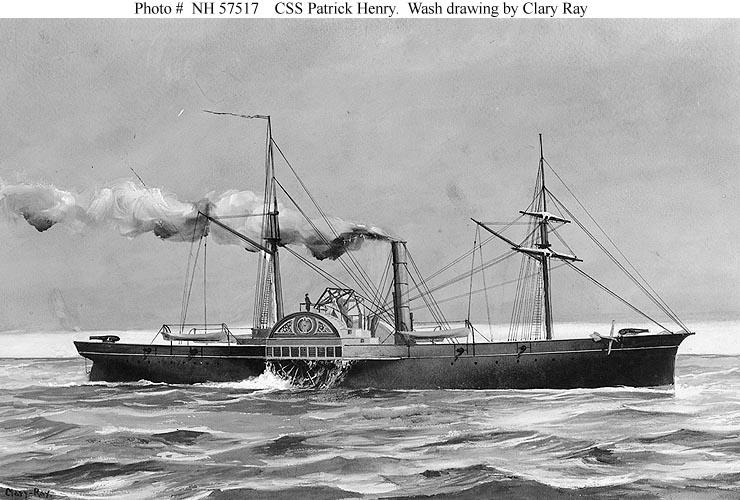
CSS Patrick Henry; Wash drawing by Clary Ray

CSS Patrick Henry

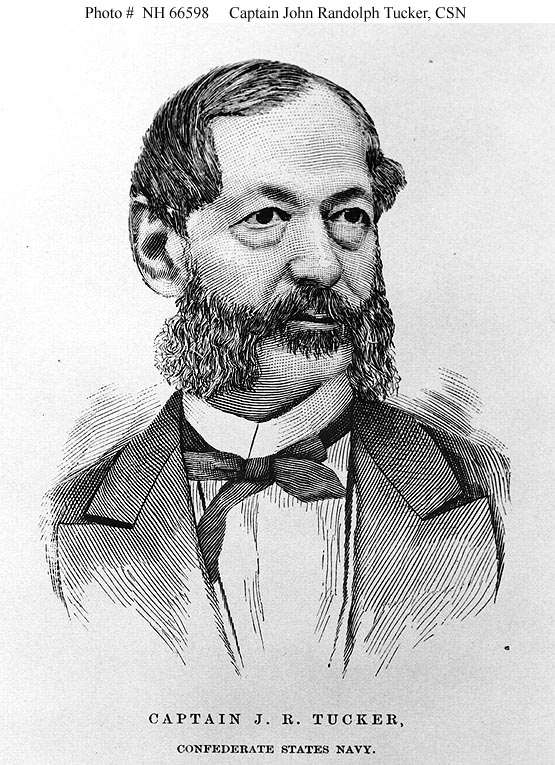
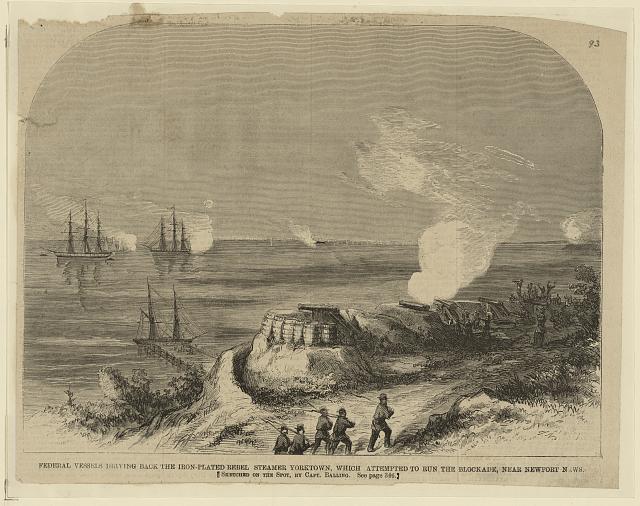
150 years ago today Confederate Navy Commander John Randolph Tucker of the CSA’s James River Squadron moved the CSS Patrick Henry down the river and skirmished long range with U.S. ships off Newport News. The Patrick Henry inflicted minor damage. This was a repeat of a similar action on September 13th. Apparently Tucker was trying to lure a Federal ship or two up the river to duke it out and maybe inflict some more severe damage. Civil War Navy Sesquicentennial says that this fight might have been in response to CSA Navy Secretary Stephen Mallory’s desire for some kind of aggressive action against the much bigger Union fleet. In fact, in July Mallory sent Tucker a letter instructing him to take the Patrick Henry past the blockading squadron out into the ocean and capture a Union ship (preferably the Harriet Lane). This never happened, but Tucker did try these two semi-aggressive actions.

Tucker joined the U.S. navy in 1826 but resigned when Virginia seceded in April 1861. After the war Tucker served in the Peruvian navy from 1866-1871.

Captain John Randolph Tucker, CSN

John Randolph Tucker, CSN

Federal Vessels Driving Back the Iron-Plated Rebel Steamer Yorktown, which Attempted to Run the Blockade, Near Newport News (New York Illustrated News, 30 September 1861;LOC: LC-DIG-ppmsca-22590)

Apparently a sketch of the September 13th skirmish involving the Patrick Henry (née Yorktown)

Posted in 150 Years Ago This Week, Confederate States of America, Military Matters | Tagged , , , , | 7 Comments

But “An Army Marches On Its Stomach”

Culpepper [i.e., Culpeper], Va.--Stacking wheat (1863 Sept. 26; LOC: LC-DIG-ppmsca-20659)

Harvesting wheat

Impressing Slaves, Wagons, and Teams for Rebel Army Means Smaller Wheat Crop

From The New-York Times December 1, 1861:

GRIEVANCE.

The Richmond Whig complains bitterly of the grievance suffered by the farming community from the impressment of negroes, and wagons and teams for the use of the rebel army. It says: “We have received many letters, complaining of individual grievances at the hands of agents of the Government, from the peninsula and from the whole region of country from Manassas along the foot of the mountains to James River in Albemarle and Nelson. The complaints from below relate mainly to the pressing negroes for the service of the Government at Yorktown and vicinity, and the treatment which the negroes receive at the hands of the authorities. It is alleged that a much greater number of negroes have been pressed than were needed, and have not had sufficient food, and are without shelter to protect them from the weather. The effect of this press, without regard to the injury to the health of the negroes, has been to diminish the wheat crops sown in the Counties of Charles City, New-Kent, King William, &c., fully one-third. The complaints from the Piedmont region relates to the pressing teams for the Quartermaster’s Departments, and the insolence of many of the government agents. In all this region the wheat crop is fully a third less than usual, in consequence of this abstraction of the teams of the farmers.”

The Whig concludes: “If this system is continued it will bring the government into such detestation among the people, that, in no great while, a Quartermaster’s agent will receive very little better treatment at the hands of the people than would one of Mr. LINCOLN’s emissaries.”

Posted in 150 Years Ago This Week, Southern Society | Tagged , | Leave a comment

Rooting Out Fugitives in Camp?

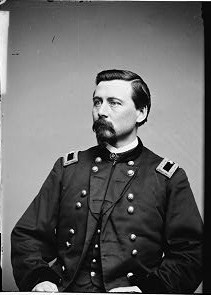
Gen. E.W. Hincks (between 1860 and 1870; LOC: LC-DIG-cwpb-04473)

Edward Winslow Hinks (or Hincks) - his brigade a refuge for fugitives?

Even Democrats Want to Leave Fugitive Slaves Alone

From The New-York Times November 30, 1861:

Slave-Catching in the Army.

MARYLAND, Sunday, Nov. 22, 1861.

To the Editor of the New-York Times:

The following document was read at our evening regimental dress parade to-night. It was received from the headquarters of LANDER’s Brigade, Col. E.W. HINKS commanding, and was read aloud, to afford the “two persons” therein described an opportunity to come forward and deliver themselves up. I may say, however, that, if they were in camp, they cannot now be found. It is feared that the publicity of the notice may have prevented its execution; an unfortunate effect, if true, and one, of course, not anticipated. I give the contents verbatim:

BRIGADE HEADQUARTERS,

CAMP BENTON, Nov. 22, 1861.

Col. Ira R. Grosvenor, Commanding Seventh Michigan Volunteers:

COLONEL: You will cause search to be made in your camp for two persons held to servitude by the laws of Maryland, answering to the following descriptions:

First — Bright mulatto boy, 22 or 23 years old, 5 feet 9 or 10 inches high; had on when left a pair of heavy new boots; cast-down countenance when looked at name CHARLEI.

Second — Black boy, quite black, 21 or 23 years old about 6 feet high; had on shoes, and has unusually large feet; also, a small scar on face; name JACOB or JAKE. I am, respectfully,

Your obedient servant,

J.A. CHADWICK, A.A.A.G.

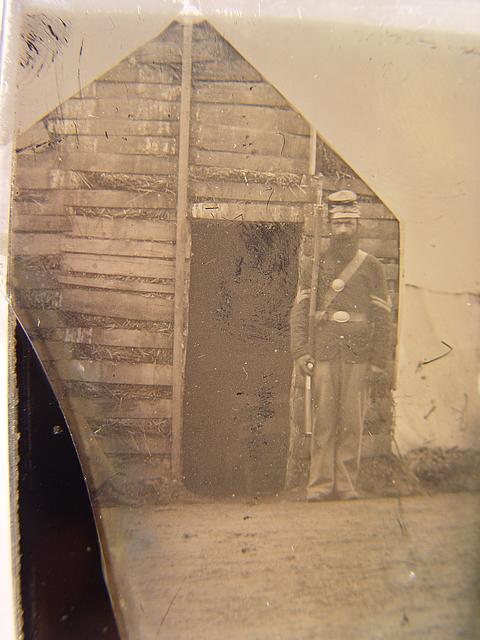
Corporal Sidney S. Goodridge of Company K, 20th Massachusetts Infantry Regiment and Company B, 4th Massachusetts Heavy Artillery Regiment with bayoneted musket in front of shebang at Camp Benton, near Edwards Ferry, Maryland (between 1861 and 1865; LOC: LC-DIG-ppmsca-27385)

A corporal at a Camp Benton shebang

It is doubted whether our superior officers ever heard of the resolution of the last Congress declaring it to be no part of the duty of the army to catch and return fugitive slaves; and certain I am that those “persons held to servitude under the laws of Maryland” would nowhere have been safer than in the camp of the Seventh Michigan immediately after hearing the above document. The field officers of the Seventh were in former times Democrats, and one of them remarked in my hearing that “he was getting to be too much of an Abolitionist to catch niggers for any man.” He made it a little stronger than this, but the oath was so worthily sworn that it can never be rigidy regarded against him. This, coming as it did from one who in times past has been a Democrat of the sternest sect, but who was ever a high-minded man is a true exponent of the sentiment everywhere expressed this evening. Nor do I believe that either of the other field officers would be one whit more eager in such a search than the one I have spoken of. The Seventh has never sought to interfere in any way with the “institution,” nor will it do so. But the slaveowners must catch their own negroes, for we never shall do it for them.

At this time (9 P.M.) it is ascertained that neither of the aforesaid persons have ever been in our camp, and there is now, if any thing, rather a feeling of disappointment that they were not here.

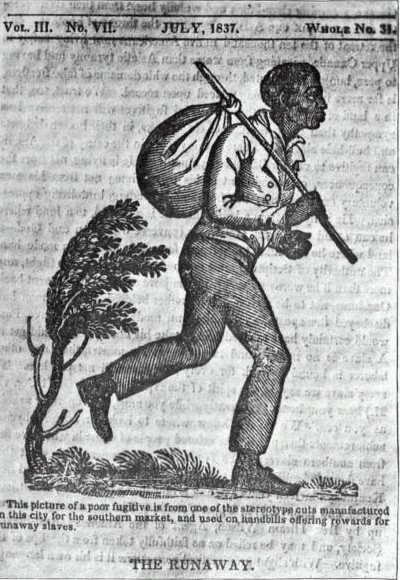
Image from: "The Underground Railroad from Slavery to Freedom" By Wilbur Henry Siebert, Albert Bushnell Hart Edition: 2 Published by Macmillan, 1898, pg. 26

Headin' North

Let me ask you, Messrs. Editors, to ventilate a little this subject, and give us to understand if this is the purpose for which we were enlisted. I cannot believe that such regulations can have the sanction of our Government, and that it is a false policy is, I think, very clear. These questions, however, you can discuss with much more ability than I.

I have but given you the facts, which are of record, and can easily be verified on occasion.

They seem to furnish their own comment.

Yours, SOLDIER.

According to Antietam on the Web E.W. Hinks was wounded at the Battle of Antietam but still served the remainder of the war. He “commanded the 3rd Divisionn/XVIII Corps (US Colored Troops) at Petersburg.”

Find A Grave has more information about Ira Rufus Grosvenor.

Posted in 150 Years Ago This Week, Military Matters, Northern Society | Tagged , | Leave a comment

Southern Patriotism: King Cotton on the Pyre

Since the Battle of Port Royal Union troops have been stationed in the vicinity of Beaufort, South Carolina. Some planters started burning their cotton to prevent it falling into Union hands. From the Richmond Daily Dispatch November 29, 1861:

The burning of cotton.

–The planters upon the Southern coast, at all those points which are exposed to the depredations of the Yankee invaders, are busily employed in removing their negroes to the interior and in burning their cotton. The comparatively small quantity of the staple which has fallen into the enemy’s hands could have been destroyed by the proprietors but for the confidence they felt in the ability of the slight fortifications in their neighborhood to resist attack. The success of the Yankees in their attack upon Port Royal has had a different effect from what they anticipated. Instead of opening a port for Southern cotton, it has rendered it impossible that another bale of Southern cotton shall ever fall into their hands. –Already the work of destruction has commenced. With a self-sacrificing patriotism nobler than the courage of the battle field, the planters are applying the torch to the rich product of their soil at every place where it is in danger of a visit from the enemy. The midnight sky on the seacoast of Carolina is lighted up with the flames of the coveted treasure, and systematic arrangements have been made to convert it into ashes universally, before it shall fall into the invader’s hands. All the Fire Zouaves of New York cannot extinguish this great conflagration. The signal of their approach will be the signal for the torch to be applied, and if the strong man must fall, he will pull down the pillars of the temple upon his persecutors and bury himself and them in a common ruin.

The Yankees do not understand the spirit of the Southern people. They might as well attempt to subjugate the winds as to conquer such a people. They have determined to sacrifice every worldly possession on the altar of independence and liberty. They will never permit Yankee Generals to wring from them either their rights, or, that which the Yankees are alone fighting for, their commerce. They are not themselves dependent upon cotton, valuable as it is to them, and essential to the rest of the world. They can give up the cultivation of cotton altogether, and still live in comfort and plenty. Their wonderful soil produces in boundless abundance every va y of agricultural production. They can raise more than enough of wheat, corn, rye, oats, hay, to supply their own population.–They will, in all probability, devote their soil exclusively the next year to the cultivation of the cereals, and whether the present crop shall be available for the use of the world depends entirely upon their own sovereign will and pleasure. The cotton is ready for the torch, and the torch is ready for the cotton. The Yankees have proved themselves successful inventors of agricultural machines, but when they employ the sword to raise Southern staples, they make a blunder which will destroy their commerce, ruin their cities, and convert the subjugation of the South, even if it would be accomplished, into their own financed [financial?] and political ruin.

According to an article reproduced at Civil War Home not by any means did all Southerners burn their cotton to keep it away from the Yankees:

If the Confederate government was able, albeit partially and belatedly, to gain control over the cotton trade with Europe, it had much less success in curtailing the cotton trade with the Union. On May 21, 1861, the Confederate Congress prohibited the sale of cotton to the North. Yet an illicit trade across military lines flourished between Southern cotton farmers and Northern traders. President Abraham Lincoln gave licenses to traders, who followed the Union army into the South. On March 17, 1862, the Confederacy gave state governments the right to destroy any cotton that might fall into the hands of the Union army. Some devoted Confederates burned their own cotton to keep it out of enemy hands. Other Southerners, however, discovered that Union agents were willing to pay the highest prices in over half a century for cotton or offered badly needed supplies as barter. Ironically, valuable currency for cotton from the North saved some small Southern farmers from starvation. But this selling of cotton to the North undermined Confederate Nationalism, as did the official Confederate trading of cotton with the North conducted in the last years of the war.

Posted in 150 Years Ago This Week, Confederate States of America, Southern Society | Tagged | Leave a comment

Thanksgiving

Thanksgiving in camp sketched Thursday 28th 1861 (1861 [November] 28 by Alfred R. Waud; LOC: LC-DIG-ppmsca-21210)

Thanksgiving in camp 11-28-1861

150 years ago today most northern states celebrated Thanksgiving. From glancing through The New-York Times it seems that there was sadness for the absence of soldiers through death or away still serving in the one of the many “seats of war”. Nevertheless, there was plenty of food to go around. In an article entitled “THE DAY AMONG THE CHARITIES.; AN UNEXPECTEDLY PLEASANT TIME.” The Times noted, “The Home for the Friendless was unusually favored this year in the way of donations, both in money and provisions.” Like 1860 there were many sermons reproduced, including Henry Ward Beecher at Plymouth Church. And Thanksgiving was observed in the Union army camps. From The New-York TimesNovember 29, 1861:

NEWS FROM WASHINGTON.; Thanksgiving in the Camps A Quiet Day. …

WASHINGTON, Thursday, Nov. 28.

To-day has been unusually quiet. The Departments, stores and shops have been closed. Religious services were held in nearly all of the churches. Large numbers of visitors crossed the river to see their friends in camp. In the camps from the States the Governors of which had appointed this as the day of thanksgiving, it was generally observed. At the camp of the Second Wisconsin, a thanksgiving dinner was spread. Gov. RANDALL, Gen. KING and Col. MANSFIELD, of Wisconsin, and Senator WILSON were among the invited guests present. …

John A. Andrews (between 1855 and 1865; LOC: LC-DIG-cwpbh-02564)

Governor Andrew

In 1861 each state decided if and when it would celebrate Thanksgiving. Governor Andrew proclaimed that Massachusetts would have its Thanksgiving on November 21. Here’s a bit about the celebration of regiments from Massachusetts. From The New-York Times November 28, 1861:

FROM GEN. STONE’S DIVISION.; Thanksgiving with the Troops– Great Doings in the Fifteenth and Nineteenth Massachusetts…

POOLESVILLE, Friday, Nov. 22, 1861.

There are few things in this world more enjoyable to a New-Englander than a Thanksgiving Dinner. The dinner itself is supposed to be good, but in its comfort-giving it is but the exponent of the thousand and one causes for gratitude with which the time past has been filled, and which, both in secret and in public, call for and receive from the hard-fisted sons of the East heartfelt and lip-spoken appreciation. A Thanksgiving Dinner should properly be eaten at home — elsewise it is bereft of many a pleasure and of many a desirable presence. But in times of war “some must fight while others pray,” and if those who are surrounding the camp-fire rather than that which blazes cheerfully on their hearthstone can be thankful, and can approximate to the delights of home, it is a most blessed circumstance. I don’t know how many troops New-England has in the field at this time, but if the doings and eatings, the sayings and drinkings of her hardy sons in this division may be taken as a sample of them all, it is fair to presume that for the next six months not a turkey, not a chicken, not a goose, or even a lame duck, will be seen south of Philadelphia or west of Baltimore. …

The correspondent was invited to the shindig that the Massachusetts 19th was putting on. This included a greased pole and a game of football!

Hearing that in addition to the dinner and ball, there was to be a greased pole and vigorous attempts on the part of avaricious privates to get a five-dollar gold piece on top of it, a grand game of football and a monster concert at sundown, I mounted my pet filly Nannie, and started for the camp. Arrived there, I found that Baltimore had unselfishly deputed some thirty of her fairest damsels, (among them a lovely descendant of the martyr ROGERS) who were scattered promiscuously about the camp, shooting at marks, throwing and failing to catch balls, and making wild with delight the several hundred privates who for months hadn’t seen a woman or a bonnet. It had been arranged that the two wings of the regiment — one under charge of Lieut.-Col. DEVEREAUX and the other under Major How — were to play a rousing game of football, the officers of the losing wing to pay for the wine yet to be drank at the Thanksgiving dinner. To describe so as to interest a non-professional reader a game of football, is an impossibility. Suffice it, then, to say that the poor ball wandered here and there, meeting with rebuffs on every hand and at every foot; that the right men pulled and blew, and kicked, and ran, and watched, and hurrahed, and screamed, and cheered, and oh’d and ah’d, while the left men pushed and yelled, and heeled and toed, and ran furiously here and there, attacking with apparent vigor the unoffending object of regimental persecution. After an hour’s sport, or rather an hour’s hard labor, one side gave in, and the other side — which was also on the point of giving in — saluted its leader with three rousing cheers, at the same time informing their opponents that if there was any other game which possibly they could play better, they would be pleased to be with them at a future occasion.

Then same the climbing of the greased pole — and I confess that I never beheld anything quite so comical in all my life. Ten athletic nervous men essayed the operation, one after another, without success. Some could get up ten feet, others twenty, others still higher, and one youth, regardless of unworn pants, succeeded in almost touching the coveted and glittering prize at the top, when his hold gave way, and but for the most miraculous use of his legs and feet he would have been thrown heavily to the ground. A corporal, I think, succeded in obtaining the reward, which, for so much corporal punishment, was none too great.

The dinner, however, was the first grand feature of the day. …

Posted in 150 Years Ago This Week, Military Matters, Northern Society | Tagged , , | Leave a comment

Seizing Salt in Savannah

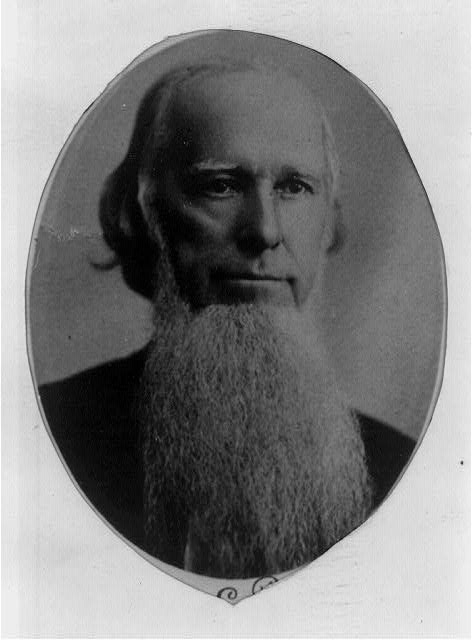
50th Congress Georgia delegation (1887 or 1888; LOC: LC-USZ62-138077)

A seasoned Joseph E. Brown in 1887 or 1888

From the Richmond Daily Dispatch November 26, 1861:

A salt Stampede and its Finale.

The Augusta (Ga.) Sentinel, of the 23d inst., says:

Upon the reception of the news that Governor Brown was appropriating salt at other points, the article became exceedingly active in this market. A multitude of drays were engaged in transporting salt to the other side of the Savannah. Somehow Governor B. got an inkling of the movement and gave orders, by a dispatch, to our city authorities, that all the salt in the city in the hands of dealers should be seized. Accordingly, over 700 sacks were sized [seized?] yesterday at the depot of the South Carolina railroad. Much had, however, made its escape to South Carolina, out of reach of the Gubernatorial talons.

Here’s the governor’s salt proclamation reproduced in the same issue of the Daily Dispatch:

Seizure of salt by the Governor of Georgia.

We have already noticed the fact that the Governor of Georgia had issued a proclamation directing the seizure of salt in that State, to be paid for at fair rates. The following is the proclamation alluded to:
Executive Department,

Milledgeville, Ga., Nov. 18th, 1861.

Col. Jared I. Whitaker, Commissary General, &c.,Colonel:

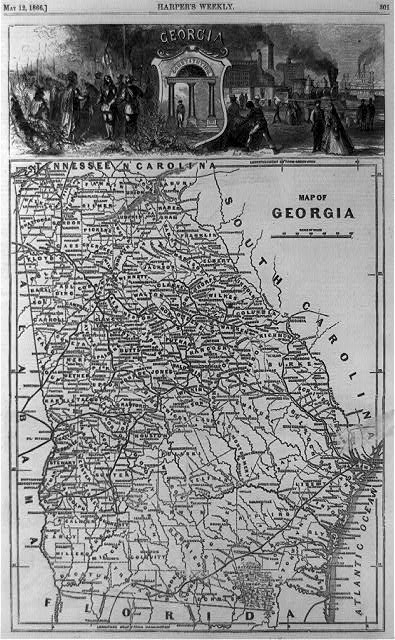
Map of Georgia (Illus. in: Harper's weekly, 1866 May 12; LOC: LC-USZ62-98260)

Salt price controls in Georgia

I have learned that there is now a considerable quantity of salt in the depot of the Central Railroad at Savannah, and I have notified Mr. Adams, the Superintendent of the road, that he is required to detain it in the depot subject to your order, for the use of the army. You are hereby instructed to take charge of the salt, and give Mr. Adams your receipt for it. When the owners present their claims you will pay each five dollars per sack, which I consider just compensation. As we shall need a very considerable quantity for public use, you will inform me of any which you may find in the hands of speculators of traders who are selling at more than five dollars per sack with freights from Savannah added, and I will give you directions as to the seizures necessary to be made. No seizures will be made of any supplies in the hands of persons who are selling to the people at five dollars per sack with [fr]eights from Savannah added. I feel that it is gross injustice to the Government and to the people to permit speculators who have managed to get the control of articles of absolute necessity, to sell them at the enormous prices now demanded in the market.

The Constitution of this State clearly provides that private property may be taken for public, use by paying just compensation. Under this provision, I feel it my duty when any necessary article is controlled by a few persons, who demand from the State and her citizens unreasonable and unjust compensation for it, to authorize you to seize in the hands of those who ask the highest prices such supplies as may be needed for public use, and pay the owners just compensation.

I very much regret the necessity which must control my action in the present emergency, but a sense of duty compels me to assume the responsibility. If the constituted authorities do not interfere, but will pay on the part of the State the high prices demanded by unpatriotic speculators, the cost of the supplies necessary to maintain our army will soon swell the public debt to an enormous burden, and as the high prices paid by the State will control the markets and compel its citizens to pay as much, provisions will be placed out of the reach of the poor who labor for their daily bread, and much suffering and misery must be the result.

I shall use all the power vested in me by the Constitution and laws of this State to prevent these deplorable results.

Very respectfully, &c.,

Joseph E. Brown.

You can read more about Brown at The New Georgia Encyclopedia.

Joseph E.Brown was actually born in Pickens, South Carolina. As governor Brown supported secession after Lincoln’s election, but opposed the increasing power of the central Confederate government:

As soon as the Confederate States of America was established, Brown spoke out against expansion of the Confederate central government’s powers. He denounced Davis in particular. Brown even tried to stop Colonel Francis Bartow from taking Georgia troops out of the state to the First Battle of Bull Run. He objected strenuously to military conscription by the Confederacy. After the loss of Atlanta, Brown withdrew the state’s militia from the Confederate forces to harvest crops for the state and the army.

But he obviously didn’t mind using state power to control the price of a major necessity. If the state paid the speculators’ price, government debt would be pushed up and poor people would be driven out of the market.

Salt in the American Civil War was important for its ability to preserve food and its role in curing leather. This Wikipedia article gives details about the way Georgia controlled the salt price.

In Georgia, the price of salt depended on one’s family circumstances. Heads of families could purchase a half-bushel of salt for $2.50. If a widow had a son in the Confederate army, the price was only $1.00. But if the widow’s husband served his nation, the price was free. Local court clerks sent the salt requests to the state government, which in turn allotted the salt to the counties as requested.

Posted in 150 Years Ago This Week, Confederate States of America, Southern Society | Tagged , , | Leave a comment

Warm Clothes Needed for ‘Refugee’ Rebel Soldiers

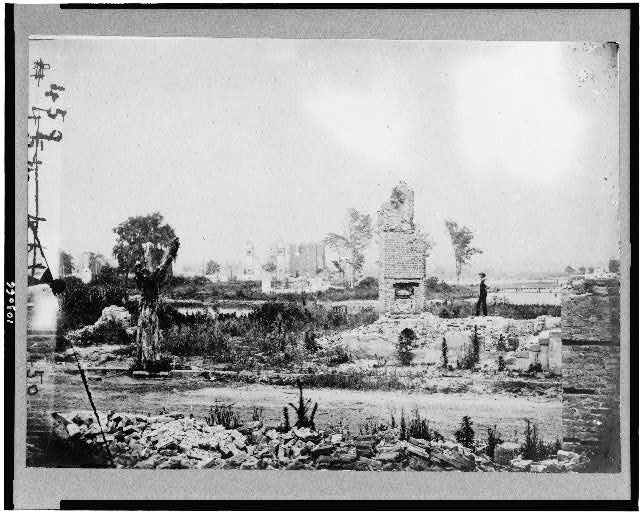
Ruins at Hampton, Virginia showing chimneys, and man standing (between 1861 and 1865; LOC: LC-USZ62-103066)

No Virginians left in the burned-down Hampton, Virginia

We’ve seen the Union military ask Northerners to make mittens for its troops as the weather gets colder. Here a Richmond paper is asking citizens to send warm clothing to the troops from the burned down Hampton, Virginia.

From the Richmond Daily Dispatch November 25, 1861:

The Elizabeth city soldiers.

–We would again call attention to the necessities of the Elizabeth City soldiers. As Jackson was the first Virginia martyr in the cause of Southern independence, Hampton was the first Virginia town which has been literally destroyed by the scourge of invasion. No one can think without a tear of the fate of that beautiful village, and of the refined and noble- hearted people who have been driven from its quiet homes, and whose roof trees are all in ashes. The whole of that region has been desolated by the vandals, and, if any who have suffered in the Southern cause deserve sympathy and aid, their claims are pre-eminent above all. We appeal again for assistance to the soldiers of this oppressed and devoted section who are now in the Confederate service. They have been driven from their homes, leaving all their wordily goods behind them — many of them bringing away only the clothes on their backs, such as were suited to the warm season that had then set in. Winter is now upon us. These soldiers have no fathers, mothers, and sisters at home to call upon; for they, too, are wanderers — A correspondent of the Enquirer states that most acceptable donations of clothing have already been sent to some of them, but still they are sadly in need of yarn socks and yarn gloves, overcoats, flannel shirts, &c. Some of them are now stationed on the wagon-courses, where the winds are piercing and the frosts are bleak. We would suggest that all boxes intended for them be directed to the captains of the respective companies, and be sent to the care of Assistant Quartermaster James White, at Yorktown. The Elizabeth City companies are, the Wythe Rifles, Capt. W. R. Wills; Old Dominion Dragoons, Capt. W. R. Vaughan; Washington Artillery, Capt. C. L. Smith and Hampton Grays, Capt. B. F. Hudgins. The York Rangers, Capt. Jeff. Sinclair, are also partially composed of Elizabeth City men. In the 115th Regiment of Virginia militia are good and true men, too, from the same county.

burning-hampton-virginia

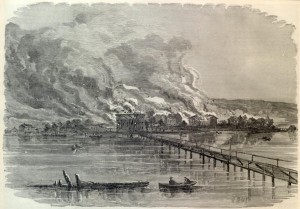
Hampton Burns

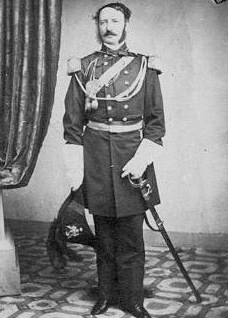
The northern “vandals” did not torch Hampton. The Dispatch sort of passed over the fact that Hampton was actually burned by Confederates commanded by John Bankhead Magruder. According to Almost Chosen People Magruder “burned Hampton, Virginia to the ground on August 7, 1861, after learning that Butler planned to use it as a base for his “contraband” former slaves.” Almost Chosen People also shows a related video from the Hampton History Museum. The video is conducted near a display that features a statue of a Napoleonesque Benjamin Butler.

You can read more about the August 7, 1861 fire at The Historical Marker Database

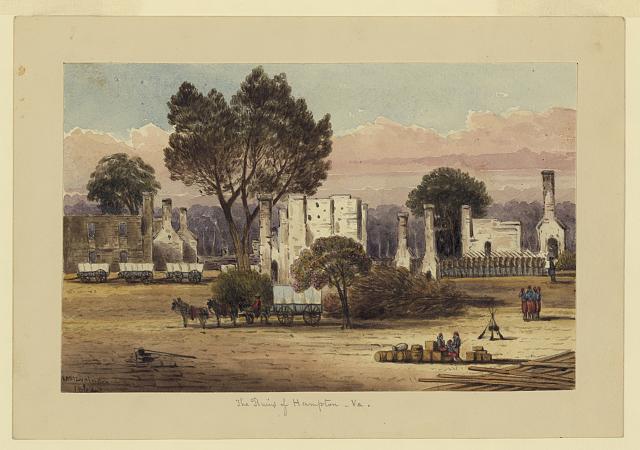
The ruins of Hampton, Va. (William McIlvaine 1862; LOC: LC-DIG-ppmsca-20006 )

Zouaves occupy what's left of town

John Bankhead Magruder, 1810-1871, full length, standing, facing left; in dress uniform, C.S.A.(between 1861 and 1865, printed later; LOC: LC-USZ62-62496)

'Prince John' Magruder torched Hampton

Posted in 150 Years Ago This Week, Confederate States of America, Military Matters, Southern Society | Tagged , , , | Leave a comment