Mitten Knittin’

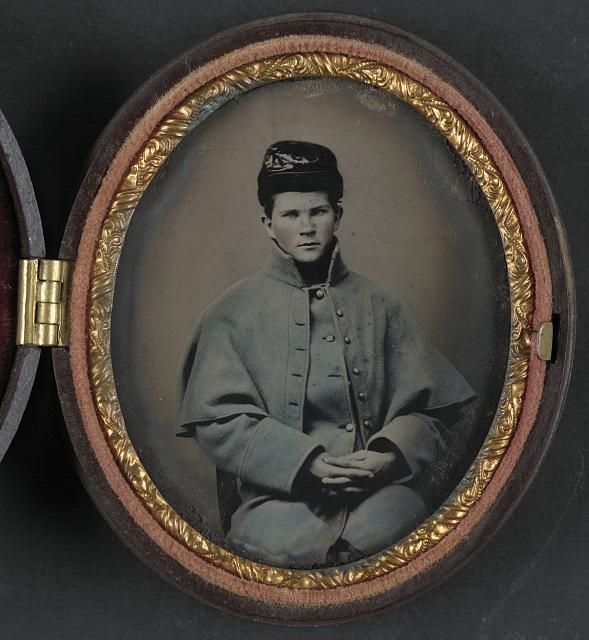
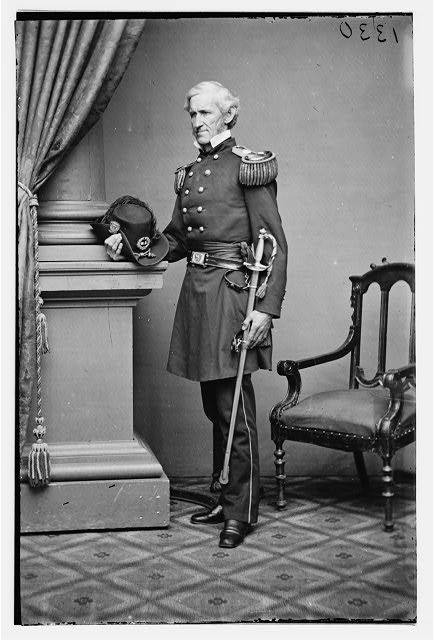
Unidentified soldier in Union great coat (between 1861 and 1865; LOC: LC-DIG-ppmsca-31658)

Great coat, no mittens

We’ve seen Quartermaster General Montgomery C. Meigs explaining the need for $800,000 worth of heavy winter clothing. Here he is apparently reaching out to citizens to help by making mittens for the troops in the field.

From a Seneca County, New York newspaper in November 1861:

Mitten Knitting for the Army

The approach of cold weather should remind us of the condition of our bave [brave] soldiers who are now in arms defending the Government from the ruthless hand of treason and rebellion. We have a large and patriotic army in the field, and there must be a great deal of suffering during the coming winter unless every effort is made to render their condition comfortable and happy. Our Government furnishes no mittens for its soldiers, nor are the kind required for those in the field made by machinery, but must be knit stitch by stitch by the nimble fingers of our patriotic women. The Quarter-master General has called upon the people for mittens to supply the wants of the army, and with a hearty and enthusiastic response from all quarters. Every patriot should respond either by giving yarn, or money with which to buy it or by knitting the material contributed by others. As the shaping of the mitten will be new to many who may wish to commence them at once, we give the following directions published in many of our exchanges: Cast 24 stitches on two needles, and 23 on the middle one. … [The rest of the directions are at least 15 lines of a single-column newspaper – extremely “Greek to me”]

The Humble Stitcher has a piece about knitting in the Civil War.

Posted in 150 Years Ago This Week, Northern Society | Tagged , , | 1 Comment

Remembrance Day

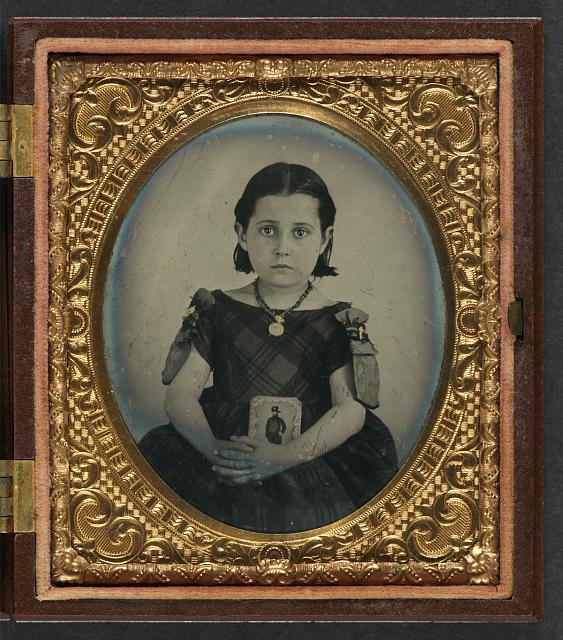
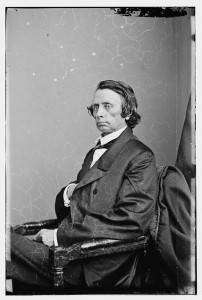
Unidentified girl in mourning dress holding framed photograph of her father as a cavalryman with sword and Hardee hat (between 1861 and 1870; LOC: LC-DIG-ppmsca-36863 )

People have been remembering for an awful long time

Posted in American History | Tagged | Leave a comment

“lodged in a horse-thief jail”

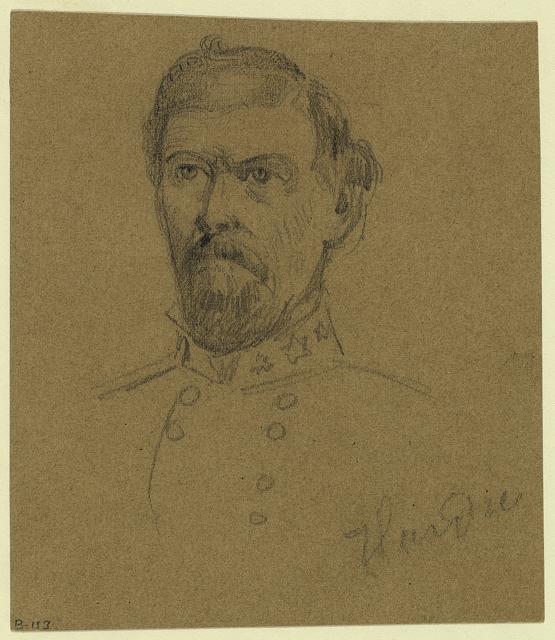
Confederate General William Joseph Hardee (between 1862 November and 1863 January; LOC: LC-DIG-ppmsca-20277)

William J. Hardee

From The New-York Times November 10, 1861:

STORY OF AN EXCHANGED PRISONER

From the Louisville Journal, Nov. 5.

We have had an interview with Mr. P.H. LIPPERT, of the Twenty-fourth Illinois Regiment, who was taken prisoner some months ago, about twenty miles from Centerville, Mo., while acting as a messenger bearing dispatches. He was arrested by rebel Missourians and placed under charge of Gen. HARDEE’s command in the southeastern part of the State, where he was exposed to great privations and sufferings. In company with twenty other Union prisoners he was lodged in a horse-thief jail at Bloomfield, for nearly a month. This place was an apartment 16 by 18 feet in dimensions, and 7 feet high, with two air holes on two sides. In this cage the twenty were cooped during the hottest weather, without any effort being made to remove their excrement, which of course produced the foulest stench. Their food was dough and water, and even that in insufficient quantities, and they were never once taken into the fresh air, which produced great sickness. While there three Union men were hung, and five shot, because they refused to take the oath. These villainies were committed by Capt. WHITE and his Texan Rangers. From Bloomfield, Mr. LAPPERT was taken to New-Madrid for a few days, during which he received no food at all, and was nearly starved; thence he was transferred to Columbus, with seven prisoners from Cape Girardeau, and placed at work on the fortifications; and they were so engaged, being driven to the works in gangs, like slaves, at the time of the engagement between the batteries and the Union gunboats, exposed to all the fire and bursting shells, but providentially none were injured. They were by this time greatly in need of clothes and blankets, and their wants were contumeliously neglected by Gen. POLK, after his attention had been called to them. Mr. LIPPERT was finally exchanged when Col. BUFORD went down under a flag of truce, and he soon reached Paducah. There he was most hospitably received by the boys of the Eleventh Indiana, and he desires to return thanks to them all, and particularly to Capt. RUGG, for their soldierly attention to a comrade in distress. From Puducah he was forwarded to Louisville, by Gen. SMITH, and will start immediately to join his regiment, which is Col. HECKER’s.

A Bit of Tit-For-Tat

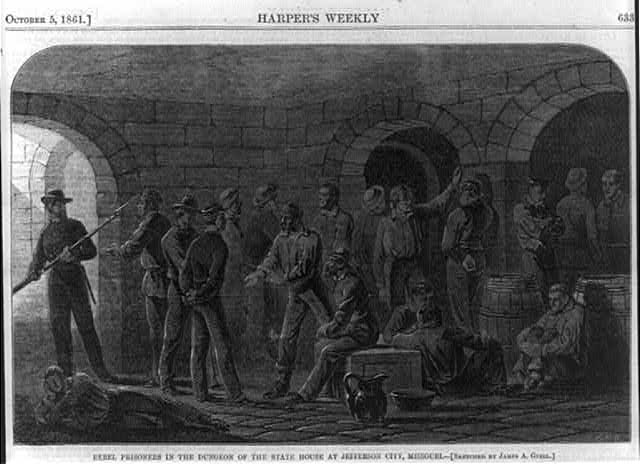
Rebel prisoners in the dungeon of the State House at Jefferson City, Missouri (Harper's Weekly, 5 October 1861; LOC: LC-USZ62-61714)

Rebels held in Missouri State House dungeon

Posted in 150 Years Ago This Week, Military Matters | Tagged , | Leave a comment

“Peculators and Speculators”

Thomas Overton Moore (circa 1860s; Duke University Digital Collections)

Governor Moore seizes the pork

From the Richmond Daily Dispatch November 9, 1861:

A Righteous man.

The mania for speculating upon the necessities of the poor is prevailing to an alarming extent throughout our Confederacy. All over the country there is a set of peculators and speculators, that ought to be branded with the mark of public reprobation. We want to see this thing put down, and if the example furnished below is followed in our own and every other Southern State, it will not be long before the evil is in a measure eradicated:

The Governor of Louisiana issued an order the other day to seize all the pork held in New Orleans by speculators. The object of the Governor is to pay a fair price for it, and furnish it to those who need it, at living prices. The graceless rascals had monopolized the article, and were forcing the people to pay them fifty dollars a barrel for it. The Governor did right. We say it emphatically; and would like to see all such rascals treated in the same manner. A few soulless men are determined to amass wealth out of the misfortunes of the country, and they ought to be marked so that they may be known through all coming time, as Shylocks of the basest stamp.

Thomas Overton Moore served as governor of Louisiana from 1860-1864.

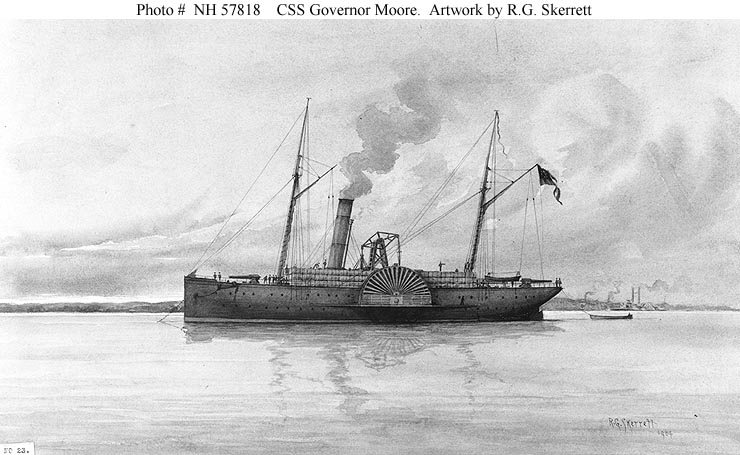
CSS Governor moore

CSS Governor moore

Posted in 150 Years Ago This Week, Confederate States of America, Southern Society | Tagged , , , | Leave a comment

Parson Shuts Down

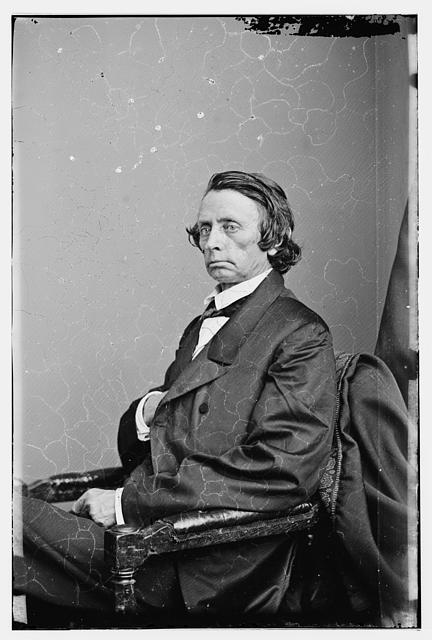
Hon. Wm. Gannaway Brownlow of Tenn. (between 1855 and 1865; LOC: LC-DIG-cwpbh-01511)

Parson preaches: Knoxville leaders should volunteer for CSA

We’ve seen evidence that the Lincoln administration has been shutting down opposition newspapers. 150 years ago today the news made it to Gotham that a similar event occurred in the Confederacy. Parson William Brownlow had announced he was suspending publication of the Knoxville Whig, the newspaper he edited, because he was probably going to be arrested and indicted by a Confederate court. Here’s a bit from The New-York Times November 8, 1861:

MISCELLANEOUS REBELLION NEWS.; A STURDY PATRIOT. PARSON BROWNLOW’S FAREWELL TO HIS READERS. From the Whig. SARCASTIC.

The Cincinnati Gazelle has received a copy of Parson BROWNLOW’s Knoxville Whig of Oct. 26, the last, that will be issued for — a few weeks only, let us hope. It contains the following

FAREWELL

From the Knoxville Whig. Oct. 26.

This issue of the Whig must necessarily be the last: for some time to come — I am unable to say how long, The Confederate authorities have determined upon my arrest, and I am to be indicted before the Grand Jury of the Confederate Court, which commercial [commenced?] its session at Nashville on Monday last. I would have awaited the indictment and arrest before announcing the remarkable event to the world, but as I only publish a weekly paper my hurried removal to Nashville would deprive me of the privilege of saying to my subscribers what is alike due to myself and them. I have the fact of my indictment, and consequent arrest having been agreed upon for this week from distinguished citizen, legislators and lawyers at Nashville, of both parties. Gentlemen of high positions, and members of the secession party, say that the indictment will be made because of some “treasonable articles in late numbers of the Whig.” I have reproduced those two “treasonable articles” on the first page of this issue, that the unbiased people of the country may “read, mark, learn and inwardly digest” the treason. They relate to the culpable remissness of these Knoxville leaders in falling to volunteer in the cause of the Confederacy. …
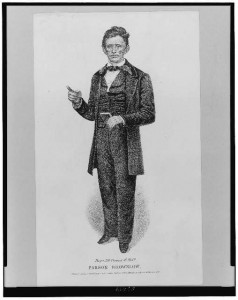
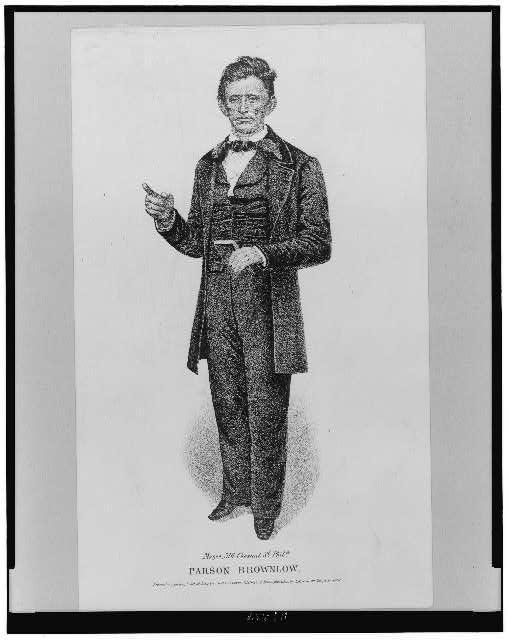
Parson Brownlow (Phil'a : J. Magee, c1861; LOC: LC-USZ62-116284)

Brownlow at work

The real object of my arrest, and contemplated imprisonment is, to dry up, break down, silence and destroy, the last – and only Union paper left in the eleven seceded States, and thereby to keep from the people of East Tennessee the facts which are dally transpiring in country. After Hon. JEFF. DAVIS had stated in Richmond, in conversation relative to my paper, that he would not live in a Government that did not tolerate freedom of Press; after the judges, attorneys, jurors, and all of these position of honor and trust, under the “Permanent Constitution,” which guarantees FREEDOM OF THE PRESS; and after the entire Press of the South had come down in their thunder tones upon the federal Government for suppressing the Louisville Courier and the New-York Day Book, and other secession journals — I did expect the utmost liberty to be allowed to one small sheet, whose errors could be combatted by the entire Southern Press! It is not enough that my paper has been denied a circulation through the ordinary channels of conveyance in the country, but it must be discontinued altogether, or its editor must write and select only such articles as meet the approval of a pack of scoundrels in Knoxville, when their superiors in all the qualities that adorn human nature, are in the Penitentiary of our State! And this is the boasted liberty of the Press, in the Southern Confederacy! …

Exchanging, with proud satisfaction, the editorial chair and the sweet endearments of home for a cell in the prison, or the [???] of an exile, I have the honor to be, &c., WILLIAM G. BROWNLOW.

Editor of the Knoxville Whig.

Oct. 24 1851 [1861].
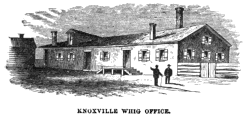
The office of the Knoxville Whig in Knoxville, Tennessee, USA, as it appeared in 1866.

Knoxville Whig office - 1866

William Gannaway Brownlow, who “often boasted that he was “never neutral” on any issue” certainly had an interesting life and career. An antebellum preacher and newspaper publisher, Brownlow would become a politician after the Civil War ended.

Brownlow’s Whig was published under various names. Here’s Wikipedia’s summary of the Civil war years for Brownlow and his paper:

After Tennessee withdrew from the Union in June 1861, the Confederate Army occupied East Tennessee and arrested several noted Union supporters. Throughout the summer of that year, Brownlow dedicated much of the Whig to defending these Unionists. By October, the Whig was the last pro-Union newspaper in the Confederacy. Finally, on October 24, Brownlow announced he had become aware of an indictment issued against him and was suspending publication. The Confederate Army confiscated the Whig offices and used the printing machinery to convert muskets into rifles.

Brownlow was eventually arrested but released. He went into exile in the North, where he published a book and played an important role in rallying support for the liberation of East Tennessee. He returned to Knoxville on the heels of the Union general Ambrose Burnside’s invading army in September 1863, and revived the Whig under the title, Knoxville Whig, and Rebel Ventilator. Brownlow used the Whig to harass Knoxville’s Confederates, and had a number of them expelled. These included the Confederate diarist Ellen Renshaw House, who wrote that Brownlow was “the vilest thing that ever lived.”

Brownlow’s Sketches of the Rise, Progress, and Decline of Secession
was published in 1862.

Southern Unionists Chronicles has a bit about Brownlow in a post back in February.
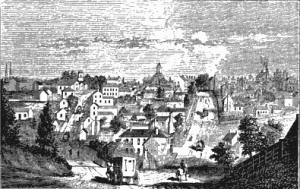
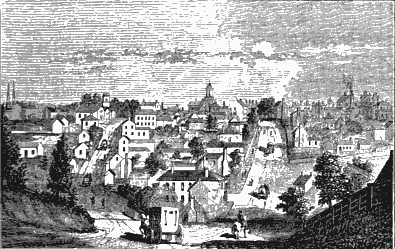
Knoxville, Tennessee, USA, viewed from the campus of East Tennessee University (now the University of Tennessee), circa 1857–1860

A view of Knoxville from the university circa 1857-1860
Posted in 150 Years Ago This Week, Confederate States of America, Southern Society | Tagged , , , | Leave a comment

Port Royal

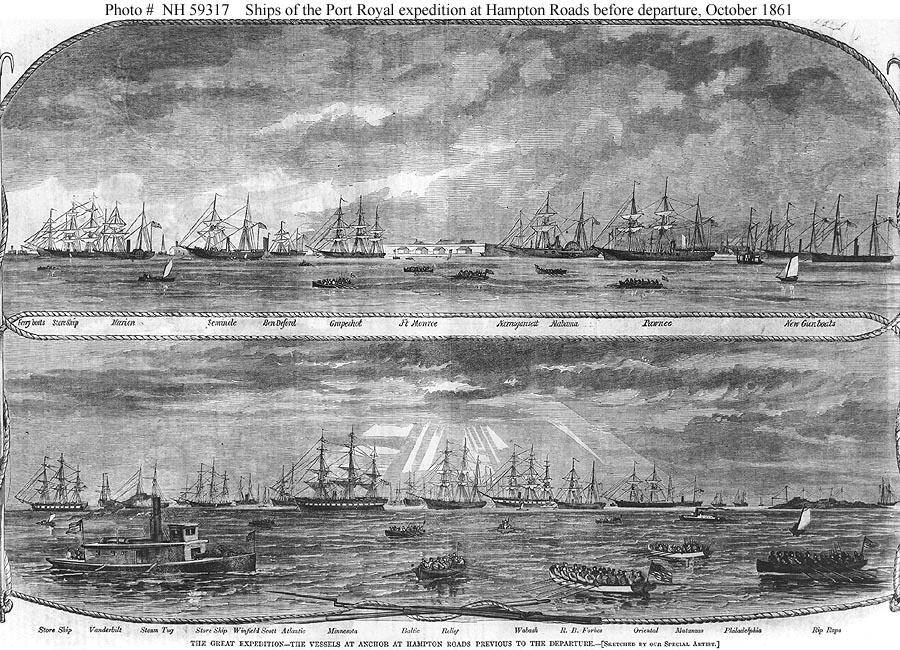
"The Great Expedition -- The Vessels at Anchor at Hampton Roads Previous to the Departure." (from "Harper's Weekly"; U.S. Naval Historical Center Photograph.)

Fleet at Hampton Roads, Virginia before departure

I’d urge anyone interested in the American Civil War to check out Civil War Daily Gazette. Eric has recently celebrated the site’s one year anniversary. His site does a great job following the war day-by-day on all fronts and in government. 150 years ago today a combined Union army – navy force defeated the Confederates at Port Royal and took over two forts guarding the approach to Beaufort, South Carolina. Samuel Francis Du Pont led the Union navy. The Union army was commanded by Thomas W. Sherman.

Here’s how one Union participant wrote about the expedition. From a Seneca County newspaper in 1861:

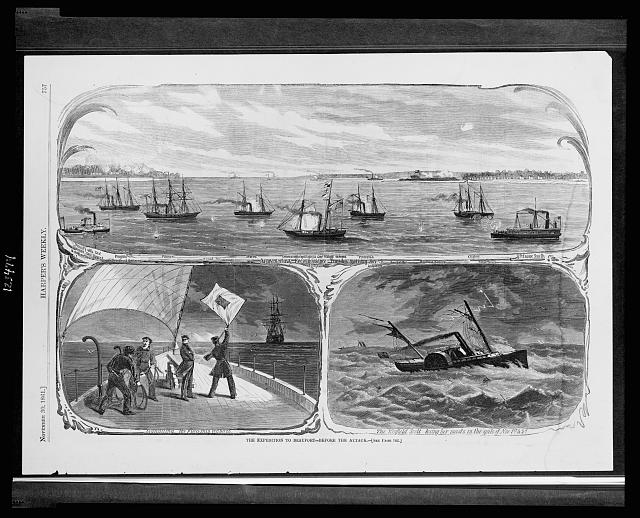
The expedition to Beaufort - before the attack (Harper's weekly, v. 5 (1861 Nov. 30); LOC - LC-USZ62-123474)

Lower right image: 'The Winfield Scott losing her masts in the gale of Nov. 1st & 2nd.'

From South Carolina

The following letter is from a brother of one of the editors of this paper, who enlisted in one of the Michigan Regiments, which accompanied the Great Naval Expedition to Port Royal, S.C.:

HILTON HEAD, S.C. November 18, 1861.

We left Annapolis on the 19th of October and remained at Hampton Roads about two weeks, before setting sail for this place. On our way here we encountered a terrible storm which wrecked two of the vessels attached to the Expedition. The Winfield Scott was so badly disabled that she had to cut away her masts, and while doing so two of her men were carried overboard, and lost. We were on the Vanderbilt which proudly rode the waves, the only damage being to the soldiers stomachs.

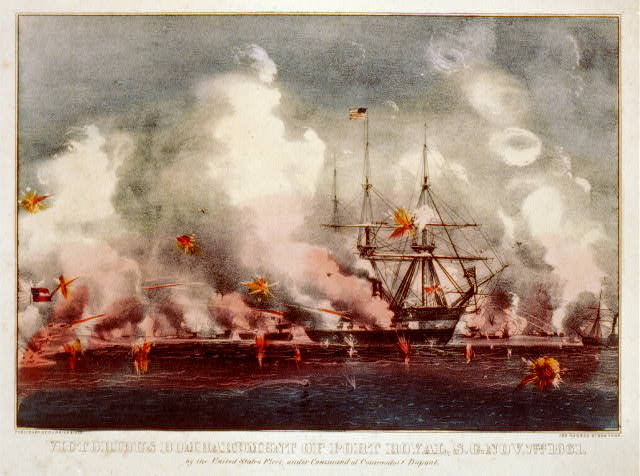
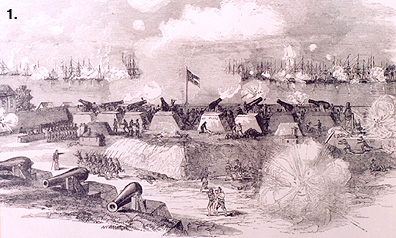
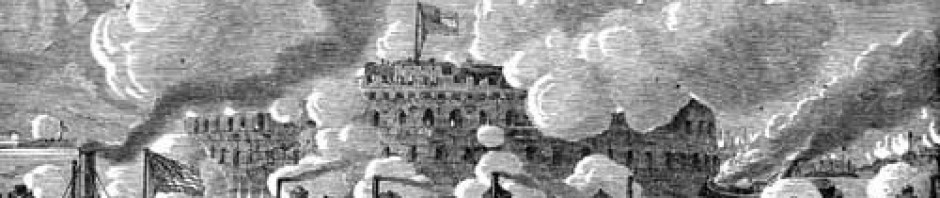
Victorious bombardment of Port Royal, S.C. Nov. 7th. 1861: by the United States fleet, under command of Commodore Dupont (Currier & Ives; LOC: LC-USZC2-3134)

DuPont's fleet bombs the forts

It was with a great deal of difficulty that we approached the harbor at Port Royal, in consequence of the Southerners having removed all the buoys. Our small boats were compelled to explore in every direction to find the channel, so that our War vessels could run up somewhere near the Forts. After no little delay every thing was got in readiness and on the morning of the 7th of November our boats opened fire on the Rebel steamers, driving them to their hole, in a very short space of time. – No sooner was this accomplished than a terrific cannonading was commenced against the Rebel Forts, there being two of them, one on each point, and after about three hours we succeeded in silencing their guns, and causing the chivalry of South Carolina to flee in a most unceremonius manner. – Our forces landed immediately and took possession of their Forts, and other works, over which the glorious old flag was soon thrust to the breeze. The Rebels left behind some twenty-five or thirty pieces of cannon, and among the number was five or six rifled guns of the most improved pattern. Our loss was eight killed and probably as many more wounded. The enemy’s loss was very great, and in their precipitate flight they left behind, their tents, guns, ammunition, wagons horses, &c &c. Upon our asking an old nego whether the Rebels run or not he replied, “Lor’ of God, massa run was no name for it”!

Fort Walker, Battle of Port Royal November 7, 1861.

View from Fort Walker before the Rebels "run"

It is as warm as Summer here and we live off the fat of the land. We have sweet potatoes in great abundance, and all the other luxuries of this most beautiful country. – We are now very busy throwing up breast works, in order that we may give the enemy trouble should he see fit to attack us, of which there is some danger. S.S.

Apparently the same storm that damaged the Winfield Scott was buffeting the North as the ship’s retired namesake traveled to New York City by train after departing Washington, D.C. and his 53 year army career.

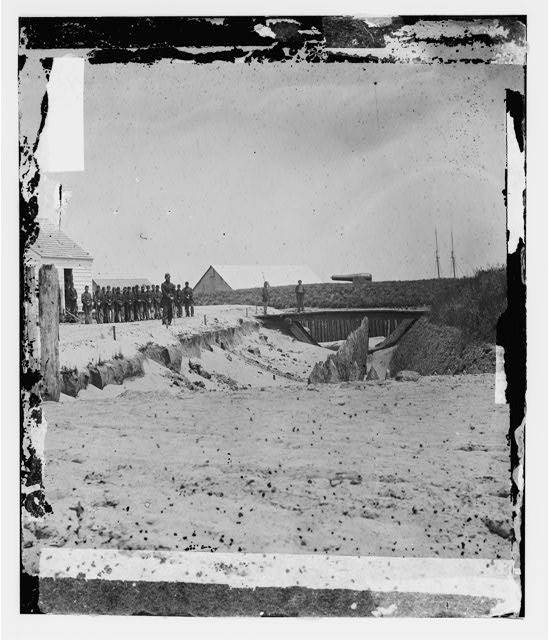
Hilton Head, S.C. Rear view of Fort Walker (1861 November; LOC: LC-DIG-cwpb-00799)

Fort Walker after the battle

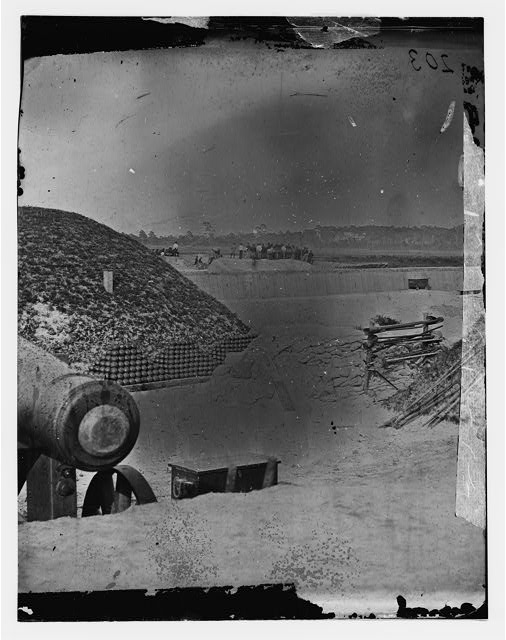
Phillips Island, S.C. Fort Beauregard (1861 November; LOC: LC-DIG-cwpb-00795)

Debris of war at Fort Beauregard

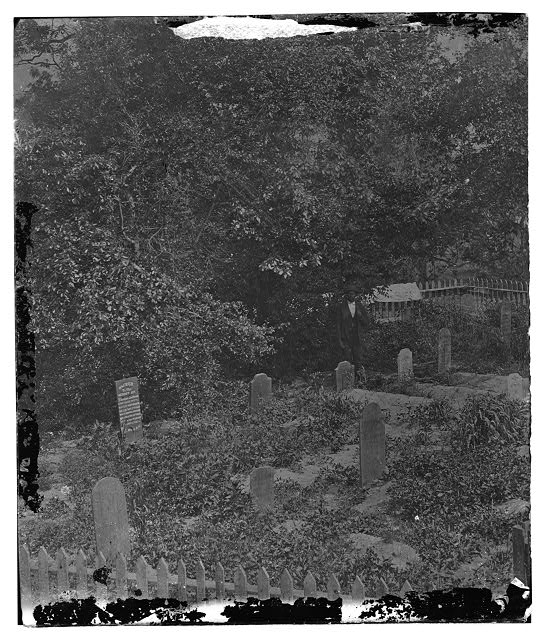
Hilton Head, South Carolina. Graves of sailors killed during the bombardment of November 7, 1861 (1861 Nov.; LOC: LC-DIG-cwpb-00772)

Union sailor graves at Hilton Head

Posted in 150 Years Ago This Week, Military Matters | Tagged , , | 3 Comments

On to Mobile!

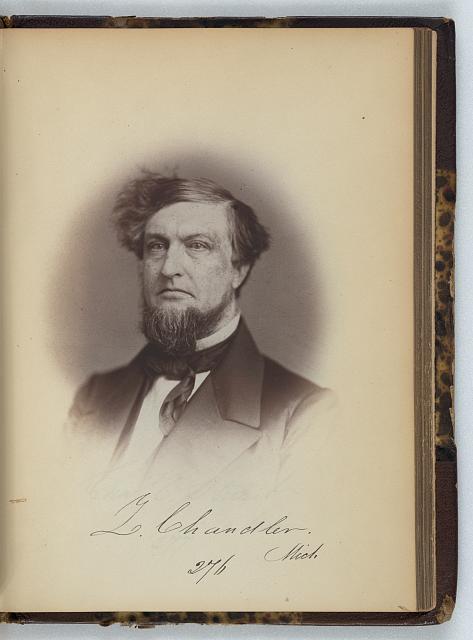
Zachariah Chandler, Senator from Michigan, Thirty-fifth Congress, half-length portrait (1859; LOC - LC-DIG-ppmsca-26815)

Chandler: Back to Bull Run - and beyond!

A couple days ago we saw George B. McClellan requesting “forbearance, patience and confidence”. Some northern politicians weren’t that patient and were letting the Lincoln administration know it.

From the Richmond Daily Dispatch November 5, 1861:

The outside Pressure upon Gen. M’Clellan.

The Washington correspondent of the New York Tribune, says:

Senator Chandler of Michigan, Ben Wade of Ohio, Trumbull of Illinois, and Wilkinson of Minnesota, are here, representing to the Administration that the popular demand of their constituents is, that General McClellan or somebody else shall right off whip the Confederates on the south-side of the Potomac in a pitched battle, and as near Bull Run as is possible, and from thence roll the tide of war steadily southward till it meets the waters of the Gulf.

Zachariah Chandler was a U.S. senator from Michigan. He was a strong abolitionist and supported the Underground Railroad in Detroit. He is known for a letter he wrote to Michigan Governor Austin Blair on February 11, 1861, in which Chandler stated:

“P.S.-Some of the manufacturing States think that a fight would be awful. Without a little bloodletting, this Union will not, in my estimation, be worth a rush.”

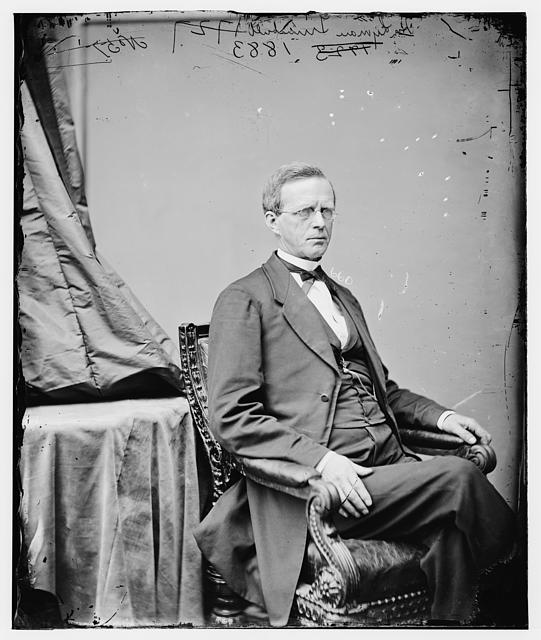
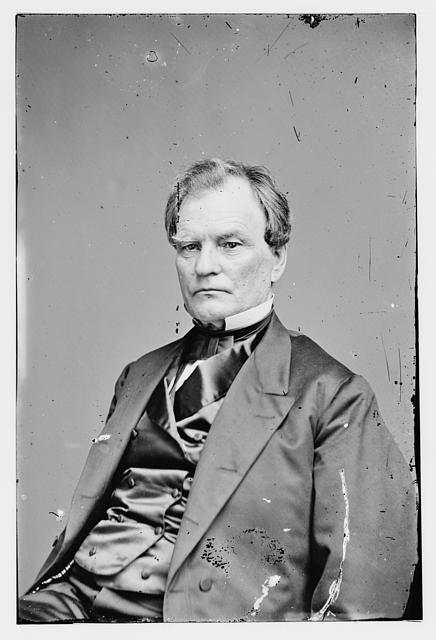
Along with Benjamin Wade and Lyman Trumbull Chandler took one one of the carriage rides out to witness First Bull Run. They got a bloodletting as the Confederates routed the Union and almost captured Chandler’s party.

Hon. Lymen (sic)Trumbull of Illinois (between 1860 and 1875; LOC - LC-DIG-cwpbh-00478)

Lyman Trumbull

Hon. Ben. F. Wade of Ohio (between 1855 and 1865; LOC - LC-DIG-cwpbh-02080)

Benjamin Wade

Posted in 150 Years Ago This Week, Military Matters, Northern Politics During War | Tagged , , , , | Leave a comment

Stealing in Wheeling?

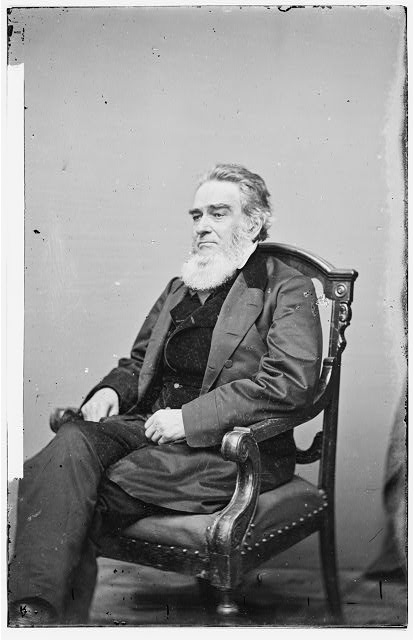
Portrait of Attorney-General Edward Bates, officer of the United States government (Between 1860 and 1865; LOC - LC-DIG-cwpb-05606)

Edward Bates

No, it’s authorized by the Confiscation Act of 1861

From The New-York Times November 5, 1861:

… From the Wheeling Intelligencer, Nov. 1. …

MORE CONFISCATIONS.

Yesterday evening United States Marshal NORTON proceeded to the former residence of Dr. HOUSTON and took possession of all his household goods, under the act of Congress authorizing the confiscation of rebel property. Dr. HOUSTON left this city at the time of the great secesh stampede. He is now a surgeon in the rebel army, and a very good one, too; but that is only another reason why his property should be confiscated. Dr. HOUSTON’s agents were in the house at the time, supposed to be engaged in preparations to remove the property or transfer it to other hands.

It was not the intention of the Marshal to interfere with any more rebel property in the city until he heard from headquarters, but obtaining information that HOUSTON’s property was being removed, he stepped in upon the confidential agents and interfered with their operations. The seizure was forced upon the Marshal, and his duty was plain. A guard was placed upon the property last night.

You can read more about U.S. Marshal Edward M. Norton at The Intelligencer, including his written words to U.S. Attorney General Edward Bates in September, 1861: “We are surrounded here by traitors”.

According to the Wikipedia link about the Confiscation Act: “Lincoln gave Attorney General Edward Bates no instructions on enforcing the bill; as a result, few such confiscations occurred”. Edward M. Norton seems to have been more proactive.

Posted in 150 Years Ago This Week, Northern Society | Tagged , , , | Leave a comment

Anticipation: Sword & Torchlit Parade

***Correction11-16-2011: According to this report at the Richmond Daily Dispatch the torchlit parade by Blenker’s division occurred on November 11, 1861. Sorry about that.

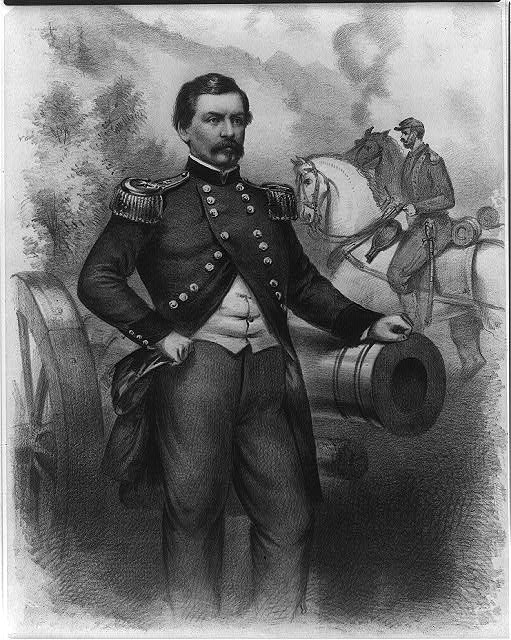
Major General George B. McClellan (c1861 October 8; LOC - LC-USZ62-16405)

Could use a sword, along with 'forbearance, patience and confidence'

President Lincoln has recently promoted George B. McClellan, a native Philadelphian, to general-in -chief of all the Union armies. McClellan also retains direct command of the Army of the Potomac.

From The New-York Times November 4, 1861:

SPEECH OF GEN. McCLELLAN.; Presentation of a Sword by the City Councils of Philadelphia. Gen. McClellan Thinks the War will be Short.

WASHINGTON, Sunday, Nov. 3.

The following is the speech of Major-Gen. McCLELLAN, on the presentation of the sword yesterday by the Committee of the City Councils of Philadelphia:

I ask you, Sir, to give my warmest and deep thanks to the honorable body you represent for this entirely unmerited compliment. I could thank you better if I thought that I deserved it, but I do not feel that I do. Nothing that I have yet accomplished would warrant this high compliment. It is for the future to determine whether I shall realize the expectations and hopes that have been centred in me. I trust and feel that the day is not far distant when I shall return to the place dearest of all others to me, there to spend the balance of my life among the people from whom I have received this beautiful gift. The war cannot be long. It may be desperate. I ask in the future forbearance, patience and confidence. With these we can accomplish all, and while I know that, ‘in the great drama which may have our hearts’-blood, Pennsylvania will not play the least, I trust that, on the other hand, she will play the highest and noblest part.

I again thank you, and again ask you to convey to the councils my most sincere thanks for the sword Say to them that it will be my ambition to deserve it hereafter. I know I do not, now.

The company loudly applauded these sentiments after which the members of the Committee were introduced to Gen. MCCLELLAN, who introduced them to the officers of his staff.

The sword was admired by all, and pronounced to be a magnificent weapon.

This article reminds me of President Obama’s remarks upon winning the Nobel Peace Prize less than eight months into his presidency. General McClellan’s words seem pretty humble.

________________________________

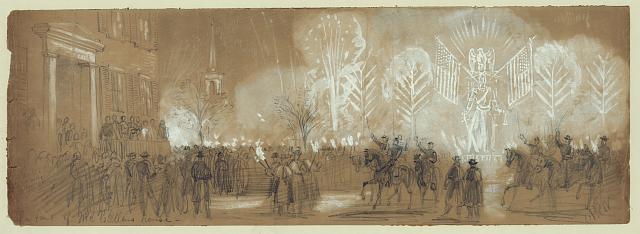
In another apparent celebration of promise and potential it is said that 150 years ago tonight there was a celebration in front of McClellan’s Washington, D.C. house. From The Library of Congress description of the image:

“Caption typed on mat: Torchlight parade by General Blenker’s Division in honor of General McClellan’s promotion to Commander-in-chief of the Army, Washington, D.C., Nov. 3, 1861.”

In front of McClellans house (1861 November 3; LOC - LC-DIG-ppmsca-22453)

Parade for a promotion

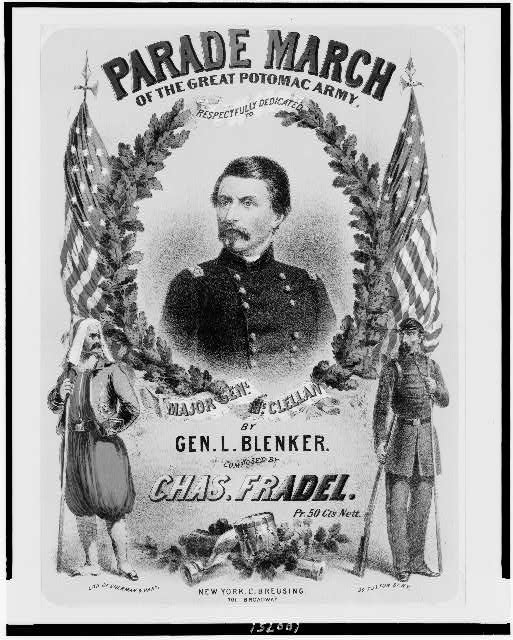
Parade march of the great Potomac Army, respectfully dedicated to Major Genl. McClellan by Gen. L. Blenker. Composed by Chas. Fradel (c186LOC - LC-USZ62-100751)

Posted in 150 Years Ago This Week, Military Matters | Tagged , | 1 Comment

Train Ride in Stormy Weather

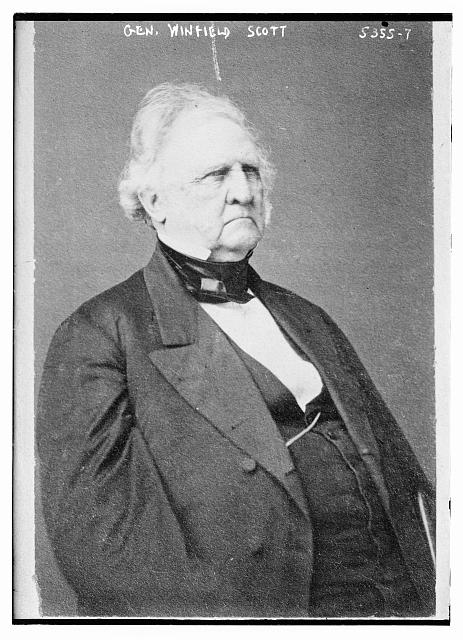
Gen. Winfield Scott (LOC - LC-DIG-ggbain-31647)

No fuss: "Oh, go home, friend, and don't make a noise."

150 years ago today, while a severe Nor’easter ravaged the eastern seaboard, retired General Winfield Scott traveled by train from Washington to New York City. Despite the stormy weather Scott arrived at his son’s home safely that night.

From The New-York Times November 4, 1861:

ARRIVAL OF GEN. SCOTT IN THIS CITY.

The General arrived in this City on Saturday evening, accompanied by the gentlemen of his Staff, and also by Secretary CAMERON, Maj.-Gen. BUTLER, Brig.-Gen. MCCALL, Col. CULLOM and others. On account of the severity of the storm, it was supposed that the party would remain over in Harrisburgh. This circumstance, together with the heavy rain, prevented the assemblage of the people who, under other circumstances, would have turned out to do honor to the retiring General. To those who were present to welcome him Gen. SCOTT gave a cordial grasp of the hand and a hearty benediction, expressing a wish, however, that no attempt at a reception should be made. When the crowd about the car cheered him, he said, good naturedly, “Oh, go home, friend, and don’t make a noise.” He was assisted to his carriage and was driven to his son’s residence in Twelfth-street. Adjutant-Gen. THOMAS escorted him to his home.

Portrait of Brig. and Adjutant-Gen. Lorenzo Thomas, officer of the Federal Army (Between 1860 and 1865; LOC - LC-DIG-cwpb-04799)

Lorenzo Thomas' hat useful that stormy night

And it was quite a storm. Here’s an example from the same issue of The Times:

The Storm in Brooklyn.

The storm that passed over this city on Saturday evening was one of the most violent experienced here for many years. The rain fell in torrents, and almost without cessation, until midnight, and the wind blowed in fearful gusts, doing considerable damage, particularly to moveable fixtures. As usual on such occasions, signboards, awnings, chimney-tops, and ornamental frees were the first to yield to the blast, and were scattered in admirable confusion in every direction, so that pedestrianism was an unsafe experiment during the height of the gale. A new three-story brick house (unoccupied) on Elliot-place, between De Kalb and Lafayette avenues owned by JOHN BROPHY, was blown down, and a large number of buildings were more or less injured in different parts of the city. The sewers were all flooded, and some gave way under the action of the water. On Fulton-avenue, near Lafayette, the pavement sank into the sewer a distance of twenty or thirty feet. The high tide flooded many of the cellars on the low grades near the East River, and considerable damage must have resulted therefrom. The shipping at the wharves and the ferry-boats rode out the gale in safety.

Adjutant General Lorenzo Thomas served as General Scott’s chief of staff from 1853-1861, so it seems kind of fitting that Thomas accompanied “Old Fuss and Feathers” to the old warrior’s destination.

Posted in 150 Years Ago This Week, Military Matters | Tagged , | 1 Comment