Shivering in “thin Summer flannel blouses”

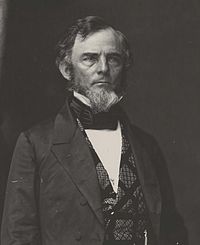
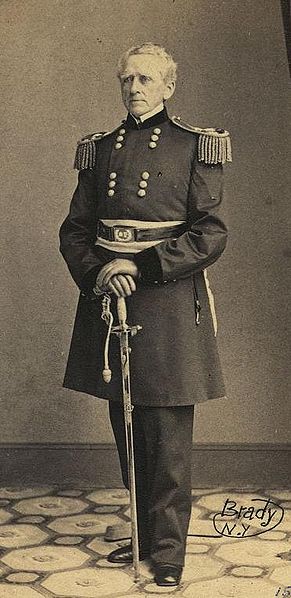
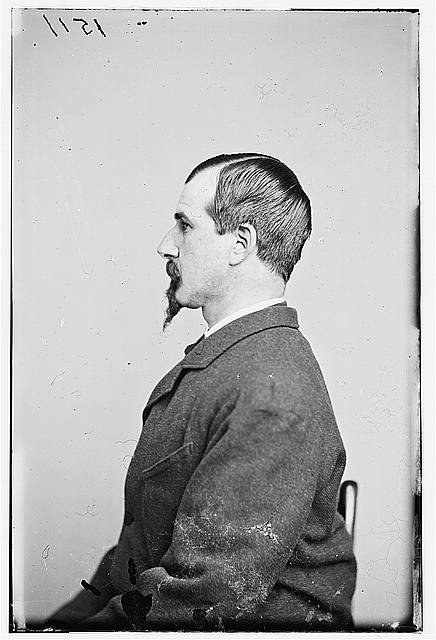
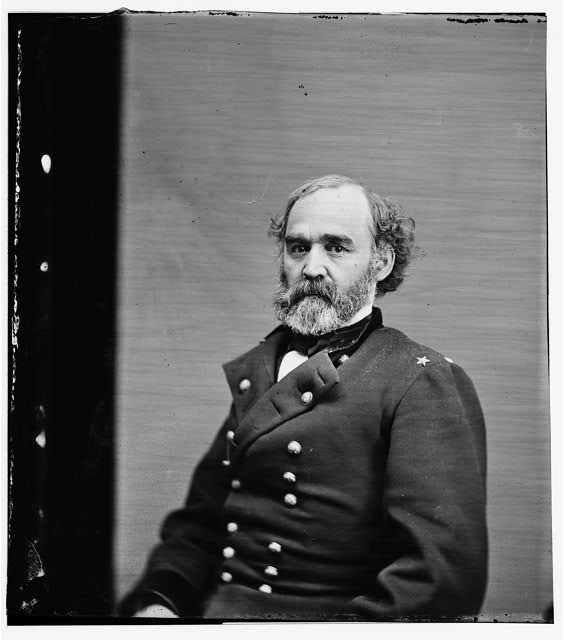
Montgomery C. Meigs (between 1860 and 1870; LOC - LC-DIG-cwpb-07054 )

"The want of clothing more than the want of money discourages enlistments."

As Civil War Daily Gazette has reported 150 years ago President Lincoln accepted the retirement of General Winfield Scott and directed that George McClellan take command of the Army of the United States. You can read Lincoln’s order at Classic Reader.

Apparently the Northern armies that McClellan will be overseeing are in dire need of warm clothing as winter approaches. From The New-York Times November 1, 1861:

CLOTHING FOR THE ARMY.; LETTER FROM THE QUARTERMASTER-GENERAL.

QUARTERMASTER-GENERAL’s OFFICE,

WASHINGTON CITY, Oct. 22, 1861.

Sir: The within communication from the Board of Trade of Boston has been handed to this office with a request to transmit it to the Secretary of War.

The matter has been discussed with the Secretary, and I am of opinion that the order to inspect and purchase an extra quantity of cloth was a wise one, and ought not to be revoked. While the public, not truly advised as to the orders of the Government, and excited by reports such as have been published in certain newspapers, that the Government had sent out a credit L5,050,000 or $25,000,000, and in other papers that $60,000,000 had been sent out, may misjudge it, the fact is that it is proposed only to spend $800,000 in these purchases, and to purchase and ship only for instant and pressing wants of the service.

Governors daily complain that recruiting will stop unless clothing is sent in abundance and immediately to the various recruiting camps of regiments.
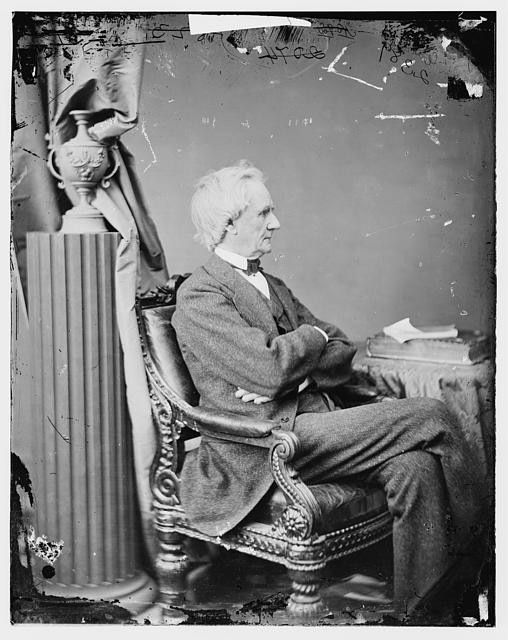
Cameron, Simon (between 1860 and 1875; LOC - LC-DIG-cwpbh-00627)

War Secretary received missive from Meigs

With every exertion, this Department has not been able to obtain clothing to supply these demands, and they have been so urgent that troops before the enemy have been compelled to do picket duty in the late cold nights without overcoats, or even coats, wearing only the thin Summer flannel blouses.

The want of clothing more than the want of money discourages enlistments. This Department would gladly pay cash and provide clothing, but it has not been able to satisfy the demands for either one or the other and as promptly as the service demands.

The financial question is in the hands of the capitalists, the merchants, and the Treasury Department.

Should the Board of Trade be right in its opinion, and the domestic manufactories be able to supply regulation cloth enough before cloth can be imported from Europe, it will gladly be purchased at any reasonable prices, and made up into clothing.

Could 150,000 suits of clothing — overcoats, coats, and pantaloons — be placed to-day in depot, it would scarcely supply the calls now before me. They would certainly leave no surplus.

Very respectfully, your obedient servant,

M.C. MEIGS, Quartermaster-General.

To the Hon. SIMON CAMERON, Secretary of War, War Department.

Born in Augusta, Georgia Montgomery C. Meigs was a career United States army officer who worked as an engineer before the Civil War. He was The Quartermaster General throughout and beyond the war. From Wikipedia:

Of his work in the quartermaster’s office, James G. Blaine remarked, “Montgomery C. Meigs, one of the ablest graduates of the Military Academy, was kept from the command of troops by the inestimably important services he performed as Quartermaster General. Perhaps in the military history of the world there never was so large an amount of money disbursed upon the order of a single man … The aggregate sum could not have been less during the war than fifteen hundred million dollars, accurately vouched and accounted for to the last cent.” Secretary of State William H. Seward’s estimate was “that without the services of this eminent soldier the national cause must have been lost or deeply imperiled.”
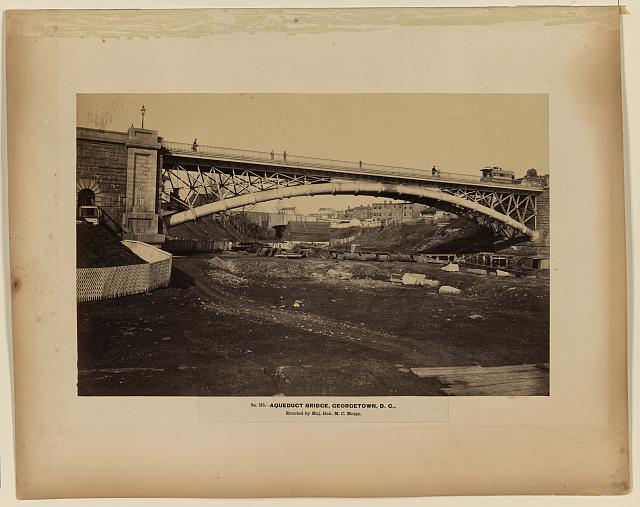
Aqueduct Bridge, Georgetown, D.C., erected by Maj. Gen. M.C. Meigs (between 1861 and 1865; LOC - LC-DIG-ppmsca-07281)

Meigs' favorite pre-Civil War project: "Tubular bridge, through the pipes of which the city of Washington is supplied with water; built by General Meigs"
Posted in 150 Years Ago This Week, Military Matters | Tagged , | 1 Comment

Grim Reaper?

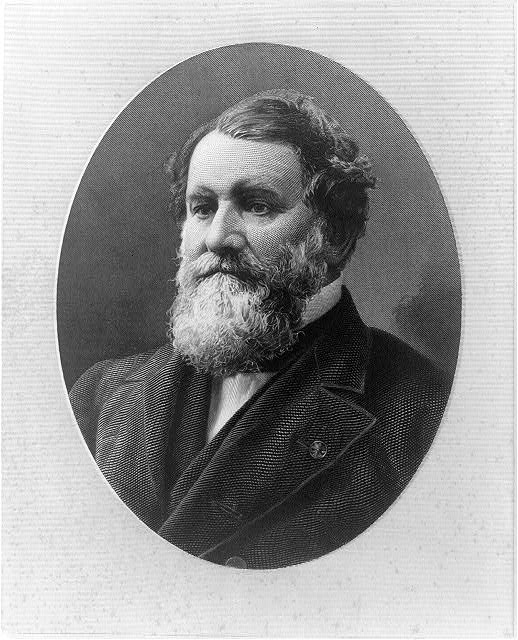
Cyrus McCormick (LC-USZ62-27710)

Denied a patent extension

From the Richmond Daily Dispatch October 29, 1861:

Non-extension of M’Cormick’s reaper patent.

The Commissioner of Patents has declared adversely on McCormick’s application for the extension of his reaper patent of 1847, for the following reasons:

1. 1st. That the invention is one of great utility and importance to the public.
2. 2d. That the sums already received by Mr. McCormick and the sums he is entitled to receive from infringements, together amount to an adequate remuneration, and therefore the patent should not be extended.

The parties residing in the State of New York and opposing the extension, were represented by Judge Dewitt, C. Lawrence, and Robert W. Fenwick, of Washington City.

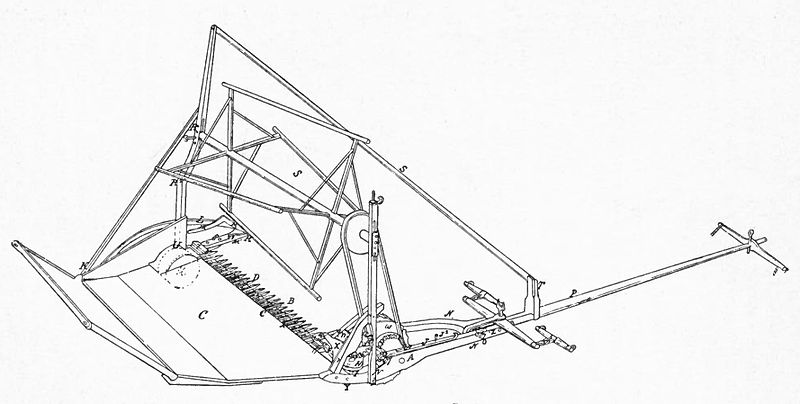
Sketch from 1845 patent of an improved grain reaper by Cyrus Hall McCormick.

Sketch from 1845 patent of an improved grain reaper by Cyrus Hall McCormick.

Cyrus McCormick was not the sole inventor of the mechanical reaper, but he and his family helped develop it. Patent controversies were a part of the story of reaper development. Civil War connection? I’m guessing, but it seems like it’s a tale of two inventions. Eli Whitney was a Northerner who invented the cotton gin, which made cotton a great cash crop for the United States, but “King Cotton” made the South much more dependent on slavery. Cyrus McCormick was a Virginian. The McCormick family business took off as it moved to Chicago, which was closer to the huge, flat, fertile ground in the Midwest and Plains. The reaper seems to have helped (along with railroads, canals, etc.) the North more than the South because it freed up more laborers for manufacturing.

Grim reaper against red sunset (1905; CAI - Clark, no. 53 (D size))

Could we suspend gravity for a while?

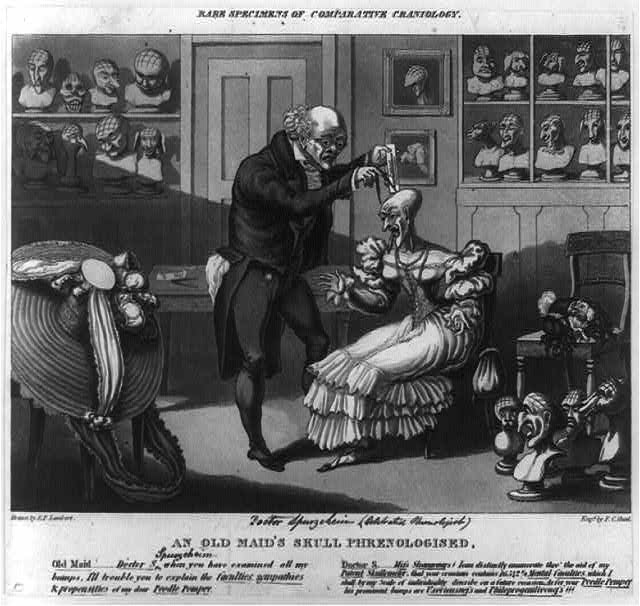
Rare specimens of comparative craniology: an old maid's skull phrenologised. (ca. 1815; LOC - LC-USZ62-8606)

Posted in 150 Years Ago This Week, American History, Northern Society | Tagged , , , , | Leave a comment

Responding to Need

General Gideon Johnson Pillow

Pillow: threatens troop reduction - his own

The war is disrupting the economies of North and South. Here’s a couple Southern examples from the Richmond Daily Dispatch October 29, 1861:

Deserves Emulation.

A free market has been opened in Mobile for those who are not able to purchase their own provisions. Tickets are issued by the members of the ward committees to such persons as apply to them for assistance. About four hundred persons are daily supplied with provisions.

Commendable purpose a Confederate General.

A woman residing in Memphis, whose husband is a volunteer in Gen. Pillow’s command, recently wrote him that she had not received any assistance from the city authorities, and added that she did not know how herself and children could get along. The contents of the letter having reached Gen. Pillow, he addressed a letter to the Memphis press, in which he states that unless the families of the volunteers under him are properly taken care of, he will release all such as have families dependent upon them.

I am assuming the Mobile story is war-related.

Here’s a little political incorrectness for the season from Karen’s Whimsy:

Halloween Greetings

Smoke 'em if you got 'em

Posted in 150 Years Ago This Week, Confederate States of America, Southern Society | Tagged , | Leave a comment

Baltimore Barometer

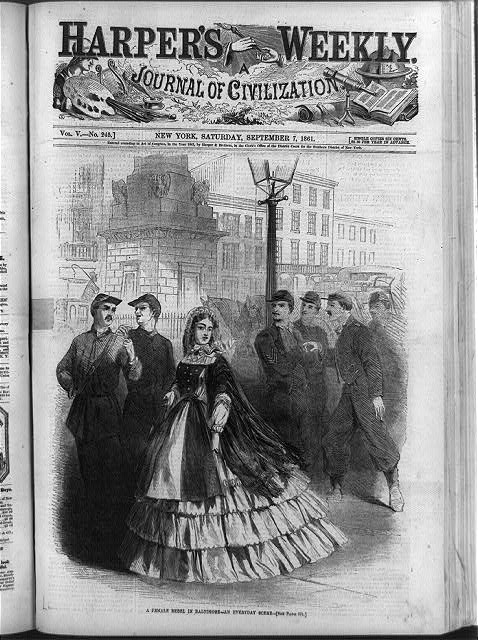
A female rebel in Baltimore - an everyday scene (Harper's Weekly, (1861 Sept. 7); LOC - LC-USZ62-87801)

Sticking to her guns?

From The New-York Times October 28, 1861:

A SECESSION BAROMETER.

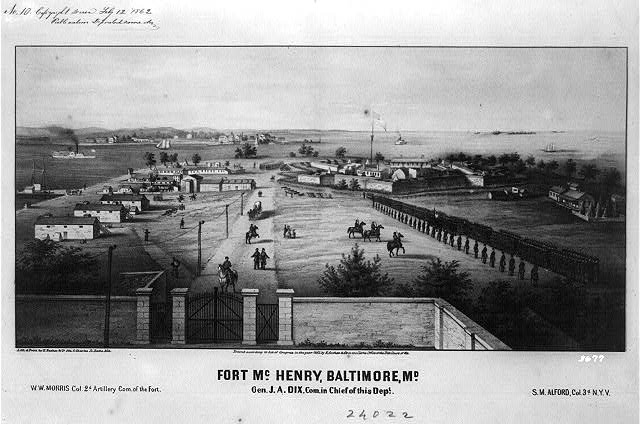
— Baltimore is a perfect barometer of the war. If you would see how the National fortunes stand, you have but to note the state of feeling and its manifestations in that divided city. Let our arms meet with a reverse — up goes the secesh mercury; let the Government show the tusks of power, and down sinks treason to the lower registers, though only to lie perdu till an opportunity comes. A fortnight ago, the Monumental City polled a splendid Union majority. But the disaster at Ball’s Bluff has made treason once more rampant, and Baltimore is reported again all feverish and unsettled. Happily, while secession proposes, Fort McHenry disposes; and Gen. DIX is altogether too keen to be dixied.

John Adams Dix commanded the Department of Maryland at this time. He is known for his strong Union statement in January 1861.

Fort McHenry, Baltimore, Md (c1861 October 29; LOC - LC-USZ62-3677)

Fort McHenry disposes

General John A. Dix

won't be dixied

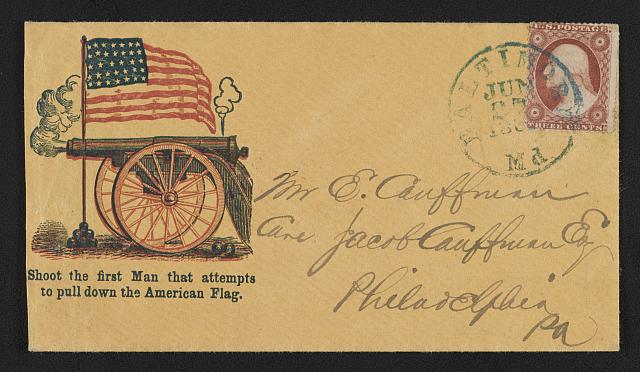
Civil War envelope showing American flag and cannon with message "Shoot the first man that attempts to pull down the American flag" (between 1861 and 1865; LOC - LC-DIG-ppmsca-31705 )

Dix legacy posted in Baltimore

Posted in 150 Years Ago This Week, Military Matters | Tagged , , | Leave a comment

D—-d Hessians!

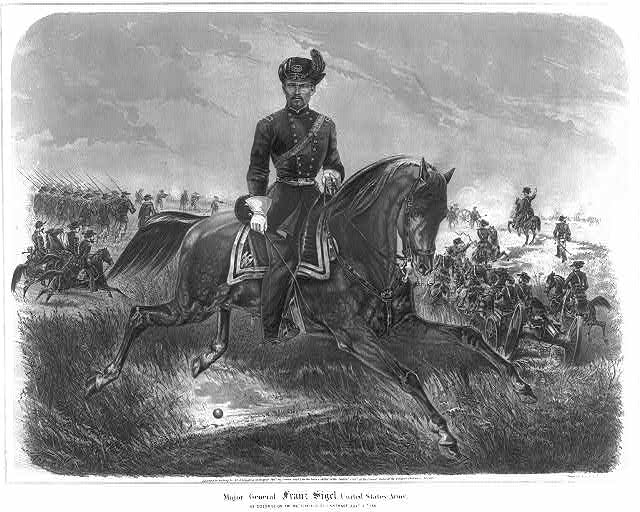
Major General Franz Sigel, United States Army, as colonel, on the battlefield of Carthage July 5th 1861 (LOC - LC-USZ62-15597)

I'm going to fight (and get paid) mit Sigel

An editorial from the October 26, 1861 edition of the Richmond Daily Dispatch:

Who are we fighting?

–The term “Yankee” ought no longer to be applied to the enemy. Such a term is not just to the fighting men on the other side, nor to ourselves. We are, in point of fact, literally and truly, invaded by a European army. That army is made up of Irishmen and Germans with a small proportion of Yankees. Whilst the Yankee Government deprecates bitterly the sympathy of European Governments with the South, its own main reliance is European soldiers. The prisoners just brought in are chiefly of this class. If we call them Yankees we not only commit an error in fact, but give the Yankees credit for fighting their own battles. We have just whipped an Irish and German army, whose bravest leader was a depraved Englishman; and it is an army of foreign mercenaries which still remains for us to whip on the borders of the Potomac.

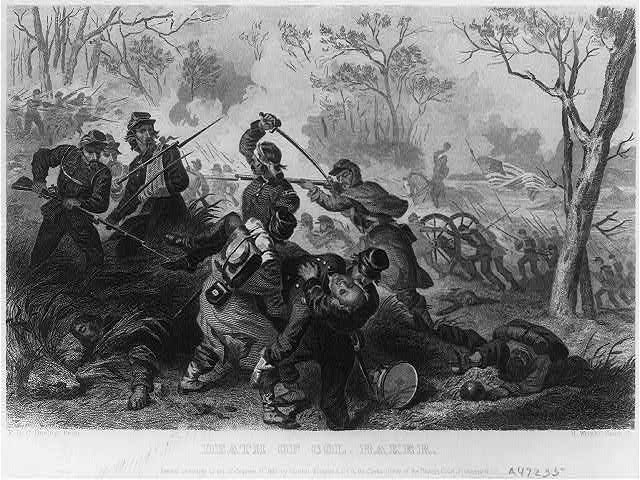
Death of Col. Baker (at Ball's Bluff (near Leesburg, Va.) in the Civil War, Oct. 22, 1861) (c1862; LOC - LC-USZ62-71781)

"Depraved Englishman" killed at Ball's Bluff

There is a great article about Union recruitment at the National Park Services’s Governors Island site. About 370,000 out of the approximately one million men who served in the Union army throughout the course of the war were native Germans and Irish. Employment/pay was one of several motivations.

The Confederates killed English-bornEdward Dickinson Baker during the rout of the Union force during the October 21, 1861 Battle of Ball’s Bluff.

Franz Sigel was a political general who was valuable to the Union because of “his ability to recruit and motivate German immigrants ..”. A resident of St Louis when the war started, Sigel was operating in Missouri 150 years ago today.

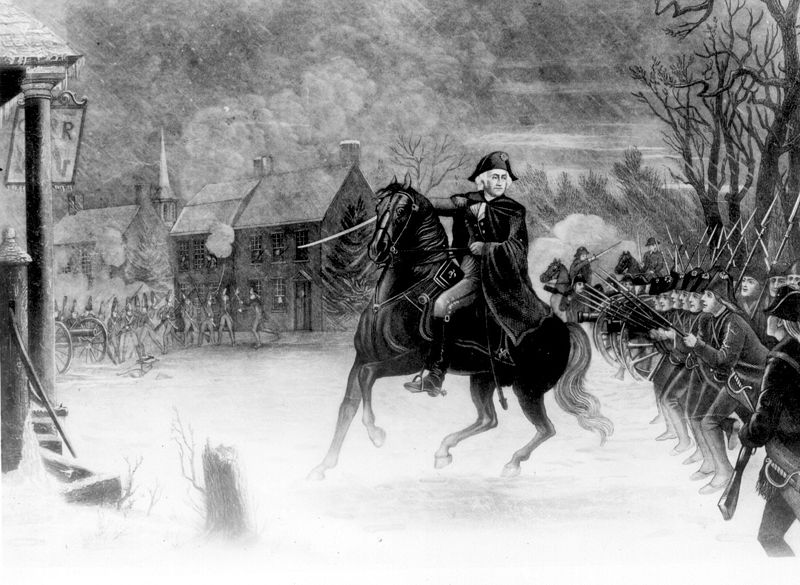
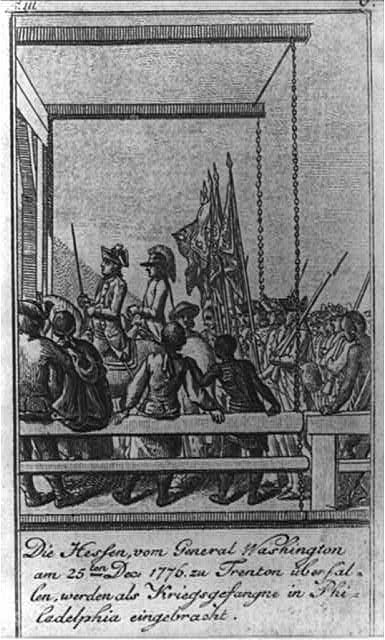
George Washington led the Continental army to victory over Hessians at the Battle of Trenton during the American Revolutionary War. According to Wikipedia although a Hessian soldier was from Germany, he was not strictly speaking a mercenary because German rulers got the money.

Washington at the Battle of Trenton. An engraving by Illman Brothers. From painting by E.L. Henry.

Famous Virginian leads American assault against German interlopers

Die Hessen, vom General Washington am 25ten Dec. 1776, zu Trenton überfallen, werden als Kriegsgefangne in Philadelphia eingebracht (Germany : s.n., 1784; LOC - LC-USZ62-19419)

Captured Hessians from Battle of Trenton led to Philadelphia

Posted in 150 Years Ago This Week, Military Matters, Southern Society | Tagged , , , , , | Leave a comment

Scary Stuff

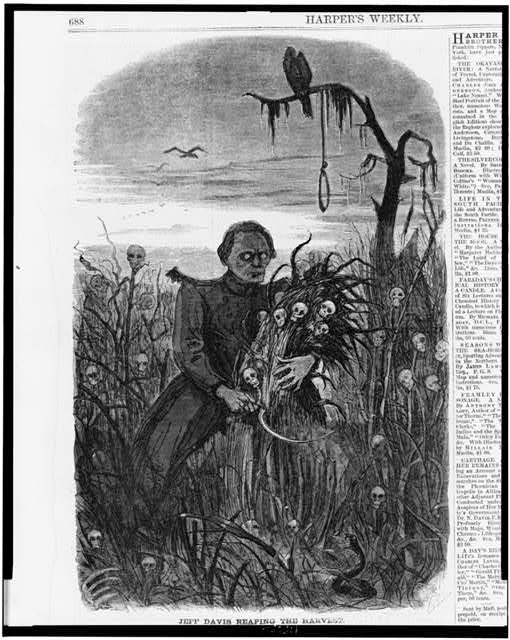
Published 150 years ago today in Harper’s Weekly:

Jeff Davis reaping the harvest (Harper's weekly, 1861 Oct. 26; LOC - LC-USZ62-115352)

Jeff Davis Reaping The Harvest

Posted in 150 Years Ago This Week, Confederate States of America | Tagged , , | Leave a comment

“torch-light procession”; layin’ a keel

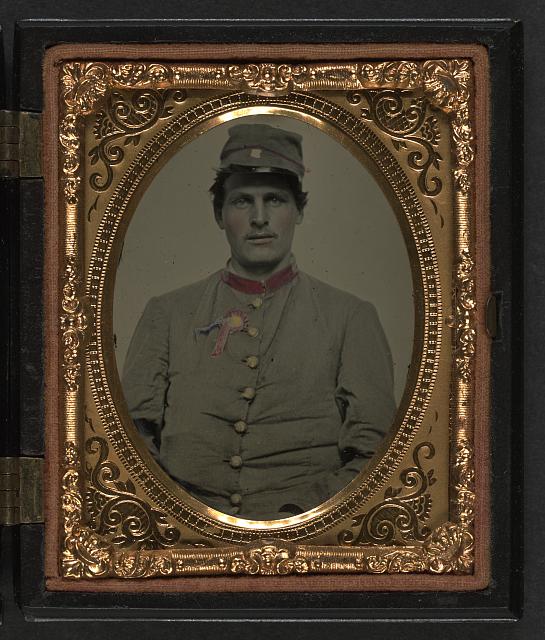
Unidentified soldier in Confederate artillery jacket with secession badge and artillery forage hat (between 1861 and 186; LOC - LC-DIG-ppmsca-37168)

caps very versatile

In Lieu of Radway’s Ready Relief?

Given the Radway Company’s strong Union stance in yesterday’s post I doubt it is sending any of its wondrous elixir to Confederate soldiers. Here’s a story about a substitute in one Rebel camp.

From the Richmond Daily Dispatch October 22, 1861:

Smuggling whiskey in the Camp.

“Personne,” the intelligent and spicy correspondent of the Charleston Courier, writing from Fairfax, Oct. 11, communicates the following, which is a pretty fair specimen of the expedients which are resorted to for obtaining that favorite contraband of an army, whiskey:

Speaking of Bourbon, it is positively distressing to one with a sympathizing nature, to see the straits to which the soldiers are occasionally reduced by the want of their accustomed stimuli. Liquor of any kind is a rarity, and the more difficult it is to obtain, the greater is its abuse. Speculators among the soldiers are selling rifled stuff, which is a cross between sheet lightning and North Carolina turpentine, at three dollars a quart, while the Provost Marshal has confiscated a lot, which, at auction, would not bring fifteen cents a gallon.–Now and then some sharp captain, while foraging, will secure enough to last himself and comrades one drink round, but this is the exception and not the rule. The article is tabooed wherever found. Even private packages are not exempt from examination, and the presence of half a dozen straws from the crevice of a box is evidence on which an official wedge or axe is brought into requisition to discover the liquid iniquity. Smuggling is, therefore, again coming into vogue. Several days ago a terrible rumpus was created in one of the camps by the development of some twenty or thirty men so intoxicated as to be unable to engage in the evening drill. An examination was at once set on foot to ascertain where the liquor had been obtained, but without success. The next day another party were also drunk, and for nearly a week the occurrence was repeated, in spite of the utmost vigilance. Finally, one of the delinquents, a royally happy Irishman, was brought to headquarters, where the perplexed officers were holding a consultation over the strange proceedings.

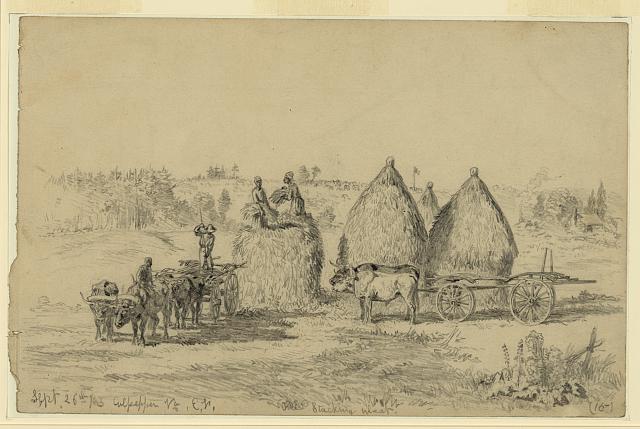
Culpepper (i.e., Culpeper), Va.--Stacking wheat (1863; LOC - LC-DIG-ppmsca-20659)

Oxen - even another use!

“The top o’ the mornin’ to yez, gintlemen.”

“Silence!” thundered the Colonel–“You’re drunk, sir.”

“Dhrunk is it, sure; begorra, its only delighted that I am to recaive a letter from me swateheart.”

“Tell me where you got your liquor, instantly, sir.”

“Whiskey, d’ye mane, Kern’l — I hav’nt had a smill of the craythur for the lasht six wakes.”

At this juncture one of the officers called attention to a little stream that was trickling down the Paddy’s ear.

“What’s that?” demanded the Colonel.

Mike slipped his hand up to the delinquent auricular, and drawing his finger across his mouth to taste the drop he now felt, an expression of comic guiltiness took possession of his face, as if he had discovered something going wrong, and he replied–

“By the powers, Kern’l, but it’s a warrum day. I belave I’m prespiring.”

“Take off your cap, sir.”

“That I will, sur, to any gintleman like yer honor.”

Mike’s head was as wet as a soaked dish rag; and it was now observed that his cap, usually so pliable, was stiff and unruly with some suspicious contents.

“Hand it to me, sir.”

“Indade Kern’l, but it’s nothing but me handkerchief.”

He had to pass it over, however, and much to the mortification of Pat, the officers drew forth an object which at first puzzled the credulity of every person present, and which would be an equal puzzle to your best guess. It was about eighteen inches of the entrails of an ox, dried and prepared for this novel use, filled with a pint or two of “torch-light procession,” and tied at both ends. Unfortunately for Mike, one of these had become loose, and his extraordinary “prespiration,” led to the long sought discovery. The “milk in the cocoa nut” of the regiment being thus accounted for, the delinquent was dismissed for extra duty, and to give the Colonel and his brother inquisitors an opportunity to let out the broad “guffaws” which had been accumulating during the strange examination. Others of these intestinal arrangements were subsequently found, and I need not add that no further trouble has been experienced there from surreptitious drinks.

I think it’s a great story. How truthful it is – that’s another question. I can be a pretty gullible person, but I’m becoming more skeptical about articles I’m reading in the newspapers. The following appeared in the same issue of the Daily Dispatch:

Spicy letter from a Yankee girl.

–The following letter, found on the body of one of the slain at Manassas, has been sent to an exchange for publication. Every assurance is given that it is genuine:

Providence, Rhode Island, July 9th, 1861.

Dear Georges:

Yours of the 3d instant came to hand to day, which found me enjoying health, and at once revived and raised for you my heartfelt passion to a considerable extent.–And glad I am to hear that your regiment have got in the land of the rebels and are well and ready to drive them from the soil of liberty and love. Mrs. Ribburn received a letter from her husband, the Captain of the Rhode Island Artillery, that he would play Yankee Doodle on the rebels at Bull Run on the 21st of this month, and I am told that on the 28th of the same month you are to have a grand ball at Richmond, with Jeff. Davis and Beauregard, assisted by many of the Southern girls as waiters. …

I appreciate the assurance of genuineness because it’s amazing that the spicy girl could predict the date and place of the upcoming battle but get the victor wrong.

The other thing about the whiskey article – obviously both Yankees and Rebels drank alcohol.

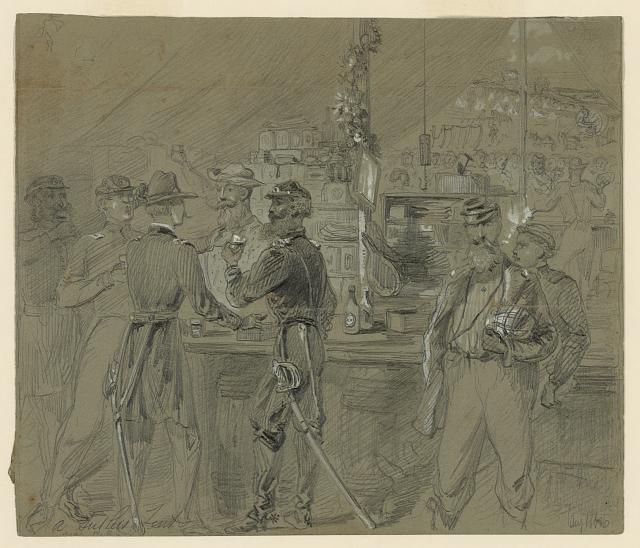
A sutler's tent near H.Q. (1862 August; LOC - LC-DIG-ppmsca-20779)

Doing business with the sutler

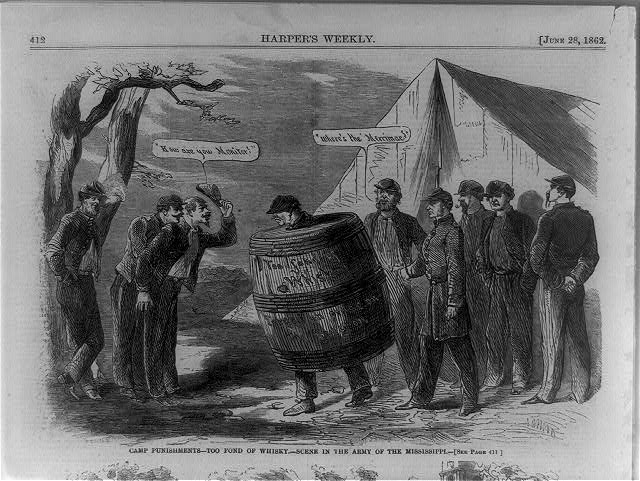
Camp punishments--too fond of whisky (sic)--scene in the Army of the Mississippi (Harper's 6-28-1862; LOC - LC-USZ62-96119)

"How are you Monitor?"

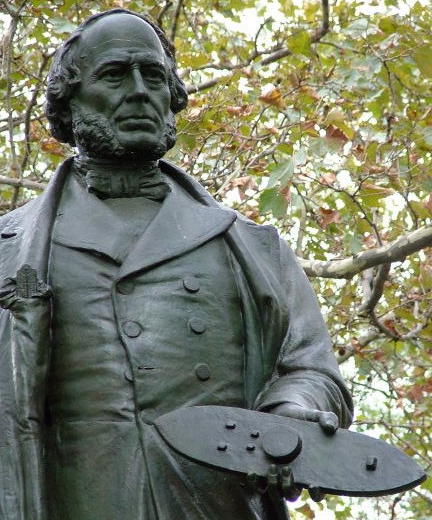
The reference to The Monitor and Merrimac is ahead of schedule but somehow appropriate because 150 years ago today John Ericsson laid the keel of the USS Monitor at Greenpoint, Brooklyn.

The statue of John Ericsson in Battery Park, New York City.

He's got the whole Monitor in his hand

Posted in 150 Years Ago This Week, Confederate States of America, Military Matters | Tagged , , , , , , | Leave a comment

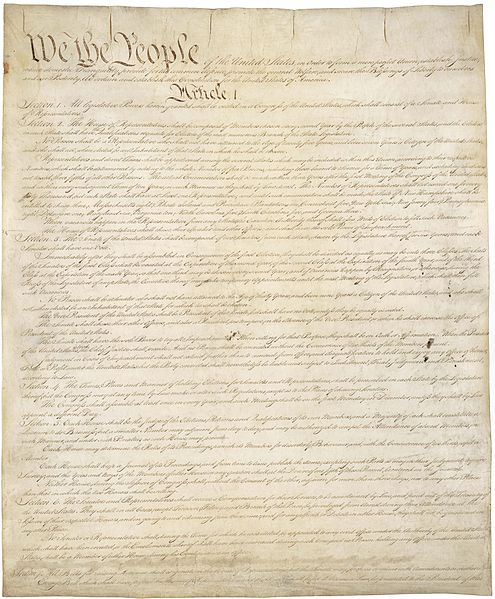
Constitution as Marketing Tool for Wonder Drug

U.S. Constitution page 1

needs to be studied

Radway & Co. took out a large spot to promote its products. The ad seems kind of modern. Here’s bits of it.

From The New-York Times October 23, 1861:

A FREE GIFT; TO THE AMERICAN PEOPLE. WHAT THE FEDERAL TROOPS ARE FIGHTING TO SUSTAIN. HOW OUR SOLDIERS SHOULD BE PREPARED TO FIGHT. DRS. RADWAY & CO. RADWAY & CO., NO. 23 John-st., New-York. HOW OUR SOLDIERS SHOULD BE PREPARED TO FIGHT. Health and discipline are the most important elements. RADWAY’S READY RELIEF. IN DR. RADWAY’S REMEDIES RADWAY’S READY RELIEF IN HIS KNAPSACK, WHEN SICK, DUTY OF CIVILIANS. ARMY INDORSEMENT. NOT ONE IN THE HOSPITAL. IMPORTANT TO FAMILIES. DR. RADWAY’S PILLS. RADWAY’S REGULATING PILLS RADWAY’S RENOVATING RESOLVENT. IT CURES, WITH ASTONISHING RAPIDITY. HUMORS AND SORES OF ALL KINDS, LADIES NOTICE.

It is a singular fact that a large majority of the people of the United States are unacquainted with the great importance of the cause for which the soldiers of the Union are fighting. Let every man and woman throughout the United States carefully read and study the Constitution of the United States, they will become convinced of the holiness of our cause and of the wickedness of those who are striving to overthrow this grand palladium of freedom.

We truly believe that had the reading of the Constitution been adopted as a daily lesson in every school throughout the United States, the doctrines of secession and States rights would never have attained the position of a political question; nor would the country have been called upon to mourn for the unfortunate wrangling and misconstructions that have arisen, and which so many of our statesmen have lost their time in attempting its interpretation.

Millions of our citizens have never thoroughly studied the constitution, and even at the present time, when it is the duty of every citizen of this country to inform himself of the rights and privileges secured to him, under its protecting arm, it is not in one household in five hundred. In view, therefore, of correcting this great oversight, and to furnish every man, woman and child throughout the United States with the means of studying this great palladium of liberty, and to protect us against future false doctrines and political disasters.

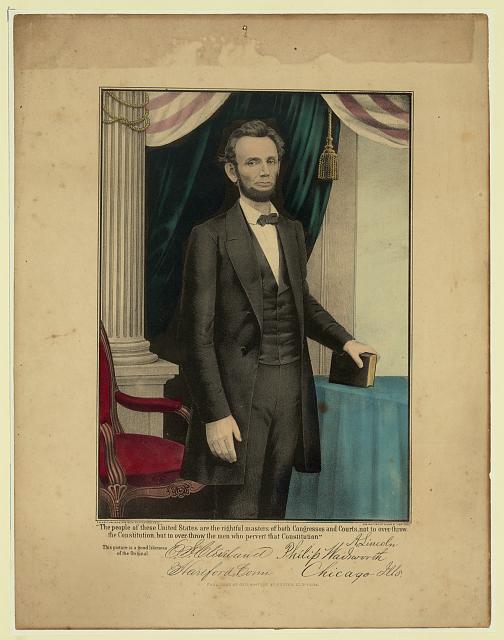
"The people of these United States are the rightful masters of both congresses and courts, not to over-throw the Constitution, but to over-throw the men who pervert that Constitution" (1864; LOC - LC-DIG-ppmsca-19243)

Honest Abe defends Constitution

[We?] present to the American public, free of charge, the Constitution of the United States of America, neatly bound, together with an improved Almanac for the year 1862, called “Dr. Radway’s Constitution Almanac.” As soon as practicable, Dr. Radway’s agents, in every village and town throughout the Union, will be furnished with a supply for free circulation. A copy of the same will be sent to all who will inclose a stamp for the payment of postage.

DRUGGISTS, BOOKSELLERS, NEWSDEALERS THROUGHOUT THE COUNTRY, DESIROUS OF AIDING US IN DISTRIBUTING TO THE PEOPLE THE CONSTITUTIONAL ALAMANAC, ARE INVITED TO SEND IN THEIR ORDERS. NO CHARGE WILL BE MADE FOR THE SAME.

We also invite the people of the Canadas, British Provinces, and, in fact, all who can read the English language throughout the world, to accept as gifts from us our Constitutional Almanac.

WE WILL SEND TO ANY ONE WHO IS WILLING TO PAY THE POSTAGE ON IT A COPY; OR IF THE CITIZENS OF ANY TOWN OR VILLAGE WILL ACCEPT FROM 100 TO 500 COPIES, WE WILL FURNISH THEM FREE OF CHARGE, BEING CONVINCED THAT IF OUR FOREIGN FRIENDS WILL CAREFULLY READ THE CONSTITUTION, THEY WILL BECOME SATISFIED THAT OUR PEOPLE, IN SUPPORTING OUR GOVERNMENT IN WIPING-OUT THIS FOUL BLOT OF SECESSION FROM OUR ESCUTCHEON, ARE NOT ONLY RIGHT, BUT ARE ESTABLISHING ON A SOUND BASIS THE FREEDOM OF THE PEOPLE THROUGHOUT THE WORLD.

Health and discipline are the most important elements in an army to insure success. Discipline without health will prove as ineffectual as shot without powder. Health is the propelling force of the army, and is the symbol of victory.

It is, therefore, of the greatest importance, that the system of medication best adapted for the protection of soldiers against sickness, as well as that known to be the most speedy and effectual in restoring the sick to health without regard to professional prejudice, be adopted.

This is no time for medical martinets to quibble about professional dignity. All the dignity the profession can bring to bear will neither prevent sickness among the troops, for cure those afflicted. Our armies to be successful, must be kept in a healthy condition; and the most sure means of securing this desideratum is through the remedial powers of [Dr Radway’s drugs?]

which has already proved itself in over fifty regiments now at the seat of war near Washington, to be a positive preventive against sickness in the form of

CHILLS AND FEVER, FEVER AND AGUE, [and many more sicknesses] …

Gen. Rush C. Hawkins (between 1860 and 1870; LOC - LC-DIG-cwpb-05086)

Rush Hawkins swears by the stuff

Civilians having friends or relatives in the army should send them a few bottles of Radway’s Ready Relief and a box of Radway’s Pills. The Government makes no provision for these valuable remedies in the medical stores. The soldier depends upon his friends for a supply of these invaluable medicines. A bottle or two of the Ready Relief may save the life of your soldier friend.

We have received a large number of letters from army surgeons, officers and privates who have derived benefits from the use of RADWAY’S READY RELIEF. Among the great number we have on file we refer to the following:

Col. Rush C. Hawkins, Ninth Regiment, N.Y.V.

We have the assurances of officers of over fifty regiments of the volunteer forces, that there has not been a single man in their regiments who has used RADWAY’s READY RELIEF that has been sent to the hospital, nor has there, out of the great number of sick who have used this invaluable medicine, a death occurred.

Every family should keep a bottle of RADWAY’s READY RELIEF in the house. …

Rush Hawkins was the only name I recognized in the testimonials section.

You can see an example of a Radway’s trade card at Remember When Postcards (under the kissing section!).

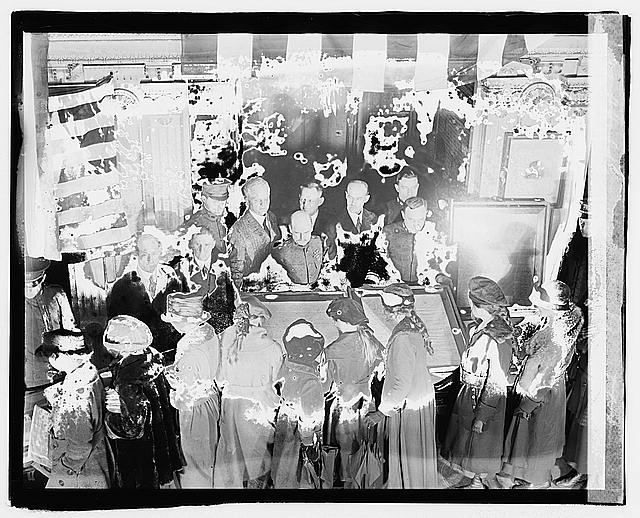
The following photo is a damaged negative from February 13, 1920. “Children of the Washington Public schools were today given an oportunity [i.e. opportunity] to see the original constitution of the United States in the State Dept. Photo shows the children passing by the famous document.” It kind of gets me in the mood for Halloween with it’s spectral forms.

Children viewing Constitution (1920; LOC - LC-DIG-npcc-01106 )

Viewing the original in 1920 - Boo!

Posted in 150 Years Ago This Week, Northern Society | Tagged , , , | Leave a comment

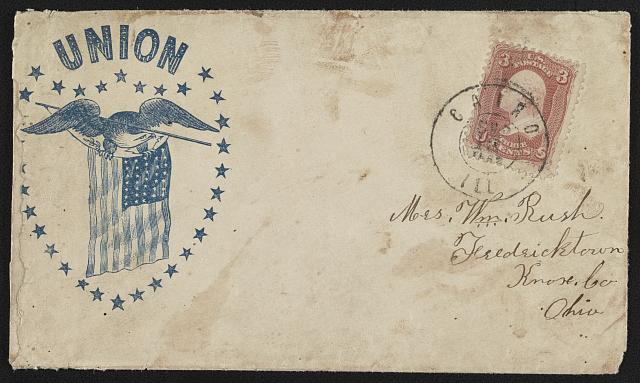
Nothing in the Envelope Today

Civil War envelope showing eagle with American flag surrounded by stars in the form of a shield and the message "Union" (between 1861 and 1862;LC-DIG-ppmsca-31814)

I’m sure whoever posted this letter in Cairo, Illinois about 150 years ago had a lot of interesting information to convey.

That’s not the case for me today.

Posted in Northern Society | Tagged | Leave a comment

Bonnie Blue Flag

Modify the Tadeusz Kościuszko Flag

Bonnie Blue Flag

The Richmond Daily Dispatch didn’t publish the news about the October 21, 1861 Confederate victory at Ball’s Bluff until the 23rd – a day later than The New-York Times. The following article comes from that same issue:

Proposed change of the Confederate flag.

The Natchez (Miss.) Courier has the following appropriate suggestions in regard to the propriety of changing the Confederate flag:

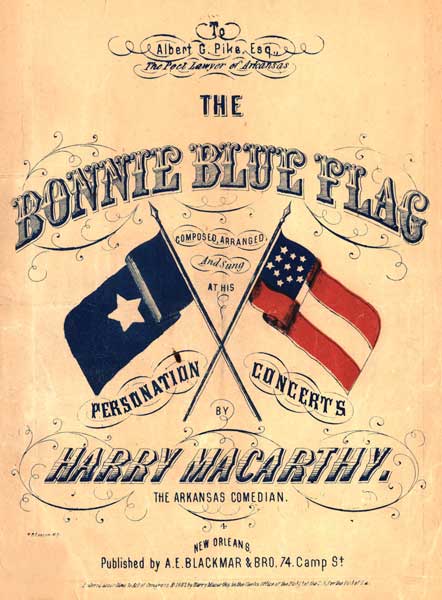
The Bonnie Blue Flag sheet music

Sheet Music

It has been said that the Confederate flag is to be changed. Judge Porter, of Alabama, one of the best men in the South, proposes that we should adopt, in lieu of the present flag, which, he says, “borrows too much from the North, and is associated with stripes,” the beautiful flag raised by that lover of freedom, Kosciusko, in his native Poland, after his return from fighting for freedom with Washington. It is a plain, blue field, with the white eagle. There is no other flag like it now in use. Russia extinguished that splendid blue flag, and it would be very appropriate for the South. It would be easily distinguished. The only difficulty we can see in the way of adopting such a flag is that it could not be easily made where there were no artists to paint on the flag the white eagle. If the lone star in the centre were substituted for the eagle it would, in our opinion, be more acceptable.

The Bonnie Blue Flag inspired the song, which you can hear at You Tube. I think the video is well done with a nice review of most of the Confederate state flags. You can read about the song’s lyricist, Harry Macarthy at HistoryNet.Com.

Posted in 150 Years Ago This Week, Confederate States of America, Southern Society | Tagged , , | Leave a comment