In the Camp of Cain and Arnold

Correspondent Disguised as Country Clerk Checks Out a Rebel Camp
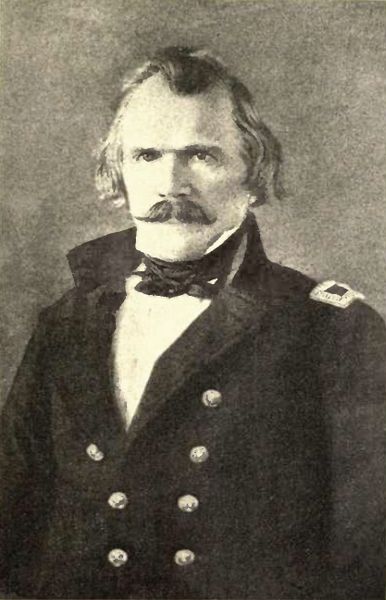
Albert S Johnston

Albert S Johnston - CSA commander in the West

From The New-York Times October 20, 1861:

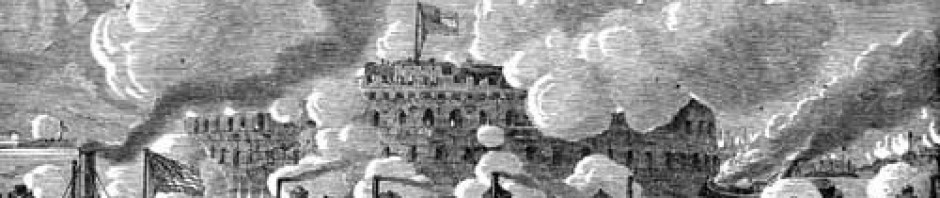
INTERIOR OF THE REBEL CAMP AT COLUMBUS, KENTUCKY.

Approaching Columbus, it proved there the same as elsewhere, an easy matter to pass the pickets and get in, the only difficult to be feared that of getting cut, which, as my companion was a Kentuckian, and on business to Columbus, where he was known, a correspondent found himself turned into a country clerk crown [grown] on the same soil and travelling with his employer. If the food and drill agreed with him, as the latter observed to a Captain with a villainous eye and long hair, he might (?) become a good Confederate soldier. The country clerk preferred a wish to keep on ribbon measuring, and opened his eyes wide to see what there was to see, but failed in discovering anything at all remarkable at first. The novelty of the situation, surrounded by men whose arms were lifted, CAIN-like against their brothers, and ARNOLD-like to strike their country, was somewhat exciting, but that was all. Columbus is a monotenous, dull appearing little village, of usually five hundred inhabitants or thereabouts, but now populated by an army drawn from the glades of Florida, the cities of the South, the lines of the border, to meet that mighty host who have risen to seek among the cypress and cotton those stars stricken so rudely from their flag.

Correspondence of the Missouri Republican.

CAIRO, Sunday, Oct. 13, 1861.
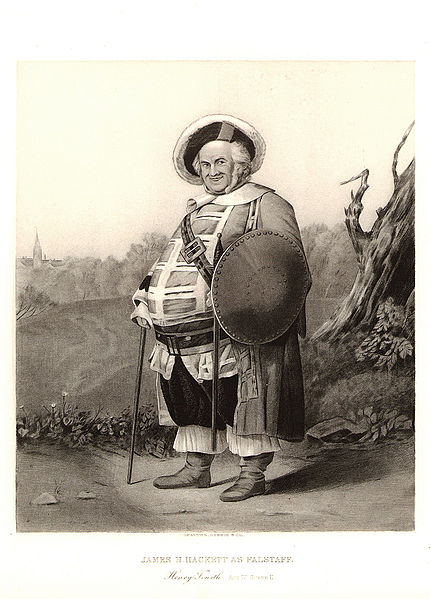
James Henry Hackett as Falstaff

Falstaff joined the Rebels?

The houses of the town are generally small, many painted white, and some few allowing good taste by their surroundings of shrubbery and cultivated grounds. On the river bank is the depot of the Mobile and Ohio Railroad, a commodious building, and the chief ornament of the place. No passenger, with carpet sack in hand, or porter with trunk on shoulder, were visible, but instead a regiment of gray uniformed fellows, from Louisiana, I understood, were occupying the depot. A locomotive attached to four platform and one passenger car, was standing idly on the track, but blew its whistle and started off shortly after. It seemed strange. An enemy’s camp, yet all Americans, in tone, speech and action similar to yourself and those in Union camps at other places. Instead of being a bloodthirsty, hoofed, horned and tailed multitude, there are good looking boys, effeminate men with downy beards, laughing, Falstaffian individuals also, as well as those with true military cut, among the secession multitude.
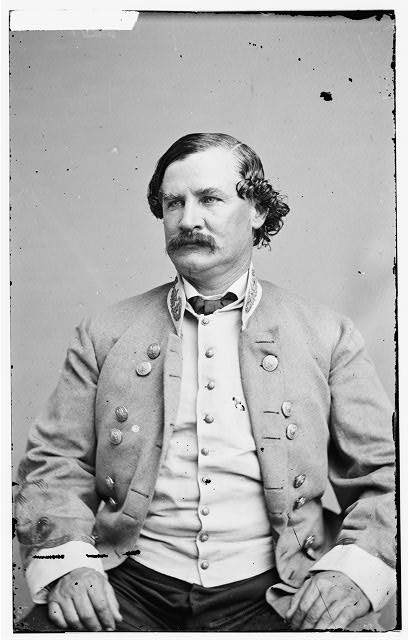
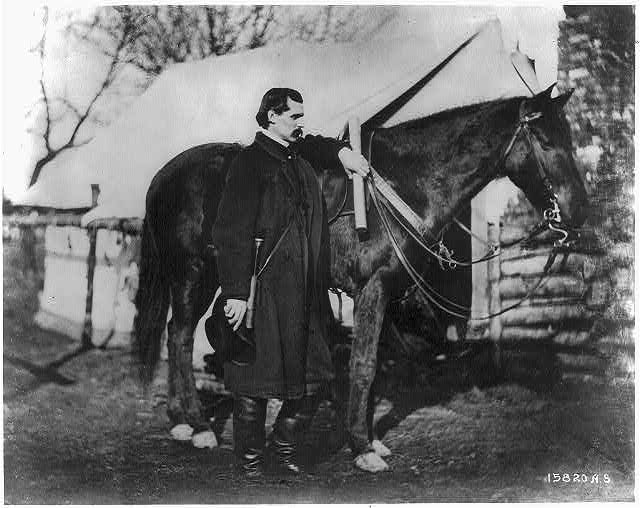
Gen. Benjamin F. Cheatham (between 1860 and 1870; LOC - LC-DIG-cwpb-05991)

Benjamin Franklin Cheatham - thick cloth shoes?

As there was danger of incurring suspicion, my explorations were limited, and I was unable to visit all the different points of interest. About half of those soldiers I saw were uniformed, while of the balance many had an army cap, a coat, pants with stripe or military mark of some kind, and the rest simply ordinary costume. Their arms were decidedly mixed, some of those in tents or hands of sentinels being revolving weapons, others breech-loading common muskets, hunting rifles, &c. I picked up one with the stamp “Harper’s Ferry” upon it. Tents were of the old style; some tattered and useless, others strong and new, but pitched in regular order. Discipline was evidently more lax than in Federal camps, and the men appeared to take things in a free and easy style. Shoes cave the most melancholy effect of the blockade. Those of leather showed numerous patches, and the long-haired Captain said a style made from thick cloth were being used instead. None of the uniforms of the soldiers were new, and a pinch will evidently come when they are worn out. Blankets were also scarce, and preparations for Winter scanty. A proclamation posted on the board proved to be from Gen. PILLOW, forbidding the inhabitants of Missouri or ports on the Mississippi sending any more bacon or provisions of any description South, as it was needed by the forces “in this department.”
Gideon Johnson Pillow, 1806-1878 (LOC - LC-USZ61-1762)

G.J. Pillow: commandeering the bacon

The fortifications that defend Columbus are situated on the [???] just above the town and along Lucas bend. These I described in a former letter. They are so placed, and the natural advantages of the ground are such, that any attempt to take them without the cooperation of a powerful land force will prove unsuccessful and disastrous. I noticed but one cannon on the bank in front of the town, and that was a small one. Gen. JOHNSTON commands the forces there, and has with him PILLOW and CHEATHAM. The number of their troops was stated at 35,000, of whom 25,000 were then at Columbus, eight regiments having started the day before for some point inward. From all appearances the secession forces were themselves afraid of being attacked, and as long as they can keep the Federals, by feint and otherwise, from marching upon them, they will be well satisfied. There was quite a shade of anxiety on the face of him of the long hair when he asked, “Is it true they have taken New-Orleans?” and remarked, “if they have, we will welcome them with hospitable hands to bloody graves,” which, besides being an incorrect quotation, was not fresh enough to excite the admiration of his hearers. If he sees this, I hope he will appreciate the delicacy that prevented these remarks at that tune

My kingdom for a photo of Cain. At least I can let you know that James Henry Hackett was a famous American actor who did indeed play Falstaff.
Posted in 150 Years Ago This Week, Confederate States of America, Military Matters | Tagged , , , , | Leave a comment

“little dogs of war”

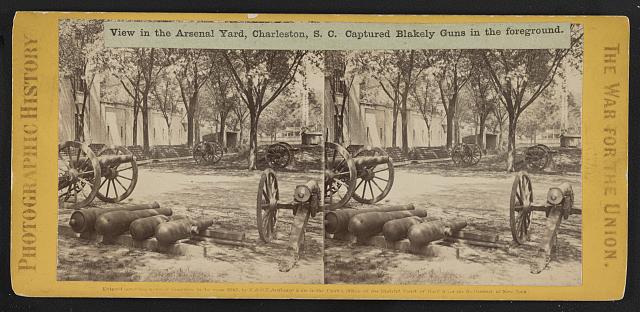
View in the Arsenal Yard, Charleston, S.C. Captured Blakely Guns in the foreground (c1865; LOC - LC-DIG-stereo-1s02462 )

dogs at rest

Must Have Slipped Through the Blockade

From the Richmond Daily Dispatch October 19, 1861:

Steel rifled Cannon.

–We saw yesterday, near the Central railroad depot, awaiting transportation, two steel 12-pounders, rifled. The mark on each shows where they came from–“Blakely’s Patent — Fawcett, Preston & Co., makers — Liverpool, 1861.” These little dogs of war very recently arrived on this continent.

Captain Alexander Blakely RA has a ton of information about the Irish-born artillerist and inventor.

Robinson’s Battery illustrates the variety of Blakely Rifles. You can also a good illustration of the identification markings that the Daily Dispatched mentioned. The only difference is the year.

Gettin’ North

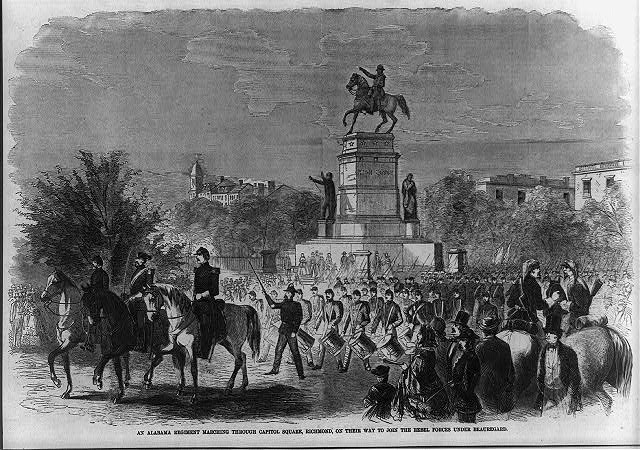
An illustration published Harper’s Weekly 150 years ago today:

An Alabama regiment marching Capitol Square, Richmond, on their way to join the rebel forces under Beauregard (harper's weekly 10-19-1861; LOC - LC-USZ62-16604)

Alabamians headed to the front

Posted in 150 Years Ago This Week, Confederate States of America, Military Matters | Tagged , , , , | Leave a comment

A Steam-Rams Proposal

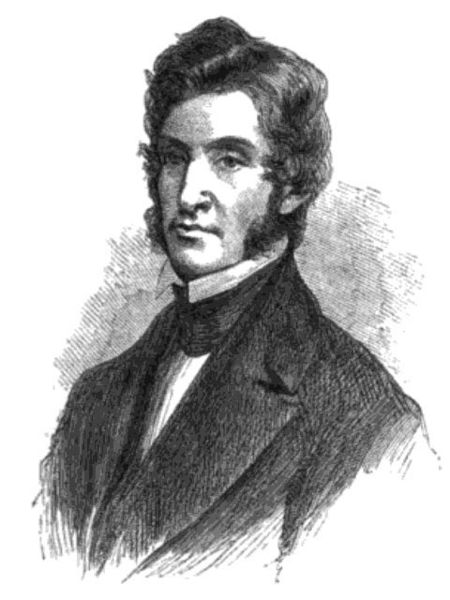
Charles Ellet, Jr.

Charles Ellet, Jr.

From The New-York Times October 18, 1861:

Defences of New-York.

The following letter, written by a Civil Engineer, of high professional reputation, over a month ago, has special interest at the present moment, in view of the circular to the Governors of the States, which we published yesterday:

GEORGETOWN, D.C., Sept. 14, 1861.

His Excellency, E.D. Morgan, Governor of New-York:

SIR: Permit me to make a suggestion to you touching the defences of New-York.

Should we rely on shot and shell to protect a great city against modern war-steamers, iron-plated, and constructed, after ample experiments, in the confident belief that they are shot and shell proof?

For my part, I think it would be imprudent, in case of a war with any great naval power, to allow the safety of New-York to depend at all on mere artillery. Something more certain and reliable will assuredly be needed.

For more than six years I have earnestly endeavored to induce the Navy Department to investigate the proposition to introduce steam-rams — powerful steam vessels, so constructed that they may be driven against the hull of a ship-of-war and sink her by the force of the collision — as an auxiliary, and, indeed, in my opinion, the only effective means of harbor defence.

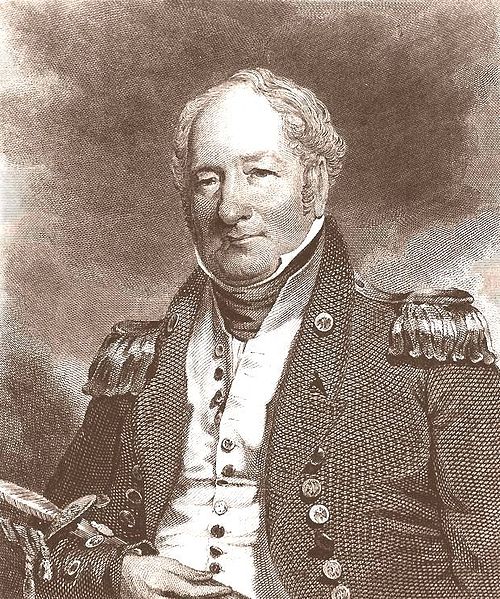
Commodore James Barron

Commodore James Barron: enthusiast of rams - and duels

The suggestion has hitherto received but little encouragement from the Department, but since the publication and distribution of my views to Congress, the plan has been extensively adopted, both by the French and British Governments, where huge rams are now in course of construction in the National Navy-yards, and under contracts with private builders.

This suggestion did not originate with me, but was submitted to Congress by Commodore BARRON in 1832, and since that period, has been urged by several other officers of the United States Navy.

I may add, that the rebel Government is now preparing one or more rams in Mobile and New-Orleans, and I very much fear that we shall presently have a new and costly illustration of the efficacy of the plan, in the loss of some of our blockading vessels.

If you cannot defend New-York by shot and shell, you can certainly defend it by a few powerful rams, and I therefore earnestly suggest the subject to your attention, at least as an auxiliary protection; and am, Sir. very respectfully,

Your obedient servant,

CHARLES ELLET, JR., Civil Engineer.

It’s interesting that Ellet would mention Commodore James Barron as an endorser of rams for the navy. Although Barron was basically a career navy man, he was controversial and was court-martialed for his failure in the Chesapeake–Leopard Affair. Barron challenged Stephen Decatur to a duel with pistols in 1820. Barraon killed Decatur in the duel.

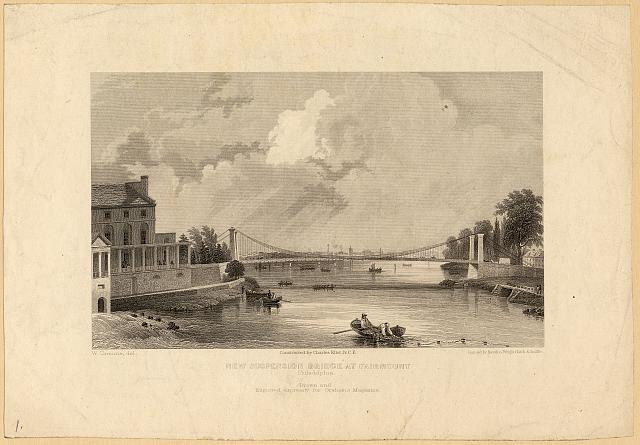
As a civil engineer Charles Ellet, Jr. was known for his work on suspension bridges:

In 1842, he designed and built the first major wire-cable suspension bridge in the United States, spanning 358 feet over the Schuylkill River at Fairmount, Philadelphia, Pennsylvania. He designed the record-breaking Wheeling suspension bridge over the Ohio River at Wheeling, West Virginia in 1848, and a 770-foot suspension footbridge at Niagara Falls at the same time.

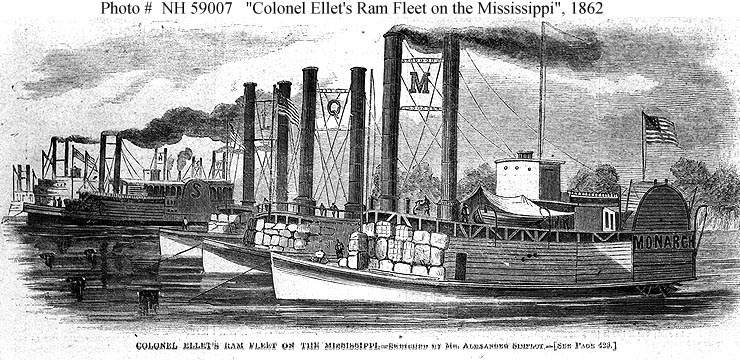
Ellet actually started working on rams for the federal government. “In March 1861, the Secretary of War Edwin M. Stanton appointed him colonel of engineers and tasked him with developing the United States Ram Fleet.”

Ellet would die from wounds received during the Battle of Memphis on June 6, 1862.

New suspension bridge at Fairmount, Philadelphia, constructed by Charles Ellet Jr., C.E. (ca. 1842; LOC - LC-DIG-ppmsca-11610)

Peace (1842)

Colonel Ellet's Ram Fleet on the Misissippi (Line engraving after a sketch by Alexander Simplot, published in "Harper's Weekly", 1862.)

War (1862)

Posted in 150 Years Ago This Week, Military Matters | Tagged , , | 1 Comment

Not Exactly an Unfunded Mandate

An Unfunded Suggestion, Which Congress Will Probably Reimburse, and which the Federals will be happy to superintend

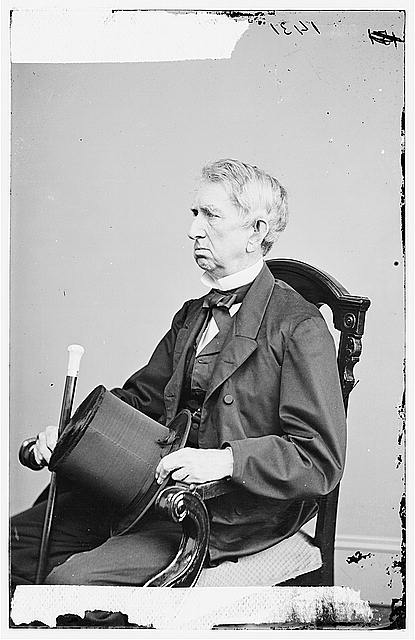
Portrait of Secretary of State William H. Seward, officer of the United States government (Between 1860 and 1865; LOC - LC-DIG-cwpb-04948)

Better safe than sorry

From The New-York Times October 17, 1861:

IMPORTANT CIRCULAR FROM SECRETARY SEWARD.

The following important circular has been sent to Gov. MORGAN, and similar ones to the Governors of all the States on the seaboard and lakes:

DEPARTMENT OF STATE,

WASHINGTON. Oct. 14, 1861.

To His Excellency, the Governor of the State of New-York:

SIR: The present insurrection had not even revealed itself in arms when disloyal citizens hastened to foreign countries to invoke their intervention for the overthrow of the Government, and the destruction of the National Union. These agents are known to have made their appeals to some of the more important States without success. It is not likely, however, that they will remain content with such refusals. Indeed, it is understood that they are industriously endeavoring to accomplish their disloyal purposes by degrees and by indirection. Taking advantage of the embarrassments of agriculture, manufactures and commerce in foreign countries, resulting from the insurrection they have inaugurated at home, they seek to involve our common country in controversies with States with which every public interest and every interest of mankind require that it shall remain in relations of peace, amity and friendship. I am able to state for your satisfaction that the prospect for any such disturbance is now less serious than it has been at any previous period during the course of the insurrection. It is nevertheless necessary now, as it has hitherto been, to take every precaution that is possible to avoid the evils of foreign war, to be superinduced upon those of civil commotion, which we are endeavoring to cure.

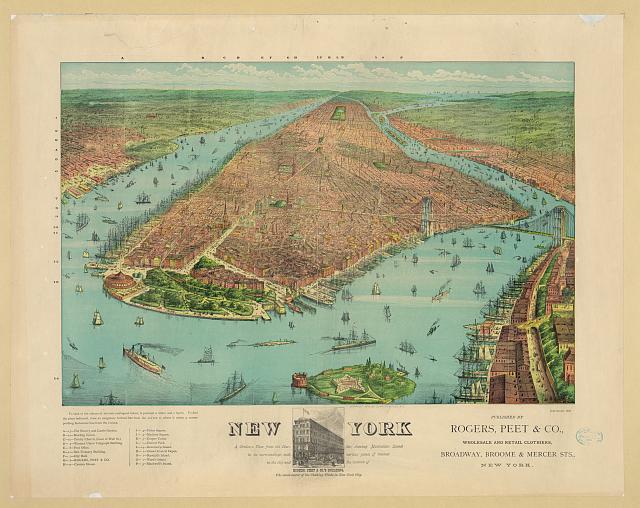
New York: a birdseye view from the harbor, showing Manhattan Island in its surroundings, with various points of interest in the city and the location of Rogers, Peet & Co.'s building, the exact center of the clothing trade in New York City (1879; LOC - LC-DIG-pga-00841)

Big Target

One of the most obvious of such precautions is, that our ports and harbors on the seas and lakes should be put in a condition of complete defence, for any nation may be said to involuntarily incur danger in tempestuous seasons when it fails to show that it hits [has?] sheltered itself on every side from which the storm might possibly come.

The measures which the Executive can adopt in this emergency are such only as Congress has sanctioned, and for which it has provided.

The President Is putting forth the most diligent efforts to execute these measures, and we have the great satisfaction of seeing that these efforts are seconded by the favor, aid and support of a loyal, patriotic and self-sacrificing people, and are rapidly bringing the military and naval forces of the United States into the highest state of efficiency. But Congress was chiefly absorbed during its recent extra session with these measures, and did not provide as ample as could be wished for the fortification of our sea and lake coasts. In previous wars the loyal States have applied themselves by independent and separate activity to the support and aid of the Federal Government in its arduous responsibilities. The same disposition has been manifested in a degree eminently honorable by all the loyal States during the present in surrection.

In view of this fact, and relying upon the increase and continuance of the same disposition on the part of the loyal States, the President has directed me to invite your consideration to the subject of the improvement and perfection of the defences of the State over which you preside, and to ask you to submit the subject to the consideration of the Legislature, when it shall have assembled. Such proceedings by the State would require only a temporary use of its means.

The expenditures ought to be made the subject of conference with the Federal Government. Being thus made with the concurrence of the Government for general defence, there is every reason to believe that Congress would sanction what the State would do, and would provide for its reimbursement.

Should these suggestions be accepted, the President will direct the proper agents of the Federal Government to confer with you, and to superintend, direct and conduct the prosecution of the system of defence of your State.

I have the honor to be, Sir,

Your obedient servant,

(Signed) WILLIAM H. SEWARD.

In an editorial on the same date the Times thought Seward’s biggest concern might be Britain’s overwhelming need for cotton. In an article on October 18, 1861 The New-York Times suggested that Seward’s main concern might be European intervention in Mexico:

We shall be fighting our own battle most effectually in defending Mexico against European conquest. Our prestige and national honor are involved in resisting such an effort to plant a hostile flag upon our weakest and most exposed frontier.

In either case the United States might be at war with another country that would see the undefended Northern coastline as an inviting target.

Posted in 150 Years Ago This Week, Lincoln Administration, Military Matters | Tagged , , | Leave a comment

George Mason’s Will

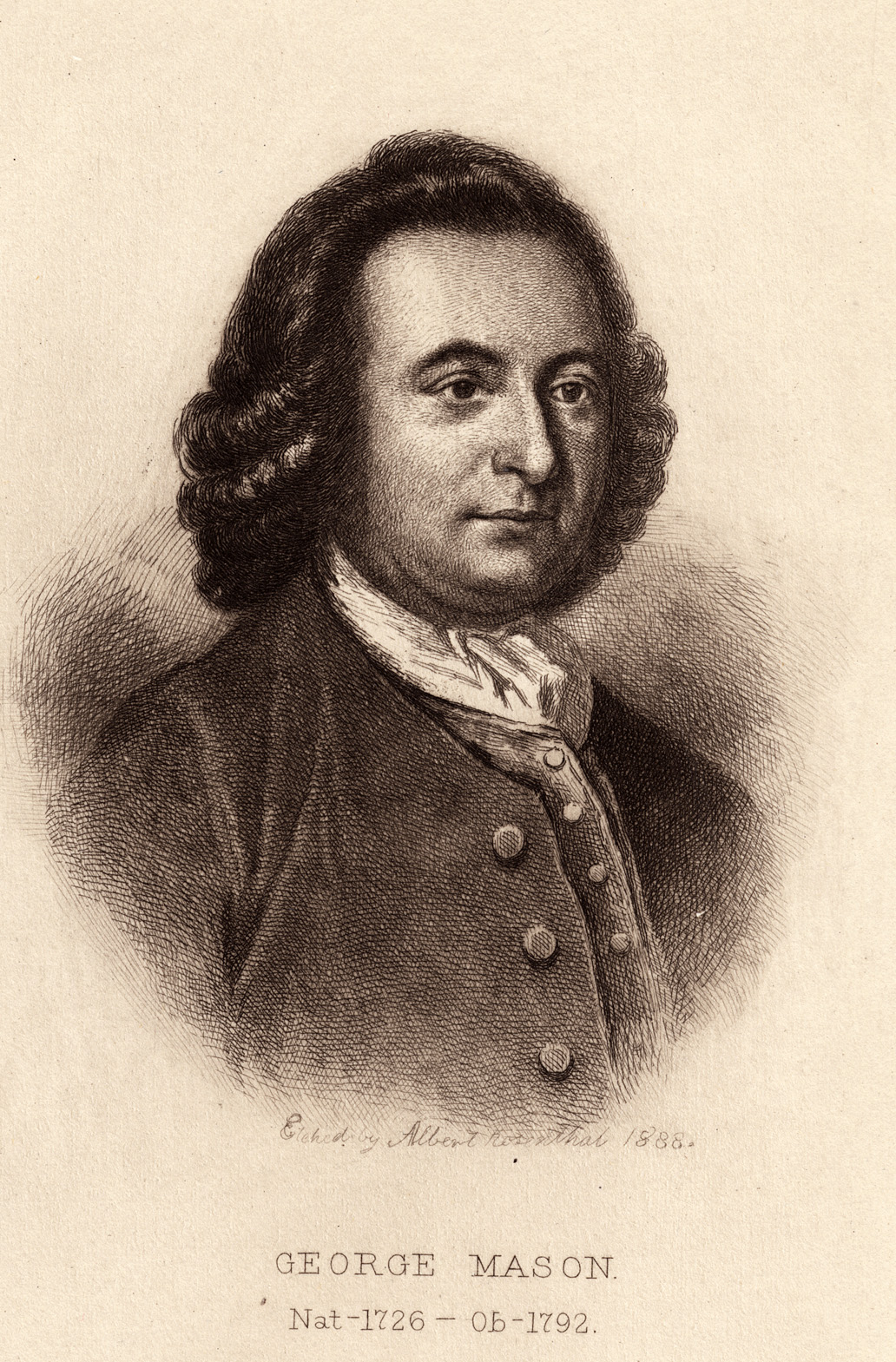
George Mason of Virginia (LOC)

"indubitable, unalienable, and indefeasible right to reform, alter or abolish" bad government

From the Richmond Daily Dispatch October 16, 1861:

A Patriot’s charge to his Sons.

–Col. George Mason, the author of the first Constitution of Virginia, died at his residence in Fairfax county, near Alexandria, on the 7th of October, 1792, in the 67th year of his age. The following extract from his will is worthy of universal acceptation in these times: “I recommend it to my sons, from my experience in life, to prefer the happiness and independence of a private station to the troubles and vexation of public business; but, if either their own inclinations or the necessity of the times should engage them in public affairs, I charge them, on a father’s blessing, never to let the motive of private interest or ambition, induce them to betray, nor the terrors of poverty and disgrace, or the fear of danger and death, deter them from asserting the liberty of their country, and endeavoring to transmit to their posterity those sacred rights to which themselves were born.”

Words that in the present state of affairs may be aptly described by the language of Scripture as “Apples of gold in pictures of silver.”

George Mason was the principle author of the Virginia Declaration of Rights, which was adopted on June 12, 1776. The declaration asserts

That government is, or ought to be, instituted for the common benefit, protection, and security of the people, nation or community; of all the various modes and forms of government that is best, which is capable of producing the greatest degree of happiness and safety and is most effectually secured against the danger of maladministration; and that, whenever any government shall be found inadequate or contrary to these purposes, a majority of the community hath an indubitable, unalienable, and indefeasible right to reform, alter or abolish it, in such manner as shall be judged most conducive to the public weal.

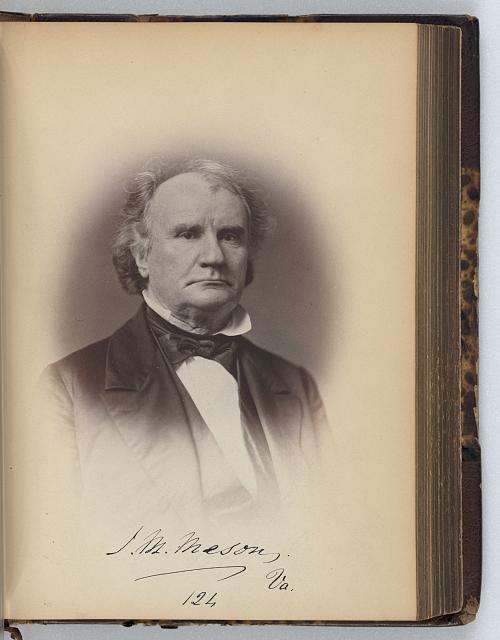
150 years ago today James Murray Mason, George’s grandson, was on his way to Europe as “Commissioner of the Confederate States to the English Government”. I guess you could say that James Mason represented a government that was trying to “reform, alter or abolish” the United States government by seceding from it.

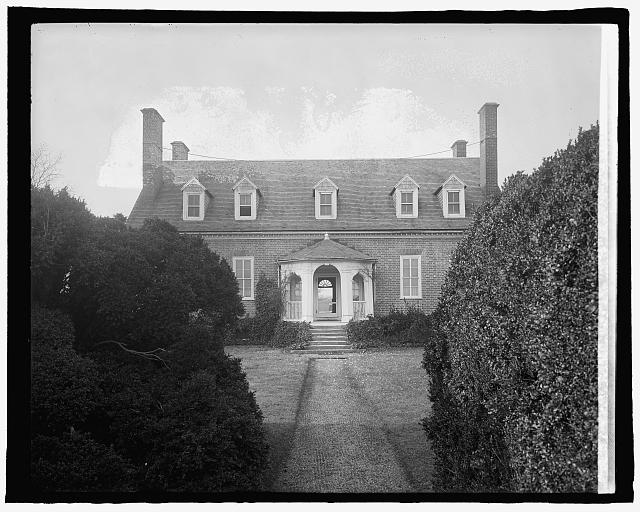
George’s estate, Gunston Hall, is a National Historic Landmark.

James M. Mason, Senator from Virginia, Thirty-fifth Congress, half-length portrait (1859; LOC - LC-DIG-ppmsca-26663 )

James Mason

Gunston Hall, Virginia (between 1910 and 1925; LOC - LC-DIG-npcc-31540)

Gunston Hall

Posted in 150 Years Ago This Week, American History | Tagged , , | Leave a comment

“we lack enterprise …” ???

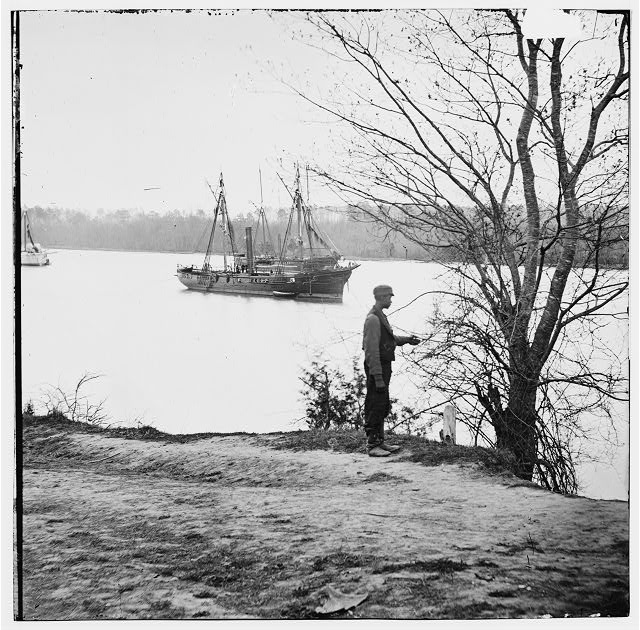
James River, Virginia. Ships on the (James River) (between 1861 and 1869; LOC - LC-DIG-cwpb-02184)

Can't see forest for tree?

From the Richmond Daily Dispatch October 14, 1861:

Fuel.

–The difficulty of obtaining adequate supplies of coal would not be a source of extreme annoyance to our people, if it were possible to obtain wood in sufficient quantities to make up the deficiency. The country about Richmond is rich in coal deposits, yet we lack enterprise to bring it to market, and even at the advance of $1.50 on the usual price, we hear citizens lamenting that they have to plead, almost with tears in their eyes, to persuade the dealers to send them a scanty supply for immediate wants. There is also wood enough in our forests; indeed, the quantity is vast beyond computation. The price has gone up in this market in greater ratio than the circumstances justify, and if some enterprising, men would devote their energies to the business, we feel confident that not only Richmond, but the camps in the neighborhood, might be furnished with a plenty of fuel at a reasonable, yet compensating rate. The plantations on the borders of James river are accessible, and steam-tugs and lighters could be profitably employed in transporting wood from thence to Richmond.

Certainly not everyone in the South lacked enterprise. In an editorial from the same issue the Daily Dispatch criticized the greed of speculators and the “avidity for office” of some politicians. The editorial says that the greediest Yankee trader would not even measure up to the worst Southern speculators and contains this statement:

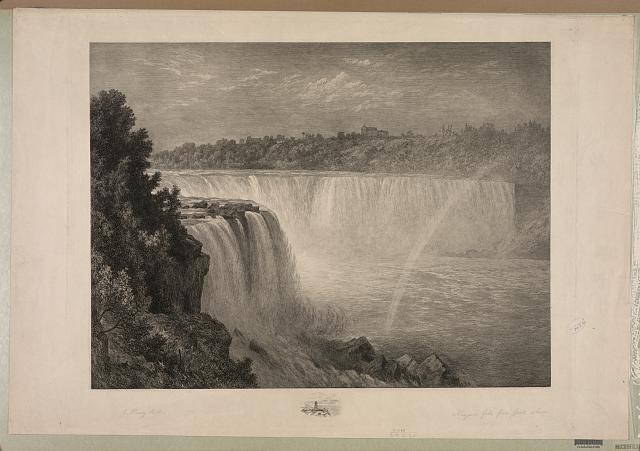
If our forces were able to advance as fast as our prices, the Confederate flag would be now waving in triumph over Niagara falls.

What seems somehow related to the Rebel flag flying over Niagara Falls: 150 years ago today President Lincoln authorized General Winfield Scott to suspend the writ of habeas corpus anywhere from Washington, D.C. all the way to Bangor Maine. That’s where the president extended the “military line of the United States for the suppression of the insurrection”

Niagara Falls. Part of the American Fall from the foot of the stair case (LOC - LC-DIG-pga-01562)

Dixieland?

Posted in 150 Years Ago This Week, Confederate States of America, Lincoln Administration, Southern Society | Tagged , | Leave a comment

Mosquitos in the Delta

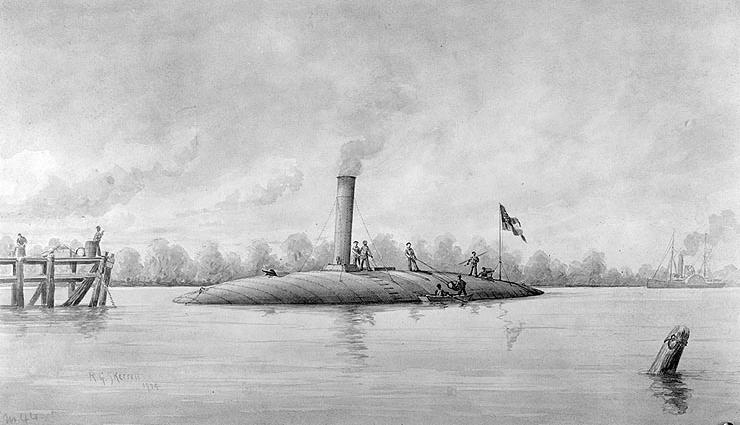
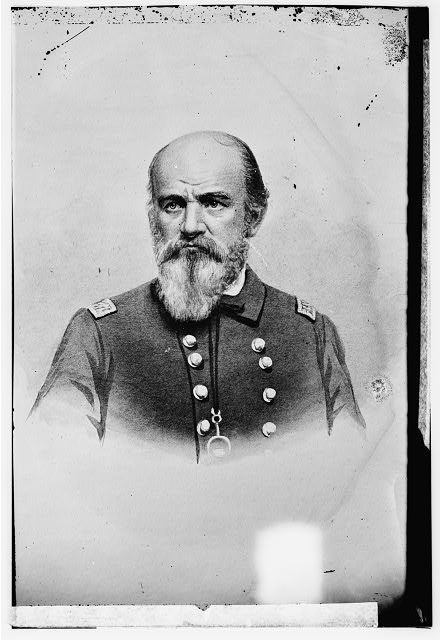
CSS Manassas

CSS Manassas: mosquito lost its sting

I got in over my head yesterday as I was exploring the October 12, 1861 naval battle at the Head of Passes. The articles that The New-York Times reproduced from Southern papers had some major factual errors.

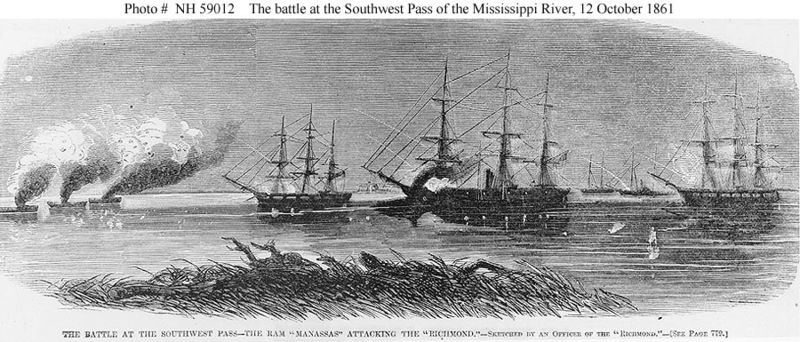
Sometime on the night of October 11-12, 1861 the Battle of the Head of Passes commenced. A small Confederate Mosquito Fleet stationed on the Mississippi River near New Orleans and under the command of George N. Hollinsattacked the Union blockading fleet at the mouth of the Mississippi – the Head of Passes. Leading the Rebel attack was the commandeered CSS Manassas, an icebreaker converted into a “turtle-shaped” ironclad ram. The Manassas was able to ram and somewhat damage the USS Richmond but sustained enough damage itself that it was ineffective for the rest of the battle (but Union shells bounced off its armor). By sunrise all the U.S. vessels save one had run aground as they fled downriver to avoid the remaining Confederate ships. By 10 AM Hollins determined that the Confederate ships were too low on coal and ammunition to continue shelling the stationary Union ships and headed back up the river. Here’s a couple accounts in The New-York Times via Southern newspapers. Hollins and/or the newspapers exaggerated or mislead the public. The USS Preble was not sunk and was the only Union ship not run aground. The battle appears to be a victory for Southern morale but did not impair the Union blockade much at all.

Commodore G.N. Hollins, C.S.N. (between 1860 and 1870; LOC - LC-DIG-cwpb-07408 )

"Great job, if I do say so myself" - George N. Hollins

From The New-York Times October 16, 1861:

IMPORTANT FROM NEW-ORLEANS.; REPORTED ATTACK ON THE NATIONAL FLEET.

BALTIMORE, Tuesday, Oct. 15.

The Norfolk Examiner of Monday, which has been received by a flag of truce, contains a dispatch dated New-Orleans. Oct. 12, stating that a naval engagement had taken place at the head of the Passes, on the night of the 11th, lasting one hour, and was afterwards renewed.

Also the following dispatch:

FORT JACKSON, Saturday, Oct. 12.

CSS Manassas attacks USS Richmond October 12, 1861

Hard-to-see Manassas attacks the Richmond

Last night I attacked the blockaders with my little fleet. I succeeded, after a very short struggle, in driving them all aground on the Southwest Pass bar except the Preble, which I sunk.

I captured a prize from them, and after they were fast in sand I peppered them well.

There were no casualties on our side. It was a complete success. HOLLINS.

NEW-ORLEANS, Sunday, Oct. 13.

The force of the National fleet was 40 guns and nearly 1,000 men, while the little Confederate mosquito fleet was 16 guns and 300 men.

It is reported that our iron steamer sunk the Preble, with her iron plow.

Commander HOLLINS arrived last night.

BALTIMORE, Tuesday, Oct. 15 — P.M.

Another dispatch, dated from New-Orleans, expresses the belief that a sufficient force can be organized to capture the whole National fleet, in its present disabled condition.

The rebel fleet was in the command of Commodore HOLLINS.

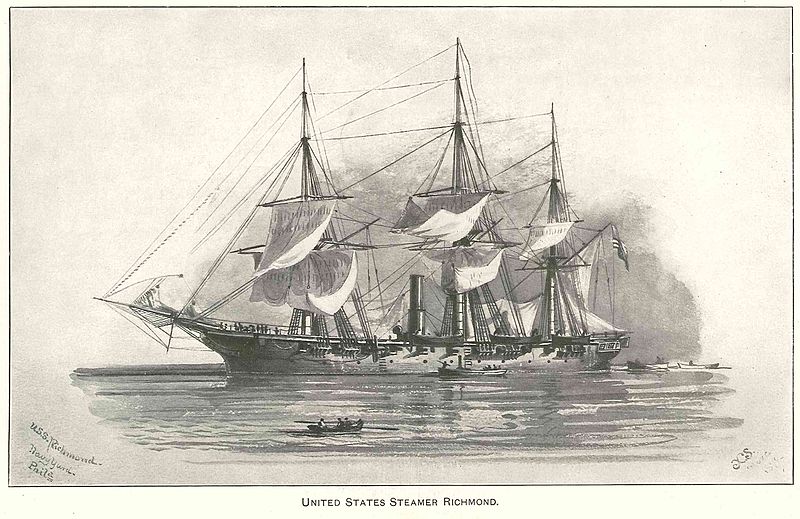
USS Richmond 1860

Big target: USS Richmond 1860

From The New-York Times October 18, 1861:

IMPORTANT FROM THE SOUTH.; Further Particulars of the Reported Naval Engagement at New-Orleans. HOW THE PREBLE WAS SUNK. New-Orleans Illuminated for a Victory. …

The Petersburgh Express has the following additional particulars concerning the late reported naval engagement at New-Orleans:

The Turtle ran against the Preble without firing a gun, and immediately sunk her, by staving in her sides, she, in the meantime being fired upon by the whole squadron, but the balls glancing from her iron form without effecting the least damage.

Mississippi delta from space by NASA

Delta passes from space

The Turtle then turned on the other two vessels, which, seeing the fate of their companion, endeavored to get out of the way, in which effort they were driven on shore, their crews deserting them. Com. HOLLINS, in his report, says he thinks he will be able to capture and carry them both into New-Orleans.

The Preble cannot be raised. A large number of prisoners, arms, ammunition, &c., were taken during the action. Com. HOLLINS confirms the account of the defeat of BILLY WILSON’s Zouaves on Santa Rosa Island.

Com. HOLLINS arrived in New-Orleans on the 14th ult. The city was illuminated on the receipt of the intelligence.

The number of men under Com. HOLLINS was 300. The Federalists numbered 1,000.

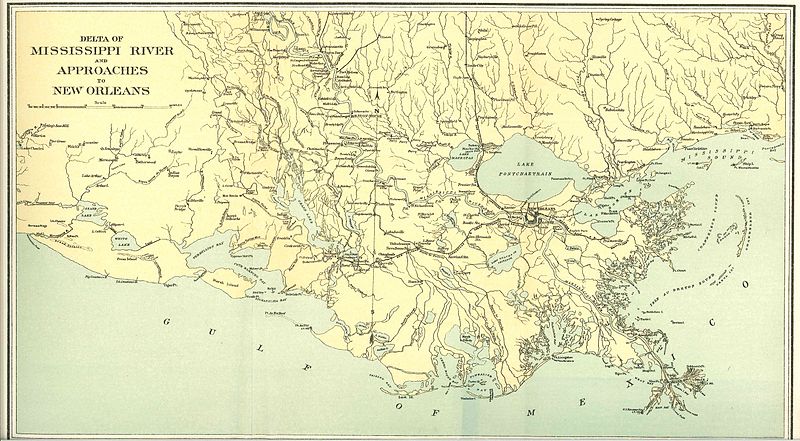
Lower Mississippi River Map

Lower Mississippi River Map

The same journal has the following comments on the affair:

“The Confederate cause has again been victorious. Capt. HOLLINS, of our little navy, has succeeded in driving the blockading squadron of the —– Yankees at the mouth of the Mississippi, ashore, capturing a prize, and sinking the crack sloop-of-war Preble. Such particulars as have reached us will be found in our telegraphic dispatches. They are, as yet, quite meagre-just enough to create a desire for more, and enkindle a most lively feeling of satisfaction. With a large force, we should think the stranded vessels might easily be captured. At all events, they will not soon forget the thorough peppering Capt. HOLLINS informs us he has administered. We regret that our knowledge of Capt. GEORGE N. HOLLINS, the hero of this fight, is too limited to enable us to give such a sketch of his life, as we know would prove highly interesting at this time. But the Naval Register of 1859 informs us that he is a native of Maryland, and was appointed from Maryland, but was at the time of his appointment a citizen of Florida. We may add that HOLLINS entered the service of the United States Navy on the 1st of February, 1814, and his commission of Captain was dated on the 14th September, 1855. As soon as the present troubles commenced, he resigned his position in the navy, after drawing considerable pay, and was immediately appointed with a post of equal rank in the Confederate States Navy. It is well known that HOLLINS had much to do with the capture of the side-wheel steamer St. Nicholas, Capt. KIRWAN, of the Baltimore and Washington line, which was taken a few months since, near the mouth of the Potomac River, by Col. ZARVOONA THOMAS. …

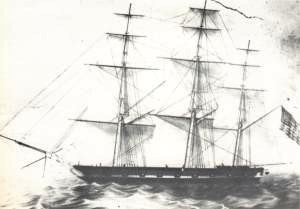
USS Preble

USS Preble: rumors of its sinking greatly exaggerated

Posted in 150 Years Ago This Week, Confederate States of America, Military Matters | Tagged , , , , , , | Leave a comment

Nothing to Trumpet Today

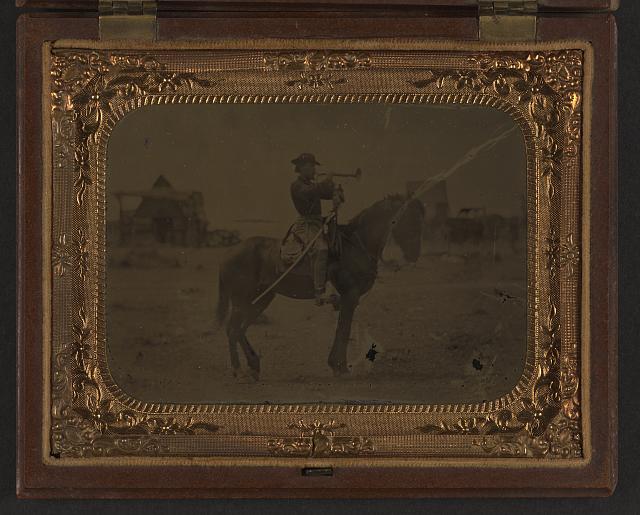
So Here’s a Civil War Photo

[Unidentified soldier in Union uniform atop horse blowing bugle while unsheathing sword (between 1861 and 1865; LOC - LC-DIG-ppmsca-37528)

Posted in Military Matters | Leave a comment

Have Maps – Will Paste

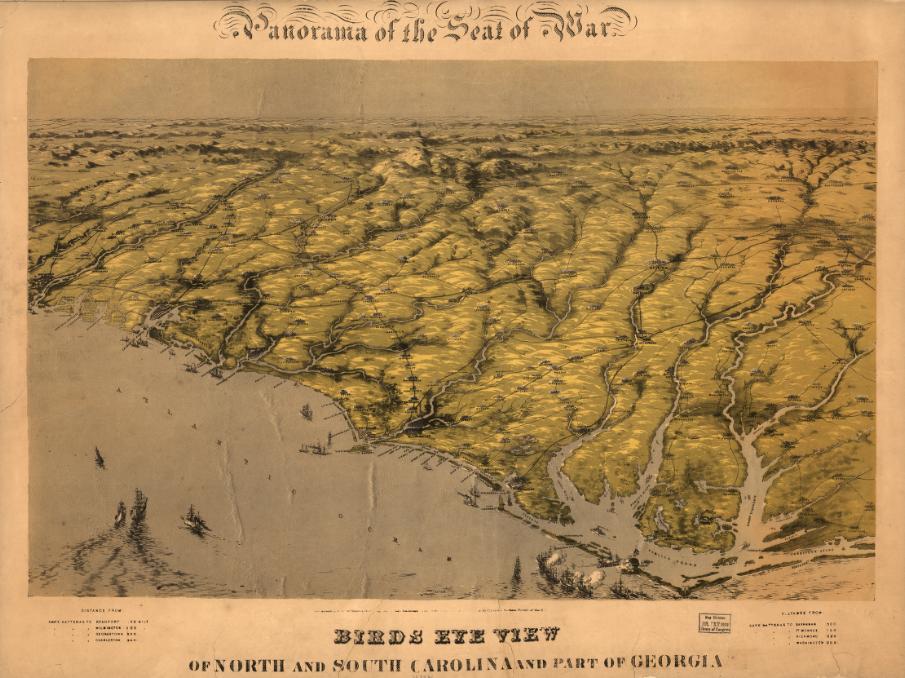
Birds eye view of North and South Carolina and part of Georgia. (by John Bachmann; LOC - http://hdl.loc.gov/loc.gmd/g3871a.cw0304500 )

Bombing Hatteras at yet another Seat of War

From The New-York Times October 11, 1861:

Another “Bird’s-Eye View.”

The “seat of war” does not seem to be a standing one. It changes its location almost daily. But the publishers of maps follow it up faithfully. Thus, JOHN BACHMAN, who has before published several panoramic views of other marshes where the war fever prevails, now publishes a “Bird’s-Eye View,” of North and South Carolina and a part of Georgia. He has judiciously introduced a few ships in the vicinity of Hatteras Inlet, and represented the bombardment and capture of that fortification. Mr. BACHMAN’s maps are so arranged that they can be joined together — each representing a part of one gigantic whole — and he makes no extra charge for putting them through the pasting process.

John Bachmann, Sr. “was a Swiss-born lithographer and artist best known for his bird’s-eye views …” This work was “drawn from an imagined perspective” (no hot air balloons here). He enjoyed a long career:

Birds' eye view of New-Orleans (c. 1851; LOC - LC-DIG-ppmsca-08888)

pre-Secession work: Pelicans' eye view of New Orleans

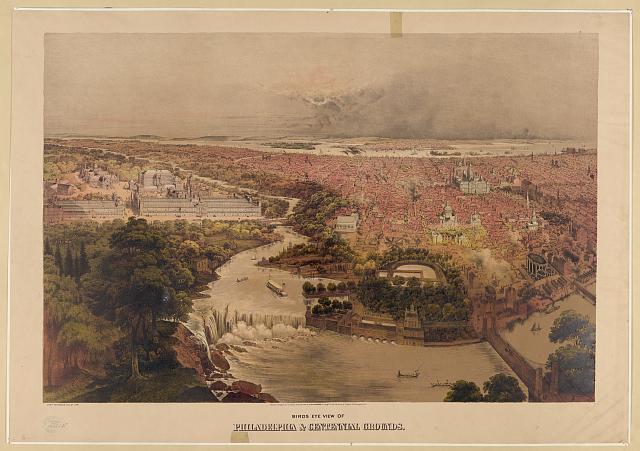
Birds eye view of Philadelphia & centennial grounds (c. 1875; LOC - LC-DIG-pga-00098)

Philadelphia preps for the Centennial Exposition

Posted in 150 Years Ago This Week, Northern Society | Tagged , | Leave a comment

‘Twixt Da Vinci and the Wrights

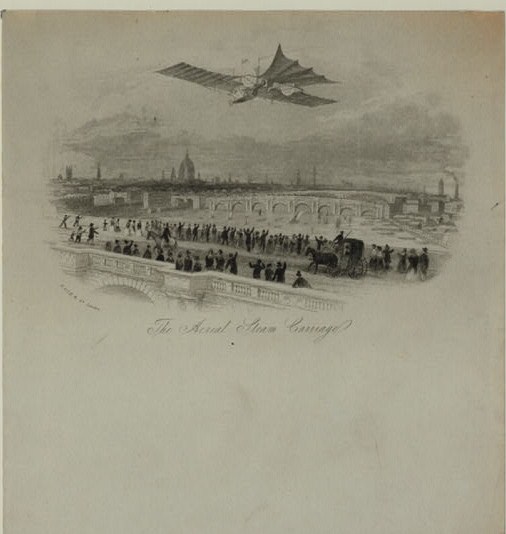
The aerial steam carriage (ca. 1843; LOC - LC-DIG-ppmsca-02570)

It's a bird .. It's a ... ???

A few days ago I was browsing at the Library of Congress for an illustration for a post about an editorial by The Times of London. When I saw the image above I had another of those jaw-dropping, ‘I had no idea’ moments. Once again I’m stretching the claim that this is “An American Civil War site”, but it seems that Columbus Day might be a good day for this particular “Show and Tell”. Americans are commemorating the spirit of exploration that helped create the nation.

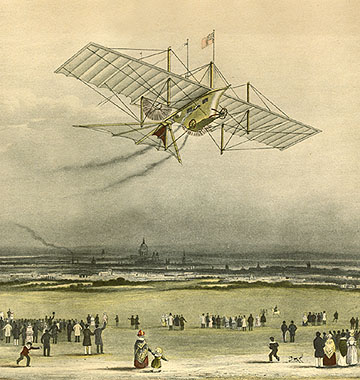
The illustration above is considered “ephemera” – an imaginative work based a patent given to William Samuel Henson and John Stringfellow for an Aerial Steam Carriage:

The Aerial Steam Carriage, also named Ariel, was a flying machine patented in 1842 that was supposed to carry passengers into the air. It was, in practice, incapable of flight since it had insufficient power from its heavy steam engine to fly. A more successful model was built in 1848 which was able to fly for small distances within a hangar. The Aerial Steam Carriage was significant because it was a transition from glider experimentation to powered flight experimentation.

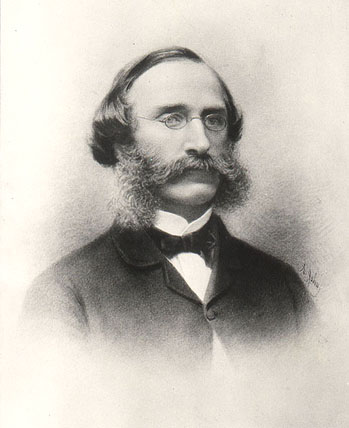
William Samuel Henson (1812-1888)

William Samuel Henson (1812-1888)

1843 engraving of the Aerial Steam Carriage

Imagined but not executed - 1843

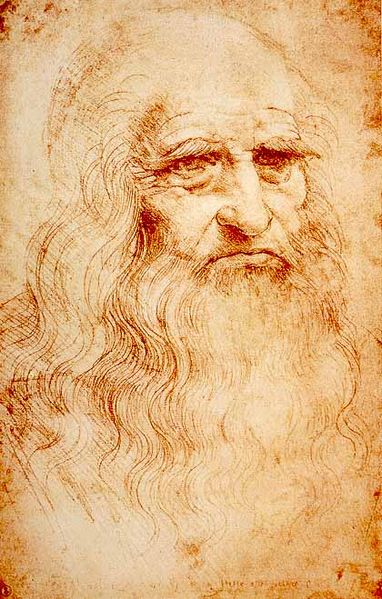
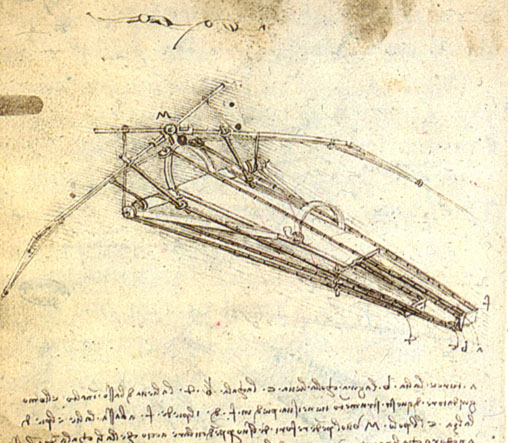
Over 350 years earlier that true Renaissance man, Leonardo da Vinci imagined and drew up plans for a flying machine.

Leonardo daVinci: self-portrait (ca. 1510-1515; attributed to him)

da Vinci - peering into the future of flight?


Design for a Flying Machine (Leonardo da Vinci c. 1488)

Leonardo's Design for a Flying Machine

_____________________________________________________________

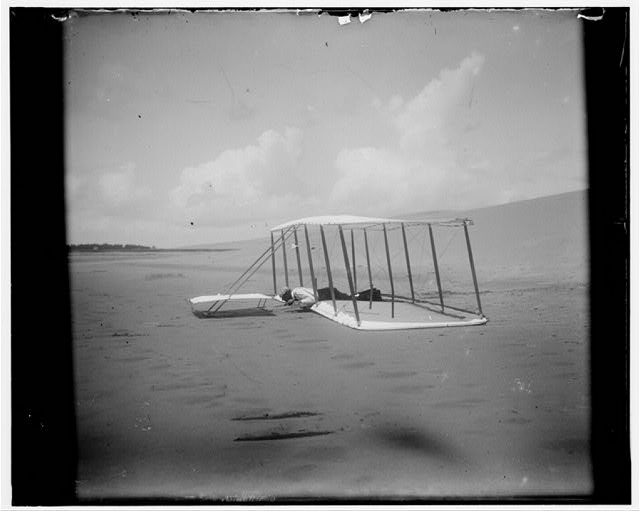
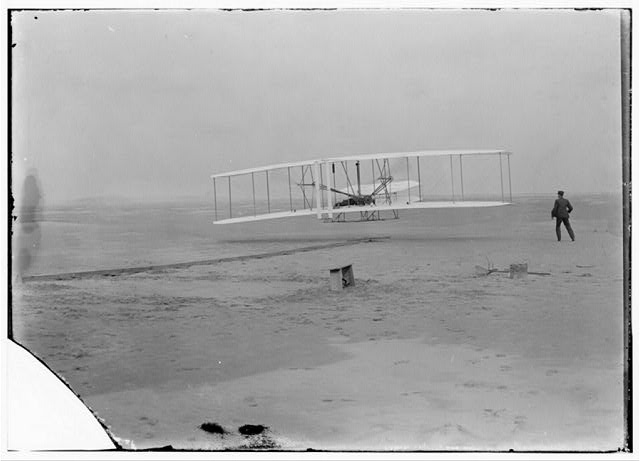
The Wright brothers executed “the first powered, controlled, sustained flight” on December 17, 1903.

Wilbur Wright in prone position on glider just after landing, its skid marks visible behind it and, in the foreground, skid marks from a previous landing; Kitty Hawk, North Carolina (1901; LOC - LC-DIG-ppprs-00570)

Wilbur Wright lands glider - 1901

First flight, 120 feet in 12 seconds, 10:35 a.m.; Kitty Hawk, North Carolina (1903 Dec. 17; LOC - LC-DIG-ppprs-00626)

First flight - Orville stays off the ground for 12 seconds 12-17-1903

____________________

Of course, there’s a Civil War connection. I guess one big difference between a flying machine and a balloon is that a balloon is much more at the mercy of the prevailing winds. However, Professor Thaddeus S. C. Lowe was Chief Aeronaut of the Union Army Balloon Corps from 1861-1863 and was able to navigate his balloons well-enough to spy out Confederate positions. [01-18-2021 – probably because the balloons during the Civil War were almost always tethered. You can learn a lot more about balloons during the war at American Battlefield Trust.]

Prof. T.S.C. Lowe, Civil War balloonist (between 1861 and 1865; LOC - LC-USZ62-17468)

Professor Lowe with ground transportation

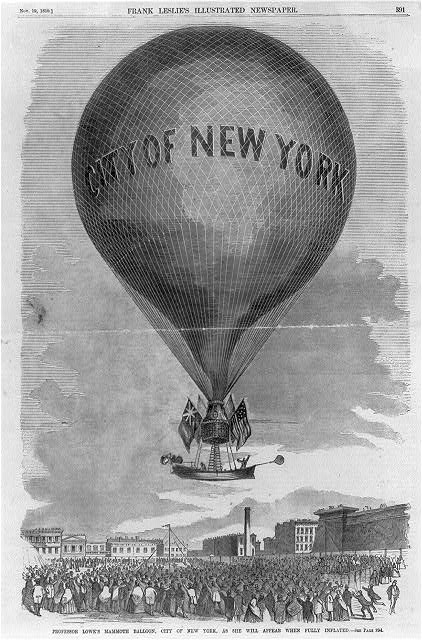
Professor (Thaddeus S.C.) Lowe's mammoth balloon, CITY OF NEW YORK, as she will apepar when fully inflated (Frank Leslie's 1859 Nov. 19; LOC - LC-USZ62-42864)

pre-Secession work - couldn't make it over The Pond

Posted in Military Matters | Tagged , , , , , , | Leave a comment