“crying for water”

Fahrenheit 111

We’ve been following the 19th New York Volunteer Infantry. 150 years ago they were encamped with the rest of General Banks’ Union army north of the Potomac in Maryland. According to Henry Hall in Cayuga in the Field the 19th “pined for active service.” Captain Kennedy came up with a plan to take a small detachment across the river to Lovettsville, Virginia. His goal was to capture a Confederate cavalry squad that often passed through the town. Here’s how one of the Northern soldiers fleshed out the “telegraphic dispatches.”

From A Seneca County, New York newspaper August 15, 1861:

ARMY CORRESPONDENCE
From the 19th Regiment.

[our regular correspondence from the Nineteenth Regiment has this week again failed to reach us, but we are permitted to copy a letter from HENRY B. SEYMOUR, a member of Captain Ashcroft’s Company, addressed to one of his sisters, from which it will be seen that the writer and thirteen others of the same Company were engaged in the skirmish at Lovettsville, Va., a report of which appeared in the telegraphic dispatches of Tuesday, and which is described in a letter copied in another column from the Auburn Daily Advertiser. The following is young Seymour’s letter:]

CAMP CAYUGA, KNOXVILLE, MD.,
Aug. 10, 1861.

Dear Sister: – I just came off from sixty hours duty without a wink of sleep; you can imagine how I feel at present. Wednesday we received orders to go and guard the Village. I was on duty all night and nearly all the next day. Thursday night we received orders to cross the river into Virginia. We crossed about 9 o’clock and marched all night long; arrived at a small place called Lovettsville at 4 o’clock Friday morning, very tired and nearly exhausted. We expected to meet some of the Secession cavalry. They were not there when we arrived, but came in about 2 o’clock, P.M. We were on our return to the camp, within a mile of the river, when a man came running up and said there were about 125 cavalry at Lovettsville. We wheeled and ran about a mile and a half, right in the heat of the day. Some of the men were sun-struck, others nearly exhausted, – some crying for water. I never saw such a time.

When we arrived within a mile of Lovettsville, we crossed through some woods, and went within a few rods of the enemy without being detected, when a small boy saw us approaching the village, and ran and told them there were “some men with guns right over there,” and pointed toward us. We heard the word “mount,” and then they started. You never saw such running of horses in all the days of your life. The order was given for us to fire. I wish you could have been near and heard the report of our muskets. I had two good shots at them. We wounded six of them, the others escaped. We then marched down into the village, and for more than a mile up the road, carbines, cartridge-boxes, cartridges, coats, saddles, stirrups, and a little of everything, were scattered. The Captain lost his cap and our Surgeon picked it up. Not one of the privates was allowed to pick up anything; no one but the commissioned officers. They picked up a coat with a bullet-hole in the collar of it. The Rebels might have shot everyone of us if they had only known our forces. We numbered in all about one hundred, and some of them were left behind.

We left Lovettsville Friday night, marched all night and arrived at camp this morning. there were only fourteen men from our Company, commanded by Lieut. Clark Day. that was the toughest time I have seen.

The weather is very warm here. Yesterday the thermometer stood at 111°. What do you think of that? I never saw it so hot. ***

From your brother,

HENRY B. SEYMOUR

Writing twelve years later Henry Hall supports most of what Seymour wrote. Hall mentions that “This affair was celebrated in the papers, south and north, as a battle. It is a specimen of what war was to our inexperienced and unaccustomed people at the commencement of the rebellion”.
Posted in 150 Years Ago This Week, Military Matters | Tagged , | 1 Comment

Alms for the Poor, Poor CSA

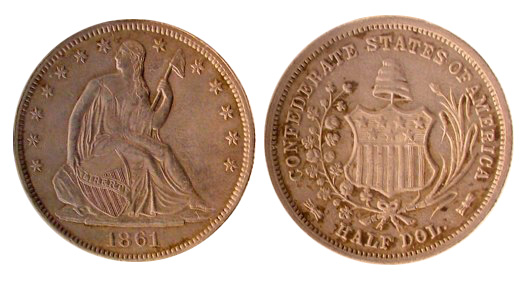
1861_Confederate_Half Dollar

Every little bit helps - 1861 Confederate Half Dollar

“Mister, can you spare half a dime?”

From The New-York Times August 8, 1861:

A NEW DODGE.

The Louisville Journal of Aug. 3 says:

“It is a fact that genteel little girls in this city, nine or ten years old, representing themselves as sent out by their fathers, gentlemen of social position, have been going within the last two or three days, and probably are going still, from family to family, soliciting subscriptions for the Southern Confederacy, and raising perhaps a dollar in one house, a quarter in another, and a dime or half a dime in a third.

This is pitiful to the last degree. Of course the little girls are not to blame; but what is to be thought of the fathers that thus employ their children, and what of the Southern Confederacy that thus employs the fathers? If the Southern Government, at this early stage of the war, is really reduced to the necessity of establishing such a system of petty mendicancy, it might as well close up its affairs at once and step out the world.”

Christopher Memminger, CSA Secretary of the Treasury

Christopher Memminger, CSA Secretary of the Treasury

Certainly the Confederacy was developing other ways to finance itself and the war.

From The New-York Times August 4, 1861:

CONFEDERATE BONDS.

The Richmond Dispatch, of July 28, says: “Mr. MEMMINGER stated yesterday to the Bankers’ Convention that the Treasury Department had, for the first time, on that day, received proof impressions of the Confederate State Bonds, which will soon be issued in sums of $5, $10, $20 and $50. As these bonds will be received as bank notes by all the Southern banks, they will form a very convenient currency, and we are glad to find the measure has been adopted, and have no doubt the people will readily aid in their circulation.”

Christopher Gustavus Memminger served as Treasury secretary for the Confederacy until June 1864. He had his hands full trying to finance the war. Those Louisville girls apparently did help: “Early on (in the first half of 1861), when the support for the separation from the Union and the military effort was running strong, the donation of coins and gold to the government accounted for about 35% of all sources of government funds.”

Kentucky was officially neutral at this time.

The above photo of the CSA Half Dollar minted at New Orleans is licensed by Creative Commons.

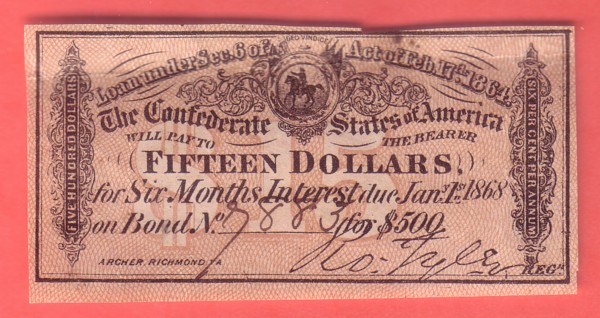
CSA $15 bond coupon

CSA $15 bond coupon

Posted in 150 Years Ago This Week, Confederate States of America | Tagged , , , | Leave a comment

Toasting Manassas from a Sickbed

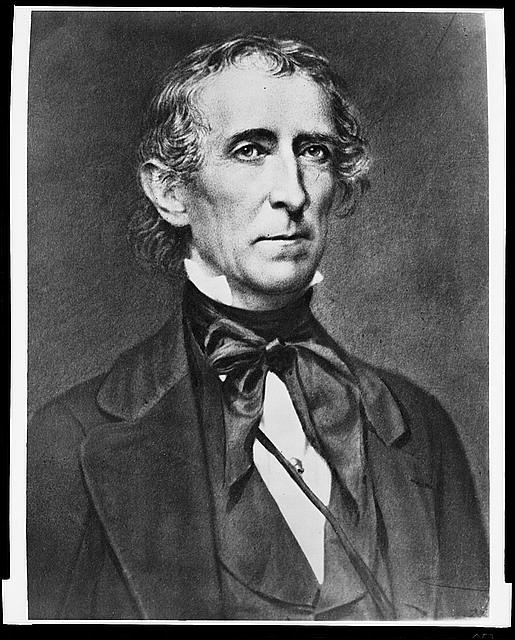
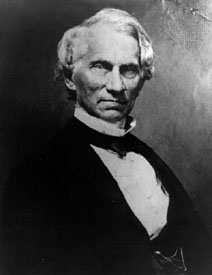
John Tyler (c1860 )

John Tyler (c1860 LOC - LC-USZ62-13010)

From The New-York Times August 7, 1861:

EX-PRESIDENT TYLER TAKES A DRINK.

The Richmond Enquirer has this paragraph:

“Ex-President TYLER (member of Congress) has been detained at his estate in Charles City County, by illness. We are glad to hear, however, that he is convalescent, and although in bed when the news was read to him of the glorious victory achieved by our troops on the field of Manassas, he called for champagne, and made his family and friends drink the health of our Generals.”

John Tyler, the tenth president of the United States, sided with the Confederacy. He was elected to the CSA Congress but died in January, 1862. “Tyler’s death was the only one in presidential history not to be officially mourned in Washington, because of his allegiance to the Confederacy.”

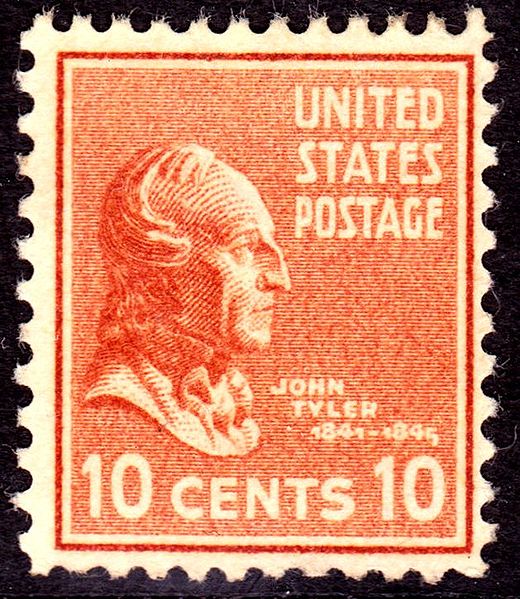
John_Tyler_1938_Issue-10c

1938 stamp

Posted in 150 Years Ago This Week, First Manassas - Bull Run | Tagged , | Leave a comment

Confederate Deterrence Along the Potomac

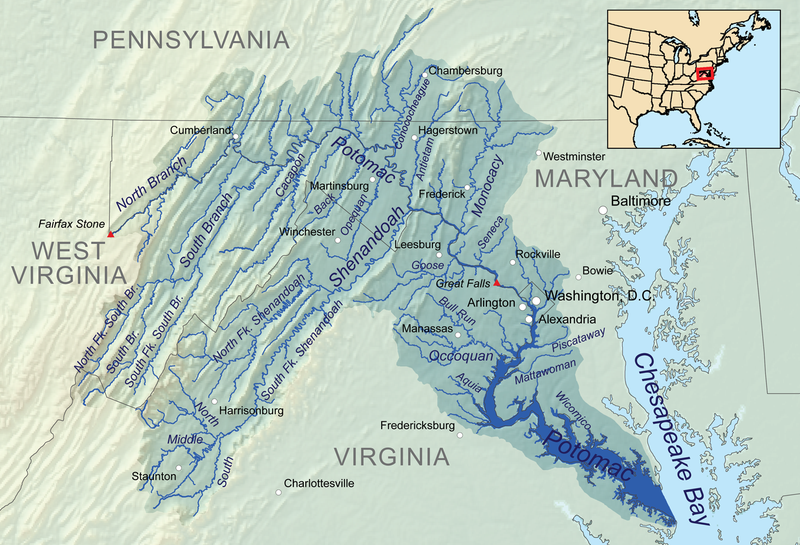
Potomacwatershedmap

Rebel Deterrent along the Potomac at Aquia

From The New-York Times August 6, 1861:

THE GREAT REBELLION.; IMPORTANT NEWS FROM WASHINGTON. …

WASHINGTON, Monday, Aug. 5. …

DANGERS OF NAVIGATION.

The city is now with the mercury at 95°, nearly out of ice — the scarcity being occasioned by the non-arrival of the usual supplies from Boston. On account of the reported batteries at Aquia Creek and Potomac Point, private shippers of all kinds of freight are fearful of forwarding vessels to ascend the Potomac. Lumber now arrives by railroad, instead of by water, thus increasing the freight to treble the usual rates.

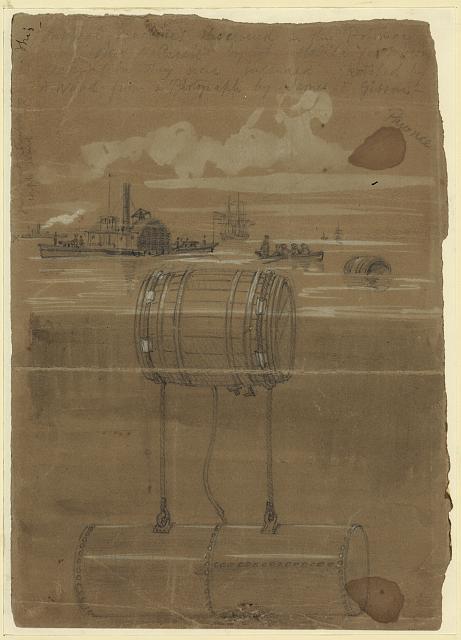
Infernal Machine at Aquia Creek created 1861 July 7

Another possible deterrent: Infernal machines discovered in the Potomac near Aquia Creek (LOC - LC-DIG-ppmsca-21002)

BRITISH GOLD IN RICHMOND.

A Northern gentleman, who arrived two days since from Richmond, announces that at the date of his departure, and for some time previously, there was a great abundance of British coin circulated in the city, being for the most part sovereigns. It was currently reported that large amounts of gold had been advanced by British capitalists upon the new crop.

COMING HOME.

Col. WARD, of the Thirty-eighth, goes to New-York in the morning. The rigid discipline now enforced has forced several of the officers of the regiments to resign, owing to their manifest incapacity. Col. WARD goes to New-York for the purpose of obtaining suitable officers to take the places of those who have resigned.

INCREASE OF SOLDIERS’ PAY.

The House to-day passed the bill providing that privates shall hereafter be paid fifteen dollars per month, instead of eleven dollars, as at present. The House also passed the bill providing that volunteers and militia shall be paid from the date of their enlistment, instead of from the day of their being sworn into service, as at present. This will give the volunteers and militia from New-York pay for about a month more than they have heretofore received.

ARRIVAL OF ICE FOR THE HOSPITALS.

Fifty tons of ice arrived from New-York, to-day, for the use of the sick and wounded, and was sent to the hospitals. …

***Talk about unintended consequences! Not only has the limber price tripled, but think of all the global warming of using trains. Oh, that’s right – there’s a war on.

Map licensed by Creative Commons

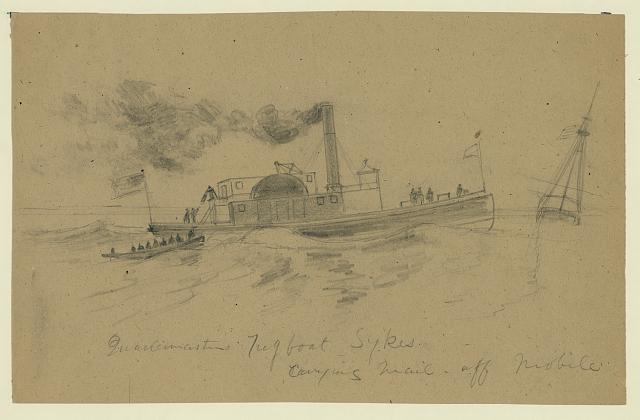
***08-06/2011: Talk about unintended consequences of being rash! Not all ships by 1860 used wind power. There were “steamers”, see below:

Quartermasters Tugboat Sykes, carrying mail off Mobile

Quartermasters Tugboat Sykes, carrying mail off Mobile (ca1860-5; LOC - LC-DIG-ppmsca-20858)

Posted in 150 Years Ago This Week | Tagged , , | Leave a comment

Fort Ellsworth: Death and (Un)Discipline

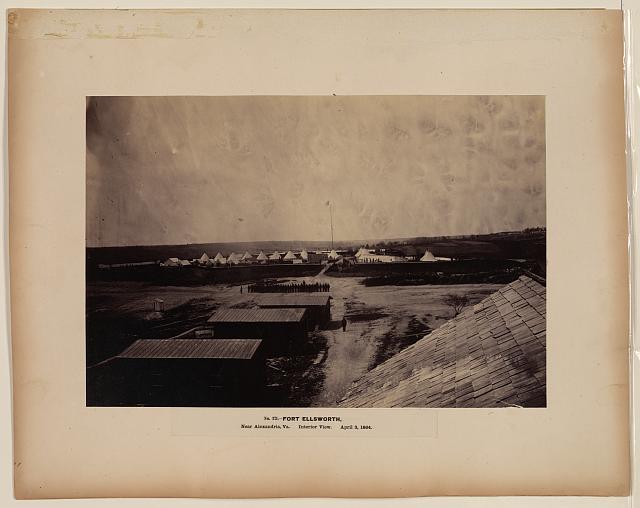
Fort Ellsworth 1864

Fort Ellsworth sans scaffold (1864 photo LOC - LC-USZ62-136030)

From The New-York Times August 3, 1861:

REPORTS FROM ALEXANDRIA.

ALEXANDRIA, Friday, Aug. 2.

The execution of private WM. MURRAY, of Company F, Second New-Hampshire Regiment, for the murder of MARY BUTLER, on Saturday last, took place this afternoon. In order that his fate might be a warning to all evil-disposed soldiers, the scaffold was erected upon the walls of Fort Ellsworth, affording an unobstructed view to all. All the regiments encamped in the vicinity of Alexandria were present, and notwithstanding 20,000 persons witnessed the execution everything passed off without unnecessary excitement. The culprit ascended the scaffold with a steady gait, he made no allusion to his guilt, but called upon his friends to sustain his family in their hour of trial.

The private residence of SAMUEL JOHNSON, a Lieutenant in the Confederate Army, and located on the other side of Hunting Creek, was burned on Saturday afternoon.

Private KEETH, of Company E, Seventeeth New-York Regiment, stationed at Fort Ellsworth, was shot dead on Wednesday evening by Capt. STONE, of the same regiment. He was riotous, and committed an assault and battery upon the Captain.

I think Fort Ellsworth was in the process of being constructed and fortified at this time.

The 17th New York Infantry Regiment was also known as the Westchester Chasseurs. You can see their regimental color here.

The 2nd New Hampshire Volunteer Infantry fought from First Bull Run through the occupation of Richmond.

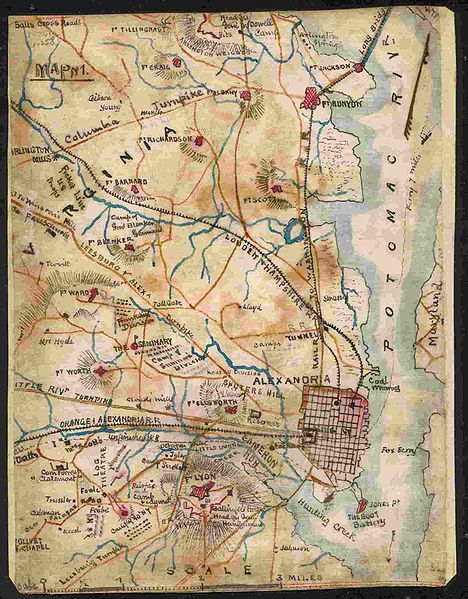
Alexandria area with Fort Ellsworth

Alexandria area with Fort Ellsworth (by Henry Knox Snedon; LOC, Virginia Historical Society)

Posted in 150 Years Ago This Week, Military Matters | Tagged , , , , | Leave a comment

New Millennium on Hold

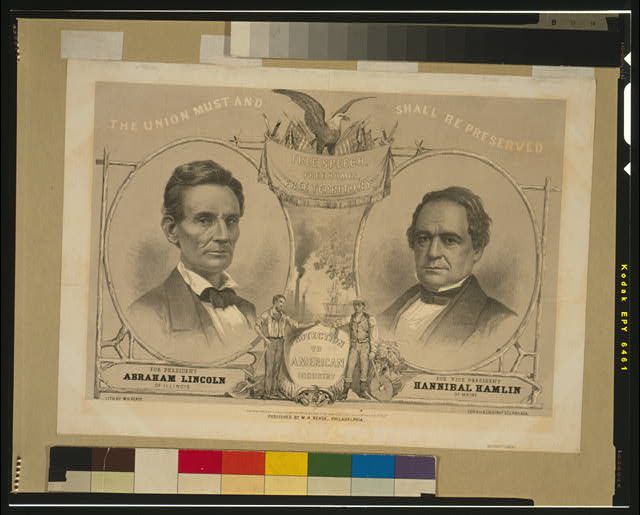
1860 Republican Campaign banner

"Protection to American Industry" (1860 Republican Campaign banner LOC - LC-USZC4-7996)

An editorial from a newspaper in Seneca Falls, New York that leaned toward the Democrat Party (and which must have been published about 150 years ago this week):

The Fulfillment of Prophesy.

Upon the eve of last Fall’s election our Republican friends assured us that the election of Mr. LINCOLN to the Presidency would lead to a glorious condition of things, and that the peace and prosperity of the country depended upon the success of the Republican candidate.the triumph of Republican principles was all that was then desired to give the finishing touch to the individual happiness of every man, woman, and child. There could be no doubt of this, nothing more certain. The rich man would prosper and property would enhance in value to an unprecedented figure, while the labor of the poor man would be in great demand, with wages to correspond. Manufactures would certainly increase and the mechanics of the land would go clothed in “purple and fine linen.” Everybody would prosper far beyond all human calculations, and the earth would be transformed into a Paradise, filled with choice boquets and fervent piety. – Pro-Slavery Democrats would be changed into Divines, or dispatched to the regions of bliss astride of some ponderous negro. In short, the election of Mr. LINCOLN was to be considered as a sort of Providential Dispensation, and a panacea for all the ills that afflicted the body politic, – in reality the dawn of the New Millennium. Mr. LINCOLN is President. Nearly five months have elapsed since his inauguration, and what is the result? Look to our own village and answer. Business is prostrated, our

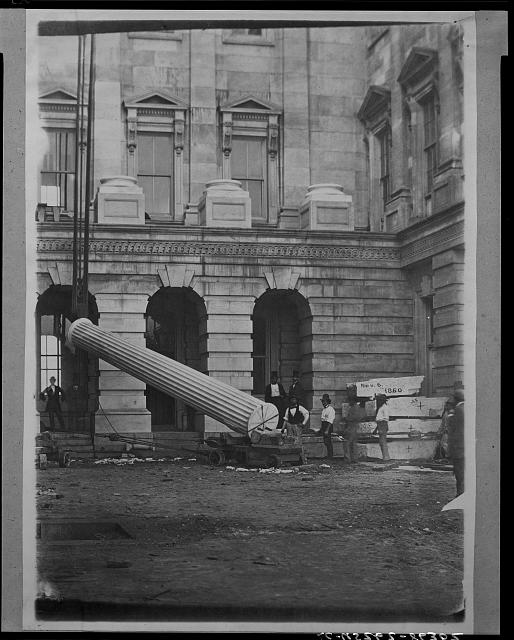
U.S. Capitol construction 11-1860

To honor the "New Millennium"? (The "Lincoln column," first monolith raised, Nov. 1860 U.S. Capitol LOC - LC-USZ62-86302)


mechanics and laboring men thrown out of employment and in many cases in destitute circumstances. What is true of our village applies with equal force to every community throughout the length and breadth of the land. When the sun rose on the morning of the last election, it shone upon a prosperous, peaceful and united people. Our Government was the pride and admiration of every American citizen. Its power, and influence, and greatness was felt and acknowledged by all nations. It now struggles in the throes of dissolution and death. Its power and strength is no longer is no longer acknowledged and respected by Governments abroad. Rebellion has raised its hydra head and bids defiance to its power. We are plunged into a civil war, and the Government placed in the hands of politicians, and not statesmen. Incompetency and imbecility rule the day. These things were prophecied and the people everywhere warned of the consequences, but without affect. Did anyone ever witness such a condition of affairs upon the election of a Democratic President? Does anyone believe that we should have been thus afflicted had Mr. LINCOLN and the Republican party been defeated at the last election?

This editorial reminded me of some current political speech. It seems like it is meant to fire up the like-minded by using hyperbole to put impossible expectations on the opponent.

I can understand why people would disagree with Lincoln’s policies, but to accuse the Republicans of being politicians is interesting – the Democrat “statesmen” split the party asunder in 1860 – that had to make Lincoln’s election at least easier.

I’d like to write more, but I have to put on my top hat and get to work.

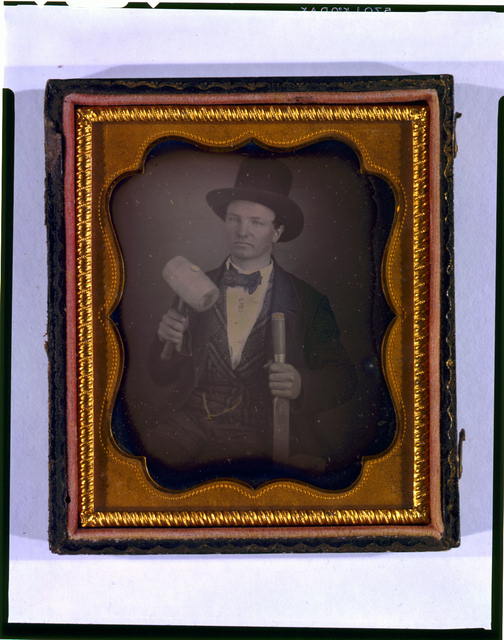
Occupational portrait of an unidentified man with mallet and chisel ca. 1840-1860

Out of work? (Occupational portrait of an unidentified man with mallet and chisel ca. 1840-1860 LOC - LC-USZC4-3950)

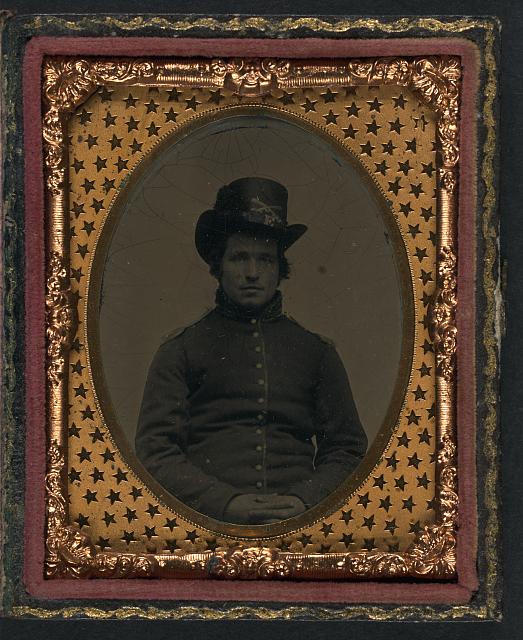
Unidentified young Union soldier in infantry shell jacket with shoulder scales and Company E Hardee hat

Federal Government hiring (unidentified Union soldier LOC - LC-DIG-ppmsca-2744)

Posted in 150 Years Ago This Week, Lincoln Administration, Northern Politics During War | Tagged , , | 1 Comment

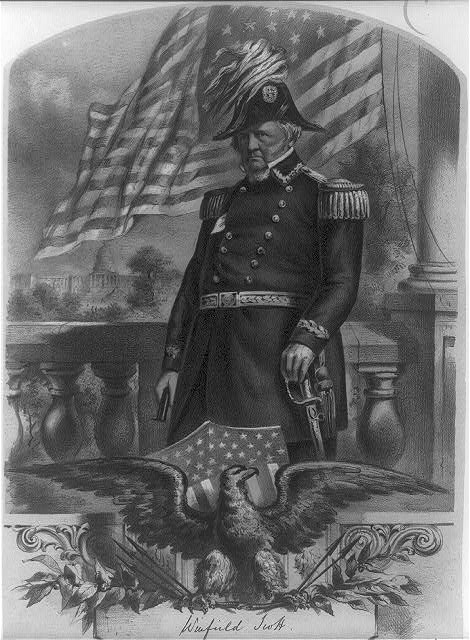
Orders from General Scott

General Winfield Scott c7-20-1861

Defending Union and Mount Vernon (General Winfield Scott c7-20-1861 LOC - LC-USZ62-37503)

From The New-York Times August 2, 1861:

THE GREAT REBELLION. … Important Orders Issued by General Scott. More Caution to be Observed in Searching for Arms and Making Arrests. The Rebels Desecrating Mount Vernon. …

WASHINGTON, Thursday, Aug. 1.

The following orders have just been promulgated: HEAD-QUARTERS OF THE ARMY,

WASHINGTON, July 30, 1861.

GENERAL ORDERS No. 12. — Searches of houses for arms, traitors or spies, and arrests of offenders to such matters, shall only be made in any Department by the special authority of the Commander thereof, except in extreme cases admitting of no delay.

By command of Lieut.-Gen. SCOTT.

E.D. TOWNSEND, Assistant Adjutant-General.

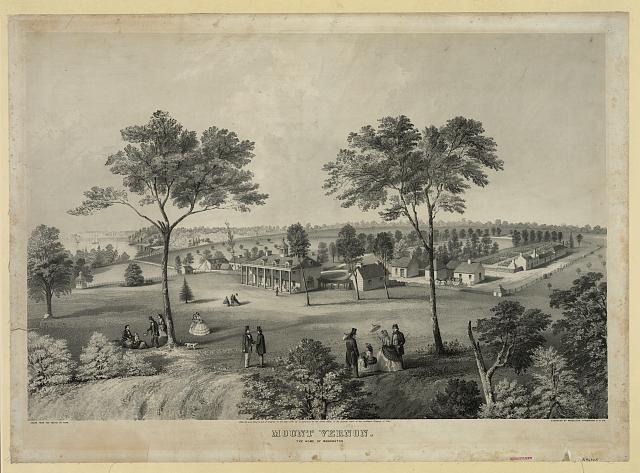
Mount Vernon c1861

Mount Vernon c1861 (LOC - LC-DIG-pga-03139)


HEAD-QUARTERS OF THE ARMY,

WASHINGTON, July 31, 1861.

GENERAL ORDERS No. 13. — It has been the prayer of every patriot that the tramp and din of civil war might at least spare the precincts within which repose the sacred remains of the Father of his Country, but this pious hope is disappointed. Mount Vernon, so recently consecrated anew to the immortal WASHINGTON by the ladies of America, has already been overrun by bands of rebels, who, having trampled under foot the Constitution of the United States, the ark of our freedom and prosperity, are prepared to trample on the ashes of him to whom we are all mainly indebted for those mighty blessings. Should the operations of the war take the United States troops in that direction, the General-in-Chief does not doubt that each and every man will approach with due reverence, and leave uninjured not only the tomb, but also the house, the groves and walks, which were so loved by the best and greatest of men.

By command, WINFIELD SCOTT.

E.D. TOWNSEND, Assistant Adjutant-General.

Edward D. Townsend

Edward D. Townsend (LOC - LC-DIG-cwpb-05800)

Edward D. Townsend was the Adjutant-General from 1869-1880.

Winfield Scott “Scott served under every president from Jefferson to Lincoln, a total of fourteen administrations, and was an active-duty general for thirteen of them; a total of 47 years of service. Historians rank him highly both as a strategist and as a battlefield commander.” Even as the general-in-chief of the U.S. army, Scott could accept responsibility: “When Lincoln received news that the Union Army had been defeated at Manassas on July 21, 1861 he went to Scott’s residence. Scott assumed responsibility for the Union defeat.”

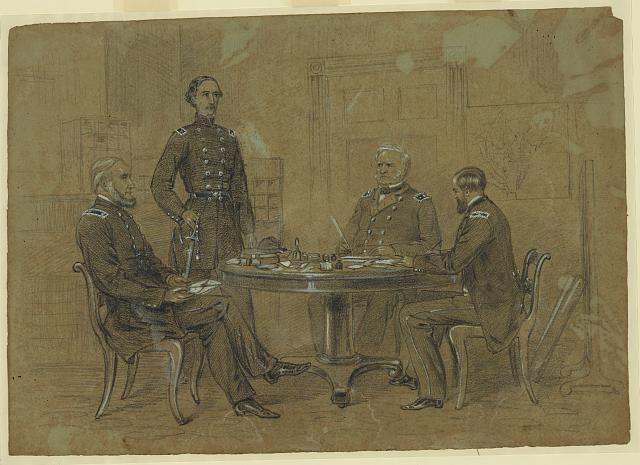
The image below is said to be “General Scott giving orders to his aides for the advance of the Grand Army”. Ironically, it is also said to have been published in the New York Illustrated News, July 22, 1861 – the day after that advance got decisively stopped at Bull Run.

General Scott and staff July 1861

General Scott and staff July 1861 (LOC - LC-DIG-ppmsca-22465)

Posted in 150 Years Ago This Week, Military Matters | Tagged , , , | Leave a comment

Papers, Rock, Scissored

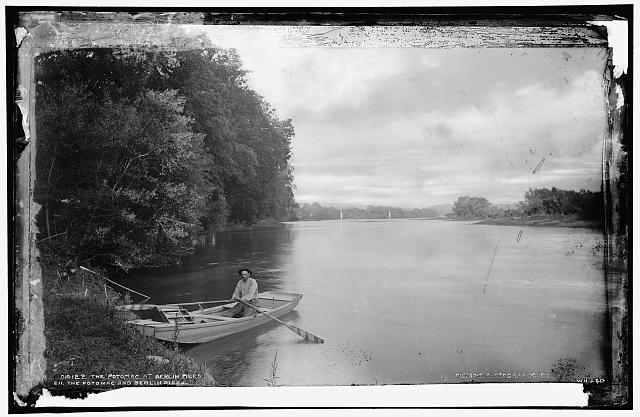
Potomac near Berlin, Maryland

The frontier: the Potomac near Berlin, Maryland (ca.1890 LOC - LC-D4-14122)

We found out a couple days ago that the 19th NY Volunteer Infantry had arrived in Pleasant Valley, Maryland. General Nathaniel P. Banks, having taken command of Robert Patterson’s Union army, decided to move it north of the Potomac River. The 19th was organized at the end of April, but it has seen no real battle. Probably the most notable feature of the 19th is its shabby gray uniforms. Thankfully, 150 years ago today the 19th got proper blue uniforms. From Cayuga in the Field by Henry Hall and James Hall:

[At Pleasant Valley] the Cayuga regiment was encamped for three weeks. Here also, it was rejoined by a detachment of sick and nurses, which had been left at Kalorama. The regiment was held under rigid discipline, and improved rapidly in steadiness and soldierly bearing. Guard duty along the Potomac, and the canal and railroad on its bank, from Sandy Hook to Berlin, required daily detachments from the companies. The upper Potomac at this time formed the frontier of war in this quarter. The Union forces, under Banks, held and acted on the north bank, from Williamsport, twenty miles above Pleasant Valley, to the Monocacy, twenty miles below. The rebels watched the fords and scouted along the river on the Virginia side. Our pickets often talked with the rebel pickets, and met them half way in the stream and exchanged papers.

During July, twenty-one men were discharged from the 19th for disability, used up by hard service.

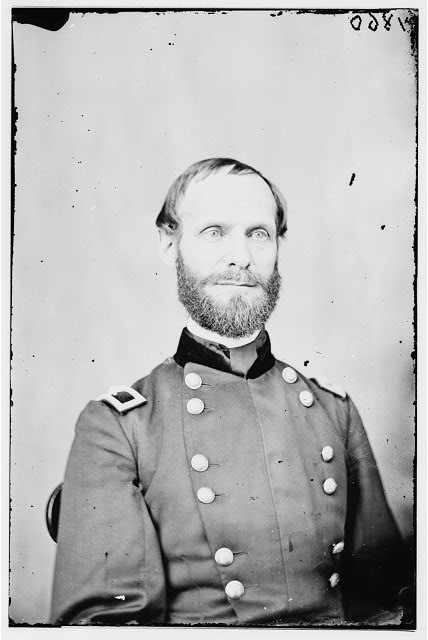
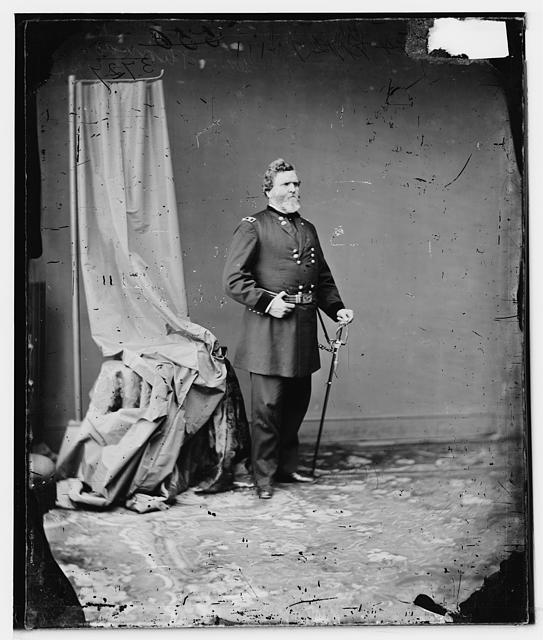
General George H. Thomas

"a brave and daring officer" (LOC - LC-DIG-cwpbh-00679)

July 29th, Gen. Banks issued orders for the reorganization of his army. So many militia regiments had gone home, that the old brigades were all cut up, and now the new three years’ regiments, raised under the President’s second call, were arriving, sometimes five or six in a day. As the old 8th Brigade was, in a day or two, to lose the 5th and 12th Militia, a consolidation with other regiments of the army was effected, and a new brigade was temporarily formed, designated as the 1st of the army. It embraced the 2d United States Cavalry, Col. George H. Thomas; 2d New York and 9th Rhode Island battery; 19th New York Volunteers, Col. Clark; 28th New York Volunteers, Col. Donnelly; 28th Pennsylvania Volunteers, Lt. Col. Geary; and the 2d Pennsylvania Reserves, Col. Mann. It was placed under the command of Col. George H. Thomas, afterwards one of the most renowned Generals of the army. Col. Thomas was a specimen of the perfect soldier. Of a fine personal presence, he was gentlemanly, considerate of the kind of forces he had to command, without a single bad habit, and a brave and daring officer. He was loved and respected by every soldier in his command. Green as the troops were, he could have led them anywhere, and they would have done their duty under him to the last man.

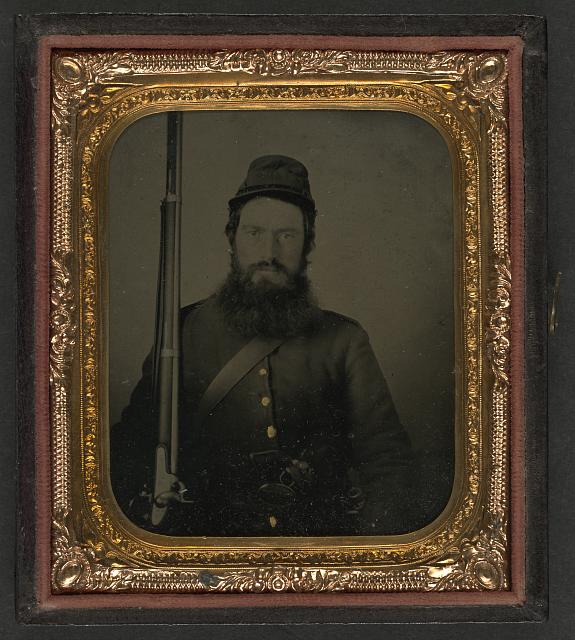
Unidentified soldier in Union uniform

Nice uniform - not sure about the shoes (Unidentified soldier in Union uniform LOC - LC-DIG-ppmsca-36915)

July 30th, excitement and joy agitated Camp Cayuga. Regulation uniforms came. They had been following the regiment for a month. That night, on dress parade, the Cayugas wore for the first time the long sighed for, comfortable army blue. The shoddy, worn and torn to rags, was cast off with a parting shudder. Gov. Morgan’s shoddy shoes having worn out, leaving half the men barefoot, foot gear was next supplied by borrowing five hundred pairs of new shoes from Connecticut and Massachusetts regiments encamped in the Valley. New life for a while thrilled the whole command.

The regiment again pined for active service. Opportunities for a fight with the rebels were eagerly watched for. …

Everything is going great as long as the 19th can borrow some shoes.

The enemies meeting half way in the Potomac to exchange newspapers until they can fight again another day

George Henry Thomas was serving in the 2nd U.S. Cavalry when the war broke out. He soon would move to the Western Theater.

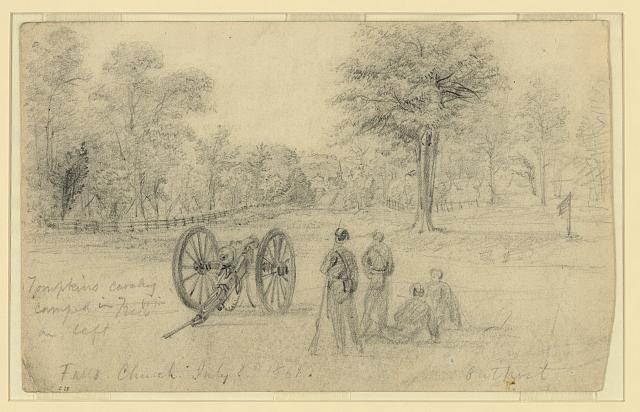
Part of 2nd US Cavlry at Falls Church 7-1-1861

Part of 2nd US Cavlry at Falls Church 7-1-1861 (LOC - LC-DIG-ppmsca-21635)

Posted in 150 Years Ago This Week, Military Matters | Tagged , , , , , | 1 Comment

A Bishop on Jeff’s Chessboard

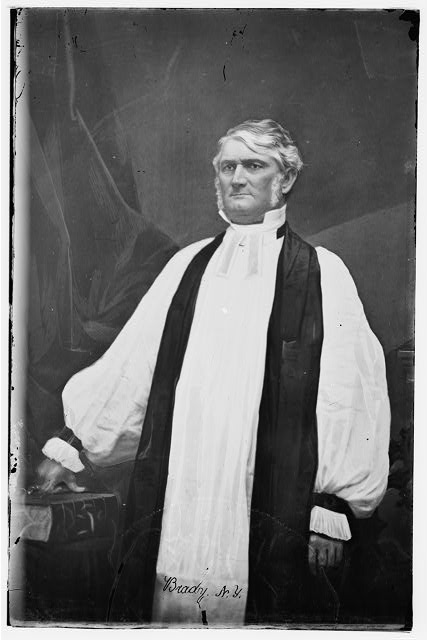
Bishop Leonidas Polk

'Union' - a pretence for Yankee plunder (LOC - LC-DIG-cwpb-06714)

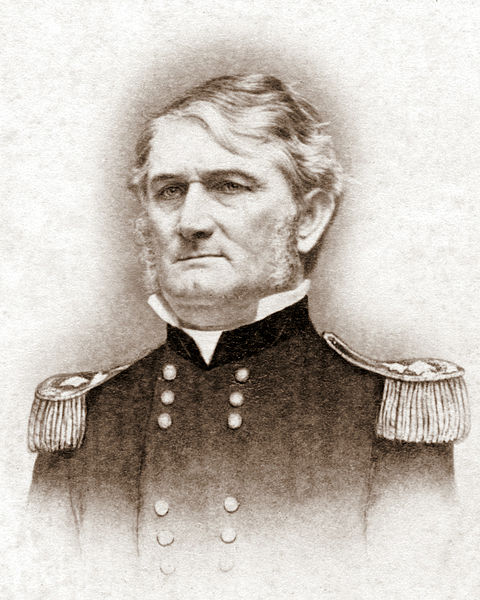
150 years ago today we Yankees could have read the proclamation of Leonidas Polk upon taking command of Confederate Department No.2.

From The New-York Times July 29, 1861:

PROCLAMATION OF MAJOR-GENERAL POLK

The annexed proclamation appears in the Memphis Avalanche of the 18th inst.:

We have protested, and do protest, that all we desire is to be let alone, to repose in quickness under our own vine and our own fig tree. We have sought, and only sought, the undisturbed employment of the inherent and indefeasible right of self-government — a right which freemen can never relinquish, and which none but tyrants could ever seek to wrest from us. Those with whom we have been lately associated in the bonds of a pretended fraternal regard have wished and endeavored to deprive us of this, our great birthright as American freemen. Nor is this all; they have sought to deprive us of this inestimable right by a merciless war, which can attain no other possible end than the ruin of fortunes and the destruction of lives, for the subjugation of Christian freemen is out of the question.

A war which has thus no motive except lust or hate, and no object except ruin and devastation, under the shallow pretence of the restoration of the Union, is surely a war against Heaven as well as a war against earth. Of all the absurdities ever enacted, of all the hypocricies ever practiced, an attempt to restore a union of minds, and hearts, and wills, like that which once existed in North America, by the ravages of fire and sword, are assuredly among the most prodigious. As sure as there is a righteous Ruler of the universe, such a war must end in disaster to those by whom it was inaugurated, and by whom it is now prosecuted, with circumstances of barbarity which it was fondly believed would never more disgrace the annals of a civilized people. Numbers may be against us, but the battle is not always to the strong. Justice will triumph, and an earnest of this triumph is already beheld in the mighty uprising of the whole Southern heart. Almost as one man this great section comes to the rescue, resolved to perish rather than yield to the oppressor, who, in the name of freedom, yet under the prime inspiration of an infidel horde, seeks to reduce eight millions of freemen to abject bondage and subjection. All ages and conditions are united in the one grand and holy purpose of rolling back the desolating tides of invasion and of restoring to the people of the South that peace, independence and right of self-government, to which they are by Nature and Nature’s God as justly entitled as those who seek thus ruthlessly to enslave them.

Polk,_Leonidas,_1806-1864

General Polk

The General in command having the strongest confidence in the intelligence and firmness of purpose of those belonging to his department, enjoins upon them the maintenance of a calm, patient, persistent and undaunted determination to resist the invasion at all hazard and to the last extremity. It comes bringing with it a contempt for constitutional liberty, and the withering influence of the infidelity of New-England and Germany combined. Its success would deprive us of a future. The best men among our invaders opposed the course they are pursuing at first, but they have been overborne or swept into the wake of the prevailing current, and now, under the promptings of their fears, or the delusions of some idolatrous reverence due to a favorite symbol, are as active as any in instigating this unnatural, unchristian and cruel war.

Our protests, which we here solemnly repeat in the face of the civilized world, have been hitherto unheeded, and we are left alone, under God; to the resources of our own minds and our hearts — to the resources of our manhood. Upon them, knowing as he does those whom he addresses as well as those with whom you are cooperating throughout the South, the General in command feels we may rely with unwavering confidence. Let every man, then, throughout the land, arm himself in the most, effective manner, and hold himself in readiness to support the combined resistance. A cause which has for its object nothing less than the security of civil liberty and the preservation of the purity of religious truth, is the cause of Heaven, and may well challenge the homage and service of the patriot and the christian. In God is our trust. LEONIDAS POLK.

Major-Gen. P.A.C.S. Commanding.

Leonidas Polk attended West Point and “graduated eighth of 38 cadets on July 1, 1827”. By December 1827 Polk resigned from the army to attend Virginia Theological Seminary. He was Episcopal Bishop of Louisiana for about twenty years before the war.

You can read the boundaries of Department No. 2 at The Confederate War Department

Posted in 150 Years Ago This Week, Confederate States of America, Military Matters | Tagged | Leave a comment

Souvenirs

Pleasant Valley, Maryland from Virginia

Where 19th ended up on July 28, 1861: Pleasant Valley, Maryland from Virginia

Making Pipes from “Sacred Soil”

On July 15, 1861 New York’s 19th Regiment marched with the rest of General Robert Patterson’s Union Army to Bunker Hill, now in West Virginia. Patterson’s army was about 13 miles from Winchester, Virginia, where General Joseph Johnston’s Confederate army was based. The main idea was that Patterson’s army would keep Johnston busy so that Union General McDowell could attach the CSA army under General Beauregard near Manassas Junction.

That did not happen. On the 17th Patterson’s army marched to Charlestown – about 20 miles from Winchester. When the 19th realized they were not going to advance on Johnston’s army, they whispered “Retreat, Retreat”. Johnston was allowed to reinforce Beauregard. On July 21st, when the combined Confederate force eventually routed McDowell at Bull Run, Patterson’s army was marching to Harper’s Ferry. On July 25th General Nathaniel P. Banks replaced Patterson. On July 28th the army moved to Maryland. The 19th encamped in Pleasant Valley for three weeks.

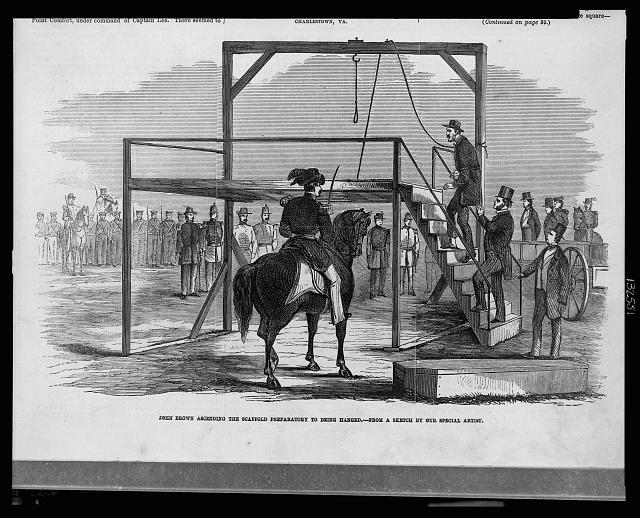
John Brown ascending the scaffold preparatory to being hanged

John Brown ascending the scaffold preparatory to being hanged (Frank Leslie's 12-17-1859 LOC - LC-USZ62-132551_

At Charlestown the 19th bivouacked at an historical site. From Cayuga in the Field by Henry Hall and James Hall:

The 19th New York occupied a wheat field south of the village, adjoining that in which John Brown was executed and only a few rods from the very spot where the historical tragedy took place. …

While at this place, the Cayuga volunteers visited the scene of John Brown’s last hours; the court house, with its four white brick pillars, the jail, the church on whose spire the old man’s eyes rested on that bright December day, when he stood upon the fatal scaffold. Everybody secured mementoes. A tree, standing near the scene of execution, was literally carried away piecemeal. A table in the jail, used by Brown, suffered a similar fate. A tenacious clay in the field of the execution, forming an excellent substitute for meerschaum, was carried away in quanties and wrought into capital pipes.

Camp regulations were strictly enforced at Charlestown. No foraging was permitted. The men subsisted on rations of five hard tack, five ounces of salt pork or beef, and coffee.

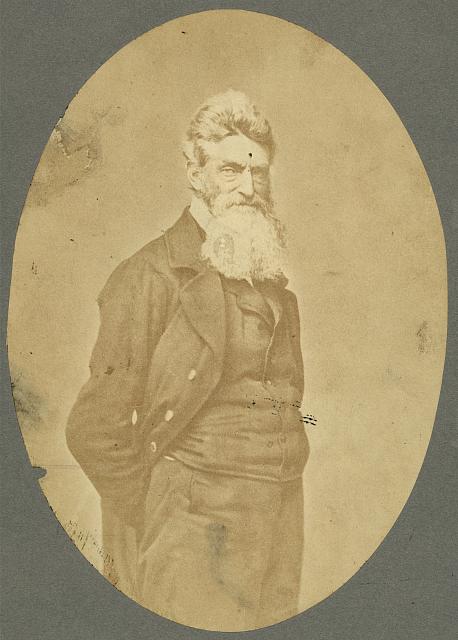
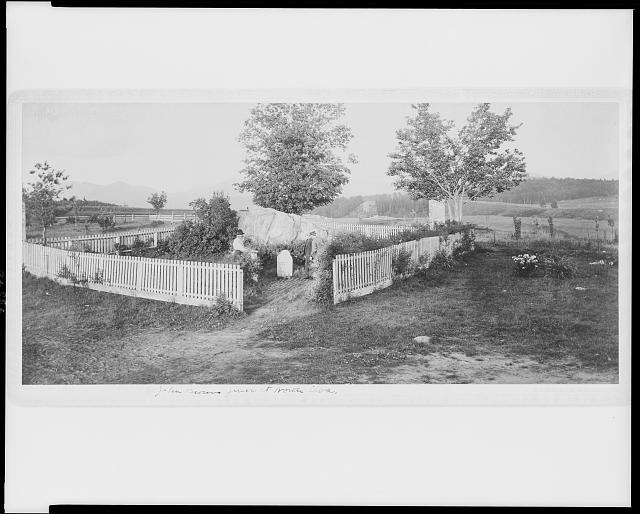
John Brown was buried in North Elba, New York.

John Brown

John Brown (LOC - LC-DIG-ppmsca-23763)

John Brown's grave at North Elba, New York

John Brown's grave at North Elba, New York (LOC - LC-USZ62-93540)

Posted in 150 Years Ago This Week, Military Matters | Tagged , , , | 1 Comment