A Spy? Without a Country?

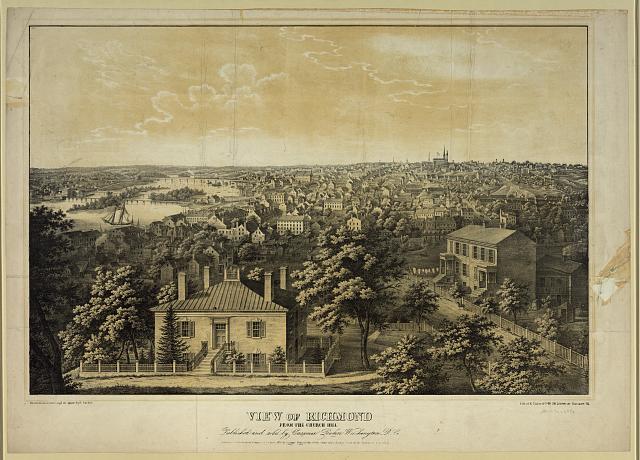
View of Richmond from the church hill - 1851

Trial venue - Richmond (1851 photo LOC - LC-DIG-pga-02597)

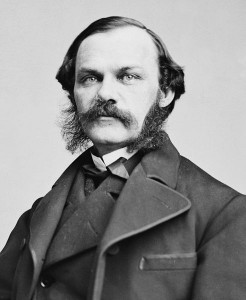
The bulk of the following article details the legal wrangling in the Richmond trial of William Henry Hurlbert. The judge’s decision is reproduced here.

From The New-York Times July 27, 1861:

THE CASE OF MR. W.H. HURLBURT

WM. H. HURLBURT, arrested at Atlanta, Georgia and sent on to Richmond, as a spy, was, on Thursday the 4th, as we learn from the Charleston Courier brought before Judge JNO. A. MEREDITH, and the examination of his case, on a writ of habeas corpus resumed. …

From the decision, given on the subsequent day, we make the annexed extract:

“In this case it has been clearly proved that the prisoner was a resident of the State of New-York for several years; and it is further proved that prior to the 6th of June last he left the State of New-York, and on that day entered the State of Virginia, by a permit from Gen. JOHNSTON. He remained a few days in the State, and went on to the State of South Carolina, where, after spending a short time, he proceeded on to Georgia, in which State he was arrested and brought back to this city, and on the 24th of June committed, by order of the Executive. This is all the proof in the case,bearing on this point. It will be seen that it does not prove that he left the City of New-York with the intention of abandoning his residence there; still less does it prove an intention of returning to his native domicil. In fact, the testimony of the case tends strongly to show that his sojourn was temporary; for, during the twelve days he was in the South, he passed through four States; and, whilst in South Carolina, did no act which looked to a permanent residence in that State. He passed through it as rapidly as he did through the other States.

The prisoner, in his petition, under oath, avers that he is without citizenship, unless his nativity in South Carolina confers it. He does not aver an intention to return to the domicil of his nativity.

Upon an examination of the whole case, I am led to the conclusion that the prisoner is a citizen of the State of New-York, a State foreign to the Southern Confederacy and at war with it; and, therefore, the executive had jurisdiction of the case, and his judgment cannot be rescinded.

The prisoner is remanded to the custody of the Sergeant.

William Henry Hurlbert wrote editorials for Henry J. Raymond at The New-York Times from 1857 until 1860 (from the Wikipedia article):

Political differences that came to a head during the 1860 presidential campaign forced Raymond and Hurlbert to part ways. Raymond remained a moderate Republican who supported Lincoln. Hurlbert, who feared that the election of a Republican president would create dangerous repercussions in the South, favored Stephen A. Douglas, Lincoln’s Democratic rival. Hurlbert watched helplessly as the Union unraveled following Lincoln’s victory. An abortive personal peacemaking expedition led to his incarceration in Richmond, Virginia, the Confederate capital, from July 1861 until August 1862.

After he was released from prison Hurlbert wrote for the Democrat newspaper, The New York World.

Recently Hurlbert has been credited with writing the anonymously published The Diary of a Public Man. You can read a take on The Diary at Civil War Bookshelf.

Posted in 150 Years Ago This Week, Confederate States of America | Tagged , | Leave a comment

Greetings from Gloucester Point!

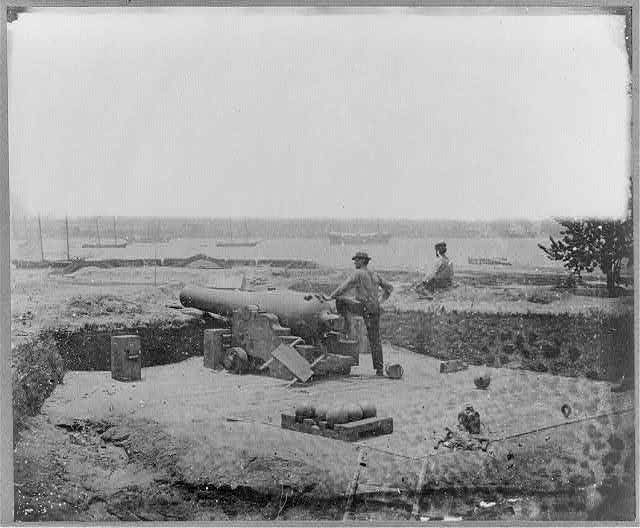
Confederate fortifications at Gloucester Point, Va., opposite Yorktown, Va.

Confederate fortifications at Gloucester Point, Va., opposite Yorktown, Va. (LOC - LC-USZ62-76208)

OK, I admit it. When I read the title of this article my first thought was, “What are the rebels doing in Massachusetts?” That’s one advantage of being me – there’s always plenty of new stuff to learn. Gloucester Point is across from Yorktown on the York River in Virginia. From the Richmond Daily Dispatch July 26, 1861:

Correspondence of the Richmond Dispatch.
Affairs at Gloucester Point.

Gloucester Point, July 24th, 1861.

The fact that you have no “special correspondent” here should not lead the friends of Southern independence to suppose for a moment that we are doing nothing for the glorious cause. Under the supervision of Col. Crump, the Commandant of this post, and the laborious and pains-taking Captain Page, aided by a faithful corps of engineers, the works have been pushed forward vigorously; and to-day our boys, who are “spoiling for a fight,” would [hail] the approach of a Yankee float [?] with a perfect shout of pleasure. Our water battery is a perfect beauty. Huge Columbiads look defiance at the blockade, which manages to keep at a most respectful distance. As to the number of guns, we never tell [tales] out of school. They are manned by fine companies, and when the proper time comes they will give a good account of themselves.

Last week Capt. Page received two beautiful flags, presented to the battery by Misses Haxall, Daniel, and others, of Richmond, and at 12 o’clock on Saturday they were thrown out to the breeze by Col. Crump and the gallant Captain, while “Jeff, Davis” belched forth a shell that danced across the waters, and the assembled crowd gave three cheers and a “tiger.” The Captain then took his stand under the flag of Virginia, and read the letter accompanying this most acceptable present, together with his reply. Col. Crump followed with some stirring remarks. Should a Yankee ball ever cut down our flag- staff, there are boys enough here to plant it on the rampart in the name of the fair ones who gave it.

The news of the glorious victory at Manassas reached us Monday evening. Orders came at once from Capt. Page to “turn out.” In double-quick time we were at our guns, and eleven vigorous reports announced the interesting intelligence to our loving friends at Fort [Monroe], the blockade, &c. The battery on the York town side took up the chorus with a will.

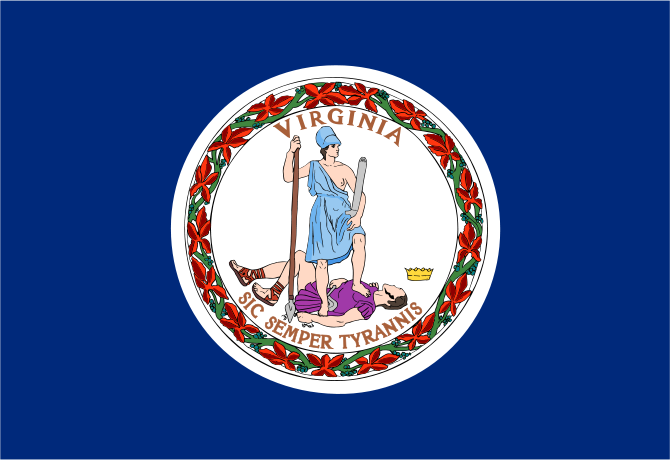
Flag_of_Virginia

"the cause that animates them" Virginia state flag from 1-31-1861

Yesterday we tried our pieces on the breast-works, and were delighted with the experiment.

There was a heavy blow here Monday night, and the rain fell in torrents. The tide swept over the floors of some tents near the battery. The occupants put all their valuables on trunks and camp-stools, and taking their seats on them, smoked philosophic pipes, and watched the minnows as they darted through in terror. Our sentinels stood at their posts like men. I can understand how men raised as they have been submit so cheerfully to the hardships of a soldier’s life, only when I remember the cause that animates them.–Though they waded through water knee deep nearly all night, not one has been made sick by it, as far as I can learn. This looks like the special providence of God.

I wish I had room to inform our friends how kind the citizens of Gloucester are to us. –They have opened their heart and their houses, and seem willing to do anything for our comfort. Batter.

Colonels Charles A. Crump and Powhatan R. Page were field officers of the 26th Virginia Infantry, which fought at several venues during the war. By April, 1865 it had dwindled to 15 officers and 81 men. You can see a photo of Powhatan R. Page at VMI Archives.

Gloucester from the river

Gloucester from the river (1862 LOC - LC-DIG-ppmsca-22409)

Posted in 150 Years Ago This Week, First Manassas - Bull Run, Military Matters | Tagged | Leave a comment

Death by Cannon Ball

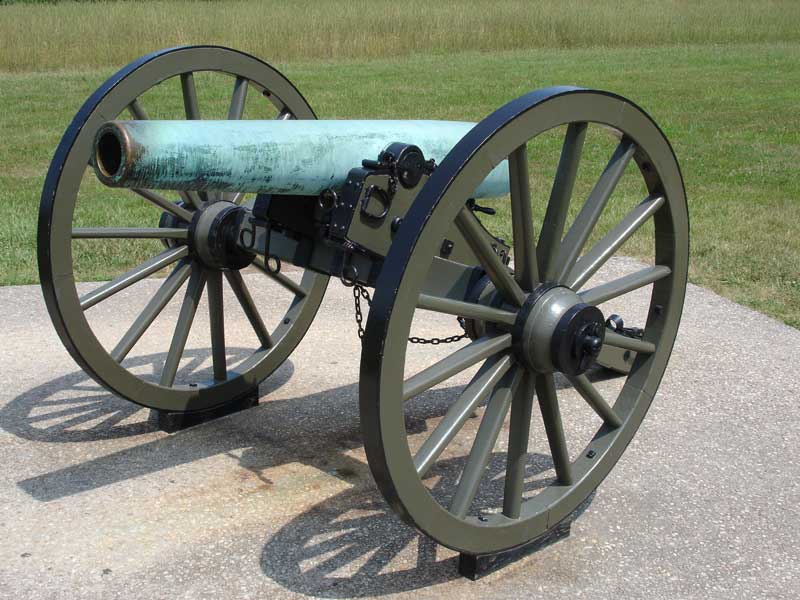
CW_Arty_Confederate_Napoleon 12 pound

From a Seneca Falls, New York newspaper in 1861:

Death of Another Volunteer

We are pained to learn that CALVIN COLGROVE, a former resident of our village, was killed during the battle near Manassas on Sunday the 21st. For the past five years he has lived in Michigan, and left that State upon the breaking out of the war, as a member of the 1st Michigan Regiment. He was color bearer in the Regiment, and while performing the duties of his office was killed by a cannon ball which severed his head from his body. He has relatives residing here and was a worthy and exemplary young man. We believe he leaves a family to mourn his loss.

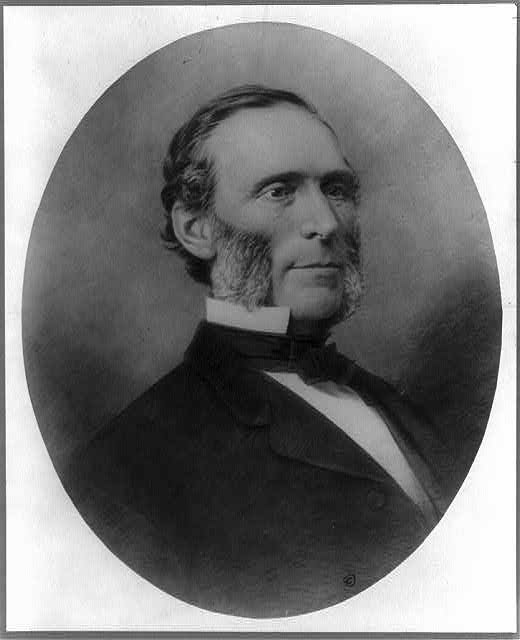
Austin Blair

Austin Blair (LOC - LC-USZ62-82923)

The 1st Regiment Michigan Volunteer Infantry was made up of a “number of independent military companies” that existed when Governor Austin Blair issued a proclamation on April 16, 1861 for the creation of a regiment in response to President Lincoln’s call for volunteers in the aftermath of Fort Sumter. Orlando B. Willcox was appointed Colonel of the 1st Regiment. Until being wounded and captured Willcox also led a brigade during the First Battle of Bull Run. It is reported that Calvin Colgrove served in Company ‘I’. Colgrove was 32 and probably a member of the Marshall Light Guard before the war. Austin Blair also was born and grew up in New York State. As a matter of fact, he married a woman from Seneca County. Blair and his state were strong supporters of the Union war effort:

At the outset of the war, Michigan had a total population of approximately 800,000 and an estimated 110,000 able-bodied men capable of bearing arms. By the end of the war, more than 90,000 Michigan men had volunteered to fight. Blair personally helped to raise about $100,000 to organize and equip the initial muster of troops. When Blair left office in 1864, he was almost destitute, having expended much of his personal wealth in support of the war effort.

You can see the the 1st Regiment’s flag at the Michigan Historical Museum. The flag was captured at First Bull Run and not returned until 1886.

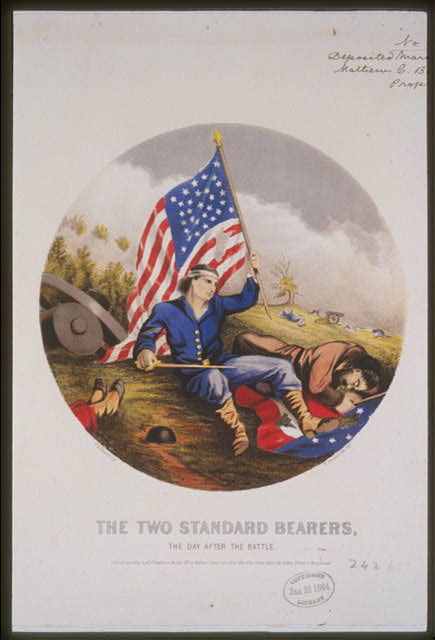
Civil War Sources has posted three articles about the courage of color bearers in the war.

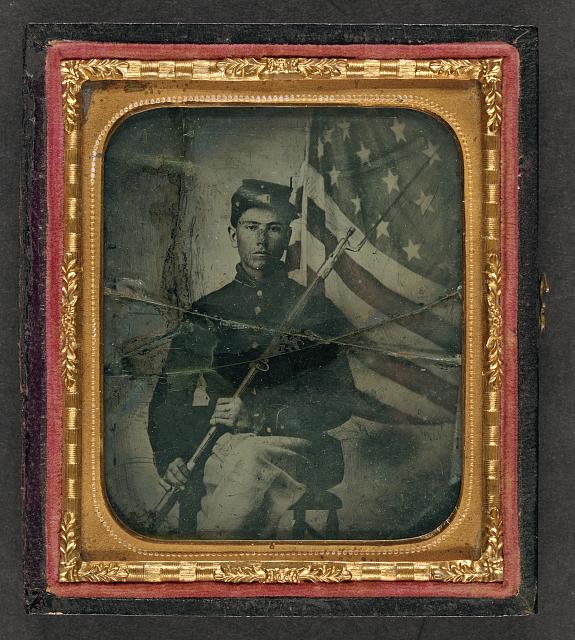
Unidentified soldier in Union uniform with bayoneted musket in front of American flag

Defending the Flag (LOC - LC-DIG-ppmsca-31117)

Two stanard bearers - 1864 sheet music

Not like Manassas: idealized sheet music cover - 1864 (LOC - LC-USZC2-3775)

Posted in 150 Years Ago This Week, First Manassas - Bull Run, Military Matters | Tagged , , , | Leave a comment

Bull Run Brings Out Bears

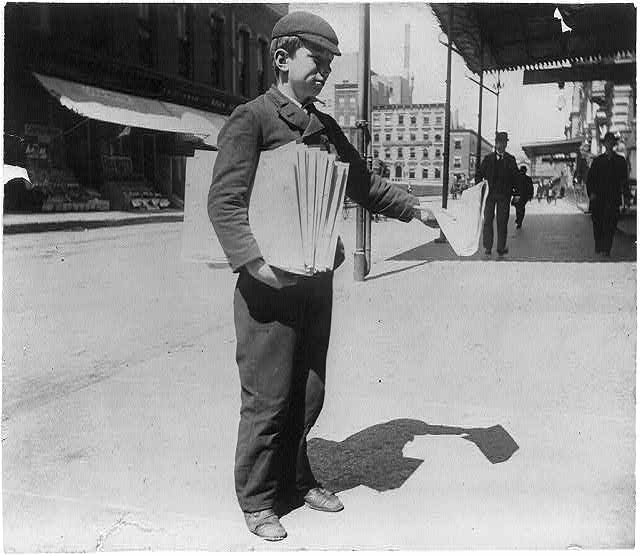
Newsboy in New York City c1896

"Defeat of the Union Army" (1896 photo LOC - LC-USZ62-76951)

Securities Down 4% on Wall Street

From the Northern perspective, the first reports from the Battle of First Manassas (Bull Run) were positive. That all changed as the Confederates stopped the Union advance on Henry Hill cold. This piece details the news catching up with the people of New York City.

From The New-York Times July 23, 1861:

THE EFFECT OF THE NEWS IN THIS CITY …

The news of our national disaster fell upon the public with overwhelming force. It came at a time when the full torrent of exultation at a supposed victory was spreading itself through the City, and cheering hearts that might be rendered desolate by the first details of the fight. No one was prepared for a check so abrupt. When the first dirty newsboy whirled through the streets, shrieking at the top of his ominous voice, “Defeat of the Union Army,” no one felt the slightest disposition to buy an extra. It was regarded as a smart commercial fraud, which ought to be put a stop to by the police. But bad tidings travel apace, and in a short time it was known that a reverse had really been encountered. The newsboys — who, if they wrong as a rule, are sometimes wronged as an exception — were then in demand. Their stock of papers was rapidly exhausted, and the supply not being able to keep pace with the demand, the fortunate possessor of an extra became a sort of animated bulletin. Circles that constantly increased gathered around him, and heard with consternation the unhappy tidings. From 11 A.M. until midnight business, as an absorbing and distinct pursuit, was virtually suspended. Those who made a show of attending to it were so disheartened and preoccupied, that they will probably regret having done so. In Wall-street, where the death of one’s grandmother has a commercial value, the reverse was considered disadvantageous to our cause to the extent of 4 per cent. Securities declined to that extent. …

Second Half A Lot Harder

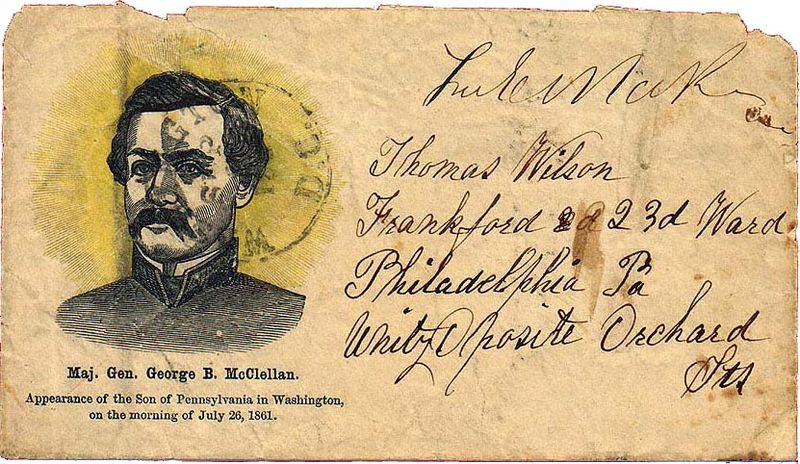
George_B._McClellan_Patriotic_Cover_1861

Postal cover celebrates McClellan's arrival in D.C.

From The New-York Times July 23, 1861:

A NEW COMMANDER.

The call of Gen. MCCLELLAN to assume command of the forces upon the Potomac, is perhaps the most judicious change the Government could make in the leadership. Not that Gen. MCDOWELL has exhibited any deficiency of soldierly qualities, or courage, or talents as a commander. But the prejudice of a defeat cannot fail to impair the confidence of his men; for the soldier is apt to regard with almost superstitions distrust the ill-fortune that has attached itself even momentarily to their General. To be led by one who has never been beaten, is a victory half earned; and we have reason to believe the experience and skill of Gen. MCCLELLAN will earn the rest.

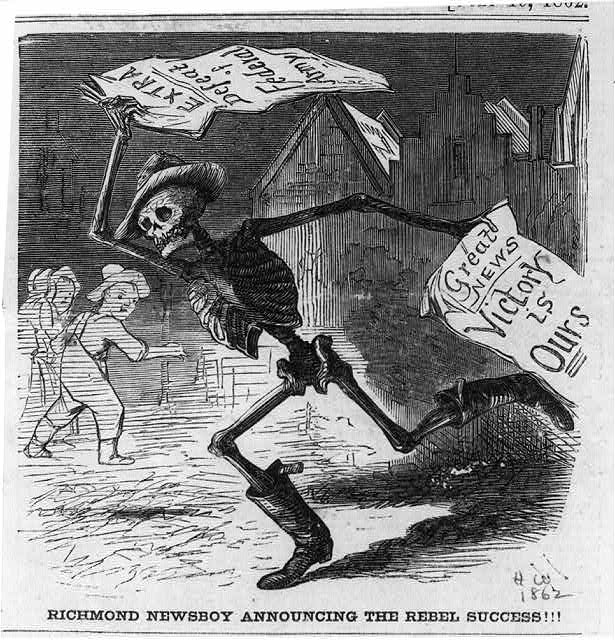
Newsboy on CSA victory 1862

Richmond Newsboy: A year later similar results (LOC - LC-USZ62-72954)

You can “read all about” George B. McClellan at Wikipedia. The image of the postal cover is licensed by Creative Commons.

Posted in 150 Years Ago This Week, First Manassas - Bull Run, Military Matters | Tagged , , | Leave a comment

A Most “Instrumental” Brigade

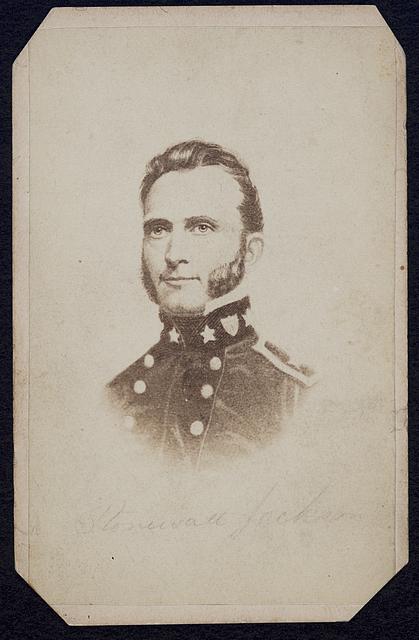
Stonewall Jackson

Stonewall Jackson (LOC - LC-DIG-ds-00288)

General Thomas J. Jackson writes his wife about the First Battle of Bull Run, where Jackson earned the “Stonewall” nickname:

Manassas, July 22d.

My Precious Pet, — Yesterday we fought a great battle and gained a great victory, for which all the glory is due to God alone. Although under a heavy fire for several continuous hours, I received only one wound, the breaking of the longest finger of my left hand; but the doctor says the finger can be saved. It was broken about midway between the hand and knuckle, the ball passing on the side next the forefinger. Had it struck the centre, I should have lost the finger. My horse was wounded, but not killed. Your coat got an ugly wound near the hip, but my servant, who is very handy, has so far repaired it that it doesn’t show very much. My preservation was entirely due, as was the glorious victory, to our God, to whom be all the honor, praise, and glory. The battle was the hardest that I have ever been in, but not near so hot in its fire. I commanded in the centre more particularly, though one of my regiments extended to the right for some distance. There were other commanders on my right and left. Whilst great credit is due to other parts of our gallant army, God made my brigade more instrumental than any other in repulsing the main attack. This is for your information only— say nothing about it. Let others speak praise, not myself.

From Life and letters of General Thomas J. Jackson by Mary Anna Jackson. I first saw this letter in The Civil War Archive (ed. by Commager and Bruun, Black Dog & Leventhal, New York 2000).

The Stonewall Jackson article at Wikipedia attributes this quote to Jackson which backs up his faith and courage shown in this letter:

My religious belief teaches me to feel as safe in battle as in bed. God has fixed the time for my death. I do not concern myself about that, but to be always ready, no matter when it may overtake me. … That is the way all men should live, and then all would be equally brave.

I like this line further on in Mrs. Jackson’s book: “August 5th. And so you think the papers ought to say more about your husband! My brigade is not a brigade of newspaper correspondents.”

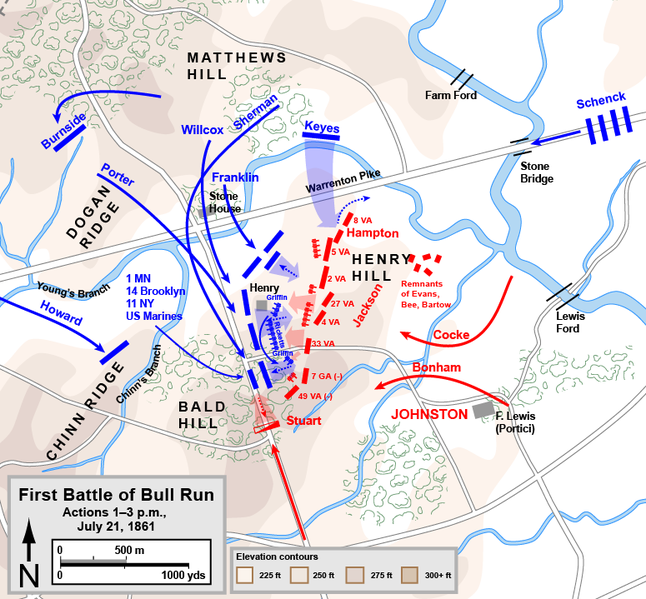
The map below is licensed by Creative Commons

First_Bull_Run_July21:1-3PM

Walling off the Federals at Henry Hill 1-3PM (map by Hal Jespersen)

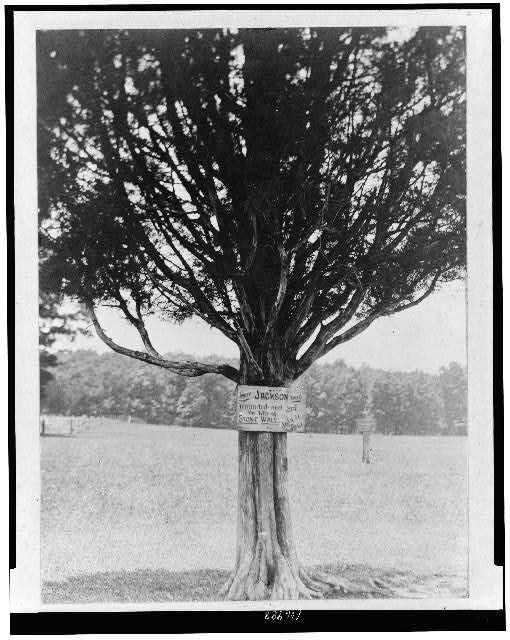
Plaque attached to tree "Here Jackson was wounded and got the title of Stone Wall, July 21, 1861"

Plaque attached to tree "Here Jackson was wounded and got the title of Stone Wall, July 21, 1861" (1910 photo LOC - LC-USZ62-116988)

Posted in 150 Years Ago This Week, First Manassas - Bull Run, Military Matters | Tagged , | Leave a comment

“the wounded jumped”

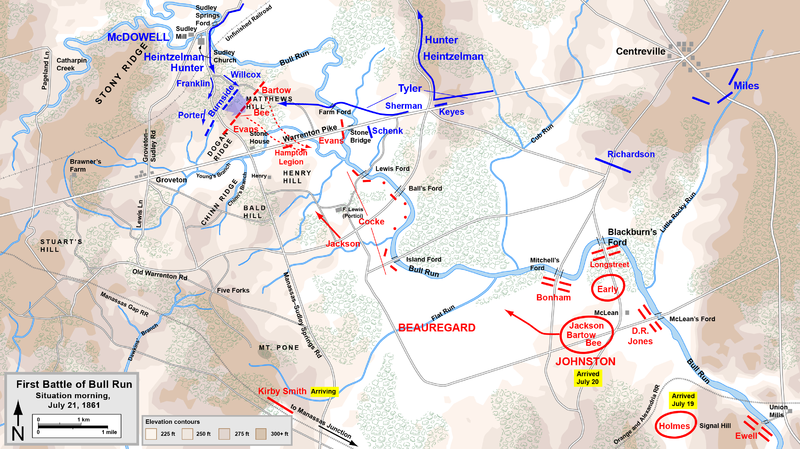
First_Bull_Run_July21am

First_Bull_Run_July21am (Map by Hal Jespersen, www.posix.com/CW)

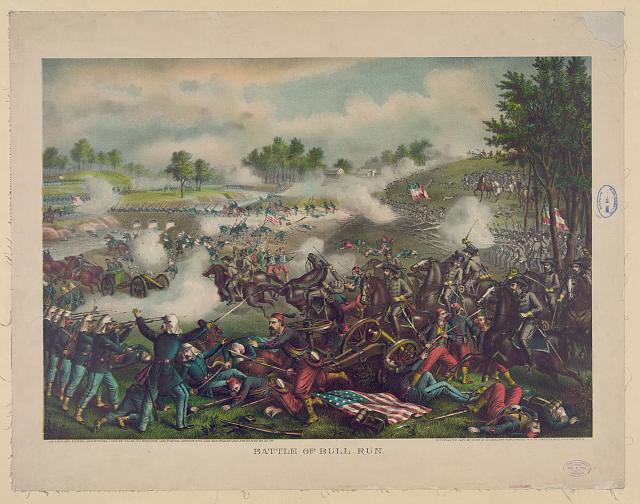
On July 21, 1861 Confederate forces at Manassas Junction, Virginia beat back and eventually routed the Union army at the First Battle of Bull Run. Here’s a Union participant’s letter to his parents ten days after the battle.

From a Seneca County, New York newspaper (probably) published on August 15, 1861:

From a Seneca Falls Boy in the Battle of Bull’s Run.

The writer of the following letter is the eldest son of Mr. HILDRETH HALSEY of the Town:

Headquarters 38 REGT, CAMP SCOTT, Co. H,
Washington, D.C., July 31, 1861.

Sudley Ford March 1862

Where the flankers (including Willcox' Brigade) crossed the Run - Sudley Ford (photo March 1862 LOC - LC-DIG-cwpb-00955)

Dear Father and Mother: – I wrote you a few lines Tuesday, on our return from the battle-field, but suppose you have not got them yet. I begin to feel a little like myself now, although I am stiff and sore yet; but will attempt to give you an account of our movements and of the battle, as correct as I can. I will commence at Centreville, from which place we started for the battle-field.

We were all aroused from our slumbers at 12 o’clock on Saturday night and held in readiness until daylight Sunday morning, when we started on the march for Manassas or Bull run, which are in fact all one. We reached there about noon, after marching fifteen miles, and wading muddy streams up to our waists, without having anything to eat since six o’clock Saturday afternoon, save a few hard sea biscuits, which were not very palatable, but had they been ever so good we could not have taken time to eat them.

Orlando_B._Willcox_-_Brady-Handy

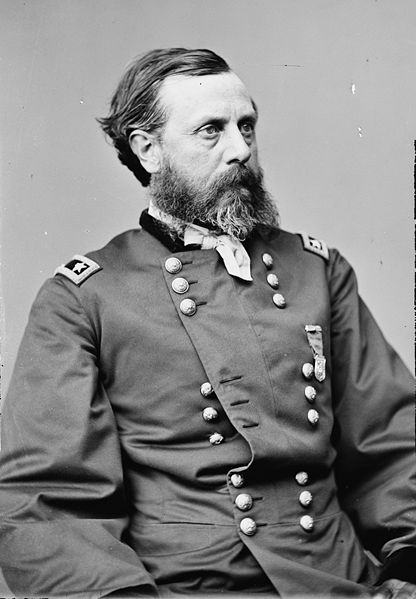
Earned the Medal of Honor - Orlando B. Willcox (LOC - LC-DIG-cwpbh-00962)

Just before we entered the field we threw off our blankets, haversacks and jackets, and marched into the field in our shirt sleeves, in a body of five thousand men, which consisted of the whole of the Second Brigade, under command of Col. Wilcox, acting under Brigadier General McDowell. There was only one Regiment on the field before us, and they laid down under the hills, entirely out of sight of the enemy. I believe they fired two shots at random into the woods and then retreated. I do not know what Regiment it was but think it was one from Pennsylvania. Our entire Brigade then received orders to advance on the enemy, which we did on quick time. The enemy then began to fire into us from their masked batteries with terrific force, but fortunately we were so far advanced that the balls passed over our heads, many of them falling into the ranks of different Regiments in the rear of us, killing many of them. At this time we were about half a mile in advance of our battery. The enemy then emerged from the woods and “let sliver” at us with great power. We then retreated and our battery advanced in front of us and fired into the Rebel batteries with powerful force but I think without much avail, as they were too numerous and most of them built of stone and railroad iron, which were almost impenetrable.

The enemy soon got range of our battery and fired into it with such force that they soon killed some of our artillerymen and horses, and broke the wheels of some of our best gun-carriages. Then the Rebels, or what is called the Black Horse Cavalry, rushed out of the woods to take our battery, which they failed to do. During this bombardment we laid just over the point of the hill, and when they attempted to take our battery, we gave them such a shower of bullets, that only three out of sixty retreated, all the rest being killed. We kept them back for about half an hour, when they again rushed upon us with such a powerful body of men that we were obliged to retreat for the last time. The order was then given for a general retreat, which was executed as fast as possible, but when we had got about four miles from the battle-field we were partially headed off by the Rebels, who fired into us with tremendous force, killing many and taking a great many prisoners. The greatest confusion prevailed at this time; those who were scarcely able to walk, at once started at the top of their speed and scattered through the woods in all directions. Many of the wounded jumped from the ambulances and wagons and fled to the woods for refuge.

First_Manassas_map2

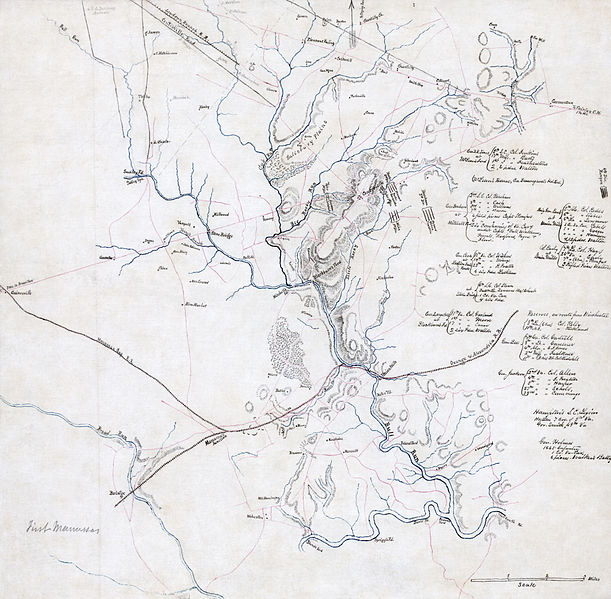
Confederate Position map First Bull Run

I notice that the papers foot up the loss of Federal troops at about six hundred, which I am pained to say is too low an estimate, as I am sure the loss will not fall short of 1,000 to 1,500 killed. As to the Rebel loss I can only say that is great. They laid, in many places, like bundles of wheat in the harvest-field.There were from 40 to 60 killed in our Regiment and a great many wounded. Our whole force in the field did not number over 25,000 men, while that of the enemy it is said numbered from 50,000 to 60,000. So you see we stood rather a poor chance to win the battle.

I was in the hottest of the battle a little over three hours and escaped without even a scratch while those who stood by my side were shot and instantly killed. I was not the least frightened after we had fired the first shot until we had left the field and reached our old quarters near Alexandria. And then to think of what we had passed through during forty-eight hours seems almost incredible, yet it is true. From the time we started from Centreville, until we returned here we marched sixty miles, without a moment’s rest or anything to eat except a few hard sea-biscuit. We suffered more from want of water than victuals. All that we had was what we could dip up out of a mud-puddle along the road. If anybody had told me what I had to pass through, before I started, my first thought would have been that I never could endure it, but as the old saying is, we don’t know what we can endure until we try.

JHHWard

J.H. Hobart Ward led 38th and then brigade after Willcox' capture

I could write a great deal more, but have not time at present, as I have got to turn out to drill soon. I have only to say that I feel thankful to God for the preservation of my life through the late battle, and hope that it will be spared through all battles to come, until such time as we may all see the Stars and Stripes float all over the United States.

Truly yours,

GEO. R. HALSEY

P.S. – I picked up a beautiful sword on the battle-field, worth about $25.

Orlando B. Willcox “… was wounded and captured in the First Battle of Bull Run (First Manassas) while in command of a brigade in Maj. Gen. Samuel P. Heintzelman’s division. He later received the Medal of Honor in 1895 for “most distinguished gallantry” during the battle.” He died in 1907 and was buried in Arlington National Cemetery.

New York’s 38th Infantry Regiment was mostly made up of men from New York City. One company was raised in Geneva about ten miles from Seneca Falls.

John Henry Hobart Ward raised the 38th Regiment. He took command of the brigade when Willcox was captured.

The map is licensed by Creative Commons. The Wikipedia article has more maps that show the progress of the battle.

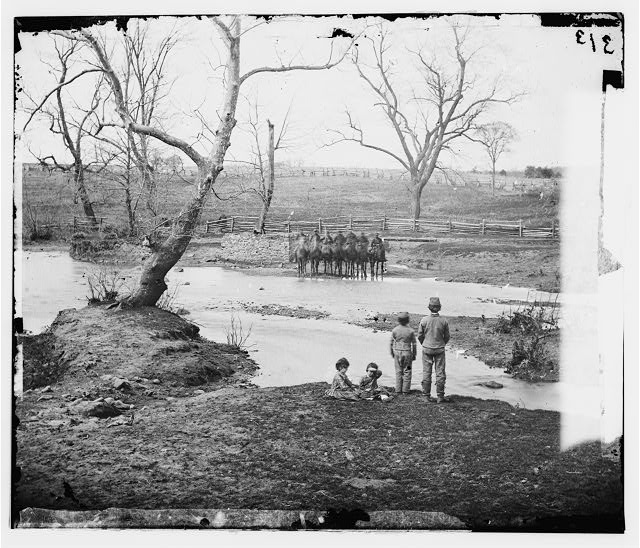
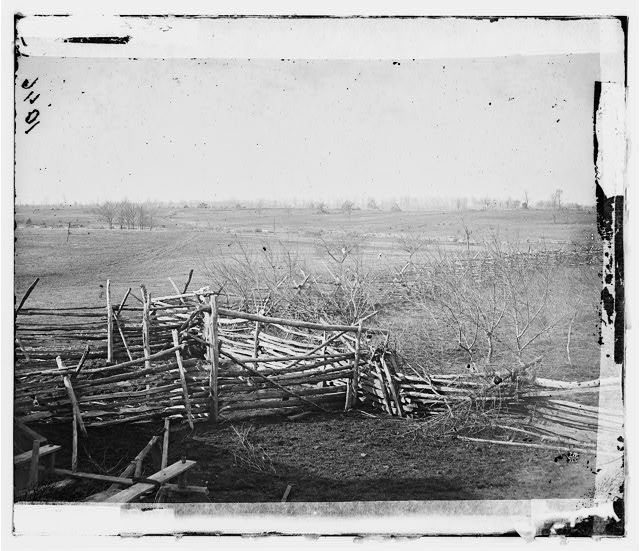
View of First Bull Run battlefield

View of First Bull Run battlefield (LOC - LC-DIG-cwpb-01314)

Posted in 150 Years Ago This Week, First Manassas - Bull Run, Military Matters | Tagged , , , , | 2 Comments

Like Dan Rather at Tiananmen Square

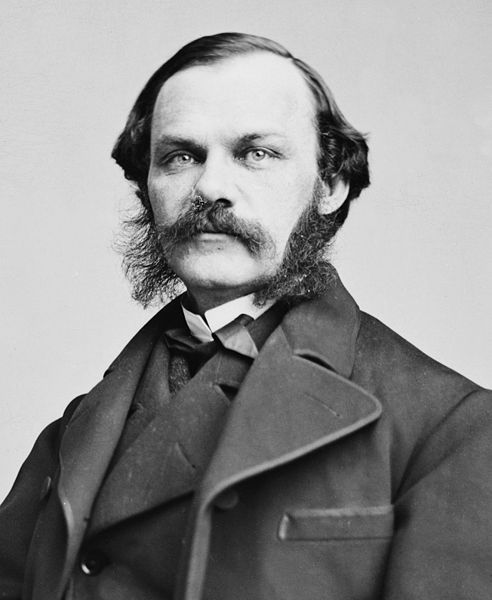
HJRaymond

Journalistic star-power at the front - Raymond (LOC - LC-DIG-cwpbh-03070)

If I had put down my TWO CENTS for a copy of The New-York Times 150 years ago today, I could have read a dispatch from a reporter with General McDowell’s Union army at Fairfax Court House. I’m assuming H.J.R., the editorial correspondent, is Henry Jarvis Raymond, the founder and editor of The Times. The star of the newspaper is reporting from the front.

From The New-York Times July 20, 1861:

FROM GEN. McDOWELL’S ARMY.; The Halt at Fairfax–Movements of the Troops– Incidents–Haste of the Rebels.

Editorial Correspondence of the New-York Times.

FAIRFAX COURT HOUSE, Va., Wednesday Night, July 17, 1861.

The General decided not to move forward any further to-night, mainly because the troops had been so fatigued by their day’s march as to render any further movement unadvisable. …

Everything we see here shows that the rebels left the place in the greatest imaginable haste. …

But the strongest evidence of haste was found in the abandoned camps. In that of the Palmetto Guards, lying nearest the side of the village at which our troops entered, almost everything remained untouched. The uniforms of the officers, plates, cans, dishes and camp equipage of every kind, an immense quantity of excellent bacon, blankets, overcoats, &c., &c., were left behind, and the tables of the officers, spread for breakfast, remained untouched. In a vest pocket of one of the officers was found a gold watch; — in another was a roll of ten cent pieces amounting to ten dollars; — letters, papers, books, and everything collected in a camp which had been occupied for some days, were abandoned without the slightest attempt to take them away. In another camp in a field at the extremity of the town, occupied by another South Carolina regiment, the same evidences of extreme haste were visible. Unopened bales of blankets were found; scarcely any of the utensils of the camp had been removed, and bags of flour and flitches of bacon were scattered over the ground. …

The discovery of these abandoned camps afforded a splendid opportunity for our troops to replenish their slender stock of camp furniture. They rushed to the plunder with a degree of enthusiasm which I only hope will be equaled when they come to fight. Men were seen crossing the fields in every direction loaded with booty of every description, — some with tents, some with blankets, over-coats, tin pans, gridirons, — everything which the most fastidious soldier could desire. I am sorry to say that they did not limit their predatory exploits to these camps, which might, perhaps, be considered fair objects of plunder. The appetite once excited became ungovernable, — and from camps they proceeded to houses, and from plunder to wanton destruction. Five or six houses were set on fire, others were completely sacked — the furniture stolen, the windows smashed and books and papers scattered to the winds. Presently in came soldiers bringing chickens, turkeys, pigs, &c., swung upon their bayonets, — proud of their exploits and exultant over the luxurious and unwonted feast in immediate prospect. These depredations were far too numerous for the credit of our troops, — and I was glad to see, as I passed the General’s head-quarters, half a dozen of the offenders under arrest and in a fair way of receiving the punishment which they deserve.

This matter of plunder, however, it is humiliating to confess, is more or less inseparable from war. It is not possible, when 30,000 or 40,000 men are marching through an enemy’s country, to prevent them from supplying their necessities and gratifying their lawless propensities by depredations upon the foe. The English understand this, and, as a matter of necessity, permit it. A good deal of this, in the case of our troops, is due to the spirit of frolic, which characterizes their progress thus far in this war. They act as if the whole expedition was a gigantic pic-nic excursion. After we were fairly in town, to-day, two of the troops dressed themselves in women’s clothes and promenaded the town amid the shouts and not over-delicate attentions of the surrounding troops. Others paraded the streets under the shade of tattered umbrellas which they had found in camp, — and one, donning a gown and broad bands, marched solemnly down the principal street, with an open book before him, reading the funeral service of “that secession scoundrel, JEFF. DAVIS.” All these humors of the camp help to pass the time, — and are pursued with just as much reckless abandon, now that they are on the eve of a battle which may send half of them into eternity, as if they were simply on a holiday excursion. Perhaps it is well that they do not take the matter any more seriously to heart, — for it is one which will scarcely bear very serious reflection.

The men are in capital spirits, and are quite ready for the approaching crisis. The best attainable information leads us to believe that the enemy is quite as strong as we are at Manassas, and that they have the advantage of intrenchments, constructed carefully and at leisure under the immediate supervision of Gen. BEAUREGARD, and the additional advantage of rapid railroad communication with Richmond and their base of operations. It is said here that Gen. B. informed the troops here last night that, whether they contested possession of this place or not, the question of an independent Southern Confederacy would be decided at Manassas, — and that he made each man of them take an oath to right to the last man. If we had not heard a good deal of this before, and seen these oaths followed by swift retreats, we might attach more importance to them. According to present appearances, however, I am inclined to think that the rebels will dispute Manassas with whatever of force and vigor they possess; and it is not impossible that Gen. MCDOWELL may deem it advisable to await reinforcements, if, after reconnoitering it he finds the place as formidable as he anticipates.
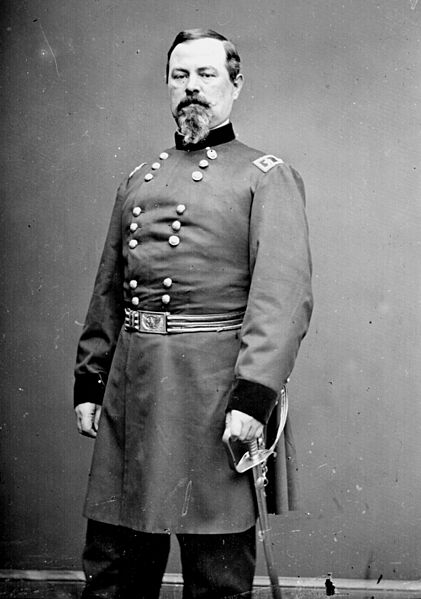
Irvin Mcdowell

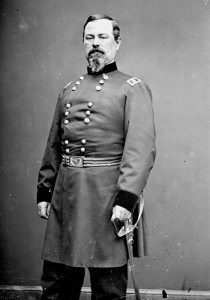
General Irvin McDowell

The troops are bivouacked to-night in the fields and under the open sky. The General and Staff, like the men, sleep on the ground, rolled in their blankets, and I found the General at three o’clock taking his dinner of bread and cheese, with a slice of ham, on the top of an overturned candle-box by the side of the main highway. When it comes to sleeping I rejoice that I am a civilian, for I am much better cared for to-night than the Commander of this, the largest force ever marshaled under one General on this continent. There are two hotels in this place, — both evidently feeble at their best estate, and just now, after a prolonged visit of rapacious and boisterous rebels, in a state of suspended animation.

Capt. RAWLINGS, of the New-Hampshire Regiment, with that versatility which enables a New-Englander to turn from commanding armies to keeping a hotel with marvelous facility, has succeeded in infusing into the mind of the invalid widow who keeps one of them, that the National troops have not come to sweep her and hers from the face of the earth. She has accordingly provided me with a bed, which, if not luxurious, is, to my untutored mind, decidedly preferable to one on the ground, even under the brilliant sky and softly superb moon of this July night.

H.J.R.

I think the whole article is a great read, and I especially like Raymond’s forboding sense that the pic-nic atmosphere is going to change soon with the “approaching crisis” – unless General McDowell decides to wait for reinforcements. Of course, that did not happen.
Posted in 150 Years Ago This Week, First Manassas - Bull Run, Military Matters | Tagged , | 1 Comment

In the Land of Lincoln (and Douglas)?

Seal_of_Illinois.svg

Impossible dream: State Sovereignty AND National Union?

From The New-York Times July 19, 1861:

FROM ILLINOIS.

CAIRO, Ill., Wednesday, July 17.

Last night some Secessionists at Nashville, Washington County, in this State, destroyed several dwellings belonging to loyal citizens, and cut down the Stars and Stripes, and hoisted in its place the secession flag. Several Union men of the town have been notified to leave immediately.

There is no news from the South.

In early June Seven Score and Ten posted an interesting article about the secession spirit in Cairo, Illinois. The secessionists there chopped up and burned their Douglas pole when they found out the Little Giant supported the Union. Nashville is about 100 miles due north of Cairo – as Google Maps fly. It is also about 110 miles south of the capital in Springfield.

Posted in 150 Years Ago This Week | Tagged , , | Leave a comment

Red Tape in the Federal Government?

Who pays the sailors?

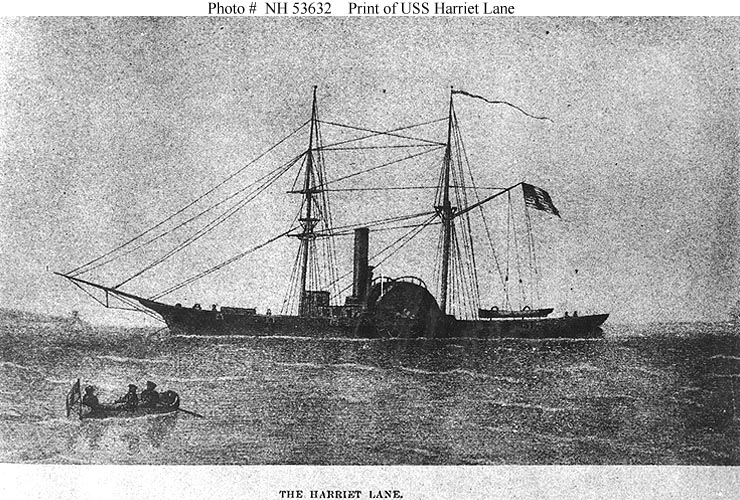
The Harriet Lane

The Harriet Lane

From The New-York Times July 18, 1861:

THE UNITED STATES STEAMER HARRIET LANE.

This steamer is now undergoing thorough repairs in her machinery and armament, and will be ready for sea in a week. The families of a number of her crew complain greatly of the delay which there has been in paying off. It is now four months since the crew of this vessel has been paid off — the men always having received their pay monthly. Indeed they shipped with that understanding. It seriously incommodes them. The wife of one of the men has been turned into the street for non-payment of her rent, and others are in as destitute a condition. It appears to be a matter of “red tape.” The ship belongs to the revenue service, and has been loaned to the Navy. On application for funds the Collector of the port says they are in the Navy, and when calling on the Naval Paymaster he says she belongs to the Revenue; and thus between them the families of the crew are in want. This is all wrong. The ship has done excellent service the past three months having been several times in action, and the men should at least receive their pay, if not be rewarded.

USRC (USS) Harriet Lane was part of the failed expedition to resupply Fort Sumter in April, 1861. She would definitely see more Civil War service.

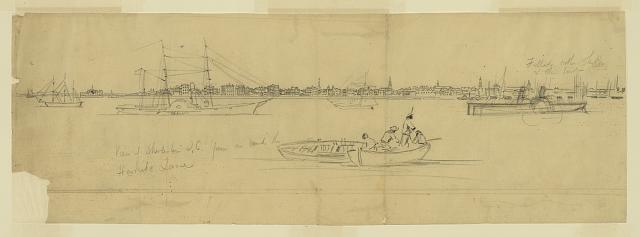
Chaleston from the Harriet Lane

Chaleston from the Harriet Lane (LOC - LC-DIG-ppmsca-22528)

Posted in 150 Years Ago This Week, Military Matters | Tagged , | Leave a comment

Jayhawking With the Convict Regiment

Robert_Patterson Mexican War

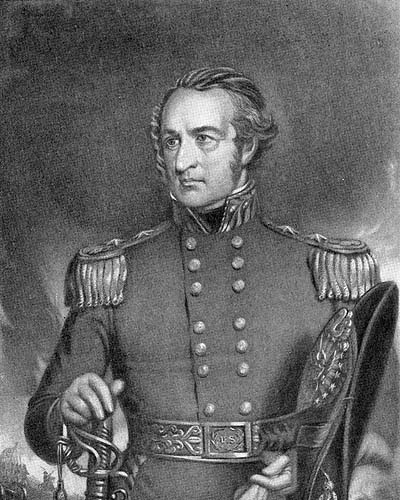
White Arm Bands and No Foraging Allowed (Patterson portrait Mexican War)

The last we heard from the 19th New York Volunteer Infantry Regiment they had moved from drill camp in the District of Columbia to Martinsburg in current West Virginia. They arrived on July 8th. Their purpose was to bolster General Patterson’s army for its expected movement against the Confederate forces in the Winchester area. As Cayuga in the Field (by Henry Hall and James Hall) points out, a few noteworthy events occurred during the week in Martinsburg.

When Patterson found out that the the 19th was attired in gray he sent white cloth strips to be worn as armbands to help distinguish the 19th from the rebel army. Henry Hall says that many of these armbands were “lost” the next day – maybe because white is the color of surrender, maybe because the white rags made the 19th’s shabby gray uniforms look even more ridiculous. My thought was it might help prevent some ‘friendly’ fire.

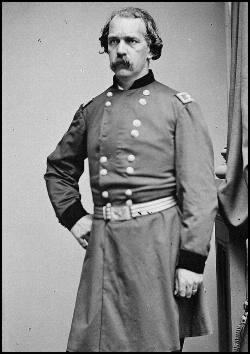
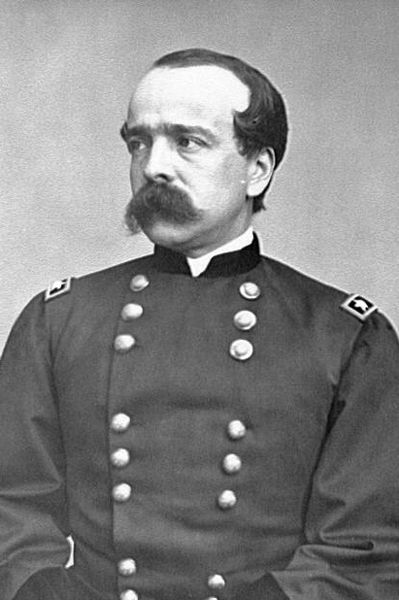
The 19th became part of the 8th Brigade commanded by Colonel Daniel Butterfield. General Charles W. Sandford led the division the 19th was part of.

399px-Daniel_Butterfield

Daniel Butterfield commanded 8th Brigade (LOC - LC-DIG-cwpb-05423)

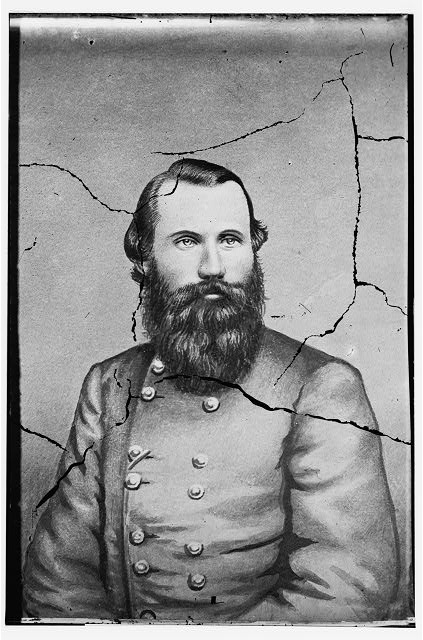
While out foraging a couple members of the regiment got into a fracas with a squad from Jeb “Stewart’s” cavalry. Both were captured; one died from his wounds; the other spent time in prisons in Richmond (Libby), Tuscaloosa, and Salisbury, N.C. He was exchanged in June 1862.

The 19th’s leader, Colonel Clark was relieved from command and put under arrest by General Patterson. Most of the captains and lieutenants in the regiment objected to Clark’s management style and told Patterson about it. Lieutenant-Colonel Clarence A. Seward took command, while Clark stayed with the regiment, always riding in its rear, until he was eventually exonerated.

The 19th marched with the rest of Patterson’s army from Martinsburg to Bunker Hill on July 15, 1861. They had to take some razzing from splendidly equipped soldiers from Massachusetts about the 19th’s shabby gray duds. One member of the 19th tried to joke about it a bit by saying that “it was a regiment of convicts from Auburn, let out of prison on condition that they would serve.” The Auburn Correctional Facility began operation in 1816.

J.E.B. Stuart (Stewart) (LOC - LC-DIG-cwpb-07544)

J.E.B. Stuart (Stewart) (LOC - LC-DIG-cwpb-07544)

On approaching Bunker Hill, at night fall, the sound of firing floated in from the advance. The rebel Stewart, with 600 cavalry, was preparing to dispute the road with our leading regiments, when the Rhode Island battery taught them a lesson and sent the flying in disorder. The firing electrified the Federals, whose long, dark columns of men pushed forward in haste, but the fight was over before any could come up.

The 19th got to camp in a just-cut wheatfield – the sheaves softened the ground for the soldiers who had no tents because the wagons were far behind. Despite orders to the contrary the 19th ate off the people of Bunker Hill:

It was contrary to the stringent orders of the tender-hearted Patterson to forage upon the inhabitants of the Valley. A great deal of it took place, notwithstanding. The army believed in the maxim of subsisting on the enemy. Undoubtedly, however, high military reasons existed for putting the practice under peremptory ban. A month before, Beauregard had, in a blatant proclamation, asserted that the South was invaded for ravage, for “beauty and booty,” as he expressed it. It became desirable, at this stage of the war, to convince the South of the untruth of the assertion. Hence Patterson imperatively forbade foraging in his army, and tried to stop it. Lieut. Col. Seward’s very first order, issued on arriving at Bunker Hill, was on this subject. Said that document: “The object of the journey of the Army of the North is to protect the property of the United States, not to plunder the property of citizens.”

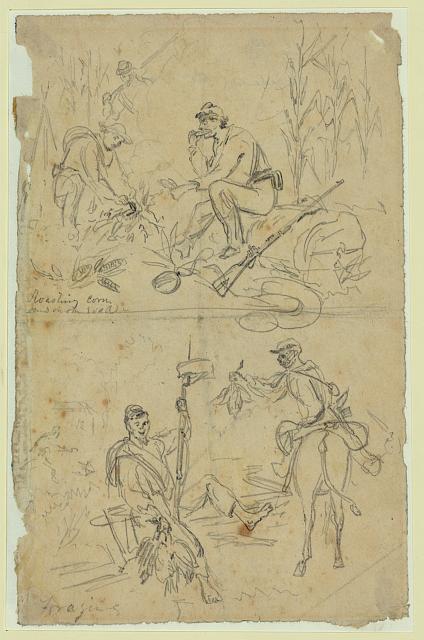
Scenes on the road: roasting corn and foraging

Tonight's menu: corn and real fresh chicken (ca.1860-1865 LOC - LC-DIG-ppmsca-21003)

But when the Cayuga men stacked arms on the afternoon of the 15th of July, and broke ranks for supper, there was that pressing on their attention, which then was of far greater present importance to them than the ease and convenience of Virginia rebels. They were hungry and almost supperless. Their commissary only afforded a scant allowance of hard-tack and salt pork, and the gnawings of empty stomachs prompted them to cast their eyes upon the forbidden poultry and cattle with which the farms all around swarmed. The temptation was irresistible. On various excuses, with permits and without, the men managed to send out foragers — jayhawkers, as they were then and thereafter called — and there was a general ransacking of the neighborhood for fresh provisions. Chickens, turkeys, several sheep, cows and calves, and other domestic game, soon found their way into camp. Not only that night, but the following day, the 19th New York feasted on the fat of the land. Jayhawkery, once begun, took in other things than provisions. Some of the men caught horses, and made the field roar with their frantic and ridiculous equestrianism, while an old lady’s wardrobe was made to do scarecrow duty on the facetious but scandalous volunteers. One fellow seized on a quantity of what he supposed to be flour, to regale his mess with pancakes and gravy for a turkey stew. To his speechless astonishment, on seeing his pancakes stiffen and his gravy refuse to run, he found his treasured bag of flour to be plaster of Paris.

Bummers [Foragers]

Here come the Bummers (Foragers) (ca.1862-64 LOC - LC-DIG-ppmsca-21787)

Foraging was common in all the Federal regiments. Yet Patterson, who bore ill will toward the regiment of Col. Clark, searched the camps and had several tons of dressed mutton, veal, hams, and other foraged provisions, brought in army wagons to the camp of the 19th and there buried, to affix a reputation for javhawking, especially on that regiment. The event is of historical importance, as Patterson afterwards gave, as one of the reasons why he did not attack Johnston, that his commmand was short of provisions and could not get up his supplies and attack Johnston too.

No booty, indeed. This story affects me, but it seems way too complicated to start moralizing. Henry Hall is writing twelve years after the events he’s justifying.

J.E.B. Stuart

was commissioned as a lieutenant colonel of Virginia Infantry in the Confederate Army on May 10, 1861. Maj. Gen. Robert E. Lee, now commanding the armed forces of Virginia, ordered him to report to Colonel Thomas J. Jackson at Harper’s Ferry. Jackson chose to ignore Stuart’s infantry designation and assigned him on July 4 to command all the cavalry companies of the Army of the Shenandoah, organized as the 1st Virginia Cavalry Regiment. He was promoted to colonel on July 16.

Butterfield was active throughout the war and is credited with writing “Taps”.

Posted in 150 Years Ago This Week, Military Matters | Tagged , , , , | 1 Comment