Southern ass-stock-crazy (aristocracy)/Chivalry
A couple Northern political images from (probably) 1861:
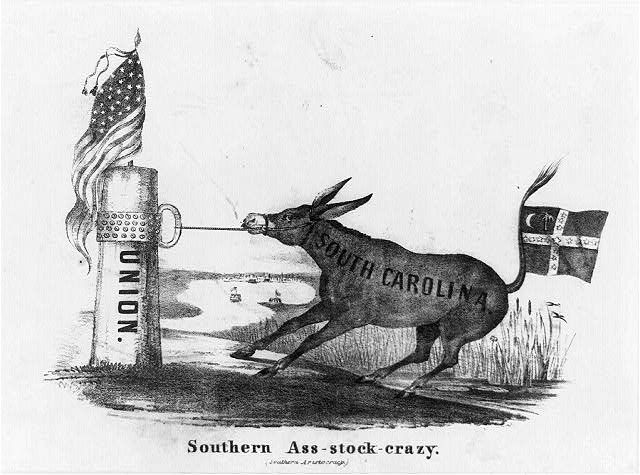
LOC - LC-USZ62-91445)
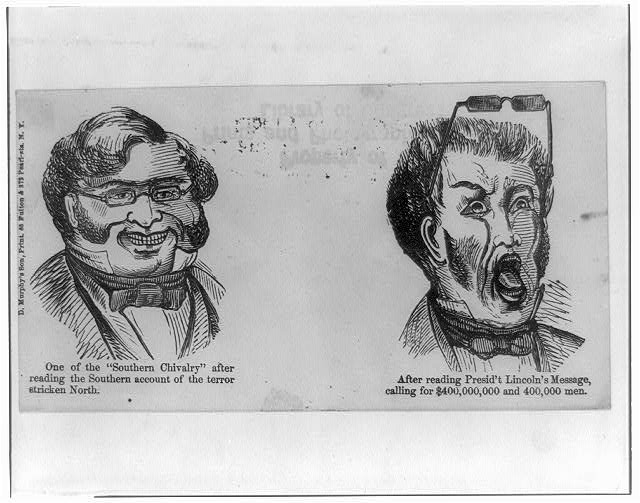
After Lincoln's Call for 400,000 (LOC - VLC-USZ6-701)
Southern ass-stock-crazy (aristocracy)/Chivalry
A couple Northern political images from (probably) 1861:
LOC - LC-USZ62-91445)
After Lincoln's Call for 400,000 (LOC - VLC-USZ6-701)
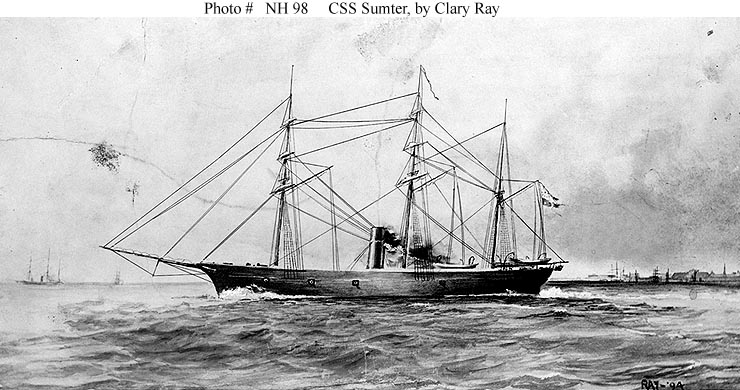
CSS Sumter
Privateering and Pickens
Our correspondent at Havana announces the arrival at Cienfuegos of the Sumter, a steamer of the rebel Navy, bringing six prizes, the results of a short predatory cruise. A seventh had been burned at sea. This Sumter was in other times a mail steamer plying between Havana and New-Orleans, with the title, Habana; but seized by the rebel government, she was converted into a man-of-war, and well-armed and manned, put to sea the other day from New-Orleans, in saucy defiance of what the journals of that city properly describe as the paper blockade. The news of her departure has barely reached us when it is hotly pursued by this later news of her success. It is true the insular authorities have reclaimed the six prizes, because they had been captured within Spanish waters; but the fact of seizure shows the power for mischief possessed by the cruiser in question, and renders it almost certain that if any of these released vessels hereafter depart for their ports of destination in the United States, they will be exposed to serious danger of recapture and condemnation. Moreover, the Sumter, sailing from Cienfuegos has doubtless placed herself in the path of the Aspinwall steamers, with their millions of California treasure. Much pains have been taken by the steamship company to put their packets in a thoroughly defensible condition; and it is possible they may be able to contend successfully against privateers. But the Sumter, according to the New-Orleans papers, is far more perfectly armed and equipped than any privateer; and if the treasure ship crosses its track, the odds are fearfully against an escape. These facts and dangers are the first fruits of the laxity with which the blockade is enforced at the mouth of the Mississippi. …
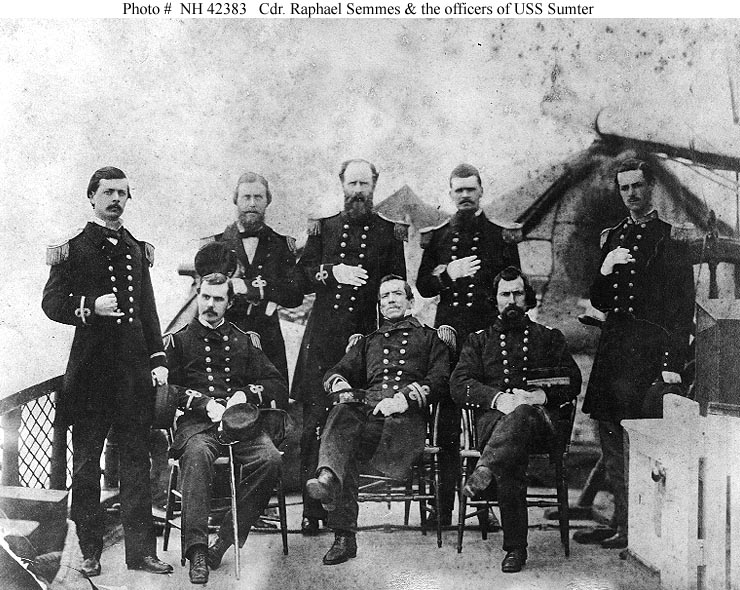
Semmes (seated center) and officers - CSS Sumter
Raphael Semmes commanded the CSS Sumter until January 1862. Needing repairs, the ship landed and stayed at Gibraltar. Semmes then commanded the CSS Alabama, which took 69 prizes throughout the war.
The photos of the Sumter and officers are from the Naval Historical Center.
One of the things I’ve found very interesting so far in this 150th year gig is learning more about the lives some of these characters had before – and after – the war. Here’s an anti-Democrat Party political cartoon from 1868. You can see Semmes with a couple other ex-Confederates. The description of the cartoon can be found here.
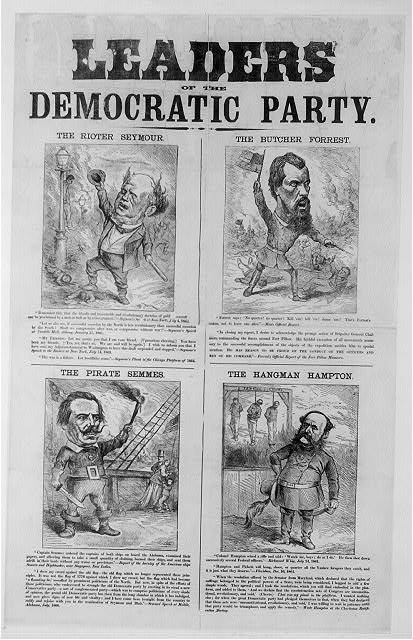
He reallly is a pirate! (LOC - LC-USZ62-43958)
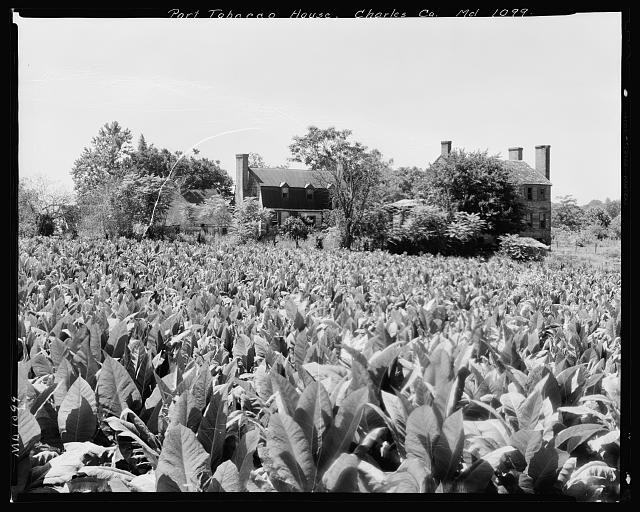
Port Tobacco Houses, Port Tobacco, Charles County, Maryland(c.1936 LOC - LC-DIG-csas-01728)
From The New-York Times July 13, 1861:
…
WASHINGTON, Friday, July 12.
Mr. TALIAFERRO, who was recently removed from a clerkship in one of the Departments, and who has been in that position for several years, has, since his departure from the Government employ, where he has so long fed liberally from the public crib, turned against us, and has indulged very indiscreetly in his secession anathemas. An eye was on him, and he was followed. The steamer [James] Guy went down the river last night and overtook this gentleman at Port Tobacco, in his hotel. A squad of soldiers seized him and brought him to the city. In his pockets were found several important letters to Secessionists in Virginia, and indications that he had furnished to the rebels drawings of the camps, fortifications, etc., around Washington. He is now in custody of the military authorities here.
…LEO
Later in the article it is stated that the Guy is the James Guy and that Captain Darling of Capitol Police was in charge of the federal operation to capture the spy. Here’s a Virginian report as reproduced at “The Daily Dispatch:
The case of G. S. Tallaferro.
–We hope that our Government at Richmond will have an eye to, and regard for, the case of Mr. G. S. Tallaferro, formerly of this place, but more recently of the Light-house Board, Washington. Mr. T. is a nephew of the late Hon John Tallaferro, of this State, and secured his office, at Washington, under the Pierce Administration, through the influence of leading men of Virginia. We believe him to be true to the South; and the fact that he was making his way to this place when arrested at Port Tobacco, and taken back to Washington, as a spy, according to the Lincoln telegrams, is of itself sufficient to justify our Government in interfering in his behalf, and securing his release as early as possible.
All the male relatives of Mr. T. in this section are unswerving in their love of the South, is their valuable services in the ranks of those who are fighting its battles will fully attest. –Fredericksburg Recorder.
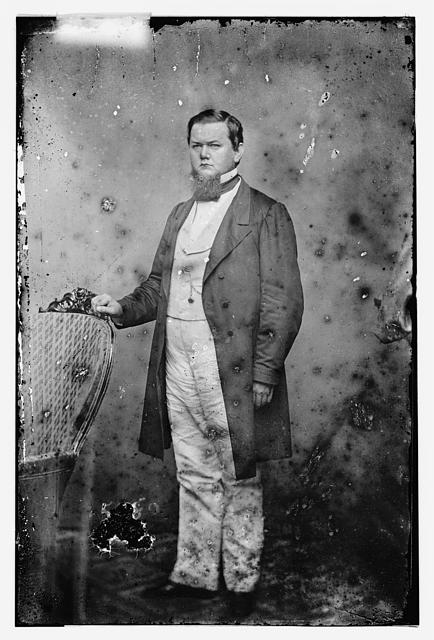
Union can't be kept together by force - Henry Cornelius Burnett (LOC - LC-DIG-cwpbh-02449)
During the same U.S. House session in which Clement Vallandigham criticized the Lincoln Administration, two representatives from the Border State of Kentucky expressed opposite opinions on Secession and the North’s response. From The New-York Times, July 11, 1861:
HOUSE OF REPRESENTATIVES.
WASHINGTON, Wednesday, July 10. …
Mr. BURNET wished to be indulged in a few, remarks, to which there were no objections.
He said, I am perhaps one of the few members who think not only that the commencement but the prosecution of the present war might have been, or might now be avoided, by proper efforts on the part of the National Administration. Entertaining this opinion, I am one of those indisposed to resort to the force of the cannon, bayonet, and sword, under any circumstances, believing under the theory of our Government that the Union can never be held together in that way. Hence it is my purpose, representing a Congressional district of Kentucky, to oppose both by my voice and vote every movement that looks to the prosecution of the war against the Southern States which have seceded. These being my views and sentiments, I cannot and will not, under any circumstances, give my vote for measures which look to the involvement of our common country in a bloody struggle, the results of which to both sections will be the destruction of their material and best interests, and the prostration of Republican Government on this continent.
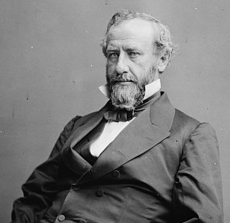
(Constitutional) Coercion fine to maintain Government and Constitution - Robert Mallory (LOC - LC-DIG-cwpbh-03572 )
Mr. MALLORY — I have risen simply to protest, in the name of Kentucky and her Union representatives, on this floor, against the remarks made by my colleague (BURNETT.) Kentucky, by a large and overwhelming majority, will support and maintain the Government and the Constitution of the United States. (Applause on the floor and in the galleries.]
The Speaker quickly reminded gentlemen that the applause was in violation of the decorum of the House, and he would insist on the enforcement of the rules. He hoped the House would sustain him. He had no desire to clear the galleries, but if the disorder therein was repeated he would feel it his duty to do so. He trusted that all the spectators present would respect the proprieties of time and occasion, and remember this was not a theatre. [VOICES — “That’s, right.” “That’s true.”]
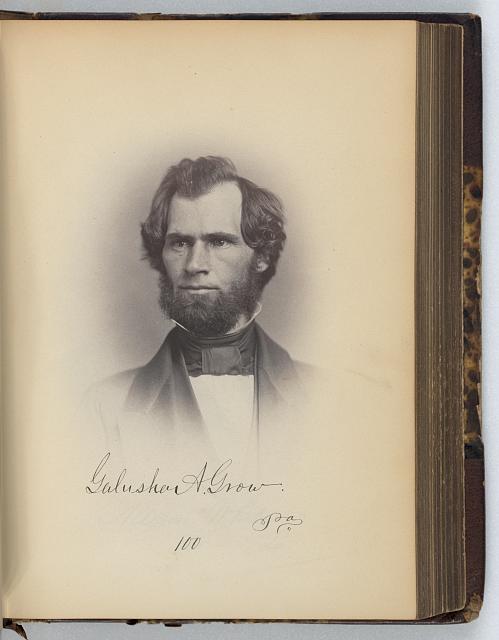
Speaker Grow keeps order in the House (1859 photo; LOC - LC-DIG-ppmsca-26639)
Mr. MALLORY resuming, said: I do not desire to make a lengthy speech. I insist that what I have stated is the opinion of Kentucky in this unfortunate state of affairs. We in Kentucky believe that the peril, the danger, the destruction, and the ruin of so many material interests, have been brought about by these very seceding States of the South, which seem to excite the sympathy of my colleague. This being my opinion, and that of Kentucky, I am authorized, I think, to say to this House and the country that the people of Kentucky, through her Union Representatives on this floor, stand ready to support the Government of the United States by every constitutional means to which it may be thought proper to resort, for the maintenance of the Government and the Constitution. [Applause.]
The Speaker said he would direct the Seageant-at-Arms to arrest any gentleman who should repeat the demonstrations of applause.
The Wikipedia article about Henry Cornelius Burnett can also be read as an overview of the conflicts in Kentucky in 1860. Here’s a couple paragraphs about Burnett:
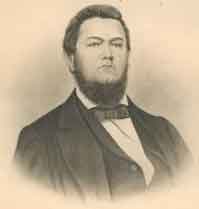
Burnett - another take
Besides championing the Southern cause in Congress, Burnett also worked within Kentucky to bolster the state’s support of the Confederacy. He presided over a sovereignty convention in Russellville in 1861 that formed a Confederate government for the state. The delegates to this convention chose Burnett to travel to Richmond, Virginia to secure Kentucky’s admission to the Confederacy. Burnett also raised a Confederate regiment at Hopkinsville, Kentucky, and briefly served in the Confederate States Army. Camp Burnett, a Confederate recruiting post located two miles west of Clinton in Hickman County, Kentucky, was named for him.
Burnett’s actions were deemed treasonable by his colleagues in Congress, and he was expelled from the House in 1861. He is one of only five members of the House of Representatives ever to be expelled. Following his expulsion, Burnett served in the Provisional Confederate Congress and the First and Second Confederate Senates. After the war, he was indicted for treason, but was never tried. He returned to the practice of law, but died of cholera in 1866 at the age of 40.
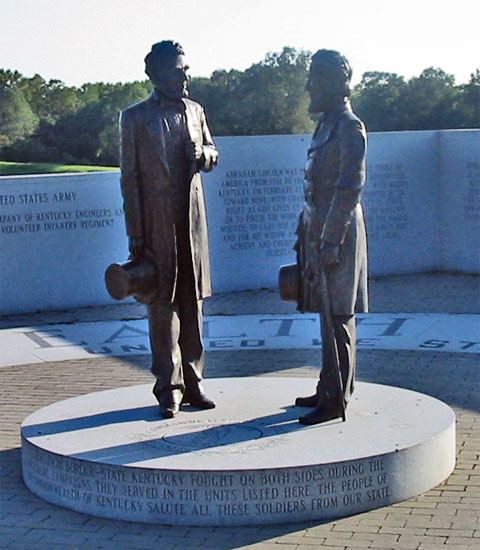
Two more disagreeing native sons: Lincoln and Davis - Kentucky memorial, Vicksburg
was elected an Opposition and later Unionist to the United States House of Representatives in 1858, serving from 1859 to 1865, being unsuccessful for reelection in 1864. There, Mallory served as chairman of the Committee on Roads and Canals from 1859 to 1863. He was a delegate to the National Union Convention in 1866 and was one of the vice presidents of the Centennial Exposition in 1876.
Galusha A. Grow was nominated by Thaddeus Stevens for Speaker at the House session that started on July 4, 1861.
Off with King Abe's head? (1859; LOC - C-DIG-ppmsca-26734)
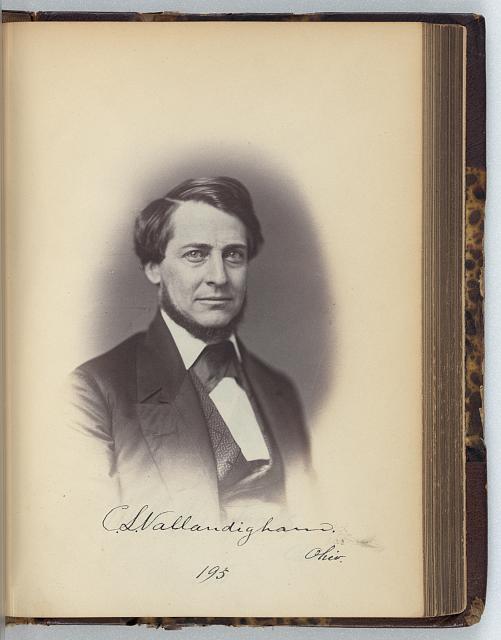
On July 11, 1861 The New-York Times reported on a speech given in the U.S. House of Representatives by Ohio Representative Clement Vallandigham. The speech occurred during a debate on a bill to finance the military and/or a bill dealing with the collection of duties on imports. Vallandigham refers to President Lincoln’s July 4 (or5) request for 400 million dollars and 400,000 troops to fight the Confederacy:
HOUSE OF REPRESENTATIVES.
WASHINGTON, Wednesday, July 10. …
Mr. VALLANDIGHAM proceeded to review the Presidents Message, and after referring to the call for four hundred thousand volunteers and four hundred millions of dollars, said that when the House of Representatives became a mere machine, to register the edicts of the President, it was time to abolish it. But there were gentlemen here who were firmly united and determined that their own rights and privileges as representatives of the people shall be preserved in spirit and in letter. At all events, there are those who would assert and exercise their rights with becoming decency and moderation, fully and freely, and regardless of the consequences. Instead of the President communicating, as required by the Constitution, the state of the country, the House had before them a vindication of his own policy, which has precipitated a bloody and terrible revolution. The President admitted that to-day we are in the midst of a civil war — not a petty insurrection, which might be suppressed in twenty days by a proclamation and the employment of three months’ militia. He had totally under-estimated the character of the revolution with which we have now to deal, and had also usurped power which the Constitution expressly confers on Congress. The President had omitted, while making out his case against the Disunionists and Secessionists of the South, and which he might have made much stronger, the still stronger case against the Abolitionists of the North and West. He had not alluded so much as a word to the “irrepressible conflict” and other causes which superinduced the action of the South. Mr. VALLANDIGHAM expressed his astonishment
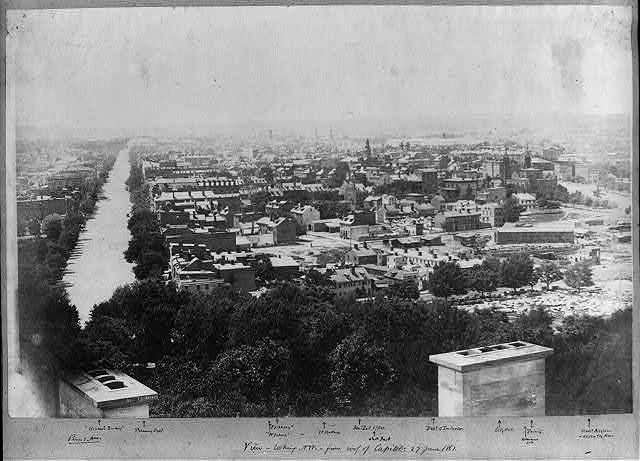
View from House of some dissent - Washington from Capitol roof June 27, 1861 (LOC - LC-USZ62-78348)
that the Administration had ignored the history of the last session when Congress refused to supply the General Government with the means of war against the South. Every principal proposition for an adjustment of our difficulties came from gentlemen of the South, with the exception of that of Mr. KELLOGG, of Illinois, and they all knew the fate which the latter met. In the subsequent elections the people ratified or approved of the policy of peace. Secession was then melting away, but it was strengthened and invigorated by the policy of the present Administration. In the course of his remarks he alluded to the ill-advised passage of a high protective tariff. In further argument he charged the President with usurpation of power which would have cost a sovereign of Europe his head, and severely reprobated the progress of affairs which threatened popular liberty and the rights dear to freemen. He stood to-day where he stood on the 4th of March last — where the Democratic and Constitutional Union Party then stood, and where he believed a majority of the people of the United States then stood. He was for peace — speedy, immediate, honorable peace, with still its blessings. His duty should be discharged freely, calmly, honestly, and regardless of consequences, with the approving voice of conscience, void of offence, and with an approving public judgment, which will follow after some time be passed. These, God help him, were his trust and support.
According to Wikipedia, Clement Laird Vallandigham, who servede in Congress from 1858-1863
…was a vigorous supporter of constitutional states’ rights. He believed the federal government had no power to regulate a legal institution, which slavery then was. He also believed the states had a right to secede and that the Confederacy could not constitutionally be conquered militarily. Vallandigham supported the Crittenden Compromise and proposed on February 20, 1861 that the Senate and the electoral college be divided into four sections, each with a veto. He strongly opposed every military bill, leading his opponents to charge that he wanted the Confederacy to win the war. Vallandigham was the acknowledged leader of the Copperheads, and in May 1862 he coined their slogan, “To maintain the Constitution as it is, and to restore the Union as it was.”
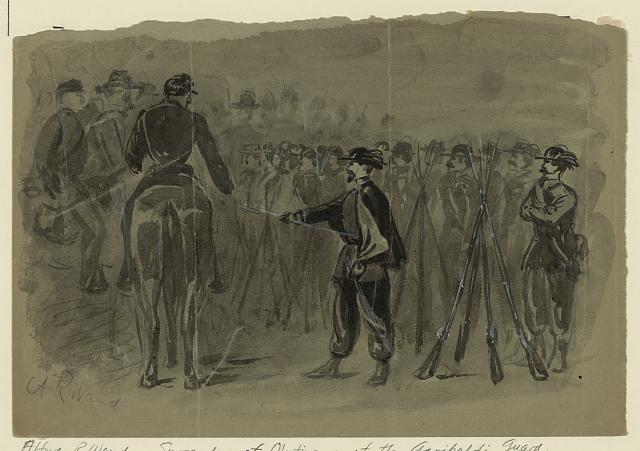
"Surrender of the revolting Garibaldi Guards to the U.S. Cavalry" (LOC - LC-DIG-ppmsca-20823 )
From The New-York Times July 9, 1861:
…WASHINGTON, Monday, July 8 …
MUTINY AMONG THE GARIBALDIANS.
It is reported that a mutiny broke out among the Garibaldi Guard to-day. One hundred of them left the camp and came to the city. They were stopped on this side of Long Bridge by the guard, and held there. The military officers on this side will make a word and a blow, and fire on the mutineers, unless they surrender and return to duty. The trouble grows out of some disaffection about the arms given to the regiment. …
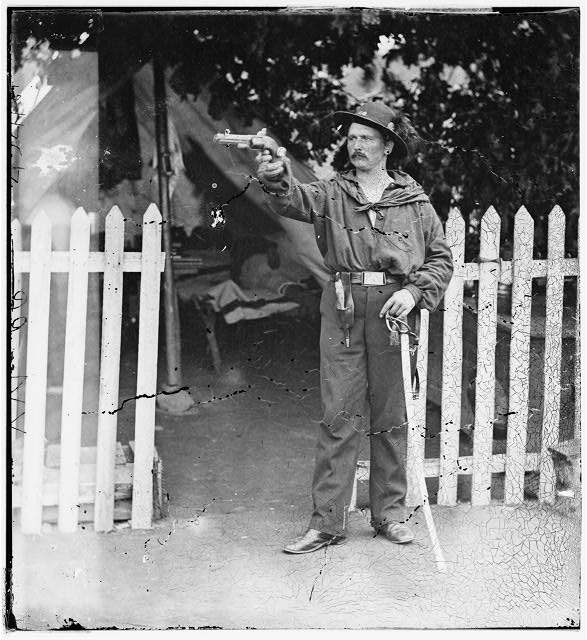
"Capt. Schwartz, sharpshooter, 39th New York Regiment. (Garibaldi Guard)" (LOC - LC-DIG-cwpb-01691)
So four days after the Garibaldi Guard paraded for President Lincoln, General Scott, and others in Washington, trouble erupted in Alexandria. I don’t know what it means to “make a word and a blow”, but firing on the mutineers is pretty straight forward. Here’s more from New York State Military Museum about the Garibaldi Guard (the 39th Infantry Regiment):
It was mustered into the U. S. service at New York, May 28, 1861, for three years and left the state for Washington on the same day. Camp Grinnell was established near Alexandria and occupied until July 17, when the 39th participated in the movement of the army toward Manassas with the 1st brigade, 5th division, though in the battle of Bull Run the regiment was but slightly engaged. After a few weeks at Alexandria much ill feeling prevailed over the failure to receive some expected privileges and 50 members of Co. G mutinied, but returned to the command after being disciplined by arrest and imprisonment.
The Library of Congress dates the drawing of the Garibaldians surrendering as June 8, 1861. I have not seen any information about trouble with the 39th on that date.
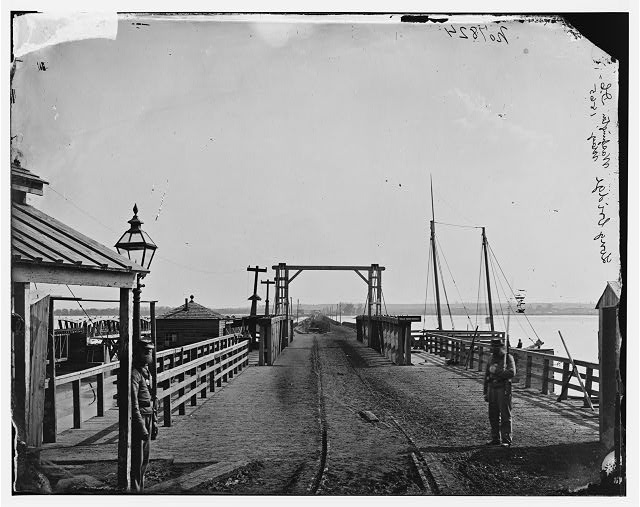
Where the mutineers got stopped - Long Bridge looking from D.C. (1865 LOC - LC-DIG-cwpb-04247)
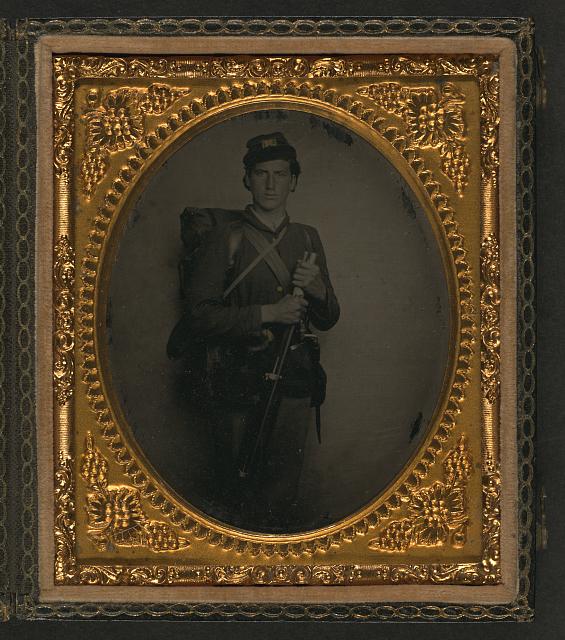
With knapsack slung - not 'slung' (LOC - LC-DIG-ppmsca-37065)
What was the 19th New York Volunteer Infantry doing 150 years ago today?
The drums beat an early reveille next morning. Blankets were hurriedly rolled up. ” Sling knapsacks,” commanded the Colonel. A long march being in prospect, some of the men, rather than carry those weighty knapsacks another day, did sling them with a vengeance — over the fence. A few were fortunate enough to obtain permission, as a special favor, to have them carried in the wagons. As fifteen wagons only were allotted to the regiment, many permissions of this sort could not be granted.
The 28th New York took the advance as usual and marched on down through the village and crossed the river; the 19th New York followed. Between verdant and romantic banks, the Potomac flows here in a current half a mile wide — not over three feet deep. Adjutant Stone leaped into the stream first; the column followed manfully in after him, and strode through the gurgling water with the nonchalance of regulars. A few took off their shoes, that they might resume the march with dry feet. Others rolled up their baggy pants. All held up their cartridge boxes. Emerging from the Potomac, the 19th New York stood on the ” sacred soil ” of rebeldom and at the entrance to one of its fairest regions — the far-famed Shenandoah Valley. It was a lovely vale — broad, gently undulating, dotted with groves and farms, and yielding such prolific crops of grain and rich fruit, that it was called the granary of Virginia. On either side, ranges of blue mountains stretched away into the remote distance till lost in view in the gathering haze which perpetually overhangs this region, giving it magical beauty and making its mountain ranges of so soft and ethereal blue that they seem the creations of enchantment. The silvery Shenandoah wound through the valley, gleaming between dark groves.
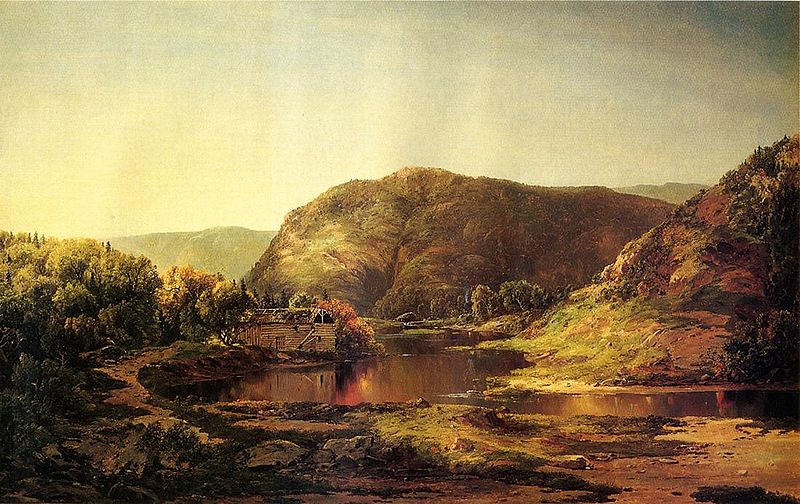
Shenandoah Valley by William Louis Sonntag (1859-1860 Courtesy Virginia Historical Society)
On the bank of the Potomac a halt was ordered, and the dripping regiment improved the opportunity to wring its garments and eat breakfast. At noon Capts. Schenck and Stewart with their companies were left at the ford to wait for Kennedy and Doubleday’s gun, and the regiment went on towards Martinsburg. At Falling Waters, six miles on the way, the scene of the late brush between Patterson and the rebels, a pause was made. The havoc of war, present on all sides, was viewed with curious eyes. Fences were, for miles, down; trees shattered with cannon shot; crops trampled to the earth; farm houses were in ashes; here and there dead rebels dotted the fields; arms and equipments were scattered everywhere. One farm house had a cannon shot hole in it. A Federal flag fluttered from a stick projecting from the hole.
While waiting here, the volunteers picked up many mementoes of the fight to carry with them. A sabre and a revolver from a dead rebel, who lay with pallid, upturned face in the grass, were among them.
At 2 p, M. Schenck and Stewart were ordered up, and Lieut- Col. Seward was dispatched to Hagerstown to ascertain the cause of Kennedy’s delay. Col. Clark then put the regiment in motion again for Martinsburg, nine miles distant. Company A, the leading company, pushed rapidly ahead and caught up with the 28th regiment three miles ahead. The others followed briskly, marching a large part of the way on the double-quick, the men in good spirits and singing “John Brown’s body lies a mouldering in the grave,” “Star Spangled Banner,” and other patriotic choruses. As the day was hot and marching swift, the heavy equipments of the volunteers again oppressed them. They endured it as long as they could and then scores threw away knapsacks, others blankets, and some pairs of fine boots, anything for relief. It was a severe thing for green soldiers to march fifteen miles under a hot sun. The manner in which they endured its discomforts showed their excellent grit.
On this march, as in all others when not in presence of the enemy, the regiment moved in loose, open order, the men taking the sides and middle of the road as they chose, and carrying their arms at will. This is called taking the “route step.” It is only required that companies maintain their relative positions and distances. At the command “Attention,” the men run together and form in compact order, the drums beat giving them the cadence, and in less than a minute’s time the apparent chaos resolves itself into the beautiful, orderly, regular column of warfare. A regiment on the march is always a magnificent spectacle, and whether in open or compact order, impresses the beholder with its moral power. The field and staff, we might say here, always ride at the head of the column. Further in advance, is the Officer of the Day with a guard to close taverns and liquor stands. In rear are the wagons and provost guard to pick up stragglers.
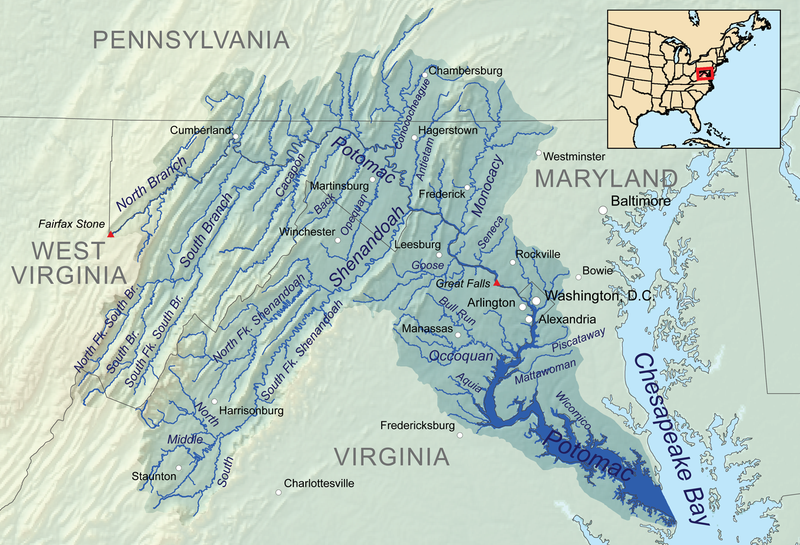
July 8, 1861: 19th forded Potomac, made it to Martinsburg
The regiment entered Martinsburg at 11 p.m. Camp fires burnt in all directions. Passing through the village by Gen. Patterson’s order, the regiment marched out on a road easterly about a mile, and then climbed a steep bank and a stone wall, arriving in a field, on the extreme right flank of Patterson’s army. The men were excessively tired. As they jumped over the stone wall, some of them knocked off stones which rattled down amongst those behind. Some murmurs were uttered at this. At Kalorama, some disorderly spirits had once groaned at Col. Clark. The Colonel on this occasion is said to have made an uncharitable remark about their groaning at the stone wall, as having now something to groan for. After stacking arms, the men fell immediately to the ground and slept, such as could sleep. The excitement of the situation kept some awake. They were in the presence of an army of 20,000 rebels, commanded by a General of consummate ability. The picket guards of the Union army not far away, out in the fields, were firing all night, firing at nothing as it proved, but still stimulating the imaginations of the soldiers bivouacked around Martinsburg and making them think gravely of the possibilities of the morrow.
From Cayuga in the Field by Henry Hall and James Hall.
The Map of the Potomac watershed is licensed by Creative Commons.
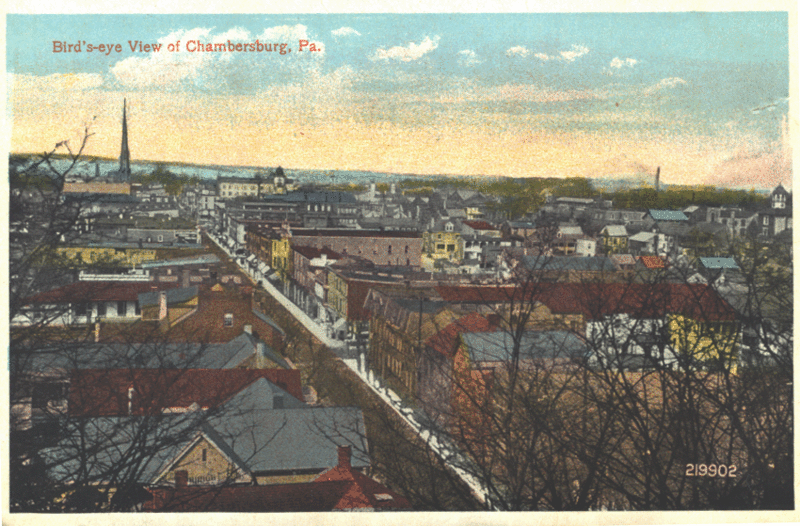
60 years after the meat offering - Chambersburg 1921
These Guys Are throwing Food Away?
The 19th New York Volunteer Infantry has been ordered to move from Washington, D.C. to the Shenandoah Valley to reinforce Union General Robert Patterson. On July 6, 1861 they loaded into freight cars and headed north out of Baltimore.
The train made its shrieking entry to Harrisburg early Sunday, July 7th.
Here began a series of kind attentions which the inhabitants of every stopping place lavished upon the far from coy volunteers. These generally took the form of presentations of first class food. No delicacies were too good to be lavished on the brave but insatiate defenders of our country. It is to be feared that the 19th left behind it a trail of empty larders in Pennsylvania. At Chambersburg, a church meeting dissolved for no other purpose than to bring a meat offering to the volunteers. Travel gave the Cayuga boys a wonderful appetite for luxurious fare. They took all that come. Salt pork and hard tack were shied at passing telegraph poles, and distended haversacks and tight belts told the tale of Pennsylvania hospitality. A stock of turkey, ham and cake was laid in for future emergencies.
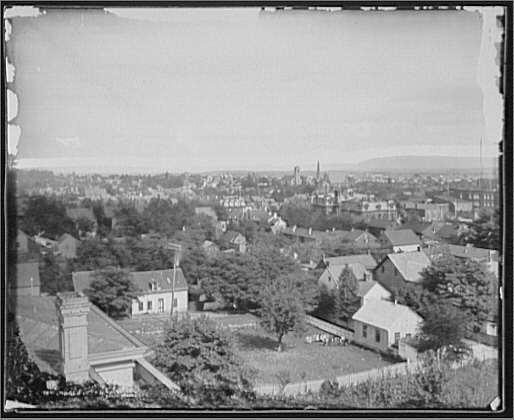
Hagerstown c.1892 (LOC - LC-D43-T01-1847)
At 5 1-2 P. M., the train halted at the terminus of the railroad in the village of Hagerstown. The companies debarked. Gen. Patterson’s Quarter-master here supplied Col. Clark with wagons for the transportation of camp equipage and officers baggage. While five men from each company were loading up, the regiment stretched its limbs in the village, where fresh attentions from the citizens made it happy and put strength into it for the march now before it.
Col. Clark ascertained here that Gen. Patterson had crossed the Potomac at Williamsport and advanced to Martinsburg in the Shenandoah Valley, sixteen miles from Winchester. All reinforcements he had left orders for, to follow him thither. Before departing en route to the front. Col. Clark received instructions to bring on to the army under the protection of his regiment, Doubleday’s thirty pound rifled cannon before spoken of. As it had not come, up to eight o’clock, the Colonel ordered Capt Kennedy to remain with Company B, until it did come and bring it on. The regiment was then assembled and put under way to reach Williamsport, six miles distant, that night.
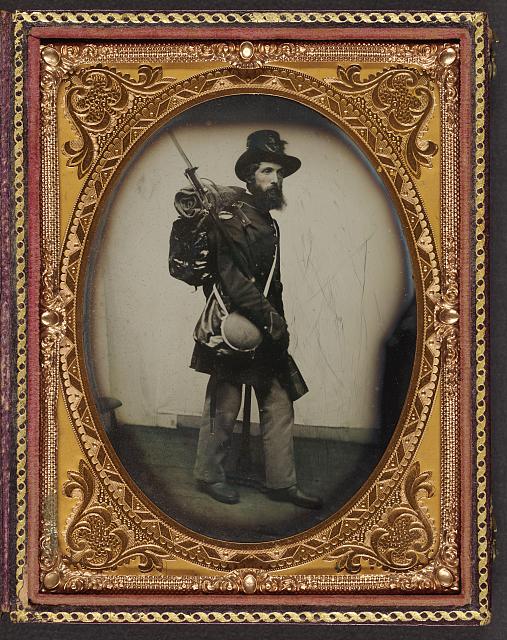
Different Regiment, Similar Personal Impedimenta (NH private 1861; LOC - LC-DIG-ppmsca-36462)
A soldier on the march is a curious looking object. Baggage dangles from every part of his person. Knapsack and haversack, blanket, cup and canteen, added to the regular equipment of musket, belts, bayonet scabbard, and cap and cartridge boxes, give him a singular appearance. The weight of this paraphernalia is considerable, seldom less than 40 lbs., and as much more, ranging as high as 70 or 80, as the soldier chooses to make it. Green soldiers invariably carry all they can stagger under and such was the case with the 19th on this occasion. A thousand unnecessary knick-knacks and a heavy surplus of provisions incautiously laid in, fairly burdened the men down, and to such an extent, that when, after a hot and dusty march, they reached Williamsport at 10 1-2 o’clock, they were thoroughly fagged out. They learnt discretion very rapidly after that experience.
Reaching a pleasant hill, back of the village, a halt was ordered for the night. The 28th N. Y. lay there in a large meadow, by the side of the road. The 19th went into bivouac on a grassy campus opposite them. Filing into the field, the order, habitually given when preparing to camp, was uttered: “By companies; by the right flank; to the rear, into column; march.” The head of each company broke off, that is turned square to the right, and marched off a few rods at right angles, then, halting, faced to the front, forming the regiment into column by companies. The weary men stacked arms and dropped to the ground and slept soundly in their places pillowed on their knapsacks and blankets, while a guard kept watch over the bivouac. (From Cayuga in the Field by Henry Hall and James Hall)
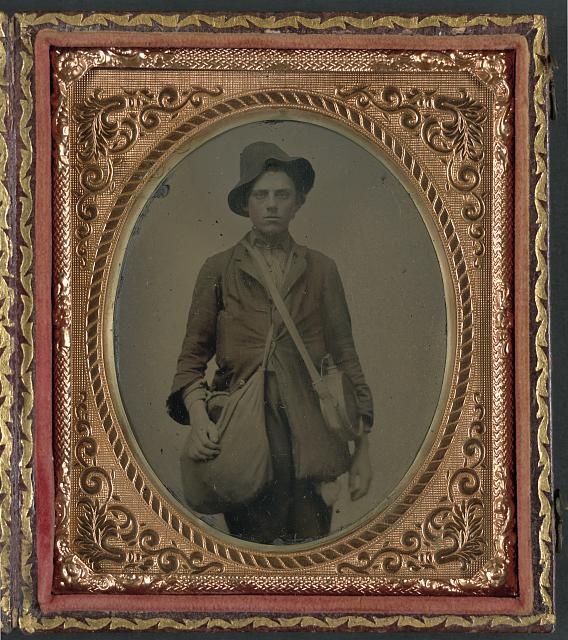
Maybe quartermaster has more of his stuff (Unidentified in Confederate uniform LOC - LC-DIG-ppmsca-31464)
Well, the North and South had at least one thing in common early in the war – soldiers on both sides carried too much stuff. From History of Kershaw’s Brigade by D. Augustus Dickert:
The baggage of the common soldier at this stage of the war would have thrown an ordinary quartermaster of latter day service into an epileptic fit, it was so ponderous in size and enormous in quantities–a perfect household outfit.
Citizens in Pennsylvania and parts of Maryland sure are generous providing good food for the troops.
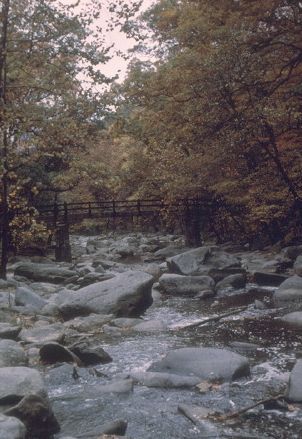
Rock Creek, District of Columbia
We’ve been following the 19th NY Volunteer Infantry from the Cayuga County area of New York State. The regiment has been drilling at their encampment in the Kalorama area of the District of Columbia for about a month. That’s all about to change, but before the 19th departs I’d like to mention that Henry Hall remembered the time at Kalorama as generally healthy, except for a few cases of the measles. The first death in the regiment occurred when Joseph Winters, the drummer boy from Company C drowned in D.C.’s Rock Creek while bathing. Also, Henry Hall says that the reinforcements for General Patterson, of which the 19th was a part, were intended by General Winfield Scott to prod Patterson to action in his mission to keep the rebels in the Shenandoah Valley busy while General McDowell advanced on Richmond.
From Cayuga in the Field by Henry Hall and James Hall:
Col. Clark, on the afternoon of July 5th, received the following order: —
” Col. Clark, 19th Regiment, New York Volunteers, is directed to be in readiness by noon, to-morrow, to march his regiment on special service, with three days’ cooked provisions and three days’ raw, which he will prepare forthwith. He will leave all extra baggage in his camp with sick and disabled men and sufficient tents for their use. Wagons for transportation will be at his camp at 12 o’clock at noon. Col. Clark will draw forty rounds of ammunition early to-morrow. He will have all his tents and ordinary baggage packed by 12 o’clock.
By Order,
Maj.-Gen. Charles W. Sandford.
Geo. W. Morell, Div. Inspector.”
Communicated to the regiment, the orders were joyfully received, and the camp fell vigorously to packing and preparing for the march. Letters were hastily written home ; knapsacks were packed; rations of meat were cooked; surplus baggage was disposed of and everything made ready for an early start next day. The larger part of the night was devoted to this work. …
At 6 A. M. of the 6th, “Strike tents” was proclaimed in Camp Cayuga. The once orderly camping ground became a scene of bustle, confusion and uproar for an hour or two, and the folded tents, with baggage and camp equipage, then lay packed on the ground and arranged in piles ready for loading into the wagons, which were to take them to the railroad depot, A small guard remained to watch the baggage and load the wagons. At 10 1-2 A.M., the regiment filed away from beautiful Kalorama and hastened in a pouring rain storm to the depot in Washington. Dr. Howard remained with ten sick in a hospital tent. …
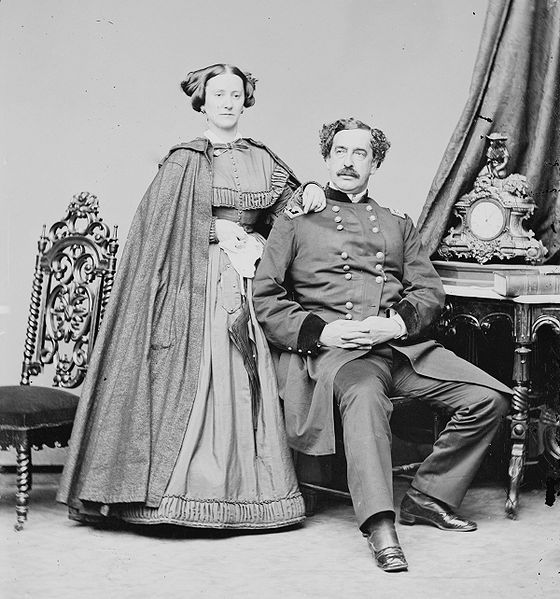
Abner and Mary Doubleday
The day before, a thirty pound rifled Parrot cannon left this depot on a freight car, labeled “Capt. A. Doubleday, Williamsport, Md.” It was part of the impedimenta of the 19th New York.
A cordial reception in Baltimore awaited the regiment on this occasion. The aspect and spirit of the rabid old city had materially changed since the 7th of June. Gen. Banks’s cannon on Federal Hill had done a marvelous work. Cheers were repeatedly given by the populace, and fluttering handkerchiefs now waved graceful greetings from balconies. Freight cars were supplied at the Harrisburg depot, and, jammed unpleasantly tight in them, the regiment rattled away at nightfall at a fearful rate of speed toward the capital of Pennsylvania. There was little chance for “nature’s sweet restorer” that hot night. The cars were packed to oppression, while the fearful rumbling and jolting so banished slumber from the eyes of the more volatile that they sat up, sang ” John Brown,” ” Hail Columbia,” and everything else an inventive imagination could suggest, and cracked jokes and plagued the sleepy, so that it would have defied Dickens’s Fat Boy himself to catch a nap the duration of a wink. Fresh, cool air, the perspiring occupants of these veritable din mills obtained by jamming pointed Gothic windows through the car sides with their muskets. Other obstacles to repose could not be overcome.
I’ve heard of gin mills; these din mills don’t sound like too much fun.
According to Wikipedia, after his service at Fort Sumter Abner Doubleday “… was promoted to major on May 14, 1861, and commanded the Artillery Department in the Shenandoah Valley from June to August …”, so I guess the 19th did send their cannon to the right person.
In one of his (different) letters home Oscar Langford stated that the drummer who drowned was 17 years old.
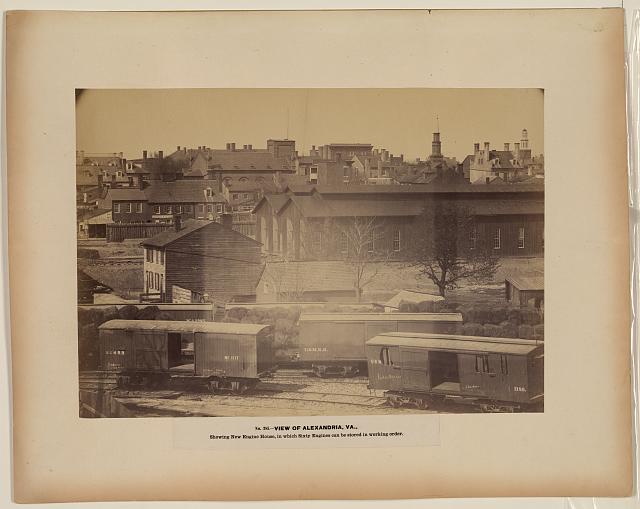
Like the 19th's ride - Freight cars in Alexandria (ca1861-65 LOC - LC-DIG-ppmsca-07316)
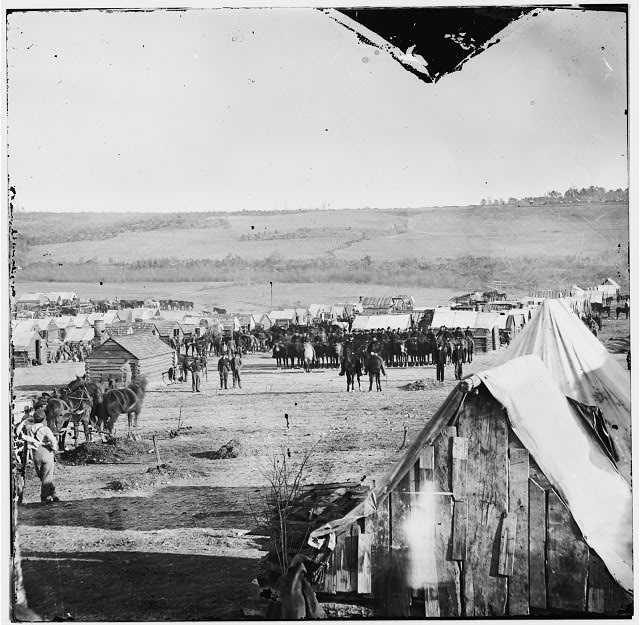
5th Pennsylvania Cavalry - October 1864 (LOC - LC-DIG-cwpb-01826)
Bring Your Own Horse
From The New-York Times July 6, 1861:
… WASHINGTON, Friday, July 5. …
MORE TROOPS COME.
…
A regiment of Dragoons from Pennsylvania, under command of Col. M. FRIEDMAN, who will provide their own horses and equipments, has been to-day accepted by the War Department, to be in readiness here within ten days. …
According to The Jews of Philadelphia:…by Henry Samuel Morais, the 5th Pennsylvania Calvary fought for the length of the Civil War. Max Friedman was born in Mühlhausen, Bavaria in 1825. Friedman resigned in 1862 because of combat wounds but continued to organize and train other cavalry units. You can also read about the “Cameron Dragoons” at pa-roots.
The image below is said to be an 1861 certificate presented to Pennsylvania volunteers. (by Peter S. Duval and son LOC – LC-DIG-pga-03676)
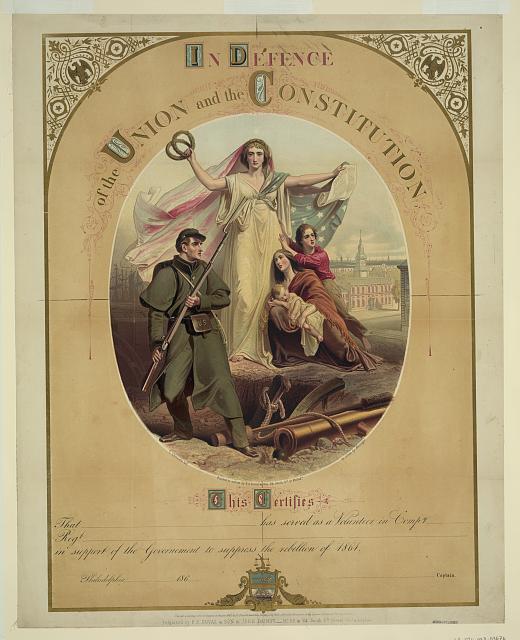
Certificate for Pennsylvania volunteer 1861

