Taxing the Frogs

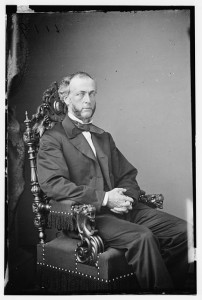
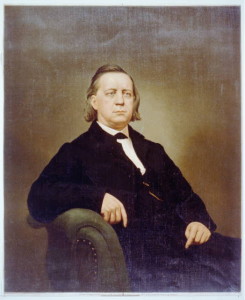
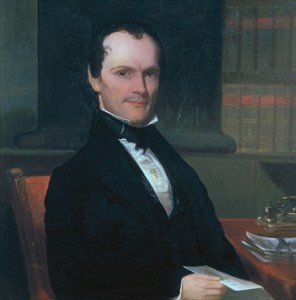
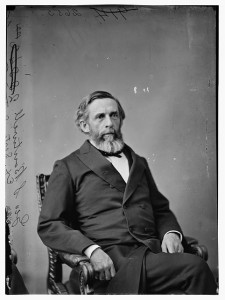
Hon. George S. Boutwell of Mass. (between 1870 and 1880; LOC: LC-DIG-cwpbh-03788)

Taxman reporteth

From The New-York Times January 22, 1863:

THE INTERNAL REVENUE REPORT.

We have every reason to congratulate the country on the operation post and prospective of the Internal Revenue Bureau. In another column we publish Mr. Commissioner BOUTWELL’S first official report, which affords abundant proof both of the administrative efficiency with which he has discharged his trust, and of the ultimate certain success of our new system of internal taxation as a source of public revenue.

“One tax,” says SISMONDI, “is preferable to another in proportion as it employs a less numerous body of officers, and as the cost of collection forms a smaller per centage of the total revenue.” Tried by this rule, our new excise tax is a great success. The French internal taxes cost 10 per cent. for collection, the English 4 1/2 per cent., while ours costs less than 2 1/2 per cent. Again, the French tax collectors amount to several thousands, the English to 5,457, while our entire body of collectors and assessors, with their clerks, deputies and assistants, number no more than 3 882. This contrast is all the more gratifying because from the sparseness of our population, and the extensive area of the country, we might have reasonably expected for the first year, at any rate, a less favorable report. Of course the number of officers will be somewhat augmented as the business of the Bureau becomes more heavy, and the important practical suggestions, recently made by the Commissioner, are more fully adopted. But there is no doubt that, so far as the loyal States are concerned, the expenses incident to collection will be kept far below the English standard of 4 1/2 per cent.

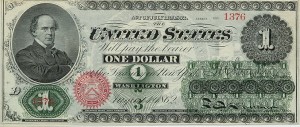
Obverse of the first $1 bill issued in 1862 as a legal tender note featuring Treasury Secretary Chase (US_$1_1862_Legal_Tender)

Render unto Salmon (hey, it’s just a buck)

According to the estimates given in the report, the stamp duties will produce during the year fifteen millions of dollars, and the other internal taxes nearly sixty-two millions. Next year it is believed the amount will be doubled, as the entire fiscal machinery will then be in full operation. Hence one hundred and fifty millions may probably be relied on from this source, as estimated in the recent financial report of Mr. CHASE.

This progressive increase is in accordance with the great principle of fiscal science, which directs us wherever a nation has not been used to a particular kind of fiscal burden, to tax gently at first, and to increase the weight by degrees, as the nation is able to bear it. Fiscal contributions for the support of a popular Government, if they be well laid and equitably distributed, form, as is proved by the example of England, no serious hindrance to the growth of national wealth. The nations which have been most heavily burdened with taxation have often been precisely those which have made the most rapid progress in opulence, productiveness and power.

George Sewall Boutwell was an ardent abolitionist who helped found the Republican Party in Massachusetts. He worked as the first Commissioner of Internal Revenue from July 17, 1862 until March 4, 1863, when he began a stint as a representative and radical Republican in the U.S. House. He served as Secretary of the Treasury during President Grant’s first term.

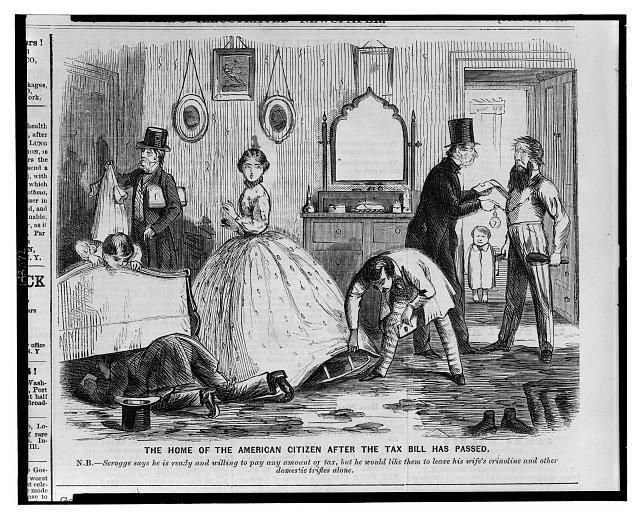
The home of the American citizen after the tax bill has passed (Frank Leslie's illustrated newspaper, v. 14, no. 355 (1862 July 19), p. 272; LOC: LC-USZ62-133072)

fiscal scientists?

Posted in 150 Years Ago This Week, American Society, Lincoln Administration, Northern Society | Tagged , , , | Leave a comment

Unimpressed

A southern editorial by way of Gotham criticized the Confederate government’s impressment policy for being imposed without legislative approval and for unfairly burdening property owners near the armies or near good transportation avenues. The problem might have been caused by Jews and Yankees infesting southern society; as President Davis suggested, the solution would be for Congress to pass a just law.

From The New-York Times  January 20, 1863:

… A GROWL AGAINST IMPRESSMENT. …

From the Richmond Whig.

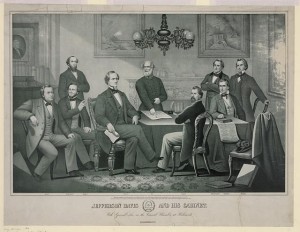
Jefferson Davis and his cabinet (no date recorded on shelflist card; LOC: LC-DIG-pga-01757)

“the Government set aside all law and justice”

The President, in his message, apologizes indirectly for the seizure of private property, by what he calls the “power of impressment,” by alleging the insufficiency of transportation. He recommends that the exercise of this power be guarded by judicious provisions against perversion or abuse, and be under due regulation of law. This is all very well, but it would have been far more consistent with a Government of freedom and law if, before exercising this tyrannical power, the right to do so had been obtained from the law-making authority. There has existed no necessity for its exercise at all. It is a slander upon the people of Virginia to assert that such necessity has existed. As a general rule they have willingly sold their produce to the Government, at the Government’s own price — even when that price was half the market price. In other cases, the parties have not refused to sell, so far as we have heard, but only demanded the market value, which the Government refused to give. For the sake of a few dollars, the Government set aside all law and justice, and resorted to force to rob individuals of their property, while millions were being lavished upon favorites. It is a striking illustration of the injustice of this proceeding, that the price at which the Government is impressing flour is from two to three dollars less than the price paid by the Government to the Crenshaws.

One would suppose that common sense would dictate, that a Government like ours, dependent for its very existence upon the affection and confidence of the country, would spare no means to secure that confidence and affection. But, so far from this, the disposition seems to exist to harass and alienate the people by every species of petty tyranny. This has been especially the cause with respect to the great agricultural population, on which, at last, rests the sole hope for the national salvation. Nothing but their whole-souled devotion to the cause could have made them submit in quiet to the violation of law and wanton invasion of their rights. It is difficult to assign a reason for this absurd and extraordinary policy. Possibly the solution may be found in the vast member of Jews and Yankees, who, having no sympathy for our people, and no regard for their feelings and interest, have insinuated themselves into the management of our affairs.

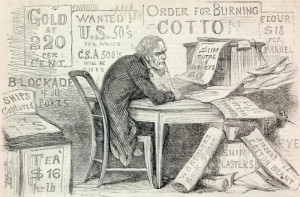
rebel-cartoon (Harper's Weekly 9-6-1862; http://www.sonofthesouth.net/leefoundation/civil-war/1862/september/rebel-cartoon.htm)


Where’s the money for ‘just compensation’ going to come from?

The system of impressment as conducted at present, operates unequally, and, consequently, unjustly and oppressively. Persons residing near the armies, or convenient to the railroads and canal, are those only who feel its burdens. While they are forced to sacrifice half the value of their property, neighbors a few miles distant go scot free, or have theirs enhanced in price by the Government seizure. Our people are willing to do anything for the cause, but they have a right to demand that the burdens should be equal, and imposed upon all alike, and by the law of the land. Their property is at the service of the Government, but let it be taken on fair terms, and for such compensation as the Government can give.

We do not write this to inflame the just discontent which exists; but in the hope of inducing such action on the part of Congress as will tend to appease it. Our people have been accustomed to law, and they abhor the unnecessary intrusion of military violence. Congress cannot pass a law on the subject which does not recognize “just compensation” for private property appropriated to public use, and which does not also, in estimating that compensation, to some extent recognize the depreciation of the currency. A law like that of the State of Virginia would meet all the demands of the Government, satisfy the people, and above all, preserve our character as a Government of liberty and law.

Eventually an impressment law would be passed. According to Encyclopedia Virginia Confederate Impressment

was the informal and then, beginning in March 1863, the legislated policy of the Confederate government to seize food, fuel, slaves, and other commodities to support armies in the field during the American Civil War (1861–1865). The tax-in-kind law, passed a month later, allowed the government to impress crops from farmers at a negotiated price. Combined with inflationary prices and plummeting morale following military defeats, impressment sparked vocal protests across the South. Discontent was exacerbated by what was perceived as the government’s haphazard enforcement of the law, its setting of below-market prices, and its abuse of labor. As a result, citizens hoarded goods and in some cases even impersonated impressment agents in an effort to steal commodities.

The following, published 150 years ago today, seems to show how arbitrary the system could be. From the Richmond Daily Dispatch January 21, 1863:

The impressments at Lynchburg.

The Quartermaster, acting under instructions from the War Department, has released all the flour impressed at Lynchburg except that of the grade of Superfine. He has also released the sugar that was impressed, and all whiskey that the ownership is in refugees. The latter, it is assumed have lost and sacrificed enough for the common cause, hence where ownership of impressed articles is in that category they are released.

The political cartoon was published in the September 6, 1862 issue of Harper’s Weekly and can be viewed at Son of the Soiuth

Posted in 150 Years Ago This Month, Confederate States of America, Southern Society | Tagged , , | Leave a comment

“capture the marauders”

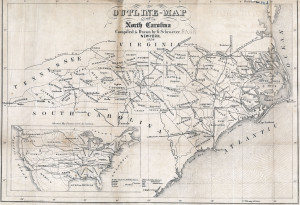
nc-railroads-1854 (http://www.learnnc.org/lp/multimedia/12394)

Madison County on border with Tennessee

From the Richmond Daily Dispatch January 17, 1863:

Tory Outrage in Western North Carolina.

–On Thursday night, 8th inst., a band of to [?] from the mountains of East Tennessee, and Laurel, N. C., attacked the village of Marshal, Madison county, N. C., taking the citizens prisoners, and robbing the whole town of whatever valuables were moveable. When they left they said their next raid would be upon the armory at Asheville, N. C., A force of 300 men, under Col. Allen, of the 64th N. C. regiment, has been sent from Knoxville, to capture the marauders.

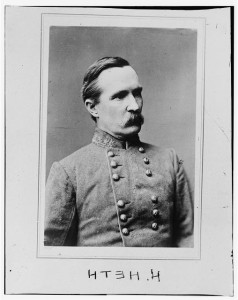
Henry Heth, C.S.A. (between 1860 and 1870; LOC: LC-DIG-cwpb-07586)

“take no prisoners”

The 64th did more than capture the Unionists. You can read a good account of the Shelton Laurel Massacre at The Civil War 150th Blog.

There’s a lot of information about the massacre on the Internet. Renegade South points out that Lt Col. James A. Keith, who led the 64th in this action, claimed that Brigadier General Henry Heth “directed him to kill the Madison County Unionists and deserters, to take no prisoners, and to file ”no reports” of the matter.” Heth’s complicity is also discussed in an article at Our State, which tells the story in the present tense and says that Colonel Lawrence M. Allen was somehow involved with leading a second column.

Posted in 150 Years Ago This Week, Confederate States of America, Southern Society | Tagged , , , , | Leave a comment

Yankee Go Home

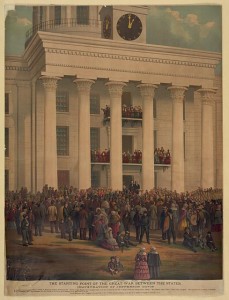
The starting point of the great war between the states (Cincinnati, Ohio : Strobridge & Co., c1878LOC: LC-DIG-pga-02817)

Blue coats now trampling the streets where Jeff Davis was inaugurated

Paroled Union soldiers roaming the streets, especially offensive to Confederate soldiers’ loved ones

From the Richmond Daily Dispatch January 17, 1863:

Are the Yankees in possession of Montgomery?

–The Montgomery Advertiser says:

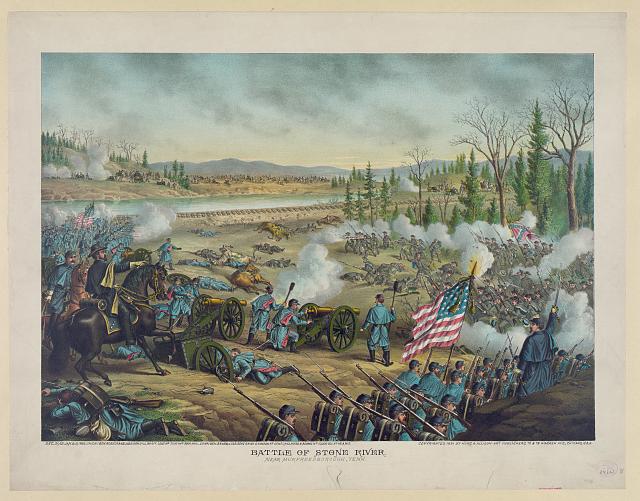
The question was quite seriously mooted yesterday and the day before whether the Yankees or the Confederates were in possession of the capital city of Alabama. Those who argued that the enemy held the city pointed to the blue coats, which were to be seen in profusion in the market, in the stores, about the hotels, and on the streets, as an argument in their favor. If they were not masters of the city, but prisoners, as some contended, what reasonable excuse could be offered for their being allowed to roam through the town without a guard? They evidently had the best of the argument; still, there were those who could not believe Montgomery had been tamely surrendered. On application to the Yankees themselves for information it was found that they claimed to be prisoners, taken near Murfreesboro’, and paroled. Some of them said they were desirous of leaving here as soon as possible, in order to go home to their families; others were not yet satisfied with the success of the efforts to subjugate the South, and wished to get another opportunity to murder Southern men; while others still professed themselves so much enamored of the “Sunny South,” that they would be willing to remain, in case they could obtain employment as mechanics at the rate of five or six dollars per day. All of them seemed to enjoy their liberty immensely, and doubtless thought the Southern Confederacy was not such a terrible monster after all. Seriously, however, the practice of allowing Yankee prisoners to perambulate the streets of our cities and towns, except when necessary for their transit from one railroad depot or steamboat landing to another, either with or without a guard, is disgraceful. Their presence is an offence to the wives, mothers, sisters and daughters of the men whom these wretches came South to murder, and their eyes should not be pained with the spectacle where it is possible to be avoided. The Yankees taken in arms against us should be treated humanely.–A brave and generous people will treat their prisoners in no other way. They should be hold as prisoners, however, be closely guarded, and allowed no opportunities for mingling promiscuously with the people, or of effecting their escape. Unless this is done we may look for abolition emissaries throughout the South, incendiarism, robbery, outbreaks and murders. Will the proper authorities give their attention to this matter?

Battle of Stone River, Near Murfreesborough, Tenn.--Dec. 31, 62. Jan. 2-3, 1863--Union (Gen. Rosecrans) ... Conf. (Gen. Bragg) ... (Kurz & Allison, 1891; LOC: LC-DIG-pga-01858)

source of proto-carpetbaggers?

Posted in 150 Years Ago This Week, Civil War prisons, Confederate States of America, Military Matters | Tagged , , | Leave a comment

Fiat: we’ll pay the troops

President Lincoln agreed with Congress that Union soldiers and sailors had to be paid, even if that required printing up to $100 million in new currency.

From THE PAPERS AND WRITINGS OF ABRAHAM LINCOLN
(VOLUME SIX)
:

PRINTING MONEY
MESSAGE TO CONGRESS.

January 17, 1863.
TO THE SENATE AND HOUSE OF REPRESENTATIVES:

I have signed the joint resolution to provide for the immediate payment of the army and navy of the United States, passed by the House of Representatives on the 14th and by the Senate on the 15th instant.

The joint resolution is a simple authority, amounting, however, under existing circumstances, to a direction, to the Secretary of the Treasury to make an additional issue of $100,000,000 in United States notes, if so much money is needed, for the payment of the army and navy.

My approval is given in order that every possible facility may be afforded for the prompt discharge of all arrears of pay due to our soldiers and our sailors.

While giving this approval, however, I think it my duty to express my sincere regret that it has been found necessary to authorize so large an additional issue of United States notes, when this circulation and that of the suspended banks together have become already so redundant as to increase prices beyond real values, thereby augmenting the cost of living to the injury of labor, and the cost of supplies to the injury of the whole country.

It seems very plain that continued issues of United States notes without any check to the issues of suspended banks, and without adequate provision for the raising of money by loans and for funding the issues so as to keep them within due limits, must soon produce disastrous consequences; and this matter appears to me so important that I feel bound to avail myself of this occasion to ask the special attention of Congress to it.

That Congress has power to regulate the currency of the country can hardly admit of doubt, and that a judicious measure to prevent the deterioration of this currency, by a seasonable taxation of bank circulation or otherwise, is needed seems equally clear. Independently of this general consideration, it would be unjust to the people at large to exempt banks enjoying the special privilege of circulation from their just proportion of the public burdens.

In order to raise money by way of loans most easily and cheaply, it is clearly necessary to give every possible support to the public credit. To that end a uniform currency, in which taxes, subscriptions to loans, and all other ordinary public dues as well as all private dues may be paid, is almost if not quite indispensable. Such a currency can be furnished by banking associations organized under a general act of Congress, as suggested in my message at the beginning of the present session. The securing of this circulation by the pledge of United States bonds, as therein suggested, would still further facilitate loans, by increasing the present and causing a future demand for such bonds.

In view of the actual financial embarrassments of the government, and of the greater embarrassment sure to come if the necessary means of relief be not afforded, I feel that I should not perform my duty by a simple announcement of my approval of the joint resolution, which proposes relief only by increased circulation, without expressing my earnest desire that measures such in substance as those I have just referred to may receive the early sanction of Congress. By such measures, in my opinion, will payment be most certainly secured, not only to the army and navy, but to all honest creditors of the government, and satisfactory provision made for future demands on the treasury.
A. LINCOLN.

After the Legal Tender Act of 1862 Legal Tender Act of 1862 U.S. greenbacks were added to the bank notes already in circulation. I think “suspended banks” were those that stopped backing their notes with gold and silver. All the money that circulated without being redeemable in specie created inflationary pressure. President Lincoln was asking Congress to create a more uniform currency. Congress did pass the National Bank Act of 1863. His suggestion for a “seasonable taxation of bank circulation” was eventually enacted: “In 1865, state bank notes were taxed out of existence. “

Posted in 150 Years Ago This Week, Lincoln Administration, Military Matters, Northern Society | Tagged , , , , | Leave a comment

Debt for our debts

Apparently the strongly pro-Democrat newspaper in Seneca County wasn’t exaggerating too much when it complained that troops and their families were suffering because the federal government was way behind in paying its soldiers.

From The New-York Times January 13, 1863:

NEWS FROM WASHINGTON,; THE FINANCES OF THE GOVERNMENT. A Bill for the Temporary Relief of the Treasury Passed in the Senate. The Proposed Consolidation of Regiments in the Field.The Bill for Raising 150,000 Negro Soldiers.Soldiers’ Arrears to be Paid atOnce. THE GOVERNMENT FINANCES. TEMPORARY RELIEF TO THE TREASURY. PAYING THE SOLDIERS. CONFISCATED LANDS FOR THE SOLDIERS. CONSOLIDATING THE REGIMENTS. THS PROPOSED ENLISTMENT OF NEGRO TROOPS. THE EMANCIPATION POLICY. THE MEDICAL DEPARTMENT. NEW RAILROAD TO NEW-YORK. SENATOR SAULSBURY. THE PAPER QUESTION. GEN. HUNTER. COMMISSIONERS OF EMIGRATION. THE M’DOWELL CASE. CONTRACTS FOR ENVELOPES. E. N. ORDNANCE DEPOT IN BALTIMORE. EMANICPATION IN MARYLAND. RETURNED.

OUR SPECIAL WASHINGTON DISPATCHES.

WASHINGTON, Monday, Jan. 12.

It is quite clear, from Secretary CHASE’S known views and known frimness, that he does not yield to the determination of the Committee of Ways and Means in regard to his me[a]sures, but will make an effort to secure their adoption by Congress in full or in a modified form.

The Senate to-day passed Secretary CHASE’s bill for temporary relief to the Treasury, in place of the joint resolution of the House, intended to provide for the prompt payment of troops in the field.

Hon. Frederick Augustus Conkling of N.Y. (between 1855 and 1865; LOC:  LC-DIG-cwpbh-01777)

pay “arrears due to soldiers in the field” before civilian employees of Government

The following resolution, adopted in the House to-day, on motion of Hon. FREDERICK A. CONKLING, indicates that there is in that body a returning consciousness of the immense wrong being perpetrated on the gallant soldiers of the Union:

Whereas, No creditor of the Government is more meritorious than the Union soldier; therefore,

Resolved, That no more money shall be paid to any civil officer or officers of the Government until all arrears due to soldiers in the field are paid.

The House to-day adopted the resolution introduced by Mr. ALDRICH, of Minnesota, instructing the Committee on Military Affairs to inquire in the expediency of bestowing on each soldier one hundred and sixty acres of confiscated land. …

From the Richmond Daily Dispatch January 14, 1863:

Hon. Wm. Pitt Fessenden of Maine (between 1855 and 1865; LOC: LC-DIG-cwpbh-02087)

$2 million in new debt for military pay

The back pay of the Army and navy.

Senator Fessenden, from the Committee on Finance; reported on the 9th inst. a bill authorizing the Secretary of the Treasury to borrow, on the credit of the Government, two hundred millions of dollars to pay arrearages due the army and navy. For one hundred millions he may issue coupons or registered bonds, hearing an interest not exceeding six per cent., payable at the pleasure of the Government any time after ten years.

For fifty millions of said sum he may issue United States notes without interest; for the remaining fifty millions he may issue Treasury notes payable two years after date, hearing four per cent, per annum; which notes shall be receivable for loans and all public dues, except customs. It also provides for the issuing of postal fractional notes, under the direction of the Secretary.

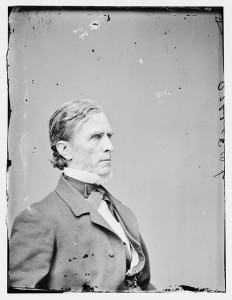
Frederick Augustus Conkling “Conkling organized the 84th New York Infantry in June 1861 and became its colonel. He initially served throughout the Shenandoah Valley Campaign.” He served as a Republican member of the House of Representatives for one term; he failed to win re-election in the 1862 midterms in which the Democrat party made some gains in New York State.

William Pitt Fessenden was strongly anti-slavery and helped develop the Republican party in Maine. He began serving in the U.S. Senate in 1854:

By the secession of the Southern senators the Republicans acquired control of the senate, and placed Fessenden at the head of the finance committee. During the Civil War, he was the most conspicuous senator in sustaining the national credit. He opposed the Legal Tender Act as unnecessary and unjust. As chairman of the finance committee, Fessenden prepared and carried through the senate all measures relating to revenue, taxation, and appropriations, and, as declared by Charles Sumner, was “in the financial field all that our best generals were in arms.”

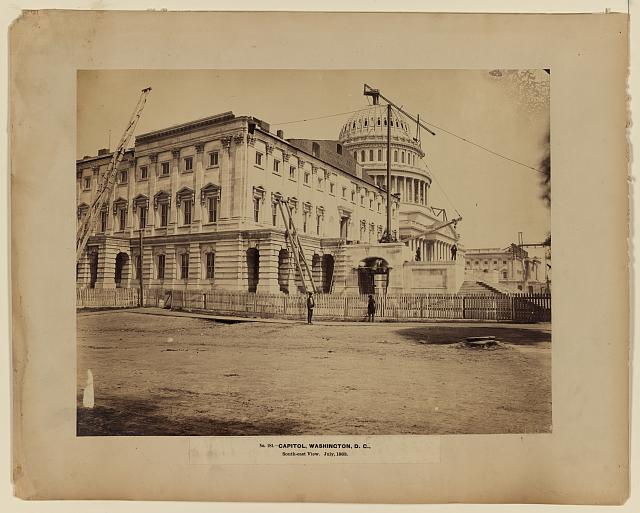
Capitol, Washington, D.C., south-east view, July, 1863 (by Andrew J. Russell, 1863 July; LOC: LC-DIG-ppmsca-07300)

might want to pay contractors, too

Posted in 150 Years Ago This Week, Military Matters, Northern Politics During War, Northern Society | Tagged , , , | Leave a comment

“destitution, insult and wrong”

Study of infantry soldier on guard--William J. Jackson, Sergt. Maj. 12th N.Y. Vols.--Sketched at Stoneman's Switch, near Fredricksburg [sic], Va. Jan. 27th, 1863 (by Edwin Forbes, January  27, 1863; LOC: LC-DIG-ppmsca-20516)

no mittens

From a Seneca County, New York newspaper in January 1863:

Our Suffering Soldiers.

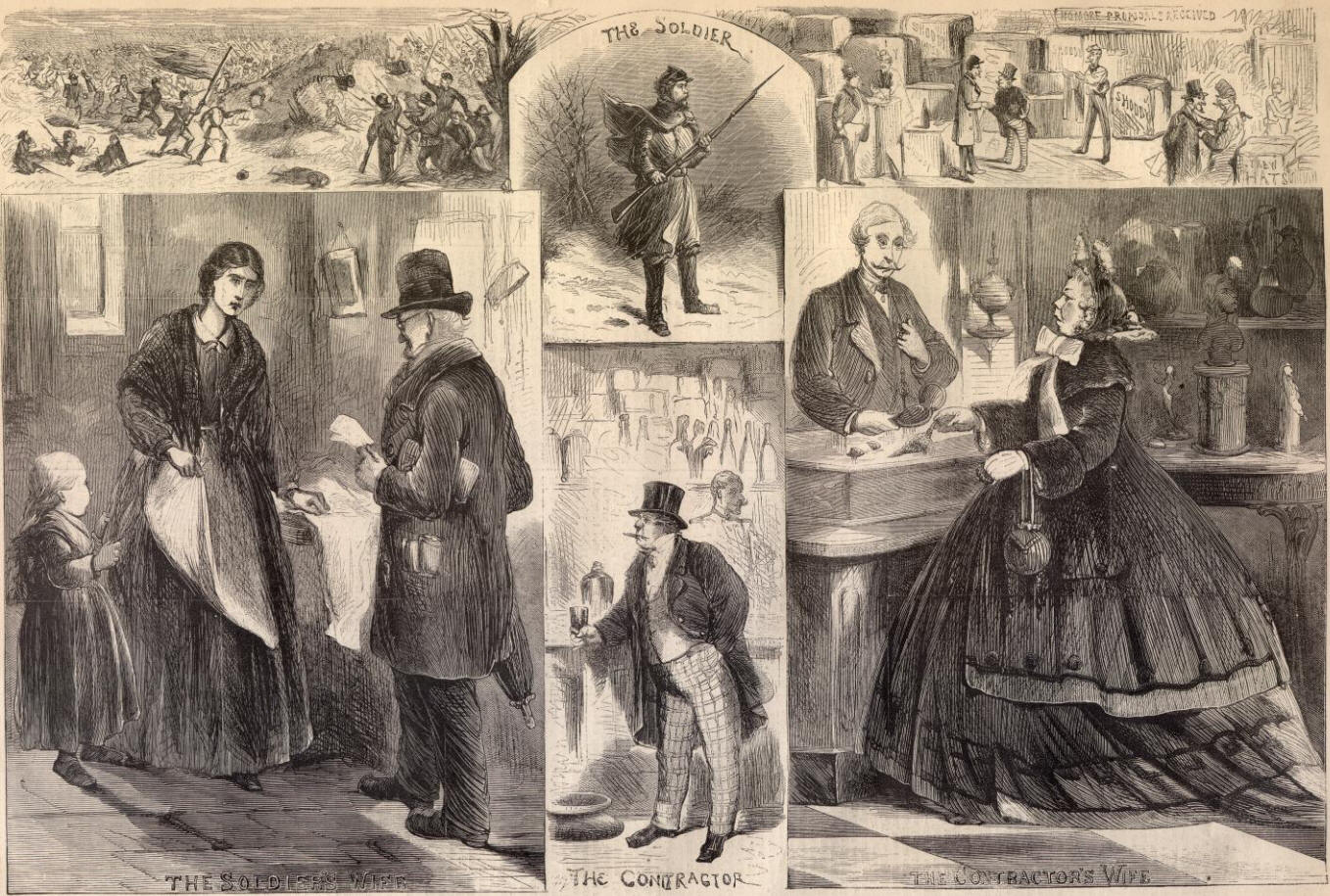
It is a fact that can no longer be denied, that suffering of the most aggravated character exists among the soldiers, from the neglect of Government. In all of the letters received from the army we have the same complaint. many of the Regiments have not been paid in seven months, and friends at home, or at least those who have the means, are compelled to send forward the funds to obtain those comforts which money alone can procure. The entire army appears to be in the most destitute circumstances, with but little hope of relief. The men are poorly clad, destitute of shoes and mittens, and without means to purchase whatever the Government neglects or refuses to furnish. And it is not the soldier alone that suffers. Many have families at home dependent on them for sustenance, but in consequence of the shameful dilatoriness of the Government, they can afford them no assistance whatever, and we have the humiliating spectacle of soldiers’ wives and children soliciting aid from their more fortunate neighbors. Is not this disgraceful to the Government, and the cause we are pretending to uphold? Nothing it seems can arouse the authorities at Washington to a sense of justice to the brave men who are imperilling their lives to uphold the Government.

The contractors who are plundering the Treasury find no difficulty in getting their pay, neither do the pimps and menials of power, who are dogging the footsteps of loyal Democrats with a view of their arrest and incarceration. The poor, unfortunate soldier is the sufferer. He can suffer destitution, insult and wrong at the hands of the Government, and if a need be, death, uncomplainingly.

The following image was published in the October 24, 1863 issue of Harper’s Weekly and is hosted at Son of the South.

SERVICE AND SHODDY—A PICTURE OF THE TIMES. (Harper's Weekly, October 24, 1863; http://www.sonofthesouth.net/leefoundation/civil-war/1863/october/contractor.htm)

SERVICE AND SHODDY—A PICTURE OF THE TIMES.

Posted in 150 Years Ago This Month, Military Matters, Northern Politics During War, Northern Society | Tagged , | Leave a comment

“practically free by the mere force of circumstances”

James F Robinson

opposed to the Emancipation Proclamation

James Fisher Robinson, governor of the border State of kentucky, opposed President Lincoln’s Emancipation Proclamation. The following editorial wonders how this could be. Kentucky has lots of troops in the Union military (in fact, “In January 1863, Governor Robinson proudly noted that a divided Kentucky at that time had provided over 44,000 men to aid the Union.” The The Times thinks it is because “no public man or public journal” has been courageous enough to speak out against slavery. Also, Kentucky might be more sensitive about the issue because it has more slaves than the border states Maryland and Missouri combined, although that would mean Kentucky slave-owners would benefit more by a proposed compensated emancipation scheme.

From The New-York Times January 13, 1863:

Kentucky and Emancipation.

What means this terrible eruption of wrath from the Kentucky Governor against the President’s Proclamation? What are we to make of the constant fulminations of the Kentucky senators and Representatives at Washington against the Executive policy? How happens it that of the three slaveholding Border States, Maryland, Missouri and Kentucky, the last alone should be kindled into rage? Missouri, five years ago, was as extreme in its devotion to Slavery as South Carolina itself, and even more furious. Its slave population, in the decade between 1850 and 1860, increased thirty-one and a half per cent., while that of Kentucky increased less than seven per cent. And yet we find Missouri promptly and cordially endorcing the emancipation propositions of the President, by a large majority of its popular vote. We see, too, the leading men of Maryland, and the ablest portion of its Press, taking the same bold stand; and there is no longer a question that the State will, not long hence, concur formally in the plan of compensated emancipation. If Gov. GAMBLE and Gov. BRADFORD can yield so pleasantly to the new necessities of the day, why should Gov. ROBINSON storm so fearfully? If the present Congressmen from Missouri and Maryland, opposed to emancipation as most of them personally are, can submit with such quiet grace to the new policy, why should the neighbors and followers of HENRY CLAY — the great Kentuckian, who always declared Slavery to be a great misfortune to Kentucky — why, we ask, should Mr. WICKLIFFE and his colleagues blaze with such indignation because the Government has at last opened a way by which their State may be cleared of Slavery? What peculiar principle or interest has Kentucky in the matter, that Missouri and Maryland have not?

We know that it is often said, and sometimes even upon the floor of Congress, that the peculiar conduct of Kentucky is owing to feeble loyalty. We do not believe it. Kentucky is every whit as loyal as either of the other two States. It has had more men in active military service for the Union than either of them — no less than forty-one regiments; and no National troops have fought with greater gallantry, as Shiloh and Donelson and Murfreesboro can well testify. The Kentucky Generals Anderson, Rousseau, Crittenden, Nelson, Boyle and others have done deeds for the old flag that will ever live in history. We have not a doubt that the Kentucky Representative who declared, last Friday, on the floor of the House that Kentucky was “as loyal and true as any State in the Union,” spoke the exact truth, if by the State he meant the majority of its people. They are unquestionably — as he said he was — “for this Government first, last and forever.” That thing was tested over and over again at the polls, and afterward by MORGAN’s appeals on his raids, and BRAGG’s proclamations during his great invasion, in a manner that has made fair doubt no longer possible. It will not do to attribute to disloyalty this peculiar hostility of Kentucky to the Emancipation policy.
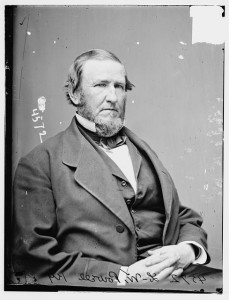
Hon. L.W. Powell ([between 1855 and 1865; LOC: LC-DIG-cwpbh-01380)

“constant fulminations”

The real reason probably may be found in two causes. First, Kentucky has more slaves than both the other States combined — her figure, by the last census, being 225,483, while that of Missouri was 114,931, that of Maryland 87,189. Having more property bound up in the system, it is natural that she should be more sensitive about it. But a more important cause for this difference of conduct on the part of Kentucky has been the fact that, while Missouri has had such public leaders as Senator HENDERSON and GRATZ BROWN, and Maryland such public journals as the Baltimore American and the Cambridge Intelligencer, to advocate the emancipation policy with ability and unflagging zeal, there has been in Kentucky no public man or public journal bold enough to start the discussion on the Anti-Slavery side. There is not a politician or a political organ in Kentucky that is not as timid as a hare on any question bearing against Slavery. The old habit of tabooing all discussion on the subject still prevails. A single high-souled, independent, earnest man of ability might easily break this up. The discussion once fairly opened, there can be no doubt it would lead to the same results as in the other two States.

If Kentucky has more slaves than they, she would obtain a proportionately larger share of compensation from the National Government. This compensation would, in fact, be just so much gained. The politicians of Kentucky seem to us to err in taking it for granted that the question still is whether Slavery shall be perpetuated in the State on its old basis, and in its old character. That thing, whether they accept the President’s plan or not, is impossible. Gen. ROSECRANS was perfectly right in declaring as he did, at the public banquet given in his honor at Louisville, last Summer, that if the war went on, Slavery must come to an end. Proclamation or no Proclamation, it is an institution that cannot stand the shock of civil war. All accounts agree that everywhere within our army lines effective slave labor is rapidly coming to an end. This is an inevitable result of the disordered condition of society. The slaves are becoming practically free by the mere force of circumstances. When this point is once reached, they never can be put back into their old condition with any profit to their masters. They will be so “demoralized,” as the expression is, that as slaves they will be forever worthless. Even apart from this inevitable operation of the war, how could Kentucky expect to retain Slavery when surrounded by Free States on every side but the South, as she would be when the system is at an end in Missouri and Western Virginia? It would cost her intolerable trouble.

The extinction of Slavery in Kentucky is simply a question of manner and time. Could the discussion once be fairly started among the people of the State, we are confident that the decision would be, as in Missouri and Maryland, that the compensating scheme of the President is the right manner, and now the appropriate time. But if the State chooses to shirk the subject, until her slaves become a profitless burden, without marketable value, she certainly should be allowed the privilege, without molestation. Of course if she resists until then, she will not expect help from the Government. That which has merely a nominal value can never be paid for in National money. Spurning the Government offer now, she must not complain when circumstances finally compel her to part from her cherished institution without a dollar from the Government treasury to lighten the sacrifice. There is a clear privilege on both sides; and there should be passion on neither.

The influence of the press and federal money.

Compensated emancipation only became law in the United States in the District of Columbia (April 16, 1862).

Wikipedia
attributes the following to Governor Robinson:

…he lamented what he perceived as poor treatment of the state as disloyal by the Federal government. He cited examples such as the declaration of martial law in the Commonwealth and the suspension of the right of habeas corpus for its citizens. He answered President Lincoln’s contention “that military necessity is not to be measured by Constitutional limits” by warning “If military necessity is not to be measured by Constitutional limits, we are no longer a free people.”

Lazarus Whitehead Powell served as U.S. senator from 1859-65:

Senator Powell favored Kentucky’s neutrality policy during the Civil War, but nationally, the conflict put him in a tenuous political situation. On one hand, he was a favored a strong national government and a strict interpretation of the U.S. Constitution. On the other hand, he was an opponent of coercion, and due to Kentucky’s proximity to the Southern states, maintained a more sympathetic view of the southern cause that legislators from more northern states. During his term as governor, Powell had been critical of Northern states that refused to abide by the Fugitive Slave Act.

In 1861, Senator Powell vigorously condemned President Lincoln’s decision to suspend the writ of habeas corpus. In 1862, he denounced the arrest of some citizens of Delaware—officially, the arrests were called “resolutions of inquiry”—as a violation of constitutional rights. These stances led to calls for his resignation by the Kentucky General Assembly in 1861, and some of his colleagues, led by Kentucky’s other senator, Garrett Davis, unsuccessfully attempted to have him expelled from the Senate. Before the end of the war, both the General Assembly and Davis admitted being wrong in their attempts to remove him.
Posted in 150 Years Ago This Week, Lincoln Administration | Tagged , , , , , , | Leave a comment

Constitutional Theorizing

Henry Ward Beecher (no date recorded on shelflist card; LOC: LC-USZC4-685)

Constitution is obsolete sheepskin

If States’ Rights are obsolete, why can’t we make New England one state?

From the Richmond Daily Dispatch January 14, 1863:

New England’s rights Considered — her Undue preponderance Objected to.

A New York paper, taking up a subject that is receiving general attention in the North–the propriety of leaving New England “out in the cold”–says:

The area of the New England States, leaving out Maine, is 33,272 square miles, that of New York is 47,000. All the northern and eastern portion of Maine is a wild, mountainous, and inhospitable region, incapable of settlement, so that the total arable surface of New England does not exceed the cultivable area of New York. Now, we wish to put the question, (we put it merely for illustration,) what objection is there to obliterating all the internal boundaries which distinguish the several New England States on the map, and consolidating them all into a single State? What right (bear in mind, we ask the question only to illustrate an argument) have three millions of population residing in New England to twelve Senators in Congress, when nearly four millions residing in New York are entitled to only two? This immense preponderance of political power, out of all reasonable proportion to its area and population, is held only by the tenure of the State rights which that section is madly attempting to undermine and overthrow. The stability of this disproportionate and enormous power rests wholly on the sacredness of the old State boundaries, which New England influence is attempting to shake and sweep away, and which it has already succeeded in destroying in Virginia. It is a favorite saw of the radicals that “revolutions never go backward;” and if this work of demolishing State rights and obliterating old State boundaries is to proceed, it is one of the likeliest things in the world that this fanatical and destructive device should return to plague the inventors. If they are going to roll up the Constitution as a piece of obsolete “sheepskin,” (this is Mr. Beecher’s tasteful and reverent epithet,) and return to first principles, why may not New York insist that New England shall take a dose of its own medicine? If the principle of human equality is to be rigorously carried out in the spirit of a doctrinaire, without regard to race or color, why not also without regard to the invisible mathematical lines which form State boundaries? Why, in short, is not a New Yorker as good as a Yankee? New England has one Senator in Congress to every 261,000 inhabitants, while New York has only one to 1,940,000, making the political value of a New Englander very nearly seven and a half times as great as that of a New Yorker.

Posted in 150 Years Ago This Week, American Society, Northern Politics During War, Northern Society | Tagged , , | Leave a comment

High and Dry in Jamaica

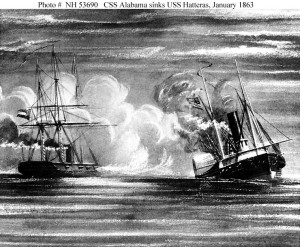
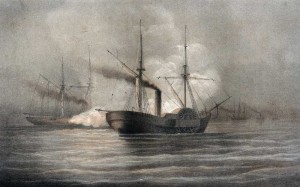
USS Hatteras (1861-1863) (right)  19th Century print, depicting the sinking of Hatteras by CSS Alabama, off Galveston, Texas, 11 January 1863.  U.S. Naval Historical Center Photograph

Bait & Switch: Alabama sinking Hatteras

1863 has been quite a year so far for John Arnett, a ship’s mate in the Union navy from Seneca Falls, New York. On New Year’s Day his ship, the Westfield, was blown up to prevent capture by the Confederates during the Battle of Galveston. As he closed his January 6th letter he wrote, “I have to report on some vessel, but I do not know which one as yet.” Based on the following report that ship was apparently the USS Hatteras, which joined the squadron off Galveston on January 6, 1863. John was not on board the Hatteras very many days. On January 11, 1863 his ship was sunk by the CSS Alabama during the Action off Galveston Light.

From a Seneca County, New York newspaper in February 1863:

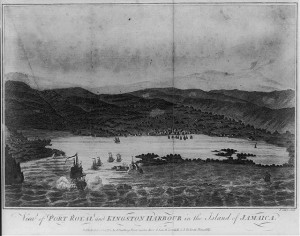
MR. ARNETT has heard from his son JOHN, who was on board the Hatteras during her engagement with the Confederate steamer Alabama. The Hatteras was sunk by the Alabama, and her officers and men taken on board the latter, paroled and landed at Kingston, Jamaica.

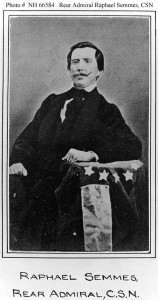
Rear Admiral Raphael Semmes, CSN  Photographed with the Confederate flag.  U.S. Naval Historical Center Photograph.

Raphael Semmes showing Confederate flag

The Alabama’s commander Raphael Semmes tells his story of the engagement in Memoirs of Service Afloat, During the War Between the States (page 541 and following). Semmes decided to sail from the Arcas Islands to the coast off Galveston to intercept the expedition of Union General Nathaniel Banks, the “hero of Boston Common”. When Semmes realized he had missed Banks, he decided to lure one of the Union ships away from the squadron and battle it one-on-one. About 20 miles later the fight commenced:

My men handled their pieces with great spirit and commendable coolness, and the action was sharp and exciting while it lasted; which, however, was not very long, for in just thirteen minutes after firing the first gun, the enemy hoisted a light, and fired an off-gun, as a signal that he had been beaten. We at once withheld our fire, and such a cheer went up from the brazen throats of my fellows, as must have astonished even a Texan, if he had heard it. We now steamed up quite close to the beaten steamer, and asked her captain, formally, if he had surrendered. He replied that he had. I then inquired if he was in want of assistance, to which he responded promptly that he was, that his ship was sinking rapidly, and that he needed all our boats.

My first thought was that John Arnett had a rocky start to 1863, but then I remembered we’tre talking about the American Civil War. As John wrote in his January 6th letter, “I lost part of my clothes when the old Westfield went, but I am thankful that I did not lose my head.”

View of Port Royal and Kingston Harbour in the Island of Jamaica (no date recorded on shelflist card; LOC: LC-USZ62-39540)

Port Royal and Kingston harbor

The Combat between the Alabama and the Hatteras, off Galveston, on the 11th of January, 1863 (KELLY, PIET & CO. PUBLISHERS  LITH BY A. HOEN & CO. BALTO)

Another view of the Action, (Hatteras main focus

Posted in 150 Years Ago This Week, Naval Matters | Tagged , , , , | Leave a comment