Digging Past Vicksburg?

View of Vicksburg and plan of the canal, fortifications & vicinity Surveyed by Lieut. L. A. Wrotnowski, Top: Engr. Drawn & lithogd. by A. F. Wrotnowski C.E.  Wrotnowski, L. A.  CREATED/PUBLISHED [S.l.], 1863.

Trying to get past Vicksburg

150 years ago this week Federal troops began digging a canal that was intended to cut between two sections of the Mississippi River so that Union ships could avoid passing by Vicksburg and its effective cannon defenses.

From A Seneca Falls, New York newspaper published July, 1862:

From Vicksburg.

We are permitted to peruse a very interesting letter from JOHN ARNETT, of our village, received this morning by his parents. It is dated on board the U.S. Steamer Westfield, off Vicksburg, June 30th, and gives an account of the bombardment of that city by the mortar and gunboats, which commenced on the 26th ult. The rebels seem to make an obstinate resistance to the fleet, and from last reports the city had not yet surrendered. – JOHN states that there are five thousand Federal troops near Vicksburg, under command of Gen. WILLIAMS, and that they, together with the contrabands are cutting a new channel for the river, which, when completed, will leave the city a distance of 3 miles from the same. The Westfield and all on board had a narrow escape during the bombardment. He states that a rifle shot from the enemy passed through the starboard wheelhouse and through the armory, bringing up in the passage way, within three inches of the steam cylinder.

The letter is very interesting, and we regret that we have not had time or room this week to publish it complete.

As that National Park Service link points out, the 1862 work on the canal ended after about a month of deaths from disease and heat. The canal was not big enough for ships to pass.

Posted in 150 Years Ago This Week, Military Matters | Tagged , , , , | 2 Comments

Carrots and (500,000) Sticks

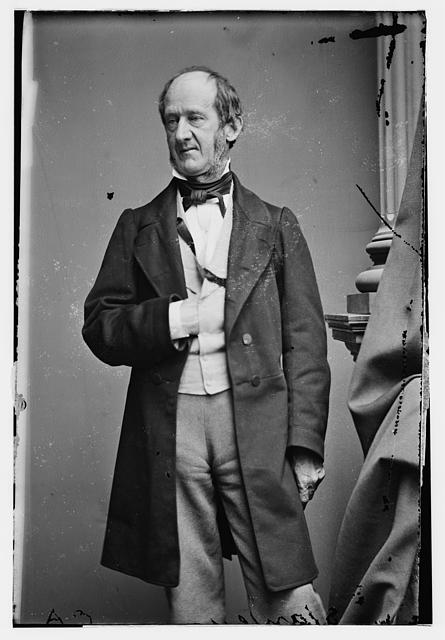
Hon. Edward Stanly of N.C. (between 1855 and 1865; LOC: LC-DIG-cwpbh-01285)

Olive branch backed up with 500,000 bayonets

From the Richmond Daily Dispatch June 26, 1862:

“Governor”Stanly makes a speech.

–The Yankee paper published in Washington, N. C., called the New Era, contains, in its issue of the 19th inst., a report of Stanly’s speech, made in that town on Tuesday, the 14th. We have seen a copy, and can find nothing in it to change our opinion in the least of the man. He says “Mr. Lincoln called upon an old son of North Carolina to bear he the olive branch of peace,” and he “implores” his hearers “to come back” into the Union, “and those bright bayonets” which now seem to flash enter and indignation will assure you protection, and happiness !” “Remember the North has over 500,000 men in the field, and while a piece of iron can be found in the earth — while a grain of gunpowder can be manufactured — each one of them is ready to pour out his last drop of blood for the Union.”

The Wilmington Journal calls attention to these quotations especially to show the inconsistency of the man. At one breath he is imploring the people to return to the Union; in the next he is holding forth threats of destruction with “bright bayonets.” if he is not obeyed; yea, “500,000 men will shed the last drop of blood for the Union;” that is, the subjugation of the South. The Journal has information that a good many persons were present to hear what stably had to say, but they manifested no disposition of approval of his course. They could not, as a matter of course, give public expression to their feelings of disapproval, being surrounded by Yankee bayonets. His reception in Washington was that of coldness. No attention was paid to him by the citizens, although it is differently reported in the Era.

Edward Stanly was a Whig from North Carolina who supported the Union over states’ rights. In 1853 he moved to San Francisco to practice law. Apparently the war brought him back East because in May 1862 President Lincoln appointed him military governor of eastern North Carolina. Stanly resigned in March 1863 because, as North Carolina Historic Sites points out, although he was a Unionist, he was also opposed Lincoln’s Emancipation Proclamation. He returned to his San Francisco law practice.

Stanly’s nephew was Confederate General Lewis Armistead.

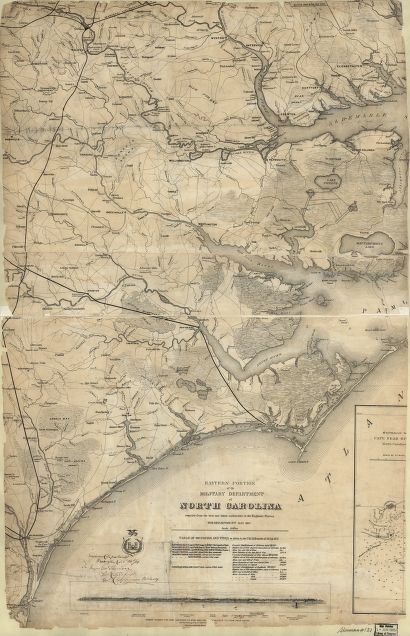
Eastern portion of the Military Department of North Carolina / compiled from the best and latest authorities in the Engineer Bureau, War Department, May 1862. (LOC: g3900 cws00121 http://hdl.loc.gov/loc.gmd/g3900.cws00121)

Mapping the eastern part of Stanly’s military department

Posted in 150 Years Ago This Week, Confederate States of America, Military Matters, Southern Society | Tagged , , , , | Leave a comment

Merciful McClellan

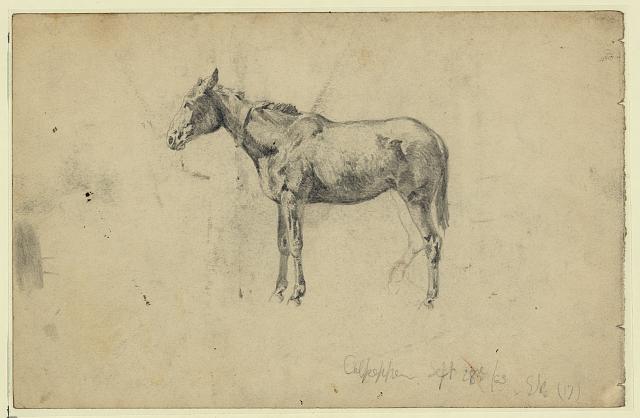
An army mule. September 28, 1863 (by Edwin forbes,1863 Sept. 28; LOC: LC-DIG-ppmsca-20572)

Thanks, General

A Kinder, Gentler Army?

The first part of the following is an order by General McClellan forbidding his troops to maraud the locals, which would seem to me to make good policy sense. As you can read, the second order controls the speed that army mules and horses are driven. My first reaction was “Twilight Zone” because certainly humans and animals have already been killed and mangled in battle, but I guess it makes sense to control speeds and not wear the animals out before it is necessary. Maybe what put me off is The Times Mercy headline.

From The New-York Times June 22, 1862:

ORDERS BY GEN. McCLELLAN.

MERCY TO BEASTS.

HEADQUARTERS, ARMY OF THE POTOMAC,

CAMP LINCOLN, Va., June 12, 1862.

1. All fast riding or driving of public horses and mules is positively prohibited, unless in case of necessity. Trains will not move faster than a walk, except under written orders to the officer or wagon-master in charge. Officers sending mounted messengers with dispatches, which are to be carried at a faster pace than a walk, will indicate on the envelope the gate the messenger is to take, whether a trot or a gallop. The same directions may be indicated by the seals of the envelope — one seal for the walk, two for the trot, and three for the gallop. Officers will be held responsible for the instructions they give to mounted orderlies or trains with regard to their gait.

All Provost Marshals and Provost Guards are specially charged with the enforcement of this order.

2. The present camp of these headquarters will be known as Camp Lincoln.

By command of Major-Gen. McCLELLAN.

S. WILLIAMS. Assistant Adjutant-General.

Posted in 150 Years Ago This Week, Military Matters, Peninsula campaign 1862 | Tagged , , | Leave a comment

His Three Sons

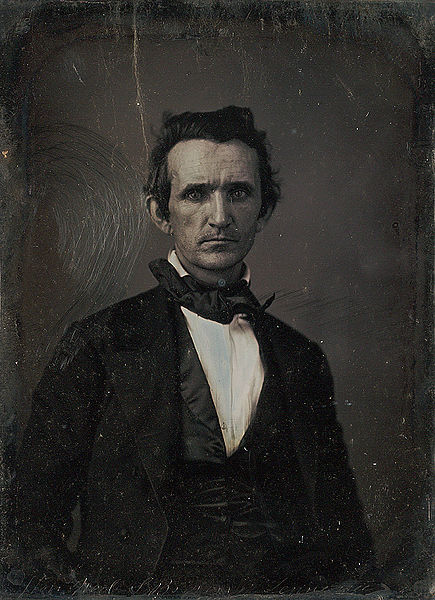
Neill_Smith_Brown_by_Mathew_Brady_1849

Apostate’s speech drives out the teenager

From the Richmond Daily Dispatch June 24, 1862:

Neil S. Brown.

–The Knoxville Register relates an incident which followed Neil S. Brown’s apostasy, which was calculated to bring a blush to the cheeks of the most hardened renegade. Brown has three sons; two of them are in the Confederate army, and one, a youth of about fifteen, was at home. Upon hearing of his father’s making a Union speech, this noble lad sought him, and hearing the confirmation from his own lips, not only expressed his indignation, but declared he could never again set foot beneath the parental roof, but would join his brothers in defence of the South. It is said he has kept his word.

Neill Smith Brown served as Governor of Tennessee from 1847-1849. He was a delegate to the convention that wrote the 1870 state constitution that was required to outlaw slavery.

Posted in 150 Years Ago This Week, Confederate States of America, Southern Society | Tagged , , | Leave a comment

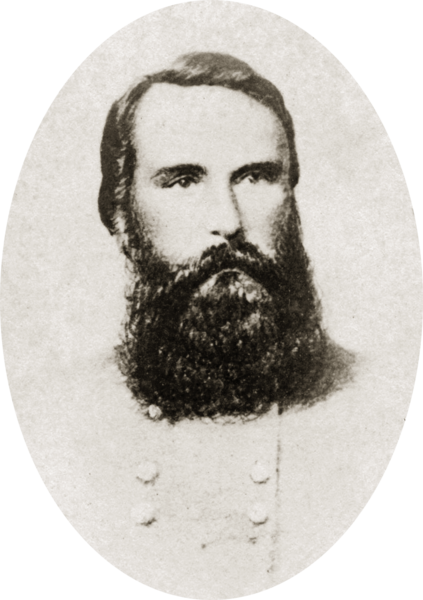
Pep talk from General Longstreet

Battle sounds worse than it is. “Keep cool, obey orders, and aim low”
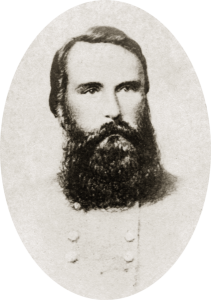
James Longstreet circa 1862

Urges his troops to fight against the ‘shame of slavery’

From the Richmond Daily Dispatch June 23, 1862:

Gen. Longstreet’s address.

The following address has been issued to the men of his division by Gen. Longstreet. It has the ring of true metal, and will be read with interest both by soldiers and civilians. Without doubt this calm and patriotic address, written by a genuine soldier, will have its desired effect:

Headquarters right Wing,

Army before Richmond, June 17th, 1862.

Soldiers:

You have marched out to fight the battles of your country, and by those battles must you be rescued from the shame of slavery. Your foes have declared their purpose of bringing you to Feggary [Beggary?] and avarice their national characteristic, recites them to redoubled efforts for the conquest of the South, in order that they may seize her sunny fields and happy homes. Already has the hatred of one of their great leaders attempted to make the negro your equal by declaring his freedom, they care not for the blood of babes, nor carnage of innocent women, which servile insurrection thus stirred up may bring upon their heads.–Worse than this, the North has sent forth another infamous chief, encouraging the lust of his hirelings to the dishonor and violation of those Southern women who have so untiringly labored to clothe our soldiers in the field, and nurse our sick and wounded. If ever men were called upon to defend the beloved daughters of their country, that now is our duty. Let such thoughts nerve you up to the most dreadful shock of battle; for were it certain death, death would be better than the fate that defeat would entail upon us all. But, remember, though the fiery noise of battle is indeed most terrifying, and seems to threaten universal ruin, it is not so destructive as it seems, and few soldiers, after all, are slain. This the Commanding General desires particularly to impress upon the fresh and inexperienced troops who now constitute a part of this command. Let officers and men, even under the most formidable fire, preserve a quiet demeanor and self- possessed temper. Keep cool, obey orders, and aim low, Remember while you are doing this, and driving the enemy before you, your comrades may be relied on to support you on either side, and are in turn relying upon you. Stand well to your duty, and when these clouds break away, as they surely will, the bright sunlight of peace, falling upon our free, virtuous, and happy land, will be a sufficient reward for the sacrifices which we are now called upon to make.

James Longstreet.

Major-General Commanding.

I had no idea that in one week in January 1862 James Longstreet lost three of his young children to scarlet fever.

Southern fears over northerners taking southern land were not unfounded. On June 21, 1862 the Daily Dispatch published a commentary on the last letter a Yankee soldier (killed at Shiloh) allegedly wrote to his wife: he’s already picked out a fine southern farm and they can get white women to do the household chores. In December 1861 a Union captain wrote that he expected industrious northern farmers to occupy and cultivate Virginia farms after the war.
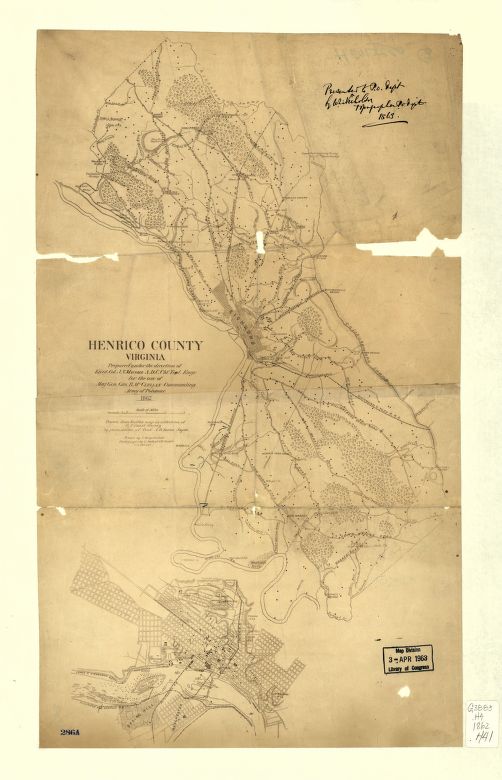
Henrico County, Virginia : prepared under the direction of Lieut. Col. J.N. Nacomb, A.D.C., Chf. Topl. Engr. for the use of Maj. Gen. Geo. B. McClellan, commanding Army of Potomac / drawn by E. Hergesheimer ; photographs by G. Mathiot & D. Hinkle, C.S. Office, 1862. LOC: g3883h cw0559200 http://hdl.loc.gov/loc.gmd/g3883h.cw0559200)

Disputed ground -Henrico County by McClellan’s topographical engineer
Posted in 150 Years Ago This Week, Confederate States of America, Military Matters, Peninsula campaign 1862 | Tagged , , | Leave a comment

Viva La Vega

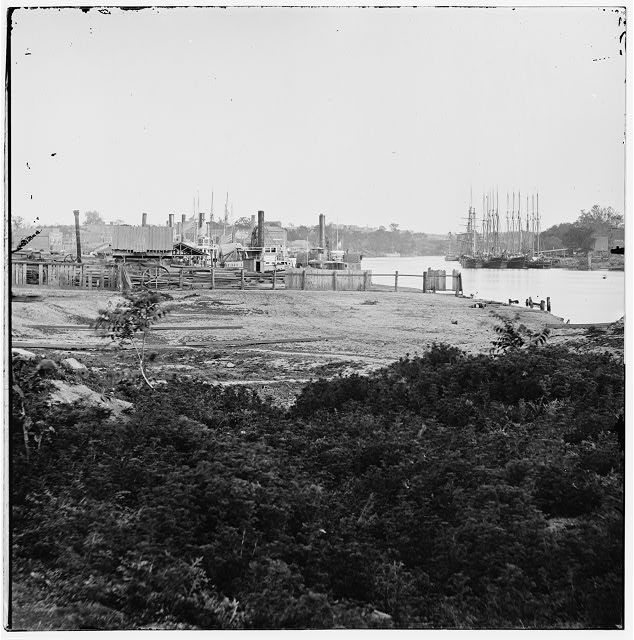
Richmond, Virginia. Wharf at Rocketts (1865 Apr; LOC: LC-DIG-cwpb-02717)

near where La Vega returned from exile

Like Napoleon at Elba

Even with over 100,000 Yankees a few miles away, it wasn’t all war news in the Confederate capital.

From the Richmond Daily Dispatch June 21, 1862:

Illustrating the Benefits of advertising.

–Mr. George Horton, who lives on the east end of Main street, near Rocketts, keeps a dog called La Vega — an ill-favored, fierce-eyed brute, whose untidy habits and cross grained temper cause him to be held in detestation by the family in general, and Mrs. Horton, his mistress, in particular. La Vega, however, is a great favorite with his master. About a week ago, Mrs. Horton became exasperated on account of some unendurable offence committed by La Vega, and privately bargained with an old colored collector of soap fat, named Abe Walker, who, for a dollar fee, agreed to take the dog off and “render him up” into tallow, or otherwise relieve Mrs. Horton from the annoyance of his presence. Mr. Horton, on coming home to his dinner, inquired for La Vega, and was chagrined with the information that his troublesome pet had absconded. For some days the absence of La Vega gave occasion for much rejoicing in the household, and even the grief of Mr. Horton for his loss was made the subject of many a sly joke in his domestic establishment. Mrs. H. congratulated herself excessively on that lucky thought of hers, which cleared her house of the odious brute; and though she is a lady who thinks a good deal of a dollar, she did not grudge the money, since it gained her object so effectually. In the meantime, La Vega was detained a close prisoner in the cellar of the soap factory, amusing himself by snapping at the rats which coursed about the premises, and sustaining himself, like Napoleon at Elba, with the belief that the objects of his destiny were not yet accomplished. On Thursdaymorning, Mr. Horton appeared at the breakfast table with a beaming countenance, “Well, my dear; good news ” said he to Mrs. H. “What is it?” asked the lady with some secret misgiving. “I’ve get La Vega back again. Advertised for him; offered a reward for his recovery, and this morning he was brought home by Abe Walker.””Heavens!” ejaculated Mrs. Horton, “what did you have to pay for him?””Only eleven dollars,” replied Horton; “one for the advertisement and ten to Old Abe for bringing him back. “”Merciful goodness!” cried the unsympathizing wife. “Eleven dollars, (enough to buy a dress pattern.) for the recovery of such a nasty cur! and to think that I gave the black rascal a dollar for taking him off.” This inadvertent confession of course produced a matrimonial duet, the report of which we omit, as it might appear stale and commonplace to some of our married readers.–By this little canine speculation all parties were gainers. Abe Walker, the cunning darkey, gained eleven dollars, the advertising sheet gained one dollar, and Mr. and Mrs. Horton gained some valuable experience, which will no doubt teach them the importance of mutual confidence between wedded partners.

Of course, there was the plug for print advertising. I wonder if the war was having an effect on newspapers 150 years ago similar to the Internet’s effect today.

Posted in 150 Years Ago This Week, Southern Society | Tagged , | Leave a comment

Richmond Racket

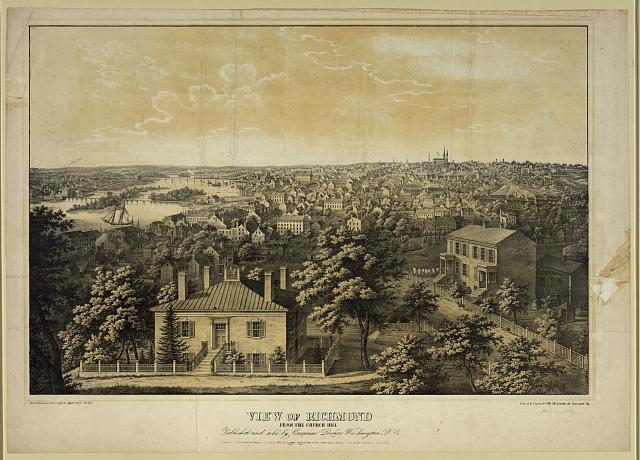
View of Richmond from the church hill (Published and sold by Casimir Bohn, c1851; LOC: LC-DIG-pga-02597)

Beware the low dens of the substitution racket

Arrest a substitute because he’s probably a deserter, and shoot a few to cut down on the nefarious practice. Well, I guess that would be an advantage of martial law.

From the Richmond Daily Dispatch June 20, 1862:

The substitute Swindle.

For sometime past persons representing themselves either as Baltimoreans or members of the 1st Virginia regiment, have been through the army trying to sell themselves as substitutes. In several cases these swindlers have succeeded in accomplishing their object, and have received money from their too willing dupes, deserting as soon as it was safely in their pockets. We doubt if one of these men ever belonged to the First Virginia. We doubt if they are anything but the veriest scoundrels and knaves — men who have deserted time and time again, and who make a business of this nefarious practices. These men also have accomplices in this city in those who advertise so extensively to furnish substitutes “at a reasonable price, ” who not only assist them in their swindling tricks, but swear to their character and shelter them in their low dens when they have deserted. After a short time they are again brought out and sold over to other parties. Within a day or two we have heard of at least a down [dozen?]  of these rascals who have been offered at different points in the army. Two came to an Alabama regiment, and were purchased for $1,700, six hundred of this going to the man who procured them. Two days afterwards both men were missing. This evil has become so great that it should be immediately attended to, and some of the base follows summarily dealt with. There are two ways to put an end to the pernicious practice, In the first place, every man who offers to sell himself as a substitute should be looked upon with suspicion, and be arrested on the spot as a deserter, which in nine cases out of ten he will prove to be. Secondly, a few of them should be court-martialed and formally shot. After what has transpired, and the frequent warning given by the press, it would be the height of folly for any soldier to throw his money away upon these infamous scoundrels.

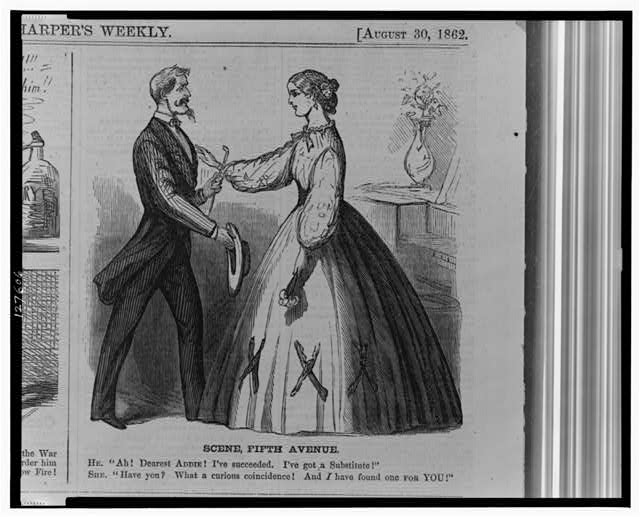
Substitution was also a phenomenon in the North:

Scene, Fifth Avenue (Harper's Weekly August 30, 1862; LOC: LC-USZ62-127606)

Patriotic Northern Belle?

Posted in 150 Years Ago This Week, Confederate States of America, Southern Society | Tagged , | Leave a comment

Would-be Chaplain Praises Acting Surgeon

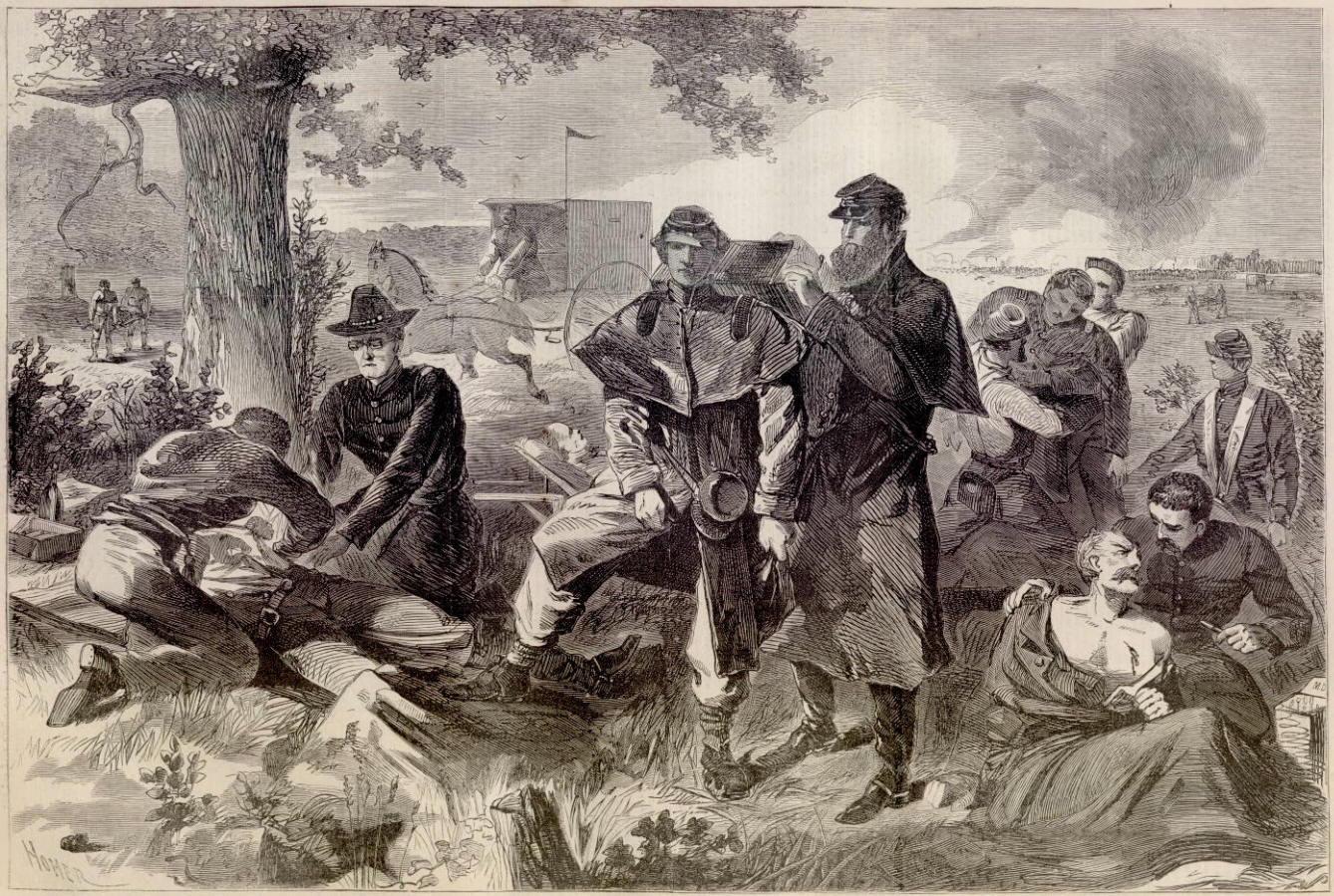
civil-war-surgeon by Winslow Homer (Harper's Weekly July 12, 1862;http://www.sonofthesouth.net/leefoundation/civil-war/1862/july/winslow-homer-surgeon.htm)

A surgeon at work behind the lines (by Winslow Homer)

The following article in a Seneca Falls, New York newspaper from June 1862 came immediately after the story of the lingering death of Charles Mensch, so I guess the editors were developing a medical theme.

A Merited Compliment

The Chaplain of the 61st Regiment, N.Y.S.V., rev. H.C. Vogel, writing from St. Peter’s Church, 15 miles from Richmond, under date of May 20th, thus speaks of Dr. SAMUEL R. WELLES, of our county:

“As Chaplain I entered the army, but as Assistant Surgeon, I have been obliged to act from necessity, on account of a vacancy in the department, Dr. S.R. Welles, of Waterloo, Sen. Co., is the acting Surgeon of the Regiment. He is an active, efficient and skillful physician, whose services to the sick and afflicted can only be known at the final reckoning. Vigilant and untiring, and prompt in the active duties of his profession, I consider him not excelled by any of the medical staff in the army. Very fortunate was our coming together in the army, and very pleasant has the association been. Similarly situated in regard to position, we share mutually the “rights and benefits,” and thus drive off the shadows, which hang around the path and field of conflict, and look through the darkening gloom – to the rainbow dipped in the sunlight of Faith, Hope, and Charity – the fixed stars in the Masonic galaxy, reflected from the dress of the passing storm.”

This letter sure seems to say something about the war’s effect on the supply and demand of medical resources when a reverend who signs up to be chaplain is forced to take on the role of assistant surgeon.

A Berdan Sharpshooter site has a good overview of Freemasonry in the Civil War.

Posted in 150 Years Ago This Week, Military Matters, Northern Society | Tagged , , , | Leave a comment

(Our) jobs depend on it!

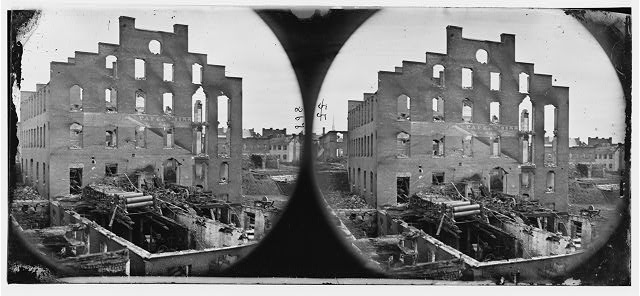
Richmond, Va. Ruins of paper mill; wrecked paper-making machinery in foreground (1865 April; LOC: LC-DIG-cwpb-00408)

Richmond paper mill, April 1865

Rags for Rags?

From the Richmond Daily Dispatch June 18, 1862:

Rags and raw cotton Wanted.

The paper mill in this city, now our sole dependence for a supply of printing paper, is very much in want of material for manufacturing paper. Both rags and raw cotton will bring excellent prices at the manufactory. Country people, by gathering up what they can and bringing it to market, will find a new source of profit and confer a benefit on the press and the public. At present, we are threatened with a suspension of newspapers for the want of paper to print upon. We urge the people in both town and country to gather up and being their rags and cotton to the paper mill as rapidly as possible.

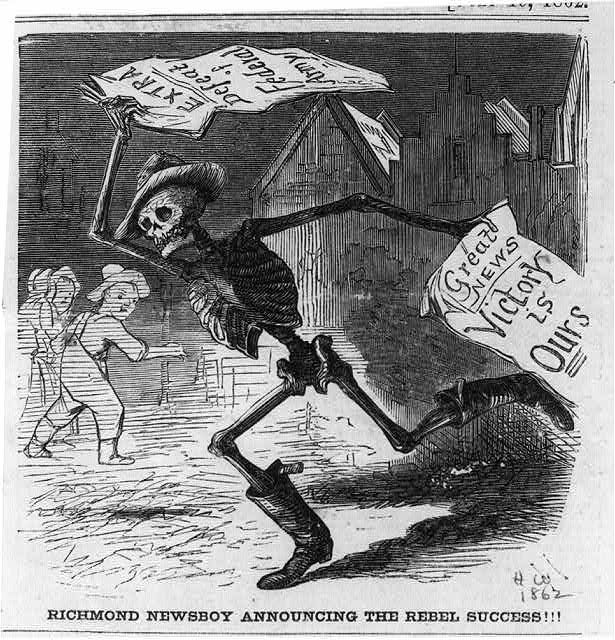
Richmond newsboy announcing the rebel success!!! (1862; LOC: LC-USZ62-72954)

Gettin’ the word out in leaner and leaner times

Posted in 150 Years Ago This Week, Confederate States of America, Southern Society | Tagged , , , | Leave a comment

“they mowed our men down like grass”

You can read all about it at Civil War Daily Gazette and The Civil War 150th Blog. Here a man from Seneca Falls, New York, who volunteered for the 8th Michigan, describes the Battle of Secessionville in a letter home. From a Seneca Falls, New York newspaper:

From South Carolina.

JAMES ISLAND, S.C.,
June 19, 1862.

I have just passed through one of the most desperate battles on record, and came out unharmed. On the morning of the 16th, we were ordered to march to take a rebel battery about two miles from our camp. Our regiment was in advance, and we had to march in an open field for over a mile in front of the enemy’s works. The Fort was to be taken by a charge. The rebels reserved their fire until we got within about forty rods of the Fort, and then they opened on us with rifles; their fire came thick and fast, but not a man faltered. – Steadily we advanced at a charge without firing a gun, bound to take the Fort with the cold steel. When within about ten rods of the fort, they opened on us a deadly fire of grape and cannister. Scores fell around me and they mowed our men down like grass. Our Captain, the acting major, fell, and also our 1st Lieutenant, mortally wounded. Our men were already on the embankment, and our colors were there. – The 79th N.Y., flew to our assistance, while the 28th Massachusetts could not be drove up, their men acting badly indeed and through their conduct the day was lost. We suffered terribly, losing out of our regiment two hundred and eight killed, wounded and missing. Our Captain was left on the field, as they would not allow us to bring off our dead with a flag of truce. – We lost out of our regiment eleven commissioned Officers, killed wounded and missing. I am the highest officer left in our company now, except one lieutenant who is acting aid to the General. We lost out of our company seventeen killed, wounded and missing. I never saw such a slaughter of human beings before, and God spare me from witnessing such a sight again. The enemy is strongly fortified on this Island, but we must have more men, and why does the Government withhold them from us? I guess our regiment has fought its last battle, as we have only about 380 men left. Lieut. Col. GRAVES was in command of the regiment, and no braver or better man ever wielded a sword. He is a fine fellow; he rode backwards and forward, through the thickest of the fight, and had his horse shot from under him. I feel sorry to think that we lost the day, but we have this to console us, and that is that we have done our duty as true soldiers of the Union, and although we have been repulsed, we are determined yet to see our glorious old flag triumphantly waving over Charleston, Sumpter and Moultrie, and that too at no distant day. I have but one life, and if that is required I will cheerfully lay it down on the altar of my country. We hope to see this war end ere long, and our failure has only made us the more desperate. Tell mother I have done my whole duty thus far: I am bound to always try and do what is right, and all I can for my country. I hope you will write often, and I will try to do the same.

Ever your brother, S.S.

Posted in 150 Years Ago This Week, Military Matters | Tagged , , , | Leave a comment