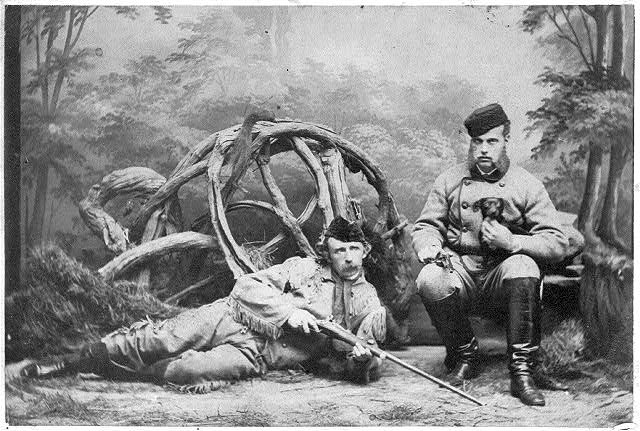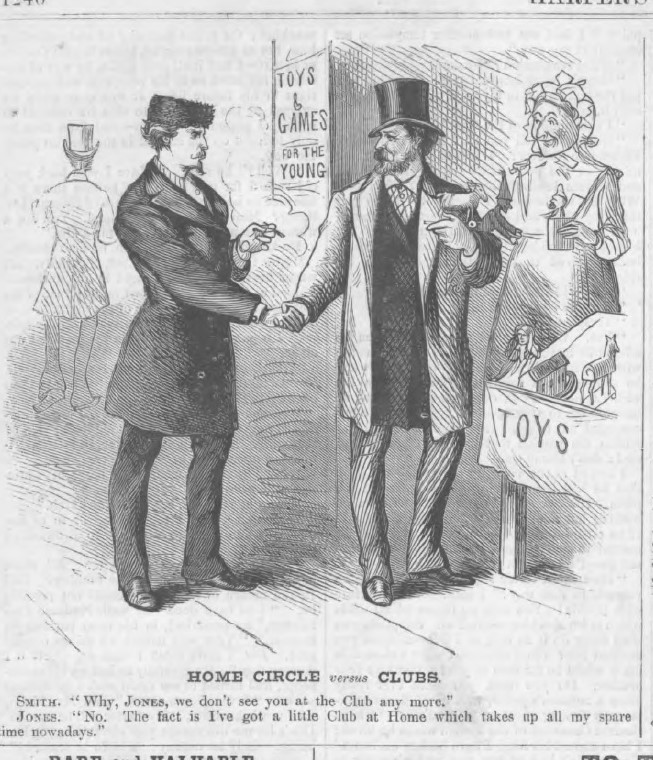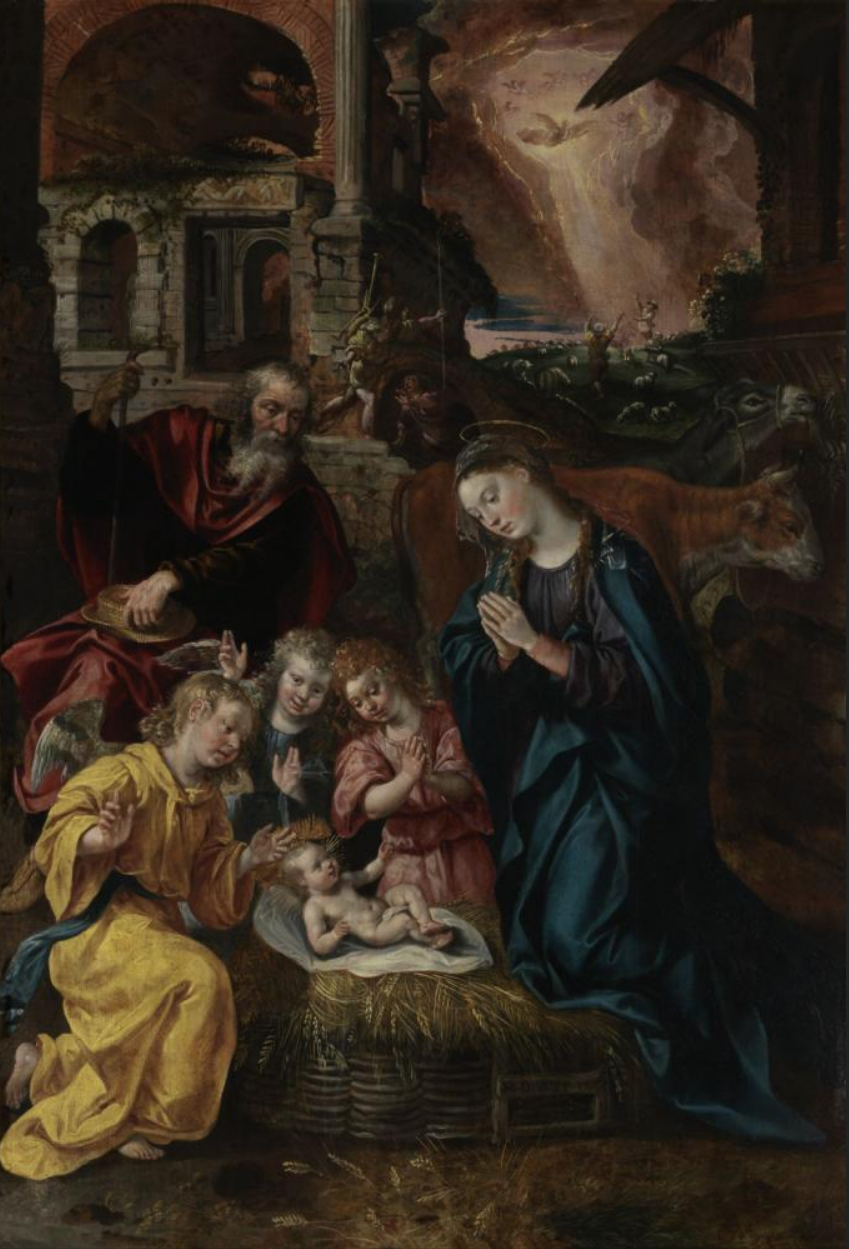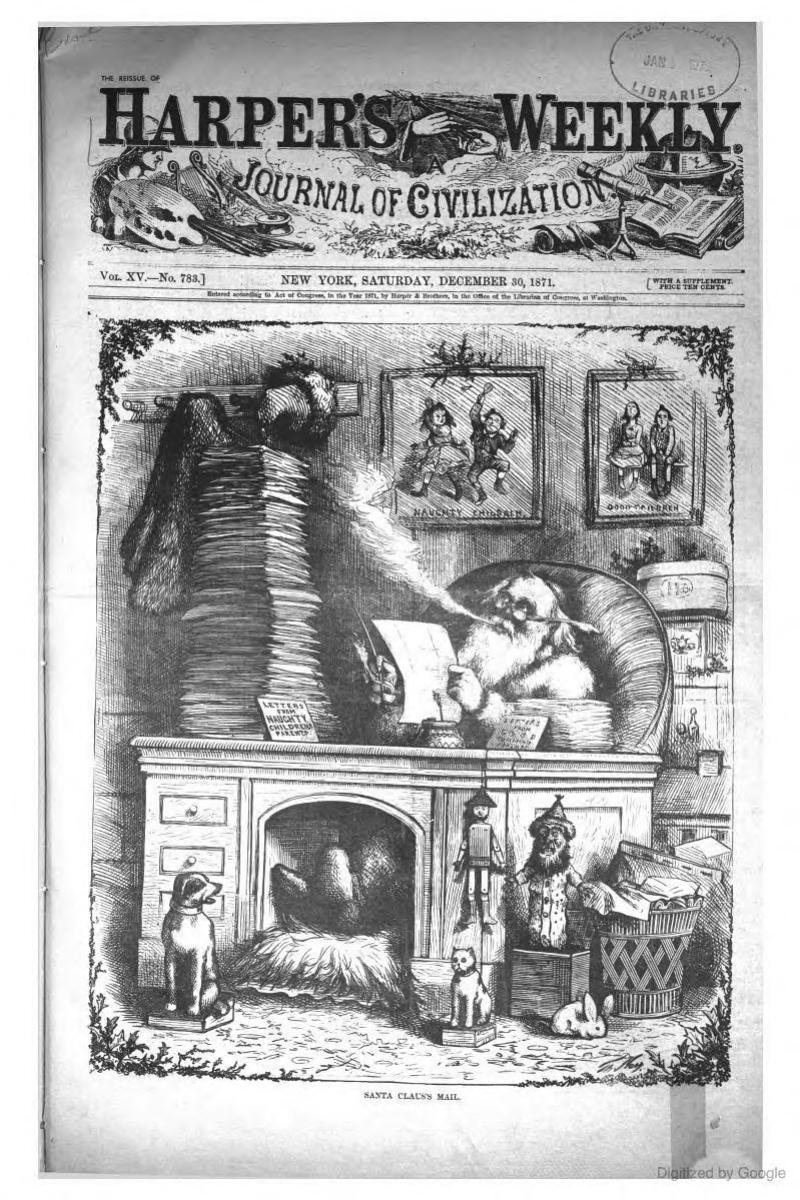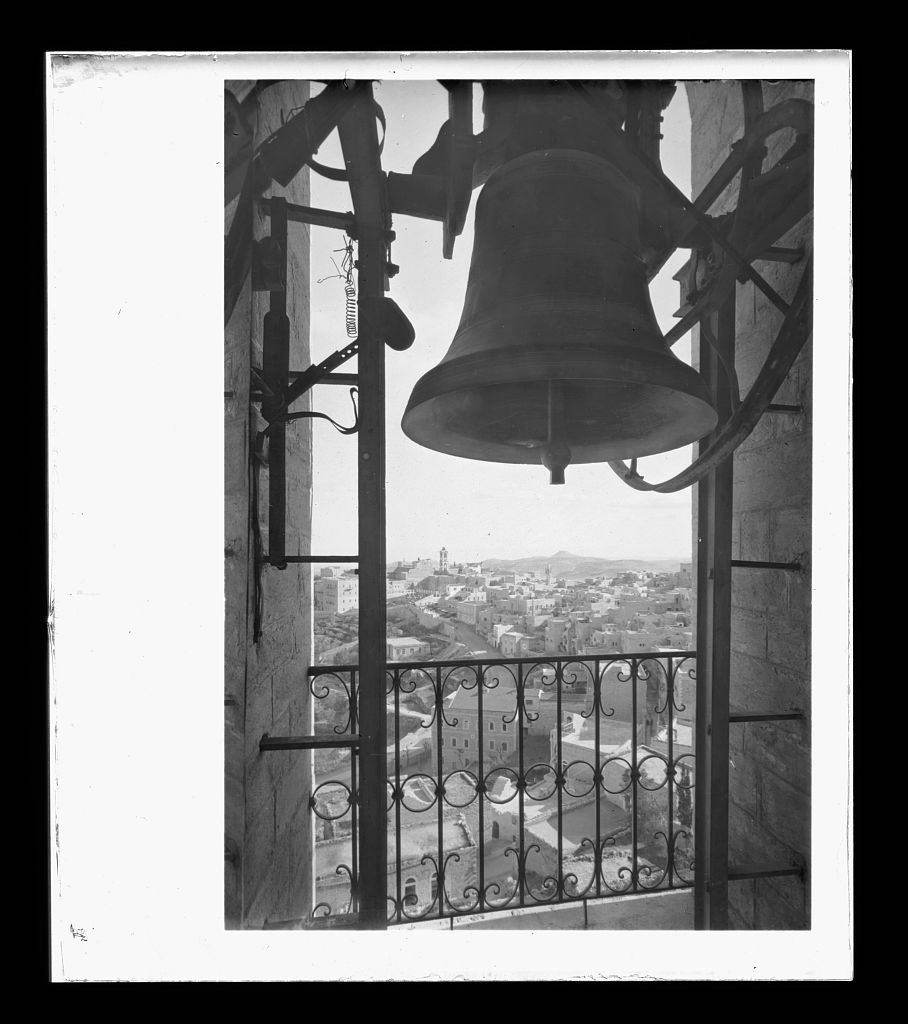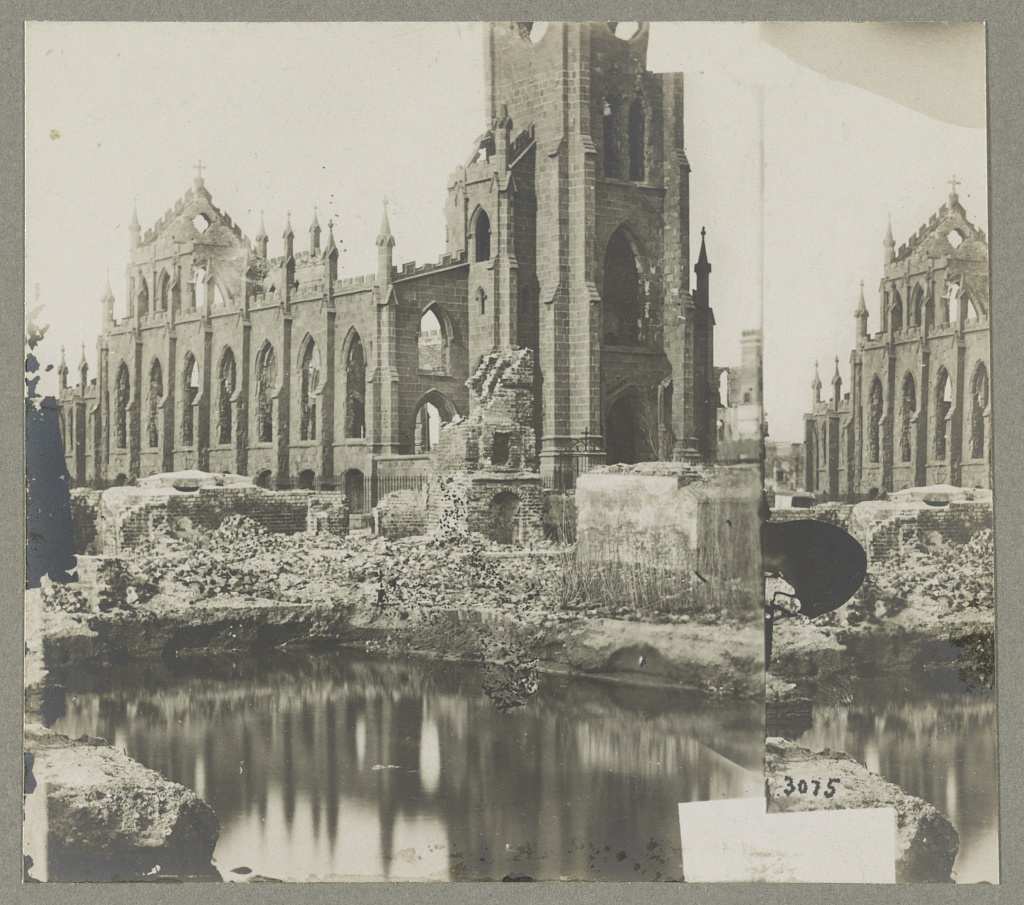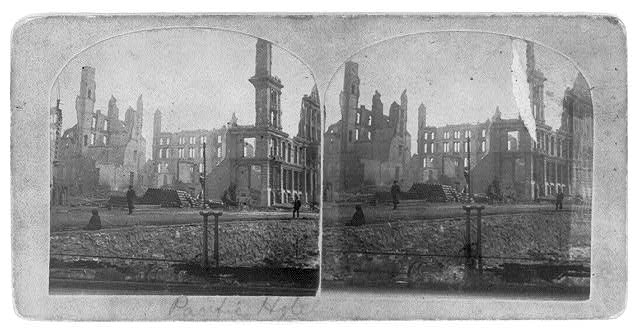
not half bad

one of the calamities

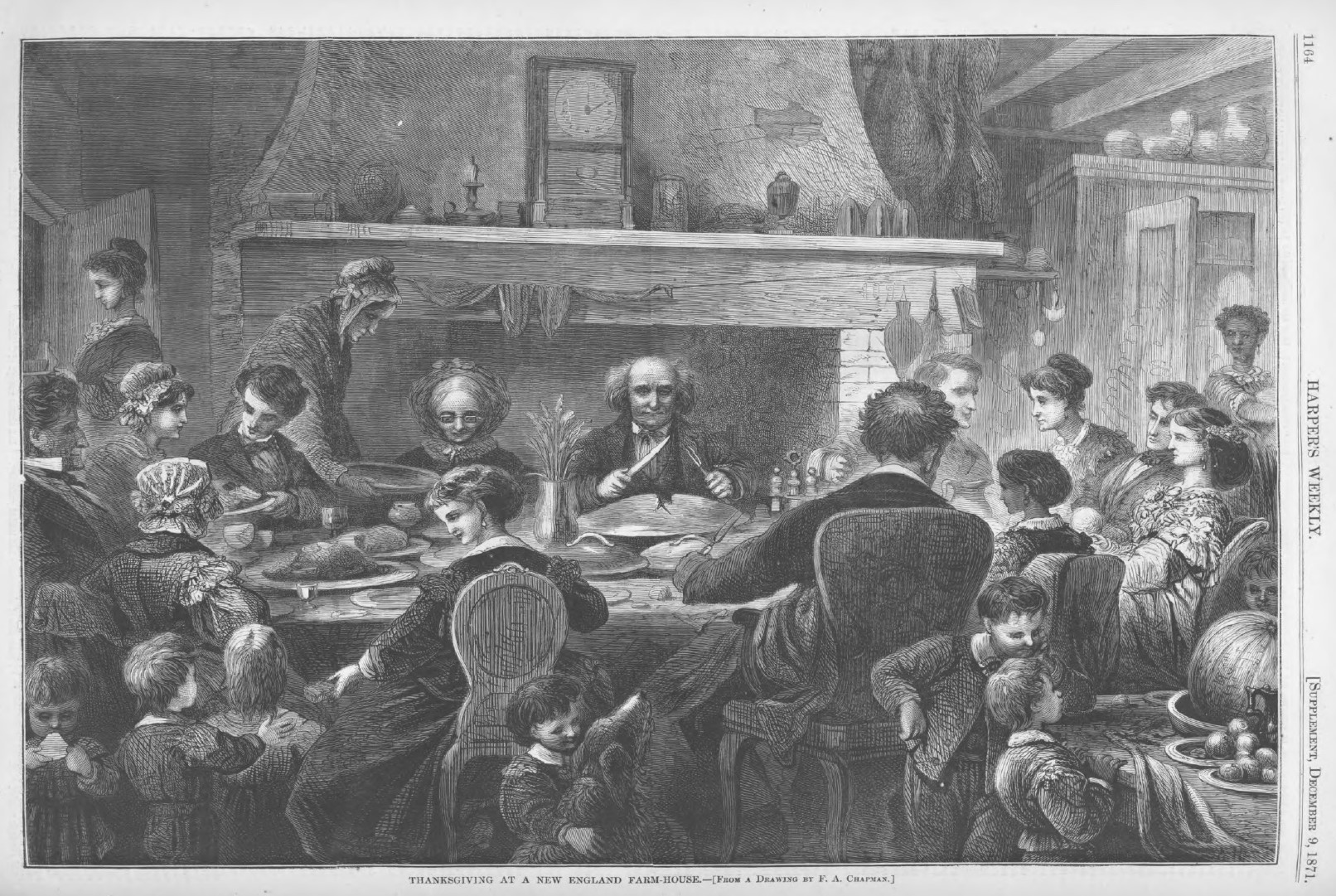
Another year, another Thanksgiving. Here’s President Grant’s 1871 Proclamation:

THANKSGIVING DAY 1871
BY THE PRESIDENT OF THE UNITED STATES OF AMERICA – A PROCLAMATION

The process of the seasons has again enabled the husbandman to garner the fruits of successful toil. Industry has been generally well rewarded. We are at peace with all nations, and tranquillity, with few exceptions, prevails at home. Within the past year we have in the main been free from ills which elsewhere have afflicted our kind. If some of us have had calamities, these should be an occasion for sympathy with the sufferers, of resignation on their part to the will of the Most High, and of rejoicing to the many who have been more favored.

I therefore recommend that on Thursday, the 30th day of November next, the people meet in their respective places of worship and there make the usual annual acknowledgments to Almighty God for the blessings He has conferred upon them, for their merciful exemption from evils, and invoke His protection and kindness for their less fortunate brethren, whom in His wisdom He has deemed it best to chastise.

In witness whereof I have hereunto set my hand and caused the seal of the United States to be affixed.

Done at the city of Washington, this 28th day of October, A.D. 1871, and of the Independence of the United States of America the ninety-sixth.
U.S. GRANT

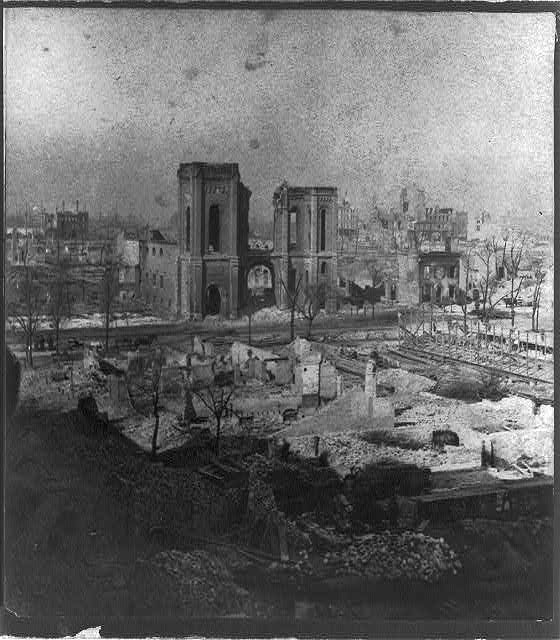
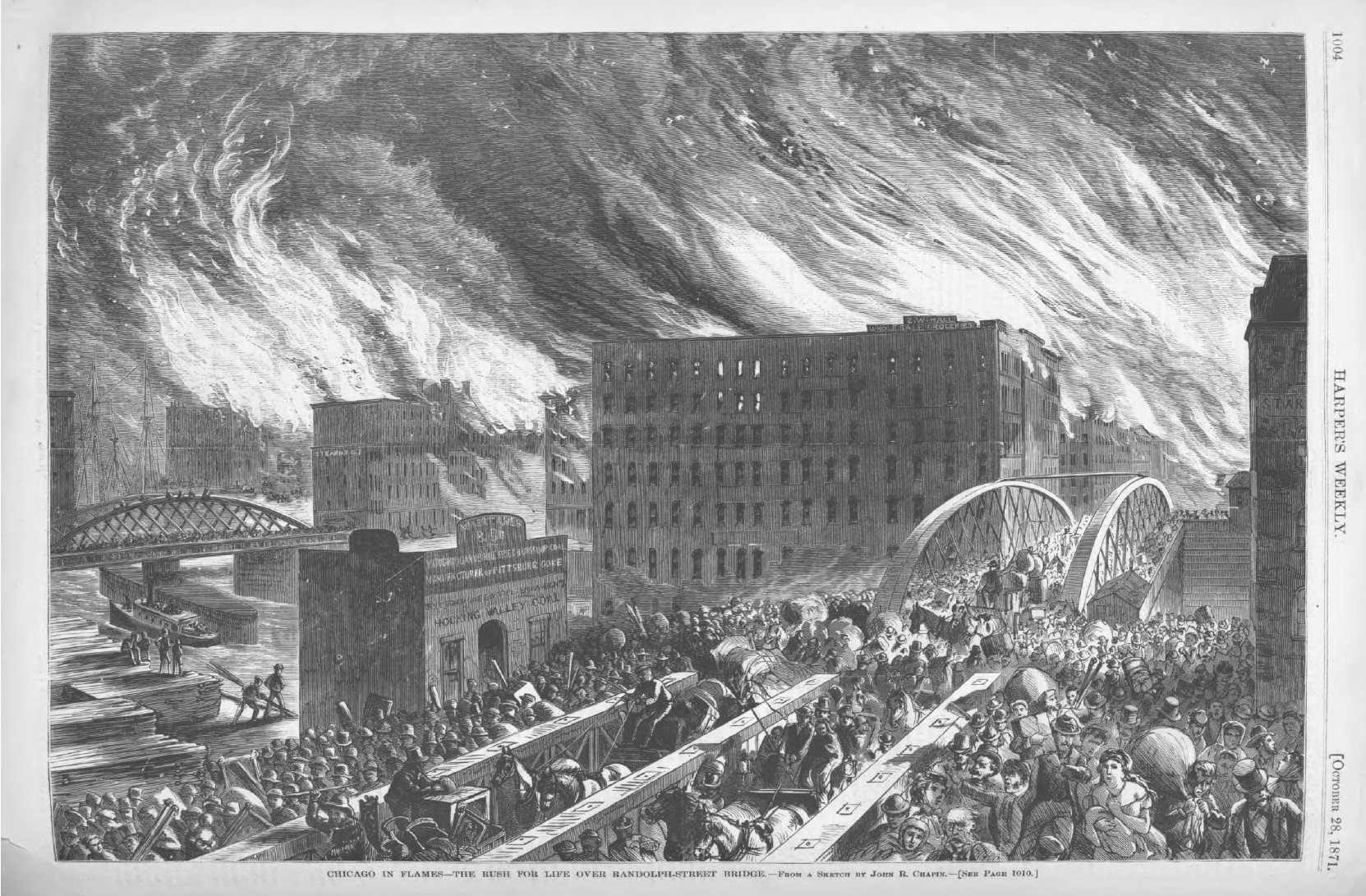
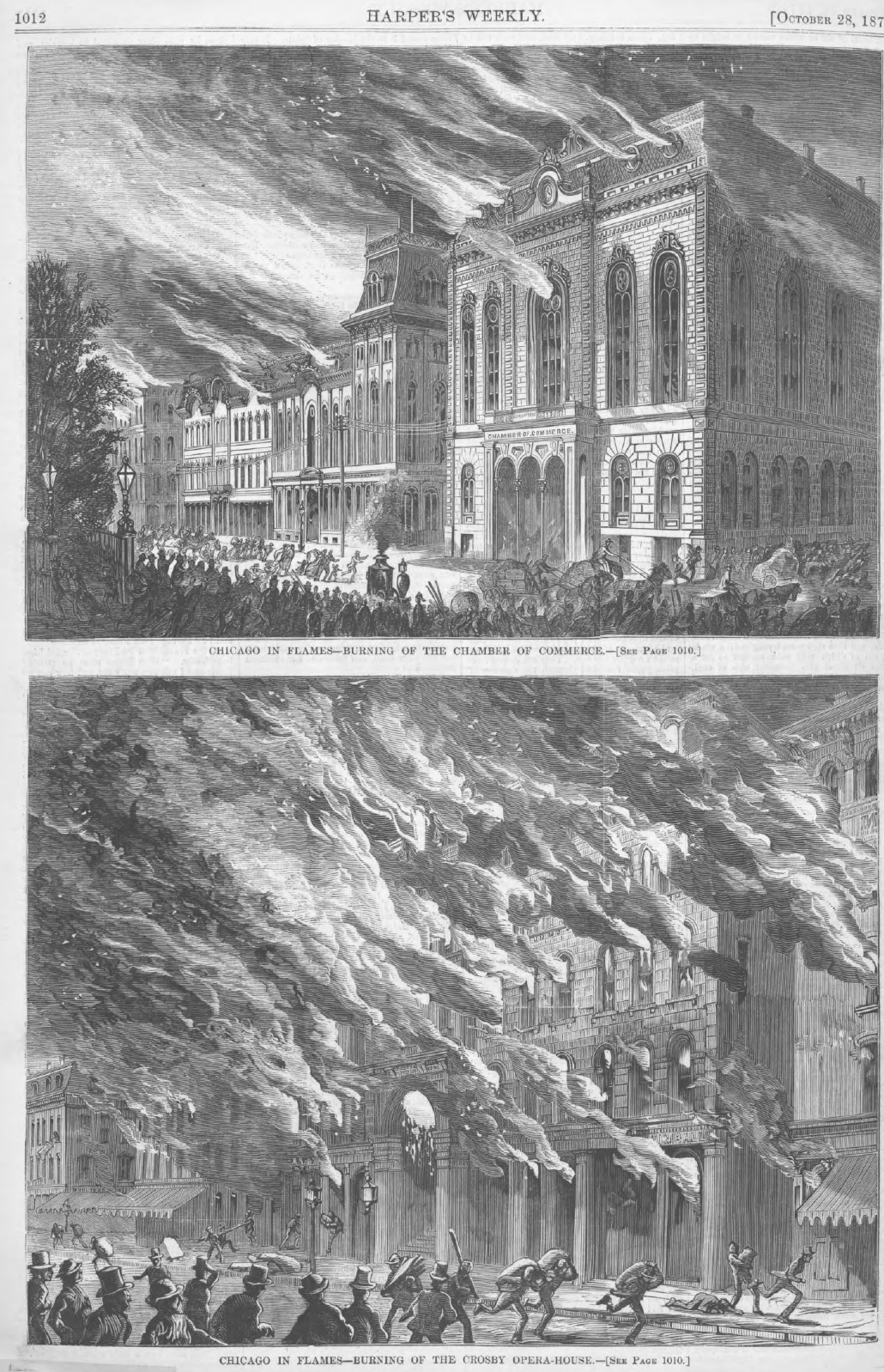
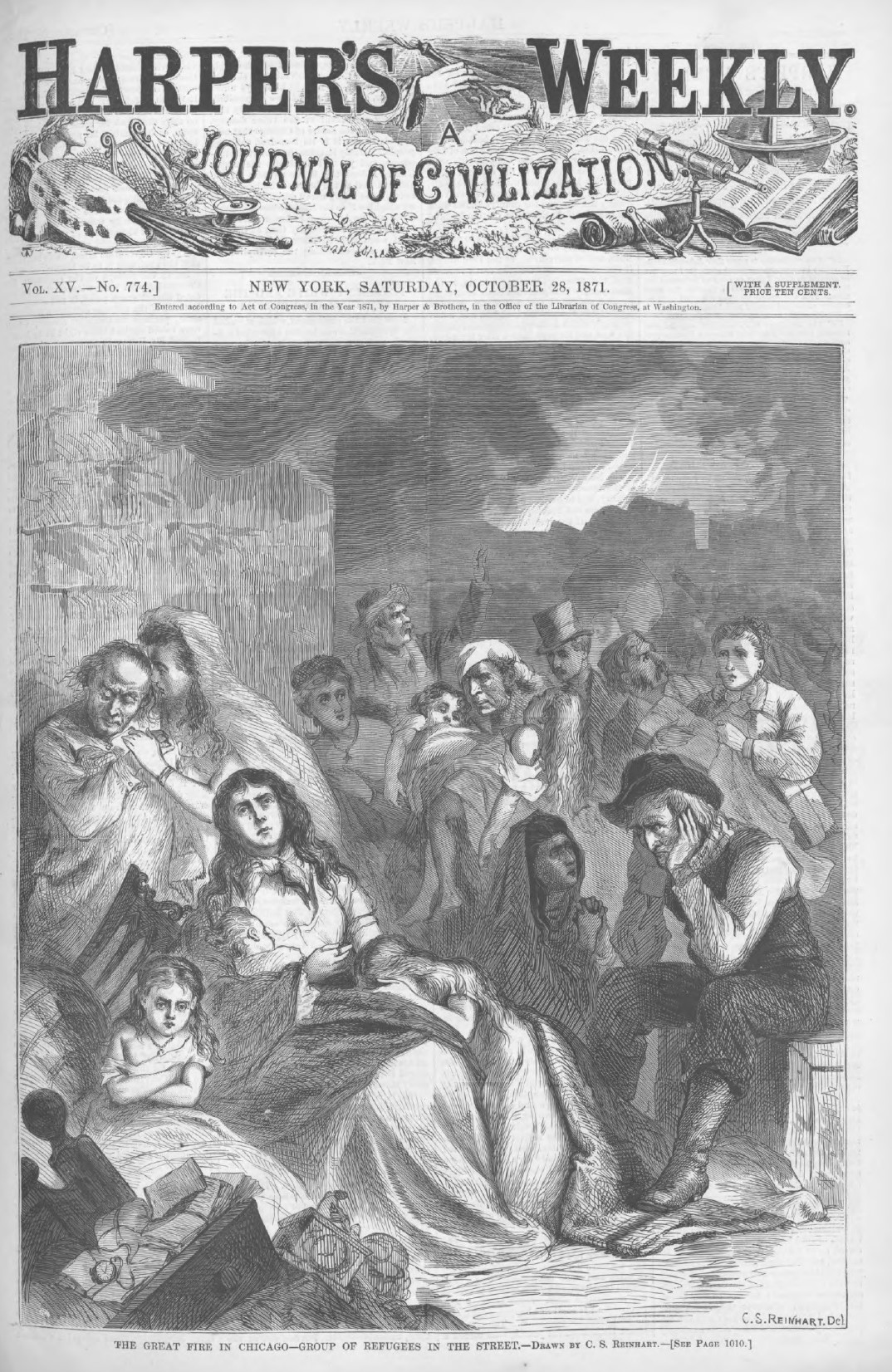
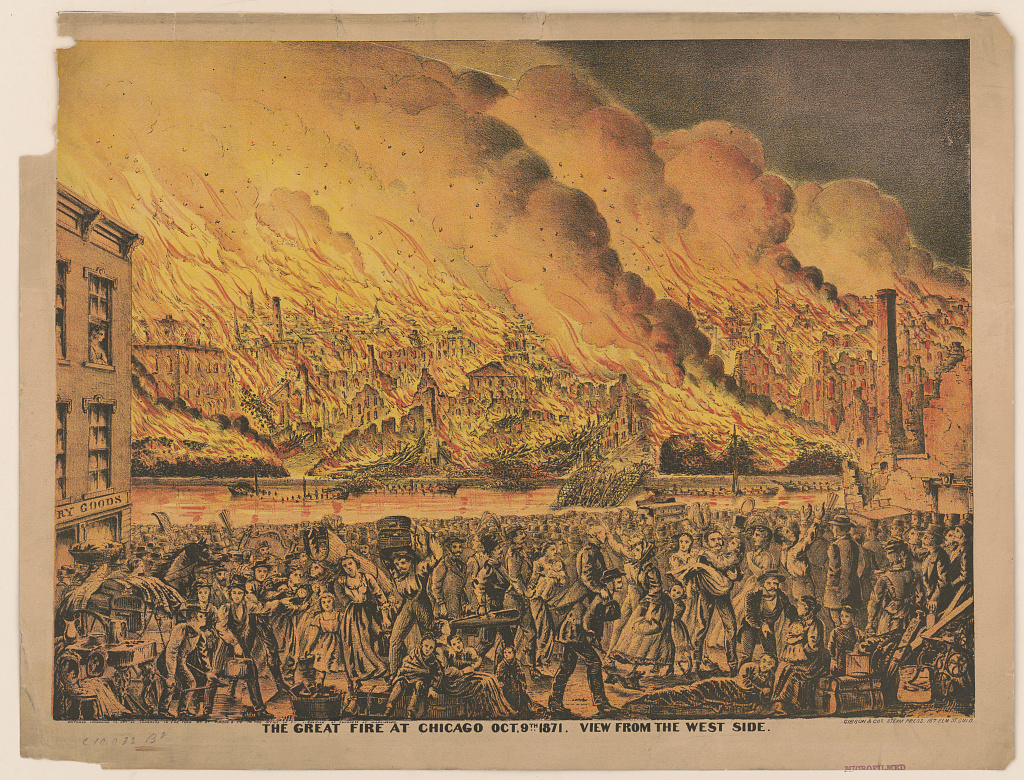
One of the calamities President Grant probably had in mind was the Great Chicago Fire that ravaged the city in early October. According to Wikipedia many people sympathized with the sufferers and sent practical help:

“In the days and weeks following the fire, monetary donations flowed into Chicago from around the country and abroad, along with donations of food, clothing, and other goods. These donations came from individuals, corporations, and cities. New York City gave $450,000 along with clothing and provisions, St. Louis gave $300,000, and the Common Council of London gave 1,000 guineas, as well as £7,000 from private donations. In Greenock, Scotland (pop. 40,000) a town meeting raised £518 on the spot. Cincinnati, Cleveland, and Buffalo, all commercial rivals, donated hundreds and thousands of dollars. Milwaukee, along with other nearby cities, helped by sending fire-fighting equipment. Food, clothing and books were brought by train from all over the continent. Mayor Mason placed the Chicago Relief and Aid Society in charge of the city’s relief efforts.”

Chicago in flames

refugees in the street

Chicago in ruins

Although Mrs. O’Leary’s cow has been exonerated as cause of the fire, some people in Chicago apparently did keep cows for the supply of fresh milk. I don’t know if anyone in New York City kept a cow in a barn out back, but I don’t think many people raised turkeys in the city, especially not enough to satisfy Gotham’s appetite, especially not at Thanksgiving. 150 years ago Connecticut was a major turkey producer. A New York City newspaper reported on the turkey operation of a Mr. Peck from the Newtown area.

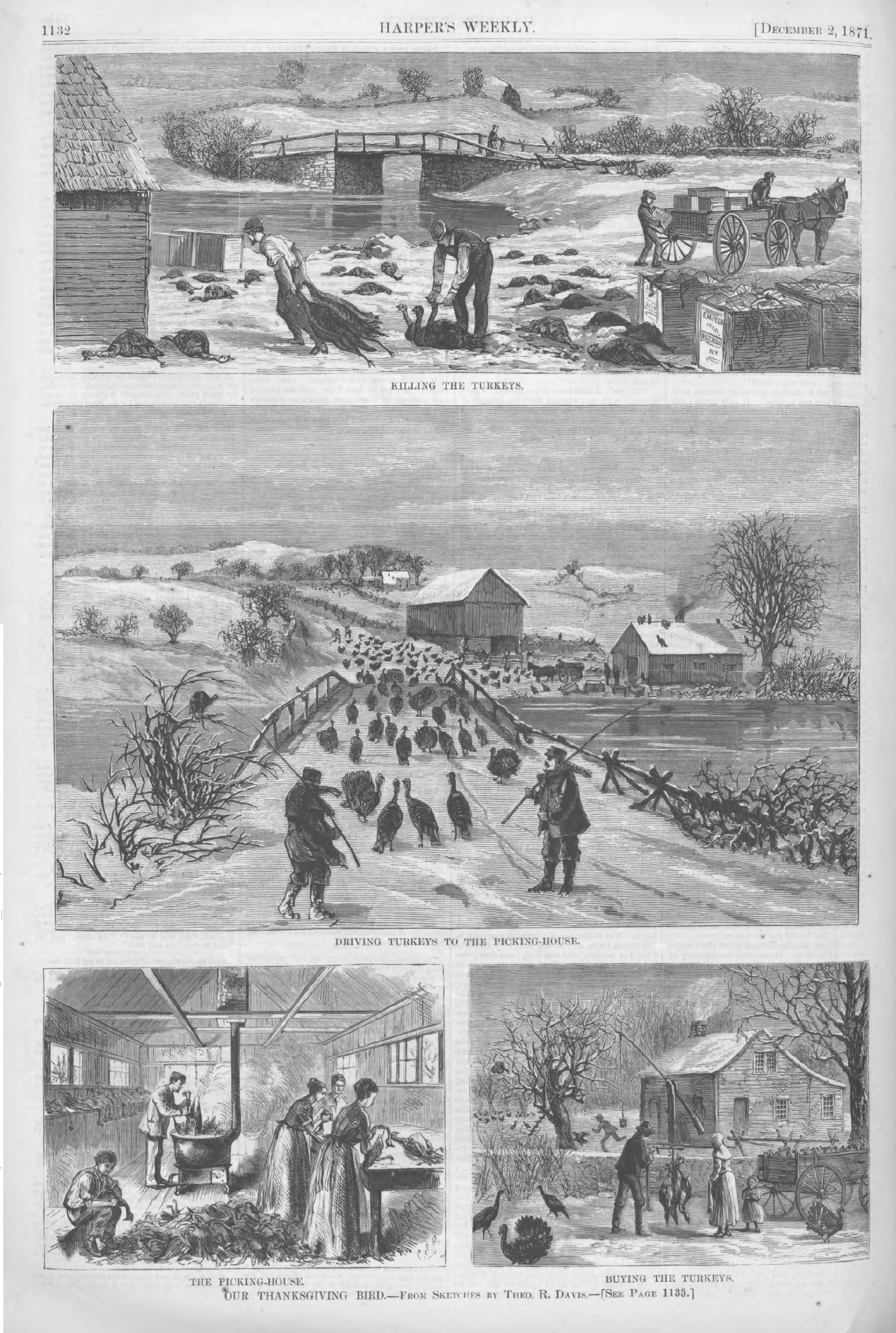
From the December 2, 1871 issue of Harper’s Weekly:

OUR THANKSGIVING BIRD.

THE immediate vicinity of Newtown, Fairfield County, Connecticut is chiefly peopled by persons interested in the turkey crop. The choicest birds sent to the New York markets are from this point.

Broadway Bound?

The turkey is not successfully reared in great numbers. A small flock well fed, and permitted to rove among hill and forest, will bring to its owner more profit than a large flock confined and fed upon corn and kitchen refuse. The largest dealers do not raise large flocks themselves. They make it a point to produce fine birds rather than great numbers. Each dealer has suitable houses for picking, and ice-houses for keeping or shipping the poultry, which is collected from the small farmers of the neighborhood. Our sketches are of Mr. E. M. PECK’s poultry house, and give an excellent idea of the modus operandi in any of the establishments. Mr. PECK scours the country, buying only the choice turkeys, paying (live weight) from twelve to fifteen cents per pound. The turkeys are carried to his farm in a wagon, fed for a few days, and then driven to the pen which adjoins the picking-house. Here they are fed a light provender of corn meal, to reduce the “crop,” and make the bird shapely for market. The turkey butcher takes the birds from this pen, three at a time, places his foot upon their legs, and makes a small cut in the large vein of the neck. This produces almost instant death; at the same time it permits the bird to bleed freely, which poultrymen say is necessary to secure fine meat. The birds are then taken into the house, when the feathers are picked from the legs (as the skin of the “drumstick” is too tender to be “scald picked”). The next move is to immerse the bird in water kept nearly at the boiling-point, after which it is passed to a table, where, for a cent and a half per bird, women remove the feathers. A skillful picker will dispose of seventy-five turkeys per day. The poultry is next arranged upon shelves to cool slowly, then packed in large boxes (with ice, if the weather is too warm), and shipped to New York. A single shipment of fifteen tons has been made at once, and, during a single week, Mr. E. M. PECK has slaughtered thirteen hundred birds, averaging fourteen pounds in weight each, making nearly a ton of turkey meat.

Connecticut is par excellence the turkey State of the Union; Rhode Island follows, and next comes New York. Some of the finest turkeys sent to this market are the frozen turkeys from Vermont. These do not come in until spring, and command a high price, on account of their fine quality. The extent of the poultry trade in New York is but little known. One of our leading houses, that of E. & A. ROBBINS, disposes of upward of 50,000 turkeys during the season, and others sell from 18,000 to 20,000 each, making an aggregate of nearly 2,000,000 pounds of turkey gobbled by Gothamites every season.

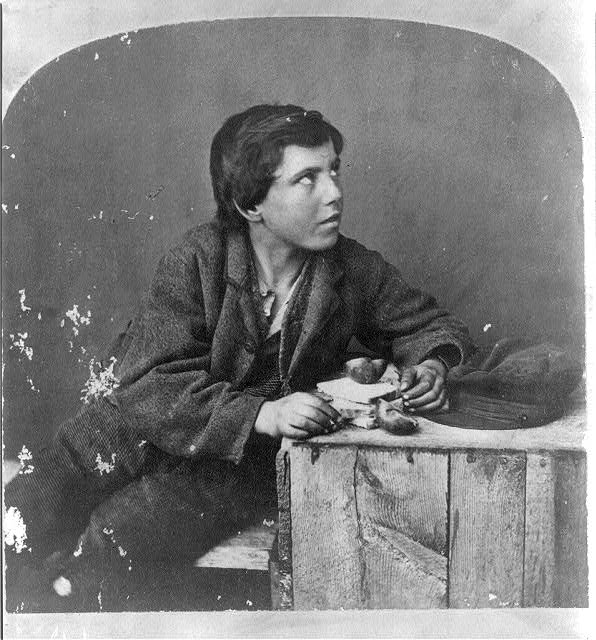
“The beggar boy’s Thanksgiving”

from Harper’s Weekly December 9, 1871

From the Library of Congress: The beggar boy’s Thanksgiving c1871. I got the Grant Administration’s 1871 Thanksgiving Proclamation at the Pilgrim Hall Museum. All of Harper’s Weekly 1871 is available at HathiTrust.

house of feasting not bad either

Posted in 150 Years Ago This Week, American Culture, American History, Postbellum Society | Tagged , , , | Leave a comment

Dutch treat

patriotic globalist, with a soft spot for Leyden

Given the fact that David McCullough’s Pulitzer Prize winning John Adams was apparently published in 2001, I have to say I’m thankful that I finally got around to reading it within the last year or so. It is a very good book. Mr. Adams served as an emissary to Holland for the fledgling United States from mid-1780 to October 1782. One of his goals was to secure a loan from the Dutch. That was tough work, but eventually in June 1782 he negotiated a loan with some Dutch banks. Also, during his time in Holland the Dutch recognized the United States and signed a treaty with Mr. Adams. For a time John Adams resided at “the first American embassy anywhere in the world.” (page 271).

David McCullough wrote about the importance of Holland’s religious tolerance. “To New Englanders it was very nearly sacred ground, as the place where the English separatists known as the Pilgrims had found refuge in the seventeenth century, settling at Leyden for twelve years before embarking for Massachusetts.” (page 245). During his sojourn in the Dutch Republic, John Adams actually spent some time in Leyden, residing with two of his sons who were studying at the university there. Their apartment was near the “Pieterskerk, the city’s famous cathedral … It was the old quarter where the Pilgrims had lived during their years at Leyden, a connection felt deeply by Adams. A deacon at the cathedral would later relate,’Mr. Adams could not refrain from tears in contemplating this great structure.’ (page 253)”
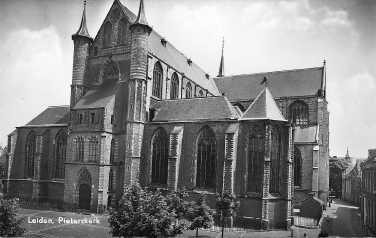
Leiden’s Pieterskerk

For the preceding quote Mr. McCullough cites Elkanah Watson’s A Tour in Holland: In MDCCLXXXIV (pages 103-104):

I FELL in fortunately with the deacon of the presbyterian church, who spoke French perfectly: The moment he found I was an American, the muscles of his face and the expression of his eye plainly declared his partiality for my country; he left his affairs, and I found him very intelligent; to his information, with what I collected from Mons. Luzac, I am principally indebted for the account I have already given of Leyden.

I FORGOT to mention that this church is the identical one, where the original Brownists worshipped, previously to forming their first establishment in Plymouth, Newengland, in 1620. The building is very old and inelegant; but I viewed it with more abstracted satisfaction than a palace. The deacon assured me that Mr. A— could not refrain from tears, in contemplating this ancient structure; a veneration and homage due to the virtuous founders of Newengland, and worthy of this great man.

I never knew about the Brownists, but maybe I should have: “The Brownists were a group of English Dissenters or early Separatists from the Church of England. They were named after Robert Browne, who was born at Tolethorpe Hall in Rutland, England, in the 1550s. A majority of the Separatists aboard the Mayflower in 1620 were Brownists, and indeed the Pilgrims were known into the 20th century as the Brownist Emigration.”

According to Wikipedia, President John F. Kennedy urged a compromise over who had the official first Thanksgiving feast in colonial America: “He issued Proclamation 3560 on November 5, 1963, saying: “Over three centuries ago, our forefathers in Virginia and in Massachusetts, far from home in a lonely wilderness, set aside a time of thanksgiving. On the appointed day, they gave reverent thanks for their safety, for the health of their children, for the fertility of their fields, for the love which bound them together and for the faith which united them with their God.”

I was pretty young when President Kennedy issued his decree. It has always seemed like Thanksgiving has been associated with the Brownists at Plymouth. Those who survived the first difficult year since landing in November 1620 definitely would have had reason to be thankful. One of the colonists wrote a letter describing about a week long thanksgiving feast, which for a few days included some of the indigenous inhabitants. From Caleb Johnson’s MayflowerHistory.com

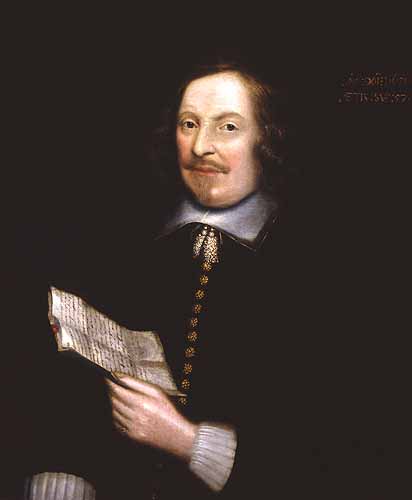
Letter of Edward Winslow, 11 December 1621
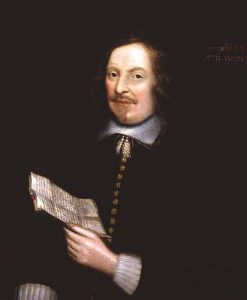
Edward Winslow

Loving, and old Friend; although I received no letter from you by this ship, yet forasmuch as I know you expect the performance of my promise, which was, to write unto you truly and faithfully of all things. I have therefore at this time sent unto you accordingly. Referring you for further satisfaction to our more large relations. You shall understand, that in this little time, that a few of us have been here, we have built seven dwelling-houses, and four for the use of the plantation, and have made preparation for divers others. We set the last spring some twenty acres of Indian corn, and sowed some six acres of barley and peas, and according to the manner of the Indians, we manured our ground with herrings or rather shads, which we have in great abundance, and take with great ease at our doors. Our corn did prove well, and God be praised, we had a good increase of Indian corn, and our barley indifferent good, but our peas not worth the gathering, for we feared they were too late sown, they came up very well, and blossomed, but the sun parched them in the blossom; our harvest being gotten in, our governor sent four men on fowling, that so we might after a more special manner rejoice together, after we had gathered the fruit of our labors; they four in one day killed as much fowl, as with a little help beside, served the company almost a week, at which time amongst other recreations, we exercised our arms, many of the Indians coming amongst us, and among the rest their greatest King Massasoit, with some ninety men, whom for three days we entertained and feasted, and they went out and killed five deer, which they brought to the plantation and bestowed on our governor, and upon the captain, and others. And although it be not always so plentiful, as it was at this time with us, yet by the goodness of God, we are so far from want, that we often wish you partakers of our plenty. We have found the Indians very faithful in their covenant of peace with us; very loving and ready to pleasure us: we often go to them, and they come to us; some of us have been fifty miles by land in the country with them; the occasions and relations whereof you shall understand by our general and more full declaration of such things as are worth the noting, yea, it hath pleased God so to possess the Indians with a fear of us, and love unto us, that not only the greatest king amongst them called Massasoit, but also all the princes and peoples round about us, have either made suit unto us, or been glad of any occasion to make peace with us, so that seven of them at once have sent their messengers to us to that end, yea, an Fle at sea, which we never saw hath also together with the former yielded willingly to be under the protection, and subjects to our sovereign Lord King James, so that there is now great peace amongst the Indians themselves, which was not formerly, neither would have been but for us; and we for our parts walk as peaceably and safely in the wood, as in the highways in England, we entertain them familiarly in our houses, and they as friendly bestowing their venison on us. They are a people without any religion, or knowledge of any God, yet very trusty, quick of apprehension, ripe-witted, just, the men and women go naked, only a skin about their middles; for the temper of the air, here it agreeth well with that in England, and if there be any difference at all, this is somewhat hotter in summer, some think it to be colder in winter, but I cannot out of experience so say; the air is very clear and not foggy, as hath been reported. I never in my life remember a more seasonable year, than we have here enjoyed: and if we have once but kine, horses, and sheep, I make no question, but men might live as contented here as in any part of the world. For fish and fowl, we have great abundance, fresh cod in the summer is but coarse meat with us, our bay is full of lobsters all the summer, and affordeth variety of other fish; in September we can take a hogshead of eels in a night, with small labor, and can dig them out of their beds, all the winter we have mussels and othus at our doors: oysters we have none near, but we can have them brought by the Indians when we will; all the springtime the earth sendeth forth naturally very good sallet herbs: here are grapes, white and red, and very sweet and strong also. Strawberries, gooseberries, raspas, etc. Plums of three sorts, with black and red, being almost as good as a damson: abundance of roses, white, red, and damask: single, but very sweet indeed; the country wanteth only industrious men to employ, for it would grieve your hearts (if as I) you had seen so many miles together by goodly rivers uninhabited, and withal to consider those parts of the world wherein you live, to be even greatly burdened with abundance of people. These things I thought good to let you understand, being the truth of things as near as I could experimentally take knowledge of, and that you might on our behalf give God thanks who hath dealt so favorably with us.
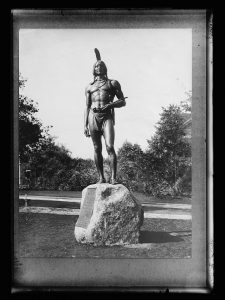
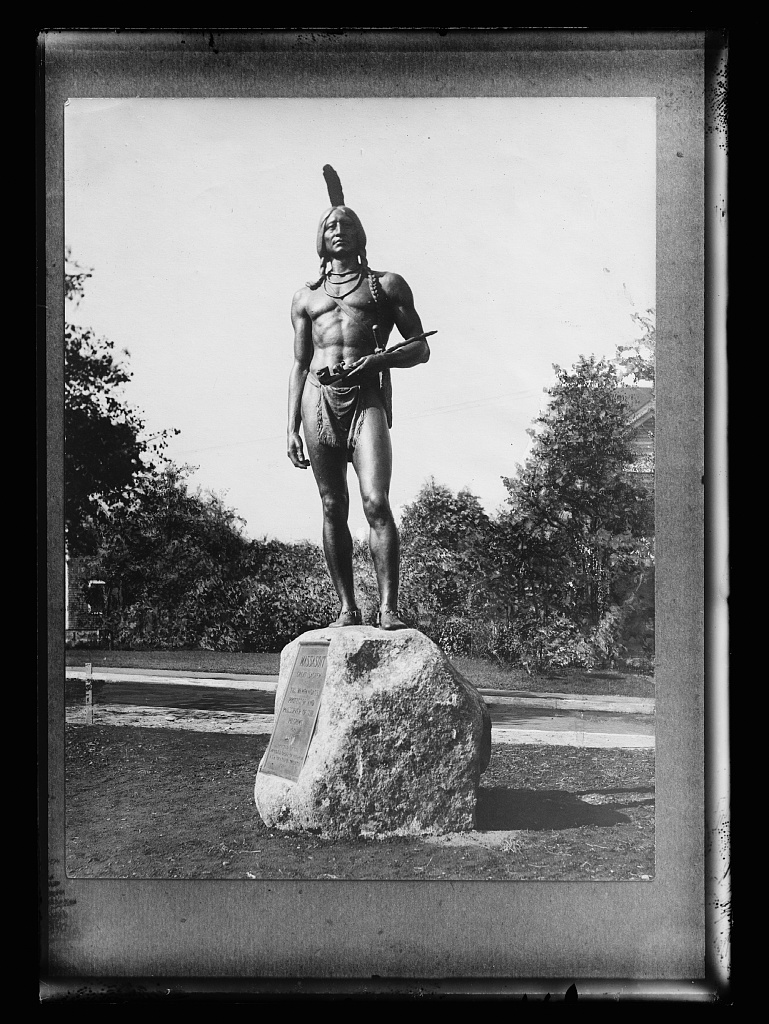
Massasoit statue in Plymouth Mass

Our supply of men from you came the ninth of November 1621, putting in at Cape Cod, some eight or ten leagues from us, the Indians that dwell thereabout were they who were owners of the corn which we found in caves, for which we have given them full content, and are in great league with them, they sent us word there was a ship near unto them, but thought it to be a Frenchman, and indeed for ourselves, we expected not a friend so soon. But when we perceived that she made for our bay, the governor commanded a great piece to be shot off, to call home such as were abroad at work; whereupon every man, yea, boy that could handle a gun were ready, with full resolution, that if she were an enemy, we would stand in our just defense, not fearing them, but God provided better for us than we supposed; these came all in health unto us, not any being sick by the way (otherwise than seasickness) and so continue at this time, by the blessing of God, the goodwife Ford was delivered of a son the first night she landed, and both of them are very well. When it pleaseth God, we are settled and fitted for the fishing business, and other trading, I doubt not but by the blessing of God, the gain will give content to all; in the mean time, that we have gotten we have sent by this ship, and though it be not much, yet it will witness for us, that we have not been idle, considering the smallness of our number all this summer. We hope the merchants will accept of it, and be encouraged to furnish us with things needful for further employment, which will also encourage us to put forth ourselves to the uttermost. Now because I expect your coming unto us with other of our friends, whose company we much desire, I thought good to advertise you of a few things needful; be careful to have a very good bread-room to put your biscuits in, let your cask for beer and water be iron-bound for the first tire if not more; let not your meat be dry-salted, none can better do it than the sailors; let your meal be so hard trod in your cask that you shall need an adz or hatchet to work it out with: trust not too much on us for corn at this time, for by reason of this last company that came, depending wholly upon us, we shall have little enough till harvest; be careful to come by some of your meal to spend by the way, it will much refresh you, build your cabins as open as you can, and bring good store of clothes, and bedding with you; bring every man a musket or fowling-piece, let your piece be long in the barrel, and fear not the weight of it, for most of our shooting is from stands; bring juice of lemons, and take it fasting, it is of good use; for hot waters, aniseed water is the best, but use it sparingly: if you bring anything for comfort in the country, butter or sallet oil, or both is very good; our Indian corn even the coarsest, maketh as pleasant meat as rice, therefore spare that unless to spend by the way; bring paper, and linseed oil for your windows, with cotton yarn for your lamps; let your shot be most for big fowls, and bring store of powder and shot: I forbear further to write for the present, hoping to see you by the next return, so I take my leave, commending you to the Lord for a safe conduct unto us. Resting in Him

Plymouth in New England
this 11 of December.
1621.

Your loving Friend
E. W.
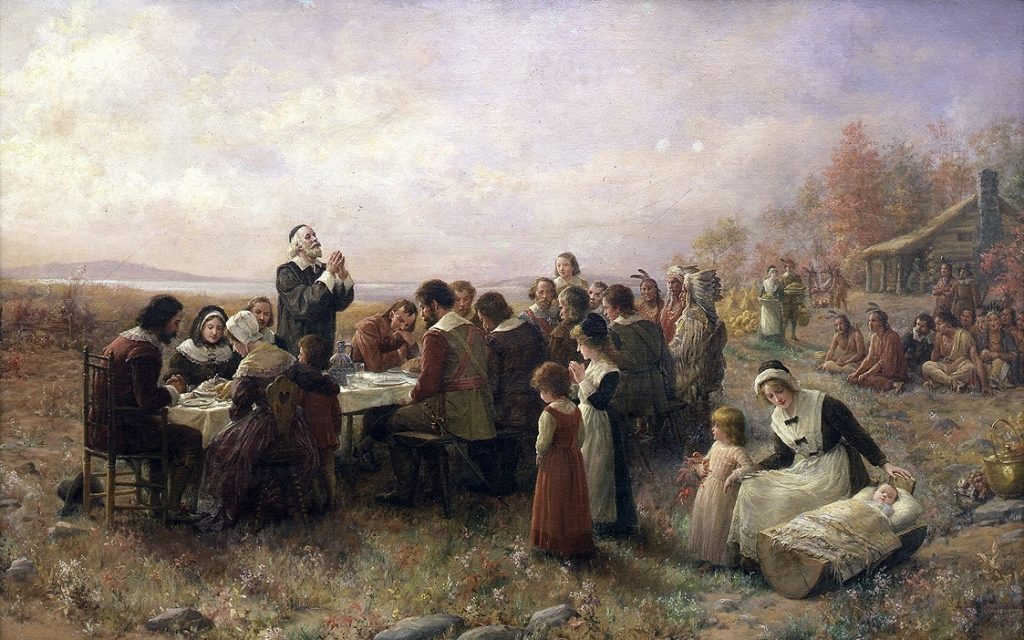
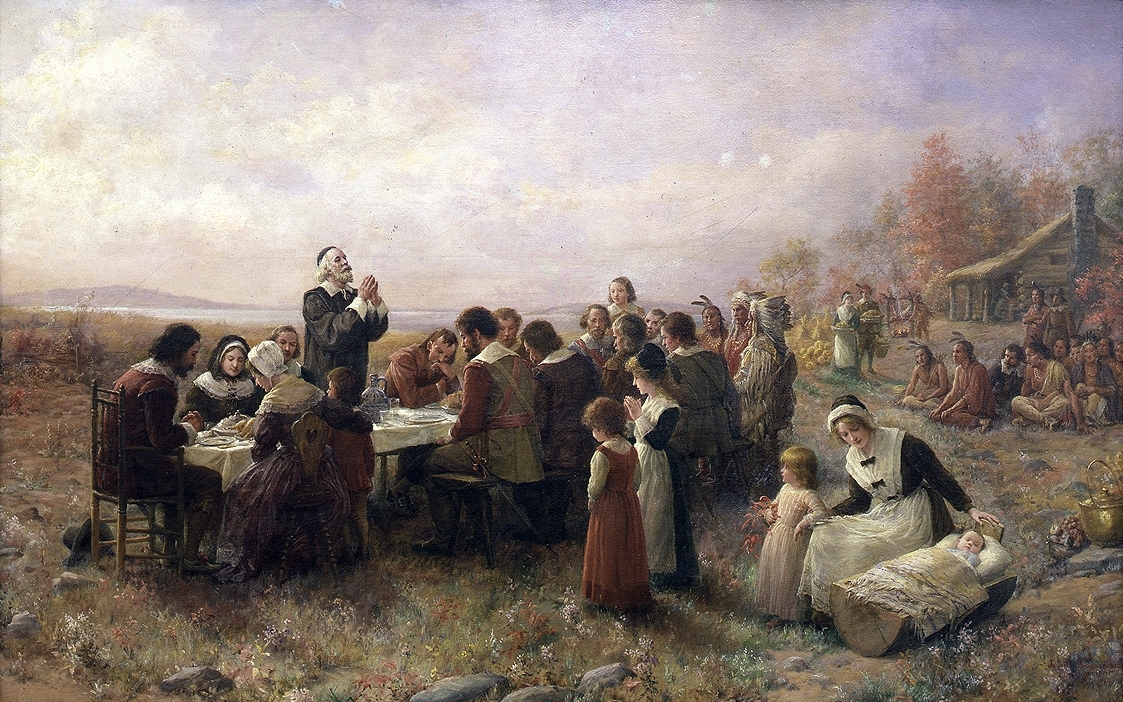
“The First Thanksgiving at Plymouth” (1914) By Jennie A. Brownscombe

Wikipedia points out that since President Lincoln’s call for a day of Thanksgiving on the last Thursday of November 1863, there has always been a national Thanksgiving Day. Secretary of State William Seward apparently wrote the words for the proclamation
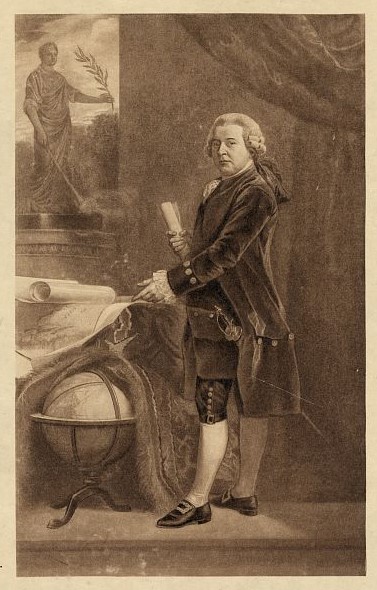
From the Library of Congress: Massasoit statue in Plymouth, Massachusetts; John Adams as Vice-President of the USA – the image is said to be after a painting by John Singleton Copley (1738-1815), according to David McCullough John Adams wrote in a letter to Charles Dana that “America … has been too long silent in Europe … Her cause is that of all nations and all men, and it needs nothing but to be explained to be approved.” (page 253);

I got the picture of Leiden’s Pieterskerk at Wikipedia, along with Jennie A. Brownscombe’s painting of the first official Thanksgiving feast at Plymouth, Mass. The greeting image comes from University of Michigan and/or Google Books)

yes, indeed
Posted in 400 Years Ago, American History | Tagged , , , , , , , , | Leave a comment

street murder

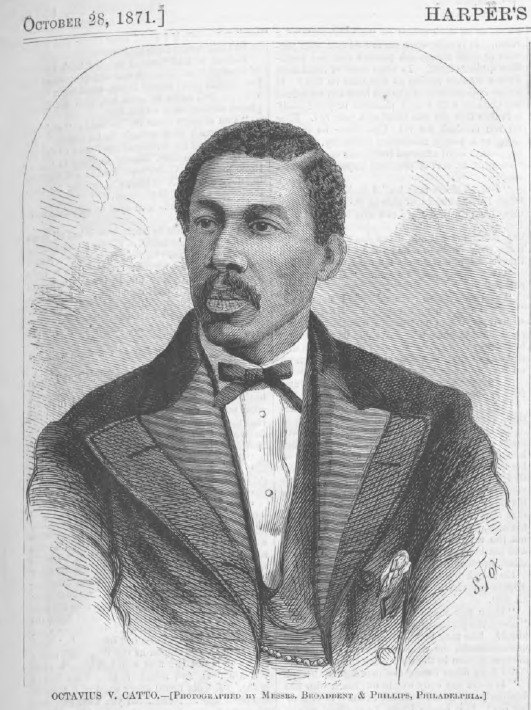
150 years ago last month a white man shot and killed a black man in public on Election Day in Philadelphia. In it’s October 28th Harper’s Weekly summarized the murder. In an editorial a week later the paper seemed to blame the Democratic Party.

From the October 28, 1871 issue of Harper’s Weekly:

Octavius V. Catto

OCTAVIUS V CATTO.

WE give on this page the portrait of Mr. OCTAVIUS V. CATTO, a worthy colored citizen of Philadelphia, who was shot by a ruffian on the night of the late election in that city. He was master of the Institute for Colored Youth, and was highly esteemed by all who knew him. Shortly after three o’clock on election day, having closed his school, he was quietly proceeding homeward, when he was rudely accosted by a white man, who leveled a pistol at his head. Mr. CATTO endeavored to pass on, taking advantage of the shelter afforded by a passing street-car,but was again accosted by the same ruffian,who then fired at him three times. One ball took effect in his left breast, passing through the heart; another struck him in the left shoulder. He fell immediately. Several citizens carried him into a station-house, where he died a few minutes afterward. Mr. CATTO was a quiet, well-educated man, and the murder was entirely unprovoked.

From the November 4, 1871 issue of Harper’s Weekly:

THE MURDER OF CATTO.

THE murder of Mr. CATTO, a colored teacher in Philadelphia, whose portrait appeared in this paper last week, the meeting of honorable Philadelphians to express sympathy and indignation, and the sneering comments and misrepresentation both of the murder and the meeting which have appeared in the Democratic papers, are striking illustration of what can only be called the essential meanness of that party. Here was a man sprung of a race which had been held in the worst slavery, and whose very color was a badge of social ‘egradation [sic] in a country which professes to honor men simply as men—and a white man knows how hard is the struggle of life when, as in his case, there are no factitious disadvantages; but a man who, like CATTO, quietly braving all the cruel obstructions which contempt, ignorance, prejudice, and hatred throw in his way, devotes himself to the elevation and instruction of his younger brethren in misfortune, and who by his superior intelligence, industry, and stainless character wins the respect and confidence of the best men around him, is worthy of an admiration which is seldom due to a white man under the same circumstances.

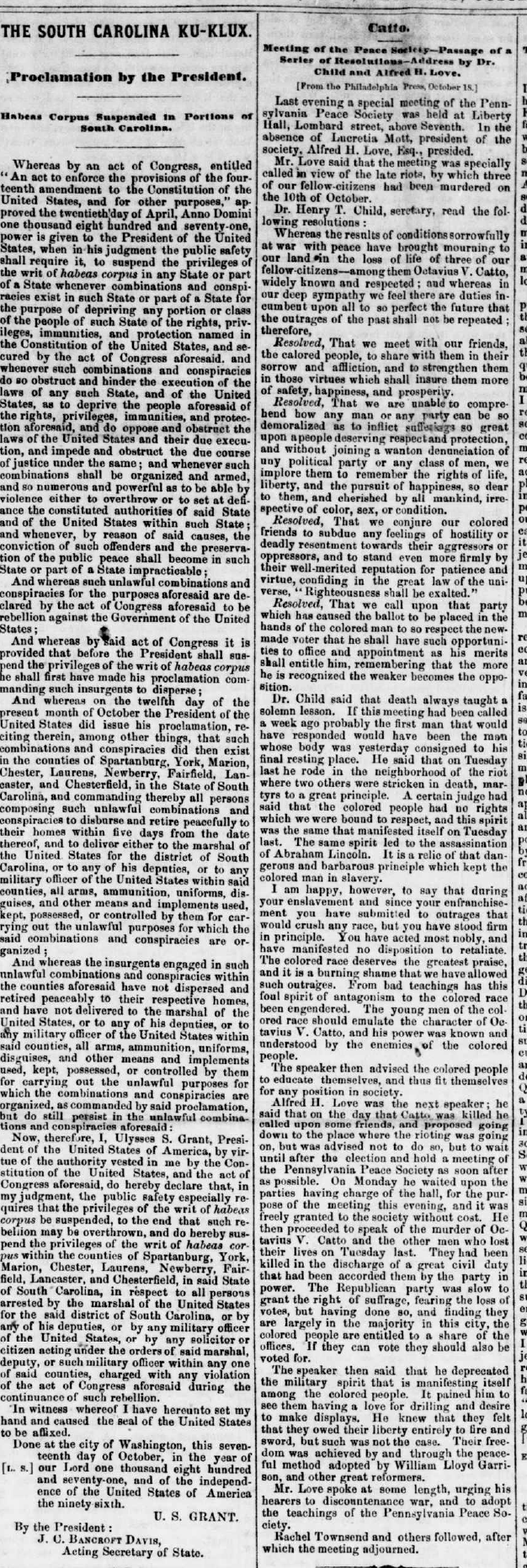
Pennsylvania Peace Society deplored the assassination

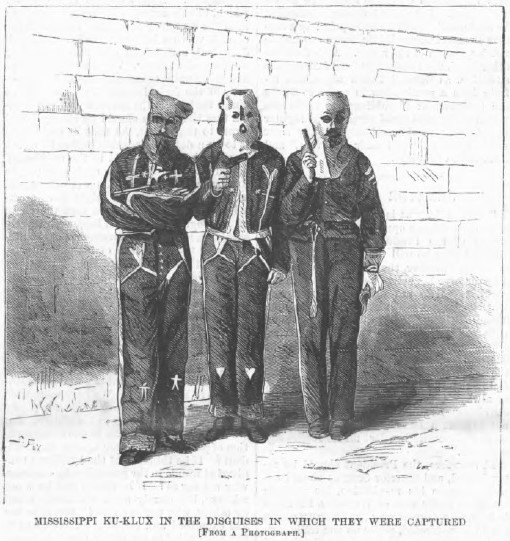
Such a man, closing his school in the afternoon upon election day, and quietly walking homeward, is accosted by a white bully, who insults him, levels a pistol, and shoots him on the spot. It would seem as if there could be but one feeling of shame and indignation among all decent men; but the assassin was, of course, a Democrat, his victim was a Republican, and the Democratic papers teem with ribaldry at the fuss made over a dead negro, when scores of white men are murdered without public excitement. It is, we repeat, another illustration of the unspeakable meanness of the Democratic party toward the colored race. That party struggled to hold the race in the most loathsome slavery, and to secure that end it sought the destruction of the government. Baffled in every foul design against them, it can now only encourage the Ku-Klux which harries the colored people in the Southern States, and jeer and insult them even in their bloody graves when murdered by drunken or merely devilish Democrats in the North.

This is the party some of whose Northern leaders affect to acquiesce in the settlement of the war, and which promises to maintain and defend the rights of all citizens more surely than the Republicans! It proved its sincerity by its bitter hostility to emancipation and the civil and political equality bills, by the slaughters at Memphis and New Orleans, by its incessant gibes at the most unfortunate class in the country honorably striving to rise, and now shows it by its sneers over the grave of this honorable and modest citizen of Philadelphia, whose offense in Democratic eyes is that his skin was not white. By their works ye shall know them.

You can read more about Octavius V. Catto and his murder at The Encyclopedia of Greater Philadelphia. For more information about the Institute for Colored Youth check out Villanova University’s Falvey Memorial Library – Mr. Catto is one of the Institute’s featured graduates.
All of Harper’s Weekly 1871 is available at HathiTrust. The clipping about the Peace Society meeting was published in the October 26, 1871 issue of The New National Era, available at the Library of Congress. The speakers at the meeting alluded to the two national parties but didn’t mention them by name. Frederick Douglass edited the paper from 1870-1872. The left-hand column in the clipping detailed one of the Grant Administration’s efforts to curtail the Ku Klux Klan. President Grant signed the Third Ku Klux Klan Act in April 1871. Pursuant to this act, on October 17th he signed the order suspending Habeas Corpus in several counties in South Carolina.

Posted in 150 Years Ago, Postbellum Politics, Postbellum Society, Reconstruction | Tagged , , , , , , | Leave a comment

“Chicago will not succumb”

displaced Chicagoans

I never knew much about the devastating 19th century Chicago fire, except that it seemed to have something to do with a Mrs. O’Leary and her cow. As I realized the fire was getting nearer, at least in sesquicentennial time, I naturally looked it up in Wikipedia. I found out that the Great Chicago Fire burned from the evening of October 8, 1871 until October 10th. I decided to go to the Library of Congress and check out a Chicago newspaper published on October 8th. I was looking for a little calm before the fire irony, some innocent ignorance just before the imminent calamity.

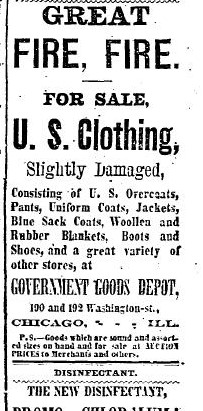
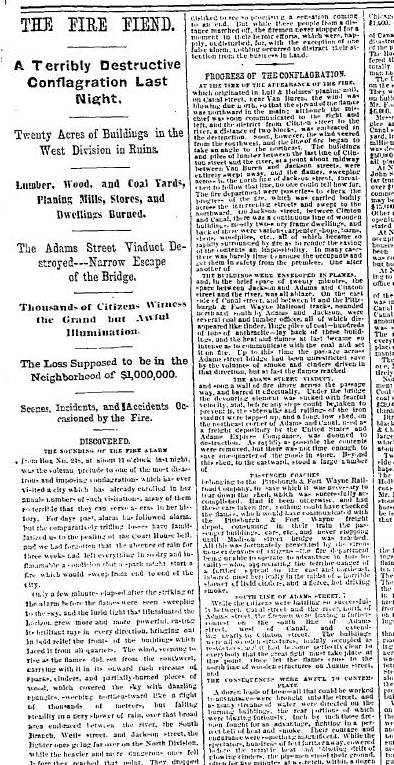
Page one of the October 8, 1871 issue of The Chicago Tribune headlined “Episcopalianism” and reported on a convention in Baltimore. So far, so good. But as I scrolled to the right I noticed an ad headlined “Great Fire, Fire” – a government surplus store was selling “slightly damaged” products. A fire sale before the great fire? How could that be? I turned to page two. There was another fire-related ad. This time an insurance company mentioned a “disastrous conflagration in the west division last night.” Last night? Now I was really suspicious. Were we somehow being hoaxed? I googled Chicago fire October 7, 1871 and sure enough, according to the Chicago History Museum, the Saturday Night Fire on October 7th appeared to be the climax of week of small fires. The October 7th fire caused an estimated one million dollars damage. “The fire will not be put out until the following afternoon, leaving firemen exhausted and their equipment in need of repair.” Page three of the October 8th Tribune reported on the “fire fiend.” The newspaper didn’t publish on October 9th and 10th.

Chicago Tribune
Oct 8, 1871 pg 1

Chicago Tribune
Oct 8, 1871 pg 2

Chicago Tribune
Oct 8, 1871 pg 3

______________________________

down but not out

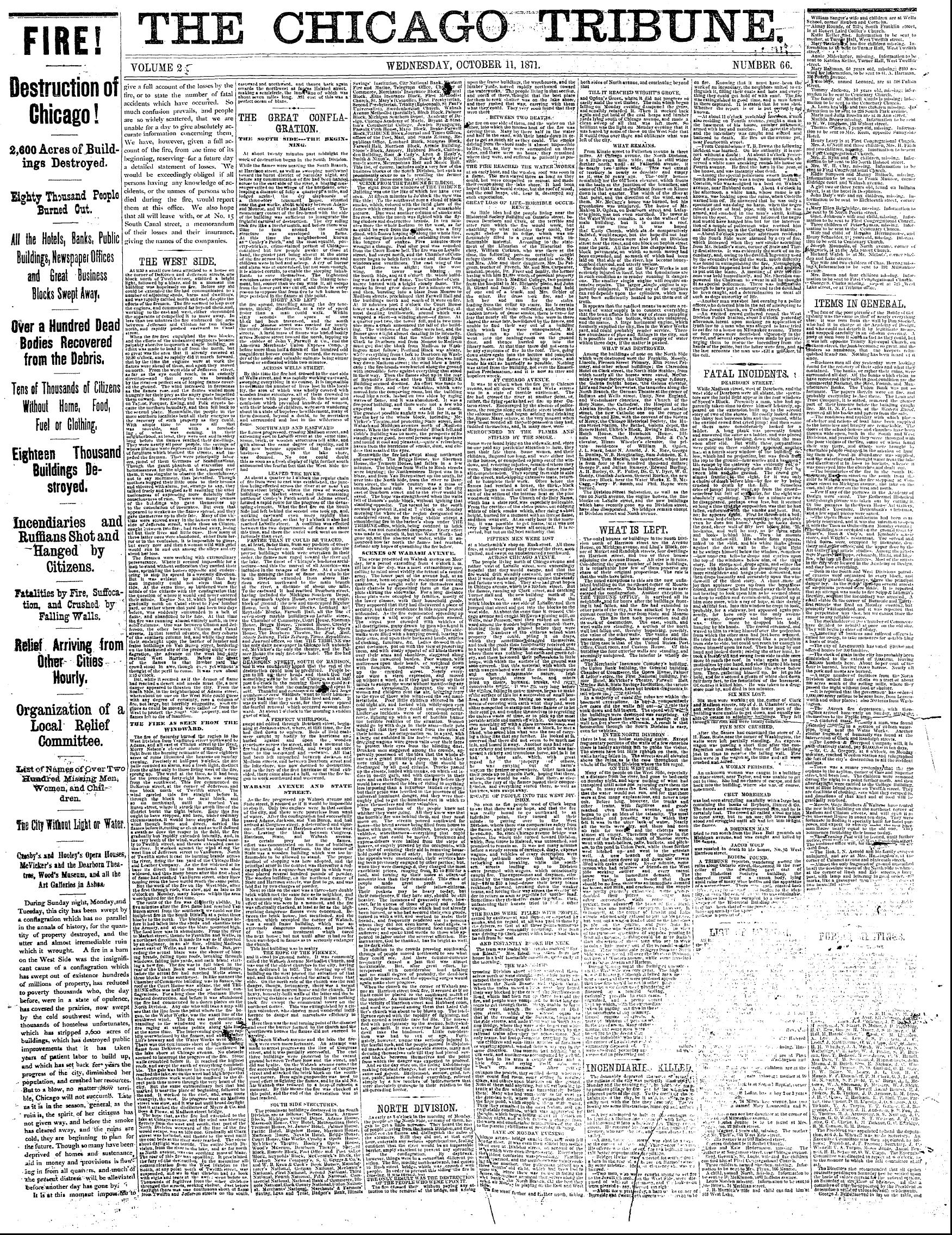
The first report in the October 11th issue of the Tribune stated that the fire apparently started in a “cow-barn,” but didn’t single out Mrs. O’Leary and/or her cow. The paper began with an overview of the catastrophe and a vow that the city wasn’t going to fold.

From The Chicago Tribune October 11, 1871:

During Sunday night, Monday,and Tuesday, this city has been swept by a conflagration which hat no parallel in the annals of history, for the quantity of property destroyed, and the utter and almost irremediable ruin which it wrought. A fire in a barn on the West Side was the insignificant cause of a conflagration which has swept out of existence hundreds of millions of property, has reduced to poverty thousands who, the day before, were in a state of opulence, has covered the prairies, now swept by the cold southwest wind, with thousands of homeless unfortunates, which has stripped 3,600 acres of buildings, which has destroyed public improvements that it has taken years of patient labor to build up, and which has set back for years the progress of the city, diminished her population, and crushed her resources. But to a blow, no matter how terrible, Chicago will not succumb. Late as it is in the season, general as the ruin is, the spirit of her citizens has not given way, and before the smoke has cleared away, and the ruins are cold, they are beginning to plan for the future. Though so many have been deprived of home and sustenance, aid in money and provisions is flowing in from all quarters, and much of the present distress will be alleviated before another day has gone by.

even Tribune paused two days

It is at this moment impossible to give a full account of losses by the fire, or to state the number of fatal accidents which have occurred. So much confusion prevails, and people are so widely scattered, that we are unable for a day to give absolutely accurate information concerning them. We have, however, given a full account of the fire, from the time of its beginning, reserving for a future day a detailed statement of losses. We would be exceedingly obliged if all persons having any knowledge of accidents, or the names of persons who died during the fire, would report them at this office. We also hope that all will leave with, or at No. 15 South Canal street, a memorandum of their losses and their insurance, giving the names of the companies.

THE WEST SIDE.

At 9:30 a small cow-barn attached to a house on the corner of DeKoven and Jefferson streets, one block north of Twelfth Street, emitted a bright light, followed by a blaze, and in a moment the building was hopelessly on fire. Before any aid could be extended the fire had communicated to a number of adjoining sheds, barns and dwellings, and was rapidly carried north and east, despite the efforts of the firemen. The fire seemed to leap over the engines, and commenced far beyond them and, working to the east and west, either surrounded the apparatus or compelled it to move away. In less than ten minutes the fire embraced the area between Jefferson and Clinton for two blocks north, and rapidly pushed eastward to Canal street.

When the fire first eugulphed the two blocks, and the efforts of the undaunted engineers became palpably abortive to quench a single building, an effort was made to head it off from the north, but so great was the area that it already covered at 10:30 o’clock, and so rapidly did it march forward, that by the time the engines were at work the flames were ahead of them, and again they moved on north. …

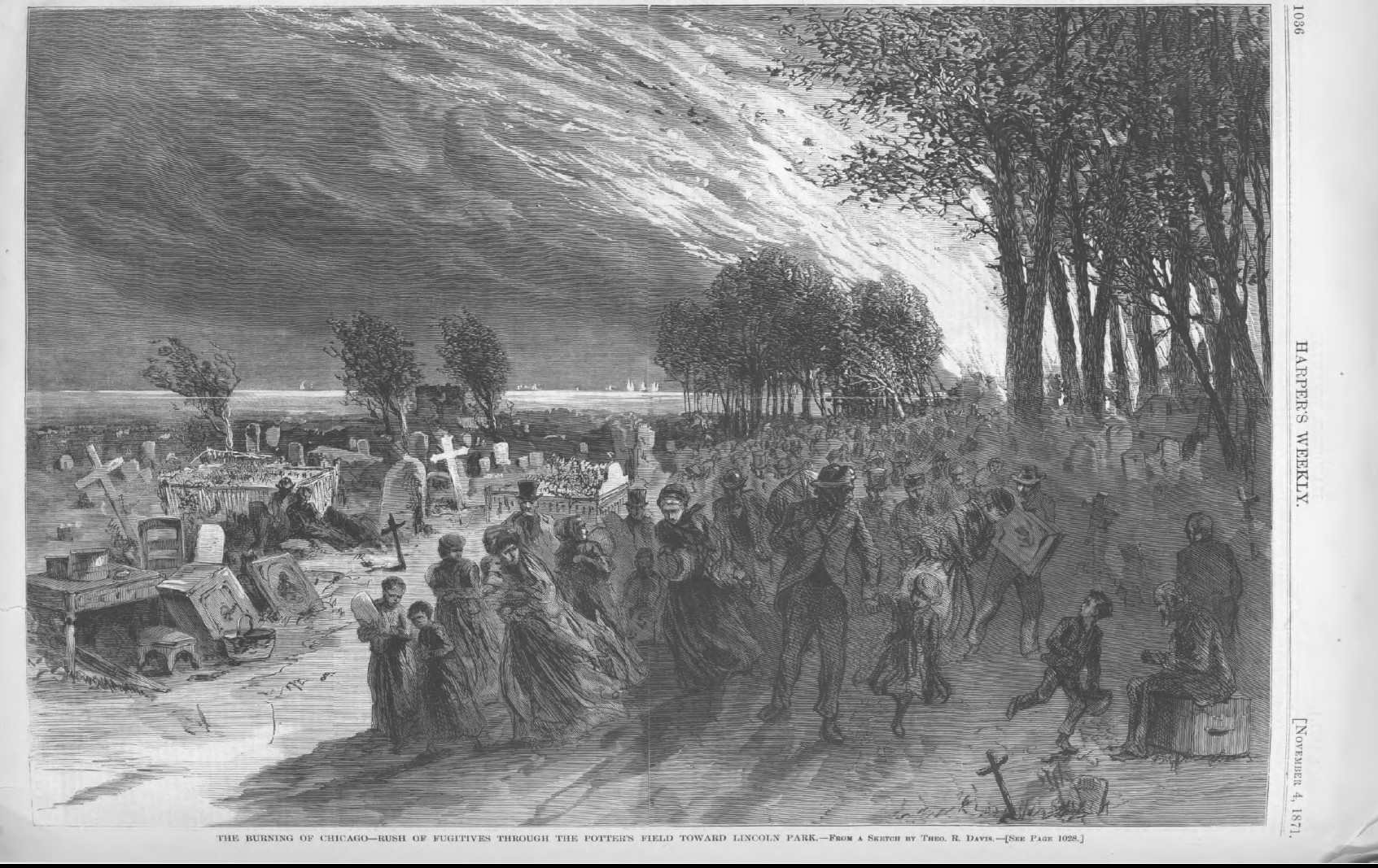
headed toward Lincoln Park

According to the Wikipedia article, General Philip Sheridan was put in charge of maintaining law and order from October 11th through the 24th. Wikipedia also mentioned that there has been a lot of controversy about what exactly caused the fire: it is was legend that Mrs. O’Leary’s cow kicked over a lantern – in 1893 a Tribune reporter admitted he made that part up. But the legend remained.

labor protest?

O’Leary home spared

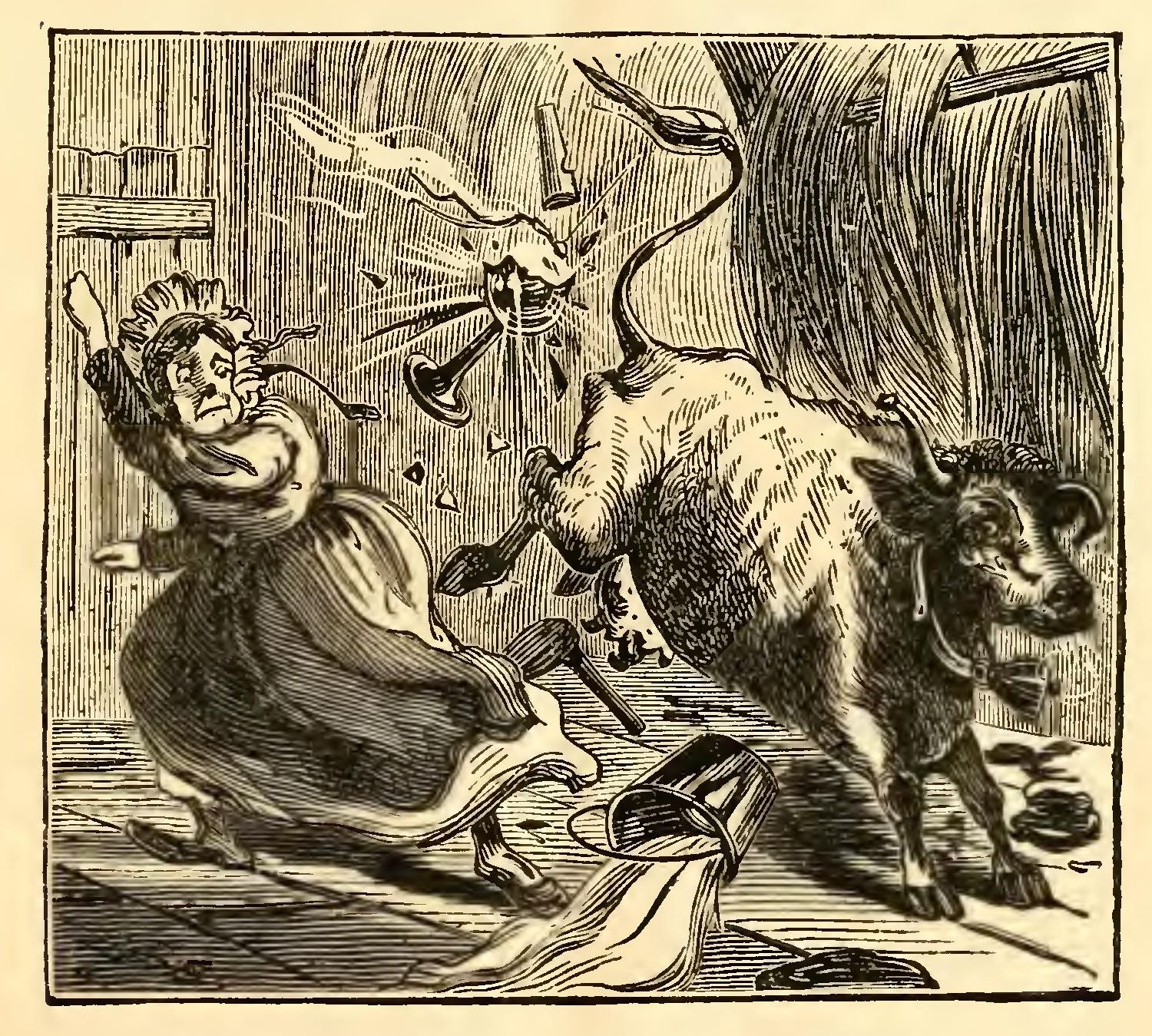
And people seemed to know it was a legend right away. The picture above of the rambunctious cow is from 1872’s Mrs. Leary’s Cow, A Legend of Chicago at Project Gutenberg. C. C. Hine’s work was sponsored by an insurance a bit north of my neck of the woods and began with this account of the Chicago fire: “Mrs. Leary got her living by selling milk; she had five cows, and kept them in her barn on De Koven street, on the west side of the river. A neighbor woman called on her for a pint of milk at nine o’clock Sunday night, October 8th, and Mrs. Leary, having sold all she had, went to the barn with her lamp to make a further draft on her best cow. The cow, as seen by the picture, being a spirited animal, became indignant at the attempt, kicked over the lamp, setting the barn on fire, and thus inaugurated the greatest fire the world has ever seen.”
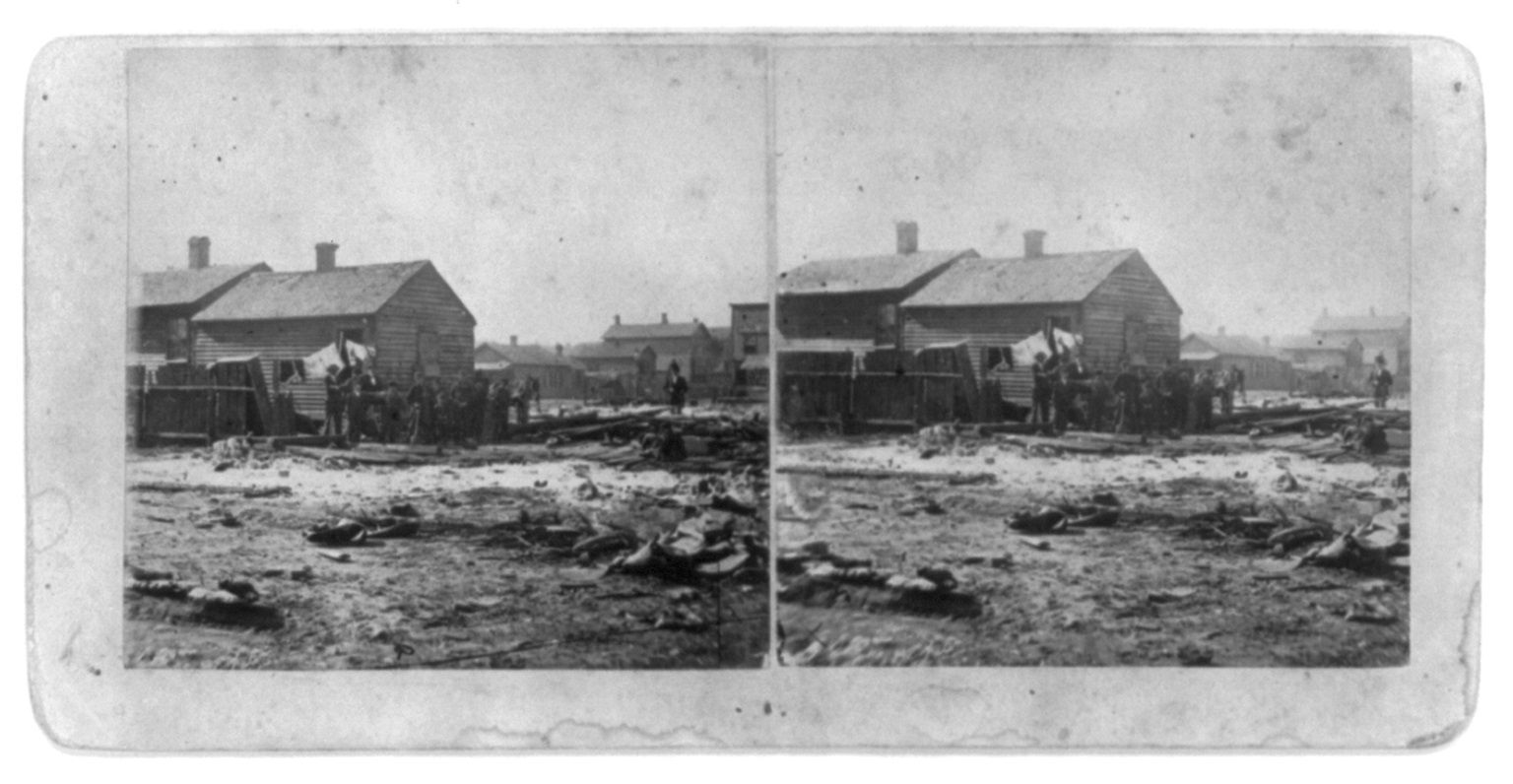
A websiteby Richard F. Bales takes a more nuanced view of the fire’s origin. One of the link’s discusses the exoneration of Mrs. O’Leary and points out that it is unlikely that if she was in the barn when the fire broke out she would have just ignored the fire and gone back to bed. The website also states that the fire spared the O’Leary’s home, which supports the photo above.
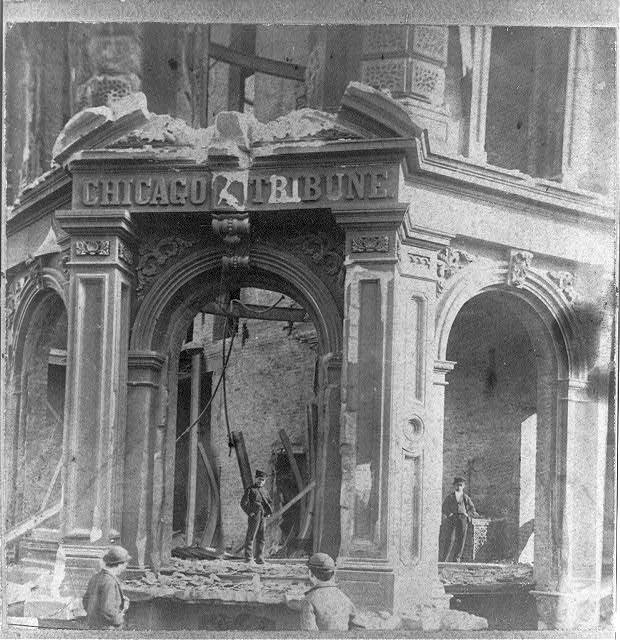
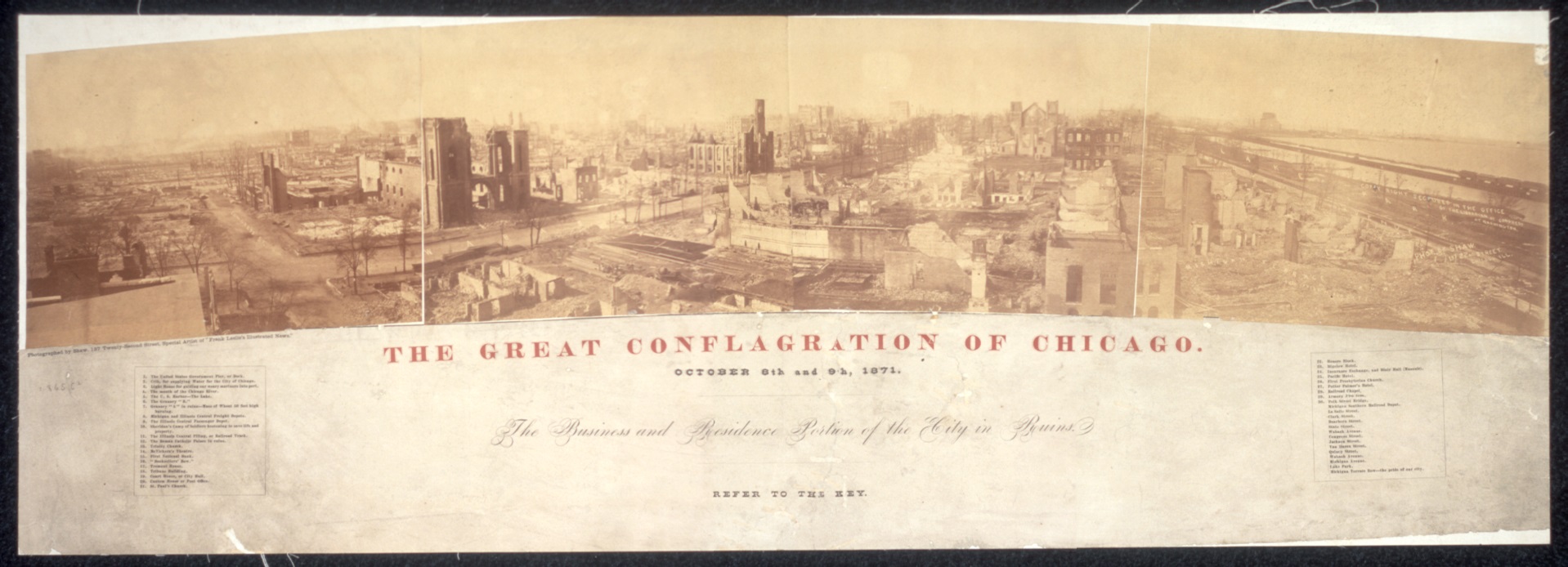
From the Library of Congress: view from West Side; damaged Tribune building and O’Leary home (the Library notes for these two photos”This record contains unverified, old data from caption card.”) – according to Richard F. Bales, “There were actually two small cottages on the O’Leary property. The house fronting DeKoven Street was rented to the McLaughlin family. The O’Learys lived in the rear building.” apparently the home on the right was the O’Leary’s; panoramic view of the ruins.
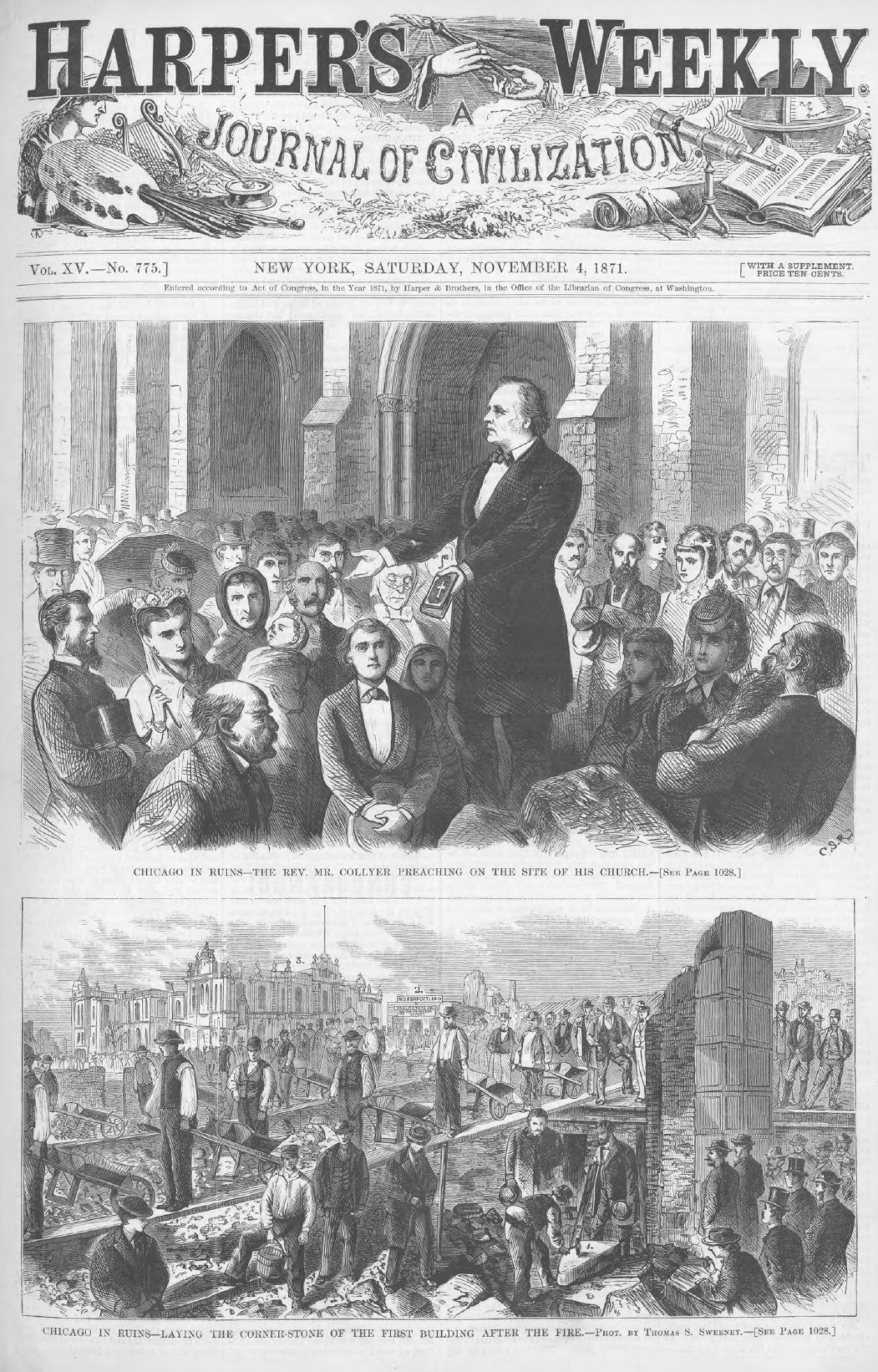
The image of the Chicagoans fleeing toward Lincoln Park was published in the November 4, 1871 issue of Harper’s Weekly, which provided extensive coverage of the conflagration. You can review all of 1871 at HathiTrust.

ruins but not ruined

Posted in 150 Years Ago This Week, American History, Postbellum Society | Tagged , , , , | Leave a comment

upriver

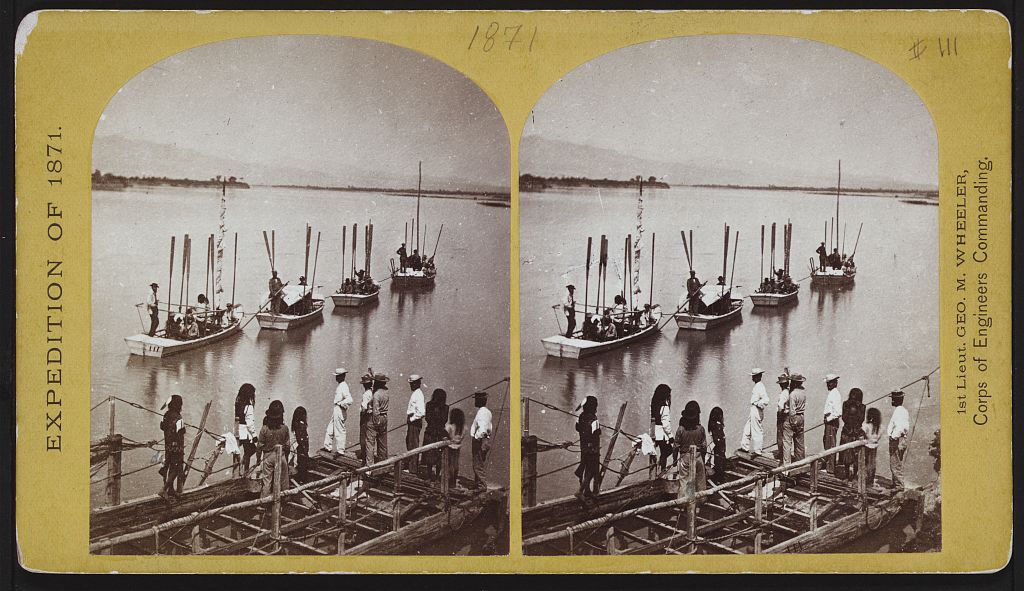
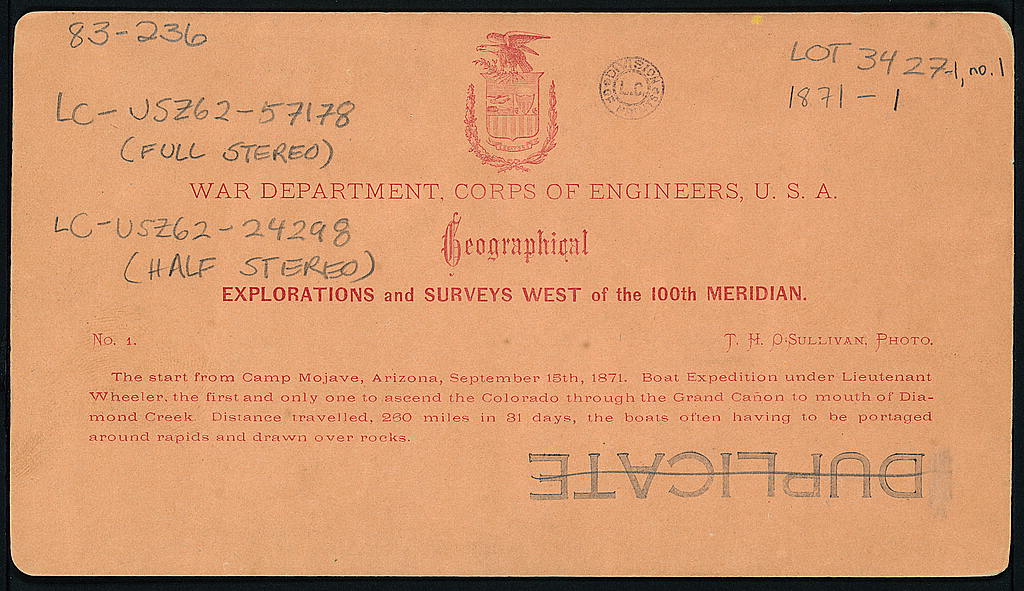
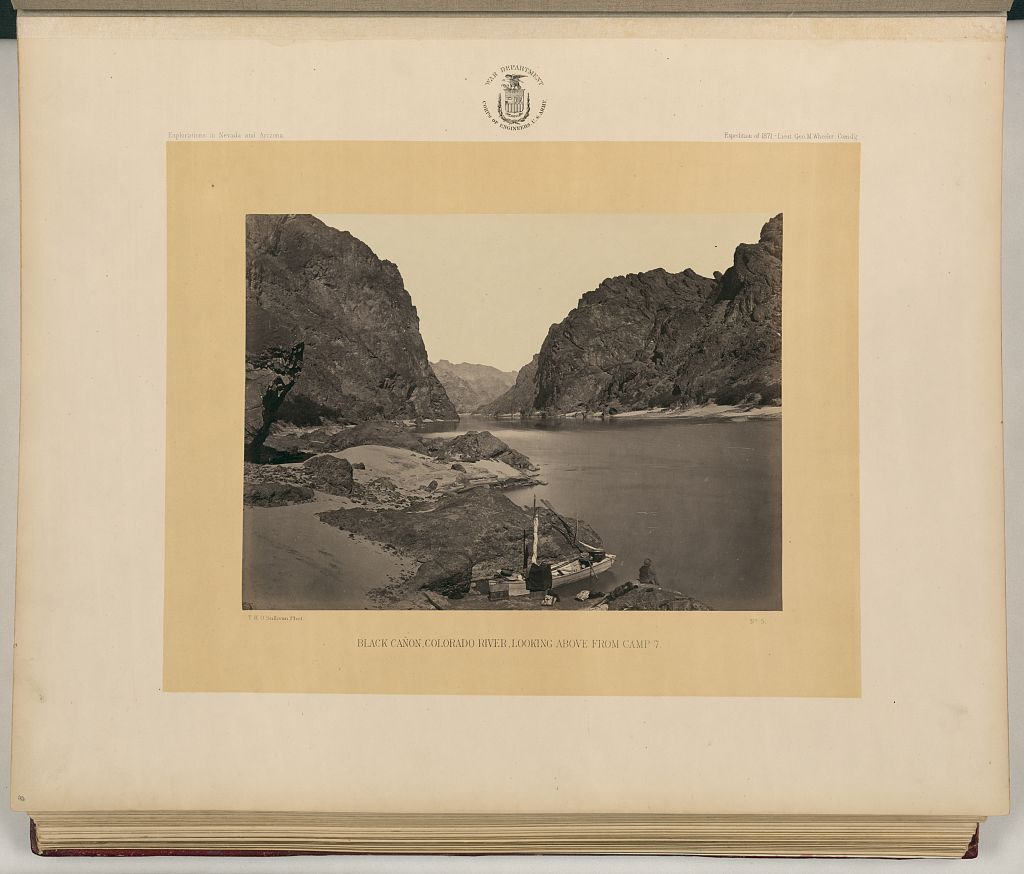
According to documentation at the Library of Congress, an expedition of exploration set out from a camp in Arizona territory 150 years ago today:

heading out

up the river

In its May 6, 1871 issue Harper’s Weekly provided more information about the expedition:

SCIENTIFIC INTELLIGENCE.

WE have heretofore referred to an expedition under Lieutenant G.M. WHEELER, U.S.A., as among those now fitting out for service in the field; and we now learn that the work is to be prosecuted with the thoroughness that characterizes all the undertakings of the Engineer Department. As already stated, the field in question embraces a large area, and that of a comparatively little known country, south of the Central Pacific Railroad, including portions of southern and southwestern Nevada, southeastern California, southwestern Utah, some of the lower cañons of the Colorado, and extending into eastern and northeastern Arizona, with perhaps some points in New Mexico, and covering an aggregate of about sixty thousand square miles. The primary object of the expedition is, of course, the acquisition of a correct topographical knowledge of the country, and the means of preparing accurate maps, by which military movements can be arranged, and the best positions for settlement determined. The proper sites for military posts will be looked after, and a careful inquiry prosecuted into the character, disposition, and statistics of the Indians inhabiting the country. Of the more purely scientific work of the survey the practical geological and mining resources of the region will receive special attention. The expedition will be accompanied by gentlemen competent to settle these points, and much care will be directed also toward procuring a complete series of the animals and plants; so that, by a combination with the results of the expeditions of Mr. CLARENCE KING, of Captain SITGREAVES, of Lieutenant IVES, of General PARKE, and of the Geological Survey of California, together with the more private explorations of Dr. COUES, U.S.A., Dr. PALMER, and others, a satisfactory knowledge of the whole country can be established. Great attention will be given to the astronomical determinations, and a competent photographer will accompany the expedition. This will probably be divided into two parties-one under the direction of Lieutenant WHEELER himself, and the other under that of Lieutenant D.W. LOCKWOOD. We shall await with great interest the result of the operations of this exploration, which, it is thought, may occupy several years for its completion, but which can not fail, year by year, to bring to light much information concerning this interesting but little known portion of our country. …

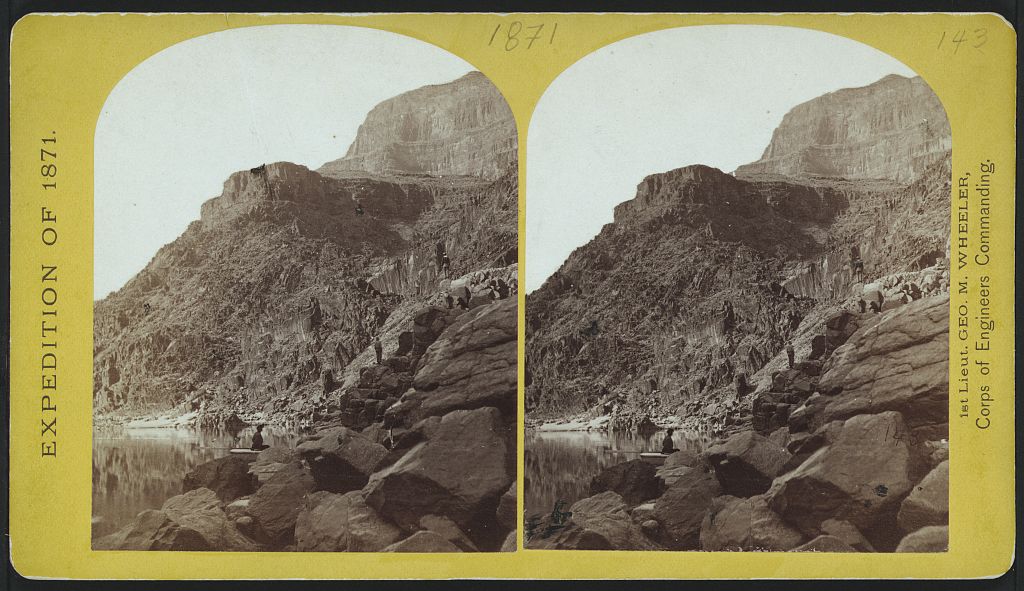
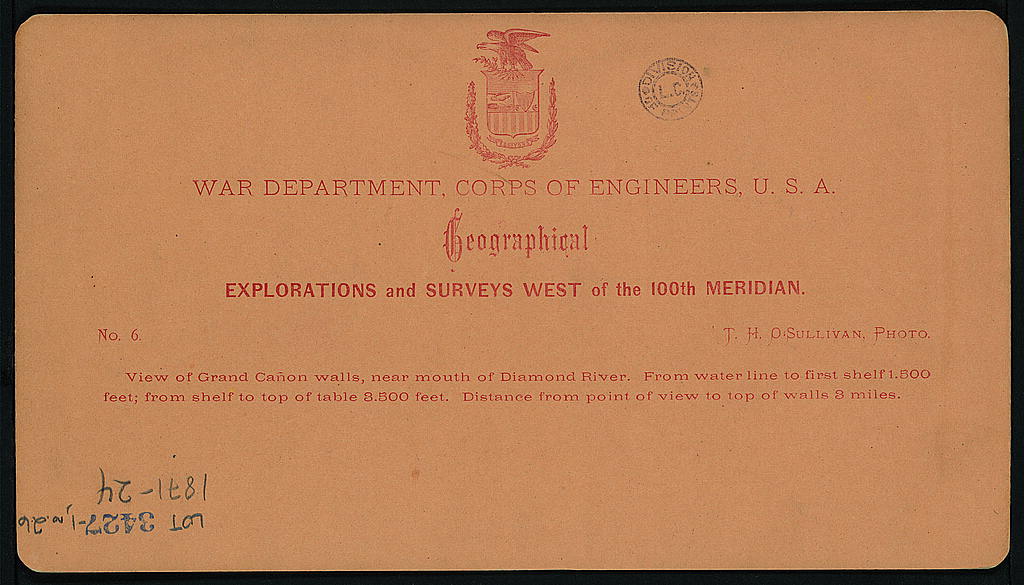
View of Grand Cañon walls, near mouth of Diamond River.

Timothy O’Sullivan – out west

Black Cañon, Colorado River, looking above from Camp 7 / T.H. O’Sullivan, Phot.

_________________________________________

Harper’s was looking at a big picture with kind of a long exposure. The Lorenzo Sitgreaves led a southwest expedition in 1851. During the Civil War he was assigned to several non-fighting jobs. At the end of the war, “He conducted the inspection of the temporary defenses in Kansas and Nebraska from October 25, 1864, to July 1865.”

According to Wikipedia, the Wheeler Survey included a series of expeditions from 1869 until 1879 that explored territory west of the 100th meridian. In 1879 the Wheeler Survey and others became part of the new Geological Survey, later the United States Geological Survey.

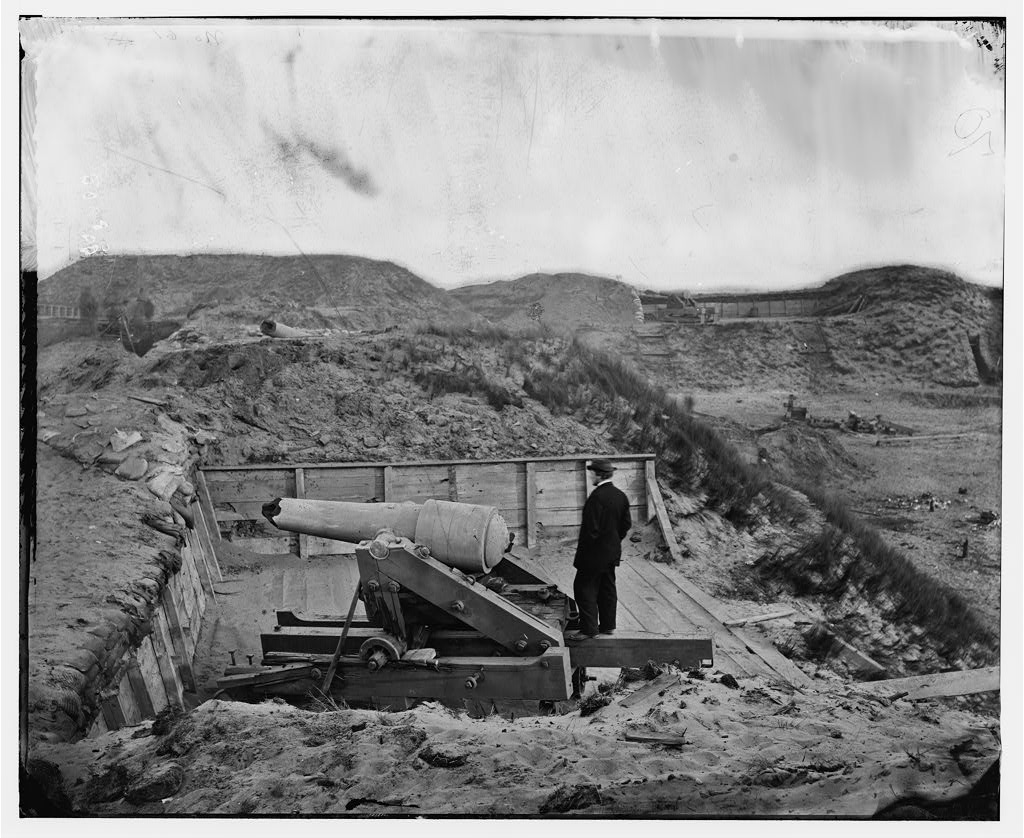
One of the competent photographers along on the 1871 expedition was Timothy H. O’Sullivan, who also took photographs of the American Civil War.

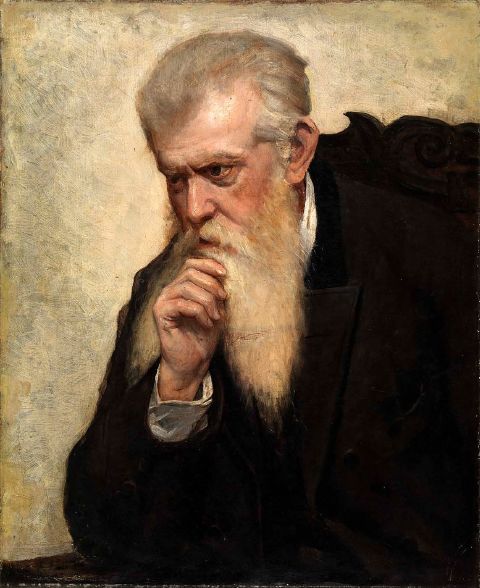
expedition leader, later in life

From Wikimedia: Alice Pike Barney’s portrait of circa 1910 of George Montague Wheeler. From Library of Congress: Timothy O’Sullivan’s photo of Grand Cañon walls, near mouth of Diamond River; his photograph of the Colorado running through Black Canyon; one of Timothy O’Sullivan’s pictures from the Civil War – one of the guns at Fort Fisher in January 1865 – broken after the bombardment

Fort Fisher, N.C. Interior view, with heavy gun broken by the bombardment

Posted in 150 Years Ago This Week, Aftermath, Postbellum Society | Tagged , , , , , | Leave a comment

prison break

From the August 18, 1871 edition of The New-York Times:

SING SING AGAIN.
__________

Daring Escape of Twelve Convicts from the Prison.

__________

They are Carried off in a Tug, by Preconcerted
Arrangement — The Engineer Suspected — One Arrrest Made and
More to Follow.

__________

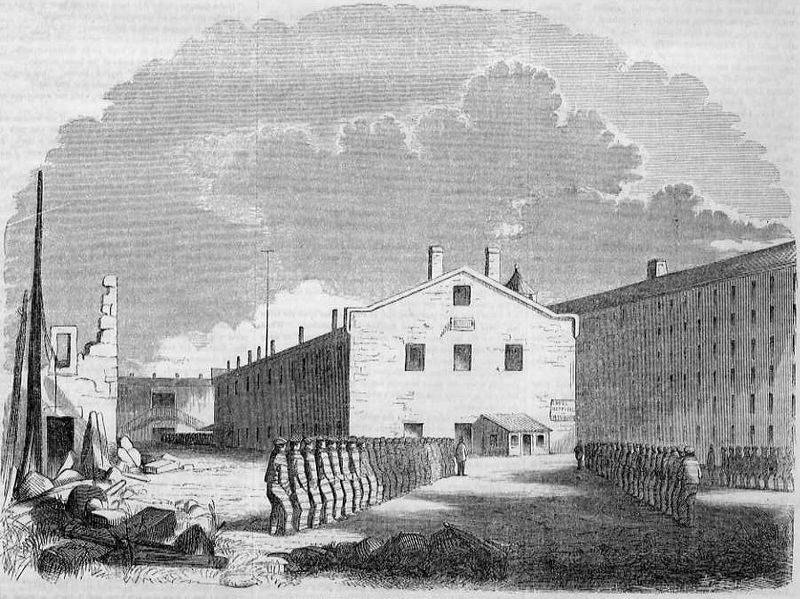
prison portrayed – 1855 engraving

No incident in connection with the prison history of Sing Sing since its establishment has created such an extraordinary commotion, not alone among the officials of the institution, but among the general community, from the perfection of its plan and the boldness of its execution, as the escape of a dozen convicts from the prison yesterday, in the middle of the noon-day, and in the face of the authorities themselves. It appears that about 11 3/4 [?] o’clock the steam-tug Dean Richmond, Capt. VAN ORDEN, with a canal-boat attached, was seen approaching the Prison dock, and making preparations for landing. There is a regulation of the institution forbidding vessels from coming within a certain distance of the prison grounds, but custom has for years ignored its existence, and boats of all descriptions land at the prison docks. The officer in charge sang out to the Captain of the Dean Richmond to “stand aloof,” but for some purpose, which is not yet distinctly ascertained, the order was disregarded, and the tug was immediately moored to the shore. Ere the officer could attempt to remonstrate, a dozen convicts, who were employed in the dock, rushed into the tug, seized the Captain, and with a purpose, as he states, only too evident, compelled him to run on shore to avoid personal injury. The other hands on the boat, the engineer and a boy, his nephew, instantly detached the moorings from the steamtug, the canal-boat was sent adrift, and swiftly and steadily the vessel steamed from the dock down the river, steering for the opposite shore.

All witnesses to the transaction concur in the statement that the proceedings occupied only a few seconds of time, and ere the astonished official realized the possibility of the fact, his charge had escaped. Hastily discharging his revolver at the retreating vessel, he gave the alarm, and about twenty officers of the prison, with an equal number of citizens, jumped into the boats lying along the piers and started in pursuit.

Dean Richmond at Kingston Point

The tug, however, got far beyond the reach of the officers, and ran on a sand-bar between Nyack and Rockland Lake. Several boats occupied by boys, the sons of fishermen, who at that time were fishing near at hand, were obtained to transport them to the shore, and dividing themselves into three different parties, they plunged into the fastnesses of the surrounding wood. As soon as the full circumstances regarding the affair, were developed at Sing Sing, dispatches were transmitted by telegraph to all the stations at each side of the river, and a number of boats started to intercept the fugitives. The tug was seen lying on the shore and was taken possession of.

THE CONDUCT OP THE ENGINEER.
THOMAS FARRELL, the engineer who aided their escape, was arrested and brought back to Sing Sing. He stated he was utterly bewildered in consequence of the action of the convicts, and that he was compelled to steer out into the river through dread of violence, but this explanation is hardly consistent with his conduct, which appeared entirely voluntary. While the prisoners ran into the cabin in the first instance to avoid the shots of the guard, be remained on deck, directing the engine, and placed his nephew, a mere boy, between himself and the fire, knowing it would make him assist. An examination of the boat revealed a number of facts illustrative of the care and precaution used for the accomplishment of the design. An Immense assortment of citizens’ attire, false whiskers, &c, had been provided, and, in case of resistance, it was determined to resort to the use of firearms. Several revolvers were found in the vessel, and these are now in the hands of the Police authorities at Sing Sing. A determined pursuit was made through the afternoon of yesterday for the capture of the fugitives, but without success, and last evening at 9 1/2 o’clock the officers returned discouraged, but not despairing. …

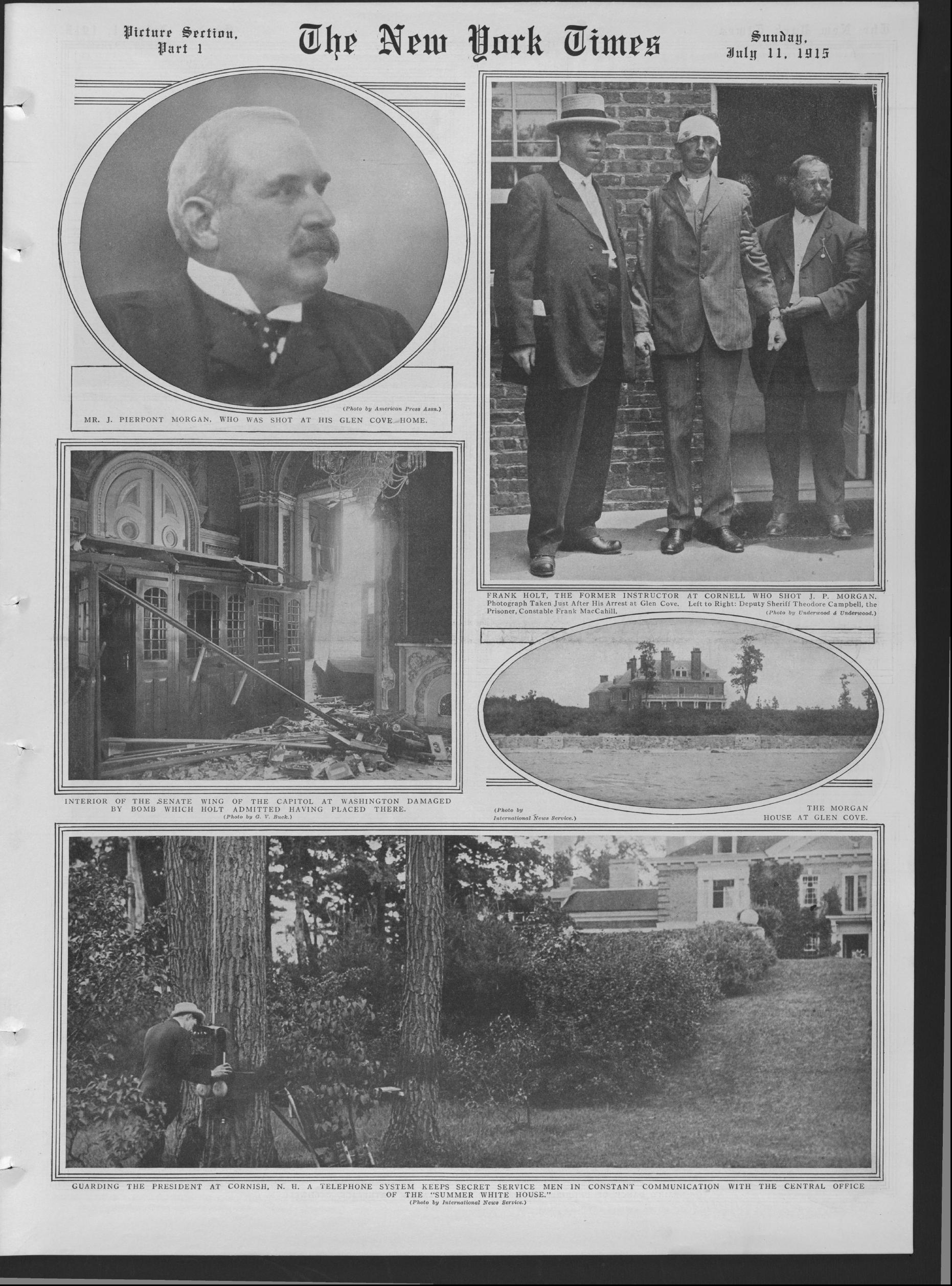
When I was searching for more information about Sing Sing, I found out that the Senate side of the U.S. Capitol was bombed back in 1915:

anything for peace

Frank Holt, aka Eric Muenter, never made it to Sing Sing. He comited suicide in police custody.
I got the image of the prison at Wikimedia and the image of the Dean Richmond at the Library of Congress. It seems several boats have been named Dean Richmond, but this picture might be the one in the story because of the date and the body of water is supposed to be the Hudson River.
Posted in 150 Years Ago This Month, Postbellum Society | Tagged , , , | Leave a comment

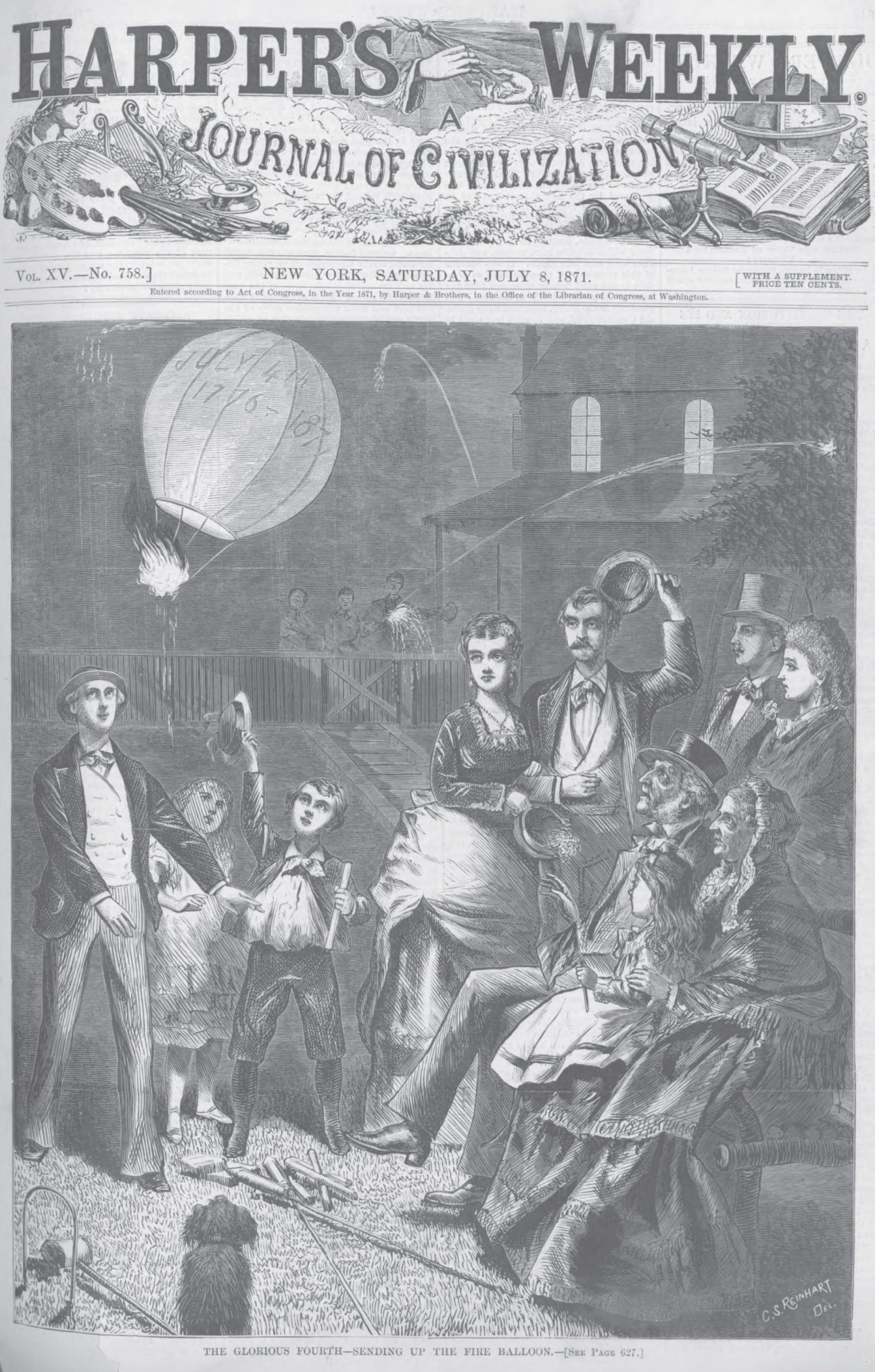
another glorious day

From the July 8, 1871 issue of Harper’s Weekly:

ninety-five years and counting

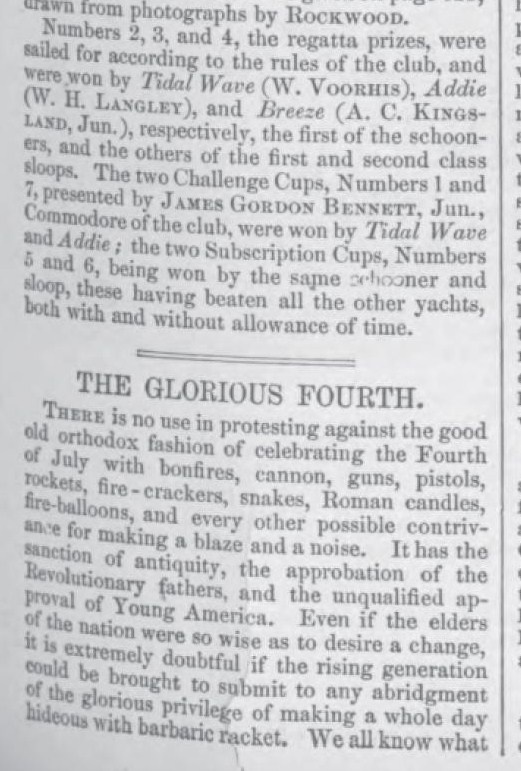
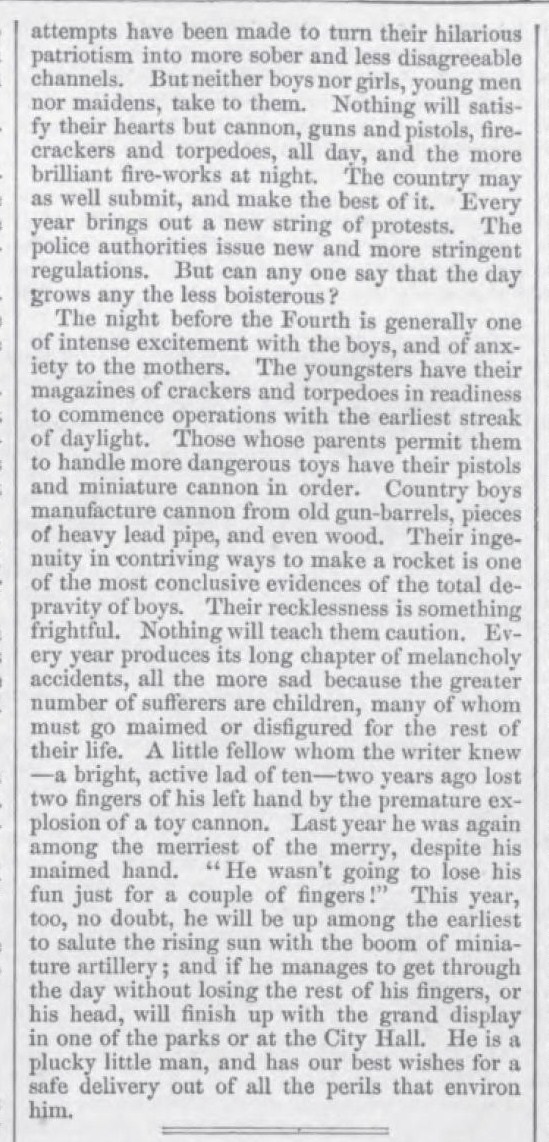
An editorial commented on the picture – the Fourth of a July was customarily a noisy, boisterous, and often dangerous holiday:

____________________________

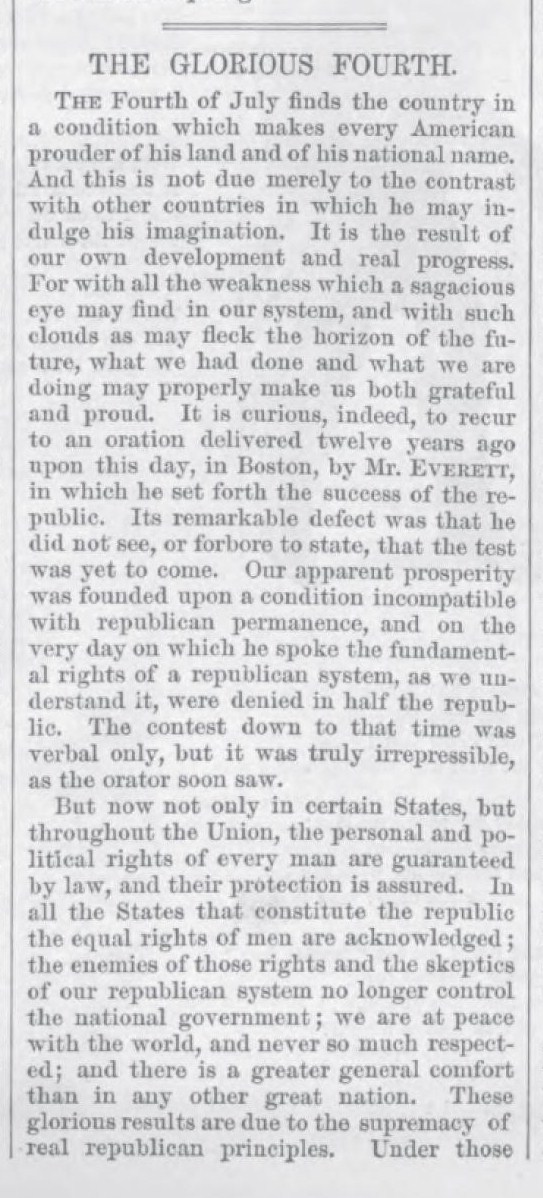
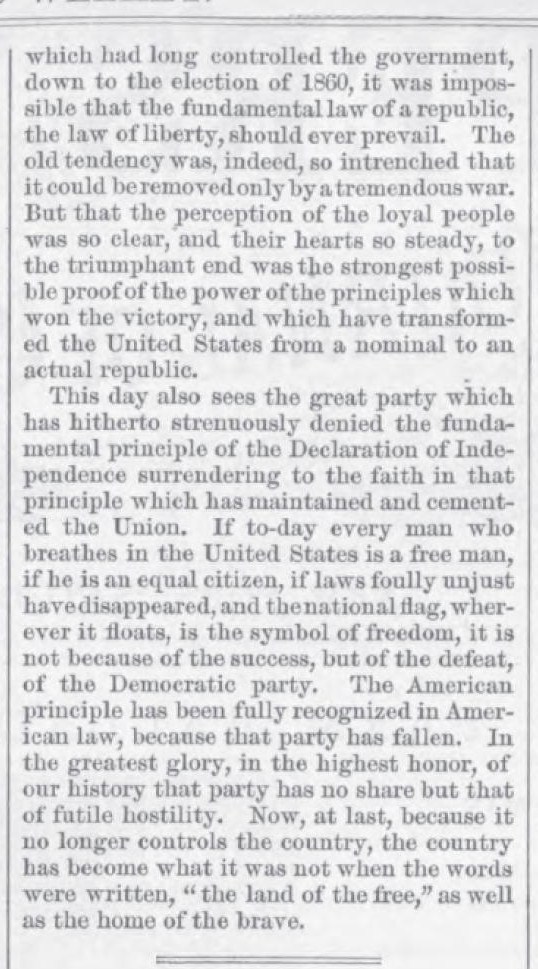
A week later the editors still found the Fourth glorious because the war and the overall defeat of the Democratic party had changed the nation “from a nominal to an actual republic” and the national flag had become “a symbol of freedom”:

_________________________________

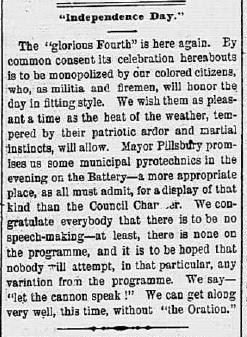
In Charleston, South Carolina the day wasn’t quite as glorious, at least not for the editors of the Daily News:

According to Wikipedia, Gilbert Pillsbury was a Yankee abolitionist who headed south during the war as an agent of the Freedmen’s Bureau. He served as mayor of Charleston from 1869-1871. He was defeated for reelection by German immigrant Johann Andreas Wagener, who served in the Confederate army during the Civil War. Mr. Pillsbury lived in Massachusetts from 1872 to his death in 1893.

The Declaration of Independence mentions Life, Liberty and the pursuit of Happiness. I think freedom is a part of liberty. You can listen to a “Hymn to Freedom” from 1964 at Youtube. You can hear a different version of the same Hymn (with words) at Barbershop Harmony Society’s 2019 International Convention. It was said that Oscar Peterson wrote the original instrumental in the 1960s.

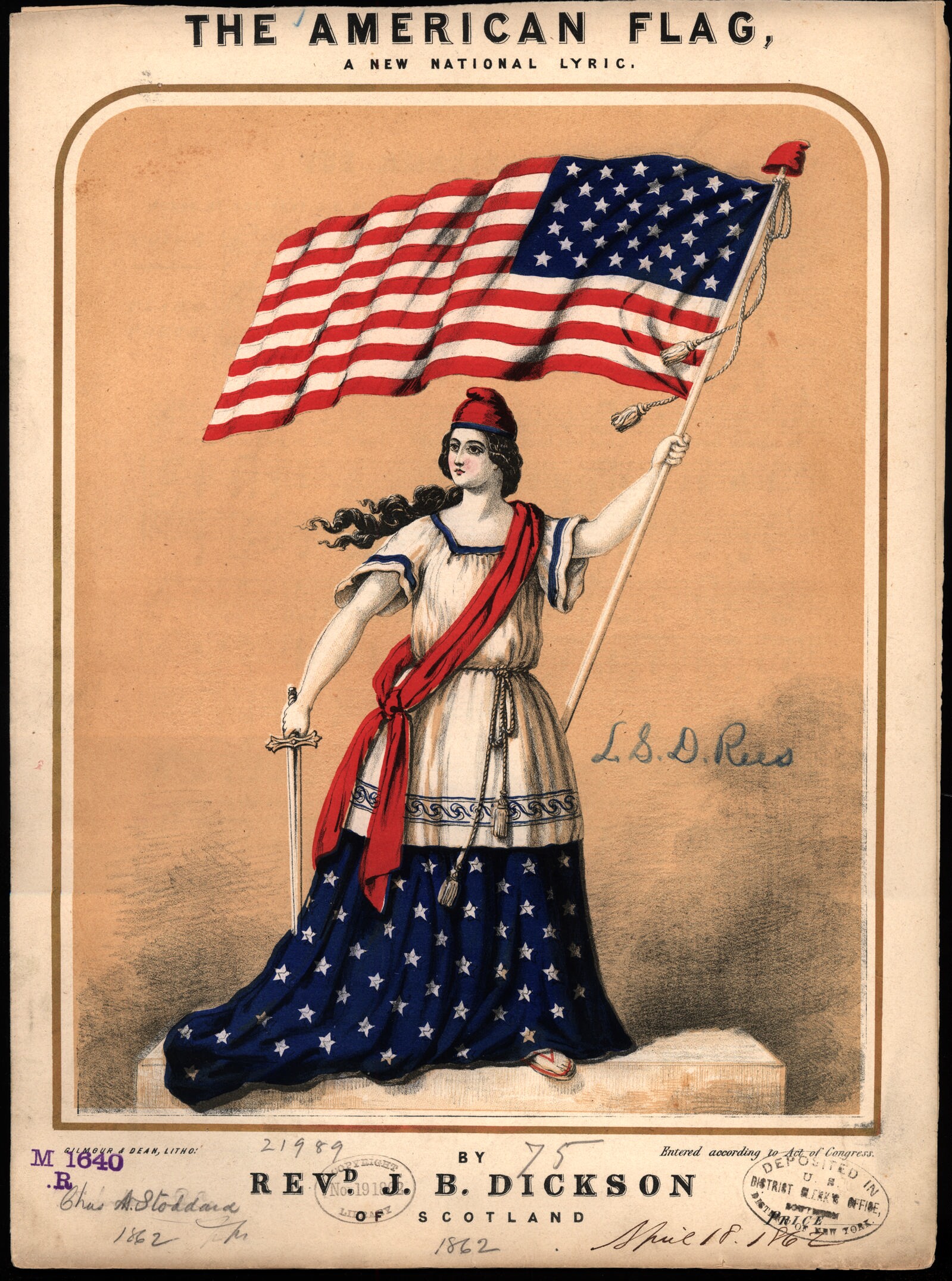
You can find all of Harper’s Weekly for 1871 at HathiTrust. From the Library of Congress: the July 4, 1871 issue of The Charleston Daily News; the 34-star national flag from 1862.

Old Glory

Posted in 150 Years Ago This Week, Aftermath, Postbellum Politics, Postbellum Society, Reconstruction, Southern Society | Tagged , , , | Leave a comment

redecoration

From the June 10, 1871 issue of Harper’s Weekly:

From the The New York Herald May 31, 1871:

THE NATION’S DEAD. …

The muffled drum’s sad roll has beat
The Soldier’s last tattoo,
No more on life’e parade shall meet
The brave and gallant few;
On Fame’s eternal camping ground
Their silent tents are spread,
And glory guards with solemn round
The bivouac of the dead.

The above exquisite lines were written by a priest of the Catholic Church, who was also an enthusiastic admirer of the lost cause, but they apply as well to the great army of American soldiers who knew no North, no South, now vanquished by death, whose graves fill the fields of the dark and bloody ground south of the Potomac. The dead had their prejudices buried with them; the passions that desolated the plains on which they fought are dead as they; the corn waves in the fields as rich and golden as ever, and over the resting place of Union and Confederate the same green grass grows luxuriantly. It is not, then, with any feeling of bitterness, hatred or revenge that the friends and relatives of those who fell in the desperate struggle for the maintenance of the integrity of the American republic annually assemble to deck the graves of the fallen brave with garlands of flowers and branches of laurel. Had we cemeteries of Southern dead within reach the same feeling of compassion and tenderness and wealth of affection would be evinced by us in whitest immortelles and greenest laurel lovingly strewn upon the green mounds under which their bodies were interred.

A glorious day shone out of the morning; the sky was clear; the wind blew in gentlest zephyrs yesterday. The streets of New York and Brooklyn were alive with people, and the citizens generally seemed conscious or the importance of the occasion which has added one more to the too few public days. It was a day of thankfulness – a day of poetic feeling – a day of sweet and tender recollection. …

At Woodlawn cemetery Admiral Farragut’s grave was honored. It close to violence in Boston when White and black soldiers returning from Mount Auburn had a disagreement about who could ride on the horse cars engaged by white troops. It was alleged that white troops made matters worse by insulting the blacks.

busy day in the Northeast corridor

And, with President Grant and Cabinet members in attendance, Frederick Douglass spoke at the Tomb of the Unknown at Arlington National Cemetery. This is his speech according to What So Proudly We Hail:

Friends and Fellow Citizens:

Tarry here for a moment. My words shall be few and simple. The solemn rites of this hour and place call for no lengthened speech. There is, in the very air of this resting-ground of the unknown dead a silent, subtle, and an all-pervading eloquence, far more touching, impressive, and thrilling than living lips have ever uttered. Into the measureless depths of every loyal soul it is now whispering lessons of all that is precious, priceless, holiest, and most enduring in human existence.

Dark and sad will be the hour to this nation when it forgets to pay grateful homage to its greatest benefactors. The offering we bring to-day is due alike to the patriot soldiers dead and their noble comrades who still live; for, whether living or dead, whether in time or eternity, the loyal soldiers who imperiled all for country and freedom are one and inseparable.

Those unknown heroes whose whitened bones have been piously gathered here, and whose green graves we now strew with sweet and beautiful flowers, choice emblems alike of pure hearts and brave spirits, reached, in their glorious career that last highest point of nobleness beyond which human power cannot go. They died for their country.

No loftier tribute can be paid to the most illustrious of all the benefactors of mankind than we pay to these unrecognized soldiers when we write above their graves this shining epitaph.

When the dark and vengeful spirit of slavery, always ambitious, preferring to rule in hell than to serve in heaven, fired the Southern heart and stirred all the malign elements of discord, when our great Republic, the hope of freedom and self-government throughout the world, had reached the point of supreme peril, when the Union of these states was torn and rent asunder at the center, and the armies of a gigantic rebellion came forth with broad blades and bloody hands to destroy the very foundations of American society, the unknown braves who flung themselves into the yawning chasm, where cannon roared and bullets whistled, fought and fell. They died for their country.

We are sometimes asked, in the name of patriotism, to forget the merits of this fearful struggle, and to remember with equal admiration those who struck at the nation’s life and those who struck to save it, those who fought for slavery and those who fought for liberty and justice.

I am no minister of malice. I would not strike the fallen. I would not repel the repentant; but may my “right hand forget her cunning and my tongue cleave to the roof of my mouth,” if I forget the difference between the parties to that terrible, protracted, and bloody conflict.

If we ought to forget a war which has filled our land with widows and orphans; which has made stumps of men of the very flower of our youth; which has sent them on the journey of life armless, legless, maimed, and mutilated; which has piled up a debt heavier than a mountain of gold, swept uncounted thousands of men into bloody graves and planted agony at a million hearthstones—I say, if this war is to be forgotten, I ask, in the name of all things sacred, what shall men remember?

The essence and significance of our devotions here to-day are not to be found in the fact that the men whose remains fill these graves were brave in battle. If we met simply to show our sense of bravery, we should find enough to kindle admiration on both sides. In the raging storm of fire and blood, in the fierce torrent of shot and shell, of sword and bayonet, whether on foot or on horse, unflinching courage marked the rebel not less than the loyal soldier.

But we are not here to applaud manly courage, save as it has been displayed in a noble cause. We must never forget that victory to the rebellion meant death to the republic. We must never forget that the loyal soldiers who rest beneath this sod flung themselves between the nation and the nation’s destroyers. If to-day we have a country not boiling in an agony of blood, like France, if now we have a united country, no longer cursed by the hell-black system of human bondage, if the American name is no longer a by-word and a hissing to a mocking earth, if the star-spangled banner floats only over free American citizens in every quarter of the land, and our country has before it a long and glorious career of justice, liberty, and civilization, we are indebted to the unselfish devotion of the noble army who rest in these honored graves all around us.

I made changes on May 31, 2021.
From the Library of Congress: the May 31, 1871 issue of The New York Herald (image 3); at Arlington
You can find all of Harper’s Weekly for 1871 at HathiTrust. It looks like Thomas Nast signed the picture here from page 524.
Yale University Library provides a typescript version of the Frederick Douglass speech.
Posted in 150 Years Ago This Week, Postbellum Society, Reconstruction, Veterans | Tagged , , , | Leave a comment

sound retreat

four of a kind

From the March 18, 1871 issue of Harper’s Weekly:

on page 236

THE SOLDIERS’ HOME.

ON one of the most beautiful sites in the neighborhood of Washington stands an edifice of singular attractiveness, known as “The Soldiers’ Home,” of which we give a sketch on page 236. For this excellent institution the country is largely indebted to the foresight of General WINFIELD SCOTT, who urged its foundation upon the government. The Home, our readers will remember, was the chosen summer residence of President LINCOLN, whose patriotic sense of duty would not permit him to seek, at more distant places of resort, relaxation from the arduous labors and responsibilities of his position during the continuance of the war.

According to the National Park Service “General Winfield Scott designated part of the money Mexico City paid to avoid invasion during the Mexican War” for a military asylum. From 1851-1857 veteran soldiers resided in the original home on the estate. The old soldiers moved into a new, larger building in 1857. That freed up the original “cottage” for presidential use. Abraham Lincoln and his family lived at the old home from July-November in 1862-1864. The residence was sort of an anti-retreat for four days in July 1864 when Jubal Early’s Confederate army threatened the United States capital. While most of the presidential household returned to the White House, Mr. Lincoln stayed in the soldiers home and even came under hostile fire while observing the Battle of Fort Stevens, about a mile from the summer residence. In addition to Lincoln, Presidents Buchanan, Hayes, and Arthur made the home a temporary escape.

Fort Stevens 1864

the way from soldiers home to Fort Stevens

Lincoln memorialized

According to General Marcus J. Wright (at Project Gutenberg), Winfield Scott sent the War Department $100,000 from Mexico for the veterans’ home:

As an army commander General Scott had frequent occasion to use money for which vouchers or even ordinary receipts could not be taken and the nature of the service could not be specified; he styled them “secret disbursements.” In a letter to the War Department of February 6, 1848, he stated that he “had made no report of such disbursements since leaving Jalapa, (1) because of the uncertainty of our communications with Vera Cruz, and (2) the necessity of certain explanations which, on account of others, ought not to be reduced to writing,” and added, “I have never tempted the honor or patriotism of any man, but have held it as lawful in morals as in war to purchase valuable information or services voluntarily tendered me.”
He charged himself with the money he received in Washington for “secret disbursements,” the one hundred and fifty thousand dollars levied upon the City of Mexico for the immediate benefit of the army, and of the captured tobacco taken from the Mexican Government, with other small sums, all of which were accounted for. He then charged himself with sixty-three thousand seven hundred and forty-five dollars and fifty-seven cents expended in the purchase of blankets and shoes distributed gratuitously to enlisted men, for ten thousand dollars extra supplies for the hospitals, ten dollars each to every crippled man discharged or furloughed, some sixty thousand dollars for secret services, including the native spy company of Dominguez, whose pay commenced in July, and which he did not wish to bring into account with the Treasury. There remained a balance of one hundred thousand dollars, a draft for which he inclosed, saying: “I hope you will allow the draft to go to the credit of the army asylum, and make the subject known in the way you may deem best to the military committees of Congress. The sum is, in small part, the price of American blood so gallantly shed in this vicinity; and considering that the army receives no prize money, I repeat the hope that its proposed destination may be approved and carried into effect…. The remainder of the money in my hands, as well as that expended, I shall be ready to account for at the proper time and in the proper manner, merely offering this imperfect report to explain, in the meantime, the character of the one hundred thousand dollars draft.”

forwarded blood money to DC

Mexicans helped pay for it

Scott-gated community

Some sources say Abraham Lincoln’s wife accompanied him to the Battle of Fort Stevens, although I don’t think Mary exposed herself to rebel bullets.
You can find all of Harper’s Weekly for 1871 at HathiTrust. I’m pretty sure the building Harper’s pictured is was the newer structure; the older “cottage” was to the left.
From the Library of Congress: Presidents Buchanan, Lincoln, Hayes, and Arthur; Fort Stevens in 1864; Robert Knox Sneden’s map of Jubal Early’s attack; plaque at the fort; Major General Scott; the Scott Building (1906) with cannon; August 1877 map
, there also are Harewood and Sherman gates; Washington, D.C. area soldiers’ home complex c1863; unveiling Lincoln tablet at Fort Stevens July 12, 1920.

cottage under flag

Fort Stevens July 12, 1920

Posted in 150 Years Ago, American Culture, American History, Veterans | Tagged , , , , , , , , , | Leave a comment

up in the air

first in flight

A duck, a sheep, and a rooster take off in a hot air balloon. … Already heard this one? … No? Well, actually, according to the Château de Versailles, this isn’t a joke. In 1782 the Montgolfier brothers, Joseph and Étienne, began experimenting with using the gas created by a fire to lift a fabric-encased object off the ground. In 1783 Étienne brought the experiments to metro Paris. After a couple tethered attempts, on September 19, 1783, at Verasaille in front of King Louis XVI, the three animals, riding in a basket attached to a balloon, successfully lifted 600 metres off the surface of the earth and traveled about two miles before a rip in the balloon fabric brought the vessel back down to earth. Then, “in front of the Dauphin at Château de La Muette on 21 November, Pilâtre de Rozier became the first man ever to be borne aloft. A new page had been written in the history of mankind.” [1]

Approximately four score and seven years later an American editorial was uncertain whether aerial machines would ever become effective weapons of war. From Harper’s Weekly Supplement January, 21, 1871 page 67:

THE USE OF BALLOONS IN WAR.

AN ingenious Frenchman, M. Bobæuf some time since discovered a method of discharging missiles by means of the gas in the balloon, which he compressed in a special apparatus; and thus, as the weight of the car was diminished by that of the bullet thrown, so also the lifting power of the balloon was lessened by the use of the amount of gas which discharged it.

Such a plan, however, might bring the aeronauts into an unpleasant position; they might fire away all their gas in the action, and find themselves slowly sinking into the hands of their irate enemies below, without any means of taking flight again. On the other hand, the vapor or gas of gunpowder has been used to inflate balloons, apparently not with any great success. What special advantage this gas has over the ordinary coal-gas does not appear.

“Perhaps the culmination of all modern civilization”

getting the word out … from Paris

Such are the only uses to which it has been proposed to apply balloons, as at present constructed, to purposes of war. Numerous other inventions have been proposed; but they are all founded on some plan for obtaining flight, either by guiding a balloon, or by means of an aerial ship, or flying-machine. Of course one of the most obvious uses to which an aerial ship could be put would be to sail quietly into the centre of a town or camp, and attack the unconscious inhabitants. Most of our greatest inventions are now principally useful according as they can be more or less easily adapted to the purposes of war. More thought and trouble have been spent on the Martini-Henry rifle than on the spinning-jenny. Perhaps the culmination of all modern civilization, the greatest achievement of modern science, is the mitrailleuse. Consequently, if ever any attempt to navigate the air can be successful, the first application of the scheme will probably be to purposes of destruction. We shall hear of balloon monitors before we hear of balloon mail, in any other sense than that in which those irregular supplies of letters from Paris are said to come par ballon monté. It is curious – as showing, among other circumstances, how little change there has been in this respect in men’s opinions — that the Jesuit, Francis Lana, who was one of the very earliest to hit upon the idea of any scheme, like that of our balloons, for rising in the air, when he described his machine (which was something like a boat, with several copper globes, from which the air had been exhausted, fastened round her gunwale, in order to raise her into the air) should have looked upon his craft as likely to be of use chiefly in war, and lamented the fact that it would make all castles and strong-holds useless. He, of course, did not know the modern dictum, which has received so much confirmation from recent events, that the easier it is to wage war, and the more destructive war is when waged, the less we of necessity have of it. But then, of course, he only lived in the dark ages, before nineteenth-century civilization and breech-loaders were invented.

Francesco Lana de Terzi’s idea upper left

Unfortunately all these schemes break down in the flying part. Nobody as yet has managed to fly – at least more than a few yards, which has been accomplished – or to construct any machine capable of being guided in the air. A man can, by the help of a balloon, rise into the air, like a cork in the water, and then drift about at the mercy of the winds, but that is all; and it seems more than probable that he will never do any thing better. To prove the impossibility of such a thing is, indeed, not easy, as it never is to prove any impossibility; but there are a few obstacles in the way which seem almost insuperable.

In order to guide any machine through the air it is necessary that it should have some motion independent of that given it by the wind– some steerage-way, at all events. It is obvious that a boat simply drifting before a current can not be steered; the rudder in such a case is simply useless, and is only available when the boat has a definite motion in some particular direction independent of that given it by the stream. Some motion, then, independent of the wind, the balloon must have. Again, to be of any avail beyond checking its forward movement, such power must be capable of driving the balloon faster than the wind, or else it can only be of use in perfectly calm weather. Considering the amount of force required to move a body along the ground, with the leverage afforded by the solid earth, at a pace equal to that even of a light breeze, the power required to move any object in the air, with no better leverage than that given by the air itself, may easily be imagined. Suppose that an aerial ship could be made which would go twenty miles an hour in a perfect calm, that would be considered a sufficient feat; but in a breeze which moved at the rate of twenty miles an hour it could only be stationary, or, at most, move in a direction with the wind, but not exactly before it–with the wind on her quarter, to use a nautical expression. It is to be remembered that a balloon must of necessity be carried along entirely by the wind, so that, as regards the balloon, the wind has absolutely no relative motion. Aeronauts never feel any breeze whatever in a balloon, since it and the wind travel along precisely at the same pace. Hence it can not sail, as a boat does, in a direction at an acute angle to that of the wind, any more than a boat can drift in any direction but that of the current. The motion of the boat is the result of two forces acting upon it; the balloon is subjected only to one. The first thing needful, then, is to impart motion to the vessel which is to sail “with sublime dominion through the azure fields of air.” Until this can be done it is hopeless to think of directing it.

This puts balloons out of the question. It will probably never be possible to make a balloon which can lift any engine capable of moving it. The surface of a balloon is enormous; and to drive such a large mass–which is incapable, from its nature, of receiving momentum–through the air, would require an engine of immense power, and, therefore, of considerable weight. The only way of increasing the lifting power of a balloon is by increasing its size, and consequently its surface, and consequently, again, the power of its engine. This is a hopeless dilemma. Then a silk balloon is not strong enough to resist any pressure from the air; and no other material of equal lightness and sufficient strength is likely to be discovered. Any frame-work which would serve to strengthen the balloon, and enable it to keep its shape, would also be heavy. Lastly, the guiding machinery must be attached to the balloon itself, not to the car–so that the ordinary shape could not be employed; and the machine would have to be fish or boat shaped–an almost impossible form for a gas balloon.

trying to “impart [non-wind] motion to the vessel”

If, then, we are ever to rival the birds, it must be by aid of some mechanical means–some flying-machine. Numbers of these have been invented, but it hardly necessary to say that none of them have as yet been successful. No one has yet really discovered the principles on which birds fly, or on which it will be necessary to proceed before men can do the same. Any of these machines would doubtless, if successful, be very useful for purposes of fighting, but some few have been intended by their inventors chiefly for that object.

Among the most remarkable of these is one for which a patent was taken out, in 1855, by the Earl of Aldborough. This invention, if it could be brought to work, would of itself be quite sufficient to revolutionize the whole art of warfare; and balloons would by this time have taken the place of men-of-war, with the additional advantage of being equally useful over land and sea, which no ship could possibly be. Then the present war might have seen fulfilled the prediction of the poet of “Locksley Hall,” who, in fancy,

“Heard the heavens fill with shouting, and there rain’d a ghastly dew
From the nations’ airy navies grappling in the central blue;
Far along the world-wide whisper of the south wind rushing warm,
With the standards of the people plunging through the thunder-storm.”

The specification of the patent in question describes a perfect armament of aerial vessels of warlike nature, which probably never existed even as models. Each of them is a sort of balloon, fitted with wings to be worked by hand and by a complicated arrangements of springs. Some are of the ordinary balloon shape, and have wings fastened to the car; others are in the shape of a boat. They are all to be raised by means of gas, and the wings are to be used only to impart horizontal motion and direction. How liable these machines are to all the objections mentioned above is obvious.

The armament of these vessels is complete. Guns and muskets are to be so placed as to utilize the recoil–how, is not said–while explosive shells are to be dropped from them. Some are even to be thinly armor-plated at top, that they may be safely protected from the attack of hostile vessels above. To each ship one or more “pilot-boats” are attached, for the purpose of guiding, landing passengers, etc., so that no convenience may be wanted.

lots of balloons – no armament

no armor

To ensure the safety of these marvelous ships a fortress is to be provided, guarded by a sort of chevaux de frise, arranged like the entrance to a mouse-trap, so as to allow vessels to go out, but impede the entry of any hostile ships. In order to admit friendly balloons the stakes of the chevaux de frise are moveable.

The invention is apparently the most complete in intention of any which would apply balloons to fighting uses. How utterly impracticable it is in all its execution is obvious. One or two others of like character have been patented, but one such is enough to mention–ex uno disce omnes. Still it is easy to laugh at the attempt after aerostation. The science may, after all, but be in its infancy; and some new source of motive power may yet be discovered which may lift us through the air. Till such discovery we must be content to go on destroying one another with the means we have–means, to judge of the present war, of very sufficient power.

Balloons weren’t used as weapons during the American Civil War, but they did have a military purpose. According to the American Battlefield Trust both the Confederacy and the Union experimented with using balloons for aerial reconnaissance, but The Union effort was more organized. Its Union Army Balloon Corps operated from 1861-1863 under the direction of Thaddeus S. C. Lowe. John LaMountain also reconnoitered in the air, mostly for General Benjamin F. Butler around Fort Monroe; he didn’t get along too well with Professor Lowe and was discharged in February 1862.

Prof. La Mountain, the Aeronaut, reconnoitering the rebel positions near Ft. Monroe

Balloon Camp, Gaines’ Mill, June 1, 1862

Civil War aircraft carrier on the Potomac

You can read about Thaddeus Lowe’s June 16, 1861 test ascent from where the National Air and Space Museum now stands at the Smithsonian. With the balloon tethered at 500 feet Professor Lowe, along with “telegrapher Herbert Robinson and George Burns, supervisor of the telegraph company,” sent President Lincoln what is said to be the first telegraph from the air.
According to Wikipedia, in “Locksley Hall” (published in 1842) Alfred Tennyson predicted “the rise of both civil aviation and military aviation in the following words:
Saw the heavens fill with commerce, argosies of magic sails,
Pilots of the purple twilight, dropping down with costly bales;
Heard the heavens fill with shouting, and there rain’d a ghastly dew
From the nations’ airy navies grappling in the central blue;
Of course, by World War I flying machines were widely used as weapons. Airplanes were in the ascendancy, but the gas-filled zeppelins bombed Britain. The zeppelin’s creator, Ferdinand von Zeppelin was in the United States during the Civil War:
Ferdinand von Zeppelin served as an official observer with the Union Army during the American Civil War. During the Peninsular Campaign, he visited the balloon camp of Thaddeus S. C. Lowe shortly after Lowe’s services were terminated by the Army. Von Zeppelin then travelled to St. Paul, MN where the German-born former Army balloonist John Steiner offered tethered flights. His first ascent in a balloon, made at Saint Paul, Minnesota during this visit, is said to have been the inspiration of his later interest in aeronautics.
Zeppelin’s ideas for large airships were first expressed in a diary entry dated 25 March 1874. Inspired by a recent lecture given by Heinrich von Stephan on the subject of “World Postal Services and Air Travel”, he outlined the basic principle of his later craft: a large rigidly-framed outer envelope containing a number of separate gasbags.

von Zeppelin crouching, Fairfax Court House, June 1863

peaceful zeppelin

According to Wikipedia Jean-François Pilâtre de Rozier took the first manned untethered balloon flight on the outskirts of Paris along with François Laurent d’Arlandes. Benjamin Franklin backs up the online encyclopedia’s statement that there were two aeronauts on the November 21st flight. He was serving as United States to France in 1783. At Project Gutenberg you can read the 1907 Benjamin Franklin and the First Balloons edited by Abbott Lawrence Rotch. This publication contains a series of letters from Mr. Franklin to Sir Joseph Banks, President of the Royal Society of London describing the balloon experiments from a tethered hydrogen-filled balloon ascent on August 27th, then the hot-air journeys on September 19 and November 21, through the first manned hydrogen balloon trip on December 1st. Benjamin Franklin might have been off by a day, but he does mention he visited with one of the two first hot-air aeronauts on November 21st: “One of these courageous Philosophers, the Marquis d’Arlandes, did me the honour to call upon me in the Evening after the Experiment, with Mr. Montgolfier the very ingenious Inventor. I was happy to see him safe. He informed me that they lit gently without the least Shock, and the Balloon was very little damaged.” He mentioned the reconnaissance possibilities: “This Method of filling the Balloon with hot Air is cheap and expeditious, and it is supposed may be sufficient for certain purposes, such as elevating an Engineer to take a View of an Enemy’s Army, Works, &c. conveying Intelligence into, or out of a besieged Town, giving Signals to distant Places, or the like.” And also philosophised: “This Experience is by no means a trifling one. It may be attended with important Consequences that no one can foresee. We should not suffer Pride to prevent our progress in Science. Beings of a Rank and Nature far superior to ours have not disdained to amuse themselves with making and launching Balloons, otherwise we should never have enjoyed the Light of those glorious objects that rule our Day & Night, nor have had the Pleasure of riding round the Sun ourselves upon the Balloon we now inhabit.”

Rozier and d’Arlandes flying November 21, 1783

same flight, in color

Montgolfier brothers

While the first manned hot air balloon flight occurred on November 21, 1783, the first manned hydrogen balloon flight took place on December 1, 1783. The hydrogen balloon also took off from Paris, and Benjamin Franklin also described that feat in a letter to Joseph Banks. This balloon was built by the Robert brothers. The aeronauts were one of the brothers and Jacques Charles

lift-off December 1, 1783

it’s a (big) bird
what goes up

According to Wikipedia war helped inspire the first hot air balloons: “Of the two brothers, it was Joseph who was first interested in aeronautics; as early as 1775 he built parachutes, and once jumped from the family house. He first contemplated building machines when he observed laundry drying over a fire incidentally form pockets that billowed upwards. Joseph made his first definitive experiments in November 1782 while living in Avignon. He reported some years later that he was watching a fire one evening while contemplating one of the great military issues of the day—an assault on the fortress of Gibraltar, which had proved impregnable from both sea and land. Joseph mused on the possibility of an air assault using troops lifted by the same force that was lifting the embers from the fire. He believed that the smoke itself was the buoyant part and contained within it a special gas, which he called “Montgolfier Gas”, with a special property he called levity, which is why he preferred smoldering fuel.”
Balloons were used for military reconnaissance at least by the 1794 Battle of Fleurus: “The French use of the reconnaissance balloon l’Entreprenant was the first military use of an aircraft that influenced the result of a battle.”

French air advantage

The French used balloons during the September 1870 – January 1871 Siege of Paris as part of two-way communication with the outside world. Balloons got information out of Paris; carrier pigeons brought messages back in. From Balloons, Airships, and Flying Machines by Gertrude Bacon (1905) (at Project Gutenberg (pages 73-78)):
But the time when the balloon was most largely and most usefully used in time of war was during the Siege of Paris. In the month of September 1870, during the Franco-Prussian War, Paris was closely invested by the Prussian forces, and for eighteen long weeks lay besieged and cut off from all the rest of the world. No communication with the city was possible either by road, river, rail, or telegraph, nor could the inhabitants convey tidings of their plight save by one means alone. Only the passage of the air was open to them.
Quite at the beginning of the siege it occurred to the Parisians that they might use balloons to escape from the beleaguered town, and pass over the heads of the enemy to safety beyond; and inquiry was at once made to discover what aeronautical resources were at their command.
It was soon found that with only one or two exceptions the balloons actually in existence within the walls were unserviceable or unsuitable for the work on hand, being mostly old ones which had been laid aside as worthless. One lucky discovery was, however, made. Two professional aeronauts, of well-proved experience and skill, were in Paris at the time. These were MM. Godard and Yon, both of whom had been in London only a short time before in connection with a huge captive balloon which was then being exhibited there. They at once received orders to establish two balloon factories, and begin making a large number of balloons as quickly as possible. For their workshops they were given the use of two great railway stations, then standing idle and deserted. No better places for the purpose could be imagined, for under the great glass roofs there was plenty of space, and the work went on apace.
As the balloons were intended to make only one journey each, plain white or coloured calico (of which there was plenty in the city), covered with quick-drying varnish, was considered good enough for their material. Hundreds of men and women were employed at the two factories; and altogether some sixty balloons were turned out during the siege. Their management was entrusted to sailors, who, of all men, seemed most fitted for the work. The only previous training that could be given them was to sling them up to the roof of the railway stations in a balloon car, and there make them go through the actions of throwing out ballast, dropping the anchor, and pulling the valve-line. This was, of course, very like learning to swim on dry land; nevertheless, these amateurs made, on the whole, very fair aeronauts.
But before the first of the new balloons was ready experiments were already being made with the few old balloons then in Paris. Two were moored captive at different ends of the town to act as observation stations from whence the enemy’s movements could be watched. Captive ascents were made in them every few hours. Meanwhile M. Duruof, a professional aeronaut, made his escape from the city in an old and unskyworthy balloon called “Le Neptune,” descending safely outside the enemy’s lines, while another equally successful voyage was made with two small balloons fastened together.
And then, as soon as the possibility of leaving Paris by this means was fully proved, an important new development arose. So far, as was shown, tidings of the besieged city could be conveyed to the outside world; but how was news from without to reach those imprisoned within? The problem was presently solved in a most ingenious way.
There was in Paris, when the siege commenced, a society or club of pigeon-fanciers who were specially interested in the breeding and training of “carrier” or “homing” pigeons. The leaders of this club now came forward and suggested to the authorities that, with the aid of the balloons, their birds might be turned to practical account as letter-carriers. The idea was at once taken up, and henceforward every balloon that sailed out of Paris contained not only letters and despatches, but also a number of properly trained pigeons, which, when liberated, would find their way back to their homes within the walls of the besieged city.
When the pigeons had been safely brought out of Paris, and fallen into friendly hands beyond the Prussian forces, there were attached to the tail feathers of each of them goose quills, about two inches long, fastened on by a silken thread or thin wire. Inside these were tiny scraps of photographic film, not much larger than postage stamps, upon which a large number of messages had been photographed by microscopic photography. So skilfully was this done that each scrap of film could contain 2500 messages of twenty words each. A bird might easily carry a dozen of these films, for the weight was always less than one gramme, or 15½ grains. One bird, in fact, arrived in Paris on the 3rd of February carrying eighteen films, containing altogether 40,000 messages. To avoid accidents, several copies of the same film were made, and attached to different birds. When any of the pigeons arrived in Paris their despatches were enlarged and thrown on a screen by a magic-lantern, then copied and sent to those for whom they were intended.
This system of balloon and pigeon post went on during the whole siege. Between sixty and seventy balloons left the city, carrying altogether nearly 200 people, and two and a half million letters, weighing in all about ten tons. The greater number of these arrived in safety, while the return journeys, accomplished by the birds, were scarcely less successful. The weather was very unfavourable during most of the time, and cold and fogs prevented many pigeons from making their way back to Paris. Of 360 birds brought safely out of the city by balloon only about 60 returned, but these had carried between them some 100,000 messages.
Of the balloons themselves two, each with its luckless aeronaut, were blown out to sea and never heard of more. Two sailed into Germany and were captured by the enemy, three more came down too soon and fell into the hands of the besieging army near Paris, and one did not even get as far as the Prussian lines. Others experienced accidents and rough landings in which their passengers were more or less injured. Moreover, each balloon which sailed by day from the city became at once a mark for the enemy’s fire; so much so that before long it became necessary to make all the ascents by night, under cover of darkness.
They were brave men indeed who dared face the perils of a night voyage in an untried balloon, manned by an unskilled pilot, and exposed to the fire of the enemy, into whose hands they ran the greatest risk of falling. It is small wonder there was much excitement in Paris when it became known that the first of the new balloons made during the siege was to take away no less a personage than M. Gambetta, the great statesman, who was at the time, and for long after, the leading man in France. He made his escape by balloon on the 7th of October, accompanied by his secretary and an aeronaut, and managed to reach a safe haven, though not before they had been vigorously fired at by shot and shell, and M. Gambetta himself had actually been grazed on the hand by a bullet.

M. Gambetta escapes

pigeon post

continued

Animals have helped humans explore space; Wikipedia sees the three balloon animals as precursor: “Animals had been used in aeronautic exploration since 1783 when the Montgolfier brothers sent a sheep, a duck, and a rooster aloft in a hot air balloon to see if ground-dwelling animals can survive (the duck serving as the experimental control).”
The material from Harper’s Weekly 1870 comes from the Internet Archive (on page 701 M. Gambetta is identified as one of the passengers escaping over the Prussian lines); you can read the editorial and all of the other 1871 Harper’s Weekly content at Hathi Trust.
From Wikimedia Commons: ChrisO’s 2004 photograph of a Reffye mitrailleuse at Les Invalides, Paris – the photo is licensed under Creative Commons; balloon air mail postcard – the manned balloon mail helped Paris communicate with the outside world during the Prussian siege of September 1870-January 1871; November 21, 1873 flight in a colorful Montgolfier balloon – it’s from one of the collecting sets at the Library of Congress; Bargès photo of the statue of the Montgolfier brothers in Annonay by Henri Louis Cordier (1853–1925) is licensed under Creative Commons; the Bataille de Fleurus 1794
From the Library of Congress: showing first balloon flight on September 19, 1783 with a sheep, a duck and a rooster as passengers; aeronautics from 1818 – the Montgolfiers’ balloon next to Father Lana’s floating boat; flying machines with some form of propulsion between 1885 and 1904; collecting card, left and right, the one on the right includes a representation of the use of a reconnaissance balloon at the 1794 Battle of Fleurus; John LaMountain reconnoitering near Fort Monroe from Frank Leslie’s Illustrated Newspaper August 31,1861; balloon camp at Gaines’ Mill; Count von Zeppelin with Union officers Fairfax Court House June 1863 – a well-read group, apparently enjoying Sun Tzu’s The Art of War, ; a Capitol visit, said to be by the Graf Zeppelin (1928-37); hot air flight on November 21, 1783; the first manned hydrogen balloon lift-off December 1, 1783; a surprise in the sky December 1, 1783; the first manned hydrogen balloon landing on December 1, 1783; the mitrailleuse mounted on a French airplane from the July 15, 1917 issue of the New York Tribune;
The image of the aircraft-carrying barge comes from the Naval History and Heritage Command: “Balloon Reconnaissance after Launch from the USS GEORGE WASHINGTON PARKE CUSTIS, Civil War Naval Aircraft Carrier, a Balloon ascends over the Potomac River, making reconnaissance of blockade, November 1861, near Budd’s Ferry below Mount Vernon. Drawing in Lowe Collection at National Archives.” George Washington Parke Custis‘s father was George Washington’s step-son; his daughter married Robert E. Lee.

mitrailleuse on a flying machine

  1. [1]According to several sources, including Benjamin Franklin, it was a two-man crew that ascended on November 21st
Posted in 150 Years Ago, Technology | Tagged , , , , , , , , , , , , , , , , , , , | Leave a comment